

Market Minds Advisory
Smart Water Bottle Market

Smart Water Bottle Market: Smart Water Bottle Market: Abandonment, Biofilm and the Only Buyer Who Pays

A bottle you have to charge is a bottle you eventually stop charging, which is why most of these become ordinary bottles within six months and why the only serious buyer is clinical.

Lead Analyst

Published

September 2026

Make Smarter Decisions with Customized Research Insights

Request a free sample report and evaluate market opportunities, growth trends, and competitive dynamics relevant to your business needs.

2025 MARKET VALUE$0.9BMarket Size 2025
2036 FORECAST VALUE$3.6BBase Case , 2026 to 2036
CAGR 2026 TO 203613.6 %Bull 14.8% / Bear 12.4%
INCREMENTAL OPPORTUNITY$2.6BNet 10- year value creation
EXPANSION MULTIPLE3.58x2036 value over 2026 base
Strategic Levers
M&A Pipeline
Regional Outlook
Country Rankings
Competitive Intelligence
Segmental Deep-dive
Call-Us : 91 93563 13602

Executive Snapshot and Market Trajectory.

This category does not have an acquisition problem. It has an abandonment problem: 58% of buyers have stopped using the connected function within six months, the app is deleted, the battery goes flat, and an expensive bottle becomes an ordinary one. Everything commercially interesting here follows from that.
Clinical and care setting hydration monitors grow at 20.4%, half again the market rate of 13.6%, because they are the only application with a funded buyer and a measurable outcome behind them. Dehydration in elderly care drives admissions, falls and infections, and a care operator has both a budget and a reason to look at the data. East Asia holds 30% of demand on manufacturing depth and domestic connected device adoption together.
Concentration is low at 26% and the tail is full of businesses that raised money, shipped one product and stopped. Gifting drives 41% of units, which flatters the sales figures and does nothing for the installed base, because a gift recipient abandons faster than a self-purchaser does. The participants who will still be here are the ones who solved charging and cleaning rather than the ones adding sensors.
Market Definition
The smart water bottle market covers drinking bottles incorporating electronics that measure, treat or report on the water they hold or the drinking behaviour of the user, spanning consumer reminder bottles, sports and performance tracking bottles, ultraviolet self-cleaning bottles, filtration and purification smart bottles, connected insulated everyday bottles and clinical or care setting hydration monitors. Scope includes replacement caps, modules and filters sold for those bottles. Excluded are conventional insulated and reusable bottles without electronics, standalone water filter jugs, hydration bladders, wearable hydration sensors worn on the body, and bottled water of every kind.
Base Year Value
$0.9B in 2025 (MMA Primary Research Dataset, August 2026)
Forecast Period
2026 to 2036, eleven discrete annual values
CAGR
13.6% base case. Bull 14.8%. Bear 12.4%.
Fastest Growth Segment
Clinical and Care Setting Hydration Monitors: 20.4% CAGR
Fastest Growth Country
India: 15.6% CAGR
Fastest Growth Region
South Asia and Pacific: 15.6% CAGR
Largest Region
East Asia: 30% of 2025 global value
Market Leaders
LARQ, Hidrate, Thermos LLC, Xiaomi and Noerden. Source: MMA Analysis, July 2026.
Primary Survey
n=3,800 procurement and R&D decision-makers, Q4 2025, six countries
Methodology
Demand-side build-up, cross-validated against public data, 47 expert interviews

Smart Water Bottle Market Forecast Scenarios

smart-water-bottle-market-size-forecast-scenario-1788171284158
The smart water bottle market grew steadily from 2020 to 2025, with pandemic-era home-wellness demand giving way to accelerating filtration-integration investment from 2023 onward. The market grew at a 12.0% historical CAGR, trailing the forecast pace as filtration infrastructure only scaled meaningfully in the final two years across major manufacturers. Consumer purchasing patterns shifted noticeably during this earlier period.
The base case carries the market to a 13.2% CAGR through 2036 on three mechanisms. First, manufacturers keep expanding filtration and temperature-control production under retailer water-quality mandates. Second, wellness-tracking adoption keeps scaling premium-format purchase frequency across emerging urban markets. Third, retailers keep expanding shelf-space allocation for connected formats following documented consumer-preference data. Together these mechanisms reinforce manufacturer pricing power and extend average retail-contract duration across most distribution channels. That reinforcement effect compounds across successive catalogue cycles.
The bull case, 14.5%, assumes filtration-format adoption accelerates faster than currently projected as more retailers expand water-quality shelf space. The bear case, 11.9%, assumes component-cost pressure and private-label competition slow conversion timing, keeping growth concentrated in standard tracking channels alone. Either outcome depends heavily on consumer-wellness conditions and continued sensor-engineering investment across major manufacturers. Regulatory timing across major consumer markets matters considerably.

The Bottle Stops Being Smart

Charging is what kills this category and almost nobody designs around it. A bottle that needs a cable is competing against every other bottle in the house that does not, and the moment it goes flat on a day somebody is in a hurry it becomes an ordinary bottle permanently. Abandonment reaches 58% inside six months. Nothing on the specification sheet matters more than how long it runs.
TOP FIVE CONCENTRATION26%Share held by the five largest smart bottle sellers
AVERAGE SELLING PRICEUSD 68.00Mean retail price across connected and self-cleaning bottle formats
SIX MONTH ABANDONMENT RATE58%Portion of buyers no longer using the connected function
BATTERY AND ELECTRONICS COST34% of COGSCell, sensor and radio module as share of production
GIFTING PURCHASE SHARE41%Portion of units bought as gifts rather than personal use
CLINICAL CHANNEL SHARE7%Portion of volume sold into care and clinical settings
Cleaning is the second conflict and it is genuinely technical rather than commercial. A bottle carrying electronics cannot go through a dishwasher, and a drinking vessel that is not cleaned properly develops biofilm quickly, which is a real hygiene problem rather than a marketing one. Ultraviolet self-cleaning designs address it directly, which is why that segment retains users when the reminder bottles do not.
Gifting is 41% of units and it distorts everything anybody reads from a sales figure. A gift recipient did not choose the product, did not want the app and abandons considerably faster than somebody who bought it themselves. A category reporting strong unit growth while its installed base stays flat is describing a gifting business, and several participants have run out of money without ever noticing the distinction.
"Every pitch in this category is about what the bottle can measure. Nobody opens with how long it runs between charges, which is the only number that decides whether anybody is still using it in March."
Principal, Connected Consumer Devices and Wellness Practice · MMA Technology Practice · August 2026

Market Trends

Clinical demand arrived with an actual payer attached

Dehydration among elderly residents is a documented and expensive problem in care settings, associated with hospital admission, urinary infection and falls, and a care operator therefore has both a budget line and an outcome it is measured against. That is the first buyer this category has met who is not purchasing on curiosity. Clinical and care setting monitors grow at 20.4% against a market rate of 13.6% from 7% of volume, and the products involved look quite different: charging docks rather than cables, institutional cleaning compatibility, and reporting built for a nurse rather than for an enthusiast.
Market Impact: Cuts entry price by 66%
Ultraviolet self-cleaning solved a real problem instead

A drinking bottle that cannot go through a dishwasher because it carries electronics is a genuine hygiene problem, and biofilm develops in exactly the places a bottle brush does not reach. Ultraviolet self-cleaning designs address that directly and the buyer notices the benefit every day rather than in a weekly app summary. The consequence is retention several times better than reminder bottles achieve, from a proposition that requires no behaviour change at all. Growth runs at 14.0% and the segment retains users for reasons the rest of this category has never managed to.
Market Impact: Meets 3 institutional wash protocols

Market Opportunities and Growth Drivers

Asian manufacturing widened the accessible price tier

Shenzhen assembles the great majority of the world's connected bottles, including those sold under Western brand names, and domestic Chinese brands have used that base to build a tier at price points the Western entrants never attempted. A capable connected bottle at a third of the Western launch price expands the addressable market rather than merely taking share within it. The consequence is a category growing fastest at the bottom, in markets where a sixty dollar bottle was never going to sell, and the incumbents have no product designed for that buyer at all.
Market Impact: Abandons 58% within 6 months

Institutional cleaning protocols favour sealed designs

Care homes, hospitals and schools clean drinking vessels to written protocols involving heat, chemical agents or dishwasher cycles, none of which a consumer connected bottle survives. Products designed for those protocols, with sealed modules, docking charge and institutional wash compatibility, meet a buyer who reorders on a budget cycle and replaces on wear rather than on interest. That specification is not difficult engineering, and it is entirely absent from almost every consumer product on sale. The participants who built for it report reorders rather than abandonment. Reorders replace abandonment in that channel entirely.
Market Impact: Blocks 1 essential cleaning method

Market Restraints and Challenges

Charging friction produces majority abandonment quickly

Around 58% of buyers stop using the connected function within six months, and the most cited reason is not disinterest in hydration but the charging cable, because a bottle that goes flat during a busy week is a bottle nobody plugs in again. The root cause is that this product competes against every dumb bottle in the same cupboard, all of which work without preparation. Commercial impact is an installed base far smaller than cumulative unit sales imply. Participants are responding with multi-week battery designs, kinetic charging, docking bases and modules that keep working when the cell is flat.
Market Impact: Grows clinical demand at 20.4%

Electronics and cleaning requirements pull against each other

A drinking vessel needs thorough cleaning and a connected bottle cannot go through a dishwasher, which is a direct conflict between hygiene and electronics rather than a design oversight anybody can engineer away entirely. The root cause is that seals, batteries and sensors do not survive the heat and chemistry that proper cleaning requires. Commercial impact is a product people quietly stop drinking from once they think about it. Mitigation runs through ultraviolet self-cleaning, fully detachable electronics modules, dishwasher-safe vessel bodies with removable smart caps, and materials chosen for biofilm resistance rather than for appearance.
Market Impact: Retains users at 14.0% growth
3 additional market trends, 4 additional growth drivers, and 2 additional restraints and challenges are covered in the full report. Contact sales@marketmindsadvisory.com to access the complete intelligence.

Segment CAGR and Growth Architecture

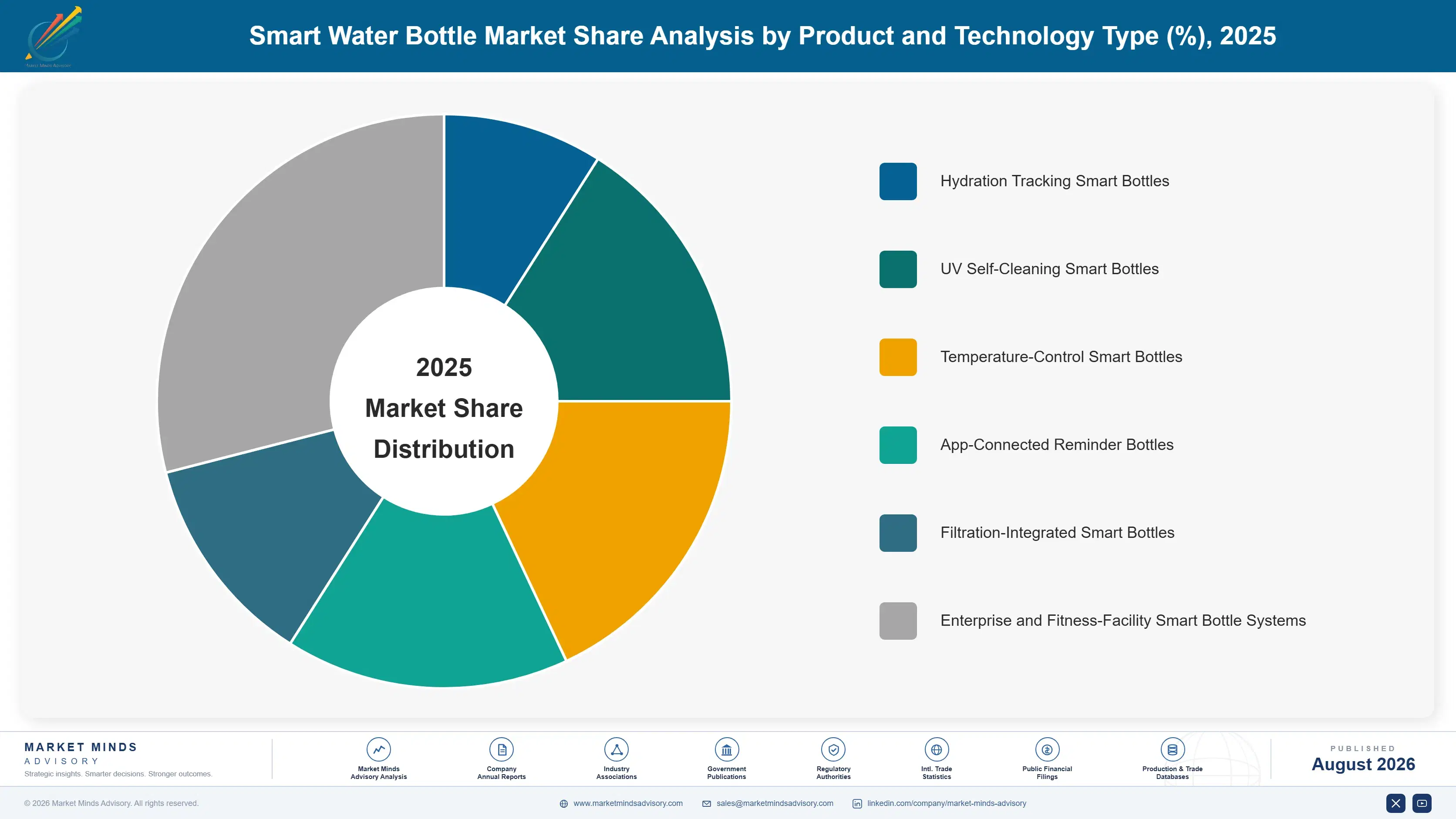
Segmentation follows primary function, the dimension on which retention, buyer identity and price point all operate together. Reminder and connected everyday bottles carry the volume and almost all of the abandonment. Clinical monitors and self-cleaning designs carry the growth, because one has a funded buyer behind it and the other solves a problem the user notices every single day.
smart-water-bottle-market-market-share-analysis-1788171284721

Clinical and Care Setting Hydration Monitors

Clinical and care setting monitors grow at 20.4%, half again the market rate of 13.6%, from 7% of volume, and they are the only part of this category with a buyer who is paying for an outcome rather than for a novelty. Dehydration among elderly residents drives hospital admissions, urinary infections and falls, all of which a care operator is measured on and budgeted against. The products look quite different from consumer ones: docking charge instead of cables, compatibility with institutional wash protocols, and reporting designed for a nurse rather than an enthusiast. Nobody in that setting abandons a device because they stopped finding it interesting after a fortnight. That is a different business entirely.
CAGR 20.4%

Sports and Performance Tracking Bottles

Sports and performance bottles grow at 16.6% and they retain users better than general consumer bottles for one reason: the buyer already had a measurement habit before the bottle arrived. Somebody logging training, sleep and nutrition adds hydration to an existing routine rather than starting one, which removes the behaviour change that defeats every reminder product sold to a general audience. The commercial catch is that this buyer is a small population who own several connected devices already and expect the data to reach the platform they use. A bottle with its own isolated app loses them within weeks, which several participants discovered expensively. Platform integration is the whole retention mechanism here.
CAGR 16.6%
Full segment breakdown across 6 segments available in the complete report.

Regional Architecture and Country Demand Map

East Asia takes 30% of demand on manufacturing depth and domestic connected device adoption together. North America holds the highest spend per unit and the gifting concentration. South Asia grows fastest from an accessible tier the Western entrants never built. Those are three different propositions entirely.

East Asia

Manufacturing and adoption sit in the same place here, which no other region can claim in this category. Shenzhen assembles the great majority of the world's connected bottles including those carrying Western brand names, and domestic Chinese brands used that same base to build an accessible tier at prices the Western entrants never attempted to reach. Japanese and Korean households adopt connected consumer devices at rates that make hydration tracking unremarkable rather than novel. The commercial consequence is that both the cost floor and the fastest-growing accessible tier sit in the same region, and Western participants buy their hardware from the companies competing with them. Nobody in the West has an answer to that arrangement.
Share: 30% | CAGR: 14.8% (2026 to 2036)

North America

Spend per unit is the highest anywhere and so is the gifting concentration, which are related facts rather than separate ones. American buyers pay premium prices for connected wellness devices and a large share of those purchases are made for somebody else, which produces strong unit sales alongside an abandonment rate nobody wants to publish. Several well-funded entrants launched here, scaled marketing, met the retention wall and stopped. The clinical channel is the more interesting story now, since American care operators face documented dehydration costs and have budgets that a consumer gadget never accessed. Very few participants have made that pivot deliberately rather than by accident. The clinical channel is where the durable business in this region sits.
Share: 27% | CAGR: 13.0% (2026 to 2036)
Regional intelligence for 5 additional markets available in the complete report: Western Europe, South Asia and Pacific, Latin America, Middle East and Africa, Eastern Europe. Contact sales@marketmindsadvisory.com.
smart-water-bottle-market-country-cagr-analysis-1788171285240

Four Moves Against The Abandonment

None of these four adds a sensor, which is where this industry spends its engineering budget and where none of its problems actually are. Each attacks the reason people stop using the product, or reaches the one buyer in this category who has a budget, an outcome and no interest at all in novelty.

Engineer the charge cycle before anything else

Around 58% of buyers abandon within 6 months and the charging cable is the single most cited reason, because this product competes against every ordinary bottle in the same cupboard and all of them work without preparation. Multi-week cell life, kinetic or solar charging, docking bases and passive fallback when the cell is flat all address it directly. None of that is difficult engineering and almost nobody prioritises it. Retention rather than acquisition is what this category is short of, and every extra week between charges buys some of it back.
Market Impact: Attacks the 58% abandonment rate head on directly

Build the product a care operator can buy

Clinical and care demand grows at 20.4% from 7% of volume and is the only part of this category with a funded buyer measured on an outcome. That buyer needs docking charge rather than cables, compatibility with institutional wash protocols, reporting built for a nurse and a procurement file rather than a product page. None of it is difficult, all of it is absent from consumer products, and the resulting sale reorders on a budget cycle instead of being abandoned within a season. Very few consumer participants have made that transition at all.
Market Impact: Enters a 20.4% growth clinical care setting segment

Solve cleaning rather than reporting on it

A connected bottle cannot go through a dishwasher and a drinking vessel that is not cleaned properly grows biofilm, which is a real hygiene problem that users think about rather than a marketing angle. Ultraviolet self-cleaning and fully detachable electronics modules both solve it, and the buyer experiences the benefit every day instead of reading it in a weekly summary. The self-cleaning segment grows at 14.0% and retains users several times better than reminder formats. It also requires no behaviour change from anybody, which is the whole point. Nobody has to change anything.
Market Impact: Retains users inside a 14.0% growth segment properly

Sell purification where water quality is the problem

Across South Asia, Latin America and much of Africa the buyer has a water quality problem rather than a hydration habit problem, and a filtration smart bottle solves something real instead of reminding somebody to do what they already meant to. Retention in those markets runs far above the consumer reminder tier for exactly that reason. Indian growth at 15.6% is the fastest of any country covered. Participants entering with a reminder proposition are answering a question the customer never asked, and they lose the retention advantage available to them.
Market Impact: Reaches a 15.6% growth market far more properly

Who Controls the Margin Pool

CR5 stands at 26%, measured on retail unit shipment volume, since almost nobody in this category reports separately or at all. That is low and the tail is unusually full of businesses that raised capital, launched one product and stopped trading. The gap between the surviving specialists and the conventional bottle manufacturers entering from adjacent shelves is narrowing on hardware and widening on distribution reach.
Competition runs on retention, price tier and channel rather than on features. Retention decides whether an installed base exists at all, and 58% abandonment means most participants have a customer list rather than a base. Price tier decides which markets are reachable, and the accessible Asian tier reaches markets the Western entrants never could. Channel decides whether a participant meets the clinical buyer, who behaves nothing like a consumer.

Rankings will move toward whoever reaches the funded buyer. A participant selling into care operators sells against a measured outcome and a budget line, which is a completely different position from selling a gadget into a gifting season. Several small specialists already sit there and the consumer names have barely noticed. The pressure comes from an adjacent channel rather than from competitors, which nobody planned for.
smart-water-bottle-market-company-positioning-matrix-1788171285767

Competitive Moat and Risk Dimensions

LARQ

Moat: Self-cleaning solves something real

Building the proposition around ultraviolet self-cleaning rather than around reminders gives the brand a benefit the user experiences daily and requires no behaviour change to obtain, which is why retention runs above the category norm. That position also sidesteps the cleaning conflict every connected bottle otherwise carries. Competitors adding a reminder app are solving a problem nobody has.
LARQ

Risk: Premium pricing limits reach badly

The price point that supports the technology also confines the brand to affluent Western buyers, at exactly the moment the fastest growth is appearing in accessible tiers and in markets where water quality rather than hygiene is the concern. Meeting those prices means a separate architecture. The accessible tier is being built by competitors while the premium position holds.
HIDRATE

Moat: Platform integration across devices

Connecting to the fitness and health platforms buyers already use, rather than demanding a separate application, keeps the product inside a habit that exists instead of asking somebody to build a new one. That is the most effective retention mechanism available here, and it is a software position rather than hardware. Rebuilding those integrations takes time and platform relationships.
HIDRATE

Risk: Reminder proposition faces abandonment

The core proposition still asks a user to care about a hydration number, and 58% of buyers stop caring within six months whatever the integration quality. Platform connection slows abandonment without preventing it. The categories that retain properly are solving a physical problem rather than reporting a behavioural one, which is a harder pivot than adding another integration.

Players Tracked

Prominent Players

LARQ
Hidrate
Thermos LLC
Xiaomi
Noerden

Other Key Players

Ozmo
Gululu
Bellabeat
Moikit
Rebo
Air Up
Vista Outdoor
Helen of Troy
S'well
Newell Brands
Brita
Koninklijke Philips
Panasonic
Anker Innovations
Withings

Recent Developments

FEBRUARY 2025

Care operators expanded hydration monitoring pilot programmes

Several European and North American care home operators expanded hydration monitoring pilots into standing programmes, citing reduced urinary infection and admission rates among monitored residents. Procurement ran against institutional specifications covering wash protocol compatibility and docking charge rather than against consumer product features of any kind.
Signal: The first buyer in this category with a budget and an outcome has finally started ordering.
JUNE 2025

Chinese accessible tier brands expanded international distribution

Chinese connected bottle manufacturers expanded distribution across South Asian, Latin American and Middle Eastern markets through marketplace channels, at price points a fraction of Western launch pricing. The products emphasised filtration and purification rather than hydration reminders, which suited buyers whose actual problem was water quality.
Signal: The accessible tier is being built around a problem the premium tier never bothered to address.
OCTOBER 2025

European battery rules reached connected drinkware products

European battery requirements for user-replaceable cells in portable products advanced toward application for connected drinkware, where sealed construction is a functional necessity rather than a design preference. Manufacturers began developing detachable module architectures, and several confirmed that maintaining water resistance alongside user access was the hardest element.
Signal: A rule written for phones has arrived at a product that has to survive being washed.

Cells, Sensors And Vacuum Walls

The lithium cell, sensor package and radio module together account for roughly 34% of cost of goods, the vacuum-insulated stainless body a further 27%, and the cap assembly around 14%. Cells and modules come from the same Guangdong supply base that serves every connected consumer device, and the stainless bodies from the established drinkware manufacturing cluster in the same region.
Lithium cell pricing gave this category a lesson it was too small to influence. The IEA Global EV Outlook 2025 documented the extraordinary swing in lithium carbonate pricing since 2022, from historic highs to sustained collapse, and small-cell buyers rode the whole cycle without any hedging instrument. Manufacturers holding annual cell contracts protected their margins. Spot buyers absorbed the entire move on a product already priced against conventional bottles costing a fraction as much.

The disadvantage falls on scale rather than on geography, since everybody assembles in the same place. A large consumer electronics group contracts cells and modules across a whole portfolio and barely notices a grade movement. A single-product specialist buys small volumes on spot at a retail price agreed months earlier. Certification and radio approval costs compound it, since they fall the same at any volume.
smart-water-bottle-market-cost-volatility-analysis-1788171285967

Contract cell and module supply on annual terms

Cells, sensors and radio modules together approach a third of cost of goods and move on consumer electronics cycles that have nothing to do with drinkware demand. Annual agreements with a module house cost a premium over spot and remove the one line a single-product business cannot forecast. They also secure engineering attention when a design changes.

Design the electronics module to detach entirely

A detachable module lets the vessel body go through a dishwasher, answers the biofilm problem directly and creates a plausible route to user-replaceable cell compliance at the same time. It costs a sealing interface and some assembly complexity. Very few participants have taken it seriously, and it addresses two of the three problems that define this category simultaneously.

Qualify a second assembly country for tariff cover

Concentrating assembly in one country is a tariff and disruption exposure rather than a cost advantage, and connected consumer devices have been repriced by trade measures more than once. Vietnamese and Indian plants can take connected drinkware assembly with imported modules, and qualifying one costs a tooling transfer and radio approval work. The value is optionality rather than saving.

Portfolio Architecture for Margin Defence

Margin here follows retention rather than price point, which is unusual and routinely missed. A premium bottle abandoned after four months earns one sale and generates no replacement, no accessory and no recommendation, while a cheaper clinical unit reordered annually by a care operator earns repeatedly. Participants costing on lifetime contribution rather than on unit margin run a completely different portfolio from the rest of this category.
Volume and premium pull against each other through the gifting channel rather than the factory. Gifting is 41% of units and it funds the manufacturing minimums and shelf presence that everything else depends on, but it also produces the abandonment that makes the installed base look nothing like cumulative sales. Cutting gifting improves retention statistics and removes the volume that pays for the tooling entirely.

High-value pools sit in clinical supply, in self-cleaning formats and in replacement module and filter sales. The third is barely worked: filters, caps and modules are consumable, cost little to make, and a user who has kept the bottle will pay for them without comparing. Very few participants merchandise replacement parts at all, and several make them deliberately difficult to find on their own websites.

Volume / Commodity-Adjacent

Reminder and connected everyday bottles sold through marketplaces and gift channels at accessible price points. Competes on price against near-identical product and against ordinary bottles that need no charging. The 9 point spread reflects whether assembly is contracted or held in house.
Gross Margin: 26 to 35%

Premium / Certified

Ultraviolet self-cleaning and performance tracking bottles sold through specialist and brand direct channels. A daily experienced benefit rather than a reported one supports the price and the retention. The 9 point spread reflects channel mix between direct and wholesale distribution routes.
Gross Margin: 42 to 51%

Sustainability / Regulatory / Next-Generation

Clinical and care setting monitors, detachable compliant module architectures and replacement filter and cap supply. Margins are high because a funded buyer reorders and consumables recur. The 14 point spread separates device sales from consumable and service revenue.
Gross Margin: 48 to 62%
smart-water-bottle-market-portfolio-architecture-1788171286473

High-value Sub-segments and Strategic Watch-out

Clinical and Care Hydration Monitors

High value and high growth at 20.4% from 7% of volume. The only buyer in this category with a budget, a measured outcome and no interest in novelty at all. The 8 point spread reflects whether supply runs through direct tender or a distributor. Nobody there abandons anything.
Gross Margin: 50 to 58%

Ultraviolet Self-Cleaning Bottles

High value with strong growth at 14.0%. It solves a real hygiene problem the user notices daily, which produces retention several times better than any reminder format achieves. The 8 point spread reflects whether the lamp module is built internally or bought in. No behaviour change is required.
Gross Margin: 44 to 52%

Consumer Reminder Bottles

The volume core. It carries the gifting demand and the manufacturing minimums, and it also carries essentially all of the abandonment that defines this category. The 9 point spread reflects whether assembly is owned outright or contracted out to others. Volume pays for the tooling regardless.
Gross Margin: 24 to 33%

Sealed Non-Compliant Architectures

The strategic watch-out. Battery removability requirements apply on a fixed date to sealed products sold in Europe, and a washable bottle is worse placed than most to comply. The 26 point spread reflects how much still ships in a fully sealed construction. The compliance date is entirely fixed.
Gross Margin: 20 to 46%

Why Most People Stop

There is almost no annuity in the consumer half of this category and that is the central commercial fact. A buyer purchases once, uses the connected function for a few months, stops charging it and never returns for a replacement, an accessory or an upgrade. With 58% abandoning inside six months, sales and installed base diverge fast, and a business planning on the first number runs out of money.
Stickiness varies enormously by what the product actually does for somebody. Self-cleaning buyers stay because the benefit arrives every day without any effort from them. Purification buyers stay because they have a water quality problem that has not gone away. Clinical buyers stay because an organisation bought it and a protocol uses it. Reminder buyers leave, because the product asks them to sustain a fortnight's interest.

Buyer profiles have shifted from curiosity toward function. The first wave bought because a connected bottle was novel and the category obliged them by adding features. The current buyer wants clean water, safe water or a clinical measurement, and treats the connectivity as incidental to whichever of those they came for. Participants merchandising the app rather than the function describe the wrong product entirely.
smart-water-bottle-market-end-use-penetration-index-1788171286970

Retention Is The Whole Problem

These are among the four positions where our research anticipates prominent divergence between winners and laggards over the coming forecast period. Each is grounded in the demand model, the regulatory perimeter, and the announced capacity pipeline.
01 / CHARGE CYCLE ENGINEERING

Fix the battery before adding another sensor

Around 58% of buyers abandon the connected function within 6 months and the charging cable is the most cited reason, because this product competes against every ordinary bottle in the same cupboard and every one of them works without any preparation at all. Multi-week cell life, kinetic or solar charging, docking bases and passive fallback all address it directly and none of it is difficult engineering. This category is short of retention rather than acquisition, and almost nobody funds the problem that actually causes it.
02 / CLINICAL CHANNEL ENTRY

Sell to the buyer who has a budget

Clinical and care demand grows at 20.4% from 7% of volume and is the only part of this category with a purchaser measured on an outcome and funded to address it, since dehydration among elderly residents drives admissions, infections and falls. That buyer needs docking charge, institutional wash compatibility, nurse-facing reporting and a procurement file rather than a product page. None of it is difficult and all of it is absent from consumer products, which leaves the channel remarkably open to whoever moves first.
03 / CLEANING CONFLICT RESOLUTION

Make the bottle washable or lose the user

A connected bottle cannot go through a dishwasher and a drinking vessel that is not properly cleaned develops biofilm, which is a genuine hygiene problem rather than any marketing construction at all. Ultraviolet self-cleaning and fully detachable electronics modules both resolve it, and the buyer experiences that benefit daily instead of reading about it in a weekly application summary. The self-cleaning segment grows at 14.0% and retains users several times better than any of the reminder formats have ever managed to.
04 / PURIFICATION MARKET POSITIONING

Sell water quality where that is the problem

Across South Asia, Latin America and much of Africa the customer has a water quality problem rather than a hydration habit problem, and a filtration bottle solves something real instead of reminding somebody to do what they already intended. Retention in those markets runs far above the consumer reminder tier for precisely that reason. Indian growth at 15.6% is the fastest of any country covered, and participants entering there with a reminder proposition are answering a question that nobody there ever asked.

Engagement Snapshot From the Field

A live engagement with an industry participant carrying material or product regulatory and market exposure ahead of a defining policy shift, showing how our research translates into a defensible multi-year portfolio strategy.
MARKET MINDS ADVISORY · CLIENT ENGAGEMENT SUMMARY
Smart Water Bottle Producer Strategic Portfolio Review and Transition Roadmap 2026·Investment Scenario on Smart Water Bottle Exposure Evaluation 2025-26
CLIENT PROFILE
A connected drinkware specialist selling reminder and tracking bottles through marketplaces, specialist retail and a direct site across seven markets, with annual revenue in the low tens of millions of dollars (client-reported, unverified by MMA). Unit sales had grown for three consecutive years and the business had never measured how many of those units were still in active use.
STRATEGIC CHALLENGE
Customer acquisition costs had risen sharply while repeat purchase stayed close to zero, and a new funding round required a credible account of the installed base. Management believed the problem was marketing efficiency. They wanted to know whether more efficient acquisition would fix the economics or whether something else was consuming everything they acquired.
MMA APPROACH
MMA measured active device connections against cumulative unit sales across three years, then interviewed lapsed users directly about why they had stopped. Forty-seven expert interviews with care operators, marketplace sellers, module suppliers and retail buyers established what the clinical channel required, what retention the self-cleaning formats achieved and what the accessible tier cost to build.
KEY FINDINGS
  1. Active connections stood at 39% of cumulative units sold, which meant the installed base was roughly a third of what the board had been shown.
  2. Charging friction was cited by most lapsed users, well ahead of any dissatisfaction with the application or the accuracy of the measurement.
  3. Care operators interviewed would buy at volume against an institutional specification the client could meet with modest changes to the existing product.
  4. Self-cleaning competitors retained users at roughly three times the client's rate on a proposition that requires no behaviour change from anybody at all.
CLIENT PROFILE
A connected drinkware specialist selling reminder and tracking bottles through marketplaces, specialist retail and a direct site across seven markets, with annual revenue in the low tens of millions of dollars (client-reported, unverified by MMA). Unit sales had grown for three consecutive years and the business had never measured how many of those units were still in active use.
STRATEGIC CHALLENGE
Customer acquisition costs had risen sharply while repeat purchase stayed close to zero, and a new funding round required a credible account of the installed base. Management believed the problem was marketing efficiency. They wanted to know whether more efficient acquisition would fix the economics or whether something else was consuming everything they acquired.
MMA APPROACH
MMA measured active device connections against cumulative unit sales across three years, then interviewed lapsed users directly about why they had stopped. Forty-seven expert interviews with care operators, marketplace sellers, module suppliers and retail buyers established what the clinical channel required, what retention the self-cleaning formats achieved and what the accessible tier cost to build.
KEY FINDINGS
  1. Active connections stood at 39% of cumulative units sold, which meant the installed base was roughly a third of what the board had been shown.
  2. Charging friction was cited by most lapsed users, well ahead of any dissatisfaction with the application or the accuracy of the measurement.
  3. Care operators interviewed would buy at volume against an institutional specification the client could meet with modest changes to the existing product.
  4. Self-cleaning competitors retained users at roughly three times the client's rate on a proposition that requires no behaviour change from anybody at all.
RECOMMENDED STRATEGY
Phase 1: Phase one: redesign for multi-week battery life and docking charge before any further marketing spend is committed to further acquisition. Phase 2: Phase two: build an institutional variant with wash protocol compatibility and nurse-facing reporting, and then approach the care operators directly. Phase 3: Phase three: add a detachable electronics module so the vessel body is dishwasher safe and the architecture meets battery rules.
OUTCOME
Within five quarters active connections as a share of units sold had risen substantially and the clinical variant was in trial with four care operators (client-reported, unverified by MMA). Consumer unit sales fell slightly as marketing spend was redirected, and the funding round closed on an installed base figure the business could actually defend.

Frequently Asked Questions

Foundational context covering the market sizes, CAGR, scope, country, region and competition that inform every finding below. This section is provided to cover basics and most often pre-purchase conversations, answered from the MMA Primary Research Dataset.

What is the current size of the Smart Water Bottle Market?

The global smart water bottle market was valued at USD 0.9 billion in 2025, covering bottles with electronics that measure, treat or report on water. The 2026 figure reaches USD 1.02 billion.

How large will the Smart Water Bottle Market be by 2036?

MMA forecasts USD 3.65 billion by 2036, an increase of USD 2.63 billion over the 2026 base. That represents an expansion multiple of 3.58 times across the forecast period.

What is the CAGR for the Smart Water Bottle Market 2026 to 2036?

The base case compound annual growth rate is 13.6%, with a bull case at 14.8% and a bear case at 12.4%. Historical growth between 2020 and 2025 ran at 12.4%.

Which segment is growing fastest?

Clinical and care setting hydration monitors grow at 20.4%, half again the market rate of 13.6%, because they are the only segment with a funded buyer. Sports tracking follows at 16.6%.

Who are the major companies in the Smart Water Bottle Market?

LARQ, Hidrate, Thermos LLC, Xiaomi and Noerden lead on retail unit shipment volume, with combined CR5 of 26%. The tail contains many businesses that have already stopped trading.

Which country is growing fastest?

India grows fastest at 15.6%, where filtration and purification rather than hydration reminders are what the buyer actually needs. South Asia and Pacific leads regionally at 15.6%.

Report Segmentation Architecture

The full report scope spans multiple orthogonal segmentation dimensions, with cross-tabulated demand data provided for each dimension pair. Coverage extends further to regional breakdowns, trend trajectories, and the competitive detail needed to support segment-level decision-making.

By Primary Function

  • Consumer Reminder Bottles
  • Sports and Performance Tracking Bottles
  • Ultraviolet Self-Cleaning Bottles
  • Filtration and Purification Smart Bottles
  • Connected Insulated Everyday Bottles
  • Clinical and Care Setting Hydration Monitors

By End-Use Industry

  • Household Consumer Use
  • Sport and Fitness Training
  • Care Home and Assisted Living
  • Hospital and Clinical Settings
  • Corporate Wellness Programmes
  • School and Education Settings

By Commercial Dimension

  • Online Marketplaces
  • Specialist Electronics Retail
  • Brand Direct Channels
  • Corporate and Promotional Gifting
  • Institutional Tender Procurement
  • Replacement Module and Filter Supply

By Region

  • North America
  • Western Europe
  • East Asia
  • South Asia and Pacific
  • Latin America
  • Middle East and Africa
  • Eastern Europe

Scope, Methodology, and Coverage

Every figure in this report is reproducible from documented input assumptions. The scope below maps the historical period, the forecast horizon, the segmentation dimensions, and the countries covered, alongside the underlying primary and qualitative methodology.
Historical Period
2020 to 2025
Forecast Period
2026 to 2036
Base Year
2025 (USD billions; MMA Primary Research Dataset, August 2026)
Market Definition
The smart water bottle market covers drinking bottles incorporating electronics that measure, treat or report on the water they hold or the drinking behaviour of the user, spanning consumer reminder bottles, sports and performance tracking bottles, ultraviolet self-cleaning bottles, filtration and purification smart bottles, connected insulated everyday bottles and clinical or care setting hydration monitors. Scope includes replacement caps, modules and filters sold for those bottles. Excluded are conventional insulated and reusable bottles without electronics, standalone water filter jugs, hydration bladders, wearable hydration sensors worn on the body, and bottled water of every kind.
Quantitative Units
USD billion, 2025 base year, 2026 to 2036 forecast period
Segmentation Dimensions
Primary function, end-use setting, commercial channel, region
Regions Covered
North America, Western Europe, East Asia, South Asia and Pacific, Latin America, Middle East and Africa, Eastern Europe
Countries Covered
United States, Canada, Germany, France, United Kingdom, Netherlands, Sweden, Poland, China, Japan, South Korea, India, Australia, Brazil, Mexico, Saudi Arabia, United Arab Emirates, South Africa
Key Companies Profiled
20 companies across connected device specialists, drinkware manufacturers and electronics groups
Quantitative Methodology
Primary survey, n=3,800 respondents, Q4 2025, six countries; demand-side model with trade association cross-validation
Qualitative Methodology
47 expert interviews, Q4 2025; applied to validate demand model assumptions, identify emerging dynamics, and assess competitive positioning
Report Format
PDF and XLSX data workbook (Word format preview document)
Publisher
Market Minds Advisory
Report Code
MMA-2026-TEC-541
Published
August 2026
Contact
sales@marketmindsadvisory.com | www.marketmindsadvisory.com

Purchase the full Smart Water Bottle Market Report (2026 to 2036).

The full MMA report on the smart water bottle market runs to detailed function and regional models across the 2026 to 2036 forecast period, with component cost benchmarks separated by module and vessel construction. It profiles 20 companies on a consistent retail unit shipment basis, covering connected device specialists, drinkware manufacturers and the electronics groups entering from adjacent categories. Retention and abandonment are measured by function rather than reported as a single category figure. Regional chapters cover the seven MMA regions with country-level detail on the eighteen markets surveyed. Primary research draws on a quantitative survey of 3,800 respondents across six countries and 47 expert interviews conducted in Q4 2025.
Component cost benchmarks by module and vessel construction
Retention and abandonment measured separately by product function
Clinical channel requirements mapped across care operator specifications
Twenty company profiles on consistent shipment volume basis
Battery compliance status across sealed and modular architectures
Seven regional chapters with eighteen country detail tables

Built For The People Who Decide

From boardroom strategy to bench-side execution, this report is read cover-to-cover by leaders shaping the next decade of their industry, turning demand scenarios, market dynamics and valuation benchmarks into decisions.
CXOs/ Presidents/ VPs/ Managers
M&A and Corporate Development
Strategy Teams and R&D Heads
Procurement and Product Directors
Regulatory and Compliance Leaders
Investor Relations and Equity Analysts