Market Minds Advisory
Smart Mining Technologies Market

Smart Mining Technologies Market: Smart Mining Technologies Market. Autonomy, Retrofit Economics, and Remote Operations.

Global miners are deploying autonomous haulage, digital twin simulation, and predictive maintenance analytics across ageing pit fleets, even as connectivity constraints and skilled operator shortages slow rollout beyond flagship sites already running at full autonomy.

Lead Analyst

Published

September 2026

Make Smarter Decisions with Customized Research Insights

Request a free sample report and evaluate market opportunities, growth trends, and competitive dynamics relevant to your business needs.

2025 MARKET VALUE$19.0BMarket Size 2025
2036 FORECAST VALUE$59.9BBase Case , 2026 to 2036
CAGR 2026 TO 203611.0 %Bull 12.3% / Bear 9.8%
INCREMENTAL OPPORTUNITY$38.8BNet 10- year value creation
EXPANSION MULTIPLE2.84x2036 value over 2026 base
Strategic Levers
M&A Pipeline
Regional Outlook
Country Rankings
Competitive Intelligence
Segmental Deep-dive
Call-Us : 91 93563 13602

Executive Snapshot and Market Trajectory.

Autonomous haulage and remote operations centres are shifting from pilot deployments to standard fleet renewal specification, as major miners chase step-change productivity gains that manual operation increasingly cannot match on comparable ore grades across most large-scale operations worldwide today, a shift equipment makers now treat as a baseline design requirement.
Demand concentrates around iron ore and copper operations with the scale to justify site-wide connectivity investment, with Australian and Chilean mines the largest deployment base as equipment makers push autonomy deeper into mid-tier operators previously priced out of full fleet automation given constrained digital transformation budgets across most of the sector, and this expansion is reshaping which vendors win the largest new contracts now.
Competitive character splits between original equipment manufacturers bundling autonomy into new fleet sales and independent software vendors retrofitting digital twin and analytics platforms onto existing manual equipment that miners are not ready to fully replace given current capital constraints, a divide that is narrowing as both camps expand into each other's traditional territory. Independent vendors are increasingly winning flagship contracts once reserved exclusively for original equipment manufacturers with established fleet relationships.
Market Definition
This report covers technology platforms and services for autonomous, remote, and data-driven mining operations, spanning autonomous haulage, fleet software, digital twin simulation, predictive analytics, and remote operations services. Manual equipment without connected technology and exploration-stage survey software are excluded.
Base Year Value
$19.0B in 2025 (MMA Primary Research Dataset, September 2026)
Forecast Period
2026 to 2036, eleven discrete annual values
CAGR
11.0% base case. Bull 12.3%. Bear 9.8%.
Fastest Growth Segment
Digital Twin and Simulation Platforms: 17.4% CAGR
Fastest Growth Country
Australia: 13.5% CAGR
Fastest Growth Region
South Asia and Pacific: 13.0% CAGR
Largest Region
North America: 25% of 2025 global value
Market Leaders
Caterpillar Inc, Komatsu Ltd, Hitachi Construction Machinery Co Ltd, Epiroc AB, Sandvik AB. Source: MMA Analysis based on company annual reports.
Primary Survey
n=3,800 procurement and R&D decision-makers, Q4 2025, six countries
Methodology
Demand-side build-up, cross-validated against public data, 47 expert interviews

Smart Mining Technologies Market Forecast Scenarios

smart-mining-technologies-market-size-forecast-scenario-1788454752356
Between 2020 and 2025, smart mining technology adoption accelerated as commodity price strength funded digital transformation budgets and early autonomous haulage deployments at flagship Pilbara and Chilean sites demonstrated measurable productivity gains that other operators across the industry began to replicate at their own operations over subsequent years. Capital markets rewarded early movers with visible productivity data, encouraging peer operators.
The base case assumes continued momentum from three mechanisms: skilled operator shortages pushing miners toward remote and autonomous operation, ageing fleet replacement cycles increasingly specifying autonomy-ready equipment as standard, and falling connectivity and sensor hardware costs extending smart mining economics to mid-tier operators previously priced out of full deployment given constrained capital budgets across most of the industry. Each of these mechanisms operates largely independent of near-term commodity price swings, giving the base.
A bull scenario assumes faster autonomy retrofit economics pull forward adoption across mid-tier operators beyond current flagship-site concentration, while the principal bear risk is prolonged commodity price weakness delaying digital transformation capital budgets across capital-constrained mining companies still evaluating deployment timing against uncertain near-term commodity price conditions. Micro LED style technology disruption risk remains distant given the mechanical complexity autonomous haulage systems still require to operate safely.

Autonomy Economics and Deployment Scale

Smart mining technology sits downstream of commodity price cycles and mine operator capital budgets, and adoption pace tracks site-level connectivity infrastructure investment more closely than raw equipment sales volume across most large-scale operations worldwide, a dynamic distinct from most other industrial technology categories where price competition dominates purchase decisions. Vendors that can demonstrate measurable site-level productivity data increasingly win contracts ahead of competitors relying on generic capability claims alone.
MARKET CONCENTRATION46%share held by five largest technology platform suppliers
RETROFIT PRICE POINT$1.8Mtypical current price per autonomous haul truck retrofit
AUTONOMOUS FLEET PENETRATION9%share of global haulage fleet currently running autonomously
INTEGRATION CAPACITY UTILISATION88%technology integration teams currently booked above full capacity
INTERNATIONAL REVENUE SHARE64%share of platform revenue generated outside home markets
TECHNOLOGY REFRESH CYCLE6 yearsyears typical technology refresh cycle at mine sites
Buyers increasingly specify autonomy-ready equipment and integrated digital twin platforms as standard for new fleet purchases, pushing legacy manual equipment suppliers toward retrofit niches while integrated technology vendors hold pricing power on flagship site contracts across the largest mining operations globally, a shift accelerating as mid-tier operators follow flagship precedent. This pricing power is beginning to erode at the margin as more vendors.
Over the next decade, expect falling sensor and connectivity costs alongside persistent operator shortages to keep smart mining adoption expanding beyond flagship sites, favouring suppliers who can retrofit legacy fleets as fast as they sell new autonomous equipment to operators of every scale across all major mining regions. Consolidation among smaller technology vendors lacking retrofit capability looks increasingly likely as this competitive pressure intensifies over the coming years.
"Autonomy pays for itself in about three years at a flagship iron ore pit. The real question the industry hasn't answered yet is what the payback looks like at a mid-tier copper mine with half the tonnage."
Director, Mining Technology Practice · MMA Technology Practice · September 2026

Market Trends

Autonomous Haulage Moves From Pilot to Standard Fleet Specification

Major miners operating at flagship iron ore and copper sites have shifted autonomous haulage from pilot programme status to standard specification for new fleet purchases, reflecting measurable productivity and safety gains accumulated across several years of production-scale operation at leading sites. Equipment makers report a growing share of new haul truck orders now specify autonomy-ready configuration as a baseline requirement rather than an optional upgrade path miners consider separately after initial equipment delivery. This shift is compressing the addressable market for purely manual haulage equipment, pushing legacy fleet suppliers to develop retrofit autonomy kits or risk losing.
Market Impact: Adds 14% to remote demand
Digital Twin Simulation Extends Beyond Flagship Site Planning

Digital twin platforms modelling full mine site operations, from pit design through haulage routing to processing plant throughput, are extending from planning-stage use at flagship sites into ongoing operational optimisation tools mid-tier operators are beginning to adopt as software costs decline. Mine planners report simulation-driven haulage route optimisation delivering measurable fuel and cycle time savings once digital twin models are calibrated against actual site telemetry data collected over several months of operation. This expansion beyond flagship sites is opening a meaningfully larger addressable market for simulation software vendors previously limited to the handful of operators with dedicated digital transformation budgets.
Market Impact: Expands addressable sites by 28 percent

Market Opportunities and Growth Drivers

Skilled Operator Shortages Push Miners Toward Remote Operation

Persistent shortages of skilled haul truck and equipment operators, particularly in remote mining regions where workforce housing and rotation costs run considerably higher than urban employment alternatives, are pushing miners toward remote operations centres that let a single operator manage equipment across multiple distant sites from a centralised location. Mining companies report remote operations centre staffing proving meaningfully easier to fill than equivalent on-site positions, since remote roles do not require workers to relocate away from established communities and family networks. This persistent labour dynamic gives smart mining technology adoption a demand driver largely independent.
Market Impact: Delays deployment 6 to 9 months

Falling Sensor and Connectivity Costs Extend Smart Mining Economics

Private LTE and 5G network hardware costs, alongside IoT condition monitoring sensor pricing, have declined meaningfully over recent years, extending smart mining technology economics to mid-tier operators previously priced out of the connectivity infrastructure investment flagship sites could justify on scale alone. Technology vendors report deployment inquiries from mid-tier operators rising considerably faster than flagship site expansion orders, reflecting this broadening addressable market as connectivity costs fall below the threshold smaller operations can justify against expected productivity gains. This cost decline is reshaping competitive dynamics as vendors previously focused exclusively on flagship accounts build simplified.
Market Impact: Adds 5 months to timelines

Market Restraints and Challenges

Connectivity Infrastructure Gaps Delay Remote Site Deployment

Many mining operations sit in remote locations without existing fibre or cellular backhaul infrastructure, requiring miners to fund dedicated satellite or microwave connectivity links before smart mining technology deployment can begin, a cost and schedule burden that falls disproportionately on smaller operators without existing telecommunications infrastructure relationships. The root cause is that remote site connectivity investment rarely pencils out for telecommunications providers absent a committed anchor tenant, leaving individual mining companies to fund dedicated infrastructure rather than sharing cost across multiple regional users. The commercial impact shows up as extended deployment timelines running considerably longer.
Market Impact: Lifts autonomous fleet share 9 points

Skilled Integration Talent Shortage Constrains Rollout Pace

Technology vendors and mining companies alike face persistent shortages of engineers with combined mining operations and information technology integration expertise, a specialised skill set that traditional mining engineering programmes and computer science curricula have not historically produced in sufficient numbers relative to accelerating deployment demand. The underlying driver is that smart mining integration requires understanding both heavy equipment operational constraints and modern software architecture, a combination few existing training pathways address directly at the depth deployment projects require. Vendors are responding by building internal training academies and partnering with technical universities to develop dedicated smart.
Market Impact: Adds 12% to platform demand
3 additional market trends, 4 additional growth drivers, and 2 additional restraints and challenges are covered in the full report. Contact sales@marketmindsadvisory.com to access the complete intelligence.

Segment CAGR and Growth Architecture

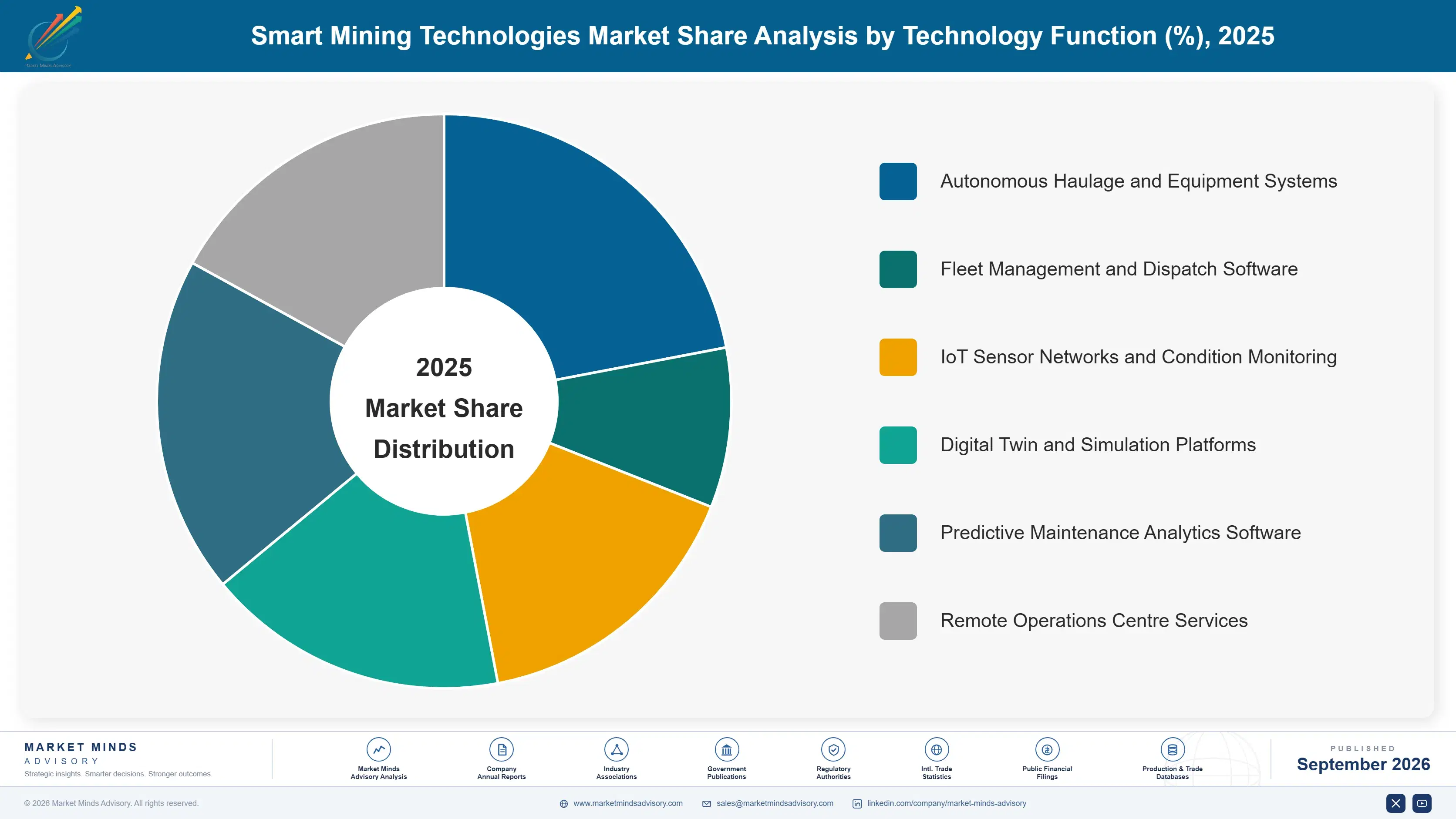
Segmentation follows technology function across the mine operations stack, from autonomous haulage equipment through fleet management software to digital twin and predictive analytics platforms, keeping hardware distinct from the software and remote operations service layers built around it across the full deployment and support chain across every major mining region covered in this analysis.
smart-mining-technologies-market-market-share-analysis-1788454752894

Digital Twin and Simulation Platforms

Digital twin platforms modelling full mine site operations from pit design through processing plant throughput let planners test haulage routing, blast sequencing, and equipment allocation scenarios against calibrated site telemetry data before committing capital to physical changes on the ground. Miners piloting these platforms report meaningfully faster scenario evaluation cycles compared with traditional spreadsheet-based planning approaches, since digital twin models update continuously as new operational data flows in from connected equipment across the site. Adoption remains concentrated among flagship sites with the connectivity infrastructure and technical staff to maintain calibrated models, but software-as-a-service delivery is extending access to mid-tier operators previously unable to justify dedicated simulation software licensing costs. Expect this segment to keep outpacing.
CAGR 17.4%

Predictive Maintenance Analytics Software

Predictive maintenance platforms analysing equipment sensor data to flag component failure risk before unplanned breakdowns occur are reducing costly production stoppages at mines where a single haul truck failure can idle an entire pit's ore movement schedule for hours or days. Mining companies adopting these platforms report meaningfully reduced unplanned maintenance events because component wear patterns are flagged well ahead of failure, letting maintenance teams schedule repairs during planned downtime windows rather than responding to emergency breakdowns disrupting production schedules. This segment benefits directly from the same IoT sensor cost decline extending digital twin adoption to mid-tier operators, since predictive maintenance requires similar underlying condition monitoring infrastructure already being deployed for other smart mining applications.
CAGR 14.7%
Full segment breakdown across 6 segments available in the complete report.

Regional Architecture and Country Demand Map

South Asia and Pacific holds an outsized share given Australia's globally leading concentration of production-scale autonomous mining deployment, while North America and East Asia follow on equipment manufacturing scale and expanding domestic mining automation investment. Buyers now treat this as baseline procurement criteria rather than a differentiator.

North America

Caterpillar and other major equipment manufacturers headquartered in the region anchor substantial demand from Canadian oil sands and United States copper and coal operations adopting autonomous haulage and remote operations technology as flagship domestic deployment sites. Skilled operator shortages in remote Canadian and western United States mining regions are pushing operators toward remote operations centres at a pace comparable to Australian adoption, though total deployed autonomous fleet scale still trails the concentrated Pilbara iron ore operations by a meaningful margin. Equipment manufacturers based in the region benefit from proximity to major mining company headquarters and engineering teams, supporting close collaboration during technology deployment and ongoing system refinement across multiple mine sites simultaneously. Average selling prices.
Share: 25% | CAGR: 12.0% (2026 to 2036)

Western Europe

European mining technology vendors, particularly Swedish equipment and software companies with deep underground mining automation expertise, anchor a meaningful regional demand pool despite the region's comparatively modest domestic mining production base relative to major resource-exporting economies elsewhere. Nordic underground mining operations have pioneered autonomous equipment for confined-space applications distinct from the open-pit autonomy dominating Australian and North American deployment, creating a specialised technology export base serving underground mining customers globally rather than primarily domestic demand. Domestic mining production remains limited outside a handful of Scandinavian and Eastern European operations, meaning most regional technology revenue reflects export sales to mining companies operating elsewhere rather than local deployment. Growth trails other major regions given this comparatively small.
Share: 18% | CAGR: 9.5% (2026 to 2036)
Regional intelligence for 5 additional markets available in the complete report: East Asia, South Asia and Pacific, Latin America, Middle East and Africa, Eastern Europe. Contact sales@marketmindsadvisory.com.
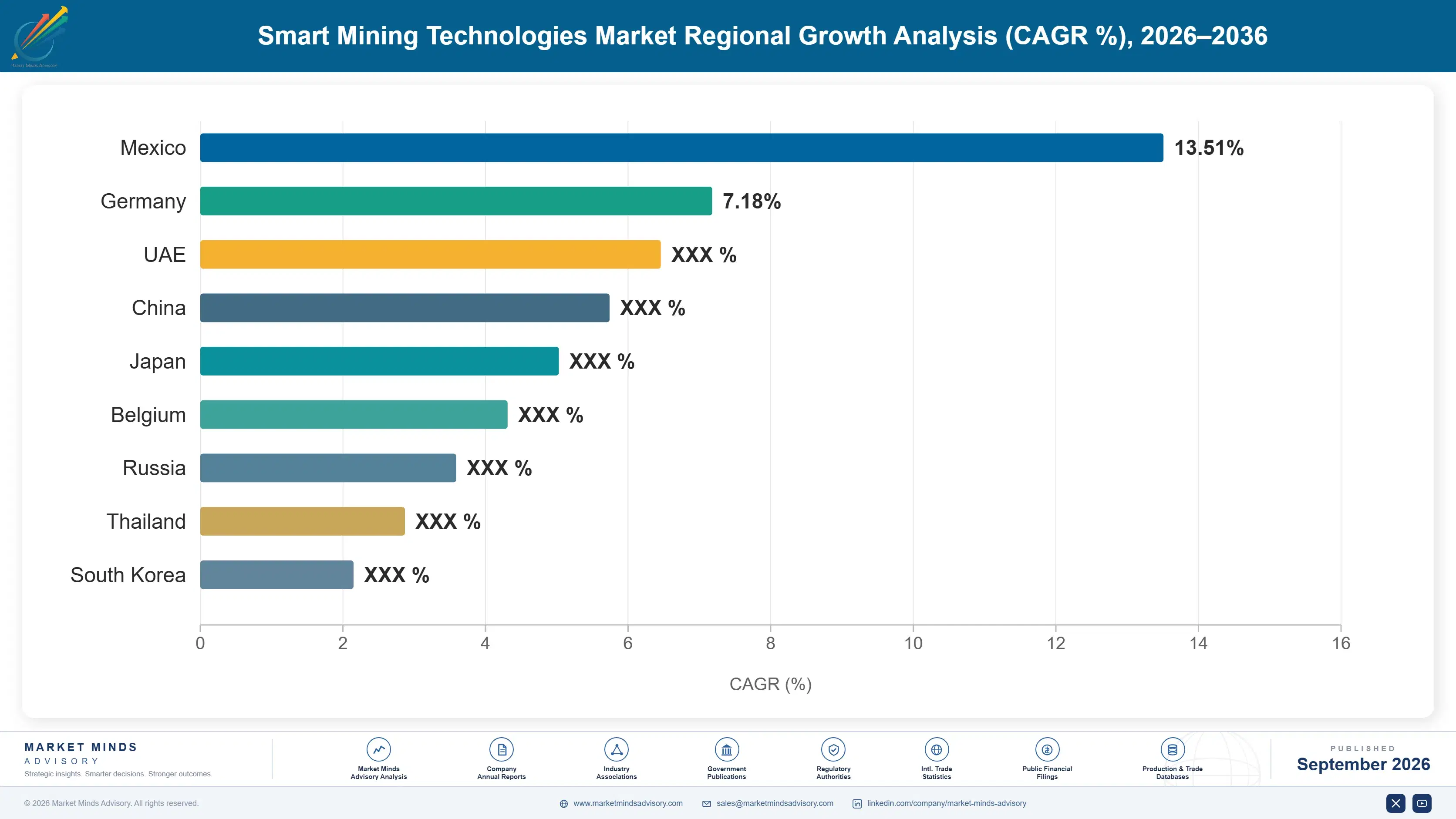
smart-mining-technologies-market-country-cagr-analysis-1788454753412

Retrofit Economics, Remote Operations, and Data Platform Depth

Suppliers hold pricing power where legacy fleet retrofit capability, remote operations centre integration, and data platform depth combine, letting qualified players capture recurring revenue that hardware-only equipment vendors cannot easily replicate at comparable margin or account retention across the largest mining company accounts as point-solution vendors struggle to defend share against broader platform offerings.

Autonomy Retrofit Kits for Legacy Haulage Fleets

Offering autonomy retrofit kits that upgrade existing manual haul trucks rather than requiring full fleet replacement directly addresses the capital constraint most mid-tier operators face when evaluating smart mining technology adoption against limited digital transformation budgets. Suppliers offering retrofit capability report winning a growing share of mid-tier operator contracts specifically because retrofit economics deliver roughly 60 to 70 percent of full autonomous fleet productivity gains at a fraction of new equipment capital cost. This retrofit capability is opening a meaningfully larger addressable market beyond the flagship sites that could previously justify full autonomous fleet replacement.
Market Impact: Delivers 60 to 70 percent of full autonomy gains

Remote Operations Centre Integration and Managed Services

Building and operating remote operations centres as a managed service, rather than selling standalone software licences, lets suppliers capture recurring revenue while addressing the operator staffing shortage driving remote operations adoption in the first place across most major mining regions. Suppliers offering this managed service model report meaningfully higher customer retention rates than software-only competitors, since switching remote operations providers carries real operational continuity risk that mining companies prefer to avoid once a relationship is established and trusted. Managed service contract pricing typically runs at a 2 to 3 times multiple over comparable software-only licensing.
Market Impact: Lifts lifetime account value 2 to 3 times

Unified Data Platform Integration Across Technology Layers

Building a unified data platform that integrates fleet management, predictive maintenance, and digital twin simulation into a single connected system positions suppliers to capture the full technology stack rather than competing point-solution by point-solution against specialised vendors serving individual layers separately. Suppliers offering unified platforms report meaningfully faster site-wide deployment timelines because integration work happens once rather than repeatedly across separate vendor relationships, and customers report roughly 20 to 25 percent lower total technology cost of ownership compared with assembling equivalent capability from multiple point solutions. This integration advantage is becoming a key differentiator as operators consolidate.
Market Impact: Cuts total cost of ownership 20 to 25 percent

Who Controls the Margin Pool

Concentration sits moderate at a cr5 near 46 percent measured on global technology platform revenue, with a meaningful gap separating the largest original equipment manufacturers bundling autonomy into new fleet sales from a fragmented tail of independent software vendors competing mainly in retrofit and analytics niches. This gap is widening rather than closing, since leading vendors keep reinvesting margin into retrofit and platform development that smaller competitors cannot match.
Current competitive activity centres on three dimensions: expanding autonomy retrofit kit availability for legacy fleets, building unified data platforms integrating fleet management with predictive analytics and digital twin simulation, and pursuing remote operations centre managed service contracts to capture recurring revenue beyond equipment sales alone. Consolidation activity has also picked up, with several smaller analytics vendors exploring acquisition by larger platform suppliers seeking faster capability expansion.

Emerging pressure comes from Chinese equipment manufacturers scaling domestic autonomous haulage capability behind government industrial policy support, which could compress pricing on standard equipment while established international suppliers defend share through deeper retrofit and integrated platform specialisation domestic entrants have not yet matched. Watch for share shifts toward vendors combining retrofit reach with unified platform depth, since that combination increasingly wins the largest multi-year contracts.
smart-mining-technologies-market-company-positioning-matrix-1788454753935

Competitive Moat and Risk Dimensions

CATERPILLAR INC

Moat: Deep flagship deployment track record

Caterpillar has accumulated more than a decade of production-scale autonomous haulage deployment experience at flagship Australian and North American sites, building operational reliability data and mining company trust that newer entrants cannot replicate without comparable field deployment history. This track record depth lets Caterpillar win the largest fleet replacement contracts on demonstrated.
CATERPILLAR INC

Risk: Exposure to mining capex cycles

A meaningful share of Caterpillar's smart mining revenue ties to new equipment fleet sales, which move with mining company capital expenditure cycles tightly correlated to commodity price conditions and can slow sharply during periods of resource sector capital discipline. Because autonomy technology development costs stay largely fixed regardless of near-term fleet order.
HEXAGON AB

Moat: Broadest unified data platform reach

Hexagon has built the broadest unified data platform among independent technology vendors, integrating fleet management, predictive maintenance, and digital twin simulation into a single connected system that competing point-solution vendors cannot match without assembling multiple separate partnerships. This integration depth gives Hexagon an advantage in the growing preference among mine operators for fewer, deeper vendor relationships.
HEXAGON AB

Risk: Lacks proprietary equipment manufacturing

Unlike equipment manufacturers that can bundle autonomy directly into new fleet sales, Hexagon depends entirely on software and retrofit positioning, leaving it more exposed to original equipment manufacturers deepening their own software capability and potentially excluding independent vendors from access to proprietary equipment telemetry data. Any tightening of equipment manufacturer data access.

Players Tracked

Prominent Players

Caterpillar Inc
Komatsu Ltd
Hitachi Construction Machinery Co Ltd
Epiroc AB
Sandvik AB

Other Key Players

ABB Ltd
Hexagon AB
Trimble Inc
Wenco International Mining Systems
Micromine Pty Ltd
Maptek Pty Ltd
Deswik Pty Ltd
Bentley Systems Incorporated
Rajant Corporation
Cisco Systems Inc
Nokia Corporation
Honeywell International Inc
Schneider Electric SE
Motion Metrics International Corp
Orica Limited

Recent Developments

FEBRUARY 2026

Caterpillar Launches Autonomy Retrofit Kit for Mid-Tier Operators

Caterpillar launched a new autonomy retrofit kit designed for mid-tier mining operators seeking to upgrade existing manual haul truck fleets, targeting operators previously unable to justify full autonomous fleet replacement given constrained digital transformation capital budgets most mid-tier operators face today across most operators evaluating similar upgrade paths this year.
Signal: Confirms established equipment manufacturers are extending autonomy beyond flagship site deployment models. Buyers now treat this as baseline.
OCTOBER 2025

Hexagon Signs Unified Platform Agreement With Major Copper Producer

Hexagon AB signed a multi-year unified data platform agreement with a major copper mining company, integrating fleet management, predictive maintenance, and digital twin simulation across the producer's operations in Chile and Peru under a single connected system. Buyers now treat this as baseline procurement criteria rather than.
Signal: Shows independent software vendors winning large integrated platform contracts against equipment manufacturers for large integrated technology contracts.
JUNE 2025

Komatsu Expands Remote Operations Centre Capacity in Australia

Komatsu Ltd expanded remote operations centre capacity at its existing Australian facility, responding to rising demand from mid-tier iron ore and copper operators seeking managed remote operations services rather than building dedicated in-house centres. Buyers now treat this as baseline procurement criteria rather than a differentiator worth.
Signal: Signals equipment manufacturers expect sustained growth in managed remote operations service demand. Buyers now treat this as baseline.

Sensor Hardware and Connectivity Infrastructure Cost Exposure

Sensor hardware, onboard computing systems, and dedicated connectivity infrastructure together typically account for a meaningful share of smart mining deployment cost, sourced from semiconductor and telecommunications equipment supply chains largely unrelated to traditional mining equipment manufacturing, a dependency that differs meaningfully from traditional mining equipment manufacturing cost structures, a structural difference from the equipment-centric cost base traditional mining suppliers have historically managed.
Semiconductor component pricing rose meaningfully during a 2024 global chip fabrication capacity disruption tracked by the IEA and major electronics component manufacturers' annual reports, compressing margins at technology vendors within a single fiscal year and delaying several planned deployment projects awaiting hardware delivery, a disruption vendors did not fully anticipate when planning annual production schedules, with recovery taking roughly two quarters as fabrication capacity gradually normalised across the affected supply chain.

Vendors relying on standardised commercial sensor and computing hardware carry different exposure than those developing proprietary mining-specific equipment, since commercial semiconductor markets move independently of specialised mining hardware production cycles, giving diversified vendors a natural hedge that single-source specialists lack across their narrower supply chain, a distinction increasingly shaping vendor sourcing strategy across the sector.
smart-mining-technologies-market-cost-volatility-analysis-1788454754133

Multi-Year Semiconductor Component Supply Agreements

Larger vendors are locking multi-year semiconductor and sensor component supply agreements across diversified vendor bases rather than relying on spot purchases, smoothing input cost volatility and protecting margin on fixed-price mine site deployment contracts signed years in advance of delivery. Suppliers. This approach has already reduced realised cost volatility meaningfully for early adopting vendors.

Qualification of Secondary Hardware Vendors

Several technology vendors are qualifying secondary sensor and computing hardware vendors as alternatives to primary sources, reducing single-source concentration risk over time, though field reliability testing lag against existing deployment standards means broad diversification remains a multi-quarter undertaking industry-wide. Early results suggest performance parity is achievable once field testing catches up with formulation timelines.

Commercial Off-The-Shelf Hardware Adoption

Vendors are shifting toward commercial off-the-shelf sensor and computing hardware rather than proprietary mining-specific components where field conditions permit, cutting exposure to specialised supply chain volatility while also reducing per-unit hardware cost across large-scale site deployments. Suppliers slower to adapt risk. This shift also shortens procurement lead times when component markets move sharply within a quarter.

Portfolio Architecture for Margin Defence

Portfolio economics split across three tiers running from commodity-adjacent standard fleet management software through certified autonomy-integrated platforms to next-generation digital twin and predictive analytics systems, with gross margin widening meaningfully at each successive tier as integration and data complexity increase across the range. This structure mirrors margin patterns seen in other technology-integrated industrial categories where platform depth separates premium from commodity pricing tiers overall.
Volume still concentrates in the standard fleet management tier where most mid-tier operator contracts sit today, but the autonomy-integrated and next-generation analytics tiers are growing faster and increasingly determine which suppliers win the largest flagship site framework agreements across major mining regions. Neither positioning is inherently superior, but capital allocation increasingly favours whichever tier shows the clearest path toward sustained margin expansion over time.

High-value margin pools concentrate specifically around unified data platforms and remote operations managed services, where integration complexity and recurring service relationships keep point-solution competitors from competing effectively on price alone across the largest mining company accounts. Vendors slow to build unified platform capability risk ceding this margin pool entirely to faster-moving competitors within the next several years.

Volume / Commodity-Adjacent Tier

Standard fleet management and dispatch software meeting baseline operational tracking requirements, sold mainly on price into smaller operations without extensive automation or data integration requirements. Buyers now treat this as baseline procurement criteria rather than a differentiator.
Gross Margin: 20%-26%

Premium / Certified Tier

Autonomy-integrated platforms meeting flagship site deployment standards, commanding meaningful price premiums over standard fleet management software given the integration and reliability track record competitors must clear first. Buyers now treat this as baseline procurement criteria rather than.
Gross Margin: 32%-38%

Sustainability / Regulatory / Next-Generation Tier

Digital twin and predictive analytics next-generation platforms sold into flagship site optimisation and remote operations contracts, carrying the widest margins given data integration complexity and scarce specialist engineering capacity. Buyers now treat this as baseline procurement criteria.
Gross Margin: 42%-50%
smart-mining-technologies-market-portfolio-architecture-1788454754635

High-value Sub-segments and Strategic Watch-out

Unified Data Platforms and Digital Twin Systems

Unified platforms integrating fleet management, predictive maintenance, and digital twin simulation command the widest margins as mine operators consolidate vendor relationships, though adoption still concentrates among flagship sites with dedicated technology budgets today. Buyers now treat this as baseline procurement criteria rather than a differentiator worth paying.
Gross Margin: 44%-50%

Remote Operations Centre Managed Services

Managed remote operations services grow steadily as operator shortages persist across remote mining regions, commanding solid recurring margins though not yet matching unified platform margins across most current contracts industry-wide. Suppliers as more operators adopt this delivery model over the coming years across most regions.
Gross Margin: 36%-42%

Standard Autonomy-Integrated Fleet Platforms

Autonomy-integrated fleet platforms serving mainstream flagship site contracts remain the largest volume pool by a wide margin, carrying moderate but stable margins as fleet replacement demand guarantees multi-year order visibility across established suppliers. Buyers now treat this as baseline procurement criteria rather than a differentiator worth paying.
Gross Margin: 30%-36%

Legacy Manual Fleet Management Software

Standard fleet management software sold into operations without autonomy investment plans faces the greatest margin compression risk as autonomy-integrated platforms gradually displace legacy tracking software across new deployment decisions. Suppliers slower as autonomy investment becomes the default rather than the exception over the coming years.
Gross Margin: 16%-22%

Deployment Depth and Renewal Cycles

Smart mining technology revenue behaves like a recurring platform relationship once deployed, since fleet management and analytics software typically retains its position across multiple equipment renewal cycles rather than requiring rebidding with each new haul truck purchase. Vendors instead depend on new deployment and retrofit volume for near-term revenue visibility rather than counting on installed base alone.
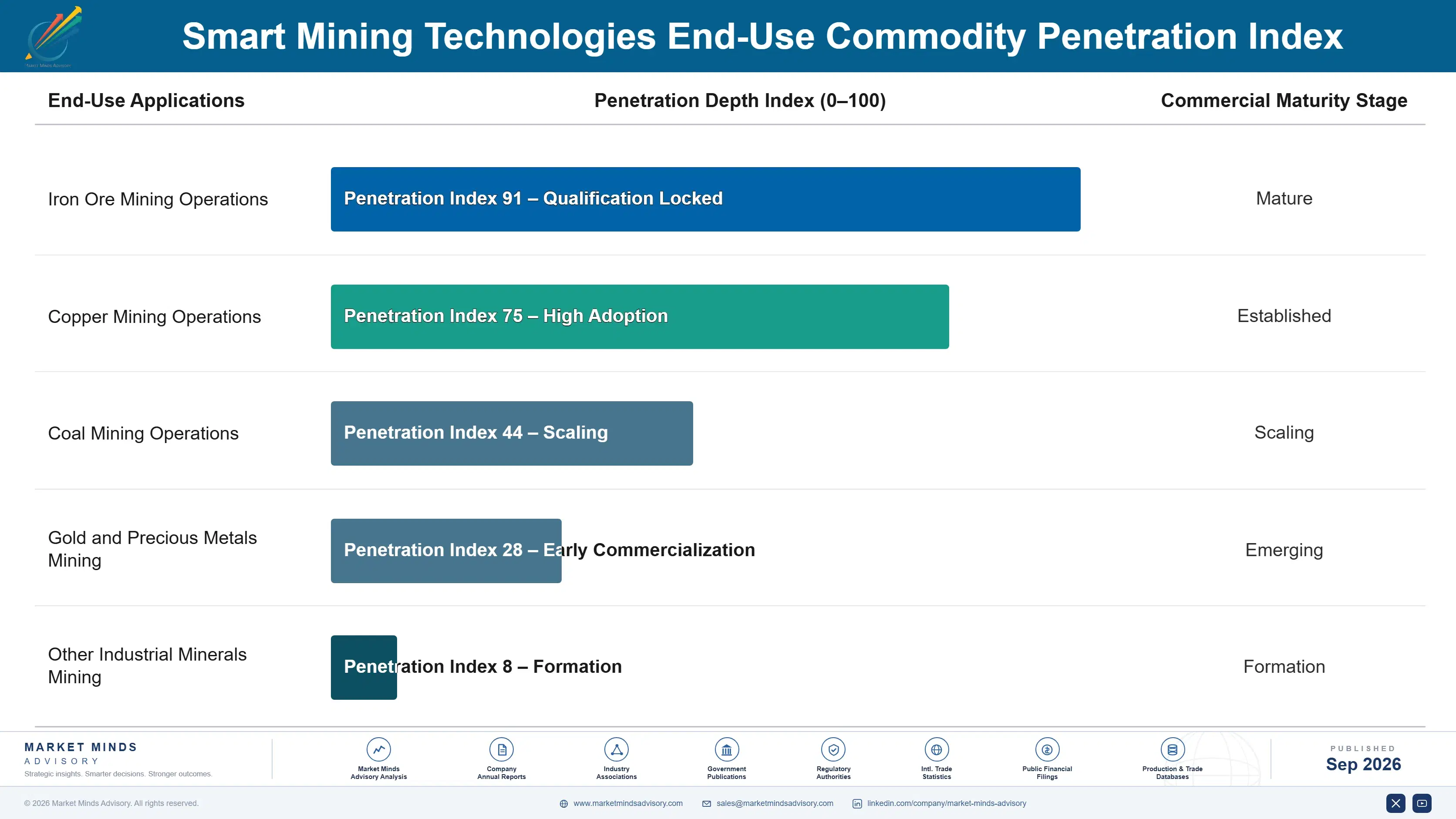
Adoption depth varies meaningfully by end-use vertical: flagship iron ore and copper operators integrate unified platforms deeply into daily operations spanning autonomy, maintenance, and simulation together, while smaller coal and industrial mineral operations often adopt individual point solutions without full platform integration. Smaller operations often adopt individual point solutions without a formal standardised specification governing every future technology purchase decision made across most smaller operations.

A generational shift is underway as mine planning engineers who relied on manual scheduling for decades give way to younger staff expecting digital twin and predictive analytics tools by default, accelerating platform adoption faster than the underlying equipment replacement cycle alone would suggest. Vendor relationships are shifting accordingly toward suppliers who can demonstrate credible platform integration competence, not equipment manufacturing history alone going forward.
smart-mining-technologies-market-end-use-penetration-index-1788454755125

Where Suppliers Should Focus Investment Next

These are among the four positions where our research anticipates prominent divergence between winners and laggards over the coming forecast period. Each is grounded in the demand model, the regulatory perimeter, and the announced capacity pipeline.
01 / RETROFIT MARKET PRIORITY

Build Retrofit Capability to Reach Mid-Tier Operators First

Mid-tier operators represent a meaningfully larger addressable market than the flagship sites currently driving most industry revenue, but capital constraints mean full autonomous fleet replacement remains out of reach for most of these operators. Suppliers who have already built retrofit capability are winning a growing share of mid-tier contracts specifically because retrofit economics deliver meaningful productivity gains at a fraction of new equipment capital cost. MMA advises prioritising retrofit product development now, since the mid-tier addressable market will only keep expanding as connectivity and sensor costs continue falling.
02 / REMOTE OPERATIONS SERVICE MODEL

Shift Toward Managed Remote Operations Rather Than Software Alone

Skilled operator shortages driving remote operations adoption are structural rather than cyclical, meaning demand for managed remote operations services will keep expanding regardless of near-term commodity price fluctuations affecting broader mining capital expenditure across the sector. Suppliers offering managed remote operations as a service capture meaningfully higher customer retention than software-only competitors, since switching providers carries real operational continuity risk mining companies prefer to avoid once trust is established. MMA recommends treating managed service delivery as a core commercial strategy rather than a peripheral offering appended to equipment sales.
03 / UNIFIED PLATFORM INVESTMENT

Integrate Fleet, Maintenance, and Simulation Into One Platform

Mine operators increasingly prefer fewer, deeper vendor relationships over managing a fragmented technology stack across many specialised point-solution suppliers, creating a clear competitive opening for vendors willing to invest in unified platform integration across previously separate technology layers. Suppliers offering unified platforms report meaningfully faster deployment timelines and lower total cost of ownership for customers, a combination that is becoming a key differentiator as more operators consolidate technology budgets around fewer strategic vendor relationships. MMA sees unified platform capability as an increasingly important prerequisite for winning the largest.
04 / HARDWARE SUPPLY DIVERSIFICATION

Diversify Sensor and Computing Hardware Sourcing Now

Semiconductor and connectivity hardware price volatility has already compressed margins meaningfully at vendors without diversified sourcing relationships, and this exposure grows as more suppliers sign fixed-price multi-year deployment contracts without matching input cost protection built into contract terms from the outset. Vendors adopting commercial off-the-shelf hardware where field conditions permit reduce exposure to specialised supply chain volatility while also cutting per-unit hardware cost across large-scale site deployments spanning many connected devices. MMA sees hardware sourcing flexibility as a prerequisite for suppliers pursuing the largest multi-year deployment contracts.

Engagement Snapshot From the Field

A live engagement with an industry participant carrying material or product regulatory and market exposure ahead of a defining policy shift, showing how our research translates into a defensible multi-year portfolio strategy.
MARKET MINDS ADVISORY · CLIENT ENGAGEMENT SUMMARY
Smart Mining Technologies Producer Strategic Portfolio Review and Transition Roadmap 2026·Investment Scenario on Smart Mining Technologies Exposure Evaluation 2025-26
CLIENT PROFILE
The client operates several copper mining sites across South America and approached MMA following persistent operator shortages that were constraining haulage capacity, reportedly costing over 15 million dollars in lost production value during peak shortage periods (client-reported, unverified by MMA) across the affected operations. Suppliers slower, a gap steadily widening each quarter as skilled labour remained scarce across the region.
STRATEGIC CHALLENGE
Leadership needed an evidence-based business case comparing autonomy retrofit investment against continued manual operation with expanded recruitment spending, but internal operations and finance teams disagreed sharply on realistic productivity gain assumptions for a mid-tier site lacking flagship-scale connectivity infrastructure. Suppliers slower given the site's more limited existing connectivity infrastructure relative to flagship operations elsewhere.
MMA APPROACH
MMA benchmarked comparable mid-tier retrofit deployments across similar operating conditions, modelled productivity gains against connectivity infrastructure investment cost, and built a phased deployment framework prioritising the highest-tonnage haul routes for fastest measurable return on investment. Suppliers slower to adapt risk losing, validated jointly against both engineering and finance stakeholder requirements before final sign-off.
KEY FINDINGS
  1. Routes with the highest cycle frequency accounted for a disproportionate share of total haulage productivity loss relative to their share of overall route mileage across the site network.
  2. Retrofit autonomy delivered meaningful productivity gains at considerably lower capital cost than full fleet replacement based on comparable mid-tier deployment data reviewed across similar operating conditions.
  3. Prioritising retrofit by route tonnage rather than truck age alone improved the projected payback period meaningfully within the proposed phased deployment programme structure.
  4. Bundling connectivity infrastructure investment with the retrofit contract shortened projected deployment timeline versus a traditional separately procured infrastructure and equipment approach across the full site network.
CLIENT PROFILE
The client operates several copper mining sites across South America and approached MMA following persistent operator shortages that were constraining haulage capacity, reportedly costing over 15 million dollars in lost production value during peak shortage periods (client-reported, unverified by MMA) across the affected operations. Suppliers slower, a gap steadily widening each quarter as skilled labour remained scarce across the region.
STRATEGIC CHALLENGE
Leadership needed an evidence-based business case comparing autonomy retrofit investment against continued manual operation with expanded recruitment spending, but internal operations and finance teams disagreed sharply on realistic productivity gain assumptions for a mid-tier site lacking flagship-scale connectivity infrastructure. Suppliers slower given the site's more limited existing connectivity infrastructure relative to flagship operations elsewhere.
MMA APPROACH
MMA benchmarked comparable mid-tier retrofit deployments across similar operating conditions, modelled productivity gains against connectivity infrastructure investment cost, and built a phased deployment framework prioritising the highest-tonnage haul routes for fastest measurable return on investment. Suppliers slower to adapt risk losing, validated jointly against both engineering and finance stakeholder requirements before final sign-off.
KEY FINDINGS
  1. Routes with the highest cycle frequency accounted for a disproportionate share of total haulage productivity loss relative to their share of overall route mileage across the site network.
  2. Retrofit autonomy delivered meaningful productivity gains at considerably lower capital cost than full fleet replacement based on comparable mid-tier deployment data reviewed across similar operating conditions.
  3. Prioritising retrofit by route tonnage rather than truck age alone improved the projected payback period meaningfully within the proposed phased deployment programme structure.
  4. Bundling connectivity infrastructure investment with the retrofit contract shortened projected deployment timeline versus a traditional separately procured infrastructure and equipment approach across the full site network.
RECOMMENDED STRATEGY
Phase 1: Phase 1 (Year 1): Deploy retrofit autonomy kits on the highest-tonnage haul routes first, bundled with dedicated connectivity infrastructure investment. Phase 2: Phase 2 (Years 2 to 3): Extend retrofit deployment across remaining priority routes identified through the tonnage-based prioritisation framework developed during scoping. Phase 3: Phase 3 (Years 3 to 4): Integrate predictive maintenance and digital twin simulation across the fully retrofitted fleet to compound productivity gains further.
OUTCOME
The client approved a four-year retrofit programme following the engagement, with Phase 1 route deployment reportedly improving haulage productivity by roughly 32 percent against the prior manual baseline (client-reported, unverified by MMA), supporting the case for full site rollout continuation. Buyers now treat this as baseline procurement criteria rather than a differentiator.

Frequently Asked Questions

Foundational context covering the market sizes, CAGR, scope, country, region and competition that inform every finding below. This section is provided to cover basics and most often pre-purchase conversations, answered from the MMA Primary Research Dataset.

What is the current size of the Smart Mining Technologies Market?

The global smart mining technologies market reached approximately 19 billion dollars in 2025. Growth has been rapid as autonomous haulage and digital twin adoption both expand beyond flagship sites.

How large will the Smart Mining Technologies Market be by 2036?

MMA projects the market reaching approximately 59.9 billion dollars by 2036 under the base case scenario. Falling sensor costs and persistent operator shortages both support this trajectory.

What is the CAGR for the Smart Mining Technologies Market 2026 to 2036?

The base case CAGR is 11.0 percent across the forecast period. Bull and bear scenarios range between roughly 9.8 and 12.3 percent depending on commodity price conditions and retrofit adoption pace.

Which segment is growing fastest?

Digital twin and simulation platforms lead at 17.4 percent CAGR, well above the overall market rate. Expanding adoption beyond flagship sites is the primary driver behind this segment's outsized growth.

Who are the major companies in the Smart Mining Technologies Market?

Leading suppliers include Caterpillar Inc, Komatsu Ltd, Hitachi Construction Machinery Co Ltd, Epiroc AB, and Sandvik AB. Combined, the top five hold roughly 46 percent of global platform revenue.

Which country is growing fastest?

Australia leads among major markets at approximately 13.5 percent CAGR, driven by the world's largest concentration of production-scale autonomous mining deployment. Continued Pilbara fleet expansion reinforces this pace.

Report Segmentation Architecture

The full report scope spans multiple orthogonal segmentation dimensions, with cross-tabulated demand data provided for each dimension pair. Coverage extends further to regional breakdowns, trend trajectories, and the competitive detail needed to support segment-level decision-making.

By Technology Function

  • Autonomous Haulage and Equipment Systems
  • Fleet Management and Dispatch Software
  • IoT Sensor Networks and Condition Monitoring
  • Digital Twin and Simulation Platforms
  • Predictive Maintenance Analytics Software
  • Remote Operations Centre Services

By End-Use Commodity

  • Iron Ore Mining Operations
  • Copper Mining Operations
  • Coal Mining Operations
  • Gold and Precious Metals Mining
  • Other Industrial Minerals Mining

By Commercial Dimension

  • Direct Original Equipment Manufacturer Sales
  • Independent Software Vendor Licensing
  • Managed Remote Operations Service Contracts
  • Retrofit Kit Distribution Channels

By Region

  • North America
  • Western Europe
  • East Asia
  • South Asia and Pacific
  • Latin America
  • Middle East and Africa
  • Eastern Europe

Scope, Methodology, and Coverage

Every figure in this report is reproducible from documented input assumptions. The scope below maps the historical period, the forecast horizon, the segmentation dimensions, and the countries covered, alongside the underlying primary and qualitative methodology.
Historical Period
2020 to 2025
Forecast Period
2026 to 2036
Base Year
2025 (USD billions; MMA Primary Research Dataset, September 2026)
Market Definition
This report covers technology platforms and services used for autonomous, remote, and data-driven mining operations, including autonomous haulage systems, fleet management software, digital twin simulation, predictive maintenance analytics, and remote operations centre services. It excludes traditional manual mining equipment without connected technology integration and exploration-stage geological survey software unrelated to active operations.
Quantitative Units
USD billions (current prices); deployed sites and connected equipment units
Segmentation Dimensions
By Technology Function; By End-Use Commodity; By Commercial Dimension; By Region
Regions Covered
North America, Western Europe, East Asia, South Asia and Pacific, Latin America, Middle East and Africa, Eastern Europe
Countries Covered
USA, China, Germany, France, UK, Japan, South Korea, India, Australia, Canada, Brazil, Mexico, Indonesia, Vietnam, Thailand, Malaysia, UAE, Saudi Arabia, South Africa, Nigeria, Turkey, Poland, Netherlands, Italy, Spain, Sweden, Switzerland, Argentina, Colombia, Singapore, and additional markets relevant to this sector
Key Companies Profiled
Caterpillar Inc, Komatsu Ltd, Hitachi Construction Machinery Co Ltd, Epiroc AB, Sandvik AB, ABB Ltd, Hexagon AB, Trimble Inc, Wenco International Mining Systems, Micromine Pty Ltd, Maptek Pty Ltd, Deswik Pty Ltd, Bentley Systems Incorporated, Rajant Corporation, Cisco Systems Inc, Nokia Corporation, Honeywell International Inc, Schneider Electric SE, Motion Metrics International Corp, Orica Limited
Quantitative Methodology
Primary survey, n=3,800 respondents, Q4 2025, six countries; demand-side model with trade association cross-validation
Qualitative Methodology
47 expert interviews, Q4 2025; applied to validate demand model assumptions, identify emerging dynamics, and assess competitive positioning
Report Format
PDF and XLSX data workbook (Word format preview document)
Publisher
Market Minds Advisory
Report Code
MMA-2026-TEC-567
Published
September 2026
Contact
sales@marketmindsadvisory.com | www.marketmindsadvisory.com

Purchase the full Smart Mining Technologies Market Report (2026 to 2036).

The full MMA report delivers granular segmentation across six technology function tiers, seven-region demand and pricing forecasts through 2036, and a detailed competitive assessment of twenty profiled suppliers including retrofit capability and unified platform positioning. It includes a dedicated flagship site deployment tracker covering major mining regions, plus quarterly semiconductor and connectivity hardware cost pass-through analysis. Buyers receive editable data tables supporting internal technology investment and vendor evaluation models. Suppliers slower to adapt risk losing allocation on the next fleet renewal. Analysts update the deployment tracker each quarter as new flagship and mid-tier sites reach production milestones.
Seven-region demand and pricing forecasts to 2036
Twenty-supplier retrofit and platform capability tracker
Flagship site autonomous deployment status tracker
Quarterly hardware cost pass-through model update
Segment-level margin benchmarking across all tiers
Editable technology investment and vendor evaluation tables

Built For The People Who Decide

From boardroom strategy to bench-side execution, this report is read cover-to-cover by leaders shaping the next decade of their industry, turning demand scenarios, market dynamics and valuation benchmarks into decisions.
CXOs/ Presidents/ VPs/ Managers
M&A and Corporate Development
Strategy Teams and R&D Heads
Procurement and Product Directors
Regulatory and Compliance Leaders
Investor Relations and Equity Analysts