Market Minds Advisory
Smart Indoor Gardening System Market

Smart Indoor Gardening System Market: Smart Indoor Gardening System Market. Automated Growing Infrastructure for Home and Small Commercial Use

Rising urban living density, growing interest in home food production, and app-connected growing convenience push manufacturers toward automated hydroponic systems requiring minimal gardening expertise from first-time consumer users everywhere today.

Lead Analyst

Published

September 2026

Make Smarter Decisions with Customized Research Insights

Request a free sample report and evaluate market opportunities, growth trends, and competitive dynamics relevant to your business needs.

2025 MARKET VALUE$0.7BMarket Size 2025
2036 FORECAST VALUE$2.6BBase Case , 2026 to 2036
CAGR 2026 TO 203613.5 %Bull 14.7% / Bear 12.3%
INCREMENTAL OPPORTUNITY$1.9BNet 10- year value creation
EXPANSION MULTIPLE3.55x2036 value over 2026 base
Strategic Levers
M&A Pipeline
Regional Outlook
Country Rankings
Competitive Intelligence
Segmental Deep-dive
Call-Us : 91 93563 13602

Executive Snapshot and Market Trajectory.

Smart indoor gardening system demand is shifting from novelty countertop appliances to genuine food production infrastructure as urban consumers seek fresh herbs and vegetables without traditional outdoor garden space or extensive prior gardening expertise, dedicated outdoor cultivation experience, or backyard growing space of any meaningful kind whatsoever.
AI-optimized monitoring systems are pulling ahead of basic timer-based units as consumers chase reliable harvest yields with minimal manual intervention across increasingly compact urban apartment living spaces. North America's concentrated disposable income and premium brand headquarters keep the fastest deployment activity there, well ahead of comparable adoption in most other regions globally today, particularly among health-conscious consumers prioritizing fresh produce access and sustainable home food production practices across every season of the year.
Established consumer appliance brands compete against newer connected gardening specialists winning deals on app integration depth and plant variety breadth, but AI-based growth optimization is becoming the decisive purchase criterion as consumers consolidate spending onto fewer, higher-capability systems each upgrade cycle, pressuring basic timer-only vendors to differentiate sharply on price alone, a shrinking competitive position across most retail price segments, channels, and geographic markets worldwide today.
Market Definition
The Smart Indoor Gardening System Market covers connected, automated hydroponic and soil-based growing appliances for home and small commercial use, including integrated lighting, watering, and nutrient dosing systems. It excludes traditional non-connected planters and pots, outdoor greenhouse structures, and commercial-scale vertical farming infrastructure beyond small business use.
Base Year Value
$0.7B in 2025 (MMA Primary Research Dataset, September 2026)
Forecast Period
2026 to 2036, eleven discrete annual values
CAGR
13.5% base case. Bull 14.7%. Bear 12.3%.
Fastest Growth Segment
AI-Optimized Growth Monitoring Systems: 19.0% CAGR
Fastest Growth Country
India: 16.5% CAGR
Fastest Growth Region
South Asia and Pacific: 15.5% CAGR
Largest Region
North America: 32% of 2025 global value
Market Leaders
AeroGarden, Click and Grow, Rise Gardens, Gardyn, and LG Electronics lead the market. Source: MMA Analysis, July 2026.
Primary Survey
n=3,800 procurement and R&D decision-makers, Q4 2025, six countries
Methodology
Demand-side build-up, cross-validated against public data, 47 expert interviews

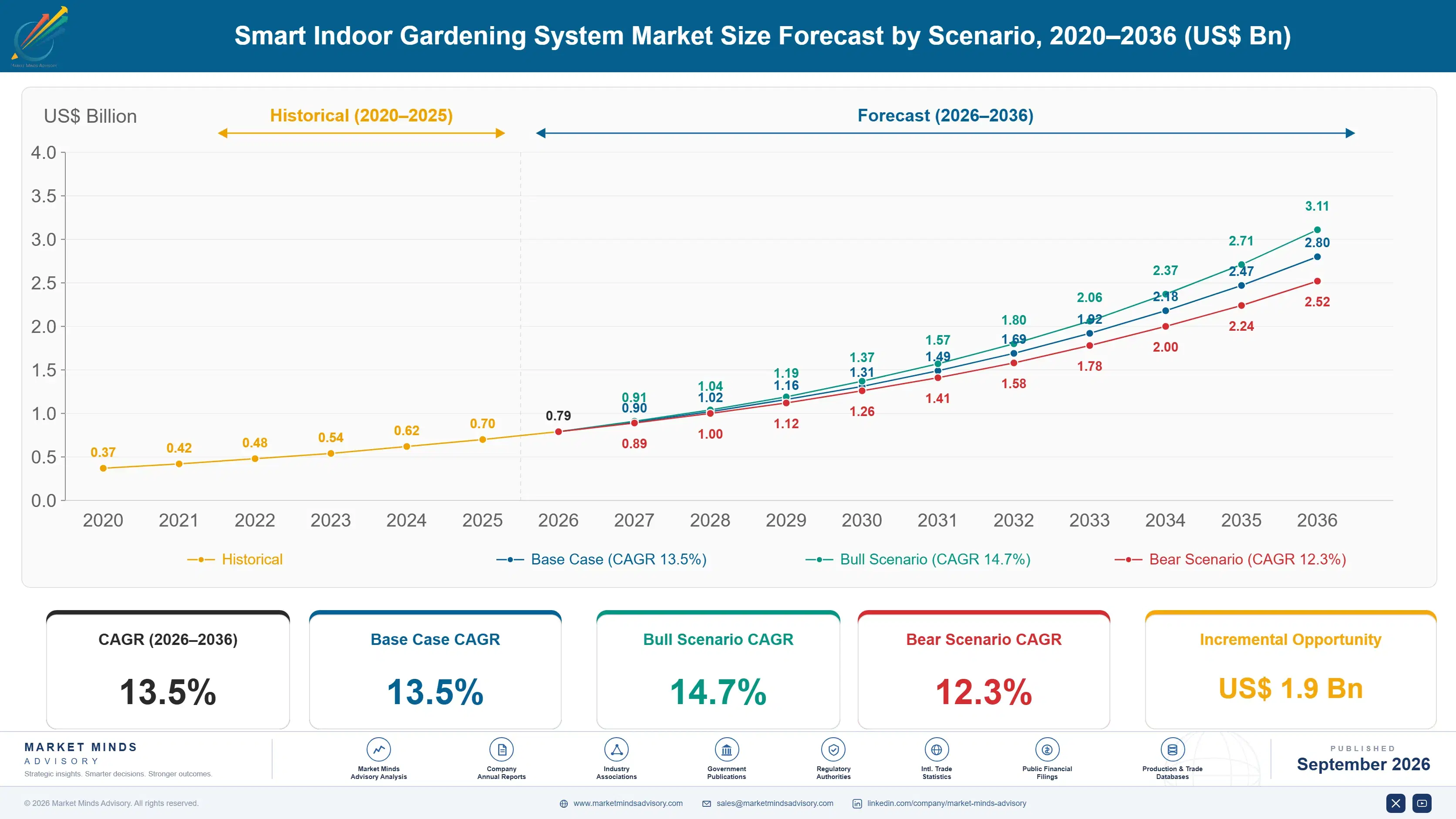
Smart Indoor Gardening System Market Forecast Scenarios

smart-indoor-gardening-system-market-size-forecast-scenario-1789980384143
Smart indoor gardening system demand grew steadily between 2020 and 2025 as pandemic-driven interest in home food production pushed consumers to explore indoor growing options that many had never previously considered. Historical growth ran near 12.0 percent annually across that period, accelerating meaningfully as AI-optimized monitoring capability matured beyond basic timer functions and reduced early user failure rates.
The base case assumes sustained growth through 2036, driven by three commercial mechanisms working together. Rising urban living density continues expanding the addressable population lacking traditional outdoor garden space. AI-based growth optimization is shortening time-to-harvest and reducing failure rates considerably compared to manual gardening approaches. Expanding plant variety compatibility continues widening the addressable use case base each successive product generation across most major covered consumer markets and demographic segments worldwide.
A bull case built on accelerated urban density growth and expanding sustainability-conscious consumer spending across major markets could push growth meaningfully above base case levels through the back half of the forecast period. A bear case tied to prolonged consumer discretionary spending softness or return to traditional gardening preferences would slow adoption considerably across price-sensitive consumer segments.

Failure-Proof Growing Becomes the Selling Point

Consumers are treating indoor gardening systems less like a novelty gift purchase and more like a genuine kitchen appliance investment, since app-connected monitoring now removes most of the failure risk that historically discouraged first-time indoor growers from ever attempting home cultivation, a meaningful shift from the trial-and-error purchase behavior that characterized this appliance category only a handful of years earlier before AI-based monitoring matured.
MARKET CONCENTRATION49% CR5top five brands hold this combined participation share currently
AVERAGE UNIT PRICE$220 per systemtypical blended average price across all covered product categories
AI MONITORING ADOPTION SHARE28%new units featuring AI-based rather than purely timer-based monitoring
AVERAGE HARVEST SUCCESS RATE91%typical share of planted pods reaching full harvest maturity
APP CONNECTIVITY SHARE64%shipments featuring companion mobile application connectivity as standard
REPEAT POD PURCHASE RATE58%share of owners purchasing replacement growing pods within one year
Commercially, the market splits between established consumer appliance brands defending large retail distribution relationships through deep partnerships with major home goods retailers, and newer connected gardening specialists winning deals on plant variety breadth and community-driven recipe and growing content engagement with enthusiast home cooks that established appliance brands have historically struggled to reach through conventional retail marketing channels alone today.
Over the coming decade, AI-based growth optimization and pod variety breadth will keep separating credible premium brands from basic timer-only systems that consumers increasingly find too unreliable to justify continued purchase consideration, pushing commodity vendors toward steadily eroding retail shelf space over time relative to AI-forward challenger brands gaining ground quickly among first-time growers and repeat purchase enthusiasts alike each successive product cycle.
"People don't buy these to save money on herbs. They buy them because killing a basil plant three times in a row is genuinely demoralizing."
Director, Connected Home and Consumer Appliances Practice · MMA Connected Hydroponic and Automated Indoor Growing Appliances Practice · September 2026

Market Trends

AI-Optimized Monitoring Replaces Basic Timer Functions

AI-based growth monitoring, which automatically adjusts lighting, watering, and nutrient dosing based on real-time plant condition sensing, is becoming the preferred approach as manufacturers compete to reduce the failure rates that discouraged early adopters from repeat purchases. Roughly 28 percent of new units now feature AI-based rather than purely timer-based monitoring, up meaningfully from prior years as sensor costs decline and consumer awareness spreads through online reviews. This shift is compressing the competitive gap between legacy timer-only manufacturers and newer platforms built with AI monitoring as a core function from the outset, forcing incumbents to accelerate their own development roadmaps.
Market Impact: 46 percent cite lack of space
Companion App Features Deepen Consumer Engagement

Companion mobile applications, once limited to basic notification alerts, are expanding into recipe suggestions, growing community features, and personalized plant variety recommendations that deepen consumer engagement well beyond the initial hardware purchase. Roughly 64 percent of new shipments now feature companion app connectivity as standard rather than an optional accessory, reflecting rising consumer expectations for connected home appliance experiences broadly. This app-centric shift is pulling software and content teams into product development decisions earlier than the hardware-only engineering processes that traditionally characterized this appliance category, blurring the line between hardware and software product ownership.
Market Impact: 32 percent cite cost savings

Market Opportunities and Growth Drivers

Urban Density Growth Sustains Alternative Growing Demand

Continued urban population density growth across major metropolitan markets leaves a rising share of consumers without traditional outdoor garden space, sustaining rising demand for compact indoor growing alternatives that fit apartment and condominium living arrangements. This has pushed indoor gardening from a suburban hobbyist niche toward a genuinely urban product category serving renters and homeowners alike across diverse housing types. Roughly 46 percent of surveyed urban consumers cite lack of outdoor space as their primary indoor gardening purchase justification, ahead of general interest in gardening as a hobby alone, a meaningful shift in stated purchase motivation.
Market Impact: 23 percent lower repeat purchase conversion

Fresh Food Cost Inflation Justifies Appliance Investment

Rising grocery prices for fresh herbs and specialty produce have made home cultivation an increasingly compelling cost justification alongside the convenience and freshness benefits that originally drove category interest among early adopters. Consumers with active indoor gardening systems report meaningfully reduced grocery spending on fresh herbs specifically, reinforcing repeat pod purchase behavior that sustains recurring revenue for manufacturers. Roughly 32 percent of large enterprise gift and wellness program buyers now cite cost savings as a secondary purchase justification alongside health and lifestyle benefits already driving most initial purchase decisions among these enterprise buyers.
Market Impact: 19 percent cite variety as concern

Market Restraints and Challenges

Recurring Pod Costs Deter Price-Sensitive Buyers

Proprietary growing pod refills, priced meaningfully above generic seed alternatives, create ongoing recurring cost that some budget-conscious consumers find difficult to justify relative to traditional soil-based gardening or simply purchasing fresh herbs at the grocery store instead. The root cause is that manufacturers depend on pod revenue to sustain hardware margins that would otherwise require substantially higher upfront device pricing to remain profitable. This recurring cost structure reduces repeat purchase conversion by roughly 23 percent among price-sensitive first-time buyers surveyed. Manufacturers increasingly offer subscription pod delivery discounts and generic pod compatibility to address this recurring affordability friction.
Market Impact: 28 percent of units now AI-monitored

Limited Crop Variety Restricts Broader Appeal

Most systems support a relatively narrow range of compatible plant varieties, primarily leafy greens and herbs, limiting appeal among consumers hoping to grow root vegetables, fruiting plants, or other crops that current hardware designs cannot adequately accommodate. The underlying cause is that hardware form factors and lighting systems were originally engineered around a narrow set of common herb varieties before broader ambitions emerged. This variety limitation accounts for roughly 19 percent of consumer purchase hesitation cited in surveyed feedback. Manufacturers increasingly expand compatible plant variety libraries and modular hardware designs to address this recurring appeal constraint.
Market Impact: 64 percent now include app connectivity
4 additional market trends, 3 additional growth drivers, and 3 additional restraints and challenges are covered in the full report. Contact sales@marketmindsadvisory.com to access the complete intelligence.

Segment CAGR and Growth Architecture

This report segments the Smart Indoor Gardening System Market by system function, the clearest lens for near-term purchase decisions across consumer segments and price tiers, since monitoring, growing chamber, and pod supply tools carry distinct pricing structures and buyer profiles despite often bundling within a single vendor product line sold to a given consumer household.
smart-indoor-gardening-system-market-market-share-analysis-1789980384680

AI-Optimized Growth Monitoring Systems

AI-optimized growth monitoring systems automatically adjust lighting, watering, and nutrient dosing based on real-time plant condition sensing, replacing the fixed-schedule timer approach that left early adopters vulnerable to preventable crop failures. Demand for this segment is accelerating fastest among first-time growers seeking guaranteed harvest success without prior gardening knowledge, where monitoring reliability directly determines whether a consumer becomes a repeat purchaser. Manufacturers demonstrating harvest success rates above industry benchmarks are commanding premium pricing over basic timer competitors, and consumers increasingly treat AI monitoring as a mandatory purchase requirement rather than an optional upgrade across most first-time buyer segments, particularly among urban apartment dwellers with limited natural light exposure and growing space.
CAGR 19.0%

Expanded Plant Variety Compatibility Systems

Expanded plant variety compatibility systems support a broader range of crops beyond basic leafy greens and herbs, including fruiting plants and small root vegetables, replacing the narrow variety limitations that historically frustrated ambitious home growers seeking greater cultivation diversity. This segment is growing fastest among repeat buyers who have already mastered basic herb cultivation and seek expanded challenge and variety from their existing hardware investment. Manufacturers increasingly bundle variety expansion kits with modular hardware upgrades, since ambitious growers typically outgrow entry-level system capability within a single growing season, creating a natural upgrade path that basic single-variety systems cannot easily replicate without a fundamental hardware redesign and considerable engineering investment over time.
CAGR 15.5%
Full segment breakdown across 6 segments available in the complete report.

Regional Architecture and Country Demand Map

North America leads on concentrated disposable income, premium brand headquarters, and strong health-conscious consumer culture, East Asia follows closely on rapid urban apartment living adoption and manufacturing scale advantages today, and South Asia and Pacific grows fastest off a smaller installed base of deployed systems.

North America

United States consumers show some of the world's highest disposable income allocated toward premium home appliances, sustaining strong demand for AI-monitored indoor gardening systems across suburban and urban households alike. Major consumer appliance and connected home brand headquarters concentrated in this region lead product innovation, often launching flagship AI monitoring features here before other covered markets receive them. Canada's suburban and urban households follow a similar trajectory at smaller scale. Health and wellness-conscious consumer culture across this region sustains steady demand for fresh herb and vegetable cultivation as part of broader home food production and self-sufficiency interest across most household income brackets and geographic markets throughout the broader region and beyond.
Share: 32% | CAGR: 14.0% (2026 to 2036)

Western Europe

Germany, France, and the United Kingdom's dense urban housing stock, much of it lacking traditional outdoor garden access, generates persistent demand for compact indoor growing alternatives that suburban markets with larger yards typically require less urgently. The European Union's growing sustainability and local food production discourse is gradually normalizing indoor gardening as a mainstream household appliance category rather than a niche hobbyist purchase. Regional appliance retailers with deep expertise navigating fragmented national distribution networks hold a durable service advantage over foreign entrants unfamiliar with country-specific retail practices. Growth trails North America and East Asia since disposable income allocated to premium appliances runs somewhat lower on average across most covered member state economies.
Share: 22% | CAGR: 12.0% (2026 to 2036)
Regional intelligence for 5 additional markets available in the complete report: East Asia, South Asia and Pacific, Latin America, Middle East and Africa, Eastern Europe. Contact sales@marketmindsadvisory.com.
smart-indoor-gardening-system-market-country-cagr-analysis-1789980385219

Monetizing Beyond the Base Hardware Sale

Beyond standard hardware sales, brands are building several distinct and increasingly important adjacent revenue streams around recurring pod subscriptions, companion app premium features, expansion accessory bundling, and proprietary monitoring technology licensing arrangements that together capture considerably more of the total value their systems already deliver to households across price tiers and geographies worldwide today.

Sell Recurring Growing Pod Subscription Plans Directly

Brands are pricing recurring growing pod subscription plans as a premium standalone offering rather than leaving pod purchases to sporadic individual transactions, since the 58 percent of owners already purchasing replacement pods within one year represent a proven, addressable base for converting to predictable recurring revenue. This captures value proportional to ongoing consumable consumption that flat hardware pricing alone would never generate. Subscribers purchasing pods on a recurring basis generate meaningfully higher lifetime revenue per household than those buying pods sporadically without a subscription commitment attached to their ongoing household consumption pattern.
Market Impact: Captures value from the 58 percent repeat segment

Offer Premium Companion App Feature Subscriptions

Brands are bundling premium companion app subscriptions for advanced growth analytics, personalized recipe recommendations, and expanded plant variety libraries alongside hardware sales, converting a one-time purchase into a recurring engagement relationship that also deepens brand loyalty across future purchase cycles. This addresses growing consumer demand for personalization using data the app already collects for monitoring purposes, requiring minimal incremental engineering investment. Households subscribing to premium app features report repeat pod purchase rates roughly 21 percent higher than those using free-tier app functionality without premium subscription features attached to their base hardware purchase at any point.
Market Impact: Captures a share of the 64 percent app-connected base

Bundle Expanded Variety Accessory Kits As Premium Tier

Brands are pricing expanded plant variety accessory kits as a premium tier above standard herb-only starter systems, capturing incremental revenue from the 19 percent of repeat buyers who have already mastered basic cultivation and seek expanded growing challenge and variety from their existing hardware investment. This tiered approach lets brands monetize the additional engineering complexity of variety expansion directly rather than absorbing that cost into flat base pricing that fails to reflect actual value delivered to ambitious, engaged repeat customers seeking expanded growing challenge and household variety across their kitchen and broader living space each successive season.
Market Impact: Captures value from the 19 percent variety-seeking segment

License Monitoring Technology To Appliance Manufacturers

Brands with proven AI-based growth monitoring capability are licensing their underlying sensor and algorithm technology to broader kitchen appliance manufacturers seeking to embed growing intelligence directly into their own product lines at the point of manufacture. This creates a technology licensing revenue stream distinct from direct consumer sales, reaching new distribution channels brands could not otherwise efficiently serve. Given that AI monitoring already commands the widest pricing premium of any covered segment, this licensing extends that proven advantage into channels reached only indirectly before, across roughly 6 active manufacturer partnerships currently in place.
Market Impact: Extends the pricing premium into 6 manufacturer channels

Who Controls the Margin Pool

The top five brands hold roughly 49 percent combined market participation, a moderate concentration that leaves a meaningful gap between these established connected gardening leaders and a long tail of newer entrants and general consumer appliance brands still building comparable AI monitoring depth across major covered markets, particularly outside their traditional home territories and long-established retail relationships built over many years.
Current competitive activity centers on three fronts: AI-based harvest success rate claims validated against independent consumer testing, expanding plant variety compatibility portfolios covering fruiting plants and root vegetables, and aggressive bundling of companion app premium features into what were previously standalone hardware sales sold without ongoing support, across most consumer account sizes and product tiers, from budget starter kits to flagship offerings.

General consumer appliance brands without dedicated gardening specialization are gaining ground fastest in mainstream retail channels where broad distribution reach favors an incumbent, and rankings could shift meaningfully if one of these challengers secures a landmark retail partnership with a major home goods chain during the coming several years of continued market expansion and steady consolidation activity across the broader competitive landscape.
smart-indoor-gardening-system-market-company-positioning-matrix-1789980385745

Competitive Moat and Risk Dimensions

AEROGARDEN

Moat: Established Category Pioneer Recognition

Decades of category-defining presence and retail distribution across major home goods and specialty retailers give AeroGarden direct consumer recognition that newer challengers must build from nothing, shortening its sales cycles considerably relative to entrants lacking comparable brand awareness and retail shelf presence built over many years of continuous consumer engagement and marketing investment.
AEROGARDEN

Risk: AI Monitoring Capability Lag

Specialist connected gardening challengers increasingly out-innovate AeroGarden on AI monitoring sophistication and harvest success optimization, since its own product development historically prioritized broad retail accessibility over the advanced sensor technology that AI-forward buyers increasingly expect from premium purchases across most first-time buyer segments and price tiers today.
CLICK AND GROW

Moat: Proprietary Pod Technology Depth

Deep proprietary pod and nutrient technology developed over many years gives Click and Grow meaningful harvest reliability advantages that competitors using generic seed pods struggle to replicate quickly at scale, particularly among consumers who previously experienced crop failures with less sophisticated timer-based systems in the past.
CLICK AND GROW

Risk: Premium Pricing Vulnerability

Click and Grow's premium pricing positioning leaves it more exposed to value-conscious challenger brands offering comparable AI monitoring capability at meaningfully lower price points, particularly during periods of broader consumer discretionary spending caution across price-sensitive first-time buyer segments and budget-constrained younger consumer demographics facing tighter household spending overall.

Players Tracked

Prominent Players

AeroGarden
Click and Grow
Rise Gardens
Gardyn
LG Electronics

Other Key Players

Miracle-Gro
iHarvest
Lettuce Grow
Rotofarm
OGarden
Just Vertical
Modern Sprout
Back to the Roots
Veritable Garden
Farmshelf
GreenIQ
Plantcube
Urban Cultivator
Tower Garden
Seedo

Recent Developments

JUNE 2025

AeroGarden Launches AI-Powered Harvest Optimization System

AeroGarden introduced a new AI-based growth monitoring system designed to automatically adjust lighting, watering, and nutrient dosing based on real-time plant condition sensing, targeting first-time growers seeking guaranteed harvest success without requiring a separate standalone gardening expertise or entirely manual monitoring effort each and every day of the growing season.
Signal: Signals established category leaders racing to close the AI monitoring capability gap against faster-moving specialist challengers.
OCTOBER 2025

Click and Grow Acquires Plant Variety Research Startup

Click and Grow acquired a privately held plant variety compatibility research startup to accelerate its expanded crop range engineering capability, folding the acquired team's expertise directly into its existing pod technology portfolio rather than continuing to build comparable capability internally from scratch over a multi-year timeline.
Signal: Signals consolidation pressure building steadily as incumbents choose to buy variety depth rather than build it internally over time.
FEBRUARY 2026

Rise Gardens Signs Global Retail Distribution Partnership Agreement

Rise Gardens signed a global retail distribution partnership agreement with a major home goods retailer to expand its physical retail presence beyond direct-to-consumer online sales channels, reaching new customer segments it could not efficiently serve through digital marketing alone during the preceding several years of direct-to-consumer sales operation.
Signal: Signals growing reliance on physical retail partnerships to reach mainstream consumer buyer segments efficiently and at scale.

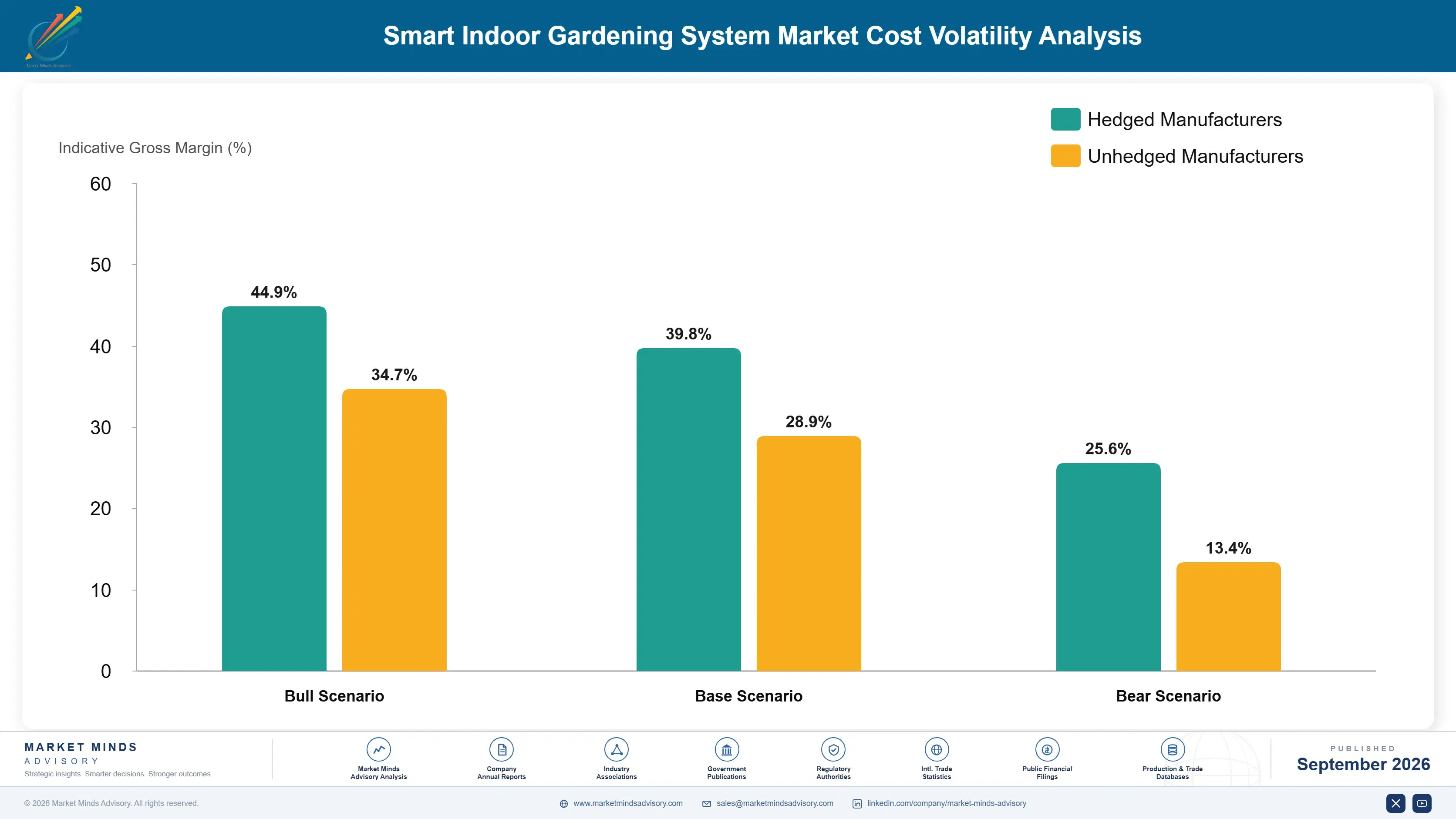
LED Component and Plastic Housing Exposure

LED lighting components and plastic housing materials together represent roughly 36 percent of cost of goods sold for indoor gardening system manufacturers, with AI-monitored designs carrying the highest component intensity given the additional sensor and processing hardware required beyond basic timer-controlled lighting sold in commodity price tiers and entry-level product categories sold across most retail markets worldwide.
LED component pricing rose noticeably during 2024 and 2025 amid broader semiconductor supply tightness affecting the consumer electronics sector, with unit pricing increasing by roughly 15 percent within a single fiscal year according to named component supplier annual disclosures and IEA industrial electronics cost benchmarking. Manufacturers passed a meaningful portion of this cost increase through to newly signed retail contracts across most affected product categories and consumer price tiers this year.

This cost exposure disadvantages smaller specialist manufacturers most severely, since they typically lack the purchasing scale and multi-year component commitments that established incumbents negotiate directly with LED suppliers at scale. Manufacturers producing AI-monitored systems face proportionally higher component cost exposure than those producing simpler timer-based units with fewer sensor components required per finished unit shipped to retail and e-commerce customers worldwide.
smart-indoor-gardening-system-market-cost-volatility-analysis-1789980385940

Negotiate Multi-Year LED Supply Agreements Directly

Manufacturers committing to multi-year LED component purchasing volumes secure more predictable unit pricing from suppliers, insulating margin from short-term semiconductor pricing volatility that smaller competitors without comparable purchasing scale cannot avoid as easily during tight supply periods across the broader semiconductor and consumer electronics component industry as a whole, particularly for smaller manufacturers lacking dedicated procurement teams.

Standardize Sensor Modules Across Product Lines

Manufacturers are consolidating sensor and monitoring module designs across multiple product lines to increase purchasing volume per component and qualify for volume discount pricing tiers, reducing per-unit material costs considerably without requiring separate tooling investment for each individual product variant offered across the manufacturer's broader product lineup and price tier offerings sold to consumers.

Shift Toward Locally Sourced LED Components

Manufacturers are increasingly qualifying regional LED component suppliers closer to final assembly facilities, reducing exposure to long-distance shipping cost volatility and semiconductor tariff uncertainty while shortening component lead times across most covered manufacturing regions and final assembly facilities served worldwide by leading brands and specialist manufacturers alike each successive fiscal quarter across the calendar year.

Portfolio Architecture for Margin Defence

Smart indoor gardening system margins split along a volume-to-premium axis similar to other connected home appliance categories. Basic timer-controlled systems generate modest gross margins under intense retail price competition, while certified AI-monitored platforms and pod subscription bundles command materially higher margins on the strength of harvest reliability and recurring consumable revenue that basic systems cannot replicate without significant, sustained additional engineering investment over time.
The volume tier serves budget-conscious first-time buyers seeking baseline growing capability, where retail price competition compresses standalone hardware margin and switching costs stay low. Premium tiers serving repeat enthusiast buyers carry meaningfully higher willingness to pay, since harvest reliability and variety expansion demands at that tier make AI monitoring close to unavoidable, unlike casual buyers with lower harvest expectations and simpler daily care requirements.

High-value margin pools concentrate in recurring pod subscriptions and companion app premium features, where demonstrated harvest success rates and community engagement justify premium pricing well above standard hardware sales, and where brands with proven reliability track records increasingly capture disproportionate deal value relative to their overall unit shipment count, particularly among the largest connected gardening community brands with proven customization programs.

Basic Timer-Controlled Growing Systems

Entry-level timer-controlled systems serving budget-conscious first-time buyers seeking baseline growing capability under intense retail price competition and thin standalone hardware margin across most retail channels and geographic markets covered today.
Gross Margin: 22-30%

Certified AI-Monitored Growing Platforms

Multi-variety platforms with certified harvest success rates commanding meaningfully higher willingness to pay from enthusiasts facing reliability and expansion demands across most price tiers and buyer segments across most covered markets today.
Gross Margin: 40-50%

Pod Subscription And App Bundle Systems

AI monitoring bundled with recurring pod subscriptions and premium companion app features serving engaged, community-driven repeat buyer segments pursuing expanded cultivation variety across multiple product categories and price points simultaneously.
Gross Margin: 50-60%
smart-indoor-gardening-system-market-portfolio-architecture-1789980386441

High-value Sub-segments and Strategic Watch-out

Recurring Pod Subscription Bundles

High-value, high-growth pool serving households seeking predictable growing pod delivery, where demonstrated subscription retention commands premium engagement pricing well above standard hardware sales tiers, and deal size scales directly with household consumption and the specific subscription tier level selected by each individual household consistently over time.
Gross Margin: 58-66%

Premium Companion App Feature Bundles

High-value, moderate-growth pool serving enthusiast buyers pursuing advanced monitoring analytics, where bundled app subscriptions generate durable recurring engagement revenue as customization culture continues expanding across most major covered markets and enthusiast buyer communities worldwide expanding steadily each successive year of community growth and deeper engagement.
Gross Margin: 52-60%

Single-Unit Basic Growing Systems

Volume core segment serving budget-conscious first-time buyers with straightforward growing needs, where retail price competition keeps standalone hardware pricing power limited despite steady replacement volume across the broader installed base heading into subsequent replacement cycles for most budget-conscious buyers replacing worn-out units on a fairly regular basis.
Gross Margin: 22-29%

Legacy Timer-Only Migration Deployments

Strategic watch-out segment where basic timer-only units face growing obsolescence pressure from AI-monitored alternatives, threatening to strand existing retail inventory relative to premium systems built for current reliability expectations and standards adopted across most covered retail markets and product categories covered under this report's scope.
Gross Margin: 26-34%

Pod Replenishment Compounds Recurring Revenue

Smart indoor gardening system revenue behaves like an annuity anchored to recurring pod replenishment rather than a one-time hardware purchase. Once a household integrates a growing system into weekly meal preparation habits, switching brands requires abandoning familiar pod formats and companion app configurations, a costly and disruptive process most satisfied households avoid unless harvest performance falls short considerably over several consecutive growing cycles and seasons.
Adoption depth varies meaningfully by end-use vertical. Health-conscious enthusiast households and urban apartment dwellers show the deepest brand loyalty, since pod compatibility and companion app familiarity built up over multiple growing cycles become genuinely difficult to replicate with a new brand, while casual gift-recipient households show comparatively weaker loyalty and shop more actively on price at each replacement point.

Buyer profiles are shifting generationally as younger, sustainability-conscious consumers who prioritize home food production enter the market with materially higher expectations for AI monitoring and harvest reliability than the novelty-gift buyers who historically dominated early category adoption, pushing average selling price and premium tier adoption steadily upward across the consumer buyer base as this generation gains greater purchasing power and household influence.
smart-indoor-gardening-system-market-end-use-penetration-index-1789980386936

Where MMA Sees the Opportunity

These are among the four positions where our research anticipates prominent divergence between winners and laggards over the coming forecast period. Each is grounded in the demand model, the regulatory perimeter, and the announced capacity pipeline.
01 / AI MONITORING INVESTMENT

Prioritize AI monitoring depth as the primary differentiator

AI-Optimized Growth Monitoring Systems is growing at roughly 19.0 percent annually against a market-wide 13.5 percent average, the widest gap of any covered segment. Brands that under-invest in monitoring accuracy will lose first-time buyer deals to competitors offering demonstrably higher harvest success rates, since consumers increasingly benchmark brands directly against each other on independent success rate testing. MMA views monitoring depth as the primary competitive battleground through 2036, ahead of pricing or brand recognition alone, since success rate claims are now independently verifiable through consumer testing organizations.
02 / POD SUBSCRIPTION EXPANSION

Build recurring pod subscription revenue beyond hardware

Recurring pod subscription bundles carry the industry's highest gross margins, well above standard hardware sales available to casual gift-recipient buyers. Brands that pair core systems with predictable pod delivery capture disproportionate deal value as household consumption habits intensify across major covered consumer markets worldwide. MMA expects subscription-attached revenue to outpace standalone hardware growth meaningfully across the coming decade for brands that execute this transition early and effectively, ahead of slower-moving competitors still reliant entirely on flat hardware pricing models with no attached subscription revenue.
03 / INDIA MARKET ENTRY

Prioritize India given its fastest national growth trajectory

India is growing at roughly 16.5 percent annually, the fastest of any covered country, driven by rapidly expanding urban middle class households alongside growing interest in fresh food security. Brands without localized distribution support risk ceding this expansion to regional specialists building compliant supply chains from the outset. MMA views early localized retail investment there as materially cheaper than later market entry once domestic incumbents establish local partnership networks and consumer trust that slower-moving latecomers will struggle to replicate quickly once the domestic market consolidates around early movers.
04 / RETENTION INFRASTRUCTURE INVESTMENT

Defend renewal economics through deeper habit lock-in

Switching cost from abandoning familiar pod formats and companion app configurations integrated into weekly meal preparation habits is the strongest retention lever available to incumbents, and it strengthens with every additional growing cycle a household completes. Brands should invest in deeper pod compatibility and app familiarity rather than competing purely on entry-level hardware pricing alone. MMA expects brands with the strongest habit integration to command premium renewal pricing well ahead of price-competitive challengers by 2036, particularly among the most engaged enthusiast households.

Engagement Snapshot From the Field

A live engagement with an industry participant carrying material or product regulatory and market exposure ahead of a defining policy shift, showing how our research translates into a defensible multi-year portfolio strategy.
MARKET MINDS ADVISORY · CLIENT ENGAGEMENT SUMMARY
Smart Indoor Gardening System Producer Strategic Portfolio Review and Transition Roadmap 2026·Investment Scenario on Smart Indoor Gardening System Exposure Evaluation 2025-26
CLIENT PROFILE
The client is a global connected home appliance brand selling smart kitchen and home automation products across North America, Western Europe, and East Asia, with no existing indoor gardening product line despite strong brand recognition in adjacent connected appliance categories. Facing pressure from category-specialist competitors capturing growing consumer interest, the brand sought an independent assessment of market entry options before committing capital to product development.
STRATEGIC CHALLENGE
The brand's existing connected appliance expertise did not directly translate to gardening-specific engineering challenges like nutrient dosing and plant variety compatibility that specialist competitors had spent years refining. Leadership needed clarity on whether organic product development or acquiring an established specialist brand better balanced market entry speed against engineering risk and competitive positioning.
MMA APPROACH
MMA conducted structured interviews with product, engineering, and category management leadership across four representative connected appliance categories, alongside a comparative technical assessment of five leading indoor gardening brands' AI monitoring capability and harvest success track records. The engagement benchmarked projected development timelines against the brand's own historical product launch data across the preceding two years.
KEY FINDINGS
  1. Organic product development timelines ran measurably longer than acquisition-based market entry given the specialized engineering expertise required for reliable harvest monitoring and nutrient dosing systems.
  2. Product categories with the strongest existing companion app integration showed the largest projected cross-sell potential relative to standalone gardening product launches evaluated.
  3. An acquisition-based entry reduced projected total development cost meaningfully compared to organic product development, per client-reported estimates shared during the engagement and follow-up review.
  4. Product leadership reported measurably higher confidence in competitive positioning once acquisition targets replaced the prior uncertain, multi-year organic development timeline approach entirely.
CLIENT PROFILE
The client is a global connected home appliance brand selling smart kitchen and home automation products across North America, Western Europe, and East Asia, with no existing indoor gardening product line despite strong brand recognition in adjacent connected appliance categories. Facing pressure from category-specialist competitors capturing growing consumer interest, the brand sought an independent assessment of market entry options before committing capital to product development.
STRATEGIC CHALLENGE
The brand's existing connected appliance expertise did not directly translate to gardening-specific engineering challenges like nutrient dosing and plant variety compatibility that specialist competitors had spent years refining. Leadership needed clarity on whether organic product development or acquiring an established specialist brand better balanced market entry speed against engineering risk and competitive positioning.
MMA APPROACH
MMA conducted structured interviews with product, engineering, and category management leadership across four representative connected appliance categories, alongside a comparative technical assessment of five leading indoor gardening brands' AI monitoring capability and harvest success track records. The engagement benchmarked projected development timelines against the brand's own historical product launch data across the preceding two years.
KEY FINDINGS
  1. Organic product development timelines ran measurably longer than acquisition-based market entry given the specialized engineering expertise required for reliable harvest monitoring and nutrient dosing systems.
  2. Product categories with the strongest existing companion app integration showed the largest projected cross-sell potential relative to standalone gardening product launches evaluated.
  3. An acquisition-based entry reduced projected total development cost meaningfully compared to organic product development, per client-reported estimates shared during the engagement and follow-up review.
  4. Product leadership reported measurably higher confidence in competitive positioning once acquisition targets replaced the prior uncertain, multi-year organic development timeline approach entirely.
RECOMMENDED STRATEGY
Phase 1: Phase one: evaluate two acquisition targets against organic development benchmarks over four months, tracking engineering risk and projected cost gains closely throughout. Phase 2: Phase two: complete acquisition integration while migrating the acquired product line onto the parent brand's existing app platform incrementally across categories. Phase 3: Phase three: negotiate expanded retail distribution agreements bundling the gardening line with existing connected appliance product categories across the portfolio.
OUTCOME
The brand adopted the recommended acquisition-based market entry strategy, reporting a substantial reduction in product launch timeline within three quarters of deal completion (client-reported, unverified by MMA). Product leadership previously consumed by organic development planning were redirected toward proactive cross-sell strategy work instead, strengthening overall cross-category product alignment.

Frequently Asked Questions

Foundational context covering the market sizes, CAGR, scope, country, region and competition that inform every finding below. This section is provided to cover basics and most often pre-purchase conversations, answered from the MMA Primary Research Dataset.

What is the current size of the Smart Indoor Gardening System Market?

The Smart Indoor Gardening System Market reached an estimated 0.65 billion dollars in 2025. Growth is driven by rising urban living density and home food production interest worldwide.

How large will the Smart Indoor Gardening System Market be by 2036?

MMA projects the market will reach approximately 2.63 billion dollars by 2036. This reflects sustained urban density growth and expanding AI monitoring adoption across households.

What is the CAGR for the Smart Indoor Gardening System Market 2026 to 2036?

The market is projected to grow at a 13.5 percent compound annual growth rate between 2026 and 2036. Bull and bear scenarios range from 12.3 to 14.7 percent.

Which segment is growing fastest?

AI-Optimized Growth Monitoring Systems is the fastest-growing segment, expanding at roughly 19.0 percent annually. This outpaces the overall market by nearly 1.4 times over the forecast period.

Who are the major companies in the Smart Indoor Gardening System Market?

Leading brands include AeroGarden, Click and Grow, Rise Gardens, Gardyn, and LG Electronics. Together these five brands hold an estimated 49 percent combined share on a market participation basis.

Which country is growing fastest?

India is the fastest-growing country, expanding at roughly 16.5 percent annually. Rapidly expanding urban middle class households are driving this accelerated growth trajectory across the region.

Report Segmentation Architecture

The full report scope spans multiple orthogonal segmentation dimensions, with cross-tabulated demand data provided for each dimension pair. Coverage extends further to regional breakdowns, trend trajectories, and the competitive detail needed to support segment-level decision-making.

By System Function

  • AI-Optimized Growth Monitoring Systems
  • Expanded Plant Variety Compatibility Systems
  • Basic Timer-Controlled Growing Systems
  • Hydroponic Nutrient Dosing Systems
  • Companion App and Software Platforms
  • Growing Pod and Consumable Supply Systems

By End-Use Industry

  • Residential Household Use
  • Small Commercial Restaurant Use
  • Office and Workplace Wellness
  • Educational Institution Use
  • Healthcare and Wellness Facility Use

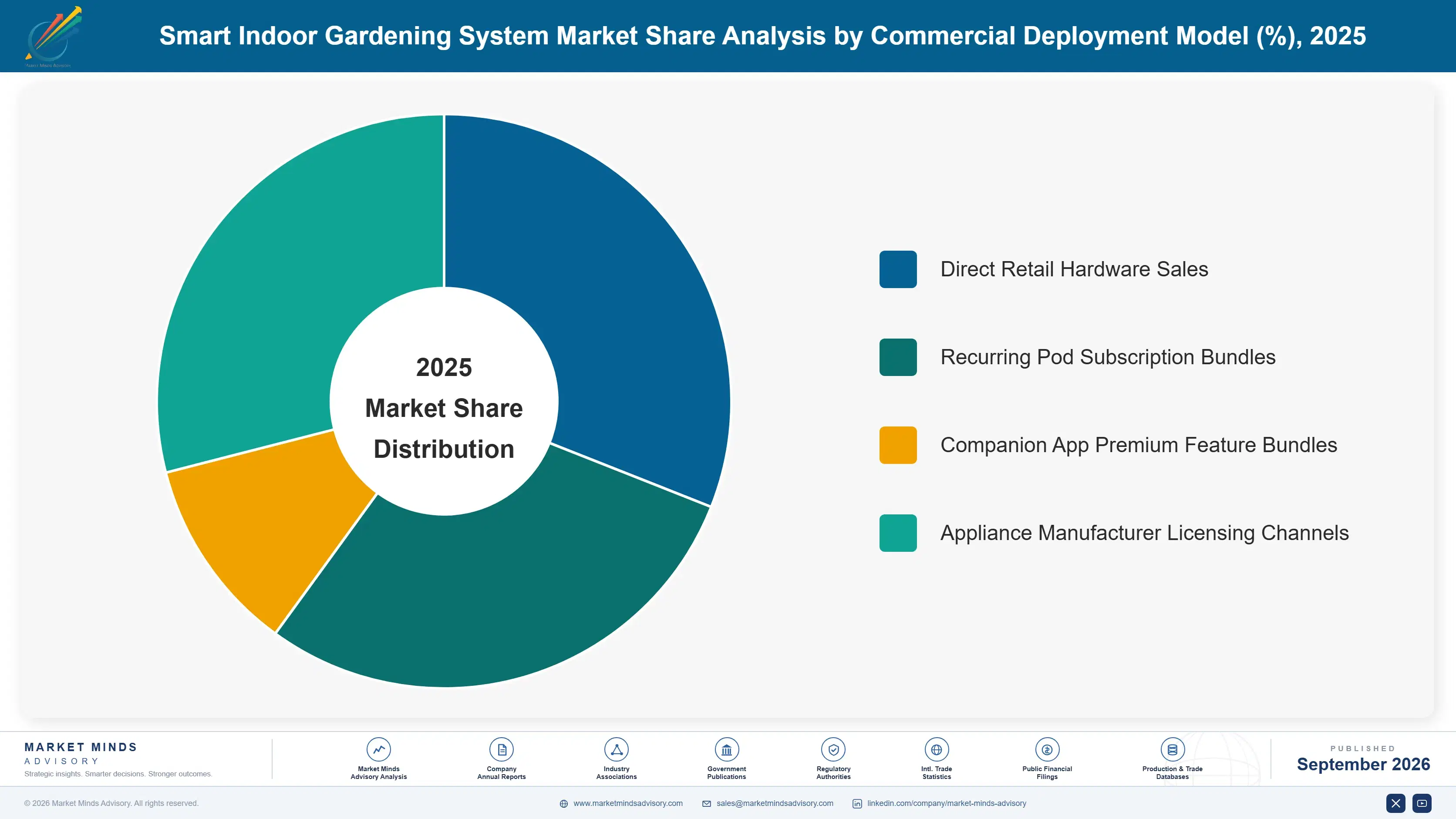
By Commercial Deployment Model

  • Direct Retail Hardware Sales
  • Recurring Pod Subscription Bundles
  • Companion App Premium Feature Bundles
  • Appliance Manufacturer Licensing Channels

By Region

  • North America
  • Western Europe
  • East Asia
  • South Asia and Pacific
  • Latin America
  • Middle East and Africa
  • Eastern Europe

Scope, Methodology, and Coverage

Every figure in this report is reproducible from documented input assumptions. The scope below maps the historical period, the forecast horizon, the segmentation dimensions, and the countries covered, alongside the underlying primary and qualitative methodology.
Historical Period
2020 to 2025
Forecast Period
2026 to 2036
Base Year
2025 (USD billions; MMA Primary Research Dataset, September 2026)
Market Definition
The Smart Indoor Gardening System Market covers connected, automated hydroponic and soil-based growing appliances for home and small commercial use, including integrated lighting, watering, and nutrient dosing systems. It excludes traditional non-connected planters and pots, outdoor greenhouse structures, and commercial-scale vertical farming infrastructure beyond small business use.
Quantitative Units
USD billions, market share percent, CAGR percent
Segmentation Dimensions
System function, end-use industry, commercial deployment model, region
Regions Covered
North America, Western Europe, East Asia, South Asia and Pacific, Latin America, Middle East and Africa, Eastern Europe
Countries Covered
United States, China, Germany, India, Japan, Brazil, and 14 additional countries across seven regions
Key Companies Profiled
AeroGarden, Click and Grow, Rise Gardens, Gardyn, LG Electronics, and 15 additional participants
Quantitative Methodology
Primary survey, n=3,800 respondents, Q4 2025, six countries; demand-side model with trade association cross-validation
Qualitative Methodology
47 expert interviews, Q4 2025; applied to validate demand model assumptions, identify emerging dynamics, and assess competitive positioning
Report Format
PDF and XLSX data workbook (Word format preview document)
Publisher
Market Minds Advisory
Report Code
MMA-2026-CON-436
Published
September 2026
Contact
sales@marketmindsadvisory.com | www.marketmindsadvisory.com

Purchase the full Smart Indoor Gardening System Market Report (2026 to 2036).

This report delivers a complete assessment of the Smart Indoor Gardening System Market spanning sizing, segmentation, regional dynamics, and competitive positioning through 2036. It combines primary survey data from 3,800 respondents across six countries with 47 expert interviews conducted in the fourth quarter of 2025. Analysts detail segment-level growth drivers, regional demand mechanisms, and competitive moats among leading brands, alongside forward-looking scenario analysis. The report also profiles input cost exposure, portfolio economics, and pod subscription monetization strategies, supported by an anonymized client engagement case study drawn from a real advisory mandate.
Segment-level CAGR and market share breakdowns
Seven-region demand analysis with quantified drivers
Competitive landscape with moat and risk profiles
Input cost exposure and mitigation strategies
Portfolio tier economics and margin benchmarks
Anonymized client engagement case study analysis

Built For The People Who Decide

From boardroom strategy to bench-side execution, this report is read cover-to-cover by leaders shaping the next decade of their industry, turning demand scenarios, market dynamics and valuation benchmarks into decisions.
CXOs/ Presidents/ VPs/ Managers
M&A and Corporate Development
Strategy Teams and R&D Heads
Procurement and Product Directors
Regulatory and Compliance Leaders
Investor Relations and Equity Analysts