Market Minds Advisory
Smart Glass Market

Smart Glass Market: Sold on Energy Models, Judged on Glare and Tint

The business case is built by a facade consultant modelling cooling load, and the repeat order is decided by occupants who dislike the tint and the wait for it to change.

Lead Analyst

Bilal Shaikh

Published

September 2026

Make Smarter Decisions with Customized Research Insights

Request a free sample report and evaluate market opportunities, growth trends, and competitive dynamics relevant to your business needs.

2025 MARKET VALUE$5.8BMarket Size 2025
2036 FORECAST VALUE$15.3BBase Case , 2026 to 2036
CAGR 2026 TO 20369.2 %Bull 10.4% / Bear 8.0%
INCREMENTAL OPPORTUNITY$8.9BNet 10- year value creation
EXPANSION MULTIPLE2.41x2036 value over 2026 base
Strategic Levers
M&A Pipeline
Regional Outlook
Country Rankings
Competitive Intelligence
Segmental Deep-dive
Call-Us : 91 93563 13602

Executive Snapshot and Market Trajectory

Two different people judge this product. A facade consultant justifies it on modelled cooling load and daylight, and occupants judge it on glare, colour and how long it takes to change. Around 26% report the tint itself as a complaint, which no energy model captures at all. They never meet.
The honest comparison is also unflattering to the product. Smart glass costs roughly 4.6 times conventional glazing fitted with automated blinds, and blinds are cheap, instant, fully opaque and repairable by any maintenance technician. What smart glass genuinely wins is view retention while tinted and no moving parts to fail, which is a narrower argument than the industry usually makes. Automotive scale is what could narrow that gap.
Automotive is where the volume finally arrived. Panoramic switchable roofs now feature on around 18% of premium vehicle launches, and China grows fastest anywhere at 15.4% on electric vehicle glazing adoption. PDLC laminated glass grows at 13.8%, half again the market rate of 9.2%, because switching in milliseconds suits a car in a way that switching in minutes never could. Volume changed the trajectory. Mainstream ranges are next. Cost is finally moving.
Market Definition
Glazing products whose light transmission changes actively or passively, covering electrochromic glass, polymer dispersed liquid crystal laminated glass, suspended particle device glass, thermochromic glass, photochromic glass, and retrofit switchable film applied to existing glazing. Measured at manufacturer selling value for the glazing or film product. Excludes conventional solar control and low emissivity coatings, mechanical shading systems, building management software, and vehicle glazing without switching capability.
Base Year Value
$5.8B in 2025 (MMA Primary Research Dataset, August 2026)
Forecast Period
2026 to 2036, eleven discrete annual values
CAGR
9.2% base case. Bull 10.4%. Bear 8.0%.
Fastest Growth Segment
PDLC Laminated Glass: 13.8% CAGR
Fastest Growth Country
China: 15.4% CAGR
Fastest Growth Region
South Asia and Pacific: 11.4% CAGR
Largest Region
East Asia: 30% of 2025 global value
Market Leaders
Saint-Gobain, AGC, Gentex, Halio, Research Frontiers. Source: MMA Primary Research Dataset, July 2026.
Primary Survey
n=3,800 procurement and R&D decision-makers, Q4 2025, six countries
Methodology
Demand-side build-up, cross-validated against public data, 47 expert interviews

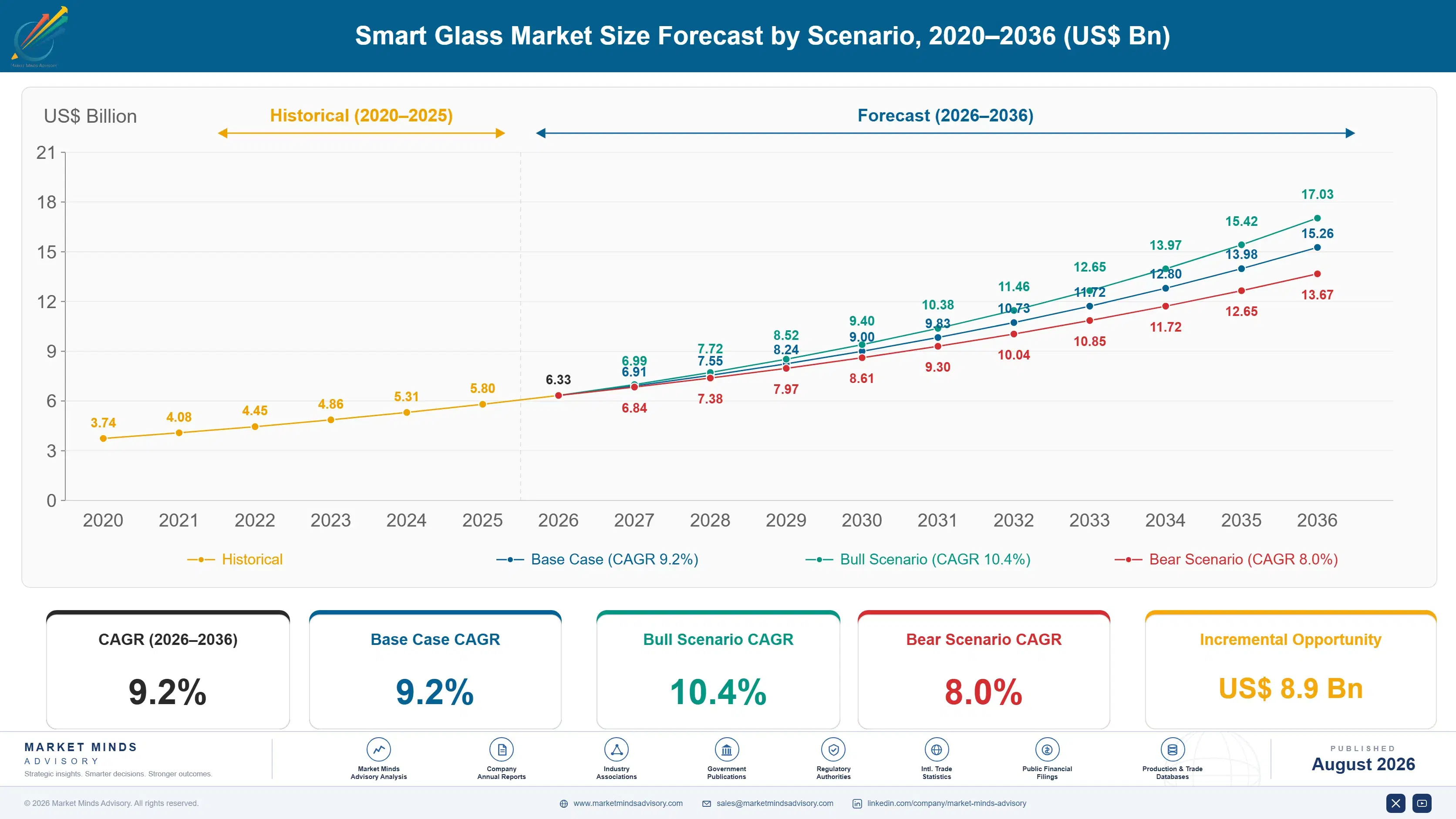
Smart Glass Market Forecast Scenarios

smart-glass-market-trends-size-forecast-scenario-1787595195308
Growth ran near 8.0% between 2020 and 2025, with commercial construction adoption progressing slowly against cost while automotive applications expanded rapidly from a much smaller base. Several architectural projects encountered durability and warranty issues that circulated widely among facade consultants and slowed specification. Automotive volume did more to advance manufacturing scale during the period than a decade of building projects had managed.
Base case 9.2% rests on three mechanisms. Automotive panoramic roofs reach around 18% of premium launches and are moving down into mainstream vehicle ranges, which brings volume that architectural demand alone would never deliver. Chinese electric vehicle glazing grows fastest anywhere at 15.4%. And retrofit switchable film opens existing buildings that would never justify replacing glazing outright for a comfort improvement, which is an enormous installed base nobody is contesting.
The bull case at 10.4% assumes automotive volume driving manufacturing cost down far enough to narrow the 4.6 times gap against blinds in construction. The bear case at 8.0% is further durability failures in architectural installations, since facade consultants circulate warranty experience among themselves and a visible failure removes a manufacturer from specification lists for years afterwards.

The Model and the Occupant

The product is specified by one person and lived with by another, and they weigh entirely different things. A facade consultant builds the business case on modelled cooling load reduction, daylight availability and glare control, all of which the technology genuinely delivers. Occupants notice a blue-grey cast across the view, a switching time near seven minutes and uneven tinting across large panes, and around 26% raise the colour appearance specifically.
TOP FIVE CONCENTRATION43%Glass manufacturing scale narrows the credible supplier field
COST AGAINST BLINDS4.6xInstalled cost against glazing fitted with automated shading
SWITCHING TIME7 minutesPeriod for architectural electrochromic glazing to fully change
AUTOMOTIVE ROOF ADOPTION18%Premium vehicle launches offering switchable panoramic roof glazing
ARCHITECTURAL WARRANTY TERM10 yearsPeriod a manufacturer stands behind an installed facade unit
TINT COMPLAINT RATE26%Occupants raising colour appearance as a specific concern
The comparison the industry avoids is against blinds. Smart glass installed costs roughly 4.6 times conventional glazing fitted with automated shading, and blinds switch instantly, go fully opaque, cost almost nothing and can be repaired by a maintenance technician with a ladder. What smart glass genuinely offers is view retention while tinted and no moving parts to fail, which is real and narrower than most marketing claims.
Automotive changed the industry's trajectory more than any building did. Switchable panoramic roofs appear on around 18% of premium vehicle launches and are spreading into mainstream ranges, bringing manufacturing volume that a decade of architectural projects never approached. Vehicle applications also favour different technology, since a car needs switching in milliseconds and tolerates a smaller area, which suits liquid crystal devices.
"The energy model gets the project approved and the occupant complaint file decides whether the owner ever specifies it again. Manufacturers spend their engineering budget on transmission range and their customers are talking about the colour of the sky through the window."
Director, Building Envelope and Advanced Glazing Practice · MMA Construction and Building Materials Practice · August 2026

Market Trends

Automotive volume driving manufacturing scale beyond architectural reach

Switchable panoramic roofs now appear on around 18% of premium vehicle launches and are moving into mainstream ranges, which brings production volume that a decade of architectural projects never came close to delivering. That scale is what could eventually narrow the cost gap against conventional glazing with blinds. Vehicle applications also favour liquid crystal technologies over electrochromic ones, since a car requires switching in milliseconds and tolerates a considerably smaller glazed area than a facade does. Manufacturers sharing production learning between the two are pulling ahead on cost. Yield learning transfers directly.
Market Impact: Chinese demand growing at 15.4%
Retrofit film opening buildings that would never replace glazing

Switchable film applied to existing glazing reaches buildings where replacing facade units for a comfort improvement could never be justified, and it costs a fraction of a glazing replacement while delivering most of the switching benefit. Optical quality and durability both fall short of laminated products, which limits it to interior partitions and less demanding applications. The addressable base is enormous compared with new construction, and very few manufacturers have pursued it seriously. The addressable existing building stock dwarfs new construction, and almost nobody is selling into it seriously. Optical quality limits it to partitions.
Market Impact: Complaints from 26% of occupants

Market Opportunities and Growth Drivers

Chinese electric vehicle glazing adopting switchable roofs rapidly

China grows fastest anywhere at 15.4%, as electric vehicle manufacturers adopt switchable panoramic roofs to differentiate interiors and manage cabin heat load without the weight of a mechanical blind. Panoramic glazing is close to standard on Chinese electric models, and switchable versions are moving from premium trims into mainstream ones quickly. Domestic glass manufacturers have entered the category at scale, which is bringing cost down faster than architectural demand ever managed to. Panoramic glazing is close to standard on Chinese electric models already. Domestic manufacturers entered at scale quickly. Cost fell faster than architecture managed.
Market Impact: Costs 4.6 times blind alternatives

Glare and comfort arguments outperforming energy savings commercially

Energy modelling justifies the project on paper while occupant comfort determines whether a building owner specifies the product again on the next development. Glare control without losing the view is what occupants value and blinds cannot deliver, and it is a more persuasive argument to a developer than modelled cooling load ever proves to be. Around 26% still raise tint colour as a complaint, which is the counterweight the industry has yet to resolve properly. Developers see it in a mock-up rather than in a spreadsheet, which changes the conversation entirely.
Market Impact: Warranty runs just 10 years

Market Restraints and Challenges

Cost gap against automated blinds remaining stubbornly wide

Installed smart glass costs roughly 4.6 times conventional glazing fitted with automated shading, and blinds switch instantly, achieve full opacity and can be repaired by any maintenance technician. The root cause is manufacturing scale rather than any fundamental material cost, which is why automotive volume matters so much to the architectural case. Commercially it confines building adoption to projects with specific glare or view requirements. Automotive scale is the mitigation and it is arriving slowly. Projects with specific glare or view requirements still justify it. Automotive volume is arriving slowly.
Market Impact: Fitted to 18% of premium launches

Durability and warranty exposure across facade lifetimes

An electrochromic unit is an insulated glazing unit with electronics inside the seal, exposed to thermal cycling and ultraviolet radiation across a building life far exceeding the ten year warranty typically offered. The root cause is that edge seal integrity and bus bar corrosion both degrade over periods nobody can accelerate-test convincingly. Commercially a visible failure removes a manufacturer from consultant specification lists for years. Extended warranty terms are the response and they increase the exposure being carried. Consultants circulate that experience among themselves continuously. Extended terms increase the exposure carried.
Market Impact: Avoids 4.6 times replacement cost
4 additional market trends, 3 additional growth drivers, and 2 additional restraints and challenges are covered in the full report. Contact sales@marketmindsadvisory.com to access the complete intelligence.

Segment CAGR and Growth Architecture

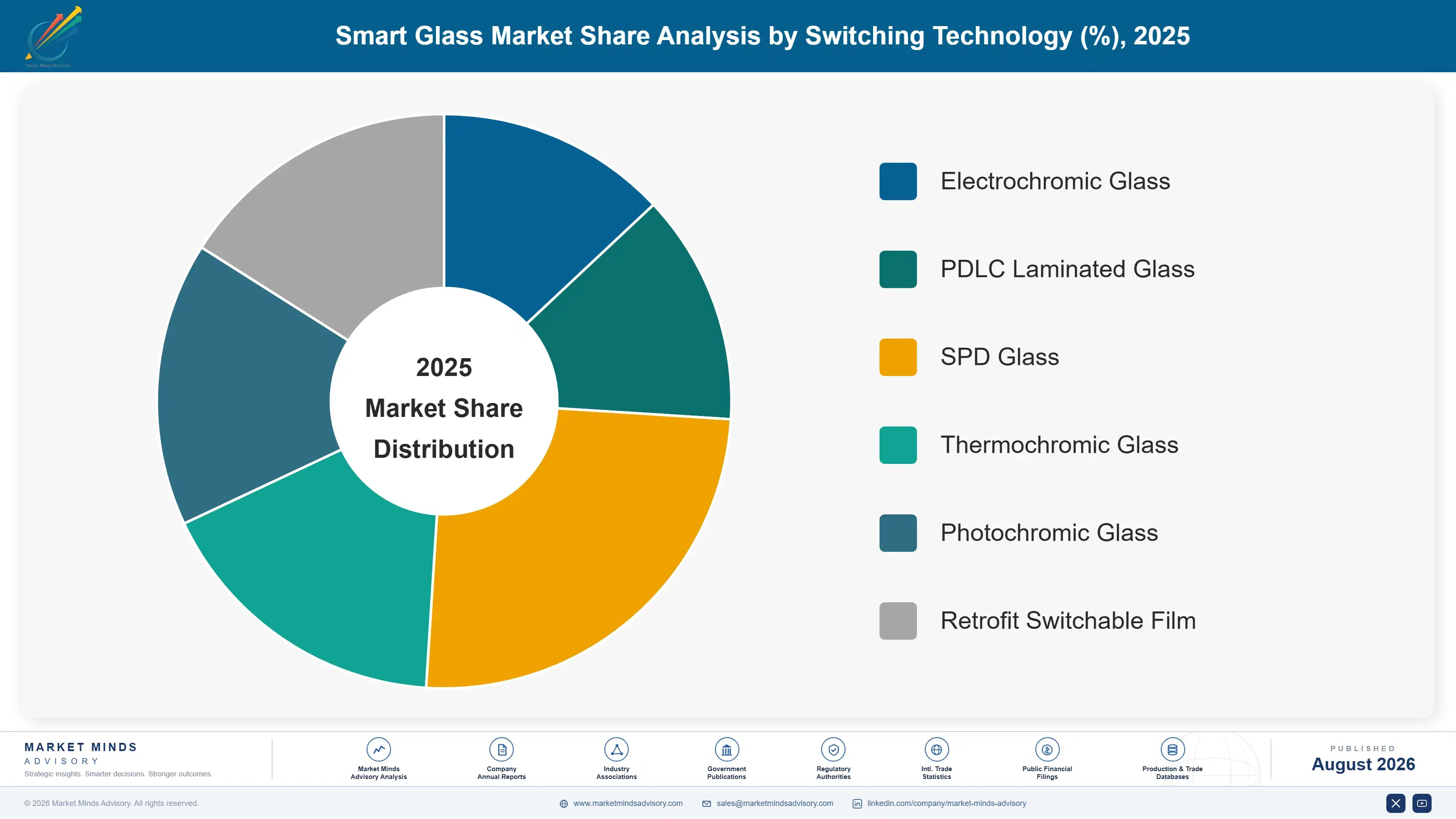
Six segments are split here by the switching technology, because technology determines switching speed, appearance when tinted, achievable pane size and which applications a product can realistically serve at all. Substrate and glazing build variants sit inside each technology rather than beside them. End-use application and sales channel are both handled in the framework instead.
smart-glass-market-trends-market-share-analysis-1787595195891

PDLC Laminated Glass

Growing at 13.8%, half again the market rate of 9.2%, polymer dispersed liquid crystal laminates switch between clear and opaque in milliseconds rather than minutes, which suits vehicles and privacy applications where waiting is unacceptable. The tradeoff is that the tinted state is diffuse rather than transparent, so it delivers privacy rather than view retention, and it requires continuous power to stay clear. Automotive panoramic roofs and interior partitions drive most demand. Manufacturing scale from vehicle applications is bringing unit costs down considerably faster than architectural volumes ever managed to. Continuous power is required to hold the clear state. Privacy rather than view retention is delivered. Interior partitions take much of the balance.
CAGR 13.8%

SPD Glass

At 11.0% suspended particle devices offer continuously variable transmission with switching in seconds rather than minutes, occupying useful ground between fast privacy glazing and slow architectural electrochromic. Aircraft cabin windows and premium automotive applications account for much of the demand, both being settings where switching speed and variable control both matter and cost tolerance is higher. The technology requires continuous power in the clear state and carries a characteristic dark blue appearance when off, which is a genuine constraint on architectural adoption. Cost tolerance is higher in aircraft and premium vehicle applications than in any building project, which is where the technology has found its most defensible positions so far.
CAGR 11.0%
Full segment breakdown across 6 segments available in the complete report.

Regional Architecture and Country Demand Map

East Asia currently holds 30% of the value on automotive glazing volume and on Chinese construction demand taken together. North America then follows at 26% on its deeper commercial architectural adoption, with Western Europe holding 22% of value on premium vehicle and architectural facade applications.

North America

Commercial architectural adoption is deeper here than anywhere, driven by energy code requirements and by developers seeking differentiation in office markets where tenant comfort affects letting. Facade consultants exercise considerable influence over specification and circulate durability experience among themselves, which means a visible failure travels quickly through the professional community. Automotive adoption is growing on premium and electric vehicle launches. Retrofit film applications are developing in existing office stock. Growth of 8.2% runs below the base case on cost against conventional alternatives. A visible failure travels quickly through the professional community and removes a manufacturer from consideration for years. Retrofit film applications are developing in existing office stock. Energy codes support adoption.
Share: 26% | CAGR: 8.2% (2026 to 2036)

Western Europe

Premium automotive manufacture drives a substantial share of regional demand, with German vehicle programmes adopting switchable roofs across model ranges. Architectural adoption is steady and constrained by cost, with energy performance regulation favouring the technology while procurement economics frequently do not. Occupant comfort standards in northern European workplaces are demanding and glare control matters considerably. Renovation of existing commercial stock creates retrofit film opportunity. Growth at 7.6% runs below the base case on architectural cost constraints rather than any technical objection. German vehicle programmes have adopted switchable roofs across whole model ranges. Occupant comfort standards in northern European workplaces are unusually demanding on glare. Renovation creates retrofit opportunity. Adoption stays steady.
Share: 22% | CAGR: 7.6% (2026 to 2036)
Regional intelligence for 5 additional markets available in the complete report: East Asia, South Asia and Pacific, Latin America, Middle East and Africa, Eastern Europe. Contact sales@marketmindsadvisory.com.
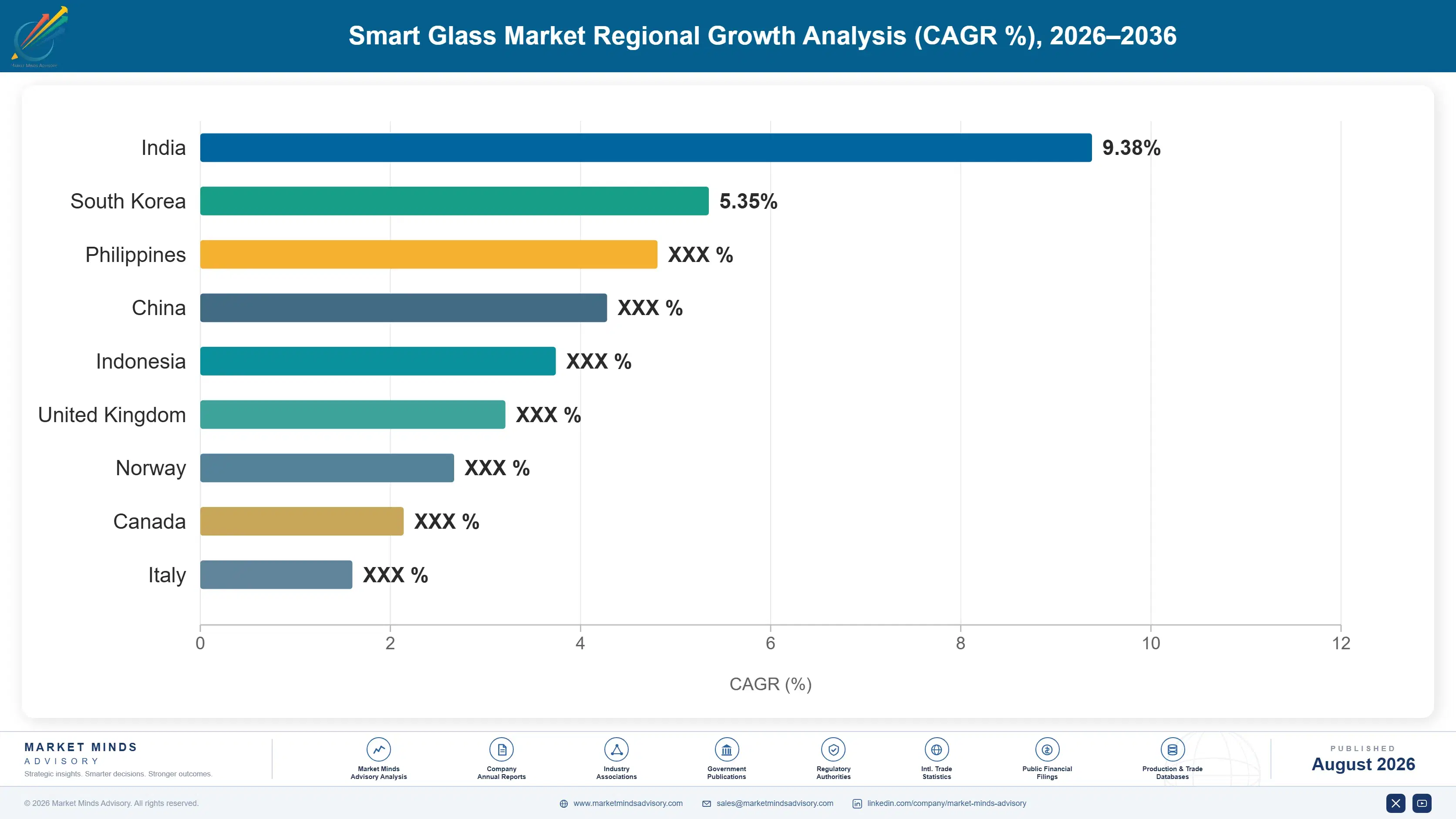
smart-glass-market-trends-country-cagr-analysis-1787595196417

Four Moves Past the Energy Model

An energy model gets the project approved and the occupant complaint file decides whether that owner ever specifies it again on the next one. At around 4.6 times the cost of blinds, the argument has to be about something that blinds genuinely cannot do rather than about modelled cooling load reduction on a spreadsheet.

Sell view retention rather than energy performance

Blinds achieve shading instantly, completely and cheaply, so competing on solar control against them is competing on their own ground at 4.6 times the price. What smart glass alone delivers is a tinted state that keeps the view, which occupants value and developers can see in a mock-up. That argument reaches a developer weighing tenant satisfaction rather than a consultant running a cooling load model, and it survives the cost comparison considerably better. Occupants notice it immediately and developers hear about it afterwards. The mock-up settles it faster than any model.
Market Impact: Justifies the whole 4.6 times cost premium properly

Fix the colour before adding transmission range

Around 26% of occupants raise tint colour as a specific complaint, and no amount of additional transmission range addresses a blue-grey cast across the view. Engineering effort in this industry concentrates on switching range and speed while the actual objection is chromatic. Neutral tinting is technically harder and commercially far more valuable, since it removes the complaint that turns a satisfied specifier into somebody who tries a competitor next time. Neutral tinting is harder to achieve and worth considerably more commercially. It removes the objection that loses the repeat specification.
Market Impact: Addresses 26% of all the occupant tint complaints

Ride automotive volume into architectural cost position

Switchable roofs reach around 18% of premium vehicle launches and are moving into mainstream ranges, bringing manufacturing volume that architectural projects never delivered. That scale is the only realistic route to narrowing a 4.6 times cost gap in construction. Manufacturers treating automotive and architectural as separate businesses forfeit exactly that benefit, and the ones sharing production learning between them are pulling ahead on cost quite visibly. Yield learning from vehicle volumes transfers directly into architectural production. Separate business units forfeit exactly that benefit. Sharing process development is what pulls a manufacturer ahead.
Market Impact: Uses the whole 18% automotive launch adoption base

Build the retrofit film business nobody is contesting

Switchable film on existing glazing reaches buildings that would never replace facade units for comfort, at a fraction of the 4.6 times cost that new glazing carries. Optical quality falls short of laminated products, which confines it to partitions and less demanding applications, and the addressable existing building stock is enormous by comparison with new construction. Remarkably few manufacturers have pursued it with any seriousness at all. The installed building stock dwarfs new construction by a very wide margin. Partitions and less demanding applications are where it fits. Almost nobody is contesting it at any scale.
Market Impact: Avoids the entire 4.6 times replacement cost outright

Who Controls the Margin Pool

Participation is measured on annual switchable glazing production area, and the top five hold 43%. Concentration reflects glass manufacturing scale and automotive qualification rather than switching technology, since several technologies work and none has won outright. Saint-Gobain and AGC lead through float glass positions that let them laminate and process at scale. The gap to specialists is manufacturing capability rather than device performance. Several technologies work and none has won outright.
Competition runs on three fronts. Automotive qualification decides access to the volume that is actually scaling, and vehicle programmes qualify suppliers over years. Durability record decides architectural specification, since facade consultants circulate warranty experience among themselves continuously. Optical quality decides occupant acceptance, which determines whether an owner specifies again. Repeat specification depends entirely on occupant acceptance.

Pressure ahead comes from Chinese glass manufacturers entering automotive switchable glazing at volume and from durability experience shaping architectural specification. Several architectural specialists have encountered severe financial difficulty, which has made consultants cautious about warranty backing. Expect automotive qualification investment rather than acquisitions. Rankings shift as vehicle volume grows and cost positions move. Cost positions are moving as vehicle volume grows.
smart-glass-market-trends-company-positioning-matrix-1787595196947

Competitive Moat and Risk Dimensions

SAINT-GOBAIN

Moat: Float glass and lamination scale

Owning float glass production and lamination capability means switchable devices integrate into an existing glass manufacturing chain rather than requiring a specialist to buy substrate and process it separately. That scale supports both automotive qualification and architectural warranty backing, which consultants weigh heavily after watching specialists encounter financial difficulty.
SAINT-GOBAIN

Risk: Slow architectural switching speed

Architectural electrochromic switching near seven minutes and a characteristic tint remain occupant objections that manufacturing scale does not address at all. Faster liquid crystal technologies are taking the automotive volume, and a position built on architectural electrochromic depends on a market that has grown slowly against a cheap and effective alternative.
GENTEX

Moat: Automotive electrochromic qualification depth

Decades of automotive electrochromic supply through mirror production created qualification relationships, manufacturing discipline and automotive-grade durability data that architectural specialists simply do not possess at all. As vehicle glazing volume grows, that qualification position transfers directly into a category where programmes decide suppliers over multi-year cycles.
GENTEX

Risk: Mirror business displacement risk

The electrochromic mirror business that built the company faces camera-based mirror replacement in several major markets, which threatens the volume base currently funding development work. Glazing growth must outpace that erosion, and camera systems are advancing faster in vehicle programmes than switchable glazing adoption is currently spreading anywhere.

Players Tracked

Prominent Players

Saint-Gobain
AGC
Gentex
Halio
Research Frontiers

Other Key Players

Nippon Sheet Glass
Guardian Glass
Corning
Gauzy
Smartglass International
Polytronix
ChromoGenics
Merck KGaA
Resonac
Fuyao Glass
Xinyi Glass
Vitro
Pleotint
Glass Apps
Sage Electrochromics

Recent Developments

MARCH 2026

Vehicle manufacturer extends switchable roof across mainstream model range

A vehicle manufacturer extended switchable panoramic roof glazing from premium trims into mainstream model variants, citing cabin thermal management and interior differentiation. Order volumes moved switchable glazing production into a scale that architectural demand has never approached. Interior differentiation was cited alongside thermal management. Volumes moved beyond architectural scale.
Signal: Automotive volume rather than any building project is what will eventually move the manufacturing cost down
SEPTEMBER 2025

Facade consultants circulate durability findings across specification community

Facade consultants circulated durability findings from ageing architectural installations, covering edge seal integrity and bus bar corrosion observed well within expected building lifetimes. Several manufacturers were informally removed from specification consideration across multiple practices. Observations covered installations well within their expected service lives. Specification lists changed quietly.
Signal: Durability experience travels through the whole consultant community considerably faster than any marketing effort ever does
JANUARY 2026

Occupant survey identifies tint colour as principal complaint

An occupant satisfaction survey across completed installations identified tint colour appearance rather than switching speed or transmission range as the principal complaint raised. Building owners cited it when deciding whether to specify the technology on subsequent developments. Switching speed ranked well below colour in the responses.
Signal: Chromatic neutrality matters far more to repeat specification than any transmission range ever does in practice

Glass, Films and Conductive Coatings

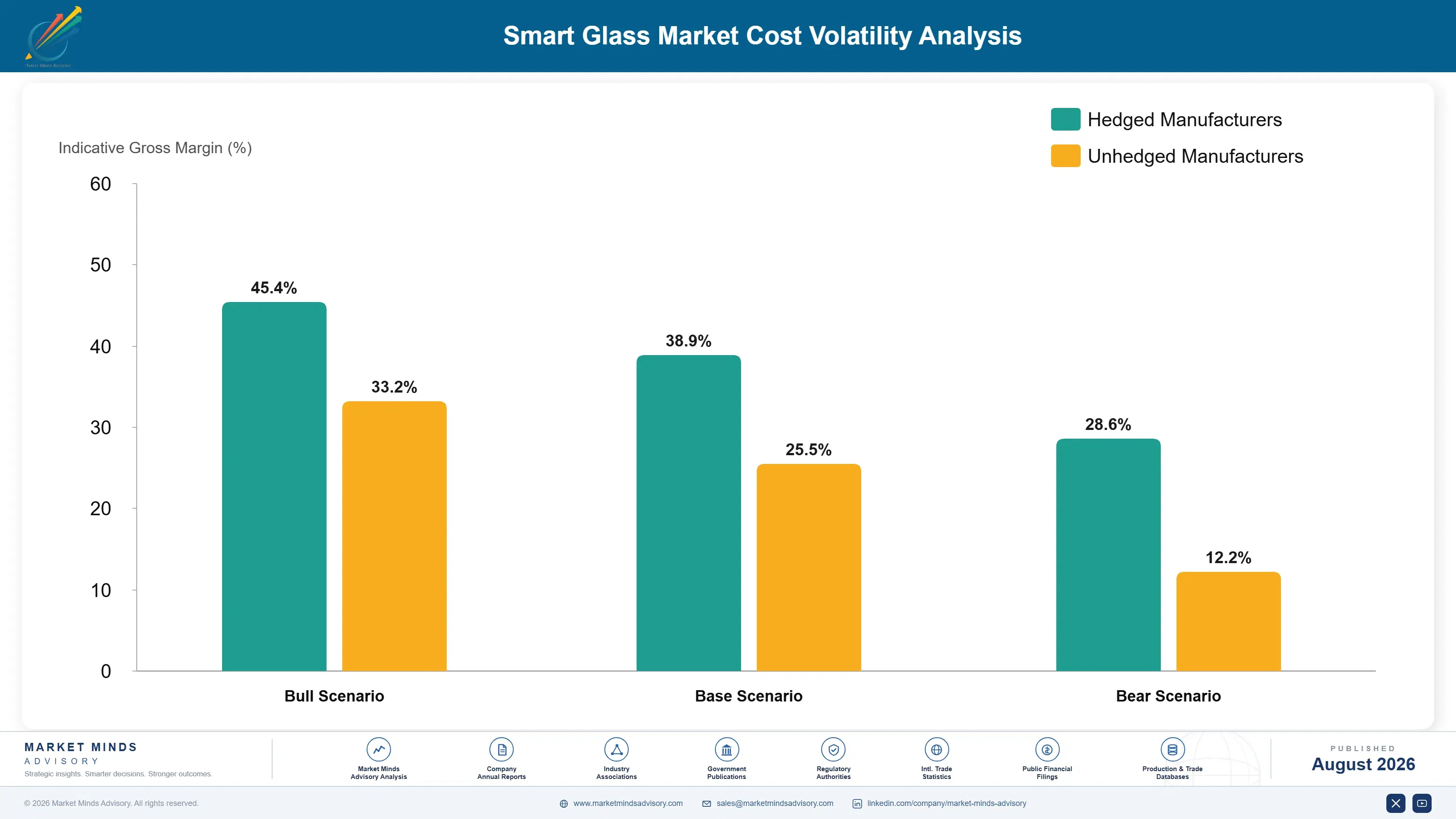
Transparent conductive coating accounts for roughly 24% of device cost, principally indium tin oxide deposited by sputtering, which carries both material and vacuum processing expense. Glass substrate carries about 19%. Active layer materials, whether electrochromic films, liquid crystal or suspended particle formulations, take around 22%. Lamination, edge sealing, electrical connection and yield loss absorb the balance across a process with unforgiving quality requirements.
Indium pricing moved on supply concentration and by-product zinc production through the period, per national statistical office reporting, and indium arrives largely as a by-product of zinc refining rather than being mined directly for its own sake. Energy costs for vacuum coating rose alongside industrial electricity generally. Yield loss remains the largest hidden cost, since a defect in a large architectural pane discards the whole unit.

Exposure divides on scale and on yield. A manufacturer running automotive volumes achieves yields that architectural producers making bespoke pane sizes cannot approach, and yield differences dominate every other cost consideration in this industry. Indium exposure is common to most technologies, though alternative transparent conductors are being pursued precisely because the supply position is uncomfortable for anybody planning volume growth.
smart-glass-market-trends-cost-volatility-analysis-1787595197147

Share production learning between automotive and architectural lines

Automotive volumes deliver yield learning that bespoke architectural pane production cannot generate on its own, and yield dominates every other cost consideration in this industry. Manufacturers treating the two as separate businesses forfeit that transfer entirely. Those sharing process development between them are pulling ahead on cost in ways that show up directly in architectural quotations.

Qualify alternative transparent conductors ahead of volume growth

Indium tin oxide is around 24% of device cost and indium arrives as a by-product of zinc refining rather than being mined for itself, which makes supply respond to entirely unrelated economics. Alternative conductors are being developed precisely because that position is uncomfortable. Qualification takes years, and starting after a supply problem appears is starting far too late.

Attack yield loss before attacking material cost

A defect in a large architectural pane discards the entire unit, which makes yield the largest hidden cost in this business by a considerable margin. Material cost reduction efforts deliver less than process control improvements do at current yield levels. Manufacturers benchmarking themselves on material cost while running poor yields are optimising the smaller number entirely.

Portfolio Architecture for Margin Defence

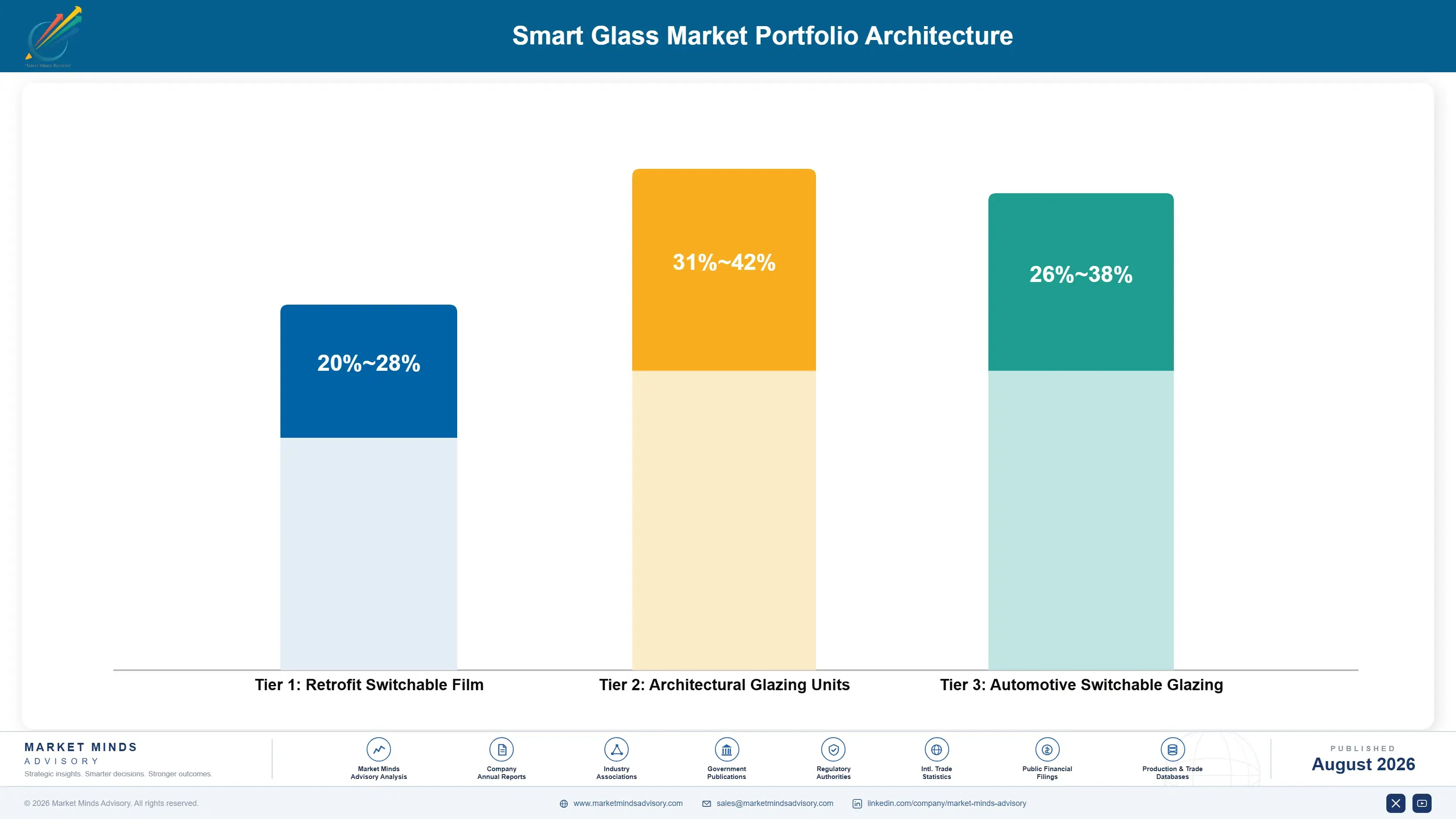
Margin here follows application rather than technology, because the same device earns very differently depending on what it is fitted to. Retrofit switchable film earns margins in the low twenties, since optical quality is limited, installation is straightforward and buyers compare it directly against conventional window film and blinds. Installation is straightforward and the channel is fragmented. Nothing about it supports a premium.
Architectural glazing units do better in the low to mid thirties, because facade projects tolerate premium pricing where glare and view retention matter, though warranty exposure across a ten year term sits against that margin and occasionally consumes it entirely when an installation fails visibly. A visible failure can consume the margin on a whole project. Glare and view retention justify premium pricing.

Automotive switchable glazing holds a different position again, running in the mid twenties to high thirties, because vehicle programmes negotiate hard on price while qualification creates multi-year supply positions. Those margins reflect volume certainty rather than pricing power, which is a trade most manufacturers now accept willingly. Volume certainty is the trade most manufacturers now accept. Qualification creates multi-year supply positions.

Retrofit Switchable Film

Film applied to existing glazing for privacy and comfort improvement. The eight point range reflects installation channel and product quality rather than technology, since buyers compare against conventional film and blinds.
Gross Margin: 20-28%

Architectural Glazing Units

Insulated glazing units with integrated switching supplied directly into facade applications. The eleven point range reflects project specification value set against warranty exposure carried across a ten year installed term.
Gross Margin: 31-42%

Automotive Switchable Glazing

Vehicle roof and window glazing qualified into automotive production programmes directly. The twelve point range reflects volume certainty and qualification position rather than any pricing power over the vehicle manufacturer.
Gross Margin: 26-38%
smart-glass-market-trends-portfolio-architecture-1787595197652

High-value Sub-segments and Strategic Watch-out

Automotive Switchable Glazing

High value on volume rather than price, reaching around 18% of premium launches and moving into mainstream ranges. Qualification creates multi-year supply positions that architectural projects never provide to anybody. Vehicle programmes negotiate hard on price and qualify over years. Feedback arrives fast here. Volume beats price.
Gross Margin: 28-38%

Fast Switching Privacy Applications

High value and the fastest growth at 13.8%, since millisecond switching suits vehicles and partitions where minutes are unacceptable. Privacy rather than view retention is what the diffuse tinted state actually delivers. Continuous power is needed to hold the clear state. Diffuse tinting is the trade.
Gross Margin: 33-44%

Retrofit Switchable Film

The volume opportunity nobody is contesting seriously, reaching existing buildings that would never replace glazing for comfort. Optical quality limits it to partitions and less demanding applications throughout. Buyers compare directly against conventional film and blinds. Installation is straightforward. Channel is fragmented and installer-led. Nobody contests it.
Gross Margin: 20-28%

Architectural Warranty Exposure

The strategic watch-out. Ten year terms sit against facade lifetimes several times longer, and the range reflects how far a manufacturer has tested edge seal and connection durability properly. Edge seal and bus bar durability cannot be accelerate-tested convincingly. Failures remove specification. Facade lifetimes far exceed terms.
Gross Margin: 14-42%

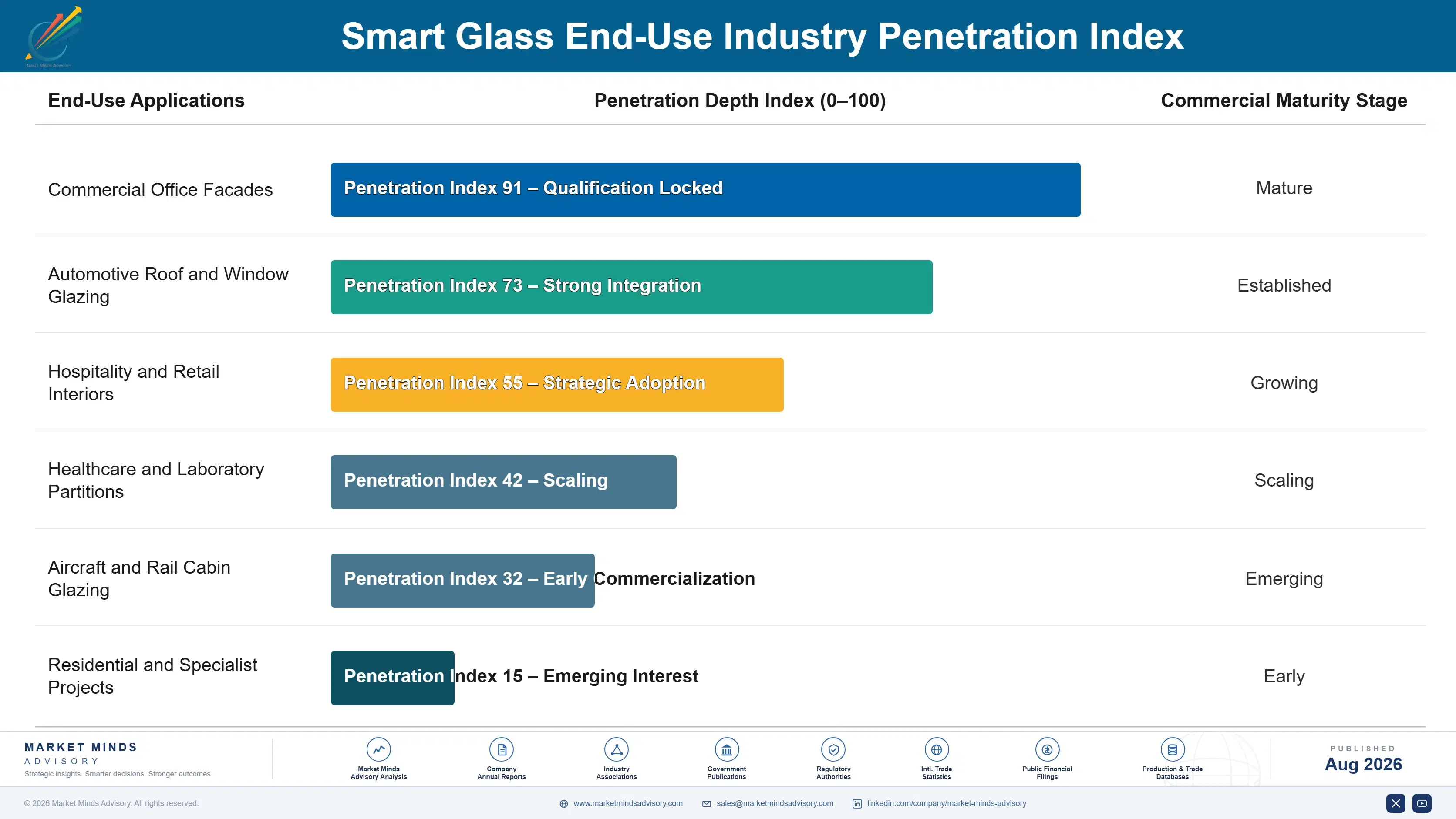
Specified Once, Judged Afterwards

Architectural demand arrives project by project through a specification decision made years before anybody occupies the building. A facade consultant recommends, a developer approves on cost and differentiation, and occupants form a view long after both have moved on. That separation means the feedback that should improve products reaches manufacturers slowly and through consultants rather than directly from anybody using the glass. Feedback reaches manufacturers slowly and second hand.
Automotive demand behaves completely differently and far more usefully. A vehicle programme qualifies a supplier over years and then buys predictably across the model life, which delivers volume certainty that architectural work never provides. Consumer feedback also reaches manufacturers faster through vehicle quality processes than architectural feedback ever does through a facade consultant. Vehicle quality processes report faults quickly.

The repeat specification decision is where value actually accumulates. A developer who has fielded occupant complaints about tint on one building specifies differently on the next, and facade consultants circulate that experience among themselves continuously. Around 26% raising colour as a complaint therefore threatens far more than the individual project it appeared on. One complaint threatens far more than one project.
smart-glass-market-trends-end-use-penetration-index-1787595198147

Where We Would Focus Effort

These are among the four positions where our research anticipates prominent divergence between winners and laggards over the coming forecast period. Each is grounded in the demand model, the regulatory perimeter, and the announced capacity pipeline.
01 / VIEW RETENTION POSITIONING

Compete where blinds genuinely cannot follow

Automated blinds achieve shading instantly, completely and at a small fraction of the cost, which makes competing on solar control against them a losing argument at around 4.6 times the price. What switchable glazing alone delivers is a tinted state that preserves the view outward, which occupants value and a developer can see immediately in a mock-up. That argument reaches somebody weighing tenant satisfaction rather than a consultant running a cooling load model, and it survives the cost comparison rather better.
02 / CHROMATIC NEUTRALITY ENGINEERING

Nobody complains about transmission range

Around 26% of occupants raise tint colour as their specific complaint, and no amount of additional transmission range or faster switching addresses a blue-grey cast lying across the view outside the window. Engineering effort across this industry concentrates on range and speed while the actual objection people actually voice is chromatic. Neutral tinting is technically harder and commercially far more valuable, because it removes the complaint that turns a satisfied specifier into somebody trying a competitor on the next project.
03 / AUTOMOTIVE SCALE TRANSFER

One business, not two separate ones

Switchable roofs now reach around 18% of premium vehicle launches and are moving into mainstream ranges, bringing manufacturing volume and yield learning that architectural projects have never come close to actually delivering to anybody. That scale is the only realistic route to narrowing a 4.6 times cost gap in construction applications at all. Manufacturers treating automotive and architectural as separate businesses forfeit exactly that transfer, and those sharing process development between them are pulling ahead on cost quite visibly already.
04 / RETROFIT MARKET ENTRY

The existing buildings nobody is selling to

Switchable film applied to existing glazing reaches an enormous installed building stock that would never justify replacing facade units purely purely for a comfort improvement, at a fraction of what new glazing costs. Optical quality falls short of laminated products, which confines it to partitions and less demanding applications rather than any premium facade work. Remarkably few manufacturers have pursued this seriously, which leaves a large and genuinely uncontested opportunity sitting sitting available to whoever actually chooses to move first.

Engagement Snapshot From the Field

A live engagement with an industry participant carrying material or product regulatory and market exposure ahead of a defining policy shift, showing how our research translates into a defensible multi-year portfolio strategy.
MARKET MINDS ADVISORY · CLIENT ENGAGEMENT SUMMARY
Smart Glass Producer Strategic Portfolio Review and Transition Roadmap 2026·Investment Scenario on Smart Glass Exposure Evaluation 2025-26
CLIENT PROFILE
A European switchable glazing manufacturer supplying architectural electrochromic units to commercial projects across eight markets, at annual revenue near 96 million euros (client-reported, unverified by MMA). Engineering investment concentrated on transmission range and switching speed, and no automotive qualification or retrofit film product existed anywhere in the range or anywhere at all under active development.
STRATEGIC CHALLENGE
Repeat specification from developers who had used the product once had fallen sharply, and two facade consultancies had removed the company from consideration entirely. Management attributed the whole decline to price competition and were preparing to reduce architectural pricing right across the whole architectural range in direct response to it.
MMA APPROACH
MMA surveyed occupant and developer feedback across completed installations, benchmarked cost position against automotive-scale producers, assessed retrofit film opportunity in the client's markets, and traced why the two consultancies had removed the company from specification lists. Interviews with 47 experts covered facade consulting practice, glazing manufacture and automotive programme qualification.
KEY FINDINGS
  1. Developers declining to specify again cited occupant complaints about tint colour rather than price, and the same complaint appeared consistently across every completed installation surveyed.
  2. Both consultancy removals followed durability observations at ageing installations rather than any commercial consideration, and neither had been communicated to the client directly.
  3. Automotive-scale producers held cost positions the client could not reach through architectural volume alone, regardless of how efficiently it ran its existing production line.
  4. Retrofit film opportunity in the client's markets exceeded its entire architectural revenue and was being addressed by almost nobody at any meaningful scale.
CLIENT PROFILE
A European switchable glazing manufacturer supplying architectural electrochromic units to commercial projects across eight markets, at annual revenue near 96 million euros (client-reported, unverified by MMA). Engineering investment concentrated on transmission range and switching speed, and no automotive qualification or retrofit film product existed anywhere in the range or anywhere at all under active development.
STRATEGIC CHALLENGE
Repeat specification from developers who had used the product once had fallen sharply, and two facade consultancies had removed the company from consideration entirely. Management attributed the whole decline to price competition and were preparing to reduce architectural pricing right across the whole architectural range in direct response to it.
MMA APPROACH
MMA surveyed occupant and developer feedback across completed installations, benchmarked cost position against automotive-scale producers, assessed retrofit film opportunity in the client's markets, and traced why the two consultancies had removed the company from specification lists. Interviews with 47 experts covered facade consulting practice, glazing manufacture and automotive programme qualification.
KEY FINDINGS
  1. Developers declining to specify again cited occupant complaints about tint colour rather than price, and the same complaint appeared consistently across every completed installation surveyed.
  2. Both consultancy removals followed durability observations at ageing installations rather than any commercial consideration, and neither had been communicated to the client directly.
  3. Automotive-scale producers held cost positions the client could not reach through architectural volume alone, regardless of how efficiently it ran its existing production line.
  4. Retrofit film opportunity in the client's markets exceeded its entire architectural revenue and was being addressed by almost nobody at any meaningful scale.
RECOMMENDED STRATEGY
Phase 1: Phase one: redirect engineering from transmission range toward chromatic neutrality, since colour rather than performance is what stops developers specifying again. Phase 2: Phase two: enter retrofit switchable film, where the addressable opportunity exceeds architectural revenue and serious competition is almost entirely absent. Phase 3: Phase three: abandon the architectural price reduction, since specification losses were caused by tint and durability rather than by any pricing position.
OUTCOME
The manufacturer redirected engineering toward neutral tinting during 2026 and launched a retrofit film range (client-reported, unverified by MMA). Durability findings were addressed with both consultancies directly, and the planned price reduction was cancelled as irrelevant to the actual problem. Repeat specification recovered at two developers.

Frequently Asked Questions

Foundational context covering the market sizes, CAGR, scope, country, region and competition that inform every finding below. This section is provided to cover basics and most often pre-purchase conversations, answered from the MMA Primary Research Dataset.

What is the current size of the Smart Glass Market?

MMA sizes it at USD 5.8 billion in 2025, rising to USD 6.33 billion in 2026. The figure covers glazing products whose light transmission changes actively or passively at manufacturer selling value.

How large will the Smart Glass Market be by 2036?

USD 15.26 billion by 2036, an incremental USD 8.93 billion over the 2026 base and an expansion multiple of 2.41 times. Automotive applications account for a disproportionate share.

What is the CAGR for the Smart Glass Market 2026 to 2036?

9.2% in the base case, with a bull case at 10.4% and a bear case at 8.0%. The spread turns on automotive volume driving cost down and on architectural durability experience.

Which segment is growing fastest?

PDLC laminated glass at 13.8%, half again the market rate of 9.2%. Millisecond switching suits vehicles and privacy applications where waiting minutes is entirely unacceptable.

Who are the major companies in the Smart Glass Market?

Saint-Gobain, AGC, Gentex, Halio and Research Frontiers lead on switchable glazing production area. Fifteen further participants are profiled in the full report on that basis.

Which country is growing fastest?

China at 15.4%, as electric vehicle manufacturers adopt switchable panoramic roofs to differentiate their interiors and manage cabin heat without carrying any mechanical blind weight.

Report Segmentation Architecture

The full report scope spans multiple orthogonal segmentation dimensions, with cross-tabulated demand data provided for each dimension pair. Coverage extends further to regional breakdowns, trend trajectories, and the competitive detail needed to support segment-level decision-making.

By Switching Technology

  • Electrochromic Glass
  • PDLC Laminated Glass
  • SPD Glass
  • Thermochromic Glass
  • Photochromic Glass
  • Retrofit Switchable Film

By End-Use Industry

  • Commercial Office Facades
  • Automotive Roof and Window Glazing
  • Hospitality and Retail Interiors
  • Healthcare and Laboratory Partitions
  • Aircraft and Rail Cabin Glazing
  • Residential and Specialist Projects

By Commercial Dimension

  • Architectural Project Specification
  • Automotive Programme Supply
  • Retrofit and Renovation Channels
  • Glazing Fabricator Partnerships
  • Distributor and Installer Networks
  • Export and Cross-Border Supply

By Region

  • North America
  • Western Europe
  • East Asia
  • South Asia and Pacific
  • Latin America
  • Middle East and Africa
  • Eastern Europe

Scope, Methodology, and Coverage

Every figure in this report is reproducible from documented input assumptions. The scope below maps the historical period, the forecast horizon, the segmentation dimensions, and the countries covered, alongside the underlying primary and qualitative methodology.
Historical Period
2020 to 2025
Forecast Period
2026 to 2036
Base Year
2025 (USD billions; MMA Primary Research Dataset, August 2026)
Market Definition
Glazing products whose light transmission changes actively or passively, covering electrochromic glass, polymer dispersed liquid crystal laminated glass, suspended particle device glass, thermochromic glass, photochromic glass, and retrofit switchable film applied to existing glazing. Measured at manufacturer selling value for the glazing or film product across all applications. Conventional solar control and low emissivity coatings, mechanical shading systems, building management software, and vehicle glazing without switching capability are excluded from scope.
Quantitative Units
USD billions (current prices); million square metres of switchable area; USD per square metre by technology
Segmentation Dimensions
Switching technology; end-use application; commercial dimension; region
Regions Covered
North America, Western Europe, East Asia, South Asia and Pacific, Latin America, Middle East and Africa, Eastern Europe
Countries Covered
China, Japan, South Korea, Taiwan, India, Singapore, Australia, United States, Canada, Mexico, Germany, France, United Kingdom, Netherlands, Italy, Poland, Brazil, Saudi Arabia, United Arab Emirates, South Africa
Key Companies Profiled
Saint-Gobain, AGC, Gentex, Halio, Research Frontiers, Nippon Sheet Glass, Guardian Glass, Corning, Gauzy, Smartglass International, Polytronix, ChromoGenics, Merck KGaA, Resonac, Fuyao Glass, Xinyi Glass, Vitro, Pleotint, Glass Apps, Sage Electrochromics
Quantitative Methodology
Primary survey, n=3,800 respondents, Q4 2025, six countries; demand-side model with trade association cross-validation
Qualitative Methodology
47 expert interviews, Q4 2025; applied to validate demand model assumptions, identify emerging dynamics, and assess competitive positioning
Report Format
PDF and XLSX data workbook (Word format preview document)
Publisher
Market Minds Advisory
Report Code
MMA-2026-CON-115
Published
August 2026
Contact
sales@marketmindsadvisory.com | www.marketmindsadvisory.com

Purchase the full Smart Glass Market Report (2026 to 2036).

The full report separates the specifier's business case from the occupant's experience, because the first wins a project and the second decides whether anybody specifies the technology again. It sizes all six switching technologies independently through 2036, models installed cost against automated blind alternatives by application, and assesses architectural warranty exposure against observed durability across ageing installations. Regional chapters cover all seven regions with automotive and architectural demand separated throughout, since the two behave entirely differently. Competitive profiling covers 20 participants on a single production area basis.
Six switching technologies sized independently through 2036
Installed cost modelled against automated blind alternatives by application
Occupant complaint data assessed against repeat specification behaviour
Warranty exposure benchmarked against observed installation durability
Twenty participants profiled on one consistent production area basis
Automotive and architectural demand separated across every region

Built For The People Who Decide

From boardroom strategy to bench-side execution, this report is read cover-to-cover by leaders shaping the next decade of their industry, turning demand scenarios, market dynamics and valuation benchmarks into decisions.
CXOs/ Presidents/ VPs/ Managers
M&A and Corporate Development
Strategy Teams and R&D Heads
Procurement and Product Directors
Regulatory and Compliance Leaders
Investor Relations and Equity Analysts