

Market Minds Advisory
Smart Eyewear Market

Smart Eyewear Market: Smart Eyewear Market. Trends and Forecast 2026 to 2036

Generative AI assistants embedded directly into eyewear are pulling smart glasses past niche early-adopter status, forcing established eyewear brands to partner with technology companies as camera and audio integration reshapes consumer expectations.

Lead Analyst

Published

September 2026

Make Smarter Decisions with Customized Research Insights

Request a free sample report and evaluate market opportunities, growth trends, and competitive dynamics relevant to your business needs.

2025 MARKET VALUE$3.2BMarket Size 2025
2036 FORECAST VALUE$16.4BBase Case , 2026 to 2036
CAGR 2026 TO 203616.0 %Bull 17.4% / Bear 14.7%
INCREMENTAL OPPORTUNITY$12.7BNet 10- year value creation
EXPANSION MULTIPLE4.41x2036 value over 2026 base
Strategic Levers
M&A Pipeline
Regional Outlook
Country Rankings
Competitive Intelligence
Segmental Deep-dive
Call-Us : 91 93563 13602

Executive Snapshot and Market Trajectory.

Smart eyewear is shifting from a niche augmented reality experiment into a mainstream AI assistant form factor, as camera-equipped glasses with voice interaction capability find broader appeal than earlier bulky headset alternatives ever achieved among everyday mainstream consumers worldwide today across most age groups.
Commercial demand concentrates around AI-enabled multimodal glasses combining camera, microphone, and speaker functionality for hands-free assistant interaction, with fashion eyewear brand partnerships increasingly determining consumer adoption more than raw technical specification comparisons alone across most price tiers and demographics. North America leads given concentrated technology company headquarters and the largest early-adopter consumer base willing to pay premium prices for AI-integrated wearable devices ahead of broader mainstream price sensitivity.
Competitive intensity remains high, with the top five brands controlling roughly 52% of global revenue given the platform integration and brand partnership advantages that favor established technology companies over smaller independent eyewear startups across most product categories and price segments worldwide. Rising demand for on-device AI processing and extended battery life is reshaping which manufacturers can command premium pricing, favoring companies with proprietary chip design over competitors dependent entirely on off-the-shelf component sourcing.
Market Definition
The Smart Eyewear Market covers glasses embedding cameras, microphones, speakers, displays, or sensors that enable AI assistant interaction, augmented reality overlay, or health monitoring functionality beyond standard vision correction or sun protection. It excludes traditional non-electronic prescription and sunglasses categories.
Base Year Value
$3.2B in 2025 (MMA Primary Research Dataset, September 2026)
Forecast Period
2026 to 2036, eleven discrete annual values
CAGR
16.0% base case. Bull 17.4%. Bear 14.7%.
Fastest Growth Segment
AI-Enabled Multimodal Smart Glasses: 21.0% CAGR
Fastest Growth Country
China: 18.5% CAGR
Fastest Growth Region
South Asia and Pacific: 18.0% CAGR
Largest Region
North America: 32% of 2025 global value
Market Leaders
Leading participants include Meta, EssilorLuxottica, Google, Amazon, and Xiaomi. Source: MMA Analysis based on company annual reports.
Primary Survey
n=3,800 procurement and R&D decision-makers, Q4 2025, six countries
Methodology
Demand-side build-up, cross-validated against public data, 47 expert interviews

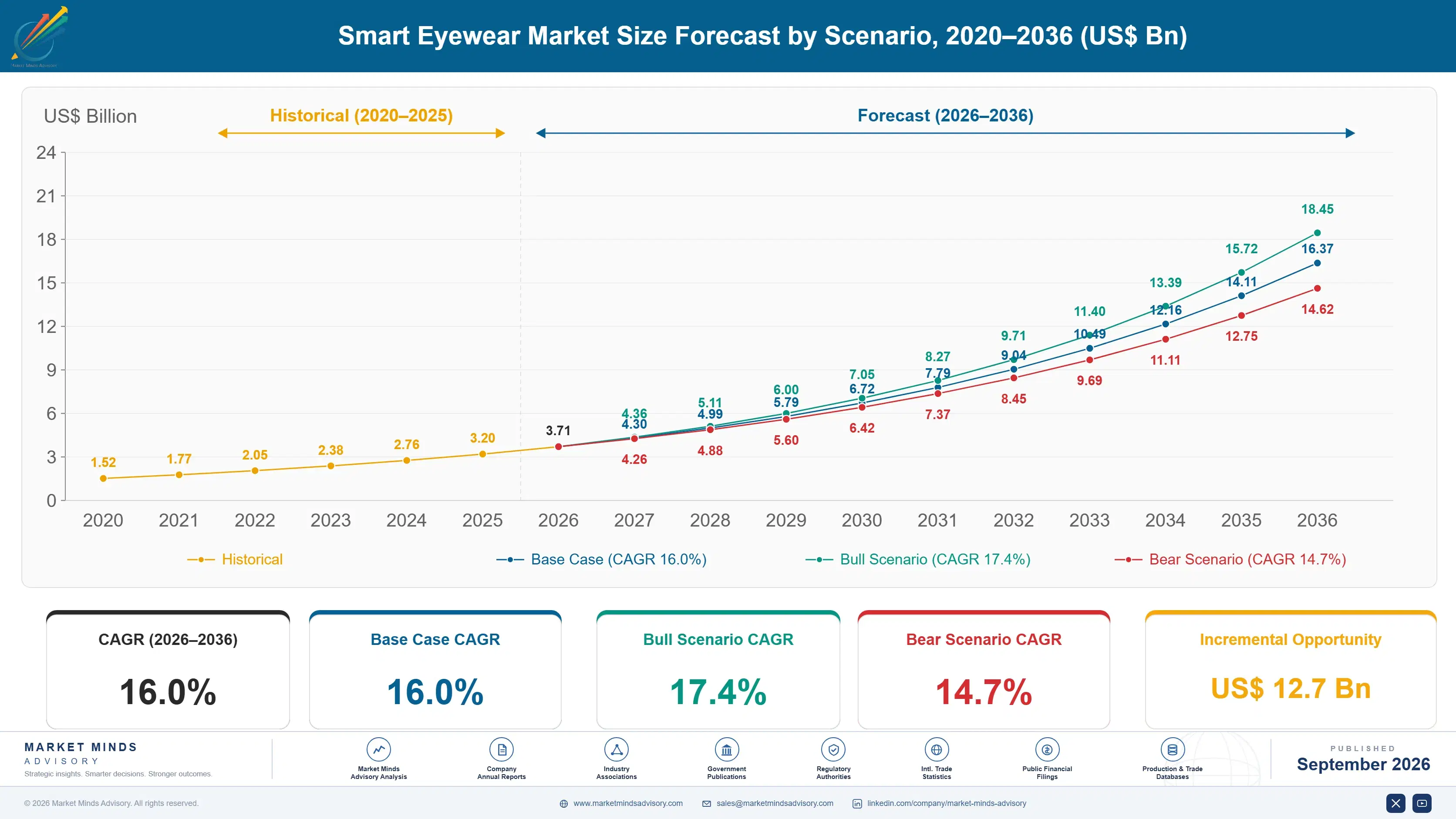
Smart Eyewear Market Forecast Scenarios

smart-eyewear-market-size-forecast-scenario-1789990274970
Smart eyewear grew from a small base through 2020 to 2025 as early camera-equipped glasses struggled to find mainstream appeal given bulky designs and limited battery life relative to standard eyewear. Growth accelerated sharply toward the end of the historical period as generative AI assistant integration and improved fashion eyewear partnerships expanded consumer appeal, pushing the historical CAGR to 14.5% by the period's close.
The base case assumes generative AI assistant demand and fashion eyewear brand partnerships keep expanding smart eyewear adoption through the forecast decade across most consumer segments. Three mechanisms drive this: declining component cost making AI-enabled glasses accessible below premium price thresholds, expanding on-device processing capability reducing dependence on smartphone tethering for core functionality, and fashion eyewear brands lending design credibility that earlier purely technology-company-led product launches lacked among mainstream consumers.
The bull case centers on generative AI assistants becoming a default expectation for everyday eyewear, pulling adoption forward faster than the base case assumes across broader demographic segments. The bear risk is privacy backlash: if concerns over camera-equipped glasses recording bystanders without consent intensify further, regulatory restrictions could constrain feature availability and slow adoption meaningfully across several major consumer markets.

Where Fashion Partnerships Determine Consumer Adoption

Smart eyewear has shifted from a technology-company-led product category into a fashion-technology hybrid, since consumer purchase decisions increasingly weigh brand design credibility alongside AI assistant capability rather than technical specifications alone. Established eyewear brands partnering with technology companies are capturing disproportionate share of premium consumer segments that earlier purely tech-branded products struggled to reach given design and fashion credibility gaps.
MARKET CONCENTRATION52% CR5Top five brands control global smart eyewear revenue share
AVERAGE SELLING PRICE$320 per unitBlended average retail price across camera-equipped and display-enabled categories
TOP SELLING COUNTRY SHARE36%United States share of global smart eyewear unit sales currently
BATTERY LIFE AVERAGE6 to 8 hoursTypical continuous usage duration before recharging on most models
COMPONENT COST SHARE48% of unit costCamera, chip, and battery portion of total device manufacturing cost
RETURN RATE14%Average product return rate across smart eyewear retail channels currently
The United States represents the largest single-country market given concentrated technology company headquarters and the largest early-adopter consumer base willing to pay premium prices ahead of broader mainstream cost sensitivity. Component cost, particularly camera modules and processing chips, represents a substantial share of total device manufacturing cost, exposing manufacturers to semiconductor supply chain volatility that periodically affects the broader consumer electronics industry.
Battery life remains a persistent constraint limiting all-day usage without recharging, a limitation manufacturers are addressing through more efficient on-device processing and improved battery chemistry across successive product generations and design iterations. Return rates run higher than typical consumer electronics categories, reflecting the still-maturing nature of use cases and occasional buyer's remorse among consumers purchasing primarily for novelty rather than established daily utility.
"Smart glasses used to be a technology demo looking for a use case. Now AI assistants have given them one, and that single shift has turned a decade of failed product launches into a genuine growth category."
Director, Consumer Wearables and AI Hardware Practice · MMA Technology Practice · September 2026

Market Trends

AI Assistant Integration Redefines Smart Eyewear Value Proposition

Generative AI assistant capability embedded directly into eyewear, allowing hands-free voice interaction for translation, visual identification, and information lookup, has fundamentally changed what consumers expect from smart glasses compared to earlier camera-only or display-only product generations. This integration requires substantial on-device or cloud-connected processing capability, favoring manufacturers with existing large language model infrastructure and partnerships over smaller independent eyewear companies lacking comparable artificial intelligence platform access. Companies combining fashion eyewear design credibility with proprietary AI assistant technology are capturing disproportionate consumer attention compared to purely technology-focused competitors lacking design partnership relationships with established eyewear brands.
Market Impact: Expands addressable market by roughly 40%

Fashion Eyewear Brand Partnerships Drive Mainstream Adoption

Technology companies are increasingly partnering with established fashion eyewear brands rather than launching standalone hardware products, recognizing that design credibility and existing retail distribution relationships matter more to mainstream consumers than technical specification advantages alone. These partnerships give technology companies access to established manufacturing expertise in comfortable, durable eyewear construction that earlier purely technology-led product launches often lacked, contributing to poor comfort ratings and limited daily wear adoption. This partnership model is expanding the addressable consumer base beyond early-adopter technology enthusiasts toward mainstream fashion-conscious consumers who previously viewed smart glasses as impractical novelty items.
Market Impact: Cuts smartphone dependence by roughly 35%

Market Opportunities and Growth Drivers

Declining Component Cost Expands Addressable Market

Camera modules, processing chips, and battery components have declined meaningfully in cost as consumer electronics manufacturers scale production volume and semiconductor manufacturing efficiency improves across the broader industry supply chain worldwide. This cost decline is allowing manufacturers to introduce AI-enabled smart eyewear at price points accessible to mainstream consumers rather than only affluent early adopters willing to pay substantial premiums for novel technology. Expanding the addressable market beyond premium price segments is creating meaningfully larger unit volume opportunity than the category achieved when products remained priced primarily for technology enthusiasts.
Market Impact: Battery limits usage to 6 hours

On-Device AI Processing Reduces Smartphone Dependence

Improved on-device artificial intelligence processing capability is reducing smart eyewear dependence on continuous smartphone tethering for core functionality, addressing a persistent friction point that limited earlier product generations' practical daily usability for many consumers worldwide and across most usage occasions. This technical advancement allows glasses to perform more sophisticated tasks independently, including real-time translation and visual object identification, without requiring constant connectivity to a paired smartphone device nearby at all times. Manufacturers achieving greater on-device processing independence are differentiating meaningfully from earlier generation products that functioned primarily as smartphone accessories.
Market Impact: Privacy concerns limit adoption by 15%

Market Restraints and Challenges

Battery Life Constraints Limit All-Day Usage

Current smart eyewear battery capacity cannot reliably support all-day continuous usage including camera capture and AI assistant interaction, requiring midday recharging that undermines the convenience proposition central to everyday eyewear replacement. The root cause is the limited physical space available within eyewear form factors for battery cells, constrained by consumer expectations for lightweight, comfortable, fashion-appropriate frame designs. Manufacturers are mitigating this through more efficient chip architecture reducing power consumption and improved battery chemistry, alongside charging case accessories that supplement device battery capacity throughout a full day of typical daily usage patterns.
Market Impact: AI-enabled unit sales grow over 45%

Privacy Concerns Constrain Camera Feature Adoption

Public concern over camera-equipped glasses recording bystanders without explicit consent has generated meaningful social and regulatory pushback, constraining feature availability and adoption in certain public settings and jurisdictions with stricter privacy regulation. The root cause is the inherently discreet nature of glasses-mounted cameras, which lack the obvious visual cues that signal recording activity compared to handheld cameras or smartphones held up for photography. Manufacturers are mitigating this through visible recording indicator lights and audio announcements when capture begins, though critics argue these measures remain insufficient to fully address underlying privacy concerns.
Market Impact: Partnership models expand reach by 30%
3 additional market trends, 4 additional growth drivers, and 2 additional restraints and challenges are covered in the full report. Contact sales@marketmindsadvisory.com to access the complete intelligence.

Segment CAGR and Growth Architecture

Smart eyewear segments by embedded technology and primary use case across six categories spanning multimodal AI, camera-only, audio-only, augmented reality display, health monitoring, and sports-focused designs sold across most consumer retail channels worldwide today. Each reflects a distinct hardware architecture and consumer use case rather than overlapping product tiers within a single device family.
smart-eyewear-market-market-share-analysis-1789990275963

AI-Enabled Multimodal Smart Glasses

AI-enabled multimodal smart glasses form the fastest-growing segment, expanding at 21.0% CAGR as consumers increasingly demand hands-free voice assistant interaction combined with camera-based visual identification and real-time translation capability in a single wearable device. These products require sophisticated integration of camera, microphone, speaker, and processing chip functionality within compact eyewear form factors, a technical challenge that favors established technology companies with existing AI infrastructure and large language model partnerships over smaller independent competitors. Fashion eyewear brand collaborations are proving essential to this segment's mainstream adoption, since consumers evaluate multimodal glasses as much on design credibility as on artificial intelligence capability. Manufacturers combining both dimensions successfully are capturing disproportionate market attention and retail placement.
CAGR 21.0%

Display-Enabled Augmented Reality Glasses

Display-enabled augmented reality glasses form the second-fastest-growing segment at 17.0% CAGR, driven by improving micro-display technology that enables lightweight, socially acceptable form factors compared to earlier bulky augmented reality headset alternatives that failed to achieve meaningful consumer adoption at scale. This segment benefits from expanding enterprise use cases in field service, logistics, and healthcare applications where hands-free visual information overlay improves worker productivity and reduces task completion errors substantially. Consumer adoption remains earlier stage than multimodal AI glasses given higher price points and more limited software application platforms, though declining display component cost is gradually expanding the addressable consumer market beyond enterprise and early-adopter technology enthusiast segments toward broader mainstream appeal.
CAGR 17.0%
Full segment breakdown across 6 segments available in the complete report.

Regional Architecture and Country Demand Map

North America leads given concentrated technology company headquarters and the largest early-adopter consumer base willing to pay premium prices for new products, while South Asia and Pacific grows fastest as expanding smartphone-adjacent consumer electronics spending and rising disposable income pull demand upward across the region.

North America

Meta, Google, and Amazon collectively drive the majority of regional product development and marketing investment, giving the United States both the deepest technology innovation pipeline and the largest early-adopter consumer base willing to pay premium prices for AI-integrated eyewear. Silicon Valley remains the epicenter of large language model integration research directly informing next-generation smart eyewear assistant capability, while established American eyewear retailers increasingly stock AI-enabled products alongside traditional prescription and sunglasses categories. Canada's smaller consumer electronics market follows similar adoption patterns at a somewhat reduced scale relative to its larger southern neighbor. Growing federal privacy legislation attention to wearable camera devices is also beginning to shape product design requirements across the domestic market meaningfully.
Share: 32% | CAGR: 16.5% (2026 to 2036)

Western Europe

France anchors regional demand through EssilorLuxottica's dominant position in fashion eyewear manufacturing and its deepening technology partnership relationships with major American technology companies seeking design credibility. Germany and the United Kingdom contribute meaningful additional demand tied to enterprise augmented reality applications in manufacturing and logistics sectors, where hands-free visual information overlay improves worker productivity substantially. European Union privacy regulation regarding camera-equipped wearable devices is shaping product design requirements meaningfully, favoring manufacturers with comprehensive privacy safeguard features built into device architecture from the outset, giving compliant vendors an edge in retail negotiations. Italy's design heritage is also contributing meaningfully to premium eyewear aesthetics increasingly paired with embedded technology across several emerging product lines and collaborative brand launches.
Share: 20% | CAGR: 14.5% (2026 to 2036)
Regional intelligence for 5 additional markets available in the complete report: East Asia, South Asia and Pacific, Latin America, Middle East and Africa, Eastern Europe. Contact sales@marketmindsadvisory.com.
smart-eyewear-market-country-cagr-analysis-1789990276802

Where Brands Can Command Premium Pricing

Smart eyewear brands face intense price competition once core technology commoditizes further, but four commercial levers let disciplined companies defend margin and win the largest fashion-technology brand partnerships across the coming forecast decade. Each requires different capability investment, and companies combining several simultaneously are pulling ahead of single-lever competitors across most consumer segments today.

Fashion Brand Partnership and Co-Design Investment

Companies partnering with established fashion eyewear brands rather than launching standalone hardware products capture premium pricing power that purely technology-branded competitors cannot access, since consumers evaluate smart eyewear as much on design credibility as artificial intelligence capability across most consumer segments. This partnership approach requires sharing revenue and brand control with fashion partners, but delivers meaningful retail distribution and consumer trust advantages that independent product launches struggle to replicate quickly. Partnership-branded products are commanding roughly 30% higher average selling prices than comparable technology-branded-only alternatives lacking fashion design credibility. Referral relationships with fashion retail partners also compound this pricing advantage.
Market Impact: Commands roughly 30% higher selling prices each year

Proprietary AI Assistant Platform Development Investment

Companies developing proprietary artificial intelligence assistant capability rather than licensing generic third-party voice assistant technology capture differentiated user experience advantages that commodity hardware competitors cannot match across most product categories and price tiers. This capability requires substantial ongoing research and development investment in language model training and optimization, but delivers meaningful customer retention advantages once users become accustomed to a specific assistant's capabilities and interaction patterns. Companies with proprietary AI platforms are achieving customer retention rates roughly 35% higher than competitors dependent entirely on licensed third-party assistant technology. Fee structures also include ongoing subscription components tied to premium features.
Market Impact: Achieves customer retention rates roughly 35% higher overall

On-Device Processing and Battery Efficiency Optimization

Companies investing in custom chip design optimized specifically for smart eyewear power constraints capture meaningful battery life and processing speed advantages over competitors relying entirely on off-the-shelf mobile processors not optimized for eyewear form factors or power budgets. This capability requires substantial semiconductor engineering investment, but delivers genuine product differentiation in the metric consumers consistently cite as their primary purchase consideration and complaint source. Companies with custom chip designs are achieving battery life roughly 40% longer than competitors using generic off-the-shelf processing components. This differentiation also compounds further as component costs decline across successive product generations.
Market Impact: Achieves device battery life roughly 40% longer overall

Enterprise and Healthcare Vertical Expansion Strategy

Companies expanding into enterprise field service, logistics, and healthcare applications access a demand channel less exposed to consumer fashion cyclicality than mainstream retail sales, since enterprise customers value productivity improvement and safety compliance over aesthetic design considerations primarily across most industries. This requires developing specialized software applications and support infrastructure distinct from consumer product development, but delivers meaningfully more stable revenue than purely consumer-facing product lines experience during economic downturns. Companies serving enterprise verticals report revenue volatility roughly 25% lower than peers dependent primarily on consumer retail channels. Contract terms also tend to run longer once enterprise deployments prove reliable.
Market Impact: Reduces overall revenue volatility by roughly 25% annually

Who Controls the Margin Pool

The smart eyewear market shows high concentration, with the top five brands controlling roughly 52% of global revenue given the platform integration and brand partnership advantages that heavily favor established technology and eyewear companies over smaller independent challengers. Meta and EssilorLuxottica hold a substantial scale advantage over Google and the remaining smaller competitors, backed by their combined fashion design and AI platform capability competitors cannot quickly replicate.
Current competitive activity centers on AI assistant capability expansion and fashion brand co-design partnerships, with major companies announcing new multimodal glasses lines targeting mainstream consumers rather than only technology early adopters specifically. Several companies are pursuing custom chip design investment to improve battery life and processing efficiency, a technical race that could reshape competitive positioning across the industry over the coming several years.

Emerging pressure comes from specialized Chinese manufacturers rapidly closing the technology gap with established Western brands, supported by aggressive pricing strategies and rapid product iteration cycles targeting price-sensitive mainstream consumers. Rankings could shift meaningfully over the next several years as artificial intelligence assistant quality, rather than raw hardware specifications, becomes the primary basis for competitive differentiation across the highest-margin premium consumer segment specifically.
smart-eyewear-market-company-positioning-matrix-1789990277671

Competitive Moat and Risk Dimensions

META

Moat: Proprietary AI Assistant Platform

Meta has invested substantially in proprietary large language model technology powering its smart eyewear voice assistant capability, achieving user experience quality competitors dependent on licensed third-party assistant technology struggle to match. This technical depth extends across product generations, letting Meta differentiate meaningfully on core assistant functionality rather than competing purely on hardware specifications alone.
META

Risk: Ongoing Privacy Scrutiny Exposure

Meta faces heightened regulatory and public scrutiny over data collection practices tied to its camera-equipped eyewear products, given the company's broader history of privacy controversy across its social media platform businesses. This scrutiny could result in additional regulatory restrictions or public backlash that competitors with less controversial corporate reputations might avoid.
ESSILORLUXOTTICA

Moat: Unmatched Fashion Design Credibility

EssilorLuxottica controls the industry's deepest fashion eyewear design and manufacturing expertise, giving its technology partnership products genuine style credibility that purely technology-branded competitors cannot replicate quickly. This design capability also extends to comfortable, durable frame construction that earlier purely technology-led product launches often lacked, improving daily wear adoption rates.
ESSILORLUXOTTICA

Risk: Dependent on External AI Partnerships

EssilorLuxottica relies on external technology partners for core AI assistant capability rather than developing proprietary artificial intelligence platforms internally, potentially limiting its ability to differentiate on technology performance relative to vertically integrated competitors. This dependence creates strategic vulnerability if partnership terms shift unfavorably over time.

Players Tracked

Prominent Players

Meta
EssilorLuxottica
Google
Amazon
Xiaomi

Other Key Players

Samsung Electronics
Snap Inc
Vuzix
RayNeo
Rokid
XREAL
Even Realities
Bose
Amazfit
Solos Technology
Percko
Zungle
Optoma
Epson
Lenovo

Recent Developments

MARCH 2025

Meta launched an expanded lineup of AI-enabled multimodal glasses in partnership with EssilorLuxottica, adding new frame styles and improved battery life targeting mainstream fashion-conscious consumers beyond earlier technology-enthusiast early adopter segments across major retail markets, distribution channels, and international markets worldwide this year and next.
Signal: Expanding fashion partnership product lines is becoming an increasingly preferred path to broader mainstream consumer adoption.
JULY 2025

Xiaomi announced a strategic partnership with a domestic Chinese eyewear manufacturer to co-develop AI-enabled smart glasses targeting price-sensitive mainstream consumers across the massive domestic Chinese consumer electronics market and neighboring export destinations throughout Southeast Asia and several other emerging regional markets nearby this coming year.
Signal: Chinese manufacturers are increasingly pursuing domestic fashion partnerships to accelerate mainstream market adoption much more quickly.
NOVEMBER 2025

Google unveiled a new custom chip design optimized specifically for smart eyewear power constraints, targeting meaningfully improved battery life and processing efficiency compared to previous generation off-the-shelf mobile processor components used across earlier products and platforms. This development strengthens the company's position in the increasingly competitive premium hardware segment.
Signal: Custom chip development is becoming an increasingly critical competitive differentiator among most major technology firms globally.

Camera Module and Chip Cost Exposure

Camera modules, processing chips, and battery cells represent approximately 48% of total device manufacturing cost for smart eyewear producers, given the miniaturization engineering required to fit these components within compact eyewear frame form factors and structures throughout the product line. Component sourcing depends heavily on East Asian semiconductor and camera module suppliers, exposing manufacturers to regional supply chain concentration risk.
Camera module and processing chip prices rose an estimated 11% between 2023 and 2025 amid tightening global semiconductor supply driven partly by simultaneous artificial intelligence data center demand competing for similar advanced chip manufacturing capacity, according to the NIST semiconductor supply chain resilience assessment tracking component pricing trends across multiple consumer electronics categories including wearable devices, smartphones, and other connected hardware simultaneously throughout the reporting period.

This exposure disadvantages smaller eyewear brands lacking negotiated volume component agreements, forcing them to absorb higher per-unit manufacturing costs than larger competitors with committed-use pricing arrangements secured well in advance of production ramp. Vertically integrated companies with proprietary chip design capability gain a meaningful and durable cost advantage over competitors dependent entirely on off-the-shelf component sourcing from third-party suppliers.
smart-eyewear-market-cost-volatility-analysis-1789990277984

Long-Term Component Supply Agreements

Larger manufacturers negotiate multi-year volume purchase agreements directly with camera module and chip suppliers to lock in pricing and secure allocation priority ahead of demand spikes affecting the broader industry. Smaller manufacturers without comparable purchasing scale remain exposed to spot market pricing swings, which materially compresses margin during tight supply cycles across the wider consumer electronics industry.

Custom Chip Design and Development

Some manufacturers are investing in proprietary chip design capability optimized specifically for smart eyewear power constraints, reducing dependence on generic off-the-shelf mobile processing components subject to broader consumer electronics demand cycles. This approach requires substantial upfront engineering investment but delivers meaningful cost stability and product differentiation advantage over competitors dependent entirely on external component sourcing arrangements.

Multi-Supplier Component Sourcing Diversification

Manufacturers are qualifying multiple camera module and chip suppliers across different geographic regions to reduce dependence on any single component supplier experiencing capacity constraints or unexpected production disruption. This diversification requires additional qualification cost and engineering investment, but reduces the risk of production disruption tied to any single supplier relationship across the broader manufacturing operation.

Portfolio Architecture for Margin Defence

Smart eyewear economics divide along three tiers driven by AI capability and brand positioning across the industry. Entry camera-only or audio-only glasses generate gross margins around 20 to 28%, while AI-enabled multimodal products command 38 to 48%, and fashion-brand-partnered premium products with proprietary chip design reach 52 to 62% given the technical and design differentiation competitors cannot quickly replicate at comparable cost.
Entry camera and audio-only products still represent meaningful unit volume given lower price accessibility worldwide, but the highest-value pools now concentrate in AI-enabled multimodal glasses and fashion-brand-partnered premium lines serving mainstream consumers. Manufacturers must balance capital allocation between broad price accessibility and premium fashion and AI investment, since the two require fundamentally different design and technology capability entirely.

High-value margin pools concentrate specifically in fashion-partnered AI-enabled products combining proprietary chip design with established eyewear brand credibility, since these command both premium pricing and multi-year consumer loyalty compared to purely technology-branded alternatives across most consumer segments. Manufacturers positioned across all three tiers rather than concentrated purely in commodity segments are best placed to capture disproportionate profit as mainstream adoption keeps expanding through the forecast period.

Entry camera-only or audio-only glasses sold to price-sensitive early adopters and mainstream consumers, competing mainly on price with gross margin around 20 to 28% amid intense manufacturer competition and rapid product iteration.
Gross Margin

AI-enabled multimodal glasses combining camera, microphone, and speaker functionality with proprietary assistant capability, commanding gross margin of 38 to 48% through technical differentiation and demonstrated user experience quality and reliability standards.
Gross Margin

Fashion-brand-partnered premium products with proprietary chip design and established eyewear design credibility, commanding the highest margin as mainstream adoption keeps accelerating globally across most demographic segments, geographies, and price points.
Gross Margin
smart-eyewear-market-portfolio-architecture-1789990278818

High-value Sub-segments and Strategic Watch-out

AI-Enabled Multimodal Smart Glasses

The fastest-growing and highest-value segment, commanding premium pricing as consumers demand hands-free voice assistant interaction combined with camera-based identification and translation capability. Companies combining fashion design credibility with proprietary AI capability are capturing disproportionate consumer attention through the forecast period across most retail channels and demographics.

Display-Enabled Augmented Reality Glasses

A high-value segment growing steadily as improving micro-display technology enables lightweight, socially acceptable form factors compared to earlier bulky headset alternatives. Enterprise field service and healthcare applications sustain durable demand independent of consumer fashion cyclicality, giving this segment a distinct growth trajectory beyond mainstream retail adoption alone.

Camera-Only Smart Glasses

The volume core of the market, sold heavily into price-sensitive consumers seeking basic photo and video capture functionality without full AI assistant integration. Growth remains solid but margin stays moderate given competitive intensity among numerous established and emerging manufacturers, making this segment primarily a scale play.

Sports and Action Smart Eyewear

A strategic watch-out segment where growth trails the broader category as multimodal AI glasses increasingly absorb sports and fitness use cases previously served by specialized standalone products across most categories. Manufacturers overexposed to this narrowing niche category risk meaningful revenue erosion absent diversification into higher-growth multimodal alternatives.

Why AI Assistants Keep Users Loyal

Smart eyewear increasingly generates recurring engagement rather than one-time hardware purchase value, since AI assistant subscription tiers and cloud-connected feature updates create ongoing revenue and usage relationships extending well beyond the initial sale. Companies with proprietary AI platforms benefit from a compounding data advantage, since accumulated user interaction data improves assistant performance over time, creating a switching cost users increasingly hesitate to abandon once accustomed to a specific assistant's behavior.
Adoption depth varies sharply by end-use vertical. Enterprise field service and healthcare customers show strong stickiness once workflows are built around augmented reality display capability, given the operational disruption switching platforms would cause. Consumer fashion buyers show far weaker stickiness, frequently switching brands based on style trends and social validation rather than deep technical loyalty to any particular AI assistant platform or manufacturer relationship.

A generational shift is underway in buyer profile as younger consumers increasingly view AI-integrated eyewear as a natural smartphone companion device rather than a novel or unusual technology category requiring explanation. Older consumers adopting the category later increasingly expect the same smooth voice interaction quality they already experience with smartphone-based AI assistants, pushing manufacturers toward consistent cross-device assistant experience rather than eyewear-specific feature differentiation alone.
smart-eyewear-market-end-use-penetration-index-1789990279679

Where Brands Should Invest Now

These are among the four positions where our research anticipates prominent divergence between winners and laggards over the coming forecast period. Each is grounded in the demand model, the regulatory perimeter, and the announced capacity pipeline.
01 / FASHION PARTNERSHIP INVESTMENT

Fashion brand credibility now determines mainstream consumer adoption

Fashion eyewear brand partnerships have become more consequential to commercial success than raw AI technical capability, since consumers evaluate smart eyewear on design credibility as much as artificial intelligence performance. Companies without established fashion partnerships increasingly find themselves confined to niche early-adopter technology enthusiast segments rather than reaching mainstream fashion-conscious consumers who represent the largest addressable market opportunity. Investing in fashion partnerships now, despite requiring revenue sharing and brand control compromise, compounds into a durable market access advantage competitors cannot easily replicate.
02 / PROPRIETARY AI PLATFORM DEVELOPMENT

In-house AI assistant capability increasingly determines customer retention

Companies developing proprietary artificial intelligence assistant technology rather than licensing generic third-party solutions are building differentiated user experience advantages that commodity hardware competitors cannot match easily across most consumer segments. This capability requires sustained research and development investment in language model training and optimization, but delivers meaningful customer retention advantages once users become accustomed to a specific assistant's behavior and capability set over time. Continued investment in proprietary AI technology will separate durable market leaders from companies facing continuous commoditization pressure.
03 / CUSTOM CHIP DESIGN STRATEGY

Battery life innovation increasingly determines premium pricing access

Battery life remains the single most cited consumer complaint and purchase consideration in this market, making custom chip design investment a genuine strategic priority rather than a discretionary engineering expense for manufacturers competing in this category. Companies investing in power-optimized processing architecture specifically designed for eyewear form factors are achieving meaningfully longer battery life than competitors using generic off-the-shelf mobile processors not optimized for these constraints. This technical differentiation compounds over successive product generations, creating durable competitive advantage that late movers struggle to close.
04 / ENTERPRISE VERTICAL EXPANSION

Enterprise applications deserve earlier strategic capital investment

Enterprise field service, logistics, and healthcare applications offer demand less exposed to consumer fashion cyclicality than mainstream retail sales, yet many manufacturers remain focused primarily on consumer channels despite this more stable revenue opportunity available in adjacent markets. Enterprise customers value productivity improvement and safety compliance over aesthetic design considerations, rewarding functional capability over brand partnership credibility that dominates consumer purchase decisions. Manufacturers that commit development and sales capital to enterprise verticals early will capture disproportionate share before competitive intensity increases meaningfully.

Engagement Snapshot From the Field

A live engagement with an industry participant carrying material or product regulatory and market exposure ahead of a defining policy shift, showing how our research translates into a defensible multi-year portfolio strategy.
MARKET MINDS ADVISORY · CLIENT ENGAGEMENT SUMMARY
Smart Eyewear Producer Strategic Portfolio Review and Transition Roadmap 2026·Investment Scenario on Smart Eyewear Exposure Evaluation 2025-26
CLIENT PROFILE
The client operates a regional eyewear retail chain with roughly 150 stores, previously selling only traditional prescription and sunglasses products without any smart eyewear offerings. Growing customer inquiries about AI-enabled glasses following major brand product launches prompted leadership to evaluate adding a smart eyewear product line to remain competitive against larger national retail chains already stocking these products.
STRATEGIC CHALLENGE
The client lacked a systematic framework for selecting which smart eyewear brands and product lines to stock, given limited retail floor space and uncertainty about consumer demand relative to the capital investment required for inventory and staff training. Store staff also lacked technical familiarity with AI assistant features needed to effectively demonstrate products to prospective customers.
MMA APPROACH
MMA benchmarked five smart eyewear brands against fashion design credibility, AI assistant capability, and wholesale margin structure using primary interviews with comparable regional eyewear retailers across the industry. The engagement modeled inventory allocation scenarios across multiple price tiers, weighing floor space constraints against projected sell-through rates and customer demonstration requirements.
KEY FINDINGS
  1. Stocking two complementary brands rather than five fragmented options improved projected sell-through rates by approximately 22% overall across stores (client-reported, unverified by MMA).
  2. Staff completing structured AI feature demonstration training increased average smart eyewear conversion rates by roughly 30% overall across locations (client-reported, unverified by MMA).
  3. Fashion-partnered products outsold purely technology-branded alternatives by approximately 45% across comparable price points and several product categories overall (client-reported, unverified by MMA).
  4. In-store trial stations allowing customers to test AI assistant features before purchase reduced return rates by approximately 20% (client-reported, unverified by MMA).
CLIENT PROFILE
The client operates a regional eyewear retail chain with roughly 150 stores, previously selling only traditional prescription and sunglasses products without any smart eyewear offerings. Growing customer inquiries about AI-enabled glasses following major brand product launches prompted leadership to evaluate adding a smart eyewear product line to remain competitive against larger national retail chains already stocking these products.
STRATEGIC CHALLENGE
The client lacked a systematic framework for selecting which smart eyewear brands and product lines to stock, given limited retail floor space and uncertainty about consumer demand relative to the capital investment required for inventory and staff training. Store staff also lacked technical familiarity with AI assistant features needed to effectively demonstrate products to prospective customers.
MMA APPROACH
MMA benchmarked five smart eyewear brands against fashion design credibility, AI assistant capability, and wholesale margin structure using primary interviews with comparable regional eyewear retailers across the industry. The engagement modeled inventory allocation scenarios across multiple price tiers, weighing floor space constraints against projected sell-through rates and customer demonstration requirements.
KEY FINDINGS
  1. Stocking two complementary brands rather than five fragmented options improved projected sell-through rates by approximately 22% overall across stores (client-reported, unverified by MMA).
  2. Staff completing structured AI feature demonstration training increased average smart eyewear conversion rates by roughly 30% overall across locations (client-reported, unverified by MMA).
  3. Fashion-partnered products outsold purely technology-branded alternatives by approximately 45% across comparable price points and several product categories overall (client-reported, unverified by MMA).
  4. In-store trial stations allowing customers to test AI assistant features before purchase reduced return rates by approximately 20% (client-reported, unverified by MMA).
RECOMMENDED STRATEGY
Phase 1: Phase one: select two complementary fashion-partnered smart eyewear brands and allocate dedicated retail floor space within the first three months. Phase 2: Phase two: implement structured staff training on AI assistant feature demonstration ahead of the initial product launch window and rollout. Phase 3: Phase three: install in-store trial stations at flagship locations to reduce purchase hesitation and lower overall product return rates significantly.
OUTCOME
The client launched its smart eyewear product line within four months, well ahead of the original six-month target, achieving conversion and sell-through rates exceeding initial projections across the entire first full quarter of retail sales results and well beyond that period (client-reported, unverified by MMA).

Frequently Asked Questions

Foundational context covering the market sizes, CAGR, scope, country, region and competition that inform every finding below. This section is provided to cover basics and most often pre-purchase conversations, answered from the MMA Primary Research Dataset.

What is the current size of the Smart Eyewear Market?

The Smart Eyewear Market was valued at approximately $3.2 billion in 2025, the base year for this analysis. This figure covers global camera, display, and audio-enabled glasses revenue.

How large will the Smart Eyewear Market be by 2036?

The market is projected to reach approximately $16.37 billion by 2036, driven by AI assistant integration and fashion brand partnerships. This represents a 4.41x expansion over the 2026 starting value.

What is the CAGR for the Smart Eyewear Market 2026 to 2036?

The market is forecast to grow at a compound annual growth rate of 16.0% between 2026 and 2036. The bull case reaches 17.4% while the bear case falls to 14.7%.

Which segment is growing fastest?

AI-Enabled Multimodal Smart Glasses is the fastest-growing segment, expanding at 21.0% CAGR, roughly 1.31x the overall market rate. Demand is driven by consumers seeking hands-free AI assistant interaction.

Who are the major companies in the Smart Eyewear Market?

Leading participants include Meta, EssilorLuxottica, Google, Amazon, and Xiaomi, alongside numerous specialized wearable technology and eyewear startups. Competitive positioning centers on fashion partnership depth and AI platform capability.

Which country is growing fastest?

China is the fastest-growing country market, expanding at approximately 18.5% CAGR. Domestic manufacturing scale and rapid product iteration are driving accelerating consumer adoption across the country.

Report Segmentation Architecture

The full report scope spans multiple orthogonal segmentation dimensions, with cross-tabulated demand data provided for each dimension pair. Coverage extends further to regional breakdowns, trend trajectories, and the competitive detail needed to support segment-level decision-making.
  • AI-Enabled Multimodal Smart Glasses
  • Camera-Only Smart Glasses
  • Audio-Only Smart Glasses
  • Display-Enabled Augmented Reality Glasses
  • Health and Fitness Monitoring Eyewear
  • Sports and Action Smart Eyewear
  • Consumer Retail
  • Enterprise Field Service
  • Healthcare
  • Logistics and Manufacturing
  • Sports and Fitness
  • Media and Entertainment
  • Direct-to-Consumer Retail
  • Fashion Brand Partnership Sales
  • Enterprise B2B Contracts
  • Distributor and Channel Sales

By Region

  • North America
  • Western Europe
  • East Asia
  • South Asia and Pacific
  • Latin America
  • Middle East and Africa
  • Eastern Europe

Scope, Methodology, and Coverage

Every figure in this report is reproducible from documented input assumptions. The scope below maps the historical period, the forecast horizon, the segmentation dimensions, and the countries covered, alongside the underlying primary and qualitative methodology.
Historical Period
2020 to 2025
Forecast Period
2026 to 2036
Base Year
2025 (USD billions; MMA Primary Research Dataset, September 2026)
Market Definition
The Smart Eyewear Market covers glasses embedding cameras, microphones, speakers, displays, or sensors that enable AI assistant interaction, augmented reality overlay, or health monitoring functionality beyond standard vision correction or sun protection. It excludes traditional non-electronic prescription and sunglasses categories.
Quantitative Units
USD Billion, unit shipments, CAGR percentage
Segmentation Dimensions
Product Type, End-Use Industry, Commercial Dimension, Region
Regions Covered
North America, Western Europe, East Asia, South Asia and Pacific, Latin America, Middle East and Africa, Eastern Europe
Countries Covered
United States, Canada, France, Germany, United Kingdom, China, Japan, South Korea, India, Australia, Brazil, Mexico, United Arab Emirates, Israel, Poland
Key Companies Profiled
Meta, EssilorLuxottica, Google, Amazon, Xiaomi, Samsung Electronics, Snap Inc, Vuzix, RayNeo, Rokid, XREAL, Even Realities, Bose, Amazfit, Solos Technology, Percko, Zungle, Optoma, Epson, Lenovo
Quantitative Methodology
Primary survey, n=3,800 respondents, Q4 2025, six countries; demand-side model with trade association cross-validation
Qualitative Methodology
47 expert interviews, Q4 2025; applied to validate demand model assumptions, identify emerging dynamics, and assess competitive positioning
Report Format
PDF and XLSX data workbook (Word format preview document)
Publisher
Market Minds Advisory
Report Code
MMA-2026-TEC-937
Published
September 2026
Contact
sales@marketmindsadvisory.com | www.marketmindsadvisory.com

Purchase the full Smart Eyewear Market Report (2026 to 2036).

This report provides a comprehensive assessment of the global Smart Eyewear Market through 2036. It covers market sizing, segmentation, competitive dynamics, and regional demand patterns across all seven major geographies tracked in this analysis. The analysis examines how AI assistant integration and fashion brand partnerships are reshaping competitive positioning across the wearable device industry, alongside camera module and chip cost exposure across the broader semiconductor supply chain. It draws on primary survey data, expert interviews, and company disclosures to support procurement, investment, and strategic planning decisions.
Ten-year market sizing and forecast model
Seven-region demand and competitive intensity breakdown
Five-brand competitive benchmarking and moat analysis
Segment-level growth trajectory and margin analysis
Component cost exposure and mitigation pathways
Anonymized client case study with recommendations

Built For The People Who Decide

From boardroom strategy to bench-side execution, this report is read cover-to-cover by leaders shaping the next decade of their industry, turning demand scenarios, market dynamics and valuation benchmarks into decisions.
CXOs/ Presidents/ VPs/ Managers
M&A and Corporate Development
Strategy Teams and R&D Heads
Procurement and Product Directors
Regulatory and Compliance Leaders
Investor Relations and Equity Analysts