Market Minds Advisory
Smart Crop Mobility Market

Smart Crop Mobility Market: Smart Crop Mobility Market. Autonomous Field Robots, Guided Transport Vehicles, and Precision Navigation Systems, 2026 to 2036

Farms facing persistent seasonal labor shortages are turning to autonomous field robots and guided crop-handling vehicles, forcing equipment makers to move faster than their traditional multi-year development cycles ever required.

Lead Analyst

Published

September 2026

Make Smarter Decisions with Customized Research Insights

Request a free sample report and evaluate market opportunities, growth trends, and competitive dynamics relevant to your business needs.

2025 MARKET VALUE$2.2BMarket Size 2025
2036 FORECAST VALUE$8.9BBase Case , 2026 to 2036
CAGR 2026 TO 203613.5 %Bull 14.8% / Bear 12.2%
INCREMENTAL OPPORTUNITY$6.4BNet 10- year value creation
EXPANSION MULTIPLE3.55x2036 value over 2026 base
Strategic Levers
M&A Pipeline
Regional Outlook
Country Rankings
Competitive Intelligence
Segmental Deep-dive
Call-Us : 91 93563 13602

Executive Snapshot and Market Trajectory.

Seasonal farm labor has grown scarce and expensive across nearly every major agricultural region simultaneously, pushing growers toward autonomous field robots and guided crop-handling vehicles that were considered experimental novelties just a few years ago but now represent genuine production necessities for many operations across multiple crop types and geographies.
Precision navigation and guidance software is growing fastest as autonomous platforms increasingly need centimeter-level positioning accuracy to operate safely among crop rows and farm workers without constant human supervision, a capability that has matured rapidly alongside broader advances in satellite positioning and computer vision technology borrowed from adjacent industries and their own applications. North America leads regional adoption given its concentration of large-scale mechanized farming operations and established equipment manufacturer relationships with growers nationwide.
Competitive intensity is rising as traditional farm equipment manufacturers race to add robotics capability to their existing product lines, competing against dedicated agricultural robotics startups offering purpose-built autonomous platforms, while growers increasingly demand proven field reliability and service support rather than experimental technology requiring extensive in-house technical troubleshooting capability most farm operations simply do not have readily available on staff today.
Market Definition
The Smart Crop Mobility Market covers autonomous field robots, guided crop transport vehicles, robotic sorting and packing mobility systems, precision navigation and guidance components, and fleet management software used in crop production, harvesting, and handling. It excludes traditional non-autonomous farm machinery, irrigation infrastructure, and post-farm-gate logistics unrelated to in-field crop mobility operations.
Base Year Value
$2.2B in 2025 (MMA Primary Research Dataset, September 2026)
Forecast Period
2026 to 2036, eleven discrete annual values
CAGR
13.5% base case. Bull 14.8%. Bear 12.2%.
Fastest Growth Segment
Precision Navigation and Guidance Software and Sensors: 16.5% CAGR
Fastest Growth Country
Brazil: 17.5% CAGR
Fastest Growth Region
South Asia and Pacific: 15.5% CAGR
Largest Region
North America: 30% of 2025 global value
Market Leaders
John Deere, AGCO, CNH Industrial, Kubota, and Naio Technologies lead by deployed autonomous unit volume. Source: MMA Primary Research Dataset, July 2026.
Primary Survey
n=3,800 procurement and R&D decision-makers, Q4 2025, six countries
Methodology
Demand-side build-up, cross-validated against public data, 47 expert interviews

Smart Crop Mobility Market Forecast Scenarios

smart-crop-mobility-market-size-forecast-scenario-1789989971877
Between 2020 and 2025, smart crop mobility adoption accelerated sharply as pandemic-era labor disruption exposed the fragility of seasonal migrant workforce dependence that most large-scale farming operations had relied on for decades, pushing growers toward autonomous alternatives faster than the technology's own maturity curve might otherwise have justified on pure economic grounds alone across most regions.
The base case assumes continued expansion of autonomous field robot and guided vehicle deployment as labor shortages persist across major agricultural regions, sustained precision navigation software improvement enabling safer autonomous operation among crop rows and farm workers, and steady equipment manufacturer consolidation as traditional farm machinery makers acquire specialized robotics capability across the industry. Together these three mechanisms sustain strong double-digit growth through 2036, with navigation software capturing disproportionate value creation.
A bull scenario assumes accelerated labor cost inflation across major agricultural regions pulls forward autonomous adoption considerably faster than currently planned across most affected countries. A bear scenario assumes persistent field reliability concerns and limited technical support infrastructure discourage growers from expanding beyond pilot deployments, extending the useful life of conventional labor-dependent farming methods well beyond current projections.

Where Field Reliability Now Determines Adoption Pace

Smart crop mobility has moved from experimental pilot programs to genuine production infrastructure at large-scale farming operations, with growers now tracking field uptime and labor cost avoidance as rigorously as any other capital equipment investment, reflecting how quickly the technology's economic case has matured beyond early skepticism about reliability in unpredictable outdoor field conditions across multiple crop types and growing seasons.
MARKET CONCENTRATION (CR5)45%Top five equipment makers hold under half of shipments
AVERAGE ROBOT UNIT COST$95,000Typical purchase price for a mid-tier autonomous field robot
NORTH AMERICA ADOPTION SHARE30%Regional share of deployed autonomous crop mobility platforms
LABOR COST REDUCTION42%Average reduction in seasonal labor cost per covered acre
SOFTWARE SHARE OF COGS28%Portion of equipment cost from navigation and guidance systems
AVERAGE FIELD TRIAL PERIOD8 monthsTypical time growers evaluate equipment before full-fleet purchase
North American growers, operating the world's largest concentration of mechanized large-acreage farms, lead adoption given both the scale economics that justify autonomous equipment investment and persistent seasonal labor shortages that have only worsened since 2020 across most major crop-producing states nationwide. This concentration has attracted disproportionate equipment manufacturer product development attention relative to the region's overall share of global farmland under cultivation.
Field reliability concerns remain the single largest obstacle to broader adoption, with growers citing equipment downtime during critical harvest windows as their primary hesitation about expanding autonomous fleets beyond initial pilot deployments across their broader farm operations and acreage. Manufacturers offering genuine field service infrastructure and rapid response support increasingly outcompete those selling equipment without comparable service commitments to their grower customers.
"Growers do not care whether a robot is impressive. They care whether it shows up every single morning during a three-week harvest window without breaking down at exactly the wrong moment."
Director, Agricultural Automation and Field Robotics Practice · MMA Agriculture Practice · September 2026

Market Trends

Manufacturers Now Bundle Field Service Into Sales Contracts

Leading agricultural robotics vendors have shifted their commercial model from standalone equipment sales toward bundled packages including field technician support, remote diagnostics, and guaranteed response times during critical harvest windows, responding directly to widespread grower concerns about equipment downtime during time-sensitive operations. This shift has improved reported field uptime meaningfully among growers adopting the bundled service model compared to those who purchased equipment without comparable support commitments in prior years. Vendors without genuine field service capability increasingly lose competitive tenders to bundled competitors, particularly among growers who experienced costly downtime with previous equipment purchases.
Market Impact: Labor costs rose 32% since 2020

Precision Navigation Software Reaches Commercial Maturity

Autonomous field robots and guided vehicles increasingly rely on centimeter-level satellite positioning combined with computer vision obstacle detection to navigate safely among crop rows and farm workers without constant human supervision, a capability that has matured considerably since 2023 as component costs declined and processing power improved. This navigation sophistication has become the primary technical differentiator among competing platforms, since growers increasingly evaluate equipment based on demonstrated safety and precision performance rather than basic mobility functionality alone. Vendors with the strongest navigation software capability command meaningful pricing premiums over less sophisticated competitors.
Market Impact: Navigation component costs fell 38%

Market Opportunities and Growth Drivers

Seasonal Farm Labor Shortages Persist Industry-Wide

Farms worldwide continue struggling to secure adequate seasonal labor for planting, harvesting, and crop handling operations, a shortage that predates but was significantly worsened by pandemic-era migration disruption and has not fully recovered in most major agricultural regions since. Autonomous crop mobility equipment offers growers a way to maintain or expand production capacity without depending entirely on a seasonal labor market that has proven increasingly difficult and expensive to staff reliably each harvest cycle. This dynamic shows no sign of reversing as farm labor costs continue rising faster than crop commodity prices in most major producing regions.
Market Impact: Harvest downtime costs 15% of yield

Precision Navigation Component Costs Decline Considerably

Satellite positioning receivers, computer vision cameras, and processing chips capable of centimeter-level navigation accuracy have fallen considerably in cost over the past several years, making autonomous crop mobility platforms economically viable for a much broader range of farm sizes than the largest operations that could previously justify the technology's earlier, considerably higher price point. This cost decline has expanded the addressable market meaningfully beyond the largest mechanized operations toward mid-sized farms previously priced out of autonomous equipment entirely. Equipment manufacturers have responded by launching lower-cost platform tiers specifically targeting this expanding customer segment.
Market Impact: Payback runs 4 to 6 years

Market Restraints and Challenges

Field Reliability Concerns Slow Fleet-Wide Adoption

Growers remain genuinely cautious about expanding autonomous equipment fleets beyond initial pilot deployments, and the root cause is that unpredictable outdoor field conditions, including mud, dust, and variable crop density, create reliability challenges controlled indoor robotics environments never had to address. The commercial impact concentrates adoption risk during the shortest, most critical harvest windows, where equipment downtime carries genuinely severe financial consequences unlike a comparable failure during a less time-sensitive operation. Manufacturers are mitigating this through extensive field testing programs and by offering backup equipment guarantees during peak harvest periods specifically.
Market Impact: Bundled service cuts downtime by 45%

High Upfront Cost Deters Smaller Farm Operations

Autonomous crop mobility equipment carries meaningfully higher upfront cost than conventional labor-dependent alternatives, and the root cause is the specialized navigation, sensing, and safety engineering required to operate reliably and safely in unstructured outdoor field environments without any constant human oversight of any kind. The commercial impact falls hardest on smaller farm operations lacking the capital or acreage scale to justify the investment within a reasonable payback period comparable to larger commercial operations. Manufacturers are mitigating this by introducing equipment leasing and shared-fleet cooperative ownership models specifically targeting smaller growers.
Market Impact: Navigation accuracy improved to 2cm
4 additional market trends, 3 additional growth drivers, and 4 additional restraints and challenges are covered in the full report. Contact sales@marketmindsadvisory.com to access the complete intelligence.

Segment CAGR and Growth Architecture

Smart crop mobility divides into five categories distinguished by function within the farm operation, from field-level autonomous machinery through supporting navigation and fleet software across the industry. Autonomous field robots, guided crop transport vehicles, robotic sorting and packing systems, precision navigation and guidance components, and fleet management software each carry distinct deployment models and margin profiles.
smart-crop-mobility-market-market-share-analysis-1789989972444

Precision Navigation and Guidance Software and Sensors

Precision navigation and guidance software and sensors have become the fastest-growing category because they underpin every other equipment category's ability to operate safely and reliably without constant human supervision in unstructured outdoor field conditions that vary considerably across crop types, terrain, weather, and seasonal growing cycles found worldwide today. Manufacturers building the most sophisticated navigation capability increasingly capture disproportionate value across the entire equipment stack, since growers evaluate competing platforms primarily on demonstrated safety and precision performance rather than basic mobility functionality alone. This has pushed even traditional equipment manufacturers to acquire or partner with specialized navigation technology providers rather than attempting to develop comparable capability entirely in-house from scratch.
CAGR 16.5%

Autonomous Field Robots

Autonomous field robots have grown quickly as growers seek direct labor replacement for the most labor-intensive crop production tasks, including selective harvesting, weeding, and continuous field scouting that previously required dedicated seasonal workers moving through fields on foot for extended periods each day of the entire growing season and even beyond. These robots increasingly incorporate the precision navigation and computer vision capability needed to identify individual plants and make real-time harvesting or treatment decisions autonomously, a meaningfully more complex technical challenge than simple guided transport between fixed points. Adoption concentrates heavily among specialty crop growers facing the most acute seasonal labor shortages and highest labor cost exposure per harvested unit.
CAGR 15.0%
Full segment breakdown across 5 segments available in the complete report.

Regional Architecture and Country Demand Map

North America accounts for the largest share of smart crop mobility revenue, reflecting its concentration of large-scale mechanized farms and persistent seasonal labor shortages across most major crop-producing states. South Asia and Pacific posts the fastest regional growth rate as India's agricultural mechanization program accelerates rapidly nationwide.

North America

North America's dominance reflects the sheer scale of its large-acreage mechanized farming operations, particularly across the American Midwest and California's specialty crop regions, where persistent seasonal labor shortages have made autonomous alternatives an increasingly urgent operational necessity rather than a discretionary technology investment for most growers operating today across the entire country and its many rural farming communities and towns. Established equipment manufacturers headquartered in the region maintain deep, decades-long relationships with growers, giving them a genuine advantage in introducing autonomous equipment to customers already trusting their brand for conventional machinery. Specialized robotics startups have also concentrated development resources in this region given its dense concentration of well-capitalized commercial farming customers.
Share: 30% | CAGR: 13.5% (2026 to 2036)

Western Europe

Western Europe's smart crop mobility revenue reflects steady adoption across German, French, and Dutch specialty crop and viticulture operations facing similarly persistent seasonal labor shortages, though growth trails North America given generally smaller average farm sizes that make the technology's upfront cost harder to justify economically across most operations, holdings, and farming communities nationwide and well beyond too, even today and tomorrow. European Union agricultural modernization funding has supported some adoption specifically among mid-sized operations that might otherwise have been priced out of autonomous equipment investment entirely across the region. Dutch greenhouse and precision horticulture operations represent a particularly advanced adoption pocket given the sector's existing technology sophistication and expertise.
Share: 20% | CAGR: 12.0% (2026 to 2036)
Regional intelligence for 5 additional markets available in the complete report: East Asia, South Asia and Pacific, Latin America, Middle East and Africa, Eastern Europe. Contact sales@marketmindsadvisory.com.
smart-crop-mobility-market-country-cagr-analysis-1789989972964

Where Crop Mobility Vendors Build Margin

Manufacturers are testing new commercial structures to capture more value from equipment where field reliability and service support increasingly determine customer satisfaction and expansion decisions beyond hardware specifications alone across the entire broader industry today. The levers below reflect where the industry is actively investing to build recurring, higher-margin revenue beyond basic equipment sales.

Bundling Field Service Guarantees Into Purchase Contracts

Manufacturers are packaging guaranteed response times, remote diagnostics, and backup equipment availability directly into purchase contracts rather than selling hardware standalone, commanding a price premium of 18 to 25 percent given the direct downtime risk reduction this bundled support delivers to growers facing time-critical harvest windows each and every single growing season. This bundled approach has become the primary competitive differentiator as growers increasingly evaluate vendors on realized field uptime rather than hardware specifications alone during procurement decisions. Vendors without genuine service capability increasingly lose competitive tenders to bundled competitors.
Market Impact: Commands a premium of 18 to 25 percent

Offering Equipment Leasing and Shared-Fleet Ownership Models

Manufacturers are increasingly offering leasing arrangements and shared-fleet cooperative ownership models to smaller farm operations unable to justify the full upfront capital cost of autonomous equipment purchase, adding a financing revenue stream worth roughly 15 to 20 percent of the total contract value negotiated annually with each grower customer directly and quite individually each time. This approach expands the addressable customer base meaningfully beyond the largest mechanized operations that could previously afford outright equipment purchase. Adoption has grown fastest among smaller and mid-sized growers previously priced out of autonomous equipment entirely.
Market Impact: Leasing models add 15 to 20 percent value

Licensing Precision Navigation Software to Smaller Manufacturers

Larger vendors with proprietary precision navigation and guidance software, refined across a large installed base of deployed field equipment, are increasingly licensing that software to smaller regional manufacturers lacking comparable navigation engineering capability to develop independently on their own timeline. This licensing arrangement typically returns 12 to 18 percent of the licensee's resulting equipment revenue, a meaningful ongoing royalty stream for the software provider requiring minimal incremental cost to sustain once the underlying navigation platform already exists. Licensing revenue has grown steadily as more regional manufacturers enter price-sensitive emerging agricultural markets.
Market Impact: Licensing returns 12 to 18 percent in royalties

Selling Fleet Management Data Analytics as a Subscription

Manufacturers are increasingly bundling fleet management and field performance analytics software with hardware sales, since equipment usage and yield data collected during operation can reveal actionable insights for improving future field operations and planning decisions each season. This adds a recurring software subscription revenue stream worth roughly 8 to 12 percent of the original equipment sale price annually, requiring minimal incremental engineering investment since the underlying sensor data already exists for equipment operation purposes. Growers increasingly expect this analytics capability as a standard feature rather than a genuinely optional add-on purchase.
Market Impact: Adds 8 to 12 percent in recurring revenue

Who Controls the Margin Pool

Smart crop mobility equipment revenue concentrates moderately at the top, with the five leading manufacturers holding roughly 45 percent combined share, reflecting a still-fragmented market where dedicated agricultural robotics startups compete alongside established farm equipment manufacturers adding autonomous capability to existing product lines. John Deere and AGCO lead by this measure, drawing on decades of farm equipment manufacturing scale and deep grower relationships that newer entrants must build from scratch. CNH Industrial trails the two leaders somewhat in pure autonomous unit revenue, though it holds a strong conventional equipment position.
Current competitive activity centers on field service and reliability guarantees, as manufacturers race to address grower concerns about equipment downtime that have historically slowed adoption beyond pilot deployments. Several manufacturers have announced bundled service packages alongside core hardware sales, while partnership activity between traditional equipment makers and specialized robotics startups has increased considerably.

Emerging pressure comes from dedicated agricultural robotics startups offering purpose-built, crop-specific autonomous solutions at prices competitive with modified conventional equipment from larger manufacturers. Rankings among established manufacturers are likely to shift as precision navigation software capability becomes the primary competitive differentiator, favoring manufacturers who invest in genuine software engineering depth over those relying primarily on mechanical expertise.
smart-crop-mobility-market-company-positioning-matrix-1789989973492

Competitive Moat and Risk Dimensions

JOHN DEERE

Moat: Decades of Grower Relationship Depth

John Deere's decades-long relationships with growers across major agricultural regions give it existing customer trust and distribution access that dedicated robotics-only vendors must earn from scratch over time. This positions Deere to cross-sell autonomous equipment into accounts already running its broader conventional machinery product portfolio.
JOHN DEERE

Risk: Slower Innovation Pace Than Startups

Deere's large organizational scale and established product development processes generally move more slowly than nimble robotics startups building autonomous platforms from a clean technical slate without legacy product constraints. This risks losing the most technically demanding, newest deployments to specialists offering faster iteration on emerging navigation and sensing technology.
AGCO

Moat: Strong International Distribution Network

AGCO's extensive international dealer and distribution network, built serving diverse agricultural markets across multiple continents, gives it reach into international markets that many specialized robotics startups have not yet established comparable distribution and service infrastructure to serve effectively. This global footprint supports faster autonomous equipment rollout across international grower markets.
AGCO

Risk: Less Advanced Navigation Software Depth

AGCO's navigation software capability generally trails dedicated robotics specialists who built their entire product architecture around autonomous navigation from inception rather than adding it to existing conventional equipment platforms. This risks ceding the highest-margin precision navigation segment to competitors with deeper software engineering investment and specialization.

Players Tracked

Prominent Players

John Deere
AGCO
CNH Industrial
Kubota
Naio Technologies

Other Key Players

Trimble
Solinftec
Monarch Tractor
FarmWise
Small Robot Company
Agrointelli
Ecorobotix
AGROBOT
Harvest Automation
Iron Ox
Burro
Guss Automation
Verdant Robotics
Carbon Robotics
Advanced Farm Technologies

Recent Developments

FEBRUARY 2026

Deere Launches Guaranteed Field Service Program

John Deere launched an expanded field service program guaranteeing rapid technician response during critical harvest windows for its autonomous equipment customers, addressing widespread grower concerns about downtime during time-sensitive operations. The program targets growers who previously hesitated to expand their fleets beyond initial pilot units.
Signal: Signals field service guarantees are becoming standard rather than optional across the entire competitive landscape broadly
OCTOBER 2025

AGCO Partners on Precision Navigation Software

AGCO announced a partnership with a specialized precision navigation software provider to integrate advanced centimeter-level guidance capability into its existing autonomous equipment line, rather than developing comparable software entirely in-house from scratch all internally. The partnership targets growers requiring the highest precision navigation accuracy available.
Signal: Signals established manufacturers are increasingly partnering rather than building navigation software entirely from scratch internally themselves
MAY 2025

Robotics Startup Launches Equipment Leasing Program

A specialized agricultural robotics startup announced a leasing program specifically targeting mid-sized farm operations previously unable to justify the full upfront capital cost of autonomous field robot purchase outright entirely. The program aims to expand the addressable customer base meaningfully beyond the largest mechanized operations.
Signal: Signals financing innovation is expanding the addressable customer base beyond the largest mechanized farms specifically today

What Drives Crop Mobility Manufacturing Cost

Sensor and navigation hardware components represent the dominant input cost for smart crop mobility equipment, typically running 40 to 50 percent of total manufacturing cost, sourced primarily from LiDAR, camera, and satellite positioning receiver manufacturers concentrated in East Asian and North American supply chains. Battery systems and structural chassis components round out the remaining major cost categories.
LiDAR and satellite positioning component pricing rose meaningfully during 2021 and 2022 as broader semiconductor and specialized sensor supply constraints, documented extensively in industry supply chain reports covering that period, tightened availability across multiple robotics categories competing for limited sensor fabrication capacity. Manufacturers without long-term component supply agreements faced considerably longer lead times and higher spot market pricing during the tightest months of that period.

Smaller manufacturers without long-term component supply agreements or in-house sensor integration capability absorb price and lead-time volatility directly into equipment cost, pricing them out of competing for the largest commercial fleet contracts against better-capitalized rivals with locked-in supply terms. This dynamic favors vertically integrated manufacturers like John Deere and AGCO that control significant portions of their own component sourcing, while smaller firms face considerably thinner margins on comparable equipment capability.
smart-crop-mobility-market-cost-volatility-analysis-1789989973688

Securing Long-Term Sensor Supply Agreements

Manufacturers are locking in multi-year LiDAR and satellite positioning component supply agreements with key suppliers, trading some pricing flexibility for protection against the spot market volatility and lead-time extension that squeezed the industry badly during 2021 and 2022 across nearly every robotics category. This approach requires sufficient purchasing volume to interest suppliers in long-term commitments.

Vertically Integrating Sensor Assembly Capability

Larger manufacturers are building internal sensor integration and calibration capability rather than remaining fully dependent on external suppliers for finished navigation modules, capturing margin previously paid to third parties while gaining direct control over supply reliability during periods of volatility across the broader supply chain. This requires substantial capital investment smaller manufacturers typically cannot justify.

Standardizing Sensor Platforms Across Equipment Lines

Manufacturers are consolidating sensor and navigation platform choices across multiple equipment product lines rather than maintaining separate designs per machine type, reducing duplicate component qualification effort and enabling larger consolidated purchase orders that improve negotiating leverage with component suppliers on unit pricing across the entire portfolio and its many varied configurations sold each year.

Portfolio Architecture for Margin Defence

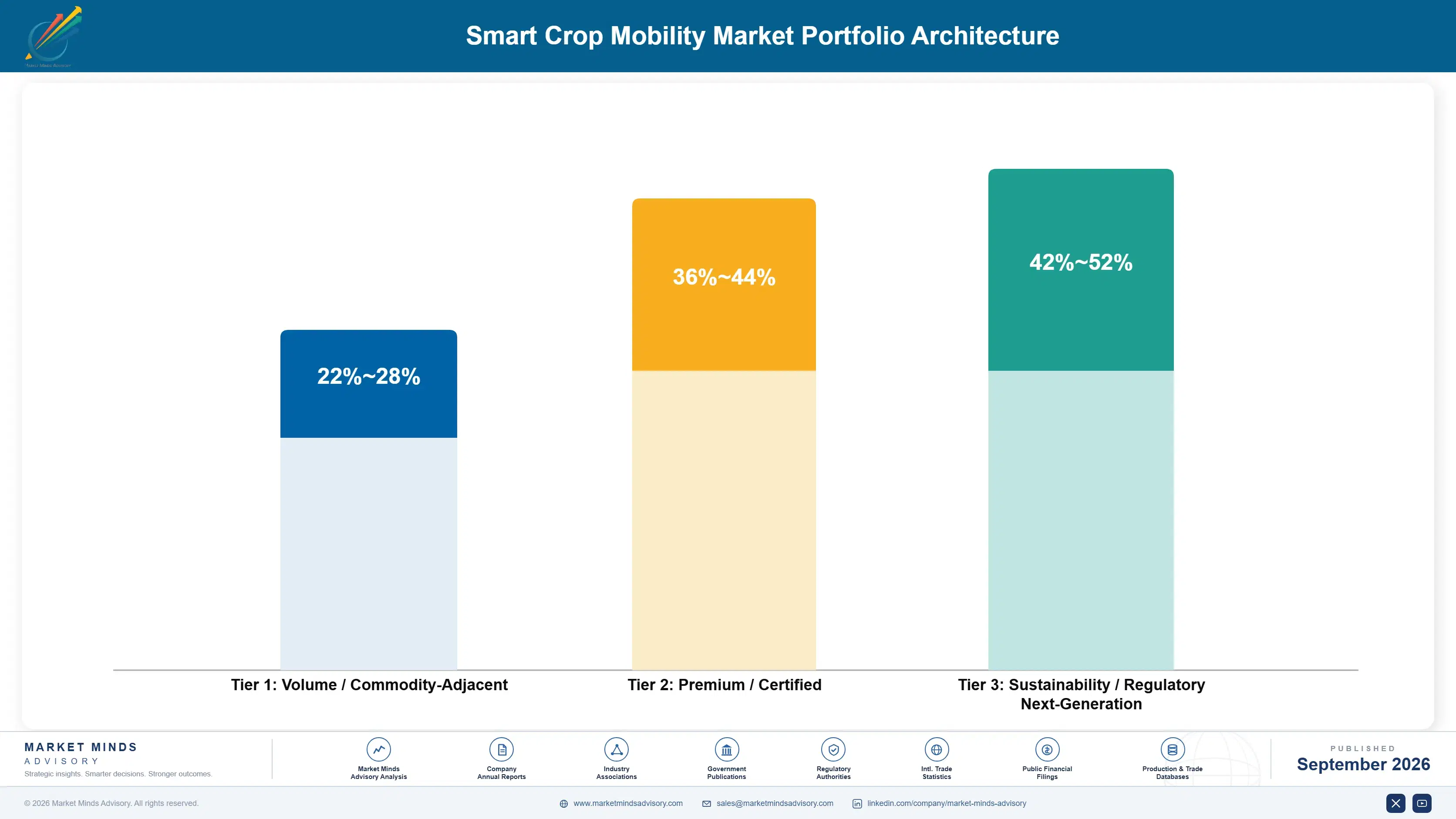
Smart crop mobility equipment splits into three margin tiers reflecting technology sophistication and service complexity across the industry today. Standardized guided transport vehicles and basic sorting systems run on volume economics with thinner per-unit margins, while precision navigation software and field service contracts command materially higher margins given their specialized engineering and ongoing support requirements.
Tension between volume and premium tiers shows up in how manufacturers allocate engineering investment, since precision navigation software and field service capability require ongoing specialized capability that standardized transport vehicles no longer need at the same intensity as before across most product lines. Manufacturers increasingly treat mature transport products as a stable volume generator, funding premium navigation and service development from that steadier baseline revenue stream.

High-value margin pools concentrate specifically in precision navigation software, field service contracts, and fleet management analytics, all of which combine strong pricing power with meaningful barriers to entry from specialized engineering and support infrastructure requirements across the broader industry today. Standardized guided transport vehicles represent the largest volume pool but the thinnest margins, having become increasingly commoditized as manufacturing scale drives unit pricing down steadily each year.

Volume / Commodity-Adjacent

Standardized guided transport vehicles and basic sorting systems sold at accessible unit pricing across high-volume commercial farm deployment programs to maximize shipment volume broadly across the entire market and industry.
Gross Margin: 22-28%

Premium / Certified

Autonomous field robots and mid-tier navigation packages sold as differentiated products commanding stronger per-unit pricing power than commodity transport alternatives available broadly across the wider market and entire industry today.
Gross Margin: 36-44%

Sustainability / Regulatory / Next-Generation

Precision navigation software, field service contracts, and fleet management analytics addressing the industry's most demanding reliability and performance requirements across most farm operations, geographies, and various major crop types worldwide.
Gross Margin: 42-52%
smart-crop-mobility-market-portfolio-architecture-1789989974206

High-value Sub-segments and Strategic Watch-out

Precision Navigation and Guidance Software and Sensors

Precision navigation and guidance software combines the strongest growth with strong margins, driven by manufacturers needing centimeter-level positioning accuracy to operate safely among crop rows and farm workers without constant human supervision across most equipment categories, use cases, crop types, terrains, and weather conditions worldwide.
Gross Margin: 44-52%

Autonomous Field Robots

Autonomous field robots post healthy margins and strong growth as growers seek direct labor replacement for the most labor-intensive crop tasks, though absolute revenue remains smaller than transport equipment given a still-developing market and comparatively narrower current customer base overall today, historically, and going forward.
Gross Margin: 40-48%

Guided Crop Transport Vehicles

Standardized guided transport vehicles remain the volume core of the market, deployed across the vast majority of commercial farms at accessible pricing, and manufacturers rely heavily on this segment for stable baseline revenue even as margins continue to compress steadily each and every single year.
Gross Margin: 22-28%

Robotic Sorting and Packing Mobility Systems

Robotic sorting and packing mobility systems warrant close monitoring as computational alternatives increasingly replicate their functionality using cheaper fixed conveyor automation, threatening to displace a segment that once provided steady, dependable revenue without requiring major ongoing differentiation from competing vendors nationwide and even internationally too.
Gross Margin: 26-34%

Why Fleet Purchases Expand Season-Over-Season

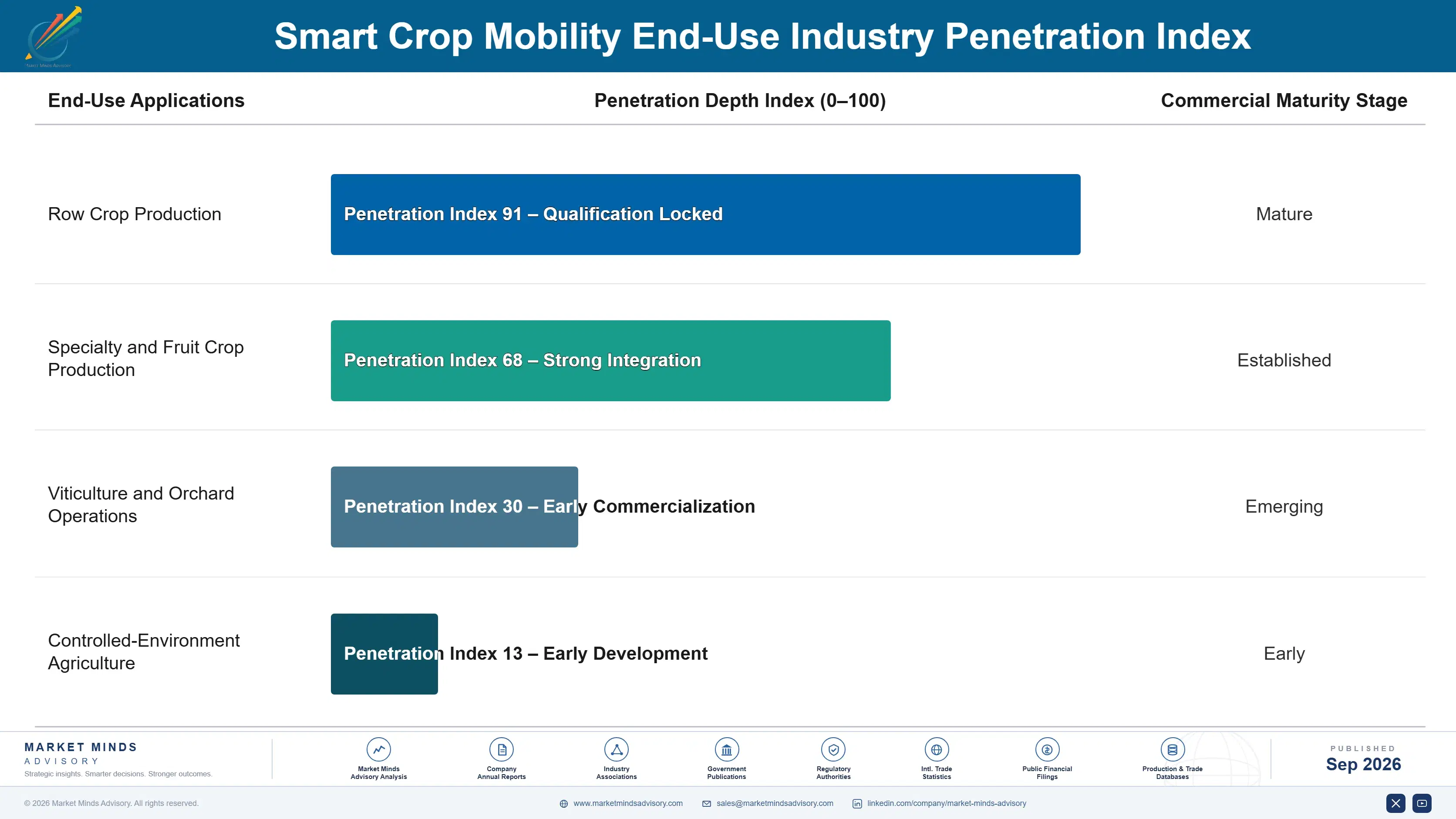
Smart crop mobility revenue behaves like a genuine annuity business once a farm operation completes a successful initial deployment, since a positive experience with one autonomous machine type typically leads to expansion into adjacent field operations across the same acreage within a few growing seasons. Repeat farm clients account for a meaningfully larger share of manufacturer revenue than first-time buyers, and manufacturers structure pricing specifically to reward fleet expansion over isolated single-unit purchases.
Adoption stickiness varies considerably by end-use vertical: large-scale row crop operations with the most acute seasonal labor shortages adopt automation fastest and most completely, while smaller specialty crop growers with more complex, less standardized harvesting requirements often delay adoption until proven technology becomes considerably more affordable and reliable. This uneven adoption pattern shapes which manufacturers compete most aggressively in which farm segment.

Buyer profiles are shifting generationally as farm procurement increasingly involves dedicated agricultural technology specialists rather than relying solely on traditional farm management leadership, pushing manufacturers to demonstrate navigation sophistication alongside basic equipment reliability during evaluation. This generational shift favors manufacturers who can speak credibly to both robotics technical depth and traditional farm operations requirements simultaneously.
smart-crop-mobility-market-end-use-penetration-index-1789989974705

Priorities for Crop Mobility Vendors

These are among the four positions where our research anticipates prominent divergence between winners and laggards over the coming forecast period. Each is grounded in the demand model, the regulatory perimeter, and the announced capacity pipeline.
01 / FIELD SERVICE INVESTMENT PRIORITY

Build Genuine Field Service Infrastructure Now

Widespread grower complaints about equipment downtime during critical harvest windows have slowed adoption beyond initial pilot deployments across most major agricultural regions and crop types, and manufacturers without genuine field service support increasingly lose competitive tenders to bundled competitors offering guaranteed response times. Manufacturers who build real service infrastructure now, rather than treating it as an afterthought, capture the pricing premium growers increasingly pay for demonstrated reliability outcomes. Waiting risks permanent reputational damage that is difficult to reverse once established.
02 / PRECISION NAVIGATION DEVELOPMENT PRIORITY

Invest in Centimeter-Level Navigation Capability

Precision navigation and guidance software has become the primary technical differentiator among competing equipment platforms, and manufacturers who invest early in centimeter-level positioning accuracy position themselves ahead of competitors still relying on less sophisticated navigation approaches across most equipment categories and applications currently in the market. This capability is growing fastest of any category, making early investment a meaningful long-term competitive advantage across the entire equipment stack. Manufacturers without navigation depth risk losing the fastest-growing part of the market entirely.
03 / FINANCING MODEL INNOVATION STRATEGY

Offer Leasing to Reach Smaller Farm Operations

High upfront equipment cost has excluded smaller farm operations from autonomous adoption despite genuine interest in the technology's labor cost reduction potential, and manufacturers offering leasing or shared-fleet ownership models capture a disproportionate share of this underserved segment against competitors requiring full upfront purchase from every customer. This approach directly addresses the capital constraint that otherwise limits how quickly smaller growers can access autonomous equipment benefits. Manufacturers without flexible financing options risk losing this expanding market segment to better-prepared rivals.
04 / COMPONENT SUPPLY CHAIN SECURITY

Lock in Long-Term Sensor Supply Agreements

Sensor and navigation component price volatility during 2021 and 2022 squeezed margins hardest for manufacturers dependent on spot market purchasing rather than locked-in long-term supply relationships with established component suppliers across the broader supply chain. Manufacturers who secure multi-year agreements trade some short-term pricing flexibility for meaningful protection against future volatility, a trade generally worth making given how frequently component supply disruptions have recurred across the broader robotics industry. Manufacturers still purchasing entirely on the spot market face real earnings risk.

Engagement Snapshot From the Field

A live engagement with an industry participant carrying material or product regulatory and market exposure ahead of a defining policy shift, showing how our research translates into a defensible multi-year portfolio strategy.
MARKET MINDS ADVISORY · CLIENT ENGAGEMENT SUMMARY
Smart Crop Mobility Producer Strategic Portfolio Review and Transition Roadmap 2026·Investment Scenario on Smart Crop Mobility Exposure Evaluation 2025-26
CLIENT PROFILE
The client is a large-scale specialty crop grower operating roughly 12,000 acres across three distinct growing regions with meaningfully varying terrain, soil, and climate conditions throughout the year, having purchased eight autonomous field robots over the prior two years, with utilization concentrated heavily on a single crop variety despite broader potential applications across the operation.
STRATEGIC CHALLENGE
The grower needed to determine whether expanding its autonomous fleet across additional crop varieties and growing regions justified the capital investment required, given uncertain field reliability performance data from its initial limited deployment and constrained internal technical staff capacity to support a considerably larger fleet going forward each growing season.
MMA APPROACH
MMA conducted a very thorough fleet performance audit analyzing utilization, downtime, and labor cost avoidance data from the initial deployment across all eight deployed units, modeling expansion economics across additional crop varieties and growing regions under multiple field reliability assumptions informed by relevant published industry benchmark data, precedent, and experience.
KEY FINDINGS
  1. The initial deployment achieved labor cost avoidance exceeding original projections by roughly 20 percent, driven primarily by reduced seasonal hiring requirements across the operation.
  2. Field reliability performance varied considerably by growing region, with the most favorable terrain conditions producing meaningfully higher utilization rates than challenging sites.
  3. Expansion economics favored prioritizing the two most favorable growing regions first rather than pursuing simultaneous expansion across all three regions immediately and at once.
  4. The grower's internal technical staff required additional training investment to support expanded fleet operations without excessive reliance on manufacturer field service going forward.
CLIENT PROFILE
The client is a large-scale specialty crop grower operating roughly 12,000 acres across three distinct growing regions with meaningfully varying terrain, soil, and climate conditions throughout the year, having purchased eight autonomous field robots over the prior two years, with utilization concentrated heavily on a single crop variety despite broader potential applications across the operation.
STRATEGIC CHALLENGE
The grower needed to determine whether expanding its autonomous fleet across additional crop varieties and growing regions justified the capital investment required, given uncertain field reliability performance data from its initial limited deployment and constrained internal technical staff capacity to support a considerably larger fleet going forward each growing season.
MMA APPROACH
MMA conducted a very thorough fleet performance audit analyzing utilization, downtime, and labor cost avoidance data from the initial deployment across all eight deployed units, modeling expansion economics across additional crop varieties and growing regions under multiple field reliability assumptions informed by relevant published industry benchmark data, precedent, and experience.
KEY FINDINGS
  1. The initial deployment achieved labor cost avoidance exceeding original projections by roughly 20 percent, driven primarily by reduced seasonal hiring requirements across the operation.
  2. Field reliability performance varied considerably by growing region, with the most favorable terrain conditions producing meaningfully higher utilization rates than challenging sites.
  3. Expansion economics favored prioritizing the two most favorable growing regions first rather than pursuing simultaneous expansion across all three regions immediately and at once.
  4. The grower's internal technical staff required additional training investment to support expanded fleet operations without excessive reliance on manufacturer field service going forward.
RECOMMENDED STRATEGY
Phase 1: Phase one: conduct a fleet performance audit analyzing utilization, downtime, and labor cost avoidance across the entire initial deployment period. Phase 2: Phase two: expand the autonomous fleet into the two most favorable growing regions first, prioritizing proven reliability conditions and terrain. Phase 3: Phase three: invest in internal technical staff training to reduce reliance on manufacturer field service as the fleet scales further.
OUTCOME
The grower expanded its autonomous fleet into the two prioritized growing regions on schedule, achieving labor cost avoidance consistent with the initial deployment's strong performance record across the operation (client-reported, unverified by MMA). The grower has since begun evaluating expansion into its third growing region.

Frequently Asked Questions

Foundational context covering the market sizes, CAGR, scope, country, region and competition that inform every finding below. This section is provided to cover basics and most often pre-purchase conversations, answered from the MMA Primary Research Dataset.

What is the current size of the Smart Crop Mobility Market?

The Smart Crop Mobility Market was valued at $2.2 billion in 2025. This figure covers autonomous field robots, guided crop transport vehicles, robotic sorting systems, and precision navigation components used in crop production.

How large will the Smart Crop Mobility Market be by 2036?

MMA projects the market will reach $8.87 billion by 2036, up from $2.5 billion in 2026. This represents a 3.55-times expansion over the forecast decade.

What is the CAGR for the Smart Crop Mobility Market 2026 to 2036?

The market is projected to grow at a 13.5% compound annual growth rate between 2026 and 2036. This compares to a historical CAGR of roughly 12.5% between 2020 and 2025.

Which segment is growing fastest?

Precision navigation and guidance software and sensors lead all segments at a 16.5% CAGR, roughly 1.22 times the overall market rate. Autonomous field robots follow closely at 15.0%.

Who are the major companies in the Smart Crop Mobility Market?

John Deere, AGCO, CNH Industrial, Kubota, and Naio Technologies lead by deployed autonomous unit volume. Trimble and Carbon Robotics hold strong positions in specific application segments.

Which country is growing fastest?

Brazil is the fastest-growing major market at a 17.5% CAGR, driven by large-scale mechanized soybean and sugarcane operations adopting autonomous equipment rapidly. Adoption is accelerating quickly nationwide.

Report Segmentation Architecture

The full report scope spans multiple orthogonal segmentation dimensions, with cross-tabulated demand data provided for each dimension pair. Coverage extends further to regional breakdowns, trend trajectories, and the competitive detail needed to support segment-level decision-making.

By Primary Market Dimension

  • Autonomous Field Robots
  • Guided Crop Transport Vehicles
  • Robotic Sorting and Packing Mobility Systems
  • Precision Navigation and Guidance Software and Sensors
  • Fleet Management and Farm Operations Software

By End-Use Industry

  • Row Crop Production
  • Specialty and Fruit Crop Production
  • Viticulture and Orchard Operations
  • Controlled-Environment Agriculture

By Commercial Dimension

  • Direct Equipment Sales
  • Equipment Leasing and Shared-Fleet Ownership
  • Fleet Management Software Subscriptions

By Region

  • North America
  • Western Europe
  • East Asia
  • South Asia and Pacific
  • Latin America
  • Middle East and Africa
  • Eastern Europe

Scope, Methodology, and Coverage

Every figure in this report is reproducible from documented input assumptions. The scope below maps the historical period, the forecast horizon, the segmentation dimensions, and the countries covered, alongside the underlying primary and qualitative methodology.
Historical Period
2020 to 2025
Forecast Period
2026 to 2036
Base Year
2025 (USD billions; MMA Primary Research Dataset, September 2026)
Market Definition
The Smart Crop Mobility Market covers autonomous field robots, guided crop transport vehicles, robotic sorting and packing mobility systems, precision navigation and guidance components, and fleet management software used in crop production, harvesting, and handling. It excludes traditional non-autonomous farm machinery, irrigation infrastructure, and post-farm-gate logistics unrelated to in-field crop mobility operations.
Quantitative Units
USD Billion, Average Robot Unit Cost, CAGR %
Segmentation Dimensions
Equipment Category, End-Use Industry, Commercial Dimension, Region
Regions Covered
North America, Western Europe, East Asia, South Asia and Pacific, Latin America, Middle East and Africa, Eastern Europe
Countries Covered
United States, Canada, Germany, France, Netherlands, China, Japan, South Korea, India, Brazil, Argentina, Mexico, United Arab Emirates, South Africa, Poland
Key Companies Profiled
John Deere, AGCO, CNH Industrial, Kubota, Naio Technologies, Trimble, Solinftec, Monarch Tractor, FarmWise, Small Robot Company, Agrointelli, Ecorobotix, AGROBOT, Harvest Automation, Iron Ox, Burro, Guss Automation, Verdant Robotics, Carbon Robotics, Advanced Farm Technologies
Quantitative Methodology
Primary survey, n=3,800 respondents, Q4 2025, six countries; demand-side model with trade association cross-validation
Qualitative Methodology
47 expert interviews, Q4 2025; applied to validate demand model assumptions, identify emerging dynamics, and assess competitive positioning
Report Format
PDF and XLSX data workbook (Word format preview document)
Publisher
Market Minds Advisory
Report Code
MMA-2026-AGR-984
Published
September 2026
Contact
sales@marketmindsadvisory.com | www.marketmindsadvisory.com

Purchase the full Smart Crop Mobility Market Report (2026 to 2036).

This report examines the Smart Crop Mobility Market across five equipment categories and seven demand regions. It analyzes the competitive dynamics reshaping how manufacturers price and deliver automation to farms facing persistent seasonal labor shortages. The analysis quantifies market size, growth, and segment-level trends through 2036, drawing on primary survey data covering three thousand eight hundred respondents and forty-seven expert interviews conducted in the fourth quarter of 2025. It also covers input cost pressure and revenue strategies available to manufacturers navigating this rapidly scaling category.
Ten-Year Market Sizing and Forecast Model
Five-Segment MECE Equipment Category Classification Taxonomy
Seven-Region Demand Breakdown and Growth Analysis
Competitive Benchmarking of Twenty Named Manufacturers
Revenue Lever and Margin Economics Analysis
Anonymized Client Engagement Case Study Review

Built For The People Who Decide

From boardroom strategy to bench-side execution, this report is read cover-to-cover by leaders shaping the next decade of their industry, turning demand scenarios, market dynamics and valuation benchmarks into decisions.
CXOs/ Presidents/ VPs/ Managers
M&A and Corporate Development
Strategy Teams and R&D Heads
Procurement and Product Directors
Regulatory and Compliance Leaders
Investor Relations and Equity Analysts