Market Minds Advisory
Smart Clothing Market

Smart Clothing Market: Wearable Sensing Textiles for Health, Fitness, and Performance Monitoring.

Washable conductive textiles have finally matched the reliability early smart clothing prototypes promised, pulling the category past novelty fitness gadgets into genuine clinical monitoring tools as healthcare reimbursement pathways slowly open for garment-based sensing.

Lead Analyst

Published

September 2026

Make Smarter Decisions with Customized Research Insights

Request a free sample report and evaluate market opportunities, growth trends, and competitive dynamics relevant to your business needs.

2025 MARKET VALUE$2.4BMarket Size 2025
2036 FORECAST VALUE$11.7BBase Case , 2026 to 2036
CAGR 2026 TO 203615.5 %Bull 16.9% / Bear 14.1%
INCREMENTAL OPPORTUNITY$8.9BNet 10- year value creation
EXPANSION MULTIPLE4.22x2036 value over 2026 base
Strategic Levers
M&A Pipeline
Regional Outlook
Country Rankings
Competitive Intelligence
Segmental Deep-dive
Call-Us : 91 93563 13602

Executive Snapshot and Market Trajectory.

Smart clothing has moved past novelty fitness gadgets into genuine clinical and athletic performance tools, as washable conductive textiles and miniaturized sensor modules finally deliver the manufacturing reliability that early smart garment attempts could rarely consistently match at comparable comfort, durability, and price.
Clinical remote patient monitoring and elite athletic performance tracking are the two dominant commercial forces, concentrating volume in East Asia, where textile manufacturing scale and consumer wearable adoption both outpace most other regions of the world. Smart clothing for clinical remote patient monitoring absorbs a rapidly growing share of spend, since healthcare providers increasingly value continuous biometric data collection that traditional wrist-worn wearable devices simply cannot capture as comprehensively across a full monitoring cycle.
Competitive intensity spans established sportswear brands partnering with sensor technology startups alongside specialized medical textile manufacturers competing on washability durability and signal accuracy, a dynamic reshaping product development timelines across the industry. Falling conductive yarn cost is pulling smart clothing into mainstream fitness apparel lines that previously could not justify the added manufacturing complexity and price premium these garments once carried over standard performance wear entirely across the category.
Market Definition
The Smart Clothing Market covers garments and textiles embedded with conductive fibers, flexible sensors, or miniaturized electronics that capture biometric, motion, or physiological data for health, fitness, or clinical monitoring purposes. It excludes standalone wearable devices such as smartwatches, fitness bands, and clip-on sensor accessories not integrated into the fabric itself.
Base Year Value
$2.4B in 2025 (MMA Primary Research Dataset, September 2026)
Forecast Period
2026 to 2036, eleven discrete annual values
CAGR
15.5% base case. Bull 16.9%. Bear 14.1%.
Fastest Growth Segment
Smart Clothing for Clinical Remote Patient Monitoring: 22.0% CAGR
Fastest Growth Country
China: 19.0% CAGR
Fastest Growth Region
South Asia and Pacific: 17.5% CAGR
Largest Region
East Asia: 29% of 2025 global value
Market Leaders
Hexoskin, Sensoria, Athos, Under Armour, and Myant lead the global Smart Clothing Market. Source: MMA Primary Research Dataset, July 2026, and company disclosures.
Primary Survey
n=3,800 procurement and R&D decision-makers, Q4 2025, six countries
Methodology
Demand-side build-up, cross-validated against public data, 47 expert interviews

Smart Clothing Market Forecast Scenarios

smart-clothing-market-size-forecast-scenario-1790007706832
Smart clothing grew from a niche fitness gadget category into an emerging clinical monitoring tool across 2020 to 2025, as early reliability and washability problems that plagued first-generation products gradually gave way to more durable conductive textile manufacturing techniques, though overall adoption remained fairly modest relative to the broader wearable technology category throughout most of that five-year period.
The base case assumes continued clinical validation of smart clothing for remote patient monitoring, expanding professional and collegiate athletic team adoption of performance tracking garments, and gradual consumer price reduction as conductive yarn manufacturing scales toward higher production volumes. These three mechanisms together sustain strong double-digit growth even as broader consumer adoption remains gradual compared to standalone wearable devices that require no specialized garment manufacturing infrastructure or washability engineering investment.
A bull scenario centers on accelerated healthcare system reimbursement approval for smart clothing remote monitoring programs, pulling adoption well beyond current forecasts across multiple chronic disease management categories. A bear scenario centers on persistent washability and battery life limitations continuing to constrain mainstream consumer adoption beyond dedicated athletic and clinical use cases specifically over the coming decade.

Textile Reliability Finally Catches Up to Ambition

Smart clothing demand now tracks clinical and athletic performance validation more than consumer novelty appeal, since healthcare providers and professional sports organizations increasingly require documented accuracy data before adopting garment-based sensing over established wrist-worn alternatives. This validation-first approach is reshaping product development priorities across the entire supplier base, from initial fabric selection through final sensor calibration and regulatory submission.
MARKET CONCENTRATIONCR5 34%Fragmented across many specialty and mainstream sportswear brands
AVERAGE SELLING PRICE$85-$450Price scales sharply with sensor sophistication and garment type
TOP PRODUCING REGIONEast Asia 41%Volume concentrated among established textile and electronics assembly partners
TRADE INTENSITY52% Cross-BorderMajority of finished garments shipped across international borders
INPUT COST SHARE35% of COGSConductive yarn and flexible sensor modules dominate total cost
REPLACEMENT CYCLE1-2 YearsGarments wear out faster than standalone electronic wearable devices
Commercial character has shifted from a fragmented collection of startup experiments toward a more structured industry, where washability durability and signal accuracy increasingly determine which products survive beyond initial launch and early adopter enthusiasm. Suppliers unable to solve durability at scale increasingly exit the category rather than continuing to burn capital on unprofitable niche positioning that investors have grown considerably less patient with over the past several funding cycles.
Falling conductive yarn cost, expanding clinical reimbursement pathways, and growing professional athletic team adoption will shape smart clothing demand through the next decade, with suppliers solving washability durability best positioned to capture mainstream consumer adoption beyond today's dedicated athletic and clinical early-adopter customer base into genuinely mainstream retail apparel channels that were previously priced out of the category entirely.
"The smart clothing category spent a decade over-promising. The products shipping today finally survive a washing machine, which turns out to be the feature that actually mattered."
Director, Wearable Technology and Digital Health Practice · MMA Technology Practice · September 2026

Market Trends

Clinical Reimbursement Pathways Open for Remote Monitoring Garments

Several national health systems have begun approving reimbursement pathways for smart clothing used in chronic condition remote patient monitoring, particularly for cardiac and respiratory conditions requiring continuous biometric data collection outside hospital settings. This reimbursement shift directly addresses one of the category's longest-standing adoption barriers, since healthcare providers previously had no clear billing pathway for garment-based monitoring even when clinical accuracy matched or exceeded traditional wired monitoring equipment. Several major health insurers have disclosed pilot coverage programs launching across multiple regions over the coming year, a shift that could meaningfully accelerate mainstream clinical adoption if outcomes hold up.
Market Impact: Conductive yarn cost down 35%
Professional Sports Teams Standardize Performance Tracking Garments

Professional and collegiate sports organizations increasingly standardize smart clothing across entire rosters for performance tracking and injury prevention, moving beyond earlier pilot programs involving only a handful of players. This standardization reflects growing confidence in data accuracy and durability that earlier product generations could not reliably deliver across a full competitive season. Several major professional leagues have disclosed league-wide data collection initiatives incorporating smart clothing alongside traditional wearable tracking devices already in use across most teams, a sign the technology has finally cleared its early credibility hurdle with coaching staff.
Market Impact: Remote monitoring adoption up 22% yearly

Market Opportunities and Growth Drivers

Falling Conductive Yarn Cost Expands Addressable Market

Conductive yarn and flexible sensor module manufacturing costs have declined meaningfully as production scales and manufacturing techniques mature, pulling smart clothing into price ranges that mainstream fitness apparel brands can credibly offer alongside standard performance wear. This cost decline directly expands the addressable market beyond the elite athlete and clinical patient segments that historically justified the category's considerably higher price premiums. Several mainstream sportswear brands have disclosed plans to launch smart clothing lines at price points approaching standard premium athletic apparel within the next one to two product development cycles across most major categories.
Market Impact: Return rates remain 3x standard apparel

Chronic Disease Prevalence Drives Remote Monitoring Demand

Rising chronic disease prevalence, particularly cardiovascular and respiratory conditions requiring ongoing biometric monitoring, is driving healthcare system interest in smart clothing as a more comfortable and less invasive alternative to traditional wired monitoring equipment or clip-on wearable devices. Multiple health systems have disclosed pilot programs specifically targeting patients discharged after cardiac events, where continuous monitoring meaningfully reduces readmission rates compared to periodic in-person follow-up appointments alone, a gap payers increasingly recognize as costly to leave unaddressed given the considerable expense of repeated hospital readmission relative to the cost of a monitoring garment itself.
Market Impact: Daily usage drops 40% quickly

Market Restraints and Challenges

Washability and Durability Limitations Constrain Consumer Trust

Many consumers remain skeptical of smart clothing durability after high-profile early product failures, whose root cause traces to first-generation conductive textiles and sensor modules that degraded significantly after repeated washing cycles well before typical garment end-of-life. The commercial impact limits mainstream retail adoption to consumers willing to accept a price premium despite lingering durability concerns from the category's earlier reputation. Suppliers are pursuing mitigation through extended washability testing certification and visible durability guarantees marketed directly to skeptical mainstream consumers still wary from the category's earlier reputation for premature failure after only modest wear.
Market Impact: Reimbursed monitoring programs up 30% yearly

Battery Life and Charging Requirements Limit Daily Usability

Smart clothing requiring frequent battery charging or removable electronic modules creates usability friction that standalone wearable devices with longer battery life do not face to the same degree, whose root cause lies in the physical space constraints of embedding electronics within flexible fabric rather than a rigid device housing. The commercial impact discourages daily consistent use among consumers accustomed to simpler wearable device charging routines. Suppliers are pursuing mitigation through modular sensor designs that separate washable fabric from removable electronic components requiring regular charging, an approach several suppliers now consider the category's most promising near-term fix.
Market Impact: Team-wide adoption up 25% since 2023
4 additional market trends, 4 additional growth drivers, and 4 additional restraints and challenges are covered in the full report. Contact sales@marketmindsadvisory.com to access the complete intelligence.

Segment CAGR and Growth Architecture

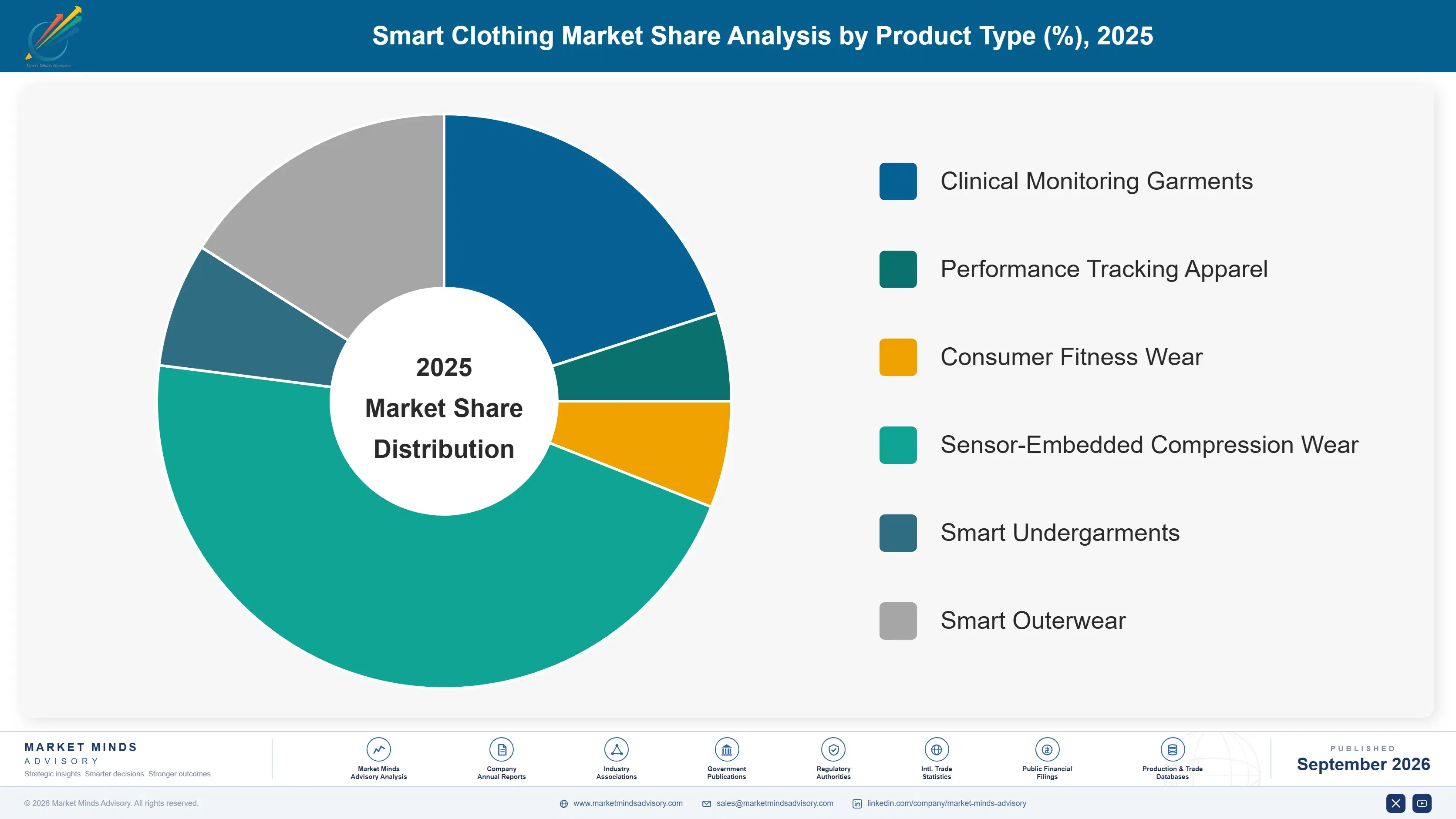
The Smart Clothing Market segments by end-use application, since clinical monitoring, athletic performance, and everyday fitness contexts impose distinct accuracy, durability, and regulatory requirements that shape how buyers specify and purchase smart clothing products across each vertical, rather than by underlying textile or sensor technology alone, which matters less to the ultimate end customer.
smart-clothing-market-market-share-analysis-1790007707386

Smart Clothing for Clinical Remote Patient Monitoring

Clinical remote patient monitoring garments capture continuous cardiac, respiratory, and other biometric data outside hospital settings, meeting regulatory accuracy standards that consumer fitness garments do not require. Demand here grows fastest because expanding health system reimbursement pathways directly address the category's longest-standing adoption barrier, opening access to a large population of chronic disease patients who previously had no clear billing pathway for garment-based monitoring. Suppliers with clinical validation data and regulatory clearance increasingly capture health system contracts over consumer-oriented competitors lacking equivalent medical device certification, a barrier that takes considerable time, clinical trial investment, and regulatory capital for newer entrants to clear successfully, well beyond what most venture-backed startups can sustain without a strategic partner.
CAGR 22.0%

Smart Clothing for Elite Athletic Performance Tracking

Elite athletic performance tracking garments capture biomechanical, cardiovascular, and muscle activity data for professional and collegiate sports organizations optimizing training load and injury prevention programs. This segment grows quickly as sports organizations standardize smart clothing across entire rosters rather than limited pilot programs, reflecting growing confidence in data accuracy and durability across a full competitive season. Suppliers with proven durability track records and sports science partnerships increasingly win team-wide adoption contracts over newer entrants lacking comparable performance validation history, particularly where coaching staff remain skeptical of unproven technology mid-season and unwilling to disrupt established training routines without clear, statistically credible evidence gathered directly across an actual, full-length competitive season rather than a limited preseason trial.
CAGR 17.0%
Full segment breakdown across 6 segments available in the complete report.

Regional Architecture and Country Demand Map

Smart clothing demand concentrates wherever textile manufacturing scale and healthcare or sports technology adoption intersect, with East Asia leading on garment production and North America anchoring substantial clinical and athletic performance market activity worldwide today across nearly every major demand category, from clinical validation studies through professional sports team adoption.

North America

North American demand centers on clinical remote patient monitoring adoption and professional sports team performance tracking, with the United States hosting several leading smart clothing companies and the majority of clinical trial and reimbursement pilot activity. Major professional sports leagues headquartered in the United States increasingly standardize smart clothing across entire rosters for injury prevention and performance optimization purposes. Growing health insurer pilot coverage programs for cardiac and respiratory remote monitoring further sustain demand well above the broader wearable technology category's average growth pace across most tracked demographic and clinical segments this year, according to MMA primary research survey data collected across major metropolitan health systems and professional sports league training facilities nationwide.
Share: 28% | CAGR: 16.0% (2026 to 2036)

Western Europe

Western European demand draws on strong healthcare system interest in remote patient monitoring alongside established athletic apparel brands based in Germany, France, and the United Kingdom expanding into smart clothing product lines. National health systems across the region show growing interest in reimbursement pathways for garment-based chronic disease monitoring, though adoption trails North America given more cautious medical device regulatory approval timelines. European sportswear brands continue investing in performance tracking garment development for both professional and consumer athletic markets, particularly across football, cycling, and endurance sports categories where injury prevention data increasingly carries genuine competitive value for coaching and medical staff alike across most major professional leagues in the region.
Share: 21% | CAGR: 13.5% (2026 to 2036)
Regional intelligence for 5 additional markets available in the complete report: East Asia, South Asia and Pacific, Latin America, Middle East and Africa, Eastern Europe. Contact sales@marketmindsadvisory.com.
smart-clothing-market-country-cagr-analysis-1790007707911

How Smart Clothing Brands Actually Monetize

Smart clothing brands capture value beyond garment sale price through four commercial mechanisms that reward data platform depth and clinical validation over hardware margin alone. Subscription data analytics services, clinical reimbursement partnerships, professional team licensing agreements, and premium durability-guaranteed tiers all matter considerably more here than hardware unit economics alone across the entire industry.

Selling Subscription Data Analytics and Coaching Services

Brands that pair smart clothing hardware with subscription-based data analytics and personalized coaching services capture recurring revenue that meaningfully exceeds the initial garment sale price over a customer's multi-year usage lifetime. This subscription layer typically generates 20 to 35% of total customer revenue annually, compounding well beyond what a one-time garment purchase alone would capture. Brands offering genuinely differentiated coaching insights increasingly retain subscribers longer than those offering only basic raw data dashboards without any accompanying personalized interpretation, coaching guidance, or ongoing performance benchmarking support against comparable users or teammates.
Market Impact: Subscriptions add 20 to 35% of annual revenue

Partnering With Healthcare Systems on Reimbursement Programs

Suppliers that establish clinical reimbursement partnerships with healthcare systems and insurers capture predictable per-patient revenue tied to approved remote monitoring programs, rather than competing purely on one-time consumer garment sales. These partnerships typically guarantee 3 to 5 year program commitments once clinical validation clears, providing suppliers revenue visibility that consumer-only competitors lack entirely. This approach favors suppliers with dedicated regulatory affairs teams over smaller rivals lacking comparable clinical trial and reimbursement navigation expertise built up over multiple product approval cycles and years of accumulated regulatory agency relationship management across multiple product submission cycles.
Market Impact: Reimbursed programs add $150 to $300 per patient

Licensing Performance Tracking Technology to Professional Teams

Suppliers that license their performance tracking technology and data platform directly to professional sports organizations capture team-wide licensing revenue substantially exceeding what individual athlete garment sales alone would generate. These licensing agreements typically span 2 to 4 year team contracts covering entire rosters, providing suppliers stable revenue visibility tied to league and team budget cycles rather than individual consumer purchasing decisions. Suppliers with proven sports science credibility increasingly win these larger institutional contracts over consumer-focused competitors lacking equivalent sports science partnerships and dedicated athletic performance research staff embedded directly within their broader organization structure.
Market Impact: Team licensing contracts span 2 to 4 years

Offering Premium Durability-Guaranteed Product Line Tiers

Brands offering premium product tiers with extended durability guarantees and washability warranties capture incremental margin from consumers willing to pay for reduced replacement risk after the category's early reputation for premature product failure. This tier typically commands 25 to 40% higher pricing than standard smart clothing products, reflecting the additional materials engineering and quality testing involved. Brands investing early in these premium durability tiers increasingly capture the highest-margin customers across both clinical and athletic segments of the broader smart clothing market who genuinely value reduced replacement risk and longer garment service life over time.
Market Impact: Durability tier commands 25 to 40% price premium

Who Controls the Margin Pool

Five firms hold roughly 34% of global smart clothing revenue, a fragmented market structure reflecting the category's relative youth and the diversity of technical approaches suppliers have pursued. Hexoskin and Sensoria lead through early clinical validation and sports science partnership credibility, while the gap to smaller specialty startups remains narrower than in more mature technology categories, since no single supplier has yet established dominant scale or a clearly superior technical approach.
Current competitive activity centers on clinical reimbursement partnership development, professional sports team licensing agreements, and durability testing certification programs, as suppliers race to establish credibility with skeptical healthcare and athletic buyers. Mainstream sportswear brands increasingly acquire or partner with specialized sensor technology startups rather than building smart clothing capability entirely in-house, accelerating consolidation among smaller technical specialists that lack the capital to sustain independent operations much longer.

Emerging pressure comes from standalone wearable device makers extending battery life and sensor sophistication, potentially reducing the comfort and continuous monitoring advantage that garment-based sensing has historically claimed over wrist-worn alternatives. Rankings shift fastest in clinical remote monitoring, where suppliers with regulatory clearance and reimbursement partnerships increasingly out-compete consumer-focused rivals lacking comparable medical device credentials, regulatory approval, and established provider relationships.
smart-clothing-market-company-positioning-matrix-1790007708435

Competitive Moat and Risk Dimensions

HEXOSKIN

Moat: Early Clinical Validation Data

Hexoskin's years of accumulated clinical trial and research partnership data give it credibility with healthcare providers and academic researchers that newer entrants cannot quickly replicate, particularly for cardiac and respiratory monitoring applications where documented accuracy history matters more than marketing claims alone, particularly for chronic disease management applications requiring regulatory sign-off.
HEXOSKIN

Risk: Limited Consumer Brand Recognition

Hexoskin's focus on clinical and research applications has left it with comparatively limited consumer brand recognition compared to mainstream sportswear competitors entering the category, risking share loss in the faster-growing consumer athletic segment to brands with existing retail distribution, marketing scale, and far larger advertising budgets.
UNDER ARMOUR

Moat: Established Retail Distribution Scale

Under Armour's existing retail distribution network and consumer brand recognition let it introduce smart clothing products to a far larger addressable customer base than specialized startups can reach, giving it cross-selling opportunities into its existing athletic apparel customer relationships that narrower competitors simply cannot replicate without comparable retail scale and brand history.
UNDER ARMOUR

Risk: Shallow Clinical Validation Depth

Under Armour's consumer-first approach means it invests less intensively in clinical trial validation than specialized medical-focused competitors, risking exclusion from the fastest-growing clinical reimbursement segment where regulatory credibility matters more than brand recognition alone, particularly among skeptical healthcare providers and payers evaluating new monitoring technology.

Players Tracked

Prominent Players

Hexoskin
Sensoria
Athos
Under Armour
Myant

Other Key Players

Nadi X (Wearable X)
OMsignal
Prevayl
Xensr
Siren Care
Ambiotex
Cityzen Sciences
Chronolife
Vivalnk
Nike
Adidas
Xiaomi
Anta Sports
Li Ning
Bioserenity

Recent Developments

FEBRUARY 2026

Hexoskin Announces Expanded Health System Reimbursement Partnership

Hexoskin announced an expanded reimbursement partnership with a major regional health system covering remote cardiac monitoring garments for post-discharge patients, extending coverage across several additional hospital networks. The partnership includes committed pilot enrollment targets and shared clinical outcome data collection over an eighteen-month evaluation period.
Signal: Signals health systems are increasingly willing to formally establish reimbursement pathways for garment-based remote monitoring technology.
OCTOBER 2025

Under Armour Acquires Sensor Technology Startup for Athletic Line

Under Armour completed the acquisition of a specialized sensor technology startup with established biomechanical tracking expertise, adding engineering talent and existing intellectual property to its broader smart clothing product roadmap targeting professional and consumer athletic markets across multiple sports categories and price tiers going forward.
Signal: Signals mainstream sportswear brands increasingly prefer acquiring specialized technology rather than building it internally from scratch.
JUNE 2025

Sensoria Forms Licensing Agreement With Professional Sports League

Sensoria entered a multi-year licensing agreement with a professional sports league covering performance tracking garments for player injury prevention and load management across multiple member teams, including shared data analytics access for league medical staff and team-designated athletic performance personnel across every participating club in the league.
Signal: Signals professional sports leagues are increasingly standardizing smart clothing adoption across entire member team rosters league-wide.

Conductive Yarn Costs Anchor Garment Economics

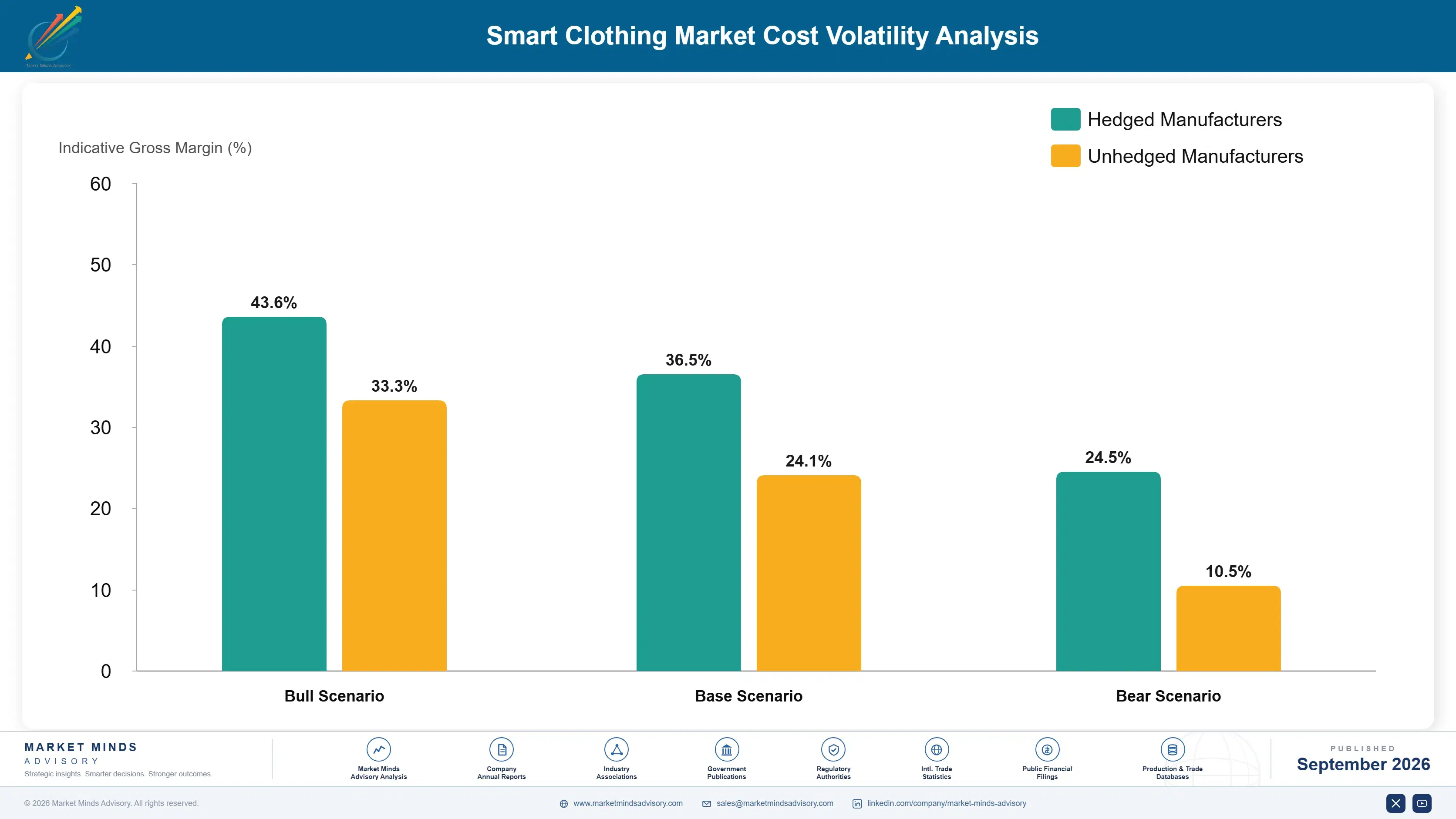
Conductive yarn and flexible sensor modules together account for roughly 35% of smart clothing manufacturing cost, sourced primarily from specialty textile chemical processors and sensor component suppliers concentrated in East Asia and a handful of European specialty materials firms. This dependence on a limited supplier base means most brands, regardless of headquarters location, rely on the same relatively narrow global input supply chain.
A documented conductive yarn supply constraint during 2023 pushed input costs up by roughly 18% and extended lead times to 10 to 14 weeks, according to industry supply chain reporting referenced in company annual disclosures, as demand from expanding pilot programs outpaced specialty textile processor capacity. Several smart clothing brands delayed product launches by multiple months as a direct consequence, straining relationships with healthcare and sports organization customers awaiting delivery.

Smaller smart clothing startups face a genuine competitive disadvantage here since they lack the purchase volume needed to secure priority allocation from constrained conductive yarn suppliers during shortage periods, unlike larger consumer brands with broader materials sourcing relationships. This dynamic favors companies like Under Armour with diversified supplier networks, while smaller startups pursue joint development agreements with textile processors as mitigation against recurring input cost volatility.
smart-clothing-market-cost-volatility-analysis-1790007708631

Joint Development Agreements With Textile Chemical Processors

Larger smart clothing brands are entering joint development agreements with textile chemical processors, securing dedicated production capacity and preferential pricing terms in exchange for co-investment in manufacturing process improvements that benefit both parties over the life of the multi-year agreement and beyond into future product generations that both parties currently have in active joint development.

Diversifying Across Multiple Sensor Component Suppliers

Brands are qualifying flexible sensor modules from multiple component suppliers rather than concentrating sourcing with a single vendor, reducing exposure to any one supplier's capacity constraints during periods of rapid demand growth across the broader smart clothing category, particularly during major product launch cycles requiring large volume commitments on short notice from any single supplier.

Building Strategic Conductive Yarn Inventory Reserves

Suppliers with healthcare and professional sports customers requiring strict delivery reliability are building strategic conductive yarn inventory reserves, absorbing modest carrying cost increases in exchange for improved resilience against future specialty textile processor capacity shortages that could otherwise delay committed customer delivery schedules across both clinical and athletic product lines during peak seasonal demand periods.

Portfolio Architecture for Margin Defence

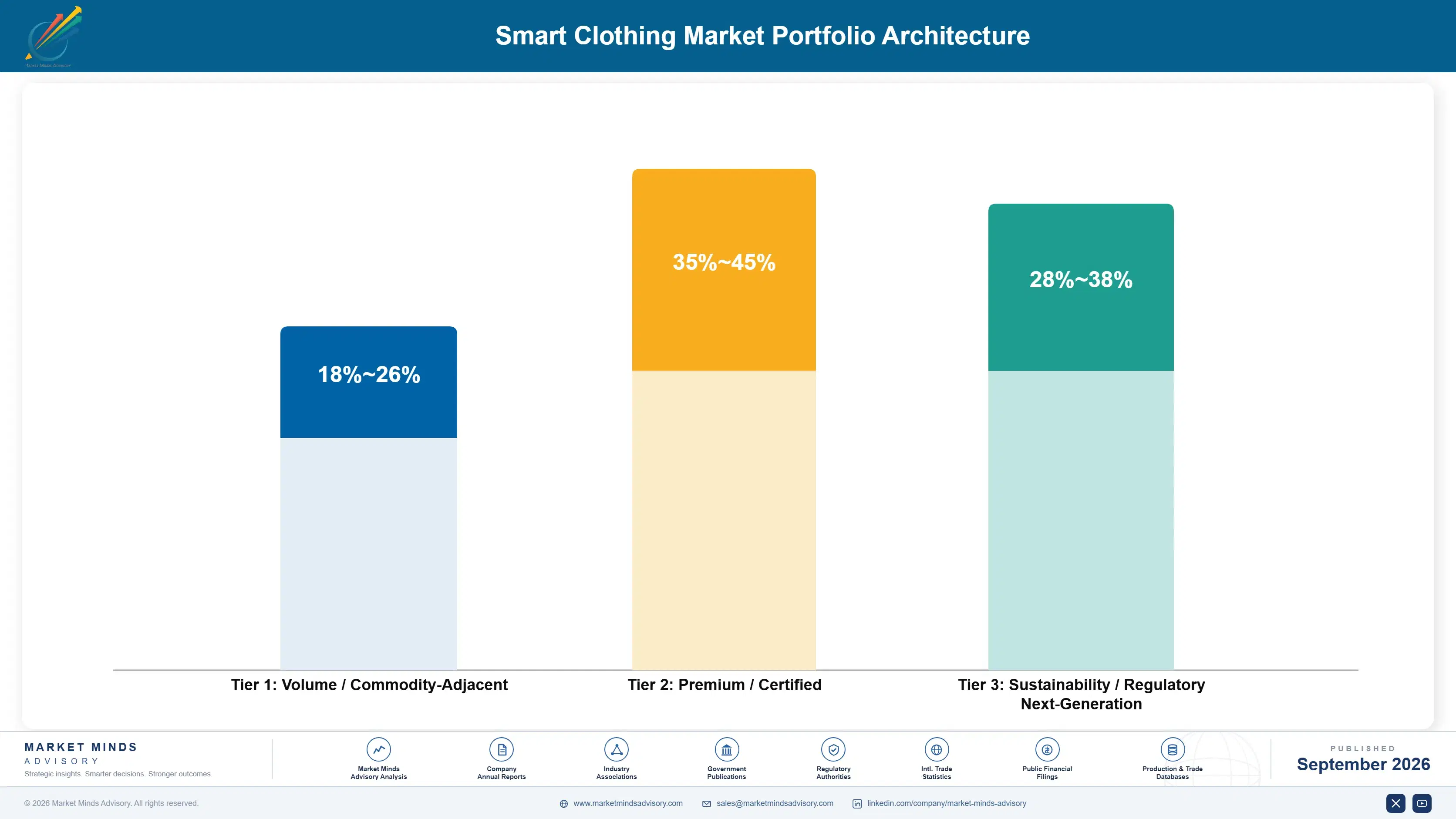
Margin architecture in smart clothing splits between commoditized consumer fitness garments and premium clinical or professional athletic products. Consumer fitness smart clothing runs thin gross margins given intense competition from mainstream sportswear brands entering the category, while clinical monitoring garments and professional athletic team products command substantially richer margins tied to regulatory certification and sports science partnership depth.
Volume consumer fitness applications still generate meaningful revenue today, but margin economics increasingly favor premium clinical and professional athletic product tiers as reimbursement pathways expand and professional sports organizations standardize adoption. Suppliers positioned only in commoditized consumer fitness garments face genuine margin pressure as mainstream brands enter with lower price points, forcing many smaller specialists to pursue clinical or professional sports partnerships as a defensive necessity rather than a pure growth choice.

High-value margin pools concentrate in clinical remote monitoring garments, professional team licensing agreements, and subscription data analytics services, where regulatory credentials and sports science partnerships command premium pricing that commodity consumer fitness competitors simply cannot match today. Suppliers building genuine clinical regulatory depth alongside sports science credibility increasingly capture the richest margin pools within the entire smart clothing industry.

Volume / Commodity-Adjacent

Consumer fitness smart clothing sold through mainstream retail channels, competing on price against conventional performance apparel with modest smart features and thin gross margins reflecting intense brand competition and rapid feature commoditization across most major retailers.
Gross Margin: 18-26%

Premium / Certified

Clinical remote monitoring garments meeting regulatory certification standards, priced for medical device credentials and reimbursement pathway access that consumer-grade competitors cannot match at comparable manufacturing cost or accumulated clinical trial history.
Gross Margin: 35-45%

Sustainability / Regulatory / Next-Generation

Professional athletic team licensing products and subscription data analytics services positioned ahead of sports science standardization trends, commanding premium early-mover pricing before wider competitive entry compresses these margins across the broader category.
Gross Margin: 28-38%
smart-clothing-market-portfolio-architecture-1790007709137

High-value Sub-segments and Strategic Watch-out

Smart Clothing for Clinical Remote Patient Monitoring

The fastest-growing and highest-value segment, combining a 22.0% forecast CAGR with premium margins tied to regulatory certification and reimbursement partnerships. Suppliers with proven clinical validation and payer relationships capture the richest growth and margin combination across the entire smart clothing market today, well ahead of every other application category.
Gross Margin: 38-46%

Smart Clothing for Elite Athletic Performance Tracking

A high-value segment growing at 17.0% annually, tied to professional sports team standardization of performance tracking garments. Margin economics here trail clinical products though overall deployment volume remains substantial across multiple professional leagues, sustained by growing appetite for injury prevention data among team coaching staff.
Gross Margin: 30-38%

Consumer Fitness Smart Clothing for Mainstream Retail

The volume core of the market, generating steady but lower-margin revenue through mainstream retail fitness apparel sales, though intensifying competition from entering sportswear brands is compressing segment margins toward the market's lower end over the coming forecast period across most major consumer retail channels worldwide.
Gross Margin: 18-24%

Standalone Wearable Device Encroachment Into Continuous Monitoring

A strategic watch-out segment where improving battery life and sensor sophistication in standalone wearable devices increasingly narrows the continuous monitoring advantage that garment-based smart clothing has historically claimed over wrist-worn alternatives, a category facing gradual pressure as standalone devices keep improving battery life and sensor accuracy each generation.
Gross Margin: 22-30%

Why Smart Clothing Revenue Recurs

Smart clothing revenue builds annuity-like characteristics through subscription data analytics services and multi-year clinical or team licensing agreements, rather than through one-time garment sales alone. Healthcare and professional sports customers rarely switch monitoring providers once integrated into clinical workflows or training programs, since replacing an established provider requires re-validating data continuity and staff retraining at real cost, disruption risk, and potential loss of accumulated historical monitoring data.
Adoption stickiness varies meaningfully by end-use vertical: clinical monitoring customers show the deepest lock-in, since regulatory-approved monitoring protocols cannot easily switch providers without new clinical validation, while consumer fitness customers show comparatively shallower stickiness given lower switching costs and frequent product replacement cycles. Professional sports organizations sit in between, with switching costs tied closely to accumulated historical performance data value.

A generational shift in buyer profile is underway as sports science and clinical informatics teams, not just individual athletes or patients, increasingly drive smart clothing procurement decisions. These newer buyers evaluate suppliers on data platform integration and analytics depth rather than pure garment comfort or styling, reshaping how suppliers must position, sell, and structure ongoing account relationships with clinical and sports science departments.
smart-clothing-market-end-use-penetration-index-1790007709627

Where to Compete in Smart Clothing

These are among the four positions where our research anticipates prominent divergence between winners and laggards over the coming forecast period. Each is grounded in the demand model, the regulatory perimeter, and the announced capacity pipeline.
01 / CLINICAL REIMBURSEMENT DEPTH

Pursue clinical validation before consumer scale ambitions

Smart clothing for clinical remote patient monitoring is growing at 22.0% annually, nearly one and a half times the market's average pace, yet many suppliers still prioritize consumer fitness features over regulatory validation. Suppliers that invest in clinical trial data and reimbursement partnership development now will capture disproportionate share as healthcare system adoption accelerates over the next several years. Waiting until reimbursement pathways mature further cedes this position to already-validated competitors that moved first and already hold established health system relationships.
02 / DURABILITY ENGINEERING INVESTMENT

Solve washability durability before chasing new features

Consumer trust in smart clothing remains damaged by high-profile early product failures, with return rates still running roughly three times standard apparel categories. Suppliers that invest in extended washability testing and durability guarantees capture mainstream retail credibility that feature-focused competitors still struggle to earn. Brands should prioritize durability engineering investment over additional sensor capability, since consumers repeatedly cite reliability, not feature depth, as their primary purchase hesitation across nearly every product review, return survey, and post-purchase customer interview collected to date.
03 / PROFESSIONAL SPORTS LICENSING

Build team-wide licensing relationships ahead of standardization

Professional and collegiate sports organizations are increasingly standardizing smart clothing across entire rosters rather than limited pilot programs, a shift that rewards suppliers with established sports science credibility. Suppliers that secure team-wide licensing agreements now will capture multi-year revenue visibility that individual athlete sales alone cannot provide. Smaller suppliers lacking sports science partnerships should pursue collaboration with established research institutions before larger rivals with more established relationships capture the remaining league-wide contracts across every major professional and collegiate sport still available.
04 / SUBSCRIPTION REVENUE DEVELOPMENT

Build subscription analytics revenue beyond hardware margin

Suppliers pairing smart clothing hardware with subscription data analytics services capture revenue that typically reaches 20 to 35% of total customer value annually, well beyond what garment sales alone generate. Suppliers without a genuine subscription offering face a hard revenue ceiling compared to rivals building recurring platform relationships with their customer base. Brands still selling only hardware should prioritize subscription analytics development now, before competitors establish deeper, harder-to-displace customer relationships across the exact same target enterprise and consumer accounts everyone is pursuing first.

Engagement Snapshot From the Field

A live engagement with an industry participant carrying material or product regulatory and market exposure ahead of a defining policy shift, showing how our research translates into a defensible multi-year portfolio strategy.
MARKET MINDS ADVISORY · CLIENT ENGAGEMENT SUMMARY
Smart Clothing Producer Strategic Portfolio Review and Transition Roadmap 2026·Investment Scenario on Smart Clothing Exposure Evaluation 2025-26
CLIENT PROFILE
The client is a regional health system operating multiple hospitals and outpatient cardiology clinics, with annual patient monitoring technology spending reportedly exceeding $40 million (client-reported, unverified by MMA). The client sought to reduce post-discharge cardiac readmission rates through continuous remote monitoring rather than relying solely on periodic in-person follow-up appointments after hospital discharge, particularly among older patients living alone with limited caregiver support at home.
STRATEGIC CHALLENGE
The client faced persistently high thirty-day readmission rates among discharged cardiac patients, driven partly by delayed detection of concerning symptom changes between scheduled follow-up appointments. Leadership needed an objective evaluation of smart clothing remote monitoring options against traditional wired monitoring equipment and standalone wearable device alternatives already piloted elsewhere in the broader healthcare system.
MMA APPROACH
MMA conducted a structured vendor capability assessment across five candidate smart clothing suppliers, evaluating clinical validation data, regulatory clearance status, and patient comfort and compliance rates from existing pilot programs. The engagement combined primary interviews with the client's cardiology and care management teams alongside comparative analysis against standalone wearable alternatives.
KEY FINDINGS
  1. Only two of five candidate suppliers held regulatory clearance matching the client's clinical accuracy requirements consistently across all clinical trials conducted during the multi-month evaluation period.
  2. Patient compliance with garment-based monitoring exceeded standalone wearable device compliance by roughly 30% in comparable pilot populations studied across similar patient demographic groups.
  3. Continuous monitoring data detected concerning symptom changes an average of 2.5 days earlier than periodic follow-up appointments alone would have provided in most comparable cases.
  4. Projected readmission cost savings could reach $1.8 million annually if the pilot program's early results hold consistently at the full patient population scale.
CLIENT PROFILE
The client is a regional health system operating multiple hospitals and outpatient cardiology clinics, with annual patient monitoring technology spending reportedly exceeding $40 million (client-reported, unverified by MMA). The client sought to reduce post-discharge cardiac readmission rates through continuous remote monitoring rather than relying solely on periodic in-person follow-up appointments after hospital discharge, particularly among older patients living alone with limited caregiver support at home.
STRATEGIC CHALLENGE
The client faced persistently high thirty-day readmission rates among discharged cardiac patients, driven partly by delayed detection of concerning symptom changes between scheduled follow-up appointments. Leadership needed an objective evaluation of smart clothing remote monitoring options against traditional wired monitoring equipment and standalone wearable device alternatives already piloted elsewhere in the broader healthcare system.
MMA APPROACH
MMA conducted a structured vendor capability assessment across five candidate smart clothing suppliers, evaluating clinical validation data, regulatory clearance status, and patient comfort and compliance rates from existing pilot programs. The engagement combined primary interviews with the client's cardiology and care management teams alongside comparative analysis against standalone wearable alternatives.
KEY FINDINGS
  1. Only two of five candidate suppliers held regulatory clearance matching the client's clinical accuracy requirements consistently across all clinical trials conducted during the multi-month evaluation period.
  2. Patient compliance with garment-based monitoring exceeded standalone wearable device compliance by roughly 30% in comparable pilot populations studied across similar patient demographic groups.
  3. Continuous monitoring data detected concerning symptom changes an average of 2.5 days earlier than periodic follow-up appointments alone would have provided in most comparable cases.
  4. Projected readmission cost savings could reach $1.8 million annually if the pilot program's early results hold consistently at the full patient population scale.
RECOMMENDED STRATEGY
Phase 1: Phase 1 (Pilot Expansion): Expand the remote monitoring pilot to cover 500 additional discharged cardiac patients over the following two fiscal quarters. Phase 2: Phase 2 (Integration): Integrate continuous monitoring data directly into the client's existing electronic health record system and existing care management workflows. Phase 3: Phase 3 (Scale): Extend the program to respiratory patients and negotiate a multi-year supply agreement with the selected vendor partner.
OUTCOME
The client expanded its pilot program as recommended and began electronic health record integration within the planned timeframe. Early tracking reportedly showed a 24% reduction in thirty-day readmission rates among enrolled patients within the first year (client-reported, unverified by MMA), alongside high patient satisfaction scores.

Frequently Asked Questions

Foundational context covering the market sizes, CAGR, scope, country, region and competition that inform every finding below. This section is provided to cover basics and most often pre-purchase conversations, answered from the MMA Primary Research Dataset.

What is the current size of the Smart Clothing Market?

The Smart Clothing Market reached $2.4 billion in 2025, driven by expanding clinical remote monitoring adoption and professional athletic performance tracking programs worldwide across most major regions.

How large will the Smart Clothing Market be by 2036?

The market is projected to reach $11.7 billion by 2036, roughly 4.22 times its 2026 level, as durability and washability improvements broaden mainstream consumer adoption.

What is the CAGR for the Smart Clothing Market 2026 to 2036?

The market is forecast to grow at a 15.5% compound annual rate between 2026 and 2036, with clinical monitoring garments growing considerably faster than consumer fitness categories.

Which segment is growing fastest?

Smart clothing for clinical remote patient monitoring leads at 22.0% CAGR, roughly 1.42 times the overall market's average growth pace through the entire forecast period.

Who are the major companies in the Smart Clothing Market?

Hexoskin, Sensoria, Athos, Under Armour, and Myant lead the market, together holding roughly 34% of global smart clothing revenue across all major product categories tracked.

Which country is growing fastest?

China leads country-level growth at roughly 19.0% CAGR, driven by rapid domestic sportswear market expansion and rising fitness-conscious consumer spending across the country's major metropolitan markets.

Report Segmentation Architecture

The full report scope spans multiple orthogonal segmentation dimensions, with cross-tabulated demand data provided for each dimension pair. Coverage extends further to regional breakdowns, trend trajectories, and the competitive detail needed to support segment-level decision-making.

By Product Type

  • Clinical Monitoring Garments
  • Performance Tracking Apparel
  • Consumer Fitness Wear
  • Sensor-Embedded Compression Wear
  • Smart Undergarments
  • Smart Outerwear

By End-Use Industry

  • Healthcare
  • Professional and Collegiate Sports
  • Fitness and Wellness
  • Military and Defense
  • Consumer Retail

By Commercial Dimension

  • Direct-to-Consumer Sales
  • Healthcare System Procurement
  • Team and League Licensing
  • Retail Distribution

By Region

  • North America
  • Western Europe
  • East Asia
  • South Asia and Pacific
  • Latin America
  • Middle East and Africa
  • Eastern Europe

Scope, Methodology, and Coverage

Every figure in this report is reproducible from documented input assumptions. The scope below maps the historical period, the forecast horizon, the segmentation dimensions, and the countries covered, alongside the underlying primary and qualitative methodology.
Historical Period
2020 to 2025
Forecast Period
2026 to 2036
Base Year
2025 (USD billions; MMA Primary Research Dataset, September 2026)
Market Definition
The Smart Clothing Market covers garments and textiles embedded with conductive fibers, flexible sensors, or miniaturized electronics that capture biometric, motion, or physiological data for health, fitness, or clinical monitoring purposes. It excludes standalone wearable devices such as smartwatches, fitness bands, and clip-on sensor accessories not integrated into the fabric itself.
Quantitative Units
USD billions (current prices); unit shipment volume where applicable
Segmentation Dimensions
By Product Type; By End-Use Industry; By Commercial Dimension; By Region
Regions Covered
North America, Western Europe, East Asia, South Asia and Pacific, Latin America, Middle East and Africa, Eastern Europe
Countries Covered
USA, China, Germany, France, UK, Japan, South Korea, India, Australia, Canada, Brazil, Mexico, Indonesia, Vietnam, Thailand, Malaysia, UAE, Saudi Arabia, South Africa, Nigeria, Turkey, Poland, Netherlands, Italy, Spain, Sweden, Switzerland, Argentina, Colombia, Singapore, and additional markets relevant to this sector
Key Companies Profiled
Hexoskin, Sensoria, Athos, Under Armour, Myant, Nadi X (Wearable X), OMsignal, Prevayl, Xensr, Siren Care, Ambiotex, Cityzen Sciences, Chronolife, Vivalnk, Nike, Adidas, Xiaomi, Anta Sports, Li Ning, Bioserenity
Quantitative Methodology
Primary survey, n=3,800 respondents, Q4 2025, six countries; demand-side model with trade association cross-validation
Qualitative Methodology
47 expert interviews, Q4 2025; applied to validate demand model assumptions, identify emerging dynamics, and assess competitive positioning
Report Format
PDF and XLSX data workbook (Word format preview document)
Publisher
Market Minds Advisory
Report Code
MMA-2026-TEC-103
Published
September 2026
Contact
sales@marketmindsadvisory.com | www.marketmindsadvisory.com

Purchase the full Smart Clothing Market Report (2026 to 2036).

This report delivers a comprehensive analysis of the global Smart Clothing Market, covering sizing, segmentation, regional dynamics, and competitive positioning through 2036. It profiles the twenty leading smart clothing companies. The analysis examines clinical reimbursement barriers shaping adoption economics, and it quantifies input cost exposure tied to conductive yarn supply concentration across the industry's global manufacturing base. Readers gain access to detailed regional demand mechanisms across all seven global regions, alongside forward-looking scenario analysis spanning bull, base, and bear growth cases through the full ten-year 2026 to 2036 forecast period covered in this report.
Ten-year market sizing and forecast model
Twenty-company competitive benchmarking and profiling analysis
Seven-region demand and CAGR breakdown tables
Clinical reimbursement pathway and regulatory analysis
Input cost and conductive yarn supply risk assessment
Revenue lever and margin architecture framework

Built For The People Who Decide

From boardroom strategy to bench-side execution, this report is read cover-to-cover by leaders shaping the next decade of their industry, turning demand scenarios, market dynamics and valuation benchmarks into decisions.
CXOs/ Presidents/ VPs/ Managers
M&A and Corporate Development
Strategy Teams and R&D Heads
Procurement and Product Directors
Regulatory and Compliance Leaders
Investor Relations and Equity Analysts