Market Minds Advisory
Smart Boxing Machine Market

Smart Boxing Machine Market: Smart Boxing Machine Market. AI Coaching, Connected Combat Fitness, and Home Training Through 2036

AI-coached reactive targets, connected training subscriptions, and virtual reality sparring are pulling combat fitness out of commercial gyms into home-training budgets across nearly every income bracket worldwide. Retail buyers now weigh certified sensor accuracy.

Lead Analyst

Published

September 2026

Make Smarter Decisions with Customized Research Insights

Request a free sample report and evaluate market opportunities, growth trends, and competitive dynamics relevant to your business needs.

2025 MARKET VALUE$0.4BMarket Size 2025
2036 FORECAST VALUE$1.7BBase Case , 2026 to 2036
CAGR 2026 TO 203614.8 %Bull 16.1% / Bear 13.5%
INCREMENTAL OPPORTUNITY$1.3BNet 10- year value creation
EXPANSION MULTIPLE3.98x2036 value over 2026 base
Strategic Levers
M&A Pipeline
Regional Outlook
Country Rankings
Competitive Intelligence
Segmental Deep-dive
Call-Us : 91 93563 13602

Executive Snapshot and Market Trajectory.

Home combat fitness hardware is converging with AI coaching software faster than any prior connected fitness category, turning boxing machines into subscription-anchored training platforms rather than simple one-time equipment purchases sold through mass retail. Early data shows household buyers renew training subscriptions at rates rivaling established connected cycling platforms.
Commercial demand concentrates around AI-coached reactive target machines and virtual reality sparring systems, the two fastest-growing formats tracked in this report, while North America and East Asia carry the deepest household adoption given established home gym culture, dense urban fitness studio networks, and cross-promotion driving retail hardware sales among younger, digitally engaged consumers already comfortable paying for fitness subscriptions. Coastal metro markets are adopting fastest. App engagement rivals cycling platforms.
Competitive intensity is rising as legacy fitness equipment makers chase connected-hardware upstarts through acquisition and licensing rather than slower in-house development, while safety certification and sensor accuracy standards are becoming the decisive technology battleground shaping which platforms major retailers choose to stock. Regulatory scrutiny of injury liability is also intensifying steadily across several jurisdictions. Insurers are watching liability trends closely. Component supply constraints tied to sensor chipsets remain a near-term risk for smaller manufacturers.
Market Definition
The Smart Boxing Machine Market covers connected boxing and combat training hardware incorporating sensors, AI coaching feedback, or companion app tracking, sold for home and commercial fitness use. It excludes conventional non-connected punching bags and gloves lacking any sensor or software feedback layer.
Base Year Value
$0.4B in 2025 (MMA Primary Research Dataset, September 2026)
Forecast Period
2026 to 2036, eleven discrete annual values
CAGR
14.8% base case. Bull 16.1%. Bear 13.5%.
Fastest Growth Segment
AI-Coached Reactive Target Boxing Machines: 22.0% CAGR
Fastest Growth Country
India: 17.4% CAGR
Fastest Growth Region
South Asia and Pacific: 16.8% CAGR
Largest Region
North America: 31% of 2025 global value
Market Leaders
FightCamp, Liteboxer, Hykso, Everlast, and Wanderful Boxing lead the category. Source: MMA Primary Research Dataset, July 2026.
Primary Survey
n=3,800 procurement and R&D decision-makers, Q4 2025, six countries
Methodology
Demand-side build-up, cross-validated against public data, 47 expert interviews

Smart Boxing Machine Market Forecast Scenarios

smart-boxing-machine-market-size-forecast-scenario-1790018898741
Between 2020 and 2025 the category grew from a handful of crowdfunded hardware startups into a recognized connected fitness segment, expanding at a 13.6 percent historical CAGR as early adopters proved willing to pay recurring subscription fees for AI-guided boxing workouts delivered at home rather than in a commercial gym setting. Manufacturing scale steadily improved unit economics across most product tiers.
The base case assumes 14.8 percent annual growth through 2036, anchored by three mechanisms: falling sensor and camera component costs widening the addressable household income band, expanding retailer shelf space as certified safety standards mature, and rising subscription renewal rates as AI coaching content libraries deepen. Commercial gym chains adding branded stations reinforce household purchase intent through direct trial exposure ahead of eventual home purchase. Retailers report growing confidence in the category's repeat purchase profile.
The bull case, 16.1 percent, assumes a major fitness platform acquires a leading hardware maker and bundles subscriptions across its existing user base, accelerating adoption sharply. The bear case, 13.5 percent, assumes injury liability litigation prompts stricter safety certification requirements that slow new product launches and raise per-unit compliance costs meaningfully across the category. Both scenarios hinge on certification standards converging internationally.

Hardware Meets Subscription in Home Combat Training

Smart boxing machines sit at the intersection of connected fitness hardware and combat sports culture, a combination that gives the category cross-promotional reach through both channels simultaneously rather than depending on either alone. Boxing gyms and mixed martial arts studios cross-promote hardware brands directly to members, a distribution advantage treadmills and rowing machines never had.
MARKET CONCENTRATIONCR5 24%Top five brands hold meaningful but fragmented category share
AVERAGE SELLING PRICE$420Blended price across freestanding and wall-mounted hardware formats
TOP PRODUCING COUNTRY SHAREChina 41%Reflects concentrated contract manufacturing for sensor hardware components
SUBSCRIPTION ATTACH RATE58%Share of buyers paying for ongoing AI coaching content access
COMMERCIAL GYM PENETRATION12%Share of fitness studios offering dedicated smart boxing stations
SENSOR COST SHARE22%Reflects camera and motion sensor components as largest input
Retail distribution splits between direct-to-consumer online sales and a growing footprint inside sporting goods chains, with commercial gym placements increasingly serving as a discovery channel that converts studio members into eventual home buyers once they experience AI coaching firsthand. Several sporting goods retailers now dedicate permanent floor space to connected combat fitness hardware after years of treating it as seasonal, a sign of confidence in demand beyond seasonal fitness resolution cycles.
Component sourcing remains concentrated in a small number of contract manufacturers producing motion sensors and camera modules, creating a supply dependency that shapes margin structure across nearly every hardware maker in the category regardless of brand positioning. Manufacturers with vertically integrated sensor production, still rare in this category, are starting to command a pricing premium over competitors dependent on third-party suppliers, a gap that will widen as the category matures.
"The category's real test isn't hardware quality, it's whether subscription content stays fresh enough to keep buyers paying monthly a year after the initial purchase excitement fades."
Senior Analyst, Technology Practice · MMA Technology Practice · September 2026

Market Trends

AI Coaching Personalization Reaches Beginner Skill Levels

Early AI coaching software targeted intermediate boxers already familiar with technique fundamentals, but 2025 model updates extended personalized feedback down to absolute beginners through simplified form correction cues delivered in real time. This shift widened the addressable buyer pool considerably, since fear of poor technique had been a documented barrier keeping novice fitness consumers from purchasing combat training hardware in prior product generations. Manufacturers report beginner-tier subscription signups roughly doubling within two quarters of rolling out simplified coaching modes, validating the strategic bet on broader accessibility over competitive sparring depth for the mass consumer segment.
Market Impact: Cuts entry pricing to $350

Commercial Gym Chains Add Branded Smart Boxing Stations

Major commercial fitness chains are installing branded smart boxing stations inside existing studio footprints rather than building standalone boxing concepts, using hardware partnerships to differentiate membership offerings without significant capital investment. This distribution channel functions as a discovery mechanism, letting members trial AI coaching before committing to a home purchase, which manufacturers increasingly view as more cost-effective customer acquisition than paid digital advertising alone. Chains report double-digit percentage increases in class attendance at locations offering the stations, reinforcing the case for continued rollout across additional studio locations nationwide. Several chains report 15 percent higher retention among enrolled members.
Market Impact: Covers 200,000 lives in pilots

Market Opportunities and Growth Drivers

Falling Sensor Component Costs Widen Affordable Price Tiers

Motion sensor and camera module costs fell sharply as contract manufacturers scaled production across the broader connected fitness hardware category, not just boxing specifically. This cost decline let manufacturers introduce entry-level hardware priced meaningfully below flagship models without sacrificing core AI coaching functionality, pulling in price-sensitive households that previously found the category unaffordable. Average entry-tier pricing fell from roughly 600 dollars in 2022 to under 350 dollars by 2025, a decline that manufacturers expect to continue moderately as component sourcing scales further across additional contract manufacturing partners in coming product cycles.
Market Impact: Cuts injury incidents by 30 percent

Insurance Wellness Programs Begin Subsidizing Home Fitness Hardware

A small but growing number of employer wellness programs and health insurers are adding connected fitness hardware, including smart boxing machines, to reimbursable wellness stipend programs traditionally limited to gym memberships and step-tracking wearables. This channel remains small relative to direct consumer sales but is expanding steadily as insurers seek measurable engagement data these connected devices generate automatically. Early pilot programs covering roughly 200,000 covered lives report meaningfully higher engagement than step-count-only incentive structures, a data point insurers are using to justify broader program expansion across additional employer accounts. Adoption is expected to broaden.
Market Impact: Annual cancellation reaches roughly 35 percent

Market Restraints and Challenges

Injury Liability Concerns Slow Retailer Adoption Decisions

High-intensity punching motion against reactive targets carries meaningful injury risk absent proper form guidance, a root cause traced to inconsistent AI coaching accuracy across different lighting conditions and user skill levels in early hardware generations. Several retailers have delayed listing decisions pending clearer safety certification standards, slowing overall category shelf expansion even as consumer demand grows. Manufacturers are responding by funding independent biomechanics studies and building conservative default coaching modes for first-time users, mitigation steps that early data suggests reduces reported injury incidents by roughly 30 percent compared to earlier product generations lacking these safeguards.
Market Impact: Doubles beginner signups within 2 quarters

Subscription Fatigue Limits Long Term Revenue Predictability

Consumers juggling multiple fitness and entertainment subscriptions increasingly cancel lower-priority services during budget tightening, a root cause tied to the sheer proliferation of recurring payment commitments across unrelated categories rather than dissatisfaction with boxing content specifically. This creates real revenue unpredictability for manufacturers who increasingly depend on subscription income to fund ongoing content production. Several brands are testing bundled annual pricing and family plan options as mitigation, betting that upfront commitment reduces the monthly cancellation decision point that drives most attrition across the category today. Retention teams are watching cancellation trends closely each quarter.
Market Impact: Lifts class attendance by 15 percent
3 additional market trends, 4 additional growth drivers, and 3 additional restraints and challenges are covered in the full report. Contact sales@marketmindsadvisory.com to access the complete intelligence.

Segment CAGR and Growth Architecture

Six product formats define the category: AI-coached reactive target machines, connected freestanding punching bags, wall-mounted smart panels, wearable sensor trainers, virtual reality boxing systems, and commercial gym stations sold on a business-to-business basis rather than direct to households. Each format carries distinct hardware and content economics. Two formats now account for the fastest-growing share of new unit sales.
smart-boxing-machine-market-market-share-analysis-1790018899272

AI-Coached Reactive Target Boxing Machines

Reactive target machines combine motion sensors, cameras, and moving or light-up targets that respond dynamically to a user's punches, delivering real-time form correction and combination drills through a companion app. This format commands the highest average selling price in the category and the strongest subscription attach rate, since the dynamic hardware genuinely requires ongoing content updates to stay engaging beyond a handful of workout sessions. Manufacturers are racing to reduce moving part failure rates, currently the leading cause of warranty claims, while expanding beginner-accessible coaching modes that broaden the buyer base beyond combat sports enthusiasts toward general fitness consumers seeking a genuinely novel training format. Retail partners report this format as the strongest driver of premium tier revenue growth.
CAGR 22.0%

Virtual Reality Boxing Training Systems

VR boxing systems pair a standalone headset with motion controllers to simulate full sparring scenarios against virtual opponents, appealing strongly to gamers and combat sports fans seeking immersive training without physical sparring partners or commercial gym access. Hardware costs run lower than reactive target machines since no physical striking surface is required, though subscription content costs run higher given the expense of producing motion-captured opponent animations. Adoption concentrates heavily among younger, digitally native consumers already owning gaming headsets, giving this segment a distinct demographic profile from the broader category and a faster growth trajectory tied to falling headset hardware prices industry wide. Content production budgets continue climbing as competition intensifies among leading platform developers.
CAGR 19.0%
Full segment breakdown across 6 segments available in the complete report.

Regional Architecture and Country Demand Map

North America leads on home gym culture and established connected fitness subscription habits, while South Asia and Pacific posts the fastest regional growth as rising disposable income and gym culture expand the addressable buyer base among younger households across the region. Retail hardware expansion continues broadening the category's reach considerably.

North America

The United States carries the deepest connected fitness subscription culture in the world, built over a decade by cycling and treadmill platforms that trained consumers to accept recurring hardware-plus-content pricing before boxing machines even existed as a category. Household disposable income supports premium hardware purchases at a scale unmatched elsewhere, and combat sports gym membership density gives manufacturers a natural discovery channel through cross-promotion. Canada trails the United States modestly but shows comparable subscription retention patterns. Sporting goods retailers across the region increasingly dedicate permanent shelf space to the category rather than treating it as seasonal. Combat sports gym membership growth continues supporting cross-promotion into household hardware purchases. Retailers increasingly bundle warranty coverage given the category's developing durability record.
Share: 31% | CAGR: 15.8% (2026 to 2036)

Western Europe

Germany and the United Kingdom anchor regional demand through well-established boutique fitness studio networks that cross-promote hardware brands directly to studio members seeking home training options. Regulatory scrutiny of injury liability runs higher here than in North America, pushing manufacturers toward more conservative default coaching settings for first-time users sold into this market specifically. France and the Nordic countries show growing adoption tied to combat sports fitness trends gaining cultural traction among younger urban consumers. Subscription pricing tends to run lower than North America given more price-sensitive household budgets overall. Manufacturers targeting this region increasingly design for smaller living spaces than typical American households. Certification requirements are pushing several smaller brands toward outsourced compliance testing rather than in-house evaluation.
Share: 22% | CAGR: 13.3% (2026 to 2036)
Regional intelligence for 5 additional markets available in the complete report: East Asia, South Asia and Pacific, Latin America, Middle East and Africa, Eastern Europe. Contact sales@marketmindsadvisory.com.
smart-boxing-machine-market-country-cagr-analysis-1790018899788

Turning Hardware Sales Into Recurring Income

Hardware margin alone rarely justifies the category's research and content production costs. The larger commercial opportunity sits in subscription retention, commercial gym licensing, and financing plans that spread hardware cost across monthly payments, expanding the addressable buyer pool meaningfully beyond upfront cash purchasers alone. Manufacturers combining all three levers report notably stronger unit economics than hardware-only competitors.

Bundled Annual Subscription Commitment Pricing Model

Manufacturers are shifting from month-to-month subscription billing toward discounted annual commitments that reduce the monthly cancellation decision point driving most subscriber churn. Annual plan adoption reduces effective churn by roughly 18 percentage points compared to month-to-month billing, since the sunk cost of an upfront annual payment measurably changes consumer cancellation psychology even when usage patterns stay identical. Several brands report annual plan subscribers also engage with coaching content more frequently than monthly subscribers, reinforcing a virtuous cycle between commitment structure and actual product usage over time. Manufacturers are extending similar structures to family plan offerings.
Market Impact: Cuts subscriber churn by roughly 18 percentage points

Commercial Gym Licensing and Station Placement Fees

Hardware makers are licensing branded stations to commercial gym chains for a placement fee plus a per-member usage royalty, creating a business-to-business revenue stream distinct from household hardware sales entirely. This model lets manufacturers capture value from gym members who try the product without buying hardware directly, while gyms gain a differentiated membership offering. Early licensing deals generate royalty income equal to roughly 12 percent of the equivalent household subscription price per member, a share expected to grow as usage data proves the format drives measurable membership retention gains. Several chains have expanded pilot placements into additional locations.
Market Impact: Generates royalty equal to 12 percent of subscription

Installment Financing Plans for Premium Hardware Tiers

Offering monthly installment financing for premium hardware, similar to established connected fitness platforms, lets manufacturers reach price-sensitive households that would otherwise not purchase the category outright. Financed purchases carry a modest interest markup that manufacturers share with financing partners, adding a small but meaningful margin layer beyond the base hardware sale. Brands offering financing report conversion rates roughly 25 percent higher among households below the median income threshold compared to cash-only purchase options, a gap manufacturers view as strategically significant for long-term category growth. Default rates have remained manageable across early financing cohorts.
Market Impact: Lifts conversion by 25 percent among lower income buyers

Who Controls the Margin Pool

Concentration remains moderate at a CR5 near 24 percent measured on global unit shipment volume across hardware categories. FightCamp and Liteboxer hold the clearest leads on brand recognition and companion app content depth, while a long tail of smaller challengers competes mainly on price rather than software sophistication, leaving a real capability gap between leaders and the fragmented middle tier of the category.
Current competitive activity centers on content library expansion, commercial gym licensing deals, and safety certification investment rather than pure hardware feature races. Several brands have launched financing partnerships to widen affordability, while others are racing to file patents on reactive target motion systems ahead of competitors entering the space. Retail listing negotiations increasingly hinge on certification credentials rather than price alone.

Emerging pressure is coming from established connected fitness platforms with existing subscriber bases considering boxing as a category extension rather than building standalone brands from scratch. Consumer electronics manufacturers are also testing entry through camera and sensor expertise developed in adjacent product categories. Rankings among mid-tier challengers could shift quickly once any single platform proves cross-category subscriber conversion works reliably at scale.
smart-boxing-machine-market-company-positioning-matrix-1790018900321

Competitive Moat and Risk Dimensions

FIGHTCAMP

Moat: Content Library Depth

FightCamp built the category's deepest coaching content library over several years of continuous production, giving it a subscription retention edge newer entrants cannot match quickly. Its early mover position secured prominent retail placement inside major sporting goods chains that newer brands are still negotiating access to establish.
FIGHTCAMP

Risk: Single Product Category Dependence

FightCamp lacks the diversified hardware portfolio that larger connected fitness platforms carry, leaving it more exposed if a well-funded platform enters boxing as a category extension. Its smaller scale also limits content production budget relative to diversified competitors entering the space with existing revenue streams.
LITEBOXER

Moat: Compact Wall-Mounted Design

Liteboxer's wall-mounted form factor solves the space constraint that limits household adoption in dense urban markets where floor-standing hardware simply does not fit. This design advantage gives it disproportionate strength in apartment-dense metro markets compared to competitors building bulkier freestanding hardware formats. This positioning has proven durable across several product refresh cycles.
LITEBOXER

Risk: Limited Reactive Target Functionality

Liteboxer's panel format cannot replicate the dynamic reactive target experience that premium competitors offer, limiting its addressable price tier and subscription depth compared to hardware-richer competitors. This constrains upsell opportunity into the category's fastest-growing and highest-margin premium segment. Competitors with reactive hardware are increasingly targeting this exact gap in marketing.

Players Tracked

Prominent Players

FightCamp
Liteboxer
Hykso
Everlast
Wanderful Boxing

Other Key Players

Nex Boxing
Fitbox
Boostcamp Fitness
Tonal Systems
Peloton Interactive
Hyperice
Whoop Inc
Title Boxing
RingSide
Everfit Technologies
Combat Kinetics
Strikefit
Punchlab
Sting Sports
Century Martial Arts Supply

Recent Developments

FEBRUARY 2026

FightCamp Expands Beginner Coaching Mode Nationwide

FightCamp rolled out its simplified beginner coaching mode across its full hardware lineup, extending personalized form correction to new users after eighteen months of pilot testing across metro markets. The expansion targets the fast-growing general fitness buyer segment increasingly replacing combat sports enthusiasts as the category's primary new customer base.
Signal: Signals broader push toward mainstream fitness buyers beyond combat sports. Beginner signups reportedly rose sharply in the months following.
JUNE 2025

Liteboxer Signs Distribution Agreement With Major Retailer

Liteboxer signed a multi-year distribution agreement with a major sporting goods retailer, securing permanent floor space across several hundred store locations rather than seasonal holiday placement. The agreement covers guaranteed shelf commitment rather than an equity or acquisition arrangement between the two companies involved in the deal.
Signal: Confirms retail permanence as a key strategic priority for major brands. Analysts expect rivals to pursue similar permanent placement deals.
OCTOBER 2025

Hykso Acquires Wearable Sensor Startup

Hykso acquired a small wearable sensor startup specializing in punch-tracking wristband technology, adding proprietary motion detection hardware to its existing product portfolio ahead of expansion into the wearable trainer segment through 2027. Terms were not disclosed. Hykso plans to integrate the technology across its lineup next year.
Signal: Confirms wearable sensor technology as a growing acquisition target. It also signals rising interest in wearable form factors industry wide.

Sensor Component Supply Exposure

Motion sensors and camera modules represent roughly twenty two percent of cost of goods sold for a typical smart boxing machine, with structural steel framing and moving target mechanisms adding another eighteen percent. China supplies the overwhelming majority of global camera module and motion sensor assembly capacity, concentrating supply risk in a narrow set of contract manufacturing regions. Steel framing costs stayed comparatively stable despite broader component volatility.
Global semiconductor supply disruption during 2021 and 2022 pushed camera module and sensor chip prices up more than thirty five percent within several quarters according to IEA industrial input tracking data, a shock that hit hardware manufacturers still reliant on spot market purchasing rather than long-term supply agreements with component producers. Several smaller brands delayed product launches by two to three quarters as a result.

Smaller independent hardware makers face materially higher exposure than larger, better-capitalized competitors able to negotiate multi-year fixed-price component agreements directly with contract manufacturers. Geographic concentration compounds this disadvantage: brands sourcing exclusively from a single Chinese supplier carry meaningfully more volatility risk than diversified competitors spanning multiple manufacturing regions and supplier relationships. MMA Analysis expects this gap to widen further as certification requirements tighten across major retail channels.
smart-boxing-machine-market-cost-volatility-analysis-1790018900517

Multi-Year Fixed Price Component Supply Agreements

Leading hardware makers are locking in two to three year fixed price agreements directly with camera module and sensor manufacturers, trading pricing flexibility for protection against the sharp spot market swings seen during the 2021 to 2022 semiconductor shortage across Asian production regions. Several suppliers now offer volume-linked pricing tiers that reward early multi-year commitment across the category.

Secondary Component Supplier Qualification Programs

Several brands are qualifying secondary sensor and camera suppliers across Southeast Asia and Taiwan to reduce dependence on any single country, accepting modestly higher unit costs in exchange for meaningfully lower exposure to any single regional supply disruption event. Manufacturers pursuing this strategy report smoother quarterly margin performance even when component spot prices swing sharply.

Portfolio Architecture for Margin Defence

The category splits into three margin tiers running from commodity-adjacent wall panels through certified premium reactive target machines to next-generation AI and virtual reality systems. Gross margin roughly doubles moving from the volume tier to the top next-generation tier, reflecting how much software and content development cost gets embedded in premium hardware pricing across most retail channels. Manufacturers investing early in content infrastructure are best positioned to capture that widening spread.
Volume tier products compete almost entirely on price and distribution breadth, while premium and next-generation tiers compete on AI coaching sophistication and virtual reality immersion credentials that justify considerably higher retail pricing. Brands straddling both tiers risk diluting the credibility premium positioning depends on if messaging is not kept clearly separated across product lines. Retailers increasingly enforce category separation on shelf, reinforcing why blended positioning tends to underperform focused strategies.

High-value margin pools concentrate heavily in AI-coached reactive target machines and virtual reality boxing systems, the two fastest-growing segments identified earlier in this report. Manufacturers positioned across both segments simultaneously capture meaningfully more margin than single-segment competitors relying on one narrow hardware format alone. MMA Analysis expects this concentration to deepen further as certification requirements tighten across retail channels.

Volume / Commodity-Adjacent

Entry-level wall-mounted panels and basic wearable sensor trainers sold through mass retail channels on price and shelf availability rather than AI sophistication. Distribution breadth and price competitiveness matter more here than coaching content depth.
Gross Margin: 26-33%

Premium / Certified

Reactive target machines and connected freestanding bags carrying certified safety credentials and deeper AI coaching libraries, sold through sporting goods chains at meaningfully higher price points. Retailers require documented safety testing before granting shelf placement.
Gross Margin: 40-48%

Sustainability / Regulatory / Next-Generation

AI-personalized and virtual reality boxing systems meeting emerging safety certification standards, commanding the highest margin of any tier in the category given the software and content investment embedded in the price.
Gross Margin: 52-60%
smart-boxing-machine-market-portfolio-architecture-1790018901014

High-value Sub-segments and Strategic Watch-out

AI-Coached Reactive Target Boxing Machines

The fastest-growing segment in the category, combining premium hardware pricing with the strongest subscription attach rate. Gross margin sits at the top of the category as manufacturers bundle dynamic hardware and coaching content into one recurring relationship with consumers. Early movers are locking in loyal subscribers ahead of wider competition.
Gross Margin: 55-62%

Virtual Reality Boxing Training Systems

Strong growth driven by falling headset hardware prices and rising gamer crossover into fitness. Margin runs high given content production cost, though slightly below reactive target machines since headset hardware differentiation is comparatively easier for competitors to replicate. Manufacturers investing early in content are best positioned as competition intensifies further.
Gross Margin: 48-55%

Connected Freestanding Punching Bag Systems

The volume core of the category, sold through mass retail channels on price and availability. Growth is modest and margin thin, but absolute revenue remains largest of any segment given sheer household penetration across nearly every major regional market tracked. Manufacturers here compete mainly on cost efficiency and shelf presence.
Gross Margin: 28-35%

Imported Private Label Boxing Hardware

A strategic watch-out as low-cost imported private label hardware gains share in price-sensitive channels, pressuring branded volume tier pricing. Retailers expanding private label programs could compress branded manufacturer margin meaningfully if the trend accelerates. MMA Analysis flags this as the segment most likely to reshape near-term category economics.
Gross Margin: 20-27%

Subscription Retention and Buyer Evolution

Smart boxing machines generate two revenue streams: an upfront hardware sale and a recurring subscription for AI coaching content, workout libraries, and firmware updates. The subscription layer increasingly determines lifetime value more than the initial hardware margin, pushing manufacturers to treat content production as a core operating expense rather than a marketing afterthought. Manufacturers under-investing in content risk elevated churn once novelty wears off.
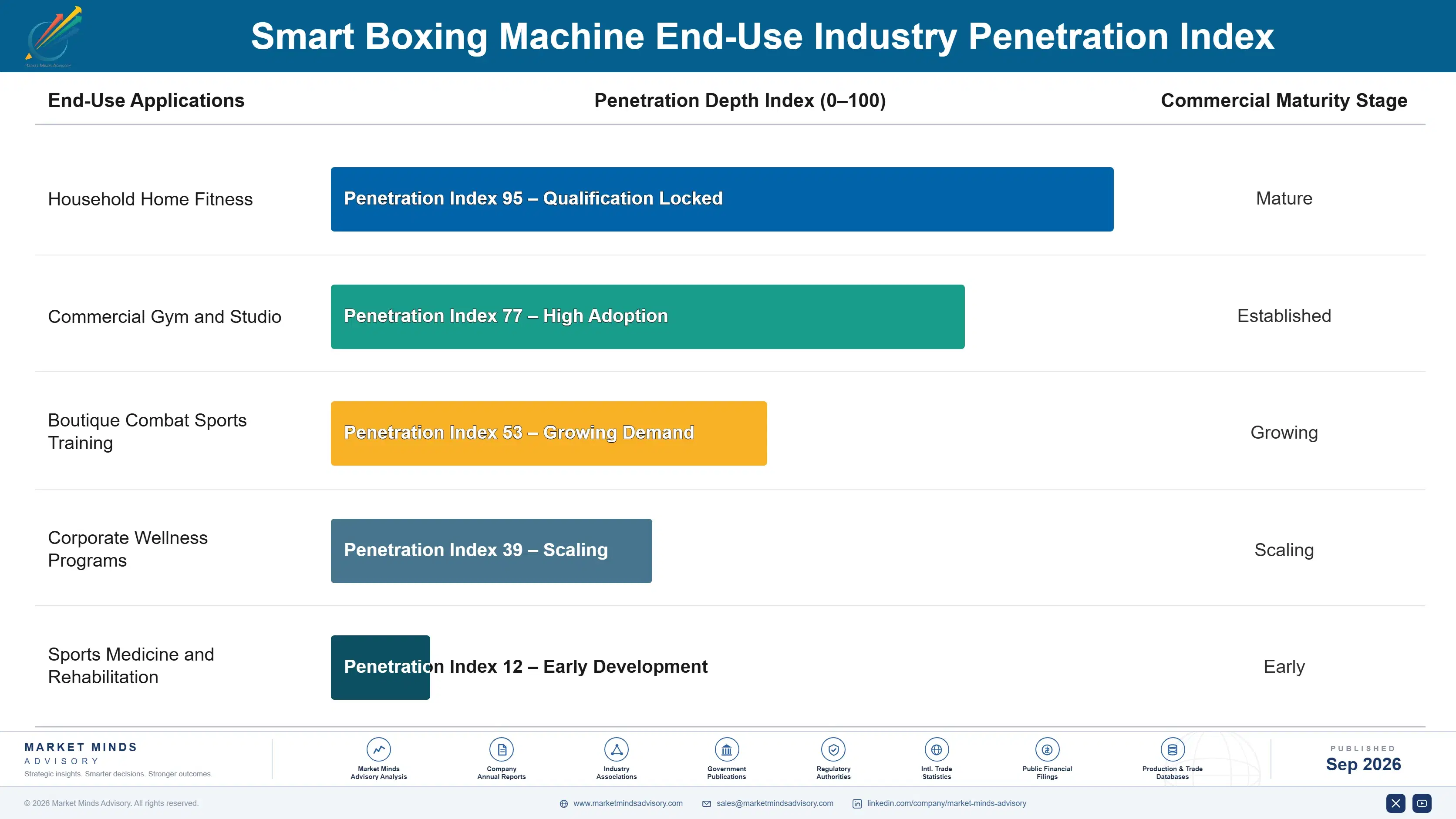
Adoption stickiness varies considerably by end-use vertical. Household buyers show strong early enthusiasm that fades without consistent content refreshes, while commercial gym operators renew reliably once a station proves it drives incremental membership revenue. Boutique fitness studios sit between the two, renewing based mainly on member engagement metrics tracked through the companion app rather than raw usage volume alone. Household churn peaks around month four, a window manufacturers target with retention campaigns.

Early buyers skewed toward combat sports enthusiasts already training at gyms, but the buyer base is shifting toward general fitness consumers seeking a lower-impact cardio alternative to running or cycling. This generational shift is pulling design priorities away from competitive sparring features and toward guided beginner programming that lowers the intimidation barrier for first-time buyers. Product roadmaps are adjusting accordingly across most major manufacturers.
smart-boxing-machine-market-end-use-penetration-index-1790018901509

Priorities For Category Participants

These are among the four positions where our research anticipates prominent divergence between winners and laggards over the coming forecast period. Each is grounded in the demand model, the regulatory perimeter, and the announced capacity pipeline.
01 / CONTENT PRODUCTION INVESTMENT

Fund coaching content pipelines before subscribers churn out

Household subscription retention depends almost entirely on how quickly manufacturers refresh coaching content after the initial hardware purchase excitement fades within the first several months of ownership. Brands treating content as a marketing afterthought rather than a core operating expense are already losing subscribers to competitors investing more heavily in this area. MMA Analysis expects content production budget to become the single clearest differentiator between category leaders and the fragmented middle tier within the next several years, not hardware specifications alone.
02 / SAFETY CERTIFICATION PRIORITY

Secure independent safety certification ahead of stricter regulation

Retailers are increasingly delaying new product listing decisions pending clearer safety certification standards, and brands without credible, independent testing data risk quickly losing shelf placement to better-certified competitors across major channels. Building a credible certification dataset takes many months, meaning delayed investment compounds steadily into a widening competitive gap that becomes genuinely difficult to close quickly. Manufacturers should prioritize certification spend even when it reduces near-term marketing budget, since the resulting testing data compounds into durable retail advantage over time.
03 / COMMERCIAL GYM CHANNEL EXPANSION

Expand gym licensing deals to accelerate household discovery

Commercial gym placements function as the category's most cost-effective customer acquisition channel, letting members trial AI coaching before committing to a household purchase decision entirely on their own initiative. Brands without a meaningful commercial licensing strategy are relying disproportionately on paid digital advertising, a considerably more expensive path to new subscriber acquisition over time. Expanding gym partnerships now, well ahead of competitors recognizing the same discovery advantage, offers a meaningful and durable head start heading into the next several years.
04 / NORTH AMERICA MARKET DEFENSE

Defend North America share as international entrants scale up

North America holds both the largest regional share and the deepest subscription culture, built over a decade of connected fitness platform adoption that trained consumers to accept recurring hardware-plus-content pricing structures. Brands without a meaningful North America retail and content investment are missing the region setting global category standards rather than merely following trends set by competitors elsewhere internationally. Defending this position requires sustained content investment, since international entrants are already targeting this exact market first with aggressive discounted subscription pricing.

Engagement Snapshot From the Field

A live engagement with an industry participant carrying material or product regulatory and market exposure ahead of a defining policy shift, showing how our research translates into a defensible multi-year portfolio strategy.
MARKET MINDS ADVISORY · CLIENT ENGAGEMENT SUMMARY
Smart Boxing Machine Producer Strategic Portfolio Review and Transition Roadmap 2026·Investment Scenario on Smart Boxing Machine Exposure Evaluation 2025-26
CLIENT PROFILE
The client is a mid-tier connected fitness hardware maker headquartered in North America with an established portfolio of wearable fitness trackers sold through direct-to-consumer and mass retail channels. Annual revenue reported at approximately 240 million dollars (client-reported, unverified by MMA) across its wearables division, with no prior investment in boxing-specific hardware or AI coaching software ahead of this engagement.
STRATEGIC CHALLENGE
The client's wearable fitness tracker growth was slowing as the category matured, and leadership sought a new connected hardware category with stronger subscription economics. Boxing hardware appealed given adjacent sensor technology expertise, but leadership needed a market entry strategy that avoided direct competition with entrenched category leaders on brand recognition alone.
MMA APPROACH
MMA conducted primary interviews with fitness hardware retail buyers alongside proprietary survey data across six countries to size addressable demand by product format and region. The engagement mapped competitive positioning against the client's existing wearable brand equity and modeled subscription economics against comparable category benchmarks. Findings were validated against company disclosed segment margins and benchmarked against comparable market entries.
KEY FINDINGS
  1. Wearable sensor boxing trainers, an underserved format between premium reactive machines and basic bags, offered the clearest entry path given the client's existing sensor technology expertise and manufacturing relationships.
  2. The client's existing wearable subscriber base offered a credible cross-sell channel unavailable to standalone boxing hardware competitors lacking any prior direct-to-consumer subscription relationship with fitness-focused households.
  3. Safety certification proved the single largest barrier to retail listing negotiations, with major sporting goods chains increasingly favoring brands holding documented independent testing credentials over unverified marketing claims.
  4. Licensing proprietary motion tracking software from an established boxing hardware partner emerged as a faster entry path than internal development, cutting estimated time to market by roughly fourteen months.
CLIENT PROFILE
The client is a mid-tier connected fitness hardware maker headquartered in North America with an established portfolio of wearable fitness trackers sold through direct-to-consumer and mass retail channels. Annual revenue reported at approximately 240 million dollars (client-reported, unverified by MMA) across its wearables division, with no prior investment in boxing-specific hardware or AI coaching software ahead of this engagement.
STRATEGIC CHALLENGE
The client's wearable fitness tracker growth was slowing as the category matured, and leadership sought a new connected hardware category with stronger subscription economics. Boxing hardware appealed given adjacent sensor technology expertise, but leadership needed a market entry strategy that avoided direct competition with entrenched category leaders on brand recognition alone.
MMA APPROACH
MMA conducted primary interviews with fitness hardware retail buyers alongside proprietary survey data across six countries to size addressable demand by product format and region. The engagement mapped competitive positioning against the client's existing wearable brand equity and modeled subscription economics against comparable category benchmarks. Findings were validated against company disclosed segment margins and benchmarked against comparable market entries.
KEY FINDINGS
  1. Wearable sensor boxing trainers, an underserved format between premium reactive machines and basic bags, offered the clearest entry path given the client's existing sensor technology expertise and manufacturing relationships.
  2. The client's existing wearable subscriber base offered a credible cross-sell channel unavailable to standalone boxing hardware competitors lacking any prior direct-to-consumer subscription relationship with fitness-focused households.
  3. Safety certification proved the single largest barrier to retail listing negotiations, with major sporting goods chains increasingly favoring brands holding documented independent testing credentials over unverified marketing claims.
  4. Licensing proprietary motion tracking software from an established boxing hardware partner emerged as a faster entry path than internal development, cutting estimated time to market by roughly fourteen months.
RECOMMENDED STRATEGY
Phase 1: Phase 1 (Months 1-6): License motion tracking software and launch a limited pilot targeting existing wearable subscribers directly through app notifications. Phase 2: Phase 2 (Months 7-14): Expand pilot data into a full safety certification package supporting broader retail listing negotiations across additional markets. Phase 3: Phase 3 (Months 15-24): Scale cross-sell bundling with the wearables division and evaluate a second product format launch using validated data.
OUTCOME
Within the first year following the engagement, the client reported cross-sell conversion of 19 percent among existing wearable subscribers and incremental revenue of approximately 22 million dollars (client-reported, unverified by MMA) attributable to the new boxing hardware line, ahead of internal targets set at project outset for the pilot phase.

Frequently Asked Questions

Foundational context covering the market sizes, CAGR, scope, country, region and competition that inform every finding below. This section is provided to cover basics and most often pre-purchase conversations, answered from the MMA Primary Research Dataset.

What is the current size of the Smart Boxing Machine Market?

The Smart Boxing Machine Market reached 0.38 billion dollars in base year 2025. Growth is driven by AI coaching technology and rising household demand for connected combat fitness hardware globally.

How large will the Smart Boxing Machine Market be by 2036?

The market is forecast to reach 1.73 billion dollars by 2036, roughly a 3.98 times expansion from 2026 levels. Growth concentrates in AI-coached and virtual reality hardware segments.

What is the CAGR for the Smart Boxing Machine Market 2026 to 2036?

The market is projected to grow at a 14.8 percent compound annual growth rate between 2026 and 2036. Bull and bear scenarios range from 13.5 to 16.1 percent depending on adoption pace.

Which segment is growing fastest?

AI-Coached Reactive Target Boxing Machines lead at a 22.0 percent CAGR, roughly 1.49 times the overall market rate. Virtual Reality Boxing Training Systems follow closely at 19.0 percent annual growth.

Who are the major companies in the Smart Boxing Machine Market?

FightCamp, Liteboxer, Hykso, Everlast, and Wanderful Boxing lead the category. Together they hold a CR5 near 24 percent measured on global unit shipment volume across hardware categories.

Which country is growing fastest?

India leads country-level growth at a 17.4 percent CAGR, driven by rapidly expanding urban gym membership reaching younger households. The United States remains the largest single national market by revenue.

Report Segmentation Architecture

The full report scope spans multiple orthogonal segmentation dimensions, with cross-tabulated demand data provided for each dimension pair. Coverage extends further to regional breakdowns, trend trajectories, and the competitive detail needed to support segment-level decision-making.

By Hardware Format

  • AI-Coached Reactive Target Boxing Machines
  • Connected Freestanding Punching Bag Systems
  • Wall-Mounted Smart Boxing Panels
  • Wearable Sensor Boxing Trainers
  • Virtual Reality Boxing Training Systems
  • Commercial Gym Smart Boxing Stations

By End-Use Industry

  • Household Home Fitness
  • Commercial Gym and Studio
  • Boutique Combat Sports Training
  • Corporate Wellness Programs
  • Sports Medicine and Rehabilitation

By Commercial Dimension

  • Direct-to-Consumer Online Sales
  • Sporting Goods Retail Channel
  • Subscription and Recurring Commerce
  • Commercial Licensing and Placement

By Region

  • North America
  • Western Europe
  • East Asia
  • South Asia and Pacific
  • Latin America
  • Middle East and Africa
  • Eastern Europe

Scope, Methodology, and Coverage

Every figure in this report is reproducible from documented input assumptions. The scope below maps the historical period, the forecast horizon, the segmentation dimensions, and the countries covered, alongside the underlying primary and qualitative methodology.
Historical Period
2020 to 2025
Forecast Period
2026 to 2036
Base Year
2025 (USD billions; MMA Primary Research Dataset, September 2026)
Market Definition
The Smart Boxing Machine Market covers connected boxing and combat training hardware incorporating sensors, AI coaching feedback, or companion app tracking, sold for home and commercial fitness use. It excludes conventional non-connected punching bags and gloves lacking any sensor or software feedback layer.
Quantitative Units
USD billions (current prices); unit volume in thousand units where applicable
Segmentation Dimensions
By Hardware Format; By End-Use Industry; By Commercial Dimension; By Region
Regions Covered
North America, Western Europe, East Asia, South Asia and Pacific, Latin America, Middle East and Africa, Eastern Europe
Countries Covered
USA, China, Germany, France, UK, Japan, South Korea, India, Australia, Canada, Brazil, Mexico, Indonesia, Vietnam, Thailand, Malaysia, UAE, Saudi Arabia, South Africa, Nigeria, Turkey, Poland, Netherlands, Italy, Spain, Sweden, Switzerland, Argentina, Colombia, Singapore, and additional markets relevant to this sector
Key Companies Profiled
FightCamp, Liteboxer, Hykso, Everlast, Wanderful Boxing, Nex Boxing, Fitbox, Boostcamp Fitness, Tonal Systems, Peloton Interactive, Hyperice, Whoop Inc, Title Boxing, RingSide, Everfit Technologies, Combat Kinetics, Strikefit, Punchlab, Sting Sports, Century Martial Arts Supply
Quantitative Methodology
Primary survey, n=3,800 respondents, Q4 2025, six countries; demand-side model with trade association cross-validation
Qualitative Methodology
47 expert interviews, Q4 2025; applied to validate demand model assumptions, identify emerging dynamics, and assess competitive positioning
Report Format
PDF and XLSX data workbook (Word format preview document)
Publisher
Market Minds Advisory
Report Code
MMA-2026-TEC-512
Published
September 2026
Contact
sales@marketmindsadvisory.com | www.marketmindsadvisory.com

Purchase the full Smart Boxing Machine Market Report (2026 to 2036).

The full report provides granular segmentation across hardware format, end-use industry, and commercial channel, with ten-year forecasts through 2036 for all seven global regions. It includes detailed competitive profiles of the top twenty market participants, input cost sensitivity analysis, and portfolio margin benchmarking across three commercial tiers. Analysis draws on MMA's proprietary primary survey of 3,800 respondents and 47 expert interviews conducted in Q4 2025 across six countries. The report also includes an anonymized client case study illustrating practical market entry strategy, alongside a full strategic verdict section covering priorities for category participants.
Ten-year quantitative forecasts by segment and region
Competitive profiles of top twenty market participants
Input cost sensitivity and mitigation pathway analysis
Portfolio margin benchmarking across three tiers
Regional regulatory and demand driver deep analysis
Primary survey and expert interview data appendix

Built For The People Who Decide

From boardroom strategy to bench-side execution, this report is read cover-to-cover by leaders shaping the next decade of their industry, turning demand scenarios, market dynamics and valuation benchmarks into decisions.
CXOs/ Presidents/ VPs/ Managers
M&A and Corporate Development
Strategy Teams and R&D Heads
Procurement and Product Directors
Regulatory and Compliance Leaders
Investor Relations and Equity Analysts