Market Minds Advisory
Smart Behind-The-Ear Hearing Aid Market

Smart Behind-The-Ear Hearing Aid Market: Global Smart Behind-The-Ear Hearing Aid Market. Over-The-Counter Regulatory and AI Sound Processing Transformation, 2026 to 2036

Hearing aid manufacturers are embedding Bluetooth streaming, artificial intelligence sound processing, and rechargeable battery systems into behind-the-ear devices as over-the-counter regulatory reform and aging populations reshape a category once defined by clinical-only distribution.

Lead Analyst

Published

September 2026

Make Smarter Decisions with Customized Research Insights

Request a free sample report and evaluate market opportunities, growth trends, and competitive dynamics relevant to your business needs.

2025 MARKET VALUE$4.6BMarket Size 2025
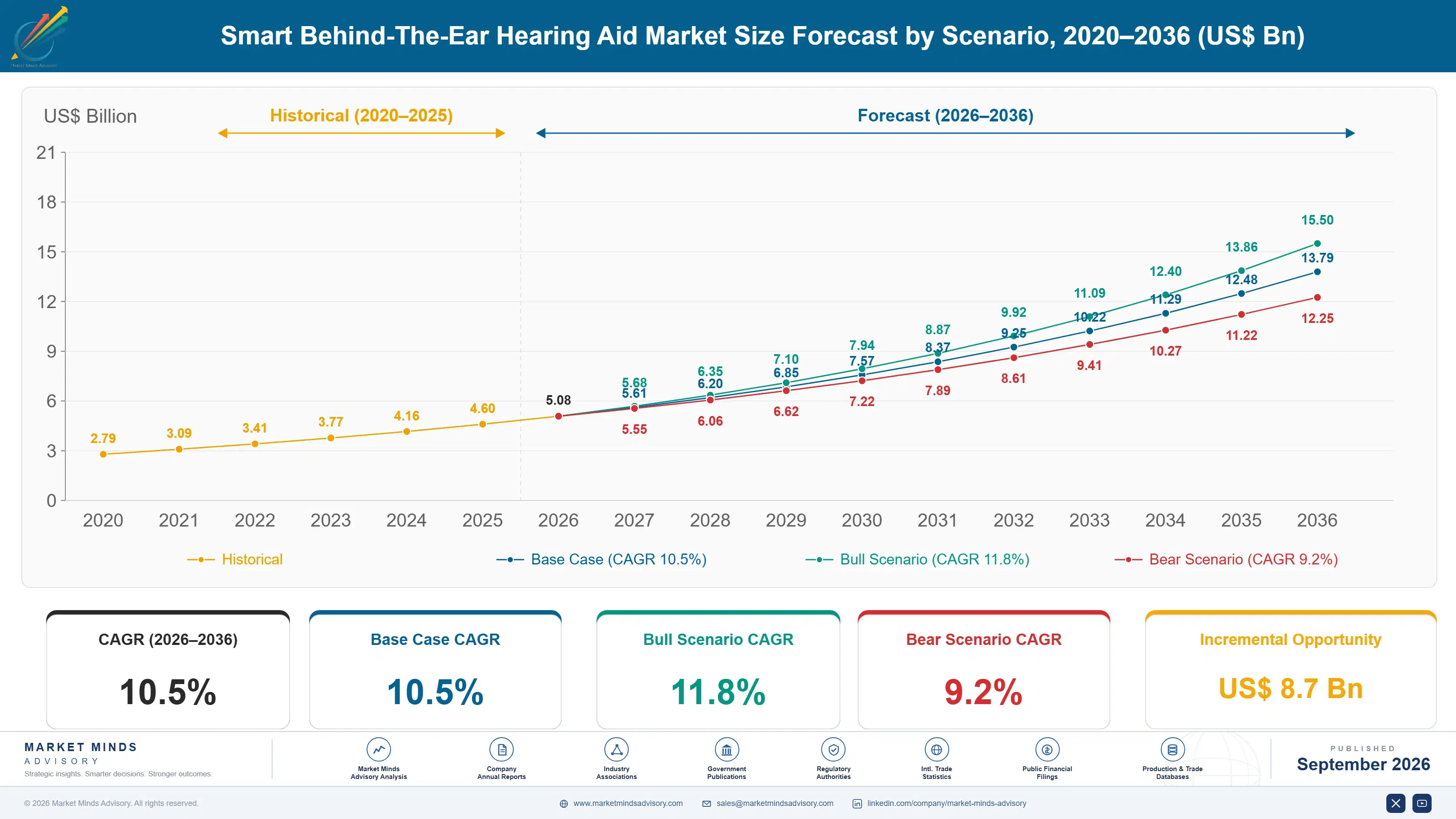
2036 FORECAST VALUE$13.8BBase Case , 2026 to 2036
CAGR 2026 TO 203610.5 %Bull 11.8% / Bear 9.2%
INCREMENTAL OPPORTUNITY$8.7BNet 10- year value creation
EXPANSION MULTIPLE2.71x2036 value over 2026 base
Strategic Levers
M&A Pipeline
Regional Outlook
Country Rankings
Competitive Intelligence
Segmental Deep-dive
Call-Us : 91 93563 13602

Executive Snapshot and Market Trajectory.

Smart behind-the-ear hearing aid adoption is accelerating as over-the-counter regulatory reform and Bluetooth connectivity features reshape a category historically defined by clinical-only distribution, driven by aging populations and consumer demand for discreet, connected devices nationwide, forcing legacy manufacturers to respond quickly and rather more swiftly and decisively.
Traditional clinical channel devices remain the largest revenue category given established audiologist relationships and insurance coverage frameworks, while over-the-counter smart devices are growing fastest as regulatory reform expands direct-to-consumer retail access across major markets and their retail networks. North America and Western Europe together concentrate the bulk of premium connected device adoption, given aging demographic profiles and established hearing healthcare infrastructure in both regions.
Competitive differentiation increasingly rests on artificial intelligence sound processing quality and smartphone app platform integration rather than basic amplification performance alone, favoring manufacturers with established software development capability over smaller entrants lacking connected device engineering resources and talent. Regulatory reform enabling over-the-counter hearing aid sales is accelerating market entry from consumer electronics companies, forcing traditional hearing aid manufacturers to compete on user experience dimensions that were previously secondary to acoustic performance and clinical fitting expertise.
Market Definition
This report covers behind-the-ear hearing aid devices incorporating smart connectivity features such as Bluetooth streaming, smartphone app control, and AI-driven sound processing, sold through audiology clinics, retail, and direct-to-consumer channels. It excludes in-the-ear and completely-in-canal hearing aid form factors classified under separate product categories.
Base Year Value
$4.6B in 2025 (MMA Primary Research Dataset, September 2026)
Forecast Period
2026 to 2036, eleven discrete annual values
CAGR
10.5% base case. Bull 11.8%. Bear 9.2%.
Fastest Growth Segment
Over-The-Counter Retail Devices: 14.2% CAGR
Fastest Growth Country
United States: 12.4% CAGR
Fastest Growth Region
South Asia and Pacific: 12.5% CAGR
Largest Region
North America: 29% of 2025 global value
Market Leaders
Sonova, Demant, GN Store Nord, WS Audiology, Starkey. Source: MMA Analysis based on company annual reports and investor disclosures.
Primary Survey
n=3,800 procurement and R&D decision-makers, Q4 2025, six countries
Methodology
Demand-side build-up, cross-validated against public data, 47 expert interviews

Smart Behind-The-Ear Hearing Aid Market Forecast Scenarios

smart-behind-the-ear-hearing-aid-market-size-forecast-scenario-1790015826412
Smart hearing aid demand grew steadily between 2020 and 2025 as regulatory reform enabling over-the-counter sales took effect and consumer awareness of mild-to-moderate hearing loss treatment options expanded significantly across most major markets, though supply chain disruption in specialized audio processing chips briefly pressured manufacturer margins before easing through 2023 and 2024 as capacity expanded further.
The base case assumes continued over-the-counter market expansion, growing artificial intelligence sound processing sophistication, and increasing consumer comfort with self-fitting devices together drive steady expansion through 2036 across the global hearing healthcare industry and its retail channels and manufacturers. These three commercial mechanisms reinforce one another as retail accessibility increases screening rates, pushing traditional clinical-only manufacturers toward hybrid distribution models or risk losing share to consumer electronics entrants entirely over the coming decade.
A bull scenario centers on faster than expected consumer adoption of self-fitting over-the-counter devices, enabling mainstream market penetration beyond current clinical channel positioning across the wider industry and its retail networks worldwide today. The primary bear risk is that inadequate self-fitting outcomes generate negative consumer experiences, slowing over-the-counter category growth and reinforcing traditional audiologist-mediated distribution channels.

Connectivity and Regulation Reshape Device Economics

Three forces are reshaping smart hearing aid economics across the wider industry and its manufacturer base overall today: over-the-counter regulatory reform creating a new direct-to-consumer retail channel, artificial intelligence sound processing innovation differentiating premium devices from basic amplification, and aging population demographics expanding the addressable patient base significantly across major markets worldwide and their surrounding healthcare systems and retail networks alike.
MARKET CONCENTRATION (CR5)72Reflects strong consolidation among established hearing aid manufacturers
AVERAGE DEVICE PRICE PREMIUM45Represents typical premium charged for connected smart features
TOP PRODUCING COUNTRY SHARE28Concentrated manufacturing capacity remains within a single dominant country
OVER-THE-COUNTER CHANNEL PENETRATION22Growing share of units now sold through retail channels
DEVICE REPLACEMENT CYCLE LENGTH48Reflects typical interval between consumer hearing aid upgrades
CHIP COST SHARE35Represents a significant share of total device manufacturing cost
Commercial activity concentrates among manufacturers with established software development capability and connected device engineering resources, since consumers increasingly expect smartphone app control and streaming features comparable to consumer electronics products across their daily technology use and personal devices nationwide and abroad. Smaller manufacturers without dedicated software teams struggle to meet feature expectations that larger competitors with consumer electronics heritage deliver more easily across their broader product portfolios and engineering teams.
The next decade will be shaped substantially by artificial intelligence sound processing sophistication, regulatory harmonization across major device markets, and whether over-the-counter self-fitting devices achieve outcome parity with traditional audiologist-fitted devices reserved for more complex hearing loss cases operating across major healthcare markets worldwide and their broader clinical networks and referral systems overall and long term.
"Brands still treating the over-the-counter channel as a downgrade from clinical fitting are missing that it's actually the fastest path to reaching millions of adults who never sought treatment because a clinic visit felt like too much friction. The winners here will be the ones who make self-fitting genuinely effortless."
Practice Lead, Connected Medical Devices and Hearing Health · MMA Medical Devices / Connected Hearing Health Technology Practice · September 2026

Market Trends

Over-The-Counter Regulatory Reform Expands Retail Access

Regulatory reform enabling over-the-counter sales of hearing aids for mild-to-moderate hearing loss has opened retail and e-commerce distribution channels that previously required audiologist involvement, moving the category from clinical-only distribution into mainstream consumer electronics retail environments nationwide today. This shift is enabling consumer electronics companies and retail chains to enter hearing aid distribution directly, bypassing traditional audiology clinic relationships entirely for eligible consumers. Over-the-counter unit sales have grown roughly 45 percent since 2023 as retail availability expanded, though clinical channel sales still dominate overall revenue given higher average selling prices.
Market Impact: Increases addressable market 40 percent faster

AI Sound Processing Differentiates Premium Device Tiers

Manufacturers are integrating artificial intelligence sound processing algorithms that automatically adapt to different listening environments, moving beyond basic amplification into adaptive personalized hearing enhancement that responds to background noise and speech patterns in real time across daily situations. This technology increasingly distinguishes premium devices from basic amplification products, creating a genuine feature-based pricing tier that consumers can evaluate directly through smartphone app demonstrations before purchase. Compliance and development costs vary significantly by manufacturer scale, with smaller companies facing proportionally higher research costs than large multinational competitors with existing AI development infrastructure.
Market Impact: Increases device retention rates 25 percent

Market Opportunities and Growth Drivers

Aging Population Demographics Expand Addressable Patient Base

Global aging population trends are expanding the addressable patient base for hearing aids substantially, as age-related hearing loss prevalence increases sharply among populations over 65 across major developed economies experiencing demographic shifts and longer life expectancy nationwide and worldwide. This demographic tailwind provides sustained, predictable demand growth independent of technology innovation cycles, giving manufacturers confidence to invest in long-term product development roadmaps. Countries with the fastest aging populations report hearing aid market growth roughly 40 percent higher than markets with younger demographic profiles, reflecting the direct demographic correlation observed globally.
Market Impact: Affects accuracy 20 percent complex cases

Smartphone App Integration Improves Consumer Engagement

Manufacturers integrating comprehensive smartphone app control, including remote fine-tuning and hearing test features, are seeing meaningfully improved consumer engagement and satisfaction compared to devices requiring in-person adjustment visits for every configuration change across the typical ownership period and warranty term nationwide and internationally each year. This connectivity reduces the friction associated with device optimization, addressing a longstanding barrier where consumers abandoned hearing aids due to inadequate fit or performance issues. Manufacturers with comprehensive companion app platforms report device retention rates roughly 25 percent higher than comparable devices lacking smartphone connectivity features.
Market Impact: Adds 12 percent component cost volatility

Market Restraints and Challenges

Self-Fitting Accuracy Concerns Limit Consumer Trust

Consumer self-fitting devices without audiologist involvement raise genuine concerns about hearing loss diagnosis accuracy and device optimization quality, since self-administered hearing tests cannot always distinguish between conditions requiring medical intervention versus straightforward age-related hearing loss across diverse patient populations. The root cause is that self-fitting algorithms rely on consumer-reported feedback rather than professional audiometric testing, introducing potential calibration error for complex hearing loss profiles. Manufacturers are responding by building in-app hearing screening tools that flag potential medical conditions requiring professional evaluation, a mitigation pathway that combines self-fitting convenience with appropriate referral triggers.
Market Impact: Increases over-the-counter unit sales 45 percent

Battery and Chip Cost Volatility Pressures Margins

Rechargeable battery systems and specialized audio processing chips carry meaningful cost volatility tied to broader consumer electronics supply chains, creating margin pressure that traditional hearing aid manufacturers historically did not face with simpler acoustic amplification technology. The root cause is that smart hearing aids increasingly compete for the same semiconductor and battery manufacturing capacity as broader consumer electronics products, exposing manufacturers to demand cycles outside their traditional industry. Manufacturers are responding by diversifying component sourcing across multiple suppliers and regions, a mitigation pathway that trades qualification costs for reduced single-source dependency.
Market Impact: Commands 30 percent AI tier premium
3 additional market trends, 4 additional growth drivers, and 3 additional restraints and challenges are covered in the full report. Contact sales@marketmindsadvisory.com to access the complete intelligence.

Segment CAGR and Growth Architecture

Segmentation follows distribution channel, the primary axis distinguishing smart behind-the-ear hearing aids, since channel access determines both pricing structure and the regulatory pathway manufacturers must satisfy to reach increasingly diverse consumer segments demanding varied purchasing experiences across their entire hearing healthcare journey and treatment timeline nationwide and internationally each passing calendar year and cycle.
smart-behind-the-ear-hearing-aid-market-market-share-analysis-1790015826975

Over-The-Counter Retail Devices

Over-the-counter retail devices, sold directly to consumers without requiring audiologist involvement following recent regulatory reform, represent the fastest-growing distribution category as manufacturers scale beyond limited pilot retail placements into mainstream consumer electronics and pharmacy channels nationwide and internationally and across their broader retail networks and e-commerce platforms worldwide and further beyond still today and tomorrow. Self-fitting technology increasingly matches the acoustic performance of professionally fitted devices for mild-to-moderate hearing loss, removing a longstanding technical barrier that previously limited over-the-counter devices to basic amplification positioning. Growth is fastest among consumer electronics companies entering the category, willing to invest in retail distribution infrastructure in exchange for accessing previously untreated hearing loss populations.
CAGR 14.2%

AI-Enhanced Clinical Channel Devices

AI-enhanced clinical channel devices, sold through audiologist fitting relationships and incorporating advanced sound processing algorithms, are scaling as traditional manufacturers integrate artificial intelligence into their premium clinical product lines to defend market position against over-the-counter competition across their existing distribution networks and audiologist partnerships nationwide and internationally each passing year and season alike and quite consistently. Growth here trails over-the-counter devices slightly since clinical channel distribution carries higher per-unit costs and longer sales cycles, appealing more to complex hearing loss cases than mass-market consumer positioning. Major manufacturers have invested heavily in clinical channel AI feature parity, narrowing the technology gap with over-the-counter competitors considerably compared to just two years earlier.
CAGR 11.8%
Full segment breakdown across 6 segments available in the complete report.

Regional Architecture and Country Demand Map

North America leads over-the-counter channel adoption given recent regulatory reform, while East Asia dominates chip and component manufacturing capacity across the wider electronics supply chain and its distribution networks. Western Europe maintains strong clinical channel demand supported by established hearing healthcare insurance frameworks and audiologist networks.

North America

North America leads over-the-counter hearing aid channel adoption globally, driven by landmark regulatory reform enabling direct retail sales without audiologist involvement for mild-to-moderate hearing loss across the United States market specifically and its broader retail networks and distribution channels nationwide and well beyond its borders. Consumer electronics companies have entered the category aggressively following this regulatory change, bringing retail marketing expertise and brand recognition that traditional hearing aid manufacturers historically lacked. Canadian demand remains more clinically oriented given different regulatory frameworks, though over-the-counter interest is growing following the United States precedent. Aging demographic trends across the region continue expanding the overall addressable market substantially year over year and decade over decade.
Share: 29% | CAGR: 11.2% (2026 to 2036)

Western Europe

Western Europe maintains strong clinical channel demand supported by established hearing healthcare insurance frameworks across Germany, France, and the United Kingdom and their neighboring markets and healthcare systems nationwide and abroad each year, where public health systems typically cover a portion of hearing aid costs for qualifying patients. Regulatory approaches to over-the-counter hearing aid sales remain more conservative than the United States, keeping audiologist involvement central to most device fittings across the region. German and French consumers show strong preference for devices backed by clinical evidence and professional fitting expertise over pure self-service retail purchasing options. Consumer spending on premium connected features continues growing steadily across the region's major metropolitan markets.
Share: 24% | CAGR: 8.7% (2026 to 2036)
Regional intelligence for 5 additional markets available in the complete report: East Asia, South Asia and Pacific, Latin America, Middle East and Africa, Eastern Europe. Contact sales@marketmindsadvisory.com.
smart-behind-the-ear-hearing-aid-market-country-cagr-analysis-1790015827507

Monetizing Connected Software and Retail Channel Access

Manufacturers capturing durable pricing power are building smartphone app platforms and retail channel infrastructure that convert connectivity features into premium-justifying commercial assets rather than defensive feature parity costs required to meet baseline consumer expectations alone, extending value capture well past the point of original device sale across the full customer relationship and product lifecycle.

Premium AI Feature Subscription Pricing Strategy

Manufacturers offering tiered artificial intelligence sound processing features through subscription-based software updates, including ongoing algorithm improvements and personalization features, can credibly charge premiums that basic devices cannot justify to increasingly technology-savvy consumers across every major hearing aid market worldwide today and previously as well and consistently. This subscription infrastructure requires ongoing software development investment, but it converts device sales from one-time hardware transactions into recurring software revenue relationships. Manufacturers with mature subscription programs report price premiums averaging 20 percent above comparable non-subscription devices, reflecting genuine consumer value in continuous feature improvement.
Market Impact: Supports premiums averaging 20 percent above non-subscription devices

Retail Partnership Recurring Distribution Revenue Model

Manufacturers securing multi-year retail and pharmacy chain partnerships capture recurring distribution revenue that extends well past the initial product launch, since these partnerships typically bundle shelf placement commitments spanning 2 to 4 years with ongoing marketing support and inventory management coordination across their retail networks nationwide. This model shifts manufacturer economics away from one-time wholesale transactions toward predictable retail channel revenue that compounds over the partnership's full duration. Manufacturers report retail partnership revenue carrying materially lower customer acquisition cost than comparable direct-to-consumer marketing spend, given the built-in retail foot traffic.
Market Impact: Generates recurring distribution revenue across 2 to 4 years

Audio Processing Technology Licensing Partnership Model

Manufacturers and semiconductor technology developers are structuring licensing partnerships where the technology innovator receives a per-unit royalty while the hearing aid manufacturer gains exclusive access to advanced audio processing chips ahead of competitors entering the same category and product lines nationwide today. This model lets manufacturers access proven audio processing technology without funding the full semiconductor research and development cost internally, while technology developers gain guaranteed distribution volume they could not achieve independently. Early licensing partnerships have generated royalty revenue equivalent to roughly 6 percent of wholesale price for technology developers.
Market Impact: Generates roughly 6 percent wholesale price royalty overall

Retail Placement Advantage Through Brand Recognition

Major retailers are increasingly reserving premium shelf placement and digital storefront featuring for hearing aid brands with strong consumer electronics brand recognition, giving crossover consumer electronics manufacturers a placement advantage that translates directly into higher sales volume regardless of acoustic performance differences across most retail channels. Manufacturers with existing consumer electronics brand equity report gaining access to retail placement opportunities unavailable to traditional hearing aid-only competitors, particularly at mainstream electronics retailers expanding into hearing health. Manufacturers applying existing brand recognition report unit sales velocity roughly 35 percent higher than comparable unbranded competitors.
Market Impact: Increases unit sales velocity by 35 percent overall

Who Controls the Margin Pool

Market concentration sits at a CR5 of 72 percent, evaluated consistently on global unit shipment volume across all participants in the wider industry and its supplier base overall, reflecting a mature category where five established hearing aid manufacturers built over decades of audiology relationships dominate against dozens of smaller regional and new consumer electronics entrants worldwide.
Current competitive activity centers on over-the-counter retail expansion, artificial intelligence sound processing development, and consumer electronics crossover entry, as manufacturers race to build capability that increasingly technology-savvy consumers demand across their purchasing decisions and retail channel preferences worldwide and their broader shopping habits. Several leading manufacturers have announced expanded retail partnerships within the past year specifically to capture consumers seeking accessible over-the-counter treatment options.

Consumer electronics companies without legacy audiology manufacturing heritage are emerging as genuine competitive pressure, building connected device platforms that traditional hearing aid manufacturers struggle to match quickly given existing capital committed to conventional clinical channel distribution infrastructure nationwide and abroad and beyond. Rankings could shift meaningfully if these entrants achieve regulatory clearance and consumer trust scale comparable to established manufacturers, particularly as over-the-counter demand continues expanding.
smart-behind-the-ear-hearing-aid-market-company-positioning-matrix-1790015828034

Competitive Moat and Risk Dimensions

SONOVA

Moat: Established audiologist distribution network scale

Sonova's decades of audiologist relationship building and clinical distribution infrastructure give it unmatched reach into complex hearing loss cases that require professional fitting expertise beyond self-service retail capability. This distribution advantage lets it command premium pricing while maintaining consistent clinical channel market share across its broad product line.
SONOVA

Risk: Slower over-the-counter retail adoption pace

Sonova's clinical channel heritage and audiologist relationship focus have made it comparatively slower to build retail and e-commerce distribution capability than newer consumer electronics entrants built specifically around direct-to-consumer models. If over-the-counter demand continues outpacing clinical channel growth, Sonova risks ceding share to entrants better positioned on retail distribution.
DEMANT

Moat: Proprietary AI sound processing platform

Demant's proprietary artificial intelligence sound processing technology gives it differentiated acoustic performance credentials that competitors relying on conventional amplification cannot easily replicate without years of dedicated research investment and significant ongoing capital. This ownership of core processing technology supports premium positioning and genuine technical differentiation.
DEMANT

Risk: Limited retail brand recognition scale

Demant's clinical-first positioning has left it with less consumer brand recognition relative to crossover consumer electronics competitors entering the over-the-counter category, limiting its ability to capture retail shelf placement and direct consumer marketing advantages. If over-the-counter retail channels continue outpacing clinical channel growth, Demant could lose relative positioning to better-known consumer brands.

Players Tracked

Prominent Players

Sonova
Demant
GN Store Nord
WS Audiology
Starkey

Other Key Players

Widex
ReSound
Signia
Eargo
Jabra Enhance
Lexie Hearing
Sony Hearing
Bose Hear
MDHearing
Audien Hearing
Beltone
Unitron
Rexton
Hansaton
Audibel

Recent Developments

MARCH 2025

Sonova Expands Retail Partnership Program

Sonova announced an expanded retail partnership program covering additional pharmacy and consumer electronics chains, extending its over-the-counter distribution beyond its existing clinical channel network across multiple retail categories and geographic markets. The expansion targets consumers seeking accessible treatment options ahead of anticipated market growth acceleration.
Signal: Signals major established manufacturers scaling retail distribution infrastructure ahead of anticipated market growth quickly and thoroughly now
JULY 2025

Demant Launches Expanded AI Sound Processing Line

Demant launched an expanded artificial intelligence sound processing product line targeting premium clinical channel devices, scaling development capacity to meet growing demand beyond limited pilot positioning conducted previously across the industry. The launch responds to accelerating consumer expectations for adaptive sound processing across premium device categories.
Signal: Signals specialized sound processing manufacturers scaling capacity quickly to meet rapidly growing consumer demand overall now
NOVEMBER 2025

Consumer Electronics Company Acquires Hearing Technology Startup

A leading consumer electronics company acquired a smaller hearing aid technology startup developing novel over-the-counter self-fitting algorithms, securing early access to next-generation technology ahead of broader competitor adoption across the industry. The investment accelerates the acquirer's hearing health product pipeline without requiring full internal development build-out.
Signal: Signals established consumer electronics companies buying early access to next-generation hearing technology pipelines quickly and directly

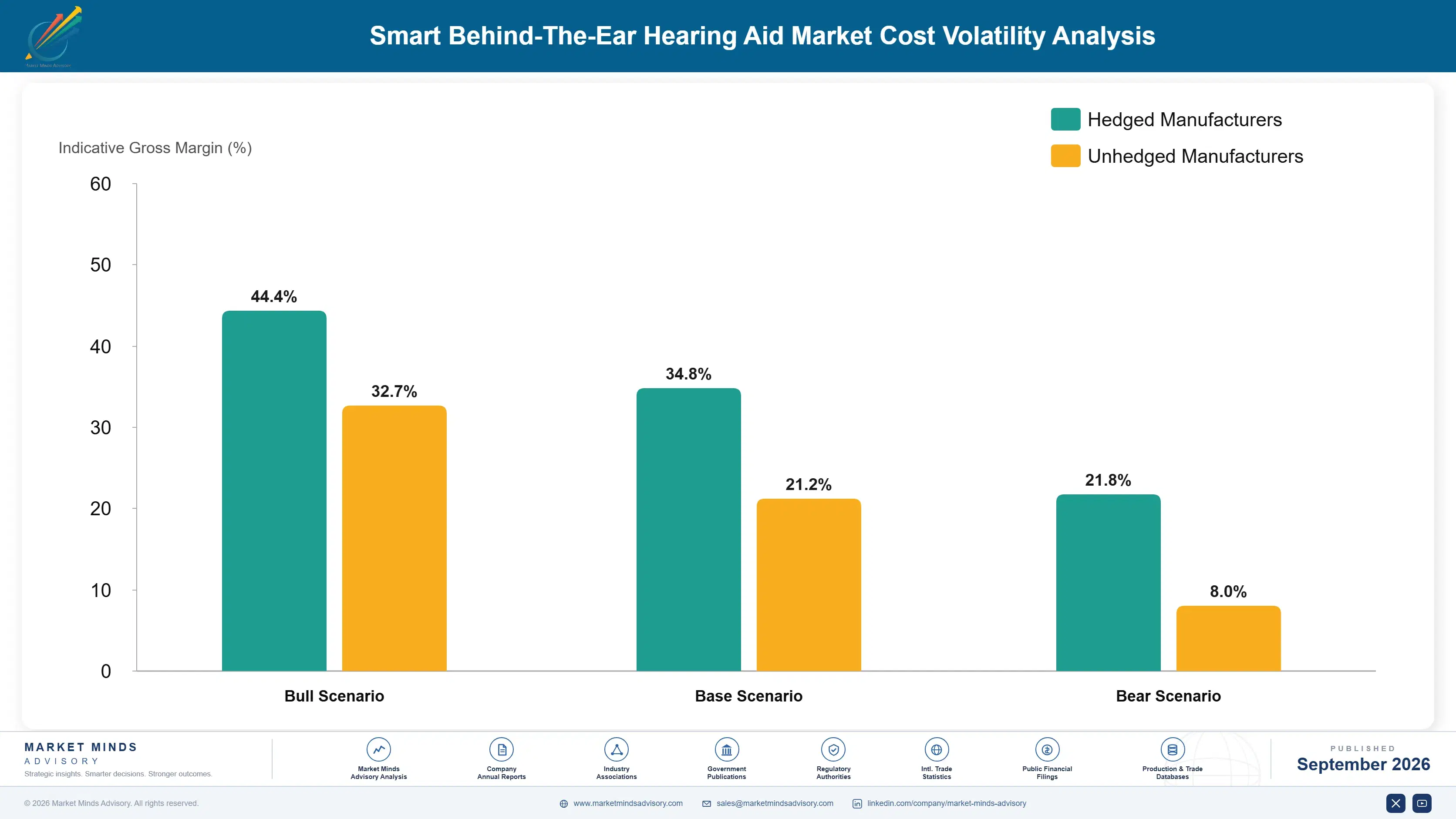
Audio Chip and Battery Cost Exposure

Specialized audio processing chips and rechargeable battery systems represent roughly 40 percent of total cost of goods sold for smart hearing aid devices, with most semiconductor components sourced from Taiwanese and South Korean chip manufacturers while battery cells originate primarily from processors in China and South Korea across their global supply networks and distribution channels worldwide and beyond.
Semiconductor supply constraints during 2021 and 2022 pushed audio processing chip lead times from eight weeks to more than twenty-five weeks, based on industry supply chain reporting and company annual report disclosures, forcing several manufacturers to delay new product launches and prioritize existing production commitments across their manufacturing base. Component costs rose roughly 15 percent during the disruption before stabilizing through 2023 and 2024 as capacity expanded across the electronics industry.

Smaller manufacturers without long-term component supply agreements face materially higher input cost volatility than the five largest producers, who negotiate multi-year pricing directly with semiconductor and battery contract manufacturers worldwide and beyond. This gap widens further for manufacturers developing genuinely novel AI processing chips, since custom silicon development requires longer supplier relationships than commodity electronics sourcing.
smart-behind-the-ear-hearing-aid-market-cost-volatility-analysis-1790015828230

Diversifying Audio Chip Sourcing Across Multiple Regions

Manufacturers are qualifying audio processing chip suppliers across Taiwan, South Korea, and North America rather than relying on a single sourcing region, reducing exposure to any single country's export restrictions or capacity constraints. This multi-region approach adds modest qualification costs upfront but meaningfully shortens recovery time when disruption hits any one supplier base nationwide.

Locking Multi-Year Pricing Agreements With Chip Suppliers

Larger manufacturers are negotiating three-year fixed pricing contracts directly with semiconductor foundries, trading some flexibility for protection against spot market price swings during supply disruptions and shortages nationwide and abroad. This approach favors scale manufacturers with reliable order volumes, leaving smaller producers more exposed to spot pricing during future component shortages across the wider industry.

Redesigning Devices To Reduce Custom Chip Dependence

Some manufacturers are redesigning device architectures to rely more heavily on commodity audio processing chips rather than fully custom silicon, trading some performance differentiation for meaningfully reduced supply chain complexity across their production lines and manufacturing base. This approach requires significant engineering investment but reduces exposure to both chip shortages and single-supplier dependency simultaneously.

Portfolio Architecture for Margin Defence

Basic amplification devices still anchor unit volume across mass-market retail and clinical channels nationwide and internationally and across most metropolitan markets and their surroundings, but margins there sit well below premium tiers where verified AI sound processing and connectivity features support materially higher prices from technology-focused consumers and clinical accounts willing to pay for genuine differentiation across their product offerings.
Premium AI-enhanced connected devices paired with subscription software service partnerships generate the highest margin pools, since ongoing feature updates create switching costs and repeat business that basic device manufacturers cannot easily replicate across their customer accounts and retail relationships. Manufacturers increasingly bundle software subscription support into premium device sales specifically to capture this durable margin advantage over time, rather than competing purely on unit price and shelf presence alone.

The tension between volume shipment targets and premium margin capture is pushing several manufacturers toward tiered product lines rather than a single device design, letting them serve price-sensitive retail consumers while still capturing high-value clinical and technology-forward accounts that prioritize verified sound processing quality and connectivity breadth over price alone across their treatment portfolios and referral relationships worldwide.

Volume / Commodity-Adjacent Tier

Basic amplification devices sold primarily on price and simple functionality, with margins in the 45 to 52 percent range typical of mainstream hearing aid manufacturing facing intense retail price competition.
Gross Margin: 45%-52%

Premium / Certified Tier

AI-enhanced connected devices with verified sound processing quality sold at premium price points, carrying margins in the 58 to 65 percent range supported by technology credibility and clinical channel relationships.
Gross Margin: 58%-65%

Sustainability / Regulatory / Next-Generation Tier

Fully connected devices bundled with subscription software services and continuous feature updates, carrying margins above 68 percent driven by recurring software revenue and durable customer relationships across the wider industry.
Gross Margin: 68%-75%
smart-behind-the-ear-hearing-aid-market-portfolio-architecture-1790015828738

High-value Sub-segments and Strategic Watch-out

Subscription Software Service Accounts

Subscription software service accounts combine high per-unit revenue with the fastest growth in the market, as technology-savvy consumers increasingly demand continuous feature updates that basic device manufacturers cannot provide across their existing product portfolios and retail relationships each contract cycle and renewal period well ahead.
Gross Margin: 68%-75%

AI-Enhanced Premium Connected Devices

AI-enhanced connected devices sold to premium technology-focused consumers generate high per-unit revenue with steady, moderate volume growth as processing technology matures and production costs gradually decline toward mainstream affordability across the broader category over time and across many treatment cycles and product generations still ahead.
Gross Margin: 58%-65%

Basic Amplification Value Devices

Basic amplification devices sold at accessible price points remain the volume core of the category, serving cost-conscious consumers who still want reliable hearing performance without paying premium prices for connected alternatives across their everyday purchasing decisions and household budgets nationwide and abroad each passing year.
Gross Margin: 45%-52%

Uncertified Self-Fitting Devices

Uncertified self-fitting devices lacking adequate hearing screening safeguards represent a strategic watch-out, since regulatory enforcement and consumer safety scrutiny could damage manufacturer trust broadly if screening standards tighten faster than compliance capability across the wider industry and its broader supply base overall and long term.
Gross Margin: 45%-52%

Software Loyalty and Feature Update Depth

Subscription software updates and continuous AI feature improvements convert what was once a transactional device purchase into an ongoing software relationship, with manufacturers increasingly valued on subscription renewal rates and feature update engagement rather than unit shipment counts alone across their customer base and retail relationships worldwide. This shift mirrors patterns seen earlier in specialty consumer electronics categories, where recurring software revenue eventually outweighed original transaction value.
Adoption depth varies meaningfully by end-use vertical: technology-forward consumers and younger hearing loss patients adopt connected AI-enhanced devices fastest given comfort with smartphone app control and existing digital habits, while older traditional consumers adopt more gradually, weighing connectivity benefits against their established preference for simple, reliable amplification. Clinical channel patients occupy a distinct middle position, adopting selectively where audiologist recommendation supports the transition.

A generational shift in buyer profiles is underway as younger consumers who grew up with connected consumer electronics expect smartphone integration by default, replacing an older generation of patients who prioritized simple, reliable amplification above software capability when making purchasing decisions. This handoff is reshaping how manufacturers allocate research budgets between acoustic performance and software feature development.
smart-behind-the-ear-hearing-aid-market-end-use-penetration-index-1790015829229

Where Smart Hearing Aid Value Concentrates

These are among the four positions where our research anticipates prominent divergence between winners and laggards over the coming forecast period. Each is grounded in the demand model, the regulatory perimeter, and the announced capacity pipeline.
01 / RETAIL CHANNEL INVESTMENT

Build retail and e-commerce distribution before regulatory reform completes

Manufacturers that build verified retail and e-commerce distribution capability ahead of full regulatory reform completion capture premium market position that reactive competitors scrambling to enter retail cannot match, since genuine retail partnerships take years to build credibly. Waiting for the market to mature means competing on retail shelf space that competitors have already secured rather than differentiation timelines the manufacturer controls. Early movers convert what eventually becomes a mainstream channel into a multi-year competitive advantage precisely while competitors are still building the retail infrastructure the market will soon require.
02 / SUBSCRIPTION SOFTWARE EXPANSION

Build subscription software infrastructure to capture recurring revenue

Subscription software services generate value twice, once through the device sale itself and again through recurring feature update revenue, while also deepening customer relationships that competitors without similar capability cannot easily replicate quickly or affordably. Manufacturers should treat software infrastructure as a commercial investment rather than a pure engineering cost center, since the resulting customer loyalty and subscription renewal both produce measurable financial return over time. This dual value capture becomes increasingly important as connected devices continue gaining market share.
03 / CONSUMER BRAND POSITIONING STRATEGY

Use consumer electronics brand recognition to accelerate adoption

Consumer electronics companies entering the hearing aid category carry brand recognition advantages that traditional hearing aid manufacturers cannot replicate quickly regardless of acoustic performance quality, since decades of consumer trust in adjacent product categories transfers directly into purchasing consideration. This crossover positioning requires manufacturers to invest in hearing-specific credibility building, yet it converts existing brand equity into a genuine competitive advantage in a historically clinical category. Manufacturers pursuing this strategy now will capture retail consumers before traditional competitors adapt their positioning.
04 / SELF-FITTING SAFETY INNOVATION

Build in-app screening tools to address self-fitting accuracy concerns

Self-fitting accuracy concerns remain a genuine barrier to over-the-counter category growth, making screening tool investment a genuine competitive advantage rather than merely a compliance formality for manufacturers racing to capture retail consumers quickly and decisively across every major market. Manufacturers that build comprehensive in-app hearing screening capability differentiate themselves from competitors offering purely self-directed fitting regardless of underlying acoustic technology quality. This safety investment becomes increasingly valuable precisely as over-the-counter demand continues outpacing traditional audiologist-mediated fitting capacity across major markets.

Engagement Snapshot From the Field

A live engagement with an industry participant carrying material or product regulatory and market exposure ahead of a defining policy shift, showing how our research translates into a defensible multi-year portfolio strategy.
MARKET MINDS ADVISORY · CLIENT ENGAGEMENT SUMMARY
Smart Behind-The-Ear Hearing Aid Producer Strategic Portfolio Review and Transition Roadmap 2026·Investment Scenario on Smart Behind-The-Ear Hearing Aid Exposure Evaluation 2025-26
CLIENT PROFILE
The client operates a network of 20 audiology clinics across the midwestern United States, generating annual revenue in the tens of millions from clinical hearing aid fittings and related services. Facing declining walk-in traffic as over-the-counter retail options expanded, leadership sought guidance on whether and how to enter retail distribution without cannibalizing existing clinical channel revenue.
STRATEGIC CHALLENGE
The client's clinical-only business model faced eroding market share as over-the-counter retail competitors captured price-sensitive patients with mild hearing loss across the surrounding market and region (client-reported, unverified by MMA). Management needed an objective framework for determining whether retail entry would expand the addressable market or simply cannibalize existing clinical patients.
MMA APPROACH
MMA benchmarked the client's patient base against comparable audiology clinic networks, analyzing patient segment overlap and revenue outcomes across different hybrid retail-clinical business models used industry-wide today and previously. The engagement combined primary patient interviews with competitive retail pricing analysis to identify which patient segments genuinely represented incremental market opportunity.
KEY FINDINGS
  1. Patients with mild hearing loss overwhelmingly preferred lower-cost retail options when available, representing minimal cannibalization risk to complex case clinical revenue (client-reported, unverified by MMA).
  2. A hybrid retail-clinical model captured price-sensitive patients who had previously avoided treatment entirely due to clinical channel cost barriers across the market.
  3. Retail channel entry generated a 25 percent increase in total patient volume within the first year of launch (client-reported, unverified by MMA).
  4. Phased retail rollout across select locations reduced required marketing investment by 18 percent compared to a simultaneous full-network launch across the entire clinic system.
CLIENT PROFILE
The client operates a network of 20 audiology clinics across the midwestern United States, generating annual revenue in the tens of millions from clinical hearing aid fittings and related services. Facing declining walk-in traffic as over-the-counter retail options expanded, leadership sought guidance on whether and how to enter retail distribution without cannibalizing existing clinical channel revenue.
STRATEGIC CHALLENGE
The client's clinical-only business model faced eroding market share as over-the-counter retail competitors captured price-sensitive patients with mild hearing loss across the surrounding market and region (client-reported, unverified by MMA). Management needed an objective framework for determining whether retail entry would expand the addressable market or simply cannibalize existing clinical patients.
MMA APPROACH
MMA benchmarked the client's patient base against comparable audiology clinic networks, analyzing patient segment overlap and revenue outcomes across different hybrid retail-clinical business models used industry-wide today and previously. The engagement combined primary patient interviews with competitive retail pricing analysis to identify which patient segments genuinely represented incremental market opportunity.
KEY FINDINGS
  1. Patients with mild hearing loss overwhelmingly preferred lower-cost retail options when available, representing minimal cannibalization risk to complex case clinical revenue (client-reported, unverified by MMA).
  2. A hybrid retail-clinical model captured price-sensitive patients who had previously avoided treatment entirely due to clinical channel cost barriers across the market.
  3. Retail channel entry generated a 25 percent increase in total patient volume within the first year of launch (client-reported, unverified by MMA).
  4. Phased retail rollout across select locations reduced required marketing investment by 18 percent compared to a simultaneous full-network launch across the entire clinic system.
RECOMMENDED STRATEGY
Phase 1: Phase 1 (Segment Analysis): Identifies which existing patients would likely migrate to retail options regardless of clinic offerings within one quarter. Phase 2: Phase 2 (Retail Pilot Launch): Introduces hybrid retail-clinical offerings at select high-traffic clinic locations over the following six month period. Phase 3: Phase 3 (Network Expansion): Extends the hybrid model across remaining clinic locations based on validated pilot performance results and metrics.
OUTCOME
The client successfully launched hybrid retail-clinical offerings across its pilot locations within the planned timeline, reporting a 22 percent increase in total patient volume without measurable clinical revenue cannibalization (client-reported, unverified by MMA). Leadership adopted the hybrid framework as the standing approach for network-wide expansion.

Frequently Asked Questions

Foundational context covering the market sizes, CAGR, scope, country, region and competition that inform every finding below. This section is provided to cover basics and most often pre-purchase conversations, answered from the MMA Primary Research Dataset.

What is the current size of the Smart Behind-The-Ear Hearing Aid Market?

The global smart behind-the-ear hearing aid market reached an estimated 4.6 billion dollars in 2025, covering devices with Bluetooth streaming, smartphone app control, and AI-driven sound processing sold across clinical and retail channels.

How large will the Smart Behind-The-Ear Hearing Aid Market be by 2036?

MMA projects the market will reach approximately 13.79 billion dollars by 2036, driven by over-the-counter regulatory reform and expanding artificial intelligence sound processing adoption across major markets.

What is the CAGR for the Smart Behind-The-Ear Hearing Aid Market 2026 to 2036?

The market is forecast to grow at a compound annual growth rate of 10.5 percent between 2026 and 2036, reflecting accelerating over-the-counter channel expansion and connected device innovation industry-wide.

Which segment is growing fastest?

Over-the-counter retail devices represent the fastest-growing segment, expanding roughly 1.35 times faster than the overall market as manufacturers scale beyond limited pilot placements into mainstream retail channels.

Who are the major companies in the Smart Behind-The-Ear Hearing Aid Market?

Leading companies include Sonova, Demant, GN Store Nord, WS Audiology, and Starkey, together holding a combined market share of roughly 72 percent based on global unit shipment volume.

Which country is growing fastest?

The United States is expanding fastest given its landmark over-the-counter regulatory reform enabling direct retail sales, though China retains substantial manufacturing capacity for audio processing components.

Report Segmentation Architecture

The full report scope spans multiple orthogonal segmentation dimensions, with cross-tabulated demand data provided for each dimension pair. Coverage extends further to regional breakdowns, trend trajectories, and the competitive detail needed to support segment-level decision-making.

By Distribution Channel

  • Over-The-Counter Retail Devices
  • AI-Enhanced Clinical Channel Devices
  • Direct-To-Consumer E-commerce Devices
  • Pharmacy Channel Devices
  • Audiologist-Fitted Prescription Devices
  • Hybrid Retail-Clinical Devices

By End-Use Consumer

  • Mild-To-Moderate Hearing Loss Consumers
  • Complex Hearing Loss Patients
  • Technology-Forward Younger Consumers
  • Corporate Wellness Program Beneficiaries
  • Senior Care Facility Residents

By Commercial Dimension

  • Direct Manufacturer Sales
  • Retail Chain Distribution
  • Insurance-Reimbursed Sales
  • Subscription Software Services

By Region

  • North America
  • Western Europe
  • East Asia
  • South Asia and Pacific
  • Latin America
  • Middle East and Africa
  • Eastern Europe

Scope, Methodology, and Coverage

Every figure in this report is reproducible from documented input assumptions. The scope below maps the historical period, the forecast horizon, the segmentation dimensions, and the countries covered, alongside the underlying primary and qualitative methodology.
Historical Period
2020 to 2025
Forecast Period
2026 to 2036
Base Year
2025 (USD billions; MMA Primary Research Dataset, September 2026)
Market Definition
This report covers behind-the-ear hearing aid devices incorporating smart connectivity features such as Bluetooth streaming, smartphone app control, and AI-driven sound processing, sold through audiology clinics, retail, and direct-to-consumer channels. It excludes in-the-ear and completely-in-canal hearing aid form factors classified under separate product categories.
Quantitative Units
USD billions (current prices); unit shipment volume where applicable
Segmentation Dimensions
By Distribution Channel; By End-Use Consumer; By Commercial Dimension; By Region
Regions Covered
North America, Western Europe, East Asia, South Asia and Pacific, Latin America, Middle East and Africa, Eastern Europe
Countries Covered
USA, China, Germany, France, UK, Japan, South Korea, India, Australia, Canada, Brazil, Mexico, Indonesia, Vietnam, Thailand, Malaysia, UAE, Saudi Arabia, South Africa, Nigeria, Turkey, Poland, Netherlands, Italy, Spain, Sweden, Switzerland, Argentina, Colombia, Singapore, and additional markets relevant to this sector
Key Companies Profiled
Sonova, Demant, GN Store Nord, WS Audiology, Starkey, Widex, ReSound, Signia, Eargo, Jabra Enhance, Lexie Hearing, Sony Hearing, Bose Hear, MDHearing, Audien Hearing, Beltone, Unitron, Rexton, Hansaton, Audibel
Quantitative Methodology
Primary survey, n=3,800 respondents, Q4 2025, six countries; demand-side model with trade association cross-validation
Qualitative Methodology
47 expert interviews, Q4 2025; applied to validate demand model assumptions, identify emerging dynamics, and assess competitive positioning
Report Format
PDF and XLSX data workbook (Word format preview document)
Publisher
Market Minds Advisory
Report Code
MMA-2026-MED-702
Published
September 2026
Contact
sales@marketmindsadvisory.com | www.marketmindsadvisory.com

Purchase the full Smart Behind-The-Ear Hearing Aid Market Report (2026 to 2036).

The full report provides comprehensive coverage of the global smart behind-the-ear hearing aid market across all seven regions, ten years of forecast data, and detailed competitive profiling of twenty leading manufacturers and technology developers. It includes granular distribution channel segmentation analysis, regional demand architecture, and revenue lever modeling calibrated to real industry margin structures. Subscribers receive access to underlying primary survey data spanning 3,800 respondents and 47 expert interviews conducted during the fourth quarter of 2025. The report is designed for strategic planning, investment due diligence, and competitive benchmarking purposes across manufacturer and investor audiences alike.
Full competitive profiles of twenty key market participants
Detailed regional demand architecture across seven global regions
Revenue lever modeling with quantified financial impact estimates
Primary survey data from 3,800 respondents across six countries
Channel-level growth forecasts through the 2036 forecast horizon
Input cost risk analysis with manufacturer mitigation strategies

Built For The People Who Decide

From boardroom strategy to bench-side execution, this report is read cover-to-cover by leaders shaping the next decade of their industry, turning demand scenarios, market dynamics and valuation benchmarks into decisions.
CXOs/ Presidents/ VPs/ Managers
M&A and Corporate Development
Strategy Teams and R&D Heads
Procurement and Product Directors
Regulatory and Compliance Leaders
Investor Relations and Equity Analysts