Market Minds Advisory
Smart Bed Market

Smart Bed Market: Smart Bed Market. Trends and Forecast 2026 to 2036

Rising sleep health awareness and wearable fatigue are pushing consumers toward mattresses that track and adjust automatically, but premium pricing and unproven long-term reliability keep adoption among affluent early adopters rather than the broader public.

Lead Analyst

Published

September 2026

Make Smarter Decisions with Customized Research Insights

Request a free sample report and evaluate market opportunities, growth trends, and competitive dynamics relevant to your business needs.

2025 MARKET VALUE$5.6BMarket Size 2025
2036 FORECAST VALUE$17.7BBase Case , 2026 to 2036
CAGR 2026 TO 203611.0 %Bull 12.3% / Bear 9.7%
INCREMENTAL OPPORTUNITY$11.4BNet 10- year value creation
EXPANSION MULTIPLE2.84x2036 value over 2026 base
Strategic Levers
M&A Pipeline
Regional Outlook
Country Rankings
Competitive Intelligence
Segmental Deep-dive
Call-Us : 91 93563 13602

Executive Snapshot and Market Trajectory.

A mattress that quietly adjusts firmness at 3 AM because it noticed you tossing is a different sales pitch than memory foam ever was, and premium retailers have built entire showroom sections around that single difference alone, betting heavily on it paying off consistently across every single price tier offered.
Sleep technology integration is moving from a novelty feature into a genuine purchase driver, as consumers increasingly expect biometric tracking and automatic firmness adjustment from premium mattress purchases rather than treating them as optional upgrades reserved for the wealthiest buyers only. North America and East Asia concentrate the largest share of smart bed adoption, driven respectively by dense premium retail distribution and rapid consumer electronics manufacturing integration across domestic supply chains.
Competitive character centers on sensor accuracy and sleep coaching software rather than mattress construction alone, since the data layer increasingly differentiates vendors more than foam or coil composition ever could on its own merit alone today across every price segment. Health insurance and wellness program partnerships are pushing manufacturers toward validated sleep tracking accuracy that meets medical-grade measurement standards rather than consumer novelty benchmarks.
Market Definition
The Smart Bed Market covers mattresses and adjustable bed bases with embedded sensors, connectivity, and automated adjustment capability that track sleep metrics and modify firmness, temperature, or position in response. It excludes standard adjustable bed frames without sensor or connectivity features and standalone sleep tracking wearables sold independently of the bed itself.
Base Year Value
$5.6B in 2025 (MMA Primary Research Dataset, September 2026)
Forecast Period
2026 to 2036, eleven discrete annual values
CAGR
11.0% base case. Bull 12.3%. Bear 9.7%.
Fastest Growth Segment
AI-Driven Sleep Tracking and Adjustment Systems: 16.0% CAGR
Fastest Growth Country
China: 13.0% CAGR
Fastest Growth Region
South Asia and Pacific: 13.0% CAGR
Largest Region
North America: 32% of 2025 global value
Market Leaders
Leading participants include Sleep Number, Eight Sleep, Tempur Sealy, ReST, and Simba Sleep.
Primary Survey
n=3,800 procurement and R&D decision-makers, Q4 2025, six countries
Methodology
Demand-side build-up, cross-validated against public data, 47 expert interviews

Smart Bed Market Forecast Scenarios

smart-bed-market-size-forecast-scenario-1789996199491
Between 2020 and 2025, the market grew steadily as pandemic-era focus on health and wellness drove consumer interest in sleep quality tracking, while falling sensor component costs made tracking capability affordable outside flagship product tiers entirely. Early products suffered reliability and app connectivity issues that tempered some consumer enthusiasm toward the middle of the period.
The base case assumes continued consumer wellness spending growth, expanding sensor accuracy validated through clinical partnerships, and growing retailer floor space dedicated to connected sleep products across mattress and department store channels. Mattress manufacturers will keep integrating sensor technology into mid-range product tiers previously limited to basic foam construction, health insurers will expand wellness program partnerships tied to verified sleep improvement, and smart home platform makers will deepen bed integration alongside other connected devices.
A bull scenario emerges if health insurers begin offering premium discounts tied to verified sleep improvement data, pulling forward mainstream adoption across price-sensitive mattress buyers who previously viewed the category as unaffordable. The bear risk is continued consumer skepticism about data privacy and subscription fees eroding enthusiasm, particularly if sensor accuracy claims face public scrutiny or high-profile product recalls.

Where Sensor Accuracy Determines Purchase Trust

Smart beds are moving from a novelty positioned alongside smart home gadgets into a legitimate health monitoring category, as sensor accuracy claims increasingly face validation against clinical sleep study benchmarks rather than marketing copy alone. This shift matters most for buyers who now expect a level of measurement rigor previously reserved for medical devices rather than everyday consumer electronics gadgets and toys.
MARKET CONCENTRATIONCR5 40%Top five vendors control under half of revenue
AVERAGE UNIT PRICE$2,800Typical cost for a fully equipped smart mattress
TOP ADOPTING REGION SHARE34%North America leads global smart bed retail spending
SENSOR ACCURACY RATE88-95%Typical agreement with clinical-grade sleep measurement devices tested
SUBSCRIPTION ATTACH RATE45%Portion of buyers paying for ongoing coaching software
REPLACEMENT CYCLE LENGTH7-10 yearsAverage span before a mattress is typically replaced
Vendors compete on sensor accuracy and sleep coaching software depth rather than mattress construction alone, since the data and recommendation layer increasingly determines customer satisfaction and repeat purchase more than foam density or coil count ever did before in this evolving category. Retailers report that demonstration experiences highlighting real-time tracking now drive conversion more than traditional showroom comfort testing methods.
The next decade will be shaped by health insurer partnerships tied to verified sleep improvement, growing integration with broader smart home and wearable device platforms, and continued sensor cost declines pulling tracking capability into mid-range mattress tiers previously served only by basic foam and coil products. Regulatory scrutiny of health claims will likely intensify considerably as the category matures beyond its current early-adopter phase.
"A smart bed that can't tell the difference between a restless night and someone getting up to use the bathroom isn't tracking sleep, it's guessing with better marketing."
Director, Consumer Health Technology and Sleep Wellness Practice · MMA Construction and Industrial Equipment Practice · September 2026

Market Trends

AI Coaching Software Differentiates Premium Products

Sleep coaching software that analyzes tracked data and delivers personalized recommendations is becoming the primary differentiator between smart bed brands, replacing sensor hardware specifications as the leading purchase consideration for repeat buyers. Vendors offering AI-driven coaching report subscription renewal rates running significantly above those offering only raw data dashboards without actionable guidance. This shift has pushed several manufacturers to acquire or partner with sleep science companies rather than developing coaching algorithms entirely in-house, accelerating time-to-market for competitive software features. Mattress retailers now train sales staff on software capability alongside traditional comfort and construction selling points.
Market Impact: Ranks in top 3 purchase factors
Health Insurer Partnerships Expand Market Reach

Health insurers in several countries are beginning to offer premium discounts or reimbursement for smart bed purchases tied to documented sleep improvement, treating verified sleep tracking as a measurable wellness intervention comparable to fitness tracker incentive programs. This financial incentive is pulling smart bed consideration into households that previously viewed the category as an unaffordable luxury purchase reserved for wealthy early adopters. Several insurers have begun requiring clinical validation of sleep tracking accuracy as a condition for participating in these reimbursement programs, raising the bar for vendors seeking insurer partnerships.
Market Impact: Cuts sensor costs by 40%

Market Opportunities and Growth Drivers

Rising Sleep Health Awareness Drives Adoption

Growing public awareness of sleep's role in overall health outcomes, amplified by wearable fitness tracker adoption that first introduced consumers to sleep tracking concepts, has created substantial demand for mattresses offering more detailed and less intrusive monitoring than a wrist-worn device can provide day after day and night after night. Surveys of premium mattress buyers report that sleep tracking capability now ranks among the top three purchase considerations, alongside comfort and price, for consumers replacing an existing mattress. This awareness-driven demand extends beyond technology enthusiasts into mainstream buyers actively managing chronic sleep issues.
Market Impact: Deters 30% of interested buyers

Falling Sensor Costs Enable Mid-Range Adoption

Sensor component costs for pressure sensing, temperature monitoring, and connectivity modules have fallen substantially over the past several years, allowing manufacturers to integrate tracking capability into mid-range mattress tiers previously limited to basic foam or coil construction without any smart features. This cost decline has expanded the addressable market considerably beyond the premium tier that originally defined the category, pulling mainstream department store and online mattress retailers into the smart bed category for the first time. Component suppliers report sensor module costs have fallen by roughly forty percent over three years.
Market Impact: Caps subscription attach below 50%

Market Restraints and Challenges

Data Privacy Concerns Slow Household Adoption

Smart beds capture some of the most intimate personal data a device can collect, including movement, breathing patterns, and presence in bed, raising privacy concerns that make some consumers hesitant even when interested in the health benefits. The root cause is that biometric sleep data reveals sensitive information about health conditions and daily routines that consumers are reluctant to share with a mattress company's cloud servers. Surveys report that roughly thirty percent of otherwise interested buyers cite data privacy as a reason for delaying purchase. Vendors are responding by offering local data processing options to address these concerns directly.
Market Impact: Lifts renewal rates by 20%

Recurring Subscription Fatigue Limits Software Revenue Growth

Consumers already paying for streaming, fitness, and other subscription services increasingly resist an additional monthly fee for sleep coaching software, even when the underlying hardware purchase price is substantial. The underlying cause is that subscription fatigue has become a broad consumer sentiment extending well beyond the smart bed category specifically, making any new recurring charge a harder sell regardless of its individual value proposition. This resistance has pushed subscription attach rates below what hardware margins alone can sustain for several vendors. Some manufacturers are shifting toward one-time software purchase models or bundling coaching features into the hardware price entirely.
Market Impact: Expands reimbursement to 5+ countries
4 additional market trends, 3 additional growth drivers, and 2 additional restraints and challenges are covered in the full report. Contact sales@marketmindsadvisory.com to access the complete intelligence.

Segment CAGR and Growth Architecture

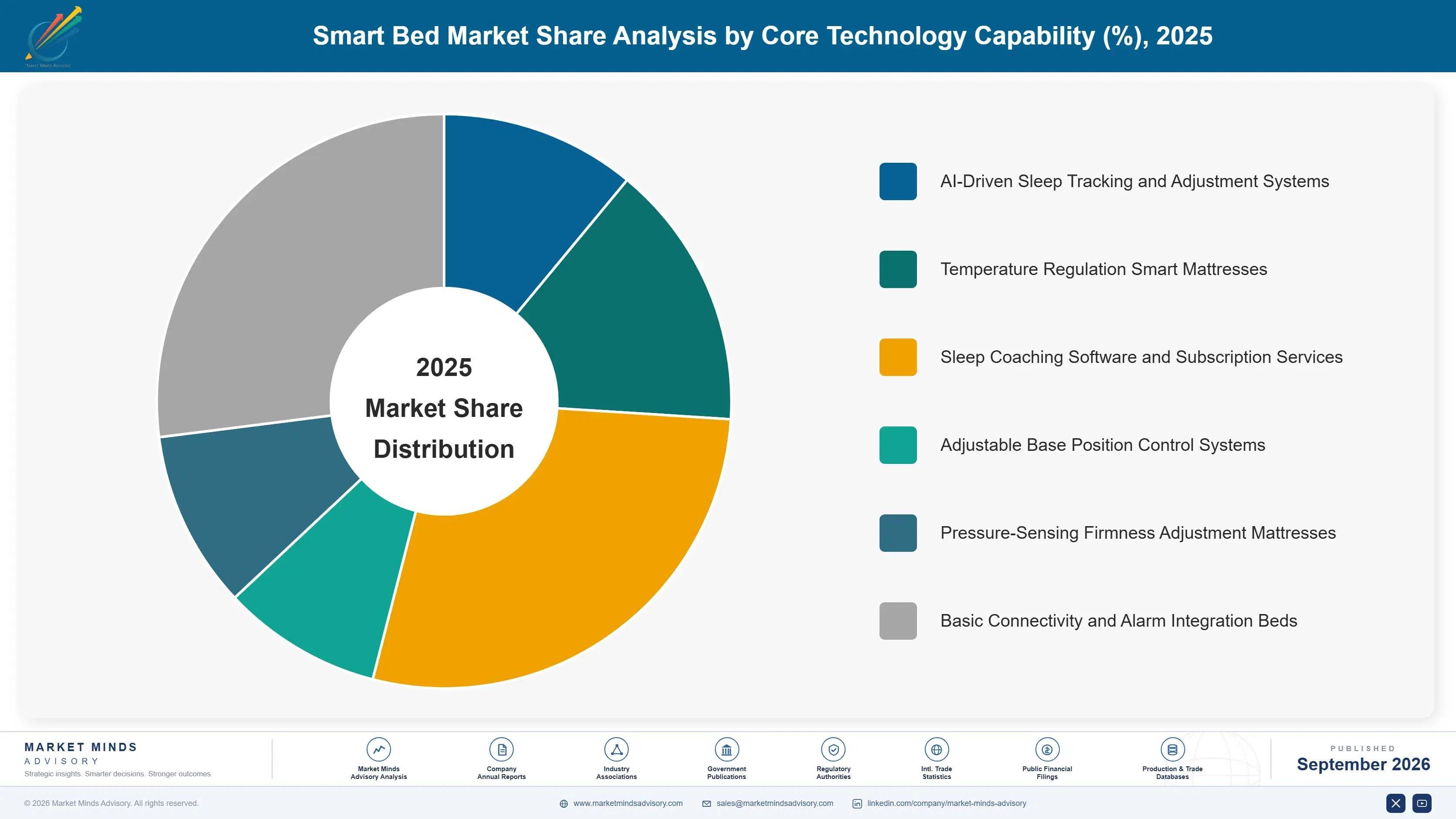
Smart beds segment by core technology capability, the dimension separating passive tracking systems from active adjustment and temperature regulation products that respond automatically to detected conditions in real time. AI-driven tracking and temperature regulation are pulling ahead as sensor accuracy and thermal comfort both become primary purchase drivers across most price tiers and buyer segments.
smart-bed-market-market-share-analysis-1789996200095

AI-Driven Sleep Tracking and Adjustment Systems

AI-driven sleep tracking and adjustment systems combine pressure, motion, and biometric sensors with machine learning algorithms that automatically adjust firmness and position in response to detected sleep stage and movement patterns, rather than requiring manual adjustment or offering tracking without any corrective action of any kind whatsoever from the sleeper themselves. This closed-loop capability represents the clearest technical differentiation from earlier smart bed generations that offered tracking dashboards without any automated response. Manufacturers report that customers upgrading from basic tracking-only products to AI-adjustment systems cite noticeably improved sleep quality scores, driving strong word-of-mouth referral within existing customer bases and pulling this segment ahead of every other category in growth rate.
CAGR 16.0%

Temperature Regulation Smart Mattresses

Temperature regulation smart mattresses use active heating and cooling elements, often paired with app-controlled temperature scheduling, to address the temperature-related sleep disruption that affects a large share of the adult population, particularly during hot summer months or menopause-related symptoms experienced by many buyers worldwide each and every calendar year without fail at all. This segment has benefited from clinical research increasingly linking core body temperature regulation to sleep quality, giving manufacturers credible health messaging beyond general comfort claims. Component costs for thermoelectric and water-based temperature regulation systems have fallen enough to pull this capability into upper-mid-range mattress tiers, accelerating adoption beyond the luxury segment that originally defined the entire category.
CAGR 13.0%
Full segment breakdown across 6 segments available in the complete report.

Regional Architecture and Country Demand Map

North America leads on premium mattress retail infrastructure and wellness spending, home to several of the category's largest and most established brands, while East Asia follows closely on consumer electronics manufacturing scale and rapidly expanding domestic smart bed brands across major cities and provinces nationwide.

North America

The deepest premium mattress retail infrastructure in the world anchors North America's leading share of the smart bed market. United States retailers including specialty mattress chains and major department stores have built dedicated showroom sections around connected sleep products, giving consumers hands-on demonstration experiences that accelerate purchase decisions. Several of the category's largest brands, including Sleep Number and Eight Sleep, are headquartered domestically, concentrating research and development investment in the region. Canada mirrors this pattern at a smaller scale, with similar premium retail distribution driving adoption. Health insurer wellness program partnerships have also emerged first in this region, reinforcing North America's position as the category's most mature and highest-value market.
Share: 32% | CAGR: 11.5% (2026 to 2036)

Western Europe

Regulatory scrutiny of health claims and mature retail channels shape demand growth across Western Europe more than raw construction volume does elsewhere in the wider world today still. Germany and the United Kingdom lead adoption of sleep tracking mattresses, with retailers investing in in-store demonstration technology similar to North American showrooms. France's stricter interpretation of health claim advertising regulations has pushed manufacturers toward clinically validated accuracy language rather than general wellness marketing. Nordic countries show strong per-capita adoption tied to broader cultural emphasis on sleep quality and wellness spending. The region's data protection framework has also pushed several vendors toward on-device processing architectures that avoid transmitting sensitive sleep data externally.
Share: 21% | CAGR: 9.5% (2026 to 2036)
Regional intelligence for 5 additional markets available in the complete report: East Asia, South Asia and Pacific, Latin America, Middle East and Africa, Eastern Europe. Contact sales@marketmindsadvisory.com.
smart-bed-market-country-cagr-analysis-1789996200631

Where Smart Bed Makers Can Grow Margin

Mattress hardware alone carries thin margins as manufacturing scales globally across every producing region and price tier worldwide today, so durable margin pools sit in sleep coaching software, insurer partnerships, and premium accessory attachments rather than the mattress itself. Vendors combining hardware with a recurring service layer capture disproportionate value relative to unit volume.

Bundling Sleep Coaching Software Subscription Tiers

Vendors that layer AI-driven sleep coaching software on top of a mattress purchase capture a recurring monthly subscription fee that hardware sales alone cannot generate, converting a one-time mattress sale into a multi-year relationship with the customer's sleep data over time. Customers accept the added subscription cost because personalized coaching recommendations improve outcomes measurably compared to raw data dashboards without guidance. Several vendors have raised average customer lifetime value by 30 percent after introducing tiered coaching subscriptions, since software margin runs far above the thin margin typical of mattress hardware alone.
Market Impact: Raises average customer lifetime value by 30 percent

Partnering With Insurers on Wellness Reimbursement Programs

Vendors negotiating direct partnerships with health insurers to offer premium discounts or partial reimbursement for smart bed purchases capture a customer acquisition advantage competitors without insurer relationships cannot match, since the reimbursement effectively subsidizes a significant portion of the purchase price for the buyer directly and immediately at checkout time each purchase. Vendors with active insurer partnerships report customer acquisition costs running 25 percent lower than competitors relying solely on direct marketing spend, since the insurer channel delivers pre-qualified customers already motivated by a documented health condition requiring ongoing treatment.
Market Impact: Cuts customer acquisition costs by 25 percent overall

Selling Premium Temperature Regulation as an Upgrade

Customers purchasing a basic tracking-enabled mattress increasingly accept an upsell into temperature regulation capability, a feature carrying substantially higher component cost but even higher perceived value tied to documented sleep quality improvement over time and across different seasons and regional climates worldwide overall. Vendors offering this upgrade path report average revenue per customer running 35 percent higher than tracking-only configurations, since temperature regulation commands premium pricing that tracking sensors alone cannot justify on their own. This upsell also deepens customer satisfaction, reducing return rates that erode margin on tracking-only products.
Market Impact: Lifts average revenue per customer by 35 percent

Offering Extended Warranty and Sensor Replacement Plans

Customers concerned about long-term sensor reliability in an expensive mattress purchase increasingly pay for extended warranty and sensor replacement plans that cover component failure beyond the standard manufacturer warranty period offered at purchase. Vendors offering these extended plans report attach rates and margin contribution comparable to extended warranty programs in the broader consumer electronics industry, capturing incremental revenue at roughly 90 percent margin since actual failure rates remain relatively low. This warranty revenue also builds customer confidence that reduces purchase hesitation tied to concerns about a novel product category's long-term reliability.
Market Impact: Adds warranty plan attach rates near 40 percent

Who Controls the Margin Pool

The smart bed market shows moderate fragmentation with a CR5 of forty percent, reflecting a category that grew out of both established mattress manufacturers and dedicated sleep technology startups. Sleep Number and Eight Sleep lead on revenue given their long-established brand recognition and dedicated sleep technology focus, holding a meaningful gap over challengers such as ReST and Simba Sleep, whose smaller scale limits marketing reach into mainstream mattress buyers.
Current competitive activity centers on AI coaching software differentiation, as vendors race to build personalized recommendation engines that reduce churn and justify subscription pricing beyond raw tracking data. Several vendors have also launched health insurer partnership programs, deepening customer relationships beyond a simple hardware sale and positioning the category as a legitimate wellness intervention.

Emerging pressure comes from traditional mattress manufacturers that could bundle basic sensor technology directly into mainstream product lines, potentially squeezing dedicated sleep tech specialists out of the mid-range price tier specifically. Rankings are most likely to shift among smaller software-focused challengers, where a single large retail partnership or insurer deal can move a company from a niche player into a top-tier revenue position within one product cycle.
smart-bed-market-company-positioning-matrix-1789996201169

Competitive Moat and Risk Dimensions

SLEEP NUMBER

Moat: Decades of Adjustment Technology Patents

Sleep Number's decades of experience in adjustable air chamber mattress technology give it a patent portfolio and manufacturing expertise pure software-focused competitors cannot easily replicate. This depth also gives Sleep Number an extensive company-owned retail store network that provides hands-on demonstration experiences few competitors can match at comparable national scale.
SLEEP NUMBER

Risk: Slower Software Development Cycles

Sleep Number's hardware-manufacturing heritage can slow software feature development compared to venture-backed sleep technology startups built around software-first product cycles from inception. A software-native competitor that ships superior AI coaching features first could capture younger, tech-forward customers before Sleep Number's product roadmap catches up to emerging expectations.
EIGHT SLEEP

Moat: Clinical Validation and Health Positioning

Eight Sleep has invested heavily in clinical validation studies and health-focused marketing positioning that give it credibility with health insurers and wellness-focused consumers competitors marketing purely on comfort cannot easily match. This positioning has opened insurer partnership discussions ahead of most competitors in the category.
EIGHT SLEEP

Risk: Premium Pricing Limits Addressable Market

Eight Sleep's premium pricing strategy, while supporting strong margins, limits its addressable market to affluent early adopters, leaving the larger mid-range market open to competitors willing to accept thinner margins for broader volume. A well-funded mid-market entrant could capture significant share before Eight Sleep extends downmarket successfully.

Players Tracked

Prominent Players

Sleep Number
Eight Sleep
Tempur Sealy
ReST
Simba Sleep

Other Key Players

Casper Sleep
Purple Innovation
Serta Simmons Bedding
Emma Sleep
Bryte
Xiaomi
Ecovacs Robotics
Nectar Sleep
Saatva
Sonno
Ergomotion
Reverie
Leesa Sleep
Amerisleep
GhostBed

Recent Developments

MARCH 2026

Eight Sleep Acquires Sleep Coaching Software Startup

Eight Sleep acquired a privately held sleep coaching software developer to add personalized recommendation capability to its temperature regulation product line, integrating the acquired team's behavioral science expertise directly into upcoming mattress software features. The deal gives Eight Sleep in-house coaching software it previously sourced through third-party licensing arrangements.
Signal: Signals hardware vendors internalizing coaching software capability rather than continuing to license it from outside specialists.
SEPTEMBER 2025

Sleep Number Signs Multi-Year Insurer Partnership Agreement

Sleep Number and a major national health insurer signed a multi-year partnership agreement offering premium discounts to policyholders purchasing Sleep Number's verified sleep tracking mattresses. The agreement gives Sleep Number priority access to the insurer's customer base while locking in guaranteed referral volume through 2029.
Signal: Shows insurers and mattress makers deepening commercial ties well ahead of broader industry-wide adoption trends today.
JANUARY 2026

Tempur Sealy Expands Manufacturing Capacity for Sensor Mattresses

Tempur Sealy expanded its organic manufacturing capacity for sensor-embedded mattresses by opening a new production line dedicated to mid-range smart bed products, responding to rising demand from retailers seeking lower price points than premium competitors offer. The expansion adds dedicated assembly capacity the company previously lacked.
Signal: Reflects growing demand for accessible smart bed pricing beyond the premium market segment currently served today.

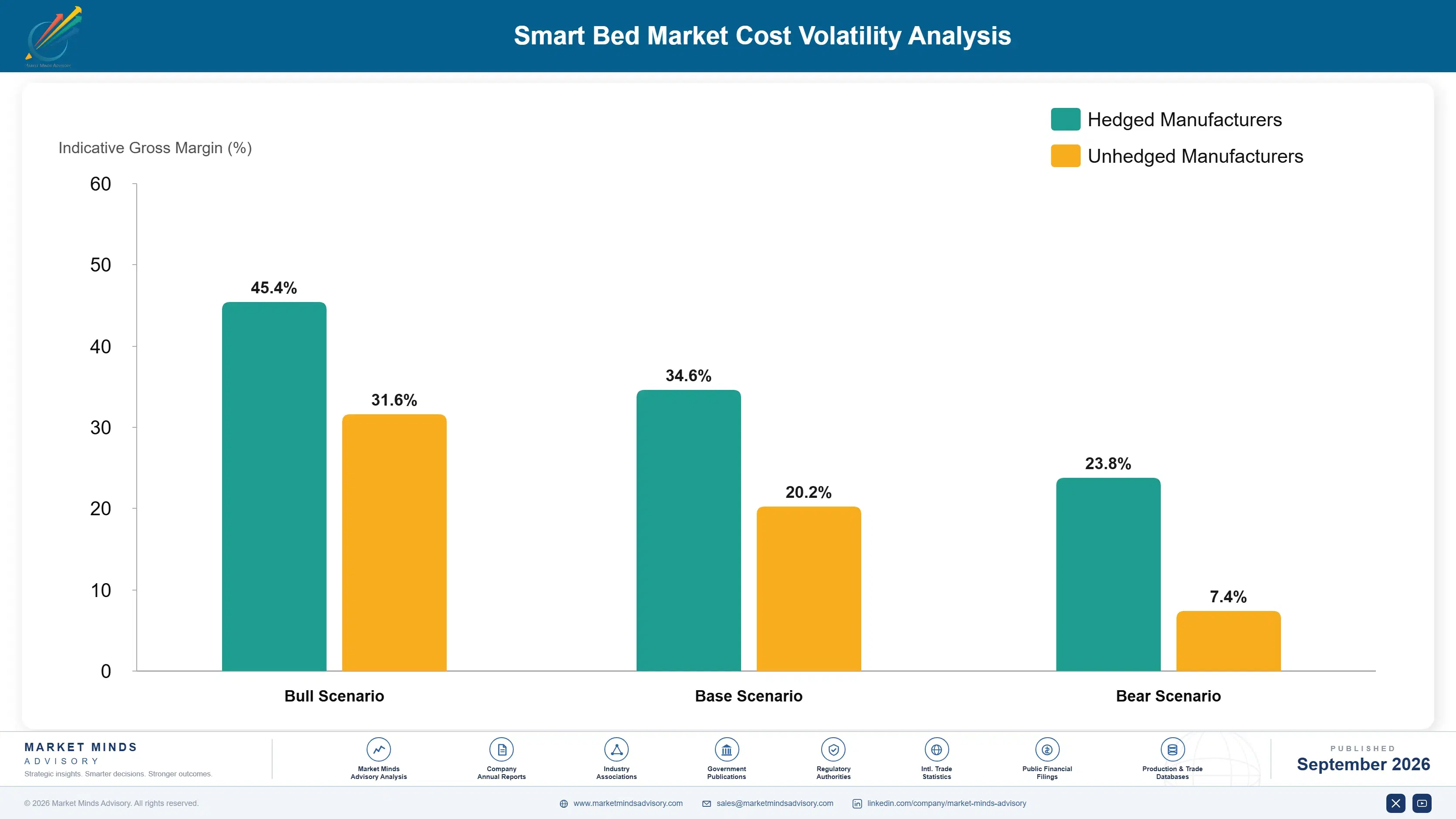
Foam and Sensor Electronics Cost Exposure

Memory foam and specialty foam materials account for roughly thirty-five percent of a smart mattress's bill of materials, with sensor electronics and connectivity modules adding another twenty-five percent to the total. Foam is sourced through petrochemical supply chains sensitive to oil price movements, while sensor components draw on the same East Asian semiconductor supply chains serving the broader consumer electronics industry.
The clearest recent volatility event traces to the 2022 polyurethane foam feedstock price surge following broader petrochemical market disruption, a dynamic documented in the United States Census Bureau's tracking of chemical industry input costs during that period. Mattress manufacturers absorbed cost increases of roughly fifteen percent during peak pricing before passing a portion through to customers, delaying several planned product launches by one to two quarters.

This exposure disadvantages smaller manufacturers more heavily than the largest vendors, since companies like Tempur Sealy negotiate foam feedstock pricing across diversified global supply agreements that smooth regional price spikes considerably. Vendors sourcing foam entirely through spot markets face sharper margin swings during petrochemical price shocks, a gap that widens further whenever oil prices move unpredictably across major producing regions.
smart-bed-market-cost-volatility-analysis-1789996201372

Diversify Foam Feedstock Sourcing Regionally

Manufacturers are qualifying foam suppliers across multiple regions rather than relying on a single petrochemical source, spreading exposure to any one region's price spikes or supply disruptions across the broader supply base and network. This adds procurement complexity upfront but has shortened recovery time during price shocks and given buyers stronger negotiating leverage overall.

Lock In Long-Term Sensor Component Agreements

Larger vendors are signing multi-year supply agreements directly with sensor component suppliers to secure priority allocation and stable pricing ahead of smaller competitors during periods of tight capacity across the wider market overall. Smaller manufacturers increasingly pool orders through distributor consortiums to access similar priority treatment collectively across the wider industry as a whole.

Redesign Mattresses Around Alternate Foam Materials

Engineering teams are testing plant-based and recycled foam alternatives to petroleum-based polyurethane in cost-sensitive product tiers, reducing exposure to petrochemical price swings while maintaining acceptable comfort performance across most applications, product categories, and price points offered. This design flexibility adds development cost but has already lowered bill-of-materials exposure for several vendors testing the approach.

Portfolio Architecture for Margin Defence

Smart bed portfolios split into three margin tiers tracking how software-attached and clinically validated each product line is relative to a standardized commodity mattress sold at scale across the broader market. Volume commodity-adjacent tracking-only mattresses carry thin margins driven by manufacturing scale competition among many suppliers, while certified premium temperature regulation and AI-adjustment products command a markup tied to documented sleep improvement claims.
The volume versus premium tension appears most clearly in how vendors allocate research investment across competing product families: chasing high-volume mid-range mattress orders requires aggressive cost reduction that can erode the margin structure supporting premium temperature regulation and AI-adjustment product lines simultaneously. Vendors trying to serve both ends with a single manufacturing line typically end up uncompetitive in each segment they attempt to serve.

High-value margin pools concentrate in sleep coaching software and insurer partnership revenue rather than in the mattress itself, which explains why the fastest-growing revenue lines sit closer to the software and data layer than to raw foam and coil construction. Vendors positioning purely as commodity mattress manufacturers face the steepest long-term margin compression as manufacturing scales globally across every producing region.

Volume / Commodity-Adjacent Tier

Basic tracking-only mattresses sold into cost-sensitive mid-range retail channels, priced on unit cost competition with gross margins typically in the fifteen to twenty-five percent range across most suppliers in the category.
Gross Margin: 15-25%

Premium / Certified Tier

Temperature regulation and AI-adjustment mattresses carrying clinical validation and insurer partnership eligibility, sold at a premium for documented sleep improvement, with gross margins running thirty-five to forty-five percent for certified vendors.
Gross Margin: 35-45%

Sustainability / Regulatory / Next-Generation Tier

Sleep coaching software and subscription platforms combining hardware with recurring service revenue and wellness program partnerships, carrying the highest margins in the entire portfolio at fifty to sixty-five percent gross margin.
Gross Margin: 50-65%
smart-bed-market-portfolio-architecture-1789996201983

High-value Sub-segments and Strategic Watch-out

AI-Driven Sleep Tracking and Adjustment Systems

AI-driven sleep tracking and adjustment systems combining the fastest unit growth with the highest software-attachment margins found anywhere in the entire portfolio today, making this segment the priority allocation target for most vendors' research budgets over the coming several forecast years still ahead of us.
Gross Margin: 40-55%

Temperature Regulation Smart Mattresses

Temperature regulation smart mattresses growing quickly on clinical research linking body temperature to sleep quality, but facing a longer sales cycle tied to premium pricing that limits mainstream affordability across most markets, buyer income levels, geographic regions, retail channels, and product tiers worldwide right now.
Gross Margin: 35-45%

Adjustable Base Position Control Systems (Volume Core)

Adjustable base position control systems, the largest unit volume category and steadiest cash generator even as unit pricing declines gradually and margins compress each and every successive product generation cycle across most retail tiers, channels, price points, buyer segments, and mattress categories offered overall nationwide.
Gross Margin: 15-22%

Basic Connectivity and Alarm Integration Beds (Strategic Watch)

Basic connectivity and alarm integration beds, a segment facing gradual displacement by full sensor and AI-driven products, worth monitoring closely for how quickly manufacturers choose to retire this entry-level category from their broader product lines entirely and completely over the coming several forecast years ahead.
Gross Margin: 10-18%

Subscriptions Turn Mattresses Into Annuities

Smart bed revenue increasingly behaves like an annuity rather than a one-time mattress sale, since monthly coaching software subscriptions lock in recurring revenue that outlasts the initial hardware purchase for years at a time. A vendor that wins a customer's subscription at initial purchase can expect several years of recurring software revenue before the mattress itself is eventually replaced by a newer model.
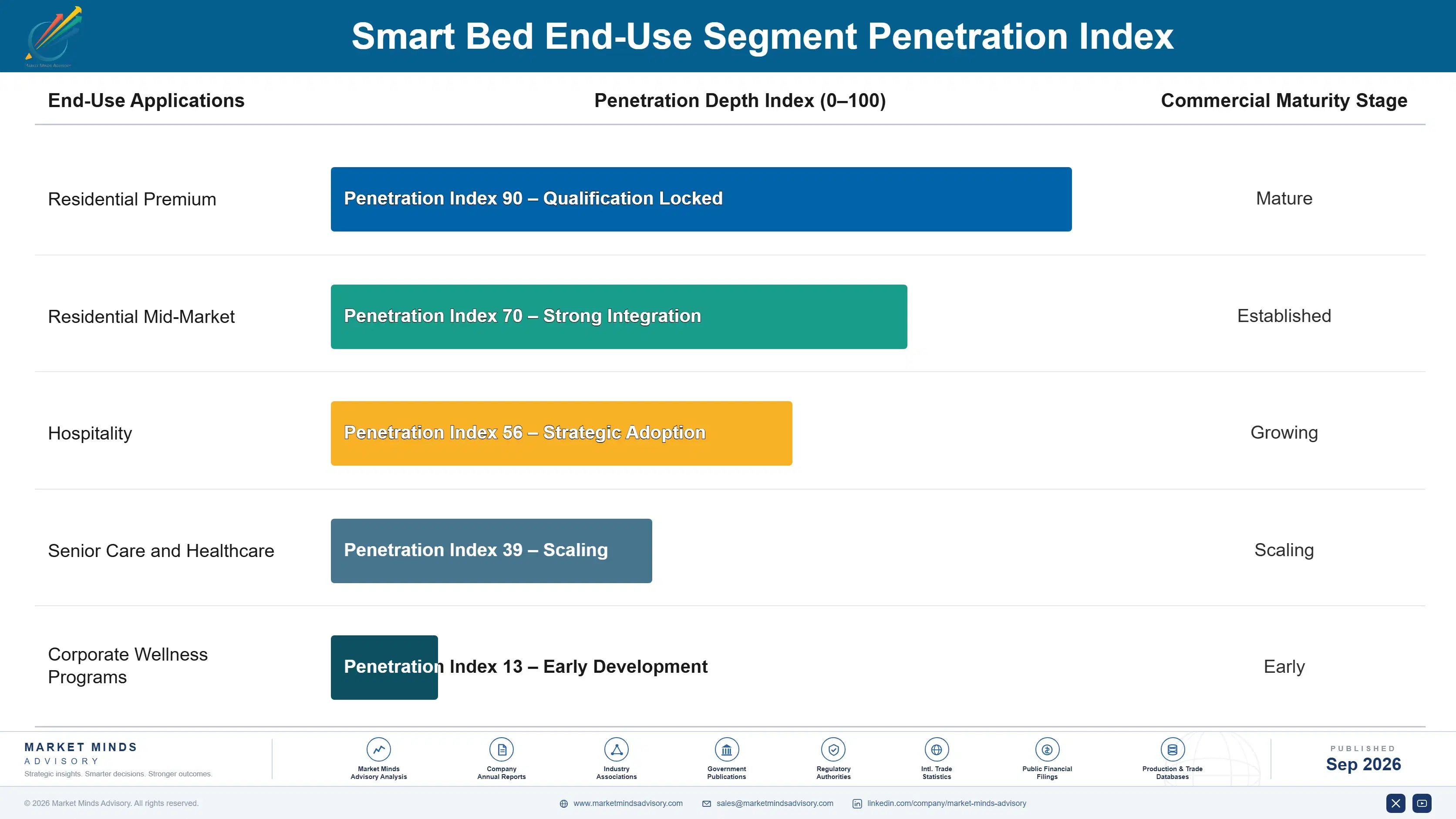
Adoption depth varies sharply by end-use vertical: affluent health-conscious consumers treat smart beds as a near-standard wellness purchase with strong repeat-brand loyalty and referral behavior, while mainstream mid-market adoption remains uneven, constrained by price sensitivity and lingering skepticism about sensor accuracy claims. Hospitality and senior care applications sit between these extremes, growing steadily as institutional buyers value sleep monitoring for guest experience and resident health management respectively.

Buyer profiles are shifting generationally as younger consumers increasingly evaluate mattress purchases alongside broader wearable and health app platforms rather than treating the mattress as a standalone furniture decision made in isolation. This shift favors vendors that can demonstrate integration with popular fitness and health platforms over those competing purely on traditional mattress comfort specifications.
smart-bed-market-end-use-penetration-index-1789996202523

Where the Real Margin Sits

These are among the four positions where our research anticipates prominent divergence between winners and laggards over the coming forecast period. Each is grounded in the demand model, the regulatory perimeter, and the announced capacity pipeline.
01 / AI ADJUSTMENT INVESTMENT PRIORITY

Prioritize AI Adjustment Over Passive Tracking Only

Vendors concentrating engineering investment on AI-driven sleep tracking and adjustment systems are positioned ahead of the market's fastest-growing segment, expanding at sixteen percent annually against an eleven percent market average across the entire broader category. Customers upgrading from tracking-only products to closed-loop adjustment systems report noticeably improved sleep quality scores, driving strong word-of-mouth referral within their existing personal and professional networks. Companies still shipping passive tracking dashboards without automated response risk losing accounts to competitors building genuine closed-loop adjustment capability.
02 / INSURER PARTNERSHIP DEVELOPMENT STRATEGY

Build Health Insurer Partnerships Ahead of Competitors

Vendors with active insurer partnerships report customer acquisition costs running twenty-five percent lower than those relying solely on direct marketing spend and advertising, since the insurer channel delivers pre-qualified, health-motivated customers already interested in the entire category. Building these relationships requires clinical validation data most smaller vendors lack the resources to generate independently and quickly enough to compete effectively. Vendors that delay this investment will keep paying an acquisition cost premium that better-connected competitors have already eliminated from their unit economics.
03 / SLEEP COACHING SOFTWARE DEVELOPMENT

Build Proprietary Sleep Coaching Software Now

Vendors offering AI-driven sleep coaching software report meaningfully higher subscription renewal rates than those offering only raw data dashboards without any actionable guidance for customers trying hard to improve their sleep. This software layer has become the primary differentiator between smart bed brands, replacing sensor hardware specifications as the leading purchase consideration for repeat buyers across every price tier and segment. Companies without proprietary coaching capability will keep competing purely on hardware specifications against better-differentiated, software-equipped competitors entering the category.
04 / FOAM SUPPLY DIVERSIFICATION PLANNING

Diversify Foam Feedstock Sourcing Ahead of Shocks

Foam feedstock costs concentrate heavily in petrochemical supply chains sensitive to oil price movements, leaving vendors exposed to the same volatility that produced fifteen percent cost spikes during the recent polyurethane price surge across the industry. Qualifying suppliers across multiple regions adds procurement complexity but shortens recovery time substantially when the next disruption occurs unexpectedly across the supply chain. Vendors treating this diversification as optional rather than mandatory will keep losing margin to competitors who can absorb the next price shock more smoothly.

Engagement Snapshot From the Field

A live engagement with an industry participant carrying material or product regulatory and market exposure ahead of a defining policy shift, showing how our research translates into a defensible multi-year portfolio strategy.
MARKET MINDS ADVISORY · CLIENT ENGAGEMENT SUMMARY
Smart Bed Producer Strategic Portfolio Review and Transition Roadmap 2026·Investment Scenario on Smart Bed Exposure Evaluation 2025-26
CLIENT PROFILE
The client is a mid-cap mattress manufacturer with roughly 380 million dollars in annual revenue (client-reported, unverified by MMA), historically focused on traditional foam and coil mattress construction sold at mid-range retail price points. The company had not moved into sensor-embedded or connected products as competitors began capturing premium retail floor space with smart bed offerings.
STRATEGIC CHALLENGE
The client faced declining retail floor space allocation as major mattress retailers prioritized smart bed brands offering more engaging in-store demonstration experiences. Internal product teams disagreed on whether to build sensor capability in-house or partner with a technology vendor, and the board wanted a data-driven recommendation before the next product line refresh cycle.
MMA APPROACH
MMA conducted structured interviews with the client's product development leadership alongside its own primary survey and expert interview datasets to benchmark sensor technology development timelines and retail partnership terms across leading smart bed vendors. The analysis mapped the client's existing retail relationships against competitor smart bed floor space allocation to identify the highest-priority product tier for initial launch.
KEY FINDINGS
  1. Retailers allocating floor space to smart bed brands reported conversion rates twice as high as traditional mattress displays, driven by hands-on demonstration experiences that engaged customers longer.
  2. Building basic sensor capability in-house was estimated to take engineering teams twelve months longer to reach production quality than partnering with an existing sensor technology supplier already serving the category.
  3. Retailers overwhelmingly preferred a mid-range price point below 2,000 dollars for entry-level smart bed products, a segment underserved by existing premium-focused competitors in the market.
  4. Consumers evaluating the client's traditional mattresses increasingly asked sales staff about sleep tracking capability, indicating latent demand the client's product line was not yet positioned to capture.
CLIENT PROFILE
The client is a mid-cap mattress manufacturer with roughly 380 million dollars in annual revenue (client-reported, unverified by MMA), historically focused on traditional foam and coil mattress construction sold at mid-range retail price points. The company had not moved into sensor-embedded or connected products as competitors began capturing premium retail floor space with smart bed offerings.
STRATEGIC CHALLENGE
The client faced declining retail floor space allocation as major mattress retailers prioritized smart bed brands offering more engaging in-store demonstration experiences. Internal product teams disagreed on whether to build sensor capability in-house or partner with a technology vendor, and the board wanted a data-driven recommendation before the next product line refresh cycle.
MMA APPROACH
MMA conducted structured interviews with the client's product development leadership alongside its own primary survey and expert interview datasets to benchmark sensor technology development timelines and retail partnership terms across leading smart bed vendors. The analysis mapped the client's existing retail relationships against competitor smart bed floor space allocation to identify the highest-priority product tier for initial launch.
KEY FINDINGS
  1. Retailers allocating floor space to smart bed brands reported conversion rates twice as high as traditional mattress displays, driven by hands-on demonstration experiences that engaged customers longer.
  2. Building basic sensor capability in-house was estimated to take engineering teams twelve months longer to reach production quality than partnering with an existing sensor technology supplier already serving the category.
  3. Retailers overwhelmingly preferred a mid-range price point below 2,000 dollars for entry-level smart bed products, a segment underserved by existing premium-focused competitors in the market.
  4. Consumers evaluating the client's traditional mattresses increasingly asked sales staff about sleep tracking capability, indicating latent demand the client's product line was not yet positioned to capture.
RECOMMENDED STRATEGY
Phase 1: Phase 1 (Partnership): Partner with a sensor technology supplier within four months rather than building the capability from scratch internally. Phase 2: Phase 2 (Mid-Range Launch): Launch an entry-level smart bed product line priced below 2,000 dollars targeting the underserved mid-range segment. Phase 3: Phase 3 (Retail Expansion): Expand retail floor space allocation using the same demonstration format that drives competitor conversion rates higher.
OUTCOME
The client launched its entry-level smart bed product line within seven months and reported securing expanded retail floor space at several major mattress retailers within the first two quarters (client-reported, unverified by MMA). The client subsequently began development of a second, higher-tier product line building on the initial partnership's technology foundation.

Frequently Asked Questions

Foundational context covering the market sizes, CAGR, scope, country, region and competition that inform every finding below. This section is provided to cover basics and most often pre-purchase conversations, answered from the MMA Primary Research Dataset.

What is the current size of the Smart Bed Market?

The Smart Bed Market is valued at 5.6 billion dollars in 2025, the base year for this analysis. It is projected to reach 6.22 billion dollars in 2026 as sleep health awareness accelerates adoption.

How large will the Smart Bed Market be by 2036?

The market is forecast to reach 17.66 billion dollars by 2036, up from 6.22 billion dollars in 2026. This represents a 2.84 times expansion over the ten-year forecast period.

What is the CAGR for the Smart Bed Market 2026 to 2036?

The market is projected to grow at a compound annual growth rate of 11.0 percent between 2026 and 2036. Bull and bear scenarios range from 12.3 percent to 9.7 percent depending on insurer partnership adoption.

Which segment is growing fastest?

AI-Driven Sleep Tracking and Adjustment Systems is the fastest-growing segment, expanding at 16.0 percent annually, 1.45 times the overall market rate. Closed-loop adjustment capability is driving strong upgrade demand from tracking-only products.

Who are the major companies in the Smart Bed Market?

Leading participants include Sleep Number, Eight Sleep, Tempur Sealy, ReST, and Simba Sleep. These five companies hold a combined CR5 of 40 percent, reflecting a moderately fragmented competitive landscape.

Which country is growing fastest?

China is the fastest-growing country, expanding at 13.0 percent annually as domestic manufacturers integrate sensor technology using existing consumer electronics supply chains. This outpaces the broader East Asia regional average.

Report Segmentation Architecture

The full report scope spans multiple orthogonal segmentation dimensions, with cross-tabulated demand data provided for each dimension pair. Coverage extends further to regional breakdowns, trend trajectories, and the competitive detail needed to support segment-level decision-making.

By Core Technology Capability

  • AI-Driven Sleep Tracking and Adjustment Systems
  • Temperature Regulation Smart Mattresses
  • Sleep Coaching Software and Subscription Services
  • Adjustable Base Position Control Systems
  • Pressure-Sensing Firmness Adjustment Mattresses
  • Basic Connectivity and Alarm Integration Beds

By End-Use Segment

  • Residential Premium
  • Residential Mid-Market
  • Hospitality
  • Senior Care and Healthcare
  • Corporate Wellness Programs

By Commercial Dimension

  • Direct-to-Consumer Online Sales
  • Specialty Mattress Retail Channel
  • Insurer-Partnered Reimbursement Channel

By Region

  • North America
  • Western Europe
  • East Asia
  • South Asia and Pacific
  • Latin America
  • Middle East and Africa
  • Eastern Europe

Scope, Methodology, and Coverage

Every figure in this report is reproducible from documented input assumptions. The scope below maps the historical period, the forecast horizon, the segmentation dimensions, and the countries covered, alongside the underlying primary and qualitative methodology.
Historical Period
2020 to 2025
Forecast Period
2026 to 2036
Base Year
2025 (USD billions; MMA Primary Research Dataset, September 2026)
Market Definition
The Smart Bed Market covers mattresses and adjustable bed bases with embedded sensors, connectivity, and automated adjustment capability that track sleep metrics and modify firmness, temperature, or position in response. It excludes standard adjustable bed frames without sensor or connectivity features and standalone sleep tracking wearables sold independently of the bed itself.
Quantitative Units
USD Billion, CAGR (%)
Segmentation Dimensions
By Core Technology Capability, By End-Use Segment, By Commercial Dimension, By Region
Regions Covered
North America, Western Europe, East Asia, South Asia and Pacific, Latin America, Middle East and Africa, Eastern Europe
Countries Covered
United States, Canada, Germany, United Kingdom, France, Sweden, China, Japan, South Korea, India, Australia, Brazil, Mexico, United Arab Emirates, Saudi Arabia, South Africa, Poland
Key Companies Profiled
Sleep Number, Eight Sleep, Tempur Sealy, ReST, Simba Sleep, Casper Sleep, Purple Innovation, Serta Simmons Bedding, Emma Sleep, Bryte, Xiaomi, Ecovacs Robotics, Nectar Sleep, Saatva, Sonno, Ergomotion, Reverie, Leesa Sleep, Amerisleep, GhostBed
Quantitative Methodology
Primary survey, n=3,800 respondents, Q4 2025, six countries; demand-side model with trade association cross-validation
Qualitative Methodology
47 expert interviews, Q4 2025; applied to validate demand model assumptions, identify emerging dynamics, and assess competitive positioning
Report Format
PDF and XLSX data workbook (Word format preview document)
Publisher
Market Minds Advisory
Report Code
MMA-2026-CON-116
Published
September 2026
Contact
sales@marketmindsadvisory.com | www.marketmindsadvisory.com

Purchase the full Smart Bed Market Report (2026 to 2036).

This report provides a comprehensive analysis of the global Smart Bed Market from 2026 through 2036, covering market sizing, segmentation, regional dynamics, and competitive positioning across all major technology capabilities. It draws on primary survey data from 3,800 respondents and 47 expert interviews conducted in the fourth quarter of 2025 to ground every forecast in verifiable industry behavior. Segment-level growth projections identify where AI-driven adjustment and temperature regulation are outpacing basic connectivity products. Readers also gain regional demand drivers, input cost exposure analysis, and a strategic verdict identifying where margin and growth intersect.
Ten-year market sizing and growth forecast
Six-capability segmentation with detailed growth rate data
Seven-region demand pattern and competitive positioning analysis
Twenty-company competitive benchmarking and moat assessment database
Input cost and supply chain risk assessment
Anonymized client engagement case study with outcomes

Built For The People Who Decide

From boardroom strategy to bench-side execution, this report is read cover-to-cover by leaders shaping the next decade of their industry, turning demand scenarios, market dynamics and valuation benchmarks into decisions.
CXOs/ Presidents/ VPs/ Managers
M&A and Corporate Development
Strategy Teams and R&D Heads
Procurement and Product Directors
Regulatory and Compliance Leaders
Investor Relations and Equity Analysts