Market Minds Advisory
Small Modular Reactors (SMRs) Market

Small Modular Reactors (SMRs) Market: A Factory Build Model Betting Everything On The Second Unit Costing Less Than The First

A commercial reading of small modular reactors, where the whole case depends on factory-built units getting cheaper each time, and nobody has yet proven that cost curve is genuinely real.

Lead Analyst

David Horsley

Published

September 2026

Make Smarter Decisions with Customized Research Insights

Request a free sample report and evaluate market opportunities, growth trends, and competitive dynamics relevant to your business needs.

2025 MARKET VALUE$2.8BMarket Size 2025
2036 FORECAST VALUE$14.9BBase Case , 2026 to 2036
CAGR 2026 TO 203616.4 %Bull 17.9% / Bear 14.9%
INCREMENTAL OPPORTUNITY$11.6BNet 10- year value creation
EXPANSION MULTIPLE4.57x2036 value over 2026 base
Strategic Levers
M&A Pipeline
Regional Outlook
Country Rankings
Competitive Intelligence
Segmental Deep-dive
Call-Us : 91 93563 13602

Executive Snapshot and Market Trajectory

The entire commercial case for small modular reactors rests on unit two costing meaningfully less than unit one, the way factory-built aircraft or ships do. Nobody has yet built enough of any single design to prove that curve is real rather than assumed.
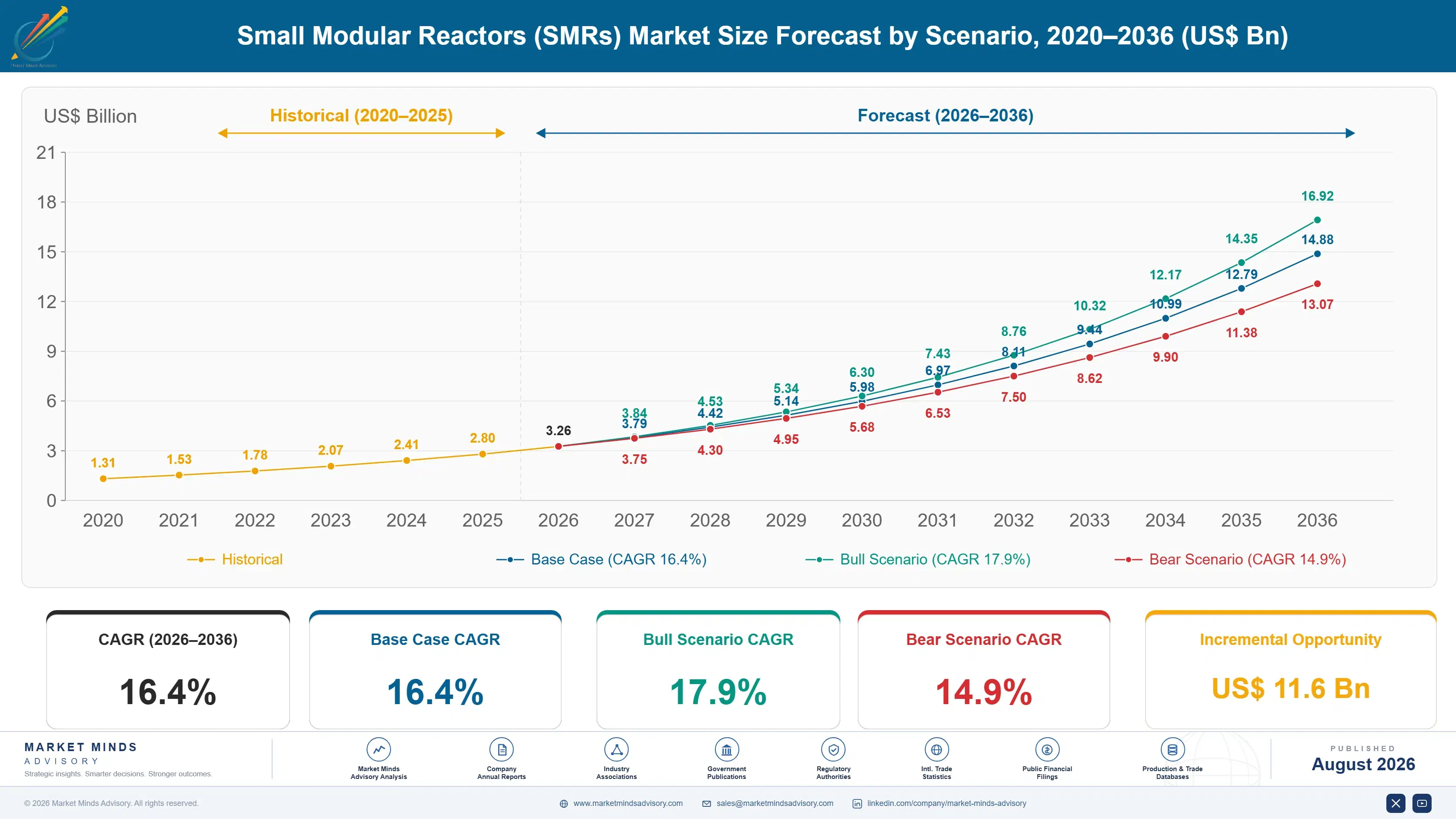
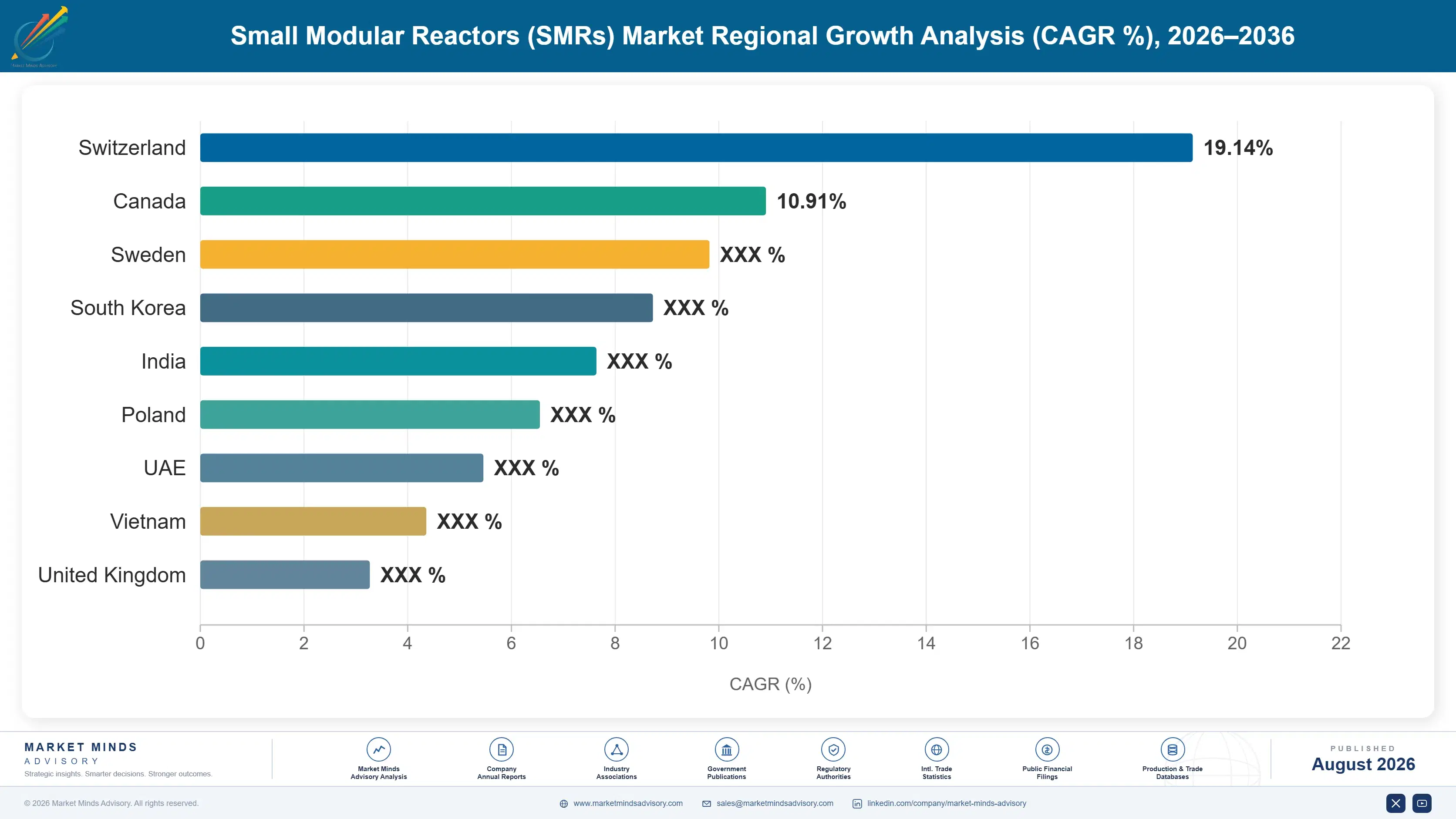
The market stands at USD 2.8 billion in 2025 and reaches USD 14.88 billion by 2036 at a 16.4% CAGR. Advanced non-light-water reactor designs grow fastest at 25.8%, about 1.57 times the overall rate, as molten salt and sodium-cooled concepts move from paper studies toward first construction. East Asia holds 30% of value on China's active deployment programme, while Poland posts the quickest national growth at 19.6% on multiple signed utility-scale procurement commitments finalised recently.
Concentration is high at roughly 46%, because only a handful of designs have reached genuine regulatory approval anywhere. Two forces dominate. First-of-a-kind construction cost keeps running well above vendor projections on every project attempted so far, and data centre electricity demand is pulling utility interest toward SMRs faster than the supply chain can realistically respond. That gap between promise and delivery is what defines the entire industry's commercial character right now.
Market Definition
The small modular reactors market covers factory-fabricated nuclear reactor systems and major equipment below 300 megawatts electrical output designed for modular assembly and reduced on-site construction, spanning light water SMR designs, advanced non-light-water designs including molten salt and sodium-cooled concepts, high-temperature gas-cooled designs, and microreactors, valued at vendor equipment and engineering revenue. Conventional large-scale nuclear reactors above 300 megawatts, nuclear fuel supply and enrichment services, plant operations and maintenance services, and site civil construction sold separately from reactor equipment are excluded.
Base Year Value
$2.8B in 2025 (MMA Primary Research Dataset, August 2026)
Forecast Period
2026 to 2036, eleven discrete annual values
CAGR
16.4% base case. Bull 17.9%. Bear 14.9%.
Fastest Growth Segment
Advanced Non-Light-Water Reactor Designs: 25.8% CAGR
Fastest Growth Country
Poland: 19.6% CAGR
Fastest Growth Region
South Asia and Pacific: 18.4% CAGR
Largest Region
East Asia: 30% of 2025 global value
Market Leaders
NuScale Power, GE Hitachi Nuclear Energy, Rolls-Royce SMR, TerraPower, X-energy. Source: MMA Analysis based on company annual reports.
Primary Survey
n=3,800 procurement and R&D decision-makers, Q4 2025, six countries
Methodology
Demand-side build-up, cross-validated against public data, 47 expert interviews

Small Modular Reactors (SMRs) Market Forecast Scenarios

small-modular-reactors-market-size-forecast-scenario-1787325048207
Growth from 2020 to 2025 compounded near 15.1%, and it was almost entirely design certification progress rather than construction revenue, since barely any equipment had actually shipped by the end of the period. Regulatory approvals accumulated steadily across several designs, utility procurement commitments multiplied, and data centre operators began signing early power agreements, but revenue stayed minimal against the scale of announced pipeline.
Three mechanisms carry the base case to 16.4%. First, first-of-a-kind projects under construction in Canada, the United States, and China finally converting years of design work into equipment orders and site activity. Second, data centre demand pulling utility and hyperscale interest toward SMRs faster than the supply chain can realistically match. Third, government funding and loan guarantee programmes de-risking initial projects enough that private capital is now willing to commit alongside them.
The bull case at 17.9% assumes first-of-a-kind projects deliver close to schedule and cost, releasing the follow-on orders vendors need to reach factory-scale production. The bear case at 14.9% assumes construction delays and cost overruns repeat the pattern seen on nearly every prior nuclear project, follow-on orders stall, and at least one prominent vendor exits or restructures before reaching commercial deployment.

Why Nobody Has Proven The Second Unit Is Cheaper Yet

Three forces set demand. Utility replacement need drives the most durable interest, as ageing coal and nuclear plants retire and operators want dispatchable low-carbon capacity renewables alone cannot provide. Data centre demand drives a newer, faster-moving stream, as hyperscale operators seek firm power for facilities that cannot tolerate outages. Government energy security policy drives a third stream, funding domestic reactor supply chains rather than waiting for commercial economics alone.
MARKET CONCENTRATIONCR5: 46%Highly concentrated among the few approved SMR designs
DESIGN CERTIFICATION TIMELINE5 to 8 yearsTime from application to full regulatory design approval
TYPICAL UNIT OUTPUT50 to 300 MWElectrical output range across designs marketed as modular
FIRST-OF-A-KIND COST PREMIUM40 to 100%First unit cost against vendor projected mature-fleet pricing
CONSTRUCTION TIMELINE TARGET3 to 4 yearsVendor-projected build time once a design reaches serial production
DESIGNS UNDER REGULATORY REVIEWOver 80Distinct SMR concepts in active development or review worldwide
The commercial character is defined by first-of-a-kind risk rather than by underlying reactor physics. Every SMR project built so far has cost meaningfully more than its original estimate, because construction learning and workforce experience take real projects to develop and cannot be modelled reliably in advance. That pattern repeats project after project, and it is what the modular factory-build model is meant to eventually break.
The decade turns on whether any vendor reaches genuine serial production. A design that ships a handful of units stays trapped in first-of-a-kind economics indefinitely, while one reaching a real production line can plausibly deliver the cost curve the industry has promised investors for over a decade. Which vendor gets there first will likely determine who captures the bulk of subsequent global orders.
"Every vendor's slide deck shows a cost curve dropping sharply after unit three or four, and every single one of those curves is still hypothetical. The company that actually builds unit four at the promised cost, not the one with the best rendering, wins this market."
Director, Advanced Nuclear and Power Generation Practice · MMA Energy / Advanced

Market Trends

Data Centre Demand Is Pulling Interest Ahead Of Supply

Hyperscale data centre operators need firm, round-the-clock power at a scale and reliability that renewables paired with batteries cannot yet guarantee economically, and several have signed early power purchase agreements with SMR developers years before any reactor will actually be operating. That demand has genuinely accelerated utility and investor interest in the sector, giving several vendors commercial validation that pure government funding never provided on its own. The commercial risk is that operators are contracting against construction timelines that nuclear projects have essentially never met historically, and schedule disappointment could damage confidence in the entire technology category.
Market Impact: Over 200 GW of coal retiring
Government Funding Is De-Risking Early Projects Deliberately

The United States Department of Energy, Canadian federal and provincial programmes, and the United Kingdom's Great British Nuclear initiative have all committed substantial funding toward first-of-a-kind SMR projects, recognising that private capital alone will not absorb the cost overrun risk history suggests is likely on any first unit. That funding is deliberately structured to de-risk the earliest projects specifically, rather than to subsidise the technology indefinitely across an entire fleet. The commercial effect is that government-backed projects are moving first and fastest, while purely private ventures without similar backing are generally struggling to reach financial close on comparable timelines.
Market Impact: Cuts import dependence on 2 states

Market Opportunities and Growth Drivers

Retiring Coal And Ageing Nuclear Capacity Need Dispatchable Replacement

Coal plants are retiring across most developed grids on both economic and emissions grounds, and many older large nuclear plants are approaching the end of their operating licences within the coming two decades, together removing dispatchable generation that intermittent wind and solar cannot fully substitute for without extensive storage. SMRs are being positioned specifically to fill that gap, often sited at retiring coal plant locations where existing grid connections and cooling infrastructure already exist and can be reused directly. That siting advantage meaningfully shortens both permitting timelines and total project cost against a fully greenfield location.
Market Impact: Overruns often exceed 50%

Energy Security Policy Is Funding Domestic Reactor Supply Chains

Governments across North America, Europe, and parts of Asia have identified nuclear fuel and reactor supply chain dependence on Russia and China as a genuine strategic vulnerability following recent geopolitical disruption, and are funding domestic SMR development partly for energy security reasons that run alongside, and sometimes ahead of, pure economic justification. That policy backing has proven durable across changes in government in several major markets, which matters considerably in an industry where projects routinely span multiple electoral cycles from first announcement through to commissioning. Domestic supply chain investment also builds the skilled workforce future projects will require.
Market Impact: Costs above USD 10 million

Market Restraints and Challenges

First-Of-A-Kind Costs Keep Exceeding Every Vendor Projection

Every SMR project actually under construction so far has reported cost overruns against its original budget, in some cases exceeding the initial estimate by well over half, echoing a pattern affecting nearly every nuclear project across the industry's history regardless of reactor size. The root cause is that construction learning, workforce availability, and supply chain maturity cannot be reliably modelled before a project is actually built. The commercial impact is that early projects need patient capital willing to absorb overrun risk that conventional project financing resists. Mitigation runs through government cost-sharing and standardised designs.
Market Impact: Deals now exceed 10 gigawatts

Regulatory Approval Remains Slow And Design-Specific Everywhere

Design certification takes five to eight years in most major jurisdictions, and a design approved in one country generally requires a substantially separate review process in another, since regulators have not achieved harmonisation that would let a single certification transfer across borders. The root cause is that nuclear safety regulation developed independently in each jurisdiction over decades, and no regulator wants to simply defer to another country's judgement. The commercial impact is that vendors must fund parallel certification campaigns to access multiple markets. Mitigation runs through emerging regulatory cooperation initiatives.
Market Impact: Funding now exceeds USD 3 billion
3 additional market trends, 4 additional growth drivers, and 2 additional restraints and challenges are covered in the full report. Contact sales@marketmindsadvisory.com to access the complete intelligence.

Segment CAGR and Growth Architecture

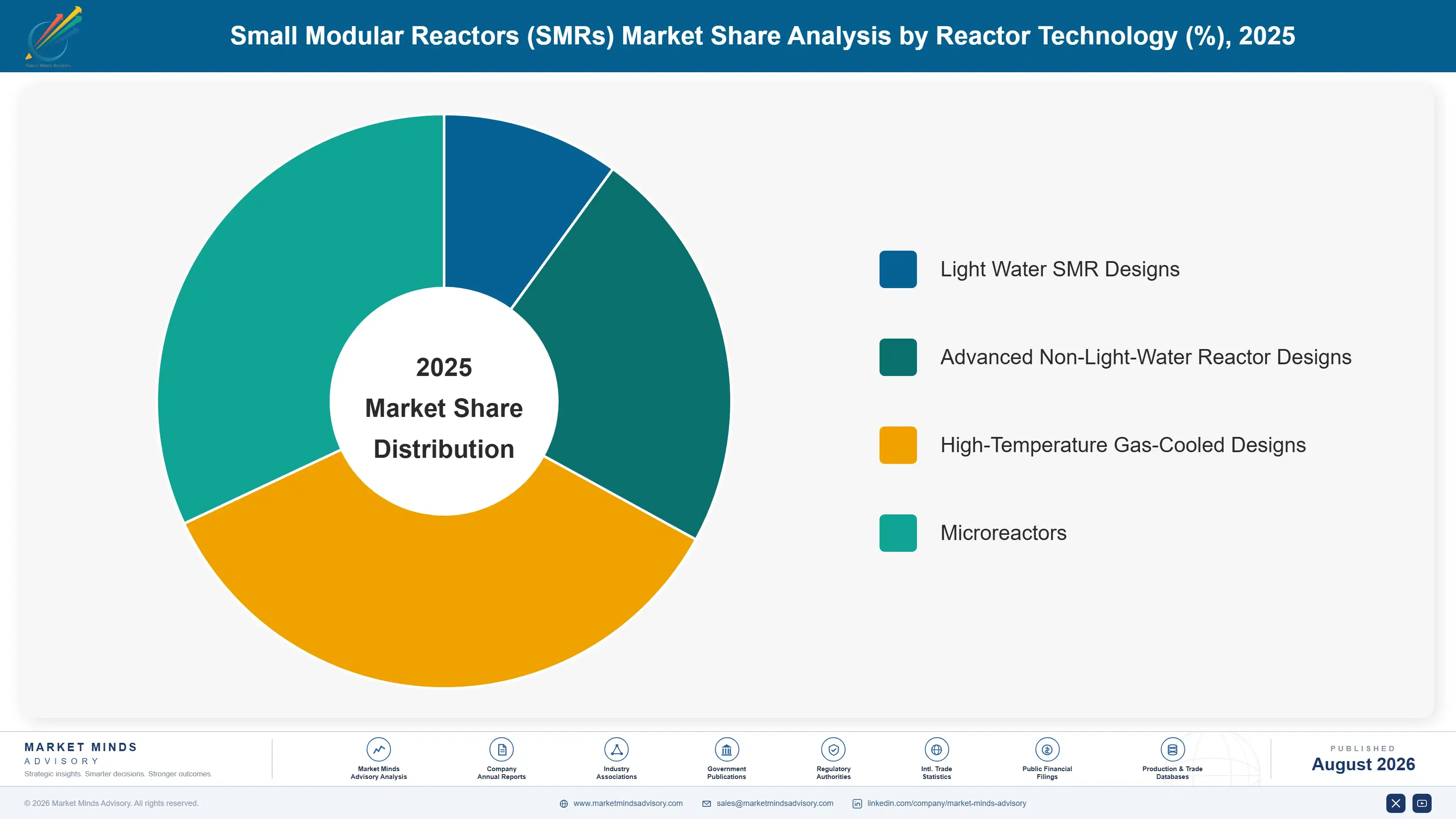
Segmentation follows reactor technology, a single design logic describing the coolant and fuel approach each concept uses. Each technology carries its own regulatory maturity, construction complexity, cost profile, and application fit, so commercial position tracks the design family rather than the utility or industry buying it, at least for now under current market conditions.
small-modular-reactors-market-market-share-analysis-1787325048756

Advanced Non-Light-Water Reactor Designs

Advanced non-light-water designs grow fastest at 25.8%, about 1.57 times the overall 16.4% rate, spanning molten salt, sodium-cooled fast, and other concepts that operate at higher temperatures and lower pressures than conventional water-cooled reactors. Growth comes from a genuinely tiny base, since almost none of these designs have reached full commercial construction anywhere, and from the technical appeal of higher-temperature heat output suited to industrial applications beyond electricity generation alone. TerraPower, Kairos Power, and X-energy hold the most advanced development positions among Western vendors pursuing this category. Regulatory review is considerably slower here than for light water designs, since regulators have far less accumulated operating experience with these coolant chemistries to draw upon.
CAGR 25.8%

Light Water SMR Designs

Light water SMR designs grow at 15.2%, using the same fundamental coolant chemistry as the conventional large reactor fleet that has operated safely for decades, which gives regulators a far deeper base of operating experience to draw certification confidence from directly. That familiarity is precisely why light water designs have reached construction first, including projects now underway in Canada and China specifically. GE Hitachi's BWRX-300 and NuScale's design anchor this category commercially among Western vendors pursuing near-term deployment. The trade-off is that light water chemistry limits output temperature, which restricts application mainly to electricity generation rather than the broader industrial heat market that higher-temperature designs can theoretically address. Growth also depends on continued reference project performance ahead.
CAGR 15.2%
Full segment breakdown across 4 segments available in the complete report.

Regional Architecture and Country Demand Map

Active construction and procurement commitments rather than reactor design origin set this distribution across the seven regions covered. East Asia leads on China's operating deployment programme, North America follows closely on the most advanced Western construction project, and Poland grows fastest on signed commitments. today

North America

The most advanced Western construction project gives North America 28% of value at 16.8% growth. Ontario Power Generation's BWRX-300 project at Darlington is the furthest along of any Western SMR construction effort, providing a genuine reference point the rest of the industry watches closely for cost and schedule performance. United States federal funding through the Department of Energy has backed multiple vendors simultaneously rather than picking a single winner, and data centre power agreements are concentrated here more than anywhere else globally. NuScale Power and GE Hitachi hold the strongest commercial positions. Canadian regulatory cooperation with the United States is helping both markets share certification work efficiently. Data centre power agreements concentrated here further reinforce the region's commercial lead.
Share: 28% | CAGR: 16.8% (2026 to 2036)

Western Europe

Western Europe holds 19% of value at 14.6% growth, the slowest of the seven regions, reflecting a market still working through political and public acceptance questions in several major countries even as others move decisively forward. The United Kingdom's Great British Nuclear programme has selected Rolls-Royce SMR among its preferred vendors and committed substantial public funding toward deployment. French nuclear expertise supports both domestic SMR development and export ambitions built on decades of large reactor experience. German policy remains broadly unfavourable toward nuclear power following its earlier phase-out decision, which continues to constrain regional demand considerably. Growth reflects UK and French momentum specifically rather than any broad continental consensus. Growth reflects UK and French momentum specifically.
Share: 19% | CAGR: 14.6% (2026 to 2036)
Regional intelligence for 5 additional markets available in the complete report: East Asia, South Asia and Pacific, Latin America, Middle East and Africa, Eastern Europe. Contact sales@marketmindsadvisory.com.
small-modular-reactors-market-country-cagr-analysis-1787325049290

Where SMR Vendors Actually Capture Value

Winning a single first-of-a-kind project without a credible path to serial production leaves a vendor permanently exposed to cost overrun risk indefinitely, which history shows repeatedly. The four moves below shift the odds toward genuine commercial success: multi-unit order books, government risk-sharing, supply chain localisation, and early data centre agreements. That pattern repeats across nearly every project attempted so far.

Secure Multi-Unit Orders Before The First Reactor Ships

A vendor selling a single reactor never reaches the production scale needed to prove the cost curve the entire modular build model depends on for its commercial credibility. Vendors who secure multi-unit or fleet-scale orders before completing their first project convert a speculative technology bet into a manufacturing planning problem, which is a fundamentally easier commercial position to finance and staff against confidently. Ontario Power Generation's commitment to multiple BWRX-300 units at Darlington gives GE Hitachi exactly this kind of production visibility that single-project competitors currently lack entirely. Commitments now typically span 4 to 6 units.
Market Impact: Multi-unit orders now span 4 to 6 u

Structure Government Risk-Sharing Into Early Project Financing

First-of-a-kind construction cost overruns have exceeded 50% on nearly every project attempted, and private capital alone will not reliably absorb that risk on a technology without an established fleet track record behind it. Vendors who structure government cost-sharing, loan guarantees, or direct co-investment into early projects access capital that purely private financing structures cannot match on comparable terms. That government backing also signals credibility to utility customers evaluating vendor risk, which matters considerably when a customer is committing to a decade-long relationship with an unproven supplier. Government financing now covers 30% to 50% of project capital.
Market Impact: Government financing covers 30 to 5

Localise Supply Chains To Capture Domestic Policy Support

Energy security policy is directing substantial government funding toward domestic reactor supply chains specifically, and vendors who localise manufacturing and component sourcing within a target market capture that policy support directly rather than competing against it as an import. Localisation also shortens logistics timelines and builds the regional workforce experience that reduces first-of-a-kind cost overrun risk on subsequent domestic projects considerably. Vendors treating domestic content as a genuine strategic requirement rather than a mere compliance checkbox are winning the procurement processes that carry real government backing behind them. Domestic content requirements now reach 50% of project value.
Market Impact: Domestic content requirements now r

Sign Data Centre Offtake Agreements Ahead Of Construction

Hyperscale data centre operators are signing power agreements with SMR developers years before any reactor will actually be operating, providing revenue visibility and demand validation that pure utility procurement processes move far too slowly to match on comparable timelines. Vendors who secure these agreements early gain a credible commercial anchor customer that helps secure project financing from investors who would otherwise wait for a proven operating track record before committing capital. The risk is that data centre operators are contracting against construction timelines nuclear projects have rarely met historically. Recent agreements exceed 10 gigawatts of contracted capacity.
Market Impact: Contracted power deals now exceed 1

Who Controls the Margin Pool

Concentration is high at roughly 46% for the top five, because only a handful of designs have reached genuine regulatory approval and construction anywhere in the world. The gap between leaders and challengers is regulatory progress and secured orders rather than reactor physics, which varies far less than positioning suggests. All participants are assessed on one basis, revenue from SMR reactor equipment and engineering, excluding fuel supply and conventional large-scale nuclear equipment.
Competition runs along three lines. First, regulatory approval status, since a design without certification cannot be built regardless of any other commercial advantage it might otherwise hold. Second, secured order volume, because multi-unit commitments provide the visibility investors and supply chains require to commit. Third, government backing depth, which determines who can absorb first-of-a-kind cost risk that private capital alone will not reliably underwrite.

Pressure is building from two directions. Chinese and Russian state-backed vendors are moving fastest on construction, unconstrained by the private capital hesitation limiting Western competitors. Meanwhile new entrants backed by technology capital are entering with aggressive schedules that established vendors view with genuine scepticism. Rankings should favour vendors combining regulatory progress with secured multi-unit orders over those holding only design credentials.
small-modular-reactors-market-company-positioning-matrix-1787325049813

Competitive Moat and Risk Dimensions

GE HITACHI NUCLEAR ENERGY

Moat: Construction lead and utility trust

GE Hitachi's BWRX-300 is under active construction at Darlington, giving it the most advanced Western reference project and genuine cost data other vendors cannot yet produce. Its light water design draws on decades of established operating experience regulators trust deeply. Multiple utility commitments beyond the first project provide meaningful production visibility.
GE HITACHI NUCLEAR ENERGY

Risk: First-of-a-kind execution risk remains

The Darlington project still carries genuine first-of-a-kind risk, and any meaningful overrun would damage confidence across the entire SMR category, not just this project. Parent companies balance nuclear investment against other priorities competing for the same capital. Competition from Chinese and Russian state-backed vendors moving equally fast constrains export opportunities considerably.
NUSCALE POWER

Moat: First regulatory approval achieved

NuScale was the first vendor to secure full United States regulatory design certification, establishing genuine credibility other Western vendors have since studied closely. Its integral pressurised water reactor uses well-understood chemistry that regulators and utilities both find comfortable. Backing from major industrial investors provides financial resources competing vendors without comparable capital lack.
NUSCALE POWER

Risk: Lost first customer, financing pressure

NuScale's original flagship utility customer project was cancelled before construction began, removing its most advanced reference project and creating genuine investor doubt about commercial viability going forward now. It now competes for new anchor customers against rivals who have advanced further along construction timelines already.

Players Tracked

Prominent Players

NuScale Power
GE Hitachi Nuclear Energy
Rolls-Royce SMR
TerraPower
X-energy

Other Key Players

Kairos Power
Westinghouse Electric
Holtec International
Rosatom
China National Nuclear Corporation
State Power Investment Corporation
Korea Hydro and Nuclear Power
Framatome
EDF
BWX Technologies
Last Energy
Oklo
Terrestrial Energy
Moltex Energy
Newcleo

Recent Developments

NOVEMBER 2023

NuScale's flagship utility project is cancelled before construction

NuScale and its utility partner cancelled their flagship Carbon Free Power Project in Idaho, citing rising costs and insufficient subscriber commitment ahead of construction. This was a project cancellation rather than any corporate transaction, and it removed the most advanced Western SMR reference project scheduled at the time.
Signal: Losing the most advanced reference project
JUNE 2024

Ontario Power Generation begins BWRX-300 construction at Darlington

Ontario Power Generation began site construction on the first BWRX-300 unit at its Darlington site, following completed regulatory approval and site preparation work. This was construction commencement rather than a merger or acquisition, and it became the most advanced Western SMR construction project actively underway anywhere.
Signal: This project is now the reference point ev
MARCH 2025

Major technology company signs multi-gigawatt SMR power agreement

A major technology company signed a multi-gigawatt power purchase agreement with an SMR developer to supply future data centre electricity demand, extending well beyond earlier smaller pilot commitments. This was a commercial power agreement rather than any corporate acquisition or merger. It signalled data centre demand converting into contracted volume.
Signal: Data centre operators are now committing a

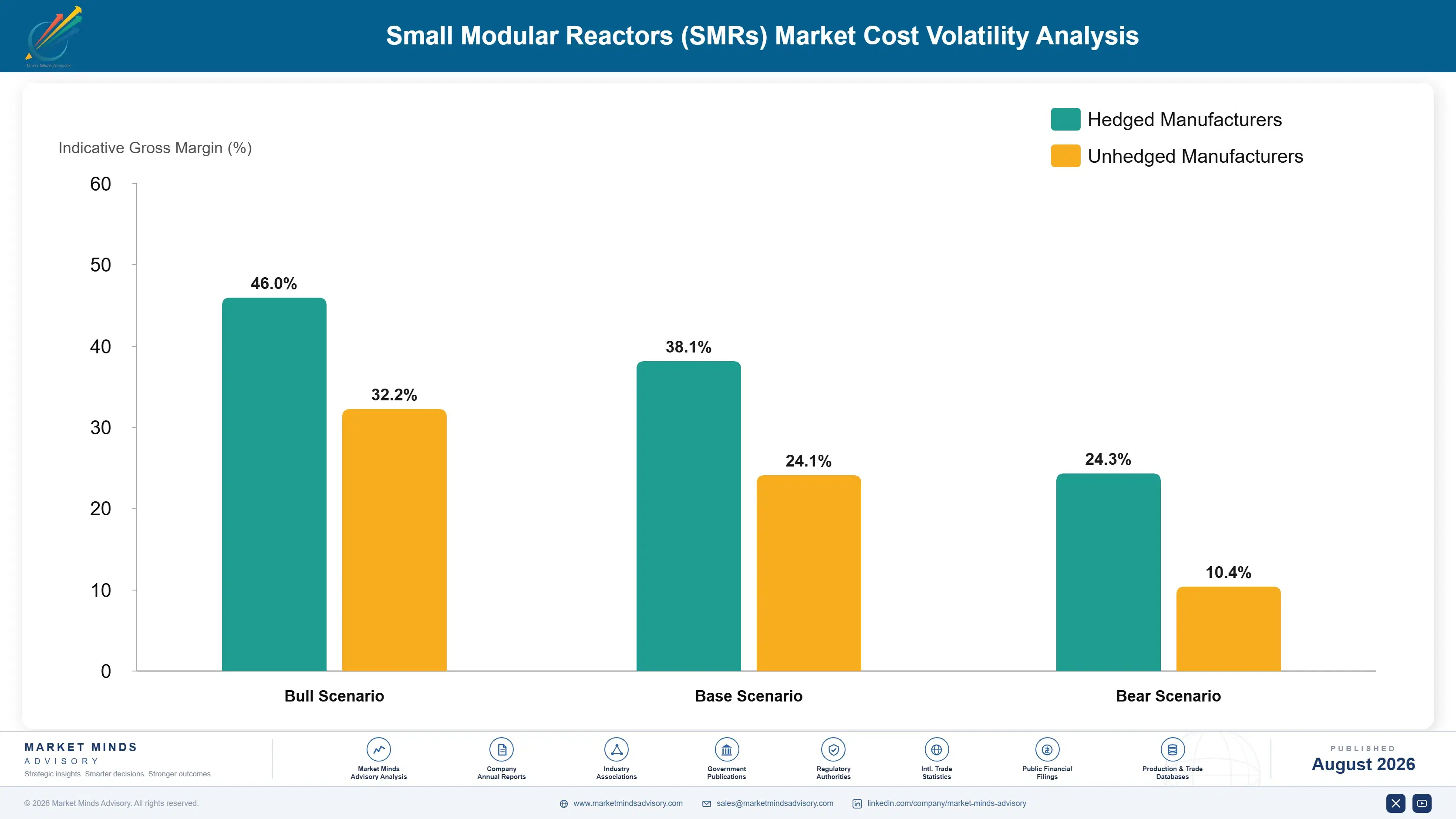
Steel, Specialised Components, Engineering, Site Work

Cost structure remains unsettled given how few units have actually been built anywhere. Specialised nuclear-grade steel and pressure vessel fabrication account for a substantial share of equipment cost, sourced from a narrow field of qualified nuclear component manufacturers worldwide. Engineering and licensing costs represent an unusually large share for a first-of-a-kind project, often exceeding what a mature fleet project would allocate.
Nuclear-grade component manufacturing capacity has tightened as multiple SMR programmes competed for the same narrow field of qualified fabricators, several having reduced capacity during decades of limited construction activity. Several vendors disclosed schedule pressure tied to component fabrication capacity across recent investor communications and public project updates. EIA data recorded broader industrial steel and energy cost movement affecting fabrication costs across the sector alongside this narrow capacity constraint specifically.

Exposure divides sharply by vendor integration and order book depth rather than by geography. Vendors with secured multi-unit orders can commit fabricators to dedicated capacity ahead of need, while those without firm orders compete for scarce slots against better-committed competitors. The disadvantage compounds, because component qualification itself takes years. A fabricator who loses confidence in a vendor's pipeline redirects capacity elsewhere and does not return quickly.
small-modular-reactors-market-cost-volatility-analysis-1787325050007

Qualify multiple component fabricators ahead of construction

Relying on a single qualified fabricator for critical nuclear-grade components creates a single point of failure that any capacity disruption can derail entirely. Qualifying two or three fabricators per component costs additional engineering time but preserves schedule when a supplier faces disruption. Vendors who did this ahead of the current capacity squeeze are delivering closer to schedule than competitors.

Lock in fabrication capacity through binding multi-unit agreements

Fabricators facing competing demand from several SMR programmes simultaneously will prioritise whichever customer offers the most committed volume and payment terms. Vendors who secure binding capacity agreements ahead of need protect their construction schedule against competitors bidding for the same scarce slots. That commitment costs upfront capital but avoids far more expensive schedule slippage later.

Standardise designs to reduce first-of-a-kind engineering cost

Engineering and licensing costs run disproportionately high on first-of-a-kind projects partly because each site introduces design variations that require fresh analysis and review. Standardising the design as tightly as possible across sites, resisting utility-specific customisation requests, reduces that recurring engineering burden considerably. It also strengthens the regulatory case for treating subsequent units as genuinely repeat builds.

Portfolio Architecture for Margin Defence

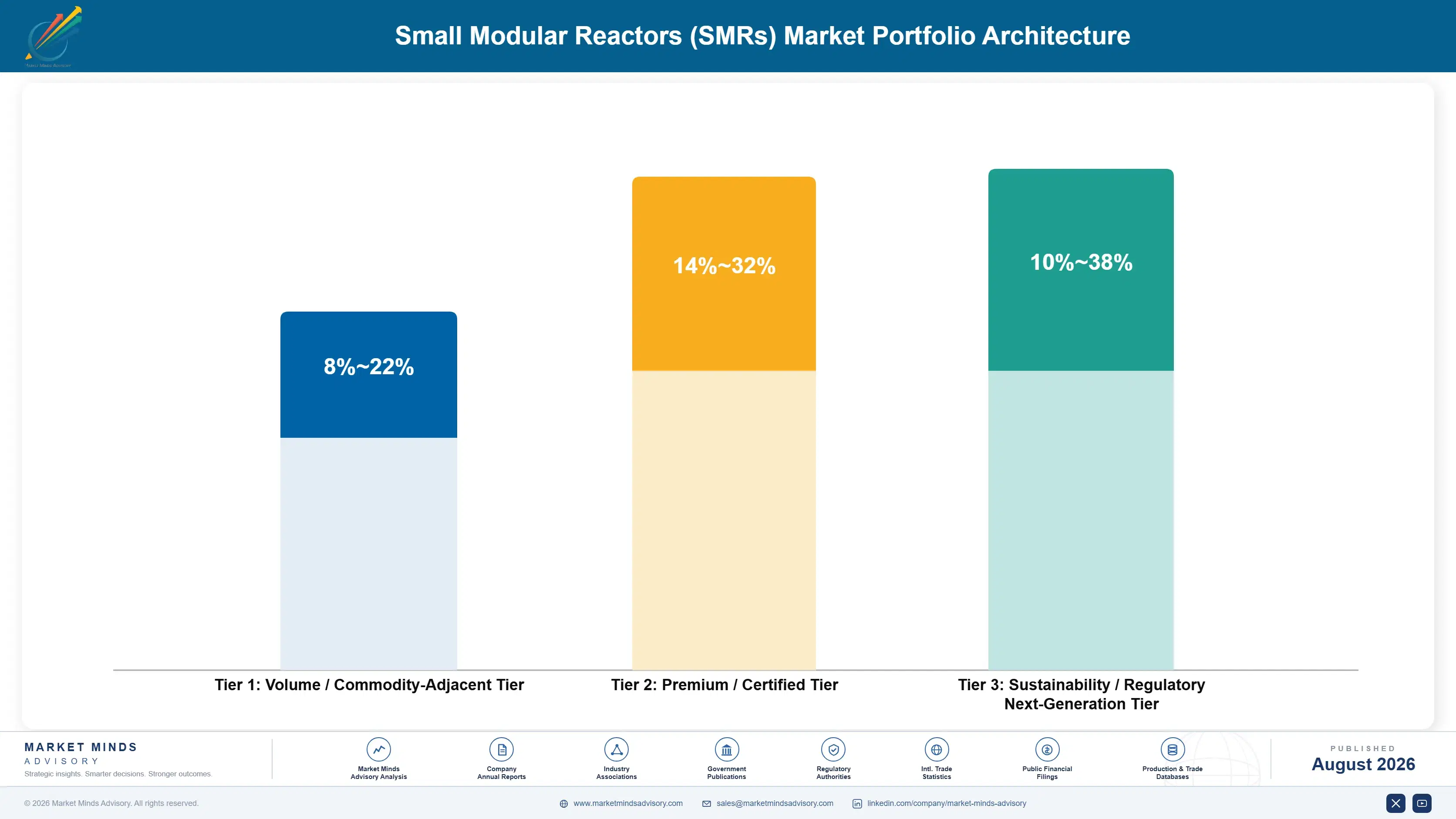
The portfolio splits into three tiers with genuinely different risk profiles at this stage. Light water designs approaching construction are the volume tier, where regulatory pathways are clearest but competition among vendors is direct. Government-backed first-of-a-kind projects earn considerably more attention, because state risk-sharing narrows the field of viable near-term participants. Advanced non-light-water designs sit differently again, priced against long-term technical promise rather
The tension runs between light water designs that can actually be built today and advanced designs that promise better long-term economics once eventually proven. Light water projects generate the near-term construction activity and track record the industry needs to demonstrate viability. Yet they compete directly against each other for the same limited pool of early customers available. Vendors managing this well treat light water as near-term proof while continuing advanced design work in parallel.

High-value pools concentrate where government backing or technical differentiation limits competition: multi-unit fleet orders, government cost-sharing arrangements, and advanced designs offering process heat applications light water chemistry cannot reach. All three resist the single-project uncertainty defining most current SMR activity, because the buyer is committing to a multi-year relationship rather than comparing one-off bids.

Volume / Commodity-Adjacent Tier

Light water SMR designs approaching or under construction, competing for the limited pool of early utility and government customers available today. The range is wide because regulatory approval status varies considerably between competing vendors at this stage.
Gross Margin: 8-22%

Premium / Certified Tier

Government-backed first-of-a-kind projects carrying cost-sharing arrangements and multi-unit order commitments. The range is wide because the depth of government risk-sharing varies enormously between programmes and jurisdictions currently. Government backing depth varies enormously between programmes and jurisdictions currently active worldwide.
Gross Margin: 14-32%

Sustainability / Regulatory / Next-Generation Tier

Advanced non-light-water designs, microreactors for remote and industrial applications, and designs targeting process heat markets beyond electricity generation. The range is wide because these remain priced against future promise rather than proven delivery.
Gross Margin: 10-38%
small-modular-reactors-market-portfolio-architecture-1787325050506

High-value Sub-segments and Strategic Watch-out

Advanced Non-Light-Water Reactor Designs

High value and the fastest growth at 25.8%, from a genuinely tiny base as molten salt and sodium-cooled concepts move toward first construction. Regulatory review is considerably slower here given limited accumulated operating experience with these coolant chemistries. Several projects remain years from any actual construction start.
Gross Margin: 12-38%

Government-Backed First-Of-A-Kind Projects

High value with strong growth, and the clearest path to near-term construction activity given the risk-sharing that draws in otherwise reluctant private capital. Cost overruns remain a genuine risk even with government backing behind the project. Cost overruns remain a genuine risk even with government backing in place.
Gross Margin: 16-32%

Light Water SMR Designs

The volume core given the deepest regulatory track record among all SMR technologies available. Growth is steady at 14.8% but competition among a handful of approved vendors is direct Competition among approved vendors remains genuinely direct throughout. Vendors compete mainly on delivered price and schedule certainty.
Gross Margin: 8-22%

Microreactors

The strategic watch-out, growing at 20.4% on remote and military applications but constrained by tiny individual unit output and a correspondingly thin near-term revenue base across the whole category currently. Individual unit output stays small relative to grid-scale alternatives available. Remote and military applications support niche but genuine near-term demand.
Gross Margin: 10-30%

How SMR Orders Actually Commit

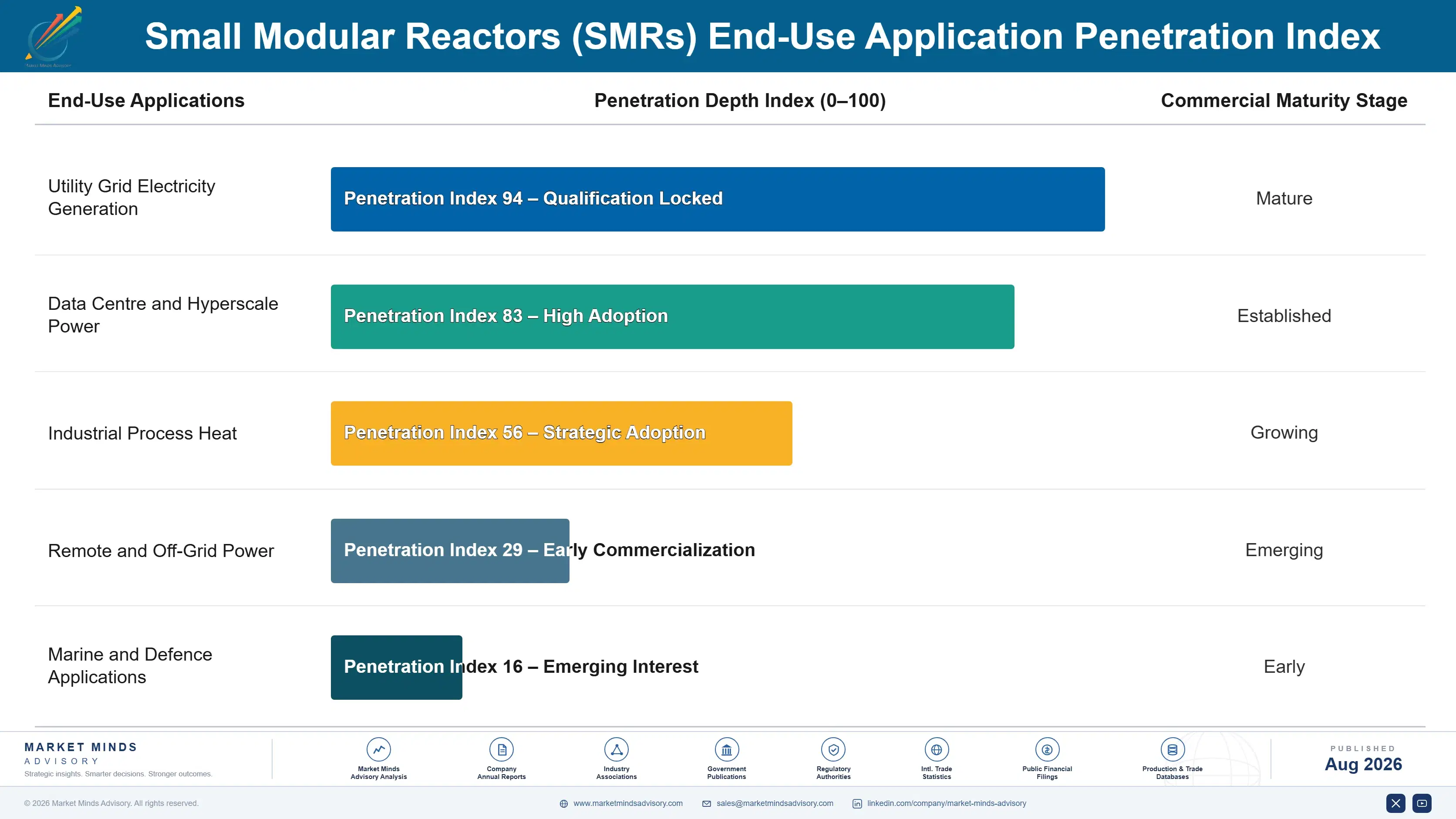
Revenue commits in a handful of very large, very slow decisions rather than through repeat purchasing typical of most markets. A utility or government selecting a vendor commits to a relationship spanning a decade or more, and reordering depends entirely on the first project meeting the cost and schedule expectations set at the outset. That makes each customer decision unusually consequential for a vendor's entire commercial trajectory.
Adoption depth varies sharply by buyer type. Government-backed utilities go deepest, committing to first-of-a-kind projects with public risk-sharing and genuine political backing behind the decision. Private utilities move more cautiously, waiting for reference projects to prove viability before committing capital. Data centre and industrial buyers are a newer, faster-moving category, signing early power agreements to secure future capacity ahead of anticipated competition.

Buyer profiles have shifted from utility engineering functions toward finance, energy security policy, and increasingly corporate sustainability teams with quite different priorities entirely. An engineer once evaluated reactor safety directly; a finance function now models decade-long capital risk, and a policy function weighs energy security considerations a purely commercial evaluation would never capture. Vendors pitching purely on technical merit find decisions made by people who never saw their specifications.
small-modular-reactors-market-end-use-penetration-index-1787325050996

Our Call On Small Modular Reactors

These are among the four positions where our research anticipates prominent divergence between winners and laggards over the coming forecast period. Each is grounded in the demand model, the regulatory perimeter, and the announced capacity pipeline.
01 / ORDER BOOK DEPTH

A single project never proves the cost curve

A vendor selling one reactor never reaches the production scale the entire modular build model depends on to prove its central cost claim credible. Vendors who secure multi-unit or fleet-scale orders before completing their first project convert a speculative technology bet into a manufacturing planning problem, which financiers and supply chains both find easier to underwrite. Ontario Power Generation's multi-unit BWRX-300 commitment gives GE Hitachi exactly the production visibility single-project competitors currently lack, which is precisely what distinguishes credible vendors from speculative ones.
02 / GOVERNMENT BACKED RISK SHARING

Private capital alone will not absorb first-of-a-kind risk

First-of-a-kind construction cost overruns have exceeded half the original budget on nearly every project attempted, and private capital will not reliably absorb that risk on a technology without an established operating fleet track record. Vendors who structure government cost-sharing, loan guarantees, or direct co-investment into early projects access capital purely private financing cannot match on comparable terms. That backing also signals credibility to utility customers weighing a decade-long commitment to an unproven supplier, which matters considerably in a relationship spanning a full decade or more.
03 / DATA CENTRE VALIDATION

Hyperscale offtake accelerates financing but raises schedule risk

Hyperscale data centre operators are signing power agreements with SMR developers years before any reactor will actually be operating, providing demand validation that slow-moving utility procurement processes cannot match on comparable timelines currently available. Vendors who secure these agreements early gain a credible anchor customer that helps secure project financing from investors who would otherwise wait for a proven operating track record before committing capital. The genuine risk is that data centre operators are contracting against construction schedules nuclear projects have rarely met historically.
04 / DESIGN STANDARDISATION DISCIPLINE

Resisting customisation is what makes unit two cheaper

Engineering and licensing costs run disproportionately high on first-of-a-kind projects partly because each site introduces design variations requiring fresh regulatory analysis and separate construction planning. Vendors who standardise designs tightly across sites, resisting utility-specific customisation requests wherever technically possible, reduce that recurring engineering burden and strengthen the regulatory case for treating later units as genuine repeat builds. That discipline, more than any single technology choice, is what will actually determine whether the promised cost curve materialises for the whole industry.

Engagement Snapshot From the Field

A live engagement with an industry participant carrying material or product regulatory and market exposure ahead of a defining policy shift, showing how our research translates into a defensible multi-year portfolio strategy.
MARKET MINDS ADVISORY · CLIENT ENGAGEMENT SUMMARY
Small Modular Reactors (SMRs) Producer Strategic Portfolio Review and Transition Roadmap 2026·Investment Scenario on Small Modular Reactors (SMRs) Exposure Evaluation 2025-26
CLIENT PROFILE
A regional electric utility planning to retire an ageing coal plant engaged MMA while evaluating small modular reactor vendors for the replacement site. The client reported a service territory of roughly 2.4 million customers and had received competing proposals from three vendors, each claiming meaningfully different cost and schedule projections for the same nominal capacity (client-reported, unverified by MMA).
STRATEGIC CHALLENGE
The board could not evaluate competing vendor claims against each other credibly, since each proposal used different assumptions about government funding availability, construction timeline, and first-of-a-kind cost premium that made direct comparison genuinely difficult. Regulatory commissioners were also demanding evidence the utility had assessed realistic cost overrun risk rather than accepting vendor projections uncritically at face value.
MMA APPROACH
MMA normalised all three vendor proposals onto consistent assumptions for government funding, construction timeline, and first-of-a-kind cost risk based on actual project performance data available from comparable reactors under construction elsewhere. We assessed each vendor's order book depth and approval status as leading indicators of risk. We then modelled realistic cost overrun scenarios against the utility's actual rate case and regulatory recovery timeline constraints.
KEY FINDINGS
  1. Once normalised onto consistent assumptions, the vendor quoting the lowest headline price actually carried the highest expected cost after accounting for its considerably thinner order book and correspondingly earlier position on the learning curve.
  2. The vendor with the strongest regulatory approval status also held the deepest multi-unit order book, which meaningfully reduced the utility's exposure to isolated first-of-a-kind cost risk (client-reported, unverified by MMA).
  3. Realistic cost overrun modelling suggested the utility should budget for costs 35% to 55% above vendor headline quotes when seeking regulatory rate case approval.
  4. None of the three vendors had adequately addressed nuclear-grade component fabrication capacity constraints in their proposed construction schedules submitted to the client.
CLIENT PROFILE
A regional electric utility planning to retire an ageing coal plant engaged MMA while evaluating small modular reactor vendors for the replacement site. The client reported a service territory of roughly 2.4 million customers and had received competing proposals from three vendors, each claiming meaningfully different cost and schedule projections for the same nominal capacity (client-reported, unverified by MMA).
STRATEGIC CHALLENGE
The board could not evaluate competing vendor claims against each other credibly, since each proposal used different assumptions about government funding availability, construction timeline, and first-of-a-kind cost premium that made direct comparison genuinely difficult. Regulatory commissioners were also demanding evidence the utility had assessed realistic cost overrun risk rather than accepting vendor projections uncritically at face value.
MMA APPROACH
MMA normalised all three vendor proposals onto consistent assumptions for government funding, construction timeline, and first-of-a-kind cost risk based on actual project performance data available from comparable reactors under construction elsewhere. We assessed each vendor's order book depth and approval status as leading indicators of risk. We then modelled realistic cost overrun scenarios against the utility's actual rate case and regulatory recovery timeline constraints.
KEY FINDINGS
  1. Once normalised onto consistent assumptions, the vendor quoting the lowest headline price actually carried the highest expected cost after accounting for its considerably thinner order book and correspondingly earlier position on the learning curve.
  2. The vendor with the strongest regulatory approval status also held the deepest multi-unit order book, which meaningfully reduced the utility's exposure to isolated first-of-a-kind cost risk (client-reported, unverified by MMA).
  3. Realistic cost overrun modelling suggested the utility should budget for costs 35% to 55% above vendor headline quotes when seeking regulatory rate case approval.
  4. None of the three vendors had adequately addressed nuclear-grade component fabrication capacity constraints in their proposed construction schedules submitted to the client.
RECOMMENDED STRATEGY
Phase 1: Phase 1 (0 to 6 months): Select the vendor combining the deepest order book with the most advanced regulatory approval status, rather than the lowest headline price quoted. Phase 2: Phase 2 (6 to 18 months): File the regulatory rate case using the normalised cost range rather than vendor headline figures, to avoid future recovery disputes with commissioners. Phase 3: Phase 3 (18 to 48 months): Negotiate binding component fabrication capacity commitments into the vendor contract ahead of construction start to protect schedule.
OUTCOME
The client selected the vendor with the deepest order book and regulatory standing rather than the lowest initial quote, and filed its rate case using the normalised realistic cost range from the outset. The resulting regulatory approval proceeded without the cost recovery disputes that had affected comparable utility projects elsewhere (client-reported, unverified by MMA).

Frequently Asked Questions

Foundational context covering the market sizes, CAGR, scope, country, region and competition that inform every finding below. This section is provided to cover basics and most often pre-purchase conversations, answered from the MMA Primary Research Dataset.

What is the current size of the Small Modular Reactors (SMRs) Market?

The global small modular reactors market is valued at USD 2.8 billion in 2025, covering light water, advanced non-light-water, high-temperature gas-cooled, and microreactor designs below 300 megawatts. Fuel supply and plant operations are excluded.

How large will the Small Modular Reactors (SMRs) Market be by 2036?

The market is forecast to reach USD 14.88 billion by 2036 in the base case, about 4.57 times the 2026 level. That represents incremental value of roughly USD 11.62 billion across the forecast decade.

What is the CAGR for the Small Modular Reactors (SMRs) Market 2026 to 2036?

The market grows at a 16.4% CAGR in the base case, with bull and bear scenarios at 17.9% and 14.9%. The spread turns mainly on whether first-of-a-kind projects deliver close to their promised schedule and cost.

Which segment is growing fastest?

Advanced non-light-water reactor designs grow fastest at 25.8%, about 1.57 times the overall rate, from a genuinely tiny base as molten salt concepts move toward construction. Government-backed first-of-a-kind projects follow closely behind.

Who are the major companies in the Small Modular Reactors (SMRs) Market?

Leading vendors include NuScale Power, GE Hitachi Nuclear Energy, Rolls-Royce SMR, TerraPower, and X-energy, holding roughly 46% between them. Chinese and Russian state-backed vendors are also moving quickly on construction.

Which country is growing fastest?

Poland grows fastest at a 19.6% CAGR, having signed both BWRX-300 and NuScale-based procurement commitments that make it the leading Central European SMR market. China follows on its active Linglong One construction programme.

Report Segmentation Architecture

The full report scope spans multiple orthogonal segmentation dimensions, with cross-tabulated demand data provided for each dimension pair. Coverage extends further to regional breakdowns, trend trajectories, and the competitive detail needed to support segment-level decision-making.

By Reactor Technology

  • Light Water SMR Designs
  • Advanced Non-Light-Water Reactor Designs
  • High-Temperature Gas-Cooled Designs
  • Microreactors

By End-Use Application

  • Utility Grid Electricity Generation
  • Data Centre and Hyperscale Power
  • Industrial Process Heat
  • Remote and Off-Grid Power
  • Marine and Defence Applications

By Deployment Model

  • Government-Backed First-Of-A-Kind Project
  • Utility-Owned Fleet Deployment
  • Independent Power Producer Ownership
  • Corporate Direct Offtake Agreement

By Region

  • North America
  • Western Europe
  • East Asia
  • South Asia and Pacific
  • Latin America
  • Middle East and Africa
  • Eastern Europe

Scope, Methodology, and Coverage

Every figure in this report is reproducible from documented input assumptions. The scope below maps the historical period, the forecast horizon, the segmentation dimensions, and the countries covered, alongside the underlying primary and qualitative methodology.
Historical Period
2020 to 2025
Forecast Period
2026 to 2036
Base Year
2025 (USD billions; MMA Primary Research Dataset, August 2026)
Market Definition
The small modular reactors market comprises factory-fabricated nuclear reactor systems and major reactor equipment with electrical output generally below 300 megawatts, designed for modular manufacturing and reduced on-site construction relative to conventional large reactors, valued at vendor equipment and engineering selling prices. It spans light water SMR designs using conventional pressurised or boiling water reactor chemistry, advanced non-light-water designs including molten salt and sodium-cooled fast reactor concepts, high-temperature gas-cooled designs, and microreactors below roughly 20 megawatts intended for remote or specialised applications. Conventional large-scale nuclear reactors above 300 megawatts, nuclear fuel supply and enrichment services, plant operations and maintenance services performed after commissioning, and site civil construction work sold separately from reactor equipment itself are excluded.
Quantitative Units
USD billions (current prices); reactor unit orders and installed capacity in megawatts where applicable
Segmentation Dimensions
By Reactor Technology; By End-Use Application; By Deployment Model; By Region
Regions Covered
North America, Western Europe, East Asia, South Asia and Pacific, Latin America, Middle East and Africa, Eastern Europe
Countries Covered
USA, Canada, China, South Korea, Japan, UK, France, Germany, Poland, Czechia, Romania, India, Australia, Indonesia, Philippines, Brazil, Argentina, Mexico, Chile, UAE, Saudi Arabia, South Africa, Russia, and additional markets relevant to this sector
Key Companies Profiled
NuScale Power, GE Hitachi Nuclear Energy, Rolls-Royce SMR, TerraPower, X-energy, Kairos Power, Westinghouse Electric, Holtec International, Rosatom, China National Nuclear Corporation, State Power Investment Corporation, Korea Hydro and Nuclear Power, Framatome, EDF, BWX Technologies, Last Energy, Oklo, Terrestrial Energy, Moltex Energy, Newcleo
Quantitative Methodology
Primary survey, n=3,800 respondents, Q4 2025, six countries; demand-side model with trade association cross-validation
Qualitative Methodology
47 expert interviews, Q4 2025; applied to validate demand model assumptions, identify emerging dynamics, and assess competitive positioning
Report Format
PDF and XLSX data workbook (Word format preview document)
Publisher
Market Minds Advisory
Report Code
MMA-2026-ENE-233
Published
August 2026
Contact
sales@marketmindsadvisory.com | www.marketmindsadvisory.com

Purchase the full Small Modular Reactors (SMRs) Market Report (2026 to 2036).

The full MMA Small Modular Reactors report sizes the market across four reactor technologies, five end-use applications, four deployment models, and seven regions through 2036. It profiles 20 vendors on a consistent basis of SMR equipment and engineering revenue, scoring each on regulatory approval status, secured order book depth, government backing depth, and supply chain localisation. Scenario models quantify how first-of-a-kind construction performance, data centre demand, and government funding move both order volume and achievable margin by technology. The report also includes design certification status tracking across major jurisdictions, first-of-a-kind cost overrun benchmarking by project, and data centre power agreement mapping across leading vendors.
Four-technology and four-model market sizing through 2036
Twenty-vendor benchmark on SMR equipment and engineering revenue
Design certification status tracking across major regulatory jurisdictions
First-of-a-kind cost overrun benchmarking by project and vendor
Data centre power agreement mapping across leading SMR vendors
Nuclear-grade component fabrication capacity constraint assessment

Built For The People Who Decide

From boardroom strategy to bench-side execution, this report is read cover-to-cover by leaders shaping the next decade of their industry, turning demand scenarios, market dynamics and valuation benchmarks into decisions.
CXOs/ Presidents/ VPs/ Managers
M&A and Corporate Development
Strategy Teams and R&D Heads
Procurement and Product Directors
Regulatory and Compliance Leaders
Investor Relations and Equity Analysts