Market Minds Advisory
Small Caliber Ammunition Market

Small Caliber Ammunition Market: Small Caliber Ammunition Market. Military Modernization and Civilian Demand Sustain Multi-Channel Production Growth

Sustained military modernization contracts and steady civilian shooting sports participation are pulling small caliber ammunition demand toward higher-precision, longer-shelf-life cartridges across defense, law enforcement, and commercial production channels worldwide today.

Lead Analyst

Published

September 2026

Make Smarter Decisions with Customized Research Insights

Request a free sample report and evaluate market opportunities, growth trends, and competitive dynamics relevant to your business needs.

2025 MARKET VALUE$13.5BMarket Size 2025
2036 FORECAST VALUE$21.2BBase Case , 2026 to 2036
CAGR 2026 TO 20364.2 %Bull 5.5% / Bear 3.0%
INCREMENTAL OPPORTUNITY$7.2BNet 10- year value creation
EXPANSION MULTIPLE1.51x2036 value over 2026 base
Strategic Levers
M&A Pipeline
Regional Outlook
Country Rankings
Competitive Intelligence
Segmental Deep-dive
Call-Us : 91 93563 13602

Executive Snapshot and Market Trajectory.

Small caliber ammunition demand remains anchored by military procurement cycles even as civilian shooting sports participation sustains a steady secondary demand base across most developed markets today, particularly in North America and parts of Europe where recreational shooting culture runs deep. Defense budgets across allied nations continue rising steadily.
NATO standardization programs and multi-year defense contracts underpin production planning, while precision match-grade cartridges grow fastest as competitive shooting and long-range civilian shooting disciplines expand participation across most Western markets. North America and Eastern Europe concentrate the bulk of production capacity, reflecting both domestic defense procurement and export contract fulfillment obligations to allied nations under long-standing security arrangements. Manufacturers are investing in expanded production lines to meet both obligations simultaneously. Manufacturing precision keeps improving steadily.
Competition spans a handful of large defense-focused manufacturers and a broader field of commercial producers serving civilian retail, each operating under different regulatory and procurement regimes entirely depending on end customer type served. Export licensing restrictions and shifting geopolitical alignment are reshaping which producers win multi-year government contracts, while brass and lead input costs remain a persistent margin pressure across the category regardless of end market.
Market Definition
This report covers the global market for small caliber ammunition cartridges up to 12.7mm used in military, law enforcement, and civilian firearms, including rifle, pistol, and rimfire cartridges. It excludes large caliber and artillery ammunition, explosive ordnance, and firearms themselves.
Base Year Value
$13.5B in 2025 (MMA Primary Research Dataset, September 2026)
Forecast Period
2026 to 2036, eleven discrete annual values
CAGR
4.2% base case. Bull 5.5%. Bear 3.0%.
Fastest Growth Segment
Precision Match-Grade Cartridges: 6.5% CAGR
Fastest Growth Country
India: 6.2% CAGR
Fastest Growth Region
South Asia and Pacific: 6.2% CAGR
Largest Region
North America: 32% of 2025 global value
Market Leaders
Vista Outdoor, Olin Corporation (Winchester), RUAG Ammotec, Nammo, Nexter Group. Source: MMA Primary Research Dataset, July 2026.
Primary Survey
n=3,800 procurement and R&D decision-makers, Q4 2025, six countries
Methodology
Demand-side build-up, cross-validated against public data, 47 expert interviews

Small Caliber Ammunition Market Forecast Scenarios

small-caliber-ammunition-market-size-forecast-scenario-1790017495761
Between 2020 and 2025 small caliber ammunition production expanded steadily as pandemic-era civilian purchasing surges gave way to more normalized retail demand, while military procurement remained the stable underlying baseline throughout the period, supporting a historical CAGR near 3.5 percent across the full historical window tracked in this analysis, with only modest year-to-year variation. Manufacturers used this stable period to invest in updated tooling.
The base case assumes continued NATO member defense spending increases sustaining multi-year procurement contracts across allied nations, steady civilian shooting sports participation across North America and parts of Europe, and gradual capacity expansion among established manufacturers responding to sustained order backlogs rather than speculative capacity additions ahead of confirmed demand across the full ten-year forecast period tracked here in careful detail throughout. Contract renewal cycles remain the primary driver of visible order visibility.
The bull case assumes accelerated defense spending amid heightened geopolitical tension drives faster multi-year contract awards than currently planned across most allied procurement programs. The bear case assumes a sustained peace dividend and civilian demand normalization slow production growth meaningfully, particularly affecting commercial-channel manufacturers most exposed to discretionary retail purchasing cycles rather than stable government contracts.

Defense Procurement Anchors Production Capacity Planning

Small caliber ammunition manufacturing sits at the intersection of long-cycle defense procurement and shorter-cycle civilian retail demand, giving the category a distinctive dual-channel commercial structure that most manufacturers must serve simultaneously across their entire production footprint. Few other defense-adjacent categories combine these two demand profiles so directly.
MARKET CONCENTRATION48% CR5Top five producers hold nearly half of global output
AVERAGE CARTRIDGE PRICE$0.42Per standard rifle cartridge across major commercial markets globally
TOP PRODUCING COUNTRYUnited States 26%Leads global production by total annual cartridge volume
CAPACITY UTILIZATION RATE82%Share of installed manufacturing capacity actively running monthly
GOVERNMENT CONTRACT SHARE58%Share of total industry revenue from government procurement contracts
METAL INPUT COST SHARE31% of COGSReflects metal commodity exposure across major production facilities
Defense contracts provide manufacturers with multi-year revenue visibility and justify sustained capital investment in production line modernization, while civilian retail demand fluctuates more with broader economic conditions and periodic purchasing surges tied to regulatory uncertainty and firearms ownership sentiment. Manufacturers serving both channels balance production scheduling carefully to avoid underutilizing capacity during civilian demand lulls between purchasing cycles. Idle capacity during softer civilian quarters represents a real cost that disciplined manufacturers actively plan around.
Brass and lead commodity price volatility remains a persistent margin pressure across the category, since these metals represent a substantial share of cost of goods sold and are subject to global commodity market swings largely outside any single manufacturer's control or influence. Domestic sourcing mandates in several countries add further cost complexity for internationally diversified producers competing for the same government contracts. Hedging strategies vary considerably across manufacturers depending on balance sheet strength and contract structure.
"Defense contracts buy manufacturers time to modernize. The producers investing in precision tooling now will own the premium civilian segment later."
Practice Lead, Defense and Industrial Manufacturing · MMA Small Caliber Cartridges for Military Practice · September 2026

Market Trends

Precision Match-Grade Cartridges Gain Commercial Share

Competitive shooting disciplines and long-range civilian shooting are expanding participation across North America and parts of Europe, driving demand for match-grade cartridges manufactured to tighter dimensional tolerances than standard rifle ammunition. Manufacturers are investing in precision case-forming and powder-metering equipment specifically to serve this segment, since match-grade cartridges command meaningfully higher per-unit pricing than standard commercial ammunition sold through mass retail channels. Several established defense-focused producers have launched dedicated precision product lines targeting this growing civilian segment directly rather than treating it as a marginal side business. Retail sporting goods chains report growing shelf space dedicated to this category.
Market Impact: Adds 1.8 billion rounds annual procurement

NATO Standardization Sustains Multi-Year Contract Visibility

NATO member states continue coordinating ammunition standardization programs to ensure interoperability across allied forces, sustaining multi-year procurement contracts that give manufacturers unusually long production planning horizons compared with most industrial categories. These standardization requirements also create meaningful barriers for new entrants lacking established certification and qualification track records with defense procurement agencies. Manufacturers holding existing NATO qualification status enjoy a durable competitive advantage over newer entrants attempting to break into government contract channels for the first time. Smaller regional manufacturers increasingly seek subcontracting arrangements with qualified suppliers to access this contract pipeline indirectly through established relationships.
Market Impact: Adds 4.2 million new participants annually

Market Opportunities and Growth Drivers

Rising Defense Budgets Across Allied Nations

Defense spending increases across NATO member states and allied Asian nations are translating directly into larger multi-year ammunition procurement contracts as militaries rebuild depleted stockpiles and modernize small arms platforms simultaneously. Several governments have publicly committed to multi-year spending targets specifically citing ammunition stockpile replenishment as a stated priority following recent regional conflicts that drew down existing reserves faster than anticipated. Manufacturers with qualified production capacity are securing multi-year contracts well ahead of previous procurement cycles, reflecting this heightened urgency across procurement agencies. Export licensing approvals to allied nations further add incremental order volume beyond domestic procurement alone.
Market Impact: Cuts gross margin 6 points

Civilian Shooting Sports Participation Continues Expanding

Growing participation in recreational and competitive shooting sports across North America, parts of Europe, and expanding markets in Asia is sustaining steady civilian retail demand independent of broader defense procurement cycles. New shooter recruitment programs run by sporting organizations and retailers are widening the participant base beyond traditional demographics, adding incremental demand from first-time buyers entering the category. Retailers report consistent replenishment purchasing from established recreational shooters, providing manufacturers with a demand floor that persists through defense procurement downturns. Indoor shooting range construction in urban markets is also broadening year-round access for participants.
Market Impact: Delays export contracts 6 months

Market Restraints and Challenges

Brass and Lead Commodity Price Volatility Pressures Margins

Brass and lead prices fluctuate with broader industrial and precious metal commodity cycles largely outside manufacturer control, squeezing margins during periods of rising input costs that cannot always be passed through to government contracts with fixed multi-year pricing terms already negotiated. The root cause traces to ammunition manufacturers competing for the same copper and lead supply that construction, electronics, and battery industries also depend on heavily. Manufacturers are mitigating exposure through longer-term metal supply contracts and increased use of recycled brass reclaimed from spent casings collected at ranges. Recycling programs are expanding steadily across major production facilities.
Market Impact: Lifts precision cartridge revenue 28 percent

Export Licensing Restrictions Limit Market Access

Export control regulations governing ammunition sales to foreign governments and civilian markets restrict which producers can pursue international contracts, particularly for sales into regions facing sanctions or heightened diplomatic scrutiny from exporting nations. The root cause lies in ammunition's dual-use classification under most national export control regimes, subjecting shipments to lengthy government review processes regardless of end customer type. Manufacturers are mitigating this by diversifying into domestically focused production lines and pursuing licensing partnerships with locally based manufacturers in target export markets instead. These partnerships remain a slow but growing alternative pathway.
Market Impact: Secures contract visibility 5 years ahead
3 additional market trends, 4 additional growth drivers, and 3 additional restraints and challenges are covered in the full report. Contact sales@marketmindsadvisory.com to access the complete intelligence.

Segment CAGR and Growth Architecture

Small caliber ammunition segments by cartridge type across rifle, pistol, and rimfire categories, with precision match-grade and standard commercial variants increasingly differentiated by manufacturing tolerance, end-use application, and target customer type, spanning military, law enforcement, and civilian shooting sports channels across most global commercial and defense procurement markets served today worldwide by established manufacturers.
small-caliber-ammunition-market-market-share-analysis-1790017496296

Precision Match-Grade Cartridges

Precision match-grade cartridges manufactured to tighter dimensional tolerances than standard commercial ammunition represent the fastest-growing segment, driven by expanding competitive and long-range civilian shooting participation across North America and parts of Europe. Manufacturers investing in precision case-forming and powder-metering equipment capture meaningfully higher per-unit margins than standard commercial production lines allow, since match-grade buyers pay a substantial premium for documented accuracy performance. Several defense-focused producers have launched dedicated precision civilian product lines, treating this segment as a genuine growth priority rather than a marginal side business alongside core government contract work. This premium positioning is reshaping how established defense-focused manufacturers allocate research and development spending across their broader product portfolios going forward.
CAGR 6.5%

Standard Rifle Cartridges

Standard rifle cartridges represent the largest segment by volume, serving both military procurement and mainstream civilian hunting and recreational shooting demand across most global markets. Production runs at high volume with tighter margins than precision variants, since standard cartridges compete primarily on price and reliable consistent performance rather than documented accuracy credentials. Military procurement contracts for standard NATO-caliber rifle cartridges provide the steadiest multi-year revenue visibility in this segment, while civilian retail demand fluctuates more with broader economic conditions and periodic regulatory-driven purchasing surges across major consumer markets. This dual-channel demand structure gives standard rifle cartridge production a resilience that more narrowly focused segments lack during cyclical downturns in either channel.
CAGR 4.5%
Full segment breakdown across 6 segments available in the complete report.

Regional Architecture and Country Demand Map

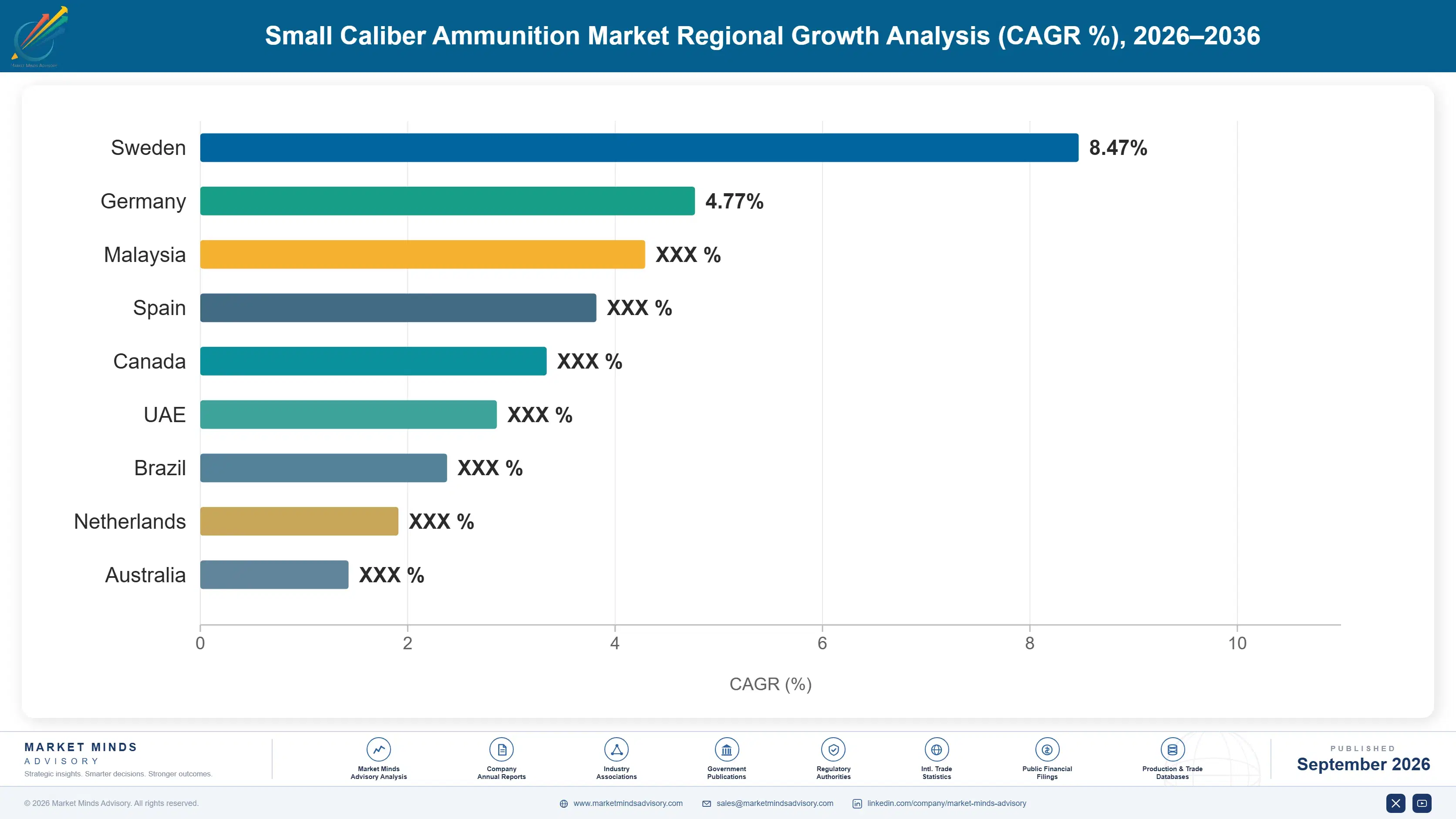
North America commands the largest regional share on the strength of a deep domestic defense industrial base and enduring civilian shooting culture, while South Asia and Pacific accelerates fastest on expanding domestic defense manufacturing initiatives and rapidly rising sport shooting participation nationwide across major cities.

North America

North America commands the largest regional share through a deep domestic defense industrial base spanning multiple qualified NATO-certified manufacturers, combined with an enduring civilian shooting culture that sustains steady retail demand independent of government contract cycles. The United States hosts the world's largest civilian firearms ownership base, supporting consistent recreational and competitive shooting cartridge purchasing across sporting goods retail nationwide. Canadian manufacturers supply complementary production capacity, often under joint procurement arrangements tied to shared North American defense commitments and interoperability standards established through decades of cooperation. Export contracts to allied nations further reinforce this concentrated production advantage. Domestic capacity investment continues expanding steadily across multiple qualified facilities. Retail replenishment demand adds further stability.
Share: 32% | CAGR: 4.5% (2026 to 2036)

Western Europe

Western European demand reflects a mature but steady defense industrial base, with several member states maintaining domestic ammunition production capacity to satisfy both NATO commitments and national security policy preferences for supply chain independence from external suppliers. Germany, France, and the United Kingdom host established manufacturers supplying both domestic militaries and export markets under government-to-government agreements requiring careful diplomatic clearance. Growth trails North America and East Asia as civilian ownership rates remain considerably lower under stricter firearms regulation, limiting the commercial retail channel's contribution to overall regional demand relative to defense procurement. Ongoing standardization efforts across the alliance continue shaping procurement priorities region-wide. National sourcing preferences occasionally complicate cross-border supplier qualification timelines.
Share: 20% | CAGR: 2.8% (2026 to 2036)
Regional intelligence for 5 additional markets available in the complete report: East Asia, South Asia and Pacific, Latin America, Middle East and Africa, Eastern Europe. Contact sales@marketmindsadvisory.com.
small-caliber-ammunition-market-country-cagr-analysis-1790017496808

Precision Segment Margin Capture Playbook

Manufacturers capture disproportionate margin by shifting production mix toward precision match-grade cartridges, by securing multi-year government contracts that justify capital investment in modernized tooling and facility expansion, and by building recycled brass reclamation programs that reduce raw material cost exposure across both defense and civilian retail channels served worldwide over the full contract cycle.

Precision Match-Grade Product Line Expansion Strategy

Manufacturers expanding dedicated precision match-grade product lines capture meaningfully higher per-unit margins than standard commercial cartridge production allows, since competitive and long-range civilian shooters pay a substantial premium for documented accuracy performance and tighter dimensional tolerances. This requires investment in precision case-forming and powder-metering equipment beyond standard production line capability, but the payback period is generally short given premium pricing power. Manufacturers with established precision lines report gross margins running roughly 14 percentage points above standard commercial cartridge production across comparable volume. Retail partners are also allocating more dedicated shelf space to these premium offerings.
Market Impact: Lifts precision segment gross margin by 14 points

Securing Long-Term Multi-Year Government Procurement Contracts

Securing multi-year government procurement contracts provides manufacturers with revenue visibility that justifies sustained capital investment in production line modernization, reducing per-unit costs over time through improved capacity utilization and manufacturing efficiency gains. This visibility also strengthens lender relationships and access to favorable financing terms for facility expansion, since predictable contracted revenue reduces perceived business risk considerably. Manufacturers holding multi-year contracts report cost of capital roughly 2 percentage points lower than those relying primarily on shorter-cycle civilian retail demand alone. Smaller manufacturers without qualification history often struggle to compete for this contract tier. This dynamic reinforces incumbent advantage considerably.
Market Impact: Reduces cost of capital by roughly 2 points

Building Recycled Brass Reclamation Program Investment

Building recycled brass reclamation programs that collect and reprocess spent casings from ranges and law enforcement training facilities reduces raw material cost exposure to volatile commodity markets considerably compared with relying entirely on virgin brass purchased at prevailing market prices. This also creates a differentiated sustainability narrative that resonates with environmentally conscious commercial buyers and some government procurement evaluation criteria increasingly weighing supply chain resilience. Manufacturers with established reclamation programs report brass input costs roughly 18 percent lower than competitors relying solely on virgin material. Range partnerships supplying spent brass are becoming a valued strategic relationship.
Market Impact: Cuts brass input costs by roughly 18 percent

Export Market Diversification Through Local Licensing

Pursuing export licensing partnerships with locally based manufacturers in target international markets expands addressable customer base beyond domestic procurement alone, opening revenue streams in markets where direct export faces regulatory friction or diplomatic complications. This approach also reduces exposure to any single national defense budget cycle, since diversified international revenue smooths demand volatility across multiple simultaneous government procurement calendars. Manufacturers pursuing this strategy report meaningfully more stable year-over-year revenue, spread across 8 or more qualified export markets, than peers dependent on a single dominant export market alone. Building these partnerships requires patience but pays off over multiple contract cycles.
Market Impact: Diversifies revenue across 8 qualified export market regions

Who Controls the Margin Pool

Small caliber ammunition competition is fairly concentrated, with the top five producers holding roughly 48 percent combined share on a production capacity basis across defense and commercial channels. Vista Outdoor and Olin Corporation's Winchester division lead through scale advantages in commercial retail distribution, while RUAG Ammotec and Nammo hold particular strength in European defense procurement. The gap between qualified NATO-certified manufacturers and smaller regional producers remains substantial and difficult to close quickly.
Current competitive activity centers on securing multi-year government procurement contracts, expanding precision match-grade product lines, and investing in recycled brass reclamation capacity rather than pure price competition among established players. Companies are racing to achieve NATO qualification status in additional cartridge calibers before rivals establish similar certification, since qualification barriers are substantial and time-consuming to overcome for new entrants.

Emerging pressure is coming from expanding domestic manufacturers in India and other nations pursuing defense self-reliance policies that favor local production over imports for government contracts. This threatens established exporters' traditional market access in previously reliable customer markets. Expect further reshuffling as Eastern European manufacturers scale capacity to meet elevated regional procurement demand tied to sustained security concerns.
small-caliber-ammunition-market-company-positioning-matrix-1790017497331

Competitive Moat and Risk Dimensions

VISTA OUTDOOR

Moat: Commercial Retail Distribution Scale

Vista Outdoor's extensive commercial retail distribution network across sporting goods chains gives it shelf presence and brand recognition among civilian buyers that smaller defense-focused manufacturers lacking consumer retail relationships cannot easily replicate. That retail footprint provides a demand buffer during defense procurement cycle troughs. That footprint spans thousands of retail doors nationwide.
VISTA OUTDOOR

Risk: Civilian Demand Cyclicality Exposure

Heavier reliance on civilian retail demand relative to defense-focused peers leaves Vista Outdoor more exposed to discretionary consumer purchasing cycles and periodic demand surges followed by inventory corrections that can pressure quarterly results more than steadier government contract revenue would. Inventory management discipline becomes especially critical during these periods.
NAMMO

Moat: NATO Qualification Certification Depth

Nammo holds broad NATO qualification across multiple cartridge calibers and specialized ammunition types, a certification portfolio built over decades that new entrants cannot replicate quickly given the multi-year testing and evaluation processes required by defense procurement agencies across member nations. Competitors must invest years and substantial capital to catch up.
NAMMO

Risk: Concentrated Government Customer Base

Heavy reliance on government defense contracts across a relatively concentrated set of NATO member customers leaves Nammo more exposed to shifts in individual national defense budgets or procurement policy changes than competitors with more diversified civilian retail revenue streams to fall back on. Diversification into civilian retail remains a longer-term strategic consideration.

Players Tracked

Prominent Players

Vista Outdoor
Olin Corporation
RUAG Ammotec
Nammo
Nexter Group

Other Key Players

Sierra Bullets
Hornady Manufacturing
Sig Sauer
CBC Global Ammunition
Denel PMP
Kalashnikov Concern
Poongsan Corporation
PT Pindad
Kynoch Ammunition
Prvi Partizan
Norinco
IMI Systems
Munitions India Limited
Ammo Inc
MKE Kurumu

Recent Developments

JANUARY 2026

Nammo Expands Precision Cartridge Production

Nammo announced expanded production capacity for precision match-grade cartridges at its Norwegian facility, responding to growing demand from both military sniper units and competitive civilian shooters across European markets. The expansion represents a capital investment in existing facilities rather than a new site or acquisition.
Signal: Established defense manufacturers are investing directly in expanded precision civilian product capacity across their existing facilities
SEPTEMBER 2025

Olin Signs Multi-Year Army Supply Agreement

Olin Corporation's Winchester division signed a multi-year supply agreement with the United States Army for small caliber cartridge production, securing predictable revenue visibility ahead of planned facility modernization investments over the coming several years. The agreement was structured as a supply contract rather than a joint venture.
Signal: Major manufacturers are securing long-term government supply agreements ahead of significant planned production capacity investment cycles
APRIL 2025

RUAG Ammotec Acquires Brass Recycling Facility

RUAG Ammotec acquired a specialized brass recycling and reclamation facility to secure raw material supply and reduce exposure to volatile commodity metal markets affecting production costs across its European manufacturing operations. The acquisition was structured as a full outright purchase rather than a minority stake or licensing deal.
Signal: Manufacturers are acquiring upstream recycling capacity to secure raw material supply chains against future market volatility

Brass and Lead Cost Exposure

Brass and lead together represent roughly 31 percent of cost of goods sold for a typical small caliber cartridge, with brass cup and cartridge case stock sourced primarily from copper and zinc alloy producers concentrated in North America, Western Europe, and China. Lead for projectile cores comes from both primary mining output and secondary recycled sources, with recycling share rising steadily across the industry.
Copper prices rose sharply during 2024 as the U.S. Census Bureau and EIA tracked tightening global copper supply amid surging demand from electric vehicle manufacturing and grid infrastructure investment competing for the same underlying metal. Ammunition manufacturers without long-term supply contracts saw brass input costs rise an estimated 12 to 15 percent during the tightest period, compressing margins on fixed-price government contracts negotiated before the price increase.

Manufacturers without diversified metal sourcing or recycled brass reclamation capacity face a meaningful competitive disadvantage relative to larger integrated producers like Olin Corporation, which operates its own metals processing operations and can better absorb commodity swings than smaller manufacturers dependent entirely on spot market purchasing for raw material inputs. Domestic sourcing mandates in several government contracts add a further layer of cost complexity for internationally diversified operators.
small-caliber-ammunition-market-cost-volatility-analysis-1790017497528

Expanding Recycled Brass Reclamation Capacity

Manufacturers are building dedicated brass reclamation operations that collect spent casings from ranges and law enforcement training facilities, reducing dependence on virgin brass purchased at volatile prevailing market prices across commodity cycles. This diversification also strengthens relationships with law enforcement agencies supplying reclaimed material. Range operators increasingly view this as a mutually beneficial partnership worth formalizing.

Long-Term Metal Supply Agreements

Larger manufacturers are locking in multi-year supply agreements with copper and zinc producers at negotiated pricing, trading some short-term flexibility for predictable input costs that support more accurate multi-year government contract bidding. Smaller manufacturers without comparable purchasing scale generally struggle to secure similarly favorable fixed-price terms. This gap in negotiating leverage is widening as commodity volatility persists.

Vertical Integration Into Metals Processing

Some manufacturers are acquiring or building in-house metals processing capacity to capture margin previously paid to third-party brass suppliers, reducing exposure to commodity market volatility across their broader production operations. This shift also insulates margins from third-party supplier pricing decisions over time. Margins improve steadily as external dependence continues to decrease. Larger players benefit most given their scale advantages.

Portfolio Architecture for Margin Defence

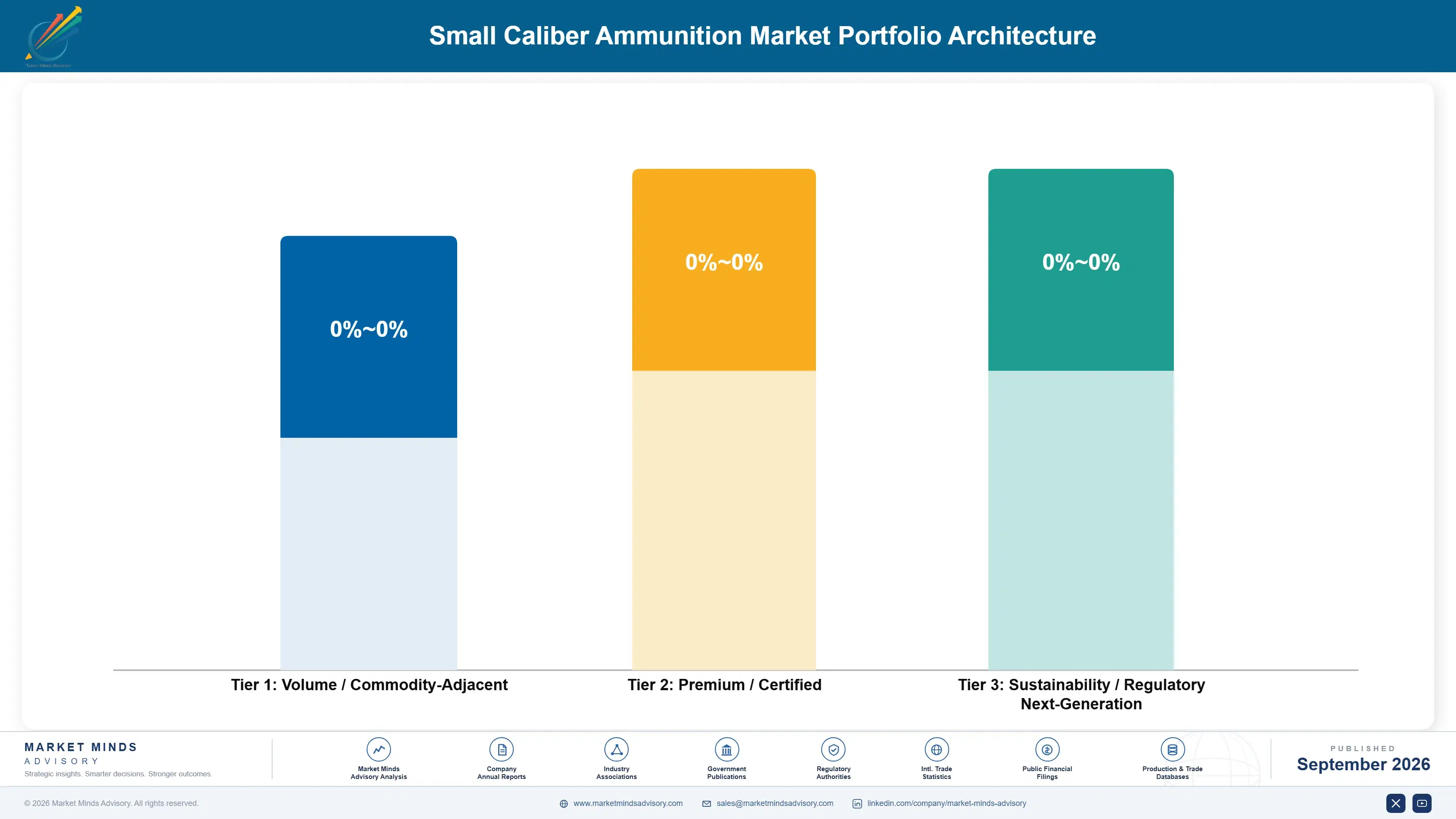
Small caliber ammunition margin architecture splits across three tiers, with volume-oriented standard commercial and military cartridges competing on price and reliable consistent performance while precision match-grade and certified defense-qualified variants command far wider margins on manufacturing tolerance and documented accuracy performance. The gap between mass commercial production and precision specialty variants keeps widening as competitive shooting participation expands.
Volume and precision tiers pull manufacturing strategy in different directions across the category. Standard commercial and military production rewards high-volume efficiency and consistent per-unit cost control, while precision match-grade production rewards manufacturing tolerance and documented performance credentials that justify premium pricing. Manufacturers straddling both risk diluting the operational focus that either strategy requires, which is why most successful players commit resources deliberately across both lanes rather than treating them identically.

The highest-value margin pools concentrate in precision match-grade cartridges and specialized law enforcement and military variants requiring certified performance documentation, where manufacturers capture premium pricing unavailable in mass commercial channels. Sustainability and recycled-material-driven production is smaller today but growing as brass reclamation programs mature and environmental considerations increasingly factor into procurement evaluation criteria at several government agencies.

Volume / Commodity-Adjacent

Standard commercial and military rifle and pistol cartridges sold at high volume on price and reliable consistent performance rather than documented precision credentials. Government fixed-price contracts and mass commercial retail dominate this tier's revenue mix.
Gross Margin: 18 to 26 percent

Premium / Certified

Precision match-grade cartridges and certified defense-qualified variants manufactured to tighter dimensional tolerances, commanding meaningfully higher per-unit pricing than standard production. Dedicated tooling investment and quality control processes support this pricing power.
Gross Margin: 32 to 42 percent

Sustainability / Regulatory / Next-Generation

Recycled-brass-content cartridges and lead-free primer formulations developed to satisfy environmental procurement criteria and range safety regulations increasingly adopted by government agencies. Adoption remains uneven across jurisdictions with differing environmental standards.
Gross Margin: 24 to 34 percent
small-caliber-ammunition-market-portfolio-architecture-1790017498035

High-value Sub-segments and Strategic Watch-out

Precision Match-Grade Cartridges

The fastest-growing and highest-value segment, manufactured to tighter dimensional tolerances for competitive and long-range civilian shooting, commanding premium pricing across most specialty retail and direct sales channels currently expanding. Manufacturers increasingly dedicate specialized production lines to this segment alone. Growth momentum here shows no sign of slowing soon.
Gross Margin: 35 to 45 percent

NATO-Standard Military Rifle Cartridges

A large and steadily growing segment anchored by multi-year defense procurement contracts, providing manufacturers with the steadiest revenue visibility of any segment across most allied government customer relationships. Interoperability standards keep this segment relatively stable across cycles. Multi-year contracts provide unusually strong revenue predictability here.
Gross Margin: 20 to 28 percent

Standard Commercial Pistol Cartridges

The volume core of the category, sold at accessible price points through mass retail, sustaining category awareness even as growth concentrates elsewhere in precision and certified defense segments. Retail promotional activity heavily influences purchasing timing in this tier. Scale efficiency remains the primary competitive differentiator here.
Gross Margin: 18 to 24 percent

Lead-Free Primer Cartridges

A strategic watch-out segment growing on environmental and range safety regulatory pressure, currently small but positioned to gain share fastest as procurement criteria mature across major government agencies. Early movers are building credibility with environmentally focused procurement officers. Regulatory tailwinds should accelerate adoption over coming years.
Gross Margin: 26 to 36 percent

Contract Renewal and Retention Dynamics

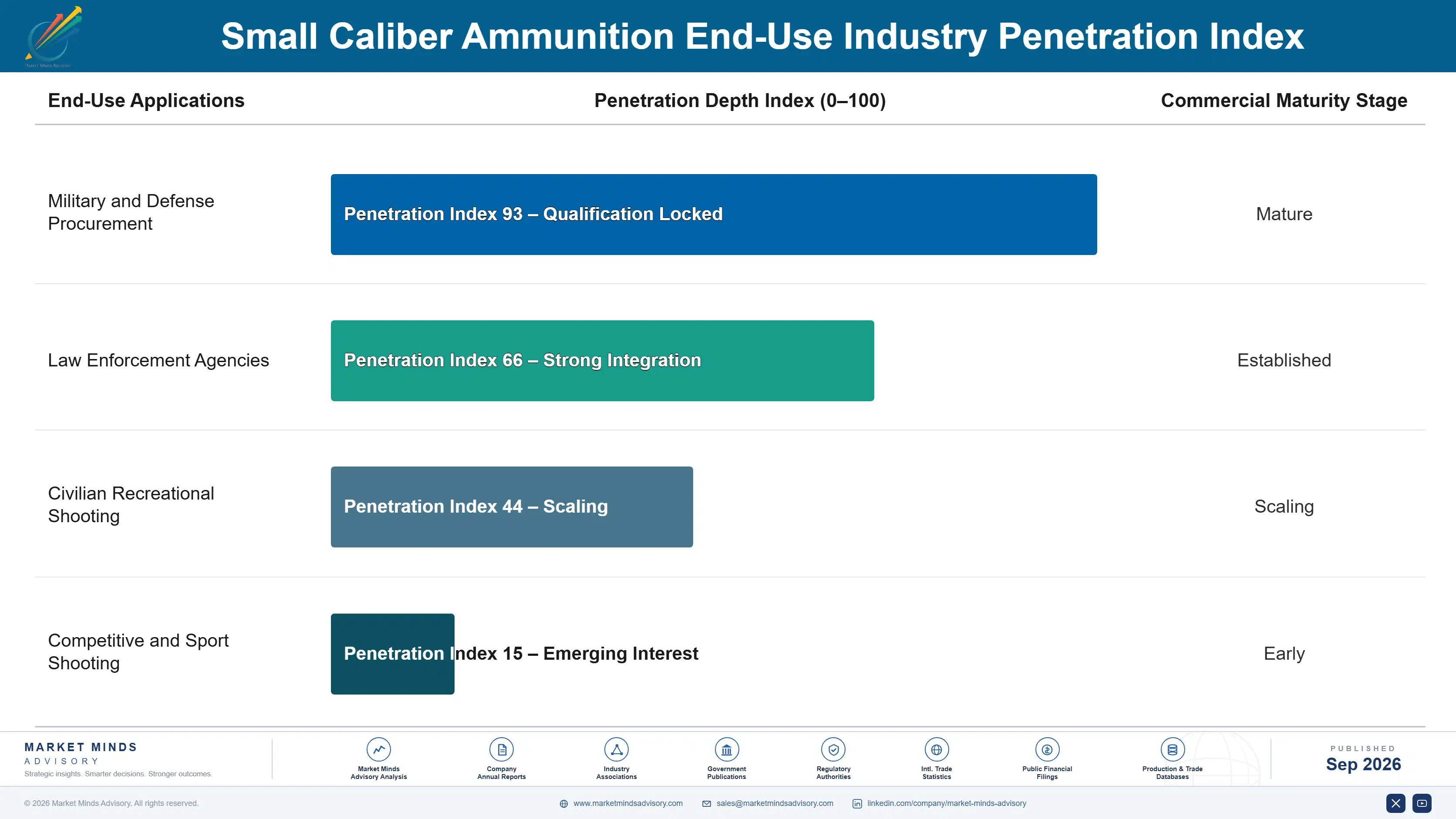
Small caliber ammunition behaves like an annuity relationship on the government side of the business, since multi-year defense procurement contracts routinely renew based on continued qualification status and demonstrated production reliability rather than competitive rebidding every cycle. Manufacturers holding existing NATO qualification and established contract relationships retain that revenue for years, and this dynamic is what makes certification investment and capacity reliability commercially durable across the sector.
Adoption depth varies meaningfully by end-use vertical. Military and law enforcement procurement shows the deepest stickiness, anchored by certification requirements and established supplier qualification that new entrants struggle to match quickly. Civilian retail buyers show shallower loyalty, often switching brands based on price and availability during periods of retail scarcity, though competitive shooters develop stronger brand preference tied to documented accuracy performance over repeated purchase cycles.

Generational buyer shifts are reshaping civilian demand architecture specifically. Younger recreational shooters entering the sport increasingly research ballistic performance data and manufacturer reputation online before purchasing, a behavior far less common among earlier generations of buyers. Veteran competitive shooters still favor established precision brands with long track records. Manufacturers serving both cohorts need distinctly different marketing approaches rather than a single unified retail strategy.
small-caliber-ammunition-market-end-use-penetration-index-1790017498532

Where to Compete Next

These are among the four positions where our research anticipates prominent divergence between winners and laggards over the coming forecast period. Each is grounded in the demand model, the regulatory perimeter, and the announced capacity pipeline.
01 / PRECISION SEGMENT INVESTMENT

Prioritize precision match-grade capacity over standard volume expansion

Precision match-grade cartridges are growing at roughly 6.5 percent annually, well above the overall category rate, driven by expanding competitive and long-range civilian shooting participation across North America and Europe and steadily rising retail interest. Manufacturers still organized purely around standard commercial volume are ceding the highest-margin segment to competitors investing early in precision tooling and quality control processes across their production lines. The window to establish credible precision brand positioning before specialty retail shelf space consolidates around established leaders is closing steadily.
02 / NATO QUALIFICATION PURSUIT

Pursue NATO qualification in additional cartridge calibers now

NATO qualification provides multi-year contract visibility that smaller manufacturers lacking certification cannot access, and the qualification process itself takes years to complete given required testing and evaluation cycles across member nations and their respective procurement agencies. Companies pursuing qualification now position themselves for the next wave of defense procurement driven by sustained elevated allied defense spending commitments across the alliance. Waiting until qualification becomes commercially urgent means competing against manufacturers who invested in certification years earlier already across multiple defense markets.
03 / BRASS RECLAMATION INVESTMENT

Build recycled brass capacity ahead of sustained commodity pressure

Copper and brass commodity price volatility already pushed input costs up 12 to 15 percent during recent tight periods, and further supply tightness remains plausible given competing demand from electric vehicle manufacturing and grid infrastructure investment across major economies. Manufacturers without reclamation capacity face meaningful margin exposure that diversified competitors with established recycling programs can avoid entirely during future price spikes. Building this capacity now, before the next commodity cycle arrives, costs considerably less than reacting during an active shortage.
04 / EXPORT MARKET DIVERSIFICATION

Diversify export markets before geopolitical realignment accelerates

Shifting geopolitical alignment and export licensing restrictions are already reshaping which producers win multi-year government contracts across several regions simultaneously and without much advance warning. Manufacturers overly dependent on a single dominant export market face meaningful revenue concentration risk if diplomatic relationships shift or licensing requirements tighten unexpectedly in that particular market. Diversifying into additional qualified export relationships now spreads risk and positions manufacturers to capture demand wherever geopolitical realignment creates fresh opportunity for well-positioned manufacturers with diversified qualified customer relationships already in place.

Engagement Snapshot From the Field

A live engagement with an industry participant carrying material or product regulatory and market exposure ahead of a defining policy shift, showing how our research translates into a defensible multi-year portfolio strategy.
MARKET MINDS ADVISORY · CLIENT ENGAGEMENT SUMMARY
Small Caliber Ammunition Producer Strategic Portfolio Review and Transition Roadmap 2026·Investment Scenario on Small Caliber Ammunition Exposure Evaluation 2025-26
CLIENT PROFILE
A mid-sized independent ammunition manufacturer generating roughly $180 million in annual revenue (client-reported, unverified by MMA), with production concentrated in standard commercial rifle and pistol cartridges sold primarily through sporting goods retail distribution and limited government contract exposure relative to larger diversified competitors in the category. The client had grown steadily over fifteen years but had not diversified beyond its founding commercial product line.
STRATEGIC CHALLENGE
Management observed larger competitors winning multi-year government contracts the client lacked qualification to bid on, while commodity cost volatility squeezed margins on price-sensitive commercial retail volume the client depended on almost entirely for revenue. The client needed to decide whether to pursue costly NATO qualification, invest in precision match-grade capacity, or continue competing purely on commercial retail price and volume.
MMA APPROACH
MMA conducted primary interviews with the client's production engineers and a competitive benchmarking exercise against five qualified NATO-certified manufacturers to assess the realistic qualification timeline and capital investment required. The engagement combined margin modeling across three strategic scenarios with commodity cost sensitivity analysis, benchmarked against category-wide brass reclamation adoption data from MMA's primary research dataset.
KEY FINDINGS
  1. Competitive benchmarking showed NATO qualification typically requires 24 to 36 months and substantial capital investment that smaller manufacturers rarely recover within five years (client-reported, unverified by MMA).
  2. Margin modeling revealed that precision match-grade product line investment offered a faster return than pursuing NATO qualification given the client's existing commercial retail distribution relationships already in place.
  3. Commodity cost sensitivity analysis showed the client's lack of brass reclamation capacity cost an estimated 4 percentage points of gross margin during the recent commodity price spike alone.
  4. Production engineer interviews identified underutilized capacity during civilian demand lulls as an opportunity to redirect toward precision product development without additional facility investment.
CLIENT PROFILE
A mid-sized independent ammunition manufacturer generating roughly $180 million in annual revenue (client-reported, unverified by MMA), with production concentrated in standard commercial rifle and pistol cartridges sold primarily through sporting goods retail distribution and limited government contract exposure relative to larger diversified competitors in the category. The client had grown steadily over fifteen years but had not diversified beyond its founding commercial product line.
STRATEGIC CHALLENGE
Management observed larger competitors winning multi-year government contracts the client lacked qualification to bid on, while commodity cost volatility squeezed margins on price-sensitive commercial retail volume the client depended on almost entirely for revenue. The client needed to decide whether to pursue costly NATO qualification, invest in precision match-grade capacity, or continue competing purely on commercial retail price and volume.
MMA APPROACH
MMA conducted primary interviews with the client's production engineers and a competitive benchmarking exercise against five qualified NATO-certified manufacturers to assess the realistic qualification timeline and capital investment required. The engagement combined margin modeling across three strategic scenarios with commodity cost sensitivity analysis, benchmarked against category-wide brass reclamation adoption data from MMA's primary research dataset.
KEY FINDINGS
  1. Competitive benchmarking showed NATO qualification typically requires 24 to 36 months and substantial capital investment that smaller manufacturers rarely recover within five years (client-reported, unverified by MMA).
  2. Margin modeling revealed that precision match-grade product line investment offered a faster return than pursuing NATO qualification given the client's existing commercial retail distribution relationships already in place.
  3. Commodity cost sensitivity analysis showed the client's lack of brass reclamation capacity cost an estimated 4 percentage points of gross margin during the recent commodity price spike alone.
  4. Production engineer interviews identified underutilized capacity during civilian demand lulls as an opportunity to redirect toward precision product development without additional facility investment.
RECOMMENDED STRATEGY
Phase 1: Phase one: redirect underutilized capacity toward precision match-grade product development, using existing commercial retail distribution relationships that were already firmly established. Phase 2: Phase two: build a modest brass reclamation program partnering with regional shooting ranges to reduce commodity cost exposure over time. Phase 3: Phase three: reassess NATO qualification once precision segment revenue and reclamation savings strengthen the balance sheet for the required investment.
OUTCOME
Within eighteen months, the client reported precision match-grade products contributing a meaningful share of total revenue at notably higher margins than standard commercial production (client-reported, unverified by MMA). The brass reclamation program reduced input cost exposure during the following commodity cycle. Leadership credited the phased approach with preserving cash flow throughout the transition period.

Frequently Asked Questions

Foundational context covering the market sizes, CAGR, scope, country, region and competition that inform every finding below. This section is provided to cover basics and most often pre-purchase conversations, answered from the MMA Primary Research Dataset.

What is the current size of the Small Caliber Ammunition Market?

The global small caliber ammunition market was valued at $13.5 billion in 2025. Growth is driven by sustained military modernization and steady civilian shooting sports demand.

How large will the Small Caliber Ammunition Market be by 2036?

The market is projected to reach approximately $21.23 billion by 2036. This represents a 1.51 times expansion driven primarily by defense procurement and precision segment growth.

What is the CAGR for the Small Caliber Ammunition Market 2026 to 2036?

The market is forecast to grow at a 4.2 percent CAGR between 2026 and 2036. Bull and bear scenarios range from 3.0 to 5.5 percent depending on defense spending trends.

Which segment is growing fastest?

Precision Match-Grade Cartridges lead growth at a 6.5 percent CAGR, roughly 1.55 times the overall market rate. This reflects expanding competitive and long-range civilian shooting participation.

Who are the major companies in the Small Caliber Ammunition Market?

Leading players include Vista Outdoor, Olin Corporation, RUAG Ammotec, Nammo, and Nexter Group. Together they hold roughly 48 percent combined market share on a production capacity basis.

Which country is growing fastest?

India leads country-level growth at a 6.2 percent CAGR. Expanding domestic defense manufacturing initiatives are driving faster adoption than in most established Western markets today.

Report Segmentation Architecture

The full report scope spans multiple orthogonal segmentation dimensions, with cross-tabulated demand data provided for each dimension pair. Coverage extends further to regional breakdowns, trend trajectories, and the competitive detail needed to support segment-level decision-making.

By Primary Market Dimension

  • Precision Match-Grade Cartridges
  • Standard Rifle Cartridges
  • Standard Pistol Cartridges
  • Rimfire Cartridges
  • NATO-Standard Military Cartridges
  • Lead-Free Primer Cartridges

By End-Use Industry

  • Military and Defense Procurement
  • Law Enforcement Agencies
  • Civilian Recreational Shooting
  • Competitive and Sport Shooting

By Commercial Dimension

  • Government Contract Sales
  • Commercial Retail Distribution
  • Direct-to-Consumer Online Sales
  • Export and International Licensing

By Region

  • North America
  • Western Europe
  • East Asia
  • South Asia and Pacific
  • Latin America
  • Middle East and Africa
  • Eastern Europe

Scope, Methodology, and Coverage

Every figure in this report is reproducible from documented input assumptions. The scope below maps the historical period, the forecast horizon, the segmentation dimensions, and the countries covered, alongside the underlying primary and qualitative methodology.
Historical Period
2020 to 2025
Forecast Period
2026 to 2036
Base Year
2025 (USD billions; MMA Primary Research Dataset, September 2026)
Market Definition
This report covers the global market for small caliber ammunition cartridges up to 12.7mm used in military, law enforcement, and civilian firearms, including rifle, pistol, and rimfire cartridges. It excludes large caliber and artillery ammunition, explosive ordnance, and firearms themselves.
Quantitative Units
USD billions, market share percentages, CAGR percentages
Segmentation Dimensions
Cartridge type, end-use industry, commercial distribution channel, region
Regions Covered
North America, Western Europe, East Asia, South Asia and Pacific, Latin America, Middle East and Africa, Eastern Europe
Countries Covered
United States, Canada, Germany, United Kingdom, France, Poland, China, Japan, South Korea, India, Australia, Brazil, Saudi Arabia, United Arab Emirates, South Africa
Key Companies Profiled
Vista Outdoor, Olin Corporation, RUAG Ammotec, Nammo, Nexter Group, Sierra Bullets, Hornady Manufacturing, Sig Sauer, CBC Global Ammunition, Denel PMP, Kalashnikov Concern, Poongsan Corporation, PT Pindad, Kynoch Ammunition, Prvi Partizan, Norinco, IMI Systems, Munitions India Limited, Ammo Inc, MKE Kurumu
Quantitative Methodology
Primary survey, n=3,800 respondents, Q4 2025, six countries; demand-side model with trade association cross-validation
Qualitative Methodology
47 expert interviews, Q4 2025; applied to validate demand model assumptions, identify emerging dynamics, and assess competitive positioning
Report Format
PDF and XLSX data workbook (Word format preview document)
Publisher
Market Minds Advisory
Report Code
MMA-2026-CON-411
Published
September 2026
Contact
sales@marketmindsadvisory.com | www.marketmindsadvisory.com

Purchase the full Small Caliber Ammunition Market Report (2026 to 2036).

This report delivers a comprehensive analysis of the global small caliber ammunition market and its shifting production landscape. It covers cartridge segmentation, regional demand patterns, and competitive dynamics across the full forecast period from 2026 through 2036 in careful detail. The analysis combines primary survey data from 3,800 respondents across six countries with 47 expert interviews to quantify defense procurement trends and civilian retail demand shifts across the category. Analysts examine input cost exposure, margin architecture, and revenue lever strategy across government and commercial channels.
Seven-region demand share and CAGR breakdown
Five to six segment competitive positioning analysis
Twenty-company competitive landscape and moat assessment
Input cost exposure and mitigation strategy review
Revenue growth lever and margin expansion playbook
Anonymized client engagement case study analysis

Built For The People Who Decide

From boardroom strategy to bench-side execution, this report is read cover-to-cover by leaders shaping the next decade of their industry, turning demand scenarios, market dynamics and valuation benchmarks into decisions.
CXOs/ Presidents/ VPs/ Managers
M&A and Corporate Development
Strategy Teams and R&D Heads
Procurement and Product Directors
Regulatory and Compliance Leaders
Investor Relations and Equity Analysts