Market Minds Advisory
Sludge Treatment Chemicals Market

Sludge Treatment Chemicals Market: Disposal cost arithmetic, dewatering performance and contaminant regulation

Every extra percentage point of dry solids removed from a sludge cake takes tonnes off the disposal bill, which is why this market is priced against haulage economics rather than against chemistry.

Lead Analyst

Bilal Shaikh

Published

September 2026

Make Smarter Decisions with Customized Research Insights

Request a free sample report and evaluate market opportunities, growth trends, and competitive dynamics relevant to your business needs.

2025 MARKET VALUE$5.9BMarket Size 2025
2036 FORECAST VALUE$10.7BBase Case , 2026 to 2036
CAGR 2026 TO 20365.5 %Bull 6.8% / Bear 4.2%
INCREMENTAL OPPORTUNITY$4.4BNet 10- year value creation
EXPANSION MULTIPLE1.71x2036 value over 2026 base
Strategic Levers
M&A Pipeline
Regional Outlook
Country Rankings
Competitive Intelligence
Segmental Deep-dive
Call-Us : 91 93563 13602

Executive Snapshot and Market Trajectory

Nobody in this market is really buying chemistry. A wastewater operator is buying dry solids in the cake and tonnes off the haulage bill, and the arithmetic is brutal: one extra point of dryness removes several percent of the disposal cost, which dwarfs what the polymer itself costs.
Growth concentrates in contaminant immobilisation reagents, expanding at 8.3%, where per- and polyfluoroalkyl substances, heavy metals and pharmaceutical residues in sludge have moved from being a monitoring question to becoming an outright disposal restriction across an expanding list of jurisdictions. East Asia holds 30% of value, the largest regional share, because Chinese municipal wastewater treatment capacity has been commissioned faster than anywhere else and every one of those plants generates sludge continuously.
The supplier base is moderately concentrated, with the top five holding 43% of supply volume, and it divides between global water treatment houses, polymer specialists, and regional blenders serving municipal contracts locally. Competition here runs on demonstrated cake dryness rather than on any product specification whatsoever. Sludge contaminant regulation is the force now reshaping what treatment route a plant is actually permitted to use at all.
Market Definition
Sludge treatment chemicals comprise reagents dosed to condition, dewater, stabilise and treat municipal and industrial sludge, spanning cationic and anionic polyacrylamide flocculants, inorganic coagulants and conditioners, lime and alkaline stabilisation reagents, odour and hydrogen sulphide control chemistry, digestion enhancement additives, and contaminant immobilisation reagents. Sizing covers chemicals sold to municipal utilities, industrial operators and contract service providers at realised delivered price. Dewatering equipment such as centrifuges and belt presses, thermal drying and incineration plant, sludge haulage and disposal services, biogas upgrading equipment, and general water treatment chemicals not dosed to sludge all fall outside scope.
Base Year Value
$5.9B in 2025 (MMA Primary Research Dataset, August 2026)
Forecast Period
2026 to 2036, eleven discrete annual values
CAGR
5.5% base case. Bull 6.8%. Bear 4.2%.
Fastest Growth Segment
Contaminant Immobilisation Reagents: 8.3% CAGR
Fastest Growth Country
India: 8.6% CAGR
Fastest Growth Region
South Asia and Pacific: 7.8% CAGR
Largest Region
East Asia: 30% of 2025 global value
Market Leaders
SNF Group, Kemira, Solenis, BASF and Ecolab lead on sludge treatment chemical supply volume across flocculant, coagulant and specialty classes. Source: MMA Primary Research Dataset, July 2026.
Primary Survey
n=3,800 procurement and R&D decision-makers, Q4 2025, six countries
Methodology
Demand-side build-up, cross-validated against public data, 47 expert interviews

Sludge Treatment Chemicals Market Forecast Scenarios

sludge-treatment-chemicals-market-trends-size-forecast-scenario-1787311149398
Growth of 4.3% across 2020 to 2025 tracked treatment capacity commissioning and disposal cost inflation rather than any change in dosing practice. Municipal wastewater investment continued through the period across Asia and the Gulf, while European and North American landfill and incineration costs rose sharply enough to change dewatering chemistry economics outright. Acrylonitrile pricing moved violently through 2022, compressing polymer supplier margins considerably.
The base case at 5.5% rests on three mechanisms. Municipal treatment capacity keeps being commissioned across South Asia, Southeast Asia and Africa, and every works generates sludge that must be conditioned and dewatered from day one. Disposal costs keep rising as landfill capacity closes and incineration gate fees climb, which raises what an operator will pay per point of cake dryness. And contaminant restrictions keep tightening on agricultural biosolids application, forcing chemical treatment routes that were previously optional.
The bull case at 6.8% turns on per- and polyfluoroalkyl substance restrictions extending to sludge disposal across more jurisdictions, since immobilisation or destruction becomes mandatory rather than discretionary at that point. The bear case at 4.2% turns on thermal routes. Wider thermal hydrolysis and drying adoption would reduce conditioning chemical demand per tonne even as sludge volumes rise.

Sludge chemicals: disposal arithmetic, not chemistry

The commercial logic in this market runs entirely through the disposal bill and almost never through the chemistry. A municipal operator pays around USD 95 per tonne to haul and dispose of dewatered cake, so lifting dry solids from 24% to 26% removes roughly eight percent of the tonnage leaving site. That saving comfortably exceeds what the conditioning polymer costs the operator in the first place.
TOP FIVE CONCENTRATION43%Share of global supply volume held collectively by leaders
ACRYLONITRILE COST SHARE51% of COGSPortion of polymer cost tied to the monomer
MUNICIPAL APPLICATION SHARE62% of volumeLargest single application by consumed chemical tonnage globally
TYPICAL CAKE DRY SOLIDS24%Solids content achieved on conventional municipal dewatering equipment
DISPOSAL COST PER TONNEUSD 95/tonneTypical charge an operator pays to remove cake
POLYMER DOSE RATE6 kg/tonneReagent consumed treating each tonne of dry solids
Cost structure for the supplier sits squarely upstream in the monomer itself. Acrylonitrile carries roughly 51% of polyacrylamide cost and prices on petrochemical logic entirely unrelated to water treatment demand, which means suppliers on flat annual municipal contracts absorb movements they neither cause nor control. That exposure has cost suppliers considerably more than any competitor behaviour has.
Demand divides according to who actually owns the disposal risk. Municipal utilities take 62% of volume and increasingly tender on outcome rather than on product, because the disposal contract dominates their operating budget. Industrial operators dosing difficult sludges pay considerably more for chemistry that works on a specific matrix, since a failed dewatering run stops production outright rather than merely costing money.
"Suppliers keep sending utilities polymer specifications and jar test results, which tell an operator nothing about what leaves the site on a lorry. The ones winning tenders arrive with cake dryness measured on the customer's own centrifuge and a disposal saving worked out in tonnes."
Director, Water Treatment and Environmental Chemicals Practice · MMA Chemicals a

Market Trends

Contaminant restrictions forcing chemical treatment that was previously optional

Per- and polyfluoroalkyl substances, heavy metals and pharmaceutical residues concentrate in sludge because that is where wastewater treatment puts them, and regulators across Europe and several US states have restricted agricultural application of biosolids on exactly those grounds. That converts contaminant immobilisation from a voluntary improvement into a permit condition, since an operator with no disposal route has no plant. Reagents binding metals or adsorbing organic contaminants are being specified where nothing was dosed before. The supplier field is narrow because the performance has to be demonstrated on real sludge rather than in a laboratory.
Market Impact: Drives 62% of global chemical volum

Disposal cost inflation repricing every point of cake dryness

Landfill capacity has been closing across Europe and North America while incineration gate fees have risen steadily, which pushes typical disposal costs toward USD 95 per tonne and higher in constrained markets. At that level a single percentage point of additional dry solids in the cake is worth considerably more than the entire conditioning chemical spend for many operators. Suppliers who quantify that saving in tonnes and currency win tenders that product specification alone never would. Most still lead with polymer charge density and molecular weight, which no operator translates into a disposal number.
Market Impact: Shifts demand across 6 kg dosing

Market Opportunities and Growth Drivers

Municipal treatment capacity commissioning across South Asia and Africa

Wastewater treatment works are being commissioned across India, Southeast Asia and East and West Africa under national programmes, and each one generates sludge continuously from the day it starts operating regardless of how the plant was financed. Conditioning and dewatering chemistry is a recurring operating requirement rather than a capital item, so demand attaches permanently once a works is running. Indian sludge chemical demand grows at 8.6% annually as that commissioning programme continues across the country. Municipal applications already account for 62% of global sludge treatment chemical volume across every region.
Market Impact: Exposes 51% of polymer cost

Anaerobic digestion expansion raising conditioning and odour control demand

Municipal and industrial operators keep adding anaerobic digestion to recover biogas and reduce sludge volume, and digested sludge conditions quite differently from raw sludge because the organic structure has been broken down. That shifts polymer selection toward higher charge density products and raises hydrogen sulphide and odour control chemistry demand around the digesters themselves. Biogas incentives across Europe, North America and increasingly Asia keep pulling digestion capacity forward. Each installation changes the chemical requirement rather than merely scaling it, which suppliers who track capital projects capture and others simply miss.
Market Impact: Removes 30% of dosing per tonne

Market Restraints and Challenges

Acrylonitrile price volatility eroding margins on municipal contracts

Acrylonitrile carries roughly 51% of polyacrylamide cost and prices on propylene and ammonia economics entirely unrelated to water treatment demand. The root cause is that municipal tenders are typically awarded on fixed annual pricing while the monomer moves on petrochemical cycles, so the supplier carries an exposure it neither causes nor influences. Commercially this destroys margin in years when acrylonitrile runs hard, which happened badly through 2022. Suppliers are responding with indexed pass-through clauses, shorter contract terms, forward monomer purchasing and a mix shift toward specialty reagents priced on performance.
Market Impact: Grows 8.3% annually through 2036

Thermal treatment routes reducing conditioning chemical demand per tonne

Thermal hydrolysis, drying and incineration all reduce or eliminate the conditioning chemistry a sludge stream requires, because heat does mechanically what polymer does chemically and often does it more completely. The root cause is that capital-rich operators can substitute equipment for consumables where sludge volumes justify the investment. Commercially this removes chemical demand permanently at the sites that convert rather than merely repricing it. Suppliers are responding by targeting the post-thermal conditioning that remains, by developing reagents for thermally treated sludge, and by focusing on operators without the capital for conversion.
Market Impact: Reprices against USD 95 per tonne
4 additional market trends, 2 additional growth drivers, and 3 additional restraints and challenges are covered in the full report. Contact sales@marketmindsadvisory.com to access the complete intelligence.

Segment CAGR and Growth Architecture

Segmentation follows the chemical function performed on the sludge stream, because conditioning, stabilisation, odour control and contaminant treatment each address a different problem, sit at a different point in the process and command quite different pricing. Six functional classes cover the whole market, from bulk flocculants and coagulants through stabilisation and odour chemistry to contaminant immobilisation reagents.
sludge-treatment-chemicals-market-trends-market-share-analysis-1787311149956

Contaminant Immobilisation Reagents

Expanding at 8.3% annually, a full 1.51 times the market rate, on reagents that bind heavy metals or adsorb organic contaminants so that treated sludge retains a permitted disposal route. Restrictions on agricultural biosolids application over per- and polyfluoroalkyl substances, metals and pharmaceutical residues have converted this from a voluntary improvement into a permit condition across an expanding list of jurisdictions. An operator with no permitted disposal route has no operating plant at all, which removes delivered price from the conversation almost entirely. Performance has to be demonstrated on the actual sludge matrix rather than in any laboratory, which is precisely what keeps the qualified supplier field genuinely narrow everywhere.
CAGR 8.3%

Odour and Hydrogen Sulphide Control Chemistry

Growing at 7.4% annually on reagents dosed to suppress hydrogen sulphide generation and odour emission right across sludge handling, storage, digestion and haulage operations, where the driver is community complaint and permit compliance rather than any process performance requirement whatsoever. Urban encroachment on treatment works has made odour a genuine operating constraint at plants that faced none at all twenty years ago, and enforcement tends to follow complaints rather than measurements. Nitrate, iron salt and oxidiser chemistries all compete against one another here on cost per unit of sulphide actually suppressed. Demand here tracks urban development around existing works and digestion capacity additions rather than sludge volume itself at all.
CAGR 7.4%
Full segment breakdown across 6 segments available in the complete report.

Regional Architecture and Country Demand Map

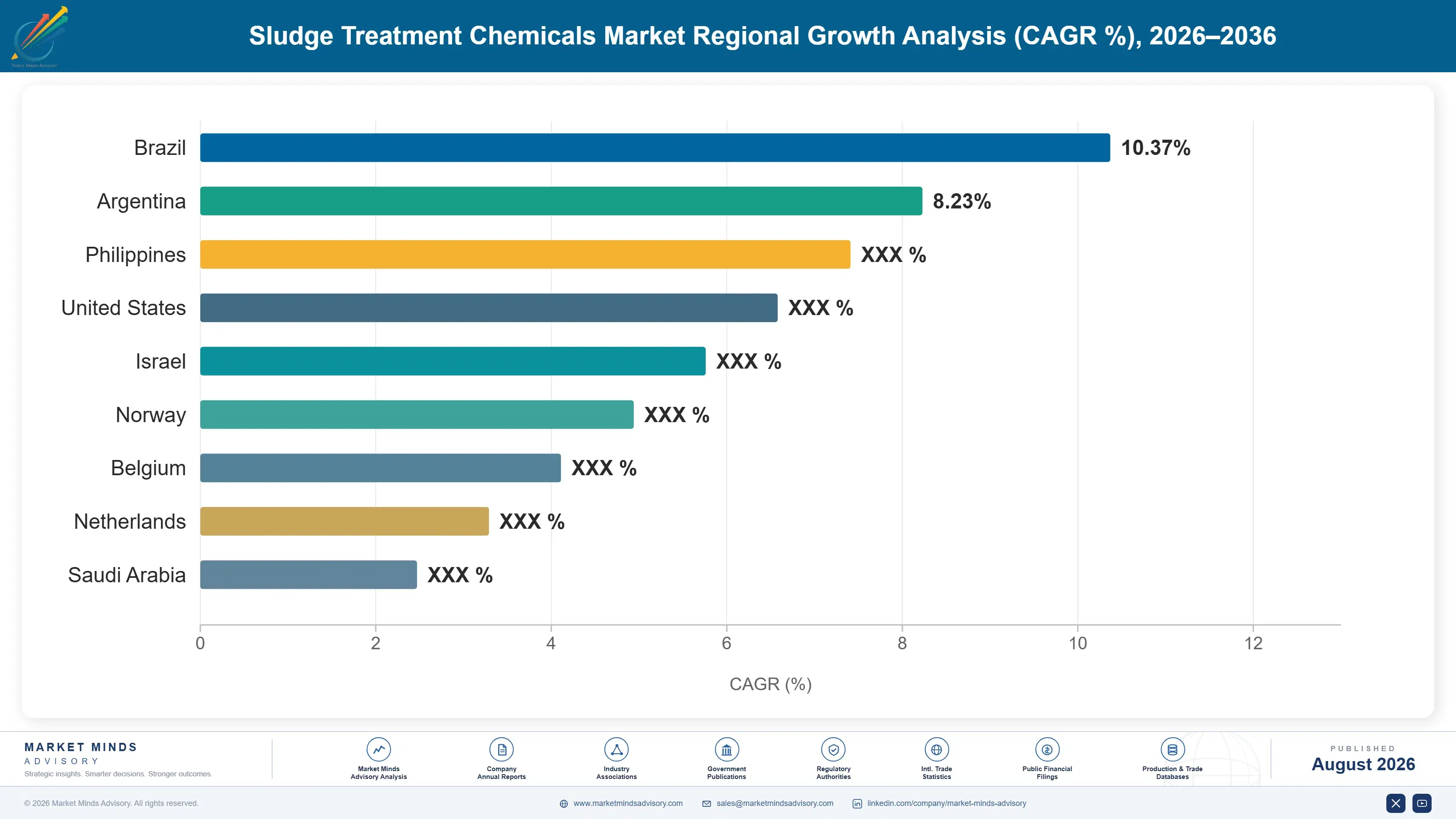
Sludge chemical demand follows the installed treatment capacity rather than regional population, and it intensifies wherever the disposal routes are constrained tightly enough that operators will genuinely pay real money out for every additional point of cake dryness they are able to achieve on site.

East Asia

Thirty percent of global value here, comfortably the largest regional share, because Chinese municipal wastewater treatment capacity has been commissioned faster than anywhere else over the past two decades and every one of those works generates sludge requiring conditioning from the day it opens. Disposal routes across Chinese cities are genuinely constrained, which raises the value of dewatering performance considerably above what the dosing volumes alone would ever suggest. Japanese and Korean operators run advanced digestion and thermal treatment routes, which shifts their demand decisively toward specialty rather than bulk chemistry. Growth of 6.4% here runs above the global rate, supported by continued commissioning and by tightening sludge disposal restrictions working together.
Share: 30% | CAGR: 6.4% (2026 to 2036)

North America

Twenty-two percent of global value here, weighted toward the municipal utilities operating very large works, industrial wastewater treatment operations across refining, food processing and pulp, and a genuinely substantial contract dewatering service sector operating alongside them. Landfill closure alongside rising incineration costs have pushed disposal charges up very sharply, which makes cake dryness a genuinely important budget line for every single operator affected. State-level restrictions on biosolids land application over per- and polyfluoroalkyl substance content keep spreading and they are reshaping the treatment requirements as they go. Growth of 4.9% here reflects a mature treatment capacity base alongside contaminant chemistry demand that is genuinely accelerating away from a small base.
Share: 22% | CAGR: 4.9% (2026 to 2036)
Regional intelligence for 5 additional markets available in the complete report: Western Europe, South Asia and Pacific, Latin America, Middle East and Africa, Eastern Europe. Contact sales@marketmindsadvisory.com.
sludge-treatment-chemicals-market-trends-country-cagr-analysis-1787311150487

Where sludge chemical margin genuinely sits

Four commercial positions separate the suppliers earning genuine performance economics from those simply quoting polymer against a specification sheet. Each one of them rests on something that a competitor cannot copy quickly: measured cake performance, genuine contaminant treatment capability, monomer contract terms, or else genuine service depth standing at the customer's own dewatering equipment.

Contract on measured cake dryness rather than product supply

An operator paying USD 95 per tonne to dispose of cake saves roughly eight percent of that bill for every two points of additional dry solids achieved, which comfortably exceeds the entire conditioning chemical spend. Suppliers contracting on measured dryness at the customer's own dewatering equipment, rather than supplying polymer against a specification, realise roughly 35% above competitors quoting product. The measurement is straightforward and the data already exists on site. Most suppliers still lead with charge density and molecular weight, which no operator can translate into a disposal number.
Market Impact: Realises roughly 35% above product-

Build contaminant immobilisation capability before permits require it

Restrictions on biosolids land application over per- and polyfluoroalkyl substances, metals and pharmaceutical residues are spreading across jurisdictions, and an operator without a permitted disposal route has no functioning plant at all. Suppliers holding demonstrated immobilisation capability command roughly 2.5 times conditioning polymer pricing, because the alternative is not a cheaper reagent but a closed works. Performance must be shown on the actual sludge matrix rather than in a laboratory. Very few suppliers have done that work, and the qualification takes months that nobody has once a permit condition lands.
Market Impact: Commands roughly 2.5 times conditio

Index acrylonitrile exposure across municipal contract terms

Acrylonitrile carries roughly 51% of polyacrylamide cost and prices on propylene and ammonia economics that have nothing to do with water treatment, yet municipal tenders are routinely awarded on fixed annual pricing. Suppliers holding indexed pass-through terms realise roughly 18% above those absorbing the movement, because the difference falls straight to margin rather than being competed away. Utilities accept indexation once the arithmetic is presented, since they index their own energy contracts already. Suppliers who have not done this are simply financing a petrochemical exposure for their customers without any payment for it.
Market Impact: Realises roughly 18% above flat-pri

Put technical service on the customer's dewatering equipment

Cake dryness depends on polymer, dose rate, mixing energy and machine settings interacting together, and a supplier optimising all four on site achieves results that no product substitution alone can match. Suppliers providing on-site optimisation service capture roughly 4 times the contract life of those delivering to a storage tank, because the operator attributes the performance to the relationship rather than to the drum. The service costs technical people rather than capital. Most suppliers still treat municipal supply as a logistics exercise and consequently never actually see the centrifuge at all.
Market Impact: Captures roughly 4 times the contra

Who Controls the Margin Pool

Concentration is moderate, with the top five holding 43% of global sludge treatment chemical supply volume, the basis on which every participant here is assessed. SNF and Kemira lead through polyacrylamide manufacturing scale combined with municipal service reach, while the challenger group spans global water treatment houses carrying broader portfolios, specialty reagent developers, and regional blenders competing hard on local contract relationships and service response times.
Competition currently runs on demonstrated dewatering performance, service depth and contaminant capability rather than on product specification, which is broadly comparable between credible suppliers. Municipal tenders increasingly specify outcome rather than product, which strongly favours suppliers willing to stand behind measured results on site. Contaminant immobilisation has become a genuine competitive dimension in its own right rather than a research topic.

Emerging pressure comes from two directions at once. Thermal treatment adoption removes conditioning chemistry permanently at the largest and best-capitalised works, which are exactly the accounts suppliers value most. And contaminant regulation is reordering positions built purely on polymer scale, since immobilisation capability rests on formulation and field demonstration rather than on monomer integration or sheer manufacturing volume.
sludge-treatment-chemicals-market-trends-company-positioning-matrix-1787311151035

Competitive Moat and Risk Dimensions

SNF GROUP

Moat: Polyacrylamide scale and integration

Manufacturing scale in polyacrylamide combined with backward integration toward monomer gives SNF a delivered cost position that smaller formulators cannot approach, in a product where the monomer carries half the cost. That scale also funds the applications laboratories and field service network that municipal customers increasingly evaluate ahead of the product itself.
SNF GROUP

Risk: Thermal displacement at large works

Thermal hydrolysis and drying adoption removes conditioning chemistry permanently at exactly the large, well-capitalised works that consume the most polymer and justify the deepest service investment. Scale advantages built around bulk polymer supply offer no protection when a customer replaces the chemistry with equipment, and the conversion is not reversed once the capital is spent.
KEMIRA

Moat: Municipal service depth and coagulants

A combined coagulant and polymer portfolio supported by deep municipal service relationships lets Kemira optimise the whole treatment train rather than one dosing point, which is what actually determines cake dryness at a works. Utilities that rely on that optimisation change supplier reluctantly, because the performance is attributed to the relationship rather than to any individual product supplied.
KEMIRA

Risk: European market concentration exposure

A position weighted toward European municipal utilities ties Kemira to the region with the most mature treatment capacity, the slowest growth and the highest rate of thermal conversion at large works. Redeploying that service model toward faster growing Asian and African markets requires local technical presence built plant by plant, which is slow and expensive to establish.

Players Tracked

Prominent Players

SNF Group
Kemira
Solenis
BASF
Ecolab

Other Key Players

Veolia Water Technologies
Suez
Kurita Water Industries
Buckman
Ashland
Feralco
USALCO
Chemtrade Logistics
Aries Chemical
Beckart Environmental
Zhejiang Vartion Chemical
Anhui Tianrun Chemicals
Shandong Polymer Bio-chemicals
Ion Exchange India
Thermax

Recent Developments

FEBRUARY 2025

State restricts biosolids land application over contaminant limits

A state environmental authority formally restricted the agricultural application of any biosolids that exceeded specified per- and polyfluoroalkyl substance thresholds, thereby removing the primary disposal route for several affected municipal utilities and forcing an immediate evaluation of contaminant immobilisation and of other alternative treatment options.
Signal: Contaminant limits are now removing dispos
JUNE 2025

Utility tenders sludge chemistry on measured cake dryness

A large municipal utility tendered its sludge conditioning contract on guaranteed cake dry solids measured at its own centrifuges rather than on product specification and delivered unit price, following internal analysis showing that disposal haulage dominated the total operating cost of the whole sludge operation.
Signal: Outcome-based tendering is now steadily di
NOVEMBER 2025

Thermal hydrolysis installation removes conditioning chemistry demand

A large municipal treatment works commissioned thermal hydrolysis ahead of its digestion stage and consequently reduced its conditioning polymer consumption substantially, having concluded that the equipment capital involved was fully recovered through combined chemical savings, improved biogas yield and reduced cake volume going for disposal.
Signal: Capital-rich operators are now substitutin

Acrylonitrile and inorganic reagent exposure

Acrylonitrile accounts for roughly 51% of polyacrylamide production cost, sourced from petrochemical producers and priced on propylene and ammonia economics. Other monomers and initiators contribute about 9%, polymerisation and drying energy around 11%, inorganic coagulant raw materials 8% where relevant, formulation and quality control 6%, with packaging, freight and working capital carrying the remaining 15% of delivered cost across most suppliers.
Acrylonitrile was the defining exposure of the forecast history. Prices moved violently through 2021 and 2022 on propylene availability and plant outages, and suppliers holding fixed annual municipal contracts absorbed the difference for several quarters with no mechanism to recover it. Kemira Annual Report 2022 recorded raw material cost pressure across its water treatment operations directly, and Ecolab Annual Report 2023 noted input cost recovery lagging contractual pricing across its water lines.

The competitive disadvantage mechanism runs through contract structure rather than through manufacturing cost. Suppliers on fixed annual municipal pricing finance a petrochemical exposure their customers never compensate them for. Those without contaminant or specialty capability compete only where product specification decides, which is exactly the volume thermal conversion removes first. Regional blenders typically carry both limitations, which confines them to short-term municipal contracts won on price.
sludge-treatment-chemicals-market-trends-cost-volatility-analysis-1787311151243

Index acrylonitrile pass-through across municipal supply contracts

Municipal tenders are routinely awarded on fixed annual pricing while acrylonitrile moves on petrochemical cycles, which leaves suppliers financing an exposure they neither cause nor influence. Indexed clauses tied to a published monomer reference remove that entirely, and utilities accept them readily enough, because they already index their own energy and fuel contracts as a matter of course.

Shift mix toward specialty reagents priced on performance

Contaminant immobilisation and odour control reagents are priced on the problem solved rather than on kilograms delivered, which insulates them from monomer movement almost completely. Building that portfolio requires formulation and field demonstration capability rather than additional polymer capacity, and it moves revenue steadily away from the most exposed part of the whole cost base.

Contract monomer supply against committed contract volumes

Suppliers holding multi-year municipal contracts have visible volume that can be matched with forward monomer purchasing, yet very few actually do it, because procurement and commercial functions rarely talk to one another at all. Aligning the two costs nothing beyond internal coordination and it removes most of the margin volatility that boards keep asking questions about.

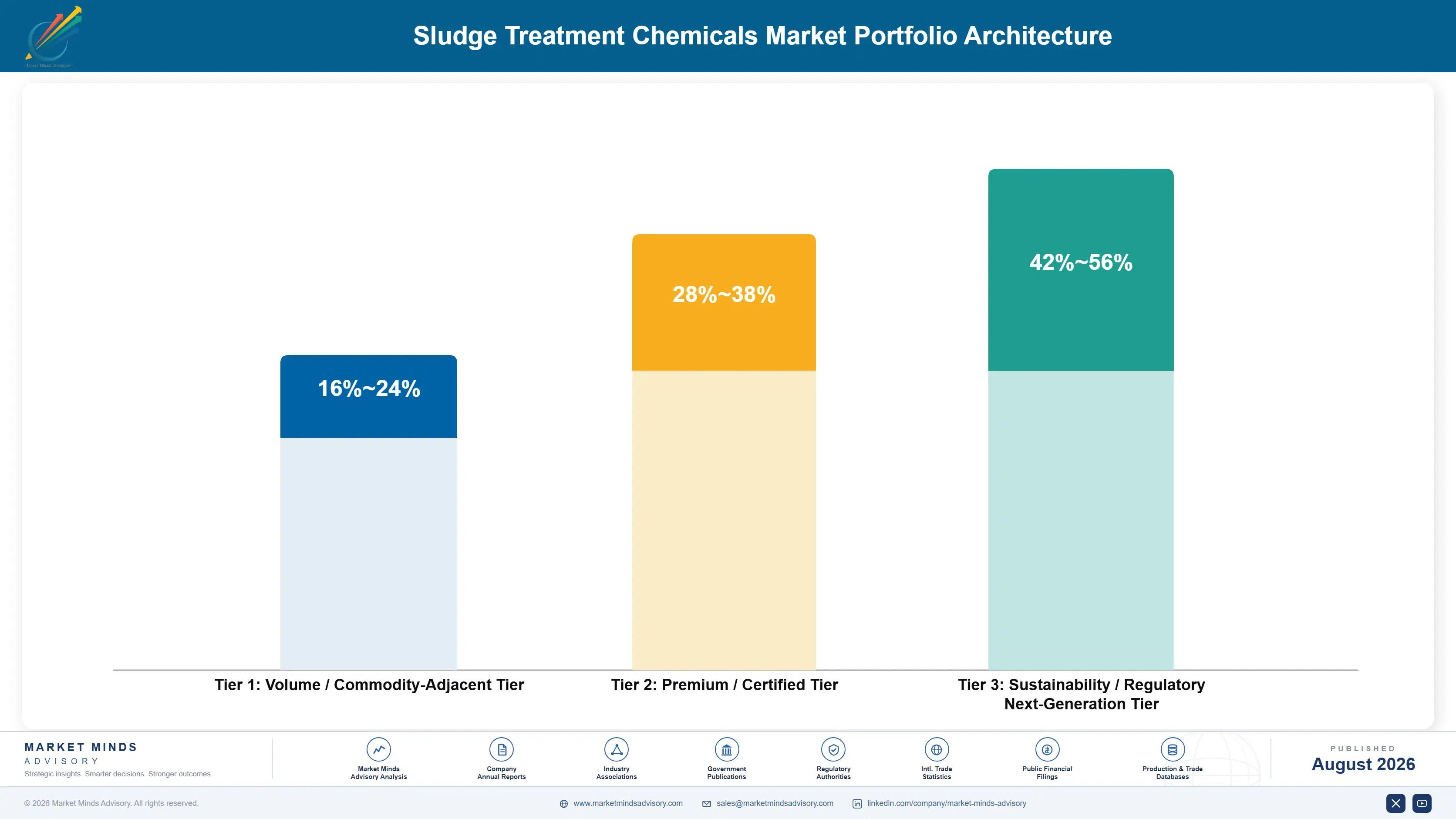
Portfolio Architecture for Margin Defence

Margin architecture separates by whether the supplier is paid for a product or for an outcome, which is not how most sludge chemical businesses organise their own reporting. Bulk conditioning polymer supplied against a specification into municipal tenders earns whatever the lowest credible bidder allows, because several suppliers can meet that specification and the buyer knows it perfectly well.
Value climbs wherever demonstrated performance rather than product decides the award. Outcome-based conditioning contracts with measured cake dryness defend real pricing, because the supplier is being paid for a disposal saving rather than for kilograms. Odour control and digestion chemistry sit higher again, since the customer is buying permit compliance and community relations rather than any process efficiency.

The highest value pools concentrate in contaminant immobilisation, where an operator without a permitted disposal route has no plant at all and the qualified supplier field is genuinely tiny. Those pools are small in tonnage and quite disproportionate in realised margin. The commercial tension is that bulk polymer volume keeps manufacturing loaded and municipal relationships alive, while being exactly the volume that thermal conversion removes first of all.

Volume / Commodity-Adjacent Tier

Bulk cationic and anionic polyacrylamide and inorganic coagulants supplied against product specification into municipal tenders, where several suppliers can meet the requirement and delivered unit price decides nearly every award made.
Gross Margin: 16-24%

Premium / Certified Tier

Outcome-based conditioning contracts with measured cake dryness guarantees and on-site optimisation service. Demonstrated performance and service depth defend pricing here. The ten-point range reflects product supply against guaranteed performance positions.
Gross Margin: 28-38%

Sustainability / Regulatory / Next-Generation Tier

Contaminant immobilisation reagents, odour and hydrogen sulphide control chemistry and digestion enhancement additives sold against permit conditions. Absent alternatives defend pricing very strongly. The fourteen-point range reflects established odour chemistry against emerging contaminant economics.
Gross Margin: 42-56%
sludge-treatment-chemicals-market-trends-portfolio-architecture-1787311151760

High-value Sub-segments and Strategic Watch-out

Contaminant immobilisation for restricted disposal routes

High value and genuinely high growth together here, because an operator without a permitted disposal route has no functioning plant at all, which removes delivered price from the negotiation almost entirely. Qualification also takes many months that nobody has spare once a permit condition lands.
Gross Margin: 42-56%

Outcome-based conditioning with dryness guarantees

Strong realised value on genuinely steady growth, because the disposal haulage bill dominates operator budgets and a supplier being paid for measured cake dryness is selling a measurable disposal saving rather than a chemical product. On-site service depth is what actually defends the position afterwards.
Gross Margin: 34-46%

Bulk conditioning polymer municipal supply

The volume core of this entire market, keeping manufacturing properly loaded and the municipal relationships alive, while earning whatever the lowest credible bidder happens to permit that year. Necessary for basic manufacturing scale, and yet exactly the volume that thermal conversion removes first of all.
Gross Margin: 16-24%

Thermal conversion exposure across large works

The strategic watch-out running right across the whole of this business here, given that thermal hydrolysis and drying both remove conditioning chemistry permanently at precisely the large, well-capitalised works that suppliers value most highly of all. Those conversions are then never subsequently reversed at all.
Gross Margin: 12-42%

How sludge chemical demand behaves

Demand is continuous, non-discretionary and attached to assets rather than to decisions. A treatment works generates sludge every hour it operates and cannot stop conditioning it, which makes volumes genuinely predictable across decades. What varies is who supplies and on what basis, because the chemical is comparable between credible suppliers and the operator knows exactly what alternatives exist nearby.
Stickiness tracks the service relationship rather than the product. Bulk polymer supply is loosest, retendered annually on delivered price with substitution costing nothing beyond a delivery schedule change. Outcome-based conditioning sits tighter, because the supplier has optimised polymer, dose and machine settings together and that knowledge does not transfer. Contaminant immobilisation is stickiest of all, since a permit condition validated against one reagent is not reopened casually by anybody.

The buyer profile splits between municipal and industrial operators in ways that defeat a single commercial model. Municipal utilities tender formally on published criteria, increasingly specify outcome rather than product, and are constrained by procurement rules that reward demonstrable measurement. Industrial operators buy on whether the chemistry works on their specific sludge matrix, decide quickly, and pay considerably more, because a failed dewatering run stops production rather than merely costing money.
sludge-treatment-chemicals-market-trends-end-use-penetration-index-1787311152257

What we would actually do here

These are among the four positions where our research anticipates prominent divergence between winners and laggards over the coming forecast period. Each is grounded in the demand model, the regulatory perimeter, and the announced capacity pipeline.
01 / CAKE DRYNESS CONTRACTING

Sell the disposal saving, not the polymer drum

An operator paying USD 95 per tonne to dispose of cake saves roughly eight percent of that bill for every two additional points of dry solids, which comfortably exceeds the entire conditioning chemical spend. Suppliers contracting on measured dryness at the customer's own dewatering equipment realise roughly 35% above competitors quoting product. The measurement is straightforward and the data already sits on site, yet most suppliers still lead with charge density and molecular weight that no operator translates into a disposal number.
02 / CONTAMINANT CAPABILITY BUILDING

Have the reagent ready before the permit changes

Restrictions on biosolids land application over per- and polyfluoroalkyl substances, metals and pharmaceutical residues keep spreading, and an operator without a permitted disposal route has no functioning plant. Suppliers holding demonstrated immobilisation capability command roughly 2.5 times conditioning polymer pricing, because the alternative is a closed works rather than a cheaper reagent. Performance must be demonstrated on the actual sludge matrix rather than in a laboratory, and qualification takes months that nobody has spare once a permit condition actually lands.
03 / MONOMER EXPOSURE INDEXATION

Stop funding your customers' petrochemical exposure

Acrylonitrile carries roughly 51% of polyacrylamide cost and prices on propylene and ammonia economics entirely unrelated to water treatment, yet municipal tenders are still routinely awarded on fixed annual pricing terms. Suppliers holding indexed pass-through terms realise roughly 18% above those absorbing the movement themselves, because the whole of that difference falls straight through to margin. Utilities accept indexation readily once the arithmetic is set out, since they already index their own energy and fuel contracts without any difficulty at all.
04 / ON-SITE SERVICE CAPABILITY

Get technical people onto the centrifuge itself

Cake dryness depends on polymer, dose rate, mixing energy and machine settings interacting together, and a supplier optimising all four on site achieves results that product substitution alone never matches. Suppliers providing on-site optimisation capture roughly 4 times the contract life of those delivering to a storage tank, because the operator attributes that performance to the relationship rather than the drum. The service costs technical people rather than any capital, and most suppliers still treat municipal supply as a pure logistics exercise instead.

Engagement Snapshot From the Field

A live engagement with an industry participant carrying material or product regulatory and market exposure ahead of a defining policy shift, showing how our research translates into a defensible multi-year portfolio strategy.
MARKET MINDS ADVISORY · CLIENT ENGAGEMENT SUMMARY
Sludge Treatment Chemicals Producer Strategic Portfolio Review and Transition Roadmap 2026·Investment Scenario on Sludge Treatment Chemicals Exposure Evaluation 2025-26
CLIENT PROFILE
A water treatment chemical supplier producing polyacrylamide flocculants and blending inorganic coagulants at two European sites, serving municipal utilities, industrial wastewater operators and contract dewatering companies across the region. Sludge treatment revenue approached EUR 78 million annually (client-reported, unverified by MMA), roughly eighty percent of it bulk conditioning polymer sold into municipal tenders on fixed annual pricing.
STRATEGIC CHALLENGE
Margins had been squeezed badly since the acrylonitrile spike and management attributed all of that pressure to aggressive tendering by regional blenders. Two large municipal accounts had been lost outright to thermal hydrolysis conversion. No contaminant immobilisation capability existed anywhere in the portfolio despite biosolids restrictions tightening steadily across several served markets.
MMA APPROACH
We rebuilt margin by contract structure rather than by product line, quantified acrylonitrile exposure across the municipal tender book under recent price movement, and reconstructed the two lost accounts and nine competitive tenders through interviews with utility operations and process engineering rather than the procurement contacts the client normally dealt with.
KEY FINDINGS
  1. Fixed annual municipal pricing accounted for more margin erosion across the period than competitor tendering behaviour did, by a considerable and consistent margin.
  2. Seven of nine competitive tenders had been decided on demonstrated cake dryness rather than unit price, and the client had submitted product specifications in every case.
  3. Both accounts lost to thermal hydrolysis had retained conditioning requirements post-treatment that nobody from the business had approached them about at any point after the conversion.
  4. Biosolids contaminant restrictions were already in force across two served markets, and no immobilisation product or field demonstration existed anywhere in the portfolio.
CLIENT PROFILE
A water treatment chemical supplier producing polyacrylamide flocculants and blending inorganic coagulants at two European sites, serving municipal utilities, industrial wastewater operators and contract dewatering companies across the region. Sludge treatment revenue approached EUR 78 million annually (client-reported, unverified by MMA), roughly eighty percent of it bulk conditioning polymer sold into municipal tenders on fixed annual pricing.
STRATEGIC CHALLENGE
Margins had been squeezed badly since the acrylonitrile spike and management attributed all of that pressure to aggressive tendering by regional blenders. Two large municipal accounts had been lost outright to thermal hydrolysis conversion. No contaminant immobilisation capability existed anywhere in the portfolio despite biosolids restrictions tightening steadily across several served markets.
MMA APPROACH
We rebuilt margin by contract structure rather than by product line, quantified acrylonitrile exposure across the municipal tender book under recent price movement, and reconstructed the two lost accounts and nine competitive tenders through interviews with utility operations and process engineering rather than the procurement contacts the client normally dealt with.
KEY FINDINGS
  1. Fixed annual municipal pricing accounted for more margin erosion across the period than competitor tendering behaviour did, by a considerable and consistent margin.
  2. Seven of nine competitive tenders had been decided on demonstrated cake dryness rather than unit price, and the client had submitted product specifications in every case.
  3. Both accounts lost to thermal hydrolysis had retained conditioning requirements post-treatment that nobody from the business had approached them about at any point after the conversion.
  4. Biosolids contaminant restrictions were already in force across two served markets, and no immobilisation product or field demonstration existed anywhere in the portfolio.
RECOMMENDED STRATEGY
Phase 1: Phase one: index acrylonitrile pass-through across every municipal contract at renewal and withdraw entirely from fixed-price tenders that refuse to accept it. Phase 2: Phase two: place technical service on customer centrifuges at the six largest accounts and retender those contracts on measured cake dryness. Phase 3: Phase three: develop and then field-demonstrate contaminant immobilisation reagents across the two served markets where biosolids restrictions already apply today.
OUTCOME
The client indexed monomer exposure across two thirds of the municipal book and won three retenders on measured dryness. Realised margin improved by 22% (client-reported, unverified by MMA) against the prior year, and one account previously lost to thermal hydrolysis returned for post-treatment conditioning supply.

Frequently Asked Questions

Foundational context covering the market sizes, CAGR, scope, country, region and competition that inform every finding below. This section is provided to cover basics and most often pre-purchase conversations, answered from the MMA Primary Research Dataset.

What is the current size of the Sludge Treatment Chemicals Market?

The market is valued at USD 5.9 billion in 2025, rising to USD 6.25 billion in 2026. Sizing covers chemicals sold to municipal utilities, industrial operators and contract service providers at realised delivered price.

How large will the Sludge Treatment Chemicals Market be by 2036?

The market reaches USD 10.68 billion by 2036, an increase of USD 4.43 billion across the forecast period. That represents an expansion multiple of 1.71 times the 2026 base.

What is the CAGR for the Sludge Treatment Chemicals Market 2026 to 2036?

The base case CAGR is 5.5% across 2026 to 2036. The bull case reaches 6.8% on wider contaminant restriction, while the bear case sits at 4.2% under faster thermal treatment adoption.

Which segment is growing fastest?

Contaminant immobilisation reagents grow fastest at 8.3%, a full 1.51 times the market rate. An operator without a permitted disposal route has no functioning plant at all.

Who are the major companies in the Sludge Treatment Chemicals Market?

SNF Group, Kemira, Solenis, BASF and Ecolab lead on supply volume, holding 43% collectively. The remaining field spans water treatment houses, specialty developers and regional blenders.

Which country is growing fastest?

India grows fastest at 8.6%, driven by municipal treatment works commissioning under national river and urban sanitation programmes alongside industrial wastewater treatment expanding with manufacturing.

Report Segmentation Architecture

The full report scope spans multiple orthogonal segmentation dimensions, with cross-tabulated demand data provided for each dimension pair. Coverage extends further to regional breakdowns, trend trajectories, and the competitive detail needed to support segment-level decision-making.

By Chemical Function

  • Cationic and Anionic Polyacrylamide Flocculants
  • Inorganic Coagulants and Conditioners
  • Lime and Alkaline Stabilisation Reagents
  • Odour and Hydrogen Sulphide Control Chemistry
  • Digestion Enhancement Additives
  • Contaminant Immobilisation Reagents

By End-Use Industry

  • Municipal Wastewater Treatment
  • Food and Beverage Processing
  • Pulp, Paper and Textiles
  • Mining and Mineral Processing
  • Refining and Petrochemicals
  • Metals and Surface Treatment

By Customer Type and Channel

  • Municipal Utilities Direct
  • Contract Dewatering Service Providers
  • Industrial Plant Operators
  • Water Utility Outsourcing Contractors
  • Chemical Distribution and Blending
  • Engineering and Design Consultancies

By Region

  • North America
  • Western Europe
  • East Asia
  • South Asia and Pacific
  • Latin America
  • Middle East and Africa
  • Eastern Europe

Scope, Methodology, and Coverage

Every figure in this report is reproducible from documented input assumptions. The scope below maps the historical period, the forecast horizon, the segmentation dimensions, and the countries covered, alongside the underlying primary and qualitative methodology.
Historical Period
2020 to 2025
Forecast Period
2026 to 2036
Base Year
2025 (USD billions; MMA Primary Research Dataset, August 2026)
Market Definition
The market comprises chemical reagents dosed to condition, dewater, stabilise and treat municipal and industrial sludge, spanning cationic and anionic polyacrylamide flocculants, inorganic coagulants and conditioners, lime and alkaline stabilisation reagents, odour and hydrogen sulphide control chemistry, digestion enhancement additives, and contaminant immobilisation reagents. Sizing captures chemical revenue at realised delivered price across municipal wastewater treatment, food and beverage processing, pulp, paper and textiles, mining and mineral processing, refining and petrochemicals, and metals and surface treatment applications. Dewatering equipment including centrifuges and belt presses, thermal drying and incineration plant, sludge haulage and disposal services, biogas upgrading equipment, and water treatment chemicals not dosed to the sludge stream all fall outside scope.
Quantitative Units
USD billions (current prices); chemicals shipped annually in thousands of tonnes on an active basis; USD per tonne at realised delivered price
Segmentation Dimensions
By Chemical Function; By End-Use Industry; By Customer Type and Channel; By Region
Regions Covered
North America, Western Europe, East Asia, South Asia and Pacific, Latin America, Middle East and Africa, Eastern Europe
Countries Covered
USA, Canada, Mexico, UK, Germany, France, Italy, Spain, Netherlands, Belgium, Sweden, Poland, Romania, Czech Republic, Turkey, China, Japan, South Korea, Taiwan, India, Singapore, Malaysia, Thailand, Vietnam, Indonesia, Philippines, Australia, Brazil, Argentina, Colombia, Chile, Saudi Arabia, UAE, Egypt, Nigeria, Kenya, South Africa, and additional markets relevant to this sector
Key Companies Profiled
SNF Group, Kemira, Solenis, BASF, Ecolab, Veolia Water Technologies, Suez, Kurita Water Industries, Buckman, Ashland, Feralco, USALCO, Chemtrade Logistics, Aries Chemical, Beckart Environmental, Zhejiang Vartion Chemical, Anhui Tianrun Chemicals, Shandong Polymer Bio-chemicals, Ion Exchange India, Thermax.
Quantitative Methodology
Primary survey, n=3,800 respondents, Q4 2025, six countries; demand-side model with trade association cross-validation
Qualitative Methodology
47 expert interviews, Q4 2025; applied to validate demand model assumptions, identify emerging dynamics, and assess competitive positioning
Report Format
PDF and XLSX data workbook (Word format preview document)
Publisher
Market Minds Advisory
Report Code
MMA-2026-CHM-648
Published
August 2026
Contact
sales@marketmindsadvisory.com | www.marketmindsadvisory.com

Purchase the full Sludge Treatment Chemicals Market Report (2026 to 2036).

The full report sizes the sludge treatment chemicals market across six chemical functions, six end-use industries, six customer channels and seven regions, with annual forecasts to 2036 in revenue and tonnage shipped. It quantifies what each additional point of cake dry solids is worth against prevailing disposal costs by market, which is the analysis that establishes how outcome-based contracts should actually be priced. Twenty participants are assessed on a consistent supply volume basis, with contaminant capability mapped separately from polymer manufacturing scale. Thermal conversion exposure is quantified works by works across major markets.
Six chemical functions sized and forecast annually to 2036
Value of each dry solids point quantified against disposal costs
Twenty participants assessed on consistent supply volume basis
Contaminant capability mapped separately from polymer manufacturing scale
Thermal conversion exposure quantified across major treatment works
Acrylonitrile exposure measured across contracted municipal supply books

Built For The People Who Decide

From boardroom strategy to bench-side execution, this report is read cover-to-cover by leaders shaping the next decade of their industry, turning demand scenarios, market dynamics and valuation benchmarks into decisions.
CXOs/ Presidents/ VPs/ Managers
M&A and Corporate Development
Strategy Teams and R&D Heads
Procurement and Product Directors
Regulatory and Compliance Leaders
Investor Relations and Equity Analysts