Market Minds Advisory
Skincare Supplement Market

Skincare Supplement Market: Claim Substantiation, Clinic Channels and the Cost of Ingesting a Beauty Promise

Regulators removed most beauty-from-within claims from European labels and consumers kept buying anyway, pushing the commercial argument into dermatology practices and clinics where recommendation carries what the pack legally cannot.

Lead Analyst

Lisa Gevelber

Published

September 2026

Make Smarter Decisions with Customized Research Insights

Request a free sample report and evaluate market opportunities, growth trends, and competitive dynamics relevant to your business needs.

2025 MARKET VALUE$7.4BMarket Size 2025
2036 FORECAST VALUE$22.4BBase Case , 2026 to 2036
CAGR 2026 TO 203610.6 %Bull 11.9% / Bear 9.4%
INCREMENTAL OPPORTUNITY$14.2BNet 10- year value creation
EXPANSION MULTIPLE2.74x2036 value over 2026 base
Strategic Levers
M&A Pipeline
Regional Outlook
Country Rankings
Competitive Intelligence
Segmental Deep-dive
Call-Us : 91 93563 13602

Executive Snapshot and Market Trajectory

European regulators struck down most beauty-from-within claims and the category kept growing regardless, which tells you where the commercial argument actually happens. It happens in a dermatology consultation or a clinic protocol, not on the front of a pack. The pack is now a compliance document.
Collagen peptides carry most of the volume and nearly all of the growth, supported by a clinical base that survived the scrutiny weaker ingredients did not. Clinic and dermatology channels carry the margin, since professional recommendation delivers what a compliant label cannot say. East Asia holds the largest share on Japanese and Korean consumption habits that treat ingestible skincare as ordinary daily routine rather than as an occasional purchase.
Concentration is genuinely low at 22% for the top five, and the category remains full of specialist brands that built positions large companies were slow to take seriously. Ingredient supply concentration among peptide manufacturers limits how far any brand can differentiate on the active itself, which pushes competition toward clinical evidence, format innovation and channel access instead of raw formulation. Ingredient suppliers themselves are also moving downstream into finished branded products of their own.
Market Definition
This market covers orally ingested supplements marketed for skin, hair and nail benefits, spanning collagen peptides, hyaluronic acid, ceramides, antioxidant and botanical formulations, and probiotic skin-health products, across retail, pharmacy, clinic and direct channels. Topical skincare, injectable dermal fillers, prescription dermatology pharmaceuticals, and general multivitamins carrying no skin-specific positioning are excluded.
Base Year Value
$7.4B in 2025 (MMA Primary Research Dataset, August 2026)
Forecast Period
2026 to 2036, eleven discrete annual values
CAGR
10.6% base case. Bull 11.9%. Bear 9.4%.
Fastest Growth Segment
Collagen Peptide Supplements: 15.9% CAGR
Fastest Growth Country
India: 15.1% CAGR
Fastest Growth Region
South Asia and Pacific: 12.9% CAGR
Largest Region
East Asia: 32% of 2025 global value
Market Leaders
Shiseido, Amway, Nestlé Health Science, Herbalife and Vital Proteins lead on skincare supplement revenue. Source: MMA Primary Research Dataset, July 2026.
Primary Survey
n=3,800 procurement and R&D decision-makers, Q4 2025, six countries
Methodology
Demand-side build-up, cross-validated against public data, 47 expert interviews

Skincare Supplement Market Forecast Scenarios

skincare-supplement-market-report-size-forecast-scenario-1787335830449
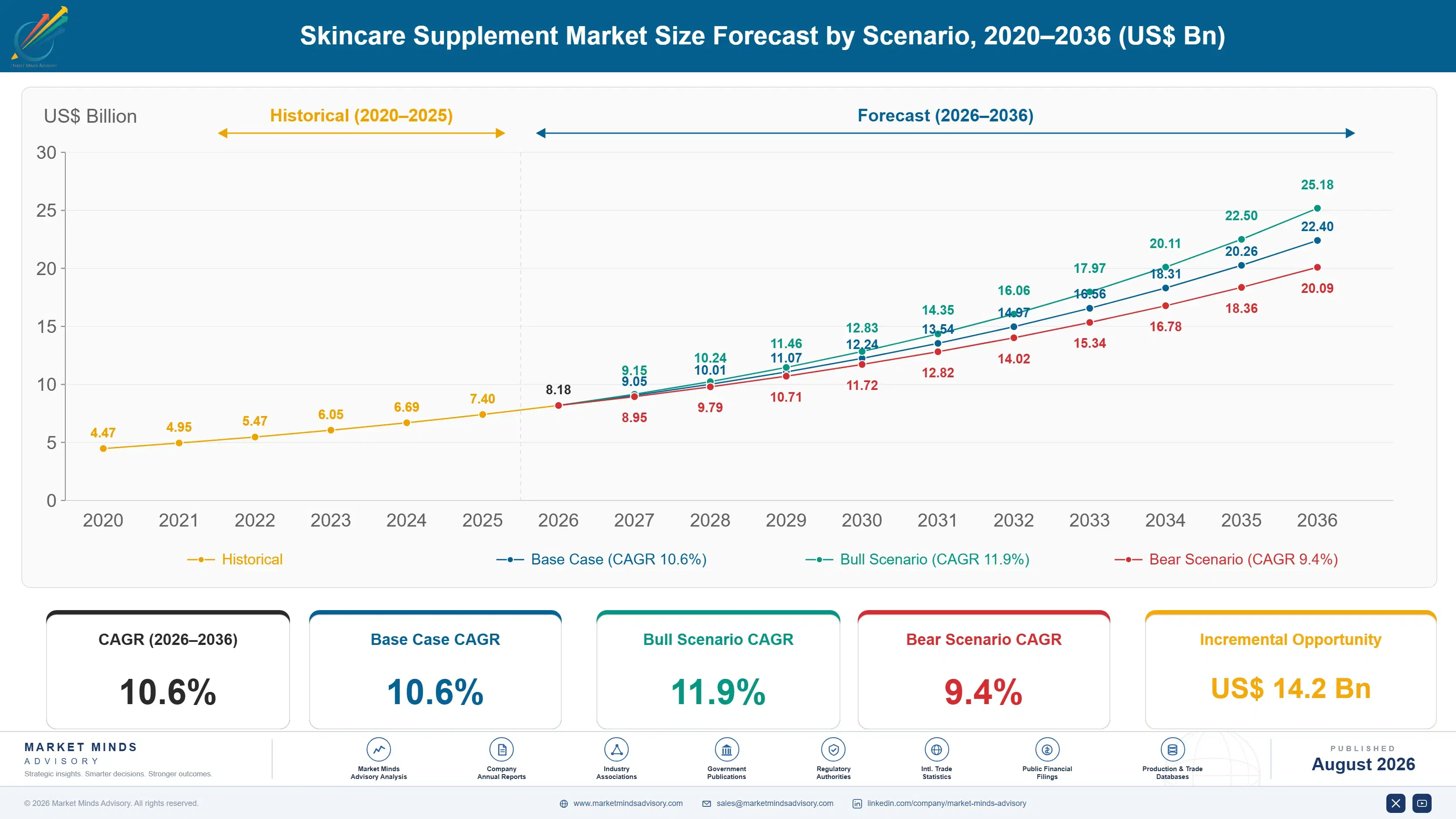
Growth ran at 9.5% annually between 2020 and 2025, and the period split neatly in two. The first half was a scramble, with brands launching on claims that were never going to survive scrutiny and several disappearing when it arrived. The second half was more disciplined, as regulatory enforcement cleared the weakest positioning and the survivors invested in evidence instead of adjectives.
The base case at 10.6% rests on three mechanisms. Collagen peptide volume continues expanding as clinical support deepens and formats diversify beyond powders into gummies and shots. Clinic and dermatology channels expand as aesthetics practices attach supplement protocols to treatments they already sell. And Indian and Southeast Asian demand grows on a rising middle class where skin lightening and anti-ageing positioning both convert unusually strongly. None of the three depends on a regulatory change.
The bull case at 11.9% turns on a substantiated health claim being approved in Europe, which would let brands state a benefit plainly for the first time and reset what the category can say. The bear case at 9.4% reflects enforcement widening to cover marketing outside the label itself, which would strip the implication brands currently rely on in advertising.

Evidence And Channel Decide This Category

The interesting thing about this category is that regulation removed its marketing language and demand carried on rising anyway. European authorities rejected most beauty-from-within health claims, leaving brands unable to state on pack the thing consumers are buying the product for. Sales grew regardless, which says something about where the persuasion actually occurs. The pack is not where it happens.
TOP FIVE CONCENTRATION22%Low, with specialist brands holding positions large companies missed
CLINIC CHANNEL SHARE27%Portion of value moving through dermatology and aesthetics practices
AVERAGE COURSE SPEND$168Typical consumer outlay across a full supplementation course
INGREDIENT COST SHARE41% of COGSActive ingredient contribution to finished product manufactured cost
REPEAT PURCHASE RATE39%Consumers repurchasing within six months of first trial
CLINICAL STUDY TIMELINE22 monthsTypical duration for a controlled skin outcome trial
It occurs in consultations. Roughly 27% of value moves through dermatology practices and aesthetics clinics, where a professional can discuss expected outcomes in terms no compliant label could carry, and where the supplement attaches to a treatment the consumer has already committed to paying for. Conversion in that setting is far higher than anything retail achieves, and repeat rates hold better because the recommendation is renewed at each appointment.
Ingredient economics constrain differentiation more than most participants admit. Active ingredients account for roughly 41% of manufactured cost and collagen peptide supply is concentrated among a handful of manufacturers selling to everybody, which means competing brands frequently contain materially the same active. Differentiation therefore has to come from clinical evidence, delivery format and channel position rather than from the formulation itself.
"Half the brands in this category are arguing about marine versus bovine collagen while buying from the same three peptide suppliers. The ones that will still be here in five years are arguing about which clinic group to detail next."
Director, Consumer Health and Nutraceuticals Practice · MMA Nutraceuticals Practice · August 2026

Market Trends

Aesthetics Clinics Attach Supplement Protocols To Existing Treatments

Medical aesthetics practices sell injectable and energy-based treatments at high value, and a supplement protocol attaches to those appointments with almost no additional selling effort. The consumer has already accepted an expensive intervention and a recovery or maintenance regimen reads as sensible rather than as an upsell. Roughly 27% of category value now moves through clinic and dermatology channels, converting at rates retail never approaches. Practice consolidation into corporate groups has professionalised the buying considerably, which raises detailing cost while making the channel far more systematic to reach. Exclusive protocol agreements are appearing already.
Market Impact: Peptide segment grows at 15.9%
Format Innovation Replaces Ingredient Claims As Differentiation

With claim language restricted and peptide supply concentrated among few manufacturers, brands increasingly compete on how a product is taken rather than on what it contains. Ready-to-drink shots, gummies and dissolvable sticks all reach consumers who will not measure powder into a drink every morning, and compliance across a full course improves measurably as a result. Repeat purchase within six months sits near 39% overall and runs higher in convenient formats. Format development is also faster and considerably cheaper than clinical work, which is why so many brands start there.
Market Impact: India grows at 15.1% annually

Market Opportunities and Growth Drivers

Collagen Peptide Clinical Base Outlasts Weaker Ingredient Positions

Regulatory enforcement across Europe removed a great many beauty-from-within claims and the ingredients that could not support them went with the claims. Collagen peptides survived because the published work behind them is genuinely larger than anything else in the category can point to. That has concentrated growth sharply into a single ingredient family, which now grows at 15.9% annually while the category overall grows considerably slower. Brands holding peptide positions with their own trial data are far better placed than those reformulating in response to enforcement. Reformulating after enforcement is the expensive path.
Market Impact: Adds 22 months to launch timing

Indian And Southeast Asian Demand Grows From Rising Middle Class

Skin-focused supplementation converts unusually strongly across South and Southeast Asia, where brightening and anti-ageing positioning both carry cultural weight that Western marketers frequently underestimate. Indian demand grows near 15.1% annually as middle-class households add supplement spending and pharmacy distribution reaches beyond the largest cities. Local manufacturers are formulating for regional preferences rather than importing Western products unchanged. Ayurvedic and traditional botanical positioning also coexists comfortably alongside collagen, which broadens the addressable base considerably beyond a single formulation approach. E-commerce distribution has also improved sharply, reaching consumers no pharmacy network covers at all today.
Market Impact: 3 suppliers cover most volume

Market Restraints and Challenges

Health Claim Enforcement Removed Most Usable Marketing Language

European authorities rejected the substantial majority of beauty-from-within health claims submitted, leaving brands unable to state on pack the benefit consumers are actually buying. The root cause is that claim dossiers were assembled from studies never designed to meet a regulatory evidence standard. Commercially this strips the packaging of its selling argument and pushes persuasion into channels where a professional can speak more freely. Participants are responding with funded clinical trials, with clinic and pharmacy distribution, and with careful marketing that implies without stating. Advertising outside the label is the next enforcement frontier.
Market Impact: Clinic channel holds 27% of value

Ingredient Supply Concentration Limits Genuine Brand Differentiation

Collagen peptide production sits with a handful of manufacturers who sell to everybody, which means competing brands frequently contain materially the same active at similar inclusion levels. The root cause is that peptide hydrolysis at commercial scale requires capital and process capability few companies possess. Commercially this makes ingredient claims hollow and pushes brands toward marketing spend they cannot recover at 39% repeat rates. Participants are responding with exclusive supply arrangements, proprietary format development, and clinical work conducted on their own specific formulation. Exclusive supply arrangements are the only genuine answer.
Market Impact: Formats lift repeat rate above 39%
4 additional market trends, 2 additional growth drivers, and 3 additional restraints and challenges are covered in the full report. Contact sales@marketmindsadvisory.com to access the complete intelligence.

Segment CAGR and Growth Architecture

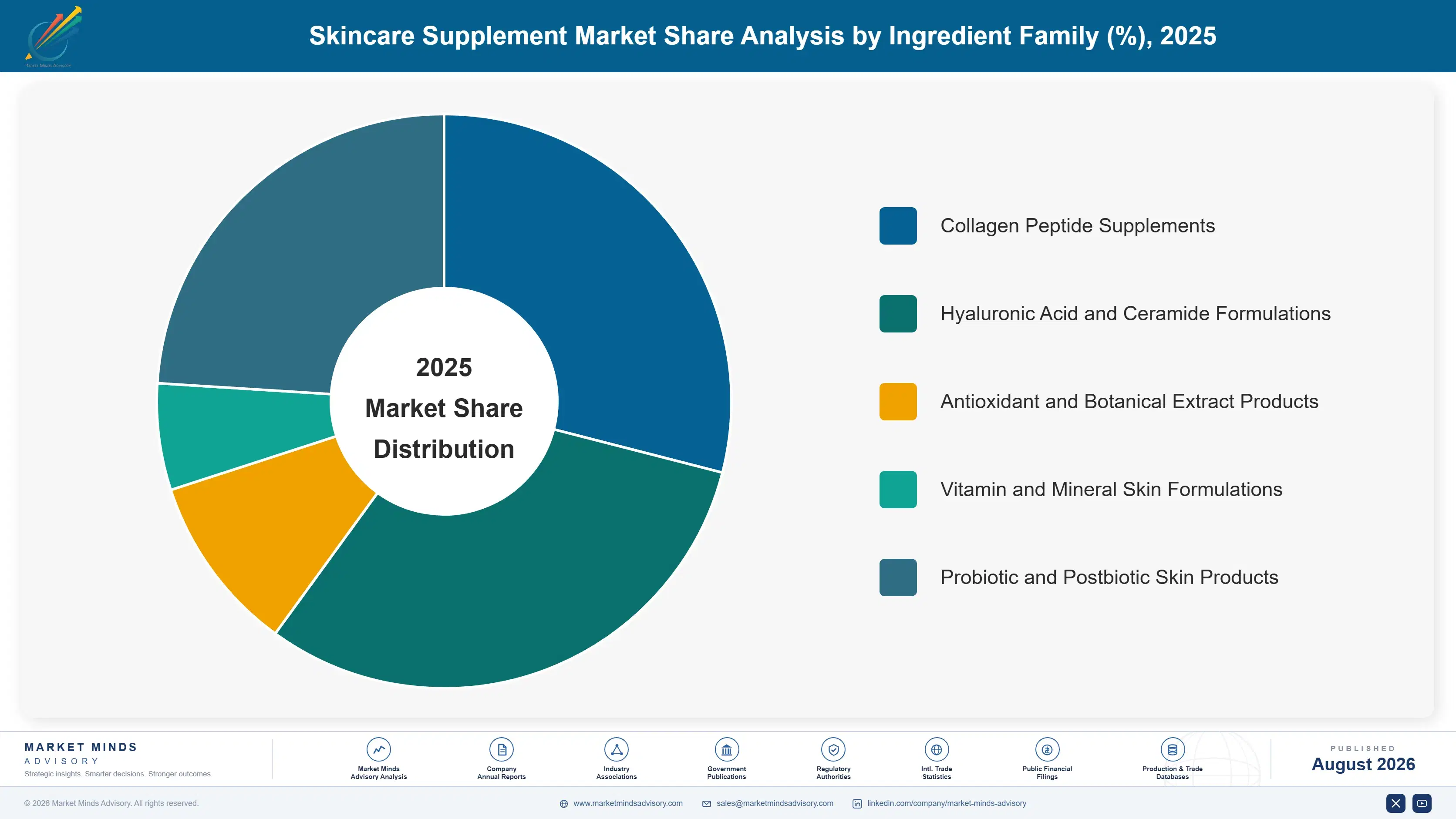
Five ingredient families divide this market on what the supplement actually contains rather than on the benefit claimed, which is deliberate: claimed benefits overlap almost completely across the category while the underlying actives, their evidence bases and their supply structures differ enormously and drive entirely different commercial positions. That distinction drives every commercial decision here.
skincare-supplement-market-report-market-share-analysis-1787335830996

Collagen Peptide Supplements

Growing at 15.9% and clearly the fastest part of this market. Oral collagen peptides dominate the tonnage here, supported by a body of clinical work larger than anything else in the category can point to, which is exactly why they survived the scrutiny that removed weaker claims from shelves across Europe. Marine collagen commands premium pricing over bovine on absorption arguments and on consumer preference that is only partly evidence-based. Format matters commercially as much as the peptide does: powders dominate in East Asia while gummies and ready-to-drink shots take share in Western retail. Supply is concentrated among a handful of peptide manufacturers, which caps how much any brand can genuinely differentiate on the ingredient itself.
CAGR 15.9%

Clinic and Dermatology Channel Formulations

Growing at 13.4% on supplements sold through dermatology practices, medical aesthetics clinics and pharmacy under professional recommendation rather than off a retail shelf. This is where the margin sits and where claim regulation bites least, because the recommendation carries the message the label legally cannot. Aesthetics clinics in particular sell supplements alongside injectable and energy-based treatments as recovery and maintenance protocols, which converts at rates no retail brand approaches. Practice consolidation into corporate groups has professionalised the buying and raised the cost of reaching it. The constraint is scale, since the channel reaches far fewer consumers than retail does and detailing costs are considerable per practice. Exclusive protocol agreements are increasingly common.
CAGR 13.4%
Full segment breakdown across 5 segments available in the complete report.

Regional Architecture and Country Demand Map

East Asia holds 32% of global value on Japanese and Korean consumption habits that treat ingestible skincare as ordinary daily routine. North America follows at 24% on clinic channel development, while South Asia and Pacific grows fastest on Indian middle-class demand and widening pharmacy reach beyond the largest cities.

East Asia

Note: East Asia sits marginally above the standard share band because Japanese and Korean per-capita consumption of ingestible beauty products exceeds every other market by a wide margin, and no realistic allocation avoids that. Japanese consumers have treated collagen drinks as ordinary daily routine for over two decades, which makes the category mature here rather than emerging. Convenience store distribution of ready-to-drink beauty shots is normal and volumes are considerable. Korean demand runs through a dense skincare culture where ingestible and topical products are bought together as one regimen. Chinese growth is the fastest of the three, driven by cross-border e-commerce and by domestic brands building on traditional ingredient positioning.
Share: 32% | CAGR: 11.7% (2026 to 2036)

North America

Clinic channel development is what distinguishes this region, and it developed faster here than anywhere. Medical aesthetics practices grew rapidly through the past decade and supplement protocols attached naturally to injectable and energy-based treatment appointments, producing conversion no retail shelf achieves. Practice consolidation into corporate groups has professionalised the buying considerably. Retail remains large through specialty nutrition chains and mass grocery, with collagen powder the anchor format. Regulatory treatment differs from Europe, since dietary supplement structure and function claims permit language European brands cannot use, which shapes formulation and marketing decisions differently. Canada follows a similar pattern with tighter claim rules applying. Direct selling networks also carry meaningful volume across both countries here.
Share: 24% | CAGR: 10.1% (2026 to 2036)
Regional intelligence for 5 additional markets available in the complete report: Western Europe, South Asia and Pacific, Latin America, Middle East and Africa, Eastern Europe. Contact sales@marketmindsadvisory.com.
skincare-supplement-market-report-country-cagr-analysis-1787335831535

Where Skincare Supplement Margin Is Won

Four positions separate brands building durable businesses from those buying trial they never convert: funding clinical work on their own formulation, building dermatology and aesthetics clinic distribution, developing formats consumers finish rather than abandon, and securing exclusive peptide supply before competitors contract the same material. Only the first two of those are genuinely hard to copy.

Fund Clinical Work On Your Own Formulation

Studies conducted on somebody else's peptide prove nothing about your product, and regulators have made that distinction plainly. A controlled skin outcome trial takes around 22 months and costs less than a single quarter of the marketing spend most brands commit without one. Brands holding their own trial data support pricing roughly 45% above unsubstantiated equivalents and reach clinic buyers who will not list anything else. The evidence also does not expire, which makes it the only investment here that genuinely compounds. Clinic buyers will simply not list a product without it.
Market Impact: Supports pricing roughly 45% above unsubstantiated competing products

Build Dermatology And Aesthetics Clinic Distribution

A supplement protocol attaches to an aesthetics appointment with almost no additional selling effort, because the consumer has already accepted an expensive intervention and a recovery regimen reads as sensible. Around 27% of category value now moves through these channels at conversion rates retail never approaches and margins roughly 30% higher. Practice consolidation makes the buying more systematic and more expensive to reach, which rewards brands detailing now over those still deciding whether the channel is worth the field cost. The field cost is real and it is recovered inside two years.
Market Impact: Delivers margins roughly 30% above comparable retail equivalents

Develop Formats Consumers Finish Rather Than Abandon

Skin outcomes require eight to twelve weeks of consistent use and most consumers stop long before that, which is why repeat purchase sits near 39% and why so much trial spending is wasted. Ready-to-drink shots, gummies and dissolvable sticks all lift completion measurably against powders that require measuring into a drink each morning. Brands moving volume into convenient formats see repeat rates 12 to 18 points higher. Format work is also faster and far cheaper than clinical trials, which makes it the sensible first move. Powders remain cheaper to make and harder to finish.
Market Impact: Lifts repeat purchase by up to 18 points

Secure Exclusive Peptide Supply Before Competitors Contract It

Collagen peptide production sits with a handful of manufacturers selling to everybody, so competing brands frequently contain materially the same active at similar inclusion levels. Exclusive or semi-exclusive supply arrangements on a specific hydrolysate give a brand something genuinely defensible to say and remove the ingredient from a competitor's reach. Securing that access typically requires volume commitments worth 15% to 20% of annual purchase value. The alternative is competing on marketing spend against products that are chemically indistinguishable. That commitment costs far less than the marketing required to compete without it.
Market Impact: Requires volume commitments near 20% of annual purchases

Who Controls the Margin Pool

Concentration reads at 22% for the top five measured on skincare supplement revenue, the basis used throughout this section, and that is genuinely low for a consumer health category. Shiseido and Nestlé Health Science bring corporate scale and evidence capability. Amway and Herbalife reach consumers through direct selling networks nobody else replicates. Vital Proteins built a collagen position from nothing while larger companies watched.
Competition runs on three fronts. Clinical substantiation on a brand's own formulation is the first, and it has become the entry requirement for clinic listing rather than a marketing advantage. Channel access is the second, with dermatology and aesthetics practices carrying margin retail cannot match. Format development is the third, and it is the fastest and cheapest of the three to attempt.

Pressure arrives from two directions. Large consumer health companies are entering with regulatory capability and pharmacy relationships that specialist brands cannot assemble quickly. Separately, ingredient manufacturers are moving downstream into finished branded products using material they already control. Rankings will shift toward participants holding proprietary evidence and clinic access rather than those competing on marketing spend alone. Marketing spend alone stopped being a defensible position some time ago.
skincare-supplement-market-report-company-positioning-matrix-1787335832062

Competitive Moat and Risk Dimensions

SHISEIDO

Moat: Japanese ingestible beauty heritage

Two decades of ingestible beauty products in a market that treats them as ordinary daily routine gives the group consumer trust and formulation experience no recent entrant can assemble. Research capability across topical and ingestible skincare together also supports the regimen positioning that converts best, and Japanese manufacturing quality carries genuine weight across the whole East Asian region.
SHISEIDO

Risk: Limited clinic channel presence

Strength in retail and department store distribution matters less as value shifts toward dermatology and aesthetics practices, where the selling proposition is clinical rather than aspirational and the buyer is a professional rather than a consumer. Building field detailing capability requires an organisation a beauty company has had little reason to develop.
NESTLÉ HEALTH SCIENCE

Moat: Clinical and regulatory capability

Established clinical research capability, regulatory affairs depth and pharmacy relationships give the group access to channels where evidence is the entry requirement rather than an advantage. Scale also makes funding controlled trials on proprietary formulations a routine decision rather than a considerable bet, which is precisely the position specialist competitors cannot reach.
NESTLÉ HEALTH SCIENCE

Risk: Slow against specialist brands

Specialist brands captured consumer positions in collagen and beauty supplementation while large health companies treated the category as marginal. Corporate processes also slow format development at a moment when convenience formats are taking share quickly, and consumers in this category respond to brand character in ways that corporate ownership frequently works against.

Players Tracked

Prominent Players

Shiseido
Amway
Nestlé Health Science
Herbalife
Vital Proteins

Other Key Players

Bayer
Reckitt Benckiser
Blackmores
Swisse Wellness
Suntory Holdings
Fancl
Asahi Group
Rousselot
Gelita
Nitta Gelatin
BioGaia
Jarrow Formulas
Nature's Bounty
Lumity Life
HUM Nutrition

Recent Developments

FEBRUARY 2025

Controlled skin outcome trial published on proprietary hydrolysate

A supplement brand published a randomised controlled trial measuring skin elasticity and hydration outcomes on its own specific collagen hydrolysate rather than on generic peptide literature, establishing evidence tied to the product itself and opening dermatology practice listings that had previously been closed. Listings followed within one quarter.
Signal: Evidence conducted on generic ingredients no longer satisfies clinic buyers or regulators assessing claim dossiers any longer
JUNE 2025

Aesthetics clinic group signs exclusive supplement protocol agreement

A corporate aesthetics practice group signed an exclusive supply agreement covering supplement protocols across its clinics, attaching a single brand to injectable and energy-based treatment appointments and locking competitors out of a channel that converts far better than retail does. The agreement runs for three years.
Signal: Practice consolidation is converting clinic access into exclusive contracts rather than open distribution shared across competing brands
OCTOBER 2025

Peptide manufacturer launches own branded finished product range

A collagen peptide manufacturer launched a branded consumer range using material it already produces, moving downstream into finished products and competing directly with the supplement brands that have been buying its hydrolysate for years. Existing hydrolysate customers were reportedly given no advance notice of the launch.
Signal: Ingredient suppliers are moving downstream because finished product margins exceed anything hydrolysate supply generates on its own

What Drives Supplement Cost Position

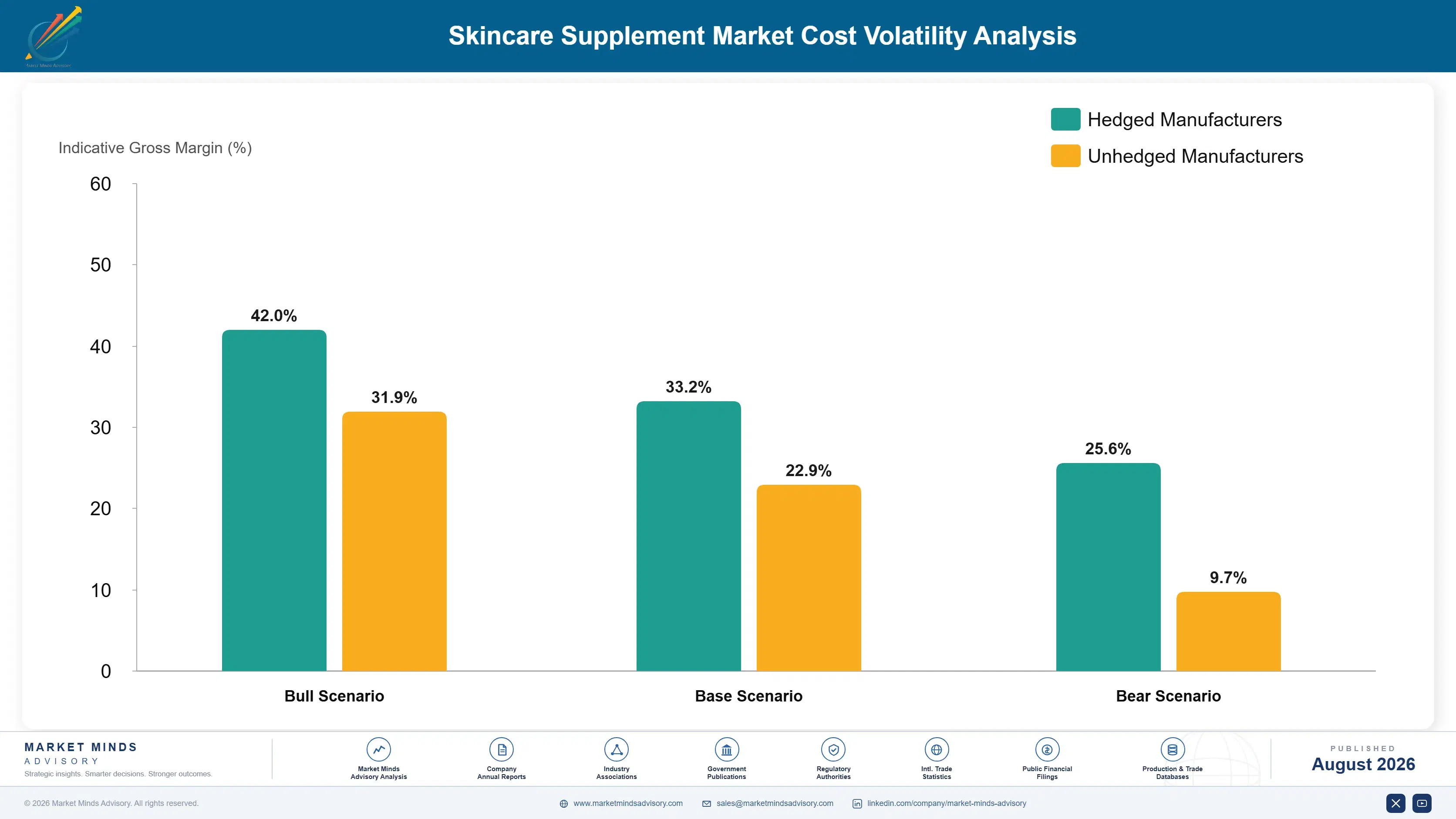
Active ingredients account for roughly 41% of manufactured cost, with collagen hydrolysate the dominant line and supply concentrated among a handful of European, Brazilian and Chinese producers. Packaging contributes around 17%, which is high because premium presentation is part of the proposition. Contract manufacturing adds about 14%, distribution and fulfilment roughly 13%, and clinical, regulatory and quality documentation close to 8% across a typical product.
Bovine hide and fish skin raw material pricing moved sharply through 2023 and 2024 on cattle herd contraction in Brazil and the United States, according to United States Department of Agriculture livestock data, which fed directly into gelatin and hydrolysate pricing. Marine peptide costs followed fishing quota changes across the North Atlantic. Producers passed most of it through as annual supply contracts renewed rather than absorbing it.

The disadvantage mechanism is ingredient concentration rather than absolute cost, and it bites hardest on brands buying spot volume. A brand contracting annual hydrolysate volume holds predictable cost and priority allocation; a brand buying opportunistically pays more and gets nothing during shortage. Exposure also varies by peptide source, since marine buyers face quota risk while bovine buyers face herd cycles, and neither can be hedged conventionally.
skincare-supplement-market-report-cost-volatility-analysis-1787335832257

Contract hydrolysate volume annually rather than buying spot

Annual contracted volume secures predictable pricing and priority allocation on an input representing over 40% of manufactured cost, and allocation matters more than price during the shortages that periodically hit this supply chain. Spot buyers pay more and receive less when material tightens. The commitment carries volume risk if demand disappoints, which is the genuine cost of the security purchased.

Qualify both marine and bovine peptide sources

Marine and bovine hydrolysates face entirely different supply risks, one following fishing quota decisions and the other cattle herd cycles, and neither correlates with the other in any useful way. Qualifying both gives a brand somewhere to move when one tightens. Each source requires its own stability work and substantiation, which is where the real cost lands.

Move packaging spend toward format rather than presentation

Packaging runs near 17% of manufactured cost because premium glass and heavy secondary presentation are treated as part of the proposition. Redirecting that spend into single-serve formats that consumers actually finish improves completion rates and repeat purchase far more than shelf appearance does. The risk is that premium positioning depends partly on presentation, so test before shifting wholesale.

Portfolio Architecture for Margin Defence

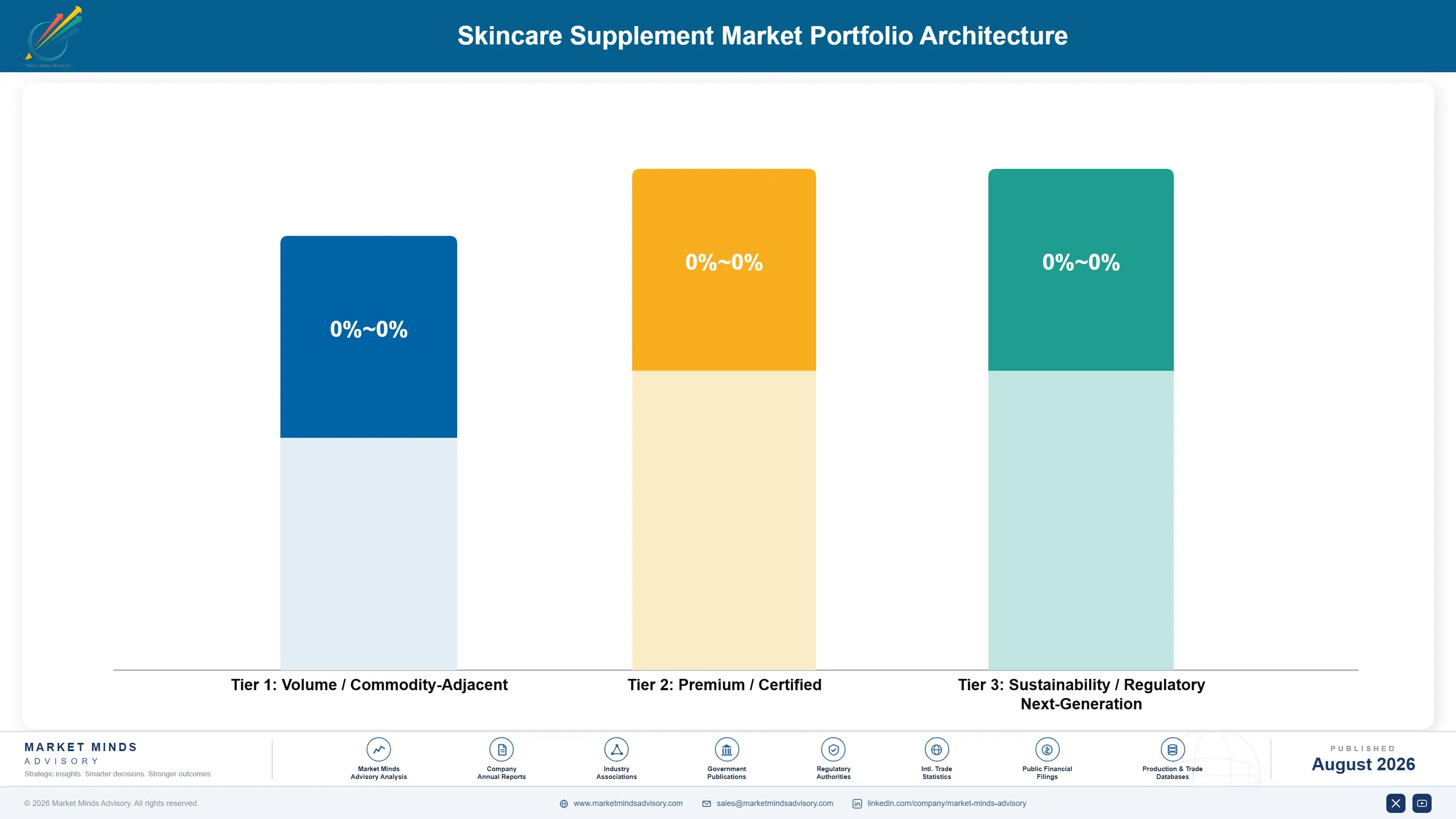
Portfolio economics here divide on evidence and channel rather than on ingredient. Retail products sold on implied benefit with no proprietary trial data behind them compete purely on marketing spend against chemically similar competitors, and at repeat rates near 39% most of that spending never comes back. Chemically similar competitors are really the whole problem at this level.
The middle tier is retail product supported by proprietary clinical evidence. Trial data tied to the specific formulation supports pricing roughly 45% above unsubstantiated equivalents, survives regulatory scrutiny, and gives retail buyers a reason to list that is not simply promotional depth. Margins reach the high forties and hold across reformulation cycles because evidence does not expire. Retail buyers want a reason to list that is not promotional.

Above both sits clinic and dermatology channel product. Professional recommendation delivers what a compliant label cannot say, conversion runs far ahead of retail, and margins reach the low sixties because there is no promotional spending and no retailer margin to fund. The position requires field detailing capability and proprietary evidence together, which is why so few brands hold it despite everyone in the category discussing it.

Volume / Commodity-Adjacent

Retail product sold on implied benefit with no proprietary evidence. The range reflects promotional depth and retailer terms rather than anything the brand controls, and differentiation against similar competitors is minimal.
Gross Margin: 31 to 39%

Premium / Certified

Retail product supported by controlled trial data on the specific formulation. The range reflects how strong the evidence is and whether it supports listing in pharmacy as well as general retail channels.
Gross Margin: 44 to 52%

Sustainability / Regulatory / Next-Generation

Clinic and dermatology channel product sold on professional recommendation. The wide range reflects detailing depth and whether the brand holds exclusive protocol agreements with consolidated practice groups. Few brands hold both capabilities.
Gross Margin: 57 to 66%
skincare-supplement-market-report-portfolio-architecture-1787335832759

High-value Sub-segments and Strategic Watch-out

Clinic Protocol Supplement Ranges

High value and high growth together. Professional recommendation delivers what a compliant label cannot say and conversion runs far ahead of retail. The wide range reflects detailing depth and whether exclusive protocol agreements are held with practice groups. Detailing capability takes several years to build properly.
Gross Margin: 57 to 66%

Clinically Substantiated Retail Products

High value on steady growth. Proprietary trial data supports pricing roughly 45% above unsubstantiated equivalents and survives regulatory scrutiny. The range reflects evidence strength and whether pharmacy listing follows from it, which varies considerably by market. Evidence tied to the specific formulation is what buyers require.
Gross Margin: 44 to 52%

Convenience Format Collagen Products

The volume core and where most format innovation is happening. Shots, gummies and sticks lift course completion measurably against powders. The range reflects format cost and channel mix, since convenience formats carry higher packaging cost per serving. Completion rather than satisfaction is what drives the repeat gap.
Gross Margin: 38 to 46%

Unsubstantiated Retail Beauty Ranges

The strategic watch-out. Volumes are real and entry is easy, but enforcement is active, differentiation is minimal and marketing spend rarely returns at these repeat rates. The range reflects promotional depth and retailer terms rather than brand strength. Enforcement in this tier is active rather than theoretical.
Gross Margin: 31 to 39%

How Supplement Demand Actually Repeats

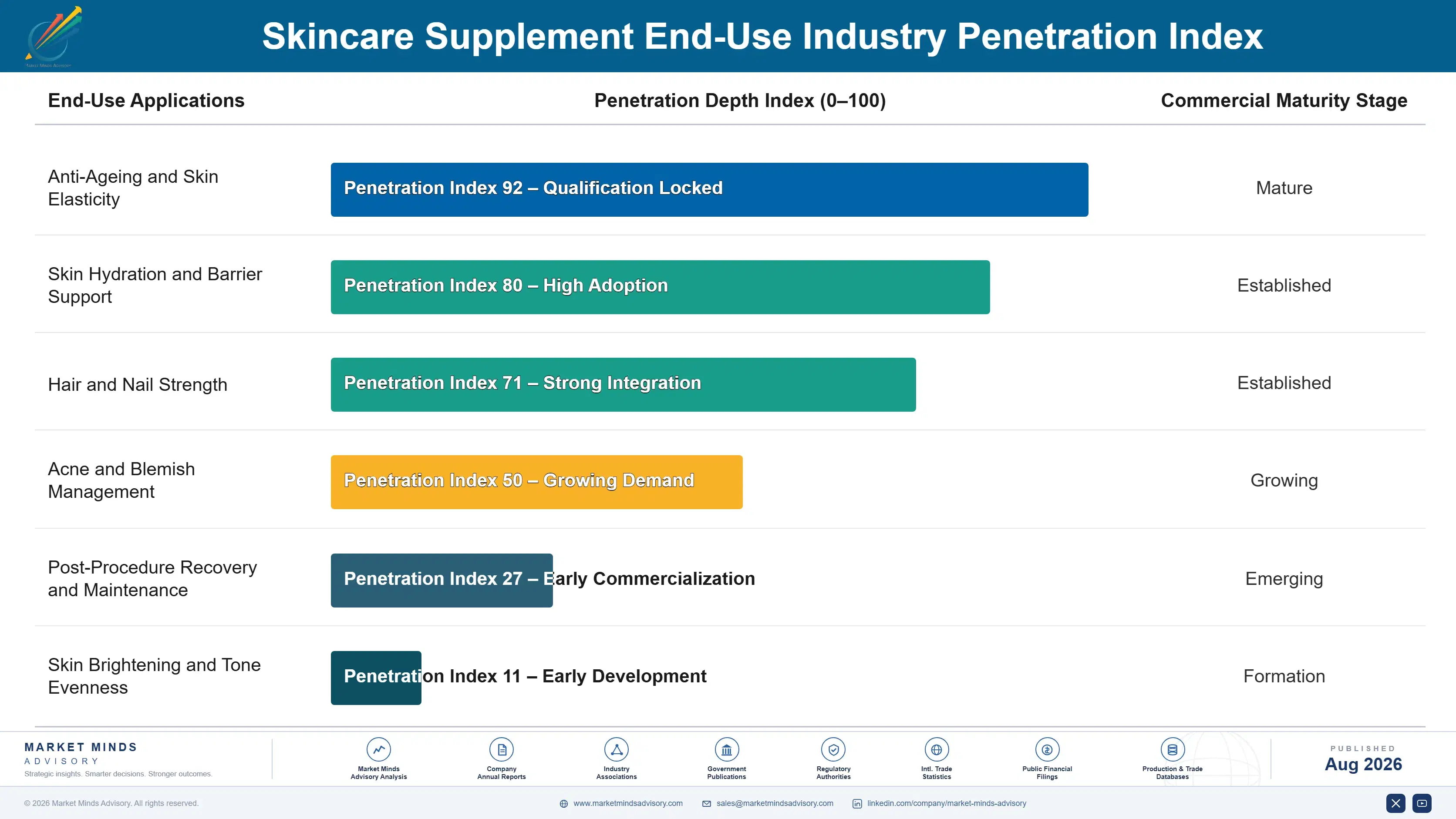
Repeat purchase is the whole commercial question here and roughly 39% of first-time buyers deliver it within six months. That figure is low because skin outcomes need eight to twelve weeks of consistent use and most consumers stop before the product has had any chance to work. Every lever in this category eventually reduces to keeping somebody taking the product long enough to notice something.
Stickiness varies sharply by channel and use case. Clinic protocols hold best, because the recommendation is renewed at each appointment and the supplement attaches to a treatment the consumer is already committed to continuing. Pharmacy purchases on pharmacist advice hold reasonably well. Retail impulse trial holds worst of all, and convenience formats hold considerably better than powders because completion improves when preparation effort falls away.

The buyer profile has broadened noticeably. Early demand came from women over forty buying anti-ageing positioning, which remains the largest single group. Younger consumers now buy preventively and treat supplementation as part of a skincare regimen rather than as a corrective measure, which lengthens the potential purchase period considerably. Male buyers remain a small share but grow faster than any other demographic in the category.
skincare-supplement-market-report-end-use-penetration-index-1787335833253

Where To Compete And Why

These are among the four positions where our research anticipates prominent divergence between winners and laggards over the coming forecast period. Each is grounded in the demand model, the regulatory perimeter, and the announced capacity pipeline.
01 / PROPRIETARY EVIDENCE INVESTMENT

Generic peptide studies prove nothing

Studies conducted on somebody else's hydrolysate prove nothing about a particular product, and both regulators and clinic buyers have made that distinction plainly rather than leaving it open to interpretation. A controlled skin outcome trial takes around 22 months and costs less than a single quarter of the marketing spend most brands commit without one. Proprietary data supports pricing roughly 45% above unsubstantiated equivalents and does not expire, which makes it the only genuinely compounding investment available anywhere in this category.
02 / CLINIC CHANNEL BUILDING

Recommendation says what labels cannot

A supplement protocol attaches to an aesthetics appointment with almost no additional selling effort, because the consumer has already accepted an expensive intervention and a maintenance regimen reads as sensible rather than as an upsell. Around 27% of category value moves through these channels at margins roughly 30% above retail equivalents. Practice consolidation makes the buying more systematic and more expensive, which rewards brands detailing now over those still deciding whether it justifies the field cost, by which time the agreements are signed.
03 / COURSE COMPLETION DESIGN

Nobody notices results they abandon

Skin outcomes require eight to twelve weeks of consistent use and most consumers stop well before that, which is why repeat purchase sits near 39% and why so much trial spending never returns anything at all. Convenience formats lift completion by 12 to 18 points against powders requiring daily measurement into a drink. Format development is faster and considerably cheaper than clinical work, which makes it the sensible first move for almost any brand here, and it needs no regulatory approval at all.
04 / INGREDIENT ACCESS SECURITY

Everyone buys the same peptide

Collagen hydrolysate production sits with a handful of manufacturers selling to everybody, so competing brands frequently contain materially the same active at broadly similar inclusion levels and consumers cannot tell them apart. Exclusive supply arrangements give a brand something genuinely defensible to say and typically require volume commitments worth 15% to 20% of annual purchase value. The alternative is competing on marketing spend against products that are chemically indistinguishable from your own, which is a contest nobody in this category has ever won profitably.

Engagement Snapshot From the Field

A live engagement with an industry participant carrying material or product regulatory and market exposure ahead of a defining policy shift, showing how our research translates into a defensible multi-year portfolio strategy.
MARKET MINDS ADVISORY · CLIENT ENGAGEMENT SUMMARY
Skincare Supplement Producer Strategic Portfolio Review and Transition Roadmap 2026·Investment Scenario on Skincare Supplement Exposure Evaluation 2025-26
CLIENT PROFILE
A European skincare supplement brand with annual revenue near $62 million (client-reported, unverified by MMA), roughly 84% of it from retail and direct online sales of collagen powders and capsules. The business held strong consumer recognition built over eight years and good retail listings, but no proprietary clinical data, no clinic distribution and repeat purchase below a third of first-time buyers.
STRATEGIC CHALLENGE
Claim enforcement had removed most of the language the brand's marketing depended on, while competitors using materially the same hydrolysate were discounting aggressively. Management needed to decide between defending retail share through promotion, funding clinical work to support premium pricing, or building the clinic channel that competitors had already started detailing.
MMA APPROACH
MMA modelled contribution by channel and format against repeat purchase behaviour using four years of the client's own transaction data, benchmarked clinical evidence positions across comparable brands, and assessed clinic listing requirements with practice buyers. Twenty-four expert interviews with dermatologists, aesthetics clinic managers and pharmacy buyers tested what actually drives professional recommendation.
KEY FINDINGS
  1. Repeat purchase among powder buyers ran roughly 17 points below capsule and shot buyers, and the gap tracked course completion almost exactly rather than any difference in satisfaction with results.
  2. Every clinic buyer interviewed required trial data conducted on the specific formulation, and none would consider generic peptide literature or consumer testimonials as a substitute for it.
  3. Promotional depth in retail had risen for six consecutive quarters without moving share, since competing brands were matching within days and contained materially the same active anyway.
  4. The client's hydrolysate supplier was already selling the identical material to three direct competitors, which the client had assumed was not the case and had never contractually addressed.
CLIENT PROFILE
A European skincare supplement brand with annual revenue near $62 million (client-reported, unverified by MMA), roughly 84% of it from retail and direct online sales of collagen powders and capsules. The business held strong consumer recognition built over eight years and good retail listings, but no proprietary clinical data, no clinic distribution and repeat purchase below a third of first-time buyers.
STRATEGIC CHALLENGE
Claim enforcement had removed most of the language the brand's marketing depended on, while competitors using materially the same hydrolysate were discounting aggressively. Management needed to decide between defending retail share through promotion, funding clinical work to support premium pricing, or building the clinic channel that competitors had already started detailing.
MMA APPROACH
MMA modelled contribution by channel and format against repeat purchase behaviour using four years of the client's own transaction data, benchmarked clinical evidence positions across comparable brands, and assessed clinic listing requirements with practice buyers. Twenty-four expert interviews with dermatologists, aesthetics clinic managers and pharmacy buyers tested what actually drives professional recommendation.
KEY FINDINGS
  1. Repeat purchase among powder buyers ran roughly 17 points below capsule and shot buyers, and the gap tracked course completion almost exactly rather than any difference in satisfaction with results.
  2. Every clinic buyer interviewed required trial data conducted on the specific formulation, and none would consider generic peptide literature or consumer testimonials as a substitute for it.
  3. Promotional depth in retail had risen for six consecutive quarters without moving share, since competing brands were matching within days and contained materially the same active anyway.
  4. The client's hydrolysate supplier was already selling the identical material to three direct competitors, which the client had assumed was not the case and had never contractually addressed.
RECOMMENDED STRATEGY
Phase 1: Phase one: shift volume toward capsule and shot formats where course completion and repeat purchase are measurably stronger, since it requires no new investment. Phase 2: Phase two: commission a controlled skin outcome trial on the specific formulation, accepting the timeline as the price of clinic listing and premium pricing. Phase 3: Phase three: negotiate semi-exclusive hydrolysate supply and build a small clinic detailing team in two markets where practice density supports it.
OUTCOME
The client lifted repeat purchase from 31% to 48% within twelve months through format shift alone and reduced promotional spending by roughly a third (client-reported, unverified by MMA). The clinical trial completed in 2026 and supported listings with two aesthetics practice groups, while blended gross margin improved by roughly eleven points across the period.

Frequently Asked Questions

Foundational context covering the market sizes, CAGR, scope, country, region and competition that inform every finding below. This section is provided to cover basics and most often pre-purchase conversations, answered from the MMA Primary Research Dataset.

What is the current size of the Skincare Supplement Market?

The global skincare supplement market was valued at $7.40 billion in 2025, reaching an estimated $8.18 billion in 2026. That covers orally ingested supplements marketed for skin, hair and nail benefits.

How large will the Skincare Supplement Market be by 2036?

MMA forecasts the market reaching $22.40 billion by 2036, an increase of $14.22 billion over the 2026 base. That represents an expansion multiple of 2.74 times across the forecast period.

What is the CAGR for the Skincare Supplement Market 2026 to 2036?

The base case compound annual growth rate is 10.6%, with a bull case of 11.9% and a bear case of 9.4%. Historical growth between 2020 and 2025 ran at 9.5% annually.

Which segment is growing fastest?

Collagen peptide supplements grow at 15.9%, a full 1.50 times the market rate, on a clinical base that survived regulatory scrutiny. Clinic and dermatology channel formulations follow at 13.4% annually.

Who are the major companies in the Skincare Supplement Market?

Shiseido, Amway, Nestlé Health Science, Herbalife and Vital Proteins lead on skincare supplement revenue. Together they account for roughly 22%, which is genuinely low for consumer health.

Which country is growing fastest?

India grows fastest at 15.1% annually, driven by middle-class household spending and pharmacy distribution now reaching well beyond the largest cities. Indonesia and Vietnam follow closely behind.

Report Segmentation Architecture

The full report scope spans multiple orthogonal segmentation dimensions, with cross-tabulated demand data provided for each dimension pair. Coverage extends further to regional breakdowns, trend trajectories, and the competitive detail needed to support segment-level decision-making.

By Ingredient Family

  • Collagen Peptide Supplements
  • Hyaluronic Acid and Ceramide Formulations
  • Antioxidant and Botanical Extract Products
  • Vitamin and Mineral Skin Formulations
  • Probiotic and Postbiotic Skin Products

By End-Use Industry

  • Anti-Ageing and Skin Elasticity
  • Skin Hydration and Barrier Support
  • Hair and Nail Strength
  • Acne and Blemish Management
  • Post-Procedure Recovery and Maintenance
  • Skin Brightening and Tone Evenness

By Commercial Dimension

  • Dermatology and Aesthetics Clinic Distribution
  • Pharmacy and Drugstore Retail
  • Specialty Nutrition and Beauty Retail
  • Direct-to-Consumer Online and Subscription
  • Direct Selling and Network Distribution

By Region

  • North America
  • Western Europe
  • East Asia
  • South Asia and Pacific
  • Latin America
  • Middle East and Africa
  • Eastern Europe

Scope, Methodology, and Coverage

Every figure in this report is reproducible from documented input assumptions. The scope below maps the historical period, the forecast horizon, the segmentation dimensions, and the countries covered, alongside the underlying primary and qualitative methodology.
Historical Period
2020 to 2025
Forecast Period
2026 to 2036
Base Year
2025 (USD billions; MMA Primary Research Dataset, August 2026)
Market Definition
This report covers orally ingested supplements marketed for skin, hair and nail benefits, spanning collagen peptide supplements, hyaluronic acid and ceramide formulations, antioxidant and botanical extract products, vitamin and mineral skin formulations, and probiotic and postbiotic skin products, across clinic, pharmacy, retail, direct selling and online channels. Topical skincare of any kind, injectable dermal fillers and biostimulators, prescription dermatology pharmaceuticals, medical foods, and general multivitamins carrying no skin-specific positioning are excluded from the sizing.
Quantitative Units
USD billions at brand realised value; volume in million course equivalents; average course spend in USD.
Segmentation Dimensions
By ingredient family; by end-use industry; by commercial dimension; by region.
Regions Covered
North America, Western Europe, East Asia, South Asia and Pacific, Latin America, Middle East and Africa, Eastern Europe
Countries Covered
Japan, South Korea, China, India, Indonesia, Thailand, Australia, United States, Canada, Mexico, Brazil, Colombia, United Kingdom, Germany, France, Italy, Spain, Poland, Turkey, Saudi Arabia.
Key Companies Profiled
Shiseido, Amway, Nestlé Health Science, Herbalife, Vital Proteins, Bayer, Blackmores, Swisse Wellness, Suntory Holdings, Fancl, Asahi Group, Rousselot, Gelita, HUM Nutrition and others.
Quantitative Methodology
Primary survey, n=3,800 respondents, Q4 2025, six countries; demand-side model with trade association cross-validation
Qualitative Methodology
47 expert interviews, Q4 2025; applied to validate demand model assumptions, identify emerging dynamics, and assess competitive positioning
Report Format
PDF and XLSX data workbook (Word format preview document)
Publisher
Market Minds Advisory
Report Code
MMA-2026-HLT-075
Published
August 2026
Contact
sales@marketmindsadvisory.com | www.marketmindsadvisory.com

Purchase the full Skincare Supplement Market Report (2026 to 2036).

The full report sizes the skincare supplement market across five ingredient families, six benefit categories and seven regions, with course volume and spend detail behind every value estimate. It profiles twenty companies on proprietary evidence position, clinic channel reach and format capability. Regional chapters cover claim regulation, channel structure and consumption habits by market. Repeat purchase analysis quantifies course completion and reorder behaviour by format and channel. Regulatory analysis maps permitted claim wording across the major jurisdictions, with enforcement history in the markets where authorities have already acted.
Course volume and spend detail by ingredient family
Health claim regulation comparison across major jurisdictions
Repeat purchase benchmarking by format and channel
Clinic and dermatology channel structure by market
Competitive position assessments across twenty companies
Collagen hydrolysate supply concentration and pricing analysis

Built For The People Who Decide

From boardroom strategy to bench-side execution, this report is read cover-to-cover by leaders shaping the next decade of their industry, turning demand scenarios, market dynamics and valuation benchmarks into decisions.
CXOs/ Presidents/ VPs/ Managers
M&A and Corporate Development
Strategy Teams and R&D Heads
Procurement and Product Directors
Regulatory and Compliance Leaders
Investor Relations and Equity Analysts