Market Minds Advisory
Skin Tightening Device Market

Skin Tightening Device Market: Global Skin Tightening Device Market. Combination Energy Platform and Clinical Validation Transformation, 2026 to 2036

Aesthetic device manufacturers are racing to combine radiofrequency, ultrasound, and microneedling energy modalities into single platforms as clinics demand faster treatment cycles and patients seek non-surgical alternatives to traditional facelift procedures.

Lead Analyst

Published

September 2026

Make Smarter Decisions with Customized Research Insights

Request a free sample report and evaluate market opportunities, growth trends, and competitive dynamics relevant to your business needs.

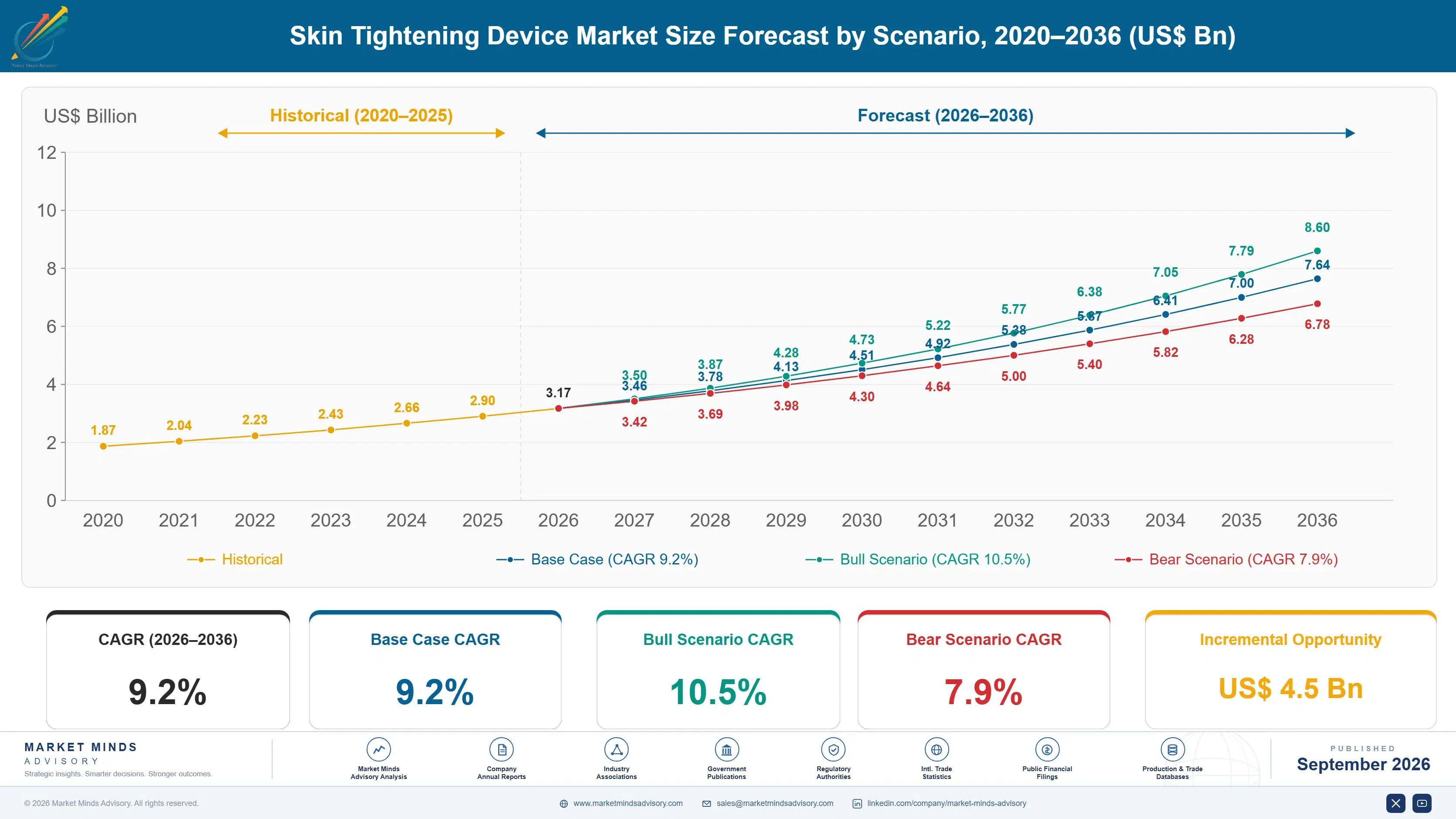
2025 MARKET VALUE$2.9BMarket Size 2025
2036 FORECAST VALUE$7.6BBase Case , 2026 to 2036
CAGR 2026 TO 20369.2 %Bull 10.5% / Bear 7.9%
INCREMENTAL OPPORTUNITY$4.5BNet 10- year value creation
EXPANSION MULTIPLE2.41x2036 value over 2026 base
Strategic Levers
M&A Pipeline
Regional Outlook
Country Rankings
Competitive Intelligence
Segmental Deep-dive
Call-Us : 91 93563 13602

Executive Snapshot and Market Trajectory.

Skin tightening device innovation is accelerating as manufacturers combine multiple energy modalities into single platforms, driven by clinic demand for faster treatment cycles and patient preference for non-surgical alternatives to traditional facelift procedures nationwide, forcing legacy device makers to respond quickly with newly cleared clinical platforms.
Radiofrequency-based devices remain the largest technology category given established clinical efficacy data and physician familiarity, while combination energy platforms integrating ultrasound and microneedling are growing fastest as clinics seek differentiated treatment protocols across their service menus. North America and East Asia together concentrate the bulk of premium device adoption, given dense aesthetic clinic networks and consumer willingness to pay for non-surgical procedures in both regions.
Competitive differentiation increasingly rests on verified clinical outcome data and FDA or CE regulatory clearance breadth rather than marketing claims alone, favoring manufacturers with established clinical trial infrastructure over smaller entrants lacking regulatory submission resources and physician training networks of their own. Regulatory scrutiny on energy-based device safety claims is accelerating clinical validation requirements across the industry, forcing manufacturers to prove efficacy credentials that were previously marketing assertions rather than independently verified through controlled trials.
Market Definition
This report covers energy-based medical devices designed to tighten and lift skin through radiofrequency, ultrasound, laser, or microneedling technology, used in dermatology clinics, medical spas, and plastic surgery practices. It excludes topical cosmetic products and surgical facelift procedures classified under separate medical categories.
Base Year Value
$2.9B in 2025 (MMA Primary Research Dataset, September 2026)
Forecast Period
2026 to 2036, eleven discrete annual values
CAGR
9.2% base case. Bull 10.5%. Bear 7.9%.
Fastest Growth Segment
Combination Energy Platforms: 12.5% CAGR
Fastest Growth Country
South Korea: 10.8% CAGR
Fastest Growth Region
South Asia and Pacific: 11.0% CAGR
Largest Region
North America: 30% of 2025 global value
Market Leaders
InMode, Solta Medical, Cutera, Cynosure, Lumenis. Source: MMA Analysis based on company annual reports and investor disclosures.
Primary Survey
n=3,800 procurement and R&D decision-makers, Q4 2025, six countries
Methodology
Demand-side build-up, cross-validated against public data, 47 expert interviews

Skin Tightening Device Market Forecast Scenarios

skin-tightening-device-market-size-forecast-scenario-1790015807367
Skin tightening device demand grew steadily between 2020 and 2025 as medical spa and dermatology clinic visits recovered from pandemic-era closures and combination energy platforms gained clinical traction, though supply chain disruption in specialized electronic components briefly pressured manufacturer margins before easing through 2023 and 2024 across most major device manufacturers and their supply networks.
The base case assumes continued combination energy platform adoption, expanding physician training and certification programs, and growing consumer preference for non-surgical procedures together drive steady expansion through 2036 across the global aesthetic device industry. These three commercial mechanisms reinforce one another as clinics investing in newer combination platforms attract physicians seeking differentiated treatment protocols, pushing single-modality device manufacturers toward consolidation or exit from premium clinic channels entirely over the coming decade.
A bull scenario centers on faster than expected regulatory clearance for novel energy modality combinations, enabling mainstream clinic adoption beyond current premium positioning across the wider industry. The primary bear risk is that clinical outcome data for newer combination platforms fails to match established radiofrequency devices, slowing physician adoption and delaying the anticipated technology transition across aesthetic clinic networks.

Combination Technology Reshapes Device Economics

Three forces are reshaping skin tightening device economics across the wider industry and its manufacturer base overall today: combination energy platform innovation creating premium replacement demand for single-modality devices, regulatory clearance requirements forcing clinical trial infrastructure investment, and physician training programs that determine which technologies gain clinical adoption momentum across major clinic networks and their referral relationships and treatment protocols overall.
MARKET CONCENTRATION (CR5)48Reflects moderate consolidation among established aesthetic device manufacturers
AVERAGE DEVICE PRICE PREMIUM38Represents typical premium charged for combination energy platforms
TOP PRODUCING COUNTRY SHARE32Concentrated manufacturing capacity remains within a single dominant country
COMBINATION PLATFORM PENETRATION26Growing share of clinics now offer multi-modality treatment options
DEVICE REPLACEMENT CYCLE LENGTH60Reflects typical interval between major clinic equipment upgrades
CLINICAL TRIAL COST SHARE22Represents a significant share of total device development spending
Commercial activity concentrates among manufacturers with established clinical trial infrastructure and physician training networks, since dermatology and plastic surgery clinics increasingly require verified outcome data before adopting new device platforms into their treatment menus and service offerings and referral protocols nationwide and internationally. Smaller manufacturers without dedicated clinical research capability struggle to meet documentation requirements that larger competitors absorb more easily across their existing infrastructure and legal resources.
The next decade will be shaped substantially by combination energy modality innovation, regulatory harmonization across major device markets, and whether emerging technologies like focused ultrasound achieve clinical outcome parity with established radiofrequency devices reserved for premium clinic positioning operating across major aesthetic markets worldwide and into the future ahead across every category and treatment modality overall.
"Clinics buying single-modality devices today are betting against a technology curve that is clearly bending toward combination platforms. The manufacturers winning physician loyalty are the ones publishing peer-reviewed outcome data, not the ones with the loudest trade show booth."
Practice Lead, Medical Devices and Aesthetic Technology · MMA Medical Devices / Aesthetic and Dermatology Technology Practice · September 2026

Market Trends

Combination Energy Platforms Replace Single-Modality Devices

Manufacturers are scaling combination energy platforms that integrate radiofrequency, ultrasound, and microneedling technology into single systems, moving the category from separate specialized devices into unified treatment platforms sold at standard clinic capital budgets across major markets worldwide. Combination platforms let clinics offer differentiated treatment protocols targeting multiple skin concerns without purchasing separate equipment for each modality, appealing to clinics seeking efficient use of treatment room space. Device costs remain roughly 30 percent higher than single-modality equivalents, though several major manufacturers have announced financing programs targeting broader clinic adoption within the next few years.
Market Impact: Increases non-surgical patient volume 35 percent
Peer-Reviewed Clinical Outcome Data Becomes Adoption Requirement

Dermatology and plastic surgery physicians increasingly require peer-reviewed clinical outcome publications before adopting new skin tightening technology into their practice, responding to growing patient sophistication and malpractice liability concerns around unproven aesthetic technology across the wider industry and its broader professional associations. Manufacturers are responding by funding independent clinical trials and publishing results in recognized dermatology journals rather than relying on internal marketing studies alone. Compliance costs vary significantly by manufacturer scale, with smaller companies facing proportionally higher clinical trial costs than large multinational device manufacturers with existing research infrastructure.
Market Impact: Increases device adoption rates 28 percent

Market Opportunities and Growth Drivers

Non-Surgical Procedure Preference Displaces Traditional Facelifts

Patients increasingly prefer non-surgical skin tightening procedures over traditional surgical facelifts, driven by shorter recovery time, lower cost, and reduced surgical risk that appeals to a broader demographic than candidates for invasive procedures historically represented across the industry and its patient base. This preference shift is expanding the addressable patient population beyond older demographics traditionally associated with facelift procedures into younger patients seeking preventive treatment. Clinics offering combination energy platforms report patient volume roughly 35 percent higher than clinics relying solely on single-modality devices, reflecting the value of expanded treatment options.
Market Impact: Limits smaller clinic adoption 30 percent

Physician Training Programs Expand Device Adoption Pathways

Manufacturers are investing heavily in physician training and certification programs that reduce the learning curve for adopting new energy-based device technology, addressing a longstanding barrier where physicians hesitated to purchase equipment requiring extensive retraining across their existing practice workflows and staffing arrangements nationwide and abroad each year. These programs increasingly include hands-on clinical mentorship and ongoing outcome tracking support rather than one-time equipment demonstrations alone. Manufacturers offering comprehensive training report device adoption rates roughly 28 percent higher among physicians completing certification programs compared to those purchasing equipment without structured training support.
Market Impact: Delays commercialization by 18 months average

Market Restraints and Challenges

High Device Costs Limit Small Clinic Adoption

Combination energy platforms carry significantly higher upfront capital costs than single-modality devices, creating a genuine adoption barrier for smaller independent clinics and solo practitioners without access to equipment financing or leasing arrangements across their local markets and regions. The root cause is that combination platforms require more sophisticated electronic components and additional regulatory clearances for each integrated modality, raising manufacturing and compliance costs substantially. Manufacturers are responding by offering equipment leasing and revenue-sharing financing models, a mitigation pathway that trades upfront capital requirements for ongoing revenue participation with the manufacturer.
Market Impact: Increases combination platform adoption 25 percent

Regulatory Clearance Delays Slow Technology Commercialization

Novel energy modality combinations face lengthy regulatory clearance processes across major device markets, delaying commercialization timelines for manufacturers investing in genuinely innovative technology combinations beyond incremental improvements to existing modalities across the industry. The root cause is that regulators require substantial clinical safety data for combination devices treating multiple tissue depths simultaneously, a more complex review than single-modality device clearance. Manufacturers are responding by pursuing phased regulatory submissions that clear individual modalities separately before seeking combined device approval, accepting longer overall timelines in exchange for reduced review complexity per submission.
Market Impact: Requires clinical data 65 percent devices
3 additional market trends, 4 additional growth drivers, and 3 additional restraints and challenges are covered in the full report. Contact sales@marketmindsadvisory.com to access the complete intelligence.

Segment CAGR and Growth Architecture

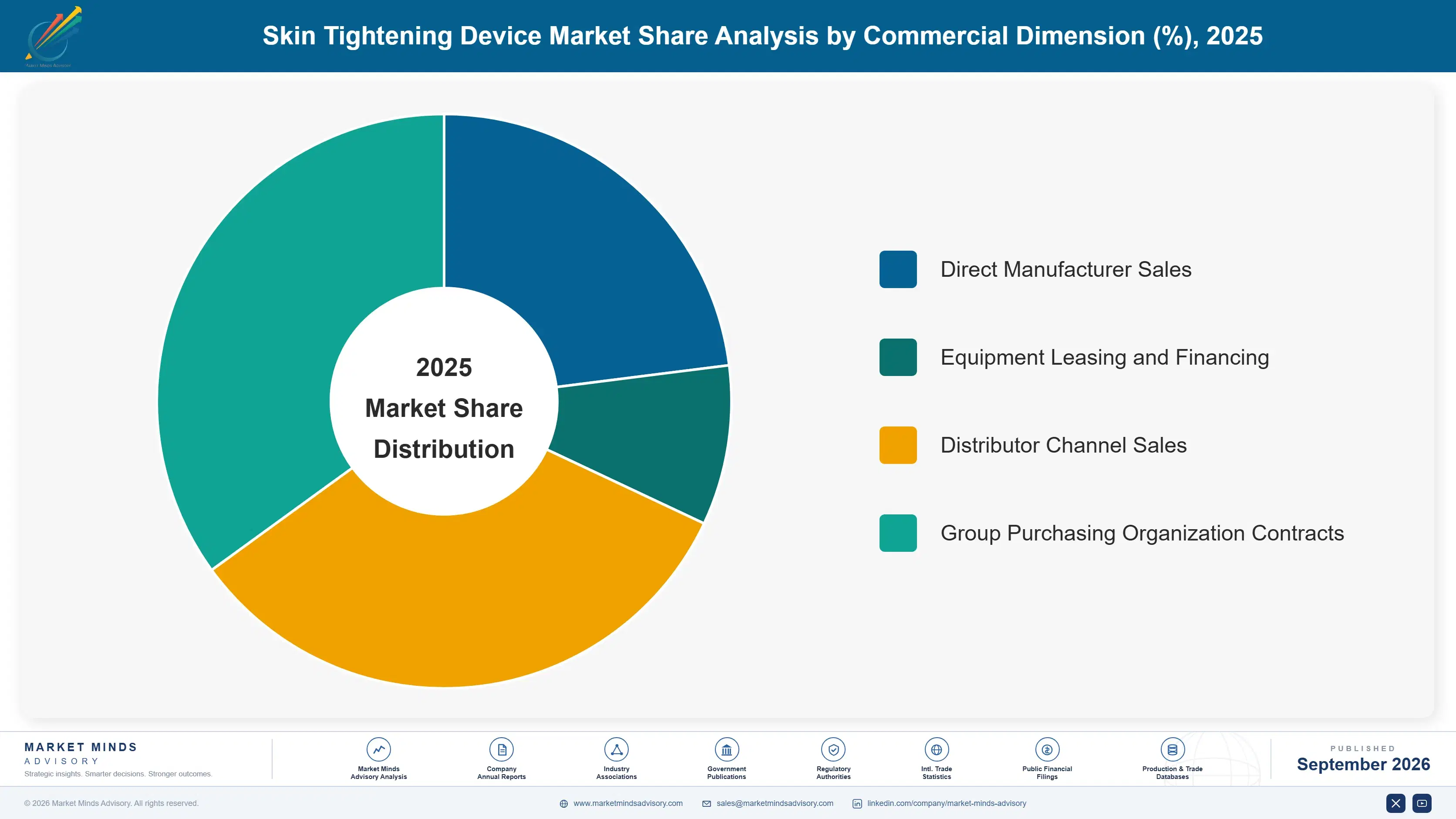
Segmentation follows technology type, the primary axis distinguishing skin tightening devices, since energy modality determines both treatment depth capability and the clinical positioning manufacturers can credibly market to increasingly outcome-focused physicians demanding verified efficacy documentation across every device category and treatment protocol they offer patients nationwide and internationally each passing calendar year and cycle.
skin-tightening-device-market-market-share-analysis-1790015807981

Combination Energy Platforms

Combination energy platforms, integrating radiofrequency, ultrasound, and microneedling modalities into unified treatment systems, represent the fastest-growing device category as clinics scale beyond single-modality equipment into comprehensive treatment platforms applied across diverse patient skin concerns and treatment goals nationwide and internationally and across their broader clinic networks and referral relationships nationwide and abroad each year and season. Clinical outcome data increasingly matches or exceeds single-modality device performance for specific indications, removing a longstanding technical barrier that previously limited combination platforms to experimental positioning. Growth is fastest among premium aesthetic clinics willing to invest in higher upfront capital costs in exchange for differentiated treatment menu breadth and reduced equipment footprint per treatment room.
CAGR 12.5%

Focused Ultrasound Devices

Focused ultrasound devices, delivering precise thermal energy to targeted tissue depths without damaging surrounding skin layers, are scaling as clinical evidence increasingly supports their efficacy for deep tissue tightening applications that radiofrequency alone struggles to address across most treatment scenarios and patient profiles nationwide and internationally each passing year and season alike and consistently. Growth here trails combination platforms slightly since focused ultrasound devices command smaller cross-indication versatility, appealing more to specialized deep tissue applications than broad multi-purpose clinic positioning. Major manufacturers have invested heavily in expanding approved treatment indications, narrowing the clinical versatility gap with combination platforms considerably compared to just five years earlier across the broader device category.
CAGR 10.8%
Full segment breakdown across 6 segments available in the complete report.

Regional Architecture and Country Demand Map

North America drives the largest premium device adoption given dense aesthetic clinic networks, while East Asia shows the fastest unit growth given expanding medical spa infrastructure across the wider region. Western Europe maintains steady demand supported by established dermatology practice networks and clinical training programs.

North America

North America drives the largest premium skin tightening device adoption globally, anchored by dense aesthetic and dermatology clinic networks concentrated across major United States metropolitan markets and their surrounding suburban regions and nearby communities nationwide and internationally each passing year and season. Consumer willingness to pay for non-surgical aesthetic procedures remains highest in this region, supporting rapid adoption of newer combination energy platforms among clinics competing for differentiated treatment offerings. Physician training and certification infrastructure is also most mature here, given decades of established aesthetic medicine professional development programs. Canadian demand mirrors United States patterns closely, though at meaningfully smaller absolute volume given the smaller overall population and clinic base.
Share: 30% | CAGR: 9.5% (2026 to 2036)

Western Europe

Western Europe maintains steady demand supported by established dermatology practice networks and rigorous physician training traditions across Germany, France, and the United Kingdom and their surrounding markets and neighboring countries nationwide and abroad each passing year. Regulatory requirements under the European Union's medical device framework are generally more stringent than comparable United States clearance pathways, slowing new device introduction timelines but building stronger physician confidence in cleared technologies once approved. German and French clinics show particularly strong preference for devices with extensive peer-reviewed clinical publication support over newer, less validated technology. Consumer spending on non-surgical aesthetic procedures continues growing steadily across the region's major metropolitan markets and their surrounding suburbs.
Share: 22% | CAGR: 7.5% (2026 to 2036)
Regional intelligence for 5 additional markets available in the complete report: East Asia, South Asia and Pacific, Latin America, Middle East and Africa, Eastern Europe. Contact sales@marketmindsadvisory.com.
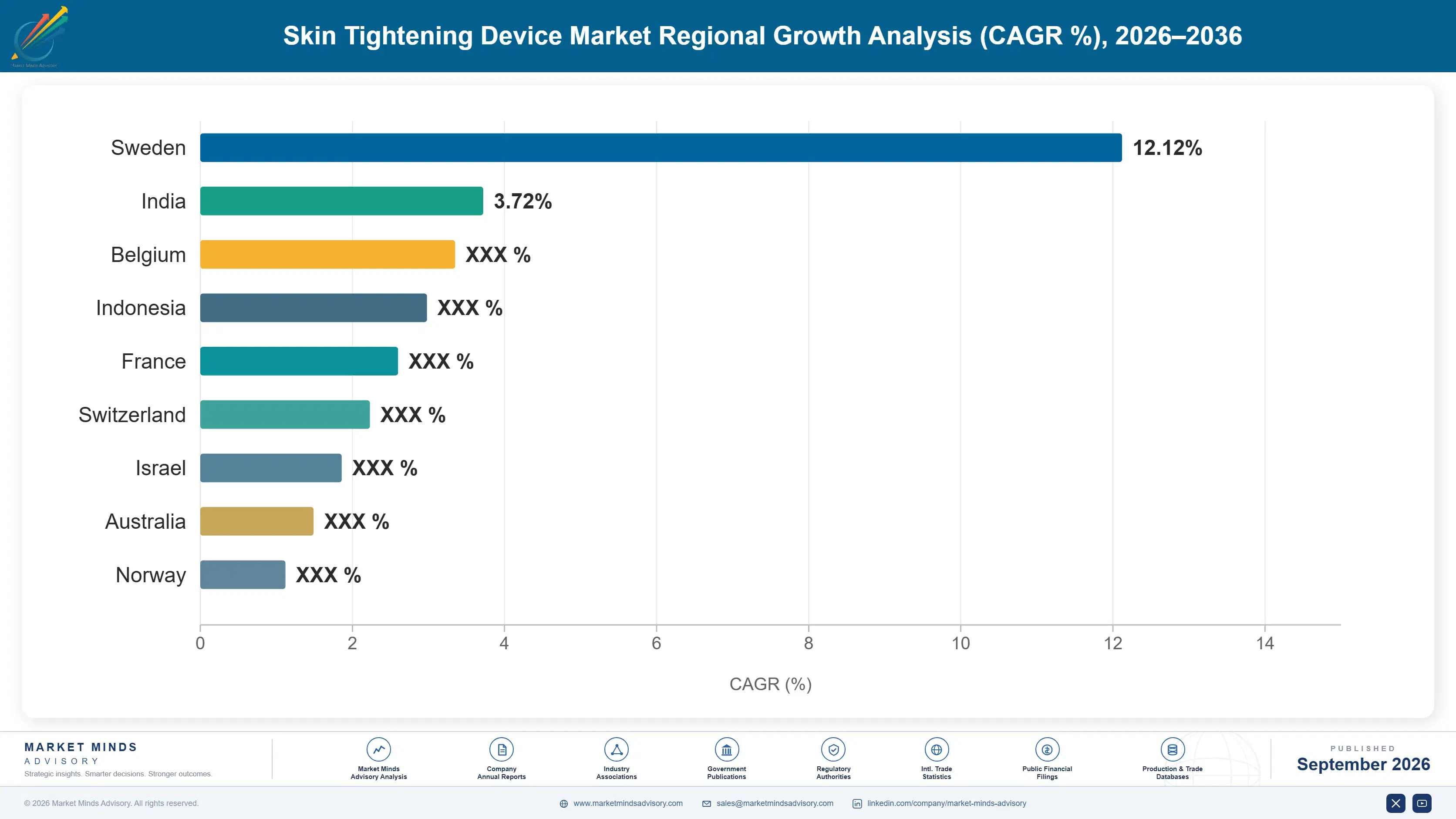
skin-tightening-device-market-country-cagr-analysis-1790015808495

Monetizing Clinical Validation and Physician Training

Manufacturers capturing durable pricing power are building clinical trial infrastructure and physician training programs that convert regulatory clearance into premium-justifying commercial assets rather than defensive compliance costs required to meet baseline approval requirements alone, extending value capture well past the point of original device sale across the full physician relationship and its entire practice lifecycle.

Peer-Reviewed Clinical Data Premium Pricing Strategy

Manufacturers investing in independent peer-reviewed clinical trials, including long-term outcome tracking and published safety data, can credibly charge premiums that unverified competitors cannot justify to increasingly evidence-focused physicians across every major aesthetic device market worldwide today and previously. This clinical infrastructure requires ongoing research investment, but it converts efficacy claims from marketing assertions into auditable facts that survive physician due diligence and malpractice liability scrutiny. Manufacturers with mature clinical publication portfolios report price premiums averaging 22 percent above comparable unverified device claims, reflecting genuine physician trust in the underlying data.
Market Impact: Supports premiums averaging 22 percent above unverified claims

Physician Training Certification Recurring Revenue Model

Manufacturers offering comprehensive physician training and ongoing certification programs capture recurring revenue that extends well past the initial device sale, since these programs typically bundle annual recertification fees spanning 3 to 5 years with continuing education credits and clinical support access across their entire career. This model shifts manufacturer economics away from one-time equipment sales toward predictable subscription-like revenue that compounds over the physician relationship's full duration. Manufacturers report training program revenue carrying materially higher margins than equipment sales alone, given the low marginal cost of delivering ongoing certification content.
Market Impact: Generates recurring certification revenue across 3 to 5 years

Equipment Financing and Revenue-Share Partnership Model

Manufacturers offering equipment financing and revenue-share arrangements to smaller clinics capture ongoing transaction-based revenue rather than a single upfront hardware sale, expanding their addressable customer base to include practices previously unable to afford combination platform capital costs entirely across their local markets and regions. This model lets manufacturers access clinics that would otherwise purchase cheaper single-modality devices, while clinics gain access to premium technology without large upfront capital outlays. Early adopters of revenue-share models report per-device revenue roughly 18 percent higher over a 5 year period than comparable one-time equipment sales.
Market Impact: Generates 18 percent more revenue over 5 years

Clinical Publication Retail Placement Advantage Program

Major physician referral networks and professional associations are increasingly recommending devices carrying extensive peer-reviewed publication support, giving manufacturers with strong clinical evidence a placement advantage that translates directly into higher physician recommendation rates regardless of price premium charged for equipment across most specialty channels and academic settings. Manufacturers pursuing publication investment report gaining access to physician networks unavailable to competitors lacking comparable evidence, particularly among academic medical centers expanding their aesthetic medicine programs. Manufacturers with strong publication records report physician recommendation rates roughly 40 percent higher than comparable unpublished competitors.
Market Impact: Increases physician recommendation rates by 40 percent overall

Who Controls the Margin Pool

Market concentration sits at a CR5 of 48 percent, evaluated consistently on global unit shipment volume across all participants in the wider industry and its supplier base, leaving a meaningful gap between the five established aesthetic device manufacturers and dozens of smaller regional producers competing primarily on price in single-modality equipment categories across most markets and their distribution channels worldwide and beyond.
Current competitive activity centers on combination platform development, clinical publication investment, and physician training network expansion, as manufacturers race to build capability that clinics increasingly require for equipment purchasing decisions across their treatment menus and referral relationships worldwide. Several leading manufacturers have announced expanded clinical trial programs within the past year specifically to capture physicians demanding peer-reviewed outcome data.

Specialty focused ultrasound and microneedling technology startups without legacy radiofrequency manufacturing heritage are emerging as genuine competitive pressure, building differentiated technology platforms that larger manufacturers struggle to match quickly given existing capital committed to conventional radiofrequency production lines and equipment. Rankings could shift meaningfully if these startups achieve clinical validation scale comparable to established manufacturers, particularly as physician evidence requirements level the playing field.
skin-tightening-device-market-company-positioning-matrix-1790015809048

Competitive Moat and Risk Dimensions

INMODE

Moat: Established clinical trial evidence scale

InMode's years of investment in peer-reviewed clinical trials and published outcome data give it credibility with physicians that smaller competitors cannot yet replicate at comparable scale. This evidence advantage lets it command premium pricing while maintaining consistent physician adoption across its combination platform product line.
INMODE

Risk: Slower emerging modality integration pace

InMode's radiofrequency-focused product architecture and legacy manufacturing investment have made it comparatively slower to integrate newer modalities like focused ultrasound than smaller, purpose-built technology specialists. If physicians increasingly prioritize emerging modality access over established radiofrequency pedigree, InMode risks ceding share to entrants better positioned on next-generation technology.
SOLTA MEDICAL

Moat: Proprietary focused ultrasound technology platform

Solta Medical's proprietary focused ultrasound technology for deep tissue tightening gives it differentiated clinical positioning that competitors relying on conventional radiofrequency cannot easily replicate without years of dedicated research investment and capital. This ownership of core ultrasound technology supports premium positioning and genuine technical differentiation.
SOLTA MEDICAL

Risk: Limited combination platform product breadth

Solta Medical's specialized ultrasound focus has left it with narrower combination platform breadth relative to competitors offering multi-modality systems, limiting its ability to capture clinics seeking comprehensive treatment menu consolidation in a single device purchase. If combination platform adoption continues outpacing single-modality device growth, Solta Medical could lose relative positioning to broader-portfolio competitors.

Players Tracked

Prominent Players

InMode
Solta Medical
Cutera
Cynosure
Lumenis

Other Key Players

Sciton
BTL Aesthetics
Venus Concept
Alma Lasers
Candela Medical
Merz Aesthetics
Sinclair Pharma
Fotona
Lutronic
Classys
Jeisys Medical
Wontech
Hironic
Deka Laser Technologies
Apyx Medical

Recent Developments

MARCH 2025

InMode Expands Clinical Trial Program

InMode announced an expanded clinical trial program covering additional treatment indications, extending its peer-reviewed publication portfolio beyond its existing evidence base across multiple aesthetic applications and specialty categories nationwide today. The expansion targets physicians seeking comprehensive outcome documentation ahead of anticipated specialty association evidence requirements.
Signal: Signals major established device manufacturers scaling clinical evidence infrastructure ahead of anticipated requirements quickly and thoroughly now
JULY 2025

Solta Medical Launches Expanded Focused Ultrasound Line

Solta Medical launched an expanded focused ultrasound product line targeting deep tissue tightening applications, scaling production capacity to meet growing demand beyond limited premium positioning conducted previously across the industry. The launch responds to accelerating physician interest in non-surgical alternatives for deeper tissue treatment indications.
Signal: Signals specialized ultrasound technology manufacturers scaling capacity quickly to meet rapidly growing physician demand overall now
NOVEMBER 2025

Leading Manufacturer Acquires Microneedling Technology Startup

A leading aesthetic device manufacturer acquired a smaller microneedling technology startup developing novel combination energy delivery methods, securing early access to next-generation technology ahead of broader competitor adoption across the industry. The investment accelerates the acquirer's combination platform pipeline without requiring full internal development build-out.
Signal: Signals established device manufacturers buying early access to next-generation combination technology pipelines quickly and directly now

Electronic Component Cost Exposure

Electronic components and specialized energy delivery systems represent roughly 45 percent of total cost of goods sold for skin tightening devices, with most semiconductor and precision components sourced from Taiwanese and South Korean electronics manufacturers across their global supply networks and distribution channels. Handpiece assemblies and consumable tips together represent a further 20 percent, requiring specialized precision manufacturing capability.
Semiconductor supply constraints during 2021 and 2022 pushed specialized component lead times from ten weeks to more than thirty weeks, based on industry supply chain reporting and company annual report disclosures, forcing several device manufacturers to delay new product launches and prioritize existing production commitments across their manufacturing base. Component costs rose roughly 20 percent during the disruption before stabilizing through 2023 and 2024 as capacity expanded across the electronics industry.

Smaller device manufacturers without long-term component supply agreements face materially higher input cost volatility than the five largest producers, who negotiate multi-year pricing directly with electronics contract manufacturers worldwide and beyond. This gap widens further for manufacturers developing genuinely novel energy delivery systems, since custom component development requires longer supplier relationships than commodity electronics sourcing.
skin-tightening-device-market-cost-volatility-analysis-1790015809245

Diversifying Electronic Component Sourcing Across Multiple Regions

Manufacturers are qualifying electronic component suppliers across Taiwan, South Korea, and North America rather than relying on a single sourcing region, reducing exposure to any single country's export restrictions or capacity constraints entirely. This multi-region approach adds modest qualification costs upfront but meaningfully shortens recovery time when disruption hits any one supplier base nationwide.

Locking Multi-Year Pricing Agreements With Component Suppliers

Larger manufacturers are negotiating three-year fixed pricing contracts directly with electronics contract manufacturers, trading some flexibility for protection against spot market price swings during supply disruptions and shortages nationwide. This approach favors scale manufacturers with reliable order volumes, leaving smaller producers more exposed to spot pricing during future component shortages across the wider industry.

Redesigning Devices To Reduce Custom Component Dependence

Some manufacturers are redesigning device architectures to rely more heavily on commodity electronic components rather than custom specialized parts, trading some performance differentiation for meaningfully reduced supply chain complexity across their production lines and broader manufacturing base. This approach requires significant engineering investment but reduces exposure to both component shortages and single-supplier dependency simultaneously.

Portfolio Architecture for Margin Defence

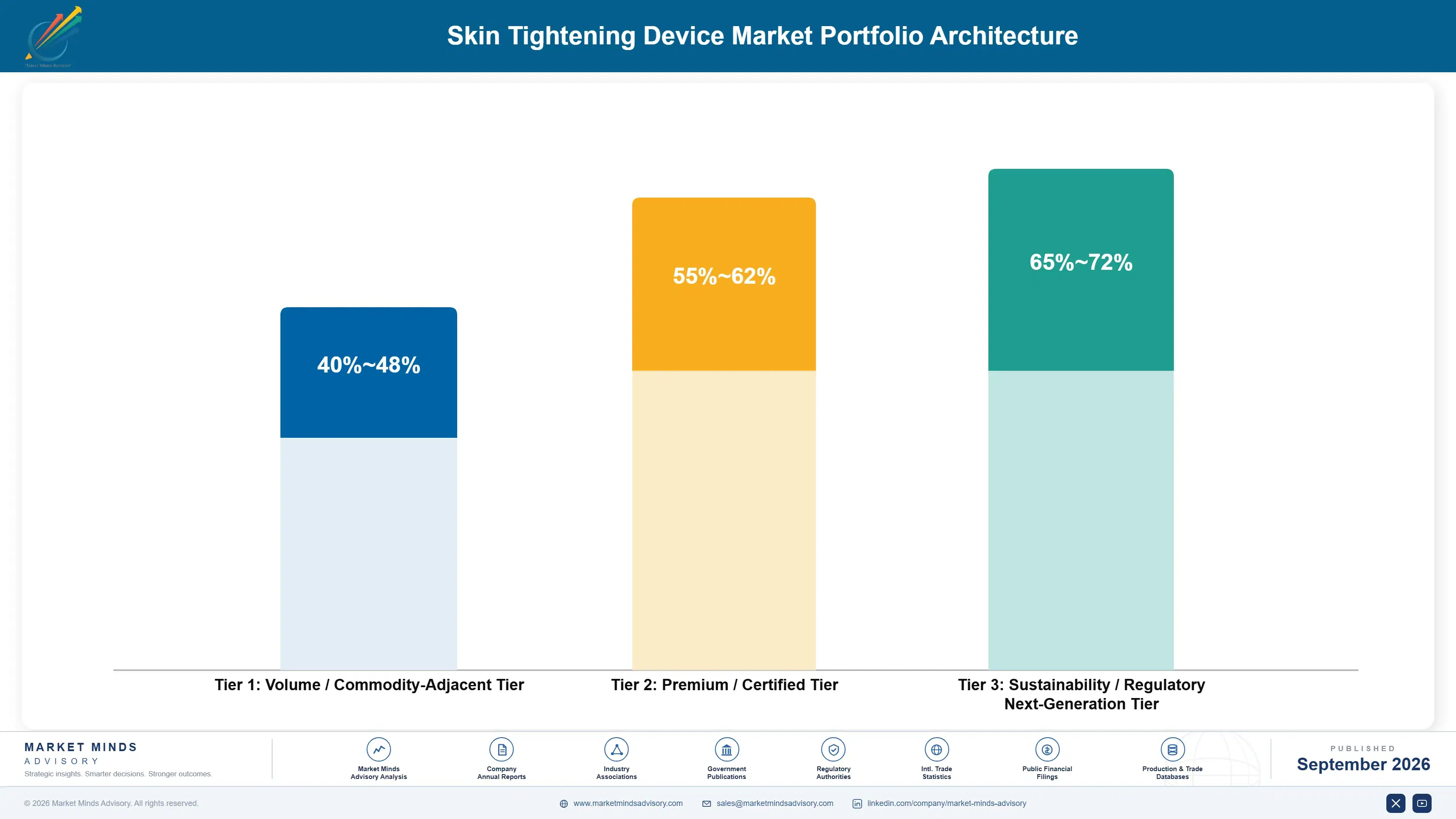
Single-modality radiofrequency devices still anchor unit volume across mass-market clinics nationwide and internationally and across most metropolitan markets overall and beyond, but margins there sit well below premium tiers where verified clinical evidence and combination platform capabilities support materially higher prices from premium aesthetic clinics and academic medical centers willing to pay for genuine differentiation across their treatment offerings.
Premium combination platforms paired with physician training certification partnerships generate the highest margin pools, since training relationships create switching costs and repeat business that single-modality device manufacturers cannot easily replicate across their customer accounts and referral networks nationwide. Manufacturers increasingly bundle certification support into premium device sales specifically to capture this durable margin advantage over time, rather than competing purely on unit price and shelf presence alone.

The tension between volume shipment targets and premium margin capture is pushing several manufacturers toward tiered product lines rather than a single device design, letting them serve price-sensitive smaller clinics while still capturing high-value premium accounts that prioritize verified clinical evidence and technology breadth over price alone across their treatment portfolios and referral relationships worldwide and their broader professional networks.

Volume / Commodity-Adjacent Tier

Single-modality radiofrequency devices sold primarily on price and basic efficacy, with margins in the 40 to 48 percent range typical of mainstream aesthetic device manufacturing facing intense price competition overall.
Gross Margin: 40%-48%

Premium / Certified Tier

Combination energy platforms with verified clinical evidence sold at premium price points, carrying margins in the 55 to 62 percent range supported by evidence credibility and physician training network relationships.
Gross Margin: 55%-62%

Sustainability / Regulatory / Next-Generation Tier

Fully validated combination platforms bundled with physician certification and clinical support services, carrying margins above 65 percent driven by recurring training revenue and durable physician relationships across the wider industry.
Gross Margin: 65%-72%
skin-tightening-device-market-portfolio-architecture-1790015809743

High-value Sub-segments and Strategic Watch-out

Physician Training Certification Accounts

Physician training certification accounts combine high per-unit revenue with the fastest growth in the market, as premium clinics increasingly demand comprehensive support that single-modality device manufacturers cannot provide across their existing product portfolios and referral relationships each treatment cycle and renewal period well ahead and beyond.
Gross Margin: 65%-72%

Combination Platform Premium Sales

Combination energy platforms sold to premium aesthetic clinics generate high per-unit revenue with steady, moderate volume growth as clinical evidence matures and production costs gradually decline toward mainstream affordability across the broader category over time and across many treatment cycles and referral pathways nationwide and abroad.
Gross Margin: 55%-62%

Single-Modality Value Devices

Single-modality radiofrequency devices sold at accessible price points remain the volume core of the category, serving cost-conscious clinics that still want reliable treatment performance without paying premium prices for combination platform alternatives across their everyday equipment purchasing decisions and capital budgets nationwide and abroad each year.
Gross Margin: 40%-48%

Unvalidated Emerging Modality Devices

Unvalidated emerging modality devices lacking peer-reviewed clinical evidence represent a strategic watch-out, since malpractice liability concerns and physician scrutiny could damage manufacturer trust broadly if evidence standards tighten faster than compliance capability across the wider industry and its broader supply base overall and long term.
Gross Margin: 40%-48%

Physician Loyalty and Clinical Evidence Depth

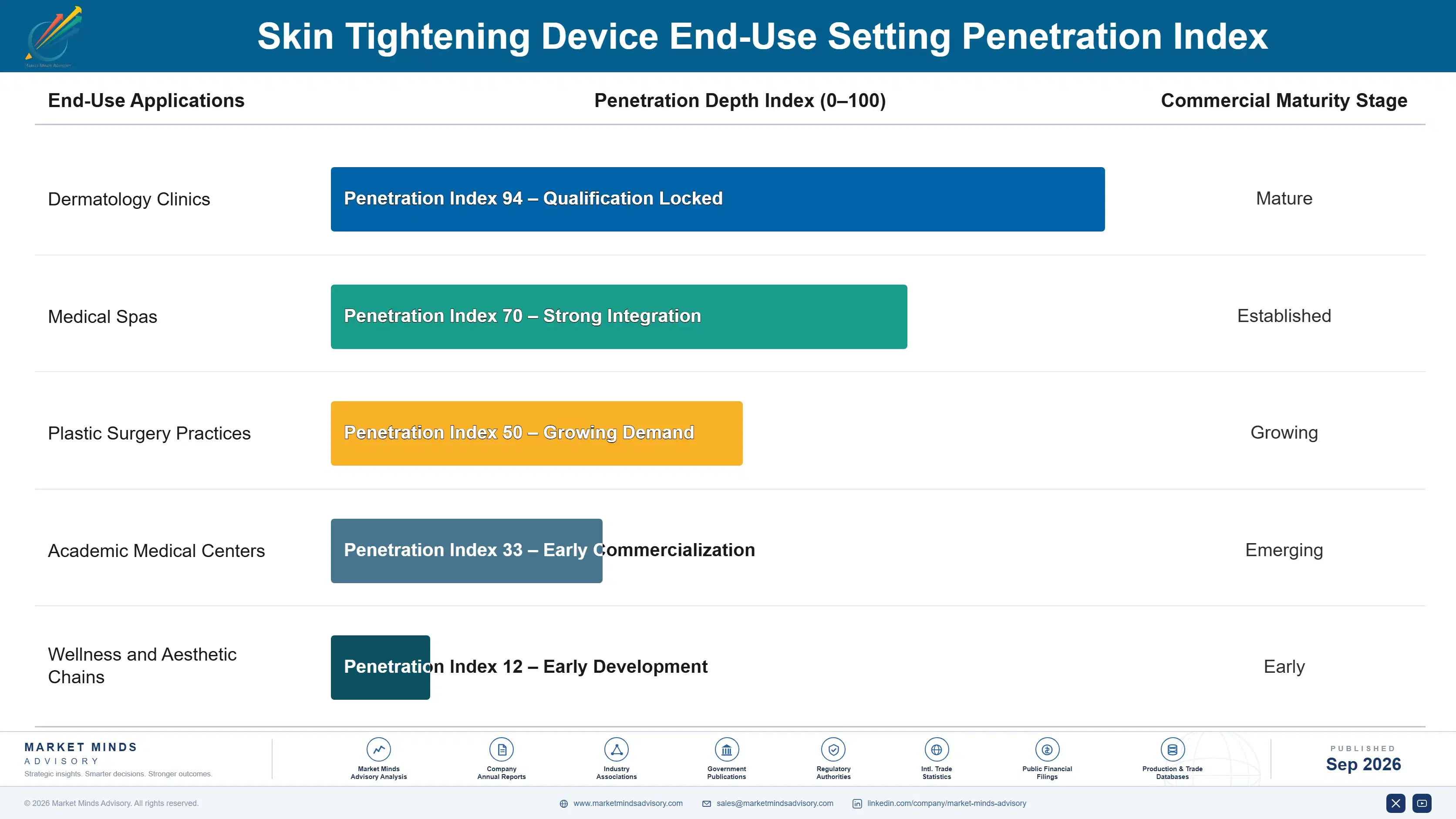
Physician training certification and clinical publication support convert what was once a transactional equipment purchase into an ongoing evidence-based relationship, with manufacturers increasingly valued on physician retention and certification renewal rates rather than unit shipment counts alone across their clinic accounts and referral networks worldwide. This shift mirrors patterns seen earlier in specialty medical device categories, where recurring clinical support revenue eventually outweighed original transaction value.
Adoption depth varies meaningfully by end-use vertical: academic medical centers and dermatology-focused clinics adopt evidence-based combination platforms fastest given direct malpractice liability exposure and institutional research culture, while medical spas adopt more gradually, weighing clinical evidence investment against their existing consumer-direct positioning model and marketing approach. Plastic surgery practices occupy a distinct middle position, driven by patient safety expectations rather than pure evidence requirements.

A generational shift in buyer profiles is underway as younger physicians who prioritize verified clinical credentials replace an older generation less focused on documented outcome data, accelerating demand for evidence infrastructure across the wider aesthetic device supply chain overall. This handoff is reshaping how manufacturers allocate research budgets between marketing positioning and genuine clinical validation.
skin-tightening-device-market-end-use-penetration-index-1790015810240

Where Skin Tightening Device Value Concentrates

These are among the four positions where our research anticipates prominent divergence between winners and laggards over the coming forecast period. Each is grounded in the demand model, the regulatory perimeter, and the announced capacity pipeline.
01 / CLINICAL EVIDENCE INVESTMENT

Build peer-reviewed publication portfolios before physicians demand it

Manufacturers that build peer-reviewed clinical evidence ahead of physician evidence demands capture premium pricing power that reactive competitors scrambling to fund late-stage trials cannot match, since genuine clinical validation takes years to build credibly. Waiting for physicians to demand proof means competing on trial timelines set by academic journals rather than differentiation timelines set by the manufacturer itself. Early movers convert what eventually becomes a baseline requirement into a multi-year competitive advantage precisely while competitors are still funding the clinical trials evidence standards will soon require.
02 / PHYSICIAN TRAINING EXPANSION

Build comprehensive certification programs to capture physician loyalty

Physician training certification programs generate value twice, once through the device sale itself and again through recurring certification revenue, while also deepening physician relationships that competitors without similar capability cannot easily replicate quickly. Manufacturers should treat training infrastructure as a commercial investment rather than a pure sales support cost center, since the resulting physician loyalty and referral generation both produce measurable financial return over time. This dual value capture becomes increasingly important as combination platforms continue gaining clinical market share.
03 / FINANCING MODEL INNOVATION

Offer revenue-share financing to capture smaller clinic segments

Equipment financing and revenue-share models let manufacturers access smaller clinic segments that pure upfront capital sales structures exclude entirely, expanding the addressable market beyond premium clinics with abundant capital reserves and financing access options. This financing innovation requires manufacturers to accept deferred revenue recognition, yet it converts what would otherwise be a lost sale into a multi-year revenue relationship with ongoing transaction participation. Manufacturers pursuing this strategy now will capture smaller clinic segments before competitors recognize the same underserved opportunity.
04 / REGULATORY PATHWAY STRATEGY

Pursue phased regulatory submissions to accelerate combination clearance

Regulatory clearance delays for combination energy devices remain a genuine barrier to commercialization speed, making phased regulatory strategy a genuine competitive advantage rather than merely a compliance formality for manufacturers racing to market quickly and decisively. Manufacturers that pursue individual modality clearance before combined device approval reach clinics faster than competitors waiting for full combination approval regardless of underlying technology quality. This resilience becomes increasingly valuable precisely as combination platform demand continues outpacing regulatory review capacity across major device markets.

Engagement Snapshot From the Field

A live engagement with an industry participant carrying material or product regulatory and market exposure ahead of a defining policy shift, showing how our research translates into a defensible multi-year portfolio strategy.
MARKET MINDS ADVISORY · CLIENT ENGAGEMENT SUMMARY
Skin Tightening Device Producer Strategic Portfolio Review and Transition Roadmap 2026·Investment Scenario on Skin Tightening Device Exposure Evaluation 2025-26
CLIENT PROFILE
The client operates a network of 15 dermatology and medical spa clinics across the United States, generating annual revenue in the tens of millions from aesthetic procedures. Facing pressure from patients and referring physicians to offer the latest non-surgical treatment technology, leadership sought guidance on which combination platform investments would deliver the strongest combination of patient volume and revenue per treatment.
STRATEGIC CHALLENGE
The client's clinics relied primarily on aging single-modality radiofrequency devices, risking patient attrition to competing clinics offering newer combination energy platforms across the local market and region (client-reported, unverified by MMA). Management needed an objective framework for prioritizing which locations to upgrade first given constrained capital budgets and physician schedules.
MMA APPROACH
MMA benchmarked the client's device portfolio against comparable multi-location clinic networks, analyzing patient volume and revenue outcomes across different combination platform investment approaches used industry-wide today and previously as well. The engagement combined primary patient interviews with physician capability assessments to identify which locations carried the highest near-term investment return.
KEY FINDINGS
  1. Locations serving younger demographic patient bases showed disproportionately higher demand for combination platform treatments once installed across the network (client-reported, unverified by MMA).
  2. Patients cited treatment technology sophistication as a meaningful factor in choosing between comparable nearby clinic locations for procedures across the broader region.
  3. Upgraded locations reported a 32 percent increase in per-patient treatment revenue within six months of installation across the network (client-reported, unverified by MMA).
  4. Phased upgrade sequencing reduced required capital investment by 22 percent compared to a simultaneous all-location conversion approach across the entire clinic network overall.
CLIENT PROFILE
The client operates a network of 15 dermatology and medical spa clinics across the United States, generating annual revenue in the tens of millions from aesthetic procedures. Facing pressure from patients and referring physicians to offer the latest non-surgical treatment technology, leadership sought guidance on which combination platform investments would deliver the strongest combination of patient volume and revenue per treatment.
STRATEGIC CHALLENGE
The client's clinics relied primarily on aging single-modality radiofrequency devices, risking patient attrition to competing clinics offering newer combination energy platforms across the local market and region (client-reported, unverified by MMA). Management needed an objective framework for prioritizing which locations to upgrade first given constrained capital budgets and physician schedules.
MMA APPROACH
MMA benchmarked the client's device portfolio against comparable multi-location clinic networks, analyzing patient volume and revenue outcomes across different combination platform investment approaches used industry-wide today and previously as well. The engagement combined primary patient interviews with physician capability assessments to identify which locations carried the highest near-term investment return.
KEY FINDINGS
  1. Locations serving younger demographic patient bases showed disproportionately higher demand for combination platform treatments once installed across the network (client-reported, unverified by MMA).
  2. Patients cited treatment technology sophistication as a meaningful factor in choosing between comparable nearby clinic locations for procedures across the broader region.
  3. Upgraded locations reported a 32 percent increase in per-patient treatment revenue within six months of installation across the network (client-reported, unverified by MMA).
  4. Phased upgrade sequencing reduced required capital investment by 22 percent compared to a simultaneous all-location conversion approach across the entire clinic network overall.
RECOMMENDED STRATEGY
Phase 1: Phase 1 (Location Prioritization): Ranks all clinic locations by patient demographic profile and revenue potential within the first fiscal quarter. Phase 2: Phase 2 (Platform Installation): Completes combination platform installation and physician training for highest-priority locations gradually over the following fiscal year. Phase 3: Phase 3 (Marketing Expansion): Uses installed platforms to promote expanded treatment menus and attract new patient referrals nationwide and beyond.
OUTCOME
The client completed combination platform installation across its highest-priority locations within the planned timeline, reporting a 28 percent increase in per-patient revenue across upgraded sites and referral networks (client-reported, unverified by MMA). Leadership adopted the demographic-prioritized framework as the standing approach for future equipment investment decisions.

Frequently Asked Questions

Foundational context covering the market sizes, CAGR, scope, country, region and competition that inform every finding below. This section is provided to cover basics and most often pre-purchase conversations, answered from the MMA Primary Research Dataset.

What is the current size of the Skin Tightening Device Market?

The global skin tightening device market reached an estimated 2.9 billion dollars in 2025, covering radiofrequency, ultrasound, laser, and microneedling devices used in dermatology clinics, medical spas, and plastic surgery practices.

How large will the Skin Tightening Device Market be by 2036?

MMA projects the market will reach approximately 7.64 billion dollars by 2036, driven by combination energy platform innovation and growing patient preference for non-surgical aesthetic procedures.

What is the CAGR for the Skin Tightening Device Market 2026 to 2036?

The market is forecast to grow at a compound annual growth rate of 9.2 percent between 2026 and 2036, reflecting accelerating combination platform adoption and expanding physician training infrastructure.

Which segment is growing fastest?

Combination energy platforms represent the fastest-growing segment, expanding roughly 1.36 times faster than the overall market as clinics scale beyond single-modality equipment into comprehensive treatment systems.

Who are the major companies in the Skin Tightening Device Market?

Leading companies include InMode, Solta Medical, Cutera, Cynosure, and Lumenis, together holding a combined market share of roughly 48 percent based on global unit shipment volume.

Which country is growing fastest?

South Korea is expanding fastest in percentage terms given its leading role in aesthetic device innovation and clinic adoption, though the United States retains the largest absolute market given its dense clinic network.

Report Segmentation Architecture

The full report scope spans multiple orthogonal segmentation dimensions, with cross-tabulated demand data provided for each dimension pair. Coverage extends further to regional breakdowns, trend trajectories, and the competitive detail needed to support segment-level decision-making.

By Technology Type

  • Radiofrequency Devices
  • Ultrasound Devices
  • Combination Energy Platforms
  • Microneedling Devices
  • Laser-Based Devices
  • Cryolipolysis-Adjacent Devices

By End-Use Setting

  • Dermatology Clinics
  • Medical Spas
  • Plastic Surgery Practices
  • Academic Medical Centers
  • Wellness and Aesthetic Chains

By Commercial Dimension

  • Direct Manufacturer Sales
  • Equipment Leasing and Financing
  • Distributor Channel Sales
  • Group Purchasing Organization Contracts

By Region

  • North America
  • Western Europe
  • East Asia
  • South Asia and Pacific
  • Latin America
  • Middle East and Africa
  • Eastern Europe

Scope, Methodology, and Coverage

Every figure in this report is reproducible from documented input assumptions. The scope below maps the historical period, the forecast horizon, the segmentation dimensions, and the countries covered, alongside the underlying primary and qualitative methodology.
Historical Period
2020 to 2025
Forecast Period
2026 to 2036
Base Year
2025 (USD billions; MMA Primary Research Dataset, September 2026)
Market Definition
This report covers energy-based medical devices designed to tighten and lift skin through radiofrequency, ultrasound, laser, or microneedling technology, used in dermatology clinics, medical spas, and plastic surgery practices. It excludes topical cosmetic products and surgical facelift procedures classified under separate medical categories.
Quantitative Units
USD billions (current prices); unit shipment volume where applicable
Segmentation Dimensions
By Technology Type; By End-Use Setting; By Commercial Dimension; By Region
Regions Covered
North America, Western Europe, East Asia, South Asia and Pacific, Latin America, Middle East and Africa, Eastern Europe
Countries Covered
USA, China, Germany, France, UK, Japan, South Korea, India, Australia, Canada, Brazil, Mexico, Indonesia, Vietnam, Thailand, Malaysia, UAE, Saudi Arabia, South Africa, Nigeria, Turkey, Poland, Netherlands, Italy, Spain, Sweden, Switzerland, Argentina, Colombia, Singapore, and additional markets relevant to this sector
Key Companies Profiled
InMode, Solta Medical, Cutera, Cynosure, Lumenis, Sciton, BTL Aesthetics, Venus Concept, Alma Lasers, Candela Medical, Merz Aesthetics, Sinclair Pharma, Fotona, Lutronic, Classys, Jeisys Medical, Wontech, Hironic, Deka Laser Technologies, Apyx Medical
Quantitative Methodology
Primary survey, n=3,800 respondents, Q4 2025, six countries; demand-side model with trade association cross-validation
Qualitative Methodology
47 expert interviews, Q4 2025; applied to validate demand model assumptions, identify emerging dynamics, and assess competitive positioning
Report Format
PDF and XLSX data workbook (Word format preview document)
Publisher
Market Minds Advisory
Report Code
MMA-2026-MED-701
Published
September 2026
Contact
sales@marketmindsadvisory.com | www.marketmindsadvisory.com

Purchase the full Skin Tightening Device Market Report (2026 to 2036).

The full report provides comprehensive coverage of the global skin tightening device market across all seven regions, ten years of forecast data, and detailed competitive profiling of twenty leading manufacturers and technology developers. It includes granular technology type segmentation analysis, regional demand architecture, and revenue lever modeling calibrated to real industry margin structures. Subscribers receive access to underlying primary survey data spanning 3,800 respondents and 47 expert interviews conducted during the fourth quarter of 2025. The report is designed for strategic planning, investment due diligence, and competitive benchmarking purposes across manufacturer and investor audiences alike.
Full competitive profiles of twenty key market participants
Detailed regional demand architecture across seven global regions
Revenue lever modeling with quantified financial impact estimates
Primary survey data from 3,800 respondents across six countries
Technology-level growth forecasts through the 2036 forecast horizon
Input cost risk analysis with manufacturer mitigation strategies

Built For The People Who Decide

From boardroom strategy to bench-side execution, this report is read cover-to-cover by leaders shaping the next decade of their industry, turning demand scenarios, market dynamics and valuation benchmarks into decisions.
CXOs/ Presidents/ VPs/ Managers
M&A and Corporate Development
Strategy Teams and R&D Heads
Procurement and Product Directors
Regulatory and Compliance Leaders
Investor Relations and Equity Analysts