Market Minds Advisory
Single Phase Shunt Reactor Market

Single Phase Shunt Reactor Market: Single Phase Shunt Reactor Market: Reactive Power Compensation Equipment for High-Voltage Transmission Networks

Ultra-high-voltage transmission expansion and offshore wind interconnection are driving unprecedented single-phase shunt reactor specification volume as grid operators race to compensate for rising line-charging reactive power. across most transmission corridors.

Lead Analyst

Published

September 2026

Make Smarter Decisions with Customized Research Insights

Request a free sample report and evaluate market opportunities, growth trends, and competitive dynamics relevant to your business needs.

2025 MARKET VALUE$0.6BMarket Size 2025
2036 FORECAST VALUE$1.2BBase Case , 2026 to 2036
CAGR 2026 TO 20366.5 %Bull 7.7% / Bear 5.3%
INCREMENTAL OPPORTUNITY$0.6BNet 10- year value creation
EXPANSION MULTIPLE1.88x2036 value over 2026 base
Strategic Levers
M&A Pipeline
Regional Outlook
Country Rankings
Competitive Intelligence
Segmental Deep-dive
Call-Us : 91 93563 13602

Executive Snapshot and Market Trajectory.

Single phase shunt reactor demand is accelerating sharply as ultra-high-voltage transmission corridors and offshore wind interconnection programs strain grid operator reactive power compensation budgets across nearly every major transmission expansion market worldwide today. Manufacturers with established ultra-high-voltage manufacturing capability are capturing outsized share of this accelerating demand.
Renewable interconnection substation applications are the fastest-growing commercial force by a wide margin, with China anchoring the single largest national demand pipeline tracked in this report as its ultra-high-voltage transmission buildout continues at an unprecedented pace. HVDC converter station reactors are also capturing a growing share of new project specifications across multiple continents. India's expanding transmission network contributes meaningful secondary demand tied to comparable ultra-high-voltage corridor investment programs currently underway across multiple states.
The competitive field remains concentrated among a handful of large transformer and reactor manufacturers, with the top five companies controlling roughly 42 percent of global shipment value. Grid stability requirements and renewable interconnection complexity are reshaping which manufacturers can capture new multi-year utility framework agreements as transmission expansion accelerates globally. Manufacturers with proven controllable reactor design capability increasingly capture share from legacy fixed-rating suppliers. Cost discipline persists.
Market Definition
This report covers single-phase shunt reactors used for reactive power compensation on high-voltage transmission lines, HVDC converter stations, and renewable interconnection substations, across oil-immersed and dry-type variants. It excludes three-phase shunt reactor units, series reactors, and low-voltage reactive power equipment.
Base Year Value
$0.6B in 2025 (MMA Primary Research Dataset, September 2026)
Forecast Period
2026 to 2036, eleven discrete annual values
CAGR
6.5% base case. Bull 7.7%. Bear 5.3%.
Fastest Growth Segment
Renewable Interconnection Substations: 11.0% CAGR
Fastest Growth Country
China: 8.5% CAGR
Fastest Growth Region
South Asia and Pacific: 8.3% CAGR
Largest Region
East Asia: 30% of 2025 global value
Market Leaders
Hitachi Energy, Siemens Energy, GE Vernova, TBEA, CG Power and Industrial Solutions. Source: MMA Analysis based on company annual reports.
Primary Survey
n=3,800 procurement and R&D decision-makers, Q4 2025, six countries
Methodology
Demand-side build-up, cross-validated against public data, 47 expert interviews

Single Phase Shunt Reactor Market Forecast Scenarios

single-phase-shunt-reactor-market-size-forecast-scenario-1788411693008
Between 2020 and 2025, single phase shunt reactor demand grew steadily as ultra-high-voltage transmission corridor construction expanded across China and India, with renewable interconnection projects providing an accelerating secondary demand stream through the final two years of the period. Historical growth averaged approximately 5.7 percent annually across this period. Manufacturers that consolidated ultra-high-voltage manufacturing capability during this period captured disproportionate share of the accelerating demand growth.
The base case assumes continued ultra-high-voltage transmission expansion across China and India, sustained HVDC converter station commissioning across multiple continents, and accelerating offshore wind and solar interconnection projects requiring dedicated reactive power compensation equipment. Grid operators increasingly specify variable and controllable reactor designs over fixed-rating units in renewable-heavy transmission corridors. Manufacturer capacity expansion investment continues accelerating as grid operators increasingly specify higher-rated reactor units to manage rising renewable interconnection complexity across multiple continents and voltage classes.
A bull scenario centers on accelerated ultra-high-voltage transmission investment across China and emerging Asian grid expansion markets outpacing current manufacturer production capacity plans. A bear scenario centers on slower renewable interconnection project approvals and delayed transmission corridor financing constraining reactor order volume more than the base case currently assumes across major transmission markets. particularly for manufacturers without diversified.

Renewable Interconnection Reshapes Reactor Specification Demand

Ultra-high-voltage transmission expansion and offshore wind interconnection are converging to push reactor order backlogs to levels manufacturers have not managed in over a decade, forcing utility developers to lock in equipment allocations years ahead of substation commissioning across most major transmission corridors. Manufacturers with early ultra-high-voltage capacity investment are capturing outsized share of this accelerating order backlog across multiple continents. Facility developers increasingly treat reactor procurement as a critical.
TOP 5 CONCENTRATION42%Share of global shipment value held by five largest manufacturers
AVERAGE PRICE PER MVAR$28,000Typical factory price per megavolt-ampere reactive capacity installed
CONTROLLABLE REACTOR ORDER SHARE24%Share of new orders specifying variable or controllable reactor designs
AVERAGE DELIVERY LEAD TIME52 weeksTypical order-to-delivery timeline for custom-engineered reactor units today
ELECTRICAL STEEL COST SHARE36%Grain-oriented electrical steel share of total manufacturing cost
AVERAGE PRODUCT SERVICE LIFE35 yearsTypical operating lifespan before major refurbishment is required
Manufacturers increasingly differentiate through controllable reactor design and grid stability engineering support rather than price alone, particularly for renewable-heavy transmission corridors where reactive power fluctuation management has become a binding technical requirement rather than an optional design feature. Hitachi Energy and Siemens Energy have both expanded dedicated controllable reactor product lines to capture this premium specification shift among transmission operators.
Electrical steel supply chain capacity, manufacturer production expansion timing, and ultra-high-voltage project approval pace will determine which companies convert order backlog into shipped revenue fastest across the coming several years of sustained transmission investment growth worldwide. Manufacturers without a credible ultra-high-voltage manufacturing roadmap risk losing share to better-positioned competitors even as overall project volume expands considerably. Electrical steel price swings also meaningfully affect competitive positioning between manufacturers with differing hedging strategies.
"Everyone talks about transmission lines and substations, but the reactor that keeps voltage stable on a lightly loaded UHV corridor at three in the morning is the unglamorous equipment nobody notices until it's missing."
Practice Lead, Transmission Grid Equipment Intelligence · MMA High-Voltage Transmission Reactive Power Compensation Equipment Practice · September 2026

Market Trends

Controllable Reactor Designs Displace Fixed-Rating Units

Grid operators increasingly specify variable and controllable shunt reactors over legacy fixed-rating designs for renewable-heavy transmission corridors, converting what was once a simple fixed-capacity procurement decision into one that also weighs dynamic reactive power management capability. Hitachi Energy and Siemens Energy have both expanded dedicated controllable reactor product lines covering an increasing share of new substation orders. This shift is opening meaningful engineering service revenue for manufacturers that pair hardware sales with ongoing grid stability consulting, and it is reshaping how transmission operators evaluate competing manufacturer proposals during procurement processes.
Market Impact: Adds 2.8 gigavolt-amperes new capacity
Ultra-High-Voltage Transmission Buildout Strains Manufacturing Capacity

Unprecedented ultra-high-voltage transmission corridor construction continues straining global reactor manufacturing capacity, pushing order lead times to multi-year highs at several major manufacturers unable to expand custom-engineering production fast enough to match accelerating demand. TBEA and CG Power and Industrial Solutions have both announced new manufacturing capacity expansion specifically targeting this sustained ultra-high-voltage order volume across their core production regions. This trend is reshaping which manufacturers can capture new capacity commitments, favoring companies with early capital investment discipline over competitors still evaluating expansion decisions. Manufacturers without early capacity investment risk ceding ultra-high-voltage allocation share to better-positioned global competitors over the coming.
Market Impact: Raises interconnection order volume 13 percent

Market Opportunities and Growth Drivers

Ultra-High-Voltage Transmission Investment Sustains Order Volume

Persistent ultra-high-voltage transmission corridor investment across China and India continues generating substantial new reactor order volume, as grid operators commit to multi-year corridor expansion programs requiring extensive reactive power compensation infrastructure across new and expanding transmission networks. Hitachi Energy and TBEA have both reported record order backlogs as a direct consequence of sustained ultra-high-voltage capital commitments across their core customer accounts. Every incremental transmission corridor commissioned translates directly into additional reactor demand across primary and interconnection categories. Multiple additional transmission corridors are expected across major markets over the coming several years of sustained expansion and investment activity.
Market Impact: Cuts production output 7 percent

Renewable Interconnection Programs Expand Compensation Demand

Growing offshore wind and utility-scale solar interconnection investment continues expanding reactor demand beyond conventional transmission corridors alone, as grid operators install dedicated reactive power compensation equipment to manage variable renewable generation output at interconnection points. Siemens Energy and GE Vernova have both expanded dedicated renewable interconnection product lines to serve this parallel demand stream across utility customers. This trend is expected to persist as renewable capacity additions continue outpacing conventional generation retirements across most major electricity markets. Manufacturers offering field-proven reliability at competitive lead times typically win these increasingly design-driven utility tender processes across most markets.
Market Impact: Delays project completion by 5 months

Market Restraints and Challenges

Electrical Steel Supply Constraints Limit Production Output

Genuine grain-oriented electrical steel supply constraints continue limiting reactor manufacturer production output, since this specialized input depends on a concentrated global supplier base that has not expanded capacity fast enough to match surging transmission equipment demand. The root cause is electrical steel manufacturers prioritizing higher-margin customer segments over reactor-specific orders during periods of constrained global steel supply. Manufacturers are mitigating this by qualifying alternative steel suppliers and redesigning cores around more available material grades, but production constraints remain a meaningful limit on how quickly backlog converts into shipped revenue across most manufacturers.
Market Impact: Lifts controllable reactor share 9 points

Long Custom-Engineering Timelines Delay Project Completion

Persistent custom-engineering and design review timelines continue delaying project completion even where manufacturing capacity is available, since ultra-high-voltage reactor units require extensive site-specific engineering that design teams have not scaled fast enough to match construction volume. The root cause is specialized transmission engineering talent remaining scarce relative to accelerating ultra-high-voltage and renewable interconnection construction demand. Manufacturers are mitigating this through standardized modular design platforms that reduce custom-engineering scope, but the engineering bottleneck remains a meaningful constraint on project completion timelines across most major transmission markets. Some manufacturers have begun forming dedicated engineering partnerships to expand talent capacity.
Market Impact: Extends lead times to 52 weeks
3 additional market trends, 4 additional growth drivers, and 3 additional restraints and challenges are covered in the full report. Contact sales@marketmindsadvisory.com to access the complete intelligence.

Segment CAGR and Growth Architecture

Single phase shunt reactors segment across six mutually exclusive end-use application categories, ranging from mature transmission line compensation through fast-growing renewable interconnection categories that increasingly determine which manufacturers capture new capacity commitments. These distinctions matter for manufacturers setting long-term production investment priorities across transmission markets. Manufacturing scale and engineering expertise increasingly determine which players can compete profitably across both categories.
single-phase-shunt-reactor-market-market-share-analysis-1788411693561

Renewable Interconnection Substations

Renewable interconnection substation applications bundle variable reactive power compensation, dynamic voltage regulation capability, and grid stability engineering support into an end-use category that has become an increasingly important driver of manufacturer revenue growth as offshore wind and utility-scale solar capacity accelerates worldwide. Siemens Energy and GE Vernova have both scaled dedicated renewable interconnection account teams covering an increasing share of new substation commitments across their operating portfolios. Growth here consistently outpaces every other segment because renewable capacity additions show no sign of moderating, and manufacturers with proven variable reactor track records are winning a growing share of new interconnection project awards. Utility demand for demonstrable grid stability performance should further accelerate this segment's growth over the coming several years.
CAGR 11.0%

HVDC Converter Station Reactors

HVDC converter station applications bundle specialized filtering and reactive power compensation equipment, high-reliability engineering requirements, and application-specific manufacturing expertise into a category that serves the rapidly expanding global HVDC transmission project pipeline connecting remote generation to demand centers. Hitachi Energy and TBEA have both scaled dedicated HVDC reactor product lines covering a growing share of converter station project specifications worldwide. Demand is accelerating as HVDC transmission continues displacing conventional AC transmission for long-distance and submarine interconnection projects requiring specialized reactive power management equipment across most major transmission corridors globally. Deployment volume in this segment continues expanding meaningfully as HVDC project commissioning accelerates across most major transmission markets tracked in this comprehensive report.
CAGR 9.0%
Full segment breakdown across 6 segments available in the complete report.

Regional Architecture and Country Demand Map

East Asia's ultra-high-voltage transmission buildout anchors global single phase shunt reactor demand, with China and India together commanding more than a third of global order volume tracked throughout this comprehensive market intelligence report, which is published and thoroughly revised each calendar year for full accuracy.

North America

Renewable interconnection substation construction anchors most regional demand, with utilities across Texas and the Midwest specifying variable reactor designs for expanding wind and solar generation capacity requiring dedicated reactive power management. Hitachi Energy and GE Vernova both maintain substantial domestic manufacturing capacity serving this accelerating demand base. Transmission corridor modernization contributes meaningful secondary demand tied to aging infrastructure replacement across several states. Canadian transmission expansion adds further steady regional demand tied to comparable renewable interconnection and grid modernization programs. Manufacturers with established distributor networks capture disproportionate share of this predictable replacement and expansion volume relative to newer entrants. Framework supply agreements increasingly extend three to five years given the scale of committed renewable interconnection pipelines.
Share: 22% | CAGR: 6.0% (2026 to 2036)

Western Europe

Offshore wind interconnection anchors most regional demand, with Germany and the UK leading adoption of controllable reactor designs across expanding North Sea wind farm connection projects. Siemens Energy and Hitachi Energy both maintain substantial regional manufacturing capacity serving this offshore-driven demand base. Growth trails the global average since the region's core transmission grid is largely mature, limiting demand primarily to renewable interconnection and replacement rather than new corridor construction. Nordic transmission investment, tied to cross-border interconnector projects, contributes a smaller but steadily growing secondary demand stream across the region. Manufacturers increasingly bundle grid stability engineering support into standard offshore wind tender specifications across most major national markets in the region.
Share: 19% | CAGR: 5.0% (2026 to 2036)
Regional intelligence for 5 additional markets available in the complete report: East Asia, South Asia and Pacific, Latin America, Middle East and Africa, Eastern Europe. Contact sales@marketmindsadvisory.com.
single-phase-shunt-reactor-market-country-cagr-analysis-1788411694074

Where Reactor Manufacturers Can Capture Additional Margin

Manufacturers face a widening gap between commodity-priced fixed-rating units and premium controllable reactor configurations, where dynamic reactive power management and renewable interconnection expertise increasingly determine which companies capture expanding transmission budgets across global markets simultaneously. This gap is widening most quickly across markets where renewable interconnection and grid stability requirements now collide directly. today.

Expand Controllable Reactor Manufacturing Capacity Now

Manufacturers that expand dedicated controllable reactor manufacturing capacity can capture a growing share of premium renewable interconnection tenders, since grid operators increasingly specify dynamic reactive power management for variable generation applications where fixed-rating units fall short of requirements. Hitachi Energy's recent capacity expansion added meaningful new production volume within eighteen months, and early results show order premiums running 18 to 24 percent above fixed-rating equivalents. Manufacturers that move early into this category can lock in multi-year utility framework agreements before competitors close the capability gap. This capability gap is widening steadily across most renewable interconnection procurement categories.
Market Impact: Adds 18 to 24 percent order premium overall

Build Dedicated Grid Stability Engineering Support Teams

Manufacturers that build dedicated grid stability engineering support teams can capture consulting revenue that standalone equipment sales cannot access, converting a one-time transaction into an ongoing customer relationship worth considerably more across the substation's multi-decade operating life. Siemens Energy has scaled bundled engineering support across a growing share of its renewable interconnection portfolio, generating service margins running 22 to 28 percent above comparable standalone equipment sales. This model also deepens customer relationships ahead of future expansion cycles. Manufacturers without dedicated engineering capability increasingly partner with specialized grid consultants to remain competitive in complex applications.
Market Impact: Generates margins 22 to 28 points higher overall

Secure Multi-Year Ultra-High-Voltage Framework Agreements Early

Manufacturers that secure multi-year framework supply agreements with ultra-high-voltage transmission operators can achieve production planning certainty that spot-order competitors cannot match, allowing more efficient capacity utilization and better electrical steel procurement terms negotiated well ahead of actual order fulfillment. TBEA has captured a growing share of ultra-high-voltage framework commitments, improving production planning efficiency by roughly 20 percent relative to spot-order manufacturing. This advantage compounds over time as manufacturers build deeper customer relationships that later entrants struggle to replicate quickly. Manufacturers without comparable framework relationships increasingly compete on price alone for remaining spot orders.
Market Impact: Improves production planning efficiency by roughly 20 percent

Qualify Alternative Electrical Steel Suppliers To Ease Bottlenecks

Manufacturers that qualify alternative electrical steel suppliers can reduce production bottlenecks that constrain competitors dependent on a single concentrated supplier base, allowing faster backlog conversion into shipped revenue during periods of sustained material shortage across the industry. GE Vernova has expanded its qualified supplier base considerably, cutting effective material lead times by roughly 25 percent relative to manufacturers still dependent on single-source procurement. This operational resilience becomes increasingly valuable as demand continues outpacing industry-wide production capacity. Manufacturers without comparable supplier diversification face growing pressure from impatient institutional customers. Some manufacturers have begun co-investing in supplier capacity expansion to secure priority.
Market Impact: Cuts material lead times by roughly 25 percent

Who Controls the Margin Pool

Single phase shunt reactor manufacturing remains concentrated among large transformer conglomerates, with the top five manufacturers, evaluated on annual shipment value, controlling roughly 42 percent of global demand. Hitachi Energy and Siemens Energy lead as the two largest global manufacturers, both operating extensive multi-region production networks and full controllable reactor product lines. The gap to challengers like TBEA and CG Power and Industrial Solutions is meaningful but narrowing as capacity expansion accelerates industry-wide.
Current competitive activity centers on manufacturing capacity expansion, controllable reactor technology development, and renewable interconnection specialization rather than pure price competition alone. Several manufacturers have pursued electrical steel supplier qualification to reduce production bottlenecks constraining backlog conversion. GE Vernova continues expanding dedicated renewable interconnection account teams, capturing framework commitments that spot-order competitors increasingly struggle to match.

Emerging pressure comes from Asian manufacturers expanding export capacity into transmission and renewable interconnection tenders previously dominated by established Western players. Manufacturers without sufficient ultra-high-voltage manufacturing capacity risk losing allocation share to better-positioned competitors, even as overall order volume continues expanding. Rankings among mid-tier manufacturers are likely to shift meaningfully as controllable reactor capability becomes the primary basis of premium tender qualification.
single-phase-shunt-reactor-market-company-positioning-matrix-1788411694593

Competitive Moat and Risk Dimensions

HITACHI ENERGY

Moat: Global Controllable Reactor Depth

Hitachi Energy holds one of the broadest controllable reactor portfolios spanning multiple voltage classes and regional certification standards, letting it win regulation-sensitive tenders that manufacturers with narrower controllable reactor offerings cannot fully address across comparable markets. This portfolio breadth also lets the company amortize certification costs across a much larger addressable tender base than narrower competitors.
HITACHI ENERGY

Risk: Premium Price Positioning Risk

Hitachi Energy's controllable reactor product line commands a meaningful price premium over fixed-rating alternatives, exposing the company to share loss in the most cost-sensitive emerging markets where utilities have not yet faced binding renewable interconnection complexity requirements. Management has responded by developing a lower-cost controllable variant targeted specifically at price-sensitive tender categories.
SIEMENS ENERGY

Moat: Established Utility Relationships

Siemens Energy holds deep, multi-decade utility relationships across both mature and emerging transmission markets, giving it a durable advantage in securing multi-year framework agreements that newer entrants without comparable track records struggle to win on technical merit alone. These relationships also generate valuable field performance data that continuously informs product reliability improvements across successive generations.
SIEMENS ENERGY

Risk: Domestic Competitor Cost Pressure

Siemens Energy faces intensifying cost pressure from domestic Asian manufacturers offering comparable reactor units at meaningfully lower prices, exposing the company to gradual share erosion in the most price-sensitive emerging market tender categories over time. Siemens Energy has responded by expanding local manufacturing partnerships specifically to narrow this cost gap in its most exposed markets.

Players Tracked

Prominent Players

Hitachi Energy
Siemens Energy
GE Vernova
TBEA
CG Power and Industrial Solutions

Other Key Players

Hyundai Electric
Toshiba Energy Systems and Solutions
Fuji Electric
Mitsubishi Electric
SGB-SMIT
Bharat Heavy Electricals
Shandong Taikai
Baoding Tianwei
TMC Transformers
EFACEC
WEG
Ormazabal
Hyosung Heavy Industries
Skoda Electric
Elsewedy Electric

Recent Developments

JANUARY 2026

Hitachi Energy launched an expanded controllable reactor product line certified for multiple ultra-high-voltage classes, positioning the company to capture growing renewable interconnection tender demand across China, India, and Southeast Asian markets over the coming several years. The launch reflects several years of dedicated dynamic reactive power research investment across the.
Signal: Signals accelerating manufacturer investment in controllable reactor technology ahead of tightening demand across the continent over the next several years
SEPTEMBER 2025

TBEA entered a joint venture with a specialized component supplier to co-develop dynamic reactive power management systems for the Chinese market, combining domestic manufacturing scale with proven controllable reactor technology capability. The partnership is expected to accelerate certification timelines considerably relative to purely independent domestic development efforts.
Signal: Reflects growing domestic manufacturer investment in closing the controllable reactor technology gap facing established multinational competitors
APRIL 2025

GE Vernova acquired a regional grid stability engineering firm to expand its bundled consulting capability across renewable interconnection markets, adding immediate technical talent and established utility customer relationships. The acquired firm brought several dozen experienced grid engineers and long-standing utility advisory relationships into the combined operation.
Signal: Indicates growing manufacturer focus on recurring engineering revenue over equipment sales alone across emerging renewable interconnection markets

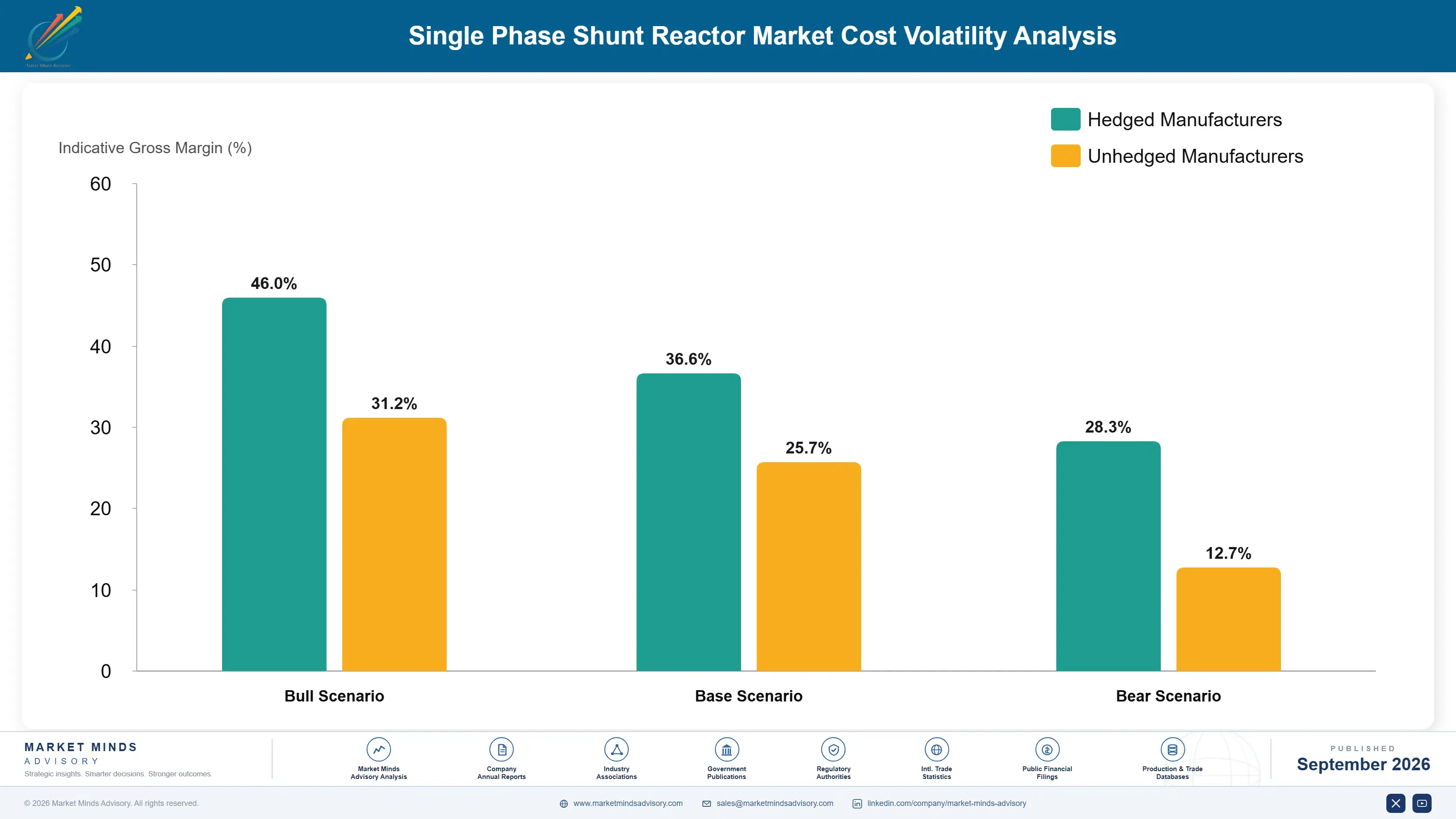
Electrical Steel Cost Exposure

Grain-oriented electrical steel represents the largest input category for shunt reactor manufacturers, typically running 36 percent of total manufacturing cost, sourced primarily through a concentrated global supplier base spanning Japan, South Korea, and China. Copper winding and insulation components add a further meaningful cost share that varies by reactor rating. Insulation media and bushing components add a further modest cost share.
Electrical steel price volatility during 2025 illustrated this exposure clearly, with prices rising sharply following capacity constraints at major producing mills, according to the US Census Bureau's industrial metals trade reporting. Manufacturers with multi-year fixed-price utility framework agreements absorbed meaningful margin pressure over the affected quarters, since most contracts lack commodity pass-through provisions that would allow cost recovery mid-contract. Prices have since partially normalized but remain above pre-disruption baseline levels across most producing regions.

This cost exposure creates a real competitive disadvantage for manufacturers without commodity hedging programs or diversified supplier relationships in place, since unhedged exposure during volatile periods can erode margins that better-prepared competitors largely avoid. Manufacturers concentrated on single-source electrical steel procurement face further exposure to allocation constraints during periods of global supply tightness. particularly across smaller regional fabricators.
single-phase-shunt-reactor-market-cost-volatility-analysis-1788411694790

Long-Term Steel Supply Agreements

Manufacturers increasingly lock in multi-year electrical steel supply agreements at fixed or index-linked prices, insulating a meaningful share of procurement volume from spot-market price volatility during periods of constrained global steel mill capacity. Several manufacturers have extended average agreement tenure to three years, locking in favorable pricing ahead of anticipated demand growth across expanding tender pipelines.

Diversified Steel Supplier Qualification

Several major manufacturers now qualify multiple electrical steel suppliers across different producing regions, reducing both cost exposure and production disruption risk relative to competitors relying entirely on single-source procurement arrangements. This diversification has meaningfully reduced average supply disruption risk for manufacturers that adopted it earliest across their production networks. across most portfolios. across product categories.

Index-Linked Utility Contract Clauses

Manufacturers increasingly negotiate index-linked commodity pass-through clauses into multi-year utility framework agreements, allowing partial cost recovery during periods of sustained input price inflation that fixed-price contracts cannot otherwise absorb. Utilities increasingly accept these clauses as standard practice given demonstrated volatility of global electrical steel markets in recent years. and volume commitments. across major deals.

Portfolio Architecture for Margin Defence

Single phase shunt reactor portfolios span a wide margin range, from commodity-priced fixed-rating configurations through premium controllable variants that command substantially better project economics and manufacturer returns across most competitive tender categories today. Volume-tier fixed units remain necessary for maintaining manufacturing utilization but contribute comparatively thin margins against steadily rising input costs. Manufacturers with diversified portfolios weather commodity cycles better than single-tier specialists.
The real margin tension sits between maintaining manufacturing utilization through high-volume fixed-rating tenders and reallocating capital toward controllable capacity that commands materially better economics in renewable-heavy transmission markets. Manufacturers leaning too heavily into commodity volume risk ceding premium renewable interconnection tenders to better-equipped competitors, while those overinvesting in controllable capacity risk underutilized manufacturing lines during periods of weaker fixed-rating order flow. Getting this balance right shapes long-term profitability considerably.

High-value margin pools concentrate clearly in controllable reactor product lines and bundled grid stability engineering services, where dynamic reactive power management and recurring consulting revenue both command premiums well above standard fixed-rating unit sales available elsewhere. Manufacturers positioning across both dimensions simultaneously capture the strongest blended portfolio economics available in this market today, and the gap versus single-dimension competitors continues widening steadily.

Volume / Commodity-Adjacent

Fixed-rating shunt reactor units sold primarily on price into standard transmission tenders, maintaining manufacturing utilization but contributing comparatively thin margins against rising input costs. Manufacturing utilization here mainly serves fixed overhead recovery rather than driving meaningful margin expansion.
Gross Margin: 12 to 18%

Premium / Certified

Controllable reactor units commanding tender premiums tied to dynamic reactive power management and superior total lifecycle cost economics for renewable-heavy corridors. This tier increasingly commands the largest share of manufacturer capital allocation decisions.
Gross Margin: 22 to 30%

Sustainability / Regulatory / Next-Generation

Bundled grid stability engineering contracts and ultra-high-voltage framework agreements generating recurring high-margin revenue independent of individual unit sale cycles. This is the fastest-growing margin tier across the entire manufacturer portfolio landscape today.
Gross Margin: 28 to 36%
single-phase-shunt-reactor-market-portfolio-architecture-1788411695295

High-value Sub-segments and Strategic Watch-out

Controllable Reactor Product Lines

The clearest high-value high-growth pocket in this market, combining premium tender pricing with the fastest segment CAGR tracked, as renewable-heavy transmission corridors increasingly treat dynamic reactive power management as standard specification. Capital allocation here should continue rising through the forecast period. Manufacturers should prioritize this category above other capital projects.
Gross Margin: 22 to 30%

Bundled Grid Stability Engineering Services

A high-value moderate-growth pool where recurring consulting revenue commands strong margins even as new unit sale growth moderates across already well-served core national markets. Manufacturers with established field service networks hold a durable edge in this segment. Institutional utility customers increasingly favor bundled contracts over standalone equipment procurement.
Gross Margin: 26 to 34%

Standard Fixed-Rating Volume Units

The volume core of this market, providing steady commodity-tier revenue at thinner margins that fund manufacturing utilization without materially expanding overall profitability across cycles. Manufacturers rely on this segment mainly to keep production lines productively utilized. Margins here rarely exceed the mid-teens even in favorable pricing years.
Gross Margin: 12 to 18%

Legacy Non-Controllable Reactor Formats

A strategic watch-out segment losing share to controllable alternatives as renewable interconnection complexity rises, forcing manufacturers still dependent on this format to plan technology transition before contracts lapse. Early transition planning reduces stranded manufacturing capacity risk considerably. Revenue pressure here should build steadily through the forecast period.
Gross Margin: 9 to 14%

Recurring Revenue Beyond Unit Sales

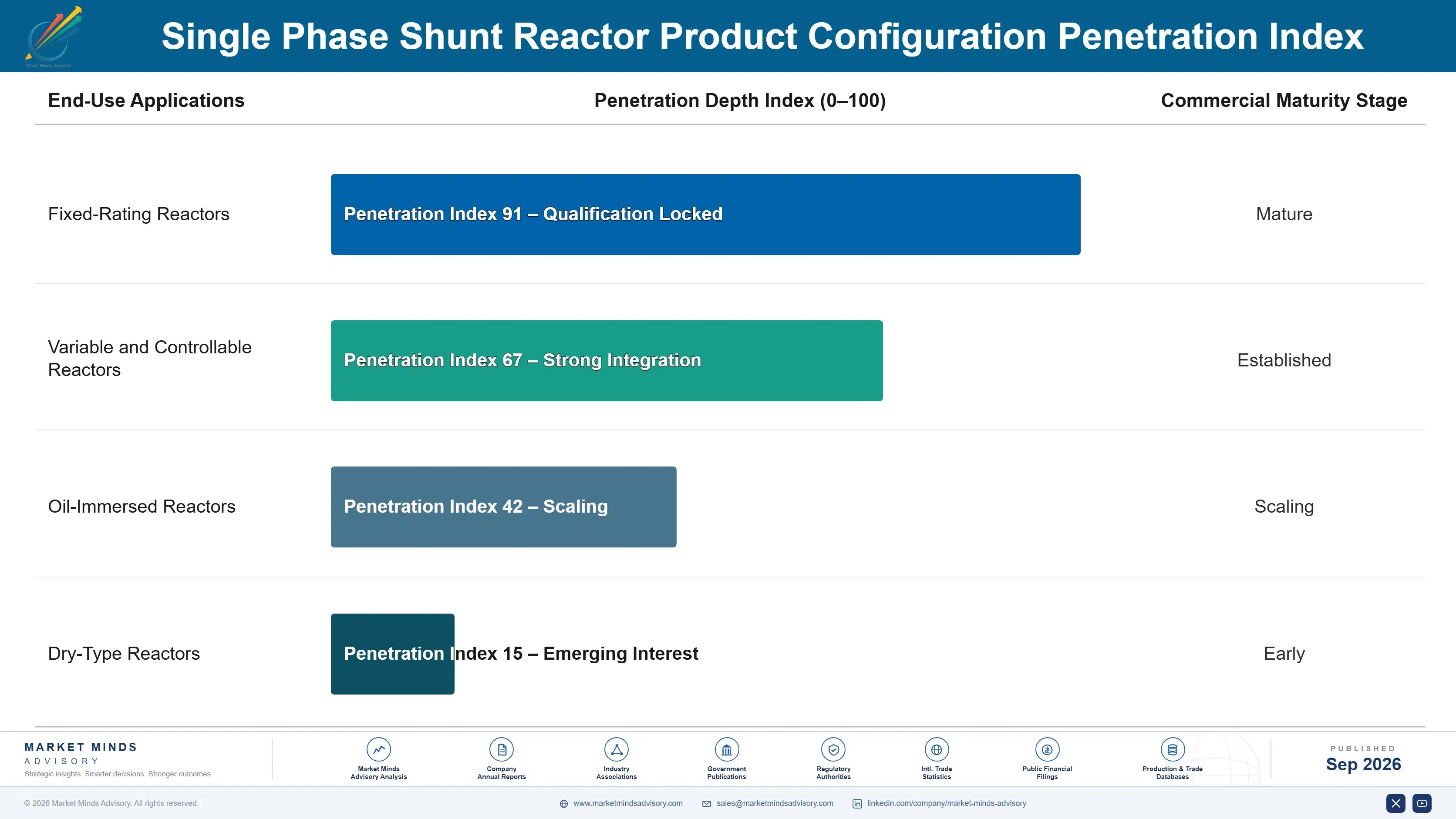
Bundled grid stability engineering contracts and multi-year framework agreements increasingly function like annuity revenue streams, generating predictable income across years of installed base operation rather than the one-time transaction structure that historically defined shunt reactor sales. Manufacturers with substantial installed base scale now derive a meaningful share of annual revenue from recurring engineering support and spare parts contracts rather than new unit sales alone. This shift is meaningfully improving how manufacturers value installed base portfolios during acquisition and strategic.
Adoption depth varies meaningfully by end-use vertical. Ultra-high-voltage transmission customers show the deepest stickiness, since switching manufacturers mid-framework-agreement carries real compatibility and performance continuity risk across multi-year corridor development programs. Standard replacement customers show comparatively shallower stickiness, treating procurement as a more transactional, price-driven decision with lower switching costs between competing manufacturer bids. Manufacturers increasingly design framework terms specifically to deepen ultra-high-voltage customer retention beyond what standard sales alone achieve.

Buyer profiles are also shifting generationally, as transmission procurement teams increasingly staffed by renewable-integration-focused engineers prioritize verified dynamic reactive power performance over the pure upfront price considerations that dominated purchasing decisions a decade ago. This generational shift favors manufacturers investing in controllable reactor technology over those competing primarily on price alone.
single-phase-shunt-reactor-market-end-use-penetration-index-1788411695786

Where Reactor Manufacturers Should Focus Next

These are among the four positions where our research anticipates prominent divergence between winners and laggards over the coming forecast period. Each is grounded in the demand model, the regulatory perimeter, and the announced capacity pipeline.
01 / CONTROLLABLE TECHNOLOGY PRIORITY

Prioritize controllable reactor capacity ahead of fixed-rating expansion

Controllable reactor units are growing considerably faster than legacy fixed-rating formats and increasingly function as the default specification for renewable-heavy transmission corridors rather than an optional premium choice reserved for the most complex applications. Manufacturers that continue investing primarily in legacy fixed-rating manufacturing capacity risk losing share in renewable interconnection markets as this shift accelerates across most major transmission economies worldwide. Capital allocated toward controllable capacity today should generate materially stronger order premiums than comparable fixed-rating investment over the coming decade.
02 / GRID ENGINEERING SPECIALIZATION

Build dedicated grid stability engineering teams ahead of rivals

Renewable interconnection demand is growing nearly twice as fast as the broader market, and grid operators increasingly favor manufacturers with proven dynamic reactive power management expertise over general-purpose equipment suppliers lacking comparable engineering depth and field track record. Hitachi Energy and Siemens Energy have both demonstrated that engineering specialization delivers meaningfully stronger project win rates than manufacturers competing as generalists across multiple application categories. Manufacturers without a credible engineering roadmap risk ceding the fastest-growing segment to better-positioned competitors over the coming several years.
03 / EMERGING MARKET LOCALIZATION

Deepen India and Southeast Asia presence ahead of rivals

South Asia and Pacific carries this market's fastest regional CAGR, and India's expanding ultra-high-voltage transmission network represents a similarly under-served high-growth opportunity relative to established, thoroughly saturated Western markets elsewhere in the world. Manufacturers that establish local manufacturing licenses and engineering presence early can capture meaningful first-mover advantage before larger competitors reallocate manufacturing capacity toward these newly active corridors and their expanding transmission programs. Waiting for these markets to mature before entering risks ceding early relationships to more nimble regional competitors.
04 / COMMODITY RISK MANAGEMENT

Formalize hedging programs to protect multi-year contract margins

Electrical steel price volatility remains one of the sector's most persistent constraints on manufacturer margin predictability, particularly for multi-year utility framework agreements that lack meaningful commodity pass-through provisions built into contract terms. Manufacturers that build dedicated hedging and index-linked contract capability can absorb input cost shocks considerably better than manufacturers relying entirely on fixed-price bidding common earlier in the sector's history. Manufacturers without a credible commodity risk strategy risk margin erosion during future input cost inflation episodes across key operating markets.

Engagement Snapshot From the Field

A live engagement with an industry participant carrying material or product regulatory and market exposure ahead of a defining policy shift, showing how our research translates into a defensible multi-year portfolio strategy.
MARKET MINDS ADVISORY · CLIENT ENGAGEMENT SUMMARY
Single Phase Shunt Reactor Producer Strategic Portfolio Review and Transition Roadmap 2026·Investment Scenario on Single Phase Shunt Reactor Exposure Evaluation 2025-26
CLIENT PROFILE
A regional transmission system operator managing a growing portfolio of renewable interconnection substations across a single national grid engaged MMA to evaluate reactor technology strategy ahead of a major multi-year procurement framework. The client had historically relied on fixed-rating units and sought an independent assessment of whether controllable reactor technology justified its premium cost. overall.
STRATEGIC CHALLENGE
The client faced a critical technology selection decision involving a procurement framework worth a meaningful share of its annual capital budget, with limited internal expertise to independently evaluate competing manufacturer claims about controllable reactor performance relative to the substantial cost premium involved. and its board was divided on which path offered the better long-term return on investment.
MMA APPROACH
MMA conducted a comparative technology assessment drawing on primary interviews with manufacturers and independent grid engineers, benchmarking reactive power management outcomes and total cost of ownership across controllable and fixed-rating alternatives for the client's specific renewable interconnection profile and grid stability requirements. supplemented by a review of comparable operator decisions in similar renewable-heavy grid profiles.
KEY FINDINGS
  1. Controllable reactor technology delivered meaningfully superior dynamic reactive power management for the client's specific renewable-heavy grid profile, justifying a premium the client's internal team had initially assessed as excessive relative to expected benefit.
  2. Total lifecycle cost, including anticipated grid stability requirements over the following several years, favored controllable technology despite its higher upfront price once compliance risk was properly incorporated into the comparison.
  3. Two of the three manufacturers evaluated lacked sufficient controllable reactor manufacturing capacity to meet the client's preferred procurement timeline without extended lead times, introducing schedule risk the client had not previously identified.
  4. Bundled grid stability engineering support offered by the controllable reactor supplier provided useful application-specific guidance that standalone equipment purchases from the fixed-rating supplier did not include at comparable cost.
CLIENT PROFILE
A regional transmission system operator managing a growing portfolio of renewable interconnection substations across a single national grid engaged MMA to evaluate reactor technology strategy ahead of a major multi-year procurement framework. The client had historically relied on fixed-rating units and sought an independent assessment of whether controllable reactor technology justified its premium cost. overall.
STRATEGIC CHALLENGE
The client faced a critical technology selection decision involving a procurement framework worth a meaningful share of its annual capital budget, with limited internal expertise to independently evaluate competing manufacturer claims about controllable reactor performance relative to the substantial cost premium involved. and its board was divided on which path offered the better long-term return on investment.
MMA APPROACH
MMA conducted a comparative technology assessment drawing on primary interviews with manufacturers and independent grid engineers, benchmarking reactive power management outcomes and total cost of ownership across controllable and fixed-rating alternatives for the client's specific renewable interconnection profile and grid stability requirements. supplemented by a review of comparable operator decisions in similar renewable-heavy grid profiles.
KEY FINDINGS
  1. Controllable reactor technology delivered meaningfully superior dynamic reactive power management for the client's specific renewable-heavy grid profile, justifying a premium the client's internal team had initially assessed as excessive relative to expected benefit.
  2. Total lifecycle cost, including anticipated grid stability requirements over the following several years, favored controllable technology despite its higher upfront price once compliance risk was properly incorporated into the comparison.
  3. Two of the three manufacturers evaluated lacked sufficient controllable reactor manufacturing capacity to meet the client's preferred procurement timeline without extended lead times, introducing schedule risk the client had not previously identified.
  4. Bundled grid stability engineering support offered by the controllable reactor supplier provided useful application-specific guidance that standalone equipment purchases from the fixed-rating supplier did not include at comparable cost.
RECOMMENDED STRATEGY
Phase 1: Phase 1: Conduct grid-wide reactive power assessment to identify priority substations for controllable reactor deployment first. across the entire grid footprint. Phase 2: Phase 2: Select a manufacturer with proven controllable reactor capacity and firmly established renewable interconnection engineering support capability, verified directly. Phase 3: Phase 3: Structure the multi-year procurement framework to secure preferential pricing and guaranteed delivery timelines across remaining substation needs. over time.
OUTCOME
The client proceeded with a phased controllable reactor procurement program starting with its highest-priority renewable interconnection substations, reporting improved grid stability performance relative to its prior fixed-rating baseline (client-reported, unverified by MMA). The client also credited the bundled engineering support with meaningfully improving deployment planning efficiency.

Frequently Asked Questions

Foundational context covering the market sizes, CAGR, scope, country, region and competition that inform every finding below. This section is provided to cover basics and most often pre-purchase conversations, answered from the MMA Primary Research Dataset.

What is the current size of the Single Phase Shunt Reactor Market?

The global single phase shunt reactor market reached an estimated 0.62 billion dollars in 2025. This reflects accelerating ultra-high-voltage transmission and renewable interconnection investment worldwide.

How large will the Single Phase Shunt Reactor Market be by 2036?

MMA projects the market will reach approximately 1.24 billion dollars by 2036. This represents roughly 1.88 times its 2026 base value over the forecast period.

What is the CAGR for the Single Phase Shunt Reactor Market 2026 to 2036?

The market is projected to grow at a 6.5 percent CAGR between 2026 and 2036. Bull and bear scenarios range from 5.3 to 7.7 percent depending on transmission investment.

Which segment is growing fastest?

Renewable interconnection substation applications are the fastest-growing segment, expanding at roughly 11.0 percent annually, well above the overall market rate. Offshore wind buildout drives this acceleration.

Who are the major companies in the Single Phase Shunt Reactor Market?

Leading manufacturers include Hitachi Energy, Siemens Energy, GE Vernova, TBEA, and CG Power and Industrial Solutions. These five companies account for approximately 42 percent of global shipment value.

Which country is growing fastest?

China is the fastest-growing major market, expanding at roughly 8.5 percent annually. Its unprecedented, rapidly expanding ultra-high-voltage transmission corridor buildout drives this sustained rapid growth.

Report Segmentation Architecture

The full report scope spans multiple orthogonal segmentation dimensions, with cross-tabulated demand data provided for each dimension pair. Coverage extends further to regional breakdowns, trend trajectories, and the competitive detail needed to support segment-level decision-making.

By End-Use Application

  • Transmission Line Compensation
  • HVDC Converter Station Reactors
  • Cable System Compensation
  • Renewable Interconnection Substations
  • Neutral Grounding Reactors
  • Industrial and Utility Substation Reactors

By Product Configuration

  • Fixed-Rating Reactors
  • Variable and Controllable Reactors
  • Oil-Immersed Reactors
  • Dry-Type Reactors

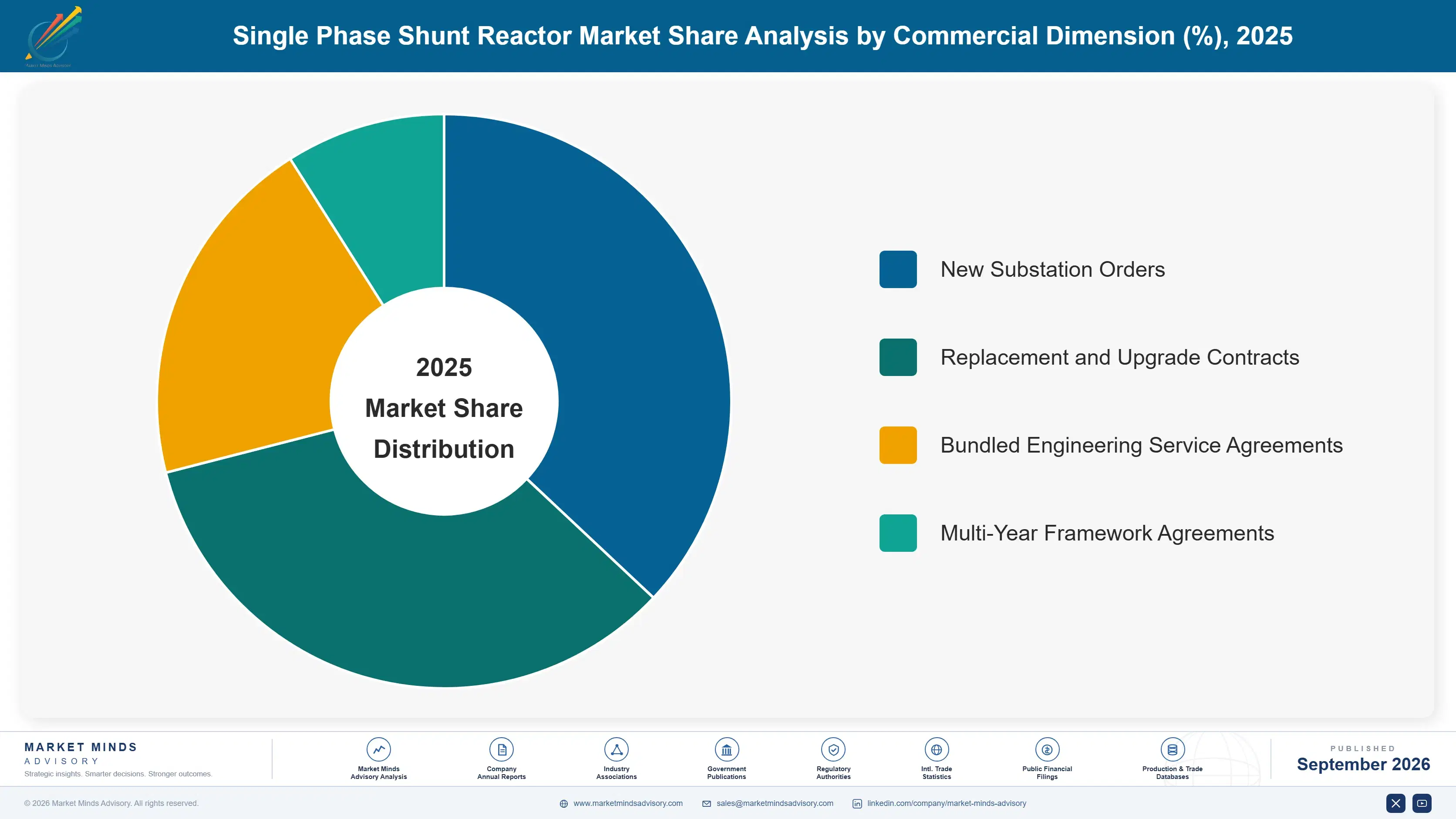
By Commercial Dimension

  • New Substation Orders
  • Replacement and Upgrade Contracts
  • Bundled Engineering Service Agreements
  • Multi-Year Framework Agreements

By Region

  • North America
  • Western Europe
  • East Asia
  • South Asia and Pacific
  • Latin America
  • Middle East and Africa
  • Eastern Europe

Scope, Methodology, and Coverage

Every figure in this report is reproducible from documented input assumptions. The scope below maps the historical period, the forecast horizon, the segmentation dimensions, and the countries covered, alongside the underlying primary and qualitative methodology.
Historical Period
2020 to 2025
Forecast Period
2026 to 2036
Base Year
2025 (USD billions; MMA Primary Research Dataset, September 2026)
Market Definition
This report covers single-phase shunt reactors used for reactive power compensation on high-voltage transmission lines, HVDC converter stations, and renewable interconnection substations, across oil-immersed and dry-type variants. It excludes three-phase shunt reactor units, series reactors, and low-voltage reactive power equipment.
Quantitative Units
USD billions (current prices); installed capacity in megavolt-amperes reactive where applicable
Segmentation Dimensions
By End-Use Application; By Product Configuration; By Commercial Dimension; By Region
Regions Covered
North America, Western Europe, East Asia, South Asia and Pacific, Latin America, Middle East and Africa, Eastern Europe
Countries Covered
USA, China, Germany, France, UK, Japan, South Korea, India, Australia, Canada, Brazil, Mexico, Saudi Arabia, UAE, South Africa, Nigeria, Egypt, Kenya, Poland, Romania, Ukraine, Netherlands, Italy, Spain, Chile, Colombia, and additional markets relevant to this sector
Key Companies Profiled
Hitachi Energy, Siemens Energy, GE Vernova, TBEA, CG Power and Industrial Solutions, Hyundai Electric, Toshiba Energy Systems and Solutions, Fuji Electric, Mitsubishi Electric, SGB-SMIT, Bharat Heavy Electricals, Shandong Taikai, Baoding Tianwei, TMC Transformers, EFACEC, WEG, Ormazabal, Hyosung Heavy Industries, Skoda Electric, Elsewedy Electric
Quantitative Methodology
Primary survey, n=3,800 respondents, Q4 2025, six countries; demand-side model with trade association cross-validation
Qualitative Methodology
47 expert interviews, Q4 2025; applied to validate demand model assumptions, identify emerging dynamics, and assess competitive positioning
Report Format
PDF and XLSX data workbook (Word format preview document)
Publisher
Market Minds Advisory
Report Code
MMA-2026-ENE-329
Published
September 2026
Contact
sales@marketmindsadvisory.com | www.marketmindsadvisory.com

Purchase the full Single Phase Shunt Reactor Market Report (2026 to 2036).

This report provides comprehensive analysis of the global single phase shunt reactor market, covering reactor technology, manufacturing economics, and competitive dynamics across all major transmission and renewable interconnection segments. It includes detailed segmentation by end-use application, product configuration, and commercial dimension. Regional analysis spans seven geographies, alongside competitive profiling of the twenty largest global manufacturers. The report draws on primary survey data from 3,800 respondents and 47 expert interviews conducted in the fourth quarter of 2025, supplemented by company disclosures and government energy statistics. It also includes detailed segment-level margin and pricing analysis.
Ten-year global market sizing and forecast
Seven-region demand share and pricing analysis
Twenty-company competitive benchmarking and profiling assessment
Segment-level growth rate and margin data
Input cost and supply chain risk assessment
Case study with recommended technology strategy

Built For The People Who Decide

From boardroom strategy to bench-side execution, this report is read cover-to-cover by leaders shaping the next decade of their industry, turning demand scenarios, market dynamics and valuation benchmarks into decisions.
CXOs/ Presidents/ VPs/ Managers
M&A and Corporate Development
Strategy Teams and R&D Heads
Procurement and Product Directors
Regulatory and Compliance Leaders
Investor Relations and Equity Analysts