Market Minds Advisory
Simulation Role-Playing Game Market

Simulation Role-Playing Game Market: Simulation Role-Playing Game Market. Trends and Forecast 2026 to 2036

Publishers are shifting development budgets away from single-purchase titles toward live-service simulation and role-playing games with recurring cosmetic and content sales, betting that sustained engagement now earns more than any one-time box price ever did.

Lead Analyst

Published

September 2026

Make Smarter Decisions with Customized Research Insights

Request a free sample report and evaluate market opportunities, growth trends, and competitive dynamics relevant to your business needs.

2025 MARKET VALUE$22.0BMarket Size 2025
2036 FORECAST VALUE$59.7BBase Case , 2026 to 2036
CAGR 2026 TO 20369.5 %Bull 10.8% / Bear 8.2%
INCREMENTAL OPPORTUNITY$35.6BNet 10- year value creation
EXPANSION MULTIPLE2.48x2036 value over 2026 base
Strategic Levers
M&A Pipeline
Regional Outlook
Country Rankings
Competitive Intelligence
Segmental Deep-dive
Call-Us : 91 93563 13602

Executive Snapshot and Market Trajectory.

Publishers keep redirecting development budgets toward live-service simulation and role-playing titles generating recurring cosmetic and content revenue, since a single successful live-service game now earns more over its lifetime than most traditional one-time box purchase titles ever could achieve across the entire industry.
Mobile gacha and live-service role-playing games are expanding fastest as smartphone hardware capability closes the gap with console experiences, while open-world action RPGs lead premium console and PC spending among enthusiast players willing to pay full retail price for flagship titles each year. East Asia and North America together account for most player spending activity, reflecting concentrated mobile gaming monetization and console market maturity in both regions respectively, a pattern MMA expects to persist.
Competitive intensity remains high as established console publishers, mobile-first studios, and independent developers all compete across overlapping genre categories, keeping player acquisition costs elevated across the entire industry despite continued revenue growth and expanding player bases. Regulatory attention is building around loot box and gacha monetization mechanics, with several jurisdictions considering disclosure requirements or outright restrictions on randomized in-game purchase systems embedded in most live-service titles worldwide today.
Market Definition
The Simulation Role-Playing Game Market covers video games combining character progression, narrative-driven role-playing mechanics, and simulation-based systems across console, PC, and mobile platforms, measured by software and in-game transaction revenue. It excludes pure simulation titles lacking role-playing progression systems and esports competitive titles without narrative role-playing elements.
Base Year Value
$22.0B in 2025 (MMA Primary Research Dataset, September 2026)
Forecast Period
2026 to 2036, eleven discrete annual values
CAGR
9.5% base case. Bull 10.8%. Bear 8.2%.
Fastest Growth Segment
Mobile Gacha and Live-Service RPGs: 13.0% CAGR
Fastest Growth Country
India: 13.0% CAGR
Fastest Growth Region
South Asia and Pacific: 11.5% CAGR
Largest Region
East Asia: 30% of 2025 global value
Market Leaders
Leading participants include Tencent Holdings, NetEase, Sony Interactive Entertainment, Square Enix, and Bandai Namco Entertainment. Source: MMA Primary Research Dataset, July 2026.
Primary Survey
n=3,800 procurement and R&D decision-makers, Q4 2025, six countries
Methodology
Demand-side build-up, cross-validated against public data, 47 expert interviews

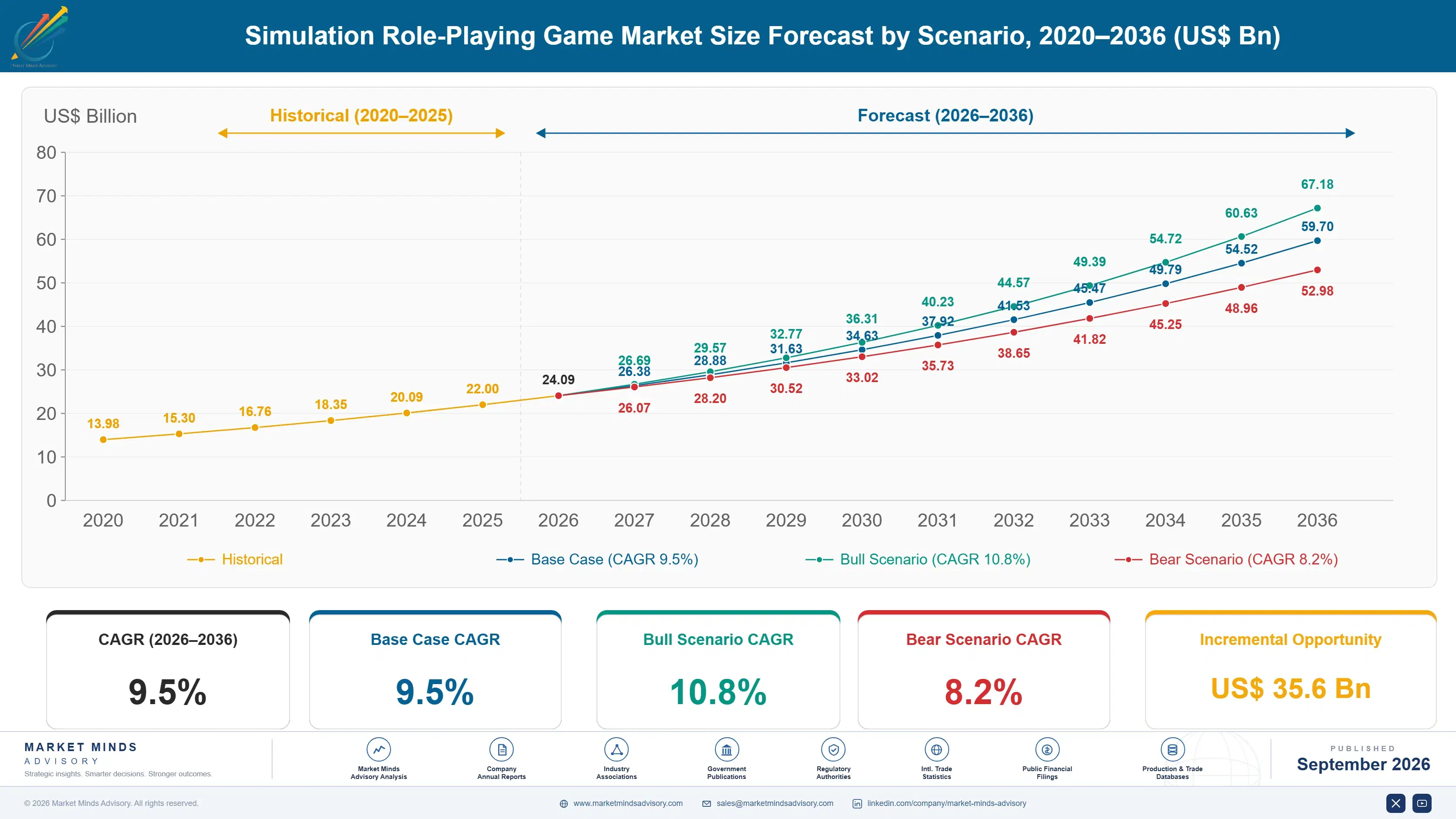
Simulation Role-Playing Game Market Forecast Scenarios

simulation-role-playing-game-market-size-forecast-scenario-1788427194404
Between 2020 and 2025, simulation role-playing game revenue grew steadily as mobile gacha titles matured into sustained live-service franchises and console publishers expanded open-world RPG production budgets substantially across their flagship franchise lineups. Historical growth ran near 8.5% annually through this period as adoption broadened across platforms nationwide and internationally throughout the entire gaming industry.
The base case assumes continued mobile gacha monetization maturity, expanding open-world RPG production budgets, and steady console hardware upgrade cycles supporting increasingly ambitious simulation and role-playing titles, sustaining growth near 9.5% annually through 2036. Publishers increasingly treat live-service RPGs as durable entertainment platforms generating years of recurring revenue rather than isolated launch events, broadening addressable player spending considerably beyond the traditional one-time purchase model that historically defined the genre across most major publishers and franchises.
A bull scenario near 10.8% depends on faster cloud gaming adoption removing hardware barriers that currently limit premium simulation RPG access in price-sensitive emerging markets across the region. The bear case near 8.2% reflects the risk that regulatory restrictions on gacha monetization mechanics compress the mobile segment's revenue growth meaningfully across several major jurisdictions currently considering restrictive legislation this year.

The Purchase Became a Subscription Without the Name

Simulation role-playing games stopped being a one-time purchase category years ago, since live-service monetization now generates the majority of category revenue through cosmetic sales, expansion content, and seasonal battle pass systems rather than initial box price alone, reshaping how studios plan long-term production budgets and staffing.
MARKET CONCENTRATION38% CR5Share held by the five largest tracked publishers
AVERAGE PLAYER SPEND$85 per yearTypical annual in-game spending by an active player
TOP CONSUMING COUNTRY24% ChinaShare of global player spending concentrated in this market
MOBILE REVENUE SHARE58% of total revenueShare of category revenue generated through mobile platforms
LIVE-SERVICE REVENUE SHARE65% of total revenueShare of revenue from ongoing content rather than initial sale
AVERAGE DEVELOPMENT CYCLE3 to 5 yearsTypical production timeline for a flagship simulation RPG title
Development remains concentrated among a handful of large publishers with the capital to fund multi-year flagship productions, while a separate and fragmented mobile studio landscape competes on gacha monetization design and live operations execution across distributed player bases spanning multiple platforms and regions worldwide. Price competition intensifies further in the free-to-play mobile tier, pushing studios to differentiate through content update cadence and player retention mechanics that competitors cannot easily replicate quickly or cheaply.
Open-world scale premiumization is reshaping flagship title budgets upward within console and PC categories, as ambitious single-player narrative RPGs command meaningfully higher production investment and retail pricing than standard genre titles sold at ordinary commodity pricing across most distribution channels worldwide. Publishers increasingly position live-service RPGs as a hedge against the box-price revenue ceiling facing persistent competitive pressure from free-to-play alternatives gaining player attention and market share.
"Nobody buys a game once anymore, not in this genre. They buy a relationship, and the publisher's job is making sure it lasts years."
Senior Analyst, Interactive Entertainment and Gaming Practice · MMA Technology Practice · September 2026

Market Trends

Live-Service Content Cadence Sustains Player Spending

Publishers increasingly commit to regular seasonal content updates, including new characters, storylines, and cosmetic items, keeping simulation RPG player bases engaged well beyond a title's initial launch window and driving sustained monetization across the entire live-service lifecycle. This content cadence requires ongoing development investment that smaller studios often cannot sustain, favoring publishers with the capital and production pipeline discipline to deliver consistent updates over multiple years without meaningful quality degradation. Titles maintaining strong content cadence report meaningfully higher player retention and spending than competitors delivering inconsistent or infrequent content updates this year.
Market Impact: Premium mobile RPG downloads grew 32%
Cross-Platform Play Expands Addressable Player Base

Publishers increasingly enable cross-platform play between console, PC, and mobile versions of the same simulation RPG title, letting players maintain progress and social connections regardless of which device they use to access the game at any given time or physical location. This cross-platform capability meaningfully expands the addressable player base for any given title, since friend groups no longer need to own the same hardware platform to play together simultaneously. Publishers report meaningfully higher player acquisition and retention rates following cross-platform feature rollout across their major franchise titles this year.
Market Impact: Emerging market spending grew roughly 38%

Market Opportunities and Growth Drivers

Smartphone Hardware Improvements Enable Console-Quality Mobile RPGs

Continued smartphone processor and graphics capability improvements let mobile studios produce simulation RPGs with visual fidelity and gameplay depth approaching console and PC experiences, closing a quality gap that previously limited mobile titles to simpler genre entries. This capability improvement is expanding the addressable player base for premium mobile RPG experiences considerably, since players no longer need dedicated gaming hardware to access genuinely ambitious titles with deep character progression systems. Mobile studios report meaningfully accelerated premium title development following recent flagship smartphone processor generation improvements across major device manufacturers this year.
Market Impact: Compliance changes cut gacha revenue 12%

Rising Disposable Income Expands Emerging Market Spending

Rising disposable income across emerging markets, particularly in South and Southeast Asia, continues expanding the addressable population able to spend meaningfully on mobile gacha and live-service RPG monetization systems previously accessible primarily to developed market players and consumers. This spending expansion represents genuine new market growth rather than share redistribution among existing developed market players, since these emerging market populations were largely absent from premium monetization systems just several years ago. Publishers report meaningfully accelerated emerging market revenue growth as localized titles and regional payment infrastructure continue improving this year.
Market Impact: Development costs rose roughly 45% overall

Market Restraints and Challenges

Regulatory Scrutiny Threatens Gacha Monetization Mechanics

Regulators in several major jurisdictions, including parts of Asia and Europe, are considering or have already implemented disclosure requirements and spending limits on randomized loot box and gacha purchase mechanics that generate a substantial share of mobile RPG revenue. The root cause is growing consumer protection concern about randomized monetization systems disproportionately affecting younger players who may not fully understand the odds and cumulative cost of repeated purchases. Some publishers are proactively adopting transparent drop-rate disclosure and spending caps ahead of mandatory regulation, aiming to preserve player trust while mitigating future compliance risk across affected markets.
Market Impact: Retained players spend roughly 45% more

Rising Development Costs Compress Flagship Title Margins

Flagship simulation RPG production budgets continue climbing as player expectations for visual fidelity, voice acting, and open-world scale rise with each console generation, squeezing margins even on commercially successful titles that fail to reach blockbuster sales volumes. The root cause traces to escalating talent costs and lengthening development timelines that have not been offset by proportional retail price increases, since publishers remain hesitant to raise base game pricing significantly. Some publishers are addressing this by shifting toward live-service monetization models that spread revenue generation across years rather than depending entirely on launch-window sales performance.
Market Impact: Cross-platform titles grew player base 25%
3 additional market trends, 4 additional growth drivers, and 3 additional restraints and challenges are covered in the full report. Contact sales@marketmindsadvisory.com to access the complete intelligence.

Segment CAGR and Growth Architecture

The Simulation Role-Playing Game Market splits into six platform and monetization-defined segments spanning mobile, console, and PC delivery formats worldwide today across all regions. Mobile gacha and live-service RPGs lead growth as smartphone capability closes the console quality gap, followed closely by open-world action RPGs, since both categories command premium spending. MMORPGs round out the mix.
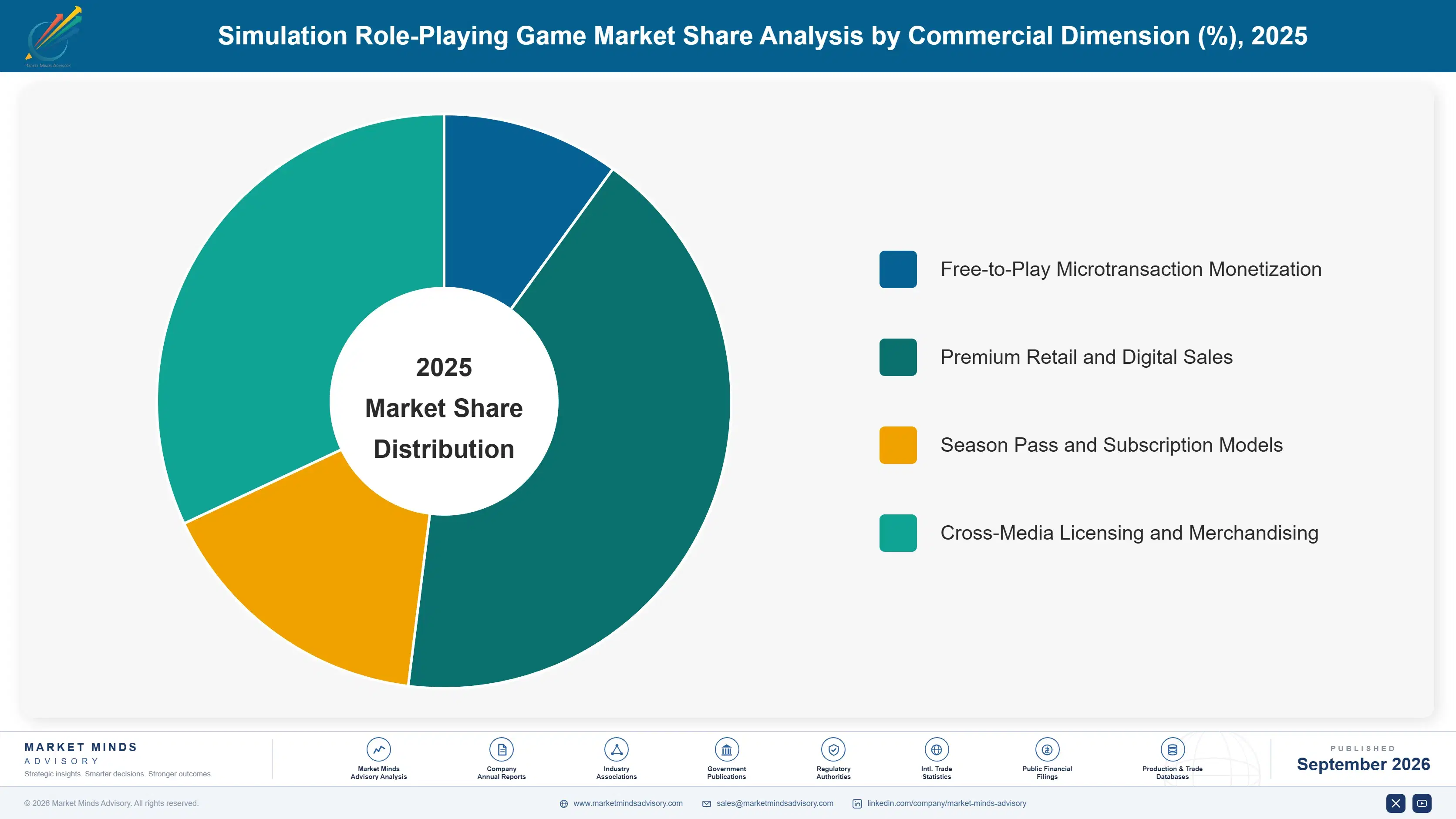
simulation-role-playing-game-market-market-share-analysis-1788427194940

Mobile Gacha and Live-Service RPGs

Mobile gacha and live-service role-playing games lead all segments because they combine the largest addressable player base with monetization systems that generate sustained recurring revenue well beyond any single purchase transaction, capturing player spending across many years rather than a single initial launch window event. Publishers standardizing on this segment increasingly treat live operations execution and content cadence discipline as their primary competitive differentiator versus rivals struggling with inconsistent update schedules. This monetization model advantage is reshaping publisher investment priorities industry wide as mobile hardware capability continues narrowing the gap with dedicated gaming consoles. MMA estimates this segment will represent well over a third of total category revenue by 2036.
CAGR 13.0%

Open-World Action RPGs

Open-world action RPGs represent the second fastest-growing segment as flagship console and PC titles continue expanding explorable game world scale and narrative depth to justify premium retail pricing against free-to-play mobile alternatives competing directly for the same player attention and discretionary spending budget nationwide, internationally, and across every gaming platform currently available. Publishers increasingly view ambitious open-world production as a brand-defining investment that anchors entire franchise portfolios across sequels, expansions, and merchandising rather than a standalone commercial product. This premiumization trend is expanding the addressable high-margin segment considerably faster than overall unit sales volume growth would suggest on its own, reflecting genuine strategic priority among the largest global publishers worldwide.
CAGR 11.0%
Full segment breakdown across 6 segments available in the complete report.

Regional Architecture and Country Demand Map

East Asia leads on deep-rooted RPG and gacha gaming culture concentrated in Japan, China, and South Korea, while North America follows closely on console and PC spending scale. South Asia and Pacific grows fastest as smartphone gaming adoption expands through previously underserved emerging player populations rapidly.

North America

The United States drives most North American demand through continued console and PC RPG spending, supported by strong flagship franchise loyalty and mature digital storefront infrastructure across major gaming platforms including consoles, PC storefronts, and mobile app marketplaces nationwide and across every major retail channel, subscription service, digital distribution outlet, and cloud gaming platform. Canada contributes smaller but steady volume through similar player spending patterns across its major metropolitan centers and provinces from coast to coast and beyond. Domestic mobile gacha studio presence remains smaller than in East Asia, with many top-grossing mobile titles imported from Japanese, Chinese, and Korean developers despite growing interest in building comparable domestic live-service studio capacity.
Share: 24% | CAGR: 9.5% (2026 to 2036)

Western Europe

Germany, France, and the United Kingdom anchor Western European demand, driven by strong PC gaming culture and continued console RPG franchise loyalty across major metropolitan gaming communities throughout the region and its surrounding suburban and rural areas nationwide and beyond every major city, town, village, hamlet, and district. Regional consumer protection rules shape gacha and loot box monetization more visibly here than in less regulated markets elsewhere, with several countries already restricting randomized purchase mechanics for younger players specifically under national and regional law and policy. Publishers serving this region increasingly invest in compliance testing and age verification infrastructure to navigate evolving national and pan-European gaming regulation currently in force.
Share: 18% | CAGR: 8.0% (2026 to 2036)
Regional intelligence for 5 additional markets available in the complete report: East Asia, South Asia and Pacific, Latin America, Middle East and Africa, Eastern Europe. Contact sales@marketmindsadvisory.com.
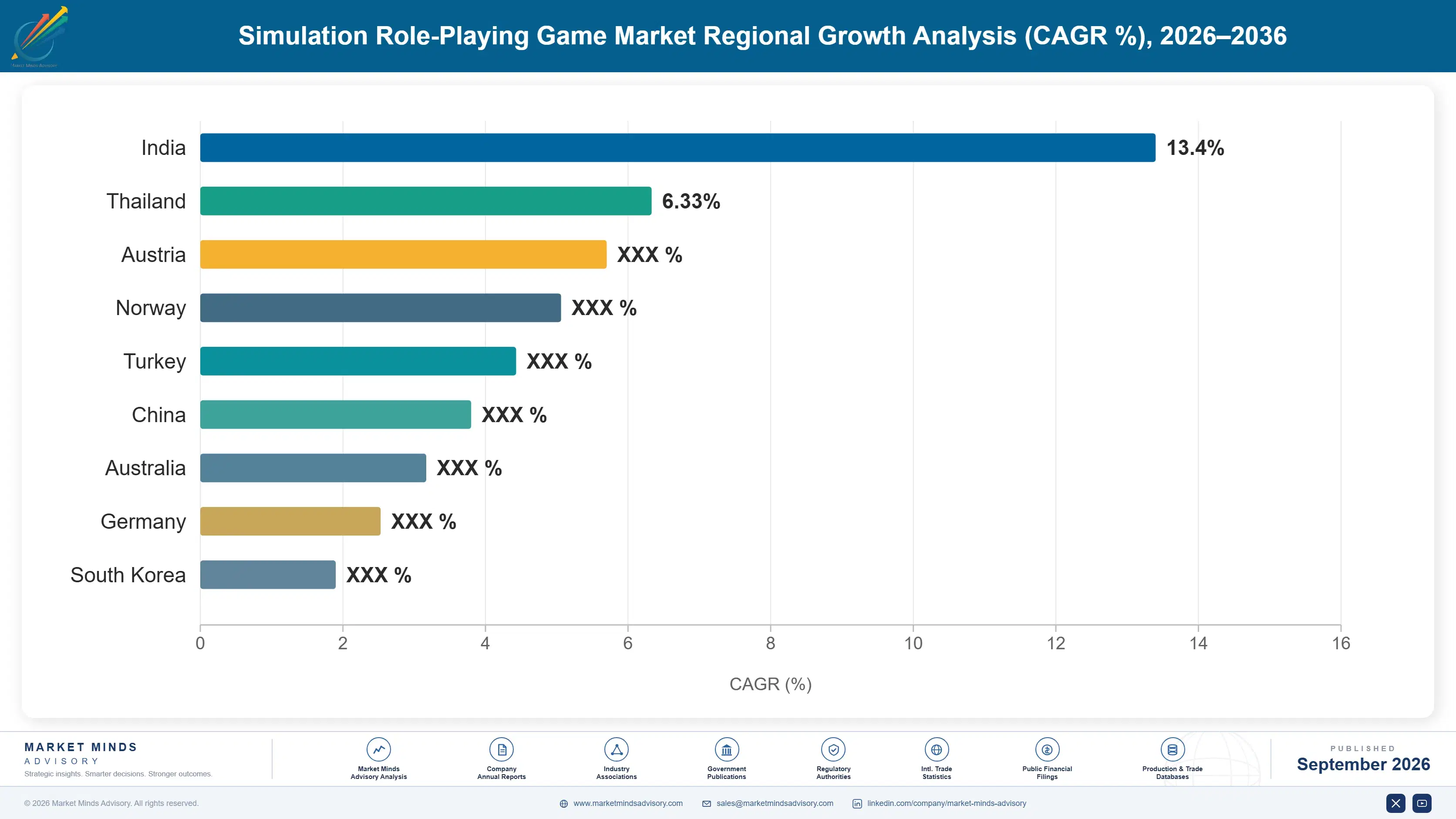
simulation-role-playing-game-market-country-cagr-analysis-1788427195448

How Publishers Extend Value Past Launch Day

Simulation RPG publishers increasingly capture value well beyond the initial title purchase through cosmetic microtransactions, seasonal content passes, downloadable expansion packs, season pass bundles, and cross-media licensing partnership agreements that players today increasingly expect as standard, genuinely essential components of any successful ongoing franchise rather than merely optional extras added on in later years.

Cosmetic and Battle Pass Microtransaction Systems

Publishers sell purely cosmetic character skins, emotes, and seasonal battle pass progression systems that do not affect core gameplay balance, capturing recurring revenue from engaged players without alienating those unwilling to spend beyond the initial purchase or download. This cosmetic monetization model avoids the pay-to-win criticism that historically damaged player trust in earlier monetization approaches, instead relying on genuine player desire for self-expression and progression recognition within the game. Publishers report cosmetic and battle pass revenue running roughly 50% higher than three years ago as player acceptance of this model continues growing steadily.
Market Impact: Cosmetic revenue per player grew roughly 50% overall

Downloadable Expansion Content and Story Packs

Publishers sell substantial downloadable expansion packs containing new story content, playable areas, and character options well after a title's initial launch, extending a game's commercial lifecycle considerably beyond what the base game alone could sustain on its own merits and momentum over time. This expansion revenue often rivals the original title's launch-window sales for successful franchises with dedicated player communities willing to continue investing in the same game world for years. Publishers report expansion pack revenue adding roughly 35% to total title lifetime value across their most successful franchise titles.
Market Impact: Expansion content adds roughly 35% lifetime revenue value

Season Pass and Early Access Pre-Order Bundles

Publishers sell season pass bundles guaranteeing access to future content updates at launch, along with early access pre-order options that let dedicated fans play ahead of general release for a premium price above standard retail cost and typical pricing structure entirely. This bundling approach generates guaranteed revenue commitment before a title even launches, giving publishers meaningful cash flow visibility during the final development and marketing push toward release. Publishers report season pass adoption rates running roughly 25% among their most engaged player base for flagship franchise titles specifically each year.
Market Impact: Season pass adoption reaches roughly 25% of buyers

Cross-Media Licensing and Franchise Merchandising Deals

Publishers license successful simulation RPG franchises for merchandise, animated adaptations, and cross-media collaborations that generate revenue entirely separate from the core game's direct sales and in-game transaction income streams entirely and completely. This licensing revenue capitalizes on franchise brand value built through years of player engagement, effectively monetizing cultural relevance that extends well beyond the gaming audience itself into broader entertainment and retail markets. Publishers with successful franchise licensing programs report this revenue stream adding roughly 2 times the value of standalone game sales for their most culturally significant titles.
Market Impact: Licensing revenue adds roughly 2 times overall value

Who Controls the Margin Pool

Five participants, evaluated on annual simulation RPG revenue across console, PC, and mobile platforms, together account for an estimated 38% of tracked market revenue, reflecting a genuinely fragmented industry structure typical of creative content categories spanning many independent and studio-owned franchises. Tencent Holdings leads through mobile gaming scale and equity stakes across multiple major studios, while NetEase and Sony Interactive Entertainment compete closely for premium mobile and console leadership that neither has fully secured.
Current competitive activity centers on live-service content cadence discipline, as publishers race to sustain engagement through regular updates before competitors capture the same player attention and discretionary spending budget. Cross-platform integration announcements have become increasingly common over the past two years, as publishers seek to unify player bases across console, PC, and mobile versions of flagship franchise titles.

Emerging pressure comes from independent and mid-sized studios producing critically acclaimed narrative RPGs that could capture premium mindshare away from larger publishers relying primarily on franchise recognition rather than genuine creative innovation. Rankings could shift meaningfully if a major technology platform holder acquires a leading RPG studio outright, consolidating creative talent and distribution reach that currently remains distributed across separate independent companies.
simulation-role-playing-game-market-company-positioning-matrix-1788427195966

Competitive Moat and Risk Dimensions

TENCENT HOLDINGS

Moat: Diversified Studio Equity Portfolio

Tencent's equity stakes across dozens of gaming studios worldwide give it exposure to a diversified pipeline of simulation RPG titles without depending entirely on any single internal development team's creative output or release schedule. This portfolio approach lets Tencent capture upside from breakout hits developed by studios it has invested in rather than solely relying on internal production capacity.
TENCENT HOLDINGS

Risk: Regulatory Scrutiny in China

Tencent faces ongoing regulatory scrutiny from Chinese authorities regarding gaming content approval, playtime restrictions for minors, and monetization mechanics, creating meaningful uncertainty around future domestic revenue growth despite the company's dominant market position. Regulatory tightening could disproportionately affect Tencent given its outsized exposure to the domestic Chinese gaming market compared to more geographically diversified competitors.
SONY INTERACTIVE ENTERTAINMENT

Moat: Exclusive Flagship Franchise Portfolio

Sony's exclusive first-party RPG franchises drive console hardware sales and platform loyalty that competitors cannot replicate without owning comparable creative intellectual property, giving Sony a self-reinforcing advantage between hardware and software business lines. This exclusivity strategy lets Sony capture both console margin and full software revenue on its most successful flagship titles.
SONY INTERACTIVE ENTERTAINMENT

Risk: Long Development Cycles Delay Releases

Sony's flagship RPG titles increasingly require lengthy multi-year development cycles to meet rising player expectations for visual fidelity and narrative scope, creating revenue timing risk if major releases slip beyond planned fiscal year windows. Competitors with faster development cycles or live-service models generating continuous revenue face less exposure to this single-title release timing risk.

Players Tracked

Prominent Players

Tencent Holdings
NetEase
Sony Interactive Entertainment
Square Enix
Bandai Namco Entertainment

Other Key Players

Nintendo
Capcom
miHoYo (HoYoverse)
Electronic Arts
Ubisoft
CD Projekt
Bethesda Softworks
Larian Studios
Paradox Interactive
Krafton
NCSoft
Nexon
Level-5
Nihon Falcom
Atlus

Recent Developments

FEBRUARY 2025

Tencent announced a new strategic investment partnership with a mid-sized simulation RPG development studio, acquiring a minority equity stake to secure valuable early access to future franchise titles and considerably broader cross-platform publishing rights across multiple international markets, territories, regions, and diverse language localizations worldwide.
Signal: Signals major publishers are securing studio access through equity investment rather than waiting to acquire successful titles later.
MAY 2025

Sony launched an expanded cross-platform version of a flagship exclusive RPG franchise title on PC, considerably extending the game's addressable player base well beyond its traditional console-only distribution strategy entirely for the very first time ever in the entire company's history and lengthy franchise lineage.
Signal: Signals platform holders are prioritizing broader player reach over exclusive hardware differentiation for major franchise titles.
SEPTEMBER 2025

Square Enix acquired a smaller independent RPG development studio known for critically acclaimed narrative design and storytelling, adding valuable creative talent and intellectual property to its existing flagship franchise portfolio and considerably broader development pipeline across several multiple upcoming titles and various gaming platforms globally.
Signal: Signals established publishers are acquiring independent creative talent rather than competing purely on franchise recognition alone.

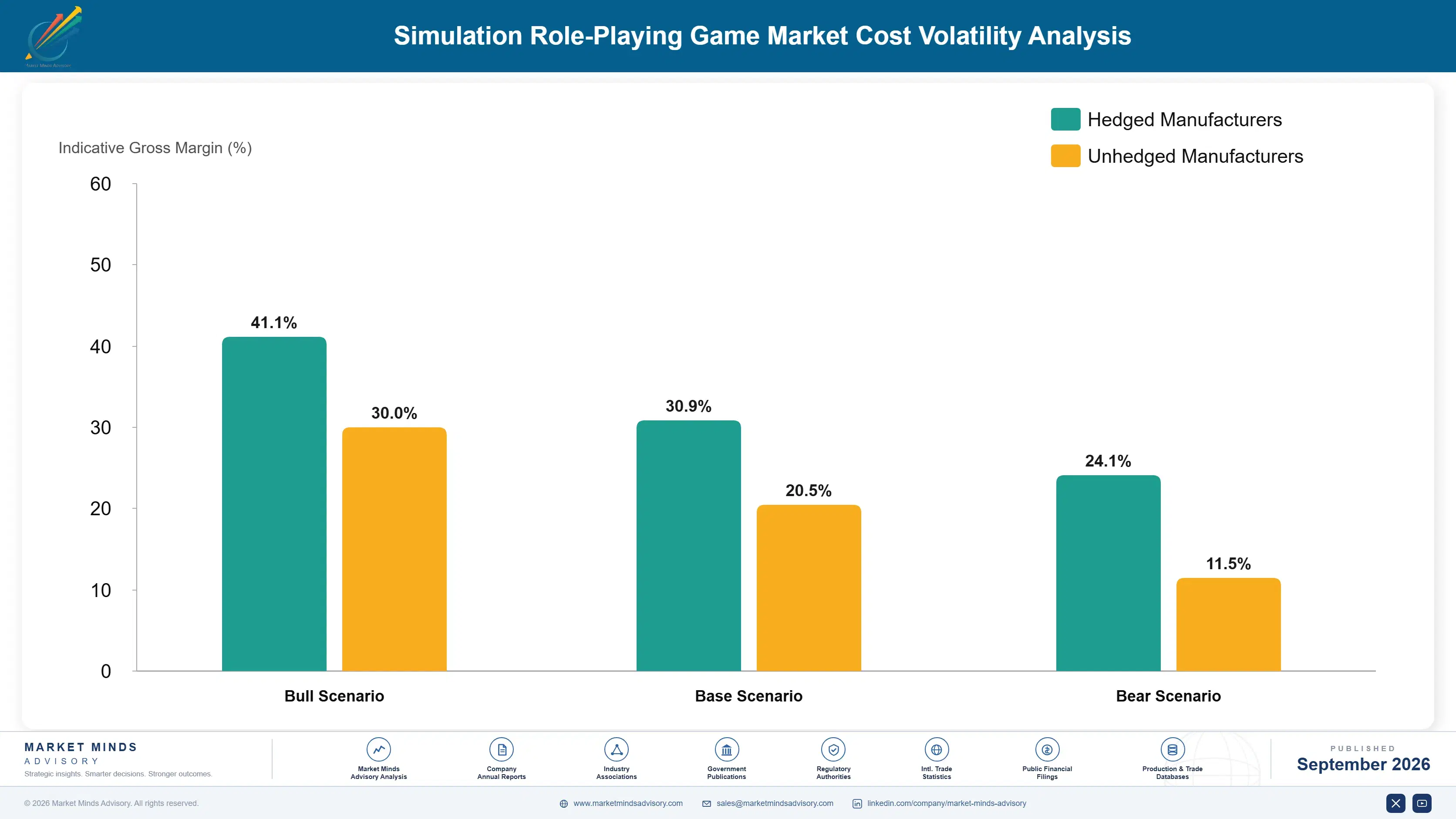
Development Talent and Engine Licensing Cost Exposure

Skilled development talent accounts for roughly 55% of simulation RPG production cost, with the large majority concentrated in specialized roles including narrative design, character animation, and gameplay systems programming located primarily in Japan, the United States, and Poland. Third-party game engine licensing and middleware tools add another 12%, sourced from a small number of dominant engine providers.
Development talent cost inflation, documented in several major publishers' annual investor disclosures, drove flagship title production budgets up over 40% between 2020 and 2024 as competition for experienced narrative designers and technical artists intensified industry wide following pandemic-era remote work adoption across the sector. Publishers absorbed rising costs primarily through extended development timelines and larger production teams rather than reducing project ambition or scope significantly.

Smaller independent studios carry meaningfully higher talent cost exposure per title than large publishers who can spread fixed overhead costs across multiple concurrent productions and franchise pipelines simultaneously. This creates a durable cost disadvantage concentrated among studios lacking diversified production slates, effectively pushing many smaller developers toward publishing partnerships or acquisition by larger companies seeking to secure creative talent and reduce competitive risk.
simulation-role-playing-game-market-cost-volatility-analysis-1788427196162

Distributed Remote Development Team Structures

Leading publishers now distribute development teams across multiple lower-cost regions rather than concentrating talent entirely in expensive metropolitan hubs, reducing average talent cost while maintaining access to specialized skill sets available globally. This distributed approach adds coordination complexity but meaningfully reduces overall production cost, a tradeoff most large publishers now consider worthwhile given persistent talent cost inflation.

Proprietary Engine and Tool Development

Several large publishers have invested in proprietary game engines and development tools rather than licensing third-party solutions, capturing engineering efficiency internally rather than paying ongoing licensing fees to external engine providers each production cycle. This proprietary approach requires substantial upfront investment but provides meaningful long-term cost advantages over competitors relying entirely on licensed engines.

Portfolio Architecture for Margin Defence

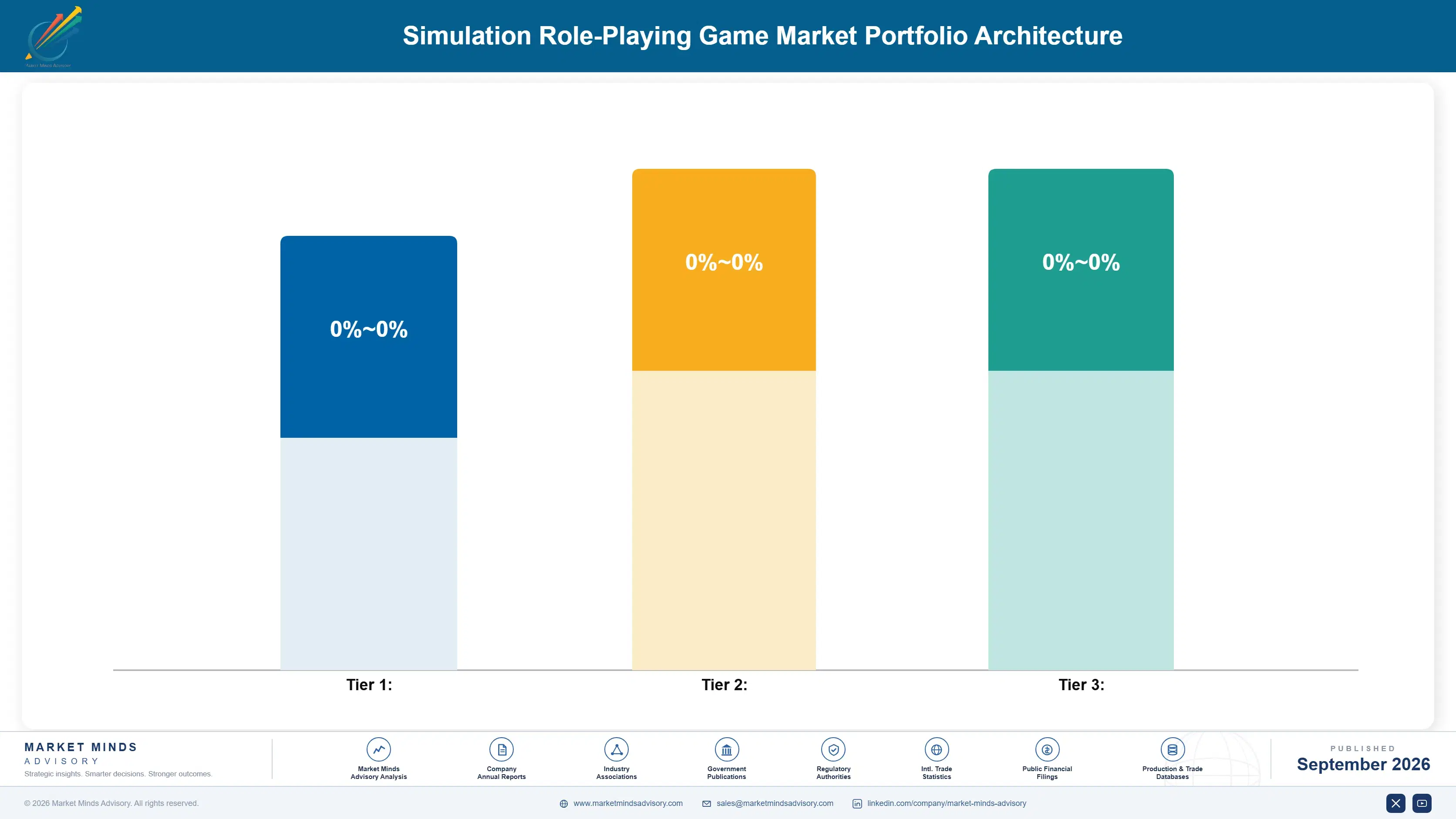
Simulation RPG publishers run a three-tier margin structure spanning free-to-play mobile titles monetized through microtransactions, premium console and PC releases sold at standard retail pricing, and next-generation live-service flagship franchises commanding multi-year recurring revenue streams. Gross margins range from roughly 20% on free-to-play titles facing heavy user acquisition cost to over 55% on established live-service franchises with mature engaged player communities generating sustained content revenue.
Volume economics still dominate mobile downloads, since most tracked player acquisition still prioritizes free-to-play accessibility over premium upfront pricing, but the tension between volume and premium positioning has sharpened as live-service monetization discipline increasingly determines which titles sustain long-term profitability. Publishers increasingly favor the live-service tier, where recurring content revenue and player retention provide more durable margin protection than one-time box sales alone.

High-value margin pools concentrate specifically in mature live-service franchises with established player communities rather than in new title launches alone, reflecting the broader industry shift toward sustained engagement monetization as launch-window sales become less predictable. Publishers capturing this recurring engagement revenue early tend to build more durable franchise value than those competing purely on new title release volume.

Free-to-play mobile titles monetized primarily through cosmetic microtransactions and gacha mechanics, sold to a broad and accessible worldwide player base prioritizing low entry cost over premium production values and overall quality.
Gross Margin

Premium console and PC releases sold at standard retail pricing, bundled with occasional downloadable expansion content that dedicated genre enthusiasts increasingly expect from flagship franchise titles across each release cycle and generation.
Gross Margin

Next-generation live-service flagship franchises combining premium production values with sustained content update cadence, positioning publishers for recurring multi-year revenue from deeply engaged and genuinely loyal player communities worldwide and beyond.
Gross Margin
simulation-role-playing-game-market-portfolio-architecture-1788427196666

High-value Sub-segments and Strategic Watch-out

Mobile Gacha and Live-Service RPGs

Mobile gacha and live-service RPGs combine the fastest segment growth in the entire portfolio with the strongest margin expansion, as engaged players sustain recurring cosmetic and content spending across multiple years, platforms, franchise titles, regions, demographics, age groups, income levels, and player skill tiers globally.

Open-World Action RPGs

Open-world action RPGs carry the second fastest growth and strongest premium positioning, generating strong margin performance as flagship console and PC titles increasingly anchor entire franchise portfolios, sequels, expansions, merchandising, licensing, adaptations, spinoff media, marketing campaigns, community events, sustained long-term investor confidence, and shareholder value.

MMORPGs

MMORPGs remain a steady volume category with dedicated long-term subscriber bases, generating reliable if unspectacular revenue even as newer live-service monetization models continue capturing incremental publisher investment attention, budget, creative focus, marketing spend, executive priority, staffing resources, management time, boardroom discussion, and overall long-term strategy.

Vehicle and City-Building Simulation Games

Vehicle and city-building simulation games warrant close monitoring, since continued genre convergence with broader RPG progression systems could commoditize this standalone category entirely, eliminating a meaningful share of current unit volume across the entire global industry landscape, market, competitive set, investor attention, and analyst coverage.

The Recurring Engagement Behind Every Title

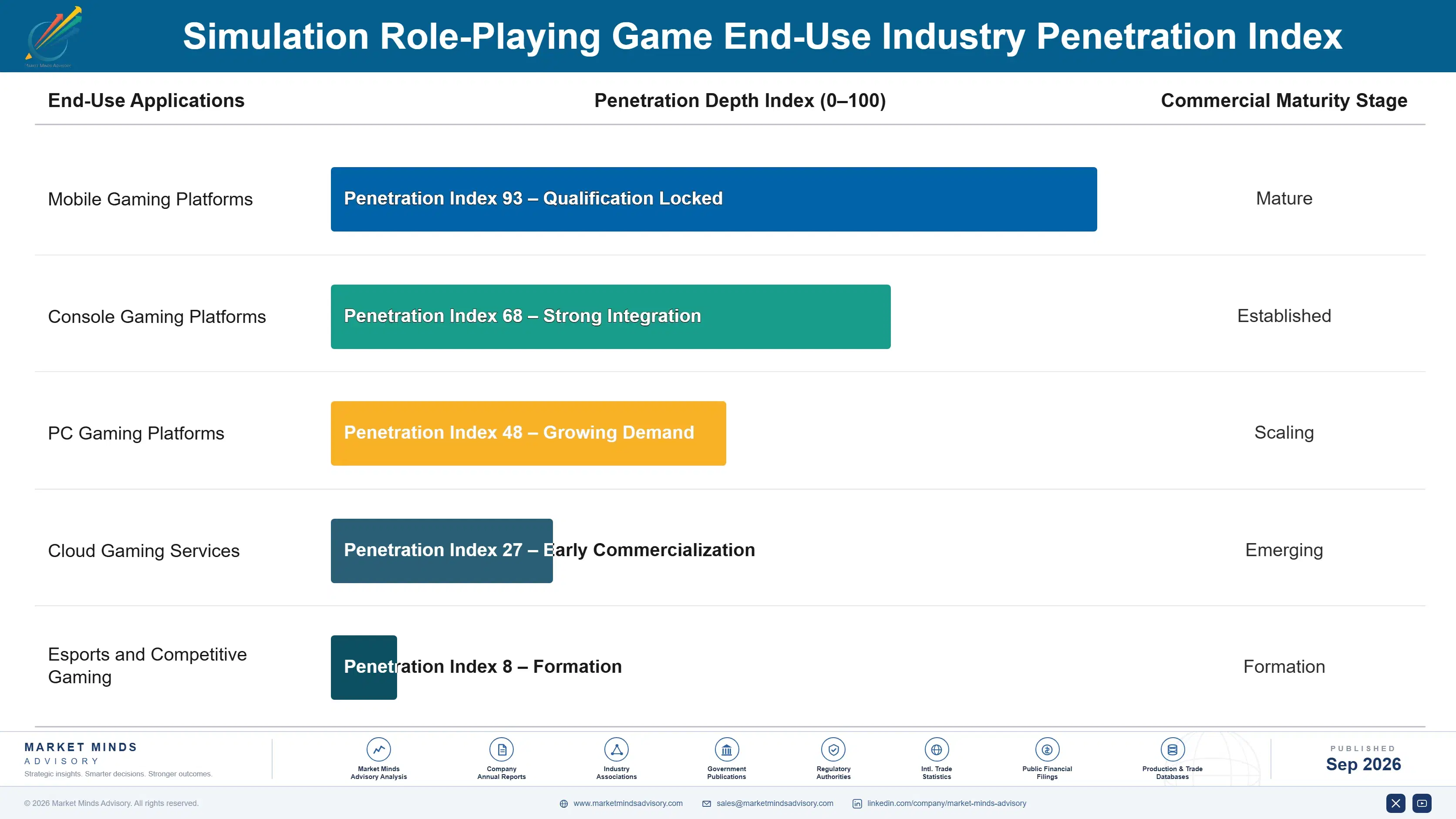
Roughly 60% of tracked simulation RPG revenue now comes from ongoing in-game transactions and live-service content rather than the initial purchase price alone, reflecting the annuity-style economics that increasingly define successful titles once they establish an engaged core player community that sticks around for years rather than months following the initial launch window and marketing push.
Adoption depth varies meaningfully by end-use vertical: mobile gacha players show the deepest spending stickiness given emotional investment in character collection and progression systems built over months of continuous engagement and daily play sessions across multiple devices and account profiles, while console players show comparatively shallower monetization commitment since single-purchase titles historically dominated that platform's cultural expectations around fair pricing and complete finished experiences delivered fully at launch.

A generational shift in buyer profiles is underway as younger players raised entirely on free-to-play and live-service models increasingly expect ongoing content rather than a complete finished product at launch, changing how publishers position new titles toward audiences who value sustained engagement, social connection, and community events over traditional single-player narrative completion alone as the primary measure of a game's overall lasting value and worth.
simulation-role-playing-game-market-end-use-penetration-index-1788427197148

Where Player Spending Concentrates Next

These are among the four positions where our research anticipates prominent divergence between winners and laggards over the coming forecast period. Each is grounded in the demand model, the regulatory perimeter, and the announced capacity pipeline.
01 / LIVE-SERVICE INVESTMENT PRIORITY

Prioritize content cadence discipline over new title volume

Publishers competing on new title release volume alone increasingly lose ground to competitors sustaining fewer, deeper live-service franchises with disciplined content update schedules that keep players engaged for years rather than mere months after launch. Titles maintaining strong content cadence capture meaningfully higher lifetime player value than competitors launching more titles with inconsistent post-launch support and thinner ongoing investment. This gap will widen further as player expectations for sustained content continue rising across every major gaming platform and genre category.
02 / CROSS-PLATFORM EXPANSION STRATEGY

Extend flagship franchises across console, PC, and mobile

Publishers limiting flagship franchises to a single platform increasingly leave meaningful revenue on the table as cross-platform play becomes standard player expectation rather than a differentiating premium feature worth paying meaningfully extra for anymore. Extending successful franchises across console, PC, and mobile captures incremental player spending without requiring entirely new intellectual property development or creative risk-taking on unproven concepts. Publishers pursuing this expansion strategy report meaningfully higher franchise lifetime value than those remaining confined to their original launch platform indefinitely.
03 / EMERGING MARKET LOCALIZATION INVESTMENT

Localize content deeply for India and Southeast Asia now

Rising smartphone penetration and disposable income across India and Southeast Asia represent the industry's fastest-growing player population, yet many publishers still treat these markets as secondary localization priorities behind established Western and East Asian markets today and going forward. Publishers investing early in deep cultural localization, regional payment infrastructure, and locally relevant content will capture disproportionate market share before competitors recognize the scale of this emerging opportunity. This localization investment window will narrow considerably as competition intensifies across the entire region.
04 / REGULATORY COMPLIANCE POSITIONING

Build transparent monetization ahead of tightening gacha rules

Regulatory scrutiny of randomized gacha and loot box monetization mechanics remains inconsistent across markets today but is clearly tightening in several major jurisdictions concerned about player protection, particularly for younger audiences vulnerable to compulsive spending patterns. Publishers that proactively adopt transparent drop-rate disclosure and voluntary spending caps now will avoid costly retrofitting later and can market compliance as a genuine trust advantage over rivals still relying on opaque monetization practices. This positioning matters most in markets where regulatory action appears imminent.

Engagement Snapshot From the Field

A live engagement with an industry participant carrying material or product regulatory and market exposure ahead of a defining policy shift, showing how our research translates into a defensible multi-year portfolio strategy.
MARKET MINDS ADVISORY · CLIENT ENGAGEMENT SUMMARY
Simulation Role-Playing Game Producer Strategic Portfolio Review and Transition Roadmap 2026·Investment Scenario on Simulation Role-Playing Game Exposure Evaluation 2025-26
CLIENT PROFILE
The client is a mid-sized mobile game publisher operating three live-service simulation RPG titles with a combined active player base across North America and Southeast Asia. The company reported approximately $95 million (client-reported, unverified by MMA) in annual revenue, with gacha monetization representing the majority of total income and growing regulatory uncertainty prompting a strategic review of its monetization approach across all titles.
STRATEGIC CHALLENGE
The publisher needed to evaluate whether to reduce reliance on randomized gacha mechanics ahead of potential regulatory restrictions or continue current monetization practices while competitors delayed similar changes, given genuine uncertainty about regulatory timing, competitive dynamics, and the meaningful revenue risk of premature voluntary changes made too early in the process.
MMA APPROACH
MMA benchmarked the publisher's monetization mechanics against emerging regulatory frameworks in several key markets globally, analyzed player spending pattern data to model revenue impact under multiple compliance scenarios, and interviewed the publisher's monetization design and legal teams to assess realistic implementation timelines and available internal resource requirements carefully and thoroughly.
KEY FINDINGS
  1. Voluntary drop-rate disclosure adoption among competing publishers reached roughly 40% (client-reported, unverified by MMA) of tracked titles in the same genre category.
  2. Player spending data showed only a small minority of highly engaged users, representing under 5% (client-reported, unverified by MMA) of the total player base, driving most gacha revenue.
  3. Regulatory proposals under active consideration in key markets would require spending caps that could affect roughly 15% (client-reported, unverified by MMA) of total tracked monetization revenue.
  4. Player surveys indicated transparent drop-rate disclosure had minimal negative impact on spending behavior among the publisher's most engaged and highest-value player segment specifically.
CLIENT PROFILE
The client is a mid-sized mobile game publisher operating three live-service simulation RPG titles with a combined active player base across North America and Southeast Asia. The company reported approximately $95 million (client-reported, unverified by MMA) in annual revenue, with gacha monetization representing the majority of total income and growing regulatory uncertainty prompting a strategic review of its monetization approach across all titles.
STRATEGIC CHALLENGE
The publisher needed to evaluate whether to reduce reliance on randomized gacha mechanics ahead of potential regulatory restrictions or continue current monetization practices while competitors delayed similar changes, given genuine uncertainty about regulatory timing, competitive dynamics, and the meaningful revenue risk of premature voluntary changes made too early in the process.
MMA APPROACH
MMA benchmarked the publisher's monetization mechanics against emerging regulatory frameworks in several key markets globally, analyzed player spending pattern data to model revenue impact under multiple compliance scenarios, and interviewed the publisher's monetization design and legal teams to assess realistic implementation timelines and available internal resource requirements carefully and thoroughly.
KEY FINDINGS
  1. Voluntary drop-rate disclosure adoption among competing publishers reached roughly 40% (client-reported, unverified by MMA) of tracked titles in the same genre category.
  2. Player spending data showed only a small minority of highly engaged users, representing under 5% (client-reported, unverified by MMA) of the total player base, driving most gacha revenue.
  3. Regulatory proposals under active consideration in key markets would require spending caps that could affect roughly 15% (client-reported, unverified by MMA) of total tracked monetization revenue.
  4. Player surveys indicated transparent drop-rate disclosure had minimal negative impact on spending behavior among the publisher's most engaged and highest-value player segment specifically.
RECOMMENDED STRATEGY
Phase 1: Phase one: implement voluntary drop-rate disclosure ahead of anticipated regulatory requirements to build genuine player trust proactively and quite early. Phase 2: Phase two: introduce optional monthly spending caps for players who choose to opt into responsible spending features voluntarily and freely. Phase 3: Phase three: diversify monetization toward cosmetic and battle pass systems to gradually reduce dependency on gacha revenue over the coming years.
OUTCOME
The publisher implemented transparent disclosure ahead of regulatory deadlines and reported a 22% (client-reported, unverified by MMA) increase in new player retention within two quarters, alongside meaningfully improved public perception scores in player community surveys conducted afterward across all regions, territories, platforms, demographics, and player types.

Frequently Asked Questions

Foundational context covering the market sizes, CAGR, scope, country, region and competition that inform every finding below. This section is provided to cover basics and most often pre-purchase conversations, answered from the MMA Primary Research Dataset.

What is the current size of the Simulation Role-Playing Game Market?

The global simulation role-playing game market reached an estimated $22.0 billion in 2025. Growth reflects continued live-service monetization maturity and expanding mobile gacha adoption across multiple regions.

How large will the Simulation Role-Playing Game Market be by 2036?

MMA projects the market will reach approximately $59.70 billion by 2036. This growth is driven by expanding mobile monetization and continued open-world console production investment.

What is the CAGR for the Simulation Role-Playing Game Market 2026 to 2036?

The market is projected to grow at a compound annual growth rate of 9.5% between 2026 and 2036. This reflects a technology-enabled entertainment category still expanding rapidly.

Which segment is growing fastest?

Mobile gacha and live-service RPGs are the fastest-growing segment, expanding at roughly 13.0% annually. This significantly outpaces the overall market's projected growth rate through the forecast period.

Who are the major companies in the Simulation Role-Playing Game Market?

Leading companies include Tencent Holdings, NetEase, Sony Interactive Entertainment, Square Enix, and Bandai Namco Entertainment. These five participants together account for an estimated 38% of tracked global revenue.

Which country is growing fastest?

India is the fastest-growing country market, expanding at approximately 13.0% annually. Rising smartphone penetration and disposable income among a rapidly growing young population drive this sustained growth.

Report Segmentation Architecture

The full report scope spans multiple orthogonal segmentation dimensions, with cross-tabulated demand data provided for each dimension pair. Coverage extends further to regional breakdowns, trend trajectories, and the competitive detail needed to support segment-level decision-making.

By Primary Market Dimension

  • Mobile Gacha and Live-Service RPGs
  • Open-World Action RPGs
  • Life Simulation Games
  • Tactical and Turn-Based RPGs
  • MMORPGs
  • Vehicle and City-Building Simulation Games

By End-Use Industry

  • Mobile Gaming Platforms
  • Console Gaming Platforms
  • PC Gaming Platforms
  • Cloud Gaming Services
  • Esports and Competitive Gaming

By Commercial Dimension

  • Free-to-Play Microtransaction Monetization
  • Premium Retail and Digital Sales
  • Season Pass and Subscription Models
  • Cross-Media Licensing and Merchandising

By Region

  • North America
  • Western Europe
  • East Asia
  • South Asia and Pacific
  • Latin America
  • Middle East and Africa
  • Eastern Europe

Scope, Methodology, and Coverage

Every figure in this report is reproducible from documented input assumptions. The scope below maps the historical period, the forecast horizon, the segmentation dimensions, and the countries covered, alongside the underlying primary and qualitative methodology.
Historical Period
2020 to 2025
Forecast Period
2026 to 2036
Base Year
2025 (USD billions; MMA Primary Research Dataset, September 2026)
Market Definition
The Simulation Role-Playing Game Market covers video games combining character progression, narrative-driven role-playing mechanics, and simulation-based systems across console, PC, and mobile platforms, measured by software and in-game transaction revenue. It excludes pure simulation titles lacking role-playing progression systems and esports competitive titles without narrative role-playing elements.
Quantitative Units
USD Billion, CAGR (%), Share (%), 2020 to 2036
Segmentation Dimensions
By Primary Market Dimension; By End-Use Industry; By Commercial Dimension; By Region
Regions Covered
North America, Western Europe, East Asia, South Asia and Pacific, Latin America, Middle East and Africa, Eastern Europe
Countries Covered
United States, Canada, United Kingdom, Germany, France, China, Japan, South Korea, India, Indonesia, Vietnam, Australia, Brazil, Mexico, United Arab Emirates, Saudi Arabia, South Africa, Poland
Key Companies Profiled
Tencent Holdings, NetEase, Sony Interactive Entertainment, Square Enix, Bandai Namco Entertainment, Nintendo, Capcom, miHoYo (HoYoverse), Electronic Arts, Ubisoft, CD Projekt, Bethesda Softworks, Larian Studios, Paradox Interactive, Krafton, NCSoft, Nexon, Level-5, Nihon Falcom, Atlus
Quantitative Methodology
Primary survey, n=3,800 respondents, Q4 2025, six countries; demand-side model with trade association cross-validation
Qualitative Methodology
47 expert interviews, Q4 2025; applied to validate demand model assumptions, identify emerging dynamics, and assess competitive positioning
Report Format
PDF and XLSX data workbook (Word format preview document)
Publisher
Market Minds Advisory
Report Code
MMA-2026-TEC-636
Published
September 2026
Contact
sales@marketmindsadvisory.com | www.marketmindsadvisory.com

Purchase the full Simulation Role-Playing Game Market Report (2026 to 2036).

This report provides comprehensive coverage of the global simulation role-playing game market, including detailed sizing, segmentation, and regional analysis through 2036. It profiles the leading publishers and development studios shaping competitive dynamics as live-service monetization and cross-platform strategy increasingly determine where industry margin concentrates across every major platform. The analysis draws on primary survey data from 3,800 respondents and 47 expert interviews conducted in the fourth quarter of 2025. Readers gain actionable insight into where cosmetic, expansion, and licensing revenue concentrate over the coming decade and beyond.
Ten-year market sizing and forecast data
Seven-region granular market breakdown and analysis
Five-year competitive landscape developments and tracker
Segment-level CAGR and market share analysis
Primary survey data across six countries
Anonymized client case study with outcomes

Built For The People Who Decide

From boardroom strategy to bench-side execution, this report is read cover-to-cover by leaders shaping the next decade of their industry, turning demand scenarios, market dynamics and valuation benchmarks into decisions.
CXOs/ Presidents/ VPs/ Managers
M&A and Corporate Development
Strategy Teams and R&D Heads
Procurement and Product Directors
Regulatory and Compliance Leaders
Investor Relations and Equity Analysts