Market Minds Advisory
Silver Nitrate Market

Silver Nitrate Market: A Chemical Whose Price Belongs to a Monetary Metal

Around 88% of what a buyer pays is the silver itself, priced by investment flows and by-product mine supply rather than by anything happening in the chemical market at all.

Lead Analyst

Bilal Shaikh

Published

September 2026

Make Smarter Decisions with Customized Research Insights

Request a free sample report and evaluate market opportunities, growth trends, and competitive dynamics relevant to your business needs.

2025 MARKET VALUE$1.9BMarket Size 2025
2036 FORECAST VALUE$3.3BBase Case , 2026 to 2036
CAGR 2026 TO 20365.4 %Bull 6.6% / Bear 4.2%
INCREMENTAL OPPORTUNITY$1.4BNet 10- year value creation
EXPANSION MULTIPLE1.69x2036 value over 2026 base
Strategic Levers
M&A Pipeline
Regional Outlook
Country Rankings
Competitive Intelligence
Segmental Deep-dive
Call-Us : 91 93563 13602

Executive Snapshot and Market Trajectory

Roughly 88% of the price of silver nitrate is the silver in it, which means a chemical producer sells conversion rather than material. Silver is priced by investment demand and by mine output arriving around 74% as a by-product of other metals. Shortage calls forth no more silver.
That leaves the industry with almost no influence over its own headline cost at all. Producers manage the exposure through toll refining arrangements returning around 98% of contained metal, consignment stocks and formal hedging rather than through any commercial action on price. Pharmaceutical and medical grade grows fastest at 8.1%, half again the market rate of 5.4%, on qualification barriers rather than performance. Qualification barriers protect the best positions in the range.
The regulatory position on silver antimicrobials is where the real risk sits. European biocidal approval costs run into millions per product type, which has removed marginal silver antimicrobial claims from the market entirely and concentrated what remains. India grows fastest anywhere at 9.6% on electronics and pharmaceutical manufacture, and East Asia holds 32% of value on conversion capacity concentration. Toll and consignment terms are the standard answer.
Market Definition
Silver nitrate supplied as a manufactured chemical across purity grades and forms, covering technical grade crystalline material, photographic grade, pharmaceutical and medical grade, electronic and conductive ink grade, analytical reagent grade, and silver nitrate solutions and prepared formulations. Measured at producer selling value including contained silver. Excludes silver metal and bullion, other silver compounds sold separately, finished medical devices and dressings, and photovoltaic silver pastes.
Base Year Value
$1.9B in 2025 (MMA Primary Research Dataset, August 2026)
Forecast Period
2026 to 2036, eleven discrete annual values
CAGR
5.4% base case. Bull 6.6%. Bear 4.2%.
Fastest Growth Segment
Pharmaceutical and Medical Grade: 8.1% CAGR
Fastest Growth Country
India: 9.6% CAGR
Fastest Growth Region
South Asia and Pacific: 7.4% CAGR
Largest Region
East Asia: 30% of 2025 global value
Market Leaders
Ames Goldsmith, Umicore, Johnson Matthey, Metalor Technologies, Heraeus. Source: MMA Primary Research Dataset, July 2026.
Primary Survey
n=3,800 procurement and R&D decision-makers, Q4 2025, six countries
Methodology
Demand-side build-up, cross-validated against public data, 47 expert interviews

Silver Nitrate Market Forecast Scenarios

silver-nitrate-market-trends-size-forecast-scenario-1787595157188
Growth ran near 4.6% between 2020 and 2025, dominated by silver price movement rather than by volume, since contained metal carries most of the value and moves on investment flows unrelated to chemical demand. Photographic grade volumes continued their long decline while medical and electronic grades expanded. Toll refining and consignment arrangements became more widely used as producers sought to reduce balance sheet exposure to metal price.
Base case 5.4% rests on three mechanisms. Medical and pharmaceutical grade grows at 8.1% on wound care, device coatings and antimicrobial applications where silver performance is genuinely difficult to replicate. Electronic and conductive ink grades expand with printed electronics and specialty conductor demand. And Indian electronics and pharmaceutical manufacture grows fastest anywhere at 9.6% as production localises under national programmes that favour domestic manufacture over imported finished goods. Domestic conversion capacity develops behind that demand.
The bull case at 6.6% assumes silver price strength on investment demand alongside volume growth, which compounds directly because contained metal dominates the value. The bear case at 4.2% is copper-plated solar metallisation displacing silver paste at scale, which would release industrial silver into a market already supplied largely by by-product mining that responds to base metal economics.

Selling Conversion, Not Material

A silver nitrate producer is a converter rather than a chemical company in any meaningful commercial sense. Around 88% of the product's value is the contained silver, priced on a metal exchange by investment flows, industrial demand and mine supply that nobody in this industry influences. What is actually sold is the dissolution, purification, crystallisation and quality assurance that turns metal into a specified chemical, and that conversion fee is the entire business.
TOP FIVE CONCENTRATION46%Refining relationships rather than chemistry decide supplier position
SILVER COST SHARE88%Product value accounted for by the contained precious metal
BY-PRODUCT MINE SHARE74%Silver arriving as a by-product of other metal mining
SOLAR SILVER THRIFTING62%Reduction in metal loading per cell over a decade
BIOCIDE APPROVAL COST2.8mCost of maintaining an antimicrobial approval per product type
TOLL REFINING RETURN98%Contained metal returned through a toll refining arrangement
Supply behaves unlike almost any other industrial input because of where silver comes from. Around 74% of mine production arrives as a by-product of copper, lead, zinc and gold operations, which means silver output responds to base metal economics rather than to silver demand or price. A silver shortage does not reliably call forth more silver, since nobody opens a copper mine because silver looks tight.
Demand faces two opposed pressures at once. Photovoltaic paste, the largest industrial application, has seen metal loading fall around 62% per cell over a decade through deliberate thrifting, and copper-plated metallisation threatens to remove it altogether. Medical and antimicrobial applications grow instead, though European biocidal approval costs running into millions per product type have removed marginal claims and concentrated what remains.
"Everybody in this business talks about crystal quality and nobody controls the number that matters. The producers who understood early that they were selling a conversion fee, and structured their metal exposure accordingly, are the ones still standing after two decades of silver doing whatever silver does."
Director, Precious Metal Chemicals and Specialty Materials Practice · MMA Chemicals and Materials Practice · August 2026

Market Trends

Metal exposure management separating survivors from casualties

With around 88% of product value in contained silver, a producer carrying unhedged metal on its balance sheet is running a commodity position rather than a chemical business. Toll refining arrangements returning roughly 98% of contained metal, consignment stocks and formal hedging all remove that exposure and leave a conversion fee that behaves like a manufacturing margin. Producers who never made that structural shift have been repeatedly damaged by silver price movements that had nothing whatever to do with their own market. Customers increasingly request consignment terms for exactly the same reason.
Market Impact: Medical grade growing at 8.1%
Solar thrifting and copper plating threatening the largest application

Photovoltaic metallisation is the largest industrial use of silver and cell makers have reduced loading around 62% per cell over a decade through deliberate thrifting, since silver is the most expensive material in the cell. Copper-plated metallisation would remove the requirement entirely rather than reduce it. That threat sits upstream of silver nitrate rather than inside it, and a substantial release of industrial silver demand would move the metal price that carries most of this product's value. Silver is the most expensive material in the cell, which gives cell makers permanent motivation to remove it.
Market Impact: Indian demand growing at 9.6%

Market Opportunities and Growth Drivers

Medical antimicrobial applications resisting easy substitution

Silver antimicrobial performance across bacteria, fungi and biofilms is genuinely difficult to replicate with alternatives at comparable breadth, which sustains demand in wound dressings, catheter coatings and device surfaces despite the metal cost. Medical grade requires purity and documentation well beyond technical material, and qualification into a device runs through regulatory approval that nobody repeats casually. The grade grows at 8.1% against a market rate of 5.4% on that combination of performance and switching difficulty. Established positions become unusually durable as a direct result of that. Approval costs concentrated the field further still.
Market Impact: Metal drives 88% of value

Indian electronics and pharmaceutical manufacture localising rapidly

India grows fastest anywhere at 9.6%, as electronics assembly and pharmaceutical manufacture both expand under national programmes that favour domestic production over imported finished goods. Silver nitrate demand follows those industries directly, and domestic conversion capacity is developing behind the demand rather than ahead of it. Refining relationships and metal financing are the practical barriers for new entrants there, since the working capital requirement is severe when the material is this valuable. Working capital requirements are severe when the material carries this much value per tonne, which excludes most would-be entrants regardless of chemical capability.
Market Impact: Costs 2.8m per product type

Market Restraints and Challenges

Metal price volatility overwhelming any commercial action

Around 88% of product value is contained silver priced on exchanges by investment flows that respond to interest rates, currency movements and speculative positioning rather than to industrial demand. The root cause is that silver is a monetary metal as much as an industrial one. Commercially it means a producer's headline pricing moves for reasons entirely outside its market, which confuses customers and destroys any pricing narrative. Toll and consignment structures are the mitigation and they are widely though not universally adopted. Customers find the resulting price movements genuinely confusing.
Market Impact: Removes 88% metal value exposure

Biocidal approval costs removing marginal antimicrobial applications

European biocidal product approval costs run to millions per product type and require sustained data generation, which has eliminated silver antimicrobial claims that could not carry the expense. The root cause is a regulatory framework designed around agricultural pesticides applied to a material with a very long history of use. Commercially it concentrated the remaining market among larger participants who could fund approvals. Shared consortium approaches spread the cost and reduce the number of independent positions available. Consortium approaches spread the cost across several participants. Independent positions have fallen accordingly.
Market Impact: Loading down 62% per cell
4 additional market trends, 3 additional growth drivers, and 2 additional restraints and challenges are covered in the full report. Contact sales@marketmindsadvisory.com to access the complete intelligence.

Segment CAGR and Growth Architecture

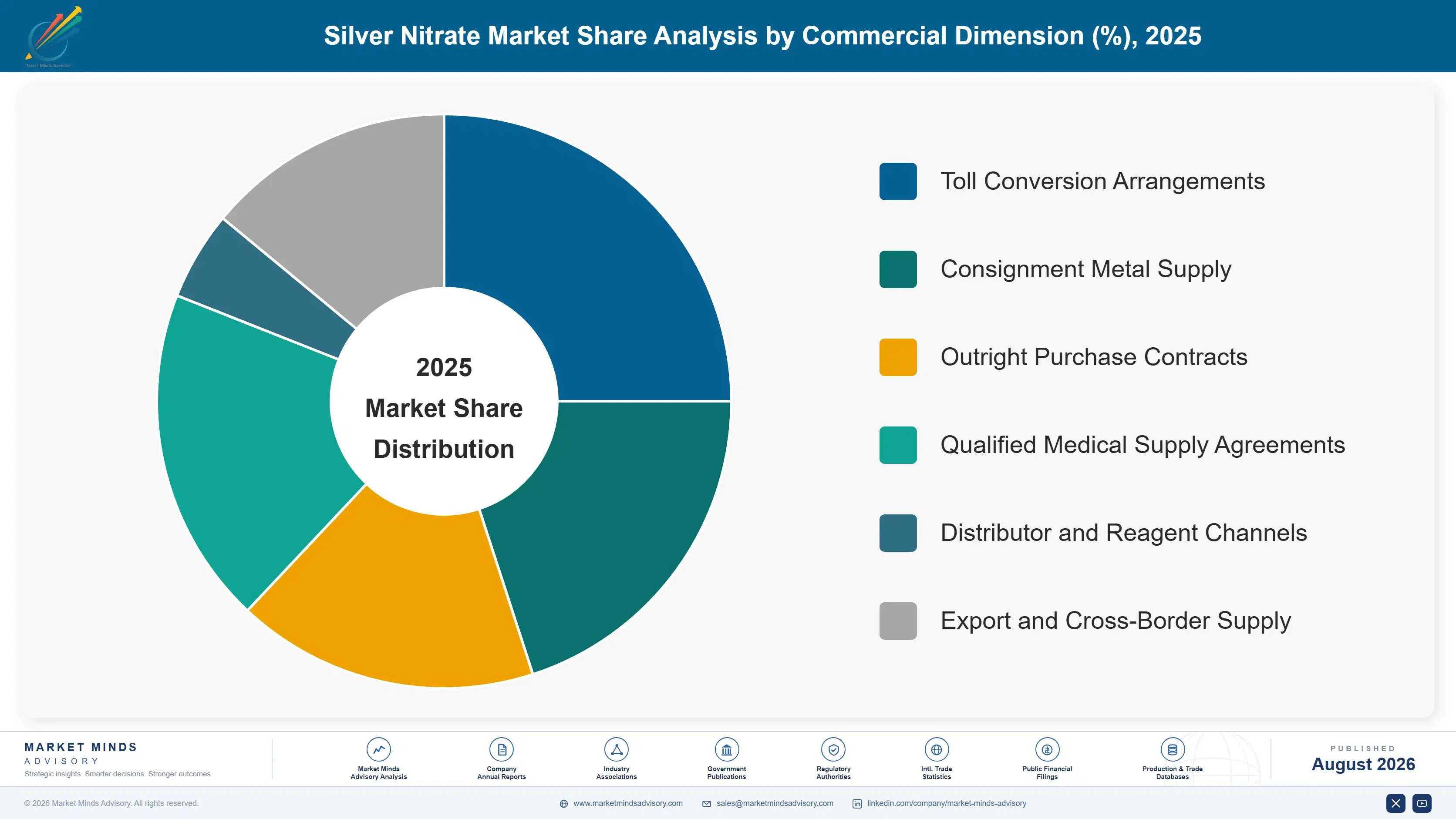
Six segments are split by purity grade and physical form, because grade determines the purification route required, the documentation a customer needs and the applications a supplier can serve at all. Packaging and concentration variants sit inside each grade rather than beside them. End-use industry and sales channel are both handled in the framework instead.
silver-nitrate-market-trends-market-share-analysis-1787595157748

Pharmaceutical and Medical Grade

Growing at 8.1%, half again the market rate of 5.4%, medical grade carries purity and documentation requirements well beyond technical material and qualifies into devices through regulatory approval that nobody repeats without good reason. Wound dressings, catheter coatings and antimicrobial device surfaces all rely on silver performance across bacteria, fungi and biofilms that alternatives replicate poorly at comparable breadth. European biocidal approval costs have concentrated the field among participants able to fund them, which reduced competition while raising the barrier for anybody arriving now. Switching difficulty makes established positions unusually durable. Regulatory affairs rather than procurement decides these qualifications. Wound dressings, catheter coatings and device surfaces all rely on that breadth of performance.
CAGR 8.1%

Electronic and Conductive Ink Grade

At 7.2% electronic grade serves conductive ink, printed electronics and specialty conductor manufacture where silver's conductivity and its behaviour during sintering both matter. Particle formation control during precipitation determines the properties of the resulting silver powder or flake, which makes process capability rather than purity alone the differentiator. Demand tracks printed electronics, sensor manufacture and specialty interconnect rather than the large photovoltaic paste application, which sits outside this scope and faces its own substitution pressure entirely separately. Sintering behaviour and conductivity both depend on how the powder or flake was formed, which makes the precipitation step the genuine differentiator rather than any purity figure on a certificate. Purity alone differentiates nothing here.
CAGR 7.2%
Full segment breakdown across 6 segments available in the complete report.

Regional Architecture and Country Demand Map

East Asia currently holds 30% of value on electronics manufacture and on chemical conversion capacity concentration right across the region. North America then follows at 24% on medical and specialty grade demand, with Western Europe at 20% holding steady on pharmaceutical and analytical reagent grades.

North America

Share sits at 20% against a band of 22 to 32% because electronics manufacture concentrates in East Asia while American demand skews toward medical, pharmaceutical and analytical applications with high value per tonne but limited volume. Medical device manufacture is substantial and qualifies silver nitrate through regulatory processes that create durable supply positions. Refining infrastructure is well established and toll arrangements are standard practice. Photographic grade demand continues its long decline from a base that was once dominant. Growth of 4.6% reflects specialty demand rather than volume expansion. Refining infrastructure is well established and toll arrangements are standard commercial practice throughout the region. Photographic grade continues its long decline from a once dominant base.
Share: 24% | CAGR: 4.6% (2026 to 2036)

Western Europe

Pharmaceutical, reagent and specialty chemical demand accounts for most regional value, with medical device manufacture and analytical laboratory supply both well established. European biocidal product regulation shapes the antimicrobial applications more heavily here than anywhere, with approval costs concentrating the market among participants able to fund them. German and Swiss refiners hold strong positions built on precious metal capability rather than on chemistry. Photographic demand has declined to a small specialty base. Growth at 4.0% runs below the base case on regulatory constraint. German and Swiss refiners hold strong positions built on precious metal capability rather than on chemistry. Photographic demand has fallen to a small specialty base. Regulation shapes antimicrobial use heavily.
Share: 20% | CAGR: 4.0% (2026 to 2036)
Regional intelligence for 5 additional markets available in the complete report: East Asia, South Asia and Pacific, Latin America, Middle East and Africa, Eastern Europe. Contact sales@marketmindsadvisory.com.
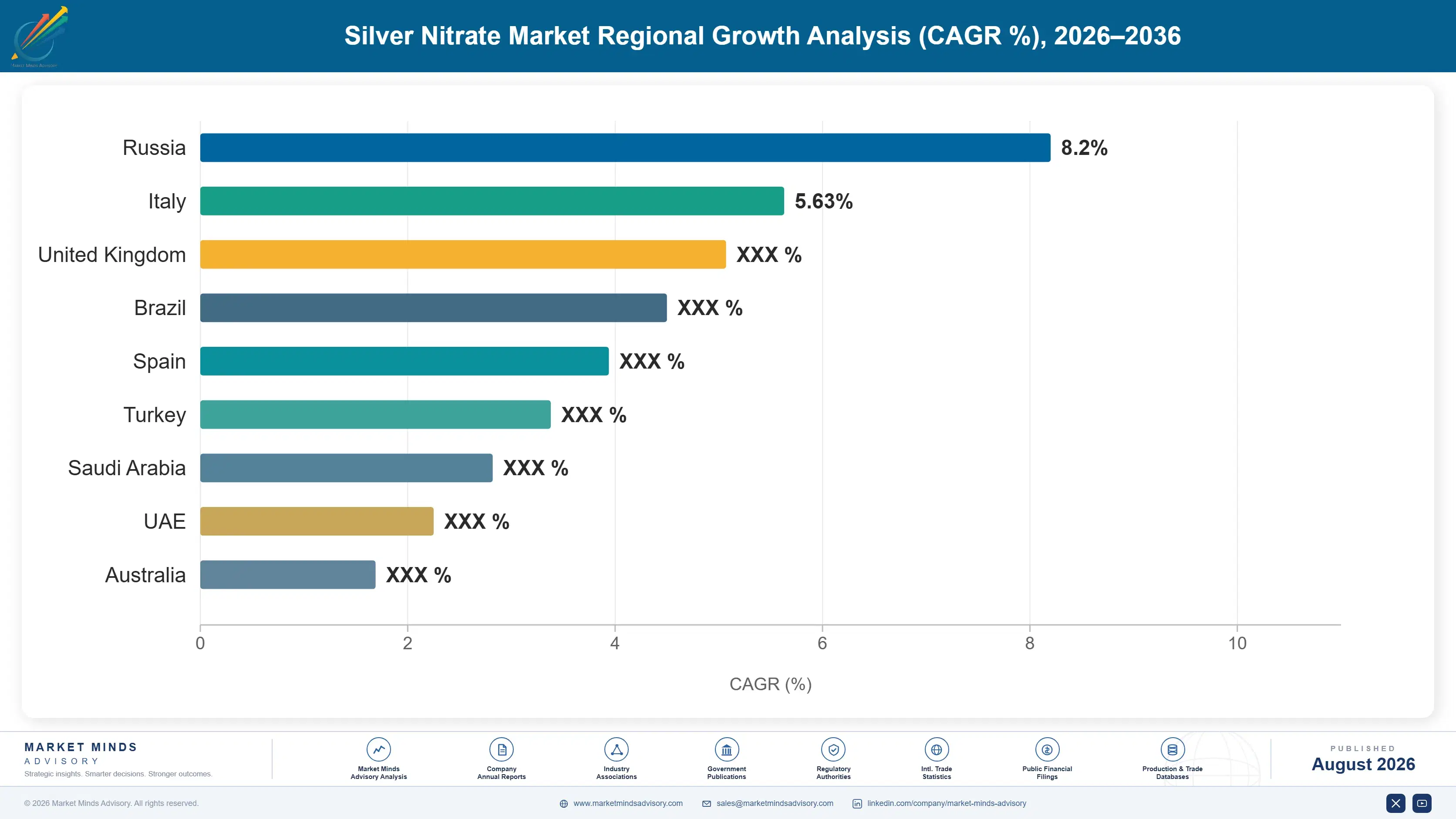
silver-nitrate-market-trends-country-cagr-analysis-1787595158270

Four Moves Without Pricing Power

Around 88% of what a customer pays is a metal priced by people who have never heard of this particular industry. Everything a producer can actually control sits in the conversion fee, in the metal exposure structure, and in the grades where qualification rather than price decides who ends up supplying whom in the end.

Structure metal exposure out of the balance sheet

Contained silver is around 88% of product value and moves on investment flows unrelated to chemical demand, which means an unhedged producer is running a commodity position it never intended to take. Toll refining returning roughly 98% of contained metal, consignment stocks and formal hedging all convert that into a clean conversion fee behaving like manufacturing margin. Producers who never made the shift have been damaged repeatedly by movements entirely outside their own market. Customers accept the structure readily, since it removes their exposure too. It behaves like manufacturing margin afterwards.
Market Impact: Removes 88% of the total product value exposure

Concentrate on grades where qualification protects position

Medical grade qualifies into devices through regulatory approval nobody repeats casually, and it grows at 8.1% while technical grade competes on conversion fee alone. Electronic grade at 7.2% depends on particle formation control that is genuinely difficult to reproduce. Both positions survive metal price swings because the customer is buying qualification and consistency rather than a commodity, which is the only durable ground available in this category. Requalification means regulatory work nobody undertakes to save a conversion fee, which is a considerably stronger defence than any pricing position could ever provide.
Market Impact: Serves 8.1% medical grade growth every single year

Share biocidal approval cost through consortium arrangements

European biocidal approval costs run to millions per product type and have already removed marginal silver antimicrobial claims from the market. Consortium approaches spread that cost across participants and preserve positions that no single small producer could fund alone. The alternative is conceding antimicrobial applications entirely to the few able to pay, which is what has been happening steadily since the framework took effect. Approval cost at around 2.8 million per product type is what forced the consolidation in the first place, and it will keep forcing it. Smaller producers exit otherwise.
Market Impact: Shares a 2.8 million cost per product type

Follow electronics and pharmaceutical manufacture as it localises

India grows fastest at 9.6% as electronics and pharmaceutical production localise under national programmes, while domestic conversion capacity develops behind that demand rather than ahead of it. Refining relationships and metal financing are the barriers, since working capital requirements are severe when material is this valuable. Suppliers able to structure metal supply into those markets reach demand that domestic converters cannot yet serve properly. Domestic converters will eventually close that gap, which makes timing the whole question. Metal supply structuring is what makes entry possible there at all. Refining relationships are the other half of that.
Market Impact: Enters a market now growing at 9.6% annually

Who Controls the Margin Pool

Participation is measured on annual silver nitrate production volume, and the top five hold 46%. Concentration reflects refining relationships and metal financing capability rather than chemistry, since dissolving silver in nitric acid is not difficult while funding the inventory certainly is. Ames Goldsmith and Umicore lead through precious metal positions that predate their chemical operations. The gap to challengers is metal access rather than technical capability. Funding the inventory is the genuine barrier here.
Competition runs on three fronts. Metal exposure structure decides who survives price volatility with a business rather than a commodity position. Grade qualification decides access to medical and electronic applications where switching is genuinely difficult. Conversion efficiency decides technical grade competitiveness, which is where the least defensible revenue sits. Conversion efficiency alone defends very little.

Pressure ahead comes from solar metallisation substitution potentially releasing industrial silver demand and from biocidal approval costs concentrating antimicrobial applications. Umicore and Heraeus both operate integrated refining and chemical positions that smaller converters cannot match on metal access. Expect qualification investment rather than acquisitions. Rankings shift as regulatory positions consolidate and localisation proceeds. Metal access separates integrated groups from converters.
silver-nitrate-market-trends-company-positioning-matrix-1787595158787

Competitive Moat and Risk Dimensions

AMES GOLDSMITH

Moat: Silver chemistry specialisation depth

Long specialisation in silver chemistry rather than precious metals generally has built qualification positions across medical, electronic and photographic applications that a diversified refiner treats as a minor line. Customers qualifying material into regulated devices value a supplier whose whole business depends on the grade they buy rather than one for whom it is incidental.
AMES GOLDSMITH

Risk: Single metal concentration

A business built entirely on one metal carries full exposure to whatever silver does, including the risk that solar metallisation substitution releases industrial demand and moves the price that carries most of the product value. Diversified refiners spread that exposure across metals with unrelated demand drivers and cycles.
UMICORE

Moat: Integrated refining and metal access

Operating precious metal refining alongside chemical conversion provides metal access and financing capability that standalone converters must arrange externally at cost. That integration also supports toll and consignment structures that remove balance sheet exposure for both the company and its customers, which is worth more in this market than most chemical capabilities would be.
UMICORE

Risk: Chemical business scale within group

Silver nitrate is a modest line within a much larger materials group, which means investment competes against battery materials and catalysis businesses with considerably larger addressable markets. Qualification-led positions require sustained attention that a small line inside a diversified group does not always reliably receive.

Players Tracked

Prominent Players

Ames Goldsmith
Umicore
Johnson Matthey
Metalor Technologies
Heraeus

Other Key Players

Sino-Platinum Metals
Dowa Holdings
Mitsubishi Materials
Tanaka Kikinzoku
Materion
Chimet
Valcambi
Nihon Kagaku Sangyo
Shanghai Ruitai
Shoei Chemical
Toyo Chemical Industries
Noah Technologies
GFS Chemicals
American Elements
Alfa Aesar

Recent Developments

MARCH 2026

Producer converts customer supply onto consignment metal terms

A silver nitrate producer converted a substantial share of customer supply onto consignment metal arrangements, removing contained silver from both balance sheets and leaving a conversion fee that behaves like manufacturing margin. Customers accepted the structure readily given their own metal exposure concerns. Working capital released was substantial.
Signal: Metal exposure structure rather than chemistry determines who actually survives a volatile silver price cycle intact
SEPTEMBER 2025

Cell manufacturer demonstrates copper metallisation at production scale

A photovoltaic cell manufacturer demonstrated copper-plated metallisation at production scale, removing the silver requirement rather than reducing it as thrifting had done previously. Industrial silver demand implications would extend well beyond the paste market itself if adoption spreads. Adoption timing remains genuinely uncertain across the industry.
Signal: Substitution upstream would move the metal price that carries most of this product's own underlying value
JANUARY 2026

Biocidal approval consortium preserves silver antimicrobial applications

A consortium of producers shared the cost of maintaining European biocidal approval for silver antimicrobial applications, preserving positions that no individual participant could have funded alone at current approval expense levels. Several smaller producers joined rather than exit those applications. Individual funding was not viable at current levels.
Signal: Shared approval cost is now the only route by which smaller producers keep any regulated applications

Silver, Nitric Acid and Financing

Contained silver accounts for roughly 88% of product cost, priced on metal exchanges by investment demand, industrial consumption and mine supply arriving around 74% as a by-product of other metal mining. Nitric acid carries about 3%. Conversion energy, purification and quality assurance take around 5%. Metal financing cost absorbs the balance and rises directly with both silver price and interest rates, which is an exposure most chemical businesses never encounter.
Silver prices moved substantially through the period on investment flows responding to interest rate expectations and currency movements, per national statistical office and exchange reporting for recent years, with industrial demand a secondary influence throughout. Nitric acid moved separately on ammonia and natural gas costs. The two exposures are entirely unrelated, and only one of them matters to the finished product's price. Only one of them moves the customer's price.

Exposure divides on metal ownership structure and on financing cost. A producer operating on toll or consignment terms carries almost no metal exposure and correspondingly little financing cost, while one purchasing metal outright carries both and sees working capital swing violently with price. Interest rate movements compound that directly, which makes financing structure more consequential than anything in production.
silver-nitrate-market-trends-cost-volatility-analysis-1787595158982

Operate on toll and consignment metal terms wherever possible

Contained silver is around 88% of product value and toll arrangements returning roughly 98% of metal remove that exposure from the balance sheet entirely. Consignment stocks achieve something comparable for customers holding their own metal. Producers purchasing metal outright carry working capital that swings violently with price and compounds directly with interest rates. No chemical business should hold it.

Price conversion explicitly rather than bundling it into metal

Quoting a single price that bundles metal and conversion makes the producer appear to move prices for reasons customers cannot understand and destroys any commercial narrative. Separating a metal pass-through from an explicit conversion fee makes the actual value being sold visible. Customers accept it readily once explained, and it protects the fee from being squeezed when metal moves.

Recover silver from process residues and customer returns

With metal at around 88% of cost, recovery from filter cakes, wash solutions and customer process residues is worth considerably more than equivalent efficiency gains anywhere else in production. Refining relationships make that recovery practical at scale. Producers treating residue as waste rather than as inventory are discarding the single most valuable stream in the plant.

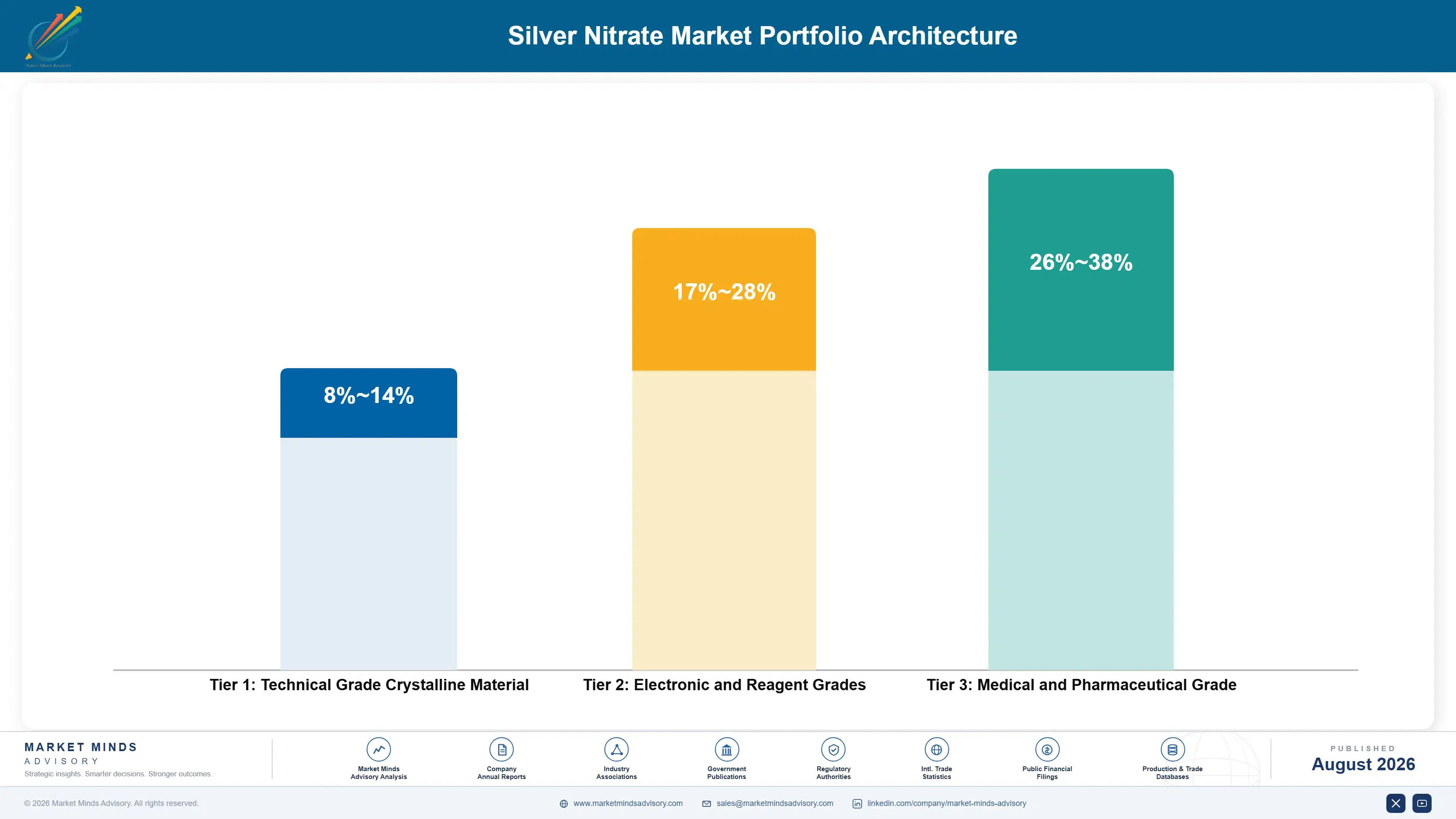
Portfolio Architecture for Margin Defence

Margin here is best read on conversion fee rather than on gross revenue, since contained metal at around 88% of value distorts every conventional measure beyond usefulness. Technical grade earns conversion margins in the high single digits to low teens, because dissolving silver competently is not a differentiated capability and buyers compare conversion charges directly. Metal financing structure decides who prices competitively here. Conversion charges get compared directly.
Electronic and reagent grades do considerably better in the high teens to high twenties, because particle formation control and documented consistency both require process capability that takes time to develop. The range reflects how far a supplier's process actually differentiates the resulting material rather than merely meeting a purity specification on paper. Downstream process behaviour rather than a certificate settles it. Consistency documentation matters as much as capability.

Medical and pharmaceutical grade holds the strongest position, reaching into the high thirties, because qualification into a regulated device creates switching costs that no price advantage overcomes. Those margins reflect regulatory position and documentation depth rather than chemistry, and biocidal approval costs have concentrated the field further still. Approval costs have concentrated the field further still. Switching costs a regulatory submission.

Technical Grade Crystalline Material

Standard technical grade supplied against common specifications on conversion or toll terms. The six point range reflects conversion efficiency and metal financing structure rather than any product difference between competing suppliers.
Gross Margin: 8-14%

Electronic and Reagent Grades

Grades where particle formation control and documented consistency both matter to the downstream process. The eleven point range reflects how far process capability differentiates material beyond meeting a purity specification.
Gross Margin: 17-28%

Medical and Pharmaceutical Grade

Material qualified into regulated medical devices and pharmaceutical preparations directly. The twelve point range reflects regulatory position and documentation depth rather than any difference in the underlying chemistry actually supplied.
Gross Margin: 26-38%
silver-nitrate-market-trends-portfolio-architecture-1787595159485

High-value Sub-segments and Strategic Watch-out

Medical and Pharmaceutical Grade

High value and the fastest growth at 8.1%, protected by device qualification that nobody repeats casually and by silver performance alternatives replicate poorly. Biocidal approval costs have concentrated the field considerably further. Documentation depth rather than chemistry protects the position. Nobody repeats a device submission casually.
Gross Margin: 28-38%

Electronic and Conductive Ink Grade

High value and growing at 7.2% on printed electronics and specialty conductor demand. Particle formation control during precipitation rather than purity alone is what actually differentiates suppliers in this application. Printed electronics and sensor manufacture drive demand rather than photovoltaic paste. Process capability takes years to develop.
Gross Margin: 19-30%

Technical Grade Crystalline

The volume core, where conversion competence is not differentiated and buyers compare charges directly. Metal financing structure rather than production efficiency determines who can price competitively here at all. Buyers compare conversion charges directly and nothing else. Dissolving silver competently is not differentiated at all.
Gross Margin: 8-14%

Solar Demand Linkage

The strategic watch-out. Copper metallisation would release industrial silver demand and move the metal price carrying most of this product's value, and the range reflects exposure to that indirect linkage. The linkage is indirect and none of it is within any producer's control. Exposure is indirect but entirely real.
Gross Margin: 6-32%

Qualified Grades, Commodity Volume

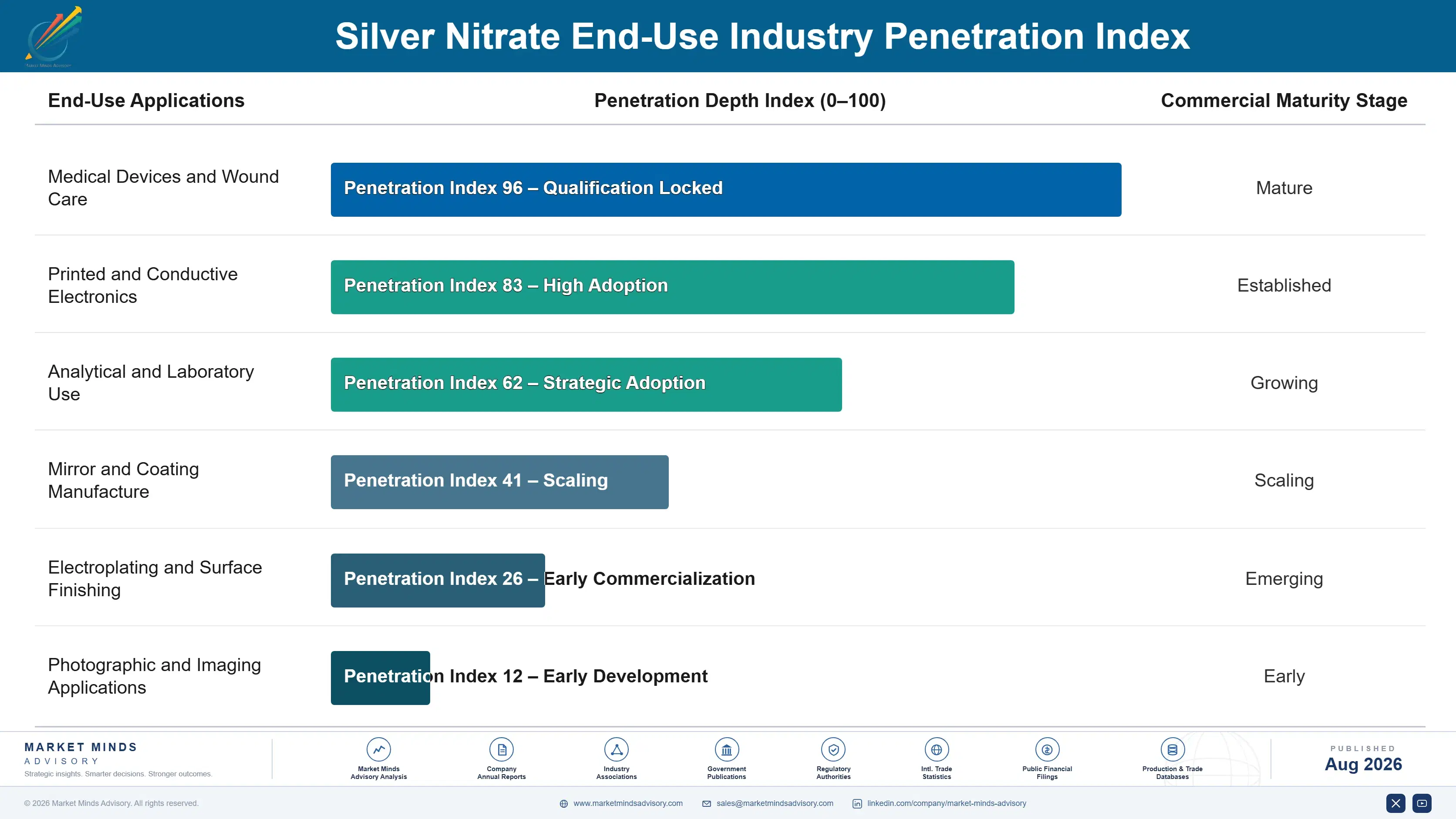
Consumption follows customer production directly rather than any periodic purchasing cycle, since silver nitrate is an input consumed continuously by processes that run against their own demand. That makes volume forecastable from customer utilisation. What is not forecastable is value, since contained metal at around 88% of price moves on flows nobody in this chain influences or predicts reliably. Volume and value behave quite differently here.
Stickiness varies enormously by grade. Medical material qualified into a regulated device is close to immovable, because requalification means regulatory work nobody undertakes to save a conversion fee. Electronic grade is nearly as durable where particle characteristics affect a downstream process. Technical grade switches on conversion charge alone at every renewal, since the material is genuinely interchangeable. Conversion charge alone settles the technical grade.

The deciding function follows the same split. Regulatory affairs and quality functions decide medical qualification and weigh documentation above everything. Process engineering decides electronic grade on material characteristics. Procurement handles technical grade against a conversion comparison, and suppliers who address procurement about a medical grade are talking to the wrong people entirely. Addressing the wrong function wastes the entire effort.
silver-nitrate-market-trends-end-use-penetration-index-1787595159978

Where We Would Focus Effort

These are among the four positions where our research anticipates prominent divergence between winners and laggards over the coming forecast period. Each is grounded in the demand model, the regulatory perimeter, and the announced capacity pipeline.
01 / METAL EXPOSURE STRUCTURING

Do not own the metal you are converting

Contained silver represents around 88% of product value and moves on investment flows that respond to interest rates and currency rather than to anything happening in chemical demand. An unhedged producer is therefore running a commodity position it it never intended to take at all, on a metal nobody here can influence. Toll refining returning roughly 98% of contained metal, consignment stocks and formal hedging all convert that exposure into a clean conversion fee behaving like an ordinary manufacturing margin instead.
02 / QUALIFICATION GRADE FOCUS

Sell where switching costs somebody a submission

Medical grade qualifies into regulated devices through regulatory approval that nobody repeats casually to save a conversion fee, and it grows at 8.1% against a market rate of 5.4%. Electronic grade at 7.2% depends on particle formation control during precipitation that is genuinely difficult to reproduce consistently at scale. Both positions survive metal price swings intact because the customer is buying qualification and consistency rather than a commodity, which is the only durable ground this category offers anybody at all.
03 / APPROVAL COST SHARING

Consortium or concede the application entirely

European biocidal approval costs run to millions per product type and have already removed marginal silver antimicrobial claims from the market, concentrating what remains among participants able to fund the extensive data requirements. Consortium arrangements spread that cost and preserve positions no individual small producer could ever fund on its own at all. The alternative is conceding antimicrobial applications to the few able to pay, which is precisely what has been happening since the framework took full effect across the region.
04 / LOCALISATION ENTRY TIMING

Working capital is the real barrier there

India grows fastest anywhere at 9.6% as electronics and pharmaceutical manufacture localise under various national programmes, while domestic conversion capacity develops well behind that demand rather than ahead of it anywhere. Refining relationships and metal financing are the practical barriers to entry, since working capital requirements are genuinely severe when the material carries this much value per tonne of material. Suppliers able to structure metal supply into those markets reach demand local converters simply cannot yet serve properly at all.

Engagement Snapshot From the Field

A live engagement with an industry participant carrying material or product regulatory and market exposure ahead of a defining policy shift, showing how our research translates into a defensible multi-year portfolio strategy.
MARKET MINDS ADVISORY · CLIENT ENGAGEMENT SUMMARY
Silver Nitrate Producer Strategic Portfolio Review and Transition Roadmap 2026·Investment Scenario on Silver Nitrate Exposure Evaluation 2025-26
CLIENT PROFILE
A European specialty chemical producer manufacturing silver nitrate across technical, reagent and electronic grades for customers in nine countries, at annual revenue near 128 million euros (client-reported, unverified by MMA). Metal was purchased outright and carried on the balance sheet, and no medical grade qualification existed anywhere in the portfolio or anywhere at all under development.
STRATEGIC CHALLENGE
Reported margins had swung violently across three years on silver price movements while conversion volumes barely changed, and the board could not distinguish operating performance from metal position effects. Management were considering exiting lower margin grades without understanding which of those margins were actually real and which were metal effects.
MMA APPROACH
MMA separated conversion margin from metal position effects across three years of results, benchmarked toll and consignment structures against outright purchasing, assessed medical grade qualification requirements and timelines, and evaluated working capital released by restructuring metal terms. Interviews with 47 experts covered precious metal refining, chemical conversion and medical device qualification.
KEY FINDINGS
  1. Conversion margins had been broadly stable across all three years, and the apparent volatility came entirely from metal position effects rather than from any operating performance change.
  2. Restructuring onto toll and consignment terms would release working capital equivalent to a substantial share of annual revenue while removing the volatility altogether.
  3. Medical grade qualification was achievable within the client's capability and reached demand growing considerably faster than the technical grade the company was considering exiting.
  4. Two customers had independently requested consignment arrangements to remove metal from their own balance sheets, and the client had declined both requests without analysis.
CLIENT PROFILE
A European specialty chemical producer manufacturing silver nitrate across technical, reagent and electronic grades for customers in nine countries, at annual revenue near 128 million euros (client-reported, unverified by MMA). Metal was purchased outright and carried on the balance sheet, and no medical grade qualification existed anywhere in the portfolio or anywhere at all under development.
STRATEGIC CHALLENGE
Reported margins had swung violently across three years on silver price movements while conversion volumes barely changed, and the board could not distinguish operating performance from metal position effects. Management were considering exiting lower margin grades without understanding which of those margins were actually real and which were metal effects.
MMA APPROACH
MMA separated conversion margin from metal position effects across three years of results, benchmarked toll and consignment structures against outright purchasing, assessed medical grade qualification requirements and timelines, and evaluated working capital released by restructuring metal terms. Interviews with 47 experts covered precious metal refining, chemical conversion and medical device qualification.
KEY FINDINGS
  1. Conversion margins had been broadly stable across all three years, and the apparent volatility came entirely from metal position effects rather than from any operating performance change.
  2. Restructuring onto toll and consignment terms would release working capital equivalent to a substantial share of annual revenue while removing the volatility altogether.
  3. Medical grade qualification was achievable within the client's capability and reached demand growing considerably faster than the technical grade the company was considering exiting.
  4. Two customers had independently requested consignment arrangements to remove metal from their own balance sheets, and the client had declined both requests without analysis.
RECOMMENDED STRATEGY
Phase 1: Phase one: restructure metal onto toll and consignment terms, which removes the volatility obscuring operating performance and releases substantial working capital. Phase 2: Phase two: pursue medical grade qualification, since it reaches faster growing demand and creates switching costs that conversion pricing never will. Phase 3: Phase three: retain technical grade rather than exiting, since its conversion margin was never the problem the board believed it to be.
OUTCOME
The producer moved most supply onto consignment and toll terms during 2026 and reported reported margins stabilising immediately (client-reported, unverified by MMA). Medical grade qualification began, working capital was released, and the planned grade exit was cancelled. Two customers moved onto consignment terms at their own request.

Frequently Asked Questions

Foundational context covering the market sizes, CAGR, scope, country, region and competition that inform every finding below. This section is provided to cover basics and most often pre-purchase conversations, answered from the MMA Primary Research Dataset.

What is the current size of the Silver Nitrate Market?

MMA sizes it at USD 1.86 billion in 2025, rising to USD 1.96 billion in 2026. The figure covers manufactured silver nitrate across purity grades at producer selling value including contained metal.

How large will the Silver Nitrate Market be by 2036?

USD 3.32 billion by 2036, an incremental USD 1.36 billion over the 2026 base and an expansion multiple of 1.69 times. Medical grade accounts for a disproportionate share of growth.

What is the CAGR for the Silver Nitrate Market 2026 to 2036?

5.4% in the base case, with a bull case at 6.6% and a bear case at 4.2%. The spread turns on silver price and on solar metallisation substitution upstream.

Which segment is growing fastest?

Pharmaceutical and medical grade at 8.1%, half again the market rate of 5.4%. Device qualification and silver antimicrobial performance together make established positions unusually durable.

Who are the major companies in the Silver Nitrate Market?

Ames Goldsmith, Umicore, Johnson Matthey, Metalor Technologies and Heraeus lead on production volume. Fifteen further participants are profiled in the full report on that same basis.

Which country is growing fastest?

India at 9.6%, as both electronics assembly and pharmaceutical manufacture keep expanding under national programmes that very strongly favour domestic production over imported finished goods.

Report Segmentation Architecture

The full report scope spans multiple orthogonal segmentation dimensions, with cross-tabulated demand data provided for each dimension pair. Coverage extends further to regional breakdowns, trend trajectories, and the competitive detail needed to support segment-level decision-making.

By Purity Grade and Form

  • Technical Grade Crystalline
  • Photographic Grade
  • Pharmaceutical and Medical Grade
  • Electronic and Conductive Ink Grade
  • Analytical Reagent Grade
  • Solutions and Prepared Formulations

By End-Use Industry

  • Medical Devices and Wound Care
  • Printed and Conductive Electronics
  • Analytical and Laboratory Use
  • Mirror and Coating Manufacture
  • Electroplating and Surface Finishing
  • Photographic and Imaging Applications

By Commercial Dimension

  • Toll Conversion Arrangements
  • Consignment Metal Supply
  • Outright Purchase Contracts
  • Qualified Medical Supply Agreements
  • Distributor and Reagent Channels
  • Export and Cross-Border Supply

By Region

  • North America
  • Western Europe
  • East Asia
  • South Asia and Pacific
  • Latin America
  • Middle East and Africa
  • Eastern Europe

Scope, Methodology, and Coverage

Every figure in this report is reproducible from documented input assumptions. The scope below maps the historical period, the forecast horizon, the segmentation dimensions, and the countries covered, alongside the underlying primary and qualitative methodology.
Historical Period
2020 to 2025
Forecast Period
2026 to 2036
Base Year
2025 (USD billions; MMA Primary Research Dataset, August 2026)
Market Definition
Silver nitrate supplied as a manufactured chemical across purity grades and forms, covering technical grade crystalline material, photographic grade, pharmaceutical and medical grade, electronic and conductive ink grade, analytical reagent grade, and silver nitrate solutions and prepared formulations. Measured at producer selling value including contained silver metal. Silver metal and bullion, other silver compounds sold as separate products, finished medical devices and dressings, and photovoltaic silver pastes are excluded from scope.
Quantitative Units
USD billions (current prices); tonnes silver nitrate; USD per kilogram by purity grade
Segmentation Dimensions
Purity grade and form; end-use industry; commercial dimension; region
Regions Covered
North America, Western Europe, East Asia, South Asia and Pacific, Latin America, Middle East and Africa, Eastern Europe
Countries Covered
China, Japan, South Korea, Taiwan, India, Malaysia, Australia, United States, Canada, Mexico, Germany, Switzerland, Belgium, Italy, United Kingdom, Poland, Czech Republic, Brazil, Peru, South Africa
Key Companies Profiled
Ames Goldsmith, Umicore, Johnson Matthey, Metalor Technologies, Heraeus, Sino-Platinum Metals, Dowa Holdings, Mitsubishi Materials, Tanaka Kikinzoku, Materion, Chimet, Valcambi, Nihon Kagaku Sangyo, Shanghai Ruitai, Shoei Chemical, Toyo Chemical Industries, Noah Technologies, GFS Chemicals, American Elements, Alfa Aesar
Quantitative Methodology
Primary survey, n=3,800 respondents, Q4 2025, six countries; demand-side model with trade association cross-validation
Qualitative Methodology
47 expert interviews, Q4 2025; applied to validate demand model assumptions, identify emerging dynamics, and assess competitive positioning
Report Format
PDF and XLSX data workbook (Word format preview document)
Publisher
Market Minds Advisory
Report Code
MMA-2026-CHM-136
Published
August 2026
Contact
sales@marketmindsadvisory.com | www.marketmindsadvisory.com

Purchase the full Silver Nitrate Market Report (2026 to 2036).

The full report separates conversion margin from metal position effects, because reported results in this industry are dominated by a metal price that no participant influences at all. It sizes all six purity grades independently through 2036, models metal exposure structures against working capital and margin volatility, and assesses biocidal approval cost effects on antimicrobial application viability. Regional chapters cover all seven regions, following conversion and consumption rather than mine production, which sits in entirely different countries. Competitive profiling covers 20 participants on a single production volume basis.
Six purity grades sized independently through 2036
Conversion margin separated from metal position effects throughout
Metal exposure structures modelled against working capital requirements
Biocidal approval costs assessed against antimicrobial application viability
Twenty participants profiled on one consistent volume basis
Solar metallisation substitution tracked as an indirect price linkage

Built For The People Who Decide

From boardroom strategy to bench-side execution, this report is read cover-to-cover by leaders shaping the next decade of their industry, turning demand scenarios, market dynamics and valuation benchmarks into decisions.
CXOs/ Presidents/ VPs/ Managers
M&A and Corporate Development
Strategy Teams and R&D Heads
Procurement and Product Directors
Regulatory and Compliance Leaders
Investor Relations and Equity Analysts