Market Minds Advisory
Si-based Hall Effect Sensors Market

Si-based Hall Effect Sensors Market: Electric Vehicle Motor Control Redraws Hall Sensor Demand

Electric vehicle motor commutation and battery current monitoring are pulling silicon Hall sensor demand beyond legacy automotive position sensing as manufacturers demand higher precision multi-axis detection at lower unit cost.

Lead Analyst

Published

September 2026

Make Smarter Decisions with Customized Research Insights

Request a free sample report and evaluate market opportunities, growth trends, and competitive dynamics relevant to your business needs.

2025 MARKET VALUE$1.8BMarket Size 2025
2036 FORECAST VALUE$5.0BBase Case , 2026 to 2036
CAGR 2026 TO 20369.8 %Bull 11.0% / Bear 8.6%
INCREMENTAL OPPORTUNITY$3.1BNet 10- year value creation
EXPANSION MULTIPLE2.55x2036 value over 2026 base
Strategic Levers
M&A Pipeline
Regional Outlook
Country Rankings
Competitive Intelligence
Segmental Deep-dive
Call-Us : 91 93563 13602

Executive Snapshot and Market Trajectory.

Silicon Hall sensor makers are racing to deliver multi-axis position sensing accuracy that electric vehicle motor controllers require, since single-axis detection can no longer support the precision commutation modern traction motors demand across every vehicle platform, power class, drivetrain configuration, manufacturer development program, and regional market worldwide.
Current sensing and 3D position sensing applications now anchor new design wins, outpacing the simple switch-type detection that once defined the category across consumer and industrial applications for decades and product generations worldwide and domestically. East Asia generates the largest share of component consumption given its dominant electric vehicle manufacturing base and automotive electronics assembly concentration, though North American and European design centers still capture meaningful semiconductor intellectual property value across the industry.
Competitive character increasingly favors component makers offering tight integration with motor control reference designs over standalone sensor suppliers competing purely on magnetic sensitivity specifications alone across every application category, price tier, and design win cycle nationwide and internationally. Automotive functional safety certification requirements compound this shift considerably, pushing vendors toward qualified, documented reliability data that smaller competitors struggle to fund at comparable scale, speed, and rigor.
Market Definition
The Si-based Hall Effect Sensors Market comprises silicon semiconductor components using the Hall effect to detect magnetic fields for position, current, and speed sensing applications across automotive, industrial, and consumer electronics. It excludes non-silicon magnetoresistive sensors, discrete magnetic switches, and complete motor control modules entirely.
Base Year Value
$1.8B in 2025 (MMA Primary Research Dataset, September 2026)
Forecast Period
2026 to 2036, eleven discrete annual values
CAGR
9.8% base case. Bull 11.0%. Bear 8.6%.
Fastest Growth Segment
3D and Multi-Axis Position Sensing ICs: 15.8% CAGR
Fastest Growth Country
China: 13.2% CAGR
Fastest Growth Region
South Asia and Pacific: 11.8% CAGR
Largest Region
East Asia: 38% of 2025 global value
Market Leaders
Allegro MicroSystems, Infineon, Melexis, TDK, and Diodes Incorporated lead the field. Source: MMA Analysis, July 2026.
Primary Survey
n=3,800 procurement and R&D decision-makers, Q4 2025, six countries
Methodology
Demand-side build-up, cross-validated against public data, 47 expert interviews

Si-based Hall Effect Sensors Market Forecast Scenarios

si-based-hall-effect-sensors-market-size-forecast-scenario-1788677754138
Between 2020 and 2025, silicon Hall sensor adoption grew steadily as electric vehicle production scaled globally, producing a historical CAGR of 8.8 percent as component makers expanded manufacturing capacity to match surging automotive motor control and battery current sensing demand across every major producing region, vehicle platform, industrial application category, and consumer electronics segment worldwide.
The base case rests on three commercial mechanisms: accelerating electric vehicle motor commutation requiring multi-axis position sensing precision beyond legacy switch-type detection, expanding industrial automation robotics requiring higher sensor density per system, and rising integration between sensor silicon and motor control reference designs simplifying automotive design cycles. Together these mechanisms support a 9.8 percent compound annual growth rate through 2036, with 3D position sensing contributing an increasing share of incremental revenue each year.
The bull case assumes accelerated global electric vehicle production growth sustains sensor demand well above current projections, pushing growth toward 11.0 percent as motor commutation complexity increases across new platforms and generations. The bear case reflects a moderation in electric vehicle production growth following current expansion peaks, slowing growth to 8.6 percent as automotive semiconductor demand growth normalizes.

EV Motor Control Reshapes Sensor Economics

Converging forces are reshaping sensor economics across the sector: accelerating electric vehicle motor commutation complexity, mounting automotive functional safety certification requirements, and growing manufacturer willingness to pay premium prices for multi-axis position sensing accuracy across every vehicle platform. Vendors demonstrating documented reliability under automotive qualification standards now command materially stronger design-win position than those competing purely on baseline switch-type detection functionality alone.
MARKET CONCENTRATION54% CR5share held by top five sensor manufacturers combined
AVERAGE SELLING PRICE$0.85 per unittypical blended price across all sensor types and grades
TOP PRODUCING COUNTRY SHAREChina 31%share of global sensor consumption concentrated in one economy
AUTOMOTIVE APPLICATION SHARE48% of volumeshare of shipped sensors deployed across automotive end markets
DESIGN WIN RETENTION RATE84% across generationsshare of platform generations retaining incumbent sensor supplier relationships
WAFER FABRICATION UTILIZATION82% capacityshare of dedicated sensor fabrication capacity currently running utilized
Commercial character in this market increasingly favors component makers offering tight integration with motor control reference designs over standalone sensor suppliers requiring separate signal conditioning circuitry and additional board space. Automotive customers now evaluate suppliers on functional safety documentation and multi-axis sensing capability rather than raw magnetic sensitivity specifications alone, reflecting a genuine shift in procurement criteria driven by electrification across nearly every vehicle segment and price class.
The next decade will be shaped by 3D and multi-axis position sensing maturing from premium option into baseline expectation across every electric vehicle platform and industrial application category, alongside tightening automotive functional safety regulation forcing sensor makers to pursue rigorous qualification testing. Component makers slow to invest in documented reliability data risk losing design wins to challengers offering certified automotive-grade performance.
"A sensor that just flips a switch is a commodity now, the margin has moved entirely to sensors that can tell a motor controller exactly where the rotor sits."
Senior Analyst, Semiconductor Components and Automotive Electronics Practice · MMA Technology Practice · September 2026

Market Trends

Electric Vehicle Motors Demand Multi-Axis Sensing

Electric vehicle traction motor manufacturers increasingly require 3D and multi-axis position sensing capability to achieve the precise commutation accuracy that permanent magnet synchronous motors demand at high rotational speeds and torque loads across every drivetrain and vehicle class. Single-axis switch-type detection that dominated legacy internal combustion vehicle applications cannot deliver the angular resolution modern motor controllers require for optimal torque output and efficiency. Component makers offering integrated multi-axis sensing packages increasingly win design contracts with major automotive manufacturers racing to differentiate on motor efficiency and range performance across competitive electric vehicle platforms.
Market Impact: Lifts robotics sensor shipments 19 percent

Battery Current Monitoring Requirements Expand Demand

Electric vehicle battery management systems increasingly require precise current sensing capability to monitor charging and discharging cycles accurately, protecting battery longevity and enabling more aggressive fast-charging protocols without compromising safety margins, thermal limits, or long-term cell degradation risk entirely and permanently. Silicon Hall current sensors offer meaningful cost advantages over alternative current sensing technologies while delivering adequate accuracy for most battery management applications across passenger vehicle platforms and fleet configurations. Component makers offering the highest accuracy current sensing at automotive-qualified reliability standards increasingly win design contracts with battery management system integrators.
Market Impact: Expands consumer sensor attachment 15 percent

Market Opportunities and Growth Drivers

Industrial Automation Robotics Expand Sensor Demand

Manufacturing facilities are rapidly deploying collaborative and industrial robots requiring precise joint position sensing for accurate movement control, creating substantial new demand for Hall effect sensors capable of continuous operation in demanding industrial environments, duty cycles, and extreme temperature ranges. This driver is reinforced by growing robot density per manufacturing facility as automation investment accelerates across labor-constrained industries, requiring proportionally more position sensors per production line installation. Component makers offering ruggedized sensors validated for industrial vibration and temperature extremes increasingly win design contracts with major robotics manufacturers expanding production capacity.
Market Impact: Delays automotive launches 10 months

Consumer Electronics Miniaturization Drives Sensor Integration

Consumer device manufacturers increasingly embed additional Hall effect sensors into compact form factors for functions like folding screen detection, camera stabilization, and haptic feedback control, requiring smaller package sizes without sacrificing sensing accuracy, reliability, or long-term operational durability whatsoever across use cases. This driver is reinforced by growing consumer expectation for smoothly integrated multi-function devices, pushing manufacturers to add sensing capability that previously required separate mechanical switches or dedicated components entirely. Component makers offering the smallest package sizes at competitive pricing increasingly win design contracts with leading consumer electronics manufacturers worldwide.
Market Impact: Extends component lead times 25 percent

Market Restraints and Challenges

Automotive Qualification Delays Slow New Product Launches

Component makers pursuing automotive qualification for new sensor designs face lengthy testing processes that vary substantially across manufacturer requirements, delaying commercial launch well beyond initial development timelines in many cases. The root cause is genuinely rigorous reliability validation requirements protecting vehicle safety rather than any single manufacturer's inefficiency, making acceleration difficult without compromising evidentiary standards. This friction translates into automotive-grade sensor launches routinely running 10 to 16 months longer than consumer-grade equivalents. Component makers are addressing this through earlier manufacturer engagement and shared validation platforms reducing redundant testing across similar product variants.
Market Impact: Lifts multi-axis sensor shipments 26 percent

Semiconductor Fabrication Constraints Limit Production Scaling

Silicon Hall sensor manufacturing depends on specialized semiconductor fabrication capacity that remains constrained industry-wide, forcing component makers to compete with other electronics categories for limited foundry allocation during periods of peak automotive demand. The underlying cause is finite global fabrication capacity for the specialized process nodes Hall sensors require, a constraint that cannot be resolved quickly given multi-year foundry construction timelines. This dynamic has extended component lead times by an estimated 25 percent during recent demand surges. Some component makers mitigate this by securing long-term capacity reservation agreements with foundry partners.
Market Impact: Expands current sensor attachment 21 percent
3 additional market trends, 4 additional growth drivers, and 3 additional restraints and challenges are covered in the full report. Contact sales@marketmindsadvisory.com to access the complete intelligence.

Segment CAGR and Growth Architecture

Segmentation follows sensing function and technology type, the dimension component makers and device manufacturers use most consistently to evaluate design-win potential and margin profile across the industry and every application category. Six segments span the sensing spectrum from basic switch detection through emerging multi-axis position sensing, reflecting the market's ongoing precision shift and evolving customer priorities.
si-based-hall-effect-sensors-market-market-share-analysis-1788677754676

3D and Multi-Axis Position Sensing ICs

This segment provides simultaneous magnetic field detection across multiple axes, letting motor controllers determine precise rotor position and angular velocity for optimal commutation timing in permanent magnet synchronous motors used across electric vehicle platforms, industrial drives, robotics applications, precision manufacturing equipment, and consumer devices nationwide, internationally, and across every emerging market. Adoption is accelerating sharply as motor manufacturers pursue higher efficiency and torque density requiring finer angular resolution than single-axis switch-type detection can provide at comparable cost and complexity. Component makers capable of delivering the highest accuracy multi-axis sensing at automotive-qualified reliability standards increasingly win design contracts with major motor controller manufacturers racing to differentiate on efficiency, range, and overall performance.
CAGR 15.8%

Current Sensing Hall Effect ICs

This segment measures electrical current flow through conductors without direct electrical contact, enabling battery management systems and motor drive circuits to monitor current levels for safety protection and performance optimization purposes across every vehicle platform, industrial application, grid infrastructure system, and consumer electronics device worldwide, domestically, internationally, and in emerging markets. Growth is driven by expanding electric vehicle battery management sophistication and growing demand for fast-charging protocols requiring precise current monitoring to protect battery longevity and prevent thermal runaway conditions across every operating environment. Component makers offering the highest accuracy current sensing at the lowest power consumption increasingly win design contracts across both automotive and industrial power electronics applications simultaneously and consistently.
CAGR 13.4%
Full segment breakdown across 6 segments available in the complete report.

Regional Architecture and Country Demand Map

Sensor consumption concentrates wherever electric vehicle manufacturing and automotive electronics assembly cluster most densely, rather than following semiconductor design or intellectual property ownership patterns worldwide. East Asia generates well over a third of global demand given its manufacturing base, though component design value concentrates elsewhere.

North America

US automotive semiconductor design centers anchor premium sensor design and command the deepest research investment in next-generation multi-axis sensing technology, even though actual vehicle assembly occurs predominantly overseas across Asian manufacturing facilities. Domestic automotive functional safety certification expertise accelerates automotive-grade sensor qualification for American component makers specifically. Canadian and Mexican automotive parts manufacturing adds meaningful incremental volume, particularly across facilities serving North American vehicle assembly plants. Vendors succeeding here typically maintain close design collaboration with domestic automotive OEMs throughout the qualification and validation cycle. This collaboration accelerates automotive qualification timelines considerably compared to arrangements involving purely overseas engineering teams and remote validation processes. Adoption pace holds broadly steady across most vehicle segments and manufacturer relationships today.
Share: 24% | CAGR: 9.4% (2026 to 2036)

Western Europe

German automotive electronics suppliers anchor regional demand, benefiting from decades of precision sensor manufacturing experience applied directly to premium vehicle motor control applications. Nordic and British industrial automation markets favor established vendors with proven long-term reliability given strong regional manufacturing traditions. Continental European Union automotive regulation increasingly requires documented functional safety compliance, creating additional certification requirements that sensor makers must navigate before launching automotive-grade products across the broader European market. Vendors expanding here increasingly partner with automotive-heritage manufacturing specialists rather than pursuing standalone market entry alone. This partnership model preserves access to specialized precision manufacturing expertise unavailable through purely domestic sensor development efforts alone. Adoption pace varies considerably by specific country and manufacturer relationship depth overall.
Share: 20% | CAGR: 8.2% (2026 to 2036)
Regional intelligence for 5 additional markets available in the complete report: East Asia, South Asia and Pacific, Latin America, Middle East and Africa, Eastern Europe. Contact sales@marketmindsadvisory.com.
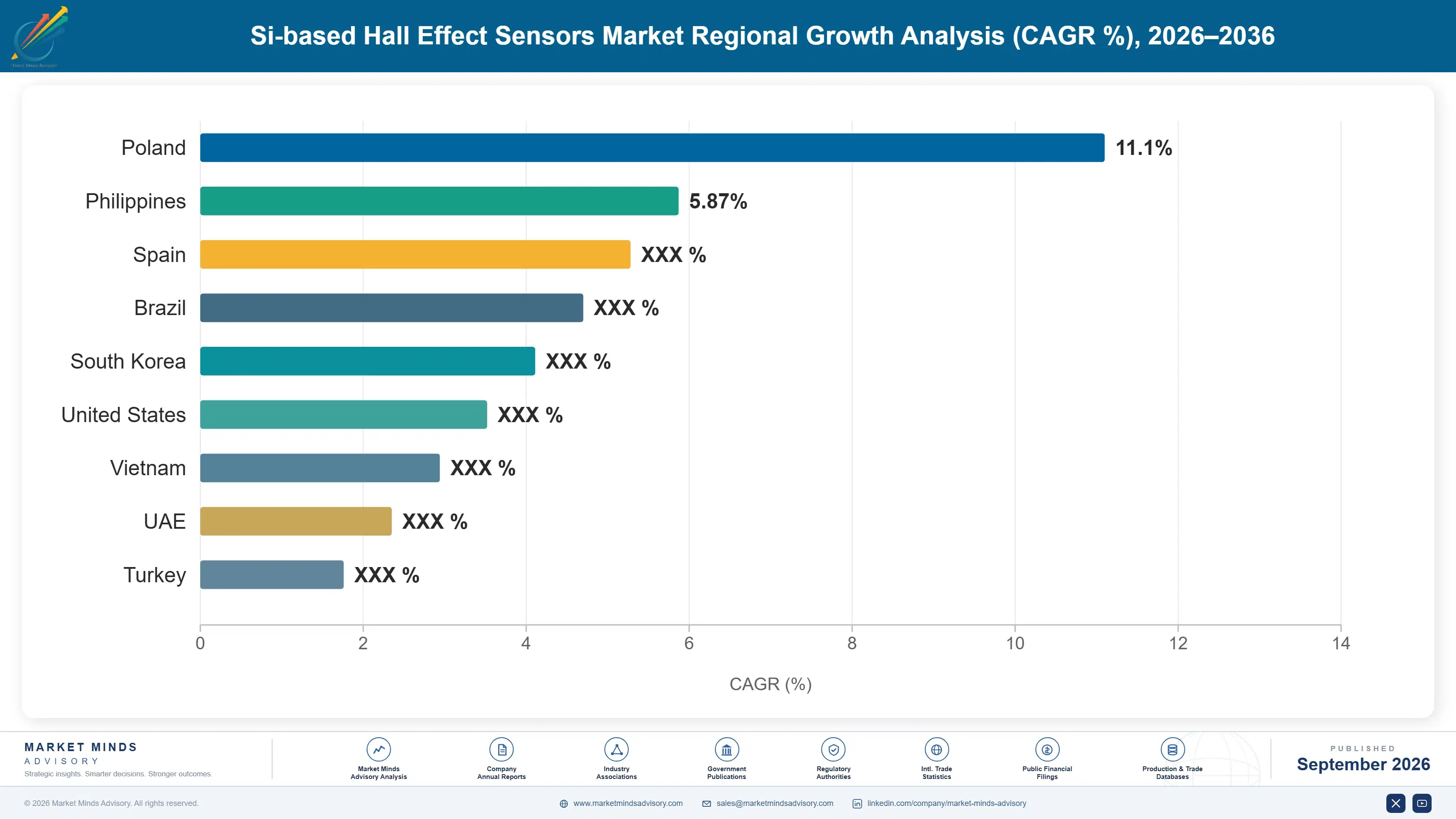
si-based-hall-effect-sensors-market-country-cagr-analysis-1788677755203

Capturing Value From Sensing Precision

Component makers capture incremental revenue through four distinct mechanisms tied to genuine automotive electrification demand rather than generic unit pricing alone or arbitrary tier naming conventions used elsewhere. Together these levers determine which suppliers compound design-win value fastest as motor control and battery management requirements grow more precise across every vehicle platform and industrial application category.

Premium Pricing for Automotive-Qualified Sensor Reliability

Component makers increasingly charge substantially elevated prices, typically 25 to 32 percent above baseline, for sensors carrying automotive functional safety certification, justified by the extensive reliability validation and quality system investment required to achieve that qualification status across every jurisdiction, manufacturer program, vehicle platform generation, and regulatory regime worldwide today and going forward. This pricing separates commodity consumer sensing revenue from differentiated automotive revenue, letting suppliers capture value proportional to genuine validation cost. Manufacturers pursuing safety-critical product positioning increasingly accept these premiums once alternative unqualified suppliers prove unsuitable for automotive integration.
Market Impact: Adds a 25 to 32 percent qualification pricing premium

Reference Design Licensing Revenue Stream Model

Component makers increasingly license complete motor control reference designs bundling sensor silicon, signal processing algorithms, and validated calibration software to smaller device makers lacking in-house sensor integration expertise, generating incremental licensing revenue equal to roughly 9 to 14 percent of total component sales across every product tier, category, application segment, and device class worldwide today. This model appeals particularly to smaller electronics brands seeking faster time to market without building dedicated sensor engineering teams internally from scratch. Component makers offering the most complete, field-tested reference designs increasingly win these licensing engagements over competitors offering component-only sales arrangements.
Market Impact: Generates 9 to 14 percent of segment revenue

Multi-Axis Sensor Bundle Pricing Strategy Model

Component makers increasingly bundle multiple sensing axes with integrated signal processing into single packaged modules, commanding premium pricing typically 18 to 24 percent above individual sensor components sold separately to device makers assembling motor control systems independently, manually, and without vendor support or guidance. This bundling captures value from the substantial engineering effort required to fuse multiple magnetic field measurements into unified, calibrated position data that device makers would otherwise need to develop internally at considerable cost and delay. Device makers increasingly prefer these integrated bundles, accepting premium pricing for faster development timelines.
Market Impact: Adds 18 to 24 percent bundle pricing premium

Software Calibration Algorithm Licensing Attachment Fee

Component makers increasingly attach proprietary signal processing and calibration algorithms to hardware sales, generating recurring per-unit licensing fees that continue well after the initial component sale transaction completes and ships to global automotive customers, manufacturers, and system integrators. This revenue stream often generates margins exceeding 0.15 dollars per unit for suppliers offering the most accurate calibration algorithm packages, since algorithm development requires specialized data science expertise few smaller competitors possess in-house. This attachment model also deepens customer relationships considerably, since switching component suppliers means redeveloping calibration algorithms entirely from scratch.
Market Impact: Adds over 0.15 dollars in recurring per-unit revenue

Who Controls the Margin Pool

The competitive field carries meaningfully high concentration, with a CR5 of 54 percent reflecting the substantial semiconductor design and automotive qualification expertise required to compete credibly at scale. Allegro MicroSystems leads decisively on automotive design-win breadth and motor control reference design depth, and the gap between Allegro and the second-ranked challenger remains genuinely wide, reflecting years of accumulated automotive electronics design experience.
Current competitive activity centers on embedding multi-axis position sensing capability natively rather than through separate discrete components, as suppliers race to demonstrate automotive qualification ahead of tightening functional safety regulatory scrutiny. Suppliers are also expanding reference design licensing and calibration algorithm bundling capability to deepen device maker switching cost, a dimension growing faster than traditional discrete component sales as integration complexity rises.

Emerging pressure comes from specialized magnetic sensor startups like MultiDimension Technology expanding into automotive-grade sensing categories, directly challenging incumbent Hall sensor suppliers on emerging technology depth rather than competing purely on price. Rankings are most likely to shift among mid-tier challengers competing for industrial automation contracts, rather than at the very top where Allegro's automotive design-win breadth continues to favor the established leader significantly.
si-based-hall-effect-sensors-market-company-positioning-matrix-1788677755725

Competitive Moat and Risk Dimensions

ALLEGRO MICROSYSTEMS INC

Moat: Automotive design-win breadth

Allegro MicroSystems supplies motor control and current sensing components to the majority of leading automotive manufacturers, built through years of accumulated automotive qualification expertise that few competitors can match at comparable manufacturing scale. This design-win breadth compounds as satisfied automotive customers expand component attachment into adjacent sensing categories during every vehicle platform refresh cycle.
ALLEGRO MICROSYSTEMS INC

Risk: Narrower non-automotive diversification

Allegro MicroSystems historically prioritized automotive applications over broader industrial and consumer sensing categories, leaving some non-automotive market segments less developed than dedicated industrial sensor specialists provide. Specialized industrial automation suppliers with deeper non-automotive expertise increasingly win design contracts for robotics and factory automation applications specifically.
INFINEON TECHNOLOGIES AG

Moat: Semiconductor manufacturing precision

Infineon operates highly precise semiconductor manufacturing capability inherited from its broader automotive and industrial power electronics heritage, giving it genuine accuracy advantages in current sensing and position detection categories. This manufacturing precision creates switching costs that competitors lacking equivalent automotive-grade quality systems cannot easily replicate.
INFINEON TECHNOLOGIES AG

Risk: Complex organizational structure friction

Infineon's broad semiconductor portfolio spanning multiple business divisions sometimes creates internal coordination friction that smaller, more focused Hall sensor specialists avoid by concentrating exclusively on magnetic sensing applications and customer relationships across every account. Nimbler competitors increasingly win smaller design contracts requiring faster decision-making and customization depth.

Players Tracked

Prominent Players

Allegro MicroSystems Inc
Infineon Technologies AG
Melexis NV
TDK Corporation
Diodes Incorporated

Other Key Players

ROHM Co Ltd
STMicroelectronics NV
Texas Instruments Incorporated
NXP Semiconductors NV
Honeywell International Inc
Asahi Kasei Microdevices Corporation
Sensitec GmbH
Monolithic Power Systems Inc
Vishay Intertechnology Inc
Littelfuse Inc
Sensata Technologies Holding plc
Ablic Inc
Winson Semiconductor Corp
Crocus Technology Inc
MultiDimension Technology Co Ltd

Recent Developments

SEPTEMBER 2025

Allegro MicroSystems Launches Integrated 3D Position Sensor

Allegro MicroSystems launched an integrated 3D position sensing module combining multi-axis detection and signal processing into a single packaged component, reducing motor controller integration complexity and strengthening its competitive position ahead of expanding electric vehicle demand across every major automotive platform category and manufacturer program.
Signal: Signals leading suppliers racing to bundle multi-axis sensing capability into unified reference design packages today and going forward.
DECEMBER 2025

Infineon Expands Automotive-Grade Manufacturing Capacity

Infineon announced expanded manufacturing capacity dedicated specifically to automotive-grade quality Hall sensors, targeting device makers pursuing automotive functional safety certification requiring documented manufacturing consistency far exceeding standard consumer electronics production quality standards across every product line, category, target market, design generation, and global manufacturing geography.
Signal: Signals continued vendor investment in manufacturing quality systems to support automotive-grade certification pathways broadly and consistently.
MARCH 2026

Melexis Acquires Current Sensing Analytics Startup

Melexis acquired a specialized current sensing analytics startup to strengthen its battery management monitoring capability, adding proprietary calibration algorithm technology that rival component suppliers currently lack in comparable form, reinforcing its position among device makers pursuing electric vehicle differentiation, regulatory approval, and long-term market leadership.
Signal: Signals continued consolidation toward current sensing analytics capability among leading Hall sensor component suppliers worldwide and domestically.

Semiconductor Fabrication Cost Exposure

Semiconductor fabrication and packaging account for roughly 55 to 65 percent of sensor component cost of goods sold, sourced primarily from specialized foundries concentrated in Taiwan, South Korea, and increasingly mainland China and Japan. Rare earth materials required for certain magnetic calibration processes represent a smaller but meaningful and growing input as automotive demand scales.
Semiconductor foundry pricing rose meaningfully through 2024 and into 2025 as demand for specialized automotive process nodes outpaced available fabrication capacity amid broader chip industry competition and rising AI compute demand, according to Taiwan's national statistical reporting on semiconductor export values. Component makers competing for constrained foundry allocation absorbed noticeably higher fabrication costs during this period, squeezing margins for smaller suppliers lacking long-term capacity reservation agreements.

Smaller component makers lacking long-term foundry relationships face a genuine cost disadvantage against larger competitors like Allegro MicroSystems and Infineon, which secure priority capacity allocation and volume discount pricing through decades of accumulated foundry partnership and scale. This dynamic favors scale incumbents in price-sensitive industrial sensor segments, since undercapitalized challengers cannot sustain premium spot-market fabrication pricing without compressing margins below sustainable levels for long.
si-based-hall-effect-sensors-market-cost-volatility-analysis-1788677755919

Long-Term Foundry Capacity Reservation Agreements

Some component makers negotiate multi-year reserved capacity commitments with semiconductor foundries, locking in discounted fabrication pricing well below spot-market rates in exchange for guaranteed minimum order volume commitments across their entire product portfolio and every automotive program planned for the coming several years, product generations, design refreshes, platform variants, and expanding global regional markets.

Multi-Foundry Sourcing to Reduce Concentration Risk

Leading suppliers qualify sensor designs across multiple foundry partners simultaneously rather than depending on a single fabrication source, using competitive bidding to secure better pricing terms while reducing exposure to any single foundry's capacity constraints, disruption, unexpected geopolitical pricing changes, currency risk, or trade policy shifts during periods of especially tight global supply and demand.

Design Simplification to Reduce Process Requirements

Some component makers redesign sensor architectures to use less advanced, more widely available process nodes where performance requirements allow, trading marginal accuracy or power efficiency gains for meaningfully lower fabrication cost and reduced exposure to constrained leading-edge foundry capacity nationwide and internationally during periods of peak industry-wide demand, shortage, and especially tight overall allocation.

Portfolio Architecture for Margin Defence

The Si-based Hall sensor field splits cleanly between commodity switch-type detection priced near marginal cost and premium multi-axis position and current sensing commanding meaningfully higher unit prices through automotive qualification investment. Gross margin architecture reflects this split directly, with automotive-qualified tiers generating substantially wider margins than basic switch functionality sold mostly on price to industrial and consumer device makers.
Volume switch-type sensing revenue still dominates unit count across consumer and basic industrial applications, but premium multi-axis and current sensing revenue is growing faster and increasingly drives new component maker investment decisions across the industry. Suppliers face a genuine tension allocating engineering resources between defending baseline switch-type share against low-cost entrants and building premium sensing capability that commands durable pricing power over multi-year automotive design-win contracts.

High-value margin pools concentrate overwhelmingly in electric vehicle motor control accounts adopting full multi-axis sensing suites bundled with reference design licensing and calibration algorithm attachment, rather than in standalone switch sensors sold individually to consumer device makers. Component makers capturing this bundled premium tier increasingly separate themselves from commodity competitors on realized design-win economics, even where headline unit pricing looks broadly comparable across the field today.

Volume / Commodity-Adjacent Tier

Basic switch-type Hall sensing components priced near marginal cost, generating gross margins of roughly 32 to 40 percent as suppliers compete primarily on price and volume for consumer device makers.
Gross Margin: 32-40%

Premium / Certified Tier

Linear and latch Hall sensors bundled with reference design support, generating gross margins of roughly 45 to 53 percent through demonstrated accuracy, consistency, reliability, and truly very long-term integration convenience.
Gross Margin: 45-53%

Sustainability / Regulatory / Next-Generation Tier

3D and multi-axis position sensing ICs carrying automotive qualification commanding gross margins of roughly 55 to 65 percent as manufacturers actively pursue electric vehicle differentiation and long-term overall safety strategies.
Gross Margin: 55-65%
si-based-hall-effect-sensors-market-portfolio-architecture-1788677756413

High-value Sub-segments and Strategic Watch-out

3D and Multi-Axis Position Sensing ICs

This segment commands the widest gross margins in the entire portfolio while growing fastest at 15.8 percent, driven by manufacturers demanding documented, automotive-qualified multi-axis sensing across every motor control application each design cycle, annual platform refresh, vehicle generation, and manufacturer program approved by leadership teams.
Gross Margin: 55-65%

Current Sensing Hall Effect ICs

Current sensing ICs generate strong margins with steady, fast growth as battery management systems increasingly require precise monitoring capability across every electric vehicle platform each generational product refresh, design cycle, annual planning decision, budget cycle, manufacturer engineering review, and full compliance audit globally and domestically.
Gross Margin: 45-53%

Switch-Type Hall Effect Sensors

This segment anchors overall unit volume and remains the largest revenue contributor today, even as its relative growth rate trails premium multi-axis and current sensing tiers across most automotive and industrial accounts evaluating design-win decisions each product cycle, refresh, annual review, and budget planning session.
Gross Margin: 32-40%

Latch-Type Hall Effect Sensors

Standalone discrete latch sensors face gradual displacement as integrated multi-sensor fusion modules absorb this functionality alongside broader sensing capability, leaving standalone component vendors exposed to shrinking addressable demand over the coming decade unless they consolidate further, pivot elsewhere, specialize narrowly, or exit the market entirely.
Gross Margin: 30-38%

Design-Win Economics of Hall Sensor Suppliers

Silicon Hall sensor supply runs on multi-year design-win contracts tied to specific vehicle or product platform generations, producing recurring revenue that compounds as component makers expand attachment across successive platform refresh cycles from the same automotive customer. Design-win retention exceeds 80 percent across consecutive platform generations once a sensor supplier's components pass automotive qualification testing, since switching suppliers requires costly requalification and potential redesign risk.
Adoption depth varies meaningfully by end-use vertical across the customer base. Electric vehicle motor control applications deploy the deepest sensor integration, often including multiple 3D position sensors per motor for redundant commutation accuracy, while traditional industrial equipment typically uses only basic switch-type detection. Consumer electronics applications show growing adoption depth as manufacturers embed additional position sensing into compact device form factors.

Buyer profiles are shifting generationally as digitally native automotive electronics engineers replace veteran component procurement specialists who once prioritized cost above all other selection criteria and considerations. Younger buyers expect integrated reference designs and comprehensive functional safety documentation by default, pushing component makers to prioritize software and validation support over the pure hardware specifications that once defined competitive advantage in this market.
si-based-hall-effect-sensors-market-end-use-penetration-index-1788677756907

Priorities for Sensor Component Investors

These are among the four positions where our research anticipates prominent divergence between winners and laggards over the coming forecast period. Each is grounded in the demand model, the regulatory perimeter, and the announced capacity pipeline.
01 / MULTI-AXIS INVESTMENT PRIORITY

Prioritize Multi-Axis Sensing Over Switch Breadth

Component makers that under-invest in multi-axis position sensing capability will lose design wins to rivals offering documented commutation accuracy ahead of tightening automotive functional safety requirements worldwide and across every jurisdiction. Allegro MicroSystems and Infineon already lead decisively on this dimension, and the gap compounds each design cycle as satisfied automotive customers expand attachment scope into adjacent sensing categories and vehicle platforms. Smaller suppliers should concentrate engineering resources narrowly on multi-axis depth rather than chasing broad, undifferentiated switch-type parity across every device category.
02 / REFERENCE DESIGN DEVELOPMENT PRIORITY

Build Reference Design Depth Before Demand Peaks

Reference design licensing increasingly separates leading component suppliers from commodity competitors, since device makers value platforms offering proven motor control integration capability without lengthy custom development delays or extensive engineering rework each time requirements shift unexpectedly. Suppliers lacking meaningful reference design depth face a widening disadvantage as leaders expand licensing wins through targeted algorithm investment across multiple device categories and vehicle platforms. Acting early to build genuine reference design depth costs considerably less than catching up after rivals lock in exclusive device maker partnerships for good.
03 / CONSUMER DEFENSE STRATEGY

Defend Consumer Accounts Against Low-Cost Entrants

Low-cost Asian challengers are targeting consumer electronics makers with cheaper commodity switch sensors, directly threatening the account base that established suppliers depend on for stable recurring revenue growth each fiscal year across the industry. Established suppliers must respond with competitive volume pricing and simplified integration paths rather than assuming automotive brand relationships alone will protect their broader market position over the coming decade. Losing consumer share now weakens future upsell potential considerably across the account base and narrows the addressable pipeline.
04 / FOUNDRY CAPACITY DISCIPLINE

Secure Foundry Partnerships to Protect Margins

Component makers competing for scarce leading-edge foundry capacity without differentiated supplier relationships face meaningful margin compression as fabrication costs rise faster than unit pricing can absorb without triggering device maker pushback at contract renewal negotiations each cycle. Long-term capacity reservation agreements and multi-foundry sourcing strategies protect gross margins meaningfully over multi-year planning horizons across the entire deployed product portfolio and every sensor category offered. Component makers that delay this discipline risk ceding pricing power entirely to better-capitalized competitors within a relatively short number of years going forward from today.

Engagement Snapshot From the Field

A live engagement with an industry participant carrying material or product regulatory and market exposure ahead of a defining policy shift, showing how our research translates into a defensible multi-year portfolio strategy.
MARKET MINDS ADVISORY · CLIENT ENGAGEMENT SUMMARY
Si-based Hall Effect Sensors Producer Strategic Portfolio Review and Transition Roadmap 2026·Investment Scenario on Si-based Hall Effect Sensors Exposure Evaluation 2025-26
CLIENT PROFILE
The client is a mid-tier electric vehicle motor manufacturer generating roughly 420 million dollars in annual revenue (client-reported, unverified by MMA), supplying traction motor assemblies to three passenger vehicle brands across two continents. The client historically sourced single-axis position sensors from a legacy supplier but sought to upgrade to multi-axis sensing capability to improve motor efficiency and range performance.
STRATEGIC CHALLENGE
The client faced pressure from competing motor manufacturers offering superior efficiency through advanced multi-axis sensing while its product line remained limited to legacy single-axis detection technology and outdated calibration methods. Leadership needed an independent evaluation of multi-axis sensor suppliers before committing to a costly motor controller redesign given limited internal sensor engineering expertise.
MMA APPROACH
MMA conducted a structured evaluation spanning five multi-axis sensor suppliers, benchmarking accuracy performance, automotive qualification status, reference design completeness, and total component cost against the client's target motor specifications and existing manufacturing partnerships. The engagement combined technical benchmarking, supplier capability scoring, and quantitative modeling of total landed cost across production volume scenarios.
KEY FINDINGS
  1. Three of five evaluated suppliers offered complete reference designs bundling sensor silicon and validated calibration algorithms, reducing projected engineering integration time substantially compared to component-only alternatives.
  2. Multi-axis sensor accuracy varied by nearly 18 percent across evaluated suppliers when tested against precision reference equipment under realistic motor operating temperature conditions.
  3. Total component cost per unit varied by almost 32 percent across evaluated suppliers once reference design licensing fees and volume discount tiers were factored into realistic annual shipment projections.
  4. The client's existing manufacturing partner already maintained a qualified relationship with two evaluated suppliers, potentially accelerating automotive qualification timeline by several months if selected.
CLIENT PROFILE
The client is a mid-tier electric vehicle motor manufacturer generating roughly 420 million dollars in annual revenue (client-reported, unverified by MMA), supplying traction motor assemblies to three passenger vehicle brands across two continents. The client historically sourced single-axis position sensors from a legacy supplier but sought to upgrade to multi-axis sensing capability to improve motor efficiency and range performance.
STRATEGIC CHALLENGE
The client faced pressure from competing motor manufacturers offering superior efficiency through advanced multi-axis sensing while its product line remained limited to legacy single-axis detection technology and outdated calibration methods. Leadership needed an independent evaluation of multi-axis sensor suppliers before committing to a costly motor controller redesign given limited internal sensor engineering expertise.
MMA APPROACH
MMA conducted a structured evaluation spanning five multi-axis sensor suppliers, benchmarking accuracy performance, automotive qualification status, reference design completeness, and total component cost against the client's target motor specifications and existing manufacturing partnerships. The engagement combined technical benchmarking, supplier capability scoring, and quantitative modeling of total landed cost across production volume scenarios.
KEY FINDINGS
  1. Three of five evaluated suppliers offered complete reference designs bundling sensor silicon and validated calibration algorithms, reducing projected engineering integration time substantially compared to component-only alternatives.
  2. Multi-axis sensor accuracy varied by nearly 18 percent across evaluated suppliers when tested against precision reference equipment under realistic motor operating temperature conditions.
  3. Total component cost per unit varied by almost 32 percent across evaluated suppliers once reference design licensing fees and volume discount tiers were factored into realistic annual shipment projections.
  4. The client's existing manufacturing partner already maintained a qualified relationship with two evaluated suppliers, potentially accelerating automotive qualification timeline by several months if selected.
RECOMMENDED STRATEGY
Phase 1: Phase 1 (Months 1 to 2): Select the top-scoring supplier and finalize reference design licensing terms for the new motor line. Phase 2: Phase 2 (Months 3 to 6): Integrate the multi-axis sensor module and validate accuracy performance thoroughly against precision benchmark equipment. Phase 3: Phase 3 (Months 7 to 9): Complete automotive qualification testing and launch the new multi-axis-enabled motor line to global markets.
OUTCOME
The client launched its multi-axis-enabled motor line within the original nine-month timeline, achieving efficiency performance within 2 percent of premium competitor motors (client-reported, unverified by MMA). Leadership credited the structured supplier evaluation with avoiding a costly efficiency shortfall that internal engineering staff had initially underestimated.

Frequently Asked Questions

Foundational context covering the market sizes, CAGR, scope, country, region and competition that inform every finding below. This section is provided to cover basics and most often pre-purchase conversations, answered from the MMA Primary Research Dataset.

What is the current size of the Si-based Hall Effect Sensors Market?

The Si-based Hall Effect Sensors Market reached 1.8 billion dollars in base year 2025. Growth is driven by electric vehicle motor control demand and expanding multi-axis position sensing adoption worldwide.

How large will the Si-based Hall Effect Sensors Market be by 2036?

The market is projected to reach 5.04 billion dollars by 2036, representing a 2.55 times expansion over the 2026 base value of 1.98 billion dollars across the ten-year forecast window.

What is the CAGR for the Si-based Hall Effect Sensors Market 2026 to 2036?

The market is forecast to grow at a 9.8 percent compound annual growth rate between 2026 and 2036, with bull and bear scenarios ranging from 8.6 to 11.0 percent respectively.

Which segment is growing fastest?

3D and Multi-Axis Position Sensing ICs leads at 15.8 percent CAGR, roughly 1.61 times the overall market rate, driven by electric vehicle motor commutation precision demand.

Who are the major companies in the Si-based Hall Effect Sensors Market?

Allegro MicroSystems, Infineon, Melexis, TDK, and Diodes Incorporated lead the field, together holding a CR5 of 54 percent given substantial semiconductor design expertise required to compete.

Which country is growing fastest?

China leads at 13.2 percent CAGR, driven by rapid electric vehicle production expansion requiring extensive motor control and battery current sensing components across every domestic plant.

Report Segmentation Architecture

The full report scope spans multiple orthogonal segmentation dimensions, with cross-tabulated demand data provided for each dimension pair. Coverage extends further to regional breakdowns, trend trajectories, and the competitive detail needed to support segment-level decision-making.

By Primary Market Dimension

  • Switch-Type Hall Effect Sensors
  • Linear Hall Effect Sensors
  • Latch-Type Hall Effect Sensors
  • Current Sensing Hall Effect ICs
  • 3D and Multi-Axis Position Sensing ICs
  • Programmable Smart Hall Sensor Modules

By End-Use Industry

  • Automotive and Electric Vehicles
  • Industrial Automation and Robotics
  • Consumer Electronics
  • Aerospace and Defense
  • Medical Devices

By Commercial Dimension

  • Original Equipment Manufacturers
  • Tier One Automotive Suppliers
  • Original Design Manufacturers
  • Aftermarket Distributors

By Region

  • North America
  • Western Europe
  • East Asia
  • South Asia and Pacific
  • Latin America
  • Middle East and Africa
  • Eastern Europe

Scope, Methodology, and Coverage

Every figure in this report is reproducible from documented input assumptions. The scope below maps the historical period, the forecast horizon, the segmentation dimensions, and the countries covered, alongside the underlying primary and qualitative methodology.
Historical Period
2020 to 2025
Forecast Period
2026 to 2036
Base Year
2025 (USD billions; MMA Primary Research Dataset, September 2026)
Market Definition
The Si-based Hall Effect Sensors Market comprises silicon semiconductor components using the Hall effect to detect magnetic fields for position, current, and speed sensing applications across automotive, industrial, and consumer electronics. It excludes non-silicon magnetoresistive sensors, discrete magnetic switches, and complete motor control modules entirely.
Quantitative Units
USD billions (current prices); market share percentages; compound annual growth rates
Segmentation Dimensions
By Primary Market Dimension; By End-Use Industry; By Commercial Dimension; By Region
Regions Covered
North America, Western Europe, East Asia, South Asia and Pacific, Latin America, Middle East and Africa, Eastern Europe
Countries Covered
USA, China, Germany, France, UK, Japan, South Korea, India, Australia, Canada, Brazil, Mexico, Indonesia, Vietnam, Thailand, Malaysia, UAE, Saudi Arabia, South Africa, Nigeria, Turkey, Poland, Netherlands, Italy, Spain, Sweden, Switzerland, Argentina, Colombia, Singapore, and additional markets relevant to this sector
Key Companies Profiled
Allegro MicroSystems Inc, Infineon Technologies AG, Melexis NV, TDK Corporation, Diodes Incorporated, ROHM Co Ltd, STMicroelectronics NV, Texas Instruments Incorporated, NXP Semiconductors NV, Honeywell International Inc, Asahi Kasei Microdevices Corporation, Sensitec GmbH, Monolithic Power Systems Inc, Vishay Intertechnology Inc, Littelfuse Inc, Sensata Technologies Holding plc, Ablic Inc, Winson Semiconductor Corp, Crocus Technology Inc, MultiDimension Technology Co Ltd
Quantitative Methodology
Primary survey, n=3,800 respondents, Q4 2025, six countries; demand-side model with trade association cross-validation
Qualitative Methodology
47 expert interviews, Q4 2025; applied to validate demand model assumptions, identify emerging dynamics, and assess competitive positioning
Report Format
PDF and XLSX data workbook (Word format preview document)
Publisher
Market Minds Advisory
Report Code
MMA-2026-TEC-819
Published
September 2026
Contact
sales@marketmindsadvisory.com | www.marketmindsadvisory.com

Purchase the full Si-based Hall Effect Sensors Market Report (2026 to 2036).

This report delivers a comprehensive assessment of the global Si-based Hall Effect Sensors Market, covering demand drivers, competitive dynamics, and regional manufacturing patterns across component makers and device manufacturers. It includes detailed segmentation analysis, five-year and ten-year forecast scenarios, and vendor competitive profiles. Twenty leading component suppliers are profiled, spanning semiconductor giants and specialized magnetic sensor challengers across every major sensing technology category. Buyers receive quantified input cost exposure, portfolio tier economics, and strategic recommendations tailored to supplier investment and device maker procurement decisions alike.
Twenty vendor competitive profiles and positioning analysis
Ten-year base, bull, and bear forecast scenarios
Seven-region demand and growth trend analysis
Six-segment MECE market breakdown and sizing
Input cost exposure and mitigation pathways
Portfolio tier and margin economics modeling

Built For The People Who Decide

From boardroom strategy to bench-side execution, this report is read cover-to-cover by leaders shaping the next decade of their industry, turning demand scenarios, market dynamics and valuation benchmarks into decisions.
CXOs/ Presidents/ VPs/ Managers
M&A and Corporate Development
Strategy Teams and R&D Heads
Procurement and Product Directors
Regulatory and Compliance Leaders
Investor Relations and Equity Analysts