Market Minds Advisory
Short Circuit Isolator Market

Short Circuit Isolator Market: Short Circuit Isolator Market. Digital Integration, Certification, and Renewable Economics.

Grid operators and renewable project developers are specifying digitally monitored short circuit isolators to meet tightening fault-clearing standards, even as switchgear manufacturers face copper cost swings and lengthening type-testing queues at accredited certification laboratories worldwide.

Lead Analyst

Published

September 2026

Make Smarter Decisions with Customized Research Insights

Request a free sample report and evaluate market opportunities, growth trends, and competitive dynamics relevant to your business needs.

2025 MARKET VALUE$1.1BMarket Size 2025
2036 FORECAST VALUE$2.2BBase Case , 2026 to 2036
CAGR 2026 TO 20366.5 %Bull 7.8% / Bear 5.3%
INCREMENTAL OPPORTUNITY$1.0BNet 10- year value creation
EXPANSION MULTIPLE1.88x2036 value over 2026 base
Strategic Levers
M&A Pipeline
Regional Outlook
Country Rankings
Competitive Intelligence
Segmental Deep-dive
Call-Us : 91 93563 13602

Executive Snapshot and Market Trajectory.

Short circuit isolators are shifting from passive mechanical fault-clearing devices toward digitally monitored components that report contact wear and fault history directly into grid operator asset management systems, changing how utilities specify replacement and maintenance cycles across ageing distribution networks today nationwide too overall broadly.
Demand concentrates around renewable energy grid connection points and utility distribution modernisation programmes where fault current profiles differ meaningfully from legacy thermal generation assumptions switchgear designers historically relied upon, with Chinese and North American grid operators the largest buyers as renewable capacity additions accelerate across most major electricity markets. This design concentration is deepening as more utility programmes converge on comparable digital and renewable specifications across most markets tracked in this analysis.
Competitive character centres on established switchgear manufacturers defending utility qualification relationships against Chinese domestic producers scaling certified capacity behind grid expansion programmes, a dynamic increasingly shaping which suppliers win the largest multi-year utility framework agreements. Domestic entrants increasingly compete on price rather than matching the certification depth established suppliers already hold across most manufacturer decisions made this year, a shift already reshaping how utilities structure vendor evaluation criteria.
Market Definition
This report covers short circuit isolators for fault current interruption in distribution and transmission networks, spanning standard mechanical, renewable-rated, and digitally monitored variants. Circuit breakers for routine switching and general disconnect switches without fault-interruption rating are excluded.
Base Year Value
$1.1B in 2025 (MMA Primary Research Dataset, September 2026)
Forecast Period
2026 to 2036, eleven discrete annual values
CAGR
6.5% base case. Bull 7.8%. Bear 5.3%.
Fastest Growth Segment
Smart Digital Monitoring-Enabled Isolators: 11.3% CAGR
Fastest Growth Country
China: 9.0% CAGR
Fastest Growth Region
South Asia and Pacific: 8.5% CAGR
Largest Region
East Asia: 29% of 2025 global value
Market Leaders
ABB Ltd, Siemens AG, Schneider Electric SE, Eaton Corporation, Mitsubishi Electric Corporation. Source: MMA Analysis based on company annual reports.
Primary Survey
n=3,800 procurement and R&D decision-makers, Q4 2025, six countries
Methodology
Demand-side build-up, cross-validated against public data, 47 expert interviews

Short Circuit Isolator Market Forecast Scenarios

short-circuit-isolator-market-size-forecast-scenario-1788503058577
Between 2020 and 2025, short circuit isolator volumes grew steadily as grid modernisation programmes and renewable capacity additions both expanded demand for fault-clearing equipment rated for the distinct current profiles distributed generation introduces into distribution networks originally designed for centralised thermal generation. Retail pricing also declined enough to broaden the addressable buyer base considerably during this period across most markets tracked.
The base case assumes continued momentum from three mechanisms: renewable energy grid connection points requiring isolators rated for bidirectional and intermittent fault current profiles, utility distribution network modernisation programmes replacing ageing equipment nearing the end of typical service life, and digital monitoring integration becoming a standard specification requirement across new utility procurement contracts. Each mechanism reinforces the others, giving the base case forecast comparatively durable support even during softer utility spending periods.
A bull scenario assumes faster renewable capacity additions pull forward isolator replacement demand beyond current utility modernisation programme concentration, while the principal bear risk is prolonged type-testing certification queues at accredited laboratories delaying new product qualification against utility procurement timelines already committed to specific technology platforms. Either scenario still favours suppliers holding broad certification over newer entrants competing mainly on price.

Digital Integration and Renewable Economics

Short circuit isolators sit downstream of both utility capital expenditure cycles and renewable energy grid connection timelines, and pricing increasingly reflects digital monitoring integration and fault current rating breadth rather than raw switchgear material cost alone across most utility contracts. Vendors documenting consistent design-win outcomes across multiple utility programmes increasingly win business ahead of price-only competitors nationwide.
MARKET CONCENTRATION44%share held by five largest global isolator suppliers
AVERAGE SELLING PRICE$4,800typical current market price per isolator unit installed
ASIAN MANUFACTURING SHARE58%share of output fabricated at leading Asian facilities
CAPACITY UTILISATION82%isolator manufacturing lines currently booked above full capacity
TRADE INTENSITY34%share of finished units traded across national borders
SERVICE LIFE32 yearsyears typical isolator remains in active grid service
Buyers increasingly specify digital monitoring capability and renewable-rated fault current handling as standard for new grid connection contracts, pushing legacy mechanical-only isolator suppliers toward smaller municipal contracts while digitally integrated suppliers hold pricing power on flagship utility framework agreements across major electricity markets. This pricing power is beginning to narrow slightly as more suppliers qualify comparable digital platforms across overlapping customer bases across most established markets tracked.
Over the next decade, expect renewable capacity additions and ageing grid infrastructure replacement cycles to keep isolator demand elevated, favouring suppliers who can clear utility type-testing certification faster than grid connection project timelines require across successive renewable capacity procurement rounds. Consolidation among smaller suppliers lacking certification investment capacity looks increasingly likely as this competitive pressure builds across most established markets today.
"Utilities don't replace isolators because they fail. They replace them because the fault current profile changed underneath the equipment once enough solar capacity got interconnected on that feeder."
Director, Electrical Infrastructure and Grid Equipment Practice · MMA Construction and Industrial Equipment Practice · September 2026

Market Trends

Digital Monitoring Integration Becomes Standard Utility Specification

Grid operators are increasingly requiring isolators with embedded digital monitoring capability that reports contact wear, fault history, and thermal condition directly into utility asset management platforms, converting what was an optional premium feature into a baseline specification requirement across new distribution network procurement contracts. Utilities report digital monitoring adoption accelerating fastest at feeders carrying meaningful renewable generation, since intermittent fault current profiles from distributed solar and wind connections make continuous condition monitoring considerably more valuable than on legacy feeders serving stable thermal generation loads alone. Suppliers slow to adapt product lines risk losing allocation on the next framework.
Market Impact: Adds 13 percent to replacement-driven demand
Renewable Grid Connections Require Bidirectional Fault Ratings

Solar and wind generation facilities connecting to distribution and transmission networks require isolators rated for bidirectional fault current flow that differs meaningfully from the unidirectional fault profiles switchgear designed for traditional centralised thermal generation historically assumed across most legacy grid infrastructure. Isolator suppliers report renewable-rated product orders growing meaningfully faster than standard utility replacement orders across most major markets, reflecting the scale of ongoing renewable capacity connection activity across both utility-scale and distributed generation project categories. This shift is reshaping how suppliers position their legacy unidirectional product lines against these faster-growing renewable-rated alternatives.
Market Impact: Adds 11 percent to compliance-driven demand

Market Opportunities and Growth Drivers

Ageing Distribution Infrastructure Reaches Replacement Age

Distribution network isolators installed during prior decades of grid buildout are reaching typical thirty to forty year replacement age across many established utility service territories, and replacement increasingly specifies digitally monitored equipment rather than like-for-like mechanical replacement given the asset management benefits utilities have observed at already-modernised feeders. Utility capital planning teams report replacement volume becoming more predictable as ageing infrastructure inventories mature into their replacement window, giving isolator suppliers meaningful multi-year order visibility tied to published utility capital expenditure plans. This visibility is rare in a category historically driven by lumpy, unpredictable failure-driven replacement spending patterns alone.
Market Impact: Delays qualification 5 to 8 months

Grid Resilience Mandates Drive Fault-Clearing Speed Requirements

Regulatory bodies across several major electricity markets are tightening fault-clearing speed requirements following high-profile grid reliability incidents, directly requiring utilities to upgrade isolators unable to meet faster clearing time standards regardless of whether the underlying equipment has otherwise reached typical replacement age. Utilities report accelerating isolator replacement specifically on feeders serving critical infrastructure and high-density population centres where regulatory scrutiny following reliability incidents concentrates most heavily across the broader distribution network. Suppliers serving both legacy and resilience-focused utilities increasingly tailor separate product lines to capture this widening compliance gap overall.
Market Impact: Adds 6 points to costs

Market Restraints and Challenges

Type-Testing Certification Queues Delay New Product Qualification

Accredited high-voltage testing laboratories capable of type-testing new isolator designs against utility fault current and mechanical endurance standards face persistent capacity constraints relative to the volume of new digitally integrated product submissions manufacturers are bringing to market simultaneously across the industry. The commercial impact shows up as manufacturers delaying new product launches or missing utility procurement deadlines when testing queue times extend beyond originally planned certification schedules. Suppliers are responding by booking testing laboratory capacity years in advance of confirmed product launch timelines to protect their qualification schedule against ongoing capacity constraints.
Market Impact: Lifts monitored share 12 points

Copper and Switchgear Material Cost Volatility Compresses Margins

Copper conductor material and precision-machined switchgear components have experienced meaningful price volatility in recent supply cycles, squeezing margins at isolator manufacturers without long-term material supply agreements across their certified utility product lines. Smaller regional manufacturers without diversified sourcing relationships carry the largest exposure to this volatility, while larger suppliers are increasingly locking multi-year material supply agreements to protect margin on fixed-price multi-year utility framework contracts signed well in advance of delivery. Suppliers with diversified sourcing relationships increasingly capture share specifically because they can absorb these swings more reliably than smaller rivals.
Market Impact: Adds 14 percent to renewable-rated demand
3 additional market trends, 4 additional growth drivers, and 2 additional restraints and challenges are covered in the full report. Contact sales@marketmindsadvisory.com to access the complete intelligence.

Segment CAGR and Growth Architecture

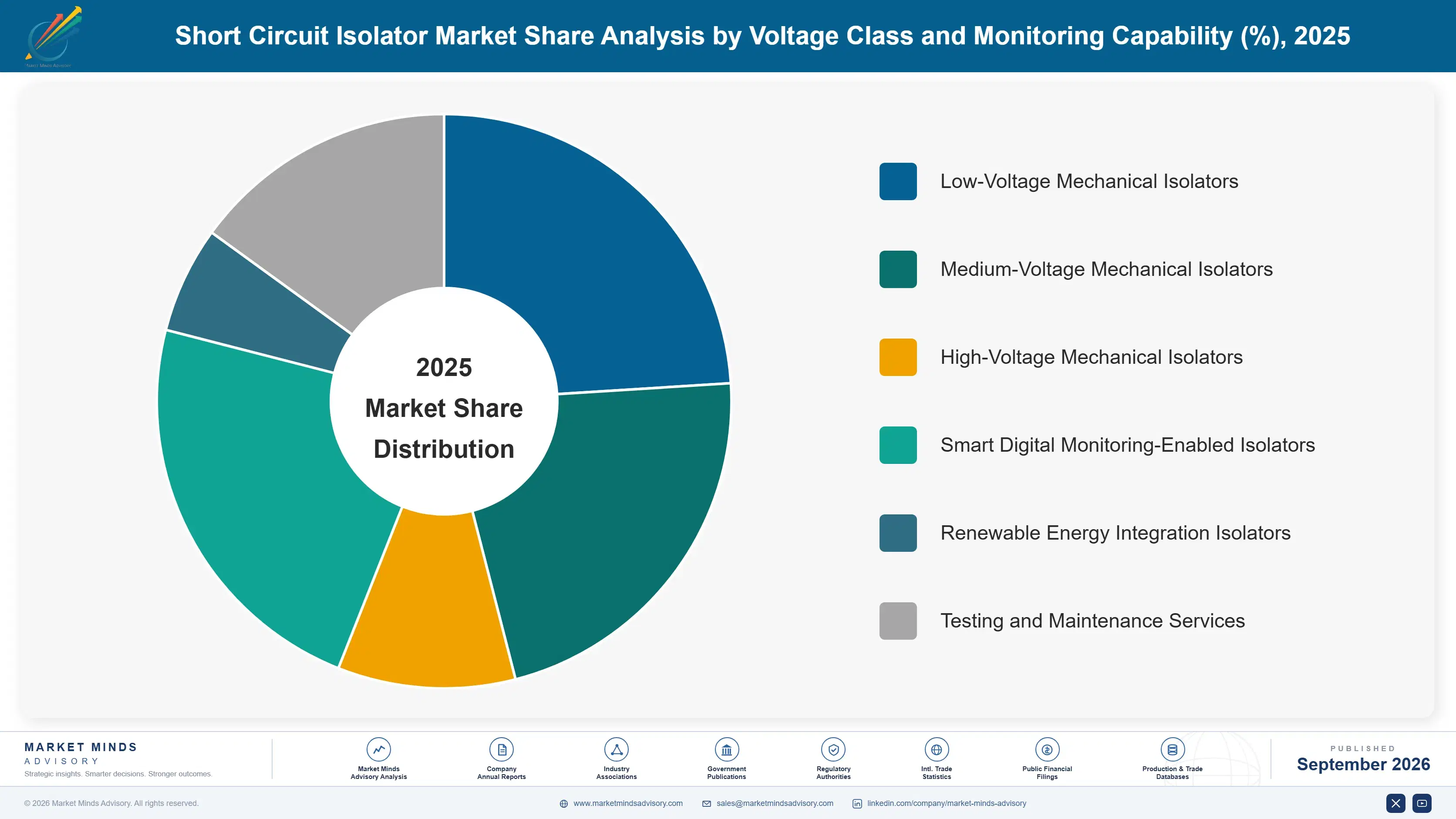
Segmentation follows voltage class and monitoring capability, from standard low and medium-voltage mechanical isolators through renewable-rated designs to digitally monitored next-generation platforms, keeping standard utility replacement product distinct from the specialised renewable and monitoring layers built around it. This framework mirrors how utilities actually structure procurement specifications across engineering and asset management teams today.
short-circuit-isolator-market-market-share-analysis-1788503059184

Smart Digital Monitoring-Enabled Isolators

Digitally monitored isolators reporting contact wear, fault history, and thermal condition directly into utility asset management platforms are capturing an expanding share of total isolator volume as utilities standardise digital monitoring across new distribution network procurement contracts. Utilities piloting these systems report meaningfully reduced unplanned outage investigation time because fault location narrows to a specific isolator rather than requiring manual inspection across an entire feeder circuit following an interruption event. Adoption remains concentrated among utilities with the asset management platform investment to use monitoring data effectively, but the qualified supplier pool is expanding as more manufacturers invest in the digital integration capability utilities increasingly require. Expect this segment to keep outpacing the broader isolator market as digital audit.
CAGR 11.3%

Renewable Energy Integration Isolators

Isolators rated for the bidirectional and intermittent fault current profiles renewable generation introduces into distribution and transmission networks are growing as solar and wind capacity additions continue expanding across both utility-scale and distributed generation project categories globally. This segment benefits directly from the same renewable capacity growth driving broader grid connection equipment demand, since every new solar or wind interconnection point requires isolators rated for fault current profiles standard utility replacement product was not originally designed to handle reliably. Suppliers require specialised engineering capability to certify bidirectional fault current ratings, a design capability barrier that favours established switchgear manufacturers with utility-grade engineering resources over smaller regional producers lacking comparable certification investment. Growth here trails digital monitoring slightly overall.
CAGR 9.6%
Full segment breakdown across 6 segments available in the complete report.

Regional Architecture and Country Demand Map

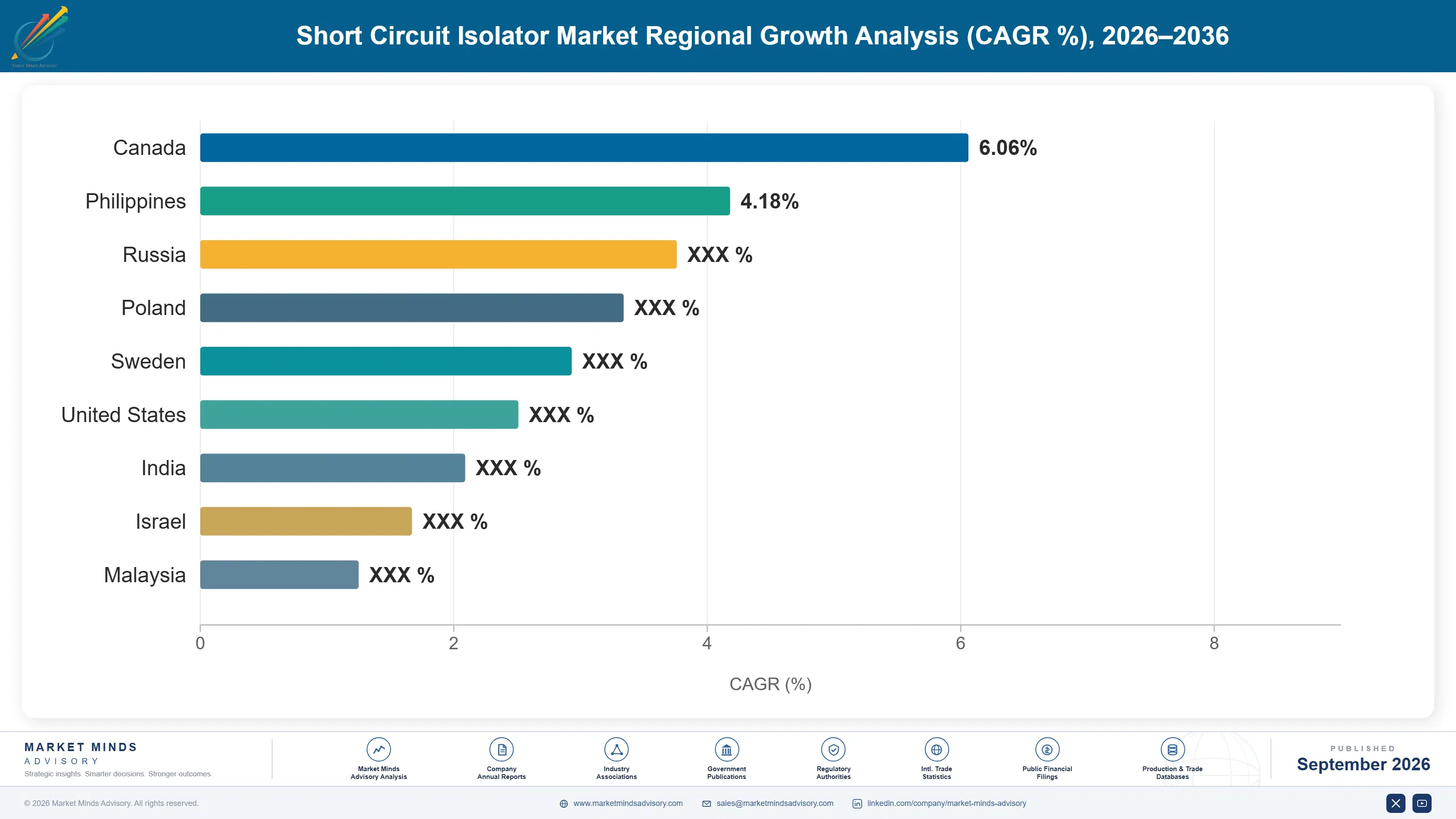
East Asia anchors the largest share given concentrated grid infrastructure investment and manufacturing capacity, while North America follows closely on utility modernisation programmes and renewable connection activity. Renewable interconnection activity and certification depth also shape the pattern meaningfully across regions overall today broadly nationwide each year.

North America

Utility distribution modernisation programmes across the United States and Canada anchor substantial demand, with several state regulatory commissions now referencing digital monitoring capability directly in grid resilience capital cost recovery filings following recent high-profile reliability incidents. Renewable capacity additions, particularly utility-scale solar in the southwestern United States and wind capacity across the central corridor, are driving meaningful renewable-rated isolator demand tied to ongoing interconnection queue processing at major utilities and independent system operators. Ageing distribution infrastructure installed during prior decades of grid buildout is reaching replacement age across many established utility service territories, giving suppliers predictable multi-year order visibility tied to published utility capital expenditure plans. Average selling prices stay firm given established utility qualification relationships.
Share: 26% | CAGR: 7.5% (2026 to 2036)

Western Europe

European Union grid modernisation and renewable integration targets anchor substantial regional demand, with national grid operators increasingly specifying digital monitoring capability as member states pursue coordinated grid resilience and decarbonisation policy objectives across the broader regional electricity market. Germany and other major European economies are qualifying isolator suppliers for large-scale offshore and onshore wind interconnection projects requiring renewable-rated fault current handling capability distinct from legacy thermal generation grid design assumptions. Domestic switchgear manufacturing capacity remains substantial given the region's established electrical equipment industry, though Asian manufacturers increasingly compete for standard utility replacement contracts on price. Growth trails East Asia given the region's more mature existing grid infrastructure with longer remaining service life across much of the distribution.
Share: 20% | CAGR: 5.0% (2026 to 2036)
Regional intelligence for 5 additional markets available in the complete report: East Asia, South Asia and Pacific, Latin America, Middle East and Africa, Eastern Europe. Contact sales@marketmindsadvisory.com.
short-circuit-isolator-market-country-cagr-analysis-1788503059722

Digital Integration, Certification Speed, and Renewable Depth

Suppliers hold pricing power where digital monitoring integration, faster type-testing certification turnaround, and renewable fault current engineering combine, letting qualified players capture margin beyond standard switchgear cost that commodity manufacturers cannot easily replicate. Point-solution suppliers lacking any of these three capabilities increasingly struggle to defend share against integrated rivals across most contract categories today.

Digital Asset Management Platform Integration Partnerships

Building direct integration partnerships with major utility asset management software platforms lets suppliers offer isolators that report condition data directly into systems utilities already operate, directly addressing the integration friction that has historically slowed digital monitoring adoption across fragmented utility technology environments. Suppliers who have secured these integration partnerships report winning a growing share of utility framework contracts specifically because direct platform integration removes a meaningful implementation barrier, with integrated suppliers commanding pricing running roughly 18 to 22 percent above comparable standalone monitoring product on qualified utility contracts. Expect this advantage to widen as digital specification requirements keep expanding.
Market Impact: Commands 18 to 22 percent price premium overall

Priority Testing Laboratory Capacity Reservation Agreements

Suppliers who secure priority accredited testing laboratory capacity reservation agreements protect new product qualification timelines during periods of constrained certification capacity far more effectively than competitors relying on standard laboratory queue scheduling subject to delay from higher-priority customer submissions. Suppliers offering this capacity security report meaningfully faster new product launch timelines than competitors without dedicated reservation agreements, with secured suppliers bringing new digitally integrated product to market roughly 4 to 6 months faster than unsecured competitors facing standard laboratory queue delays. This scheduling advantage grows as more manufacturers submit digitally integrated designs for certification simultaneously across the industry.
Market Impact: Cuts qualification lead time 4 to 6 months

Renewable Fault Current Engineering Capability Investment

Investing in specialised engineering capability for renewable bidirectional fault current certification positions suppliers to capture the fastest-growing renewable interconnection segment that standard utility replacement product design cannot reliably address without comparable engineering investment across the certification process. Suppliers who have already built this capability report winning a growing share of renewable interconnection contracts specifically because incumbent standard-design suppliers cannot meet the bidirectional fault current ratings these projects require, with renewable-rated product commanding roughly 25 percent pricing premium over standard utility replacement equipment. This engineering advantage compounds as renewable capacity additions continue expanding across most major electricity markets tracked.
Market Impact: Commands roughly 25 percent renewable-rated pricing premium overall

Who Controls the Margin Pool

Concentration sits moderate at a cr5 near 44 percent measured on global qualified shipment volume, with a meaningful gap separating established global switchgear manufacturers holding deep utility qualification relationships from a fragmented tail of regional producers competing mainly on price within standard uncertified municipal contract segments. This gap is widening rather than closing as leading suppliers reinvest margin into further integration and certification depth.
Current competitive activity centres on three dimensions: building digital asset management platform integration partnerships with utility software vendors, securing priority testing laboratory capacity to protect new product qualification timelines, and expanding renewable fault current engineering capability to capture growing interconnection contract volume across major electricity markets. Consolidation activity has also picked up among smaller regional manufacturers seeking faster certification access to major utilities.

Emerging pressure comes from Chinese manufacturers scaling qualified production capacity behind domestic grid expansion, which could compress pricing on standard utility replacement product while established suppliers defend share through deeper digital integration and renewable engineering specialisation these newer entrants have not yet matched at comparable depth. Watch for share shifts toward suppliers combining digital breadth with renewable engineering depth across contracts.
short-circuit-isolator-market-company-positioning-matrix-1788503060268

Competitive Moat and Risk Dimensions

ABB LTD

Moat: Deep utility qualification portfolio

ABB holds digital monitoring integration and mechanical certification across more utility jurisdictions than most competitors, a position built over years of jurisdiction-by-jurisdiction qualification work new entrants cannot replicate quickly. This depth lets ABB bid the largest utility framework contracts across multiple continents from a shared product platform, spreading certification cost across a far larger installed base than regionally.
ABB LTD

Risk: Exposure to utility capex cycles

A meaningful share of ABB's isolator revenue ties to utility capital expenditure, which moves with regulatory rate case outcomes and can slow sharply during periods of utility capital discipline or unfavourable rate case decisions. Because certification investment costs stay largely fixed regardless of near-term order volume, a prolonged capex slowdown compresses returns faster than at suppliers with more.
SIEMENS AG

Moat: Broadest digital platform partnerships

Siemens has built the broadest digital asset management platform integration partnerships among major isolator suppliers, letting its equipment connect natively into utility software platforms that competitors must integrate separately for each customer relationship. This integration depth gives Siemens an advantage in utility contracts specifically where digital monitoring capability increasingly determines vendor selection over hardware specifications alone.
SIEMENS AG

Risk: Complexity across broad product portfolio

Siemens manages isolators as one product line within a much broader electrical infrastructure portfolio, and this breadth risks diluting management attention and innovation investment relative to specialist isolator competitors focused entirely on this narrower equipment category. Specialist entrants building purpose-built renewable engineering capability could outpace Siemens specifically in the fastest-growing interconnection contract segment where focused execution matters most.

Players Tracked

Prominent Players

ABB Ltd
Siemens AG
Schneider Electric SE
Eaton Corporation
Mitsubishi Electric Corporation

Other Key Players

General Electric Company
Hitachi Energy Ltd
Toshiba Corporation
Hyundai Electric and Energy Systems
CG Power and Industrial Solutions
Larsen and Toubro Limited
S&C Electric Company
Rockwell Automation Inc
Legrand SA
WEG S.A.
Chint Group Corporation
TBEA Co Ltd
XJ Electric Co Ltd
Fuji Electric Co Ltd
Nissin Electric Co Ltd

Recent Developments

FEBRUARY 2026

ABB Launches Digital Isolator Platform Integration With Major Utility Software Vendor

ABB Ltd launched a new digital isolator platform featuring native integration with a leading utility asset management software vendor, targeting utilities seeking centralised condition monitoring across distributed feeder infrastructure without custom integration development work required. This follows growing customer requests across multiple regional utility programmes evaluating comparable platforms.
Signal: Confirms established suppliers are prioritising software integration to defend utility contract share. Broader integration portfolios increasingly separate leaders from rivals.
OCTOBER 2025

Siemens Expands Renewable Fault Current Testing Capacity

Siemens AG expanded renewable fault current testing capacity at its existing European facility, responding to rising qualification requests from renewable project developers requiring bidirectional isolator certification ahead of upcoming interconnection deadlines across multiple markets. The expansion follows two years of rising demand across comparable renewable interconnection programmes.
Signal: Signals suppliers expect sustained growth in renewable interconnection certification demand. Reinforces confidence in continued renewable interconnection demand growth.
JUNE 2025

Eaton Signs Multi-Year Supply Agreement With Regional Utility

Eaton Corporation signed a multi-year digitally monitored isolator supply agreement with a regional utility, securing qualified supply position across the utility's expanding distribution modernisation programme spanning multiple service territories for the duration of the contract term. The agreement includes provisions for expanding volume as the utility's modernisation programme.
Signal: Shows established suppliers converting digital integration capability into long-term supply relationships. Extends established suppliers' reach into new long-term utility.

Copper and Switchgear Component Cost Exposure

Copper conductor material and precision-machined switchgear components together typically account for a meaningful share of finished isolator cost of goods sold, sourced from a mix of commodity metal markets and specialty electrical component supply chains serving the broader switchgear industry. This concentration differs meaningfully from most other electrical infrastructure input categories suppliers must manage across their portfolios.
Copper prices rose meaningfully during a 2024 industrial demand surge tracked across major metal refiner and component manufacturer annual reports, compressing margins at isolator manufacturers within a single fiscal year and forcing several smaller suppliers to renegotiate customer pricing terms mid-contract cycle. Recovery took roughly two quarters as industrial demand growth gradually normalised across the affected metal supply chain, a pattern that could recur during future periods of industrial demand strength.

Smaller regional manufacturers without diversified metal sourcing relationships carry the largest exposure to this volatility, while larger suppliers with multi-year metal supply agreements across diversified vendor bases can partially hedge through blended purchasing that spreads price risk across several supply sources simultaneously. Larger suppliers weather these swings with comparatively limited margin impact given established diversified sourcing relationships in place.
short-circuit-isolator-market-cost-volatility-analysis-1788503060467

Multi-Year Copper and Component Supply Agreements

Larger manufacturers are locking multi-year copper and switchgear component supply agreements across diversified vendor bases rather than relying on spot purchases, smoothing input cost volatility and protecting margin on fixed-price utility framework contracts signed years in advance of delivery. This approach has already reduced realised cost volatility meaningfully for early adopting suppliers across recent quarters.

Priority Testing Laboratory Capacity Reservation

Suppliers are booking accredited testing laboratory capacity years in advance of confirmed product launch timelines, reducing exposure to certification queue delays while also shortening overall product development and qualification cycles across their certified portfolio broadly. Early results suggest meaningful reliability gains are achievable once laboratory relationships mature across the supplier base overall too overall.

Copper Recycling From Production Scrap Streams

Suppliers are investing in copper recovery from switchgear production scrap and customer installation byproduct streams, cutting exposure to primary market pricing volatility while also improving overall material yield economics across the full manufacturing process chain. This shift also shortens development cycles when copper markets move sharply within a single quarter too overall overall too.

Portfolio Architecture for Margin Defence

Portfolio economics split across three tiers running from commodity-adjacent standard mechanical isolators through certified renewable-rated designs to digitally monitored next-generation platforms, with gross margin widening meaningfully at each successive tier as engineering complexity and monitoring integration increase across the range. This structure mirrors margin patterns seen in other certified industrial equipment categories where testing barriers separate pricing tiers overall.
Volume still concentrates in the standard certified tier where most current utility replacement contracts sit today, but the renewable-rated and digitally monitored tiers are growing faster and increasingly determine which suppliers win the largest multi-year utility framework agreements across major electricity markets. Neither positioning is inherently superior, but capital allocation increasingly favours whichever tier shows the clearest path toward sustained margin expansion.

High-value margin pools concentrate specifically around digitally monitored platforms and renewable fault current engineering, where certification barriers and integration complexity keep standard mechanical competitors from competing effectively on price alone across the largest utility accounts. Suppliers slow to build digital integration capability risk ceding this margin pool entirely to faster-moving competitors within several years nationwide, a pattern likely to persist through the full forecast period ahead.

Volume / Commodity-Adjacent Tier

Standard mechanical isolators meeting baseline utility replacement specifications, sold mainly on price into smaller municipal and rural utility contracts without extensive digital monitoring or renewable rating requirements. Margins stay thin given intense price competition across this segment.
Gross Margin: 16%-22%

Premium / Certified Tier

Certified renewable-rated designs meeting bidirectional fault current standards, commanding meaningful price premiums over standard mechanical isolators given the engineering barrier competitors must clear first. Repeat business is common once a supplier clears initial certification.
Gross Margin: 28%-34%

Sustainability / Regulatory / Next-Generation Tier

Digitally monitored next-generation platforms sold into flagship utility framework contracts, carrying the widest margins given software integration complexity and scarce qualified engineering capacity. Few suppliers currently compete here at meaningful production scale.
Gross Margin: 38%-46%
short-circuit-isolator-market-portfolio-architecture-1788503060997

High-value Sub-segments and Strategic Watch-out

Digitally Monitored Utility Framework Contracts

Digitally monitored isolators command the widest margins in the category as utility asset management platforms standardise, though the qualified supplier pool remains small given the integration investment this segment requires of manufacturers today. Expect broader adoption as more utility programmes reach production volume soon soon.
Gross Margin: 40%-46%

Renewable Interconnection Certified Isolators

Renewable-rated isolators serving interconnection contracts grow steadily as capacity additions accelerate, commanding solid premiums over standard mechanical product though not yet matching digitally monitored margins across most current contracts. Expect continued steady share gains across additional utility accounts ahead across most established utilities broadly too.
Gross Margin: 30%-36%

Standard Certified Utility Replacement Isolators

Standard certified isolators serving mainstream utility replacement contracts remain the largest volume pool by a wide margin, carrying moderate but stable margins as ageing infrastructure guarantees multi-year order visibility across established relationships. This tier anchors most supplier revenue today across the industry broadly today too.
Gross Margin: 24%-30%

Legacy Uncertified Mechanical Isolators

Uncertified mechanical isolators sold into smaller municipal contracts without digital audit trail pressure face the greatest margin compression risk as accreditation bodies gradually extend documentation expectations to smaller utility buyers. Consolidation among remaining uncertified suppliers looks increasingly likely soon across most established markets broadly too.
Gross Margin: 12%-18%

Replacement Cycles and Certification Depth

Isolator revenue behaves like a long-cycle annuity once installed, since replacement typically occurs only after twenty-five to forty years of service or alongside broader distribution infrastructure upgrades, giving suppliers predictable but infrequent per-site repeat purchase timing across established utility relationships. Suppliers instead depend on new installation and replacement volume for near-term revenue visibility rather than counting on installed base alone too.
Adoption depth varies meaningfully by utility tier: large investor-owned utilities integrate digitally monitored isolators deeply into standardised procurement specifications across their entire service territory, while smaller municipal and rural cooperatives often mix suppliers project by project based on available capital budget. Smaller municipal utilities often lack a formal standardised specification governing every future isolator purchase decision made across their network.

A generational shift is underway as utility engineering teams that specified mechanical-only isolators for decades give way to younger staff trained on digital monitoring and renewable fault current considerations, accelerating specification changes faster than the underlying replacement cycle alone would suggest across most established utilities today. Vendor relationships are shifting accordingly toward suppliers who can demonstrate credible digital integration competence, not mechanical history alone.
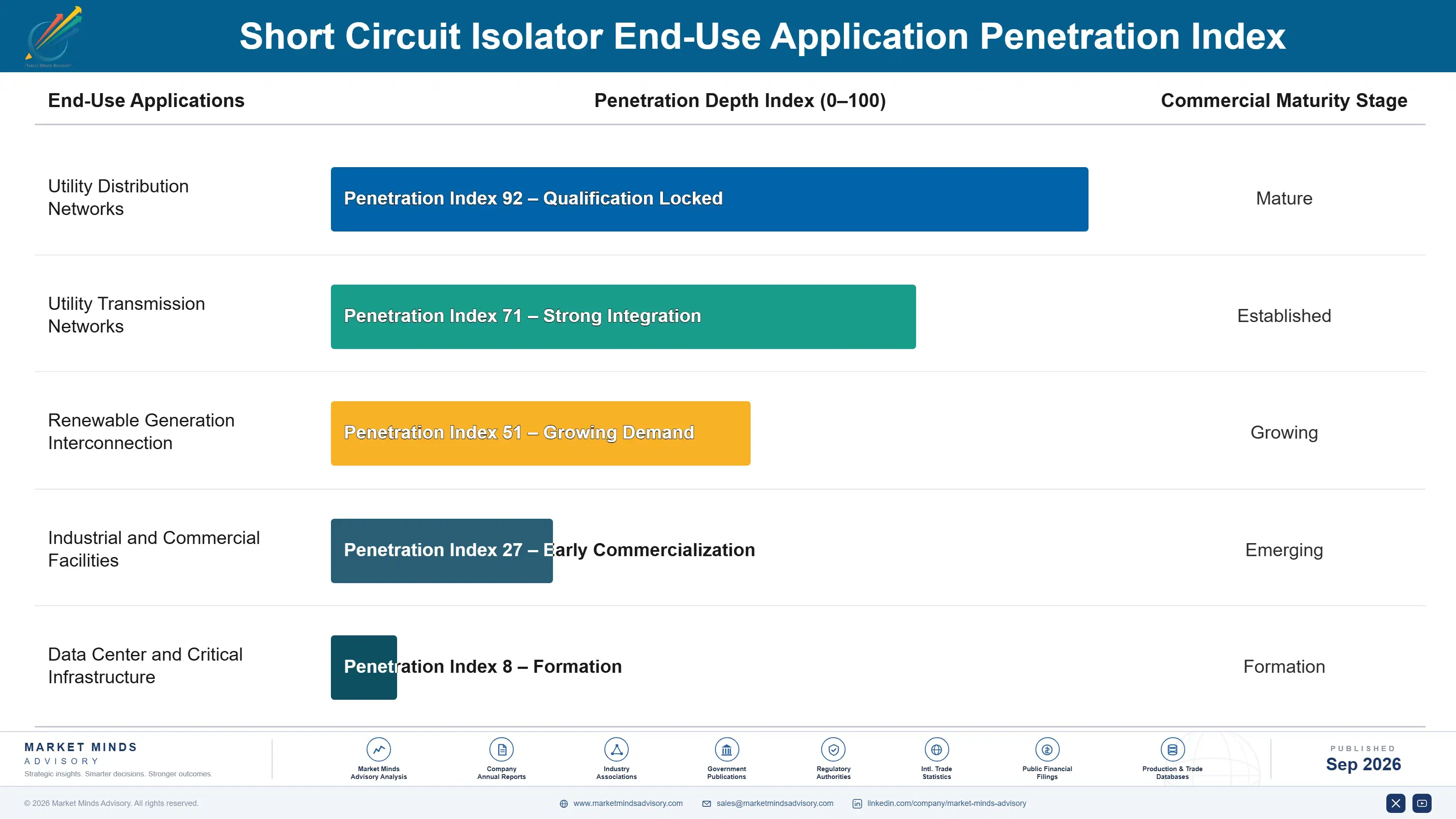
short-circuit-isolator-market-end-use-penetration-index-1788503061488

Where Suppliers Should Focus Investment Next

These are among the four positions where our research anticipates prominent divergence between winners and laggards over the coming forecast period. Each is grounded in the demand model, the regulatory perimeter, and the announced capacity pipeline.
01 / DIGITAL INTEGRATION INVESTMENT

Build Utility Software Integration Partnerships Now

Utilities increasingly treat digital monitoring integration as a baseline procurement requirement rather than a differentiator, and suppliers who have not secured direct asset management platform partnerships risk losing competitive bids regardless of hardware quality offered against better-integrated alternatives already qualified. Suppliers who have already secured these partnerships report winning a growing share of utility framework contracts specifically because direct integration removes implementation friction utilities value highly during vendor evaluation. MMA advises treating platform integration as a near-term competitive prerequisite, not a future roadmap item.
02 / CERTIFICATION SPEED INVESTMENT

Secure Priority Testing Capacity Before the Next Queue

Testing laboratory capacity constraints have already delayed product launches meaningfully at suppliers without secured reservation agreements, and this exposure grows as more manufacturers submit digitally integrated designs for certification simultaneously across the broader industry. Locking priority testing capacity ahead of the next constraint period protects new product launch timelines and utility procurement deadline commitments regardless of subsequent laboratory queue pressure across the wider market. MMA sees testing capacity security as a prerequisite for suppliers pursuing the largest utility framework agreements, not merely a defensive measure.
03 / RENEWABLE ENGINEERING CAPABILITY

Build Bidirectional Fault Current Capability Ahead of Demand

Renewable capacity additions are expanding interconnection contract volume faster than most standard-design suppliers have prepared for, meaning demand for bidirectional fault current engineering capability will keep expanding regardless of near-term fluctuations in overall utility replacement order volume across individual budget cycles. Suppliers who invest in renewable engineering capability ahead of this expansion are positioned to win interconnection contracts that standard-design competitors simply cannot serve, a durable capability barrier rather than a temporary pricing advantage. MMA recommends treating renewable capability investment as a multi-year commitment justified by clear renewable.
04 / MATERIAL COST HEDGING STRATEGY

Lock Multi-Year Copper Agreements Before Fixed-Price Contracts

Copper price volatility has already compressed margins meaningfully at manufacturers without long-term metal supply agreements, and this exposure grows as more suppliers sign fixed-price multi-year utility framework contracts without matching input cost protection built into contract terms from the outset of the relationship. Locking diversified multi-year copper agreements ahead of major fixed-price contract commitments protects margin through the full contract term regardless of subsequent metal price swings in either direction across the broader commodity market. MMA sees this as a prerequisite for suppliers pursuing the largest utility framework.

Engagement Snapshot From the Field

A live engagement with an industry participant carrying material or product regulatory and market exposure ahead of a defining policy shift, showing how our research translates into a defensible multi-year portfolio strategy.
MARKET MINDS ADVISORY · CLIENT ENGAGEMENT SUMMARY
Short Circuit Isolator Producer Strategic Portfolio Review and Transition Roadmap 2026·Investment Scenario on Short Circuit Isolator Exposure Evaluation 2025-26
CLIENT PROFILE
The client operates distribution infrastructure across several states and approached MMA following a regulatory finding that flagged inconsistent fault-clearing performance across its ageing isolator fleet, reportedly risking over 6 million dollars in delayed rate case cost recovery approval (client-reported, unverified by MMA) tied to grid resilience capital investment justification. The finding was already affecting downstream capital investment approval timelines with state regulators.
STRATEGIC CHALLENGE
Leadership needed an evidence-based prioritisation framework for a multi-year isolator replacement programme across dozens of feeder circuits, but internal engineering and finance teams disagreed sharply on which circuits to prioritise and what digital monitoring investment level the business case justified. Time pressure from the upcoming rate case filing compounded the difficulty of reaching internal consensus quickly.
MMA APPROACH
MMA benchmarked comparable utility isolator replacement programmes across similar regulatory environments, modelled compliance risk against circuit criticality and renewable penetration, and built a phased capital deployment framework prioritising circuits by both fault history and renewable interconnection density. The framework was validated jointly against engineering and finance stakeholder requirements before final sign-off.
KEY FINDINGS
  1. Circuits with the highest renewable interconnection density accounted for a disproportionate share of fault-clearing performance issues relative to their share of total circuit mileage across the utility's service territory.
  2. Digitally monitored isolator replacement reduced modelled outage investigation time substantially based on comparable utility programme data reviewed across similar regulatory and renewable penetration environments.
  3. Prioritising replacement by renewable interconnection density rather than circuit age alone improved the projected regulatory approval timeline meaningfully within the proposed capital programme structure.
  4. Bundling digital platform integration with the replacement contract shortened projected deployment timeline versus a traditional separately procured hardware and software integration approach.
CLIENT PROFILE
The client operates distribution infrastructure across several states and approached MMA following a regulatory finding that flagged inconsistent fault-clearing performance across its ageing isolator fleet, reportedly risking over 6 million dollars in delayed rate case cost recovery approval (client-reported, unverified by MMA) tied to grid resilience capital investment justification. The finding was already affecting downstream capital investment approval timelines with state regulators.
STRATEGIC CHALLENGE
Leadership needed an evidence-based prioritisation framework for a multi-year isolator replacement programme across dozens of feeder circuits, but internal engineering and finance teams disagreed sharply on which circuits to prioritise and what digital monitoring investment level the business case justified. Time pressure from the upcoming rate case filing compounded the difficulty of reaching internal consensus quickly.
MMA APPROACH
MMA benchmarked comparable utility isolator replacement programmes across similar regulatory environments, modelled compliance risk against circuit criticality and renewable penetration, and built a phased capital deployment framework prioritising circuits by both fault history and renewable interconnection density. The framework was validated jointly against engineering and finance stakeholder requirements before final sign-off.
KEY FINDINGS
  1. Circuits with the highest renewable interconnection density accounted for a disproportionate share of fault-clearing performance issues relative to their share of total circuit mileage across the utility's service territory.
  2. Digitally monitored isolator replacement reduced modelled outage investigation time substantially based on comparable utility programme data reviewed across similar regulatory and renewable penetration environments.
  3. Prioritising replacement by renewable interconnection density rather than circuit age alone improved the projected regulatory approval timeline meaningfully within the proposed capital programme structure.
  4. Bundling digital platform integration with the replacement contract shortened projected deployment timeline versus a traditional separately procured hardware and software integration approach.
RECOMMENDED STRATEGY
Phase 1: Phase 1 (Year 1): Replace isolators on the highest renewable-density circuits first, using digitally monitored systems with bundled platform integration support included. Phase 2: Phase 2 (Years 2 to 3): Extend replacement across remaining priority circuits identified through the renewable-density and fault-history prioritisation framework developed during scoping. Phase 3: Phase 3 (Years 4 to 5): Integrate predictive maintenance analytics across the fully replaced fleet to further reduce future outage investigation overhead.
OUTCOME
The client secured regulatory approval for a five-year capital programme following the engagement, with Phase 1 circuit replacement reportedly reducing fault-clearing related outage minutes by roughly 38 percent against the prior baseline (client-reported, unverified by MMA), supporting the case for full programme continuation. Leadership cited the modelling framework directly in the regulatory approval filing documentation submitted.

Frequently Asked Questions

Foundational context covering the market sizes, CAGR, scope, country, region and competition that inform every finding below. This section is provided to cover basics and most often pre-purchase conversations, answered from the MMA Primary Research Dataset.

What is the current size of the Short Circuit Isolator Market?

The global short circuit isolator market reached approximately 1.1 billion dollars in 2025. Growth has been steady as grid modernisation and renewable capacity additions both expand demand.

How large will the Short Circuit Isolator Market be by 2036?

MMA projects the market reaching approximately 2.2 billion dollars by 2036 under the base case scenario. Digital monitoring adoption and renewable interconnection growth both support this trajectory.

What is the CAGR for the Short Circuit Isolator Market 2026 to 2036?

The base case CAGR is 6.5 percent across the forecast period. Bull and bear scenarios range between roughly 5.3 and 7.8 percent depending on renewable capacity addition pace.

Which segment is growing fastest?

Smart digital monitoring-enabled isolators lead at 11.3 percent CAGR, well above the overall market rate. Utility standardisation of digital monitoring specifications is the primary driver behind this segment's outsized growth.

Who are the major companies in the Short Circuit Isolator Market?

Leading suppliers include ABB Ltd, Siemens AG, Schneider Electric SE, Eaton Corporation, and Mitsubishi Electric Corporation. Combined, the top five hold roughly 44 percent of global qualified shipment volume.

Which country is growing fastest?

China leads among major markets at approximately 9.0 percent CAGR, driven by its massive state grid modernisation programme and aggressive renewable capacity build-out. Continued grid infrastructure investment reinforces this pace.

Report Segmentation Architecture

The full report scope spans multiple orthogonal segmentation dimensions, with cross-tabulated demand data provided for each dimension pair. Coverage extends further to regional breakdowns, trend trajectories, and the competitive detail needed to support segment-level decision-making.

By Voltage Class and Monitoring Capability

  • Low-Voltage Mechanical Isolators
  • Medium-Voltage Mechanical Isolators
  • High-Voltage Mechanical Isolators
  • Smart Digital Monitoring-Enabled Isolators
  • Renewable Energy Integration Isolators
  • Testing and Maintenance Services

By End-Use Application

  • Utility Distribution Networks
  • Utility Transmission Networks
  • Renewable Generation Interconnection
  • Industrial and Commercial Facilities
  • Data Center and Critical Infrastructure

By Commercial Dimension

  • Direct Utility Procurement Contracts
  • Renewable Developer Framework Agreements
  • Distributor and Reseller Channels
  • Maintenance Service Contracts

By Region

  • North America
  • Western Europe
  • East Asia
  • South Asia and Pacific
  • Latin America
  • Middle East and Africa
  • Eastern Europe

Scope, Methodology, and Coverage

Every figure in this report is reproducible from documented input assumptions. The scope below maps the historical period, the forecast horizon, the segmentation dimensions, and the countries covered, alongside the underlying primary and qualitative methodology.
Historical Period
2020 to 2025
Forecast Period
2026 to 2036
Base Year
2025 (USD billions; MMA Primary Research Dataset, September 2026)
Market Definition
This report covers short circuit isolators used for fault current interruption and isolation in electrical distribution and transmission networks, including standard mechanical, renewable-rated, and digitally monitored variants across low, medium, and high-voltage applications. It excludes circuit breakers used for routine switching operations and general disconnect switches without fault-interruption rating.
Quantitative Units
USD billions (current prices); units shipped annually
Segmentation Dimensions
By Voltage Class and Monitoring Capability; By End-Use Application; By Commercial Dimension; By Region
Regions Covered
North America, Western Europe, East Asia, South Asia and Pacific, Latin America, Middle East and Africa, Eastern Europe
Countries Covered
USA, China, Germany, France, UK, Japan, South Korea, India, Australia, Canada, Brazil, Mexico, Indonesia, Vietnam, Thailand, Malaysia, UAE, Saudi Arabia, South Africa, Nigeria, Turkey, Poland, Netherlands, Italy, Spain, Sweden, Switzerland, Argentina, Colombia, Singapore, and additional markets relevant to this sector
Key Companies Profiled
ABB Ltd, Siemens AG, Schneider Electric SE, Eaton Corporation, Mitsubishi Electric Corporation, General Electric Company, Hitachi Energy Ltd, Toshiba Corporation, Hyundai Electric and Energy Systems, CG Power and Industrial Solutions, Larsen and Toubro Limited, S&C Electric Company, Rockwell Automation Inc, Legrand SA, WEG S.A., Chint Group Corporation, TBEA Co Ltd, XJ Electric Co Ltd, Fuji Electric Co Ltd, Nissin Electric Co Ltd
Quantitative Methodology
Primary survey, n=3,800 respondents, Q4 2025, six countries; demand-side model with trade association cross-validation
Qualitative Methodology
47 expert interviews, Q4 2025; applied to validate demand model assumptions, identify emerging dynamics, and assess competitive positioning
Report Format
PDF and XLSX data workbook (Word format preview document)
Publisher
Market Minds Advisory
Report Code
MMA-2026-CON-125
Published
September 2026
Contact
sales@marketmindsadvisory.com | www.marketmindsadvisory.com

Purchase the full Short Circuit Isolator Market Report (2026 to 2036).

The full MMA report delivers granular segmentation across six voltage and monitoring tiers, seven-region demand and pricing forecasts through 2036, and a detailed competitive assessment of twenty profiled suppliers including digital integration and renewable engineering positioning. It includes a dedicated utility digital monitoring adoption tracker covering major grid operators, plus quarterly copper cost pass-through analysis. Buyers receive editable data tables supporting internal capacity planning and supplier evaluation models across their full qualification portfolio. Analysts update the adoption tracker each quarter as major utilities reach new digital monitoring deployment milestones.
Seven-region demand and pricing forecasts to 2036
Twenty-supplier digital integration and readiness tracker
Utility monitoring adoption pipeline status tracker
Quarterly copper cost pass-through model update
Segment-level margin benchmarking across all tiers
Editable capacity planning and supplier evaluation tables

Built For The People Who Decide

From boardroom strategy to bench-side execution, this report is read cover-to-cover by leaders shaping the next decade of their industry, turning demand scenarios, market dynamics and valuation benchmarks into decisions.
CXOs/ Presidents/ VPs/ Managers
M&A and Corporate Development
Strategy Teams and R&D Heads
Procurement and Product Directors
Regulatory and Compliance Leaders
Investor Relations and Equity Analysts