

Market Minds Advisory
Shock Tube System Market

Shock Tube System Market: Shock Tube System Market: Squeezed From Above, Immune To Everything Else

The programmable alternative costs five times as much and works better. This one does not care about lightning, stray current or a radio mast, which turns out to matter more than anybody expected.

Lead Analyst

Published

September 2026

Make Smarter Decisions with Customized Research Insights

Request a free sample report and evaluate market opportunities, growth trends, and competitive dynamics relevant to your business needs.

2025 MARKET VALUE$1.1BMarket Size 2025
2036 FORECAST VALUE$2.0BBase Case , 2026 to 2036
CAGR 2026 TO 20365.8 %Bull 7.0% / Bear 4.6%
INCREMENTAL OPPORTUNITY$0.9BNet 10- year value creation
EXPANSION MULTIPLE1.76x2036 value over 2026 base
Strategic Levers
M&A Pipeline
Regional Outlook
Country Rankings
Competitive Intelligence
Segmental Deep-dive
Call-Us : 91 93563 13602

Executive Snapshot and Market Trajectory.

Electronic detonators do this job better and cost 5.2 times as much per initiation point, which is why they have taken 23% of the market and stopped. The remaining 77% is quarrying, construction and smaller mining where nobody will pay that premium for fragmentation that nobody measures.
Long-lead tunnelling assemblies grow at 8.7%, half again the market rate of 5.8%, because infrastructure tunnelling is expanding while the confined conditions underground make electronic systems awkward and expensive to deploy. South Asia and Pacific holds 26% of demand, above its usual band, on Indian coal, limestone and aggregate blasting volume and on electronic adoption that has been slower there than anywhere else. Price sensitivity across that whole market is genuinely and unusually severe.
Concentration is high at 71% of units shipped, because coating the inside of a plastic tube with 18 milligrams of energetic material per metre and having it propagate reliably over hundreds of metres is a manufacturing problem rather than a design one. Very few firms have solved it, and the ones that did built the plants decades ago. Nobody has entered this particular business from a standing start.
Market Definition
The shock tube system market covers non-electric initiation assemblies in which a thin plastic tube internally coated with energetic material propagates a low-energy signal to fire a detonator, spanning surface delay connectors, in-hole detonator assemblies, dual-delay trunkline systems, bunch connector systems, long-lead tunnelling assemblies, and seismic and specialty initiation assemblies. Scope is measured as units shipped into blasting operations. Excluded are electronic and programmable detonators, electric detonators and firing cable, detonating cord, bulk and packaged explosives, and blast design software or services supplied without initiation hardware.
Base Year Value
$1.1B in 2025 (MMA Primary Research Dataset, September 2026)
Forecast Period
2026 to 2036, eleven discrete annual values
CAGR
5.8% base case. Bull 7.0%. Bear 4.6%.
Fastest Growth Segment
Long-Lead Tunnelling Assemblies: 8.7% CAGR
Fastest Growth Country
India: 7.8% CAGR
Fastest Growth Region
South Asia and Pacific: 7.8% CAGR
Largest Region
South Asia and Pacific: 26% of 2025 global value
Market Leaders
Orica, Dyno Nobel, AECI, MAXAM and Solar Industries India. Source: MMA Analysis, July 2026.
Primary Survey
n=3,800 procurement and R&D decision-makers, Q4 2025, six countries
Methodology
Demand-side build-up, cross-validated against public data, 47 expert interviews

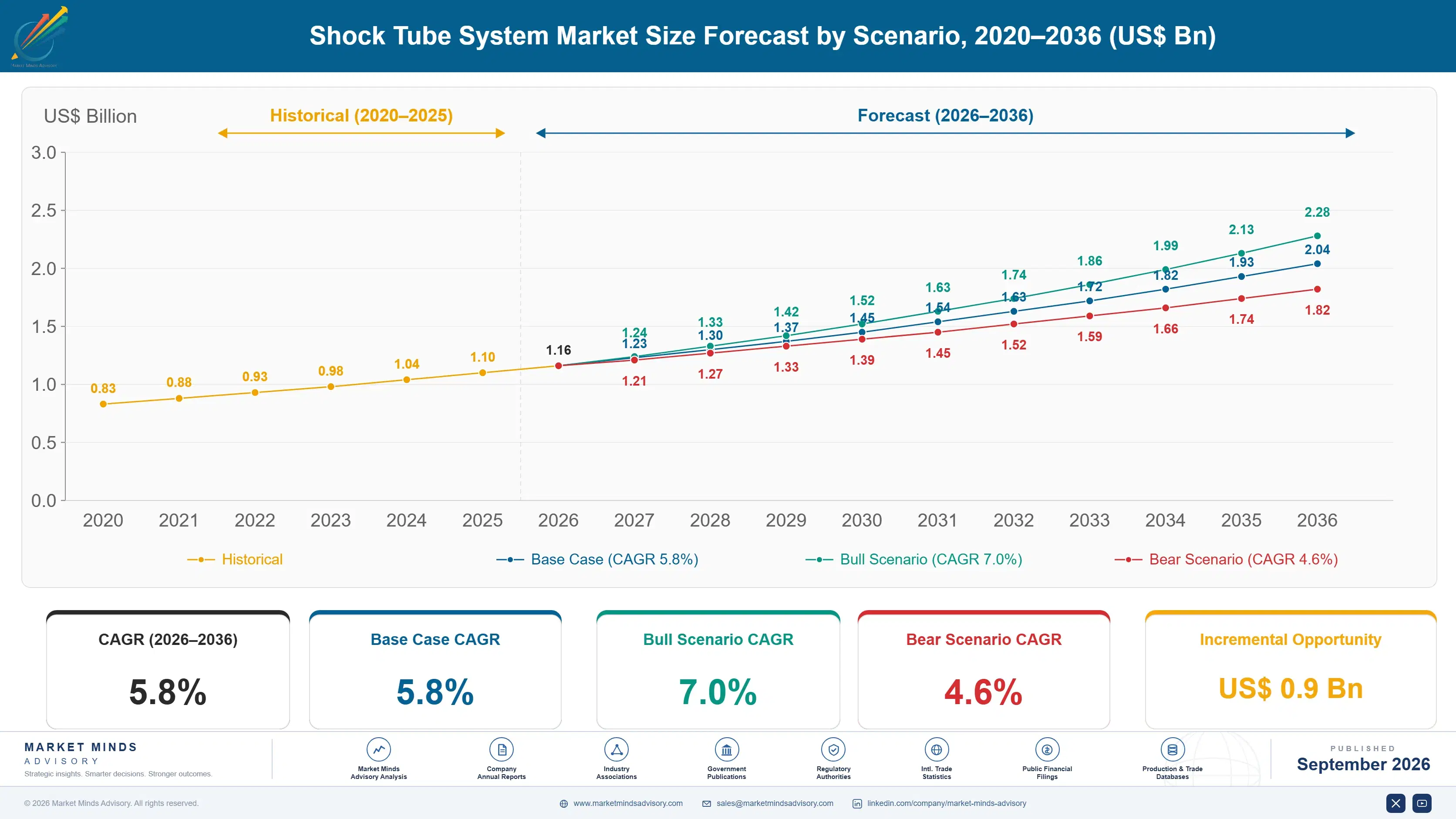
Shock Tube System Market Forecast Scenarios

shock-tube-system-market-size-forecast-scenario-1788255522150
Between 2020 and 2025 units compounded at 4.6% and the story underneath was displacement rather than decline. Electronic detonators took the large open pit operations where fragmentation control pays measurably, while shock tube volume held and grew in quarrying, construction and smaller mining across Asia, Africa and Latin America. The category lost its most valuable customers and kept almost all of its units.
The 5.8% base case rests on three mechanisms. Infrastructure tunnelling across Asia and the Middle East keeps expanding, and confined underground conditions make electronic systems awkward enough that shock tube remains the practical choice. Aggregate and construction blasting grows with construction volume and buys entirely on price. And electronic adoption has plateaued at the operations where fragmentation control genuinely pays. None of the three depends on defending share against electronics.
The bull case at 7.0% turns on electronic detonator prices staying where they are while blasting volume grows, leaving the cost gap intact across every price-sensitive application. The bear case at 4.6% is electronic cost reduction: a programmable device at twice rather than five times the price would take a large part of the remaining base quickly, and the manufacturing cost curve is moving in that direction.

Cheap, Simple And Weatherproof

The competitive position here is unusually clear and unusually stable. Electronic detonators deliver millisecond-accurate programmable delays that improve fragmentation and cut ground vibration, and they cost 5.2 times as much per initiation point. Large open pit operations measuring downstream crushing energy pay that willingly. Quarries and construction contractors blasting to a specification nobody measures afterwards do not, and they represent most of the units.
TOP FIVE CONCENTRATION71%Share of units shipped held by five largest manufacturers
AVERAGE SELLING PRICEUSD 3.40Mean price per assembly across all delay configurations
ELECTRONIC DETONATOR PREMIUM5.2 timesPrice multiple of the programmable alternative per initiation point
EXPLOSIVE COATING LOAD18 mg/mEnergetic material lining each metre of the tube
PROPAGATION RELIABILITY99.98%Portion of assemblies initiating correctly under standard field conditions
ELECTRONIC ADOPTION SHARE23%Portion of initiation points now using programmable electronic devices
What shock tube does that nothing else does is ignore electricity entirely. The signal is a low-energy shock wave travelling inside a plastic tube, which makes the system indifferent to stray current, radio frequency energy, static and lightning. Operations near power lines, transmission masts or in regions with frequent electrical storms specify it for that reason alone, and the requirement is a safety case rather than a preference.
Manufacturing is the barrier and it is severe. Coating the inner wall of an extruded tube with roughly 18 milligrams of energetic material per metre, uniformly enough to propagate hundreds of metres at 99.98% reliability, is a process problem that took incumbents years. The plants that do it were built decades ago and nobody has commissioned a new one from a standing start in a very long time.
"This is a business that lost its best customers and kept its factories running at capacity, which is not the outcome anybody predicted when electronics arrived. The quarry down the road is never going to pay five times as much to improve fragmentation it does not measure."
Director, Commercial Explosives Practice · MMA Chemicals and Materials Practice · September 2026

Market Trends

Electronic adoption plateaued where the value stops

Programmable detonators took the large open pit operations where fragmentation control translates directly into crushing energy, mill throughput and measurable cost, and adoption has settled at around 23% of initiation points rather than continuing to advance. Below that threshold the fragmentation benefit is real and unmeasured, and a 5.2 times price premium against a blast nobody analyses afterwards makes no commercial sense to anybody. That plateau has held for several years, which suggests it reflects genuine economics rather than a slow adoption curve. The economics stopped it rather than the technology.
Market Impact: Removes 1 entire hazard class

Tunnelling favours the simpler system underground

Infrastructure tunnelling across Asian and Middle Eastern metro, rail and water projects is expanding steadily, and confined underground conditions with wet faces, restricted access and rapid cycle times make electronic systems awkward to deploy, program and verify. Long-lead assemblies suited to that work grow at 8.7% against a market rate of 5.8%. The advantage is practical rather than technical: a blasting crew working a face on a tight cycle values a system that connects and fires without any programming step at all. Procedural simplicity is the whole advantage underground here.
Market Impact: Rejects a 5.2 times premium

Market Opportunities and Growth Drivers

Immunity to stray current is a genuine safety case

The initiation signal is a low-energy shock wave inside a plastic tube and carries no electrical circuit at all, which makes the system indifferent to stray current, radio frequency energy, static discharge and lightning in a way that no electric or electronic device can match. Operations near transmission lines, radio masts, electrified rail or in regions with frequent electrical storms specify shock tube on safety grounds rather than on cost. That requirement does not respond to price movement in the alternative, which makes it the most defensible part of the base.
Market Impact: Protects 77% on price alone

Construction and aggregate blasting buys purely on price

Quarrying, aggregate production and civil construction blasting represent the largest share of units by a wide margin and purchase through distribution on delivered cost, because the blast is specified to a fragmentation requirement that nobody measures downstream and the contractor is paid for cubic metres moved. A 5.2 times premium for programmable timing addresses a problem that customer does not have. Construction volume across Asia, Africa and Latin America therefore drives this category considerably more than mining activity does. Construction volume rather than mining activity drives this category, and hardly anybody models it that way.
Market Impact: Applies equally to USD 3.40 units

Market Restraints and Challenges

Electronic cost reduction would take the rest quickly

Programmable detonators currently cost 5.2 times a shock tube assembly and that gap is the only thing protecting the remaining 77% of initiation points, since electronics deliver better fragmentation and vibration control on every measure that matters. The root cause is that electronic devices are semiconductor products on a declining manufacturing cost curve while shock tube is a mature chemical process at its cost floor. Commercial impact is a defensive position dependent on somebody else's pricing. Participants are responding by defending stray current applications, targeting price-sensitive geographies, reducing manufacturing cost and offering hybrid initiation designs.
Market Impact: Settled at 23% of initiation points

Detonator tracking adds cost that units cannot carry

Many jurisdictions require individual detonator tracking from manufacture through to consumption, with serialisation, reconciliation and reporting obligations that apply identically to a USD 3.40 assembly and to an electronic device costing five times as much. The root cause is that regulation addresses the hazard rather than the value of the item. Commercial impact is compliance overhead that consumes a meaningful share of margin on the cheapest products. Mitigation runs through automated serialisation at manufacture, barcode and scanning systems, distributor reconciliation tools and pricing that reflects the administrative burden. The overhead does not scale down.
Market Impact: Grows at 8.7% against 5.8%
3 additional market trends, 4 additional growth drivers, and 2 additional restraints and challenges are covered in the full report. Contact sales@marketmindsadvisory.com to access the complete intelligence.

Segment CAGR and Growth Architecture

Segmentation follows assembly type, the dimension on which delay function, application and unit price all move together. Surface connectors and in-hole assemblies carry the volume across quarrying and construction at commodity prices. Tunnelling and dual-delay systems carry the growth, because both serve applications where the simpler system is genuinely preferred rather than merely cheaper.
shock-tube-system-market-market-share-analysis-1788255522709

Long-Lead Tunnelling Assemblies

Long-lead tunnelling assemblies grow at 8.7%, half again the market rate of 5.8%, and practical conditions rather than any technical argument explain it. Metro, rail and water tunnelling across Asia and the Middle East is expanding steadily, and a blasting crew working a wet face on a tight advance cycle values a system that connects and fires without a programming step, a logger or a battery check. Long lead lengths let the initiation point sit well back from the face, which matters where access is confined. Unit prices run above surface products because the tube lengths are considerably greater, and the customer is an underground contractor rather than a mining company.
CAGR 8.7%

Dual-Delay Trunkline Systems

Dual-delay trunkline systems at 7.2% deliver surface and in-hole timing from a single assembly, which reduces the number of components a crew handles and the number of connections that can be made incorrectly on a large pattern. That matters most in operations running big blasts with limited crew, where connection error rather than product failure is the realistic risk. The design also narrows the practical timing gap against electronic systems for operations that want better sequencing without paying the electronic premium. Adoption is strongest in medium-sized open pit operations that sit exactly between the two technologies commercially. Reducing connection error matters more than any timing improvement at that scale, which is a point the electronic vendors never make.
CAGR 7.2%
Full segment breakdown across 6 segments available in the complete report.

Regional Architecture and Country Demand Map

South Asia and Pacific takes 26%, above its usual band, on Indian blasting volume and slower electronic adoption. Middle East and Africa and Latin America also sit above band on mining activity. Blasting volume and price sensitivity together decide this map, and neither follows economic size anywhere.

South Asia and Pacific

A 26% share above the usual band comes from blasting volume meeting price sensitivity in the same market. Indian coal, limestone, iron ore and aggregate operations blast at enormous scale, and electronic detonator adoption there has been slower than anywhere else because a 5.2 times premium is simply unaffordable at prevailing contract rates. Domestic manufacturers hold most of the supply and compete hard on price against each other rather than against electronics. Indian growth at 7.8% is the fastest of any country covered. Infrastructure tunnelling for metro and rail projects adds long-lead demand on top of an already large base. Nothing about that very large base looks likely to convert soon.
Share: 26% | CAGR: 7.8% (2026 to 2036)

East Asia

Chinese blasting volume for coal, aggregates and construction exceeds anywhere else and the market operates on entirely domestic terms. Manufacturers serve it under licensing arrangements that effectively exclude foreign participation in initiation systems, so the addressable position for international suppliers is far smaller than the 24% share implies. Consolidation among Chinese producers has reduced the number of manufacturers substantially over recent years. Southeast Asian quarrying and construction blasting is more accessible and growing steadily. Japanese and Korean demand is small, tunnelling-weighted and served to considerably stricter documentation standards than anywhere else in the region. Consolidation among domestic producers has reduced the manufacturer count considerably, and the addressable position for outsiders is smaller than the share suggests.
Share: 24% | CAGR: 6.6% (2026 to 2036)
Regional intelligence for 5 additional markets available in the complete report: North America, Western Europe, Latin America, Middle East and Africa, Eastern Europe. Contact sales@marketmindsadvisory.com.
shock-tube-system-market-country-cagr-analysis-1788255523231

Four Moves While The Gap Holds

None of these four is about competing with electronic detonators on capability, because they win that comparison and everybody knows it. Each works on where shock tube is genuinely preferred rather than merely cheaper, and on making the cheap product cheaper to produce and to administer. Two of the four are documentation and manufacturing decisions rather than commercial ones.

Defend the stray current safety case explicitly

Operations near transmission lines, radio masts, electrified rail or in lightning-prone regions specify non-electric initiation as a safety requirement rather than a cost preference, and around 31% of volume moves on that basis rather than on price at all. Documenting the hazard case properly, and helping customers write it into their own blasting standards, converts a price-driven purchase into a specified one. It costs technical documentation rather than product development. Almost every manufacturer here still sells on price to customers who would happily specify on safety instead. Documentation is cheaper than product development.
Market Impact: Protects 31% of volume from any price competition

Follow tunnelling rather than following mining

Metro, rail and water tunnelling across Asia and the Middle East is expanding while large open pit mining has largely converted to electronics, and underground contractors working tight advance cycles genuinely prefer a system with no programming step at all. Long-lead assemblies grow at 8.7% against a market rate of 5.8% on that basis. The customer is a civil contractor rather than a mining company and is reached through entirely different channels. Manufacturers organised around mining accounts are missing the one segment growing properly. Mining sales organisations never reach them.
Market Impact: Targets a segment now growing at 8.7% annually

Automate serialisation to carry the tracking cost

Individual detonator tracking obligations apply identically to a USD 3.40 assembly and to an electronic device costing five times more, which means compliance overhead consumes a far larger share of margin on the cheap product. Automated serialisation at manufacture, machine-readable marking and distributor reconciliation tools reduce that burden to something the unit price can actually carry. The investment is a production line change rather than a product redesign. Manufacturers absorbing tracking cost manually are giving away margin the regulation never intended to take. The regulation never intended to take it.
Market Impact: Carries the tracking cost on USD 3.40 units

Serve the price-sensitive geographies far more deliberately

Electronic adoption has plateaued at 23% of initiation points and it is concentrated in large well capitalised operations, which leaves Indian, African, Latin American and Southeast Asian blasting almost entirely on shock tube for reasons that will not change soon. Those markets buy through distribution on delivered cost and reward local manufacturing, regional stock and credit terms rather than technical performance. South Asia grows at 7.8%, the fastest of any region. Manufacturers positioned for Western mining accounts are competing where the volume has already left. That is where the volume actually went.
Market Impact: Serves regions now growing at 7.8% every year

Who Controls the Margin Pool

CR5 stands at 71% of units shipped into blasting operations, which is the only comparable basis since initiation products sit inside far larger explosives reporting for every manufacturer. Concentration is high because the coating and extrusion process is genuinely difficult, the plants that do it well were built decades ago, and nobody has commissioned a new one from a standing start in a very long time.
Competition runs on manufacturing cost, distribution reach and regulatory documentation. Manufacturing cost decides everything in a product bought on delivered price by contractors who do not measure the outcome. Distribution decides access to quarrying and construction, which never reaches a mining sales organisation. Documentation decides who can supply into jurisdictions with strict tracking obligations. Product performance differentiates almost nothing between established manufacturers.

Rankings will move on geography rather than on technology, because the volume has shifted decisively toward markets where electronic adoption is uneconomic. Indian, African and Southeast Asian manufacturers serve those markets with cost positions Western producers cannot match. The pressure comes from where the demand sits rather than from any competing product, and relocating manufacturing is not a quick response.
shock-tube-system-market-company-positioning-matrix-1788255523752

Competitive Moat and Risk Dimensions

ORICA

Moat: Manufacturing scale and global reach

Coating and extrusion plants built over decades across several continents give the group manufacturing cost and supply reliability that a new entrant cannot approach, alongside distribution reaching both mining and construction customers. The process knowledge behind consistent propagation is genuinely difficult and accumulated rather than purchased. Nobody has built an equivalent capability from nothing in recent memory.
ORICA

Risk: Premium customers already converted

The large open pit operations that were the most valuable shock tube customers have adopted electronic detonators extensively, which leaves the group defending volume in price-sensitive markets where regional manufacturers hold cost advantages. Scale in a commodity product bought on delivered cost helps less than it should. Following the volume means competing where the group's cost base is permanently uncompetitive.
SOLAR INDUSTRIES INDIA

Moat: Cost position in growing markets

Manufacturing located inside the largest and fastest growing shock tube market gives the company a delivered cost position that imported product cannot match, in a category bought almost entirely on price. Expansion into African and Southeast Asian markets extends that advantage into similar economics. Cost leadership in a commodity is a genuinely durable position when freight and duty are significant.
SOLAR INDUSTRIES INDIA

Risk: Exposure to electronic price falls

The company's markets remain on shock tube because electronic detonators cost 5.2 times as much, and a substantial reduction in that premium would reach price-sensitive customers faster than anywhere else precisely because they are price sensitive. Cost leadership offers no protection against a competing technology becoming affordable. Developing electronic capability means competing against established manufacturers with decades of field data.

Players Tracked

Prominent Players

Orica
Dyno Nobel
AECI
MAXAM
Solar Industries India

Other Key Players

Austin Powder
Enaex
EPC Groupe
BME Mining
Premier Explosives
NOF Corporation
Yahua Group
Poly Union Chemical
Hanwha Corporation
Titanobel
Nelson Brothers
IDEAL Detonators
Keltech Energies
Austin Detonator
Omnia Holdings

Recent Developments

JANUARY 2025

Electronic detonator adoption held steady rather than advancing

Industry shipment data showed electronic detonator penetration holding at around a quarter of initiation points rather than continuing to advance, with adoption concentrated in large operations measuring downstream fragmentation benefit. Shock tube volumes in quarrying, construction and smaller mining were unaffected across every region reporting.
Signal: A plateau that has held for several years reflects economics rather than any slow adoption curve.
MAY 2025

Tunnelling contractors specified non-electric systems on cycle time

Infrastructure tunnelling contractors on Asian metro and rail projects specified non-electric initiation on the basis of advance cycle time, since programming and verifying electronic systems at a confined wet face added minutes per round that a tight advance schedule simply could not absorb at all.
Signal: The advantage underground here is procedural simplicity rather than anything at all about the initiation physics.
SEPTEMBER 2025

Tracking obligations extended to further jurisdictions

Individual detonator tracking requirements extended into additional jurisdictions, applying serialisation and reconciliation obligations identically to low-cost non-electric assemblies and to electronic devices costing several times more. Compliance overhead fell disproportionately on the cheapest products in every single affected market, since the obligation is priced by hazard rather than by value.
Signal: Regulation priced by hazard rather than by value takes far more margin from the cheap product.

Resin, Energetics And Compliance

Extruded plastic tube resin accounts for roughly 29% of unit cost, energetic coating material around 21%, and detonator components with assembly a further 26%. Regulatory compliance including serialisation, tracking and secure logistics makes up an unusually large share of what remains, at levels that would be trivial on a more expensive product and are not on an assembly selling for USD 3.40.
Polymer resin pricing through 2021 and 2022 moved sharply on petrochemical feedstock and energy costs entirely unconnected to blasting demand, and US Census Bureau trade data recorded the movement across the period. Manufacturers holding annual resin contracts protected pricing into distribution agreements set for a season. Those buying on spot faced increases they could not pass through to contractors who buy purely on delivered cost and switch supplier readily.

The disadvantage falls on production scale and location rather than on purchasing capability. A manufacturer running high volume lines close to the customer holds a delivered cost position that a smaller or more distant producer cannot approach on an identical product, because freight on a bulky low-value item is material and duty frequently applies. No purchasing improvement closes a gap created by geography and by volume together.
shock-tube-system-market-cost-volatility-analysis-1788255523946

Contract resin supply across the blasting season

Tube resin is 29% of unit cost and prices on petrochemical feedstock entirely unconnected to blasting demand, while distribution agreements fix delivered prices for a season at a time. Annual resin contracts cost a premium against spot and remove the exposure that caught several manufacturers in the last feedstock cycle. Contractors switch supplier on delivered price without hesitation.

Automate serialisation rather than absorbing it

Tracking obligations apply identically to a USD 3.40 assembly and to devices costing five times more, so manual compliance takes a disproportionate share of margin on the cheap product. Machine-readable marking applied at manufacture, with automated reconciliation through distribution, reduces the burden to something the unit price can carry. It is a production line investment rather than a product change.

Manufacture close to the growing markets

Freight and duty on a bulky low-value assembly are material, and demand has shifted decisively toward Indian, African, Southeast Asian and Latin American markets that buy purely on delivered cost. Local or regional manufacturing removes a cost disadvantage that no purchasing arrangement addresses. Manufacturers exporting from distant plants into these markets are competing at a permanent handicap.

Portfolio Architecture for Margin Defence

Margin here follows application rather than product, which the catalogues do not reflect at all. A surface connector sold into quarrying competes on delivered cost against identical assemblies and earns very little. The same manufacturing capability supplying a tunnelling contractor on advance cycle grounds, or an operation specifying non-electric on a stray current safety case, earns considerably more because the purchase is not being made on price.
Volume and premium pull against each other through the factory rather than the market. Commodity surface and in-hole assemblies carry the line volume that keeps coating and extrusion plants at the utilisation these processes require to be economic at all, and losing that volume raises unit cost across everything else produced on the same equipment. Chasing only the specified applications leaves plants running below the rate they were built for.

High-value pools sit in tunnelling assemblies, in safety-specified applications and in seismic and specialty work nobody discusses. The third is genuinely overlooked: seismic surveys and specialty initiation require configurations produced in small quantities to particular specifications, and they price on capability rather than on the delivered cost per assembly that governs everything else here.

Volume / Commodity-Adjacent

Surface delay connectors and standard in-hole assemblies sold through distribution into quarrying and construction on delivered cost. Products are effectively interchangeable between manufacturers. The 8 point spread reflects production scale and distance from the customer rather than any design difference.
Gross Margin: 12 to 20%

Premium / Certified

Dual-delay trunkline systems and long-lead tunnelling assemblies specified for connection reliability and advance cycle time rather than purchased on price alone. Application fit supports the margin. The 8 point spread reflects whether the sale is direct to a contractor or through distribution.
Gross Margin: 24 to 32%

Sustainability / Regulatory / Next-Generation

Seismic and specialty initiation assemblies, safety-specified configurations for stray current environments and custom delay programmes. Margins are high because these are specified rather than shopped. The 16 point spread separates standard specialty products from genuinely bespoke configurations built to order.
Gross Margin: 34 to 50%
shock-tube-system-market-portfolio-architecture-1788255524441

High-value Sub-segments and Strategic Watch-out

Long-Lead Tunnelling Assemblies

High value and high growth at 8.7%. Underground contractors on tight advance cycles prefer a system with no programming step, and infrastructure tunnelling keeps expanding across Asia. The 8 point spread reflects whether the manufacturer sells direct to civil contractors or through mining distribution channels.
Gross Margin: 28 to 36%

Dual-Delay Trunkline Systems

High value with strong growth at 7.2%. Combining surface and in-hole timing reduces components handled and connections made wrongly, which matters where crew size is limited. The 8 point spread reflects whether the operation sits closer to the electronic or the commodity end of the market.
Gross Margin: 26 to 34%

In-Hole Detonator Assemblies

The volume core. It earns very little and it carries the line utilisation that coating and extrusion processes require to be economic on everything else produced. The 8 point spread reflects plant scale and freight distance, which decide these economics entirely. Scale and freight decide everything.
Gross Margin: 14 to 22%

Bunch Connector Systems

The strategic watch-out. This function is increasingly absorbed into dual-delay assemblies that do the same job with fewer components and fewer connection errors. The 18 point spread separates legacy replacement demand from new specification that is steadily disappearing from blast designs. The function is being absorbed.
Gross Margin: 8 to 26%

Every Blast, Every Week

The annuity here is consumption rather than any contract, and it is remarkably steady. Every blast consumes the assemblies entirely, a working quarry blasts weekly and a mine blasts more often than that, which produces repeat demand that follows production volume with no selling required between orders. Nothing is installed, maintained or retained, and the customer relationship exists only through whoever delivers reliably at the right price.
Stickiness varies enormously by application rather than by customer size. An operation specifying non-electric initiation on a stray current safety case has written a requirement into its own blasting standard and will not change casually. A quarry buying through a distributor on delivered price switches whenever somebody quotes lower. The first position is worth several times the second and takes documentation rather than selling to create.

Buyer profiles have shifted from mine blasting engineers toward procurement functions and civil contractors, and the sales approach has not moved with them. A blasting engineer discussed timing design and initiation sequence. A procurement officer compares delivered price per assembly, and a tunnelling contractor asks how many minutes the connection takes at the face. Those are three conversations and most manufacturers handle only the first.
shock-tube-system-market-end-use-penetration-index-1788255524932

Where This Product Still Wins

These are among the four positions where our research anticipates prominent divergence between winners and laggards over the coming forecast period. Each is grounded in the demand model, the regulatory perimeter, and the announced capacity pipeline.
01 / SAFETY CASE SPECIFICATION

Get written into the blasting standard

Operations near transmission lines, radio masts, electrified rail or in lightning-prone regions specify non-electric initiation as a safety requirement rather than as a cost preference, and that demand does not move at all when electronic prices fall. Documenting the hazard case properly, and helping customers write it into their own blasting standards, converts a price-driven purchase into a specified one that competitors cannot undercut. It costs technical documentation rather than product development, and almost every manufacturer still sells on price instead.
02 / TUNNELLING CHANNEL ACCESS

Sell to civil contractors, not mining companies

Metro, rail and water tunnelling across Asia and the Middle East is expanding while large open pit mining has converted extensively to electronics, and underground contractors working tight advance cycles genuinely prefer a system requiring no programming step at the face at all. Long-lead assemblies grow at 8.7% against a market rate of 5.8% on precisely that basis. The customer is a civil contractor reached through entirely different channels, and manufacturers organised around mining accounts are missing the only segment growing properly.
03 / COMPLIANCE COST AUTOMATION

Stop paying tracking cost by hand

Individual detonator tracking obligations apply identically to a USD 3.40 assembly and to an electronic device costing more than five times as much, which means manual compliance consumes a disproportionate share of margin on exactly the cheapest products in the range. Automated serialisation at manufacture, machine-readable marking and distributor reconciliation tools reduce that burden to something the unit price can actually carry. It is a production line investment rather than any product redesign at all, and remarkably few manufacturers have made it.
04 / GEOGRAPHIC MANUFACTURING REPOSITIONING

Manufacture where the volume actually went

Electronic adoption has plateaued at 23% of initiation points and sits almost entirely in large well capitalised operations, which leaves Indian, African, Latin American and Southeast Asian blasting on shock tube for reasons unlikely to change soon. Those markets buy through distribution on delivered cost, where freight and duty on a bulky low-value assembly are genuinely material to the comparison. South Asia grows at 7.8% annually, and manufacturers exporting from distant plants compete there at a permanent and widening handicap.

Engagement Snapshot From the Field

A live engagement with an industry participant carrying material or product regulatory and market exposure ahead of a defining policy shift, showing how our research translates into a defensible multi-year portfolio strategy.
MARKET MINDS ADVISORY · CLIENT ENGAGEMENT SUMMARY
Shock Tube System Producer Strategic Portfolio Review and Transition Roadmap 2026·Investment Scenario on Shock Tube System Exposure Evaluation 2025-26
CLIENT PROFILE
An international manufacturer of non-electric initiation systems supplying mining and construction customers across four continents, with annual initiation revenue in the low hundreds of millions of dollars and unit volumes declining in its traditional mining markets for five consecutive years (client-reported, unverified by MMA). Manufacturing sat entirely in high-cost locations. Nobody had examined the remaining base.
STRATEGIC CHALLENGE
Large mining customers were converting to electronic detonators and the client had responded by developing its own electronic range, which competed against established products with far more field data behind them. Management wanted to know whether the non-electric business had a defensible future or was simply in managed decline everywhere.
MMA APPROACH
MMA separated the client's volume by application and by why each customer purchased, distinguishing price-driven purchases from those specified on safety or procedural grounds. Forty-seven expert interviews with blasting engineers, tunnelling contractors, quarry operators, distributors and competing manufacturers established where non-electric initiation was genuinely preferred rather than merely cheaper. The pattern was consistent everywhere.
KEY FINDINGS
  1. Some 31% of volume was purchased on stray current or lightning safety grounds, and the client had never documented that case for any customer.
  2. Tunnelling contractors bought on advance cycle time rather than price, and the client reached none of them because its sales organisation covered mining accounts only.
  3. Manual tracking compliance consumed roughly 6% of margin on the lowest priced products, against the automated systems that several competitors had already installed years earlier.
  4. Delivered cost into the 3 fastest growing markets exceeded local manufacturers by a wide margin, entirely on freight and import duty rather than production.
CLIENT PROFILE
An international manufacturer of non-electric initiation systems supplying mining and construction customers across four continents, with annual initiation revenue in the low hundreds of millions of dollars and unit volumes declining in its traditional mining markets for five consecutive years (client-reported, unverified by MMA). Manufacturing sat entirely in high-cost locations. Nobody had examined the remaining base.
STRATEGIC CHALLENGE
Large mining customers were converting to electronic detonators and the client had responded by developing its own electronic range, which competed against established products with far more field data behind them. Management wanted to know whether the non-electric business had a defensible future or was simply in managed decline everywhere.
MMA APPROACH
MMA separated the client's volume by application and by why each customer purchased, distinguishing price-driven purchases from those specified on safety or procedural grounds. Forty-seven expert interviews with blasting engineers, tunnelling contractors, quarry operators, distributors and competing manufacturers established where non-electric initiation was genuinely preferred rather than merely cheaper. The pattern was consistent everywhere.
KEY FINDINGS
  1. Some 31% of volume was purchased on stray current or lightning safety grounds, and the client had never documented that case for any customer.
  2. Tunnelling contractors bought on advance cycle time rather than price, and the client reached none of them because its sales organisation covered mining accounts only.
  3. Manual tracking compliance consumed roughly 6% of margin on the lowest priced products, against the automated systems that several competitors had already installed years earlier.
  4. Delivered cost into the 3 fastest growing markets exceeded local manufacturers by a wide margin, entirely on freight and import duty rather than production.
RECOMMENDED STRATEGY
Phase 1: Phase one: document the stray current safety case properly and help customers write non-electric initiation into their own blasting standards. Phase 2: Phase two: build a civil contractor sales channel for tunnelling, since that segment grows fastest and mining organisations never reach it. Phase 3: Phase three: automate serialisation and pursue regional manufacturing in the fastest growing market, since freight is the whole cost gap.
OUTCOME
Within six quarters the client held written specification positions at nine operations and tunnelling revenue had grown from almost nothing (client-reported, unverified by MMA). Serialisation was automated across two plants. Regional manufacturing remains under evaluation and has not been committed. Volume decline in mining has continued as expected.

Frequently Asked Questions

Foundational context covering the market sizes, CAGR, scope, country, region and competition that inform every finding below. This section is provided to cover basics and most often pre-purchase conversations, answered from the MMA Primary Research Dataset.

What is the current size of the Shock Tube System Market?

The global shock tube system market was valued at USD 1.1 billion in 2025, covering non-electric initiation assemblies supplied into blasting operations. The 2026 figure reaches USD 1.16 billion.

How large will the Shock Tube System Market be by 2036?

MMA forecasts USD 2.04 billion by 2036, an increase of USD 0.88 billion over the 2026 base. That represents an expansion multiple of 1.76 times across the forecast period.

What is the CAGR for the Shock Tube System Market 2026 to 2036?

The base case compound annual growth rate is 5.8%, with a bull case at 7.0% and a bear case at 4.6%. Historical growth between 2020 and 2025 ran at 4.6%.

Which segment is growing fastest?

Long-lead tunnelling assemblies grow at 8.7%, half again the market rate of 5.8%, because underground contractors prefer a system with no programming step. Dual-delay trunklines follow at 7.2%.

Who are the major companies in the Shock Tube System Market?

Orica, Dyno Nobel, AECI, MAXAM and Solar Industries India lead on units shipped into blasting operations, with combined CR5 of 71%. Concentration reflects how difficult the coating process is.

Which country is growing fastest?

India grows fastest at 7.8%, on enormous blasting volume and electronic adoption slowed by a premium the market cannot absorb. South Asia and Pacific leads regionally at 26% of demand.

Report Segmentation Architecture

The full report scope spans multiple orthogonal segmentation dimensions, with cross-tabulated demand data provided for each dimension pair. Coverage extends further to regional breakdowns, trend trajectories, and the competitive detail needed to support segment-level decision-making.

By Assembly Type

  • Surface Delay Connectors
  • In-Hole Detonator Assemblies
  • Dual-Delay Trunkline Systems
  • Bunch Connector Systems
  • Long-Lead Tunnelling Assemblies
  • Seismic and Specialty Initiation Assemblies

By End-Use Industry

  • Open Pit Metal Mining
  • Underground Metal Mining
  • Coal Mining Operations
  • Quarrying and Aggregates
  • Tunnelling and Civil Construction
  • Seismic Survey Operations

By Commercial Dimension

  • Direct Mine Site Supply
  • Explosives Distributor Networks
  • Civil Contractor Supply
  • Integrated Blasting Service Contracts
  • Government and Defence Procurement
  • Export and Trading Channels

By Region

  • North America
  • Western Europe
  • East Asia
  • South Asia and Pacific
  • Latin America
  • Middle East and Africa
  • Eastern Europe

Scope, Methodology, and Coverage

Every figure in this report is reproducible from documented input assumptions. The scope below maps the historical period, the forecast horizon, the segmentation dimensions, and the countries covered, alongside the underlying primary and qualitative methodology.
Historical Period
2020 to 2025
Forecast Period
2026 to 2036
Base Year
2025 (USD billions; MMA Primary Research Dataset, September 2026)
Market Definition
The shock tube system market covers non-electric initiation assemblies in which a thin plastic tube internally coated with energetic material propagates a low-energy signal to fire a detonator, spanning surface delay connectors, in-hole detonator assemblies, dual-delay trunkline systems, bunch connector systems, long-lead tunnelling assemblies, and seismic and specialty initiation assemblies. Scope is measured as units shipped into blasting operations. Excluded are electronic and programmable detonators, electric detonators and firing cable, detonating cord, bulk and packaged explosives, and blast design software or services supplied without initiation hardware.
Quantitative Units
USD billion, 2025 base year, 2026 to 2036 forecast period
Segmentation Dimensions
Assembly type, blasting application, commercial channel, region
Regions Covered
North America, Western Europe, East Asia, South Asia and Pacific, Latin America, Middle East and Africa, Eastern Europe
Countries Covered
United States, Canada, Sweden, Spain, France, Poland, Serbia, Kazakhstan, China, Indonesia, Vietnam, India, Australia, Chile, Peru, Brazil, South Africa, Ghana
Key Companies Profiled
20 companies across explosives groups, initiation specialists and regional manufacturers
Quantitative Methodology
Primary survey, n=3,800 respondents, Q4 2025, six countries; demand-side model with trade association cross-validation
Qualitative Methodology
47 expert interviews, Q4 2025; applied to validate demand model assumptions, identify emerging dynamics, and assess competitive positioning
Report Format
PDF and XLSX data workbook (Word format preview document)
Publisher
Market Minds Advisory
Report Code
MMA-2026-CHM-301
Published
September 2026
Contact
sales@marketmindsadvisory.com | www.marketmindsadvisory.com

Purchase the full Shock Tube System Market Report (2026 to 2036).

The full MMA report on the shock tube system market runs to detailed assembly and regional models across the 2026 to 2036 forecast period, with unit cost benchmarks separated by resin, energetic content and compliance overhead. It profiles 20 companies on a consistent units shipped basis, covering explosives groups, initiation specialists and regional manufacturers. Electronic detonator adoption is tracked by operation type to identify where the remaining non-electric base is genuinely defensible. Regional chapters cover the seven MMA regions with country-level detail on the eighteen markets surveyed. Primary research draws on a quantitative survey of 3,800 respondents across six countries and 47 expert interviews conducted in Q4 2025.
Unit cost benchmarks by resin, energetic content and compliance
Electronic detonator adoption tracked by operation type and region
Safety specified demand sized separately from price driven purchasing
Twenty company profiles on consistent units shipped basis
Delivered cost analysis by manufacturing location and freight distance
Seven regional chapters with eighteen country detail tables

Built For The People Who Decide

From boardroom strategy to bench-side execution, this report is read cover-to-cover by leaders shaping the next decade of their industry, turning demand scenarios, market dynamics and valuation benchmarks into decisions.
CXOs/ Presidents/ VPs/ Managers
M&A and Corporate Development
Strategy Teams and R&D Heads
Procurement and Product Directors
Regulatory and Compliance Leaders
Investor Relations and Equity Analysts