Market Minds Advisory
Ship Repair & Maintenance Services Market

Ship Repair & Maintenance Services Market: A Dry Dock Slot Is the Real Constraint, Not the Labour Doing the Work

A commercial reading of ship repair, where the binding constraint is dry dock availability rather than skilled labour, and emissions retrofit work is now competing with routine maintenance for the same scarce slots.

Lead Analyst

David Horsley

Published

September 2026

Make Smarter Decisions with Customized Research Insights

Request a free sample report and evaluate market opportunities, growth trends, and competitive dynamics relevant to your business needs.

2025 MARKET VALUE$42.0BMarket Size 2025
2036 FORECAST VALUE$83.1BBase Case , 2026 to 2036
CAGR 2026 TO 20366.4 %Bull 7.6% / Bear 5.2%
INCREMENTAL OPPORTUNITY$38.4BNet 10- year value creation
EXPANSION MULTIPLE1.86x2036 value over 2026 base
Strategic Levers
M&A Pipeline
Regional Outlook
Country Rankings
Competitive Intelligence
Segmental Deep-dive
Call-Us : 91 93563 13602

Executive Snapshot and Market Trajectory

A ship owner cannot simply pay more to skip the queue for a dry dock, because there are only so many docks in the world large enough to take a modern vessel. That scarcity, rather than labour cost, sets price.
The market stands at USD 42.0 billion in 2025 and reaches USD 83.1 billion by 2036 at a 6.4% CAGR. Emissions and environmental retrofit services now grow fastest at 10.8%, about 1.69 times the overall rate, as decarbonisation regulation forces retrofit rather than early scrapping. East Asia holds 30% of value on the world's densest dry dock concentration, while Oman posts the quickest growth at 9.4% on new Gulf capacity.
Fragmentation is high at roughly 23%, because dry dock capacity is inherently local and no yard can serve a customer beyond a reasonable diversion distance. Two forces dominate. Decarbonisation regulation is filling dock schedules years in advance with retrofit work that never existed a decade ago, and yards with the largest docks are capturing disproportionate value as vessel sizes keep growing beyond what most facilities can accommodate. That concentration keeps intensifying as vessel sizes climb.
Market Definition
The ship repair and maintenance services market covers dry-docking, hull maintenance, engine and machinery overhaul, emissions and environmental retrofit, and electrical and navigation system services performed on commercial vessels, spanning scheduled classification survey work, unscheduled breakdown repair, and regulatory-driven retrofit installation, valued at yard and service provider revenue. New vessel construction, naval shipbuilding and repair performed in dedicated military facilities, offshore platform construction, and marine insurance and classification society fees are excluded.
Base Year Value
$42.0B in 2025 (MMA Primary Research Dataset, August 2026)
Forecast Period
2026 to 2036, eleven discrete annual values
CAGR
6.4% base case. Bull 7.6%. Bear 5.2%.
Fastest Growth Segment
Emissions and Environmental Retrofit Services: 10.8% CAGR
Fastest Growth Country
Oman: 9.4% CAGR
Fastest Growth Region
South Asia and Pacific: 8.4% CAGR
Largest Region
East Asia: 30% of 2025 global value
Market Leaders
Damen Shiprepair and Conversion, Sembcorp Marine, Keppel Offshore and Marine, China Merchants Industry, Fincantieri. Source: MMA Analysis based on company annual reports.
Primary Survey
n=3,800 procurement and R&D decision-makers, Q4 2025, six countries
Methodology
Demand-side build-up, cross-validated against public data, 47 expert interviews

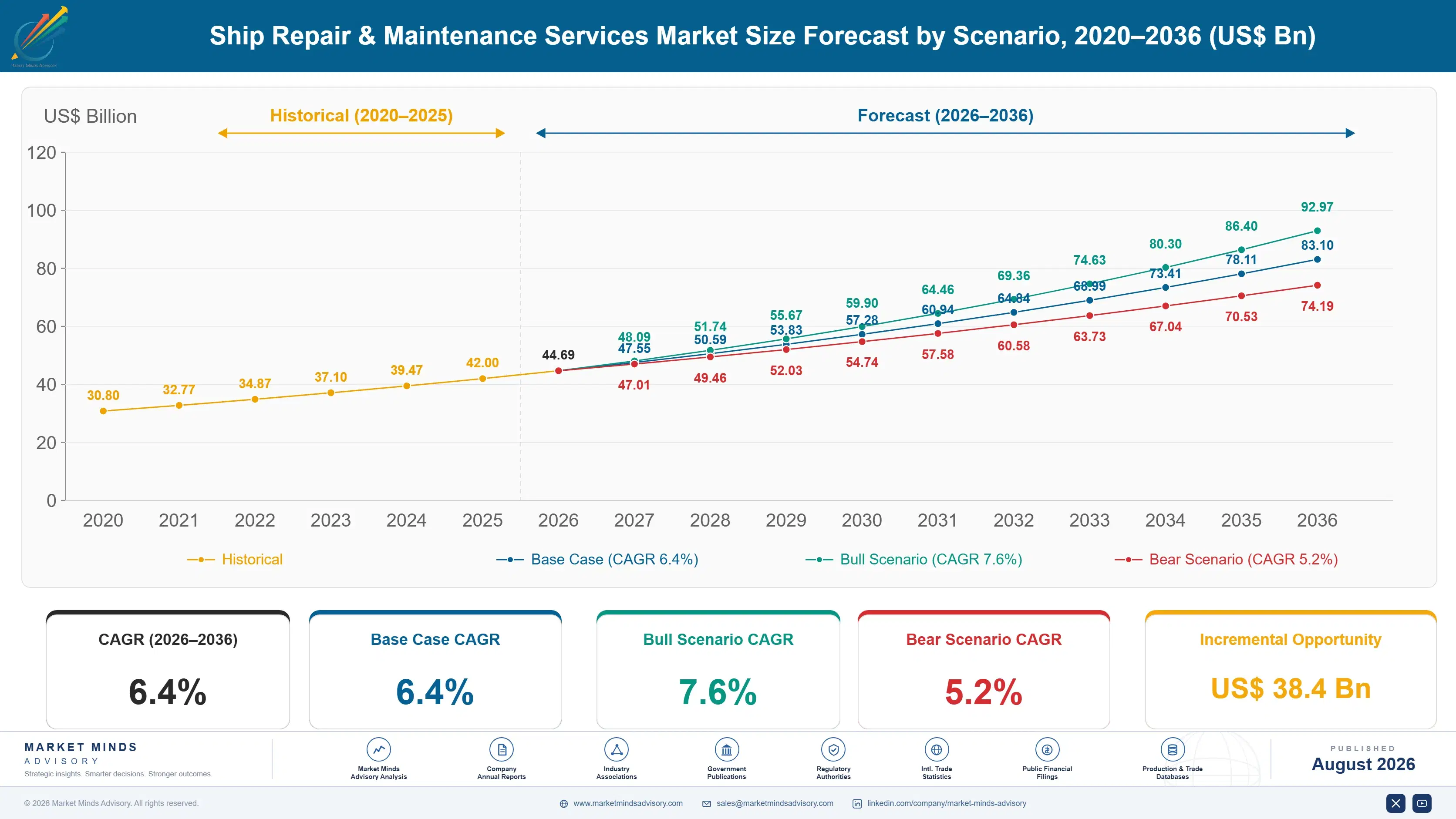
Ship Repair & Maintenance Services Market Forecast Scenarios

ship-repair-maintenance-services-market-size-forecast-scenario-1787325027781
Growth from 2020 to 2025 compounded near 5.3%, and the period split sharply in two. Pandemic disruption delayed scheduled dry-docking across the global fleet as crew changes and port access both became genuinely difficult, pushing a backlog of deferred maintenance into the years that followed. Emissions retrofit demand then accelerated sharply from 2022 onward as International Maritime Organization efficiency rules moved from proposal into binding requirement for the existing fleet.
Three mechanisms carry the base case to 6.4%. First, the deferred maintenance backlog continuing to clear as yards work through vessels that skipped their scheduled dry-docking during the pandemic years. Second, emissions retrofit demand, as carbon intensity rules force owners to install efficiency equipment or accept trading restrictions. Third, fleet ageing generally, since the global merchant fleet's average age keeps climbing and older vessels need more frequent and extensive repair work.
The bull case at 7.6% assumes emissions regulation tightens further and yard capacity expansion lags the resulting retrofit demand considerably. The bear case at 5.2% assumes global trade volumes soften, owners scrap older vessels rather than retrofitting them once charter rates fall, and newly commissioned Middle East and Southeast Asia dock capacity eases the scarcity supporting pricing.

Why A Dry Dock Slot Beats Any Discount Offered Elsewhere

Three forces set demand. Classification survey requirements drive the most predictable volume, since every commercial vessel must dry-dock on a fixed schedule to retain its trading certification regardless of owner preference. Regulatory retrofit drives a second, rapidly growing stream, as emissions rules force equipment installation unrelated to routine wear. Casualty repair drives a third, unpredictable stream yards must accommodate around scheduled workload.
MARKET CONCENTRATIONCR5: 23%Highly fragmented because dry dock capacity is inherently local
SCHEDULED SURVEY INTERVAL30 to 60 monthsTypical interval between mandatory dry-dock class surveys required
DRY DOCK DAY RATEUSD 15,000 to 80,000Typical facility charge per day across vessel size categories
RETROFIT PROJECT DURATION2 to 6 weeksTime a major retrofit adds to a docking
VESSEL OFF-HIRE COSTUSD 10,000 to 40,000 dailyLost revenue for each idle day in dock
GLOBAL FLEET AVERAGE AGEAbout 22 yearsAverage age of vessels across the world merchant shipping fleet
The commercial character is set by physical scarcity rather than by labour or material cost. Only a finite number of dry docks can accommodate a modern large vessel, and building a new one takes years and enormous capital, so capacity cannot respond quickly to a demand surge. That scarcity gives yards holding the largest docks genuine pricing power, particularly when retrofit mandates compress an already tight scheduling window even further.
The decade turns on whether retrofit demand and scheduled maintenance can both fit through the same limited capacity. Every vessel needing emissions equipment installed must complete routine survey work in the same dock visit, extending occupancy and squeezing yard throughput. Yards that manage this scheduling tension well, combining retrofit and survey work efficiently, are capturing share from those still treating retrofit as a bolt-on afterthought.
"Owners think they are buying steel and welding. What they are actually buying is a slot in a facility that took a decade to build and cannot be replicated quickly anywhere else in the world, which is why the yard, not the owner, usually sets the schedule."
Director, Marine Services and Ship Repair Practice · MMA Construction and Indust

Market Trends

Emissions Retrofit Work Is Filling Dock Schedules Years Ahead

International Maritime Organization carbon intensity rules are forcing owners of older vessels to install energy-saving devices, engine power limitation systems, or alternative fuel conversion equipment simply to remain tradeable under the new requirements. That retrofit work must be performed during a dry-docking, and because compliance deadlines apply across the global fleet simultaneously, demand is concentrating into a compressed multi-year window that yard capacity cannot easily expand to match. Owners who delay booking now find their preferred yard already committed years into the future, forcing them toward less convenient facilities or accepting compliance penalties.
Market Impact: Recurs every 30 to 60
Vessel Size Growth Is Outpacing Available Dock Capacity

Container ships and bulk carriers have grown substantially larger over the past two decades to capture shipping economies of scale, and many dry docks built a generation ago simply cannot physically accommodate the largest vessels now sailing major trade routes. That mismatch concentrates the highest-value repair and retrofit work onto a genuinely narrow set of yards holding docks large enough to take these vessels, giving them pricing power that smaller facilities serving mid-size vessels cannot access at all. Yards investing in dock extension are positioning against a demand curve that vessel size trends make essentially permanent.
Market Impact: Fleet age averages 22 years now

Market Opportunities and Growth Drivers

Classification Society Survey Requirements Create Predictable Baseline Demand

Every commercial vessel must undergo periodic dry-docking survey to maintain its classification certificate, without which it cannot legally trade, obtain insurance, or enter most major ports anywhere. That requirement applies on a fixed schedule regardless of an owner's financial position, giving the ship repair industry a demand floor that most other industrial services categories simply do not have. Yards can forecast a meaningful share of future workload years in advance based purely on the existing fleet's survey due dates, supporting capacity planning that reactive-repair businesses cannot achieve with comparable confidence.
Market Impact: Costs over USD 100 million

An Ageing Global Fleet Needs More Frequent And Extensive Repair

The world merchant fleet's average age has climbed steadily as newbuild ordering failed to keep pace with fleet growth during several recent years, and older vessels require more frequent and extensive repair work than newer tonnage built to more current design standards. Steel renewal, machinery overhaul, and system replacement all increase in scope and frequency as a vessel ages beyond roughly fifteen years, extending both the duration and value of each dry-docking visit. Owners of older vessels increasingly face a genuine choice between substantial repair investment and early scrapping. a decision retrofit and repair pricing itself now actively influences directly.
Market Impact: Costs up to USD 40,000 daily

Market Restraints and Challenges

Dry Dock Capacity Cannot Expand Quickly Regardless Of Demand

Building a new large dry dock takes years of construction and hundreds of millions of dollars in capital, and existing docks cannot be meaningfully enlarged without essentially rebuilding them entirely from scratch. The root cause is that a dry dock is fixed marine infrastructure requiring specific coastal geology and dredging conditions that most locations simply cannot offer. The commercial impact is that a demand surge cannot be met by adding capacity on any relevant timeline, so yards ration access through price and scheduling priority instead. Mitigation runs through better scheduling efficiency and selective new capacity investment.
Market Impact: Rules cover 20,000 plus vessels

Off-Hire Cost Pressures Owners To Minimise Time In Dock

A vessel earns nothing in charter revenue while sitting in dry dock, and off-hire cost can reach tens of thousands of dollars daily depending on vessel type and prevailing charter rates. The root cause is that dry-docking is inherently unproductive time from a commercial shipping perspective, unlike most industrial maintenance performed on equipment that continues generating value while serviced. The commercial impact is that owners push hard for compressed schedules, sometimes at the expense of thorough work quality. Mitigation runs through better project planning and faster installation methods. Yards investing in efficient methods capture this business increasingly.
Market Impact: Largest vessels now exceed 400 metr
3 additional market trends, 4 additional growth drivers, and 2 additional restraints and challenges are covered in the full report. Contact sales@marketmindsadvisory.com to access the complete intelligence.

Segment CAGR and Growth Architecture

Segmentation follows service type, a single work logic describing what is actually performed during a vessel's time in dock. Each service carries its own scheduling driver, technical complexity, margin profile, and regulatory linkage, so commercial position tracks the work category rather than the vessel type receiving it, in every case observed. across the whole fleet.
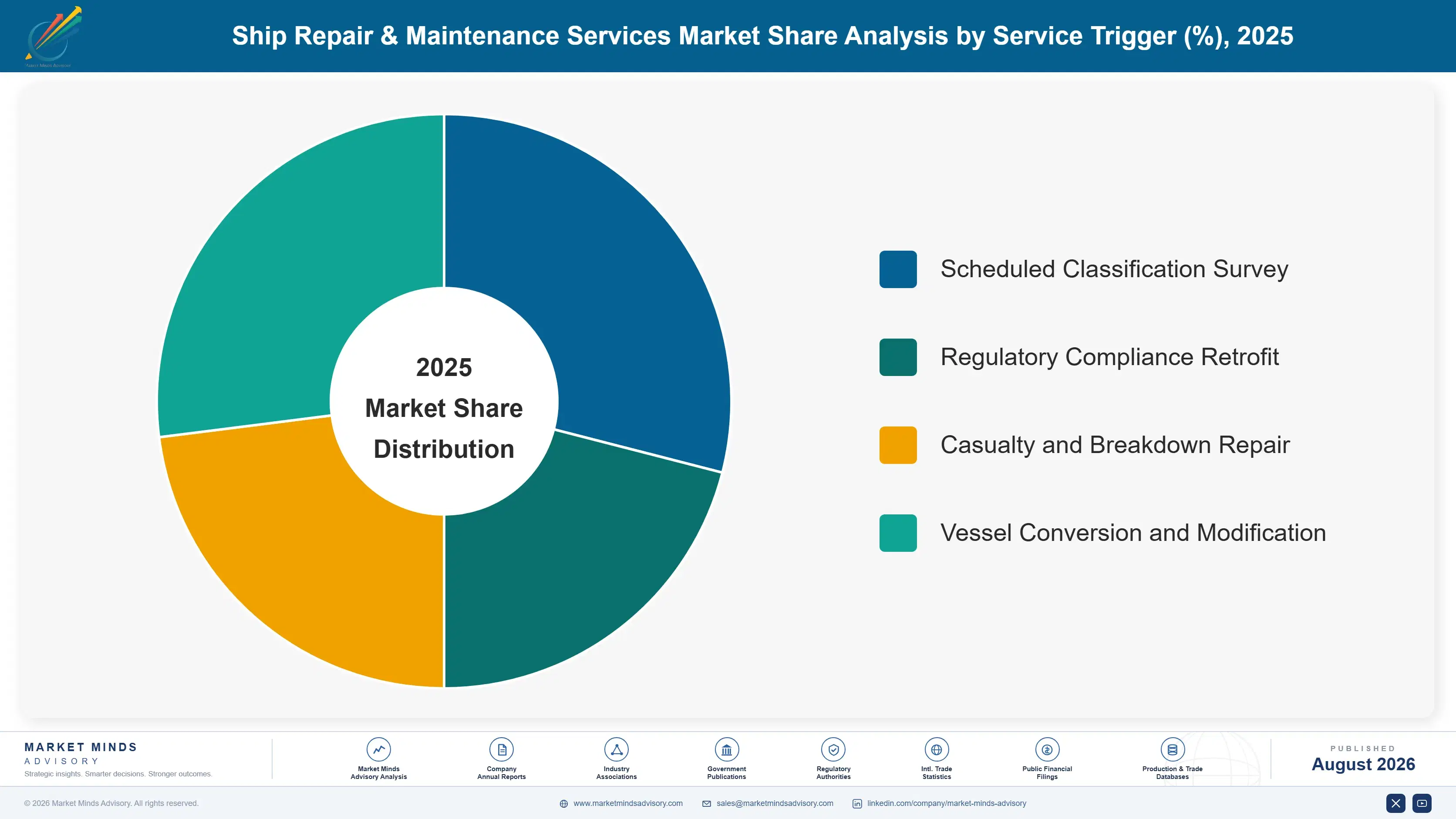
ship-repair-maintenance-services-market-market-share-analysis-1787325028315

Emissions and Environmental Retrofit Services

Emissions and environmental retrofit services grow fastest at 10.8%, about 1.69 times the overall 6.4% rate, covering energy-saving device installation, engine power limitation, exhaust gas scrubbers, ballast water treatment systems, and alternative fuel conversion work required under tightening International Maritime Organization regulation. Growth is driven entirely by compliance deadlines rather than by owner preference, since vessels failing to meet efficiency requirements face genuine trading restrictions that make retrofit essentially mandatory rather than discretionary. Wärtsilä, Alfa Laval, and specialist retrofit engineering firms supply the equipment, while yards perform the installation work during scheduled dock visits. Demand is concentrated into a compressed multi-year compliance window that yard capacity struggles to match. Demand is concentrated into a compressed compliance window.
CAGR 10.8%

Hull Maintenance and Steel Renewal

Hull maintenance and steel renewal grow at 6.9%, covering hull cleaning, coating renewal, and structural steel replacement addressing corrosion and fatigue damage accumulated over years of service in salt water. This work represents the largest single category by volume across nearly every dry-docking, since hull condition directly affects fuel efficiency and structural safety in ways classification societies inspect closely at every scheduled survey. Growth tracks fleet ageing directly, since older vessels require considerably more extensive steel renewal than newer tonnage still within its original design life. Damen Shiprepair, Sembcorp Marine, and numerous regional yards compete on this basis, with coating technology increasingly differentiating premium providers from commodity competitors. Coating technology increasingly separates premium providers from commodity competitors.
CAGR 6.9%
Full segment breakdown across 5 segments available in the complete report.

Regional Architecture and Country Demand Map

Dry dock capacity and shipping lane position rather than vessel ownership set this distribution. East Asia leads on the world's densest concentration of large docks, Middle East and Africa punches well above its band on Gulf transshipment position, and Oman grows fastest on new strategic capacity.

North America

North America holds 20% of value against the 22 to 32% band, at 6.8% growth, reflecting a commercial ship repair base that has shrunk considerably as volume repair work migrated toward lower-cost Asian yards over recent decades. What remains concentrates on naval-adjacent commercial work, Jones Act coastal fleet maintenance protected by cabotage law, and specialised repair that international competition cannot easily reach. Vigor and other regional yards hold positions built on domestic fleet relationships and geographic proximity advantages. Growth reflects fleet ageing and retrofit demand within the protected domestic trading fleet specifically. Canadian capacity is smaller and serves a comparable niche role along its own coastline. Growth reflects fleet ageing and retrofit demand specifically.
Share: 20% | CAGR: 6.8% (2026 to 2036)

Western Europe

Western Europe holds 17% of value against the 18 to 26% band, at the slowest growth of the seven regions at 4.8%, reflecting a similar decades-long migration of volume commercial repair toward Asian yards that left mainly specialised and naval-adjacent work behind. Fincantieri and Damen retain genuine positions built on conversion, offshore support vessel, and complex specialised repair work that requires engineering depth rather than pure cost competitiveness. Dutch and Norwegian yards hold particular strength in offshore and specialised vessel segments specifically. Growth is modest, reflecting a mature and considerably narrower commercial base than the region held several decades earlier. Growth is modest, reflecting a considerably narrower commercial base than decades earlier.
Share: 17% | CAGR: 4.8% (2026 to 2036)
Regional intelligence for 5 additional markets available in the complete report: East Asia, South Asia and Pacific, Latin America, Middle East and Africa, Eastern Europe. Contact sales@marketmindsadvisory.com.
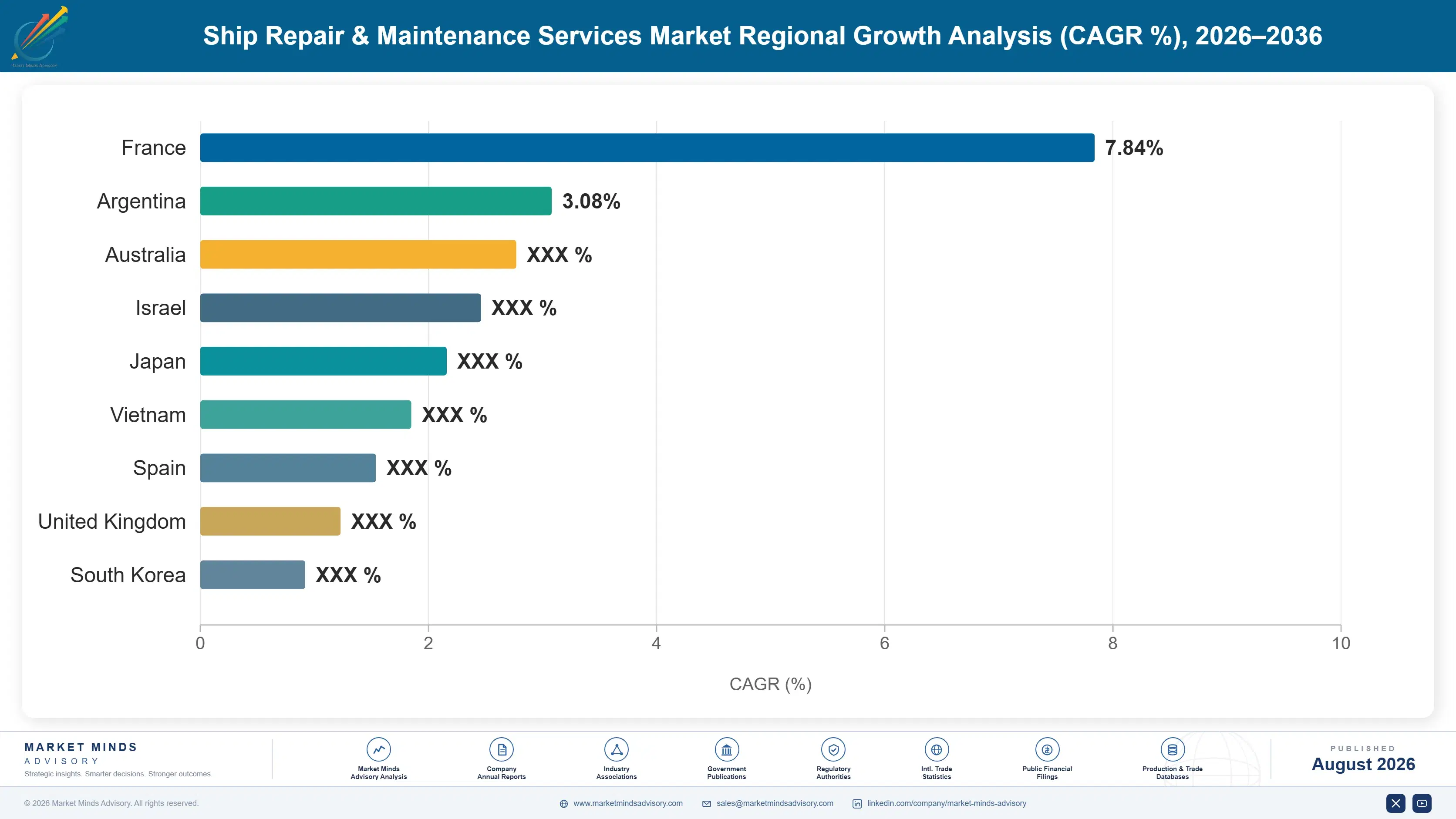
ship-repair-maintenance-services-market-country-cagr-analysis-1787325028827

Where Ship Repair Yards Actually Defend Margin

Competing purely on day rate against every other yard within diversion distance is a race yards with the newest facilities usually win. The four moves below shift earnings toward what scarce capacity and genuine expertise protect: large-vessel dock capability, retrofit-survey scheduling integration, classification relationships, and off-hire cost reduction. That pattern repeats across nearly every project attempted so far.

Invest In Dock Capacity For The Largest Vessel Classes

Container ships and bulk carriers have grown substantially larger over recent decades, and many older docks simply cannot physically accommodate the largest vessels now sailing major trade routes at all. Yards that invest in dock extension or new large-vessel capacity capture the highest-value repair and retrofit work from a customer base with genuinely few alternative facilities to choose between. That scarcity commands day rates 30% to 60% above standard mid-size dock pricing. Mid-size dock operators, competing for a much larger pool of smaller vessels, simply cannot access that same pricing regardless of their reputation or service quality.
Market Impact: Vessels now exceed 400 metres in ov

Integrate Retrofit Installation Into Scheduled Survey Visits

Every vessel needing emissions equipment installed must still complete its routine survey during the same dock visit, and yards planning both workstreams together capture meaningfully more revenue per dock day without extending total vessel downtime unreasonably. That integration reduces total off-hire duration by roughly 15% to 25%, which becomes a genuine competitive advantage against yards still scheduling retrofit and survey as separate visits. Yards achieving this are winning repeat bookings from owners managing large multi-vessel fleets. That reduction in total downtime matters considerably to owners weighing which yard to book against a compliance deadline.
Market Impact: Cuts total dock time by 15 to 25%

Build Direct Classification Society Relationships Now

Classification societies approve survey work and effectively gatekeep a vessel's ability to keep trading, and yards with strong direct relationships and faster approval processes reduce the administrative delay that otherwise extends dock time and drives owner cost up considerably. That relationship depth, built over years of consistent quality and documentation practice, is difficult for a new entrant yard to replicate quickly. Approval delays alone can add 3 to 5 extra days to a single dock visit. Owners increasingly factor that approval speed directly into yard selection alongside day rate and dock availability itself.
Market Impact: Delays can add 3 to 5 extra days

Sell Compressed Schedules As A Priced Service Offering

Off-hire cost can reach tens of thousands of dollars daily in lost charter revenue, which means an owner will pay a meaningful premium for a yard that genuinely compresses total dock time without compromising work quality or safety standards. Yards investing in parallel work streams and pre-fabricated retrofit packages can price that compression directly, often charging 10% to 20% above standard rates for guaranteed schedule commitments. This positions yards competing on speed clearly apart from those competing purely on price. Owners increasingly view guaranteed schedule commitments as worth paying for outright rather than hoping for the best.
Market Impact: Off-hire cost runs up to USD 40,000

Who Controls the Margin Pool

Fragmentation is high at roughly 23% for the top five, because dry dock capacity is inherently local and no yard can serve a customer beyond reasonable diversion distance. The gap between leaders and challengers is dock size and scheduling sophistication rather than labour cost, which varies less across yards. All participants are assessed on one basis, revenue from ship repair, maintenance, and retrofit services, excluding construction and naval-only facilities.
Competition runs along three lines. First, dock size relative to the largest vessels calling at a given trade route, since undersized facilities simply cannot bid on the highest-value work available. Second, retrofit and survey scheduling integration, which determines total dock time and therefore owner cost directly. Third, classification society relationship depth, since approval delays extend expensive dock occupancy regardless of the underlying repair work quality.

Pressure is building from two directions. Gulf and Southeast Asian yards are expanding capacity positioned to intercept traffic previously continuing toward established East Asian facilities further along typical routes. Meanwhile retrofit equipment manufacturers are moving into installation services directly, competing against traditional yards for the fastest-growing demand segment. Rankings should favour yards combining large-vessel capability with genuine retrofit integration over those competing on day rate alone.
ship-repair-maintenance-services-market-company-positioning-matrix-1787325029344

Competitive Moat and Risk Dimensions

SEMBCORP MARINE

Moat: Large-vessel dock scale and location

Sembcorp Marine operates some of the largest dry docks in Southeast Asia, positioned directly on major shipping lanes that give it a natural customer base regardless of vessel ownership or origin. Its scale supports investment in retrofit engineering capability that smaller regional yards cannot match. Deep relationships with major classification societies speed up approval processes that competitors often struggle with.
SEMBCORP MARINE

Risk: Capital intensity and cyclical exposure

Enormous dock infrastructure carries substantial fixed cost that pressures margin when shipping cycles soften and vessel owners defer discretionary maintenance work. Competition from newly expanded Gulf capacity threatens traffic that previously had few alternatives beyond established Southeast Asian facilities. Retrofit equipment manufacturers entering installation services directly threaten a growing share of its highest-margin work.
DAMEN SHIPREPAIR AND CONVERSION

Moat: European engineering and conversion depth

Damen holds genuine engineering depth in complex conversion and specialised repair work that pure cost competition cannot easily replicate, built through decades of technically demanding projects across Europe. Its network spans multiple facilities, providing flexibility that single-location competitors lack when scheduling around customer needs. Strong offshore and specialised vessel relationships provide differentiated demand beyond routine commercial repair.
DAMEN SHIPREPAIR AND CONVERSION

Risk: Cost Base Pressure

A European cost base competes poorly against Asian yards on routine commercial repair work where price rather than engineering complexity decides the contract outcome. Volume commercial vessel owners increasingly route standard maintenance toward lower-cost facilities, leaving Damen dependent on specialised work that carries its own demand volatility. Gulf capacity expansion threatens even some specialised conversion business over time.

Players Tracked

Prominent Players

Damen Shiprepair and Conversion
Sembcorp Marine
Keppel Offshore and Marine
China Merchants Industry
Fincantieri

Other Key Players

China Shipbuilding Industry Corporation
Hyundai Mipo Dockyard
Cochin Shipyard
Drydocks World
Oman Drydock Company
Sohar Shipyard
Vigor
Detyens Shipyards
Colonna's Shipyard
Smit Lamnalco
Wärtsilä Services
Alfa Laval Marine
GAC Marine
ASRY Bahrain
Cammell Laird

Recent Developments

MARCH 2023

IMO carbon intensity indicator rating scheme enters force

The International Maritime Organization's carbon intensity indicator rating scheme entered into force, requiring vessels to achieve minimum efficiency ratings or face potential trading and financing restrictions. This was regulatory implementation rather than any corporate transaction, and it converted emissions retrofit from a voluntary upgrade into an effective compliance requirement.
Signal: Regulatory compliance deadlines are now th
NOVEMBER 2023

Oman Drydock Company announces major capacity expansion

Oman Drydock Company announced expanded dry dock capacity specifically positioned to capture vessels transiting the Strait of Hormuz and wider Gulf shipping lanes. This was organic capacity investment rather than an acquisition, and it intensified competition for traffic previously routed toward more distant Asian facilities.
Signal: Strategic dock location investment can red
JUNE 2025

Major classification society speeds up retrofit approval process

A major classification society introduced a faster approval process specifically for common emissions retrofit installations, reducing documentation delay that had been extending dock occupancy time. This was a process change rather than a transaction, addressing a bottleneck yards had raised. Owners had raised this bottleneck through industry forums.
Signal: Reducing regulatory approval friction now

Steel, Coatings, Retrofit Equipment, Skilled Labour

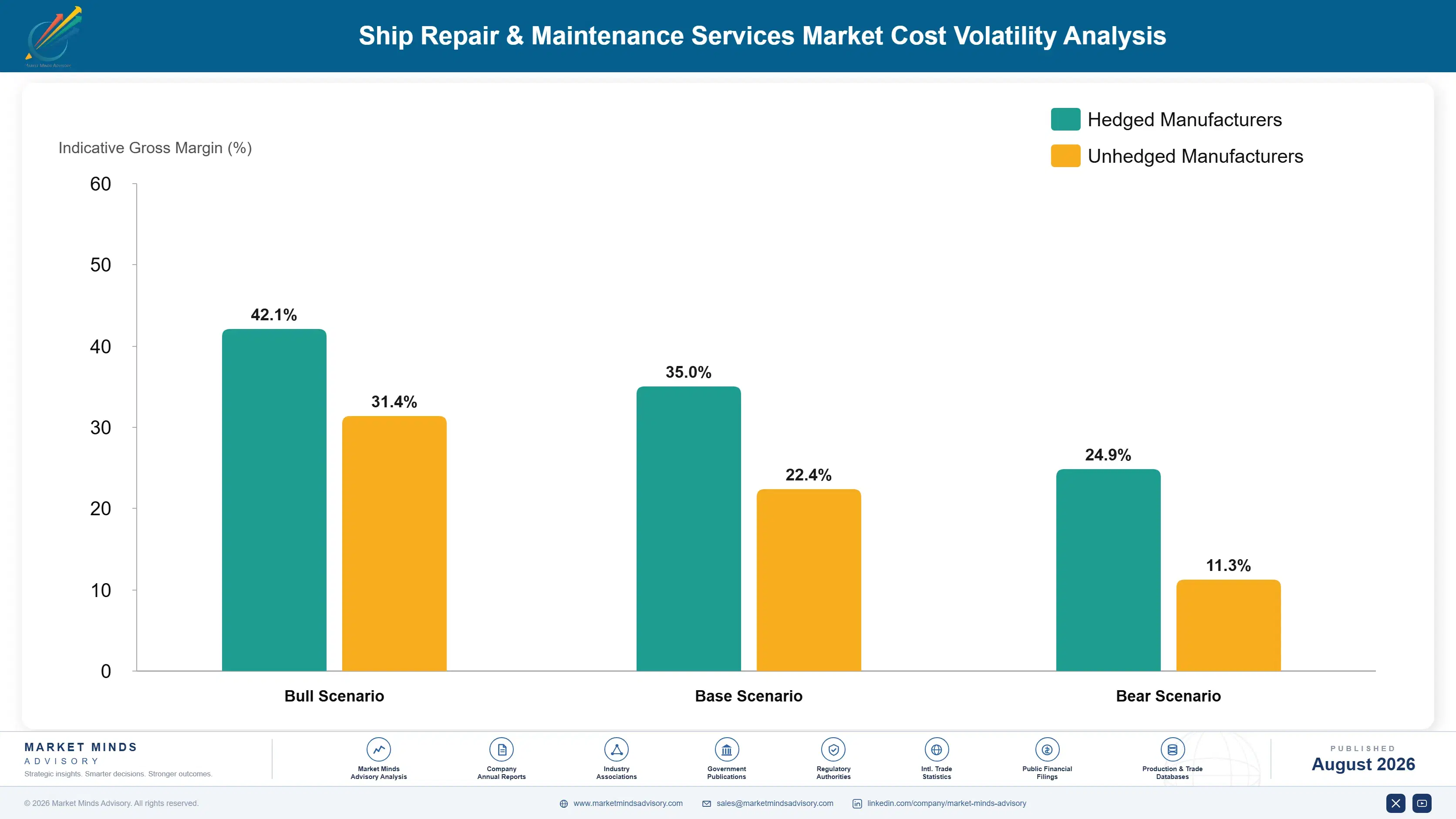
Cost structure varies by service type. Steel plate for hull renewal accounts for a substantial share of major repair project cost, priced against global steel markets that move independently of shipping demand. Coatings and surface preparation materials add a further meaningful share on major dry-dockings. Skilled welding and marine engineering labour represents the largest cost category across most routine repair work.
Steel prices rose sharply through 2021 and 2022 as global demand tightened across industries, lifting major structural repair costs considerably faster than routine maintenance moved. Several yards disclosed the resulting margin pressure across their annual reporting through that window, and EIA data recorded the parallel energy cost movement that raised both steel production and yard operating costs, including the substantial power consumption dry docks and workshops require continuously.

Exposure divides sharply by contract structure rather than by geography specifically. Yards on fixed-price long-term maintenance agreements absorbed steel and labour cost increases directly, while those pricing projects individually as they arose could reprice against current market conditions considerably more readily. The disadvantage compounds, because a yard that cannot deliver on a fixed-price commitment damages the classification society and owner relationships that took years to build in the first place.
ship-repair-maintenance-services-market-cost-volatility-analysis-1787325029540

Index long-term maintenance contracts to steel benchmarks

Multi-year fixed-price maintenance agreements made sense when steel moved slowly and became a genuine liability when prices rose sharply within a single contract year. Indexing pricing to published steel benchmarks shares that volatility with the vessel owner rather than concentrating it entirely on the yard. Owners accept this once shown the alternative is yards eventually declining to renew agreements.

Build skilled welding and engineering capacity ahead of demand

Retrofit and repair demand is rising faster than the skilled marine trades workforce in most established repair hubs, and yards without adequate staffing lose bids regardless of dock availability or pricing. Investing in apprenticeship and training programmes ahead of demand secures capacity that competitors scrambling to hire during a labour shortage cannot easily access.

Secure steel supply through regional mill relationships

Buying steel plate on spot markets exposes yards to price spikes precisely when major repair demand is also rising across the industry simultaneously. Regional mill supply agreements, even at modest committed volume, provide pricing stability and delivery priority that spot buyers competing during a tight market cannot access as readily. Spot buyers competing during tight markets rarely access comparable terms.

Portfolio Architecture for Margin Defence

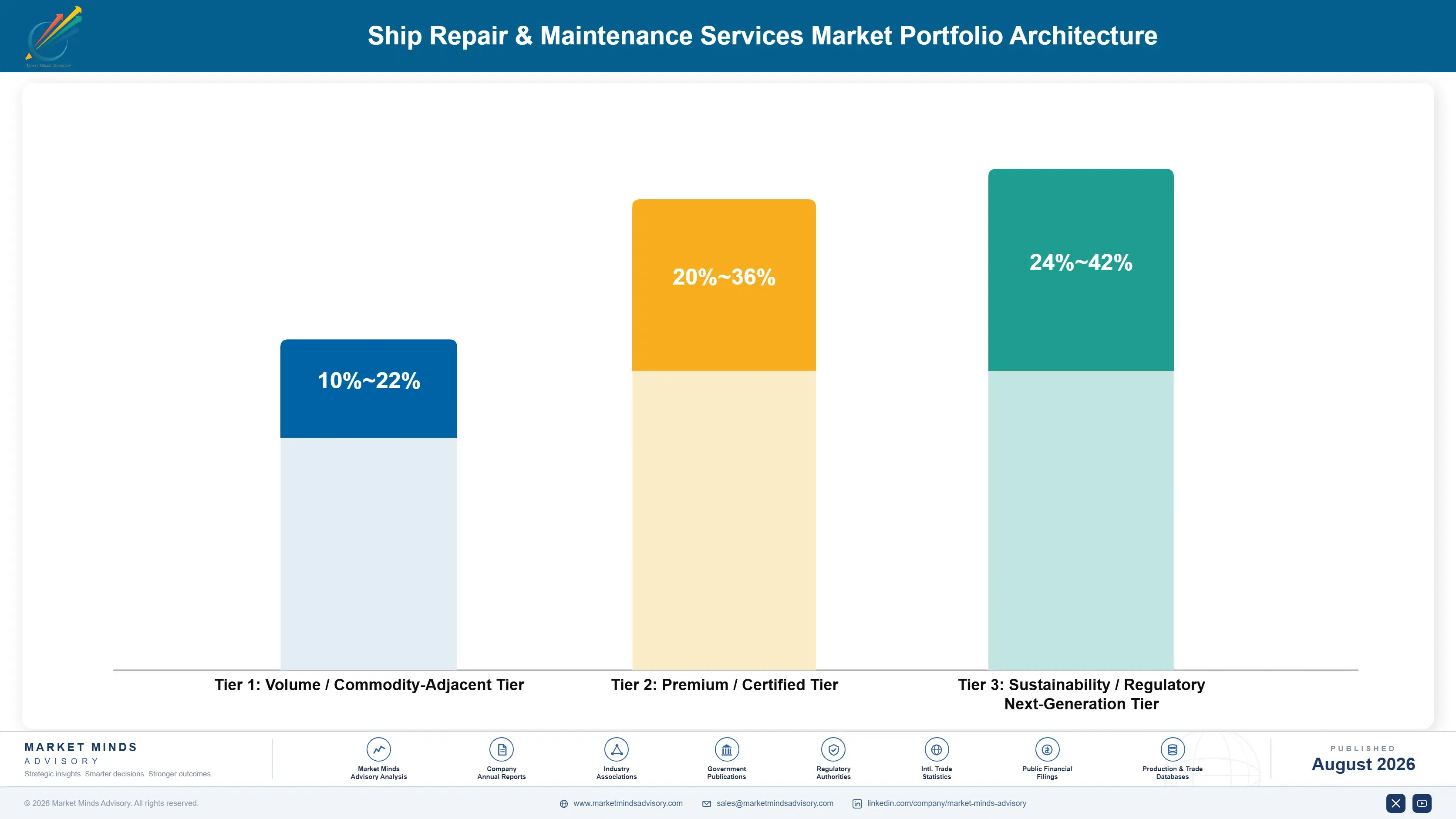
The portfolio splits into three tiers with genuinely different economics. Routine hull maintenance and standard survey work are the volume tier, where competition within diversion distance is direct and day rate dominates. Large-vessel and specialised repair earn considerably more, because dock size and technical complexity narrow the qualified field substantially. Emissions retrofit and compliance-driven work sits differently again, priced against regulatory urgency rather than routine maintena
The tension runs between routine volume that keeps docks utilised and specialised work that earns the return. Standard survey and maintenance work fills dock capacity between higher-value projects and maintains relationships through which larger work eventually arrives. Yet it competes directly on day rate against every yard within diversion range. Yards managing this well treat routine work as capacity utilisation and direct investment toward large-vessel and retrofit capability specifically.

High-value pools concentrate where physical scarcity or regulatory urgency limits competition genuinely: large-vessel docks serving ships smaller facilities cannot accommodate, compliance-driven retrofit work owners cannot indefinitely defer, and specialised conversion projects demanding engineering depth commodity yards lack. All three resist the day-rate competition defining routine maintenance, because the customer is purchasing scarce capability rather than comparing interchangeable dock availability across the market.

Volume / Commodity-Adjacent Tier

Routine hull maintenance, coating renewal, and standard classification survey work sold into competitive bids within a vessel's diversion range. The range is wide because yard efficiency and labour cost vary considerably between competing regional facilities.
Gross Margin: 10-22%

Premium / Certified Tier

Large-vessel repair requiring specialised dock capacity, and complex conversion work demanding genuine engineering depth beyond routine maintenance. The range is wide because conversion project complexity varies enormously between individual contracts.
Gross Margin: 20-36%

Sustainability / Regulatory / Next-Generation Tier

Emissions retrofit installation, alternative fuel conversion, and integrated retrofit-survey scheduling packages addressing tightening decarbonisation regulation. The range is wide because retrofit complexity and urgency both vary considerably by vessel type.
Gross Margin: 24-42%
ship-repair-maintenance-services-market-portfolio-architecture-1787325030044

High-value Sub-segments and Strategic Watch-out

Emissions and Environmental Retrofit Services

High value and the fastest growth at 10.8%, driven entirely by compliance deadlines rather than owner preference. Demand concentrates into a compressed multi-year window that yard capacity struggles to match, giving early-positioned yards genuine pricing power. Demand concentrates into a compressed compliance window yard capacity struggles to match.
Gross Margin: 26-42%

Large-Vessel Dock Capacity

High value with strong growth, protected by physical scarcity that no amount of competitive pressure can quickly resolve. Vessel size growth outpaces dock construction consistently, sustaining premium pricing for yards holding genuinely adequate capacity. Vessel size growth outpaces dock construction consistently, sustaining premium pricing for adequately equipped yards.
Gross Margin: 22-38%

Hull Maintenance and Steel Renewal

The volume core across nearly every dry-docking worldwide, and the work that keeps yards utilised between larger projects. Growth is steady at 6.2% but competition within diversion range is direct, holding margin below the specialised tiers above it. Competition within diversion range stays direct across nearly every routine bid available.
Gross Margin: 10-22%

Electrical and Navigation Systems

The strategic watch-out, growing slowest at 5.6% as digitalisation upgrades compete against more urgent hull and emissions priorities for the same limited dock time available on any given visit. Digitalisation upgrades compete against more urgent hull and emissions priorities for the same limited dock time on any visit.
Gross Margin: 14-28%

How Ship Repair Bookings Actually Commit

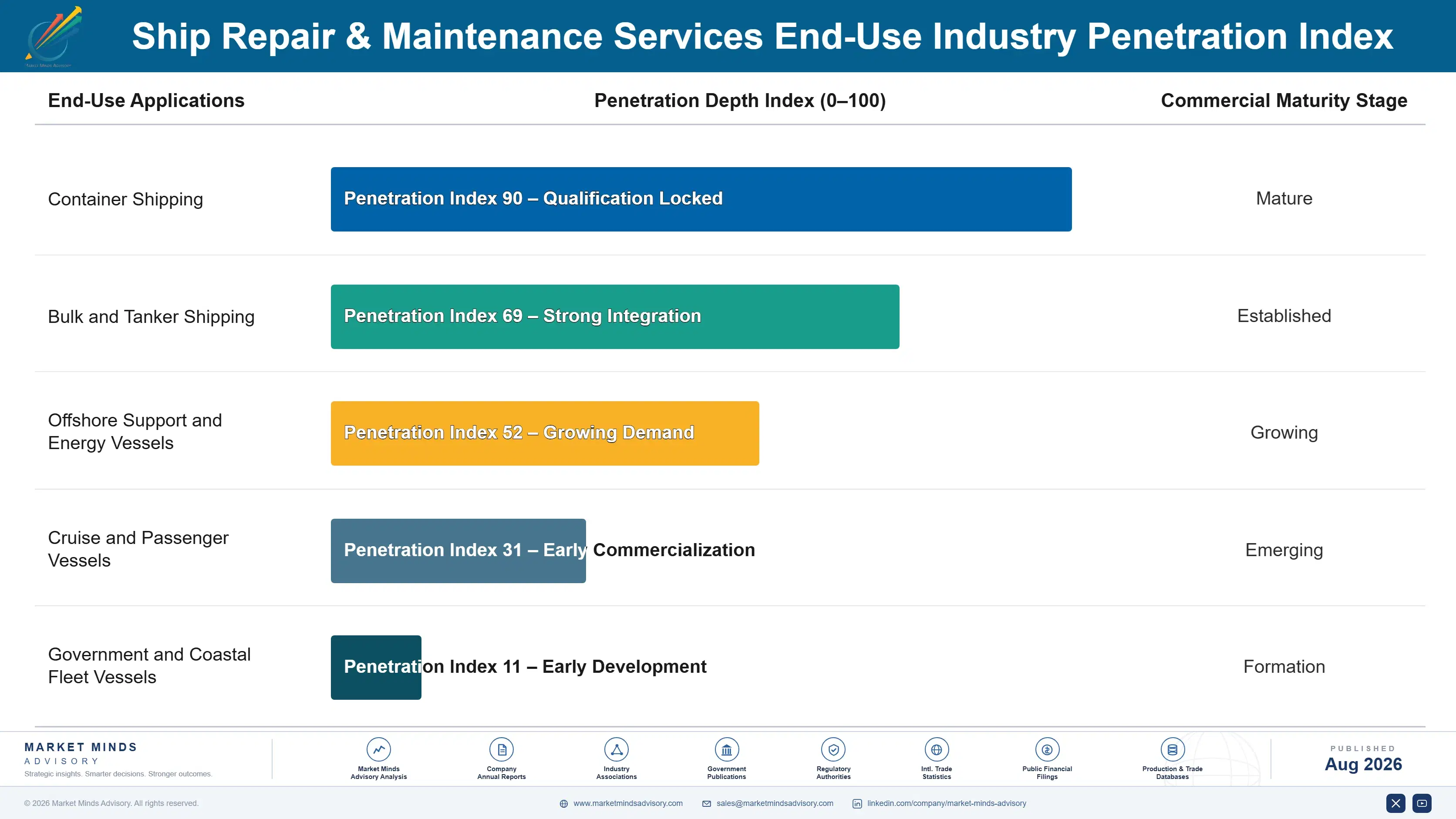
Revenue commits well in advance for scheduled work and arrives unpredictably for casualty repair, creating two quite different commercial rhythms within the same business. A vessel's classification survey due date is known years ahead, giving yards forecasting visibility most industrial services categories lack. Casualty repair arrives with essentially no notice, commanding premium pricing because the yard must disrupt its planned schedule to accommodate an owner with no alternative.
Adoption depth varies sharply by owner type. Large fleet operators go deepest, negotiating framework agreements across vessels and building long-term yard relationships smaller owners cannot replicate. Single-vessel owners book more opportunistically, driven by whichever yard has near-term availability matching their survey deadline. Charterers occasionally influence yard selection directly on vessels they control operationally, adding a further layer to the decision beyond the vessel owner alone.

Buyer profiles have shifted from technical superintendents toward fleet operations and compliance functions with quite different priorities entirely. A superintendent once compared yard technical capability directly; an operations function now models off-hire cost against dock availability, and a compliance function drives retrofit timing against deadlines a technical evaluation never prioritised. Yards selling purely on technical reputation find bookings made by people focused on schedule risk.
ship-repair-maintenance-services-market-end-use-penetration-index-1787325030540

Our Call On Ship Repair Services

These are among the four positions where our research anticipates prominent divergence between winners and laggards over the coming forecast period. Each is grounded in the demand model, the regulatory perimeter, and the announced capacity pipeline.
01 / LARGE VESSEL CAPACITY

Dock size sets an absolute ceiling on addressable demand

Container ships and bulk carriers have grown substantially larger over recent decades, and many older docks simply cannot physically accommodate the largest vessels now sailing major trade routes at all. Yards that invest in dock extension or new large-vessel capacity capture the highest-value repair work from a customer base with genuinely few alternative facilities available to choose between at all. That scarcity commands premium pricing that mid-size dock operators, competing for a far larger pool of smaller vessels, simply cannot access regardless of service quality.
02 / RETROFIT SURVEY INTEGRATION

Combining compliance work with routine survey wins repeat bookings

Every vessel needing emissions equipment installed must still complete its routine classification survey during the same dock visit, and yards planning both workstreams together capture meaningfully more revenue per dock day without extending total vessel downtime unreasonably. That integration also reduces the off-hire cost owners bear directly, becoming a genuine competitive advantage against yards still scheduling retrofit and survey as separate, sequential visits entirely. Yards achieving this integration are winning repeat bookings from owners managing large multi-vessel fleets, an advantage compounding across every subsequent booking cycle.
03 / CLASSIFICATION RELATIONSHIP DEPTH

Approval speed now decides yard selection alongside price

Classification societies approve survey work and effectively gatekeep a vessel's ability to keep trading, and yards with strong direct relationships and faster approval processes reduce the administrative delay that otherwise extends dock time and drives owner cost up considerably. That relationship depth, built over years of consistent quality and documentation practice, is genuinely difficult for a new entrant yard to replicate quickly regardless of its physical facility quality. Owners increasingly factor classification approval speed into yard selection decisions alongside day rate and dock availability.
04 / SCHEDULE COMPRESSION PRICING

Speed is a service owners will pay a real premium for

Off-hire cost can reach tens of thousands of dollars daily in lost charter revenue, which means an owner will pay a meaningful premium for a yard that genuinely compresses total dock time without compromising work quality or safety standards at all. Yards investing in parallel work streams and pre-fabricated retrofit packages can price that compression directly as a premium service rather than absorbing the efficiency gain invisibly into a standard day rate quotation offered to every customer. This positions capability-driven yards apart from those competing on price.

Engagement Snapshot From the Field

A live engagement with an industry participant carrying material or product regulatory and market exposure ahead of a defining policy shift, showing how our research translates into a defensible multi-year portfolio strategy.
MARKET MINDS ADVISORY · CLIENT ENGAGEMENT SUMMARY
Ship Repair & Maintenance Services Producer Strategic Portfolio Review and Transition Roadmap 2026·Investment Scenario on Ship Repair & Maintenance Services Exposure Evaluation 2025-26
CLIENT PROFILE
A global bulk carrier fleet operator managing 38 vessels engaged MMA while planning emissions retrofit across its fleet ahead of tightening compliance deadlines. The client reported annual dry-docking spend near USD 62 million and faced retrofit deadlines on 22 vessels within a three-year compliance window, with no coordinated scheduling strategy in place (client-reported, unverified by MMA).
STRATEGIC CHALLENGE
Booking 22 vessels for retrofit and survey work within a compressed window meant competing against the rest of the global fleet facing identical deadlines, and preferred yards were already showing limited near-term availability. The board wanted cost certainty, but retrofit equipment and yard pricing both varied considerably between facilities, and nobody had modelled the true off-hire cost of different scheduling scenarios.
MMA APPROACH
MMA mapped the client's fleet against global dock capacity and compliance deadlines to identify where genuine scheduling conflicts would arise across the sector. We modelled off-hire cost against yard day rate for several scheduling scenarios rather than optimising for day rate alone. We also assessed which yards offered genuine retrofit-survey integration capable of compressing total dock time meaningfully.
KEY FINDINGS
  1. Booking vessels at yards offering integrated retrofit-survey scheduling reduced total off-hire time by roughly 20% compared with sequential visits at separate facilities entirely.
  2. Five of the client's preferred yards were already fully booked within the compliance window, requiring immediate action to secure capacity elsewhere before slots disappeared entirely (client-reported, unverified by MMA).
  3. Gulf capacity expansion offered meaningfully earlier availability than established Asian yards for vessels transiting relevant shipping lanes on their normal routes. on relevant routes.
  4. Staggering the fleet across four yards rather than concentrating bookings reduced total off-hire cost despite marginally higher day rates at some facilities selected.
CLIENT PROFILE
A global bulk carrier fleet operator managing 38 vessels engaged MMA while planning emissions retrofit across its fleet ahead of tightening compliance deadlines. The client reported annual dry-docking spend near USD 62 million and faced retrofit deadlines on 22 vessels within a three-year compliance window, with no coordinated scheduling strategy in place (client-reported, unverified by MMA).
STRATEGIC CHALLENGE
Booking 22 vessels for retrofit and survey work within a compressed window meant competing against the rest of the global fleet facing identical deadlines, and preferred yards were already showing limited near-term availability. The board wanted cost certainty, but retrofit equipment and yard pricing both varied considerably between facilities, and nobody had modelled the true off-hire cost of different scheduling scenarios.
MMA APPROACH
MMA mapped the client's fleet against global dock capacity and compliance deadlines to identify where genuine scheduling conflicts would arise across the sector. We modelled off-hire cost against yard day rate for several scheduling scenarios rather than optimising for day rate alone. We also assessed which yards offered genuine retrofit-survey integration capable of compressing total dock time meaningfully.
KEY FINDINGS
  1. Booking vessels at yards offering integrated retrofit-survey scheduling reduced total off-hire time by roughly 20% compared with sequential visits at separate facilities entirely.
  2. Five of the client's preferred yards were already fully booked within the compliance window, requiring immediate action to secure capacity elsewhere before slots disappeared entirely (client-reported, unverified by MMA).
  3. Gulf capacity expansion offered meaningfully earlier availability than established Asian yards for vessels transiting relevant shipping lanes on their normal routes. on relevant routes.
  4. Staggering the fleet across four yards rather than concentrating bookings reduced total off-hire cost despite marginally higher day rates at some facilities selected.
RECOMMENDED STRATEGY
Phase 1: Phase 1 (0 to 6 months): Secure booking commitments across four yards immediately, prioritising integrated retrofit-survey capability over lowest quoted day rate. Phase 2: Phase 2 (6 to 24 months): Sequence vessel scheduling to balance yard capacity constraints against each vessel's specific compliance deadline urgency. Phase 3: Phase 3 (24 to 36 months): Complete retrofit across the full 22-vessel cohort, capturing lessons for the remaining fleet's future scheduled dockings.
OUTCOME
The client secured booking commitments across four yards ahead of the capacity crunch that subsequently affected competitors still finalising their own scheduling decisions. Off-hire cost came in below the original budget through integrated scheduling, and the approach is now the client's standard practice for future fleet-wide compliance programmes (client-reported, unverified by MMA).

Frequently Asked Questions

Foundational context covering the market sizes, CAGR, scope, country, region and competition that inform every finding below. This section is provided to cover basics and most often pre-purchase conversations, answered from the MMA Primary Research Dataset.

What is the current size of the Ship Repair & Maintenance Services Market?

The global ship repair and maintenance services market is valued at USD 42.0 billion in 2025, covering dry-docking, hull maintenance, machinery overhaul, emissions retrofit, and navigation system services. New vessel construction and naval-only facilities are excluded.

How large will the Ship Repair & Maintenance Services Market be by 2036?

The market is forecast to reach USD 83.1 billion by 2036 in the base case, about 1.86 times the 2026 level. That represents incremental value of roughly USD 38.41 billion across the forecast decade.

What is the CAGR for the Ship Repair & Maintenance Services Market 2026 to 2036?

The market grows at a 6.4% CAGR in the base case, with bull and bear scenarios at 7.6% and 5.2%. The spread turns mainly on emissions regulation tightening and whether new dock capacity eases current scarcity.

Which segment is growing fastest?

Emissions and environmental retrofit services grow fastest at 10.8%, about 1.69 times the overall rate, driven by International Maritime Organization compliance deadlines. Hull maintenance and steel renewal follow at 6.9% on fleet ageing.

Who are the major companies in the Ship Repair & Maintenance Services Market?

Leading providers include Damen Shiprepair and Conversion, Sembcorp Marine, Keppel Offshore and Marine, China Merchants Industry, and Fincantieri. Fragmentation is high because dry dock capacity is inherently tied to location.

Which country is growing fastest?

Oman grows fastest at a 9.4% CAGR, having invested heavily in new dry dock capacity positioned to serve vessels transiting Gulf shipping lanes. The United Arab Emirates and India follow on comparable capacity investment.

Report Segmentation Architecture

The full report scope spans multiple orthogonal segmentation dimensions, with cross-tabulated demand data provided for each dimension pair. Coverage extends further to regional breakdowns, trend trajectories, and the competitive detail needed to support segment-level decision-making.

By Service Type

  • Dry-Docking and Hull Maintenance
  • Engine and Machinery Overhaul
  • Emissions and Environmental Retrofit Services
  • Electrical and Navigation Systems
  • Offshore and Specialised Vessel Repair

By End-Use Industry

  • Container Shipping
  • Bulk and Tanker Shipping
  • Offshore Support and Energy Vessels
  • Cruise and Passenger Vessels
  • Government and Coastal Fleet Vessels

By Service Trigger

  • Scheduled Classification Survey
  • Regulatory Compliance Retrofit
  • Casualty and Breakdown Repair
  • Vessel Conversion and Modification

By Region

  • North America
  • Western Europe
  • East Asia
  • South Asia and Pacific
  • Latin America
  • Middle East and Africa
  • Eastern Europe

Scope, Methodology, and Coverage

Every figure in this report is reproducible from documented input assumptions. The scope below maps the historical period, the forecast horizon, the segmentation dimensions, and the countries covered, alongside the underlying primary and qualitative methodology.
Historical Period
2020 to 2025
Forecast Period
2026 to 2036
Base Year
2025 (USD billions; MMA Primary Research Dataset, August 2026)
Market Definition
The ship repair and maintenance services market comprises dry-docking, hull maintenance, engine and machinery overhaul, emissions and environmental retrofit, and electrical and navigation system services performed on commercial vessels, valued at yard and service provider revenue for both labour and installed materials. It spans scheduled classification society survey work required to maintain a vessel's trading certification, regulatory-driven retrofit installation including emissions control and alternative fuel conversion equipment, unscheduled casualty and breakdown repair, and vessel conversion and modification projects. New vessel construction, naval shipbuilding and repair performed in dedicated military facilities, offshore platform construction and installation, and marine insurance, classification society survey fees, and port and towage services are excluded.
Quantitative Units
USD billions (current prices); dry-docking events and dock-day volume by vessel category where applicable
Segmentation Dimensions
By Service Type; By End-Use Industry; By Service Trigger; By Region
Regions Covered
North America, Western Europe, East Asia, South Asia and Pacific, Latin America, Middle East and Africa, Eastern Europe
Countries Covered
China, South Korea, Singapore, Japan, USA, Canada, Germany, Netherlands, Norway, Italy, Poland, Romania, India, Australia, Vietnam, Indonesia, Brazil, Mexico, Panama, UAE, Oman, Saudi Arabia, Bahrain, Qatar, Egypt, South Africa, Nigeria, Turkey, and additional markets relevant to this sector
Key Companies Profiled
Damen Shiprepair and Conversion, Sembcorp Marine, Keppel Offshore and Marine, China Merchants Industry, Fincantieri, China Shipbuilding Industry Corporation, Hyundai Mipo Dockyard, Cochin Shipyard, Drydocks World, Oman Drydock Company, Sohar Shipyard, Vigor, Detyens Shipyards, Colonna's Shipyard, Smit Lamnalco, Wärtsilä Services, Alfa Laval Marine, GAC Marine, ASRY Bahrain, Cammell Laird
Quantitative Methodology
Primary survey, n=3,800 respondents, Q4 2025, six countries; demand-side model with trade association cross-validation
Qualitative Methodology
47 expert interviews, Q4 2025; applied to validate demand model assumptions, identify emerging dynamics, and assess competitive positioning
Report Format
PDF and XLSX data workbook (Word format preview document)
Publisher
Market Minds Advisory
Report Code
MMA-2026-CON-152
Published
August 2026
Contact
sales@marketmindsadvisory.com | www.marketmindsadvisory.com

Purchase the full Ship Repair & Maintenance Services Market Report (2026 to 2036).

The full MMA Ship Repair and Maintenance Services report sizes the market across five service types, five end-use industries, four service triggers, and seven regions through 2036. It profiles 20 providers on a consistent basis of ship repair and retrofit revenue, scoring each on dock size relative to fleet trends, retrofit-survey scheduling integration, classification society relationship depth, and strategic location advantage. Scenario models quantify how emissions regulation, fleet ageing, and dock capacity investment move both service volume and achievable margin by category. The report also includes global dry dock capacity mapping against vessel size trends, emissions retrofit compliance deadline tracking, and off-hire cost benchmarking across scheduling scenarios.
Five-type and four-trigger market sizing through 2036
Twenty-provider benchmark on ship repair and retrofit revenue
Global dry dock capacity mapping against vessel size trends
Emissions retrofit compliance deadline tracking by regulation
Off-hire cost benchmarking across scheduling scenarios
Classification society relationship and approval speed assessment

Built For The People Who Decide

From boardroom strategy to bench-side execution, this report is read cover-to-cover by leaders shaping the next decade of their industry, turning demand scenarios, market dynamics and valuation benchmarks into decisions.
CXOs/ Presidents/ VPs/ Managers
M&A and Corporate Development
Strategy Teams and R&D Heads
Procurement and Product Directors
Regulatory and Compliance Leaders
Investor Relations and Equity Analysts