Market Minds Advisory
Shelf-Stable Soup Market

Shelf-Stable Soup Market: Everything Good About It Comes From the Process That Ruins It

Commercial sterility requires holding food at 121 degrees, which is exactly what gives the category two years of shelf life and the cooked flavour consumers have spent decades complaining about.

Lead Analyst

Lisa Gevelber

Published

September 2026

Make Smarter Decisions with Customized Research Insights

Request a free sample report and evaluate market opportunities, growth trends, and competitive dynamics relevant to your business needs.

2025 MARKET VALUE$16.8BMarket Size 2025
2036 FORECAST VALUE$24.8BBase Case , 2026 to 2036
CAGR 2026 TO 20363.6 %Bull 4.8% / Bear 2.4%
INCREMENTAL OPPORTUNITY$7.4BNet 10- year value creation
EXPANSION MULTIPLE1.42x2036 value over 2026 base
Strategic Levers
M&A Pipeline
Regional Outlook
Country Rankings
Competitive Intelligence
Segmental Deep-dive
Call-Us : 91 93563 13602

Executive Snapshot and Market Trajectory

Retort sterilisation at around 121 degrees is what makes this category possible and what limits everything inside it. The same process delivering two years of ambient shelf life destroys vegetable texture, removes roughly 38% of heat-sensitive vitamins and produces the cooked note consumers call tinned. Premium ambition hits that wall.
Every premium ambition runs into that wall. Aseptic carton filling treats the soup more gently and grows fastest at 5.4%, half again the market rate of 3.6%, while costing considerably more per unit than a steel can does. Retort pouches follow at 4.6% on lighter weight and better shelf presentation rather than on any improvement in what is inside them. Neither format changes the underlying constraint. Capital cost is the barrier rather than any recipe.
The category also behaves as a hedge rather than simply as a food. Purchase spikes around 46% during weather events and periods of supply anxiety, then falls away sharply as households consume the stock they accumulated. India grows fastest anywhere at 7.8% on packaged food penetration, and the top five hold 42% of a market where brand memory runs unusually deep and younger households are not forming it.
Market Definition
Soup products sold shelf-stable at ambient temperature, covering steel can condensed soup, steel can ready-to-serve soup, aseptic carton soup, retort pouch soup, dry and instant soup mixes, and glass jar and premium ambient formats. Measured at manufacturer selling value. Excludes chilled and frozen soup, restaurant and foodservice preparation, bouillon cubes and stock concentrates sold as ingredients, and soup sold through unpackaged deli counters.
Base Year Value
$16.8B in 2025 (MMA Primary Research Dataset, August 2026)
Forecast Period
2026 to 2036, eleven discrete annual values
CAGR
3.6% base case. Bull 4.8%. Bear 2.4%.
Fastest Growth Segment
Aseptic Carton Soup: 5.4% CAGR
Fastest Growth Country
India: 7.8% CAGR
Fastest Growth Region
South Asia and Pacific: 5.4% CAGR
Largest Region
North America: 30% of 2025 global value
Market Leaders
Campbell Soup Company, Nestle, Unilever, Kraft Heinz, General Mills. Source: MMA Primary Research Dataset, July 2026.
Primary Survey
n=3,800 procurement and R&D decision-makers, Q4 2025, six countries
Methodology
Demand-side build-up, cross-validated against public data, 47 expert interviews

Shelf-Stable Soup Market Forecast Scenarios

shelf-stable-soup-market-report-trends-size-forecast-scenario-1787595096724
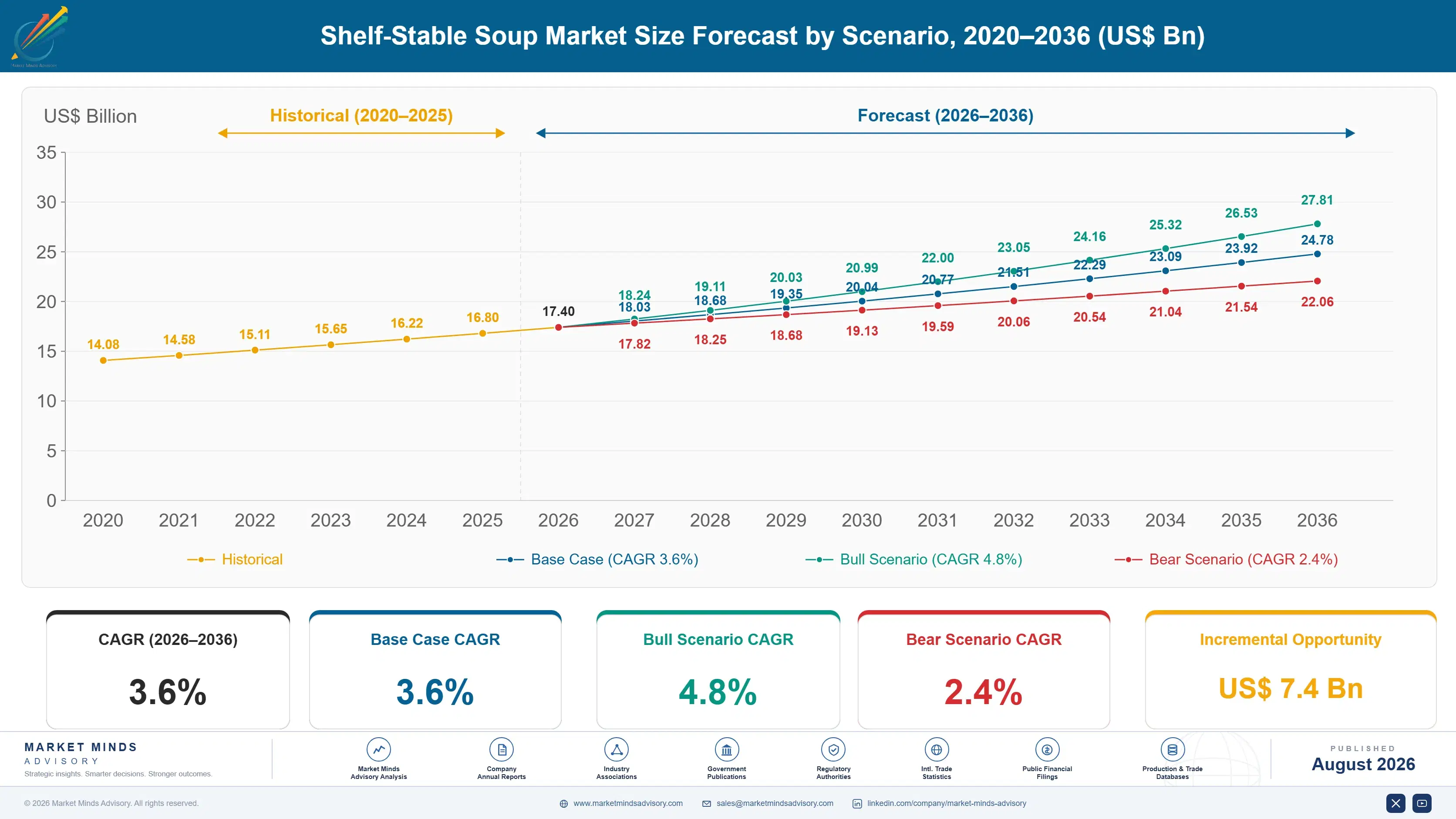
Growth ran near 2.8% between 2020 and 2025, distorted sharply by pantry stocking through 2020 that pulled demand forward and then left a soft comparison period behind it. Underlying volume in mature markets has been flat or declining for years, with value growth coming from pricing and mix rather than from anybody eating more soup. Emergency stocking events produced repeated short spikes across the period.
Base case 3.6% rests on three mechanisms. Aseptic and pouch formats keep taking share from steel cans on presentation and portability, which lifts average selling value even where volume is static. Emerging market packaged food penetration adds genuine volume, with India growing fastest anywhere at 7.8%. And preparedness stocking has become a more regular consumer behaviour rather than an occasional response to one specific event, which makes the pattern considerably more regular than it once was.
The bull case at 4.8% assumes gentler sterilisation technologies reaching cost parity with retort, which would let the category address the quality objection that has capped it for decades. The bear case at 2.4% is continued decline in mature market volume as chilled and fresh alternatives take the everyday occasion, leaving ambient soup confined to preparedness and price-driven purchase.

Two Years of Life, One Cooked Note

Everything this category is and everything it cannot become traces back to one process. Achieving commercial sterility in an ambient pack requires holding the product at around 121 degrees for long enough to destroy spores, which simultaneously delivers two years of shelf life and destroys vegetable texture, removes roughly 38% of heat-sensitive vitamins and creates the cooked flavour note that consumers have complained about since the category began.
TOP FIVE CONCENTRATION42%Brand memory rather than manufacturing capability holds position
STERILISATION TEMPERATURE121 CHeat required to achieve commercial sterility in ambient packs
VITAMIN RETENTION LOSS38%Heat-sensitive nutrients lost during the sterilisation process itself
EMERGENCY STOCKING SPIKE46%Purchase increase during weather events and supply anxiety
SODIUM CONTRIBUTION SHARE34%Daily reference intake supplied by a single serving
STEEL CAN RECYCLING RATE82%Share of packs recovered through established recycling streams
Premium positioning therefore struggles against physics rather than against marketing. Aseptic carton filling sterilises the soup rapidly before filling into a pre-sterilised pack, which reduces the heat load and preserves more texture and colour. It costs considerably more per unit and grows at 5.4% on that basis. Retort pouches heat faster than cans because the pack is thinner, which helps somewhat, though the fundamental constraint stays exactly where it was.
Consumer behaviour has an unusual second layer. Shelf-stable soup functions as household preparedness stock as much as it does as food, with purchase spiking around 46% during weather events, supply disruption and periods of general economic anxiety. No other ambient food category shows that pattern as sharply. Forecasting against consumption alone misses both the spike and the trough after it.
"The industry keeps launching premium soup and rediscovering that a retort does not care about your brand positioning. Anybody serious about quality in this category is really having a conversation about sterilisation technology and its capital cost, and that conversation happens in engineering rather than in marketing."
Director, Ambient Foods and Thermal Processing Practice · MMA Food and Beverage Practice · August 2026

Market Trends

Gentler sterilisation formats taking share on quality grounds

Aseptic filling sterilises soup rapidly at high temperature and fills it into a pre-sterilised carton, which reduces total heat load considerably against retorting a sealed can for an extended period. Texture, colour and heat-sensitive vitamins all survive better as a result. The format grows at 5.4% against a market rate of 3.6% on that quality argument, and it costs meaningfully more per unit because the filling equipment and the packaging both carry higher capital and material cost than steel canning does. Recyclability of multi-layer cartons is weaker than steel, which is an argument the format avoids making prominently.
Market Impact: Indian demand growing at 7.8%
Preparedness purchasing becoming a regular consumer behaviour

Purchase of shelf-stable soup spikes around 46% during weather events, supply disruption and periods of economic anxiety, which is a pattern no other ambient food category matches at that intensity. What has changed is regularity, with household preparedness stocking becoming a habit rather than a reaction to a specific emergency. That produces demand that responds to news cycles rather than to meal occasions, and manufacturers forecasting against consumption alone consistently miss both the spike and the trough that follows it. Retailer ordering patterns amplify both movements considerably. Manufacturers forecasting against consumption alone miss both movements.
Market Impact: Cartons growing at 5.4% annually

Market Opportunities and Growth Drivers

Emerging market packaged food penetration adding genuine volume

India grows fastest anywhere at 7.8%, driven by packaged food penetration in urban markets where soup as a category barely existed a decade ago and is being introduced alongside broader convenience food adoption. Dry and instant formats lead that entry because they carry lower price points and require no cold chain at any stage. Ambient wet formats follow as disposable income rises. This is the only part of the market adding volume rather than merely rotating value between formats. Regional flavour traditions differ enough that existing Western ranges transfer badly.
Market Impact: Requires 121 degrees to sterilise

Format migration lifting average value without adding volume

Aseptic cartons and retort pouches both carry higher selling prices than steel cans while delivering the same or slightly better product, which lifts category value in markets where volume has been flat for years. Presentation, portability and pack weight drive that migration more than any quality claim does. For manufacturers this is genuinely useful, since it converts a static category into a growing one without requiring anybody to eat more soup than they did before. Manufacturers with capital in canning lines resist that shift for understandable reasons. Mix improvement replaces volume growth entirely here.
Market Impact: Supplies 34% of sodium intake

Market Restraints and Challenges

Sterilisation physics capping achievable eating quality

Commercial sterility requires around 121 degrees held long enough to destroy spores, which destroys vegetable texture, removes roughly 38% of heat-sensitive vitamins and creates the cooked note the category is judged on. The root cause is microbiological rather than culinary, since the process targets spore survival rather than flavour. Commercially it caps how far premium positioning can go against chilled alternatives. Aseptic filling and advanced thermal processing both reduce the damage at considerably higher capital and unit cost. Chilled alternatives face no equivalent constraint at all. Capital cost is what separates the two approaches.
Market Impact: Reduces heat above 121 degrees

Sodium levels colliding with reformulation and labelling pressure

A single serving can supply around 34% of daily sodium reference intake, since salt performs flavour and palatability work that the sterilisation process actively undermines. The root cause is that heat treatment flattens flavour, and salt is the cheapest available correction. Commercially it places the category in the front line of warning label and reformulation regimes worldwide. Reduction ingredients help and interact awkwardly with retort processing, which changes their behaviour from what a chilled application would predict. Warning label regimes place soup among the most frequently flagged categories. Trials frequently fail outright under retort.
Market Impact: Spikes reach 46% above baseline
4 additional market trends, 3 additional growth drivers, and 2 additional restraints and challenges are covered in the full report. Contact sales@marketmindsadvisory.com to access the complete intelligence.

Segment CAGR and Growth Architecture

Six segments are split by pack format, because format determines the thermal process the product endures, the eating quality achievable afterwards, the price point supported and the occasion it can reach. Recipe and variety differences sit inside each format rather than beside them. Consumption occasion and retail channel are both handled in the framework instead.
shelf-stable-soup-market-report-trends-market-share-analysis-1787595097283

Aseptic Carton Soup

Growing at 5.4%, half again the market rate of 3.6%, aseptic filling sterilises soup rapidly and fills it into a pre-sterilised carton rather than heating a sealed pack for an extended period, which reduces total heat load and preserves texture, colour and heat-sensitive nutrients considerably better. The format supports premium positioning that a can genuinely cannot, and it carries higher capital cost in filling equipment and higher material cost in packaging. Recyclability of multi-layer cartons is weaker than steel, which is an argument the category tends to avoid making prominently. Private label is now following brands into the format, which reopens purchase decisions that habit had settled. Capital rather than recipe is the barrier.
CAGR 5.4%

Retort Pouch Soup

At 4.6% pouches heat faster than cans because the pack is thin, which shortens the thermal process and reduces damage somewhat without changing the underlying constraint. The commercial advantages are lighter weight, better shelf presentation and easier disposal rather than any transformation in eating quality. Pouches also suit single-serve and portable occasions that cans never reached properly. Puncture resistance and seal integrity are the manufacturing challenges, and a failure produces a spoiled product rather than an obviously damaged one, which makes quality control unusually consequential. Pouches also suit single-serve and portable occasions that cans never reached properly, which is where most of the incremental volume in the format has actually come from.
CAGR 4.6%
Full segment breakdown across 6 segments available in the complete report.

Regional Architecture and Country Demand Map

North America holds 30% of value on condensed soup consumption that no other region anywhere approaches, built up over a full century of brand presence there. Western Europe then follows at 26% on ambient ready-to-serve formats, with East Asia holding 22% on instant and dry varieties.

North America

Condensed soup consumption here has no equivalent anywhere else, built across a century of brand presence and a preparation habit that treats the can as an ingredient rather than a finished meal. That base has been declining slowly for years as chilled and fresh alternatives take everyday occasions. Preparedness stocking is unusually pronounced, with hurricane and winter storm events producing sharp regional purchase spikes. Private label participation is substantial and growing in ready-to-serve formats. Growth of 2.6% reflects value and mix rather than any volume recovery. Younger households have not formed the preparation habit that carries the condensed format, which is the structural problem underneath a slow volume decline. Private label participation keeps growing.
Share: 30% | CAGR: 2.6% (2026 to 2036)

Western Europe

Ready-to-serve ambient formats dominate rather than condensed, with British, German and Dutch consumption established and stable while volume declines slowly against chilled alternatives that have taken supermarket space. Premium ambient soup in glass and carton has developed further here than in most regions, supported by consumers willing to pay for quality claims the format can partly deliver. Sodium reduction pressure is strong and reformulation has proceeded across most major brands. Growth at 2.2% runs below the base case on structural volume decline. Chilled alternatives have taken supermarket space that ambient formats held for decades. Premium ambient soup in glass and carton has developed further here than in most regions, supported by consumers who will pay for quality claims.
Share: 26% | CAGR: 2.2% (2026 to 2036)
Regional intelligence for 5 additional markets available in the complete report: East Asia, South Asia and Pacific, Latin America, Middle East and Africa, Eastern Europe. Contact sales@marketmindsadvisory.com.
shelf-stable-soup-market-report-trends-country-cagr-analysis-1787595097804

Four Moves Against a Retort

Premium positioning in this category keeps failing for exactly the same reason every single time somebody tries it. A retort simply holds product at around 121 degrees and does not care what the label says, so quality ambitions here are really capital investment decisions made about sterilisation technology dressed up as marketing plans instead.

Treat quality as a processing investment, not a recipe

Commercial sterility requires around 121 degrees and destroys texture, colour and roughly 38% of heat-sensitive vitamins regardless of ingredient quality going in. Aseptic filling reduces that damage and costs considerably more in equipment and packaging. Manufacturers pursuing premium positioning without changing the process are spending marketing budget against physics, which is why so many premium ambient launches disappear within two years of arriving on shelf. Blind testing shows the objection is texture and cooked flavour rather than brand credibility, which more marketing cannot possibly address. Two premium launches failing in succession usually means the same thing.
Market Impact: Recovers part of the 38% nutrient loss directly

Forecast against preparedness behaviour, not meal occasions

Purchase spikes around 46% during weather events, supply disruption and economic anxiety, and falls sharply afterwards as households work through stock they already hold. Forecasting against consumption alone misses both movements and produces either stockouts during the spike or excess inventory through the trough. Building news-responsive and weather-responsive forecasting is unusual in ambient food and genuinely valuable here, since no other category behaves this way. Retailer ordering amplifies both movements, which makes the swing larger than consumer behaviour alone would produce. Very few manufacturers forecast this way at all. Weather and news feeds predict it better than sales history.
Market Impact: Anticipates a 46% preparedness demand spike more accurately

Migrate format ahead of the volume decline

Aseptic cartons and retort pouches carry higher selling prices than steel cans while delivering equal or slightly better product, and they grow at 5.4% and 4.6% while can volume declines. That converts a static category into a growing one without requiring anybody to eat more soup. Manufacturers holding capital tied up in canning lines resist the shift for understandable reasons, and the resistance costs them mix improvement they cannot recover afterwards. Private label is following into those formats, which means the migration is a race rather than an option. Mix improvement alone frequently justifies the capital before pricing benefit.
Market Impact: Captures the 5.4% carton format growth rate directly

Solve sodium within the constraints of the process

A serving can supply around 34% of daily sodium reference intake because salt corrects flavour that heat treatment flattens, which makes soup a front-line category for warning labels and reformulation regimes. Reduction ingredients behave differently under retort conditions than in chilled applications, so approaches developed elsewhere transfer badly. Manufacturers who work the problem inside the thermal process rather than around it reach reductions competitors cannot match, and very few have tried it. Trials that succeeded in chilled products frequently fail outright under retort conditions. Working inside the thermal process rather than around it is the answer.
Market Impact: Addresses a 34% sodium intake contribution per serving

Who Controls the Margin Pool

Participation is measured on annual shelf-stable soup production volume, and the top five hold 42%. Concentration reflects brand memory and retail relationships rather than manufacturing capability, since retort and aseptic capacity are both available through contract processors. Campbell Soup Company leads on condensed soup positions no competitor has ever meaningfully contested. The gap to challengers is shelf presence rather than product capability. Contract processors serve several competing labels.
Competition runs on three fronts. Format capability decides participation in the growing part of a static category, since aseptic filling requires capital that canning lines cannot be converted into. Brand memory decides trial in a category where consumers buy what their households always bought. Private label competition decides how much of the value migration a brand actually keeps. Canning lines cannot convert into aseptic filling.

Pressure ahead comes from chilled and fresh alternatives taking everyday occasions and from private label capturing format migration in several markets. Campbell Soup Company acquired Sovos Brands in 2024, adding premium ambient positions to a portfolio anchored in condensed formats. Expect processing investment rather than further large transactions. Rankings shift as format migration proceeds and preparedness behaviour normalises. Retailers reallocate space toward whatever turns fastest.
shelf-stable-soup-market-report-trends-company-positioning-matrix-1787595098320

Competitive Moat and Risk Dimensions

CAMPBELL SOUP COMPANY

Moat: Condensed soup category ownership

A century of brand presence in condensed soup created a consumer habit that treats the product as a cooking ingredient rather than a meal, which no competitor has successfully contested in that form. That familiarity delivers trial and shelf space without marketing expenditure that a new entrant would have to fund entirely from nothing.
CAMPBELL SOUP COMPANY

Risk: Declining core format volume

Condensed soup volume has been declining slowly for years as chilled and fresh alternatives take everyday occasions and younger households never formed the preparation habit. Defending a shrinking core while funding format migration requires capital allocation choices that favour neither position, and canning assets cannot convert to aseptic filling.
NESTLE

Moat: Format and geography breadth

Capability across instant powdered, ambient wet and premium formats in most world markets means regional flavour traditions and price points can both be served from an existing manufacturing and distribution base. That breadth matters particularly in emerging markets where powdered formats lead entry and wet formats follow later as incomes rise.
NESTLE

Risk: Fragmented regional brand positions

Serving distinct regional flavour traditions requires distinct brands and recipes, which fragments marketing investment across many small positions rather than concentrating it. Local manufacturers built on tradition-specific varieties compete effectively in exactly those markets, and scale confers less advantage than it does in globally consistent categories.

Players Tracked

Prominent Players

Campbell Soup Company
Nestle
Unilever
Kraft Heinz
General Mills

Other Key Players

Conagra Brands
Baxters Food Group
Premier Foods
Amy's Kitchen
Blount Fine Foods
Ottogi
Nissin Foods
Ajinomoto
Hormel Foods
Bonduelle
Lassonde Industries
Orkla
Gallina Blanca
Aneto Natural
Symington's

Recent Developments

FEBRUARY 2026

Manufacturer commissions aseptic line to address quality positioning

A soup manufacturer commissioned aseptic filling capacity specifically to support premium positioning that retort processing could not deliver, citing texture and colour retention rather than shelf life. Capital cost ran well above equivalent canning capacity for the same throughput. Shelf life was unchanged by the investment.
Signal: Premium positioning in this category is a capital investment decision rather than a marketing one entirely
SEPTEMBER 2025

Severe weather event produces sharp regional purchase spike

A severe weather event produced a sharp regional purchase spike in shelf-stable soup across affected areas, followed by a pronounced trough as households consumed accumulated stock over subsequent months. Retailer ordering patterns amplified both movements considerably. Consumption drew down accumulated household stock over several months afterwards.
Signal: Preparedness demand here is news-responsive rather than occasion-driven, and it always corrects itself very sharply afterwards
DECEMBER 2025

Warning label regime places soup among highest sodium packaged categories

A national front-of-pack warning label regime placed shelf-stable soup among the packaged categories most frequently carrying sodium warnings, prompting reformulation programmes across major brands. Retort processing constrained which reduction approaches could actually be applied. Several reduction approaches proven in chilled products failed outright under retort conditions during trials.
Signal: Sodium reduction approaches developed for chilled foods transfer very badly indeed into any thermally processed product

Steel, Vegetables and Heat

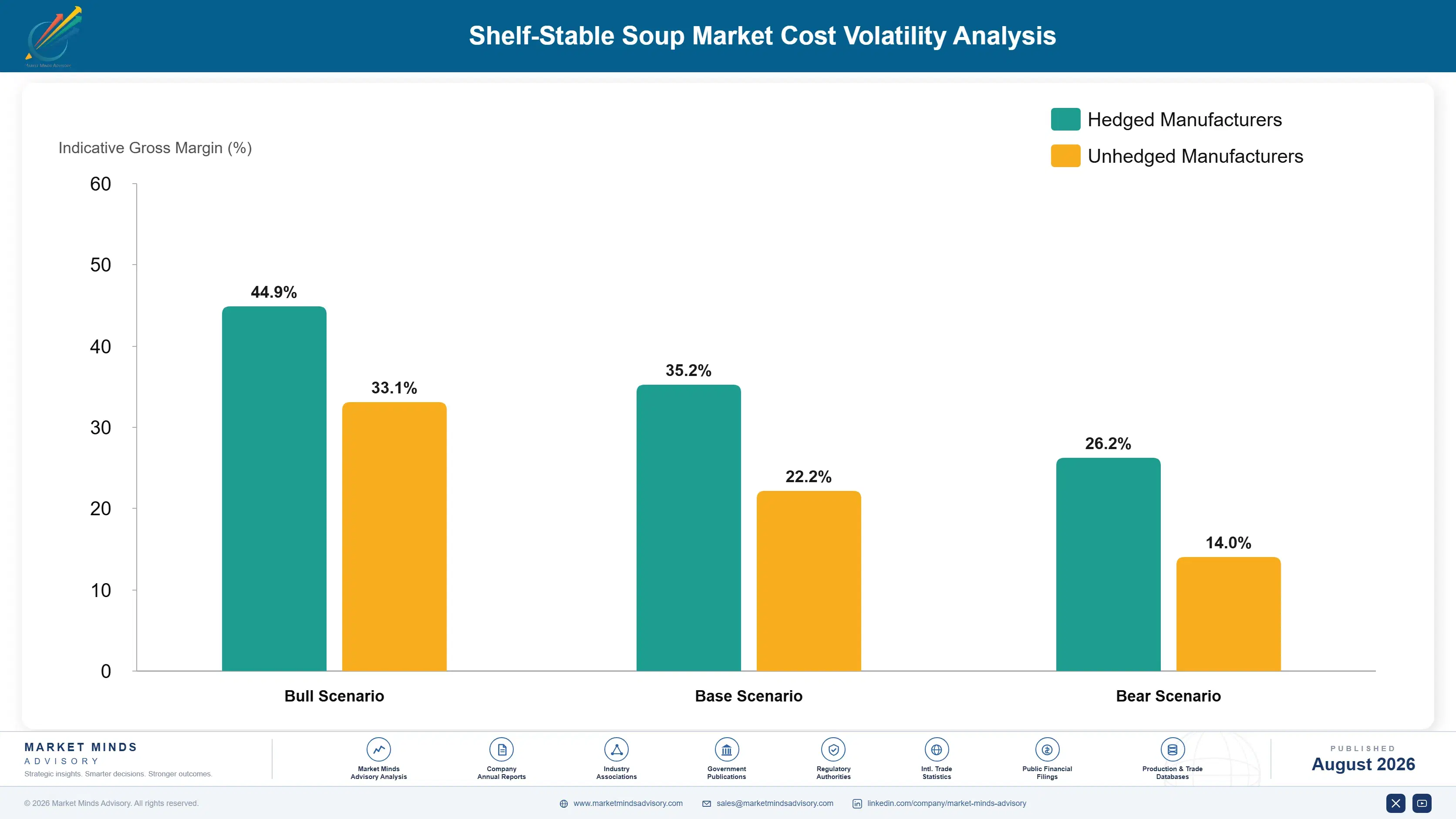
Packaging accounts for roughly 31% of delivered cost across the category, which is unusually high and rises further for aseptic cartons and pouches against steel cans. Vegetables, meat and stock ingredients carry about 28%, moving with agricultural cycles that vary by variety and origin. Thermal processing energy takes around 14%, since sterilisation is genuinely energy intensive. Labour, warehousing and distribution absorb the balance.
Steel packaging costs rose sharply through 2021 and 2022 on energy and raw material movements, per European Commission steel market monitoring for the period, while vegetable input costs moved separately on weather and agricultural conditions. Energy for thermal processing climbed alongside steel, which meant packaging and processing exposures compounded rather than offsetting. Manufacturers on annual retail agreements absorbed most of it across that period. Retail agreements repriced slowly.

Exposure divides on format mix and on energy contracting. Aseptic and pouch formats carry higher packaging cost and lower thermal energy cost than canning, which shifts the balance of exposure rather than reducing it. Geographically, manufacturers in markets with high industrial energy prices carry a processing cost disadvantage that no recipe change addresses, which is one reason production concentrates near energy and vegetable supply.
shelf-stable-soup-market-report-trends-cost-volatility-analysis-1787595098516

Balance steel and flexible packaging exposure across formats

Steel packaging and flexible carton or pouch materials move on entirely unrelated cost cycles, one tied to energy and iron ore and the other to polymer and board markets. Holding capability across formats gives a manufacturer somewhere to shift emphasis as either moves. Single-format producers carried the full steel movement through the last cycle with no alternative available anywhere.

Contract thermal processing energy on multi-year terms

Sterilisation energy is around 14% of delivered cost and cannot be reduced without changing the process itself, since the temperature requirement is microbiological rather than negotiable. Multi-year energy contracts smooth an exposure that recipe reformulation cannot touch at all. Manufacturers in high energy cost markets carry a permanent disadvantage that only siting decisions ever address.

Source vegetables against multiple origins and seasons

Vegetable and meat inputs are around 28% of cost and move on weather and agricultural conditions that vary sharply by variety and growing region. Multi-origin sourcing and seasonal contracting both smooth that considerably. Ambient soup has an advantage here that chilled competitors lack, since long shelf life permits building inventory when input prices are favourable.

Portfolio Architecture for Margin Defence

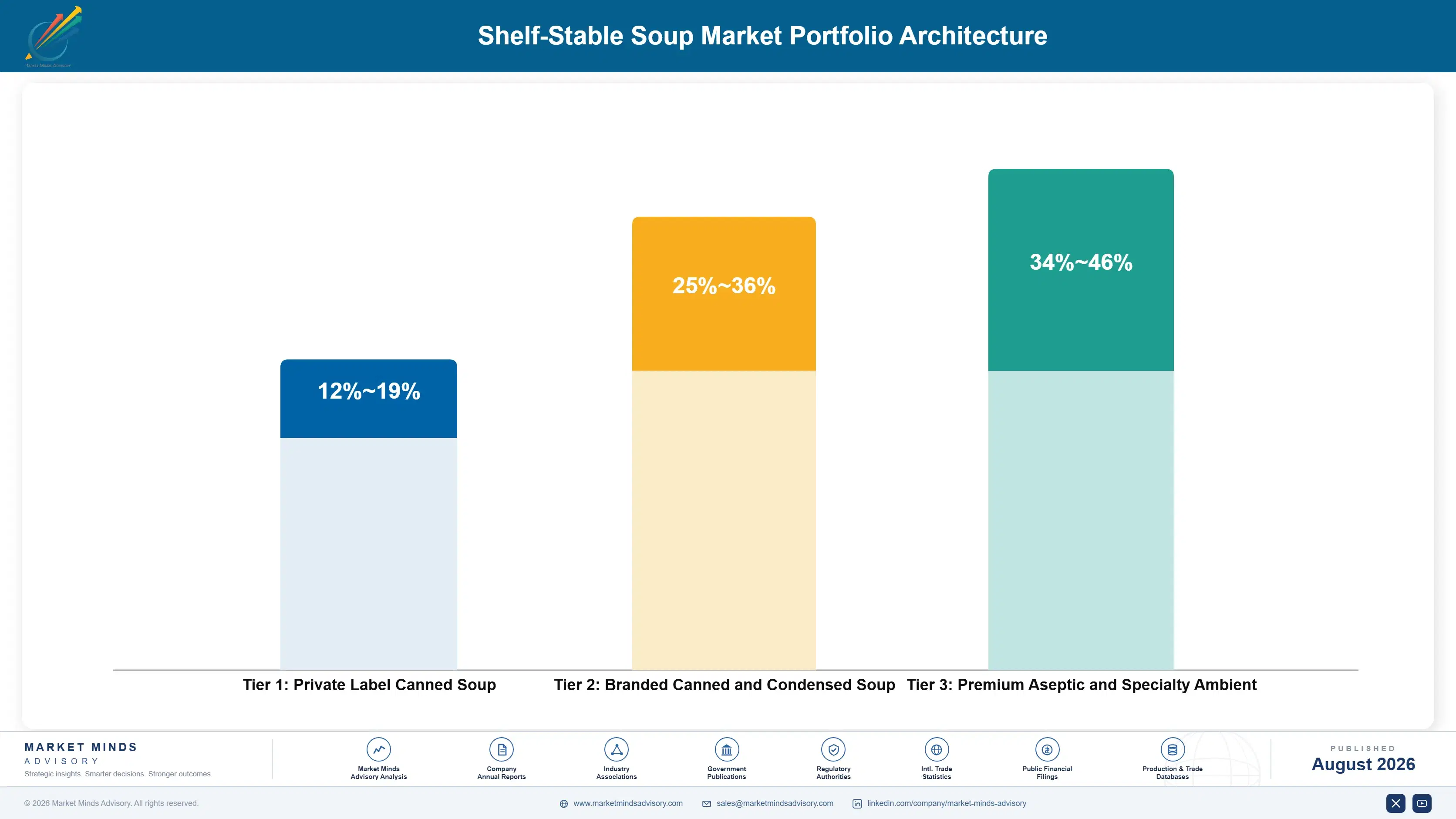
Margin here follows format and brand memory rather than recipe quality, which is a slightly uncomfortable conclusion for an industry that talks constantly about ingredients. Private label canned soup earns margins in the low to mid teens, because retailers set the price, the product is functionally interchangeable and contract processors supply several competing labels from the same line. Retailers set the price and the specification together.
Branded canned and condensed soup does considerably better in the mid twenties to mid thirties, because household habit delivers repeat purchase without marketing effort and shelf space follows established rate of sale. The range reflects brand strength and how much private label pressure a given market applies to the same shelf. Shelf space follows established rate of sale rather than brand history.

Premium aseptic and specialty ambient formats hold the strongest position, reaching into the mid forties, because processing genuinely delivers better product and consumers pay for the difference where they can taste it. Those margins reflect capital investment in filling technology rather than any recipe advantage, and private label is now following into the format. Consumers pay for a difference they can actually taste.

Private Label Canned Soup

Retailer-branded canned products frequently supplied by contract processors serving several competing labels. The seven point range reflects contract terms and processing scale rather than any difference between the products themselves.
Gross Margin: 12-19%

Branded Canned and Condensed Soup

Established branded canned formats carried by household purchase habit and shelf presence. The eleven point range reflects brand strength and how much private label pressure a particular market applies to the category.
Gross Margin: 25-36%

Premium Aseptic and Specialty Ambient

Aseptic carton and specialty formats where gentler processing delivers genuinely better product. The twelve point range reflects filling capital investment and how far private label has followed into the same format.
Gross Margin: 34-46%
shelf-stable-soup-market-report-trends-portfolio-architecture-1787595099012

High-value Sub-segments and Strategic Watch-out

Premium Aseptic Carton Formats

High value and the fastest growth at 5.4%, since gentler processing preserves texture and colour that retorting destroys. Capital cost in filling equipment is the barrier rather than any recipe or ingredient capability. Private label is following into the format, which reopens decisions brand habit had settled.
Gross Margin: 36-46%

Single-Serve Retort Pouches

High value and growing at 4.6% on portability and presentation rather than eating quality. Seal integrity is the manufacturing challenge, since a failure produces spoiled product rather than obviously damaged packaging. Lighter weight and better shelf presentation drive the migration more than any quality claim does.
Gross Margin: 30-40%

Branded Canned Soup

The volume core in slow decline, carried by household habit that younger consumers have not formed. Format migration reopens purchase decisions that brand memory had kept comfortably closed for several decades. Chilled and fresh alternatives keep taking the everyday occasion this format once owned. Habit carries it still.
Gross Margin: 25-36%

Private Label Format Migration

The strategic watch-out. Private label is following brands into carton and pouch formats, and the range reflects how much of the value migration a branded manufacturer actually manages to retain. Retailers control both shelf allocation and the promotional intensity that shapes trial. Migration is a race here.
Gross Margin: 12-30%

Habit, Weather and Anxiety

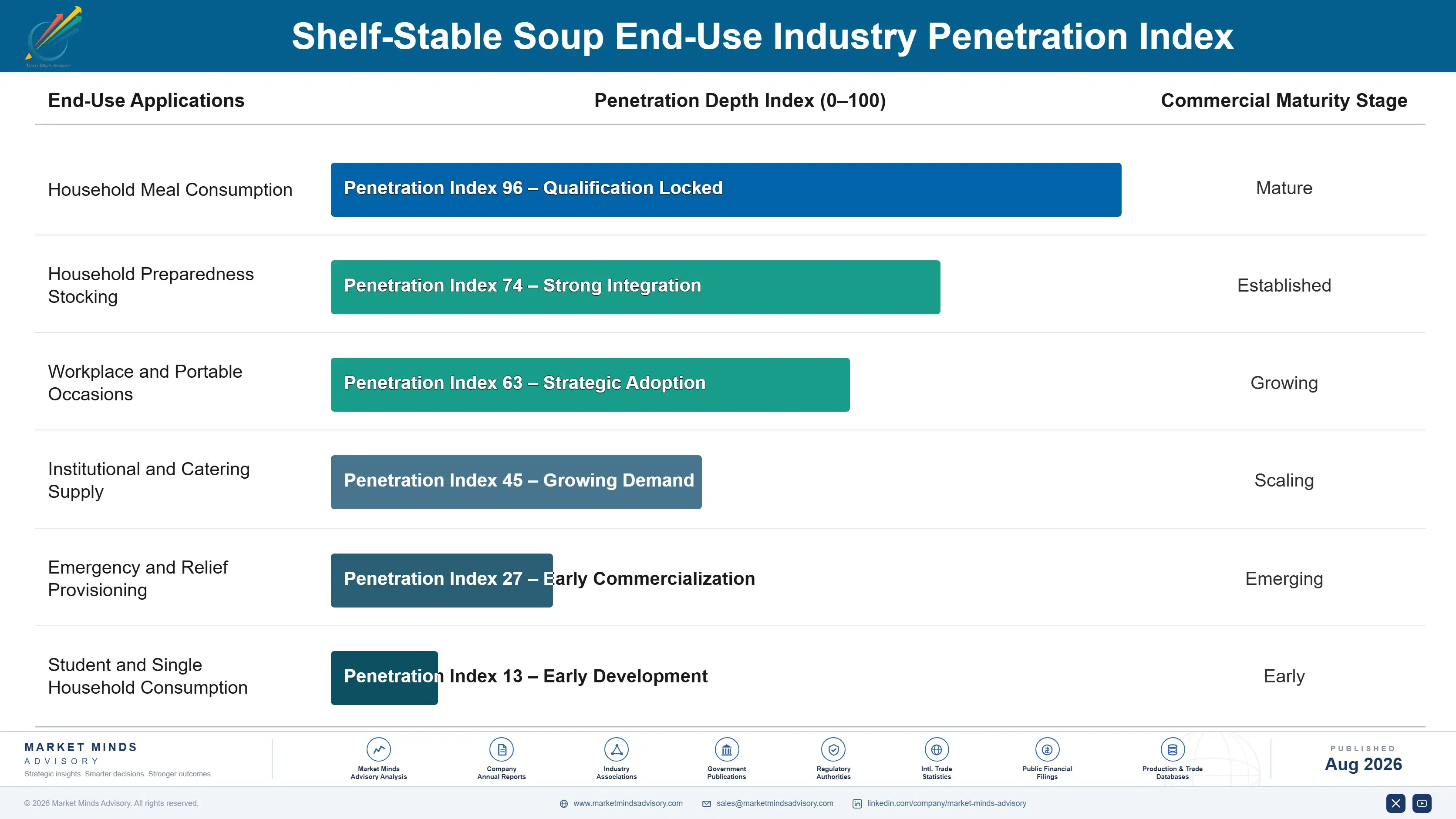
Three quite different demand patterns sit inside this category at once. Habitual purchase repeats steadily among households that have bought the same brand for decades and rarely reconsider it. Preparedness stocking spikes around 46% on weather events and supply anxiety, then falls away as accumulated stock is consumed. Emerging market adoption adds genuine new volume rather than rotating existing purchase between formats.
Stickiness comes from memory rather than from anything the product does. A household that grew up with a particular soup buys it without evaluation, which is an extremely durable position and an extremely fragile one, since it depends on habits younger consumers are not forming. Format migration is where that stickiness breaks, because a shopper choosing a carton is making a genuine decision for the first time in years.

The purchase decision has been quietly moving toward the retailer. Private label participation is heavy and growing, particularly in formats where brand habit has not yet formed, and retailers control both shelf allocation and the promotional intensity that shapes trial. In categories with declining volume, retailers reallocate space toward whatever turns fastest rather than toward whichever brand has been there longest.
shelf-stable-soup-market-report-trends-end-use-penetration-index-1787595099501

Where We Would Focus Effort

These are among the four positions where our research anticipates prominent divergence between winners and laggards over the coming forecast period. Each is grounded in the demand model, the regulatory perimeter, and the announced capacity pipeline.
01 / PROCESSING CAPITAL DECISIONS

Physics beats positioning, every single time

Commercial sterility requires holding product at around 121 degrees, which destroys texture and colour and removes roughly 38% of heat-sensitive vitamins whatever quality of ingredient went in at the start of the process. Aseptic filling reduces that damage materially and costs considerably more in both equipment and packaging material. Manufacturers pursuing premium positioning without changing the underlying process are spending marketing budget against physics, which is why so many premium ambient launches vanish within two years of launching onto shelf.
02 / PREPAREDNESS DEMAND FORECASTING

Forecast the weather, not the meal occasion

Purchase spikes around 46% during weather events, supply disruption and periods of economic anxiety, then falls sharply as households work through the stock they accumulated during the spike itself beforehand. Forecasting against consumption alone misses both movements and produces stockouts during the peak or leaves excess inventory through the trough that follows it afterwards. Building news-responsive and weather-responsive forecasting is unusual in ambient food and genuinely genuinely valuable here, since no comparable category behaves in quite this way at all.
03 / FORMAT MIGRATION TIMING

Move before the can volume goes

Aseptic cartons and retort pouches carry higher selling prices than steel cans while delivering equal or slightly better product, growing at 5.4% and 4.6% respectively while steel can volume declines steadily year on year. That converts a static category into a growing one without requiring anybody to eat more soup than they already did. Manufacturers with capital tied up in canning lines resist the shift for understandable reasons, and that resistance costs them mix improvement they cannot ever recover later.
04 / THERMAL SODIUM REDUCTION

The chilled playbook does not transfer here

A single serving can supply around 34% of daily sodium reference intake, because salt corrects flavour that heat treatment actively flattens rather than merely seasoning the product. Reduction ingredients behave differently under retort conditions than in chilled applications, so approaches developed for other categories transfer badly and frequently fail outright in trials. Manufacturers working the problem inside the thermal process rather than around it reach reductions that their competitors simply cannot match, and remarkably few have properly tried it yet anywhere.

Engagement Snapshot From the Field

A live engagement with an industry participant carrying material or product regulatory and market exposure ahead of a defining policy shift, showing how our research translates into a defensible multi-year portfolio strategy.
MARKET MINDS ADVISORY · CLIENT ENGAGEMENT SUMMARY
Shelf-Stable Soup Producer Strategic Portfolio Review and Transition Roadmap 2026·Investment Scenario on Shelf-Stable Soup Exposure Evaluation 2025-26
CLIENT PROFILE
A European soup manufacturer producing canned and pouched ambient soup across two plants supplying retail in six markets, at annual revenue near 310 million euros (client-reported, unverified by MMA). Two premium branded launches had failed within eighteen months each, and the company held no aseptic filling capability anywhere across either of its two plant operations.
STRATEGIC CHALLENGE
A third premium launch was in development with substantially increased marketing investment, while private label was taking share in the pouch format the company had pioneered regionally. Management believed brand communication had been the weakness in the earlier failures rather than anything about the product itself, and were funding accordingly.
MMA APPROACH
MMA tested consumer response to the client's premium products against aseptic competitors, benchmarked aseptic filling capital cost against projected mix improvement, analysed private label share movement through format transitions, and assessed preparedness demand patterns against the client's forecasting approach. Interviews with 47 experts covered thermal processing, ambient food retail and consumer sensory testing.
KEY FINDINGS
  1. Consumers rejected the premium products on texture and cooked flavour rather than on brand credibility, and the same rejection appeared in blind testing without any branding present.
  2. Aseptic filling capital cost was recoverable within the client's planning horizon on projected mix improvement alone, before any premium pricing benefit was counted at all.
  3. Private label had captured most of the pouch format migration precisely because the format change reopened purchase decisions that brand habit had previously settled.
  4. Forecasting against consumption alone had produced repeated stockouts during weather-driven spikes and considerable excess inventory across the troughs that followed each one.
CLIENT PROFILE
A European soup manufacturer producing canned and pouched ambient soup across two plants supplying retail in six markets, at annual revenue near 310 million euros (client-reported, unverified by MMA). Two premium branded launches had failed within eighteen months each, and the company held no aseptic filling capability anywhere across either of its two plant operations.
STRATEGIC CHALLENGE
A third premium launch was in development with substantially increased marketing investment, while private label was taking share in the pouch format the company had pioneered regionally. Management believed brand communication had been the weakness in the earlier failures rather than anything about the product itself, and were funding accordingly.
MMA APPROACH
MMA tested consumer response to the client's premium products against aseptic competitors, benchmarked aseptic filling capital cost against projected mix improvement, analysed private label share movement through format transitions, and assessed preparedness demand patterns against the client's forecasting approach. Interviews with 47 experts covered thermal processing, ambient food retail and consumer sensory testing.
KEY FINDINGS
  1. Consumers rejected the premium products on texture and cooked flavour rather than on brand credibility, and the same rejection appeared in blind testing without any branding present.
  2. Aseptic filling capital cost was recoverable within the client's planning horizon on projected mix improvement alone, before any premium pricing benefit was counted at all.
  3. Private label had captured most of the pouch format migration precisely because the format change reopened purchase decisions that brand habit had previously settled.
  4. Forecasting against consumption alone had produced repeated stockouts during weather-driven spikes and considerable excess inventory across the troughs that followed each one.
RECOMMENDED STRATEGY
Phase 1: Phase one: cancel the third premium launch, since blind testing shows the objection is processing rather than communication and more marketing cannot fix it. Phase 2: Phase two: invest in aseptic filling capability, which the mix improvement alone justifies before any premium pricing benefit is even considered. Phase 3: Phase three: rebuild forecasting around weather-driven and news-responsive preparedness demand rather than around meal occasion consumption patterns on their own.
OUTCOME
The manufacturer cancelled the planned launch and committed to aseptic capacity during 2026 (client-reported, unverified by MMA). Forecasting was rebuilt around preparedness patterns, and inventory write-offs following demand spikes fell substantially in the following year. Marketing budget was redirected toward the processing investment instead. Two plants continue running canning lines.

Frequently Asked Questions

Foundational context covering the market sizes, CAGR, scope, country, region and competition that inform every finding below. This section is provided to cover basics and most often pre-purchase conversations, answered from the MMA Primary Research Dataset.

What is the current size of the Shelf-Stable Soup Market?

MMA sizes it at USD 16.8 billion in 2025, rising to USD 17.40 billion in 2026. The figure covers soup sold shelf-stable at ambient temperature at manufacturer selling value.

How large will the Shelf-Stable Soup Market be by 2036?

USD 24.78 billion by 2036, an incremental USD 7.38 billion over the 2026 base and an expansion multiple of 1.42 times. Aseptic formats account for a disproportionate share.

What is the CAGR for the Shelf-Stable Soup Market 2026 to 2036?

3.6% in the base case, with a bull case at 4.8% and a bear case at 2.4%. The spread turns on sterilisation technology cost and on mature market volume decline.

Which segment is growing fastest?

Aseptic carton soup at 5.4%, half again the market rate of 3.6%. Gentler processing preserves the texture and colour that conventional retort sterilisation destroys entirely.

Who are the major companies in the Shelf-Stable Soup Market?

Campbell Soup Company, Nestle, Unilever, Kraft Heinz and General Mills lead on shelf-stable soup volume. Fifteen further participants are profiled in the full report on that basis.

Which country is growing fastest?

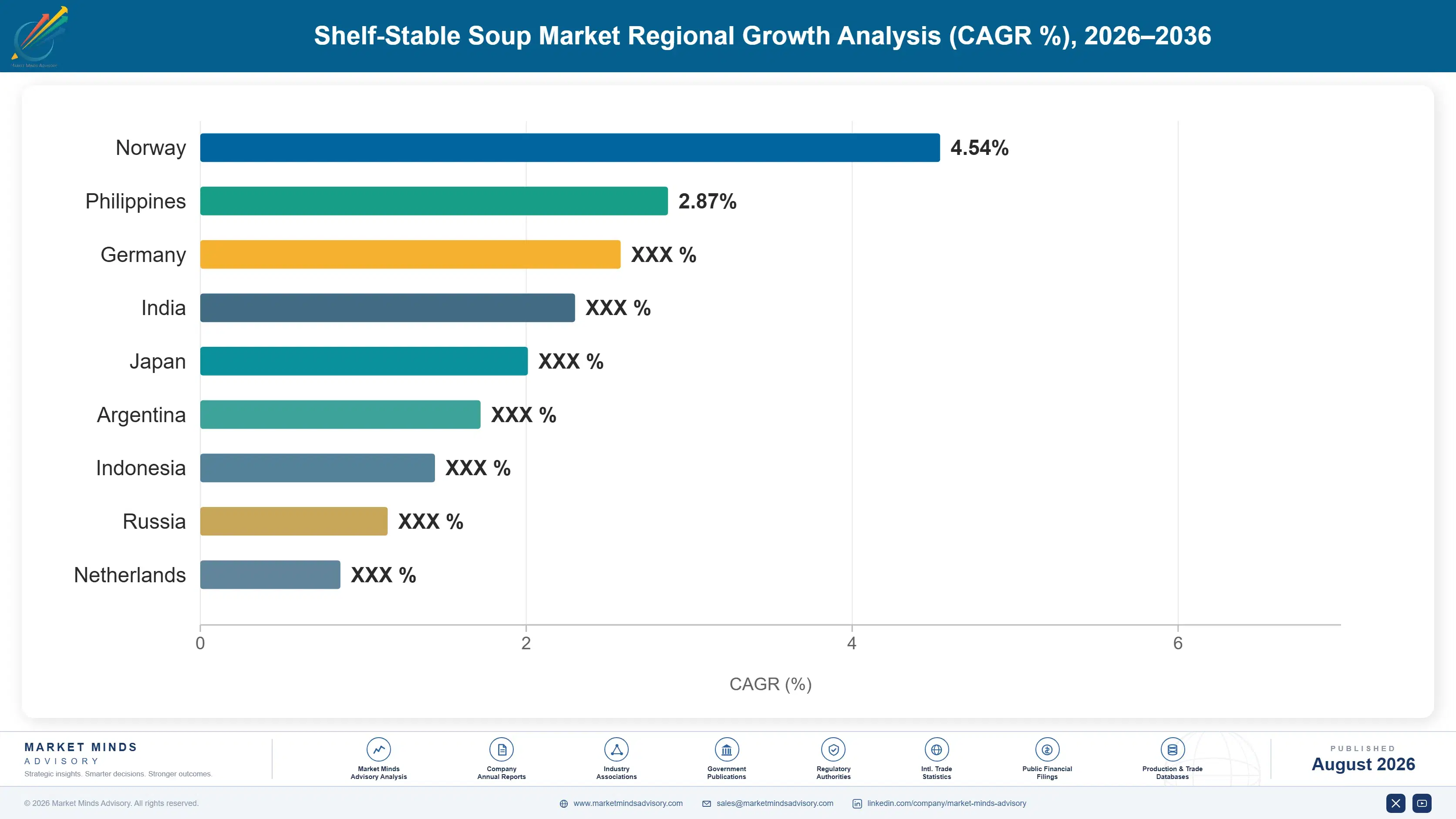
India at 7.8%, driven by packaged food penetration in urban markets where soup as a packaged category barely existed a decade ago and is now being introduced.

Report Segmentation Architecture

The full report scope spans multiple orthogonal segmentation dimensions, with cross-tabulated demand data provided for each dimension pair. Coverage extends further to regional breakdowns, trend trajectories, and the competitive detail needed to support segment-level decision-making.

By Pack Format

  • Steel Can Condensed Soup
  • Steel Can Ready-to-Serve Soup
  • Aseptic Carton Soup
  • Retort Pouch Soup
  • Dry and Instant Soup Mixes
  • Glass Jar and Premium Ambient

By End-Use Industry

  • Household Meal Consumption
  • Household Preparedness Stocking
  • Workplace and Portable Occasions
  • Institutional and Catering Supply
  • Emergency and Relief Provisioning
  • Student and Single Household Consumption

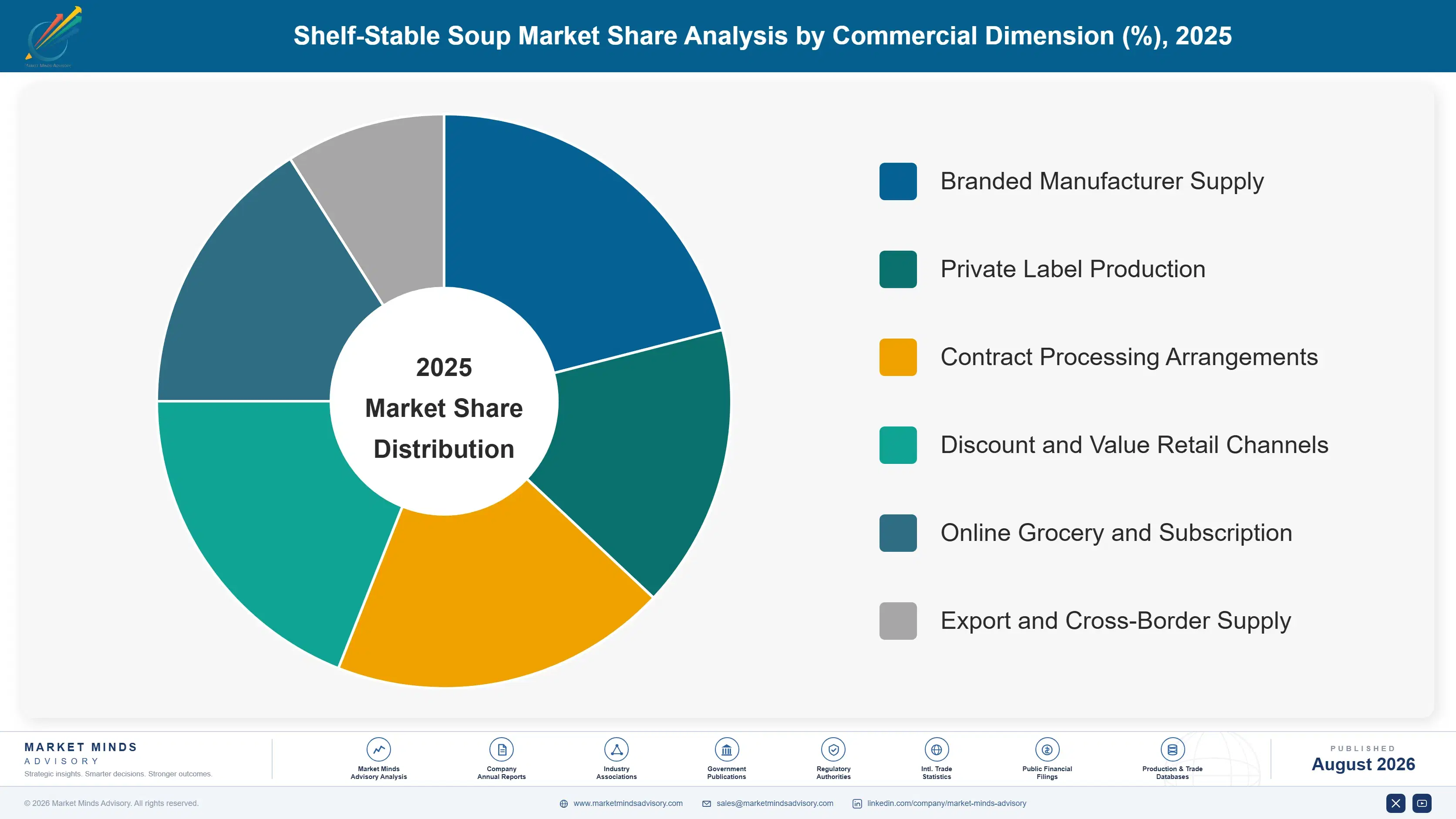
By Commercial Dimension

  • Branded Manufacturer Supply
  • Private Label Production
  • Contract Processing Arrangements
  • Discount and Value Retail Channels
  • Online Grocery and Subscription
  • Export and Cross-Border Supply

By Region

  • North America
  • Western Europe
  • East Asia
  • South Asia and Pacific
  • Latin America
  • Middle East and Africa
  • Eastern Europe

Scope, Methodology, and Coverage

Every figure in this report is reproducible from documented input assumptions. The scope below maps the historical period, the forecast horizon, the segmentation dimensions, and the countries covered, alongside the underlying primary and qualitative methodology.
Historical Period
2020 to 2025
Forecast Period
2026 to 2036
Base Year
2025 (USD billions; MMA Primary Research Dataset, August 2026)
Market Definition
Soup products sold shelf-stable at ambient temperature, covering steel can condensed soup, steel can ready-to-serve soup, aseptic carton soup, retort pouch soup, dry and instant soup mixes, and glass jar and premium ambient formats. Measured at manufacturer selling value across branded and private label supply. Chilled and frozen soup, restaurant and foodservice preparation, bouillon cubes and stock concentrates sold as cooking ingredients, and soup sold through unpackaged deli counters are excluded from scope.
Quantitative Units
USD billions (current prices); billion servings; USD per litre equivalent by pack format
Segmentation Dimensions
Pack format; consumption occasion; commercial dimension; region
Regions Covered
North America, Western Europe, East Asia, South Asia and Pacific, Latin America, Middle East and Africa, Eastern Europe
Countries Covered
United States, Canada, Mexico, United Kingdom, Germany, Netherlands, France, Spain, Japan, South Korea, China, India, Indonesia, Australia, Brazil, Argentina, Saudi Arabia, South Africa, Poland, Czech Republic
Key Companies Profiled
Campbell Soup Company, Nestle, Unilever, Kraft Heinz, General Mills, Conagra Brands, Baxters Food Group, Premier Foods, Amy's Kitchen, Blount Fine Foods, Ottogi, Nissin Foods, Ajinomoto, Hormel Foods, Bonduelle, Lassonde Industries, Orkla, Gallina Blanca, Aneto Natural, Symington's
Quantitative Methodology
Primary survey, n=3,800 respondents, Q4 2025, six countries; demand-side model with trade association cross-validation
Qualitative Methodology
47 expert interviews, Q4 2025; applied to validate demand model assumptions, identify emerging dynamics, and assess competitive positioning
Report Format
PDF and XLSX data workbook (Word format preview document)
Publisher
Market Minds Advisory
Report Code
MMA-2026-AGR-187
Published
August 2026
Contact
sales@marketmindsadvisory.com | www.marketmindsadvisory.com

Purchase the full Shelf-Stable Soup Market Report (2026 to 2036).

The full report treats sterilisation as the governing constraint on everything this category can attempt, because premium positioning fails against thermal physics rather than against marketing execution. It sizes all six pack formats independently through 2036, quantifies preparedness demand separately from meal occasion consumption, and models aseptic capital investment against achievable mix improvement. Regional chapters cover all seven regions with format preference and flavour tradition treated separately, since the two rarely transfer across borders. Competitive profiling covers 20 participants on a single production volume basis.
Six pack formats sized independently through 2036
Preparedness demand quantified separately from meal occasion consumption
Aseptic capital investment modelled against achievable mix improvement
Private label share tracked through format migration by market
Twenty participants profiled on one consistent volume basis
Sodium reduction approaches assessed under thermal processing constraints

Built For The People Who Decide

From boardroom strategy to bench-side execution, this report is read cover-to-cover by leaders shaping the next decade of their industry, turning demand scenarios, market dynamics and valuation benchmarks into decisions.
CXOs/ Presidents/ VPs/ Managers
M&A and Corporate Development
Strategy Teams and R&D Heads
Procurement and Product Directors
Regulatory and Compliance Leaders
Investor Relations and Equity Analysts