Market Minds Advisory
Sextech and Sexual Wellness Market

Sextech and Sexual Wellness Market: Sextech and Sexual Wellness Market. Trends and Forecast 2026 to 2036

Destigmatization and mainstream retail acceptance are pushing sexual wellness brands into pharmacy chains and major department stores, forcing legacy discreet-channel suppliers to defend shelf space against faster-scaling direct-to-consumer entrants today.

Lead Analyst

Published

September 2026

Make Smarter Decisions with Customized Research Insights

Request a free sample report and evaluate market opportunities, growth trends, and competitive dynamics relevant to your business needs.

2025 MARKET VALUE$38.5BMarket Size 2025
2036 FORECAST VALUE$89.8BBase Case , 2026 to 2036
CAGR 2026 TO 20368.0 %Bull 9.2% / Bear 6.8%
INCREMENTAL OPPORTUNITY$48.2BNet 10- year value creation
EXPANSION MULTIPLE2.16x2036 value over 2026 base
Strategic Levers
M&A Pipeline
Regional Outlook
Country Rankings
Competitive Intelligence
Segmental Deep-dive
Call-Us : 91 93563 13602

Executive Snapshot and Market Trajectory.

Sexual wellness demand is accelerating as social destigmatization normalizes category visibility in mainstream retail environments, giving brands access to pharmacy chains and department stores that historically restricted these products to specialty discreet-channel outlets alone. Brands report accelerating retail placement negotiations across most major mainstream grocery and pharmacy chains.
Demand concentrates around premium personal care and app-connected intimate devices, where consumers value discretion and clinically informed design over the lower cost basic products historically dominated. App-connected smart devices are emerging as the fastest growing category, since consumers want personalized experiences and usage tracking that standalone products cannot provide. Geographic concentration remains heaviest across North America's mature retail and e-commerce infrastructure, though China's expanding manufacturing and domestic consumer market is driving accelerated growth.
Competitive intensity concentrates among five brands holding a combined 30% revenue share, reflecting a fragmenting market where digitally native direct-to-consumer brands compete alongside established personal care conglomerates entering the category. Retail destigmatization is reshaping brand strategy, as mainstream placement demands packaging and marketing approaches distinct from the discreet positioning specialty retailers previously required. Brands lacking this repositioning lose shelf space to rivals with stronger mainstream retail relationships already established.
Market Definition
This report covers sexual wellness products including intimate devices, personal lubricants, and app-connected sextech hardware sold through retail, e-commerce, and direct-to-consumer channels for adult personal use. It excludes prescription pharmaceutical products for sexual health conditions, fertility and contraceptive medical devices requiring clinical prescription, and adult entertainment media content.
Base Year Value
$38.5B in 2025 (MMA Primary Research Dataset, September 2026)
Forecast Period
2026 to 2036, eleven discrete annual values
CAGR
8.0% base case. Bull 9.2%. Bear 6.8%.
Fastest Growth Segment
App-Connected Smart Intimate Devices: 13.0% CAGR
Fastest Growth Country
China: 10.5% CAGR
Fastest Growth Region
South Asia and Pacific: 10.1% CAGR
Largest Region
North America: 30% of 2025 global value
Market Leaders
Leading participants include WOW Tech Group, Lovehoney, Reckitt Benckiser, CalExotics, and LELO. Source: MMA Primary Research Dataset, July 2026.
Primary Survey
n=3,800 procurement and R&D decision-makers, Q4 2025, six countries
Methodology
Demand-side build-up, cross-validated against public data, 47 expert interviews

Sextech and Sexual Wellness Market Forecast Scenarios

sextech-and-sexual-wellness-market-size-forecast-scenario-1789981430922
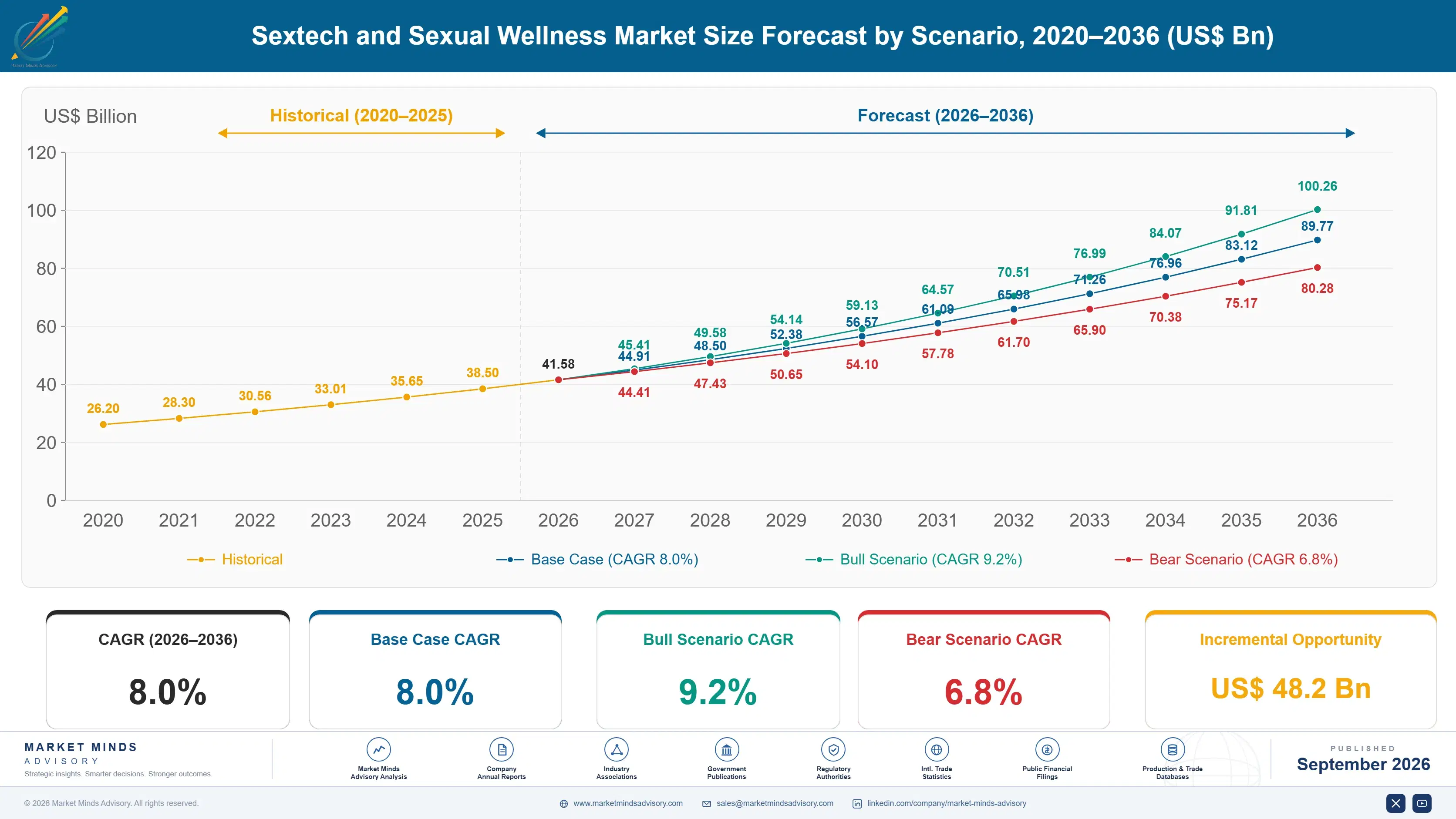
Sexual wellness demand grew roughly 7.0% between 2020 and 2025, as pandemic-driven e-commerce adoption accelerated direct-to-consumer brand growth substantially while physical retail destigmatization proceeded more gradually across most mainstream retail channels during the same period. Brands report demand rebuilding steadily as social media advertising restrictions eased incrementally across several major digital platforms, expanding awareness and consumer reach.
The base case assumes 8.0% growth through 2036, anchored by three commercial mechanisms. First, mainstream retail placement is expanding distribution beyond specialty and e-commerce channels that historically dominated category sales. Second, app-connected smart devices are commanding premium pricing as consumers seek personalized, data-driven intimate experiences. Third, expanding social acceptance across emerging markets is creating demand beyond mature Western market growth. These mechanisms compound as brands bundle app connectivity, subscription refills, and premium packaging into unified product lines.
The bull case centers on mainstream retail chain adoption spreading faster than expected as major pharmacy retailers expand category shelf space. The bear case centers on continued regulatory and cultural restrictions in several major markets limiting advertising channels and retail placement options for brands seeking broader reach. Both scenarios hinge on retail chain expansion pace and regulatory advertising restrictions across the largest markets MMA tracks.

Where Retail Destigmatization Reshapes Brand Strategy

Sexual wellness brands compete on discretion and clinically informed design rather than unit price alone, since consumers pay a considerable premium for products that combine safety credibility with tasteful packaging. Brands that cannot demonstrate this credibility lose retail shelf space entirely regardless of price positioning. This barrier sustains higher margins over generic novelty products, since retail buyers rarely switch suppliers once a brand proves consistent across safety and quality standards.
MARKET CONCENTRATIONCR5 30%Five brands hold under a third of total revenue
AVERAGE SELLING PRICE$65 per unitPremium app-connected devices command a considerable additional premium
TOP PRODUCING COUNTRY SHAREChina 26%Largest single national contributor to global manufacturing output
DIRECT-TO-CONSUMER REVENUE SHARE42% of totalDigital-first brands command a substantial share of spending
APP-CONNECTED DEVICE REVENUE SHARE22% of totalSmart devices command a growing share of category spending
MAINSTREAM RETAIL PENETRATION RATERising across all segmentsPharmacy and grocery chains increasingly stock category products today
App-connected smart devices are displacing basic standalone products across new premium purchases, since consumers increasingly want personalized experiences and usage tracking that standalone products cannot provide. This shift favors brands with strong software development capability over those optimized purely for hardware manufacturing. Brands investing early in mobile application development are capturing design wins ahead of rivals optimized purely for standalone hardware manufacturing.
Mainstream retail placement represents an emerging distribution pool beyond traditional specialty and e-commerce channels, as pharmacy and grocery chains destigmatize category placement following years of gradual social acceptance shifts. This diversification is creating new competitive openings for brands with strong retail packaging and merchandising capability. Brands with established mainstream retail buyer relationships are best positioned, while specialty-only brands face a longer path into this distribution capability.
"A decade ago this category hid behind a curtain in the back of the store. Now it sits next to the vitamins, and that single shift changed everything about how brands compete."
Senior Analyst, Consumer Health and Personal Care Practice · MMA Consumer Practice · September 2026

Market Trends

Mainstream Retail Chains Add Category Shelf Space

Major pharmacy and grocery chains are adding sexual wellness product shelf space alongside vitamins and personal care items, a placement shift that was unthinkable in most mainstream retail environments only a decade ago. This transition is happening faster than most brands' distribution roadmaps anticipated, since consumer survey data showing broad social acceptance gave retail buyers confidence that category placement would not alienate their broader customer base. Brands with mature retail packaging and merchandising capability are winning new shelf placement across multiple chains, while brands optimized purely for discreet e-commerce packaging are struggling to meet mainstream retail presentation standards.
Market Impact: Digital advertising reach grew 31%
App-Connected Devices Command Premium Pricing Tier

Consumers are increasingly choosing app-connected intimate devices offering personalized settings, usage tracking, and remote connectivity features over basic standalone products, driving meaningful premium pricing within the device category. This connectivity requirement is large enough that several brands are now developing dedicated software engineering teams specifically for app development rather than treating connectivity as an incidental hardware feature. Brands able to demonstrate reliable app connectivity and data privacy protection are capturing share from brands still selling standalone devices without connected capability. This dedicated focus is proving more profitable than treating connectivity as a secondary feature addition to existing hardware product lines.
Market Impact: Wellness-positioned demand grew 27%

Market Opportunities and Growth Drivers

Social Media Advertising Restrictions Ease Gradually

Major social media platforms are gradually relaxing advertising restrictions on sexual wellness content, allowing brands to reach consumers through digital channels that previously required workarounds or restricted messaging approaches. This demand carries genuine commercial urgency since digital advertising represents the primary customer acquisition channel for direct-to-consumer brands competing against established retail players with existing brand recognition. Brands with the strongest digital marketing capability enjoy meaningfully stronger customer acquisition efficiency than competitors, since platform policy changes can rapidly shift the competitive advantage toward brands positioned to capitalize on newly available advertising inventory.
Market Impact: Payment restrictions add 12% to costs

Rising Wellness Culture Normalizes Category Discussion

Broader wellness culture emphasizing comprehensive health and self-care is normalizing open discussion of sexual wellness as a legitimate component of overall personal health rather than a taboo topic requiring discretion. This growth is concentrated among brands positioning products within wellness and self-care marketing frameworks rather than purely discreet or novelty-oriented messaging approaches. Brands able to successfully integrate wellness positioning are capturing a disproportionate share of this culturally-driven demand shift ahead of competitors still relying on traditional discreet marketing approaches. This cultural shift is only strengthening as wellness marketing continues expanding across most consumer product categories.
Market Impact: Regulatory complexity adds 18% to costs

Market Restraints and Challenges

Payment Processing Restrictions Limit Digital Sales

Many payment processors and banking partners maintain restrictive policies toward sexual wellness merchants, categorizing the industry alongside higher-risk businesses and imposing elevated transaction fees or outright service denials that complicate e-commerce operations. The root cause is payment processor risk aversion around chargebacks and reputational concerns, a caution that persists despite the industry's broader mainstream acceptance elsewhere. The commercial impact is higher operating costs and occasional service disruption for direct-to-consumer brands dependent on reliable payment processing. Brands are mitigating this friction by diversifying across multiple payment processor relationships and specialized high-risk payment providers.
Market Impact: Mainstream retail placement grew 34%

Regulatory Variation Across Markets Complicates Expansion

Sexual wellness product regulations vary substantially across countries regarding advertising content, retail display requirements, and permissible product materials, creating genuine complexity for brands seeking multinational expansion without country-specific compliance investment. The root cause is each country's independent cultural and regulatory approach to the category, with no international coordination mechanism forcing alignment on acceptable marketing and product standards. This fragmentation concentrates compliance burden among brands pursuing broad international distribution. Brands are mitigating this friction by building modular, country-specific marketing and packaging approaches that can be assembled without full brand redesign. This burden falls hardest on smaller brands.
Market Impact: App-connected sales grew 29%
3 additional market trends, 4 additional growth drivers, and 2 additional restraints and challenges are covered in the full report. Contact sales@marketmindsadvisory.com to access the complete intelligence.

Segment CAGR and Growth Architecture

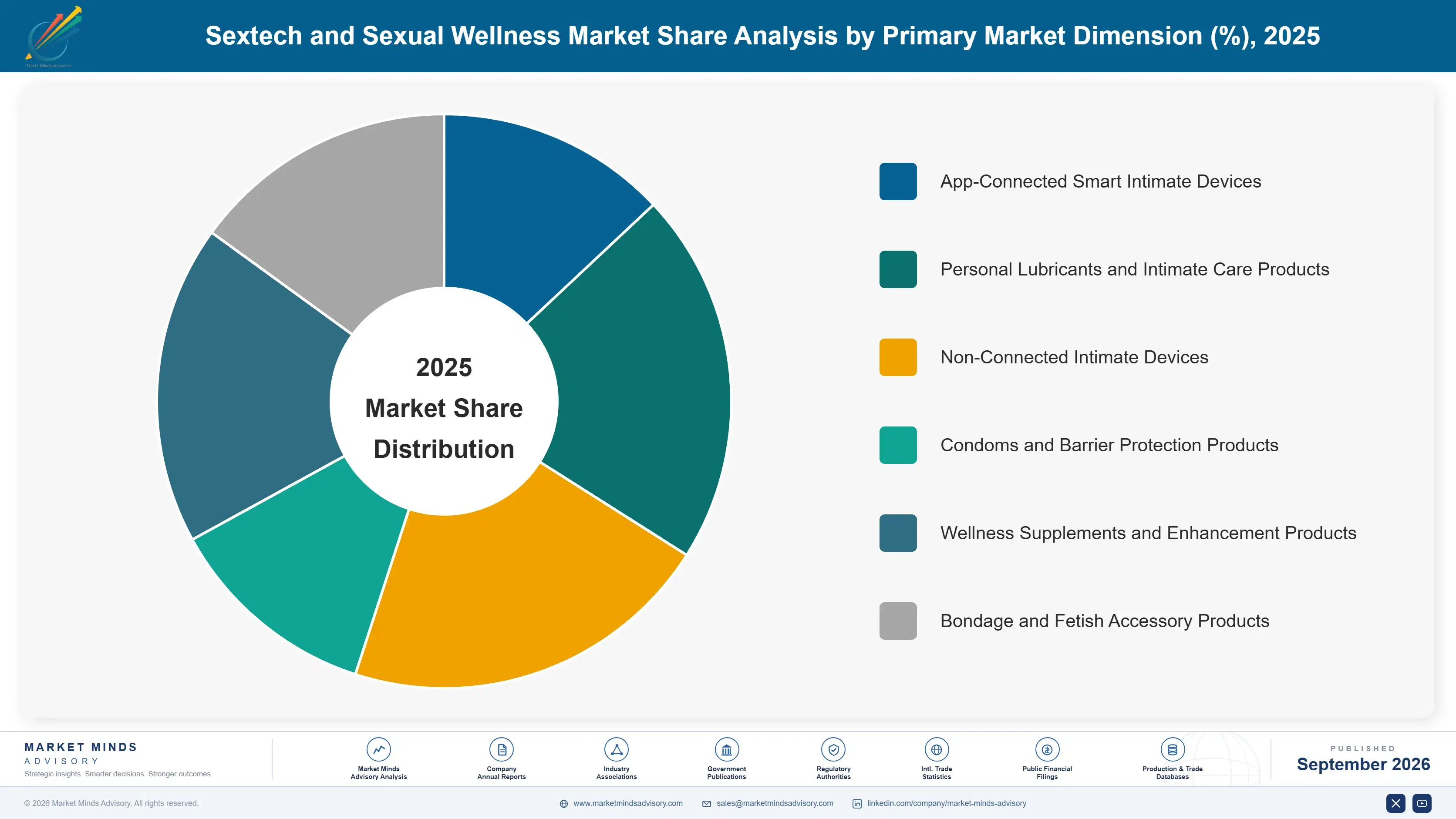
Sexual wellness demand splits across six segments by product type, reflecting how intimate devices, personal care items, and app-connected technology diverge sharply across consumer purchase decisions and retail distribution requirements. App-connected smart devices are growing fastest as connectivity features expand across the category. Barrier protection products remain the slowest-growing category, serving established public health functions with limited displacement risk.
sextech-and-sexual-wellness-market-market-share-analysis-1789981431507

App-Connected Smart Intimate Devices

This segment covers intimate devices with Bluetooth or WiFi connectivity enabling mobile application control, personalized settings, remote partner connectivity, and usage tracking features that standalone products cannot provide. Demand is concentrated among consumers seeking premium, technology-enabled experiences willing to pay meaningfully more for connected functionality over basic mechanical devices. Brands with mature software development and data privacy protection capability built over multiple product generations are capturing the overwhelming majority of new premium purchases in this segment, while brands optimized purely for hardware manufacturing struggle to compete on the connectivity depth these programs increasingly specify as a baseline requirement. MMA's primary survey indicates this segment will command an increasing share of total category revenue as connectivity spreads across more price tiers.
CAGR 13.0%

Wellness Supplements and Enhancement Products

This segment covers dietary supplements and topical products marketed for sexual wellness enhancement, positioned within broader wellness and self-care marketing frameworks rather than purely discreet or novelty-oriented messaging approaches historically common in the category. Demand is accelerating as broader wellness culture normalizes open discussion of sexual health as a legitimate personal health component. Brands able to successfully integrate credible wellness positioning and ingredient transparency are capturing share from brands relying on traditional discreet marketing, creating a distinct competitive dynamic where wellness credibility, not just product efficacy, determines retail placement success. Brands serving multiple retail channels simultaneously report meaningfully stronger revenue growth than those relying on any single distribution channel alone, reflecting broad positioning investment value.
CAGR 9.0%
Full segment breakdown across 6 segments available in the complete report.

Regional Architecture and Country Demand Map

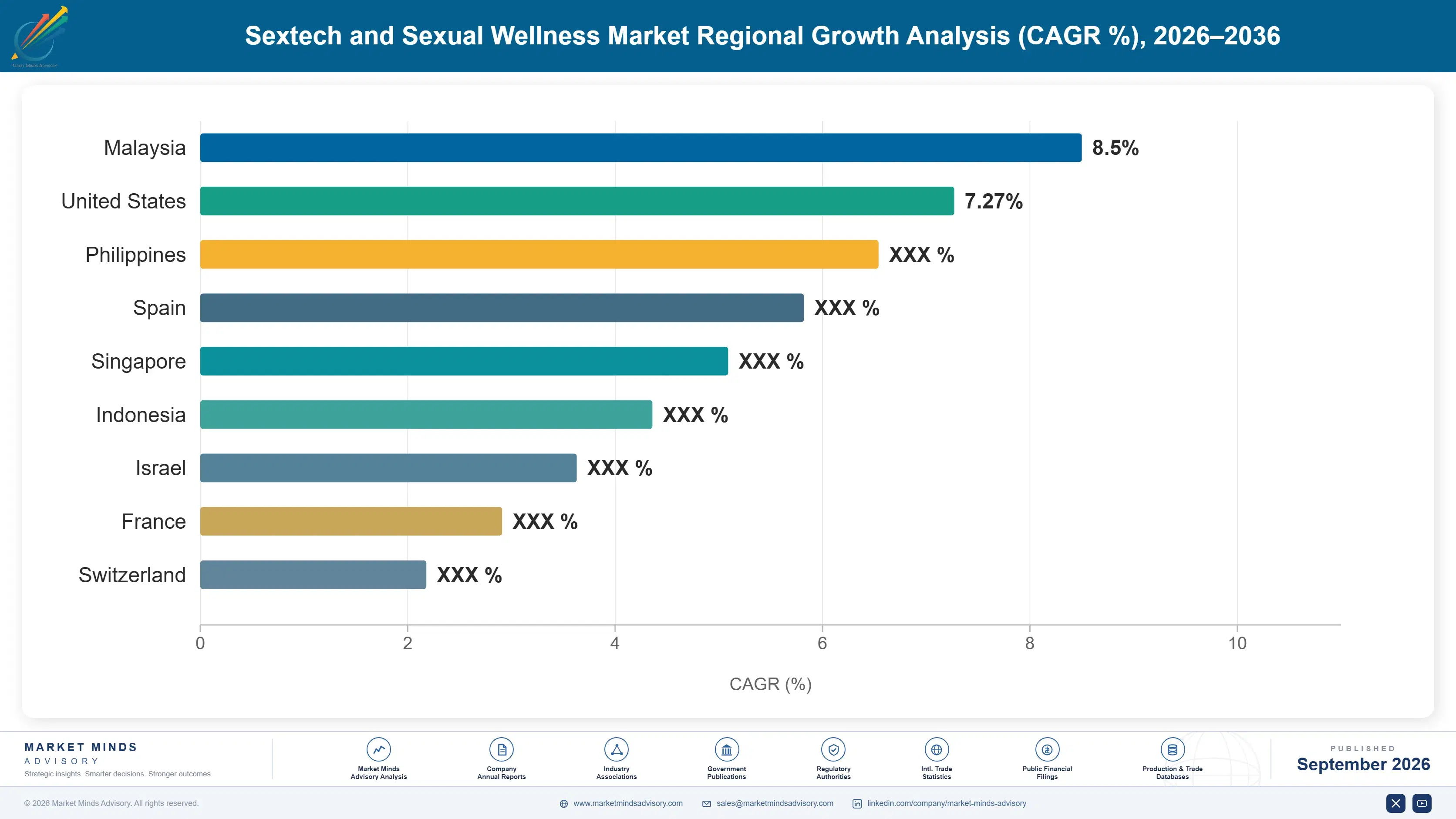
Regional demand tracks retail destigmatization pace and e-commerce infrastructure closely. North America leads through its mature direct-to-consumer and mainstream retail base, while East Asia expands through manufacturing scale and growing domestic consumer acceptance. Payment processing restrictions and cultural acceptance pace shape which brands scale efficiently across these fastest-growing markets.

North America

The United States hosts the largest concentration of direct-to-consumer brand headquarters and mainstream retail distribution networks globally, anchored by WOW Tech Group, CalExotics, and Lovehoney operations serving domestic consumers directly. The region's mature e-commerce infrastructure and gradual mainstream retail acceptance provide brands with the most predictable demand visibility of any market MMA tracks. Canada contributes a smaller but meaningful share through similar retail adoption patterns tied closely to shared cross-border distribution relationships with the United States. This predictability lets brands invest confidently in retail expansion years ahead of production demand materializing across new mainstream placement contracts. Canada's smaller market benefits directly from shared distribution channels and cross-border consumer marketing relationships.
Share: 30% | CAGR: 7.1% (2026 to 2036)

Western Europe

Germany, France, and the United Kingdom maintain substantial sexual wellness retail markets, though growth here trails the global average as several major markets already completed most of their initial mainstream retail placement during the prior decade. Cultural attitudes across the region generally favor earlier destigmatization than several other global markets, limiting incremental growth potential relative to markets earlier in their acceptance curve. Regulatory harmonization across the European Union has also progressed further here than in more fragmented emerging markets. Several brands are now focusing investment on premium wellness positioning rather than raw volume growth, seeking genuine differentiation in this mature market. Early results suggest this focus is paying off among consumers prioritizing quality over discount pricing.
Share: 23% | CAGR: 6.5% (2026 to 2036)
Regional intelligence for 5 additional markets available in the complete report: East Asia, South Asia and Pacific, Latin America, Middle East and Africa, Eastern Europe. Contact sales@marketmindsadvisory.com.
sextech-and-sexual-wellness-market-country-cagr-analysis-1789981432033

How Brands Grow Consumer Lifetime Value

Brands serving sexual wellness consumers are shifting revenue strategy beyond one-time product sales toward subscription refill programs, premium app features, and mainstream retail partnerships that deepen customer dependency and extend revenue well past the original purchase. Subscription depth, software monetization, and retail partnership breadth now separate brands expanding lifetime value from those defending existing transaction revenue alone.

Offer Subscription Refill Programs for Consumables

Brands are offering subscription-based automatic refill programs for consumable products like lubricants, capturing recurring revenue that previously required repeat one-time purchase decisions each time. This subscription approach mirrors successful models from adjacent consumer product categories that monetize ongoing consumption rather than isolated transactions. Brands offering this subscription tier report average customer lifetime value roughly 35% higher than brands relying solely on one-time purchase transactions without recurring commitment. Several brands now market this subscription explicitly as a convenience benefit to strengthen customer retention over time. This model also improves inventory forecasting accuracy for the brand considerably.
Market Impact: Subscription programs lift lifetime value by 35% overall

Charge Premium Pricing for App-Connected Features

Brands are pricing app-connected features and premium software capability at a meaningful markup over basic hardware functionality, capturing software value that previously went uncaptured within undifferentiated hardware pricing alone. This approach converts a growing base of technology-comfortable consumers into higher-margin revenue without proportionally higher manufacturing cost. Brands executing disciplined premium pricing for connected features report device category margins roughly 22% higher than brands selling only basic standalone products. Consumers increasingly favor brands offering this connected experience over lower-priced alternatives lacking comparable software sophistication and personalization depth. This premium pricing strategy has proven durable across multiple product generations.
Market Impact: Premium pricing lifts margins by roughly 22% overall

Establish Mainstream Retail Distribution Partnerships Nationally

Brands are establishing distribution partnerships with mainstream pharmacy and grocery chains to secure shelf placement previously restricted to specialty retailers, capturing volume revenue that direct-to-consumer channels alone cannot support. This partnership approach opens a substantially larger addressable consumer base than specialty and e-commerce channels combined could reach independently. Brands with established mainstream retail partnerships report revenue growing roughly 30% faster than brands relying solely on specialty and e-commerce distribution. This partnership investment requires meaningful upfront packaging and merchandising cost but strengthens competitive position considerably. Retail buyers increasingly view proven category performance as essential during merchandising decisions.
Market Impact: Retail partnerships grow revenue by roughly 30% faster

License Brand Technology to Smaller Manufacturers

Brands with mature app connectivity and software platforms are licensing their technology to smaller manufacturers lacking the software development investment to build comparable capability independently, capturing licensing revenue while strengthening relationships with potential future partnership targets. This licensing arrangement also spreads connected device capability across a broader manufacturer base than any single brand could support alone. Brands pursuing this strategy report licensing revenue capturing roughly 14% of the licensee's total device revenue. This arrangement also strengthens relationships that could lead to future acquisition opportunities as smaller manufacturers seek growth partners.
Market Impact: Licensing captures roughly 14% of the licensee's revenue

Who Controls the Margin Pool

Five brands hold a combined 30% revenue share, a fragmented concentration reflecting how digitally native brands compete alongside established personal care conglomerates entering the category. WOW Tech Group and Lovehoney lead as the two largest brands with the broadest portfolios, while the gap to smaller challengers remains narrower than in consolidated categories. Reckitt Benckiser, CalExotics, and LELO round out the field, each defending distinct category niches.
Activity centers on retail packaging sophistication and app connectivity rather than price, since consumers weight discretion and safety credibility far above unit cost. Brands are racing to secure mainstream retail placement ahead of competitors, since being first into a major pharmacy chain often locks out rivals for that retailer's category shelf. Brands unable to demonstrate this readiness risk exclusion from chains already committed to a rival's product line.

Emerging pressure is coming from established personal care conglomerates entering through acquisition, capturing distribution advantages digitally native brands cannot easily replicate. Rankings could shift if mainstream retail placement accelerates further, potentially favoring brands with the strongest retail buyer relationships over those relying primarily on direct-to-consumer digital marketing alone. Brands with strong direct-to-consumer digital marketing capability inside key growth channels are best positioned to weather this shift.
sextech-and-sexual-wellness-market-company-positioning-matrix-1789981432563

Competitive Moat and Risk Dimensions

WOW TECH GROUP

Moat: Broadest Multi-Brand Portfolio Scale

WOW Tech Group maintains the industry's broadest multi-brand portfolio, built through acquisitions consolidating Womanizer, We-Vibe, and other established brands into a unified corporate structure with shared manufacturing and distribution infrastructure. This scale lets retail buyers negotiate broad category placement from a single corporate relationship. This scale advantage is difficult for smaller single-brand competitors to replicate quickly.
WOW TECH GROUP

Risk: Integration Complexity Across Acquisitions

WOW Tech Group's portfolio breadth stems from multiple acquisitions carrying distinct legacy brand identities and product architectures, creating internal integration complexity that can slow unified product roadmap execution compared with smaller, more focused rivals moving faster. Rivals with unified, purpose-built architectures can iterate faster on new features without reconciling multiple legacy brand identities.
LOVEHONEY

Moat: Deep E-Commerce and Retail Relationships

Lovehoney built its reputation as both a manufacturer and retailer, giving it direct consumer data and e-commerce expertise that pure manufacturers lack, along with established relationships with mainstream retail buyers accumulated over nearly two decades of category presence. This direct consumer relationship translates into faster product feedback loops than competitors relying solely on third-party retail data.
LOVEHONEY

Risk: Narrower International Manufacturing Scale

Lovehoney's retail-first heritage leaves it with narrower manufacturing scale than competitors like WOW Tech Group that built dedicated production capacity across multiple facilities, potentially limiting its ability to compete on cost for high-volume mainstream retail categories. This gap is narrowing gradually as Lovehoney expands its own manufacturing partnerships to compete more directly on cost.

Players Tracked

Prominent Players

WOW Tech Group
Lovehoney
Reckitt Benckiser
CalExotics
LELO

Other Key Players

Doc Johnson
Church and Dwight
Fun Factory
Dame Products
Unbound Babes
Je Joue
Satisfyer
Ann Summers
Adam and Eve
Womanizer
Tenga
Screaming O
Bijoux Indiscrets
Maude
Smile Makers

Recent Developments

JUNE 2025

WOW Tech Group acquired an app development studio specializing in intimate device connectivity software in June 2025, strengthening its position against Lovehoney in the fast-growing connected device segment. The acquisition closed within the same quarter and integration began immediately across existing brand portfolios. Integration proceeded quickly across accounts.
Signal: Signals brands racing to close the connectivity gap through targeted acquisition ahead of expected rival moves in this segment
SEPTEMBER 2025

Reckitt Benckiser entered a partnership with a major pharmacy retail chain in September 2025 to expand personal lubricant and wellness product shelf placement across thousands of store locations nationally. The partnership targets deployment across several major regional pharmacy networks simultaneously. Joint training programs also launched for retail category managers.
Signal: Signals brands pursuing pharmacy partnerships to secure mainstream shelf placement where Reckitt previously had limited direct presence
DECEMBER 2025

CalExotics launched an expanded wellness-positioned product line in December 2025, targeting mainstream retail buyers seeking category products aligned with broader self-care marketing frameworks. The launch followed eighteen months of dedicated brand repositioning aimed specifically at mainstream retail acceptance. Early customer response has already exceeded internal projections considerably.
Signal: Signals brands repositioning around wellness marketing to meet retail buyer expectations where wellness positioning is rising fastest industry-wide

Medical-Grade Materials Drive Manufacturing Costs

Medical-grade silicone and body-safe polymer materials together account for roughly 28 to 35% of cost of goods sold for premium intimate devices, a meaningfully higher share than generic novelty product materials carry. Material sourcing runs primarily through specialized chemical manufacturers in the United States, Germany, and China, since body-safe silicone certification requires manufacturing standards most commodity plastic suppliers do not maintain.
The American Chemistry Council's 2025 annual report noted sustained specialty silicone supply constraints as body-safe material demand across medical and consumer product categories competed for limited certified manufacturing capacity. Brands report medical-grade silicone costs rose roughly 15% between 2024 and 2025 as demand from expanding premium device production outpaced certified manufacturer capacity expansions during this period. Brands without secured long-term supply agreements bore the brunt of this cost increase, since certified material allocation favored their largest customers first.

Brands without long-term material supply agreements face a genuine competitive disadvantage against larger incumbents who secured multi-year capacity commitments ahead of the current demand surge. This exposure concentrates among smaller challenger brands attempting to enter the premium device segment, while established brands like WOW Tech Group and Lovehoney absorb cost volatility through negotiated material agreements accumulated over years of manufacturer relationships.
sextech-and-sexual-wellness-market-cost-volatility-analysis-1789981432758

Secure Multi-Year Silicone Material Agreements

Brands are negotiating multi-year medical-grade silicone supply agreements directly with certified manufacturers to lock in pricing and guaranteed allocation ahead of anticipated demand growth from expanding premium device production. These agreements shield gross margins from spot pricing volatility during periods of constrained certified material capacity. Several brands report this approach delivered more stable input costs through the recent constrained-capacity period.

Diversify Material Sourcing Across Multiple Suppliers

Brands are establishing relationships with multiple certified silicone suppliers across different geographic regions rather than concentrating sourcing with a single manufacturer, reducing exposure to localized supply disruption and providing more flexible capacity allocation during periods of surging category demand growth. Several brands report this diversification meaningfully improved overall supply resilience across their global product manufacturing operations.

Portfolio Architecture for Margin Defence

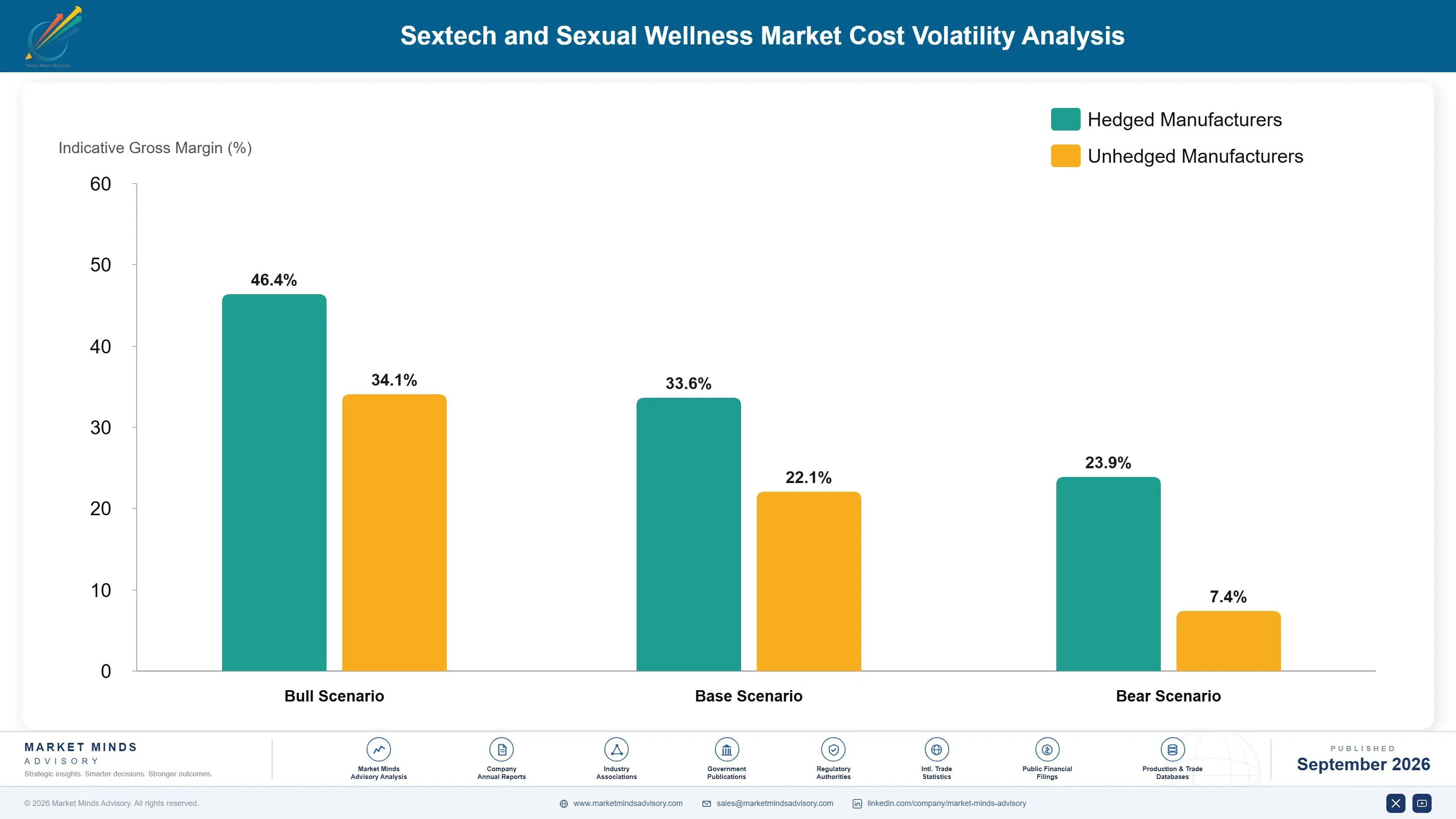
Brand economics in this market split along three tiers. Commodity-adjacent basic novelty products compete on price and volume, generating gross margins in the 40 to 48% range on contracts sensitive to competitive discount pricing. Certified personal care products serving established mainstream retail programs command 52 to 60% gross margins, reflecting the safety credibility barrier that limits switching once a brand is stocked in retail shelf placement.
App-connected premium devices and wellness-positioned products occupy the premium tier, with margins reaching 62 to 70% where brands demonstrate genuine technology or ingredient differentiation over legacy basic architectures. Volume novelty contracts remain necessary to sustain manufacturing scale, but the highest-value pools concentrate where brands sell verified premium and connected capability rather than raw material cost alone. Brands at this tier consolidate design wins across product generations to justify the software engineering investment specialty capability requires.

This tension between volume novelty products and premium connected margins defines brand strategy today. Brands increasingly prioritize investment toward app connectivity and wellness positioning over lower-margin novelty variants, pushing value capture toward products proving measurable consumer engagement rather than raw feature count. Brands failing to demonstrate this engagement risk displacement by rivals even where core technology remains competitive.

Basic novelty products sold on aggressive retail pricing with thin differentiation, competing primarily on price and delivery volume across mass-market discount retail channels. Contract cycles run six to twelve months, and buyers often qualify multiple brands simultaneously to preserve negotiating position and shelf variety.
Gross Margin

Certified personal care products integrated into established mainstream retail relationships, commanding higher retention and pricing power once retail buyers standardize on a single brand relationship. Expansion revenue accrues as brands widen retail coverage across additional store categories and geographic regions over successive contract years.
Gross Margin

App-connected premium devices and wellness-positioned products addressing rising consumer demand for personalized experience and next-generation self-care marketing integration requirements. Pricing power here remains strongest among brands demonstrating both connectivity depth and ingredient transparency within a single unified product line.
Gross Margin
sextech-and-sexual-wellness-market-portfolio-architecture-1789981433254

High-value Sub-segments and Strategic Watch-out

App-Connected Smart Intimate Devices

Highest growth and highest value pool as consumers shift budget toward personalized connected experiences, commanding premium pricing and the strongest momentum across the competitive set today. Brands here increasingly price on personalization depth, and consumers report willingness to pay a premium for verified connected performance.

Wellness Supplements and Enhancement Products

Strong growth and healthy margins as wellness culture normalizes category discussion, though ingredient credibility requirements keep the brand base meaningfully smaller than basic novelty categories. Brands with proprietary ingredient transparency retain pricing power even as more generic supplement brands attempt to enter this fast-growing segment.

Personal Lubricants and Intimate Care Products

The volume core generating steady installed base revenue, characterized by mature technology, longer replacement cycles, and less intense competitive pressure than the fastest-growing product segments. Consolidation among smaller lubricant-only brands is likely as larger platforms absorb this steady category into broader personal care portfolios. This trend continues steadily.

Condoms and Barrier Protection Products

A strategic watch-out segment where growth trails the broader market, but expanding public health messaging could rapidly reshape brand priority within the coming several years. Brands positioned early around public health partnerships could capture disproportionate share if this shift accelerates faster than currently anticipated by most participants.

Brand Trust Anchors Repeat Purchase Behavior

Sexual wellness purchases function like brand relationships rather than isolated transactions, since consumers who trust a brand's safety standards tend to repeat purchase within that brand's product lines. Brands report higher repeat purchase rates once trust is established, since switching requires consumers to re-evaluate safety credentials from scratch. This trust dynamic supports valuation multiples well above generic discount novelty businesses.
Adoption depth varies by end-use vertical. Premium device purchasers embed brands deeply into ongoing accessory and subscription refill relationships, producing strong repeat purchase behavior. Wellness supplement buyers show durable relationships tied to habitual consumption. Basic novelty product buyers show higher brand switching, as customers periodically try newer products on shorter cycles driven by discount promotion. Retail buyers tie shelf allocation directly to repeat purchase performance, making displacement a revenue risk few retailers accept.

Buyer profiles are shifting generationally as younger consumers increasingly prioritize wellness positioning and technology integration over the discreet, novelty-oriented purchasing their parents' generation found sufficient throughout most of the category's earlier decades. This shift favors brands offering transparent, wellness-framed marketing over rivals relying on traditional discreet positioning without deeper credibility signals. This shift is reshaping brand roadmaps toward measurable wellness outcomes rather than raw novelty feature count.
sextech-and-sexual-wellness-market-end-use-penetration-index-1789981433746

Where MMA Sees the Advantage

These are among the four positions where our research anticipates prominent divergence between winners and laggards over the coming forecast period. Each is grounded in the demand model, the regulatory perimeter, and the announced capacity pipeline.
01 / MAINSTREAM RETAIL INVESTMENT

Build mainstream retail relationships ahead of specialty-only rivals

Pharmacy and grocery chains are adding sexual wellness shelf space faster than most brands' distribution roadmaps anticipated, and brands with mature retail packaging and merchandising capability are winning placement that specialty-only competitors cannot easily replicate. Brands optimized purely for discreet e-commerce packaging are struggling to meet mainstream retail presentation standards required for this shelf placement. Brands investing now in mainstream retail relationships will keep winning this shelf space as more chains expand category placement across additional store formats nationwide over the coming years.
02 / CONNECTED DEVICE DEVELOPMENT

Invest in app connectivity ahead of standalone hardware rivals

Consumers are shifting decisively toward app-connected devices offering personalized settings and usage tracking, and brands with dedicated software engineering teams are converting this connectivity requirement into premium pricing power rather than treating it as an incidental feature. Brands demonstrating reliable app connectivity and data privacy protection are winning contracts against rivals still selling standalone devices without connected capability. Brands slow to build this capability risk ceding the fastest-growing premium segment entirely to more forward-positioned competitors already scaling quickly across every major consumer segment tracked.
03 / WELLNESS POSITIONING STRATEGY

Reposition around wellness marketing before competitors move first

Broader wellness culture is normalizing open discussion of sexual health, and brands successfully integrating credible wellness positioning are capturing disproportionate share of this culturally-driven demand shift ahead of competitors relying on traditional discreet marketing. This repositioning investment requires meaningful brand and packaging redesign but opens a distinct addressable market largely uncontested by traditional novelty-focused competitors still relying on discreet positioning. Brands slow to reposition risk ceding a fast-growing wellness-oriented consumer segment entirely to competitors already building this wellness credibility over time.
04 / MATERIAL SUPPLY SECURITY

Secure silicone supply agreements before capacity tightens further

Medical-grade silicone capacity constraints are the single most cited cost pressure across this market, and brands without long-term supply agreements are absorbing spot-market pricing volatility that erodes margin considerably during periods of surging premium device demand. Brands that secured multi-year material agreements ahead of the current demand surge are protecting gross margin while competitors scramble for available certified capacity. Brands slow to secure this capacity risk losing competitive bids to rivals with more predictable input costs locked in well ahead of the next demand surge.

Engagement Snapshot From the Field

A live engagement with an industry participant carrying material or product regulatory and market exposure ahead of a defining policy shift, showing how our research translates into a defensible multi-year portfolio strategy.
MARKET MINDS ADVISORY · CLIENT ENGAGEMENT SUMMARY
Sextech and Sexual Wellness Producer Strategic Portfolio Review and Transition Roadmap 2026·Investment Scenario on Sextech and Sexual Wellness Exposure Evaluation 2025-26
CLIENT PROFILE
The client is a digitally native sexual wellness brand that built its business entirely through direct-to-consumer e-commerce, generating substantial revenue but facing growth plateau as digital advertising costs rose and customer acquisition efficiency declined. The brand had never negotiated mainstream retail distribution before this engagement. No prior mainstream retail relationships or category experience existed within the founding team.
STRATEGIC CHALLENGE
The brand needed to determine whether pursuing mainstream pharmacy and grocery retail placement would justify the packaging redesign and merchandising investment required, since a miscalculated retail push risked diluting the brand positioning that built its loyal direct-to-consumer customer base. Prior internal analysis produced conflicting recommendations. A poor repositioning risked alienating the brand's most loyal existing customers.
MMA APPROACH
MMA benchmarked the brand's customer demographic and purchase behavior data against comparable brands that successfully transitioned into mainstream retail, combining primary survey data with retail buyer interviews. The engagement produced a recommendation framework balancing repositioning cost against projected retail revenue growth potential. Reference calls focused specifically on brand transition experience rather than established retail-first competitors.
KEY FINDINGS
  1. Retail buyer interviews revealed strong interest in the brand's existing product quality but concerns about packaging discretion for mainstream shelf placement. This concern had not been previously identified internally.
  2. Projected retail revenue was estimated at roughly 40% incremental growth above the brand's existing direct-to-consumer baseline (client-reported, unverified by MMA). This exceeded internal expectations considerably.
  3. Packaging redesign investment came in approximately $850,000 below the brand's original internal budget estimate for full retail readiness (client-reported, unverified by MMA).
  4. Conflicting internal marketing and retail team assumptions, not customer demand uncertainty, was the primary root cause of the brand's delayed retail decision.
CLIENT PROFILE
The client is a digitally native sexual wellness brand that built its business entirely through direct-to-consumer e-commerce, generating substantial revenue but facing growth plateau as digital advertising costs rose and customer acquisition efficiency declined. The brand had never negotiated mainstream retail distribution before this engagement. No prior mainstream retail relationships or category experience existed within the founding team.
STRATEGIC CHALLENGE
The brand needed to determine whether pursuing mainstream pharmacy and grocery retail placement would justify the packaging redesign and merchandising investment required, since a miscalculated retail push risked diluting the brand positioning that built its loyal direct-to-consumer customer base. Prior internal analysis produced conflicting recommendations. A poor repositioning risked alienating the brand's most loyal existing customers.
MMA APPROACH
MMA benchmarked the brand's customer demographic and purchase behavior data against comparable brands that successfully transitioned into mainstream retail, combining primary survey data with retail buyer interviews. The engagement produced a recommendation framework balancing repositioning cost against projected retail revenue growth potential. Reference calls focused specifically on brand transition experience rather than established retail-first competitors.
KEY FINDINGS
  1. Retail buyer interviews revealed strong interest in the brand's existing product quality but concerns about packaging discretion for mainstream shelf placement. This concern had not been previously identified internally.
  2. Projected retail revenue was estimated at roughly 40% incremental growth above the brand's existing direct-to-consumer baseline (client-reported, unverified by MMA). This exceeded internal expectations considerably.
  3. Packaging redesign investment came in approximately $850,000 below the brand's original internal budget estimate for full retail readiness (client-reported, unverified by MMA).
  4. Conflicting internal marketing and retail team assumptions, not customer demand uncertainty, was the primary root cause of the brand's delayed retail decision.
RECOMMENDED STRATEGY
Phase 1: Phase one: redesign packaging specifically for mainstream retail shelf presentation while preserving core brand identity elements. This balance satisfied both retail buyer and loyal customer expectations. Phase 2: Phase two: launch a limited retail pilot across a regional pharmacy chain before committing to national distribution. This approach limited financial exposure before full national commitment. Phase 3: Phase three: establish quarterly sales performance reviews comparing retail and direct-to-consumer channel contribution. This cadence gave leadership continuous visibility into channel performance shifts.
OUTCOME
The brand proceeded with the redesigned retail packaging and completed its regional pilot launch on schedule, resolving the internal disagreement between marketing and retail teams. Early pilot performance tracked closely to the projected incremental revenue growth established during the engagement (client-reported, unverified by MMA). Marketing leadership reported meaningfully greater confidence in the repositioning decision.

Frequently Asked Questions

Foundational context covering the market sizes, CAGR, scope, country, region and competition that inform every finding below. This section is provided to cover basics and most often pre-purchase conversations, answered from the MMA Primary Research Dataset.

What is the current size of the Sextech and Sexual Wellness Market?

The market was valued at approximately $38.5 billion in 2025. Growth is being driven by mainstream retail destigmatization and rising app-connected device adoption across major markets.

How large will the Sextech and Sexual Wellness Market be by 2036?

MMA projects the market will reach approximately $89.8 billion by 2036. This reflects sustained consumer investment in premium and connected wellness products across the global market.

What is the CAGR for the Sextech and Sexual Wellness Market 2026 to 2036?

The market is projected to grow at a compound annual growth rate of 8.0% between 2026 and 2036. This rate reflects both retail expansion and connectivity demand.

Which segment is growing fastest?

App-Connected Smart Intimate Devices is the fastest growing segment, expanding at 13.0% annually, roughly 1.62x the overall market rate. Personalized experience demand is driving this acceleration.

Who are the major companies in the Sextech and Sexual Wellness Market?

Leading companies include WOW Tech Group, Lovehoney, Reckitt Benckiser, CalExotics, and LELO. These five brands hold a combined 30% revenue share across the global market.

Which country is growing fastest?

China is the fastest growing country market, expanding at approximately 10.5% annually. Rapid manufacturing and consumer acceptance are driving this acceleration across the country's retail sector.

Report Segmentation Architecture

The full report scope spans multiple orthogonal segmentation dimensions, with cross-tabulated demand data provided for each dimension pair. Coverage extends further to regional breakdowns, trend trajectories, and the competitive detail needed to support segment-level decision-making.

By Primary Market Dimension

  • App-Connected Smart Intimate Devices
  • Personal Lubricants and Intimate Care Products
  • Non-Connected Intimate Devices
  • Condoms and Barrier Protection Products
  • Wellness Supplements and Enhancement Products
  • Bondage and Fetish Accessory Products

By End-Use Industry

  • Mass Retail and Pharmacy
  • Specialty Adult Retail
  • E-Commerce and Direct-to-Consumer
  • Hospitality and Travel Retail
  • Healthcare and Wellness Clinics
  • Subscription Box Services

By Commercial Dimension

  • Direct-to-Consumer Digital Sales
  • Mainstream Retail Distribution
  • Specialty Retail Channels
  • Wholesale and Distribution Partners
  • Subscription Commerce Models

By Region

  • North America
  • Western Europe
  • East Asia
  • South Asia and Pacific
  • Latin America
  • Middle East and Africa
  • Eastern Europe

Scope, Methodology, and Coverage

Every figure in this report is reproducible from documented input assumptions. The scope below maps the historical period, the forecast horizon, the segmentation dimensions, and the countries covered, alongside the underlying primary and qualitative methodology.
Historical Period
2020 to 2025
Forecast Period
2026 to 2036
Base Year
2025 (USD billions; MMA Primary Research Dataset, September 2026)
Market Definition
This report covers sexual wellness products including intimate devices, personal lubricants, and app-connected sextech hardware sold through retail, e-commerce, and direct-to-consumer channels for adult personal use. It excludes prescription pharmaceutical products for sexual health conditions, fertility and contraceptive medical devices requiring clinical prescription, and adult entertainment media content.
Quantitative Units
USD Billion, CAGR (%), 2020-2036
Segmentation Dimensions
By Primary Market Dimension, By End-Use Industry, By Commercial Dimension, By Region
Regions Covered
North America, Western Europe, East Asia, South Asia and Pacific, Latin America, Middle East and Africa, Eastern Europe
Countries Covered
United States, Canada, Germany, United Kingdom, France, China, Japan, South Korea, India, Australia, Brazil, Mexico, Saudi Arabia, UAE, South Africa, Poland
Key Companies Profiled
WOW Tech Group, Lovehoney, Reckitt Benckiser, CalExotics, LELO, Doc Johnson, Church and Dwight, Fun Factory, Dame Products, Unbound Babes, Je Joue, Satisfyer, Ann Summers, Adam and Eve, Womanizer, Tenga, Screaming O, Bijoux Indiscrets, Maude, Smile Makers
Quantitative Methodology
Primary survey, n=3,800 respondents, Q4 2025, six countries; demand-side model with trade association cross-validation
Qualitative Methodology
47 expert interviews, Q4 2025; applied to validate demand model assumptions, identify emerging dynamics, and assess competitive positioning
Report Format
PDF and XLSX data workbook (Word format preview document)
Publisher
Market Minds Advisory
Report Code
MMA-2026-HLT-501
Published
September 2026
Contact
sales@marketmindsadvisory.com | www.marketmindsadvisory.com

Purchase the full Sextech and Sexual Wellness Market Report (2026 to 2036).

This report provides a comprehensive assessment of the global sexual wellness market, covering historical performance from 2020 to 2025 and a detailed forecast through 2036. It examines segmentation across connected devices, personal care, and wellness supplement categories, alongside regional demand dynamics across all seven world regions. The competitive landscape section profiles twenty companies and benchmarks the five leading brands on a revenue basis. Analysis includes input cost exposure, portfolio margin economics, and strategic recommendations for market participants. The report also includes an anonymized client case study demonstrating practical retail repositioning in a real direct-to-consumer brand engagement.
Ten-year market sizing and forecast model
Six-segment MECE market segmentation framework analysis
All seven world regional markets profiled fully
Twenty-company competitive benchmarking dataset included here
Medical-grade material supply and cost analysis
Anonymized client case study with strategy

Built For The People Who Decide

From boardroom strategy to bench-side execution, this report is read cover-to-cover by leaders shaping the next decade of their industry, turning demand scenarios, market dynamics and valuation benchmarks into decisions.
CXOs/ Presidents/ VPs/ Managers
M&A and Corporate Development
Strategy Teams and R&D Heads
Procurement and Product Directors
Regulatory and Compliance Leaders
Investor Relations and Equity Analysts