Market Minds Advisory
Session Border Controller Market

Session Border Controller Market: Session Border Controllers: A Product That Exists Because Nobody Implements the Standard

A protocol designed for trusted networks was deployed across the open internet by vendors who each read the specification differently, and this appliance is what makes the results talk properly.

Lead Analyst

David Horsley

Published

August 2026

Make Smarter Decisions with Customized Research Insights

Request a free sample report and evaluate market opportunities, growth trends, and competitive dynamics relevant to your business needs.

2025 MARKET VALUE$0.9BMarket Size 2025
2036 FORECAST VALUE$2.0BBase Case , 2026 to 2036
CAGR 2026 TO 20368.2 %Bull 9.4% / Bear 7.0%
INCREMENTAL OPPORTUNITY$1.1BNet 10- year value creation
EXPANSION MULTIPLE2.20x2036 value over 2026 base
Strategic Levers
M&A Pipeline
Regional Outlook
Country Rankings
Competitive Intelligence
Segmental Deep-dive
Call-Us : 91 93563 13602

Executive Snapshot and Market Trajectory.

The session initiation protocol assumed a trusted network and then got deployed across the open internet by vendors who each interpreted the specification differently. Around 41 meaningful implementation variants circulate in enterprise networks, and translating between them is most of what this product does. No authority compels convergence.
Demand arrives from two directions that have nothing to do with each other. Legacy telephone network switch-off programmes force every remaining enterprise onto internet protocol telephony, and connecting a collaboration platform to the public network requires a certified device from a list of roughly 12 approved vendors. Neither driver is discretionary for the buyer. Both arrive on somebody else's timetable rather than the enterprise's own budget cycle.
The commercial model inverted completely along the way. Hardware appliance revenue has fallen around 62% from its peak while session capacity licensing now carries roughly 74% of category value, and cloud-native containerised deployments grow at 12.3%, half again the market rate of 8.2%. Box vendors had to rebuild as software companies or leave the category entirely. Several managed that transition better than others. Recurring revenue replaced the box entirely. Box vendors either rebuilt or left.
Market Definition
Products and services providing session border control for internet protocol voice and video communications, covering hardware appliances, virtualised private deployments, cloud-native containerised software, managed and hosted services, public cloud marketplace instances, and embedded gateway-integrated functions. Measured at vendor selling value including capacity licensing. Excludes general network firewalls, unified communications platforms, contact centre software, telephony handsets and carrier network core equipment.
Base Year Value
$0.9B in 2025 (MMA Primary Research Dataset, August 2026)
Forecast Period
2026 to 2036, eleven discrete annual values
CAGR
8.2% base case. Bull 9.4%. Bear 7.0%.
Fastest Growth Segment
Cloud-Native Containerised SBCs: 12.3% CAGR
Fastest Growth Country
India: 13.8% CAGR
Fastest Growth Region
South Asia and Pacific: 10.2% CAGR
Largest Region
North America: 28% of 2025 global value
Market Leaders
Ribbon Communications, Oracle, AudioCodes, Cisco, Avaya. Source: MMA Primary Research Dataset, July 2026.
Primary Survey
n=3,800 procurement and R&D decision-makers, Q4 2025, six countries
Methodology
Demand-side build-up, cross-validated against public data, 47 expert interviews

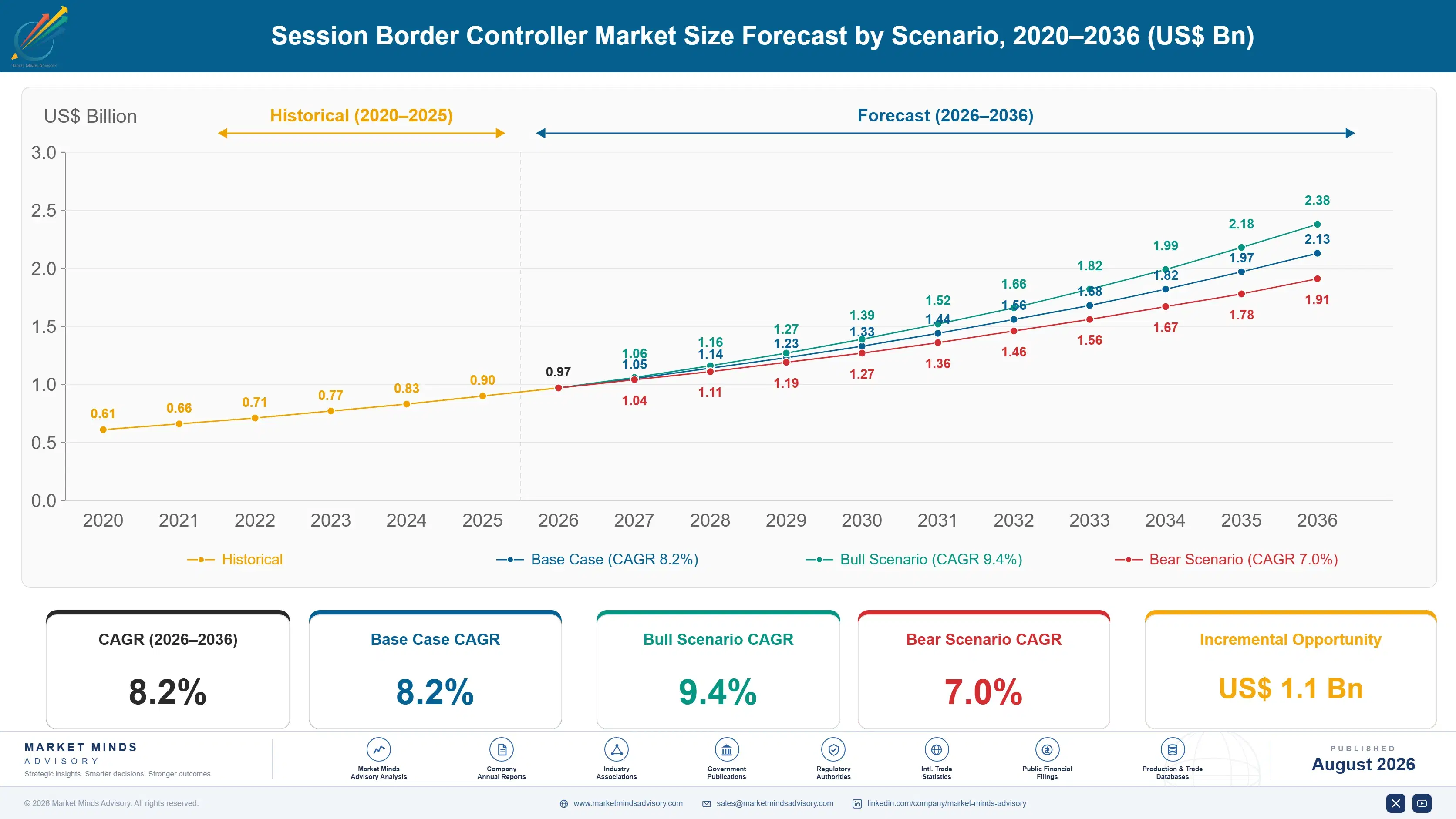
Session Border Controller Market Forecast Scenarios

session-border-controller-sbc-market-size-forecast-scenario-1787595078193
Growth ran near 6.8% between 2020 and 2025, with remote working driving collaboration platform adoption sharply while hardware appliance revenue fell away underneath it. Those two movements partly cancelled in reported value even as deployed session capacity rose considerably. Vendors that had not built software licensing models found revenue declining against unit growth, which was an uncomfortable position to explain to investors.
Base case 8.2% rests on three mechanisms. Legacy telephone network switch-off programmes across Europe and Asia force remaining enterprises onto internet protocol telephony on published deadlines, which is compulsory rather than optional migration. Collaboration platform connectivity requires certified devices, and certification lists gate the market to roughly 12 vendors. And Indian enterprise adoption grows fastest anywhere at 13.8% on a rapidly modernising enterprise communications base with very little legacy infrastructure to unwind first.
The bull case at 9.4% assumes cloud-native deployment accelerating as enterprises consolidate communications infrastructure into container platforms they already operate. The bear case at 7.0% is collaboration platform vendors absorbing border control functions into their own cloud services, which would remove the requirement for a separate product entirely in the segment currently driving most new demand.

Translating Between Broken Dialects

This product exists because a protocol failed to constrain its own implementers. The session initiation protocol was written for trusted networks and deployed across the open internet, and every equipment vendor, carrier and software platform interpreted the specification slightly differently. Around 41 meaningful variants circulate in enterprise networks, and normalising between them so that a call actually connects is the largest single thing a border controller does.
TOP FIVE CONCENTRATION68%Certification requirements narrow the field to few vendors
PROTOCOL IMPLEMENTATION VARIANTS41Distinct interpretations circulating across enterprise networks and carriers
PLATFORM CERTIFIED VENDORS12Suppliers approved for direct collaboration platform connectivity worldwide
HARDWARE REVENUE DECLINE62%Fall in appliance revenue from its historical peak
SESSION LICENSING SHARE74%Value now carried by capacity licensing rather than hardware
LEGACY NETWORK DEADLINE2027Year several national telephone networks complete their switch-off
Security and regulation supply the rest of the job. The device terminates and re-originates every session, which lets it hide internal topology, enforce policy, resist denial of service attempts and satisfy lawful intercept and emergency call routing obligations that carriers cannot avoid. None of that is optional and none of it can be done by a general firewall, which does not understand the protocol well enough to be useful.
The business model turned over completely inside a decade. Appliance revenue has fallen around 62% from its peak as functions moved into virtual machines and then containers, while session capacity licensing now carries roughly 74% of category value. Vendors who understood themselves as hardware companies had to rebuild as software businesses with recurring revenue, and several managed that transition considerably better than others did.
"Nobody buys a session border controller because they want one. They buy it because a switch-off deadline arrived, or because a collaboration platform will not connect without a certified box, and that means the certification list matters more than any feature comparison ever will."
Director, Enterprise Communications and Network Infrastructure Practice · MMA Technology and Communications Practice · August 2026

Market Trends

Collaboration platform certification acting as a market gate

Connecting a major collaboration platform to the public telephone network requires a device from the platform vendor's certified list, which currently runs to roughly 12 suppliers worldwide. That list functions as a market gate rather than a quality signal, since an uncertified product cannot participate regardless of how well it performs. Certification requires sustained engineering investment against a moving platform specification, which is exactly why the top five hold 68% of a category that would otherwise look open to newcomers. Losing certification removes a vendor from most new enterprise demand entirely.
Market Impact: Reconciles 41 protocol variants
Legacy network switch-off forcing compulsory enterprise migration

National telephone network switch-off programmes across Europe and Asia complete around 2027 in several markets, removing the circuit-switched alternative entirely and forcing every remaining enterprise onto internet protocol telephony. That migration is compulsory rather than discretionary, which produces demand on a published timetable that vendors can plan against precisely. Enterprises that deferred modernisation for a decade now face a deadline rather than a business case, and they buy accordingly. Enterprises that deferred modernisation for a decade now face a date rather than a business case, and they buy accordingly and usually late.
Market Impact: Indian demand growing at 13.8%

Market Opportunities and Growth Drivers

Protocol fragmentation making normalisation genuinely unavoidable

Around 41 meaningful implementation variants of the session protocol circulate across enterprise networks, carriers and software platforms, each differing enough that direct connection frequently fails in ways that are difficult to diagnose. Normalising between them is not a feature but the reason the product category exists at all. That fragmentation shows no sign of resolving, since every vendor has installed base reasons to keep its own interpretation and no authority can compel convergence. Every vendor has installed base reasons to keep its own interpretation exactly as it is. Diagnosis is difficult and the failures are intermittent.
Market Impact: Threatens 12 certified positions

Indian enterprise communications modernising from a low base rapidly

India grows fastest anywhere at 13.8%, as enterprises move from legacy telephony and fragmented systems directly to cloud collaboration platforms without passing through the intermediate stages Western markets took decades to traverse. Contact centre and business process operations concentrate there and consume session capacity at unusually high volumes per employee. Local hosting requirements and lawful intercept obligations both create demand for in-country deployment rather than remote cloud service. Contact centre and business process operations consume session capacity at unusually high volumes per employee, which concentrates demand geographically in ways general enterprise adoption does not.
Market Impact: Appliance revenue fell 62%

Market Restraints and Challenges

Platform vendors absorbing border control into their own services

Collaboration platform providers have incentives to build session border functions into their own cloud offerings, which would remove the requirement for a separate certified product in the segment currently driving most new demand. The root cause is that platform vendors capture more value by owning the connection than by certifying somebody else to provide it. Commercially this is the largest single risk in the category. Vendors are responding by deepening regulatory and interoperability capability that platform providers have less reason to build. Platform vendors capture more value owning the connection than certifying somebody else.
Market Impact: Gated to roughly 12 vendors

Hardware revenue decline outpacing software licensing transition

Appliance revenue has fallen around 62% from its peak while session capacity licensing now carries roughly 74% of value, and vendors moved through that transition at very different speeds. The root cause is that virtualisation and containerisation removed the reason to buy purpose-built hardware. Commercially it left several vendors reporting declining revenue against rising deployed capacity. Software licensing models and managed service offerings are the response, and building them required capability those organisations did not have. Building recurring revenue models required capability those organisations simply lacked. Deployed capacity rose while reported revenue fell.
Market Impact: Deadlines landing around 2027
4 additional market trends, 3 additional growth drivers, and 2 additional restraints and challenges are covered in the full report. Contact sales@marketmindsadvisory.com to access the complete intelligence.

Segment CAGR and Growth Architecture

Six segments are split by deployment form, because form determines the licensing model, the operational owner inside the customer organisation and the commercial relationship that follows from it. Capacity tier and feature variants sit inside each form rather than beside them. End-use organisation type and sales channel are both handled in the framework instead.
session-border-controller-sbc-market-market-share-analysis-1787595078722

Cloud-Native Containerised SBCs

Growing at 12.3%, half again the market rate of 8.2%, containerised deployment lets border control run on the same orchestration platforms an enterprise already operates for everything else, which removes a separate operational silo and the specialist skills it required. Scaling becomes elastic rather than a capacity purchase, and licensing follows sessions rather than appliances. The operational owner shifts from a telephony team toward a platform engineering function, which changes both the buying conversation and the evaluation criteria considerably. Vendors without genuine container-native architecture find that repackaging a virtual machine does not survive technical evaluation. Platform engineering functions spot the difference immediately. Elastic scaling replaces the capacity purchase entirely. Licensing follows sessions.
CAGR 12.3%

Managed and Hosted SBC Services

At 10.6% managed services remove the requirement for an enterprise to hold session protocol expertise at all, which matters because that skill set is scarce and shrinking as experienced telephony engineers retire. Service providers operate shared or dedicated instances and take responsibility for certification currency, interoperability testing and regulatory compliance. Mid-sized enterprises facing a switch-off deadline without internal capability represent most of the demand. The commercial relationship is recurring by construction, which vendors value considerably more than the equivalent appliance sale ever delivered. Certification currency, interoperability testing and regulatory compliance all transfer to the provider, which is exactly what a customer without protocol expertise is actually buying. Retention runs far above equivalent appliance relationships.
CAGR 10.6%
Full segment breakdown across 6 segments available in the complete report.

Regional Architecture and Country Demand Map

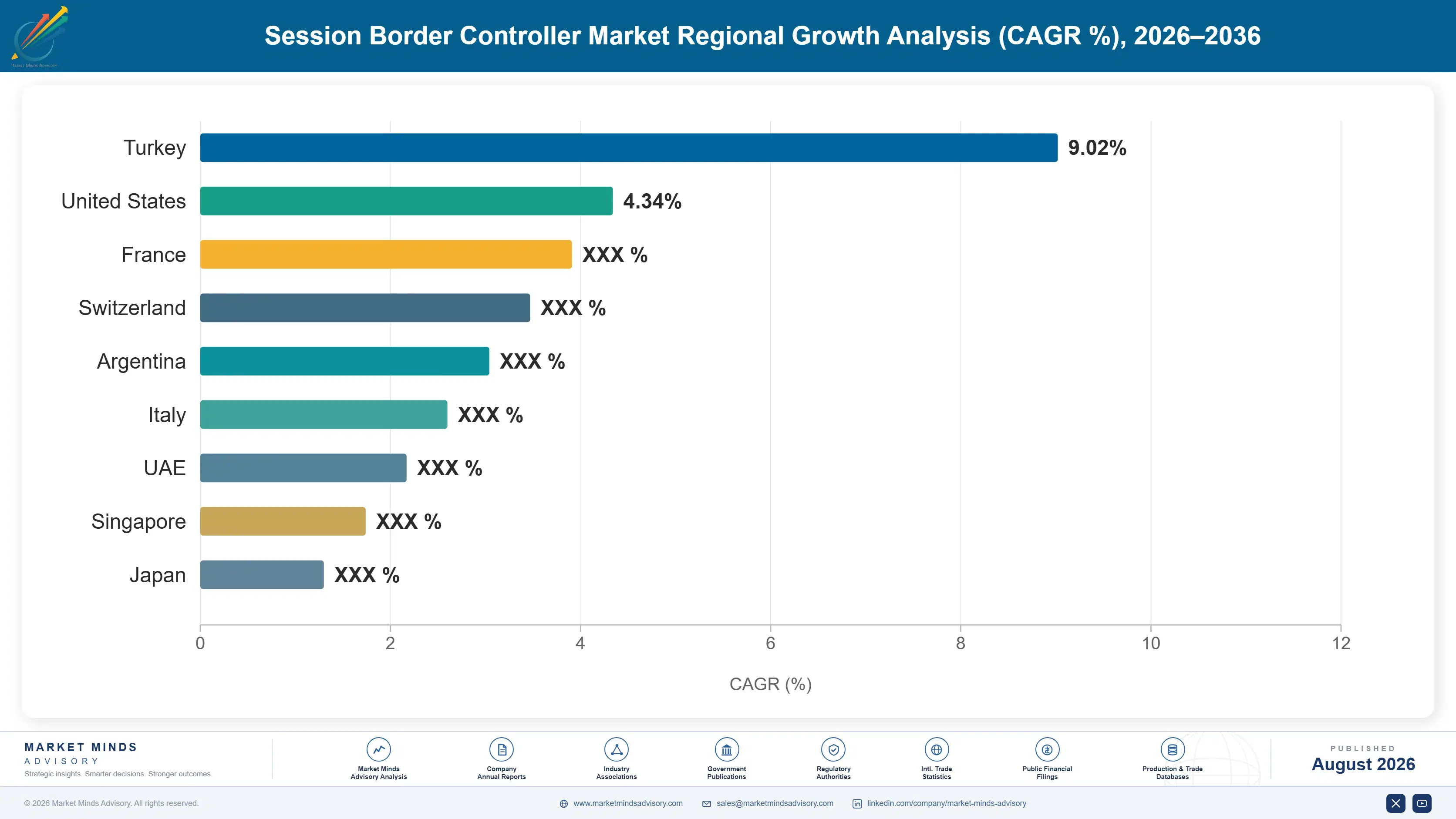
North America holds 28% of value on its deep enterprise collaboration platform adoption and unusually early internet telephony migration. Western Europe then follows at 26% on switch-off programmes now running to published deadlines, with East Asia holding 22% on carrier-led deployment right across the region.

North America

Holding 34% against a band of 22 to 32%, North America sits above band because enterprise collaboration platform adoption is deeper here than anywhere and internet telephony migration began earlier, which built a large installed base requiring continuous capacity expansion. Certified connectivity to the dominant collaboration platform drives most new enterprise demand. Carrier peering deployments are mature and expand incrementally. Regulatory obligations around emergency call routing are strict and technically specific. Growth of 7.2% runs below the base case, since migration largely happened here already. Regulatory obligations around emergency call routing are strict and technically specific here. Carrier peering deployments are mature and expand only incrementally. Installed capacity keeps expanding continuously.
Share: 28% | CAGR: 7.2% (2026 to 2036)

Western Europe

National telephone network switch-off programmes are the defining regional driver, with several markets completing around 2027 and Germany having already migrated substantially. That forces every remaining enterprise onto internet protocol telephony against a published deadline rather than a business case, producing demand vendors can plan against precisely. Regulatory requirements around lawful intercept and emergency routing vary by country and add engineering work. Managed services are growing strongly among mid-sized enterprises without internal telephony capability. Growth at 6.6% runs below the base case on migration maturity. Regulatory requirements vary by country and add jurisdiction-specific engineering work for every vendor serving the region. Managed services are growing strongly among mid-sized enterprises. Migration maturity limits growth here.
Share: 26% | CAGR: 6.6% (2026 to 2036)
Regional intelligence for 5 additional markets available in the complete report: East Asia, South Asia and Pacific, Latin America, Middle East and Africa, Eastern Europe. Contact sales@marketmindsadvisory.com.
session-border-controller-sbc-market-country-cagr-analysis-1787595079244

Four Moves Around a Certification List

Nobody in this market ever buys because they want the product itself. They buy because a deadline arrived or because a collaboration platform refuses to connect without a certified device, which means the certification list and the switch-off calendar between them together determine far more of the revenue than any feature comparison ever has.

Defend certification currency as an engineering commitment

Collaboration platform certification gates the market to roughly 12 vendors and requires continuous engineering against a specification the platform vendor keeps moving. Losing certification removes a vendor from the fastest growing demand entirely, regardless of product quality or installed base. That commitment is expensive and unglamorous and it is the single most valuable thing a vendor in this category maintains, which several have discovered by allowing it to lapse. Several vendors have discovered its value only by allowing it to lapse and watching opportunities disappear before any commercial conversation began.
Market Impact: Holds one of just 12 certified vendor positions

Sell against the switch-off calendar, not the budget cycle

Legacy network switch-off completes around 2027 in several markets, which converts telephony modernisation from a business case into a deadline that enterprises cannot negotiate. Demand therefore arrives on a published timetable rather than in response to selling effort. Vendors mapping which enterprises in which markets face which dates can position ahead of the panic, and mid-sized organisations without internal capability are the ones most likely to arrive late and buy managed services. Demand arrives on a published timetable rather than in response to selling effort. Mid-sized organisations without internal capability arrive latest of all.
Market Impact: Targets the switch-off deadlines landing around 2027 precisely

Build genuine container architecture rather than repackaging

Containerised deployment grows at 12.3% and moves the operational owner from a telephony team toward platform engineering, which changes the evaluation entirely. A virtual machine image published as a container does not survive technical assessment by an engineering function that operates orchestration platforms daily. Rebuilding properly is expensive and the alternative is losing the fastest growing segment to vendors who did, which is already visible in competitive outcomes. Conceding this segment to vendors who built properly is already visible in competitive outcomes, and the gap widens each year as container adoption spreads through enterprise infrastructure.
Market Impact: Serves the 12.3% growth across all containerised deployments

Deepen regulatory capability platform vendors will not build

Lawful intercept, emergency call routing and data residency obligations vary by country and require sustained engineering that a global platform provider has limited incentive to replicate across every jurisdiction. That is where a specialist vendor holds ground against platform providers absorbing border functions into their own services, which is the largest risk in this category. Regulatory depth is defensible in a way that protocol handling and security features increasingly are not. Roughly 12 vendors hold certified positions and the platform provider decides whether that function stays external at all, which makes jurisdictional depth the only genuinely defensible ground available here.
Market Impact: Defends against the 12 vendor certification gate risk

Who Controls the Margin Pool

Participation is measured on annual session border control revenue including capacity licensing, and the top five hold 68%. Concentration reflects certification requirements and regulatory engineering depth rather than any difficulty in building the software itself. Ribbon Communications and Oracle lead through carrier and enterprise installed bases accumulated across two decades. The gap to challengers is certification position rather than technical capability. Building the software is not the difficult part at all.
Competition runs on three fronts. Certification currency decides access to collaboration platform connectivity, which drives most new enterprise demand. Deployment architecture decides participation in containerised environments where the buying function has changed. Regulatory engineering decides defensibility against platform providers who could otherwise absorb the function entirely. The evaluating function has changed with the deployment model. Regulatory engineering decides defensibility.

Pressure ahead comes from collaboration platform vendors extending into border control and from managed service providers intermediating the customer relationship. Microsoft acquired Metaswitch in 2020, bringing carrier communications capability inside a platform provider. Expect certification and regulatory investment rather than acquisitions. Rankings shift as containerised deployment matures and switch-off deadlines pass. Managed providers increasingly intermediate the customer relationship.
session-border-controller-sbc-market-company-positioning-matrix-1787595079772

Competitive Moat and Risk Dimensions

RIBBON COMMUNICATIONS

Moat: Carrier and enterprise installed breadth

Positions across both carrier peering and enterprise access deployments give visibility into interoperability problems from both sides of every connection, which matters in a category whose core function is reconciling implementations that disagree. That breadth also supports a single vendor relationship where an enterprise and its carrier would otherwise coordinate between two.
RIBBON COMMUNICATIONS

Risk: Platform vendor function absorption

Collaboration platform providers extending border control into their own cloud services would remove the requirement for a certified third party device in the segment driving most new enterprise demand. A large installed base slows that erosion without preventing it, and the platform vendor decides the timing rather than the incumbent supplier.
AUDIOCODES

Moat: Collaboration platform certification depth

Sustained engineering against collaboration platform specifications has kept the company prominent on certification lists that gate access to most new enterprise demand, and that position requires continuous investment rather than a single approval. Vendors who allowed certification currency to lapse discovered how quickly the resulting exclusion translates into lost opportunity.
AUDIOCODES

Risk: Dependence on one platform

Deep alignment with a single dominant collaboration platform means the vendor's addressable demand moves with that platform's decisions about architecture, certification policy and whether to absorb border functions internally. None of those decisions involve the vendor, and all of them could materially reduce the opportunity available.

Players Tracked

Prominent Players

Ribbon Communications
Oracle
AudioCodes
Cisco
Avaya

Other Key Players

Nokia
Ericsson
Huawei
ZTE
Microsoft
Italtel
Dialogic
Patton Electronics
Sansay
TelcoBridges
Frafos
Enghouse Networks
NEC Corporation
Mitel
Cataleya

Recent Developments

MARCH 2026

Collaboration platform updates certification requirements for connected devices

A dominant collaboration platform updated certification requirements for devices providing public network connectivity, requiring re-testing against revised specifications within a defined period. Vendors unable to complete the process faced removal from the approved list entirely. Several vendors were removed from the approved list entirely. Re-testing windows were short.
Signal: Certification is a continuing engineering commitment rather than an approval obtained once and then simply kept
OCTOBER 2025

European switch-off deadline drives late enterprise migration surge

Enterprises facing a national telephone network switch-off deadline generated a concentrated surge of migration projects, with many organisations that had deferred modernisation for years arriving without internal telephony capability. Managed service providers captured a disproportionate share of that demand. Equipment purchases fell well behind service uptake.
Signal: Deferred migration converts into managed services rather than into any equipment purchases once the deadline arrives
JANUARY 2026

Enterprise platform team rejects repackaged virtual machine deployment

An enterprise platform engineering function rejected a border controller supplied as a virtual machine image presented as containerised, on grounds that it did not integrate with orchestration tooling the organisation already operated. A genuinely container-native alternative was selected instead. The rejection was never reported back through the vendor's sales organisation.
Signal: The evaluating function has now changed entirely, and simple repackaging no longer survives a technical assessment

Engineers, Certification and Support

Software engineering accounts for roughly 44% of cost in this category, since the product is now overwhelmingly software and the protocol and regulatory work never finishes. Certification and interoperability testing take around 17%, covering continuous work against collaboration platform and carrier specifications that keep moving. Technical support and professional services carry about 22%. Remaining hardware manufacture and logistics absorb the balance, a share that keeps shrinking.
Software engineering salary inflation ran well ahead of general wage growth through 2021 and 2022 across major technology employment markets, per national statistical office labour reporting for the period, and specialist protocol engineering capability is scarcer than general software skills. Semiconductor availability constrained remaining appliance production separately over the same years, which affected a shrinking part of the business rather than the core of it.

Exposure divides on engineering location and on portfolio breadth. A vendor maintaining certification against multiple platforms and regulatory regimes carries continuing engineering cost that a narrow participant avoids, though that breadth is precisely what protects the position. Support cost scales with deployment count rather than revenue, which means managed service models that consolidate many customers onto shared infrastructure carry structurally better support economics.
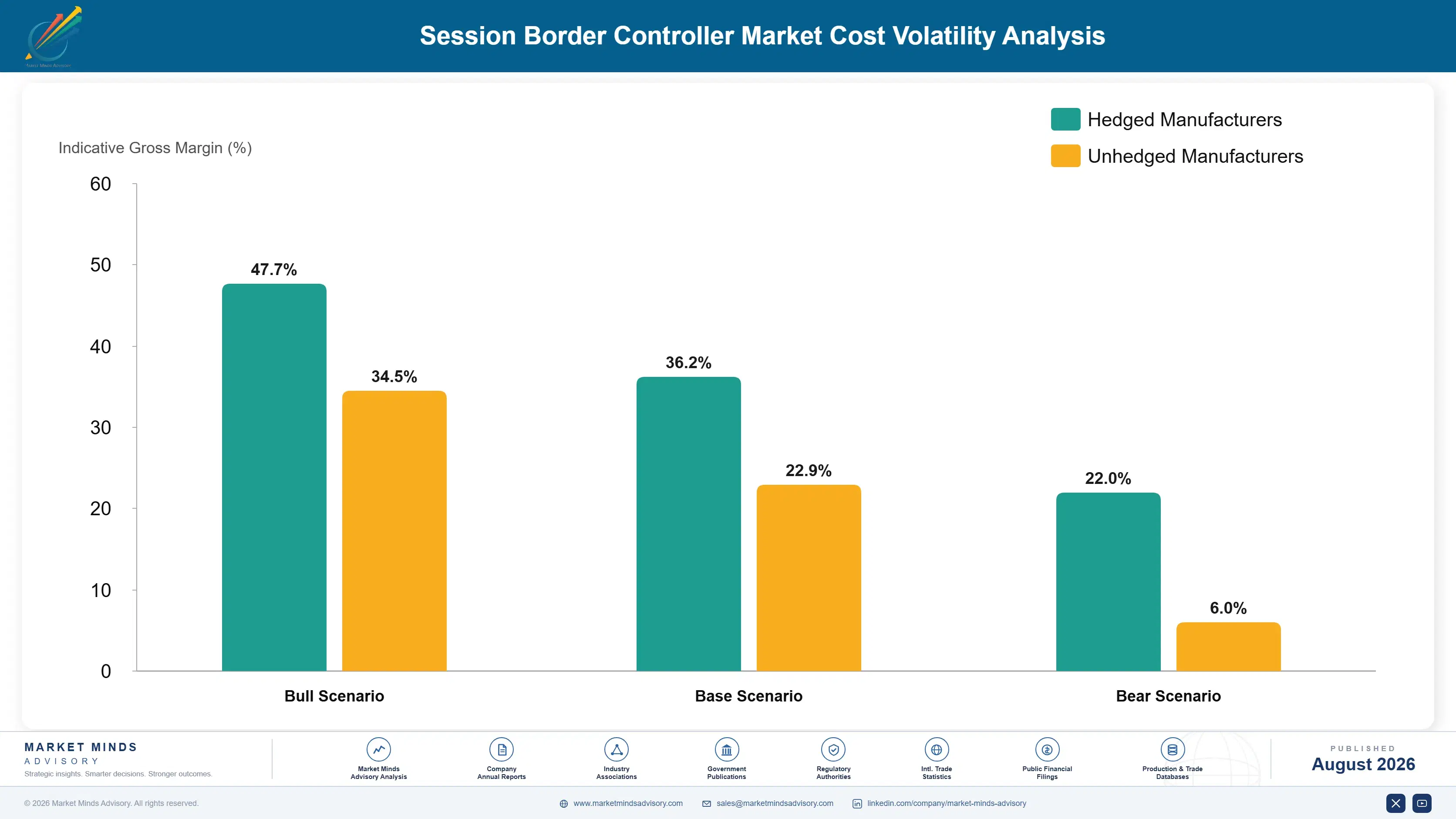
session-border-controller-sbc-market-cost-volatility-analysis-1787595079967

Treat certification engineering as a protected budget line

Certification gates access to most new enterprise demand and requires continuous engineering work against specifications that keep moving. Vendors who allowed currency to lapse during cost pressure discovered how quickly exclusion translates into lost opportunity. Budgeting it against current revenue underfunds exactly the capability that determines whether any future revenue exists at all. Exclusion is fast and reversal is slow.

Consolidate support onto shared managed infrastructure

Support cost scales with deployment count rather than with revenue, which makes many small on-premises installations expensive to serve relative to what they actually generate. Managed service models consolidating customers onto shared infrastructure carry considerably better support economics. They also create recurring revenue that an equivalent appliance sale never delivered to anybody. Consolidation improves both lines together.

Locate protocol engineering where the capability actually exists

Specialist session protocol engineering is scarcer than general software capability and concentrated in a small number of places, since the skill set developed alongside telephony infrastructure over several decades. Locating that work near existing expertise costs less than recruiting against it elsewhere. Experienced telephony engineers are retiring faster than replacements are trained anywhere. Recruitment against scarcity rarely works.

Portfolio Architecture for Margin Defence

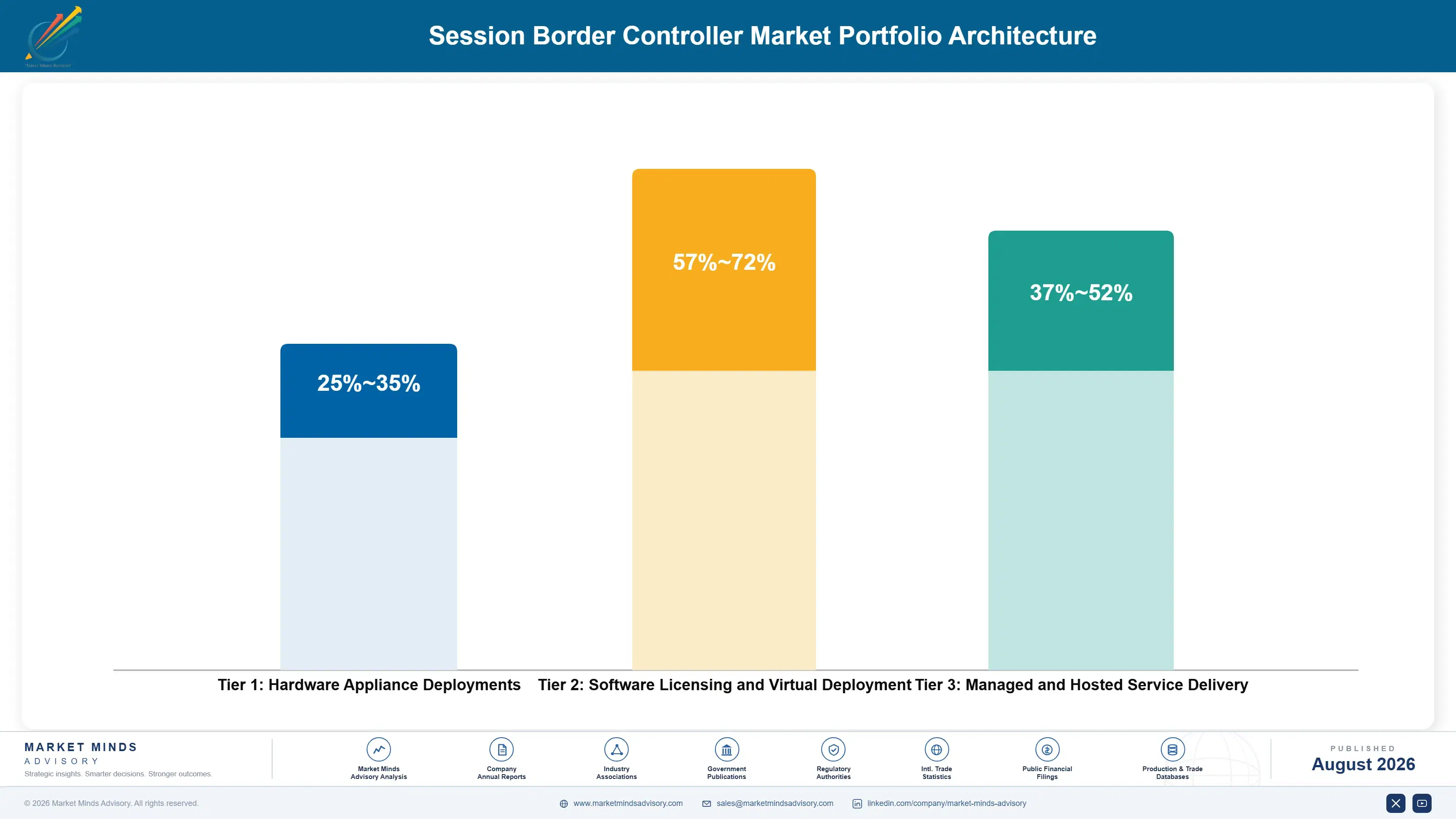
Margin here follows deployment model rather than product capability, which is a shift that caught several established vendors badly. Remaining hardware appliance sales earn margins in the mid twenties to mid thirties, because the value has moved into software while the hardware still carries manufacture, inventory and logistics cost that generate nothing distinctive. Inventory and logistics cost persists after the value has gone.
Software licensing on virtualised and containerised deployment does considerably better in the high fifties to low seventies, because delivery cost approaches zero once the engineering is done and capacity licensing scales with customer growth rather than with vendor effort. The range reflects certification position and how much professional services attach to each deployment. Certification position rather than product capability sets the upper end.

Managed and hosted services hold a different shape entirely, running in the high thirties to low fifties, because operating infrastructure for customers carries real cost that pure licensing avoids. They compensate with recurring revenue and customer retention that appliance and licence models never produced, which most vendors now value more than the margin difference. Retention now matters more to most vendors than margin does.

Hardware Appliance Deployments

Remaining purpose-built appliance sales into environments requiring physical deployment. The ten point range reflects manufacturing scale and channel position rather than capability, since the distinctive value has moved into software.
Gross Margin: 25-35%

Software Licensing and Virtual Deployment

Capacity licensing on virtualised and containerised deployments where marginal delivery cost approaches zero. The fifteen point range reflects certification position and how much professional services work attaches to each individual deployment.
Gross Margin: 57-72%

Managed and Hosted Service Delivery

Operated services removing session protocol expertise requirements from the customer entirely. The fifteen point range reflects infrastructure sharing efficiency and how many customers a single operated platform actually serves at once.
Gross Margin: 37-52%
session-border-controller-sbc-market-portfolio-architecture-1787595080466

High-value Sub-segments and Strategic Watch-out

Containerised Software Licensing

High value and the fastest growth at 12.3%, since delivery cost approaches zero and capacity licensing scales with the customer rather than the vendor. Genuine container architecture rather than repackaging is what survives technical evaluation. Platform engineering functions evaluate it rather than telephony teams. Criteria differ completely.
Gross Margin: 60-72%

Managed Service Delivery

High value and growing at 10.6% among enterprises facing deadlines without internal capability. Recurring revenue and retention more than compensate for margin below pure licensing, which most vendors now recognise clearly. Enterprises facing deadlines without internal protocol capability are the demand. Recurring revenue compensates fully.
Gross Margin: 40-52%

Hardware Appliance Sales

The volume core in decline, carrying manufacture and inventory cost while the distinctive value sits in software. Appliance revenue has fallen around 62% from peak and continues eroding as virtualisation reaches remaining environments. Virtualisation keeps reaching the remaining environments that required physical deployment. Distinctive value sits in software.
Gross Margin: 25-35%

Platform Certification Dependence

The strategic watch-out. Roughly 12 vendors hold certified positions and the platform provider controls both the specification and whether the function stays external at all, which is the largest single risk here. Neither the specification nor the decision belongs to the vendor holding the position.
Gross Margin: 30-70%

Bought Under Compulsion

Almost nothing here is bought because somebody wanted it. Demand arrives from a switch-off deadline, a platform that refuses to connect, a regulatory obligation or a security incident, all of which are external compulsions rather than internal ambitions. That makes selling effort considerably less influential than timing, and it means a vendor's most valuable asset is knowing which compulsion lands where and when. Timing beats selling effort consistently.
Stickiness runs deeper than the product would suggest. Border control sits in the path of every call, so replacing it means risking service interruption on a system whose failure is immediately visible to the whole organisation. Capacity expansions therefore go to the incumbent almost automatically, and displacement happens at platform migrations or infrastructure refreshes rather than through competitive selling. Capacity expansions go to the incumbent almost automatically.

The buying function has shifted with the deployment model. Telephony teams bought appliances and understood the protocol. Platform engineering functions now evaluate containerised deployments against orchestration integration and operational fit, and they weigh entirely different criteria. Managed services move the decision again, toward whoever owns the migration project and simply wants the deadline met. Managed services move the decision again entirely.
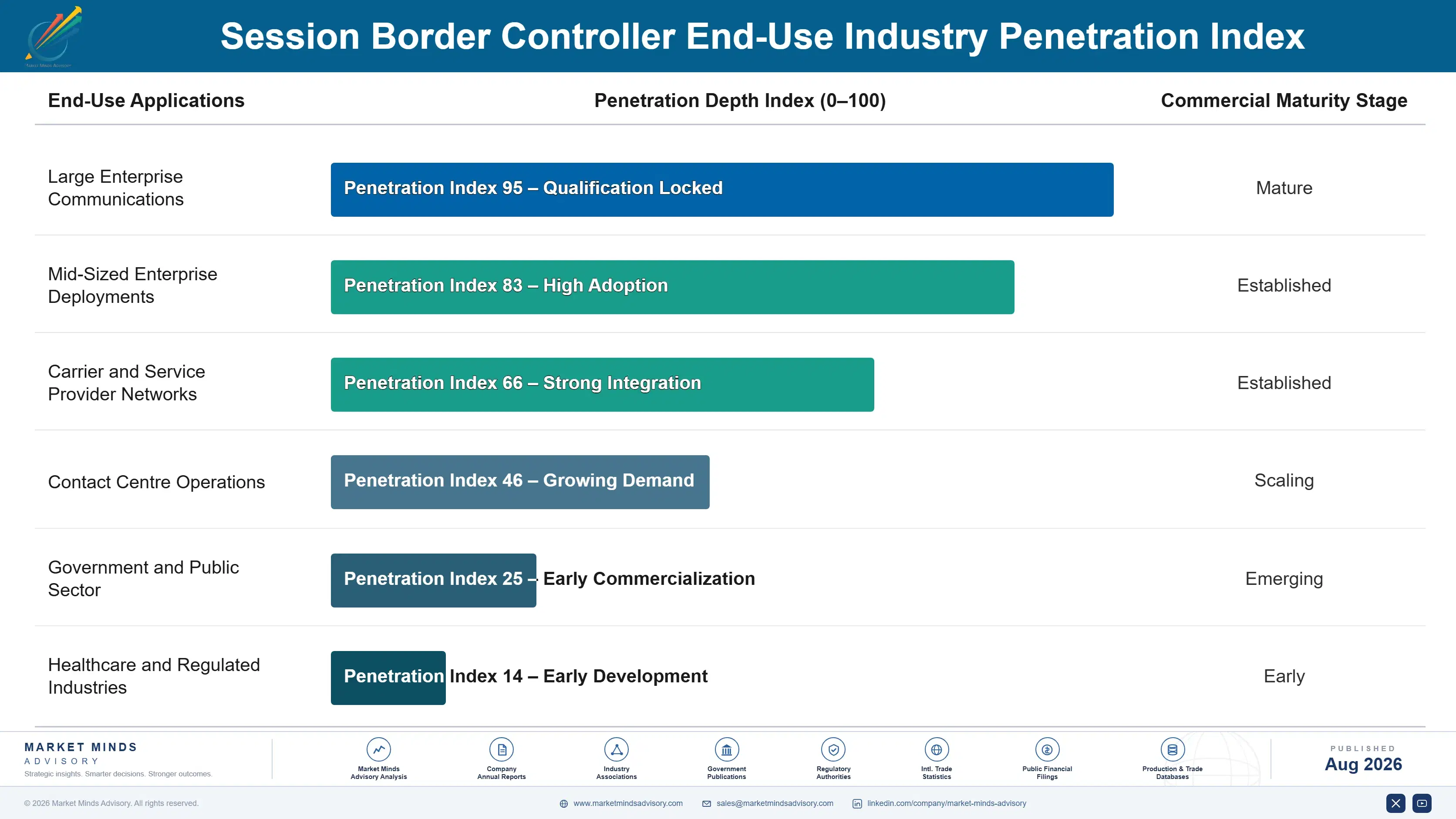
session-border-controller-sbc-market-end-use-penetration-index-1787595080955

Where We Would Focus Effort

These are among the four positions where our research anticipates prominent divergence between winners and laggards over the coming forecast period. Each is grounded in the demand model, the regulatory perimeter, and the announced capacity pipeline.
01 / CERTIFICATION CURRENCY DEFENCE

The list is the market, and it moves

Collaboration platform certification gates access to most new enterprise demand and currently runs to roughly 12 approved vendors worldwide, and it requires continuous engineering against a specification the platform vendor keeps revising. Losing that currency removes a vendor from the fastest growing part of the market regardless of product quality or installed base size. The commitment is expensive and thoroughly unglamorous, and several vendors have discovered its value only by allowing it to lapse and then watching demand disappear entirely.
02 / DEADLINE CALENDAR SELLING

Map the switch-offs, not the sales pipeline

National telephone network switch-off programmes complete around 2027 in several markets, converting telephony modernisation from a business case into a deadline enterprises simply cannot negotiate away. Demand therefore arrives on a published timetable rather than in response to any selling effort applied to it. Vendors mapping which organisations in which markets face which dates position ahead of the eventual panic, and mid-sized enterprises without internal capability arrive latest and buy managed services rather than equipment at the very last moment.
03 / CONTAINER ARCHITECTURE INVESTMENT

Repackaging does not survive the new evaluator

Containerised deployment grows at 12.3% against a market rate of 8.2% and moves the operational owner from a telephony team toward a platform engineering function that runs orchestration platforms daily. A virtual machine image published as a container does not survive technical assessment by people who would spot the difference almost immediately in evaluation. Rebuilding properly is expensive, and the alternative is conceding the fastest growing segment to vendors who already did exactly that rebuilding work properly and considerably earlier.
04 / REGULATORY DEPTH BUILDING

Own what the platform vendor will not replicate

Lawful intercept, emergency call routing and data residency obligations vary considerably by country and require sustained jurisdiction-specific engineering that a global platform provider has limited incentive to replicate across every jurisdiction it serves. That is precisely where a specialist vendor holds ground against platform providers absorbing border functions into their own cloud services, which is the single largest risk in this category. Regulatory depth stays defensible in a way that protocol handling and security features increasingly simply do not anymore at all.

Engagement Snapshot From the Field

A live engagement with an industry participant carrying material or product regulatory and market exposure ahead of a defining policy shift, showing how our research translates into a defensible multi-year portfolio strategy.
MARKET MINDS ADVISORY · CLIENT ENGAGEMENT SUMMARY
Session Border Controller Producer Strategic Portfolio Review and Transition Roadmap 2026·Investment Scenario on Session Border Controller Exposure Evaluation 2025-26
CLIENT PROFILE
A European communications equipment vendor supplying session border controllers as hardware appliances and virtual machines across nine markets, at annual revenue near 74 million euros (client-reported, unverified by MMA). Certification against the dominant collaboration platform had lapsed two years earlier, and no container-native product existed anywhere in the range or anywhere in any active development.
STRATEGIC CHALLENGE
Revenue had declined for three consecutive years while deployed session capacity across the customer base grew, and new enterprise opportunities were being lost before technical evaluation began. Management attributed the decline to pricing pressure and were preparing to reduce prices further across the whole appliance range in response to it.
MMA APPROACH
MMA analysed why opportunities were being lost at each stage, benchmarked certification requirements and re-entry cost against the dominant platform, assessed container architecture requirements with enterprise platform engineering functions, and mapped switch-off deadlines across the client's markets. Interviews with 47 experts covered enterprise communications practice, platform certification requirements and network engineering.
KEY FINDINGS
  1. Opportunities were being lost at qualification rather than on price, because the lapsed certification excluded the client from consideration before any commercial discussion took place.
  2. Re-entering certification was achievable within roughly nine months at a cost the company could fund, and the barrier was engineering commitment rather than technical difficulty.
  3. Enterprise platform teams had rejected the client's virtual machine offering as insufficiently container-native in three evaluations, none of which had been reported back through the sales organisation.
  4. Switch-off deadlines in four of the client's markets would concentrate demand within eighteen months, and no coordinated approach to those enterprises existed at all.
CLIENT PROFILE
A European communications equipment vendor supplying session border controllers as hardware appliances and virtual machines across nine markets, at annual revenue near 74 million euros (client-reported, unverified by MMA). Certification against the dominant collaboration platform had lapsed two years earlier, and no container-native product existed anywhere in the range or anywhere in any active development.
STRATEGIC CHALLENGE
Revenue had declined for three consecutive years while deployed session capacity across the customer base grew, and new enterprise opportunities were being lost before technical evaluation began. Management attributed the decline to pricing pressure and were preparing to reduce prices further across the whole appliance range in response to it.
MMA APPROACH
MMA analysed why opportunities were being lost at each stage, benchmarked certification requirements and re-entry cost against the dominant platform, assessed container architecture requirements with enterprise platform engineering functions, and mapped switch-off deadlines across the client's markets. Interviews with 47 experts covered enterprise communications practice, platform certification requirements and network engineering.
KEY FINDINGS
  1. Opportunities were being lost at qualification rather than on price, because the lapsed certification excluded the client from consideration before any commercial discussion took place.
  2. Re-entering certification was achievable within roughly nine months at a cost the company could fund, and the barrier was engineering commitment rather than technical difficulty.
  3. Enterprise platform teams had rejected the client's virtual machine offering as insufficiently container-native in three evaluations, none of which had been reported back through the sales organisation.
  4. Switch-off deadlines in four of the client's markets would concentrate demand within eighteen months, and no coordinated approach to those enterprises existed at all.
RECOMMENDED STRATEGY
Phase 1: Phase one: restore collaboration platform certification immediately, since exclusion is removing the client from consideration before price is ever discussed. Phase 2: Phase two: build genuine container-native architecture rather than repackaging, because platform engineering functions detect the difference and reject it outright. Phase 3: Phase three: map switch-off deadlines across markets and approach affected enterprises well ahead of the concentration those dates will produce.
OUTCOME
The vendor restored certification during 2026 and reported returning to enterprise shortlists it had been excluded from (client-reported, unverified by MMA). Container development was funded, and the planned appliance price reduction was cancelled as addressing the wrong problem entirely. Certification is now treated as a protected budget line.

Frequently Asked Questions

Foundational context covering the market sizes, CAGR, scope, country, region and competition that inform every finding below. This section is provided to cover basics and most often pre-purchase conversations, answered from the MMA Primary Research Dataset.

What is the current size of the Session Border Controller Market?

MMA sizes it at USD 0.86 billion in 2025, rising to USD 0.93 billion in 2026. The figure covers session border control products and services at vendor selling value including capacity licensing.

How large will the Session Border Controller Market be by 2036?

USD 2.05 billion by 2036, an incremental USD 1.12 billion over the 2026 base and an expansion multiple of 2.20 times. Containerised deployment accounts for a disproportionate share.

What is the CAGR for the Session Border Controller Market 2026 to 2036?

8.2% in the base case, with a bull case at 9.4% and a bear case at 7.0%. The spread turns on whether collaboration platforms absorb border control functions internally.

Which segment is growing fastest?

Cloud-native containerised deployments at 12.3%, half again the market rate of 8.2%. They run on orchestration platforms enterprises already operate, removing a separate operational silo.

Who are the major companies in the Session Border Controller Market?

Ribbon Communications, Oracle, AudioCodes, Cisco and Avaya lead on session border control revenue. Fifteen further participants are profiled in the full report on that basis.

Which country is growing fastest?

India at 13.8%, as enterprises move from legacy telephony directly to cloud collaboration platforms while contact centre operations consume session capacity at very high volume.

Report Segmentation Architecture

The full report scope spans multiple orthogonal segmentation dimensions, with cross-tabulated demand data provided for each dimension pair. Coverage extends further to regional breakdowns, trend trajectories, and the competitive detail needed to support segment-level decision-making.

By Deployment Form

  • Hardware Appliance SBCs
  • Virtualised Private Deployment
  • Cloud-Native Containerised SBCs
  • Managed and Hosted SBC Services
  • Public Cloud Marketplace Instances
  • Embedded and Gateway-Integrated Functions

By End-Use Industry

  • Large Enterprise Communications
  • Mid-Sized Enterprise Deployments
  • Carrier and Service Provider Networks
  • Contact Centre Operations
  • Government and Public Sector
  • Healthcare and Regulated Industries

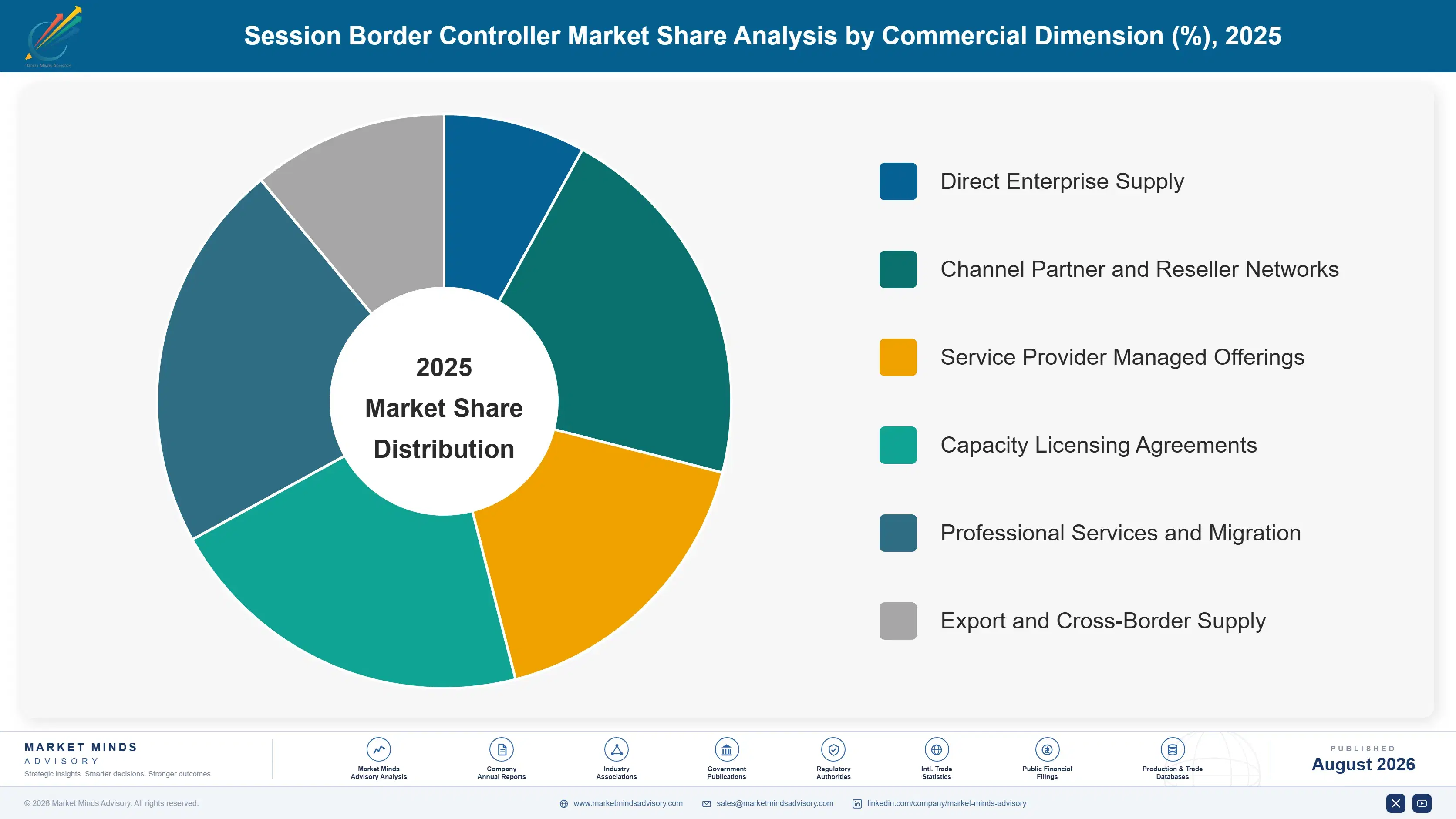
By Commercial Dimension

  • Direct Enterprise Supply
  • Channel Partner and Reseller Networks
  • Service Provider Managed Offerings
  • Capacity Licensing Agreements
  • Professional Services and Migration
  • Export and Cross-Border Supply

By Region

  • North America
  • Western Europe
  • East Asia
  • South Asia and Pacific
  • Latin America
  • Middle East and Africa
  • Eastern Europe

Scope, Methodology, and Coverage

Every figure in this report is reproducible from documented input assumptions. The scope below maps the historical period, the forecast horizon, the segmentation dimensions, and the countries covered, alongside the underlying primary and qualitative methodology.
Historical Period
2020 to 2025
Forecast Period
2026 to 2036
Base Year
2025 (USD billions; MMA Primary Research Dataset, August 2026)
Market Definition
Products and services providing session border control for internet protocol voice and video communications, covering hardware appliances, virtualised private deployments, cloud-native containerised software, managed and hosted services, public cloud marketplace instances, and embedded gateway-integrated functions. Measured at vendor selling value including session capacity licensing and attached professional services. General network firewalls, unified communications platforms, contact centre software, telephony handsets and carrier network core equipment are excluded from scope.
Quantitative Units
USD billions (current prices); million concurrent sessions licensed; USD per thousand sessions by deployment form
Segmentation Dimensions
Deployment form; end-use organisation type; commercial dimension; region
Regions Covered
North America, Western Europe, East Asia, South Asia and Pacific, Latin America, Middle East and Africa, Eastern Europe
Countries Covered
United States, Canada, Mexico, United Kingdom, Germany, France, Netherlands, Spain, Italy, Japan, South Korea, China, India, Australia, Singapore, Brazil, United Arab Emirates, Saudi Arabia, South Africa, Poland
Key Companies Profiled
Ribbon Communications, Oracle, AudioCodes, Cisco, Avaya, Nokia, Ericsson, Huawei, ZTE, Microsoft, Italtel, Dialogic, Patton Electronics, Sansay, TelcoBridges, Frafos, Enghouse Networks, NEC Corporation, Mitel, Cataleya
Quantitative Methodology
Primary survey, n=3,800 respondents, Q4 2025, six countries; demand-side model with trade association cross-validation
Qualitative Methodology
47 expert interviews, Q4 2025; applied to validate demand model assumptions, identify emerging dynamics, and assess competitive positioning
Report Format
PDF and XLSX data workbook (Word format preview document)
Publisher
Market Minds Advisory
Report Code
MMA-2026-TEC-117
Published
August 2026
Contact
sales@marketmindsadvisory.com | www.marketmindsadvisory.com

Purchase the full Session Border Controller Market Report (2026 to 2036).

The full report treats certification lists and switch-off calendars as the actual demand drivers, because almost nothing in this market is bought voluntarily. It sizes all six deployment forms independently through 2036, maps national telephone network switch-off deadlines against remaining enterprise migration, and assesses platform absorption risk by function and jurisdiction. Regional chapters cover all seven regions with enterprise and carrier demand separated throughout, since the two behave differently. Competitive profiling covers 20 participants on a single revenue basis including the certification positions each vendor currently holds.
Six deployment forms sized independently through 2036
Switch-off deadlines mapped against remaining enterprise migration
Platform absorption risk assessed by function and jurisdiction
Certification positions tracked across major collaboration platforms
Twenty participants profiled on one consistent revenue basis
Enterprise and carrier demand separated across every region

Built For The People Who Decide

From boardroom strategy to bench-side execution, this report is read cover-to-cover by leaders shaping the next decade of their industry, turning demand scenarios, market dynamics and valuation benchmarks into decisions.
CXOs/ Presidents/ VPs/ Managers
M&A and Corporate Development
Strategy Teams and R&D Heads
Procurement and Product Directors
Regulatory and Compliance Leaders
Investor Relations and Equity Analysts