Market Minds Advisory
Sensor Development Kit Market

Sensor Development Kit Market: Sensor Development Kit Market: Kit Classes, Design Win Economics and Evaluation Software 2026 to 2036

Nobody makes money selling development kits. A board goes out at around forty five dollars and costs nearly that to build, and the design win behind it is worth a thousand times more.

Lead Analyst

Published

September 2026

Make Smarter Decisions with Customized Research Insights

Request a free sample report and evaluate market opportunities, growth trends, and competitive dynamics relevant to your business needs.

2025 MARKET VALUE$0.7BMarket Size 2025
2036 FORECAST VALUE$2.3BBase Case , 2026 to 2036
CAGR 2026 TO 203611.6 %Bull 12.9% / Bear 10.3%
INCREMENTAL OPPORTUNITY$1.5BNet 10- year value creation
EXPANSION MULTIPLE3.00x2036 value over 2026 base
Strategic Levers
M&A Pipeline
Regional Outlook
Country Rankings
Competitive Intelligence
Segmental Deep-dive
Call-Us : 91 93563 13602

Executive Snapshot and Market Trajectory.

Every commercial decision here looks irrational until you notice what is being sold. A kit retails around USD 45 and costs nearly that to build, package and support. Around 6% of kits shipped turn into a production design win, and that win is the actual product.
The market reaches USD 0.76 billion in 2026 and USD 2.28 billion by 2036, a 3.00 times expansion at 11.6%. Edge machine learning sensor kits grow at 17.4%, half again the market rate of 11.6%, because engineers now need to know whether a model runs inside the power budget rather than whether a sensor reads accurately. East Asia holds 38% of kit shipment revenue on design engineer density, and India grows fastest at 19.2%.
Five suppliers hold 51% of kit shipment revenue, concentrated among semiconductor manufacturers who treat kits as marketing spending rather than as a product line. STMicroelectronics, Texas Instruments, Bosch Sensortec, Infineon and Analog Devices ship kits to seed design wins. Arduino, Adafruit, SparkFun and Seeed Studio serve a genuinely different customer altogether, one who buys the board as the finished article Those boards end up inside shipping products increasingly often.
Market Definition
This report covers evaluation boards, reference designs and development kits used to prototype with sensors ahead of production design: multi-sensor evaluation platforms, single sensor breakout boards, edge machine learning sensor kits, wireless sensor node kits, industrial reference design kits, and academic and teaching sensor kits. It excludes production sensor components themselves, general purpose microcontroller boards without sensing, test and measurement instruments, contract design services, and industrial data acquisition systems.
Base Year Value
$0.7B in 2025 (MMA Primary Research Dataset, September 2026)
Forecast Period
2026 to 2036, eleven discrete annual values
CAGR
11.6% base case. Bull 12.9%. Bear 10.3%.
Fastest Growth Segment
Edge Machine Learning Sensor Kits: 17.4% CAGR
Fastest Growth Country
India: 19.2% CAGR
Fastest Growth Region
South Asia and Pacific: 13.8% CAGR
Largest Region
East Asia: 38% of 2025 global value
Market Leaders
STMicroelectronics, Texas Instruments, Bosch Sensortec, Infineon Technologies and Analog Devices lead on development kit and evaluation board shipment revenue. Source: MMA Analysis.
Primary Survey
n=3,800 procurement and R&D decision-makers, Q4 2025, six countries
Methodology
Demand-side build-up, cross-validated against public data, 47 expert interviews

Sensor Development Kit Market Forecast Scenarios

sensor-development-kit-market-size-forecast-scenario-1789990696512
Between 2020 and 2025 the category compounded at 10.4%, and component shortages shaped it more than any product decision did. Engineers who could not obtain their preferred parts evaluated alternatives they would never otherwise have considered, and kit demand rose as design teams prototyped around whatever was actually available. Several suppliers gained design wins on availability rather than on merit and retained them afterwards.
The base case holds 11.6% on three mechanisms. Edge machine learning moved the evaluation question from whether a sensor reads accurately to whether a model runs on the microcontroller within a power budget, which requires a considerably more capable kit. Wireless sensor deployments keep expanding across building, agricultural and industrial monitoring. And hardware startup formation across India and Southeast Asia keeps adding design engineers considerably faster than established markets manage to.
The bull case at 12.9% assumes edge model tooling matures enough that kits ship with trained examples and profiling as standard, which would raise both kit value and design win conversion. The bear case at 10.3% is semiconductor marketing budget compression: kits are funded as promotional spending, and a downturn cuts promotional budgets before it cuts anything attached to revenue.

Selling Boards To Win Sockets

This is not a business in the ordinary sense and treating it as one produces the wrong decisions. A kit retails around USD 45 against a cost that leaves almost nothing, and the semiconductor manufacturers who dominate the category fund kits from marketing budgets rather than from product ones. Around 6% of kits shipped become a production design win worth a thousand times the board.
TOP FIVE CONCENTRATION51%Concentrated among semiconductor makers selling kits below actual cost
TYPICAL KIT RETAIL PRICEUSD 45Median across evaluation boards sold through distribution channels
DESIGN WIN CONVERSION RATE6%Kits shipped that lead to a production design win
EVALUATION SOFTWARE EFFORT78%Share of engineer evaluation time spent on software
PROTOTYPE TO PRODUCTION PERIOD14 monthsFrom first kit order to volume component shipment beginning
COMMUNITY QUESTION RESPONSE31 hoursMedian time to an answered question on vendor forums
The documentation is the product and most suppliers still fund the hardware. An engineer evaluating a sensor spends a few hours on the board and around 78% of the total effort on software: drivers, example code, build configuration and the questions that arise when none of it compiles. A kit shipping working code with a forum answering in 31 hours succeeds. One shipping a datasheet gets abandoned.
Edge machine learning changed what a kit has to prove and many have not caught up. Demonstrating that a sensor reads accurately was sufficient for thirty years. The question now is whether a model runs on the microcontroller alongside the sensor inside the power budget, which is a systems problem rather than a component one. Kits shipping trained examples and profiling answer it directly; the rest cannot.
"A supplier once asked me how to improve the margin on their evaluation boards. The honest answer is that the margin is not the point and never was. Their competitor was giving kits away and taking the design wins while they optimised a bill of materials."
Director, Semiconductor Design Enablement and Tools Practice · MMA Technology Practice · September 2026

Market Trends

Edge Inference Changed What Evaluation Has To Prove

For three decades a sensor kit demonstrated that the part measured accurately, and an engineer confirming that moved on to design. Machine learning at the edge replaced that question entirely with a harder one: can a useful model run on this microcontroller alongside this sensor inside the available power budget. That is a systems question requiring trained example models, profiling tools and memory analysis rather than a datasheet and a driver. Edge machine learning kits compound at 17.4% against 11.6% for the market, and many established kits simply cannot answer the new question.
Market Impact: India compounds at 19.2% annually

Software Effort Dominates Every Evaluation Engineers Actually Run

An engineer evaluating a sensor spends a few hours on the hardware and roughly 78% of total effort on software: getting drivers to build, adapting example code, resolving toolchain conflicts and asking questions when none of it works. Suppliers keep investing in board design and underfunding exactly the part that consumes the evaluation. A community forum answering in around 31 hours converts evaluations that a slower one loses silently, and the engineer never files a complaint. They simply try the competitor's kit next. Nobody files a complaint on the way out, which is why suppliers never learn what they lost.
Market Impact: Wireless node kits compound at 14.8%

Market Opportunities and Growth Drivers

Hardware Startup Formation Is Adding Engineers Rapidly

India and Southeast Asia are producing hardware design teams at a rate established markets no longer match, driven by engineering graduate volume, falling prototyping costs and domestic manufacturing incentives that make hardware ventures viable. Those engineers buy kits at the start of every project rather than drawing on an existing evaluation library, so kit demand per engineer runs higher than in mature design centres. India compounds at 19.2%, ahead of any other country. Suppliers with local distribution and documentation in the right places capture design wins that follow for a decade.
Market Impact: Kits retail near USD 45 unprofitably

Wireless Node Kits Answer A Deployment Question

Building, agricultural and industrial monitoring deployments increasingly need battery powered sensor nodes running for years without service, which turns evaluation into a question about radio protocol, duty cycle and power consumption together rather than about the sensor alone. A wireless node kit lets an engineer measure actual battery life under realistic transmission patterns before committing to anything. Wireless sensor node kits compound at 14.8% on that requirement, and the evaluation takes considerably longer than a straightforward sensor assessment because the measurement itself takes weeks. Weeks of measurement raise the switching cost considerably once an engineer has invested that time.
Market Impact: Only 6% of kits convert

Market Restraints and Challenges

Kits Are Funded From Budgets That Get Cut First

Semiconductor manufacturers fund development kits from marketing and design enablement budgets rather than from product lines, because the boards generate almost no margin at around USD 45 against their cost. The root cause is that the return arrives as design wins fourteen months later and cannot be attributed cleanly to any individual kit. Commercially this means kit programmes get cut in a downturn precisely when seeding future design wins matters most. Mitigation runs through design win attribution tracking, which very few suppliers have built properly enough to defend the budget.
Market Impact: Edge kits compound at 17.4% annually

Conversion Is Low And Nobody Measures It Honestly

Around 6% of kits shipped lead to a production design win, and most suppliers report kits distributed rather than wins generated because the second number is harder to obtain and less flattering. The root cause is that fourteen months separate the kit from the socket and the engineer who evaluated frequently is not the person who designs in. Commercially this makes kit programmes impossible to optimise, since nobody knows which kits work. Mitigation runs through registration incentives, distributor design registration and following evaluations rather than counting shipments. Following evaluations beats counting shipments entirely.
Market Impact: Software takes 78% of effort
3 additional market trends, 4 additional growth drivers, and 2 additional restraints and challenges are covered in the full report. Contact sales@marketmindsadvisory.com to access the complete intelligence.

Segment CAGR and Growth Architecture

Segmentation follows kit class, since what a kit demonstrates determines who buys it, what software it needs and whether it leads anywhere commercially. Six classes cover the market: edge machine learning kits, wireless sensor node kits, multi-sensor evaluation platforms, industrial reference designs, academic and teaching kits, and single sensor breakout boards. Customer type is a separate dimension.
sensor-development-kit-market-market-share-analysis-1789990697049

Edge Machine Learning Sensor Kits

Edge machine learning kits grow at 17.4%, half again the market rate of 11.6%, because the evaluation question changed underneath the whole category. Demonstrating that a sensor measures accurately satisfied engineers for three decades. The question now is whether a useful model runs on the microcontroller alongside the sensor within the available power and memory budget, which cannot be answered by a datasheet and a driver. Kits shipping trained example models, profiling tools and memory analysis answer it directly, and established kits designed for a component evaluation simply cannot. Around 78% of the engineer's effort here goes into software, which is where suppliers still underinvest most consistently. Nothing else in the category has moved that far.
CAGR 17.4%

Wireless Sensor Node Kits

Wireless sensor node kits compound at 14.8% on deployments requiring battery powered nodes that run for years without any service visit. That makes the evaluation a joint question about sensor, radio protocol, duty cycle and power consumption rather than about the component alone, and the only credible answer comes from measuring actual consumption under realistic transmission patterns. Those measurements take weeks rather than hours, which lengthens the evaluation and raises the switching cost considerably once an engineer has invested that time. Building, agricultural and industrial monitoring all drive the demand, and none of them tolerates a node that needs a battery change. Winning the first prototype is unusually valuable here,
CAGR 14.8%
Full segment breakdown across 6 segments available in the complete report.

Regional Architecture and Country Demand Map

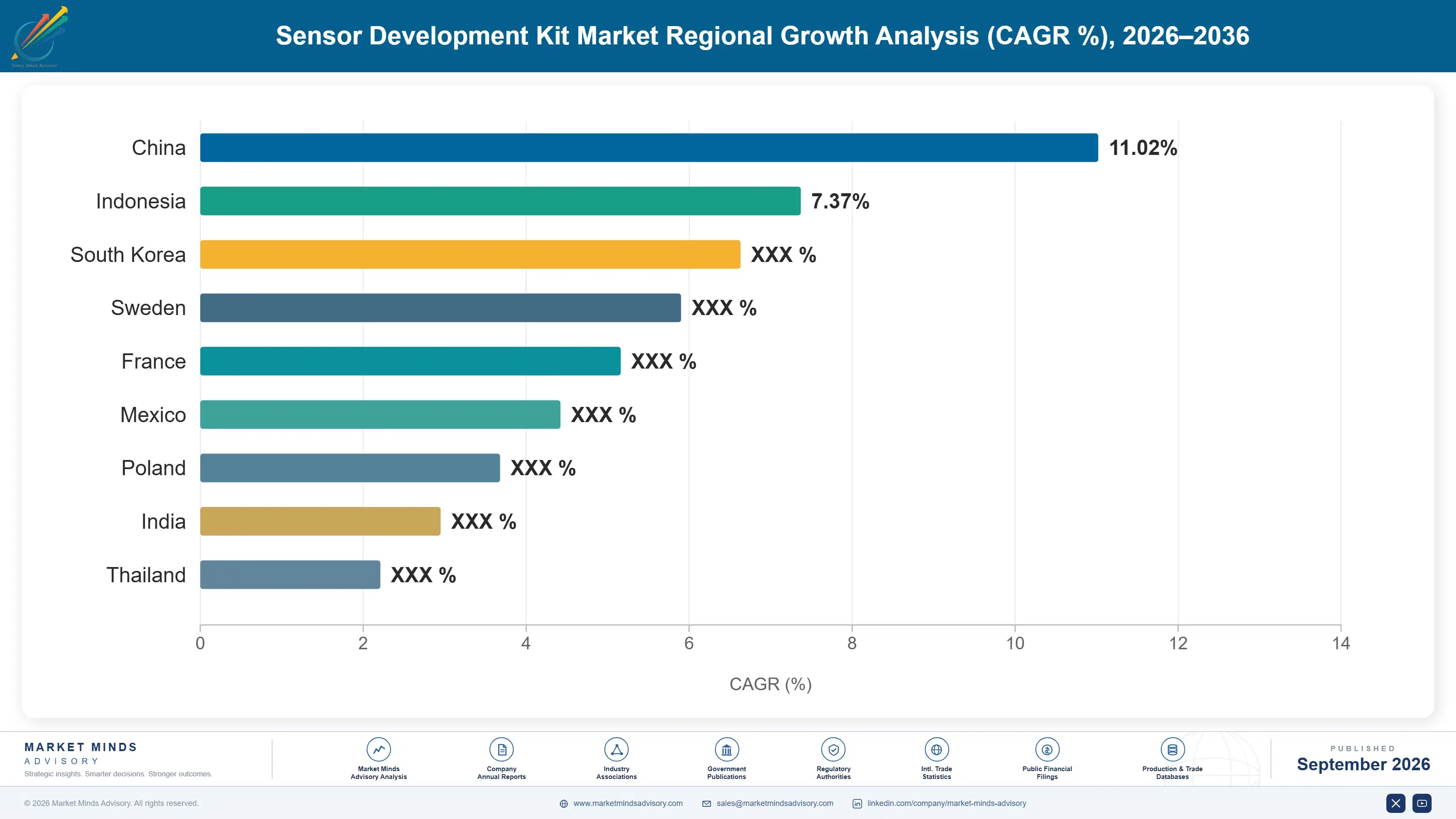
East Asia leads at 38% of kit shipment revenue, far above the standard band, because development kits go to hardware design engineers and hardware design concentrated in Shenzhen, Taipei, Seoul and Tokyo years ago. The kits follow the design engineers rather than the end markets those designs eventually serve.

East Asia

East Asia holds 38% of kit shipment revenue, far above the 30% band ceiling, for the straightforward reason that development kits go to hardware design engineers and hardware design concentrated here long ago. Shenzhen alone holds a density of electronics design teams no Western city approaches, supported by component availability and prototyping services within walking distance. Taiwanese, Korean and Japanese design centres add substantial volume. Seeed Studio operates from Shenzhen and serves designers worldwide. Chinese domestic sensor suppliers seed their own kits aggressively against international competitors. The kits follow the engineers rather than the end markets they eventually serve. Component availability and prototyping services sit within walking distance of the design teams themselves.
Share: 38% | CAGR: 12.6% (2026 to 2036)

North America

At 21% North America sits marginally below the 22% band floor, and the gap reflects where hardware gets designed rather than where products are sold. Texas Instruments, Analog Devices, Microchip Technology, SparkFun Electronics and Adafruit Industries all operate from here and ship kits worldwide, so supplier presence far exceeds regional consumption. Automotive, aerospace, medical device and industrial design teams generate steady demand at high value per evaluation. University and maker demand is substantial and converts poorly to production design wins. Growth at 10.8% sits below the global rate on a mature engineering population. Supplier presence here far exceeds actual regional consumption of the kits they ship worldwide. Maker demand converts poorly to production.
Share: 21% | CAGR: 10.8% (2026 to 2036)
Regional intelligence for 5 additional markets available in the complete report: Western Europe, South Asia and Pacific, Latin America, Middle East and Africa, Eastern Europe. Contact sales@marketmindsadvisory.com.
sensor-development-kit-market-country-cagr-analysis-1789990697575

What Kits Are Actually Selling

A kit generates no margin, roughly one in sixteen leads anywhere, and the engineer spends most of the evaluation fighting software rather than examining hardware. Each of the four levers below treats the kit as the sales instrument it genuinely is rather than as a product line to be optimised for its own profitability.

Fund The Software, Not The Board

An engineer spends around 78% of evaluation effort on drivers, example code, toolchain configuration and the questions that follow when none of it builds. Suppliers keep investing in board layout and connector choice while underfunding exactly the part that consumes the evaluation and decides its outcome. A forum answering in 31 hours converts evaluations that a slower one loses without any complaint being filed at all. The engineer simply tries a competitor's kit next, and nobody in the supplier organisation ever finds out why. Nobody in the supplier organisation ever learns why.
Market Impact: Software consumes fully 78% of all evaluation effort

Measure Design Wins Rather Than Kits Shipped

Around 6% of kits shipped lead to a production design win, and most suppliers report units distributed because that number is easier to obtain and considerably more flattering. Fourteen months separate the kit from the socket and the evaluating engineer is frequently not the one who designs in. Without attribution nobody knows which kits work, which means the programme cannot be optimised and cannot be defended when marketing budgets tighten. Registration incentives and distributor design registration make the connection visible. Registration incentives and distributor design registration make that connection visible at last.
Market Impact: Conversion sits at only 6% across the category

Ship Trained Models With Every Edge Kit

The evaluation question moved from whether a sensor reads accurately to whether a model runs on the microcontroller within the power and memory budget, which a datasheet cannot answer at all. Edge machine learning kits compound at 17.4% against 11.6% for the market, and kits shipping trained example models with profiling and memory analysis answer the question an engineer actually has. Suppliers still shipping a driver and a reference schematic are answering the question that mattered thirty years ago and losing evaluations quietly. The question that mattered thirty years ago is answered.
Market Impact: Edge kits compound at 17.4% every single year

Reach Engineers Where New Teams Are Forming

India compounds at 19.2% on hardware startup formation running at a rate established markets no longer match, and those teams buy kits at the start of every project rather than drawing on accumulated evaluation libraries. Kit demand per engineer runs considerably higher there as a result. Suppliers with local distribution, local documentation and responsive local support capture design wins that then run for a decade, and most Western suppliers still serve the region through international distribution with long lead times. Long lead times cost evaluations nobody records anywhere. Design wins from those teams run for a decade.
Market Impact: India compounds at 19.2% on entirely new teams

Who Controls the Margin Pool

Five suppliers hold 51% of development kit and evaluation board shipment revenue, concentrated among semiconductor manufacturers who fund kits as marketing spending rather than as a product line. STMicroelectronics, Texas Instruments, Bosch Sensortec, Infineon Technologies and Analog Devices ship kits specifically to seed design wins. Maker platform suppliers serve a genuinely different customer entirely, and increasingly compete for low volume production rather than prototypes alone. All participants are assessed on kit and evaluation board shipment revenue.
Competition runs on evaluation experience rather than on sensor specification, which datasheets obscure entirely. Two functionally comparable sensors reach very different outcomes depending on whether the driver builds first time, whether the example code matches the current toolchain and whether a forum question gets answered inside a working day. Engineers abandon evaluations silently, so suppliers rarely learn which ones they lost or why.

Rankings shift as edge machine learning changes what an evaluation has to prove, favouring suppliers whose kits ship trained models and profiling over those shipping schematics. The second pressure is maker platform suppliers moving upward: Arduino, Seeed Studio and Adafruit reach engineers earlier and their boards increasingly appear in low volume production rather than only in prototypes.
sensor-development-kit-market-company-positioning-matrix-1789990698100

Competitive Moat and Risk Dimensions

STMICROELECTRONICS

Moat: Development Software Toolchain Depth

STMicroelectronics built development tooling, middleware and configuration software around its sensor and microcontroller families over many years, so an engineer evaluating one part finds a working toolchain rather than assembling one. That matters enormously when 78% of evaluation effort is software. Assembling comparable software breadth takes a full decade.
STMICROELECTRONICS

Risk: Marketing Budget Dependency

Kit programmes are funded from marketing and design enablement budgets rather than from product revenue, since boards at around USD 45 generate almost nothing. Those budgets get cut in a downturn precisely when seeding future design wins matters most, and the return arrives fourteen months later where nobody attributes it. Defending the spending requires attribution the organisation has not built.
BOSCH SENSORTEC

Moat: Sensor Fusion Reference Depth

Bosch Sensortec supplies reference implementations for combining multiple sensor outputs into usable orientation, motion and environmental measurements, which is the difficult part engineers would otherwise build themselves. That fusion software is genuinely hard and accumulated across years of production deployment. Competitors ship components and leave integration entirely to the customer.
BOSCH SENSORTEC

Risk: Narrow Sensor Category Focus

A position built on motion and environmental sensing does not extend into the microcontroller and radio choices that edge machine learning and wireless node evaluations now centre on. Engineers increasingly evaluate systems rather than components, and a sensor specialist depends on somebody else's processing platform. That leaves the evaluation experience partly outside the company's own control.

Players Tracked

Prominent Players

STMicroelectronics
Texas Instruments
Bosch Sensortec
Infineon Technologies
Analog Devices

Other Key Players

NXP Semiconductors
Renesas Electronics
Nordic Semiconductor
Espressif Systems
Arduino
Adafruit Industries
SparkFun Electronics
Seeed Studio
Raspberry Pi
Microchip Technology
Silicon Labs
ams OSRAM
TDK InvenSense
Sensirion
Melexis

Recent Developments

MARCH 2025

STMicroelectronics Extends Edge Model Tooling Across Sensor Kits

STMicroelectronics extended trained model examples and profiling tooling across its sensor evaluation kit range, an organic product development rather than an acquisition. The evaluation question has moved from whether a sensor reads accurately to whether a model runs on the microcontroller within the available power and memory budget.
Signal: Kits answering last decade's question are losing evaluations that nobody in the supplier organisation ever records.
SEPTEMBER 2024

Seeed Studio Expands Sensor Kit Range For Production Volumes

Seeed Studio expanded its sensor module and kit range toward low volume production rather than prototyping alone, an organic expansion rather than any transaction. Maker platform boards increasingly appear in shipping products rather than only in prototypes, which changes what those suppliers actually compete for commercially.
Signal: Boards intended for prototypes are ending up inside products, which nobody in the category planned for.
JUNE 2025

Bosch Sensortec Adds Fusion Reference Code For Wireless Nodes

Bosch Sensortec added sensor fusion reference implementations targeting battery powered wireless node designs, an organic engineering development rather than a partnership or merger. Wireless node evaluation is a joint question about sensor, radio and duty cycle together, and measuring realistic battery life takes weeks rather than hours.
Signal: Long evaluations raise the switching costs, which makes winning that very first prototype unusually valuable here.

What A Kit Costs To Ship

Board components and assembly account for roughly 44% of kit cost, which is high because volumes are small and boards carry connectors, debug hardware and sensors that a production design would omit. Software development and maintenance carry around 26%, spread across drivers, examples and toolchain support. Community and technical support absorb about 14%, and packaging plus distribution take most of the remaining balance.
Component availability tightened through 2022 and 2023 and kit production competed for parts against production customers ordering far larger volumes, which repeatedly delayed kit availability at exactly the moment engineers were evaluating alternatives. STMicroelectronics Annual Report 2024 and Analog Devices Annual Report 2024 both record design enablement and customer support investment as operating expenditure rather than as cost of sales, which is how the whole category is accounted for.

The competitive disadvantage mechanism is software maintenance scale rather than board cost. Drivers, examples and toolchain support have to be maintained against operating system, compiler and framework changes continuously, and that expense scales with the number of supported platforms rather than with kits sold. A supplier with a broad microcontroller family amortises it widely, while a sensor specialist maintains equivalent software for a fraction of the volume.
sensor-development-kit-market-cost-volatility-analysis-1789990698301

Maintain One Driver Layer Across Every Sensor Family

Software development and maintenance run around 26% of kit cost and suppliers frequently maintain separate driver stacks per sensor family because those product lines grew up independently. A common abstraction layer with sensor-specific implementations beneath it removes duplicated maintenance against every toolchain and framework update. The discipline is architectural rather than technical, and few product organisations own it.

Design Kits Around Available Rather Than Preferred Parts

Board components run about 44% of kit cost and kit production competes for allocation against production customers ordering vastly more. Designing evaluation boards deliberately around components with deep availability rather than the newest ones keeps kits shipping when supply tightens. A kit unobtainable during a shortage loses evaluations to whichever board an engineer could buy.

Route Community Support Through Documented Answers

Technical and community support runs around 14% of kit cost and the same questions recur across thousands of engineers evaluating the same parts. Answering publicly in searchable form rather than individually converts each response into an asset serving everybody afterwards. Response times near 31 hours improve sharply when the answer already exists publicly Private support keeps paying for it.

Portfolio Architecture for Margin Defence

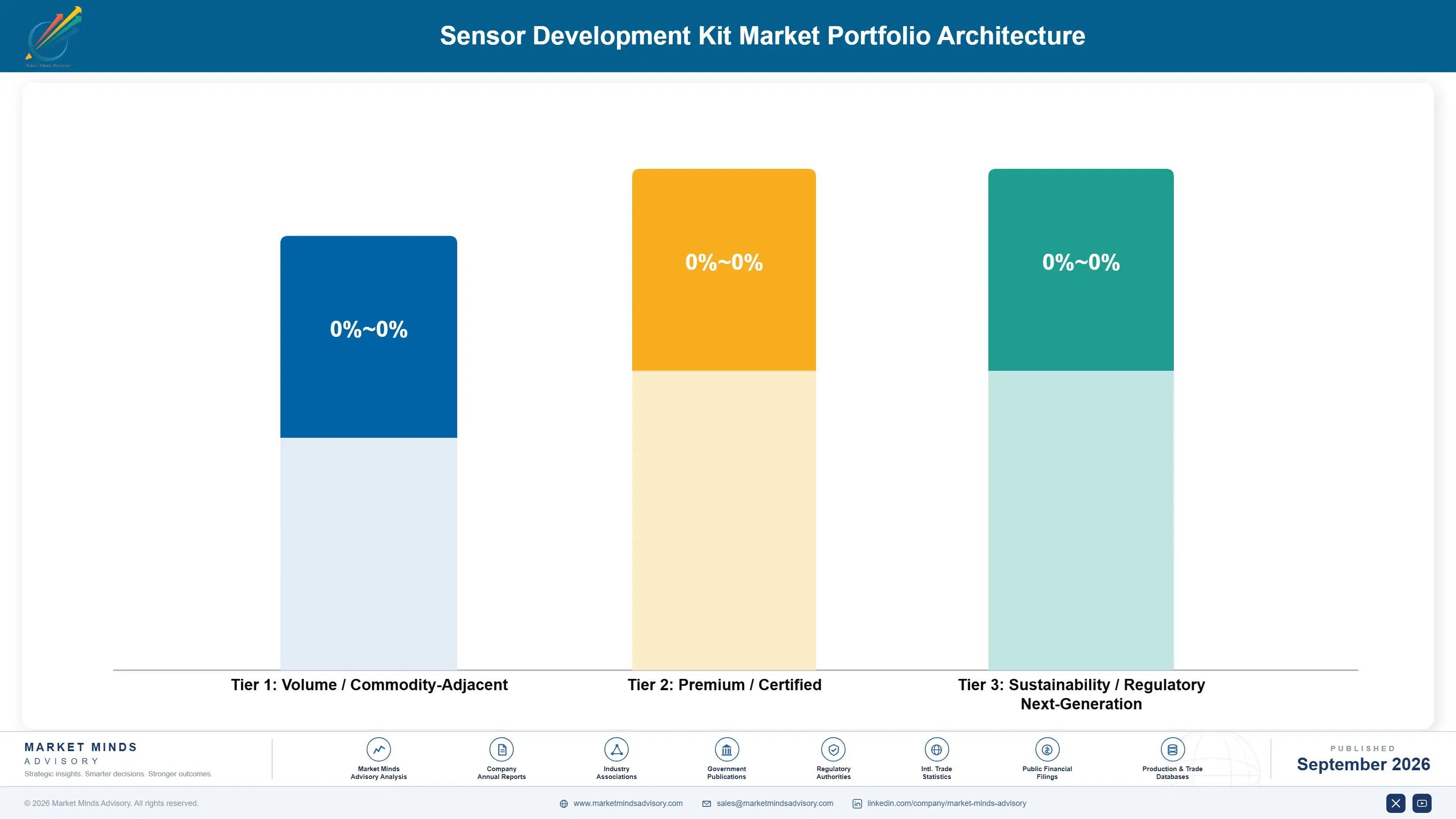
Margin architecture in this category is unusual because most of it is negative by design. Single sensor breakout boards and academic teaching kits earn least and frequently lose money outright, since both are priced to remove any barrier to trying a part. Multi-sensor platforms and industrial reference designs recover more. Edge machine learning and wireless node kits earn most, because engineers will pay for tooling that answers a genuinely hard question.
The volume versus premium tension is not really about margin at all. A cheap kit that reaches more engineers seeds more design wins even while losing money on every unit, and a premium kit that recovers cost reaches fewer. The correct answer depends on conversion, which few suppliers measure well enough to know. Most optimise board cost because that number is visible.

High-value pools concentrate in edge machine learning tooling and in fusion reference software, and neither is reached by improving hardware. Edge tooling requires model training, quantisation and profiling capability that sensor companies did not historically employ anybody to build. Fusion software accumulates through production deployment across many years. Both are software assets inside hardware companies, which is why so few exist.

Volume / Commodity-Adjacent

Single sensor breakout boards and academic teaching kits priced to remove any barrier to trying a component, frequently below full cost. The ten point spread separates suppliers with high volume board manufacturing from those producing small batches at considerably higher unit cost.
Gross Margin: 2% to 12%

Premium / Certified

Multi-sensor evaluation platforms and industrial reference design kits carrying certification, compliance documentation and application specific hardware. The twelve point spread tracks how much software a supplier ships with the board, since documentation depth rather than hardware determines what these can be priced at.
Gross Margin: 18% to 30%

Sustainability / Regulatory / Next-Generation

Edge machine learning kits and wireless sensor node kits, where engineers pay for tooling that answers a systems question a datasheet cannot. The fourteen point spread reflects model tooling and profiling depth, which very few sensor suppliers have built anybody to develop properly.
Gross Margin: 34% to 48%
sensor-development-kit-market-portfolio-architecture-1789990698797

High-value Sub-segments and Strategic Watch-out

Edge Machine Learning Sensor Kits

Grows at 17.4% because the question moved from whether a sensor reads accurately to whether a model fits the power budget. The fourteen point spread reflects model tooling depth. Kits shipping only a driver and schematic answer the question that mattered thirty years ago. Systems, not components.
Gross Margin: 34% to 48%

Wireless Sensor Node Kits

Grows at 14.8% on deployments needing battery powered nodes that run for years with no service visit at all. The fourteen point spread reflects power profiling capability. Realistic battery measurement takes weeks, which raises switching costs considerably once started. Nobody tolerates a battery change out there.
Gross Margin: 34% to 48%

Multi-Sensor Evaluation Platforms

Grows at 12.7% as designs combine motion, environmental and imaging sensing rather than evaluating any single component in isolation. The twelve point spread reflects fusion software depth. Combining outputs usefully is the hard part that engineers would otherwise build themselves. Fusion software is where the difficulty actually lives.
Gross Margin: 18% to 30%

Single Sensor Breakout Boards

Grows at 5.3%, slowest of the six classes, as engineers increasingly evaluate systems rather than individual components in isolation from everything else. The ten point spread reflects board manufacturing scale. These are priced to remove barriers rather than to recover any cost. Barriers removed rather than costs recovered.
Gross Margin: 2% to 12%

How Evaluations Become Sockets

The annuity is the design win rather than any kit purchase. An engineer who prototypes successfully with a part designs that part in, because re-prototyping with an alternative costs weeks of their own time against a component price difference measured in cents. Once the design ships, the part stays for the product's life and usually into the next generation. The kit cost around USD 45 and the socket behind it is worth orders of magnitude more.
Depth varies by how much evaluation effort was invested. A wireless node evaluation that took weeks of battery life measurement produces a design win nobody revisits, because repeating that work is genuinely expensive. An edge model evaluation is similarly sticky once tuned. A single sensor breakout used for a quick check creates no commitment at all, and the engineer switches parts on price.

The buyer changed and it happened gradually enough that few noticed. A decade ago a component engineer selected sensors against specifications and price. Today a systems engineer evaluates whether the whole arrangement of sensor, processor, radio and model works together inside a power budget. Suppliers organised around component specifications answer a question asked only after the systems question is settled.
sensor-development-kit-market-end-use-penetration-index-1789990699290

What Kits Are Really Buying

These are among the four positions where our research anticipates prominent divergence between winners and laggards over the coming forecast period. Each is grounded in the demand model, the regulatory perimeter, and the announced capacity pipeline.
01 / EVALUATION SOFTWARE INVESTMENT

Fund The Drivers Before The Layout

An engineer spends roughly 78% of evaluation effort on drivers, example code, toolchain configuration and the questions that arise when none of it builds correctly the first time. Suppliers keep investing in board layout and connector selection while underfunding exactly the part that consumes the evaluation and decides its outcome entirely. A community forum answering within 31 hours converts evaluations that a slower one loses without any complaint ever being filed, because the engineer simply goes and tries a competitor's kit next instead.
02 / DESIGN WIN ATTRIBUTION

Count Sockets Won, Not Boards Shipped

Around 6% of kits shipped lead to a production design win, and most suppliers report units distributed instead because that figure is far easier to obtain and considerably more flattering to present. Fourteen months separate the kit from the socket and the evaluating engineer is frequently not the person who eventually designs the part in. Without attribution nobody knows which kits work, which means the programme cannot be optimised and cannot be defended at all when the marketing budgets inevitably tighten again.
03 / SYSTEMS QUESTION ANSWERING

Prove The Model Fits, Not The Reading

The evaluation question moved from whether a sensor reads accurately to whether a useful model runs on the microcontroller alongside it inside the available power and memory budget, which no datasheet can answer. Edge machine learning kits compound at 17.4% against 11.6% for the market, and kits shipping trained example models with profiling and memory analysis answer what an engineer genuinely needs. Suppliers still shipping a driver and a reference schematic are quietly losing evaluations that they will never once hear anything about.
04 / NEW TEAM COVERAGE

Reach The Engineers Nobody Is Calling

India compounds at 19.2% on hardware startup formation running at a pace that established markets no longer match anywhere, and those teams buy kits at the start of every project rather than drawing on accumulated evaluation libraries built up over years. Kit demand per engineer therefore runs considerably higher there. Suppliers with local distribution, local documentation and responsive support capture design wins that run for a decade, and most Western suppliers still serve that region entirely through slow international distribution.

Engagement Snapshot From the Field

A live engagement with an industry participant carrying material or product regulatory and market exposure ahead of a defining policy shift, showing how our research translates into a defensible multi-year portfolio strategy.
MARKET MINDS ADVISORY · CLIENT ENGAGEMENT SUMMARY
Sensor Development Kit Producer Strategic Portfolio Review and Transition Roadmap 2026·Investment Scenario on Sensor Development Kit Exposure Evaluation 2025-26
CLIENT PROFILE
A global sensor manufacturer shipping around 340,000 evaluation kits annually across eleven product families, with a design enablement budget under pressure after two flat revenue years. Kit shipments were reported monthly and design wins were not tracked against them at all. Marketing was preparing to cut the programme by half without any evidence about which parts of it worked.
STRATEGIC CHALLENGE
Marketing needed a budget reduction and had no basis for choosing what to cut, so an even reduction across all families was the default plan. Applications engineering argued that kits drove every design win the company had. Nobody had connected kit shipments to production sockets, and the fourteen month lag made the relationship invisible to anybody looking at a single year.
MMA APPROACH
MMA traced design wins recorded over three years back to originating kit shipments through distributor registration and applications engineering records where they existed. We compared conversion by product family and by region, and measured software support quality against conversion outcomes. The work drew on 47 expert interviews conducted in Q4 2025 with distributors, design engineers and comparable semiconductor suppliers.
KEY FINDINGS
  1. Conversion varied by roughly 5 times between product families, and the families the company shipped most kits for converted the worst of all.
  2. Families with maintained example code and forum response under a day converted at about 3 times the rate of families without either.
  3. Indian and Southeast Asian kit shipments converted better than North American ones, and both regions were served through slow international distribution channels.
  4. An even budget cut would have removed around 40% of the kits driving genuine design wins while preserving the ones that converted worst (client-reported, unverified by MMA).
CLIENT PROFILE
A global sensor manufacturer shipping around 340,000 evaluation kits annually across eleven product families, with a design enablement budget under pressure after two flat revenue years. Kit shipments were reported monthly and design wins were not tracked against them at all. Marketing was preparing to cut the programme by half without any evidence about which parts of it worked.
STRATEGIC CHALLENGE
Marketing needed a budget reduction and had no basis for choosing what to cut, so an even reduction across all families was the default plan. Applications engineering argued that kits drove every design win the company had. Nobody had connected kit shipments to production sockets, and the fourteen month lag made the relationship invisible to anybody looking at a single year.
MMA APPROACH
MMA traced design wins recorded over three years back to originating kit shipments through distributor registration and applications engineering records where they existed. We compared conversion by product family and by region, and measured software support quality against conversion outcomes. The work drew on 47 expert interviews conducted in Q4 2025 with distributors, design engineers and comparable semiconductor suppliers.
KEY FINDINGS
  1. Conversion varied by roughly 5 times between product families, and the families the company shipped most kits for converted the worst of all.
  2. Families with maintained example code and forum response under a day converted at about 3 times the rate of families without either.
  3. Indian and Southeast Asian kit shipments converted better than North American ones, and both regions were served through slow international distribution channels.
  4. An even budget cut would have removed around 40% of the kits driving genuine design wins while preserving the ones that converted worst (client-reported, unverified by MMA).
RECOMMENDED STRATEGY
Phase 1: Phase one: cut kit volume in the families converting worst, rather than reducing evenly across every product line as planned. Phase 2: Phase two: redirect the whole saving into example code maintenance and forum response for the families that already convert well. Phase 3: Phase three: establish distributor design registration now, so that conversion becomes measurable well before the next budget cycle actually arrives.
OUTCOME
The manufacturer cut kit volume selectively and redirected the saving into software support (client-reported, unverified by MMA). Total design wins rose despite fewer kits shipping, and conversion in the improved families climbed measurably. Design wins rather than kit shipments are now the reported metric, which is the change that outlasted the engagement itself.

Frequently Asked Questions

Foundational context covering the market sizes, CAGR, scope, country, region and competition that inform every finding below. This section is provided to cover basics and most often pre-purchase conversations, answered from the MMA Primary Research Dataset.

What is the current size of the Sensor Development Kit Market?

Global value reaches USD 0.76 billion in 2026, measured as development kit and evaluation board shipment revenue across six classes. The 2025 base is USD 0.68 billion.

How large will the Sensor Development Kit Market be by 2036?

Kit shipment revenue reaches USD 2.28 billion by 2036, an increase of USD 1.52 billion over the forecast period. That represents 3.00 times expansion from the 2026 base.

What is the CAGR for the Sensor Development Kit Market 2026 to 2036?

The base case runs at 11.6% annually, with a bull case at 12.9% if edge model tooling ships as standard and a bear case at 10.3% if semiconductor marketing budgets compress.

Which segment is growing fastest?

Edge machine learning sensor kits grow at 17.4%, half again the market rate of 11.6%. The evaluation question moved from whether a sensor reads accurately to whether a model fits the power budget.

Who are the major companies in the Sensor Development Kit Market?

STMicroelectronics, Texas Instruments, Bosch Sensortec, Infineon Technologies and Analog Devices lead on kit shipment revenue, together holding 51%. Arduino, Seeed Studio and Adafruit serve a different customer.

Which country is growing fastest?

India leads at 19.2%, because hardware startup formation is running faster than in established markets and new teams buy kits at the start of every project. Vietnam and Indonesia follow.

Report Segmentation Architecture

The full report scope spans multiple orthogonal segmentation dimensions, with cross-tabulated demand data provided for each dimension pair. Coverage extends further to regional breakdowns, trend trajectories, and the competitive detail needed to support segment-level decision-making.

By Kit Class

  • Edge Machine Learning Sensor Kits
  • Wireless Sensor Node Kits
  • Multi-Sensor Evaluation Platforms
  • Industrial Reference Design Kits
  • Academic And Teaching Sensor Kits
  • Single Sensor Breakout Boards

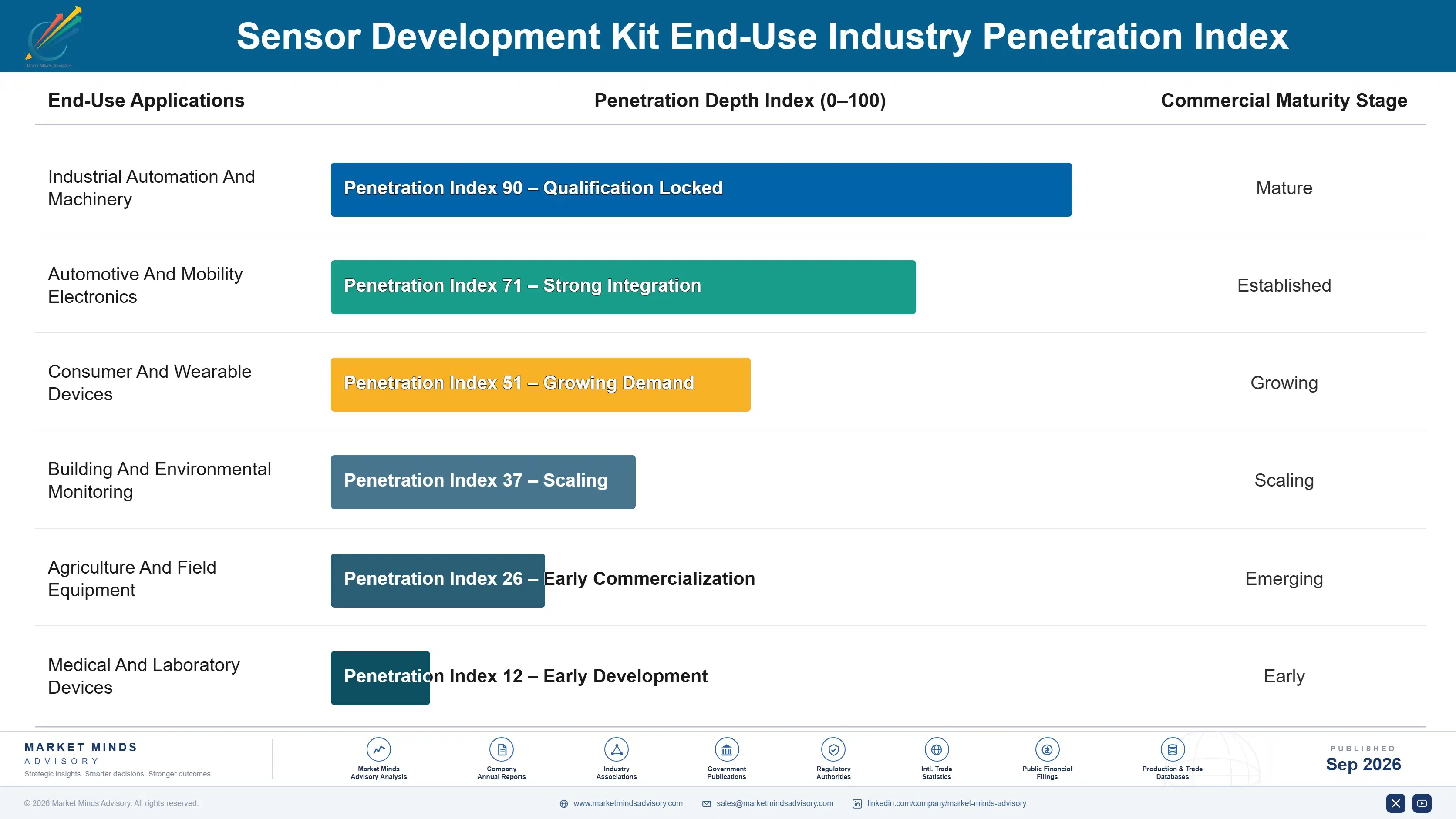
By End-Use Industry

  • Industrial Automation And Machinery
  • Automotive And Mobility Electronics
  • Consumer And Wearable Devices
  • Building And Environmental Monitoring
  • Agriculture And Field Equipment
  • Medical And Laboratory Devices

By Commercial Dimension

  • Electronics Distributor Channel
  • Direct Manufacturer Sales
  • Online Maker Retail Channel
  • University And Education Programmes
  • Design House And Consultancy Supply
  • Startup Accelerator Programmes

By Region

  • North America
  • Western Europe
  • East Asia
  • South Asia and Pacific
  • Latin America
  • Middle East and Africa
  • Eastern Europe

Scope, Methodology, and Coverage

Every figure in this report is reproducible from documented input assumptions. The scope below maps the historical period, the forecast horizon, the segmentation dimensions, and the countries covered, alongside the underlying primary and qualitative methodology.
Historical Period
2020 to 2025
Forecast Period
2026 to 2036
Base Year
2025 (USD billions; MMA Primary Research Dataset, September 2026)
Market Definition
This report covers evaluation boards, reference designs and development kits used to prototype with sensors ahead of production design: multi-sensor evaluation platforms, single sensor breakout boards, edge machine learning sensor kits, wireless sensor node kits, industrial reference design kits, and academic and teaching sensor kits. It excludes production sensor components themselves, general purpose microcontroller boards without sensing, test and measurement instruments, contract design services, and industrial data acquisition systems.
Quantitative Units
USD millions, kit and evaluation board shipment revenue basis; kits shipped annually; design win conversion as a percentage; prototype to production period in months; support response time in hours.
Segmentation Dimensions
Kit class; end-use design industry; commercial distribution channel; geography across seven regions.
Regions Covered
North America, Western Europe, East Asia, South Asia and Pacific, Latin America, Middle East and Africa, Eastern Europe
Countries Covered
China, Taiwan, South Korea, Japan, India, Vietnam, Indonesia, Australia, United States, Canada, Mexico, Brazil, Germany, Switzerland, Netherlands, Sweden, Poland, Czechia, Ukraine, Israel.
Key Companies Profiled
STMicroelectronics, Texas Instruments, Bosch Sensortec, Infineon Technologies, Analog Devices, NXP Semiconductors, Renesas Electronics, Nordic Semiconductor, Espressif Systems, Arduino, Adafruit Industries, SparkFun Electronics, Seeed Studio, TDK InvenSense, Sensirion.
Quantitative Methodology
Primary survey, n=3,800 respondents, Q4 2025, six countries; demand-side model with trade association cross-validation
Qualitative Methodology
47 expert interviews, Q4 2025; applied to validate demand model assumptions, identify emerging dynamics, and assess competitive positioning
Report Format
PDF and XLSX data workbook (Word format preview document)
Publisher
Market Minds Advisory
Report Code
MMA-2026-TEC-551
Published
September 2026
Contact
sales@marketmindsadvisory.com | www.marketmindsadvisory.com

Purchase the full Sensor Development Kit Market Report (2026 to 2036).

This report sizes the global sensor development kit market from 2026 to 2036 across six kit classes, six design industries and seven regions. It explains why a category with almost no margin exists at all, how a 6% design win conversion rate makes kits a sales instrument rather than a product line, and why 78% of evaluation effort going into software means suppliers are funding the wrong half. Cost composition is sourced to company annual reports, with software maintenance analysed as the scale constraint. Regional analysis explains why East Asia leads at 38% while India grows at 19.2%.
Six kit classes sized through to 2036
Design win economics modelled behind the kit revenue
Software maintenance cost composition from company annual filings
Twenty named suppliers assessed on kit revenue
Four revenue levers with quantified commercial impact
Anonymised sensor manufacturer enablement review engagement included fully

Built For The People Who Decide

From boardroom strategy to bench-side execution, this report is read cover-to-cover by leaders shaping the next decade of their industry, turning demand scenarios, market dynamics and valuation benchmarks into decisions.
CXOs/ Presidents/ VPs/ Managers
M&A and Corporate Development
Strategy Teams and R&D Heads
Procurement and Product Directors
Regulatory and Compliance Leaders
Investor Relations and Equity Analysts