Market Minds Advisory
Seismic Protection Device Market

Seismic Protection Device Market: Seismic Protection Device Market. Code Mandates, Retrofit Backlogs, and the Shift to Performance-Based Design

Post-earthquake code overhauls in Turkey and Nepal are converting voluntary retrofit into mandatory compliance across seismic zones, pushing base isolators and dampers from specialist infrastructure projects into mainstream commercial construction specifications worldwide.

Lead Analyst

David Horsley

Published

August 2026

Make Smarter Decisions with Customized Research Insights

Request a free sample report and evaluate market opportunities, growth trends, and competitive dynamics relevant to your business needs.

2025 MARKET VALUE$9.8BMarket Size 2025
2036 FORECAST VALUE$21.9BBase Case , 2026 to 2036
CAGR 2026 TO 20367.6 %Bull 8.8% / Bear 6.4%
INCREMENTAL OPPORTUNITY$11.4BNet 10- year value creation
EXPANSION MULTIPLE2.08x2036 value over 2026 base
Strategic Levers
M&A Pipeline
Regional Outlook
Country Rankings
Competitive Intelligence
Segmental Deep-dive
Call-Us : 91 93563 13602

Executive Snapshot and Market Trajectory.

Turkey's 2023 building code overhaul made seismic isolation mandatory for hospitals and schools in high-risk provinces, and the resulting specification wave is reshaping procurement across every major seismic-prone construction market watching closely for signs of a similar shift arriving at home before the next major earthquake.
Retrofit spending now outpaces new-build installation in Japan and the western United States, as ageing hospital and transit infrastructure reaches mandated compliance deadlines set years in advance. Friction pendulum bearings are capturing share fastest in tall commercial towers, where floor-space efficiency matters more than the elastomeric isolators that dominated installations a decade ago across most mid-rise buildings throughout Japan and the western United States, a shift reshaping specification habits at major engineering firms nationwide.
Five engineering-led manufacturers still control most specified projects, but regional fabricators in Indonesia and Chile are closing the qualification gap through joint testing programmes run with local universities and government laboratories. Performance-based design codes, now spreading beyond Japan and the United States, are resetting how quickly a new device family can move from laboratory testing into approved building specifications across additional jurisdictions still finalising their own regulatory frameworks.
Market Definition
This market covers engineered seismic protection devices, base isolation bearings, viscous and fluid dampers, tuned mass and tuned liquid dampers, and buckling-restrained braces installed in buildings and infrastructure for earthquake resistance. It excludes general structural steel, passive damping used solely for wind loads, and seismic monitoring software sold independent of hardware.
Base Year Value
$9.8B in 2025 (MMA Primary Research Dataset, August 2026)
Forecast Period
2026 to 2036, eleven discrete annual values
CAGR
7.6% base case. Bull 8.8%. Bear 6.4%.
Fastest Growth Segment
Friction Pendulum and Sliding Isolation Bearings: 11.2% CAGR
Fastest Growth Country
Turkey: 12.8% CAGR
Fastest Growth Region
South Asia and Pacific: 9.6% CAGR
Largest Region
East Asia: 29% of 2025 global value
Market Leaders
FIP Mec, Maurer SE, Dynamic Isolation Systems, Taylor Devices, THK Co. Source: MMA Analysis based on company annual reports.
Primary Survey
n=3,800 procurement and R&D decision-makers, Q4 2025, six countries
Methodology
Demand-side build-up, cross-validated against public data, 47 expert interviews

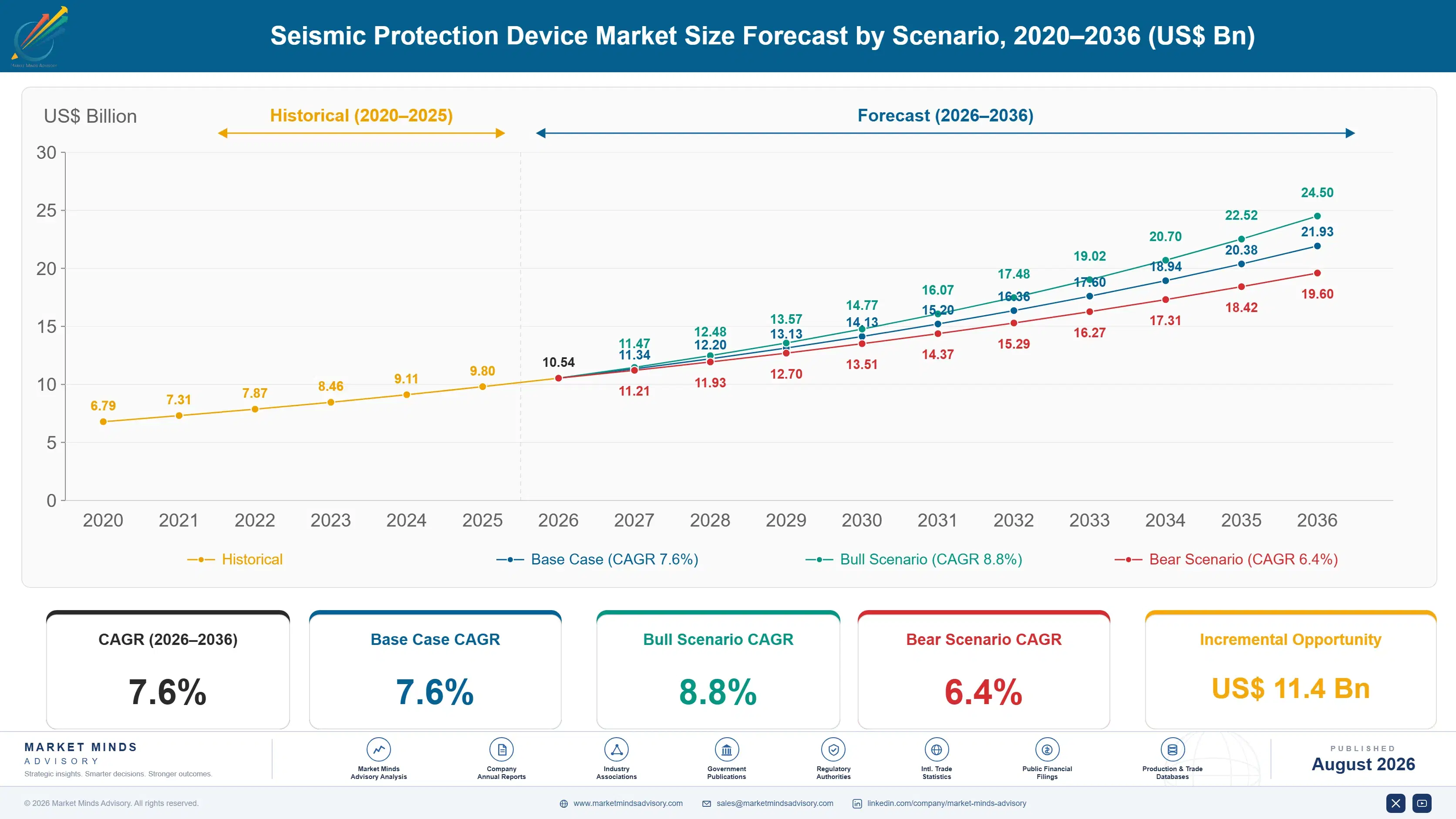
Seismic Protection Device Market Forecast Scenarios

seismic-protection-device-market-size-forecast-scenario-1787325642778
Between 2020 and 2025, the market grew at a historical rate near 6.6 percent as adoption remained concentrated in Japan, the United States, and New Zealand, with retrofit programmes moving slower than code writers intended, held back by funding gaps at the municipal level across most participating jurisdictions worldwide even as underlying engineering demand kept climbing steadily each year.
The base case assumes 7.6 percent annual growth through 2036, built on three mechanisms: Turkey's post-2023 mandatory isolation code for critical-use buildings, expanding performance-based design adoption that lets engineers specify dampers instead of pure structural mass, and accelerating hospital and school retrofit programmes in California and the Pacific Northwest tied to statutory compliance deadlines already set firmly in law well ahead of the 2030 target date facing acute-care facilities statewide.
A bull case near 8.8 percent depends on Indonesia and the Philippines adopting mandatory isolation requirements similar to Turkey's. The bear case near 6.4 percent reflects continued retrofit funding delays, since several municipal seismic bond measures have failed at the ballot box in recent election cycles across the United States, stalling procurement well behind original engineering timelines.

From Specialist Retrofit to Standard Specification

Seismic protection has moved from a niche specification reserved for landmark towers and nuclear facilities into a mainstream line item on hospital, school, and transit infrastructure budgets across every major earthquake-prone country, driven largely by code mandates rather than voluntary owner choice or marketing preference for a safer building among prospective tenants and buyers weighing competing properties.
TOP 5 CONCENTRATION44% CR5revenue share held by five largest device manufacturers
AVERAGE DEVICE LIFECYCLE35 yearstypical service life before replacement or inspection overhaul
LEADING PRODUCING COUNTRYJapan, 26%share of global production value, by home country
RETROFIT VS NEW-BUILD SPLIT54% retrofitshare of installations tied to existing structure upgrades
TESTING FACILITY CONCENTRATION68%share of qualification testing run at accredited university labs
STEEL AND ELASTOMER SHARE31% of COGSinput cost weight from structural steel and elastomers
Commercial behaviour splits along project type. New-build towers increasingly specify friction pendulum bearings for their compact footprint and predictable performance under large displacement, while retrofit projects favour viscous dampers that can be added to existing frames without full foundation reconstruction, a meaningfully cheaper and faster path to code compliance for older buildings still working through their compliance backlog across multiple ageing facility types and ownership structures.
The next decade turns on testing capacity. Countries adopting mandatory isolation codes faster than their accredited testing infrastructure can scale face a bottleneck that slows project timelines regardless of manufacturer capacity or engineering demand, a constraint policymakers rarely account for when setting compliance deadlines that assume testing throughput will simply keep pace with rising specification volume across every affected building category and jurisdiction.
"Nobody buys a base isolator because they want to. They buy it because a code official told them the building can't get an occupancy permit without one."
Director, Structural and Seismic Engineering Practice · MMA Construction and Ind

Market Trends

Turkey's Mandatory Isolation Code Reshapes Regional Specification

Turkey's 2023 code revision, enacted after the February earthquakes killed more than 50,000 people, now mandates base isolation for new hospitals and schools across its highest-risk seismic provinces. The requirement has pulled forward roughly 400 million dollars in specified isolator demand through 2028, according to Turkey's Ministry of Environment, Urbanisation and Climate Change disclosures. Neighbouring Balkan states and Greece are studying similar mandatory provisions, and several Turkish fabricators have expanded testing capacity specifically to supply both domestic demand and prospective regional export orders building over the next few years as neighbouring governments finalise their own code revisions.
Market Impact: Covers 40 hospital facilities
Performance-Based Design Codes Spread Beyond Japan and the US

Performance-based seismic design, which lets engineers specify damping devices calibrated to a building's actual displacement rather than defaulting to oversized structural mass, has moved from a Japan and California specialty into mainstream code adoption across Chile, New Zealand, and increasingly Indonesia. The approach typically cuts structural steel tonnage by 12 to 18 percent per building while adding device cost, a trade-off that favours damper and isolator manufacturers as more jurisdictions permit the calculation method for standard commercial construction rather than reserving it for landmark or critical-infrastructure projects only, widening the addressable specification pool considerably.
Market Impact: Covers 18 highest-risk provinces

Market Opportunities and Growth Drivers

Mandatory Hospital and School Retrofit Deadlines in California

California's Alfred E. Alquist Hospital Facilities Seismic Safety Act sets a 2030 compliance deadline for acute-care hospital buildings still operating under pre-1973 seismic standards, covering an estimated 40 remaining non-compliant facilities across the state. Each retrofit typically specifies multiple viscous dampers or isolation bearings depending on structure type, and the approaching deadline has pulled forward engineering and procurement timelines considerably since 2023. Washington and Oregon are drafting comparable legislation for public school buildings, extending the same compliance-driven demand pattern north along the Pacific coast over the coming decade as more states follow California's lead on mandatory retrofit.
Market Impact: Adds 6 to 12 months delay

Turkey's Post-Earthquake Code Mandate Drives Regional Demand

Following the 2023 earthquakes, Turkey's revised building code requires seismic isolation for new critical-use structures in its highest-risk zones, covering roughly 18 provinces classified under the strictest hazard category. The mandate applies retroactively to projects already in design phase, forcing rapid respecification across dozens of active hospital and school projects. Fabricators including FIP Mec have opened regional supply agreements to meet demand, and Turkish authorities have signalled the mandate may extend to residential towers above a specified height threshold within the next code revision cycle expected before 2028, according to ministry planning documents released this year.
Market Impact: Delays retrofit 3 to 5 yrs

Market Restraints and Challenges

Accredited Testing Capacity Lags Code Adoption Speed

Countries adopting mandatory isolation codes need accredited shake-table and full-scale device testing facilities to qualify new products for local use, and this infrastructure takes years to build. The root cause is that university and government labs capable of full-scale seismic testing number fewer than thirty worldwide, concentrated in Japan, the United States, and China. Manufacturers in newly regulated markets often ship devices to established labs abroad for qualification, adding months to project timelines. Several countries are now co-funding regional testing centres, notably a joint Indonesia-Philippines facility under discussion, to shorten this qualification bottleneck over time.
Market Impact: Adds $400M specified demand

Municipal Retrofit Bond Measures Face Voter Resistance

Seismic retrofit for public buildings in the United States typically depends on municipal bond measures requiring voter approval, and several such measures have failed at the ballot box in recent election cycles as competing infrastructure priorities crowd local budgets. The underlying cause is that seismic risk feels abstract to voters until an event actually occurs, unlike more visible infrastructure spending. This delays retrofit specification for public hospitals and schools by years in affected districts. Some municipalities have shifted toward state-level revolving loan funds that bypass local bond votes entirely, a mitigation path gaining traction in California and Oregon.
Market Impact: Cuts steel tonnage 12 to 18%
3 additional market trends, 4 additional growth drivers, and 3 additional restraints and challenges are covered in the full report. Contact sales@marketmindsadvisory.com to access the complete intelligence.

Segment CAGR and Growth Architecture

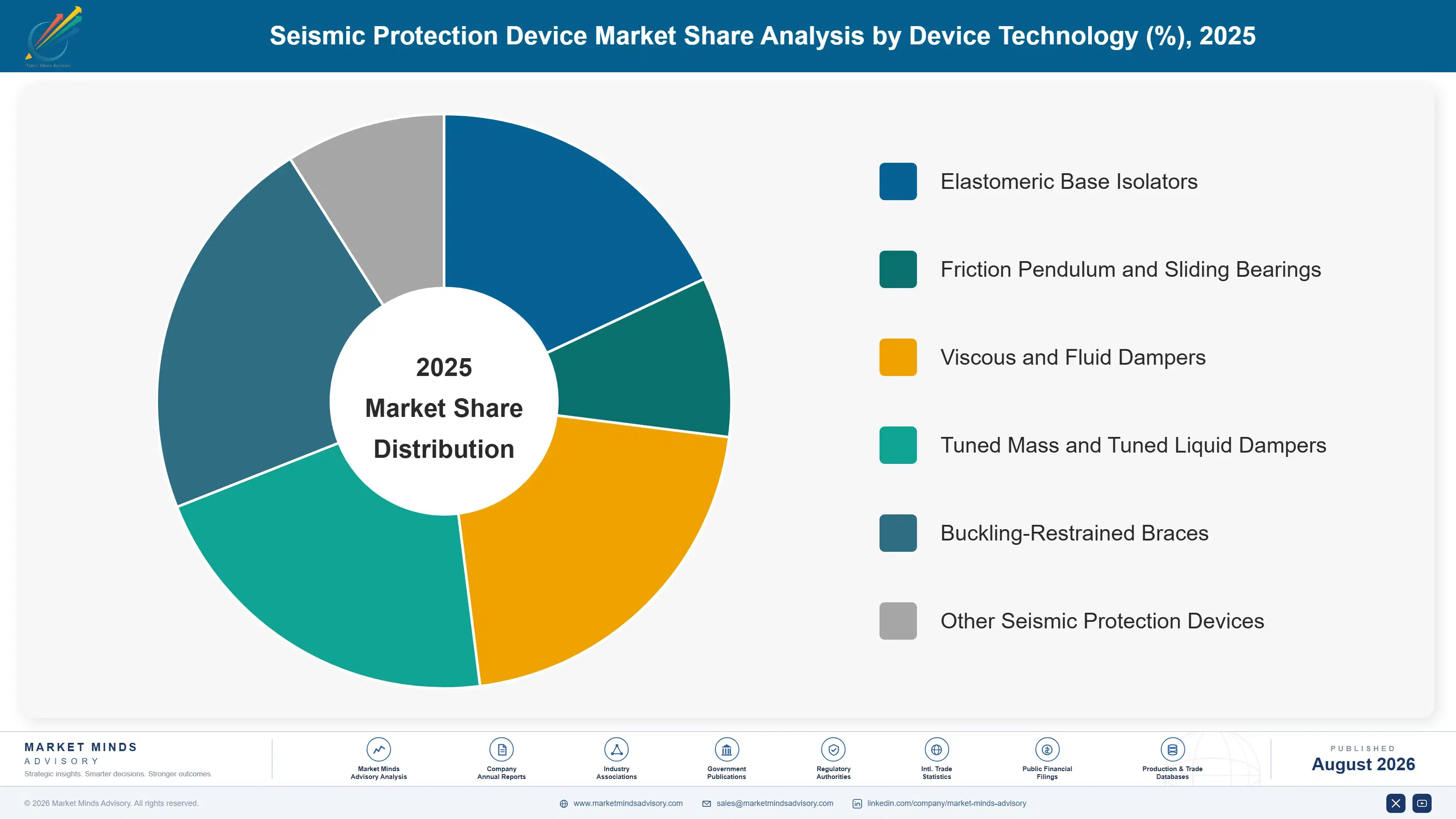
Segmentation follows device technology, the classification structural engineers and code officials already use to specify products against seismic performance requirements. Each technology class addresses a distinct structural displacement and force profile within building design, from base isolation through supplemental energy dissipation and bracing systems used across most project types specified by engineers working today.
seismic-protection-device-market-market-share-analysis-1787325643309

Friction Pendulum and Sliding Isolation Bearings

Friction pendulum bearings are the fastest-growing device class as tall commercial towers increasingly favour their compact footprint over the bulkier elastomeric isolators that dominated installations through the 2010s. The technology uses a curved sliding surface to provide a self-centring restoring force, letting engineers tune the isolation period without adding the plan-area bulk that elastomeric bearings require at large building scale. THK Co. and Earthquake Protection Systems lead approved product families across Japan and the United States. Adoption is accelerating fastest in Chile and Indonesia, where performance-based codes increasingly permit friction pendulum systems for standard commercial construction rather than reserving the technology for landmark or critical-infrastructure projects exclusively, a shift widening the addressable market for specialised bearing fabricators considerably each year.
CAGR 11.2%

Buckling-Restrained Braces

Buckling-restrained braces grow fastest among structural energy-dissipation devices as steel-frame retrofit and new-build projects increasingly favour their predictable, repeatable hysteretic behaviour under repeated loading cycles. Unlike conventional braces, which buckle and lose capacity after a single major event, buckling-restrained versions yield in both tension and compression, allowing structures to absorb multiple aftershocks without full replacement. Nippon Steel Engineering and CoreBrace hold significant specified volume across Japan and North America respectively. Growth concentrates in mid-rise steel retrofit projects, where the technology offers a lower-cost alternative to full isolation systems while still meeting increasingly strict performance-based design requirements set by local code officials reviewing each project submission before construction permits are issued.
CAGR 10.4%
Full segment breakdown across 6 segments available in the complete report.

Regional Architecture and Country Demand Map

East Asia and North America together account for more than half of global installations, while South Asia and Pacific posts the fastest regional growth on expanding code mandates across Indonesia and the Philippines, both moving toward Turkey-style mandatory isolation requirements within the next few years.

North America

California anchors regional demand through the Alquist Hospital Seismic Safety Act's 2030 compliance deadline, which has pulled forward retrofit procurement across dozens of acute-care facilities still operating under outdated structural standards. Washington and Oregon are drafting comparable legislation covering public school buildings, extending demand along the Cascadia subduction zone where seismic risk has drawn increasing legislative attention since 2019. Canada contributes a smaller share concentrated in British Columbia, where Vancouver's building code already requires isolation for essential-service facilities including hospitals and fire stations. Manufacturing and engineering expertise concentrates around the San Francisco Bay Area, where several leading device fabricators maintain testing and design facilities close to their largest specification market.
Share: 26% | CAGR: 8.4% (2026 to 2036)

Western Europe

Italy drives regional volume through its post-2016 Amatrice earthquake building code revisions, which extended isolation requirements to a broader range of public buildings across its central Apennine seismic zone and surrounding provinces. Greece follows with steady retrofit demand tied to its long history of damaging earthquakes, though funding constraints have slowed public-sector project timelines considerably compared to Italy's more consistent budget allocation for structural upgrades. Switzerland and France contribute smaller shares concentrated in alpine infrastructure and select landmark commercial towers requiring enhanced seismic performance. Regional growth trails North America and East Asia because most high-priority retrofit work in the region's highest-risk zones has already been completed over the past decade of sustained investment.
Share: 19% | CAGR: 6.2% (2026 to 2036)
Regional intelligence for 5 additional markets available in the complete report: East Asia, South Asia and Pacific, Latin America, Middle East and Africa, Eastern Europe. Contact sales@marketmindsadvisory.com.
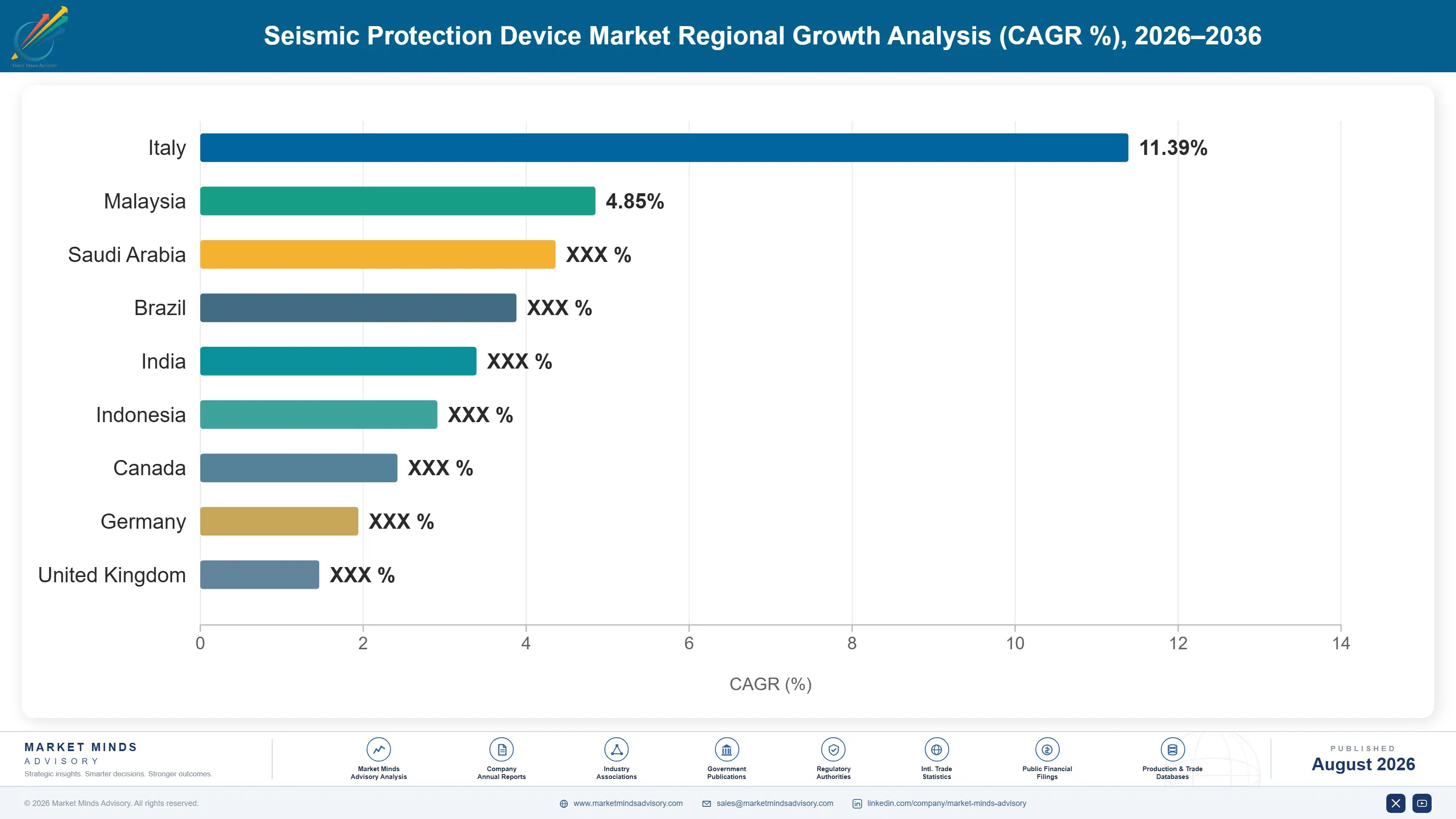
seismic-protection-device-market-country-cagr-analysis-1787325643828

Where Seismic Device Margin Concentrates

Margin follows qualification, not manufacturing scale. Whoever holds accredited testing data for a jurisdiction's specific code requirements captures the specification, regardless of who can produce the device more cheaply elsewhere once local rules take effect and procurement timelines compress around the deadline set by regulators overseeing each affected building category and its use case.

Jurisdiction-Specific Testing and Qualification Data Edge

Manufacturers holding full-scale shake-table qualification data for a specific jurisdiction's code requirements can specify projects months faster than competitors starting qualification from scratch, a meaningful edge in markets like Turkey where retroactive code mandates compress project timelines considerably. FIP Mec and Maurer SE have both invested in pre-qualifying product families across multiple jurisdictions specifically to capture this timing advantage ahead of new code adoption waves. Later entrants without existing qualification face project delays of 6 to 12 months while their devices complete local testing requirements, often losing the specification to an already-qualified competitor.
Market Impact: Cuts specification time by 6 to 12

Bundled Performance-Based Design Engineering Service Offerings

Manufacturers that pair device sales with in-house performance-based design engineering capture higher-margin specification work beyond the hardware itself, since structural engineers increasingly outsource complex nonlinear analysis rather than building it internally in-house. Taylor Devices and Dynamic Isolation Systems both run dedicated engineering-services teams that consult directly with project structural engineers from early design through final specification and installation sign-off. This bundled approach has widened effective project margins by an estimated 8 to 14 percentage points versus hardware-only supply agreements, according to MMA Primary Research interviews conducted with structural engineering firms in Q4 2025.
Market Impact: Widens margins by 8 to 14 points ov

Retrofit Installation Speed Without Foundation Work

Viscous dampers and buckling-restrained braces that retrofit into existing structures without full foundation reconstruction command a premium over isolation systems requiring extensive substructure work, since retrofit clients prioritise minimising building downtime and disruption to occupants during installation and daily hospital operations across every affected department. Taylor Devices has built its retrofit business specifically around this installation-speed advantage, typically completing hospital retrofit projects in half the time full-isolation retrofits require from start to finish. This speed premium has supported pricing 15 to 20 percent above comparable isolation-system retrofit costs across recent completed projects nationwide.
Market Impact: Commands a 15 to 20% pricing premiu

Regional Manufacturing to Meet Local Content Rules

Several countries adopting new seismic codes, including Turkey and Indonesia, have paired mandates with local content requirements of 40 percent or more, favouring domestically fabricated devices over pure imports and pushing global manufacturers to establish regional production partnerships. FIP Mec's joint venture with a Turkish fabricator secured preferred-bidder status on several major hospital retrofit contracts as a direct result of meeting local content thresholds set by procurement authorities. Manufacturers without regional production presence increasingly lose public-sector bids regardless of their technical qualification, making local partnership a near-mandatory market entry requirement in these jurisdictions.
Market Impact: Meets 40% local content threshold o

Who Controls the Margin Pool

CR5 sits at 44 percent, moderate-to-high for a specialised engineering category, reflecting the small number of manufacturers holding qualification data across multiple major seismic jurisdictions simultaneously. FIP Mec, Maurer SE, Dynamic Isolation Systems, Taylor Devices, and THK Co. hold the top five positions, with a meaningful gap to regional challengers still building multi-jurisdiction qualification portfolios of their own from a much smaller base.
Current competitive activity centres on three fronts: manufacturers racing to pre-qualify products in newly regulated jurisdictions like Turkey and Indonesia, established players bundling performance-based design engineering services with hardware sales, and regional fabricators pursuing local content-driven joint ventures to access public-sector retrofit contracts otherwise closed to pure importers lacking any domestic manufacturing footprint.

Emerging pressure comes from Chinese and Indian manufacturers, who have moved from domestic-only supply toward seeking qualification in Southeast Asian markets following Indonesia's code mandate discussions with regional regulators. Rankings shift most at the jurisdiction level rather than globally: a manufacturer's dominant position in Japan carries little weight in a newly regulated market like Turkey, where qualification and local partnership speed reset the competitive order entirely for every participant involved.
seismic-protection-device-market-company-positioning-matrix-1787325644346

Competitive Moat and Risk Dimensions

FIP MEC

Moat: Multi-Jurisdiction Qualification Depth

FIP Mec holds pre-qualified product families across more seismic jurisdictions than any competitor, letting it respond fastest when a new market like Turkey adopts mandatory isolation requirements, capturing early specification before rivals complete local testing and approval on comparable product lines still awaiting formal certification from local authorities.
FIP MEC

Risk: Regional Joint Venture Dependency

FIP Mec's local content strategy relies on joint venture partnerships in markets like Turkey, and any deterioration in those relationships or local regulatory shifts could disrupt its preferred-bidder status on major public infrastructure contracts it currently holds across the region and neighbouring markets it hopes to enter next.
TAYLOR DEVICES

Moat: Retrofit Installation Speed

Taylor Devices has built a retrofit specialisation around viscous dampers installable without full foundation work, letting hospital and school clients minimise occupant disruption, a meaningful differentiator against isolation-only competitors requiring substructure reconstruction and longer facility closures during active patient care operations across the affected wings.
TAYLOR DEVICES

Risk: Narrower Technology Portfolio

Taylor Devices' concentration in damper technology leaves it more exposed than diversified rivals if performance-based codes shift specification preference further toward isolation bearings for a given project type or jurisdiction over the coming code revision cycle ahead, reducing its addressable specified project share considerably over time.

Players Tracked

Prominent Players

FIP Mec
Maurer SE
Dynamic Isolation Systems
Taylor Devices
THK Co.

Other Key Players

Earthquake Protection Systems
CoreBrace
Nippon Steel Engineering
Kobelco
Freyssinet
Mageba Group
Kinetica Dynamics
Damptech
Robinson Seismic
Bridgestone Corporation
Sumitomo Riko
Oiles Corporation
Cosmos Engineering
Aseismic Devices
Alga S.p.A.

Recent Developments

FEBRUARY 2026

FIP Mec Opens Turkish Fabrication Joint Venture

FIP Mec finalised a joint venture with a Turkish steel fabricator to produce isolation bearings locally, meeting content requirements attached to public hospital retrofit contracts. The facility targets initial output equivalent to roughly 200 mid-size isolation bearings annually, scaling toward regional export within two years.
Signal: Local manufacturing partnerships are becom
OCTOBER 2025

Taylor Devices Wins California Hospital Retrofit Framework Contract

Taylor Devices secured a multi-year framework agreement to supply viscous dampers across a group of California hospitals working toward the 2030 Alquist Act compliance deadline. The contract covers an estimated 14 facilities requiring structural upgrades over the framework term, consolidating procurement across the participating hospital network.
Signal: Framework agreements are steadily replacin
JUNE 2025

THK Co. Expands Friction Pendulum Testing Capacity in Japan

THK Co. completed an expansion of its shake-table testing facility to qualify next-generation friction pendulum bearings for taller commercial towers across earthquake-prone regions worldwide. The expansion adds capacity equivalent to roughly 30 percent more annual qualification throughput for new product variants entering the approval pipeline this year.
Signal: Testing capacity investment is becoming a

Structural Steel and Elastomer Compounds

Structural steel and specialised elastomer compounds together represent roughly 31 percent of device manufacturing COGS, sourced from a mix of major steel producers and a smaller set of specialty rubber compounders qualified to seismic-grade material specifications required for isolation bearings and energy-dissipation hardware sold across every major market this report covers in considerable depth and detail.
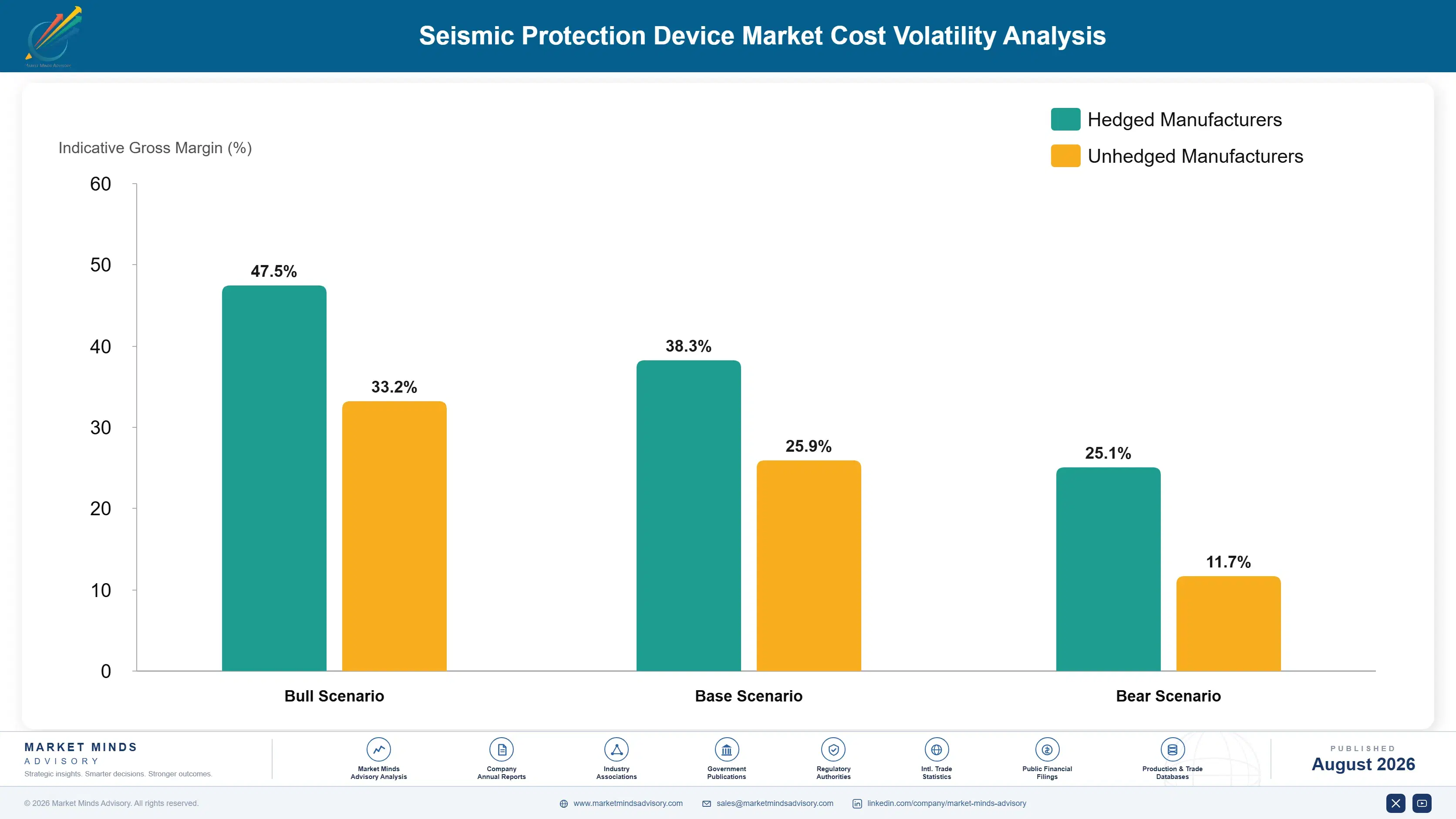
Steel plate pricing volatility during 2022 pushed input costs up a documented 22 percent according to World Steel Association data, forcing several manufacturers to renegotiate fixed-price public contracts signed before the increase took hold. Specialty elastomer compounds, sourced from a handful of qualified rubber chemists globally, saw comparable cost pressure as natural rubber prices climbed alongside broader commodity inflation documented in supplier annual reports across the sector.

Exposure varies by player type. Large manufacturers with vertically integrated steel fabrication absorb volatility more easily than smaller specialty isolator producers dependent on external steel supply contracts negotiated on shorter terms. This gap widens further during periods of simultaneous demand from multiple newly regulated markets, when several manufacturers compete for the same limited pool of qualified elastomer compounders and specialty steel mills able to meet seismic-grade certification requirements.
seismic-protection-device-market-cost-volatility-analysis-1787325644541

Long-Term Steel Supply Agreements

Larger manufacturers now lock in multi-year steel supply agreements with fixed volume commitments, insulating project bids from short-term price swings that previously forced costly contract renegotiations on fixed-price public infrastructure work signed years before material delivery was actually required at the affected construction site, protecting margins on long-cycle public contracts spanning multiple fiscal years and budget cycles.

Dual-Qualified Elastomer Compounders

Isolation bearing manufacturers increasingly qualify two elastomer compound suppliers per product line rather than one, adding validation cost upfront but avoiding single-supplier exposure during periods of simultaneous multi-market demand for specialty rubber compounds meeting seismic-grade certification standards across every jurisdiction they serve, a lesson learned from the 2022 shortage that still shapes procurement decisions today.

Vertically Integrated Steel Fabrication

Several leading manufacturers have built in-house steel fabrication capability specifically to reduce reliance on external mills, trading higher fixed capital cost for pricing certainty on public contracts that lock in prices years ahead of delivery to project sites nationwide, insulating margins from spot-market volatility during the next demand spike tied to a new code mandate.

Portfolio Architecture for Margin Defence

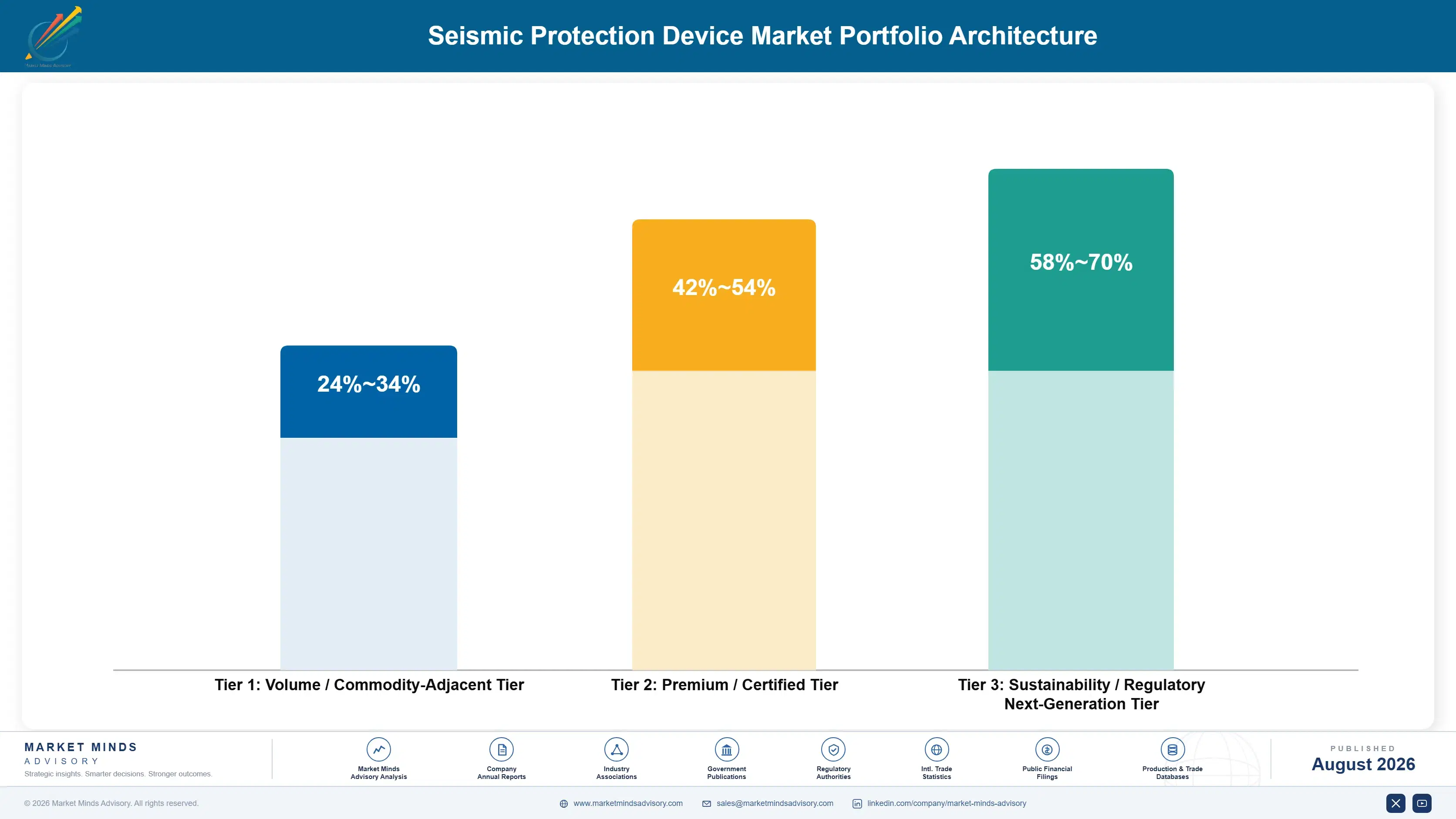
Portfolio economics split across three tiers. Standard elastomeric isolators and basic viscous dampers compete mainly on price in mature markets, while newly qualified friction pendulum systems and engineering-bundled solutions command the highest margins, particularly in newly regulated jurisdictions still building local qualification capacity of their own during this first compliance wave sweeping across multiple countries at once.
The tension between volume and premium plays out fastest in retrofit markets, where standard damper hardware competes on price against engineered solutions bundling design services from early specification through installation and final commissioning. Manufacturers that pair hardware with performance-based design consulting capture meaningfully higher project margins than hardware-only suppliers, weathering pricing pressure in mature markets considerably better than pure-play component manufacturers exposed to commoditised specification and thinning bid margins on every new tender.

High-value margin pools concentrate in newly regulated jurisdictions during their first code-mandate cycle, where qualification scarcity keeps pricing power intact well past what mature markets like Japan retain after decades of established competition among qualified suppliers serving the same well-known base of specifying engineers and procurement officials across every major project awarded in that market.

Volume / Commodity-Adjacent Tier

Standard elastomeric isolators and basic viscous dampers in mature markets, competing primarily on price against multiple qualified suppliers with comparable local track records and testing history spanning several decades of continuous service.
Gross Margin: 24%-34%

Premium / Certified Tier

Friction pendulum systems and buckling-restrained braces holding jurisdiction-specific qualification data ahead of regional competitors still completing their own local testing and approval programmes across multiple pending jurisdictions worldwide this year.
Gross Margin: 42%-54%

Sustainability / Regulatory / Next-Generation Tier

Performance-based design bundles combining hardware with engineering services for newly regulated jurisdictions still building local qualification and testing capacity of their own from scratch over several years of sustained investment.
Gross Margin: 58%-70%
seismic-protection-device-market-portfolio-architecture-1787325645033

High-value Sub-segments and Strategic Watch-out

Turkish Hospital and School Retrofit Bundles

Engineered isolation bundles supplying Turkey's mandatory retrofit programme combine high per-project value with the fastest specification volume growth in the category, as the code mandate compresses years of typical adoption into a single accelerated compliance window running through this decade across dozens of active hospital and school projects.
Gross Margin: 48%-58%

Indonesian and Philippine Early-Adoption Projects

Early isolation projects in Indonesia and the Philippines carry solid margins with a growth curve still several years behind Turkey's compressed mandate timeline, as national code adoption proceeds through slower legislative review processes with uncertain final timing and budget allocation still under discussion among lawmakers.
Gross Margin: 38%-48%

Established Japanese Replacement and Maintenance

Long-established Japanese isolation systems generate steady replacement and inspection revenue across their multi-decade service life but carry thinner margins after decades of mature competition among qualified domestic suppliers serving this well-established, saturated market with little room left for genuinely new entrants to gain meaningful share.
Gross Margin: 20%-28%

Next-Generation Smart Monitoring-Integrated Devices

Seismic devices integrated with real-time structural health monitoring sensors represent a strategic watch-out: it remains unclear how quickly building owners will pay a premium for monitoring data layered onto devices that already meet baseline code requirements without it, regardless of the added insight those sensors genuinely provide.
Gross Margin: 40%-52%

Code-Cycle Compliance Economics

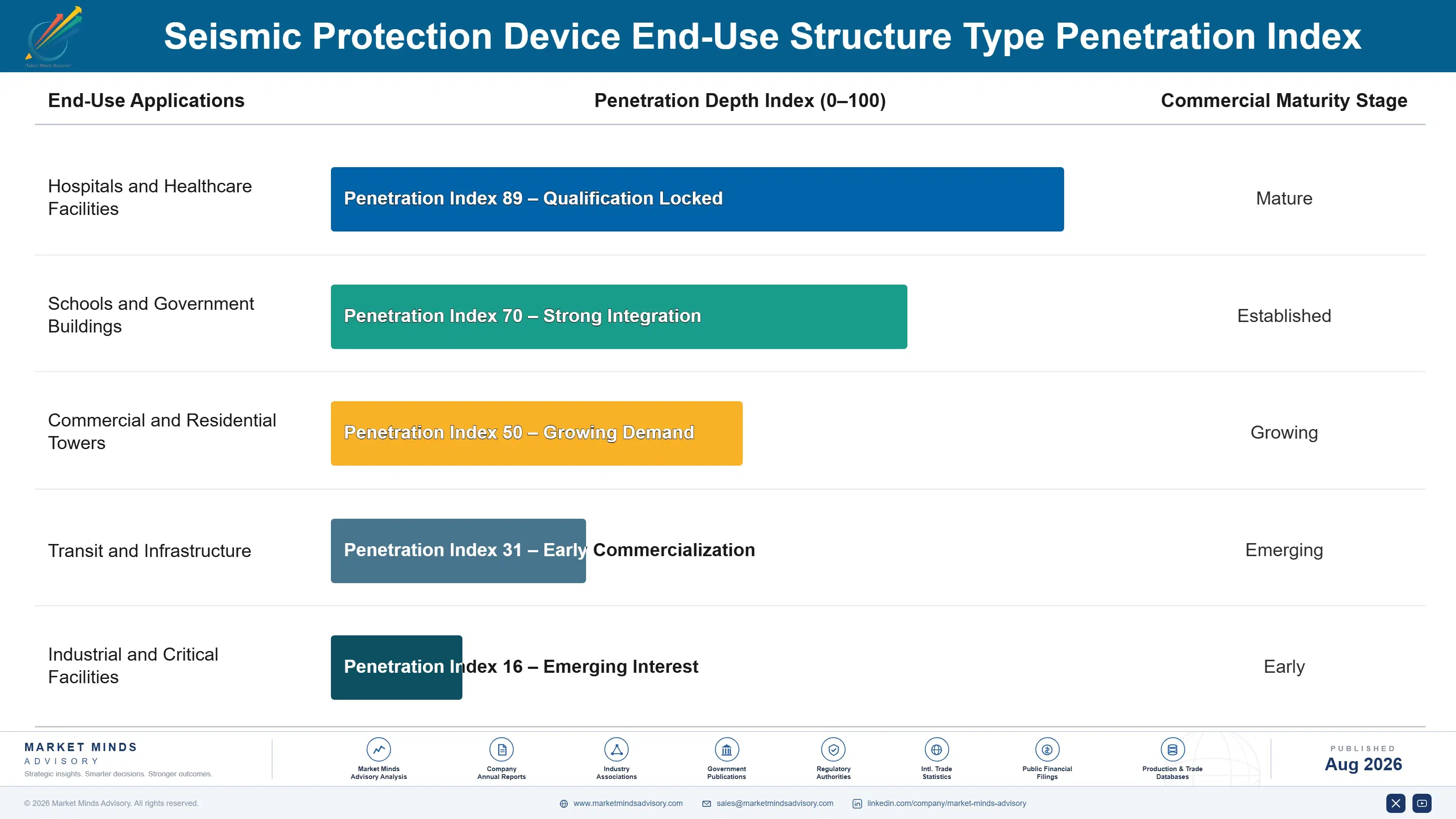
Demand for seismic protection devices behaves like a compliance annuity rather than a one-time capital purchase, since each major code revision cycle triggers a fresh wave of mandatory retrofit and new-build specification across affected jurisdictions. A jurisdiction that adopts mandatory isolation requirements typically sustains elevated demand for a decade or more as the compliance deadline works through its full backlog of affected buildings still awaiting structural upgrades.
Adoption depth varies considerably by vertical. Hospitals and critical-care facilities see the fastest and most consistent specification once a mandate takes effect, since life-safety code requirements leave building owners little discretion in the matter. Commercial towers and residential construction show more variable adoption, as owners weigh isolation cost against insurance savings and marketing value in markets without a strict legal mandate driving the underlying purchase decision.

A generational shift is underway in specifying engineers. Structural engineers trained after 2015 show meaningfully more comfort with performance-based design calculations than those trained on older prescriptive codes, a shift that should widen isolation and damper adoption further as this cohort becomes a larger share of practising structural engineers over the next decade of continued code reform.
seismic-protection-device-market-end-use-penetration-index-1787325645526

Positioning for the Next Code Cycle

These are among the four positions where our research anticipates prominent divergence between winners and laggards over the coming forecast period. Each is grounded in the demand model, the regulatory perimeter, and the announced capacity pipeline.
01 / QUALIFICATION TIMING STRATEGY

Pre-qualify in emerging code jurisdictions before mandates land

Manufacturers that wait until a jurisdiction formally adopts a mandatory isolation code to begin qualification testing consistently lose early specification share to competitors who started months or years earlier. Turkey's retroactive mandate rewarded manufacturers who already held qualification data before the 2023 earthquakes forced the code revision through legislature. Indonesia and the Philippines appear to be following a similar trajectory, and manufacturers without pre-existing qualification risk repeating the same late-mover disadvantage observed across prior code-adoption cycles in this market over the past decade.
02 / LOCAL PARTNERSHIP STRATEGY

Secure regional manufacturing before local content rules bite

Local content requirements increasingly determine public-sector bid eligibility in newly regulated markets, yet many established manufacturers still treat regional manufacturing as an optional expansion rather than a near-mandatory market entry requirement worth prioritising early. That sequencing costs real specification share during a jurisdiction's critical first compliance wave, when procurement moves fastest and rivals establish lasting relationships. Manufacturers who establish joint venture production ahead of mandate rollout, rather than afterward, consistently win preferred-bidder status on the largest public infrastructure contracts available in that market.
03 / SERVICE BUNDLE STRATEGY

Pair hardware sales with performance-based design engineering

Manufacturers selling hardware alone increasingly compete on price against qualified regional fabricators, while those bundling performance-based design consulting capture meaningfully higher project margins throughout the specification process from early design through installation sign-off on the finished structure. The most resilient competitors treat engineering services as a core commercial offering rather than an occasional add-on for landmark projects only. This bundled posture has protected margins considerably better than pure hardware supply across the five largest manufacturers evaluated this year by MMA analysts.
04 / INPUT COST RESILIENCE STRATEGY

Lock in steel and elastomer supply before the next demand spike

Steel and elastomer price volatility during 2022 forced several manufacturers to renegotiate fixed-price public contracts at a loss, and the underlying supplier concentration that caused that volatility has not meaningfully eased since it first emerged across the industry. Manufacturers still relying on spot-market steel and single-source elastomer compounds remain exposed to the same risk as multiple newly regulated markets ramp demand simultaneously over the coming years. Long-term supply agreements have already proven their value for manufacturers who adopted them early.

Engagement Snapshot From the Field

A live engagement with an industry participant carrying material or product regulatory and market exposure ahead of a defining policy shift, showing how our research translates into a defensible multi-year portfolio strategy.
MARKET MINDS ADVISORY · CLIENT ENGAGEMENT SUMMARY
Seismic Protection Device Producer Strategic Portfolio Review and Transition Roadmap 2026·Investment Scenario on Seismic Protection Device Exposure Evaluation 2025-26
CLIENT PROFILE
The client is a regional hospital network operating twelve acute-care facilities across California, with annual capital budget reported in the 200 to 350 million dollar range (client-reported, unverified by MMA), facing the 2030 Alquist Act compliance deadline across seven of its oldest facilities still requiring structural upgrades before the statutory deadline arrives and enforcement penalties take effect.
STRATEGIC CHALLENGE
The network had never procured seismic isolation or damping systems at this scale and faced a choice between full base isolation, requiring extensive foundation work and longer facility closures, or viscous damper retrofit, a faster but potentially less comprehensive solution depending on each building's specific structural configuration and existing foundation condition.
MMA APPROACH
MMA benchmarked comparable California hospital retrofit projects completed over the prior five years, analysing cost, timeline, and downtime data by technology type used at each facility. The team conducted primary interviews with structural engineers and hospital facilities directors at three comparable networks that had already completed similar Alquist Act compliance retrofits.
KEY FINDINGS
  1. Viscous damper retrofits averaged 40 percent shorter facility closure periods than full base isolation across the benchmarked comparable projects the team reviewed in detail.
  2. Full isolation retrofits cost an estimated 25 to 35 percent more per facility but offered stronger long-term seismic performance margins over the building's remaining service life.
  3. Two of three benchmarked networks reported significant unplanned cost overruns when foundation conditions differed from initial geotechnical assumptions made at the design stage.
  4. Framework procurement across multiple facilities reduced per-project engineering costs by roughly 18 percent compared to individual facility bidding processes run separately at each site.
CLIENT PROFILE
The client is a regional hospital network operating twelve acute-care facilities across California, with annual capital budget reported in the 200 to 350 million dollar range (client-reported, unverified by MMA), facing the 2030 Alquist Act compliance deadline across seven of its oldest facilities still requiring structural upgrades before the statutory deadline arrives and enforcement penalties take effect.
STRATEGIC CHALLENGE
The network had never procured seismic isolation or damping systems at this scale and faced a choice between full base isolation, requiring extensive foundation work and longer facility closures, or viscous damper retrofit, a faster but potentially less comprehensive solution depending on each building's specific structural configuration and existing foundation condition.
MMA APPROACH
MMA benchmarked comparable California hospital retrofit projects completed over the prior five years, analysing cost, timeline, and downtime data by technology type used at each facility. The team conducted primary interviews with structural engineers and hospital facilities directors at three comparable networks that had already completed similar Alquist Act compliance retrofits.
KEY FINDINGS
  1. Viscous damper retrofits averaged 40 percent shorter facility closure periods than full base isolation across the benchmarked comparable projects the team reviewed in detail.
  2. Full isolation retrofits cost an estimated 25 to 35 percent more per facility but offered stronger long-term seismic performance margins over the building's remaining service life.
  3. Two of three benchmarked networks reported significant unplanned cost overruns when foundation conditions differed from initial geotechnical assumptions made at the design stage.
  4. Framework procurement across multiple facilities reduced per-project engineering costs by roughly 18 percent compared to individual facility bidding processes run separately at each site.
RECOMMENDED STRATEGY
Phase 1: Phase 1 (Months 1 to 6): Conduct facility-by-facility geotechnical assessment to determine isolation versus damper suitability for each individual site. Phase 2: Phase 2 (Months 7 to 16): Issue a framework procurement covering all seven facilities to capture cost and engineering efficiencies. Phase 3: Phase 3 (Months 17 to 30): Execute phased retrofit installation, prioritising facilities with the shortest remaining compliance runway available first.
OUTCOME
The network selected viscous damper retrofit for five facilities and full isolation for two with more severe geotechnical risk, reaching framework contract signature four months ahead of its original internal schedule (client-reported, unverified by MMA). Projected facility closure time fell by an estimated 32 percent versus an all-isolation approach across the seven-facility programme.

Frequently Asked Questions

Foundational context covering the market sizes, CAGR, scope, country, region and competition that inform every finding below. This section is provided to cover basics and most often pre-purchase conversations, answered from the MMA Primary Research Dataset.

What is the current size of the Seismic Protection Device Market?

The global market reached an estimated 9.8 billion dollars in 2025, concentrated across Japan, the United States, and Turkey. Growth is driven by jurisdictions adopting new mandatory isolation codes.

How large will the Seismic Protection Device Market be by 2036?

MMA projects the market will reach approximately 21.93 billion dollars by 2036 under the base-case forecast scenario. This reflects sustained retrofit and new-build compliance demand.

What is the CAGR for the Seismic Protection Device Market 2026 to 2036?

The base-case compound annual growth rate is 7.6 percent across the full ten-year forecast period. Bull and bear scenarios range from 6.4 to 8.8 percent.

Which segment is growing fastest?

Friction pendulum and sliding isolation bearings lead at an 11.2 percent CAGR, roughly 1.47 times the overall market rate. Buckling-restrained braces follow as the second-fastest segment.

Who are the major companies in the Seismic Protection Device Market?

FIP Mec, Maurer SE, Dynamic Isolation Systems, Taylor Devices, and THK hold the top five positions by revenue. Regional fabricators in Turkey and Chile are closing the qualification gap.

Which country is growing fastest?

Turkey leads at an estimated 12.8 percent CAGR, driven by its 2023 mandatory isolation code for critical-use buildings. The mandate applies retroactively across dozens of active projects.

Report Segmentation Architecture

The full report scope spans multiple orthogonal segmentation dimensions, with cross-tabulated demand data provided for each dimension pair. Coverage extends further to regional breakdowns, trend trajectories, and the competitive detail needed to support segment-level decision-making.

By Device Technology

  • Elastomeric Base Isolators
  • Friction Pendulum and Sliding Bearings
  • Viscous and Fluid Dampers
  • Tuned Mass and Tuned Liquid Dampers
  • Buckling-Restrained Braces
  • Other Seismic Protection Devices

By End-Use Structure Type

  • Hospitals and Healthcare Facilities
  • Schools and Government Buildings
  • Commercial and Residential Towers
  • Transit and Infrastructure
  • Industrial and Critical Facilities

By Commercial Dimension

  • New-Build Specification
  • Retrofit and Upgrade Projects
  • Engineering-Bundled Solutions
  • Direct Public-Sector Procurement

By Region

  • North America
  • Western Europe
  • East Asia
  • South Asia and Pacific
  • Latin America
  • Middle East and Africa
  • Eastern Europe

Scope, Methodology, and Coverage

Every figure in this report is reproducible from documented input assumptions. The scope below maps the historical period, the forecast horizon, the segmentation dimensions, and the countries covered, alongside the underlying primary and qualitative methodology.
Historical Period
2020 to 2025
Forecast Period
2026 to 2036
Base Year
2025 (USD billions; MMA Primary Research Dataset, August 2026)
Market Definition
This market covers engineered seismic protection devices, base isolation bearings, viscous and fluid dampers, tuned mass and tuned liquid dampers, and buckling-restrained braces installed in buildings and infrastructure for earthquake resistance. It excludes general structural steel and seismic monitoring software sold independent of hardware.
Quantitative Units
USD billions (current prices); installed unit counts where applicable
Segmentation Dimensions
By Device Technology; By End-Use Structure Type; By Commercial Dimension; By Region
Regions Covered
North America, Western Europe, East Asia, South Asia and Pacific, Latin America, Middle East and Africa, Eastern Europe
Countries Covered
USA, China, Germany, France, UK, Japan, South Korea, India, Australia, Canada, Brazil, Mexico, Indonesia, Vietnam, Thailand, Malaysia, UAE, Saudi Arabia, South Africa, Nigeria, Turkey, Poland, Netherlands, Italy, Spain, Sweden, Switzerland, Argentina, Colombia, Singapore, and additional markets relevant to this sector
Key Companies Profiled
FIP Mec, Maurer SE, Dynamic Isolation Systems, Taylor Devices, THK Co., Earthquake Protection Systems, CoreBrace, Nippon Steel Engineering, Kobelco, Freyssinet, Mageba Group, Kinetica Dynamics, Damptech, Robinson Seismic, Bridgestone Corporation, Sumitomo Riko, Oiles Corporation, Cosmos Engineering, Aseismic Devices, Alga S.p.A.
Quantitative Methodology
Primary survey, n=3,800 respondents, Q4 2025, six countries; demand-side model with trade association cross-validation
Qualitative Methodology
47 expert interviews, Q4 2025; applied to validate demand model assumptions, identify emerging dynamics, and assess competitive positioning
Report Format
PDF and XLSX data workbook (Word format preview document)
Publisher
Market Minds Advisory
Report Code
MMA-2026-CON-337
Published
August 2026
Contact
sales@marketmindsadvisory.com | www.marketmindsadvisory.com

Purchase the full Seismic Protection Device Market Report (2026 to 2036).

The full report delivers a jurisdiction-by-jurisdiction code adoption tracker covering twenty-two countries with active or pending seismic isolation mandates and their compliance timelines. It includes a qualification and testing capacity database spanning the world's accredited shake-table facilities, with lead-time benchmarks by region. Retrofit deadline calendars are mapped across California, Turkey, and Japan, alongside project pipeline data drawn from public procurement records and filings. Buyers also receive a company-level financial and qualification-status model for each of the twenty profiled manufacturers, updated quarterly through the subscription period each year.
Jurisdiction code adoption tracker and calendar
Testing and qualification capacity database worldwide
Retrofit deadline mapping by country and region
Quarterly competitor qualification-status and financial model updates
Public procurement pipeline data and bid tracker
Custom market entry and qualification strategy sessions

Built For The People Who Decide

From boardroom strategy to bench-side execution, this report is read cover-to-cover by leaders shaping the next decade of their industry, turning demand scenarios, market dynamics and valuation benchmarks into decisions.
CXOs/ Presidents/ VPs/ Managers
M&A and Corporate Development
Strategy Teams and R&D Heads
Procurement and Product Directors
Regulatory and Compliance Leaders
Investor Relations and Equity Analysts