Market Minds Advisory
Security Service Edge Market

Security Service Edge Market: Security Service Edge Market. Zero Trust Network Access and Cloud Security Convergence Platforms

Zero trust network access is displacing legacy VPN architectures faster than traditional network security vendors can rearchitect their platforms, forcing a costly modernization race across enterprises managing distributed remote workforces.

Lead Analyst

Published

September 2026

Make Smarter Decisions with Customized Research Insights

Request a free sample report and evaluate market opportunities, growth trends, and competitive dynamics relevant to your business needs.

2025 MARKET VALUE$7.5BMarket Size 2025
2036 FORECAST VALUE$38.4BBase Case , 2026 to 2036
CAGR 2026 TO 203616.0 %Bull 17.3% / Bear 14.7%
INCREMENTAL OPPORTUNITY$29.7BNet 10- year value creation
EXPANSION MULTIPLE4.41x2036 value over 2026 base
Strategic Levers
M&A Pipeline
Regional Outlook
Country Rankings
Competitive Intelligence
Segmental Deep-dive
Call-Us : 91 93563 13602

Executive Snapshot and Market Trajectory.

Zero trust network access is overtaking legacy VPN infrastructure as the default remote access model, pushing enterprises toward converged Security Service Edge platforms that unify network and data protection for distributed, cloud-first workforces navigating hybrid work arrangements at scale across nearly every regulated sector.
Consolidation economics now drive purchasing more than feature comparison: enterprises are collapsing five to seven point security tools into a single SSE contract, cutting integration overhead while pushing spend toward vendors with proven global points-of-presence coverage, concentrated most heavily among North American financial services and technology buyers replacing MPLS backhaul architectures with direct-to-cloud internet breakout paths across thousands of branch locations and remote sites once wired for dedicated circuits.
Competitive intensity centers on platform breadth rather than price, as Palo Alto Networks and Cisco bundle SSE into wider SASE and extended detection suites while pure-play Zscaler and Netskope defend share through architecture depth and proxy performance, and evolving data residency regulation across the European Union, India, and the Gulf increasingly shapes which vendors clear enterprise procurement review cycles well before contracts reach final signature, particularly for multinational buyers spanning several jurisdictions at once.
Market Definition
The Security Service Edge market covers cloud-delivered security platforms that combine zero trust network access, secure web gateway, cloud access security broker, and data loss prevention functions to protect user access to web, cloud, and private applications. It excludes on-premises network firewall appliances, endpoint detection software, and identity governance platforms sold as standalone products.
Base Year Value
$7.5B in 2025 (MMA Primary Research Dataset, September 2026)
Forecast Period
2026 to 2036, eleven discrete annual values
CAGR
16.0% base case. Bull 17.3%. Bear 14.7%.
Fastest Growth Segment
Zero Trust Network Access (ZTNA) Platforms: 22.0% CAGR
Fastest Growth Country
India: 18.2% CAGR
Fastest Growth Region
South Asia and Pacific: 18.2% CAGR
Largest Region
North America: 30% of 2025 global value
Market Leaders
Zscaler, Netskope, Palo Alto Networks, Cloudflare, Cisco. Source: MMA Analysis based on company annual reports.
Primary Survey
n=3,800 procurement and R&D decision-makers, Q4 2025, six countries
Methodology
Demand-side build-up, cross-validated against public data, 47 expert interviews

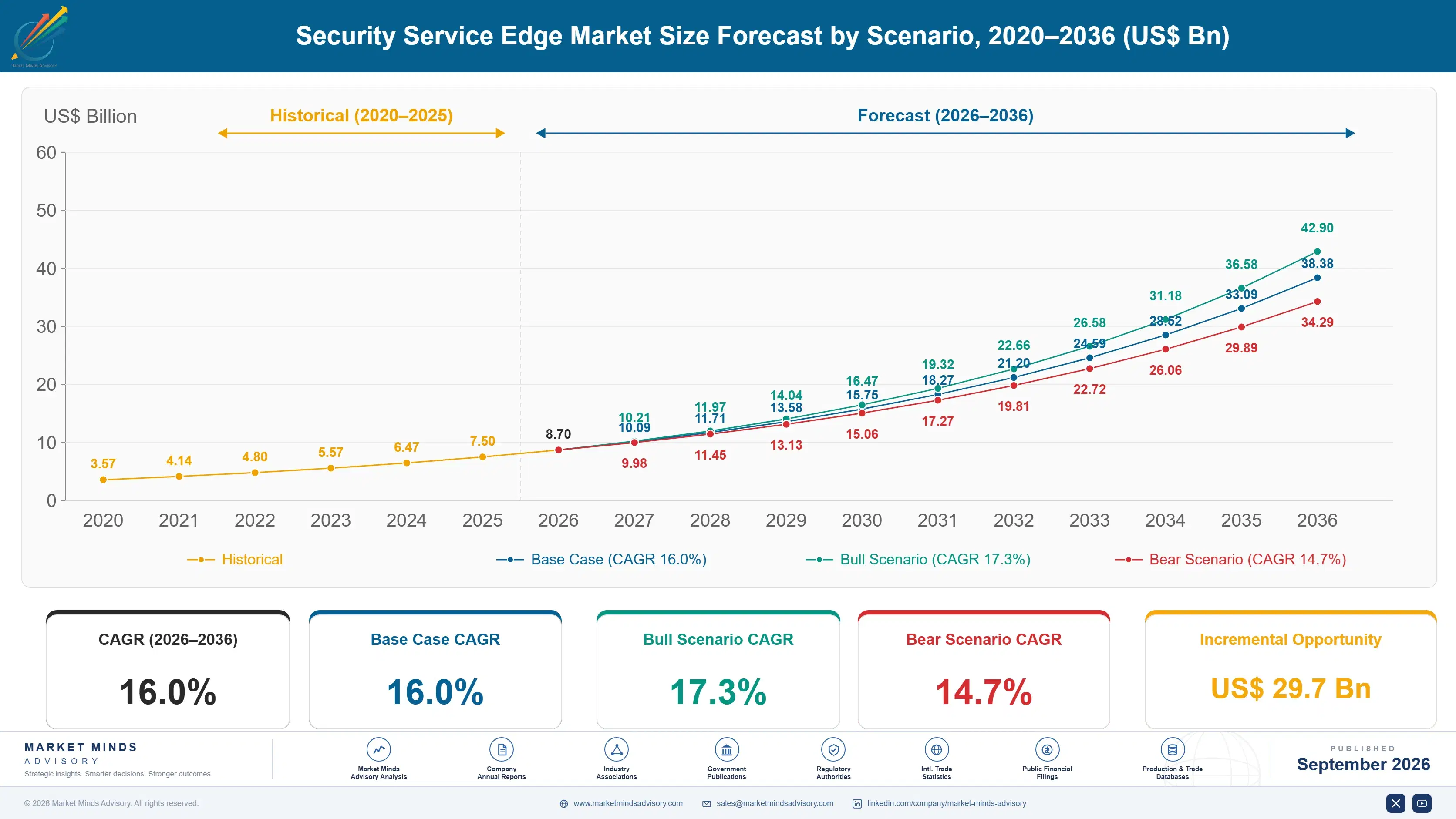
Security Service Edge Market Forecast Scenarios

security-service-edge-market-size-forecast-scenario-1789987807124
Between 2020 and 2025 Security Service Edge adoption moved from early-adopter security teams piloting cloud proxies to a mainstream enterprise procurement category, accelerated first by pandemic-era remote work and then by sustained hybrid work policies, producing a historical CAGR of roughly fifteen percent that reset baseline vendor selection criteria across regulated industries worldwide, from banking to healthcare.
The base case assumes continued VPN replacement cycles as legacy hardware contracts expire, expanding zero trust mandates inside federal, financial services, and healthcare procurement, and rising per-seat licensing as vendors bundle data loss prevention and browser isolation into core packages rather than selling them separately, three mechanisms that together sustain double-digit expansion through 2036 without a new adjacent product category needing to emerge, since hybrid work is now permanent policy rather than a temporary pandemic accommodation.
A bull scenario hinges on accelerated single-vendor SASE consolidation squeezing out fragmented multi-vendor stacks faster than currently expected across large enterprise accounts. The bear case centers on economic slowdown delaying multi-year platform migrations, as CFOs defer discretionary security modernization budgets and extend legacy VPN contracts well beyond their planned retirement dates, stretching refresh cycles by a year or more in cost-constrained sectors.

Convergence Economics Reshaping Network Security Procurement

Security Service Edge sits at the intersection of two exhausted architectures: the corporate VPN, which cannot scale to cloud-first access patterns, and the branch firewall stack, which cannot follow users who no longer work from a fixed office. Vendors selling a converged cloud platform now compete less on individual features than on global proxy footprint, inspection latency, and the breadth of private application support baked into a single console.
MARKET CONCENTRATIONCR5 40%top five vendors hold two of five dollars
AVERAGE CONTRACT VALUE$185Ktypical enterprise annual per-seat licensing commitment across mid-market deals
VENDOR HQ CONCENTRATION68%leading platform vendors headquartered in this single region
VPN DISPLACEMENT RATE34%enterprises actively retiring legacy remote access hardware now
MULTI-PRODUCT ATTACH RATE58%buyers purchasing three or more bundled SSE modules
PUBLIC SECTOR CONTRACT SHARE19%government and defense procurement share of total spend
Commercially the market behaves like enterprise software rather than a security hardware refresh cycle: subscription pricing, multi-year contracts, and expansion revenue from add-on modules such as digital experience monitoring and browser isolation. Renewal economics matter more than initial land deals, since churn is rare once traffic routing is embedded into daily network operations across every business unit, and finance teams have begun treating the category as recurring infrastructure spend rather than a discretionary project line.
Over the next decade, platform consolidation, tightening data residency rules, and AI-assisted policy automation will separate vendors who can operate at hyperscale proxy volume from smaller players forced into niche verticals or acquisition by a larger platform competitor seeking global points-of-presence coverage, and boards are asking security leaders to justify single-vendor lock-in against multi-cloud resilience concerns.
"The vendors winning right now are not the ones with the longest feature checklist. They are the ones whose proxy network is fast enough that security teams stop hearing complaints from end users."
Director, Cybersecurity and Cloud Infrastructure Practice · MMA Cloud-Delivered Zero Trust Network and Data Security Platforms Practice · September 2026

Market Trends

Single-Vendor SASE Consolidation Accelerates Platform Selection

Enterprises that once ran separate SWG, CASB, and ZTNA point products from three or four vendors are now consolidating onto one SASE platform to cut integration overhead and reduce the number of security consoles operations teams must monitor daily. Gartner-style advisory guidance and internal procurement mandates increasingly require finalists to demonstrate a single unified policy engine spanning web, cloud, and private application access, which has shortened vendor shortlists from six or seven candidates to two or three finalists per enterprise deal in the last eighteen months alone, forcing smaller point-product vendors to partner or exit the category entirely.
Market Impact: Adds $1.4 billion public sector pipeline
AI-Driven Policy Automation Reduces Manual Rule Management

Vendors are embedding machine learning models that automatically classify unmanaged SaaS applications and recommend access policies, reducing the manual rule-writing burden that historically slowed SSE deployments by months. Early adopters report policy tuning cycles dropping from several weeks to a few days once automated risk scoring flags shadow IT applications for review, and this shift is becoming a differentiator in competitive evaluations where security teams are chronically understaffed relative to the volume of cloud applications now in daily use across the organization, a gap that shows little sign of closing through hiring alone.
Market Impact: Adds 8 million licensed seats

Market Opportunities and Growth Drivers

Federal Zero Trust Mandates Force Agency Modernization

The US federal government's zero trust architecture mandate under OMB Memorandum M-22-09 requires civilian agencies to implement identity-centric, application-level access controls in place of perimeter VPNs, creating a multi-year procurement pipeline across dozens of agencies. Contractors serving the Departments of Defense, Homeland Security, and Veterans Affairs must demonstrate compliant SSE deployments to retain eligibility on major federal technology contracts, and similar mandates are now spreading into state government procurement and allied government programs across the United Kingdom and Australia, widening the addressable public sector base considerably beyond the original civilian agency scope defined in the 2022 memorandum.
Market Impact: Delays 22 percent of deals

Hybrid Work Permanence Locks In Per-Seat Licensing Growth

Enterprise real estate data shows office attendance stabilizing near sixty percent of pre-pandemic levels at large employers, confirming that hybrid work is now permanent policy rather than a temporary accommodation, which locks in sustained demand for cloud-delivered access security rather than a return to office-bound perimeter firewalls. Every new hire at a hybrid-first company now requires SSE-protected access from day one, and workforce growth at technology and financial services employers directly compounds licensing revenue for platform vendors without requiring any additional sales motion beyond routine seat true-ups handled during quarterly account reviews.
Market Impact: Adds 40 to 80 milliseconds latency

Market Restraints and Challenges

Legacy Contract Lock-In Slows Platform Migration Timelines

Many large enterprises remain bound to multi-year hardware and MPLS circuit contracts signed before cloud-delivered security became viable, and early termination penalties often exceed the projected savings from switching, so security teams must wait for natural contract expiry before migrating. The root cause is that network and security procurement historically ran on five-year refresh cycles built around physical appliance depreciation schedules, a rhythm that cloud-native SSE platforms disrupt but cannot instantly override. Vendors are mitigating this by offering hybrid transition financing that absorbs early termination fees into new multi-year SSE contracts.
Market Impact: Cuts vendor shortlists by 60%

Latency Sensitivity Limits Adoption In Bandwidth-Constrained Regions

Routing all traffic through a cloud security proxy adds measurable latency for users in regions with thin points-of-presence coverage, particularly parts of Latin America, Africa, and Southeast Asia, degrading performance for real-time applications like voice and video conferencing. The root cause is uneven data center investment: leading vendors concentrate points of presence near North American and European population centers first. Several vendors are now building regional edge nodes and peering directly with local internet exchanges to narrow this performance gap over the next several years, though rural and last-mile connectivity gaps remain harder to close.
Market Impact: Cuts tuning cycles by 70%
3 additional market trends, 3 additional growth drivers, and 3 additional restraints and challenges are covered in the full report. Contact sales@marketmindsadvisory.com to access the complete intelligence.

Segment CAGR and Growth Architecture

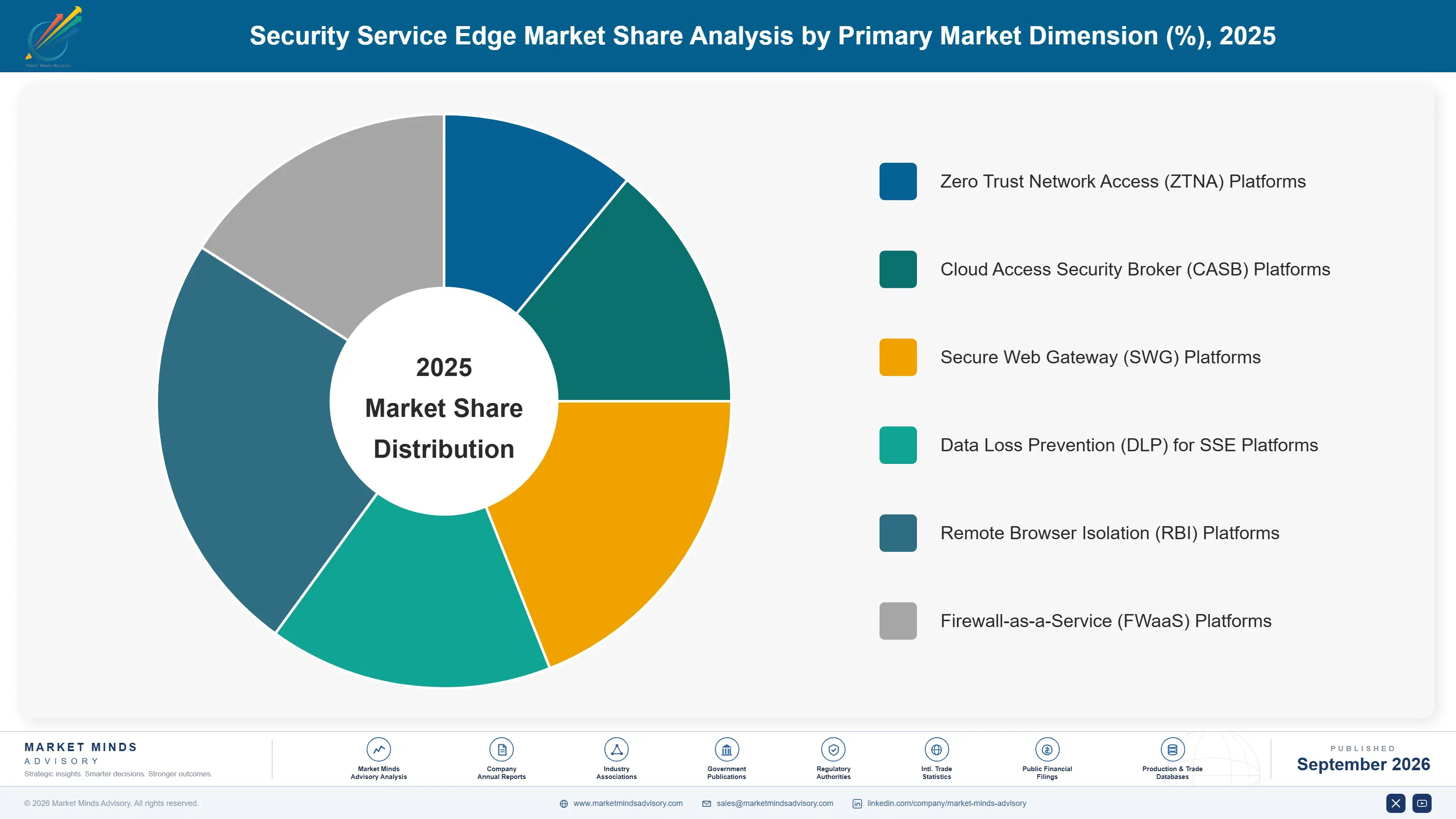
Security Service Edge is segmented by technology component, the framework enterprise buyers and analysts actually use to evaluate platform breadth and compare vendor roadmaps, since each component addresses a distinct point in the user-to-application traffic path rather than a distinct customer type or industry vertical, and this technology lens maps directly onto how competing platforms are marketed and priced.
security-service-edge-market-market-share-analysis-1789987807661

Zero Trust Network Access (ZTNA) Platforms

Zero trust network access replaces site-to-site VPN tunnels with per-application, identity-verified connections that never expose the broader corporate network to a remote device. Demand is compounding fastest because it directly displaces the most obviously obsolete legacy technology in the stack, and every federal zero trust mandate names ZTNA explicitly as a required control. Vendors increasingly differentiate on granular application segmentation and continuous device posture checks rather than simple tunnel replacement, and integration with identity providers like Okta and Microsoft Entra has become a baseline expectation rather than a differentiator, pushing competitive attention toward session-level risk scoring and continuous authentication rather than one-time login verification alone, a shift that materially raises the bar for challenger vendors entering the category late.
CAGR 22.0%

Remote Browser Isolation (RBI) Platforms

Remote browser isolation renders web content in a disposable cloud container and streams only pixels to the endpoint, eliminating an entire category of browser-based malware and phishing risk without requiring changes to how employees browse. Growth is accelerating as generative AI tools introduce new categories of unmanaged web applications that security teams cannot easily block outright, making isolation a preferred middle path between denying access and permitting unrestricted use. Financial services and legal buyers lead adoption given elevated exposure to targeted phishing campaigns, and vendors are now bundling RBI as a default-on module rather than a separately priced add-on, narrowing the gap between isolation-first specialists and broader platform incumbents that added the capability more recently through acquisition.
CAGR 19.0%
Full segment breakdown across 6 segments available in the complete report.

Regional Architecture and Country Demand Map

North America and East Asia together account for over half of global demand, while South Asia and Pacific posts the fastest regional growth as enterprises there build cloud-first security from scratch rather than migrating aging perimeter hardware, and Western Europe trails North America mainly on data residency caution.

North America

North America holds the largest share of Security Service Edge spend because the region's technology and financial services employers were first to abandon MPLS backhaul in favor of direct internet breakout, and federal zero trust mandates under OMB Memorandum M-22-09 compound demand across dozens of civilian agencies. Enterprise security budgets here run larger per employee than anywhere else, supporting premium multi-module contracts rather than single-point purchases. Vendor headquarters concentration reinforces this lead: most leading platforms were built and first sold into this market before expanding internationally, giving buyers deeper reference customers and faster support response and a wider bench of certified implementation partners than competing regions currently receive from any vendor operating today.
Share: 30% | CAGR: 16.8% (2026 to 2036)

Western Europe

Data residency rules under the General Data Protection Regulation shape nearly every Western European SSE purchase, pushing enterprises toward vendors that can guarantee in-region traffic processing rather than routing sessions through American data centers. Germany, France, and the United Kingdom account for the bulk of regional spend, led by manufacturing and financial services firms replacing site-to-site VPN infrastructure between factory floors and headquarters. Growth trails North America because budget cycles are more conservative and procurement committees often require multi-year pilot programs before committing to full platform migration, a caution that slows expansion even as underlying demand for the technology itself remains strong across nearly every industry vertical operating in the region.
Share: 22% | CAGR: 14.5% (2026 to 2036)
Regional intelligence for 5 additional markets available in the complete report: East Asia, South Asia and Pacific, Latin America, Middle East and Africa, Eastern Europe. Contact sales@marketmindsadvisory.com.
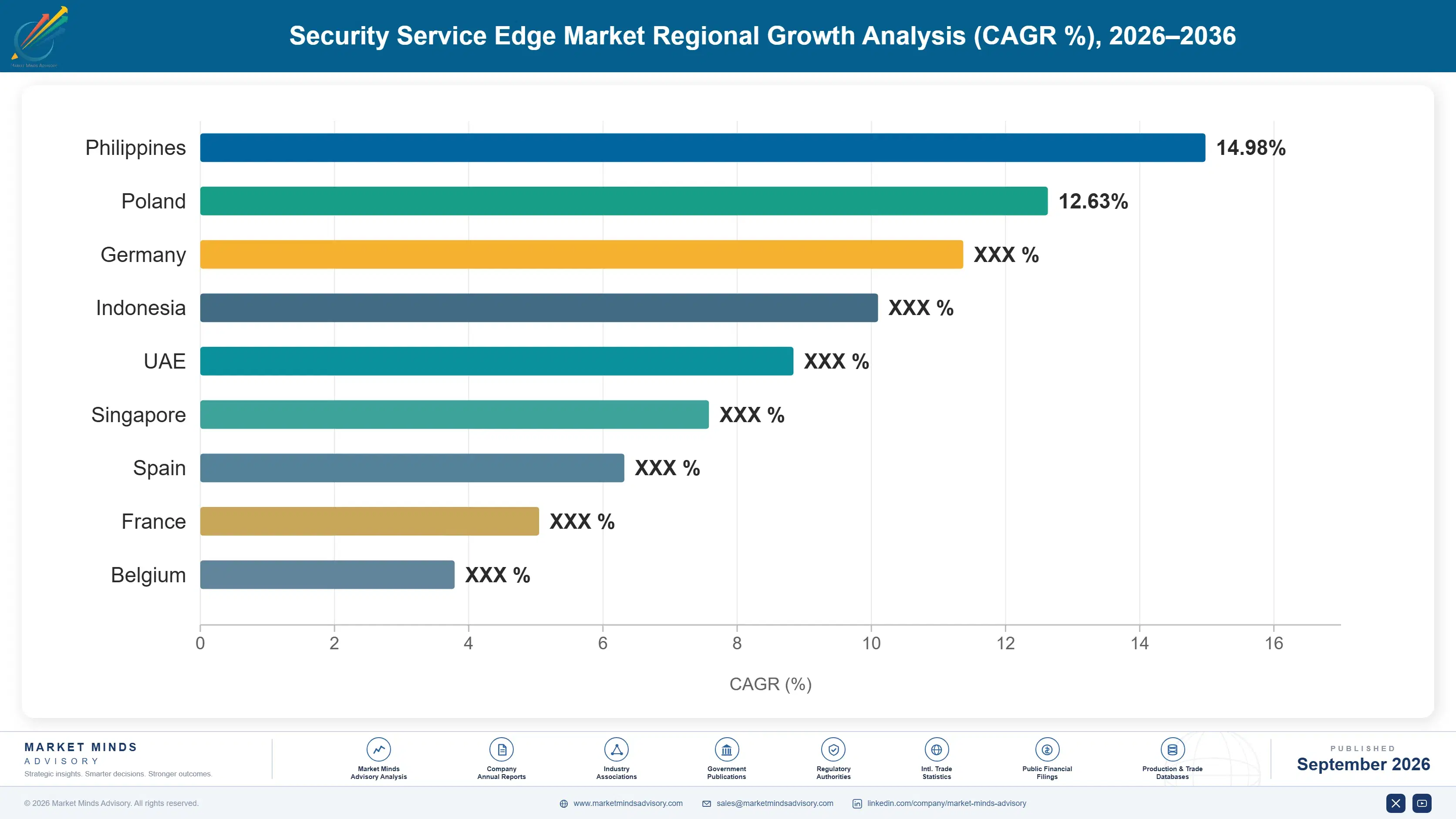
security-service-edge-market-country-cagr-analysis-1789987808192

Where Platform Vendors Actually Expand Margin

Beyond core seat licensing, four commercial mechanisms determine which SSE vendors convert market growth into durable margin expansion rather than simply chasing new-logo volume in an increasingly commoditized core platform market where per-seat pricing alone no longer separates the leaders from the pack of fast followers chasing the same enterprise renewal cycles every year.

Bundling Digital Experience Monitoring Into Core Contracts

Vendors now attach digital experience monitoring modules that let IT teams diagnose whether slow application performance originates from the network, the SSE proxy, or the application itself, a capability that previously required a separate observability vendor contract. Attach rates on this module have climbed past 35 percent among large enterprise renewals, and because the module rides on existing traffic inspection infrastructure, incremental delivery cost is minimal, converting nearly all incremental revenue into margin. Renewal negotiations increasingly start from a bundled baseline rather than an add-on discussion, shifting pricing leverage back toward the vendor at each cycle.
Market Impact: Adds 12 to 15 points of margin overall

Expanding Private Application Access Beyond Web Traffic

Early SSE deployments focused almost entirely on securing web and SaaS traffic, leaving legacy private applications running on internal data center servers outside the platform's scope. Vendors that extend ZTNA coverage to these private applications capture licensing revenue previously stuck with declining on-premises VPN concentrators, and roughly 45 percent of enterprise accounts have not yet completed this expansion, leaving substantial unclaimed contract value on the table. Each successful expansion typically raises average contract value by a meaningful double-digit percentage without requiring an entirely new sales cycle or fresh procurement approval.
Market Impact: Raises average contract value by roughly 20 percent

Monetizing AI-Assisted Policy and Risk Analytics

Vendors are packaging AI-driven risk scoring and automated policy recommendation engines as premium add-on tiers priced above the base platform, targeting security operations teams that are chronically understaffed relative to alert volume. Early pricing data suggests these premium analytics tiers carry list prices roughly 25 percent above base platform seats, and adoption is concentrated among the largest enterprise accounts with the most complex application environments. Because the underlying models are shared across the customer base, marginal delivery cost stays low as adoption scales across new accounts each quarter, reinforcing the case for continued platform investment.
Market Impact: Prices premium analytics tiers 25 percent above base

Capturing Managed Services Revenue From Understaffed Teams

Mid-market enterprises frequently lack the specialized staff to tune SSE policies continuously, creating demand for vendor-delivered managed detection and policy management services layered on top of the core software license. These managed offerings carry materially higher margins than raw licensing once initial staffing costs are absorbed across a multi-tenant delivery model, and roughly 30 percent of mid-market renewals now include some managed component, up sharply from a much smaller base only a few years earlier. This trend favors vendors with mature professional services organizations and certified regional delivery partners already in place.
Market Impact: Adds 30 percent managed-service attach rate this cycle

Who Controls the Margin Pool

Market concentration sits moderate at a CR5 of 40 percent, evaluated on trailing twelve-month platform revenue, wide enough that a clear leader-challenger gap separates Zscaler and Palo Alto Networks from the next tier of vendors still building comparable global proxy footprint and inspection capacity at matching scale and reliability, a gap that narrows only slowly given the capital intensity of building global network infrastructure.
Current competitive activity plays out across three fronts: aggressive single-vendor SASE bundling by platform incumbents, targeted acquisitions of browser isolation and AI policy startups to close capability gaps, and price-per-seat compression as challenger vendors undercut incumbents to win displaced VPN accounts away from legacy network vendors that have not yet modernized their own cloud delivery architecture, and increasingly aggressive multi-year discounting on renewal contracts to defend installed base.

Emerging pressure comes from network infrastructure vendors pushing into SSE from the hardware side and from hyperscale cloud providers bundling basic access security into broader cloud subscriptions, a dynamic that could reshuffle rankings among mid-tier vendors lacking a distinct architectural advantage over the next several years as buyers weigh best-of-breed depth against single-vendor simplicity, particularly once contract renewal cycles come up for competitive re-bid.
security-service-edge-market-company-positioning-matrix-1789987808726

Competitive Moat and Risk Dimensions

ZSCALER

Moat: Pure-play cloud-native architecture

Zscaler built its platform as a multi-tenant cloud proxy from inception rather than retrofitting appliance-based technology, giving it one of the industry's largest global points-of-presence networks and inspection capacity that legacy vendors still struggle to match at comparable latency and reliability levels across peak traffic periods.
ZSCALER

Risk: Narrow single-product portfolio exposure

As a pure-play vendor without adjacent firewall, endpoint, or identity products, Zscaler faces mounting pressure from platform competitors bundling SSE into broader security suites at effectively discounted incremental pricing, which could erode its standalone pricing power as enterprise buyers consolidate spend with fewer strategic vendors overall.
PALO ALTO NETWORKS

Moat: Broad platform bundling advantage

Prisma Access sits inside a much wider security portfolio spanning cloud security, extended detection, and firewall products, letting Palo Alto Networks win single-vendor consolidation deals that pure-play SSE vendors cannot match, particularly among large enterprises seeking to reduce the total number of strategic security vendor relationships they manage.
PALO ALTO NETWORKS

Risk: Integration complexity across acquisitions

Years of acquisitive growth have left Palo Alto Networks managing multiple underlying technology stacks under one platform brand, creating integration friction that shows up in customer support complaints and slower feature parity across modules compared to purpose-built pure-play competitors with simpler, more unified codebases overall.

Players Tracked

Prominent Players

Zscaler
Netskope
Palo Alto Networks
Cloudflare
Cisco

Other Key Players

Skyhigh Security
Forcepoint
Lookout
Menlo Security
iboss
Cato Networks
Versa Networks
Broadcom
Check Point Software Technologies
Fortinet
Ivanti
Twingate
NordLayer
Citrix
Juniper Networks

Recent Developments

MARCH 2025

Cloudflare Expands Zero Trust Suite With New Private Network Access Tier

Cloudflare added a new private network access tier to its zero trust platform, extending coverage beyond web and SaaS traffic to internal applications previously requiring separate VPN infrastructure, directly targeting the private application gap that competitors had already begun closing across large enterprise deployments earlier in the year.
Signal: Signals platform vendors racing to close private application coverage gaps before major renewal cycles finally arrive.
JULY 2025

Netskope Completes Acquisition Of An AI Policy Automation Startup

Netskope acquired a smaller AI policy automation vendor to accelerate automated risk scoring inside its platform console, folding the acquired engineering team directly into its core product organization rather than operating the technology as a standalone add-on module sold separately to existing customers under a prior standalone pricing model.
Signal: Confirms AI-driven policy automation has become a required capability rather than an optional extra product feature.
NOVEMBER 2025

Cisco Deepens Umbrella Integration With Broader Splunk Security Analytics

Cisco tied its Umbrella SSE platform more closely to Splunk security analytics following the earlier Splunk acquisition, giving enterprise customers a single console spanning access security and broader threat detection, a bundling move aimed squarely at large accounts consolidating vendor relationships across their security stack.
Signal: Shows legacy network vendors using prior acquisitions to defend market position against newer pure-play SSE challengers.

Cloud Infrastructure and Talent Cost Exposure

The dominant cost input for SSE vendors is not raw materials but cloud compute and network transit capacity, running roughly 35 to 40 percent of cost of goods sold, sourced primarily from hyperscale providers including Amazon Web Services, Microsoft Azure, and Google Cloud alongside owned points-of-presence infrastructure in key metro regions where leased capacity alone cannot meet peak-hour latency requirements for enterprise customers.
Cloud compute pricing volatility became visible in 2024 when several hyperscale providers raised list prices on premium network transit tiers, a shift documented in AWS's own annual report disclosures, forcing SSE vendors reliant on third-party infrastructure to renegotiate committed-use discount agreements or absorb thinner gross margins during the transition period, a squeeze that hit smaller vendors without scale to negotiate favorable committed-use terms hardest overall.

Vendors that own more of their proxy infrastructure directly, rather than renting it entirely from hyperscale partners, carry lower long-run exposure to this volatility but higher upfront capital requirements, creating a durable cost gap between well-capitalized incumbents and smaller challengers that lease essentially all of their delivery infrastructure from third parties without the balance sheet room to build owned capacity.
security-service-edge-market-cost-volatility-analysis-1789987808924

Diversifying Across Multiple Cloud Infrastructure Providers

Leading vendors now split workloads across two or more hyperscale providers rather than relying on a single cloud partner, reducing renegotiation leverage risk and limiting exposure to any single provider's pricing decisions or regional capacity constraints during peak demand periods. This approach also improves negotiating leverage on unit pricing whenever any single supplier attempts to raise rates unilaterally.

Locking In Multi-Year Committed-Use Discount Agreements

Vendors increasingly commit to multi-year minimum spend agreements with cloud infrastructure providers in exchange for locked-in discount pricing, trading flexibility for cost predictability that helps protect gross margin forecasts against sudden mid-contract price increases from suppliers. These agreements typically span three to five years and are negotiated well ahead of expected capacity needs to secure favorable terms.

Building Owned Points of Presence In High-Traffic Metro Regions

Some vendors are investing directly in owned data center capacity within the highest-traffic metro regions, reducing reliance on rented hyperscale capacity for the busiest routes while still leasing overflow capacity elsewhere where traffic volume does not justify the fixed capital outlay. This hybrid approach balances capital discipline against the performance benefits of direct infrastructure ownership in the busiest markets.

Portfolio Architecture for Margin Defence

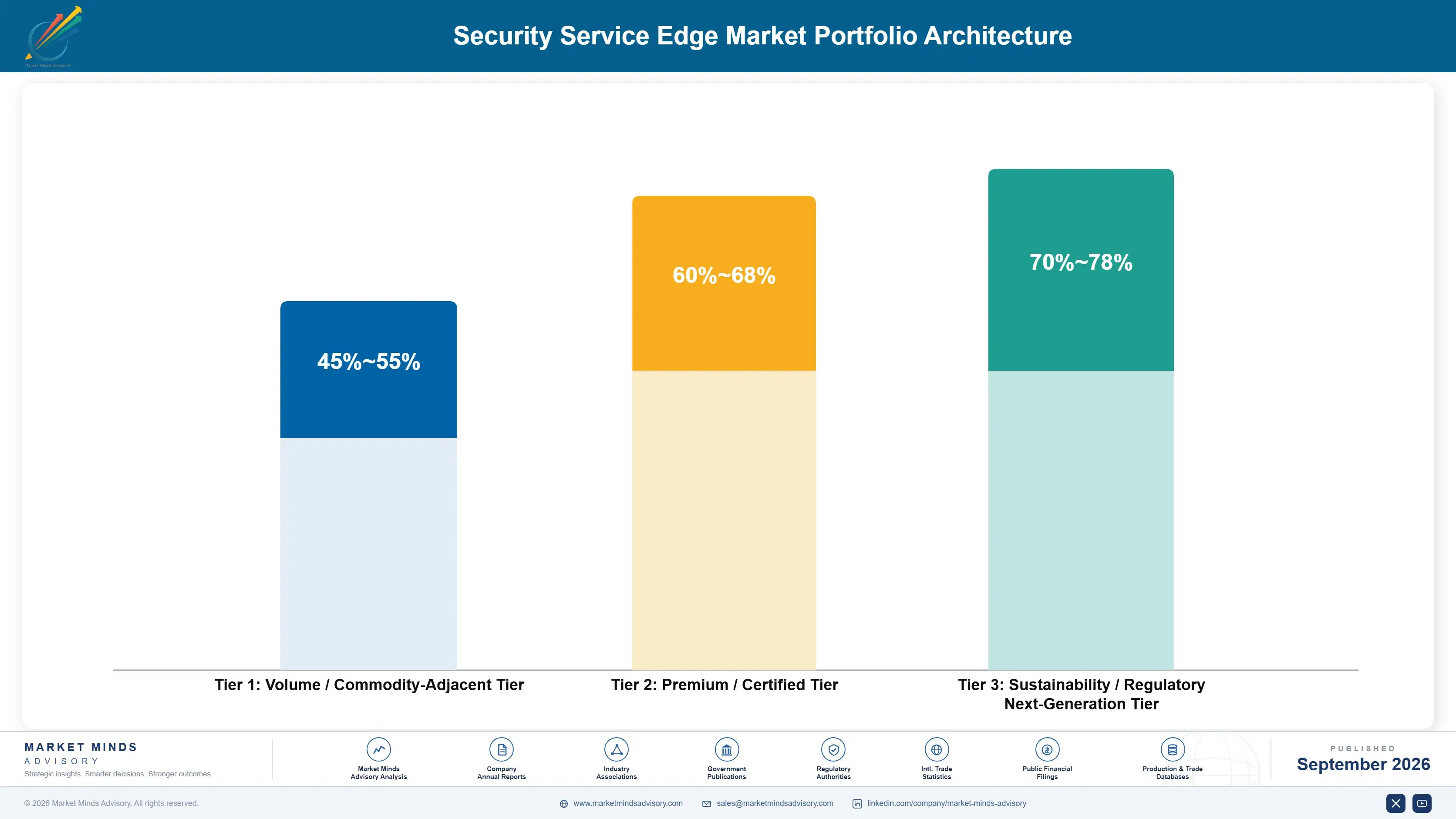
Vendor portfolios split across three margin tiers: commodity-adjacent single-module subscriptions priced to win volume, certified full-platform bundles carrying premium pricing for buyers demanding compliance certifications, and next-generation AI-augmented tiers commanding the steepest margins as differentiated capability rather than a checkbox feature, and vendors increasingly design product roadmaps around moving customers upward through this hierarchy over time rather than leaving them parked on entry-level licensing indefinitely.
Volume-tier deals win on price and speed of deployment, while premium-tier deals win on breadth and depth of platform integration, and the tension between the two shows up directly in sales team incentive structures, which increasingly reward multi-module attach over new-logo count alone, reshaping how account teams prioritize renewal conversations with existing customers each quarter as renewal season approaches across the largest strategic accounts.

High-value margin pools concentrate in the next-generation tier, where AI-driven analytics and managed services command list prices well above the base platform, and vendors capable of selling into that tier consistently outperform peers stuck competing on per-seat pricing alone, a gap that widens further as buyers grow comfortable paying for outcomes rather than raw seat counts.

Volume / Commodity-Adjacent Tier

Single-module SWG or CASB subscriptions sold to price-sensitive mid-market buyers replacing basic legacy proxy appliances with minimal customization, delivered largely through channel partners rather than through direct enterprise sales teams handling larger strategic accounts.
Gross Margin: 45-55%

Premium / Certified Tier

Full-platform bundles combining ZTNA, CASB, SWG, and DLP with compliance certifications required by regulated financial services and healthcare buyers, typically sold through direct enterprise sales motions with multi-year contract terms attached.
Gross Margin: 60-68%

Sustainability / Regulatory / Next-Generation Tier

AI-driven policy automation, managed detection services, and data residency guaranteed regional processing tiers sold to the largest global enterprise accounts, where vendor account teams work closely with customer security leadership on roadmap alignment.
Gross Margin: 70-78%
security-service-edge-market-portfolio-architecture-1789987809428

High-value Sub-segments and Strategic Watch-out

AI Policy Automation Add-On Suites

Highest-value, highest-growth pool as vendors price automated risk scoring and policy recommendation engines as standalone premium tiers above the core licensed platform, capturing disproportionate margin relative to the incremental delivery cost involved. This makes the segment the single most important one for margin-focused investors to track closely.
Gross Margin: 70-78%

Managed Detection and Policy Services

High-value, moderate-growth pool serving mid-market accounts that lack in-house staff to tune SSE policies continuously without ongoing vendor support engagement, a gap that widens as security teams stay chronically understaffed relative to workload. Vendors with mature delivery teams are best positioned to capture this expanding demand.
Gross Margin: 58-65%

Core ZTNA and SWG Seat Licensing

Volume core of the market, generating the bulk of recurring revenue at moderate margin as the primary VPN-replacement purchase most enterprises make first before expanding into adjacent premium modules over subsequent renewal cycles. Pricing here stays under steady competitive pressure from aggressive challenger discounting each quarter.
Gross Margin: 48-55%

Hyperscaler-Bundled Basic Access Security

Strategic watch-out as cloud providers bundle rudimentary access controls into broader subscriptions, threatening to commoditize the entry tier vendors currently rely on for new-logo growth among smaller and mid-market prospective customers. Vendors are responding by pushing differentiation higher up the value chain as quickly as possible.
Gross Margin: 30-40%

The Annuity Economics Of Seat Licensing

SSE revenue behaves like an annuity once deployed: traffic routing becomes embedded into daily network operations, switching costs rise with every additional integrated application, and renewal rates comfortably exceed those of most enterprise software categories once a platform clears its first full contract term without a major service incident forcing a competitive re-evaluation of the entire vendor relationship, which happens far less often than it did during the appliance era.
Adoption depth varies sharply by vertical. Financial services and technology firms push deep multi-module deployments covering ZTNA, CASB, and DLP within the first contract year, while manufacturing and retail buyers often start with a single module and expand gradually as budget and internal expertise allow over subsequent renewal cycles, a gap that platform vendors actively work to close through account-level expansion programs.

Buyer profiles are also shifting generationally: security leaders who came up managing physical firewalls are giving way to a cohort raised on cloud-native tooling, and this newer generation evaluates vendors on API quality and automation depth rather than hardware specification sheets alone, and they expect self-service configuration options that earlier buyer generations rarely demanded of their network security vendors.
security-service-edge-market-end-use-penetration-index-1789987809926

Where To Place SSE Platform Bets

These are among the four positions where our research anticipates prominent divergence between winners and laggards over the coming forecast period. Each is grounded in the demand model, the regulatory perimeter, and the announced capacity pipeline.
01 / VENDOR SELECTION DISCIPLINE

Prioritize proxy footprint and latency over feature checklists

Buyers evaluating SSE platforms should weight global points-of-presence density and measured inspection latency well above a raw feature comparison, since the two vendors leading the market, Zscaler and Palo Alto Networks, built their moats on infrastructure scale rather than any single capability. Feature parity across serious platform vendors has become the norm rather than the exception. A platform that adds latency to daily browsing will lose executive support regardless of how complete its policy engine looks on paper during a procurement bake-off.
02 / CONTRACT STRUCTURING APPROACH

Negotiate multi-module bundles at initial signature, not renewal

Enterprises consistently pay a premium to add modules like private application access or browser isolation after initial contract signature rather than negotiating the full bundle upfront. Vendors price incremental modules assuming reduced switching risk once traffic routing is already embedded into daily operations. Procurement teams that anticipate future module needs during the first negotiation window capture meaningfully better pricing than those who return to the table each time a new requirement emerges months or years later once the need becomes urgent.
03 / REGIONAL EXPANSION TIMING

Weight India and Gulf state deployments earlier than budget cycles suggest

South Asia and Pacific and Middle East regional demand is compounding faster than mature markets, driven respectively by outsourced technology services growth and government digitization spending. Vendors and enterprise buyers alike who treat these regions as an afterthought behind North American rollout plans risk ceding ground to competitors building local points of presence now. Early regional investment compounds through reference customers that later anchor broader account expansion across neighboring markets well ahead of slower-moving competitors entering the same region afterward.
04 / COMPETITIVE POSITIONING WATCH

Monitor hyperscaler bundling as the next major disruption vector

Cloud infrastructure providers bundling rudimentary access security into broader subscriptions represent the clearest long-run threat to entry-tier SSE pricing power. Pure-play and platform vendors alike should expect continued margin pressure at the commodity end of the market as this bundling deepens over the coming decade. The strategic response is pushing differentiation toward AI-driven policy automation and managed services where hyperscalers currently offer nothing comparable, a gap that should persist for at least the next several years across most enterprise segments.

Engagement Snapshot From the Field

A live engagement with an industry participant carrying material or product regulatory and market exposure ahead of a defining policy shift, showing how our research translates into a defensible multi-year portfolio strategy.
MARKET MINDS ADVISORY · CLIENT ENGAGEMENT SUMMARY
Security Service Edge Producer Strategic Portfolio Review and Transition Roadmap 2026·Investment Scenario on Security Service Edge Exposure Evaluation 2025-26
CLIENT PROFILE
The client is a multinational insurance carrier with roughly 28,000 employees across North America and Western Europe, operating a hybrid workforce spanning underwriting, claims, and corporate functions. The carrier had accumulated four separate point security products across its network access stack following a decade of regional acquisitions, each managed by a different regional IT team with limited central coordination.
STRATEGIC CHALLENGE
Fragmented tooling created inconsistent security policy enforcement across regions and duplicated licensing spend estimated at $4.2 million annually (client-reported, unverified by MMA). Leadership needed a consolidation plan that would not disrupt claims processing continuity during a mid-year renewal window while satisfying board-level pressure to demonstrate measurable security spend efficiency within two fiscal quarters.
MMA APPROACH
MMA conducted a structured vendor evaluation benchmarking five SSE platforms against the carrier's specific latency, compliance certification, and private application coverage requirements. The engagement combined primary interviews with regional IT leads, a total cost of ownership model spanning five contract years, and a phased migration sequencing plan designed to retire legacy tools without any single point of failure during transition.
KEY FINDINGS
  1. Consolidating four point products onto one platform was projected to cut annual licensing spend by roughly 22 percent (client-reported, unverified by MMA).
  2. Regional IT teams had built incompatible policy configurations that would require six months of harmonization work before full platform cutover could occur.
  3. Two of the four incumbent vendors offered early termination waivers in exchange for a multi-year commitment to their own consolidated platform instead.
  4. Claims processing latency requirements were stricter than general corporate traffic, requiring dedicated regional points of presence located near two specific regional data centers.
CLIENT PROFILE
The client is a multinational insurance carrier with roughly 28,000 employees across North America and Western Europe, operating a hybrid workforce spanning underwriting, claims, and corporate functions. The carrier had accumulated four separate point security products across its network access stack following a decade of regional acquisitions, each managed by a different regional IT team with limited central coordination.
STRATEGIC CHALLENGE
Fragmented tooling created inconsistent security policy enforcement across regions and duplicated licensing spend estimated at $4.2 million annually (client-reported, unverified by MMA). Leadership needed a consolidation plan that would not disrupt claims processing continuity during a mid-year renewal window while satisfying board-level pressure to demonstrate measurable security spend efficiency within two fiscal quarters.
MMA APPROACH
MMA conducted a structured vendor evaluation benchmarking five SSE platforms against the carrier's specific latency, compliance certification, and private application coverage requirements. The engagement combined primary interviews with regional IT leads, a total cost of ownership model spanning five contract years, and a phased migration sequencing plan designed to retire legacy tools without any single point of failure during transition.
KEY FINDINGS
  1. Consolidating four point products onto one platform was projected to cut annual licensing spend by roughly 22 percent (client-reported, unverified by MMA).
  2. Regional IT teams had built incompatible policy configurations that would require six months of harmonization work before full platform cutover could occur.
  3. Two of the four incumbent vendors offered early termination waivers in exchange for a multi-year commitment to their own consolidated platform instead.
  4. Claims processing latency requirements were stricter than general corporate traffic, requiring dedicated regional points of presence located near two specific regional data centers.
RECOMMENDED STRATEGY
Phase 1: Phase 1 (Months 1 to 3): Complete vendor selection and negotiate multi-year contract terms including migration support commitments from the winning platform vendor. Phase 2: Phase 2 (Months 4 to 9): Migrate non-claims corporate functions first, validating policy harmonization across regions before touching latency-sensitive claims workflows directly. Phase 3: Phase 3 (Months 10 to 14): Complete claims workflow migration with dedicated regional points of presence live, then formally retire all four legacy point products.
OUTCOME
The carrier selected a single consolidated platform and completed migration within the fourteen-month window, reporting annual licensing savings of approximately 19 percent against the prior four-vendor baseline (client-reported, unverified by MMA). Claims processing latency stayed within required thresholds throughout the transition, and the carrier's board cited the engagement as a template for future technology consolidation initiatives.

Frequently Asked Questions

Foundational context covering the market sizes, CAGR, scope, country, region and competition that inform every finding below. This section is provided to cover basics and most often pre-purchase conversations, answered from the MMA Primary Research Dataset.

What is the current size of the Security Service Edge Market?

The Security Service Edge market was valued at $7.5 billion in 2025. It is projected to reach $8.7 billion in 2026 as VPN replacement cycles continue accelerating across enterprises.

How large will the Security Service Edge Market be by 2036?

MMA projects the market will reach $38.38 billion by 2036, a 4.41-times expansion from 2026 levels. Growth is driven by continued platform consolidation and zero trust mandates.

What is the CAGR for the Security Service Edge Market 2026 to 2036?

The market is forecast to grow at a 16.0 percent CAGR between 2026 and 2036. Bull and bear scenarios range from 14.7 percent to 17.3 percent depending on migration pace.

Which segment is growing fastest?

Zero Trust Network Access platforms lead at a 22.0 percent CAGR, roughly 1.4 times the overall market rate. Demand is compounding as federal mandates name ZTNA explicitly as a required control.

Who are the major companies in the Security Service Edge Market?

Zscaler, Netskope, Palo Alto Networks, Cloudflare, and Cisco lead the competitive field. Together these five vendors hold roughly 40 percent of the market on a platform revenue basis.

Which country is growing fastest?

India leads country-level growth at an 18.2 percent CAGR, driven by global capability centers meeting client-mandated zero trust requirements. Australia follows closely behind on government framework compliance.

Report Segmentation Architecture

The full report scope spans multiple orthogonal segmentation dimensions, with cross-tabulated demand data provided for each dimension pair. Coverage extends further to regional breakdowns, trend trajectories, and the competitive detail needed to support segment-level decision-making.

By Primary Market Dimension

  • Zero Trust Network Access (ZTNA) Platforms
  • Cloud Access Security Broker (CASB) Platforms
  • Secure Web Gateway (SWG) Platforms
  • Data Loss Prevention (DLP) for SSE Platforms
  • Remote Browser Isolation (RBI) Platforms
  • Firewall-as-a-Service (FWaaS) Platforms

By End-Use Industry

  • Banking, Financial Services and Insurance
  • Technology and IT Services
  • Healthcare and Life Sciences
  • Government and Public Sector
  • Manufacturing and Retail

By Commercial Dimension

  • Large Enterprise
  • Mid-Market Enterprise
  • Direct Sales Channel
  • Managed Service Provider Channel

By Region

  • North America
  • Western Europe
  • East Asia
  • South Asia and Pacific
  • Latin America
  • Middle East and Africa
  • Eastern Europe

Scope, Methodology, and Coverage

Every figure in this report is reproducible from documented input assumptions. The scope below maps the historical period, the forecast horizon, the segmentation dimensions, and the countries covered, alongside the underlying primary and qualitative methodology.
Historical Period
2020 to 2025
Forecast Period
2026 to 2036
Base Year
2025 (USD billions; MMA Primary Research Dataset, September 2026)
Market Definition
This report defines the Security Service Edge market as cloud-delivered platforms combining zero trust network access, secure web gateway, cloud access security broker, and data loss prevention functions into a unified security stack. It excludes on-premises network firewall appliances sold as standalone hardware, endpoint detection and response software, and identity governance platforms marketed independently of access security bundles.
Quantitative Units
USD billions (current prices); year-over-year percentage growth; CAGR percentages
Segmentation Dimensions
By Technology Component; By End-Use Industry; By Commercial Dimension; By Region
Regions Covered
North America, Western Europe, East Asia, South Asia and Pacific, Latin America, Middle East and Africa, Eastern Europe
Countries Covered
USA, China, Germany, France, UK, Japan, South Korea, India, Australia, Canada, Brazil, Mexico, Indonesia, Vietnam, Thailand, Malaysia, UAE, Saudi Arabia, South Africa, Nigeria, Turkey, Poland, Netherlands, Italy, Spain, Sweden, Switzerland, Argentina, Colombia, Singapore, and additional markets relevant to this sector
Key Companies Profiled
Zscaler, Netskope, Palo Alto Networks, Cloudflare, Cisco, Skyhigh Security, Forcepoint, Lookout, Menlo Security, iboss, Cato Networks, Versa Networks, Broadcom, Check Point Software Technologies, Fortinet, Ivanti, Twingate, NordLayer, Citrix, Juniper Networks
Quantitative Methodology
Primary survey, n=3,800 respondents, Q4 2025, six countries; demand-side model with trade association cross-validation
Qualitative Methodology
47 expert interviews, Q4 2025; applied to validate demand model assumptions, identify emerging dynamics, and assess competitive positioning
Report Format
PDF and XLSX data workbook (Word format preview document)
Publisher
Market Minds Advisory
Report Code
MMA-2026-TEC-183
Published
September 2026
Contact
sales@marketmindsadvisory.com | www.marketmindsadvisory.com

Purchase the full Security Service Edge Market Report (2026 to 2036).

The full Security Service Edge Market report delivers comprehensive segment-level forecasts, competitive benchmarking across twenty profiled vendors, and detailed regional demand analysis spanning all seven world regions through 2036. It includes proprietary MMA primary survey data covering 3,800 enterprise respondents alongside 47 expert interviews conducted in the fourth quarter of 2025. The report also provides input cost analysis, revenue lever benchmarking, and a strategic verdict section designed to support vendor selection and investment decisions. Buyers gain access to portfolio tier margin economics and a detailed case study illustrating how a real enterprise navigated platform consolidation.
Ten-year quantitative market forecasts by segment
Competitive benchmarking across twenty profiled vendors
Regional demand analysis across seven world regions
Primary survey data from 3,800 enterprise respondents
Expert interview insights from 47 qualitative interviews
Strategic verdict and revenue lever recommendations

Built For The People Who Decide

From boardroom strategy to bench-side execution, this report is read cover-to-cover by leaders shaping the next decade of their industry, turning demand scenarios, market dynamics and valuation benchmarks into decisions.
CXOs/ Presidents/ VPs/ Managers
M&A and Corporate Development
Strategy Teams and R&D Heads
Procurement and Product Directors
Regulatory and Compliance Leaders
Investor Relations and Equity Analysts