Market Minds Advisory
Security Labels Market

Security Labels Market: Security Labels Market: Excise Programmes, Verification Reality and Serialisation Value, 2026 to 2036

The customer everyone describes is a brand protecting itself and the customer paying is a finance ministry collecting excise, which makes this a government contracting market wearing packaging clothes. Nobody says so plainly.

Lead Analyst

Published

September 2026

Make Smarter Decisions with Customized Research Insights

Request a free sample report and evaluate market opportunities, growth trends, and competitive dynamics relevant to your business needs.

2025 MARKET VALUE$4.8BMarket Size 2025
2036 FORECAST VALUE$10.5BBase Case , 2026 to 2036
CAGR 2026 TO 20367.4 %Bull 8.6% / Bear 6.2%
INCREMENTAL OPPORTUNITY$5.4BNet 10- year value creation
EXPANSION MULTIPLE2.04x2036 value over 2026 base
Strategic Levers
M&A Pipeline
Regional Outlook
Country Rankings
Competitive Intelligence
Segmental Deep-dive
Call-Us : 91 93563 13602

Executive Snapshot and Market Trajectory.

The buyer in this market is mostly a government. Excise tax stamp programmes on tobacco, alcohol and increasingly beverages account for around 46% of revenue, are mandated rather than chosen, and are awarded through national tender on security credentials. Brand protection is the story, not the revenue.
The technology argument has quietly been settled and lost. Only about 4% of consumers ever check an authentication feature, and a counterfeiter reproducing a hologram convincingly enough for that audience faces no real difficulty. What works instead is serialisation, which moves verification into a database an inspector queries. Serialised digital authentication labels grow at 11.1%, half again the market rate of 7.4%. The physical feature became a carrier for something else entirely.
Five suppliers hold 41% of measured shipment revenue, and the positions that matter are national contracts running around 8 years and covering billions of units. Switching supplier costs a country roughly USD 2.4 million in production line requalification alone, so incumbency is close to absolute. There are only a few dozen such contracts in the world. Incumbency here is very close to absolute once a contract is held.
Market Definition
The security labels market covers self-adhesive and applied labels carrying authentication, tamper evidence or traceability features, spanning holographic and optically variable constructions, tamper-evident and void designs, security printing and ink features, serialised digital authentication labels, radio frequency and near-field communication labels, and covert forensic taggant labels. Sizing is measured at supplier shipment revenue including associated serialisation platform fees. Banknotes, identity documents, tax-paid seals applied without labels, general product labelling and packaging substrates are excluded.
Base Year Value
$4.8B in 2025 (MMA Primary Research Dataset, September 2026)
Forecast Period
2026 to 2036, eleven discrete annual values
CAGR
7.4% base case. Bull 8.6%. Bear 6.2%.
Fastest Growth Segment
Serialised Digital Authentication Labels: 11.1% CAGR
Fastest Growth Country
Indonesia: 12.6% CAGR
Fastest Growth Region
South Asia and Pacific: 9.6% CAGR
Largest Region
East Asia: 26% of 2025 global value
Market Leaders
Avery Dennison, SICPA, CCL Industries, Authentix, 3M. Source: MMA Analysis based on company annual reports and measured shipment revenue including serialisation platform fees.
Primary Survey
n=3,800 procurement and R&D decision-makers, Q4 2025, six countries
Methodology
Demand-side build-up, cross-validated against public data, 47 expert interviews

Security Labels Market Forecast Scenarios

security-labels-market-size-forecast-scenario-1788415808275
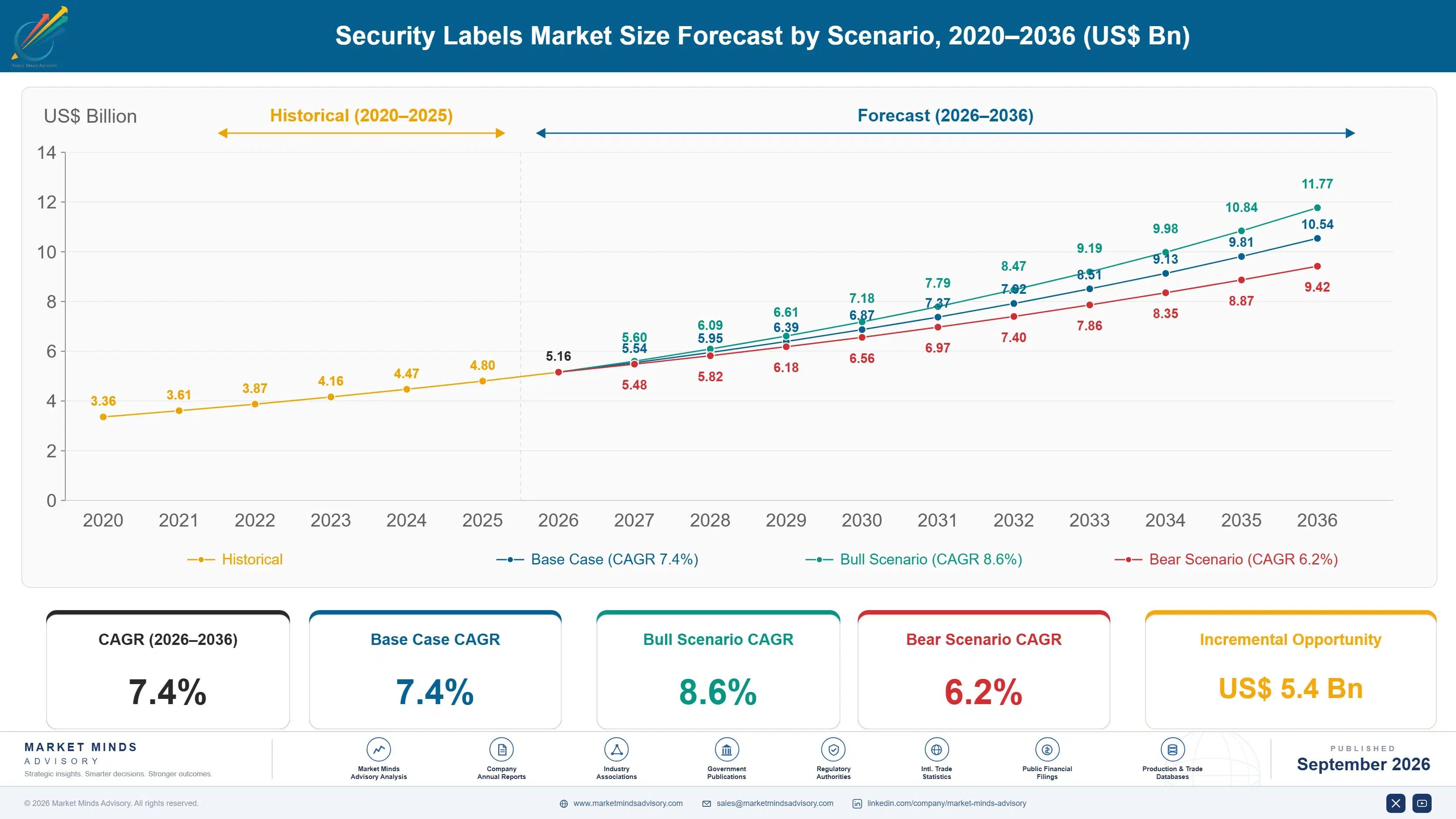
Between 2020 and 2025 the market compounded at 6.2%, with almost all of the movement coming from government programmes rather than from brand protection budgets. Tobacco track and trace obligations reached further countries under international protocol commitments, and several governments modernised excise stamp systems that had run unchanged for decades. Brand owner spending on authentication was flat throughout and in some categories declined outright.
The 7.4% base case rests on three commercial mechanisms. Tobacco and alcohol track and trace obligations continue reaching new jurisdictions on treaty timetables that governments have already committed to. Serialisation is extending from stamps into product-level authentication where the data rather than the label carries the value. And excise coverage is widening into sugared beverages, bottled water and cannabis in markets that have legalised it, each of which brings a new stamp programme with it.
The bull case is excise duty extending to further consumer categories across developing markets, since every new duty creates a stamp programme covering billions of units at once. The bear case is governments moving to stamp-free digital verification using codes printed directly onto packaging, which would remove the physical label from the largest application in this market entirely.

Governments Buy, Brands Talk About It

Brand protection is the story this industry tells about itself and excise collection is where the money actually comes from. Around 46% of revenue originates in government tax stamp programmes on tobacco, alcohol and increasingly other dutiable goods, which are mandated by law, tendered nationally and awarded on security printing credentials rather than on price. Those buyers are finance ministries protecting revenue, not brands protecting reputation.
TOP FIVE CONCENTRATION41%Share of measured shipment revenue held by leading suppliers
TAX STAMP REVENUE SHARE46%Portion of market revenue from government excise stamp programmes
CONTRACT TERM8 yearsTypical duration of a national excise stamp supply contract
CONSUMER VERIFICATION RATE4%Share of consumers who ever check an authentication feature
AVERAGE UNIT PRICEUSD 0.021Average price of a security label bought at volume
SWITCHING REQUALIFICATION COSTUSD 2.4mCost of changing stamp supplier across a national production base
The consumer verification argument does not survive examination. Roughly 4% of consumers ever check an authentication feature on anything they buy, and a counterfeiter producing a hologram good enough to satisfy that audience faces no meaningful obstacle. Overt features persist because buyers expect to see something, not because they work. What functions instead is covert marking an inspector can verify and serialisation that moves the check into a database.
Contract structure explains the industry's shape. A national excise stamp agreement runs around 8 years, covers billions of units and requires every production line in the country equipped for the supplier's format, so switching costs roughly USD 2.4 million in requalification alone. Incumbency is close to absolute, and there are only a few dozen of these positions in existence.
"Everyone in this market talks about protecting consumers from counterfeits and almost no consumer has ever looked at a hologram. The features that work are the ones a customs inspector uses and the database behind them, and neither is visible on the shelf."
Director, Authentication and Packaging Security Practice · MMA Packaging and Authentication Practice · September 2026

Market Trends

Serialisation Moves Value From Label To Database

A unique code applied to each item and registered centrally lets an inspector, a distributor or a regulator confirm authenticity against a record rather than against a physical feature, which changes what the label is for entirely. The printed part becomes a carrier while the repository, the aggregation logic and the reporting become the product. That shifts revenue toward platform fees and away from unit price, and it favours suppliers who can operate national data systems rather than only print well. Serialised digital authentication grows at 11.1% against a market at 7.4% as a direct consequence.
Market Impact: Commits 60 signatory countries
Overt Features Persist Without Doing Very Much

Holograms and optically variable features remain widely specified even though only around 4% of consumers ever check anything and a competent counterfeiter reproduces them well enough to satisfy that small minority. The features survive because procurement specifications were written when they were novel and because buyers want visible evidence they spent money on protection. Their growth has consequently fallen well below the market. Suppliers know this and rarely say so, since overt features are profitable and the customer is not asking uncomfortable questions about them. Suppliers know this and rarely raise it.
Market Impact: Grows at 12.6% annually

Market Opportunities and Growth Drivers

Treaty Obligations Extend Tobacco Traceability By Timetable

International protocol commitments on illicit tobacco trade oblige signatory countries to implement tracking and tracing systems on a defined timetable, which produces stamp and serialisation programmes governments have already agreed to fund. World Health Organization reporting records the implementation status country by country, giving unusually clear forward visibility of where programmes will arrive next. That is a demand pipeline set by treaty rather than by procurement cycles, and it reaches markets with very large cigarette volumes and no existing system. Very large cigarette volumes sit in markets with no existing system at all.
Market Impact: Costs USD 2.4 million to switch

Indonesian Excise Volumes Make Modernisation Valuable

Indonesia applies excise stamps across an enormous cigarette market with a complicated tiered duty structure, and modernising that system carries revenue implications far larger than the cost of any programme supplying it. Growth of 12.6% makes Indonesia the fastest growing country in this market. Similar volumes across the Philippines, Bangladesh and Vietnam create comparable opportunities on comparable timetables. Suppliers established in one such programme are strongly placed for the others, since the technical and operational reference matters more than pricing in these tenders. Technical reference matters more than pricing in these tenders.
Market Impact: Verified by 4% of buyers

Market Restraints and Challenges

Incumbency Makes National Contracts Nearly Unwinnable

A national excise stamp contract runs around 8 years and requires every production line in the country to be equipped for the incumbent's format, so switching costs roughly USD 2.4 million in requalification before any price comparison begins. The root cause is that the stamp is applied on customer equipment rather than supplied as a finished good. Commercial impact is a market where a challenger waits a decade for an opening that may not come. Mitigation runs through targeting first-time programmes in countries without any system, through partnering with incumbents on data platforms, and through adjacent categories.
Market Impact: Grows at 11.1% annually

Brand Owner Authentication Spending Does Not Grow

Brand protection budgets have been flat for years because the return has never been demonstrable: only around 4% of consumers verify anything, seizure data cannot be attributed to any specific feature, and the counterfeit sales avoided are unmeasurable by construction. The root cause is that the benefit is a loss that did not happen. Commercial impact is that the private half of this market grows barely at all while the government half carries everything. Participants mitigate by selling into supply chain visibility and grey market detection, where the data produces evidence a brand owner can actually act on.
Market Impact: Checked by only 4% of consumers
3 additional market trends, 3 additional growth drivers, and 2 additional restraints and challenges are covered in the full report. Contact sales@marketmindsadvisory.com to access the complete intelligence.

Segment CAGR and Growth Architecture

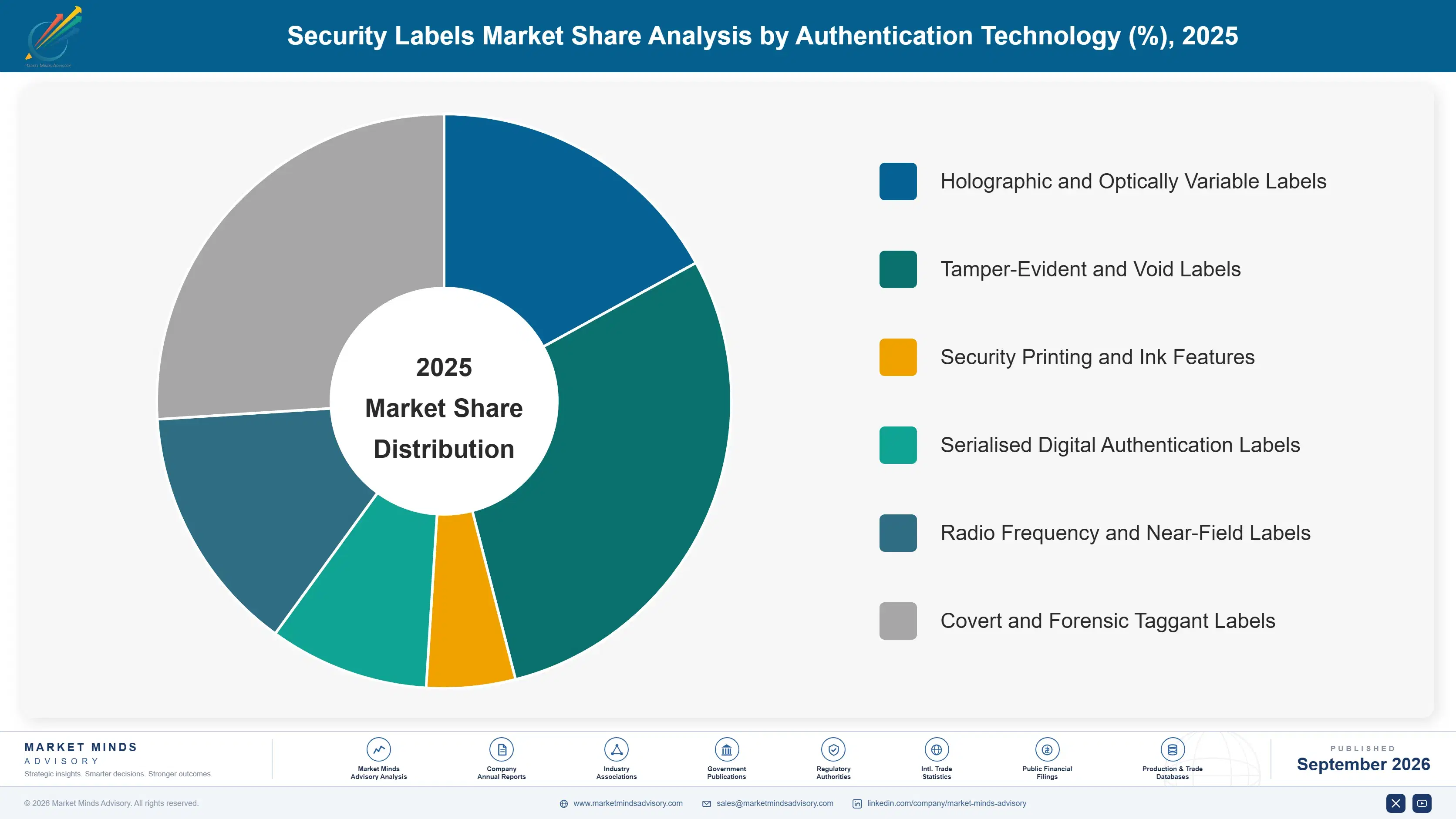
Segmentation follows the authentication technology carried, which determines who can verify it, what it costs and whether it is bought by a government or a brand. Holographic, tamper-evident, printed, serialised digital, radio frequency and covert forensic constructions serve genuinely different purposes and are growing at very different rates. Buyers differ completely between them. Growth diverges sharply.
security-labels-market-market-share-analysis-1788415808818

Serialised Digital Authentication Labels

A unique code per item registered in a central repository shifts verification from the physical feature to a database query, which is what excise authorities, pharmaceutical regulators and supply chain auditors all actually want. The label becomes a carrier and the repository, aggregation logic and reporting become the product, moving revenue toward platform fees and away from unit price. Growth at 11.1% is half again the market rate of 7.4%. Suppliers able to operate national data systems win here and pure label converters generally cannot, which is reshaping the competitive field faster than any printing technology ever did. That is reshaping the competitive field faster than printing technology ever did.
CAGR 11.1%

Radio Frequency and Near-Field Communication Labels

Chip-bearing labels allow verification without line of sight and support consumer interaction through an ordinary telephone, which is the only authentication route that has ever produced meaningful consumer engagement rather than the 4% who look at printed features. Cost remains many times a printed label, which confines it to goods where unit value carries it, principally spirits, cosmetics, pharmaceuticals and luxury items. Growth at 9.8% reflects chip prices falling steadily and brands finding marketing value alongside authentication. The marketing budget frequently pays for what the security budget could never have justified alone. Cost confines it to goods whose unit value carries the premium, principally spirits, cosmetics and luxury items. Consumer engagement is genuine here.
CAGR 9.8%
Full segment breakdown across 6 segments available in the complete report.

Regional Architecture and Country Demand Map

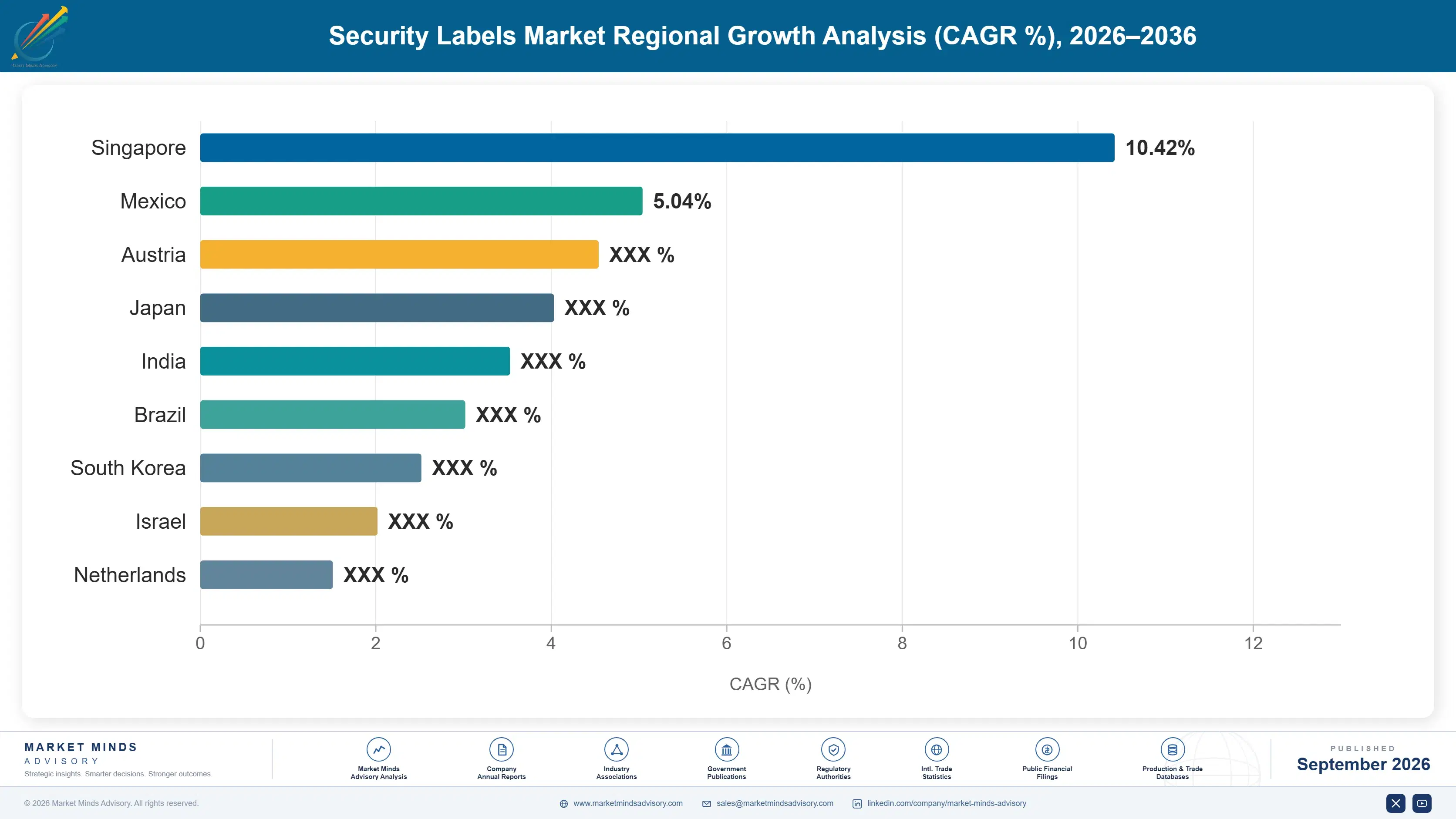
Demand follows excise duty programmes and dutiable goods volumes rather than economic size or counterfeiting prevalence. East Asia and South Asia lead because that is where the largest tobacco and alcohol volumes carrying mandatory stamps are actually produced. Counterfeiting prevalence explains almost nothing. Duty programmes decide the map.

East Asia

China applies excise stamps across the largest cigarette volume anywhere by a very wide margin, operated through a state monopoly that procures domestically and at a scale no other single programme approaches. Japanese and Korean demand is smaller and weighted toward brand authentication in cosmetics, pharmaceuticals and food, where consumer expectations are exacting. Regional suppliers hold most of the volume, with international vendors reaching the market principally through data platform and serialisation capability rather than through printing. Growth of 8.0% rests on programme modernisation rather than volume expansion. International vendors reach this region principally through data platform and serialisation capability rather than through any printing advantage they hold. Programme modernisation rather than volume expansion carries growth here.
Share: 26% | CAGR: 8.0% (2026 to 2036)

South Asia and Pacific

Indonesia, the Philippines, Bangladesh and Vietnam together apply excise stamps across enormous cigarette volumes with complicated tiered duty structures, which is why the region sits at 20%, well above the standard band ceiling of 12%. Indonesia grows at 12.6%, the fastest of any country in this market, on excise system modernisation with revenue implications far exceeding programme cost. Indian pharmaceutical serialisation for export markets creates substantial parallel demand. Australian plain packaging and excise arrangements are among the most tightly enforced anywhere. Indian pharmaceutical serialisation for export markets creates substantial parallel demand, and Australian excise arrangements are among the most tightly enforced anywhere in the world. Tiered duty structures make these programmes unusually complex to operate.
Share: 20% | CAGR: 9.6% (2026 to 2036)
Regional intelligence for 5 additional markets available in the complete report: Western Europe, North America, Latin America, Middle East and Africa, Eastern Europe. Contact sales@marketmindsadvisory.com.
security-labels-market-country-cagr-analysis-1788415809340

Where Authentication Revenue Genuinely Sits

Four positions carry margin in a market where the loudest story and the actual revenue point in different directions. Each requires selling to a government rather than a brand, or operating a data system rather than a printing press, and most suppliers are organised for neither. Most suppliers are organised for neither. Both are uncomfortable.

Win First-Time National Excise Stamp Programmes

A national stamp contract runs around 8 years across billions of units and becomes nearly unwinnable once held, since switching costs a country roughly USD 2.4 million in production line requalification before price is even discussed. The only practical entry point is a country implementing for the first time, and treaty commitments make those visible years ahead. Suppliers waiting for existing contracts to be competed will wait most of a decade for openings that frequently do not appear at all. Treaty commitments make those countries visible years ahead. Waiting for a recompete wastes most of a decade.
Market Impact: Secures a full 8 year national programme contract

Operate The Repository Not Just The Print

Serialisation moves value from the physical feature to the database an inspector queries, and platform fees behave quite differently from unit pricing on 0.021 dollar labels. Suppliers able to run national data systems win programmes that pure converters cannot bid for at all, and the segment grows at 11.1% against a market at 7.4%. Building that capability requires software and operations skills a printing business does not naturally hold. Acquiring it has become the standard route, which is why the acquisitions in this market all point the same way. Acquisition has become the standard route into it.
Market Impact: Beats unit pricing on 0.021 dollar labels entirely

Follow Excise Into Newly Dutiable Categories

Governments extending duty to sugared beverages, bottled water and cannabis create stamp programmes covering very large volumes, and each new category arrives at a treasury that already has an incumbent supplier for tobacco and alcohol. Being that incumbent converts a policy decision into revenue without any competitive process, across 4 or more additional categories in some markets. Suppliers holding one national programme should be lobbying for the next duty rather than tendering for the next contract, which is a different commercial discipline entirely. Very few suppliers practise it. Lobbying beats tendering here.
Market Impact: Extends into 4 or more additional dutiable categories

Sell Brand Owners Visibility Rather Than Protection

Brand authentication budgets are flat because the return has never been demonstrable, with only 4% of consumers verifying anything and avoided counterfeit sales unmeasurable by construction. Supply chain visibility and grey market detection produce evidence a brand owner can act on, including diversion routes, unauthorised distributors and parallel imports. That is a commercial problem with a calculable cost rather than a security argument with none. It also reaches sales and commercial functions rather than the brand protection team. The evidence produced is actionable rather than reassuring. Sales teams rather than security teams hold that budget.
Market Impact: Moves beyond the 4% who ever verify anything

Who Controls the Margin Pool

Measured on shipment revenue including serialisation platform fees, the basis used throughout this section, the top five hold 41%. Concentration reflects national contracts that cannot practically be competed once awarded rather than any manufacturing barrier, since security printing capability is more widely held than the market structure suggests. The gap between leaders and the rest is government programme incumbency and data platform capability.
Competition runs on national tender credentials, repository operation and increasingly on whether a supplier can deliver an entire programme rather than a product. Specialist security printers hold established government positions. Large label converters bring manufacturing scale and are weaker on data systems. Technology entrants compete on serialisation platforms and partner with printers rather than displacing them. Technology entrants compete on serialisation platforms and generally partner with printers rather than attempting to displace them.

Pressure comes from two directions. Governments moving to codes printed directly onto packaging would remove the physical label from the largest application in the market, which several administrations are examining seriously. And data platform capability is becoming the qualifying requirement, which advantages suppliers who acquired it early. Rankings shift where suppliers built repository operations and targeted first-time programmes rather than defending printing positions.
security-labels-market-company-positioning-matrix-1788415809872

Competitive Moat and Risk Dimensions

AVERY DENNISON

Moat: Converting scale and material breadth

Manufacturing scale across pressure sensitive materials gives cost position and supply reliability that specialist security printers cannot match on volume programmes. Radio frequency label capability at scale positions the company for the chip-bearing segment growing faster than printed features. Global converting footprint allows local production where excise programmes require domestic manufacture, which several do explicitly.
AVERY DENNISON

Risk: Government programme relationships

National excise tenders are won on security printing credentials, sovereign trust and programme operation experience rather than on converting scale, and specialist competitors hold those relationships across decades. Data repository operation sits outside a materials business and has to be acquired rather than built. The largest revenue pool is therefore the one where it competes least naturally.
SICPA

Moat: Sovereign programme trust position

Long-standing relationships with revenue authorities and central banks give a position in sovereign security work that commercial suppliers cannot easily enter, since governments buy trust and track record before they buy technology. Combined ink, printing and data platform capability allows a complete programme rather than a component. Incumbent contracts running around eight years produce revenue visibility few industrial businesses enjoy.
SICPA

Risk: Concentration and tender scrutiny

Revenue concentrated in a limited number of very large national contracts means the loss of any one is material, and government procurement attracts scrutiny that occasionally forces retendering on political rather than commercial grounds. Direct code printing onto packaging would bypass the physical stamp entirely. Dependence on tobacco and alcohol volumes exposes the business to categories under long-term consumption decline.

Players Tracked

Prominent Players

Avery Dennison
SICPA
CCL Industries
Authentix
3M

Other Key Players

De La Rue
OpSec Security
Brady Corporation
UPM Raflatac
Schreiner Group
tesa scribos
Zebra Technologies
Toppan
Dai Nippon Printing
Madras Security Printers
Leonhard Kurz
Hueck Folien
Uflex
Essentra
Sun Chemical

Recent Developments

APRIL 2025

Government awards multi-year excise stamp and traceability contract

A national revenue authority awarded a multi-year contract covering excise stamp supply and the traceability platform behind it, an award decision rather than any corporate transaction. Programme operation rather than label supply alone was the scope tendered, which excluded suppliers without data system capability. Bidders without platforms withdrew.
Signal: Tendering the programme rather than the label removes every supplier that only knows how to print.
OCTOBER 2024

Tobacco traceability obligations advance in further signatory countries

Additional signatory countries progressed implementation of tracking and tracing systems under international protocol commitments on illicit tobacco trade, a regulatory milestone rather than any commercial event. World Health Organization reporting recorded implementation status across the participating countries involved. Implementation deadlines were set nationally and reported centrally.
Signal: A treaty timetable gives this industry forward visibility that no ordinary sales pipeline could ever provide.
JANUARY 2025

Label supplier acquires digital authentication platform business

A label and packaging supplier acquired a digital authentication and serialisation platform company, an acquisition rather than any partnership or joint venture. Access to government programme tenders requiring repository operation was cited alongside the technology as the reasoning behind the transaction. Government tender access was the stated objective.
Signal: Printers are buying software because programmes now tender for data operation rather than for printed output.

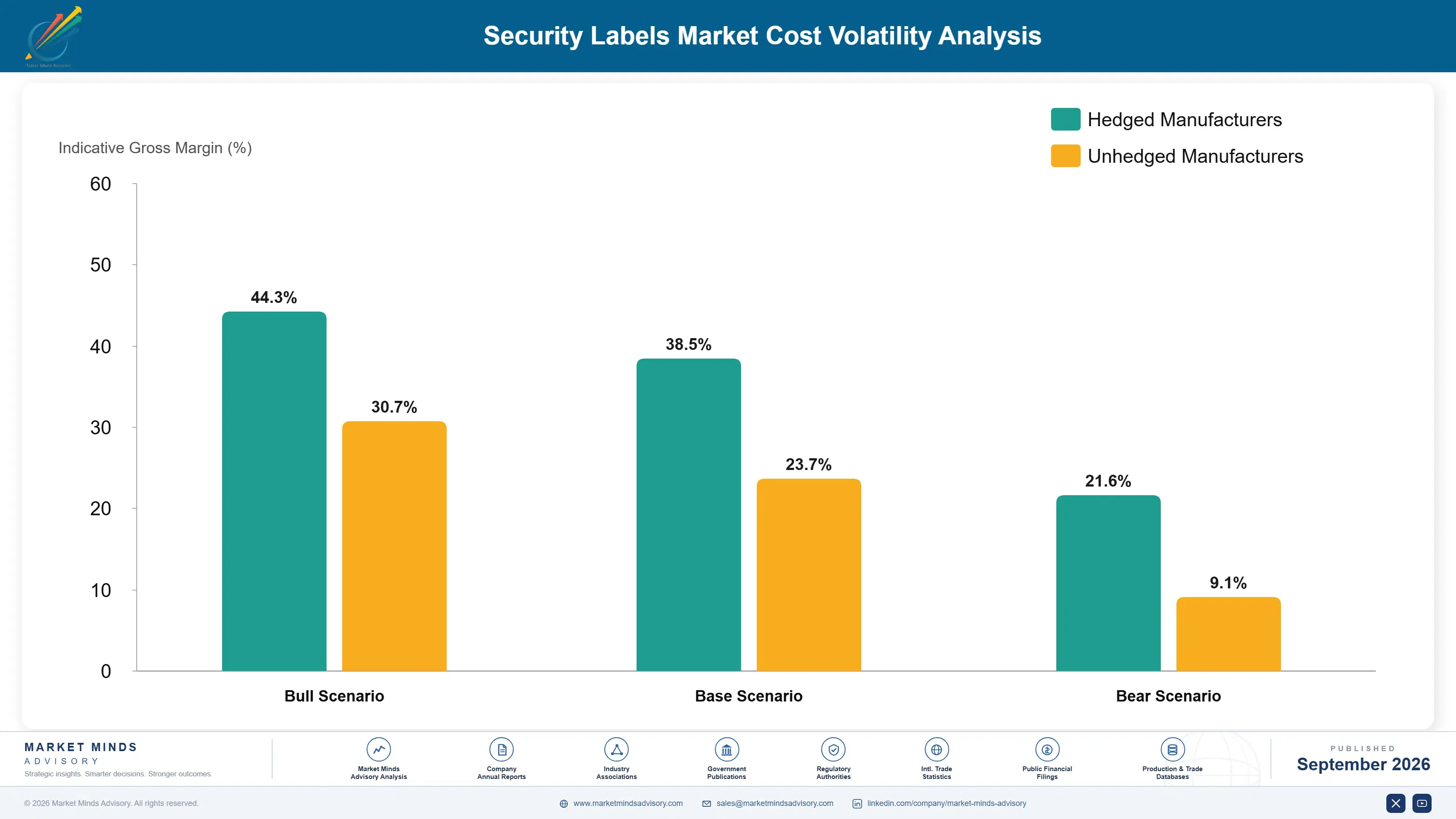
Substrate, Foil And Security Inks

Substrate paper and film account for roughly 29% of label manufactured cost, metallised and holographic foil around 21%, security inks and pigments between 12 and 18% depending on feature set, and adhesive, printing and conversion the balance. Metallisation depends on aluminium supply that USGS commodity reporting tracks, while optically variable pigments come from a small number of specialist producers with genuinely limited alternatives.
Paper and film pricing rose sharply through the 2021 and 2022 period as pulp costs and energy prices moved together, and aluminium prices swung violently across the same window. Suppliers holding fixed-price government contracts running several years absorbed both, and several disclosed margin pressure in results covering the period. Specialist pigment supply tightened alongside, with limited capacity and no ready substitution available to anybody. Substitution was unavailable throughout.

The disadvantage mechanism is contract duration rather than purchasing scale. A national programme running around eight years at fixed pricing carries input exposure across the whole term, while a brand owner contract renegotiated annually does not. Governments resist indexation because budget appropriations are annual and fixed. Suppliers with materials indexation written into long programmes manage this comfortably, and those without simply absorb it for eight years.
security-labels-market-cost-volatility-analysis-1788415810068

Materials indexation written into long programmes

Tying long government contract pricing to published pulp, film and aluminium indices moves input exposure to a buyer far better able to carry it than any supplier is. Revenue authorities resist because appropriations are annual and fixed, so the clause has to be negotiated at award rather than raised later when costs have already moved.

Feature simplification where verification never happens

Removing overt features that only 4% of consumers ever check reduces cost substantially without affecting anything that actually works, since inspection relies on covert marking and database verification. Buyers resist because visible features are what they believe they purchased, which makes this a specification conversation rather than an engineering one. Specification conversations are difficult.

Dual-sourcing metallised and holographic foil

Qualifying foil from more than one producer protects against the supply concentration that metallisation and origination capacity create, and it improves negotiating position on a line representing around a fifth of cost. Security programmes require supplier approval that makes qualification slow, which is why most suppliers never complete it. Approval processes make qualification slow.

Portfolio Architecture for Margin Defence

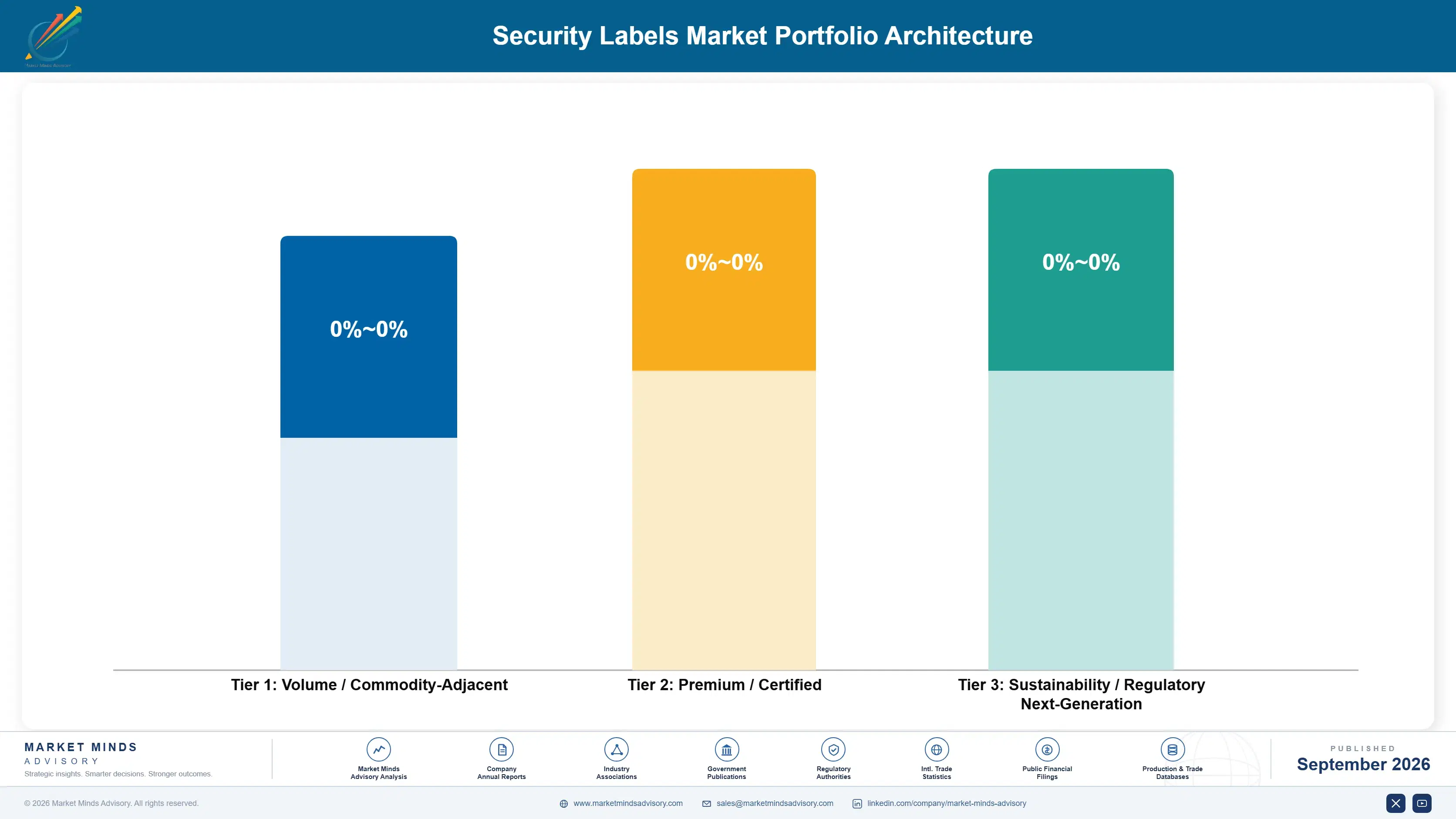
Margin separates by whether the supplier operates a programme or supplies a component. Printed labels sold into brand protection budgets compete on price against several capable converters at around 0.021 dollars a unit, and returns follow converting efficiency. National programme operation combining stamps, serialisation and repository services is priced against duty revenue protected rather than against a competitor, and incumbency removes competitive pressure for around eight years at a time.
The volume against premium tension runs through capability rather than product mix. Converting volume sustains the manufacturing base that programme contracts require suppliers to demonstrate, so a supplier cannot abandon commodity label work and still qualify for sovereign tenders. But the programme work carries the margin and the visibility. The correct reading treats converting scale as a qualification asset, and several suppliers still manage it as the business itself.

High-value pools sit where a government or a regulator creates the requirement: national excise programme operation, serialisation repositories and pharmaceutical verification services. Each is defended by incumbency and requalification cost rather than by any technology. The pools are few in number, very large individually, and carry a share of profit that has almost nothing to do with the labels being printed.

Volume / Commodity-Adjacent

Printed security and tamper-evident labels sold into brand protection budgets on price against several capable converters. Returns depend on converting efficiency and materials purchasing rather than on any feature the customer can actually evaluate.
Gross Margin: 18 to 26%

Premium / Certified

Holographic, covert and radio frequency labels specified for higher value goods where unit cost is carried by product value. The 10 point range reflects whether a marketing budget or only a security budget is paying for the feature.
Gross Margin: 32 to 42%

Sustainability / Regulatory / Next-Generation

National excise programme operation, serialisation repositories and regulated verification services. The 16 point range reflects how completely incumbency and requalification cost remove competitive pressure on price over a contract term.
Gross Margin: 40 to 56%
security-labels-market-portfolio-architecture-1788415810572

High-value Sub-segments and Strategic Watch-out

National Programme Operation

Runs around eight years across billions of units with switching costing a country roughly USD 2.4 million in requalification alone. Priced against duty revenue protected rather than against any competitor bidding on the same tender. Revenue visibility here is unlike anything else in packaging. Losses are serious events.
Gross Margin: 44 to 56%

Serialisation Repository Services

Where value migrated once verification moved from the physical feature to a database query. Suppliers able to operate national data systems win programmes that pure label converters cannot even bid for at all. Printing capability has stopped being the qualifying requirement. Converters cannot bid at all.
Gross Margin: 42 to 54%

Radio Frequency Authentication Labels

Growing at 9.8% as chip prices fall and brands find marketing value alongside authentication. The marketing budget frequently funds what the security budget could never have justified on its own merits. Consumer engagement is genuine here in a way printed features never achieved. Marketing budgets often pay.
Gross Margin: 32 to 42%

Printed Brand Protection Labels

Flat demand against budgets that never grew because the return was never demonstrable to anybody. Necessary converting volume that qualifies a supplier for programme tenders rather than a business worth defending on returns. Converting scale still qualifies a supplier for the programme tenders. Returns do not justify defending it.
Gross Margin: 18 to 26%

Who Actually Awards The Work

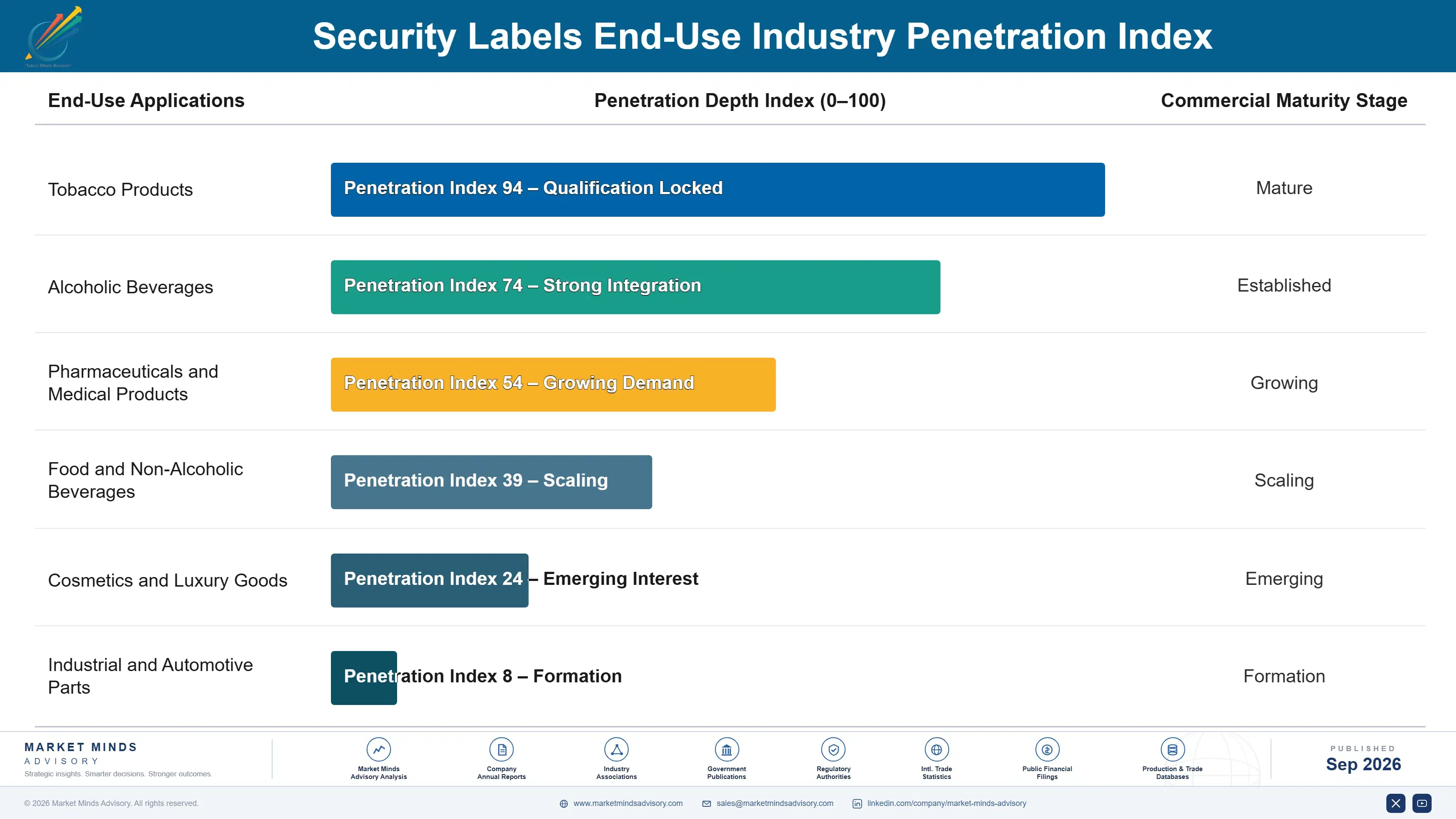
Annuity economics here are exceptional and extremely concentrated. A national excise programme runs around eight years, covers billions of units and renews with the incumbent far more often than not, because switching requires requalifying every production line at roughly USD 2.4 million. That produces revenue visibility almost no packaging business enjoys, and it makes each individual contract loss a serious event rather than a routine one.
Adoption depth varies sharply by buyer type. Revenue authorities specify comprehensively, audit continuously and treat the programme as revenue infrastructure rather than as procurement. Pharmaceutical manufacturers implement to a regulatory standard and want nothing beyond compliance. Brand owners buy features they cannot evaluate against a return they cannot measure, which is why that half of the market has not grown in a decade.

The buyer profile did not change so much as become clearer. This was always a government market describing itself as a brand protection one, and serialisation has simply made the distinction impossible to ignore. Programmes now tender for data operation as well as printed output, which excludes suppliers who only print and admits software companies who never converted a label. Both groups are still adjusting to that reality.
security-labels-market-end-use-penetration-index-1788415811059

Where Suppliers Should Compete

These are among the four positions where our research anticipates prominent divergence between winners and laggards over the coming forecast period. Each is grounded in the demand model, the regulatory perimeter, and the announced capacity pipeline.
01 / FIRST PROGRAMME TARGETING

Chase countries implementing for the first time

A national excise contract runs around eight years and becomes nearly unwinnable once held, because switching costs a country roughly USD 2.4 million in production line requalification before any price difference is even discussed by anybody. The only practical entry is a country implementing for the first time, and treaty commitments make those visible years ahead of any tender. Suppliers waiting for existing contracts to be competed will wait most of a decade for openings that frequently never appear at all.
02 / REPOSITORY CAPABILITY BUILDING

Operate the database or lose the programme tender

Serialisation moved value from the physical feature to the database an inspector queries, and programmes increasingly tender for data operation rather than for any printed output alone, which excludes suppliers who only know how to print things. The segment grows at 11.1% against a market at 7.4% and platform fees behave nothing like unit pricing on labels costing barely two cents each. Acquiring that capability has now become the standard route because printing businesses simply do not build software naturally.
03 / EXCISE CATEGORY EXTENSION

Lobby for the next duty, not the next tender

Governments extending duty to sugared beverages, bottled water and cannabis create stamp programmes covering very large unit volumes indeed, and each new category arrives at a treasury that already holds an incumbent supplier for its tobacco and alcohol programmes. Being that incumbent converts a policy decision straight into revenue with no competitive process involved at all, across four or more additional categories across some individual markets. That is a completely different commercial discipline from tendering for contracts, and few suppliers practise it.
04 / BRAND PROPOSITION REFRAMING

Sell diversion evidence, not consumer authentication

Brand authentication budgets have been entirely flat for years because only around 4% of consumers ever verify anything at all while avoided counterfeit sales remain unmeasurable by construction, so the underlying return has never been demonstrable to any finance function at all. Supply chain visibility and grey market detection both produce evidence a brand owner can genuinely act upon, including diversion routes and unauthorised distributors selling stock. That also reaches the commercial functions rather than reaching only the brand protection team.

Engagement Snapshot From the Field

A live engagement with an industry participant carrying material or product regulatory and market exposure ahead of a defining policy shift, showing how our research translates into a defensible multi-year portfolio strategy.
MARKET MINDS ADVISORY · CLIENT ENGAGEMENT SUMMARY
Security Labels Producer Strategic Portfolio Review and Transition Roadmap 2026·Investment Scenario on Security Labels Exposure Evaluation 2025-26
CLIENT PROFILE
A European security printing and labels group supplying government and commercial customers across nineteen markets, with annual revenue reported at approximately USD 620 million (client-reported, unverified by MMA). The business held two national excise stamp contracts, sold brand authentication labels commercially, and operated no data repository or serialisation capability of its own anywhere at all.
STRATEGIC CHALLENGE
The group had been excluded at prequalification from three recent national tenders without a clear explanation, while brand authentication revenue had been flat for six consecutive years. Management could not decide whether to invest in data platform capability, defend the printing business, or attempt both with the resources available. Nobody had established why.
MMA APPROACH
MMA reviewed the tender documentation from the three lost prequalifications to establish the actual exclusion criteria, sized upcoming first-time programmes against treaty implementation timetables, and assessed what brand owners would fund if the proposition were reframed around diversion evidence rather than consumer authentication. Contract indexation terms were reviewed alongside. Buyer budgets were traced.
KEY FINDINGS
  1. All three prequalification exclusions rested on repository operation requirements the group could not meet, and none of them concerned printing capability, pricing or security features at all.
  2. Twelve countries were scheduled to implement traceability for the first time within four years under treaty commitments, which was the only realistic entry point available to any challenger.
  3. Brand customers valued diversion and grey market evidence considerably more than consumer authentication, and the budget for it sat with commercial teams rather than brand protection.
  4. Existing excise contracts had no materials indexation, leaving the group carrying input cost exposure across roughly eight years of fixed pricing on both of them.
CLIENT PROFILE
A European security printing and labels group supplying government and commercial customers across nineteen markets, with annual revenue reported at approximately USD 620 million (client-reported, unverified by MMA). The business held two national excise stamp contracts, sold brand authentication labels commercially, and operated no data repository or serialisation capability of its own anywhere at all.
STRATEGIC CHALLENGE
The group had been excluded at prequalification from three recent national tenders without a clear explanation, while brand authentication revenue had been flat for six consecutive years. Management could not decide whether to invest in data platform capability, defend the printing business, or attempt both with the resources available. Nobody had established why.
MMA APPROACH
MMA reviewed the tender documentation from the three lost prequalifications to establish the actual exclusion criteria, sized upcoming first-time programmes against treaty implementation timetables, and assessed what brand owners would fund if the proposition were reframed around diversion evidence rather than consumer authentication. Contract indexation terms were reviewed alongside. Buyer budgets were traced.
KEY FINDINGS
  1. All three prequalification exclusions rested on repository operation requirements the group could not meet, and none of them concerned printing capability, pricing or security features at all.
  2. Twelve countries were scheduled to implement traceability for the first time within four years under treaty commitments, which was the only realistic entry point available to any challenger.
  3. Brand customers valued diversion and grey market evidence considerably more than consumer authentication, and the budget for it sat with commercial teams rather than brand protection.
  4. Existing excise contracts had no materials indexation, leaving the group carrying input cost exposure across roughly eight years of fixed pricing on both of them.
RECOMMENDED STRATEGY
Phase 1: Phase one: acquire repository and serialisation platform capability outright rather than attempting to build the software inside a printing organisation. Phase 2: Phase two: target the twelve first-time implementation countries directly rather than waiting for existing contracts anywhere to be recompeted at all. Phase 3: Phase three: reposition the brand offer around diversion evidence and sell it to commercial teams instead of brand protection functions.
OUTCOME
Within sixteen months the group had acquired a serialisation platform, prequalified for two of the first-time programmes, and reported brand segment revenue up 18% following the repositioning work (client-reported, unverified by MMA). Materials indexation has now been secured on one renewed government contract as well.

Frequently Asked Questions

Foundational context covering the market sizes, CAGR, scope, country, region and competition that inform every finding below. This section is provided to cover basics and most often pre-purchase conversations, answered from the MMA Primary Research Dataset.

What is the current size of the Security Labels Market?

The market was valued at USD 4.8 billion in 2025 and reaches USD 5.16 billion in 2026. Government excise stamp programmes account for the largest share of that revenue.

How large will the Security Labels Market be by 2036?

MMA forecasts USD 10.54 billion by 2036, an increase of USD 5.38 billion over the 2026 base. That represents an expansion multiple of 2.04 times.

What is the CAGR for the Security Labels Market 2026 to 2036?

The base case CAGR is 7.4%, with a bull case of 8.6% and a bear case of 6.2%. The historical rate between 2020 and 2025 was 6.2%.

Which segment is growing fastest?

Serialised digital authentication labels grow at 11.1%, half again the market rate of 7.4%. Verification moved from the physical feature to a database query that inspectors run.

Who are the major companies in the Security Labels Market?

Avery Dennison, SICPA, CCL Industries, Authentix and 3M lead on measured shipment revenue. Together they account for roughly 41% of a market shaped by contract incumbency.

Which country is growing fastest?

Indonesia grows fastest at 12.6%, on excise system modernisation across an enormous cigarette market with a complicated tiered duty structure behind it. Revenue implications far exceed cost.

Report Segmentation Architecture

The full report scope spans multiple orthogonal segmentation dimensions, with cross-tabulated demand data provided for each dimension pair. Coverage extends further to regional breakdowns, trend trajectories, and the competitive detail needed to support segment-level decision-making.

By Authentication Technology

  • Holographic and Optically Variable Labels
  • Tamper-Evident and Void Labels
  • Security Printing and Ink Features
  • Serialised Digital Authentication Labels
  • Radio Frequency and Near-Field Labels
  • Covert and Forensic Taggant Labels

By End-Use Industry

  • Tobacco Products
  • Alcoholic Beverages
  • Pharmaceuticals and Medical Products
  • Food and Non-Alcoholic Beverages
  • Cosmetics and Luxury Goods
  • Industrial and Automotive Parts

By Buyer Type and Programme Structure

  • Government Excise Programmes
  • Regulatory Serialisation Mandates
  • Brand Owner Procurement
  • National Tender Award
  • Converter and Distributor Channel
  • Managed Programme Operation

By Region

  • East Asia
  • South Asia and Pacific
  • Western Europe
  • North America
  • Latin America
  • Middle East and Africa
  • Eastern Europe

Scope, Methodology, and Coverage

Every figure in this report is reproducible from documented input assumptions. The scope below maps the historical period, the forecast horizon, the segmentation dimensions, and the countries covered, alongside the underlying primary and qualitative methodology.
Historical Period
2020 to 2025
Forecast Period
2026 to 2036
Base Year
2025 (USD billions; MMA Primary Research Dataset, September 2026)
Market Definition
The security labels market covers self-adhesive and applied labels carrying authentication, tamper evidence or traceability features, spanning holographic and optically variable constructions, tamper-evident and void designs, security printing and ink features, serialised digital authentication labels, radio frequency and near-field communication labels, and covert forensic taggant labels. Sizing is measured at supplier shipment revenue including associated serialisation platform fees. Banknotes, identity documents, tax-paid seals applied without labels, general product labelling and packaging substrates are excluded.
Quantitative Units
USD billions at supplier shipment revenue including serialisation platform fees, with supporting unit volumes and programme counts by region
Segmentation Dimensions
Authentication technology, end-use industry, buyer type and programme structure, region
Regions Covered
East Asia, South Asia and Pacific, Western Europe, North America, Latin America, Middle East and Africa, Eastern Europe
Countries Covered
China, Japan, South Korea, Indonesia, Philippines, Bangladesh, Vietnam, India, Australia, United States, Canada, Mexico, Brazil, Germany, United Kingdom, Poland, Kenya, United Arab Emirates
Key Companies Profiled
Avery Dennison, SICPA, CCL Industries, Authentix, 3M, De La Rue, OpSec Security, Brady Corporation, UPM Raflatac, Schreiner Group, tesa scribos, Zebra Technologies, Toppan, Dai Nippon Printing, Madras Security Printers, Leonhard Kurz, Hueck Folien, Uflex, Essentra, Sun Chemical
Quantitative Methodology
Primary survey, n=3,800 respondents, Q4 2025, six countries; demand-side model with trade association cross-validation
Qualitative Methodology
47 expert interviews, Q4 2025; applied to validate demand model assumptions, identify emerging dynamics, and assess competitive positioning
Report Format
PDF and XLSX data workbook (Word format preview document)
Publisher
Market Minds Advisory
Report Code
MMA-2026-PAC-121
Published
September 2026
Contact
sales@marketmindsadvisory.com | www.marketmindsadvisory.com

Purchase the full Security Labels Market Report (2026 to 2036).

The full report separates government excise revenue from brand protection spending throughout, which is the distinction that explains why this market grows steadily while brand budgets do not move at all. It sizes six authentication technologies with individual growth rates, seven regions built from dutiable goods volumes and programme implementation, and the incumbency economics that make national contracts almost impossible to compete for. Competitive analysis covers twenty suppliers on a consistent shipment revenue basis, with programme incumbency and repository capability treated as the decisive variables. Input cost modelling breaks out substrate, foil and pigment exposure across long fixed-price contracts.
Six authentication technologies with individual growth rates
Government and brand demand sized separately throughout
National programme incumbency and switching cost analysis
Treaty implementation timetables mapped by country
Twenty suppliers on consistent shipment revenue basis
Substrate, foil and pigment cost exposure

Built For The People Who Decide

From boardroom strategy to bench-side execution, this report is read cover-to-cover by leaders shaping the next decade of their industry, turning demand scenarios, market dynamics and valuation benchmarks into decisions.
CXOs/ Presidents/ VPs/ Managers
M&A and Corporate Development
Strategy Teams and R&D Heads
Procurement and Product Directors
Regulatory and Compliance Leaders
Investor Relations and Equity Analysts