Market Minds Advisory
Second-hand Bag Market

Second-hand Bag Market: Second-hand Bag Market. Authentication Technology Turns Resale Into an Institutional Channel.

Authentication technology and consignment platforms are turning informal handbag resale into an institutional retail channel, as luxury brands increasingly treat certified secondhand inventory as a distinct commercial category rather than a threat to full-price sales.

Lead Analyst

Published

September 2026

Make Smarter Decisions with Customized Research Insights

Request a free sample report and evaluate market opportunities, growth trends, and competitive dynamics relevant to your business needs.

2025 MARKET VALUE$9.6BMarket Size 2025
2036 FORECAST VALUE$26.8BBase Case , 2026 to 2036
CAGR 2026 TO 20369.8 %Bull 11.1% / Bear 8.5%
INCREMENTAL OPPORTUNITY$16.3BNet 10- year value creation
EXPANSION MULTIPLE2.55x2036 value over 2026 base
Strategic Levers
M&A Pipeline
Regional Outlook
Country Rankings
Competitive Intelligence
Segmental Deep-dive
Call-Us : 91 93563 13602

Executive Snapshot and Market Trajectory.

Certified authentication is replacing trust-based resale as the category's core commercial mechanism, letting platforms charge premium consignment fees while giving buyers confidence once reserved for full-price retail purchases, and that shift is now the single biggest driver of category legitimacy across every major consignment channel operating today.
Vintage and collectible designer bags are pulling growth well ahead of the broader resale category, as scarcity and discontinued styles command prices rivaling or exceeding new releases at retail counters worldwide. Platform consolidation concentrates volume among fewer, better-funded operators with stronger authentication infrastructure and deeper consignor relationships, while East Asia's decades-old secondhand luxury culture anchors a disproportionate share of global transaction value relative to its population and consumer base overall.
Competitive intensity is rising sharply as luxury brands launch owned resale channels rather than ceding the category entirely to third parties, pressuring independent platforms on authentication cost and consignor commission rates simultaneously across nearly every price tier and geography worldwide today, reshaping how the category competes. Regulatory scrutiny of counterfeit detection standards is pushing smaller platforms toward consolidation or exit as compliance costs climb faster than smaller operators can realistically absorb them going forward.
Market Definition
The Second-hand Bag Market covers the resale of previously owned handbags, totes, and crossbody bags through consignment platforms, marketplaces, and authenticated resale channels. It excludes first-sale retail, rental services, and non-bag leather accessories such as wallets or belts.
Base Year Value
$9.6B in 2025 (MMA Primary Research Dataset, September 2026)
Forecast Period
2026 to 2036, eleven discrete annual values
CAGR
9.8% base case. Bull 11.1%. Bear 8.5%.
Fastest Growth Segment
Vintage and Collectible Designer Bags: 13.5% CAGR
Fastest Growth Country
Vietnam: 14.2% CAGR
Fastest Growth Region
South Asia and Pacific: 11.8% CAGR
Largest Region
East Asia: 32% of 2025 global value
Market Leaders
The RealReal Inc, Vestiaire Collective SA, Fashionphile Group LLC, Rebag Inc, Poshmark Inc. Source: MMA Analysis, company disclosures.
Primary Survey
n=3,800 procurement and R&D decision-makers, Q4 2025, six countries
Methodology
Demand-side build-up, cross-validated against public data, 47 expert interviews

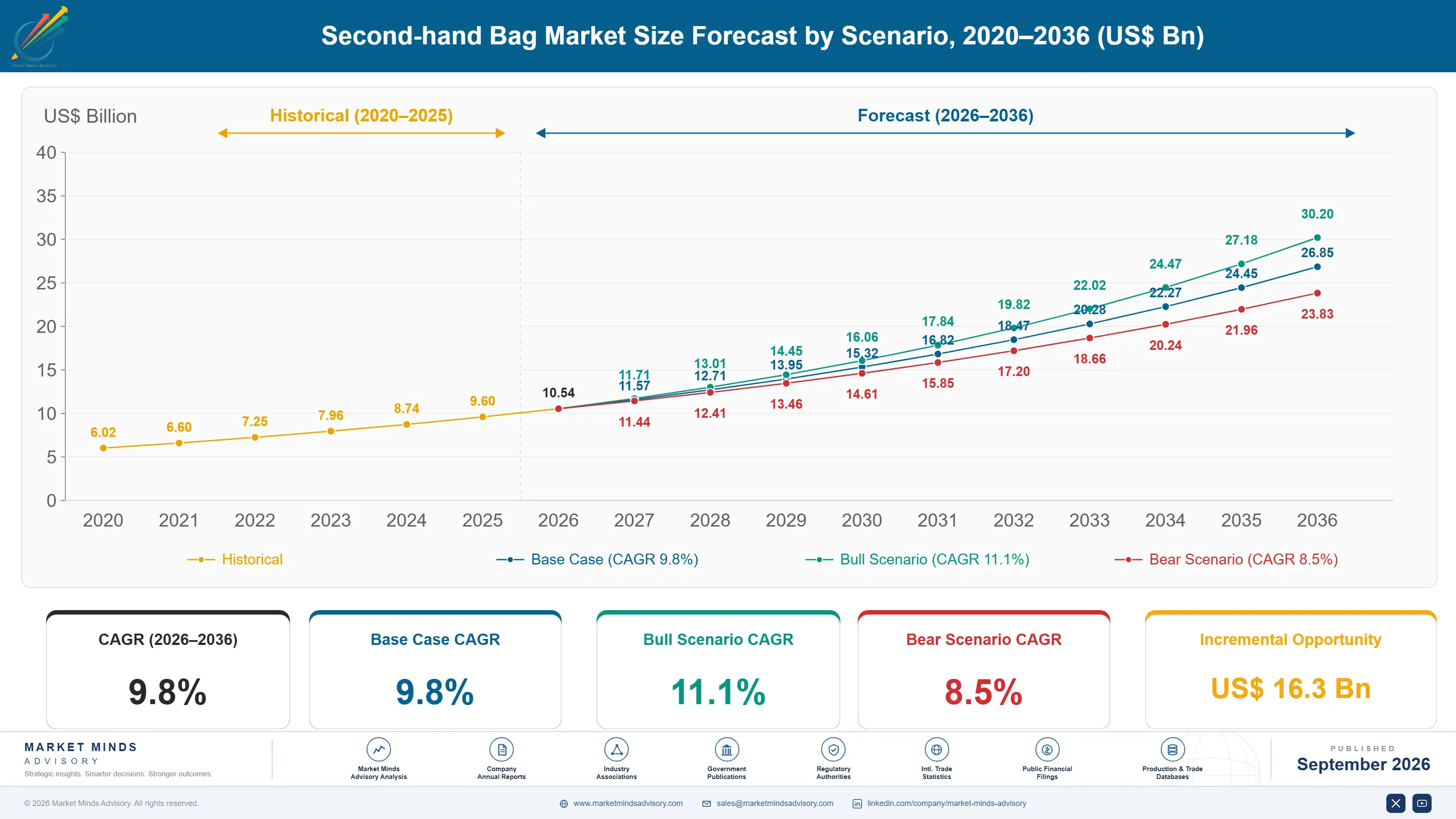
Second-hand Bag Market Forecast Scenarios

second-hand-bag-market-size-forecast-scenario-1790023833227
Resale handbag volume grew steadily through the historical period as consignment platforms professionalized operations and authentication technology meaningfully reduced counterfeit risk for cautious first-time buyers across most major markets. Growth accelerated noticeably after 2022 as luxury brand price increases pushed more buyers toward certified secondhand alternatives instead of waiting for full-price availability at flagship retail stores.
The base case assumes continued platform consolidation, expanding authentication infrastructure, and rising consignor participation from younger sellers comfortable transacting online without traditional consignment store friction or in-person appraisal delays common a decade ago. Three mechanisms drive the forecast specifically: luxury price inflation widening the resale discount considerably, brand-operated resale channels legitimizing the category further among historically cautious buyers, and cross-border logistics improvements steadily lowering platform operating costs over the full forecast horizon.
A bull scenario turns on luxury brands actively promoting certified resale as a sustainability credential, substantially expanding addressable inventory available to consignment platforms industry-wide over the next decade. The bear risk centers on counterfeit detection failures eroding buyer trust at scale, which could meaningfully slow consignor participation and compress platform take rates across the category for several years running.

Authentication Infrastructure Redefines Resale Economics

Resale handbag economics increasingly resemble institutional retail rather than informal secondhand trading, as authentication technology, standardized grading, and platform-backed guarantees replace buyer skepticism with measurable trust across nearly every major transaction category available in the market today. That shift is compressing the price gap between certified resale and new retail for scarce or discontinued styles considerably faster than most platforms anticipated even two years ago at the category's outset.
MARKET CONCENTRATIONCR5 28%top five platforms hold combined transaction share currently
AVERAGE TAKE RATE24%typical consignment commission charged across most major platforms
TOP CONSUMING COUNTRYJapan 14%leads global secondhand luxury transaction volume historically by far
AUTHENTICATION TURNAROUND3.2 daysaverage time platforms need to verify item authenticity fully
CROSS-BORDER TRADE SHARE31%transactions involving buyers and sellers across different countries entirely
CONSIGNOR PAYOUT CYCLE18 daystypical time between item sale and final consignor payment
Platform economics hinge on consignor acquisition cost and authentication throughput rather than inventory ownership, distinguishing resale sharply from traditional retail margin structures entirely and permanently across every price tier. Scale matters disproportionately here, since authentication infrastructure carries meaningful fixed cost that only high transaction volume can amortize efficiently across a wide and steadily growing consignor base spanning multiple countries and price tiers simultaneously.
The next decade will likely see brand-operated resale channels compete directly with independent platforms for consignor supply and buyer attention alike, while blockchain-based provenance tracking gradually reduces authentication cost per transaction across the category, narrowing the operating advantage that early platform scale once reliably provided to first movers in the space and giving smaller entrants a genuine opening.
"Authentication used to be the industry's biggest cost center. It's becoming its biggest competitive moat instead, and that reversal changes who wins."
Practice Lead, Resale and Circular Commerce Practice · MMA Consumer Products and Apparel Accessories Practice · September 2026

Market Trends

AI-Powered Authentication Cuts Verification Time Sharply

Machine-learning authentication tools now cross-reference stitching patterns, hardware stamps, and material texture against manufacturer databases, cutting average verification time from roughly a week to under four days at leading platforms nationwide and abroad this year. Entrupy and similar vendors license this technology to dozens of consignment operators, standardizing detection accuracy across a fragmented industry that previously relied heavily on individual expert judgment alone. Faster turnaround directly increases consignor willingness to list higher-value items, since payout delay has historically been a top complaint among sellers choosing between competing platforms in the market today.
Market Impact: Widens resale discount by 12pp

Brand-Operated Resale Channels Expand Into Core Retail

Luxury houses including several major European conglomerates have launched owned certified resale channels rather than leaving the category entirely to independent platforms, integrating trade-in credit directly into new-purchase transactions at flagship stores worldwide and online storefronts alike. This vertical integration gives brands direct control over pricing integrity and counterfeit risk while capturing consignment revenue previously flowing to third parties entirely. Independent platforms now compete with entities that control original product data, authentication records, and repair history, an advantage that few third parties can fully replicate at comparable scale or cost.
Market Impact: Adds 3.1M new consignors annually

Market Opportunities and Growth Drivers

Luxury Price Inflation Widens the Resale Discount

New handbag prices from major luxury houses have risen faster than general inflation across most regions over the past several years, pushing the gap between full-price and certified resale wider than at any point in the category's history to date. Buyers priced out of flagship stores increasingly view certified resale as the only realistic path to owning scarce or discontinued styles without paying secondary-market markups on the gray market. This dynamic pulls new, younger buyers into resale who previously would have waited for a sale or skipped the category entirely and permanently.
Market Impact: Erodes buyer trust by 8%

Younger Sellers Normalize Online Consignment Behavior

Consignor demographics have shifted meaningfully toward buyers under thirty-five who treat resale listing as a routine part of owning a handbag rather than a last resort, driven partly by social media normalization of secondhand luxury ownership across most demographics and income brackets. Platforms report consignor acquisition cost falling as organic listing volume grows, reducing marketing spend needed to source new inventory each quarter and each region. This generational shift is genuinely distinct from prior cycles because it treats resale value as a planned part of the original purchase decision itself.
Market Impact: Cuts high-value listings 15%

Market Restraints and Challenges

Counterfeit Sophistication Increasingly Outpaces Detection Technology Standards

Counterfeit producers have adopted increasingly sophisticated hardware replication and material sourcing techniques that occasionally defeat even trained human authenticators, let alone automated detection systems trained on older fake patterns and outdated reference data. The root cause is a genuine technology race rather than platform negligence: authentication vendors update detection models reactively after new counterfeit methods surface rather than anticipating them ahead of time. Platforms are responding by combining machine detection with physical inspection and manufacturer partnership data, though this hybrid approach adds cost and slows turnaround for exactly the high-value items where accuracy matters most.
Market Impact: Cuts average listing time 45%

Consignor Payout Delays Discourage High-Value Listings

Payout timelines stretching two to three weeks after sale remain a persistent friction point, rooted in platforms holding funds during return windows and dispute periods to limit their own financial exposure and chargeback risk on higher-value transactions. This delay disproportionately discourages consignors listing higher-value items, who face meaningful opportunity cost while capital sits with the platform rather than in their own account. Several operators are piloting instant-payout programs backed by third-party financing partners, trading a small fee for faster consignor cash flow, though this mitigation remains limited to top-tier sellers so far.
Market Impact: Adds 22% brand-channel resale volume
3 additional market trends, 4 additional growth drivers, and 2 additional restraints and challenges are covered in the full report. Contact sales@marketmindsadvisory.com to access the complete intelligence.

Segment CAGR and Growth Architecture

Segmentation follows bag material and product type, the dimension buyers and consignors actually use to search, price, and authenticate listings across every major platform in the category. Six categories span the full material and style range, from entry-level canvas totes to collectible vintage designer pieces commanding significant scarcity premiums in active secondary markets today.
second-hand-bag-market-market-share-analysis-1790023833760

Vintage and Collectible Designer Bags

Vintage and collectible designer bags, discontinued styles and limited runs from major houses, command premiums driven by genuine scarcity rather than material cost alone. Buyers increasingly treat these pieces as appreciating assets in some cases, particularly rare Hermes and Chanel styles that regularly resell above their original retail price at auction and through specialist consignment platforms worldwide. Authentication complexity runs highest in this segment, since older production runs predate some modern anti-counterfeiting features, requiring specialized expertise that commands premium consignment fees from platforms able to offer it credibly and consistently. Supply remains genuinely constrained, which sustains pricing power even as overall category volume grows steadily year over year across most regions.
CAGR 13.5%

Leather Luxury Handbags

Leather luxury handbags from current and recent collections form the largest premium category by transaction volume, combining strong brand recognition with relatively straightforward authentication against manufacturer databases and hardware records maintained by major houses. Consignor supply here is steadiest, since buyers regularly refresh wardrobes with current-season pieces and list prior purchases soon after acquiring replacements from flagship retail stores. Platforms compete hardest for this segment's consignor relationships, since transaction volume and repeat listing behavior make it the most reliable revenue base across the entire category by a wide margin. Pricing here tracks closely to published retail values, giving both buyers and sellers unusually high confidence in fair value at the point of sale.
CAGR 12.0%
Full segment breakdown across 6 segments available in the complete report.

Regional Architecture and Country Demand Map

Regional distribution reflects secondhand luxury culture maturity more than raw population size or luxury spending alone, with East Asia's decades-old consignment infrastructure anchoring transaction value disproportionate to its share of global luxury spending overall, ahead of North America and Western Europe combined by a meaningful margin.

North America

North America hosts the largest concentration of venture-funded resale platforms, with The RealReal and Fashionphile both headquartered domestically and operating extensive physical drop-off networks alongside online consignment channels spanning most major metropolitan markets nationwide and beyond. American consumers show unusually strong comfort transacting on marketplace apps, translating directly into consignor supply that platforms elsewhere struggle to match at comparable scale or speed. Corporate buyback programs launched by domestic retailers add another acquisition channel largely absent in less digitally mature markets elsewhere. Growth here tracks closely to overall platform investment activity, which remains concentrated domestically relative to other regions despite growing international expansion by the largest operators into adjacent markets and categories.
Share: 26% | CAGR: 10.6% (2026 to 2036)

Western Europe

Western Europe's resale market centers on Vestiaire Collective, the pan-European platform that has consolidated consignor supply across France, the UK, Germany, and neighboring markets into a single authenticated marketplace serving millions of active buyers and sellers. European buyers show particular preference for classic, investment-grade pieces over trend-driven styles, sustaining steady rather than explosive category growth year over year across most countries. Regulatory attention to extended producer responsibility and textile circularity across the European Union adds policy tailwind uncommon elsewhere, encouraging brands to support resale rather than resist it outright. Growth trails East Asia and North America modestly, reflecting a more mature, slower-growing luxury goods base overall across most member states.
Share: 20% | CAGR: 8.3% (2026 to 2036)
Regional intelligence for 5 additional markets available in the complete report: East Asia, South Asia and Pacific, Latin America, Middle East and Africa, Eastern Europe. Contact sales@marketmindsadvisory.com.
second-hand-bag-market-country-cagr-analysis-1790023834289

Ways Platforms Can Expand Take-Rate Margin

Margin expansion in resale concentrates on reducing authentication cost per transaction and increasing consignor retention rather than raising commission rates outright, since fee increases risk pushing sellers toward lower-cost competitors or peer-to-peer channels entirely and permanently over time. Four distinct levers address this problem from different angles across the consignor and buyer relationship simultaneously.

Bundling Authentication Across Multiple Consignor Items

Platforms that authenticate several items from the same consignor in a single batch cut per-item verification cost by roughly 30% compared to individual processing, since fixed setup steps like account verification and shipping logistics amortize across more items simultaneously and at greater scale. This bundling approach also shortens total turnaround time for sellers listing multiple bags at once, improving satisfaction scores measurably across nearly every consignor segment and price tier. Operators with the largest consignor bases capture this advantage most fully, since batch volume scales directly with active seller count and listing frequency over time.
Market Impact: Cuts per-item authentication cost by roughly 30% overall

Premium Concierge Service for High-Value Consignors

Charging a modest premium for white-glove consignment service, including in-home pickup and personal styling consultation, lets platforms capture higher take rates from sellers of scarce vintage and collectible pieces without alienating volume consignors on standard service tiers elsewhere in the business. Early adopters report concierge consignors listing items worth 40% more on average than standard-tier sellers, justifying the added service cost several times over across a full year of operation and beyond. This tiered approach also improves loyalty considerably among the platform's most valuable, repeat-selling consignors over the long run.
Market Impact: Lifts average consignor item value nearly 40% higher

Cross-Border Buyer Access Through Currency Localization

Localizing pricing display and payment processing for international buyers removes a meaningful friction point that previously limited cross-border transactions to roughly a fifth of total volume at most platforms industry-wide and across most regions. Operators that invested early in multi-currency checkout report cross-border purchase rates climbing past 30% of total transactions, widening the addressable buyer pool for every listed item substantially and consistently over time. This expansion particularly benefits sellers of rare items, since scarcity value depends heavily on reaching the widest possible buyer audience across multiple countries and regions.
Market Impact: Grows cross-border buyer share by roughly 30% overall

Resale-Value Guarantees Bundled With New Purchases

Brand partnerships that guarantee a minimum resale value at the point of original purchase, typically around 25% of retail price, give consumers confidence to pay full price upfront while pre-committing future consignment inventory to the partnering platform exclusively and reliably. This arrangement effectively converts a portion of future consignor acquisition cost into a marketing expense shared with the brand, improving platform unit economics meaningfully over each item's full lifecycle and beyond. Early pilots show measurably higher consignor conversion rates under this model across most participating brand partners tested so far.
Market Impact: Secures a guaranteed 25% minimum resale value upfront

Who Controls the Margin Pool

The Second-hand Bag Market carries a CR5 near 28%, moderate concentration reflecting a fragmented field of regional and category specialists competing across multiple service tiers. The RealReal and Vestiaire Collective lead by a meaningful margin, with a clear gap separating them from mid-tier challengers still building authentication scale and consignor trust comparable to the two leaders.
Current competitive activity centers on authentication technology investment, geographic expansion into underserved regions, and brand partnership agreements that secure exclusive consignment pipelines ahead of rivals. Platforms increasingly differentiate through service tier segmentation rather than price competition alone, since commission rates have converged across most major operators already, leaving service quality and turnaround speed as the more durable differentiators available today.

Emerging pressure comes from brand-operated resale channels that threaten to disintermediate independent platforms entirely for the highest-value consignment categories over time and across most regions. Rankings could shift meaningfully if luxury houses successfully route a large share of consignor supply directly through owned channels rather than third-party platforms over the coming several years, particularly for scarce vintage and collectible pieces where brand provenance data offers a genuine edge few competitors can match.
second-hand-bag-market-company-positioning-matrix-1790023834815

Competitive Moat and Risk Dimensions

THE REALREAL INC

Moat: Physical Authentication Center Network

The RealReal operates dedicated physical authentication centers staffed by trained specialists across multiple cities, giving it verification depth that competitors relying purely on remote or algorithmic authentication struggle to match for the most complex, high-value items in its catalog. That depth builds consignor and buyer trust that took years to establish and remains difficult for newer entrants to replicate quickly.
THE REALREAL INC

Risk: High Fixed Operating Cost Base

Physical authentication infrastructure carries substantial fixed labor and real estate cost that pressures margins during periods of slower consignment volume, leaving the company more exposed to demand softness than digitally-native competitors with leaner cost structures. This exposure becomes more pronounced whenever transaction volume softens across a full operating quarter.
VESTIAIRE COLLECTIVE SA

Moat: Pan-European Consignor Network Scale

Vestiaire Collective's consolidated presence across France, the UK, Germany, and neighboring markets gives it consignor supply depth and cross-border buyer reach that smaller national platforms cannot replicate without years of dedicated market-by-market investment. This scale advantage compounds further as its authenticated listing volume grows across additional adjacent European markets each year.
VESTIAIRE COLLECTIVE SA

Risk: Regulatory Fragmentation Across Markets

Operating across many European jurisdictions exposes the company to varying consumer protection, tax, and data privacy rules, adding compliance complexity and cost that purely domestic competitors in any single country do not face at comparable scale. Navigating this fragmentation consumes meaningful legal and operational resources that could otherwise fund platform growth.

Players Tracked

Prominent Players

The RealReal Inc
Vestiaire Collective SA
Fashionphile Group LLC
Rebag Inc
Poshmark Inc

Other Key Players

ThredUp Inc
Depop Ltd
Vinted UAB
StockX LLC
Tradesy Inc
Rebelle GmbH
Hardly Ever Worn It Ltd
Luxury Garage Sale Inc
What Goes Around Comes Around LLC
Malleries Inc
Sellier Inc
Bagista Inc
Komehyo Co Ltd
Brand Off Co Ltd
Cachet Group Inc

Recent Developments

MARCH 2026

Vestiaire Collective Expands Authentication Hub to Singapore

Vestiaire Collective opened a new regional authentication hub in Singapore, its first dedicated verification center in South Asia and Pacific, aiming to cut consignor turnaround time significantly for the region's growing base of sellers listing luxury handbags and accessories across the wider regional market and beyond.
Signal: Signals accelerating platform investment following East Asia and South Asia and Pacific consignor demand growth trends overall.
NOVEMBER 2025

The RealReal Signs Trade-In Partnership With Regional Retailer

The RealReal signed a trade-in credit partnership with a mid-sized department store chain, letting shoppers receive store credit for consigned handbags at checkout rather than waiting for a separate resale transaction to complete over a period of several weeks or longer than most shoppers expected.
Signal: Signals traditional department store retailers embracing certified resale as a genuine customer acquisition and loyalty tool overall.
JULY 2025

Fashionphile Launches Instant-Payout Program for Top Sellers

Fashionphile introduced an instant-payout option for its highest-volume consignors nationwide, partnering with a fintech provider to advance funds ahead of the standard settlement window typically required for larger transactions, in exchange for a small processing fee charged to the consignor directly at checkout each time.
Signal: Signals payout speed becoming a genuine competitive differentiator across the broader resale category as consignor expectations continue rising steadily.

Managing Consignor Acquisition and Authentication Cost

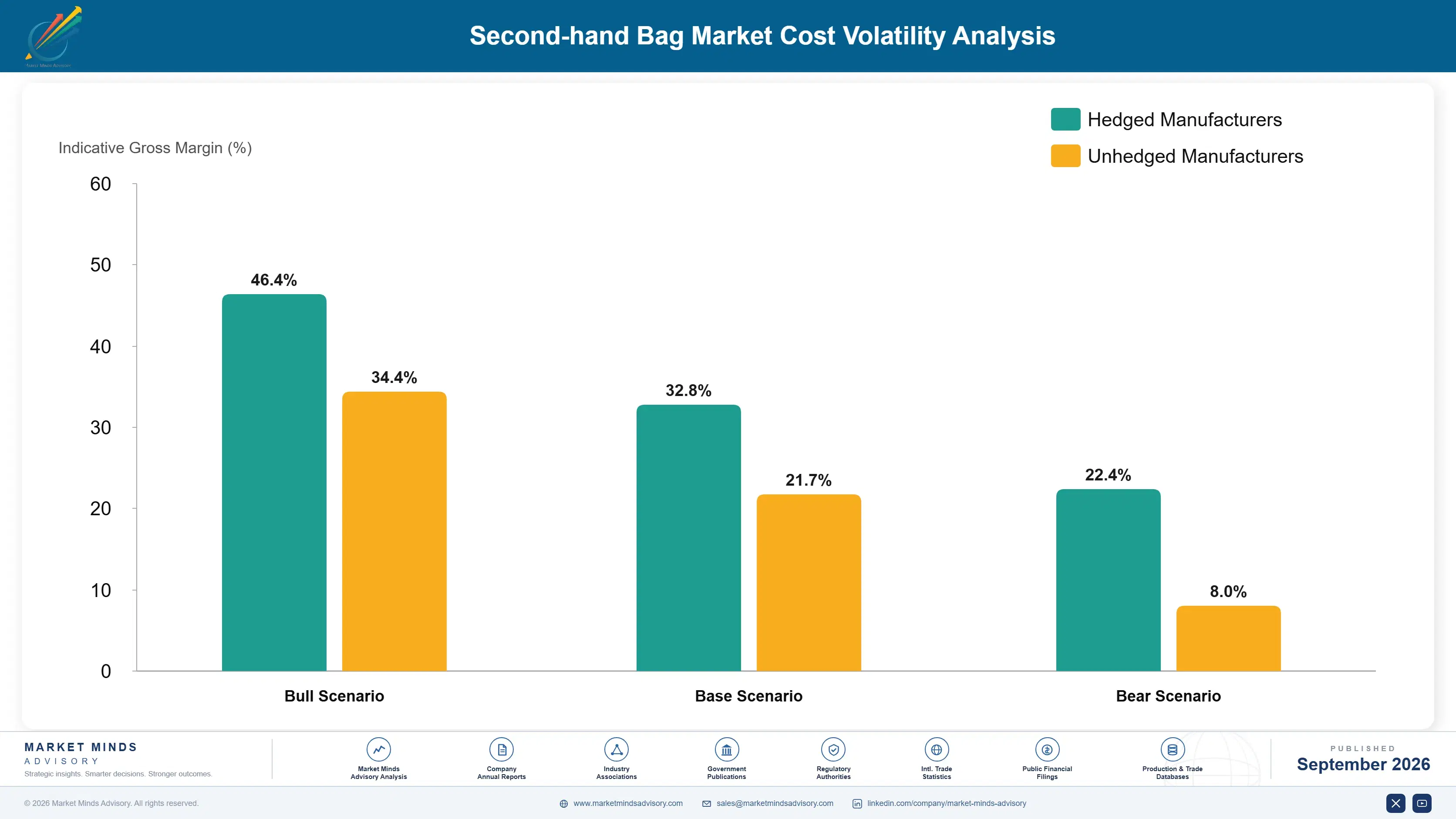
Consignor acquisition and authentication labor together represent the largest operating cost inputs for resale platforms, running roughly 35% to 45% of total cost of goods sold depending on service tier mix and item value distribution across the catalog. Authentication cost concentrates in specialist labor and equipment sourced primarily from developed markets with established expert networks and long-standing vendor relationships.
A notable volatility event occurred when a wave of increasingly sophisticated counterfeit handbags briefly disrupted buyer confidence across several major platforms in 2024, according to industry trade body reporting on secondhand luxury goods authentication standards and detection accuracy across the sector, forcing operators to accelerate investment in updated detection technology and add manual review steps that temporarily slowed consignor turnaround times industry-wide for several months running.

Smaller platforms face disproportionate cost exposure here, since they lack the transaction volume needed to amortize authentication technology investment as efficiently as larger, better-capitalized competitors can across a full operating year. This creates a genuine competitive disadvantage for independents that cannot match the detection accuracy of platforms with dedicated in-house verification infrastructure and specialist staff across multiple regional markets simultaneously.
second-hand-bag-market-cost-volatility-analysis-1790023835012

Diversify Authentication Vendor Relationships

Working with multiple authentication technology vendors rather than a single provider reduces dependency risk and lets platforms compare detection accuracy across competing systems side by side under real transaction conditions and varied item categories, improving overall verification reliability while limiting exposure to any one vendor's pricing power over time and across contract renewal cycles each year without exception.

Build In-House Expert Authentication Teams

Training dedicated in-house authentication specialists reduces reliance on third-party verification services over time, lowering per-item cost once initial training investment is recovered and giving platforms tighter control over turnaround speed, quality consistency, and consignor satisfaction across regions and item categories over the long run and well beyond the initial rollout period across every service tier.

Negotiate Volume-Based Technology Licensing

Larger platforms increasingly negotiate volume-based licensing terms with authentication technology vendors, locking in lower per-transaction costs as verification volume scales upward steadily year over year and across every major regional market served, a mitigation smaller operators can only partially access through consortium-style shared licensing arrangements negotiated collectively with regional peers and smaller competing platforms.

Portfolio Architecture for Margin Defence

Portfolio economics split across three tiers by authentication depth and item scarcity rather than simple price point, since a mid-priced bag with complex provenance can command margins rivaling far pricier standard items sold at full retail price. Volume-tier consignment carries thin per-item margins offset by high transaction counts across most mainstream listings, a pattern consistent across nearly every platform in the category regardless of scale or geography.
Premium and certified tiers carry meaningfully higher take rates justified by authentication complexity and buyer willingness to pay for verified provenance, creating real tension with volume-tier economics that depend on transaction speed rather than per-item margin to sustain overall profitability. Platforms increasingly segment operations internally to serve both models without compromising either, building distinct workflows, staffing models, and turnaround expectations for each tier's specific requirements.

High-value margin pools concentrate in vintage and collectible authentication services, where specialist expertise commands premium consignment fees unmatched anywhere else in the category, well above what standard current-season handbag listings can support even at meaningfully higher volume across comparable transaction counts and price points throughout the year and across every major consignment platform operating today.

Volume / Commodity-Adjacent Tier

Standard current-season handbags with routine authentication, competing mainly on price and turnaround speed, targeting buyers seeking recognizable brands without scarcity premiums or specialist provenance documentation attached to the listing at any point.
Gross Margin: 18%-26%

Premium / Certified Tier

Verified premium bags with documented condition grading and enhanced authentication depth, targeting buyers seeking measurable quality assurance beyond basic listing verification available on standard consignment marketplaces broadly and consistently across nearly every category.
Gross Margin: 34%-44%

Sustainability / Regulatory / Next-Generation Tier

Vintage, collectible, and blockchain-provenance-tracked bags meeting the highest authentication and traceability standards available anywhere in the category, targeting affluent collectors and export-oriented buyers seeking maximum confidence in scarce or discontinued pieces available today.
Gross Margin: 40%-52%
second-hand-bag-market-portfolio-architecture-1790023835507

High-value Sub-segments and Strategic Watch-out

Blockchain-Verified Vintage Collectibles

Vintage bags with blockchain-tracked provenance command the highest margins in the category as collectors pay substantial premiums for tamper-proof authentication records, representing the fastest-growing high-value niche within the broader premium tier and drawing significant platform investment from every major operator in the resale space today.
Gross Margin: 44%-52%

Concierge Premium Handbag Consignment

White-glove consignment service for premium current-season bags commands strong margins through personalized service and faster turnaround, generating solid per-unit value with steady growth as platforms expand concierge offerings to retain their most valuable, highest-volume consignors over time and across nearly every major regional market and service category.
Gross Margin: 36%-44%

Standard Current-Season Bag Listings

The largest transaction-volume segment by far, standard listings generate steady platform revenue at thinner per-item margins, forming the foundation of category economics even as growth concentrates in higher-margin premium and vintage tiers positioned well above this core volume segment across nearly every platform operating today.
Gross Margin: 20%-28%

Counterfeit Detection Cost Escalation

Rising counterfeit sophistication represents a genuine strategic watch-out for the entire category, since sustained detection technology investment could compress platform margins meaningfully if smaller operators cannot keep pace with authentication accuracy standards that larger, better-funded competitors maintain consistently across every major market and service tier.
Gross Margin: N/A

Repeat Consignment Economics Across Buyer Tiers

Resale handbag platforms increasingly capture annuity-like revenue as consignors return to list multiple items across a wardrobe refresh cycle rather than transacting once, generating steadier platform revenue than a single-purchase model would provide, with repeat consignors contributing a growing share of total transaction volume each year across nearly every major platform operating in the category today and expanding steadily.
Adoption depth varies sharply by end-use vertical: collectors of vintage and rare pieces engage most deeply, often listing and buying repeatedly within a single calendar year, while casual sellers of current-season bags transact only occasionally when refreshing a wardrobe once or twice annually. Corporate and institutional consignors, including estate liquidators, sit between these extremes, contributing large, infrequent batches rather than steady individual listings spread evenly across the calendar year.

Generational buyer shifts favor digital-native younger consignors who treat resale listing as routine rather than exceptional, contrasting with older sellers who often require more guidance through the authentication and listing process before completing a transaction successfully. This split is gradually reshaping how platforms design onboarding and customer support across different age cohorts and service expectations going forward.
second-hand-bag-market-end-use-penetration-index-1790023836003

Where Resale Platforms Should Place Bets

These are among the four positions where our research anticipates prominent divergence between winners and laggards over the coming forecast period. Each is grounded in the demand model, the regulatory perimeter, and the announced capacity pipeline.
01 / AUTHENTICATION INFRASTRUCTURE PRIORITY

Invest early in proprietary authentication technology and expertise

Authentication accuracy is becoming the category's defining competitive moat, and platforms that build proprietary detection capability now will hold a meaningful edge as counterfeit sophistication continues escalating across every major market and price tier over the coming years. Waiting to react after a trust-damaging incident costs far more than proactive investment, both in direct remediation spend and in permanently lost consignor confidence. Smaller operators should seriously consider consortium-style shared authentication infrastructure rather than attempting to build proprietary capability entirely alone.
02 / BRAND PARTNERSHIP DEVELOPMENT

Pursue trade-in and provenance data partnerships with luxury houses directly

Independent platforms that establish formal partnerships with luxury brands, rather than competing directly against brand-operated resale channels, gain access to original product data and authentication records that materially improve verification speed and accuracy for consignors and buyers alike across every major transaction category and price tier. This positioning also reduces the existential risk that brand-operated channels eventually capture the highest-value consignment supply entirely. Platforms without such partnerships risk being left competing only for lower-margin volume transactions over the long run.
03 / CONSIGNOR PAYOUT SPEED

Shorten payout cycles to compete for higher-value consignment listings

Payout delay remains an underappreciated source of consignor attrition, particularly among sellers listing higher-value items who face real opportunity cost while capital sits with the platform rather than in their own account. Operators that invest in instant-payout infrastructure, even at modest fee cost, will likely capture disproportionate share of high-value listings as this becomes an expected baseline service rather than a differentiator over time. This shift favors platforms with stronger balance sheets able to fund the underlying financing arrangement at meaningful scale.
04 / CROSS-BORDER EXPANSION FOCUS

Prioritize South Asia and Pacific and East Asia for expansion

Growth is concentrating disproportionately in South Asia and Pacific and East Asia relative to the more mature North American and Western European markets, driven respectively by first-time luxury buyers and decades-old secondhand culture built over many years. Platforms that delay regional expansion risk ceding these high-growth markets to domestic operators with stronger local trust and cultural fluency already in place. Early infrastructure investment in authentication hubs across these regions will compound into durable advantage over the next decade and beyond.

Engagement Snapshot From the Field

A live engagement with an industry participant carrying material or product regulatory and market exposure ahead of a defining policy shift, showing how our research translates into a defensible multi-year portfolio strategy.
MARKET MINDS ADVISORY · CLIENT ENGAGEMENT SUMMARY
Second-hand Bag Producer Strategic Portfolio Review and Transition Roadmap 2026·Investment Scenario on Second-hand Bag Exposure Evaluation 2025-26
CLIENT PROFILE
The client is a mid-sized independent resale platform specializing in premium and vintage handbag consignment, operating primarily in North America with a smaller European presence. Revenue growth had slowed as larger, better-capitalized competitors expanded authentication infrastructure faster, prompting leadership to seek an outside assessment of where to focus limited capital for the greatest competitive impact.
STRATEGIC CHALLENGE
Leadership needed to decide between investing in proprietary authentication technology or pursuing a brand partnership strategy to secure trade-in consignment pipelines, without clear visibility into which approach would generate stronger consignor retention and higher-value listing growth given the company's limited capital budget for the coming fiscal year and the one after that.
MMA APPROACH
MMA combined primary survey data across consignors and buyers with a competitive benchmarking exercise against the five largest platforms, isolating which authentication investments correlated most strongly with consignor retention and high-value listing growth over time. The team modeled both strategic paths against three-year capital requirements and projected consignor acquisition cost trajectories.
KEY FINDINGS
  1. Consignors citing authentication speed as their top platform concern grew from 18% to 34% of the surveyed base over eighteen months, survey data showed.
  2. Brand partnership pipelines showed 22% higher average consignor lifetime value than organic acquisition channels across the comparable platform competitive set overall today.
  3. Proprietary authentication technology investment showed a projected payback period of roughly twenty-two months given the client's current transaction volume and cost structure.
  4. Competitors with brand partnerships already in place captured 15% more high-value vintage listings than platforms relying solely on organic consignor acquisition channels.
CLIENT PROFILE
The client is a mid-sized independent resale platform specializing in premium and vintage handbag consignment, operating primarily in North America with a smaller European presence. Revenue growth had slowed as larger, better-capitalized competitors expanded authentication infrastructure faster, prompting leadership to seek an outside assessment of where to focus limited capital for the greatest competitive impact.
STRATEGIC CHALLENGE
Leadership needed to decide between investing in proprietary authentication technology or pursuing a brand partnership strategy to secure trade-in consignment pipelines, without clear visibility into which approach would generate stronger consignor retention and higher-value listing growth given the company's limited capital budget for the coming fiscal year and the one after that.
MMA APPROACH
MMA combined primary survey data across consignors and buyers with a competitive benchmarking exercise against the five largest platforms, isolating which authentication investments correlated most strongly with consignor retention and high-value listing growth over time. The team modeled both strategic paths against three-year capital requirements and projected consignor acquisition cost trajectories.
KEY FINDINGS
  1. Consignors citing authentication speed as their top platform concern grew from 18% to 34% of the surveyed base over eighteen months, survey data showed.
  2. Brand partnership pipelines showed 22% higher average consignor lifetime value than organic acquisition channels across the comparable platform competitive set overall today.
  3. Proprietary authentication technology investment showed a projected payback period of roughly twenty-two months given the client's current transaction volume and cost structure.
  4. Competitors with brand partnerships already in place captured 15% more high-value vintage listings than platforms relying solely on organic consignor acquisition channels.
RECOMMENDED STRATEGY
Phase 1: Phase one: pursue a pilot trade-in partnership with one mid-tier luxury brand willing to test the new model together first. Phase 2: Phase two: invest incrementally in proprietary authentication technology funded partly by partnership-driven volume growth achieved gradually over the following year. Phase 3: Phase three: expand successful brand partnerships to additional luxury houses while scaling authentication capacity and staffing levels accordingly each quarter.
OUTCOME
Within twelve months of launch, the pilot brand partnership generated (client-reported, unverified by MMA) a 19% increase in high-value consignment listings and meaningfully improved consignor retention scores. The client subsequently expanded the partnership model to two additional luxury houses while phasing in proprietary authentication upgrades funded by the added volume.

Frequently Asked Questions

Foundational context covering the market sizes, CAGR, scope, country, region and competition that inform every finding below. This section is provided to cover basics and most often pre-purchase conversations, answered from the MMA Primary Research Dataset.

What is the current size of the Second-hand Bag Market?

The Second-hand Bag Market was valued at 9.6 billion dollars in 2025. This figure reflects global consignment and marketplace transaction value across all platform types.

How large will the Second-hand Bag Market be by 2036?

The market is projected to reach 26.8 billion dollars by 2036. This represents nearly a 2.55 times expansion from 2026 value over the ten-year forecast period.

What is the CAGR for the Second-hand Bag Market 2026 to 2036?

The market is forecast to grow at a 9.8% compound annual rate between 2026 and 2036. Growth is faster in vintage and collectible segments than in standard current-season listings.

Which segment is growing fastest?

Vintage and Collectible Designer Bags are growing fastest, at a 13.5% CAGR. That is roughly 1.4 times the overall market average growth rate through the full 2036 forecast horizon.

Who are the major companies in the Second-hand Bag Market?

Major companies include The RealReal Inc, Vestiaire Collective SA, Fashionphile Group LLC, Rebag Inc, and Poshmark Inc. Together these five players hold a moderate but not dominant transaction share.

Which country is growing fastest?

Vietnam is the fastest-growing country market, expanding at a 14.2% CAGR. Rising middle-class wealth and expanding cross-border platform access are the primary growth drivers there.

Report Segmentation Architecture

The full report scope spans multiple orthogonal segmentation dimensions, with cross-tabulated demand data provided for each dimension pair. Coverage extends further to regional breakdowns, trend trajectories, and the competitive detail needed to support segment-level decision-making.

By Primary Market Dimension

  • Leather Luxury Handbags
  • Vintage and Collectible Designer Bags
  • Structured Totes and Satchels
  • Crossbody and Mini Bags
  • Canvas and Fabric Casual Bags
  • Backpacks and Travel Bags

By End-Use Industry

  • Fashion and Apparel Retail
  • Luxury Goods and Accessories
  • Estate and Liquidation Services
  • Online Marketplace Platforms

By Commercial Dimension

  • Consignment Platform
  • Peer-to-Peer Marketplace
  • Brand-Operated Trade-In
  • Physical Consignment Store

By Region

  • North America
  • Western Europe
  • East Asia
  • South Asia and Pacific
  • Latin America
  • Middle East and Africa
  • Eastern Europe

Scope, Methodology, and Coverage

Every figure in this report is reproducible from documented input assumptions. The scope below maps the historical period, the forecast horizon, the segmentation dimensions, and the countries covered, alongside the underlying primary and qualitative methodology.
Historical Period
2020 to 2025
Forecast Period
2026 to 2036
Base Year
2025 (USD billions; MMA Primary Research Dataset, September 2026)
Market Definition
The Second-hand Bag Market covers the resale of previously owned handbags, totes, and crossbody bags through consignment platforms, marketplaces, and authenticated resale channels globally. It excludes first-sale retail, rental services, and non-bag leather accessories such as wallets or belts.
Quantitative Units
USD billions (current prices); transaction volume in millions of items where applicable
Segmentation Dimensions
By Bag Type and Material; By End-Use Industry; By Commercial Dimension; By Region
Regions Covered
North America, Western Europe, East Asia, South Asia and Pacific, Latin America, Middle East and Africa, Eastern Europe
Countries Covered
USA, China, Germany, France, UK, Japan, South Korea, India, Australia, Canada, Brazil, Mexico, Indonesia, Vietnam, Thailand, Malaysia, UAE, Saudi Arabia, South Africa, Nigeria, Turkey, Poland, Netherlands, Italy, Spain, Sweden, Switzerland, Argentina, Colombia, Singapore, and additional markets relevant to this sector
Key Companies Profiled
The RealReal Inc, Vestiaire Collective SA, Fashionphile Group LLC, Rebag Inc, Poshmark Inc, ThredUp Inc, Depop Ltd, Vinted UAB, StockX LLC, Tradesy Inc, Rebelle GmbH, Hardly Ever Worn It Ltd, Luxury Garage Sale Inc, What Goes Around Comes Around LLC, Malleries Inc, Sellier Inc, Bagista Inc, Komehyo Co Ltd, Brand Off Co Ltd, Cachet Group Inc
Quantitative Methodology
Primary survey, n=3,800 respondents, Q4 2025, six countries; demand-side model with trade association cross-validation
Qualitative Methodology
47 expert interviews, Q4 2025; applied to validate demand model assumptions, identify emerging dynamics, and assess competitive positioning
Report Format
PDF and XLSX data workbook (Word format preview document)
Publisher
Market Minds Advisory
Report Code
MMA-2026-CON-205
Published
September 2026
Contact
sales@marketmindsadvisory.com | www.marketmindsadvisory.com

Purchase the full Second-hand Bag Market Report (2026 to 2036).

This report provides a comprehensive assessment of the global Second-hand Bag Market, covering market sizing, segmentation, regional dynamics, and competitive positioning through 2036. It draws on primary survey data across 3,800 respondents in six countries and 47 expert interviews conducted in Q4 2025, combined with company disclosures and MMA proprietary analysis across every major platform in the category. The report is designed to support strategic decisions on platform investment, brand partnership strategy, and competitive positioning across the forecast period. Readers gain a clear view of where margin pools concentrate and how authentication economics are likely to shift.
Detailed segmentation by bag type and material
Seven-region market sizing with growth forecasts
Competitive benchmarking of twenty leading platforms
Authentication cost and consignor economics analysis
Revenue lever and take-rate expansion strategies
Anonymized client case study with outcomes

Built For The People Who Decide

From boardroom strategy to bench-side execution, this report is read cover-to-cover by leaders shaping the next decade of their industry, turning demand scenarios, market dynamics and valuation benchmarks into decisions.
CXOs/ Presidents/ VPs/ Managers
M&A and Corporate Development
Strategy Teams and R&D Heads
Procurement and Product Directors
Regulatory and Compliance Leaders
Investor Relations and Equity Analysts