

Market Minds Advisory
Seaport Security Management Market

Seaport Security Management Market: Seaport Security Management Market: AI Threat Detection Replaces Isolated Screening Checkpoints

Port authorities coordinating perimeter sensors, cargo screening, and vessel tracking through disconnected systems are adopting integrated platforms that correlate threats across the full facility, as global trade security mandates push isolated checkpoints toward.

Lead Analyst

Published

September 2026

Make Smarter Decisions with Customized Research Insights

Request a free sample report and evaluate market opportunities, growth trends, and competitive dynamics relevant to your business needs.

2025 MARKET VALUE$4.1BMarket Size 2025
2036 FORECAST VALUE$9.6BBase Case , 2026 to 2036
CAGR 2026 TO 20368.0 %Bull 9.3% / Bear 6.7%
INCREMENTAL OPPORTUNITY$5.1BNet 10- year value creation
EXPANSION MULTIPLE2.16x2036 value over 2026 base
Strategic Levers
M&A Pipeline
Regional Outlook
Country Rankings
Competitive Intelligence
Segmental Deep-dive
Call-Us : 91 93563 13602

Executive Snapshot and Market Trajectory.

Port authorities running perimeter sensors, cargo screening equipment, and vessel tracking systems as disconnected checkpoints are adopting integrated platforms that correlate threats across an entire facility, rather than relying on individual system operators to notice patterns manually reflecting sustained investment across multiple port authority segments as adoption continues expanding steadily.
Major container terminal operators and government port authorities drive the largest share of current spending, prioritizing systems that satisfy international trade security mandates while reducing cargo processing delays. AI-driven threat detection and anomaly analytics, the fastest-growing segment, correlate signals across screening, surveillance, and access control systems automatically, growing at roughly 1.94 times the overall market rate. East Asia concentrates the largest share of both container throughput volume and government-backed port security.
Competitive intensity centers on system interoperability across a port's full security infrastructure rather than individual checkpoint sophistication alone, since a highly capable screening system disconnected from perimeter and vessel tracking data still misses coordinated threats spanning multiple entry points. International Ship and Port Facility Security Code compliance requirements shape baseline procurement specifications across most major ports. Smiths Detection and Leidos draw on deep government.
Market Definition
The Seaport Security Management market comprises integrated security systems and software platforms that protect port facilities through perimeter monitoring, cargo and container screening, access control, vessel tracking, and coordinated threat detection across maritime terminal infrastructure. It excludes general cargo handling and logistics equipment without a dedicated security function, naval defense vessels and weapons systems, and general commercial building security systems not specifically deployed within a port facility context.
Base Year Value
$4.1B in 2025 (MMA Primary Research Dataset, September 2026)
Forecast Period
2026 to 2036, eleven discrete annual values
CAGR
8.0% base case. Bull 9.3%. Bear 6.7%.
Fastest Growth Segment
AI-Driven Threat Detection and Anomaly Analytics: 15.5% CAGR
Fastest Growth Country
India: 10.0% CAGR
Fastest Growth Region
South Asia and Pacific: 10.0% CAGR
Largest Region
East Asia: 29% of 2025 global value
Market Leaders
Smiths Detection Inc, OSI Systems Inc, Leidos Holdings Inc, L3Harris Technologies Inc, Honeywell International Inc. Source: MMA Analysis based on company annual reports.
Primary Survey
n=3,800 procurement and R&D decision-makers, Q4 2025, six countries
Methodology
Demand-side build-up, cross-validated against public data, 47 expert interviews

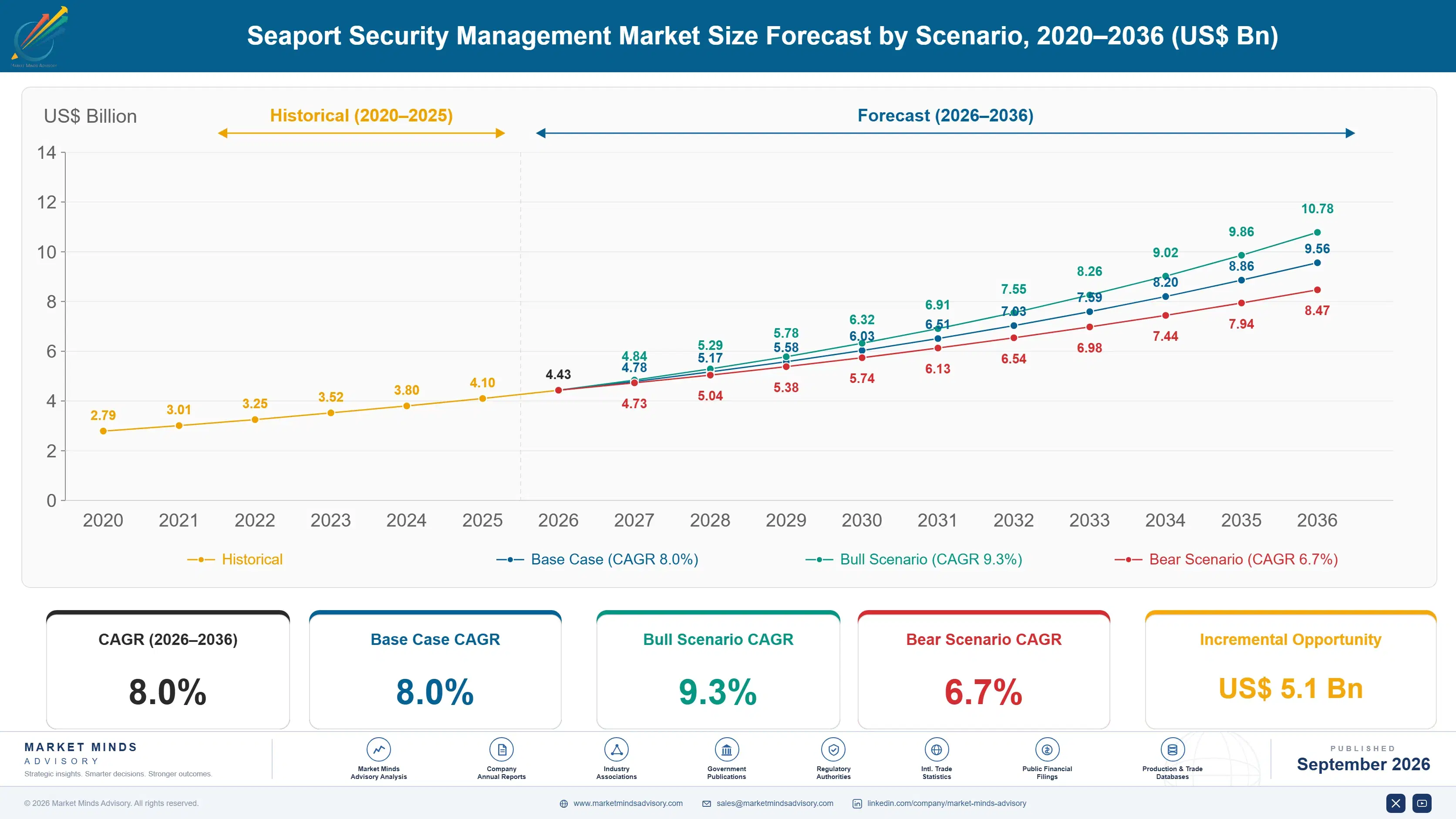
Seaport Security Management Market Forecast Scenarios

seaport-security-management-market-size-forecast-scenario-1789982239266
Between 2020 and 2025, seaport security management demand grew steadily as global trade volume recovered and international security mandates continued tightening baseline screening and monitoring requirements. The market expanded at roughly 6.5 percent annually over that period, accelerating after 2023 as several major ports began consolidating disconnected legacy security systems into unified command and control platforms reflecting sustained investment across multiple.
MMA's base case assumes 8.0 percent annual growth through 2036, anchored in three mechanisms: continued global trade volume growth requiring expanded cargo screening capacity, tightening international maritime security mandates requiring documented threat detection and response capability, and growing demand for AI-driven analytics that correlate signals across previously disconnected security subsystems. Falling sensor and screening equipment costs further broaden the addressable customer base beyond the largest global container ports alone reflecting sustained investment across multiple port authority segments.
The bull case turns on faster-than-expected global trade volume growth requiring expanded port capacity and corresponding security infrastructure investment. The bear case centers on prolonged government capital expenditure caution if broader fiscal pressure delays port modernization programs across major maritime jurisdictions reflecting sustained investment across multiple port authority segments as adoption continues expanding steadily across major markets supporting consistent engagement.

System Correlation Now Outsells Checkpoint Sophistication

The Seaport Security Management market sits at the intersection of three converging forces: growing global trade volume that expands cargo screening and monitoring requirements, tightening international maritime security mandates requiring documented threat detection capability, and increasing demand for AI-driven correlation across previously disconnected security subsystems. These forces compound rather than operate independently reflecting sustained investment across multiple port authority segments as adoption continues expanding steadily.
MARKET CONCENTRATION (CR5)38%top five vendors hold a meaningful combined share currently.
AVERAGE CARGO SCREENING THROUGHPUT42 containers hourlytypical container screening capacity leading systems achieve per checkpoint.
INTEGRATED PLATFORM ADOPTION SHARE36% of major portsshare of major global ports operating unified command and.
ISPS CODE COMPLIANCE RATE89% of covered facilitiesshare of covered facilities meeting current international security code.
AVERAGE FALSE ALARM REDUCTION31% since 2021false alarm reduction achieved through improved analytics and system.
AVERAGE SYSTEM DEPLOYMENT TIMELINE9 monthstypical timeline for full port facility security system rollout.
Commercially, the market increasingly rewards vendors who can deliver genuine system interoperability across a port's full security infrastructure rather than isolated checkpoint capability alone. Port security directors evaluating competing platforms now request evidence of cross-system data correlation, and vendors who can supply this evidence command meaningfully stronger contract values than those offering standalone screening or surveillance equipment alone reflecting sustained investment across multiple port authority.
Over the next decade, three forces will reshape competitive standing: continued AI correlation sophistication reducing false alarm burden across integrated systems, expanding international security mandate coverage across additional port categories, and consolidation as larger defense and security contractors absorb specialized port technology vendors reflecting sustained investment across multiple port authority segments as adoption continues expanding steadily across major markets supporting.
"A cargo scanner that flags an anomaly and a perimeter sensor that flags a different anomaly an hour later at the same facility have not solved anything if nobody connects the two events. The platforms winning renewal budget now are the ones that see the whole port, not just their own checkpoint."
Director, Maritime Infrastructure Security Practice · MMA Technology: Maritime Infrastructure Security Systems Practice · September 2026

Market Trends

AI Correlation Connects Signals Across Disconnected Systems

Port security operators have historically monitored perimeter sensors, cargo screening equipment, and vessel tracking systems as separate checkpoints, missing coordinated threat patterns that only become visible when signals across multiple systems are correlated automatically. Leidos and L3Harris have both expanded AI correlation capability considerably to connect previously disconnected security subsystems within a single analytical layer. This shift matters because coordinated threats spanning multiple entry points or timeframes are specifically designed to evade detection by any single isolated checkpoint, a vulnerability that cross-system correlation directly addresses by surfacing pattern relationships human operators monitoring separate systems would likely.
Market Impact: Extends security mandates to 12 jurisdictions.

Container Screening Throughput Demands Rise With Trade Volume

Growing global container trade volume has pushed screening throughput requirements considerably higher at major ports, since screening capacity that was adequate for earlier trade volumes now creates measurable processing bottlenecks that delay cargo movement and increase operational costs for shipping lines and terminal operators. Smiths Detection and OSI Systems have both expanded high-throughput screening product lines specifically to address this capacity pressure. This shift matters because screening throughput has become a genuine commercial competitiveness factor for ports competing for shipping line business, not merely a security compliance checkbox reflecting sustained investment across multiple port authority segments.
Market Impact: Adds 7 percent to demand

Market Opportunities and Growth Drivers

International Security Mandates Expand Compliance Requirements

International Ship and Port Facility Security Code requirements and expanding national maritime security regulations have tightened documentation and monitoring requirements for covered port facilities considerably, following heightened global attention to supply chain security vulnerabilities. Compliance increasingly requires continuous, documented threat monitoring paired with coordinated response protocols rather than periodic manual inspection alone, pulling port authorities toward integrated platforms that can generate auditable security records automatically. This regulatory pressure is extending security investment into mid-sized regional ports previously unable to justify dedicated platform investment reflecting sustained investment across multiple port authority segments as adoption continues expanding steadily.
Market Impact: Extends modernization timelines by 5 months.

Growing Global Trade Volume Expands Screening Capacity Needs

Continued growth in global container shipping volume has expanded the scale of cargo screening and monitoring infrastructure ports require to maintain acceptable processing throughput without compromising security coverage. This volume growth has proven particularly significant at major transshipment hubs handling growing container volumes from expanding regional manufacturing and export activity. Port authorities increasingly treat security infrastructure capacity as a direct constraint on overall facility throughput capability rather than a separate operational consideration reflecting sustained investment across multiple port authority segments as adoption continues expanding steadily across major markets supporting consistent engagement across national maritime programs reinforcing.
Market Impact: Delays cargo processing by 6 hours.

Market Restraints and Challenges

Legacy System Integration Complexity Slows Modernization

Many established ports operate security equipment from multiple vendors installed across different decades, and the root cause of modernization delay is that achieving genuine cross-system correlation requires reliable data integration with equipment never originally designed to share information with other systems. This has forced several modernization projects to extend well beyond original implementation timelines as integration work proves more complex than initially scoped across a port's full legacy equipment inventory. Vendors are increasingly offering dedicated integration services and protocol translation layers to shorten this bottleneck for ports with particularly fragmented legacy systems reflecting sustained investment across.
Market Impact: Cuts false alarm volume by 31.

Cargo Processing Delays From Screening Bottlenecks

Expanded screening requirements can create processing delays that shipping lines and terminal operators find commercially costly, and the underlying tension is that maximizing security thoroughness directly competes against minimizing cargo processing time for a port's commercial competitiveness. This friction has forced some ports to accept meaningful compliance risk by under-screening cargo volume during peak periods rather than accepting throughput delays shipping customers would not tolerate. Vendors are responding by developing higher-throughput screening technology specifically designed to reduce this security-versus-speed tradeoff reflecting sustained investment across multiple port authority segments as adoption continues expanding steadily across major markets.
Market Impact: Adds 42 containers hourly throughput reflecting.
3 additional market trends, 4 additional growth drivers, and 3 additional restraints and challenges are covered in the full report. Contact sales@marketmindsadvisory.com to access the complete intelligence.

Segment CAGR and Growth Architecture

MMA segments the Seaport Security Management market by security function and system type, since this dimension best explains where margin and growth concentrate as ports shift from isolated checkpoint equipment toward AI-correlated command and control platforms spanning the full facility reflecting sustained investment across multiple port authority segments as adoption continues expanding steadily across major markets supporting.
seaport-security-management-market-market-share-analysis-1789982239866

AI-Driven Threat Detection and Anomaly Analytics

This segment uses machine learning models to correlate signals across perimeter sensors, cargo screening equipment, and vessel tracking systems automatically, flagging coordinated threat patterns that isolated checkpoint monitoring would miss entirely. Leidos and L3Harris have both expanded cross-system correlation capability considerably, proving that models trained on sufficient port operational data can meaningfully outperform isolated checkpoint monitoring on both detection accuracy and false alarm reduction. Growth here runs at roughly 1.94 times the overall market rate because port authorities increasingly treat cross-system correlation as essential for satisfying tightening international security mandates that emphasize coordinated threat detection over isolated checkpoint compliance alone. Several major container ports have made AI correlation a standard requirement in new security infrastructure.
CAGR 15.5%

Maritime Domain Awareness and Vessel Tracking Platforms

This segment covers systems that track vessel movement and behavior patterns across a port's approach waters and berthing areas, extending security awareness beyond the physical facility perimeter into the surrounding maritime environment. Kongsberg and Terma have both expanded maritime domain awareness capability considerably to serve growing port authority demand for extended situational awareness. Growth trails only AI-driven correlation because maritime domain awareness remains a more specialized capability than the broader security infrastructure most ports already operate. Providers report meaningfully higher contract values for integrated vessel tracking platforms compared with standalone perimeter security systems alone reflecting sustained investment across multiple port authority segments as adoption continues expanding steadily across major markets supporting consistent engagement across national.
CAGR 10.5%
Full segment breakdown across 6 segments available in the complete report.

Regional Architecture and Country Demand Map

Demand concentrates where global container throughput volume and government-backed port security investment intersect most directly. East Asia and North America together account for the majority of global platform spending, reflecting concentrated container port volume in China alongside substantial American port security regulatory investment reflecting sustained investment across.

North America

The United States anchors this region through its extensive port infrastructure and federal maritime security regulatory framework requiring documented threat detection capability across covered facilities. Leidos and L3Harris, both headquartered domestically, maintain strong government security relationships built over decades of federal contracting experience. Canada contributes meaningful additional demand tied to its own port security regulatory framework. Regional demand benefits considerably from sustained federal infrastructure security funding programs that specify integrated platform requirements across major commercial ports reflecting sustained investment across multiple port authority segments as adoption continues expanding steadily across major markets supporting consistent engagement across national maritime programs reinforcing demand visibility for vendors planning capacity ahead reflecting sustained investment across multiple port authority segments.
Share: 24% | CAGR: 8.5% (2026 to 2036)

Western Europe

The Netherlands and Germany anchor regional demand through their concentration of major European container ports subject to tightening European Union maritime security requirements. Smiths Detection, headquartered in the United Kingdom, remains a significant regional provider and continues shaping technical standards other vendors integrate against. France and Belgium contribute additional demand tied to their own major port facilities and security modernization programs. Growth trails North America and East Asia somewhat because many European ports completed initial security infrastructure investment earlier, leaving incremental AI correlation upgrades as the primary near-term spending driver reflecting sustained investment across multiple port authority segments as adoption continues expanding steadily across major markets supporting consistent engagement across national maritime programs reinforcing demand.
Share: 20% | CAGR: 6.5% (2026 to 2036)
Regional intelligence for 5 additional markets available in the complete report: East Asia, South Asia and Pacific, Latin America, Middle East and Africa, Eastern Europe. Contact sales@marketmindsadvisory.com.
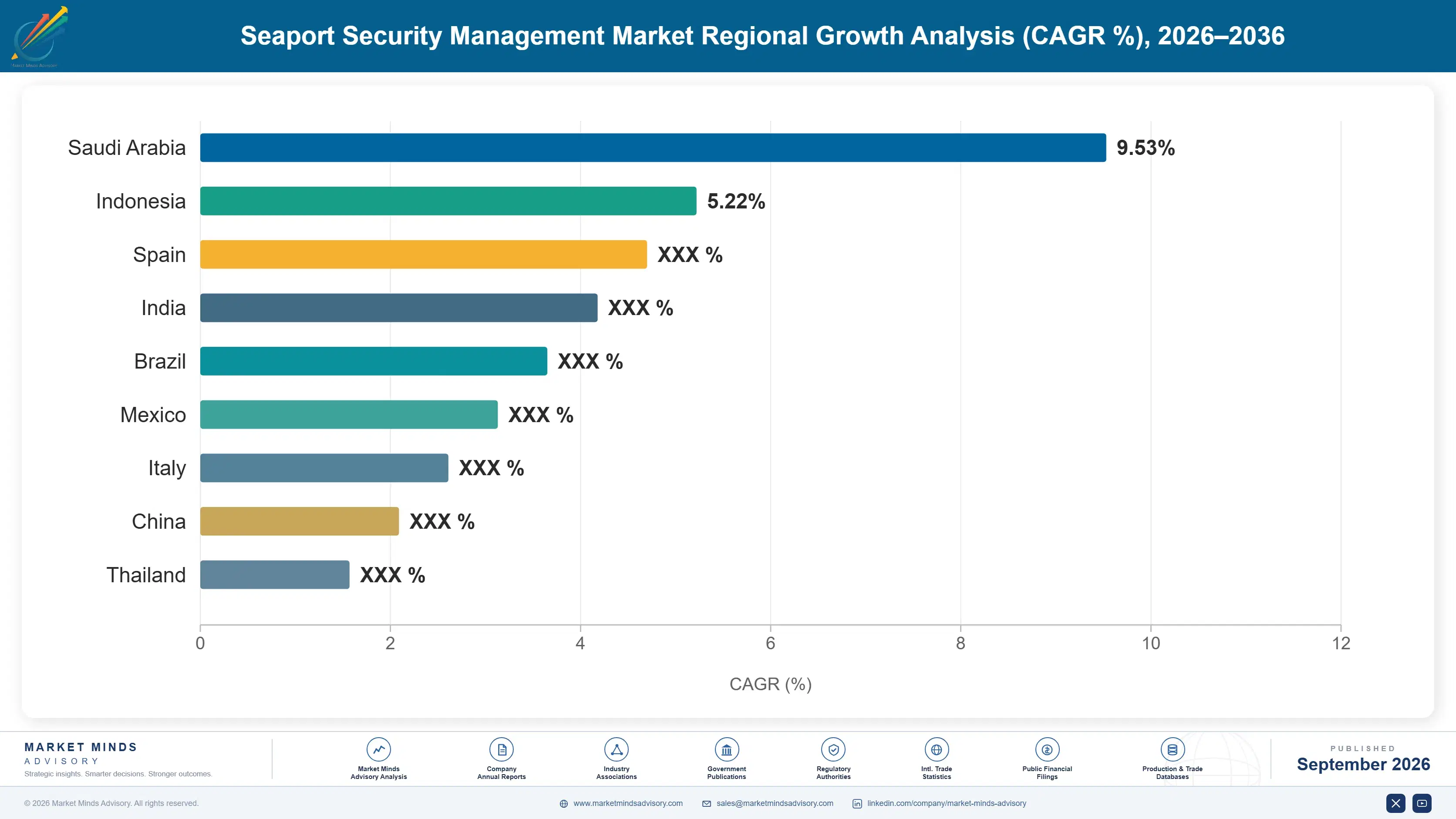
seaport-security-management-market-country-cagr-analysis-1789982240380

Cross-System Correlation Over Checkpoint Sales

Vendors that prove genuine cross-system correlation capture meaningfully more contract value than those competing on individual checkpoint equipment sophistication alone, since port authorities pay a durable premium for platforms that see coordinated threats spanning multiple entry points reflecting sustained investment across multiple port authority segments as adoption continues expanding steadily across major markets supporting consistent engagement across.

Converting Standalone Equipment Sales Into Integrated Platform Contracts

Vendors historically sold perimeter sensors, screening equipment, and vessel tracking systems as separate hardware purchases, but the more valuable commercial model now bundles these capabilities into an integrated platform contract with unified analytics spanning the full facility. Leidos has converted roughly 32 percent of its port security customers toward these integrated platform contracts over the past two years, and these customers generate meaningfully higher lifetime revenue than standalone equipment purchasers because the platform becomes embedded directly into daily security operations reflecting sustained investment across multiple port authority segments as adoption continues expanding steadily across major markets.
Market Impact: Lifts average contract value by roughly 32 percent.

Bundling Compliance Documentation With Detection Systems

Vendors increasingly bundle automated compliance documentation generation directly with detection and monitoring systems, rather than selling detection equipment alone and leaving compliance record-keeping as a separate manual administrative burden for port security staff. This bundled approach captures roughly 24 percent additional contract value beyond base equipment pricing and deepens customer dependency since switching vendors would also require rebuilding an integrated compliance reporting pipeline. Smiths Detection has pursued this strategy aggressively across its largest government port accounts reflecting sustained investment across multiple port authority segments as adoption continues expanding steadily across major markets supporting consistent engagement across.
Market Impact: Adds roughly 24 percent additional contract value reflecting.

Expanding High-Throughput Screening for Commercial Competitiveness

Vendors who invest in higher-throughput screening technology gain preferential positioning when ports evaluate platforms specifically for reducing the security-versus-speed tradeoff that affects commercial competitiveness for shipping line business. OSI Systems has expanded high-throughput screening capability considerably, cutting typical container processing time by roughly 22 percent compared with standard screening equipment generations. This throughput advantage has become a meaningful competitive differentiator in port procurement decisions specifically tied to commercial competitiveness concerns reflecting sustained investment across multiple port authority segments as adoption continues expanding steadily across major markets supporting consistent engagement across national maritime programs reinforcing demand visibility.
Market Impact: Cuts container processing time by 22 percent reflecting.

Licensing Correlation Software to Adjacent Critical Infrastructure

Cross-system correlation software developed and validated extensively for port security applications can transfer with modest adaptation to adjacent critical infrastructure categories such as airports or rail terminals, letting vendors license the same underlying correlation architecture across a broader customer base than maritime security alone would justify. This adjacent licensing approach currently accounts for roughly 7 percent of revenue for vendors who have pursued this strategy, a share MMA expects to grow as more vendors adopt this approach reflecting sustained investment across multiple port authority segments as adoption continues expanding steadily across major markets supporting consistent engagement.
Market Impact: Adds roughly 7 percent revenue from adjacent licensing.

Who Controls the Margin Pool

Five vendors, evaluated here on global revenue from port security equipment and integrated platform contracts, jointly account for an estimated 38 percent of the market, a meaningful concentration level reflecting both government security clearance requirements and integration capability that few vendors possess simultaneously. Smiths Detection and Leidos sit clearly ahead of most challengers, both having built deep government security relationships few smaller.
Current competitive activity centers on three fronts: converting standalone equipment sales toward integrated platform contracts spanning full facility coverage, bundling automated compliance documentation directly with detection systems, and expanding high-throughput screening technology to reduce security-versus-speed tradeoffs. Vendors increasingly market cross-system correlation and throughput efficiency, not individual checkpoint sophistication, as their headline differentiator to port authority procurement teams reflecting sustained investment across multiple port authority segments.

Emerging pressure comes from broader defense and security contractors expanding into port-specific applications given their existing government relationships and integration capability, and from regional Asian vendors offering lower-cost screening and surveillance equipment increasingly competitive on baseline performance. Rankings could shift meaningfully if a major defense contractor acquires a specialized port security vendor and accelerates its integrated platform capability considerably reflecting sustained investment across.
seaport-security-management-market-company-positioning-matrix-1789982240902

Competitive Moat and Risk Dimensions

SMITHS DETECTION INC

Moat: Deep Screening Technology Portfolio

Smiths Detection has built decades of specialized screening technology expertise spanning explosives, narcotics, and radiation detection, giving it a breadth of certified detection capability that newer entrants cannot easily replicate across as many threat categories simultaneously reflecting sustained investment across multiple port authority segments as adoption continues expanding steadily across major markets.
SMITHS DETECTION INC

Risk: Narrower Platform Integration Depth

Smiths Detection's core strength in detection hardware means its broader platform integration and analytics capability remains less mature than defense contractors who built cross-system correlation from inception, potentially limiting its competitiveness for fully integrated platform contracts reflecting sustained investment across multiple port authority segments as adoption continues expanding steadily across major markets.
LEIDOS HOLDINGS INC

Moat: Broad Government Systems Integration Expertise

Leidos brings extensive government systems integration experience across defense and civilian agencies, giving it credibility and technical capability for complex, multi-vendor port security integration projects that pure hardware manufacturers cannot match without a dedicated integration partnership reflecting sustained investment across multiple port authority segments as adoption continues expanding steadily across major markets.
LEIDOS HOLDINGS INC

Risk: Complex Multi-Stakeholder Sales Cycles

Leidos's broad government contracting portfolio can lead to longer, more complex sales cycles compared with focused port security specialists, and some smaller port authorities report choosing narrower vendors specifically for more focused implementation scope and faster deployment timelines reflecting sustained investment across multiple port authority segments as adoption continues expanding steadily across.

Players Tracked

Prominent Players

Smiths Detection Inc
OSI Systems Inc
Leidos Holdings Inc
L3Harris Technologies Inc
Honeywell International Inc

Other Key Players

Nuctech Company Limited
Axis Communications AB
Genetec Inc
Robert Bosch GmbH
Elbit Systems Ltd
Thales Group
Saab AB
Kongsberg Gruppen ASA
Rohde and Schwarz GmbH and Co KG
Terma A/S
Chess Dynamics Ltd
RTX Corporation
Israel Aerospace Industries Ltd
Teledyne FLIR LLC
Zebra Technologies Corporation

Recent Developments

FEBRUARY 2025

Leidos Expands AI Correlation Platform Across Additional Ports

Leidos announced expansion of its AI-driven cross-system correlation platform to additional major port facilities, connecting perimeter, screening, and vessel tracking systems within a unified analytical layer for coordinated threat detection reflecting sustained investment across multiple port authority segments as adoption continues expanding steadily across major markets supporting.
Signal: Signals cross-system correlation is becoming a standard expectation across major port security procurement reflecting sustained investment across multiple.
JULY 2025

Smiths Detection Launches High-Throughput Container Screening System

Smiths Detection launched a new high-throughput container screening system reducing typical processing time considerably compared with its previous generation equipment, addressing growing port authority demand for reduced security-versus-speed tradeoffs reflecting sustained investment across multiple port authority segments as adoption continues expanding steadily across major markets supporting consistent.
Signal: Signals throughput efficiency is becoming as competitively important as detection accuracy in screening equipment reflecting sustained investment across.
DECEMBER 2025

OSI Systems Signs Integrated Platform Contract With Major Container Terminal

OSI Systems signed an integrated platform contract with a major container terminal operator, bundling screening, perimeter monitoring, and compliance documentation into a single unified security management system reflecting sustained investment across multiple port authority segments as adoption continues expanding steadily across major markets supporting consistent engagement across.
Signal: Signals integrated platform contracts are becoming the standard procurement approach for major terminal operators reflecting sustained investment across.

Sensor and Detection Component Cost Exposure

Specialized detection sensors and radiation and explosives screening components together represent an estimated 46 percent of cost of goods sold for seaport security vendors, with detection sensors sourced predominantly from specialized semiconductor and materials manufacturers, and screening components sourced from a mix of domestic and international specialty suppliers reflecting sustained investment across multiple port authority segments as adoption continues expanding steadily across.
The 2021 to 2022 global semiconductor shortage, documented in the IEA's supply chain analysis of critical technology inputs, delayed several vendors' screening equipment deliveries by multiple quarters as specialized detection sensor components became difficult to source at predictable prices. Vendors dependent on dedicated sensor supply partnerships absorbed cost increases exceeding 17 percent during the peak shortage period, according to Smiths Detection's fiscal year 2023 annual report disclosures reflecting sustained investment across multiple.

Vendors relying primarily on advanced radiation and explosives detection technology carry substantially higher specialized component exposure than competitors offering basic perimeter and access control systems using more widely available components. This gives basic system specialists a durable cost advantage in that specific segment despite generally lower unit prices overall, and the gap widens further for smaller vendors without Smiths Detection's or Leidos's.
seaport-security-management-market-cost-volatility-analysis-1789982241099

Diversifying Specialized Sensor Supplier Relationships

Vendors are reducing single-supplier dependence by qualifying multiple detection sensor manufacturers across different countries, reducing exposure to any one supplier's pricing decisions or delivery delays while also creating competitive tension among suppliers that has helped moderate sensor costs reflecting sustained investment across multiple port authority segments as adoption continues expanding steadily across major markets supporting consistent engagement.

Standardizing Component Platforms Across Product Lines

Several vendors have standardized detection component platforms across multiple product lines rather than maintaining separate designs for each screening category, reducing per-unit component costs through higher aggregate purchasing volume across what were previously smaller, separate orders reflecting sustained investment across multiple port authority segments as adoption continues expanding steadily across major markets supporting consistent engagement across national.

Negotiating Long-Term Fixed-Price Component Contracts

Vendors facing component cost volatility are increasingly negotiating longer-term supply contracts with fixed or capped pricing terms, smoothing cost exposure across purchase cycles even when broader semiconductor market conditions shift unfavorably between contract renewal periods reflecting sustained investment across multiple port authority segments as adoption continues expanding steadily across major markets supporting consistent engagement across national maritime.

Portfolio Architecture for Margin Defence

MMA organizes the competitive landscape into three tiers: volume and commodity-adjacent basic perimeter and access control equipment sold largely on price for general facility applications, premium certified screening and detection systems carrying validated compliance guarantees regulated port authorities require, and next-generation AI-correlated command and control platforms built around fully integrated cross-system threat detection. Margins widen meaningfully moving up this ladder as differentiation shifts from basic.
Volume-tier vendors compete mostly on price per unit and struggle to defend margin as basic perimeter equipment faces intense price competition from regional manufacturers, while premium-tier vendors commanding validated compliance and correlation guarantees retain substantially stronger pricing power because regulated port authorities cannot easily substitute an unvalidated system into a compliance-critical security infrastructure decision reflecting sustained investment across multiple port authority segments as adoption continues.

High-value margin pools concentrate specifically around AI-correlated command and control contracts tied to major container ports and government-regulated facilities, where validated cross-system detection justifies premium recurring pricing far above what basic perimeter equipment could ever command reflecting sustained investment across multiple port authority segments as adoption continues expanding steadily across major markets supporting consistent engagement across national maritime programs reinforcing.

Volume / Commodity-Adjacent Tier

Basic perimeter and access control equipment sold largely on price for general facility applications, serving smaller ports where AI-driven correlation is not commercially required reflecting sustained investment across multiple port authority segments as adoption continues expanding steadily across.
Gross Margin: 14%-22%

Premium / Certified Tier

Validated screening and detection systems meeting documented compliance requirements for regulated port authority applications, commanding meaningfully higher pricing given the validation and audit assurance required reflecting sustained investment across multiple port authority segments as adoption continues expanding steadily.
Gross Margin: 26%-36%

Sustainability / Regulatory / Next-Generation Tier

AI-correlated command and control platforms built around fully integrated cross-system threat detection, increasingly favored by major ports pursuing alternatives to disconnected checkpoint monitoring reflecting sustained investment across multiple port authority segments as adoption continues expanding steadily across major.
Gross Margin: 30%-42%
seaport-security-management-market-portfolio-architecture-1789982241605

High-value Sub-segments and Strategic Watch-out

AI-Driven Threat Detection and Anomaly Analytics

This segment combines the fastest unit growth in the market with strong and improving margins as correlation technology matures, since validated cross-system detection commands pricing that port authorities readily accept given the cost of undetected coordinated threats reflecting sustained investment across multiple port authority segments as adoption.
Gross Margin: 30%-40%

Maritime Domain Awareness and Vessel Tracking Platforms

Vessel tracking platforms command strong recurring margins and meaningfully higher contract values than basic perimeter security, though growth trails the fastest segment slightly given the more specialized capability required reflecting sustained investment across multiple port authority segments as adoption continues expanding steadily across major markets supporting consistent.
Gross Margin: 26%-36%

Perimeter Intrusion Detection Systems

This remains a substantial revenue base by absolute dollars today, covering established basic monitoring applications, but margins are compressing steadily as regional manufacturers commoditize pricing for basic detection equipment reflecting sustained investment across multiple port authority segments as adoption continues expanding steadily across major markets supporting consistent.
Gross Margin: 14%-22%

Screening Versus Throughput Tradeoff Risk

Persistent tension between security thoroughness and cargo processing speed represents a genuine watch-out for the broader category, since commercial pressure to minimize delays could undermine security coverage at high-volume facilities reflecting sustained investment across multiple port authority segments as adoption continues expanding steadily across major markets supporting.
Gross Margin: 16%-26%

Integrated Platform Contracts Anchor Retention

Seaport security management revenue increasingly behaves like an annuity rather than a one-time equipment sale, since port authorities that integrate AI correlation into daily security operations cannot easily switch vendors without disrupting cross-system data integration, compliance documentation history, and operator training built around one vendor's platform reflecting sustained investment across multiple port authority segments as adoption continues expanding steadily across major markets supporting consistent engagement.
Adoption runs deepest in major container ports and government-regulated facilities, where integrated correlation is operationally essential for compliance and throughput competitiveness, followed by mid-sized regional ports where adoption is growing but not yet universal across all facilities. Smaller commercial marinas and fishing ports represent the shallowest current adoption depth, though usage is expanding as equipment costs decline enough to extend beyond the largest facilities alone.

A generational shift is underway as port authorities move from facility security managers evaluating equipment primarily on price and basic compliance toward risk and operations leadership evaluating providers on cross-system correlation accuracy, throughput efficiency, and audit readiness, a change that favors vendors with genuine systems integration credibility over pure hardware manufacturing positioning reflecting sustained investment across multiple port authority segments.
seaport-security-management-market-end-use-penetration-index-1789982242099

Where MMA Sees the Opportunity

These are among the four positions where our research anticipates prominent divergence between winners and laggards over the coming forecast period. Each is grounded in the demand model, the regulatory perimeter, and the announced capacity pipeline.
01 / CROSS-SYSTEM CORRELATION INVESTMENT

Prioritize AI Correlation Over Standalone Checkpoint Equipment

AI-driven threat detection and anomaly analytics are growing at roughly 1.94 times the overall market rate, and vendors who convert standalone equipment customers into integrated correlation contracts now will capture meaningfully more contract value than competitors selling isolated checkpoint hardware. This is not a marginal feature upgrade, it fundamentally changes whether a port catches coordinated threats spanning multiple entry points. MMA recommends vendors prioritize correlation platform investment ahead of expanding standalone equipment variety in any near-term roadmap decision reflecting sustained investment across multiple port authority.
02 / COMPLIANCE DOCUMENTATION BUNDLING

Bundle Compliance Documentation With Detection Systems

Vendors bundling automated compliance documentation directly with detection systems capture additional contract value and meaningfully deepen customer lock-in compared with vendors selling detection hardware alone. This combined approach also reduces the administrative burden port security staff otherwise face maintaining manual compliance records. MMA recommends vendors without compliance documentation capability pursue it selectively for their largest government port accounts first reflecting sustained investment across multiple port authority segments as adoption continues expanding steadily across major markets supporting consistent engagement across national maritime programs reinforcing demand visibility.
03 / THROUGHPUT EFFICIENCY INVESTMENT

Invest in High-Throughput Screening for Commercial Competitiveness

Cargo processing delays from screening bottlenecks have become a genuine commercial competitiveness concern for ports, and vendors with higher-throughput screening technology capture procurement decisions that vendors offering only standard throughput increasingly lose. This efficiency advantage has become a meaningful competitive differentiator specifically tied to a port's ability to retain shipping line business. MMA recommends vendors without high-throughput capability invest in it before competitors further consolidate this advantage reflecting sustained investment across multiple port authority segments as adoption continues expanding steadily across major markets supporting consistent.
04 / LEGACY INTEGRATION SERVICES

Build Dedicated Integration Services for Legacy Equipment

Legacy equipment integration complexity has already delayed several port modernization projects well beyond original timelines, and vendors who offer dedicated integration and protocol translation services capture meaningfully faster deployment than those leaving ports to resolve integration challenges independently. This service capability becomes increasingly valuable as more ports pursue modernization with substantial existing legacy equipment investment. MMA recommends vendors without dedicated integration services build them proactively rather than losing deals to competitors who address this friction point directly reflecting sustained investment across multiple port authority segments.

Engagement Snapshot From the Field

A live engagement with an industry participant carrying material or product regulatory and market exposure ahead of a defining policy shift, showing how our research translates into a defensible multi-year portfolio strategy.
MARKET MINDS ADVISORY · CLIENT ENGAGEMENT SUMMARY
Seaport Security Management Producer Strategic Portfolio Review and Transition Roadmap 2026·Investment Scenario on Seaport Security Management Exposure Evaluation 2025-26
CLIENT PROFILE
The client is a major container port authority operating extensive perimeter, screening, and vessel tracking infrastructure accumulated from multiple vendors over two decades, previously managing these systems as disconnected checkpoints that required separate operator teams to monitor independently. Growing container volume and tightening international security mandates prompted the authority to evaluate a comprehensive platform consolidation program reflecting sustained investment across multiple port.
STRATEGIC CHALLENGE
The authority needed to select a platform capable of correlating signals across its existing legacy equipment inventory without requiring wholesale hardware replacement across the entire facility. Internal teams disagreed over whether to prioritize a single comprehensive vendor solution or integrate several specialized point systems through custom middleware development reflecting sustained investment across multiple port authority segments as.
MMA APPROACH
MMA conducted a structured vendor evaluation benchmarking five leading seaport security providers across cross-system correlation capability, legacy integration complexity, and total cost over a five-year horizon, supplementing public information with primary interviews across the authority's security operations and facilities management organizations. The analysis modeled integration timeline explicitly against the authority's actual legacy equipment inventory reflecting sustained investment.
KEY FINDINGS
  1. Vendors offering pre-built integration connectors for the authority's specific legacy equipment brands delivered measurable correlation capability roughly two months faster than vendors requiring custom middleware development reflecting sustained.
  2. A single comprehensive vendor solution reduced total integration complexity meaningfully compared with coordinating several specialized point systems through custom middleware reflecting sustained investment across multiple port authority segments.
  3. Total platform consolidation cost was estimated at 21 million dollars (client-reported, unverified by MMA), concentrated primarily in integration engineering and operator training work reflecting sustained investment across multiple.
  4. The consolidated platform reduced false alarm volume by an estimated 29 percent (client-reported, unverified by MMA) compared with the prior disconnected checkpoint approach reflecting sustained investment across multiple.
CLIENT PROFILE
The client is a major container port authority operating extensive perimeter, screening, and vessel tracking infrastructure accumulated from multiple vendors over two decades, previously managing these systems as disconnected checkpoints that required separate operator teams to monitor independently. Growing container volume and tightening international security mandates prompted the authority to evaluate a comprehensive platform consolidation program reflecting sustained investment across multiple port.
STRATEGIC CHALLENGE
The authority needed to select a platform capable of correlating signals across its existing legacy equipment inventory without requiring wholesale hardware replacement across the entire facility. Internal teams disagreed over whether to prioritize a single comprehensive vendor solution or integrate several specialized point systems through custom middleware development reflecting sustained investment across multiple port authority segments as.
MMA APPROACH
MMA conducted a structured vendor evaluation benchmarking five leading seaport security providers across cross-system correlation capability, legacy integration complexity, and total cost over a five-year horizon, supplementing public information with primary interviews across the authority's security operations and facilities management organizations. The analysis modeled integration timeline explicitly against the authority's actual legacy equipment inventory reflecting sustained investment.
KEY FINDINGS
  1. Vendors offering pre-built integration connectors for the authority's specific legacy equipment brands delivered measurable correlation capability roughly two months faster than vendors requiring custom middleware development reflecting sustained.
  2. A single comprehensive vendor solution reduced total integration complexity meaningfully compared with coordinating several specialized point systems through custom middleware reflecting sustained investment across multiple port authority segments.
  3. Total platform consolidation cost was estimated at 21 million dollars (client-reported, unverified by MMA), concentrated primarily in integration engineering and operator training work reflecting sustained investment across multiple.
  4. The consolidated platform reduced false alarm volume by an estimated 29 percent (client-reported, unverified by MMA) compared with the prior disconnected checkpoint approach reflecting sustained investment across multiple.
RECOMMENDED STRATEGY
Phase 1: Phase 1 (Months 1 to 3): Benchmark candidate vendors directly against cross-system correlation capability and legacy integration complexity for the authority's actual equipment reflecting. Phase 2: Phase 2 (Months 4 to 10): Deploy the selected platform across the highest-traffic terminal sections first, validating correlation accuracy under real cargo volumes reflecting. Phase 3: Phase 3 (Months 11 to 18): Extend the validated platform across the full port facility, standardizing operator training for consistent security coverage reflecting sustained.
OUTCOME
The authority selected a single comprehensive vendor solution with pre-built legacy integration connectors, replacing its fragmented, multi-vendor checkpoint approach entirely. False alarm volume declined by roughly 29 percent (client-reported, unverified by MMA) compared with the prior approach, and security operations teams reported meaningfully faster coordinated threat detection across the full facility reflecting.

Frequently Asked Questions

Foundational context covering the market sizes, CAGR, scope, country, region and competition that inform every finding below. This section is provided to cover basics and most often pre-purchase conversations, answered from the MMA Primary Research Dataset.

What is the current size of the Seaport Security Management Market?

MMA estimates the Seaport Security Management market at approximately 4.1 billion dollars in 2025. This reflects sustained growth in trade volume and international security mandate compliance reflecting sustained investment across multiple port.

How large will the Seaport Security Management Market be by 2036?

MMA projects the market will reach approximately {value2036:.2f} billion dollars by 2036 under the base case scenario. Growth is driven by AI correlation adoption, screening capacity expansion, and regulatory mandate growth reflecting.

What is the CAGR for the Seaport Security Management Market 2026 to 2036?

MMA forecasts a base case compound annual growth rate of 8.0 percent between 2026 and 2036. The bull case reaches 9.3 percent while the bear case falls to 6.7 percent, reflecting trade.

Which segment is growing fastest?

AI-Driven Threat Detection and Anomaly Analytics lead growth at 15.5 percent CAGR, roughly 1.94 times the overall market rate. This reflects rising demand for coordinated cross-system threat correlation reflecting sustained investment across.

Who are the major companies in the Seaport Security Management Market?

Leading vendors include Smiths Detection Inc, OSI Systems Inc, Leidos Holdings Inc, L3Harris Technologies Inc, and Honeywell International Inc. Together these five companies account for an estimated 38 percent of market activity.

Which country is growing fastest?

India shows the fastest national growth rate at approximately 10.0 percent CAGR, driven by rapidly expanding port infrastructure under national maritime modernization programs reflecting sustained investment across multiple port authority segments as.

Report Segmentation Architecture

The full report scope spans multiple orthogonal segmentation dimensions, with cross-tabulated demand data provided for each dimension pair. Coverage extends further to regional breakdowns, trend trajectories, and the competitive detail needed to support segment-level decision-making.

By Security Function and System Type

  • Perimeter Intrusion Detection Systems
  • Cargo and Container Screening Systems
  • Access Control and Credentialing Systems
  • Maritime Domain Awareness and Vessel Tracking Platforms
  • Integrated Port Security Command and Control Software
  • AI-Driven Threat Detection and Anomaly Analytics

By End-Use Industry

  • Commercial Container Ports
  • Government and Naval Port Facilities
  • Cruise and Passenger Terminals
  • Bulk Cargo and Energy Terminals
  • Fishing and Regional Ports

By Commercial Dimension

  • Direct Port Authority Contracts
  • Government and Defense Procurement
  • Systems Integrator Partnerships
  • Terminal Operator Direct Sales

By Region

  • North America
  • Western Europe
  • East Asia
  • South Asia and Pacific
  • Latin America
  • Middle East and Africa
  • Eastern Europe

Scope, Methodology, and Coverage

Every figure in this report is reproducible from documented input assumptions. The scope below maps the historical period, the forecast horizon, the segmentation dimensions, and the countries covered, alongside the underlying primary and qualitative methodology.
Historical Period
2020 to 2025
Forecast Period
2026 to 2036
Base Year
2025 (USD billions; MMA Primary Research Dataset, September 2026)
Market Definition
The Seaport Security Management market covers integrated security systems and software platforms that protect port facilities through perimeter monitoring, cargo and container screening, access control, vessel tracking, and coordinated threat detection across maritime terminal infrastructure. It excludes general cargo handling and logistics equipment without a dedicated security function, naval defense vessels and weapons systems, and general commercial building security systems not specifically deployed within a port facility context.
Quantitative Units
USD billions (current prices); segment and regional CAGR in percent
Segmentation Dimensions
By Security Function and System Type; By End-Use Industry; By Commercial Dimension; By Region
Regions Covered
North America, Western Europe, East Asia, South Asia and Pacific, Latin America, Middle East and Africa, Eastern Europe
Countries Covered
USA, China, Netherlands, Germany, UK, Japan, South Korea, India, Australia, Canada, Brazil, Panama, Mexico, Singapore, Vietnam, UAE, Saudi Arabia, South Africa, Poland, and additional markets relevant to this sector
Key Companies Profiled
Smiths Detection Inc, OSI Systems Inc, Leidos Holdings Inc, L3Harris Technologies Inc, Honeywell International Inc, Nuctech Company Limited, Axis Communications AB, Genetec Inc, Robert Bosch GmbH, Elbit Systems Ltd, Thales Group, Saab AB, Kongsberg Gruppen ASA, Rohde and Schwarz GmbH and Co KG, Terma A/S, Chess Dynamics Ltd, RTX Corporation, Israel Aerospace Industries Ltd, Teledyne FLIR LLC, Zebra Technologies Corporation
Quantitative Methodology
Primary survey, n=3,800 respondents, Q4 2025, six countries; demand-side model with trade association cross-validation
Qualitative Methodology
47 expert interviews, Q4 2025; applied to validate demand model assumptions, identify emerging dynamics, and assess competitive positioning
Report Format
PDF and XLSX data workbook (Word format preview document)
Publisher
Market Minds Advisory
Report Code
MMA-2026-TEC-503
Published
September 2026
Contact
sales@marketmindsadvisory.com | www.marketmindsadvisory.com

Purchase the full Seaport Security Management Market Report (2026 to 2036).

The full report delivers a complete view of the Seaport Security Management market, covering detailed segmentation, regional forecasts, and competitive benchmarking across all six security function categories through 2036. It includes company profiles for all 20 evaluated vendors, detailed analysis of international security mandate trends and AI correlation dynamics, and a dedicated section on throughput efficiency economics. Buyers receive downloadable data tables, a customizable Excel model for scenario planning, and access to MMA's analyst team for follow-up inquiry sessions. The report is designed for strategy, port operations, and security technology teams evaluating vendor selection or.
Detailed profiles of all 20 evaluated vendors
Regional forecasts across all seven MMA-defined regions
Customizable Excel model for scenario planning analysis
International security mandate and compliance analysis
Segment-level CAGR and margin benchmarking data
Direct analyst access for follow-up inquiries

Built For The People Who Decide

From boardroom strategy to bench-side execution, this report is read cover-to-cover by leaders shaping the next decade of their industry, turning demand scenarios, market dynamics and valuation benchmarks into decisions.
CXOs/ Presidents/ VPs/ Managers
M&A and Corporate Development
Strategy Teams and R&D Heads
Procurement and Product Directors
Regulatory and Compliance Leaders
Investor Relations and Equity Analysts