Market Minds Advisory
Schottky Diodes Market

Schottky Diodes Market: Schottky Diodes Market: Device Classes, Voltage Ceilings and Substrate Economics 2026 to 2036

The physics has not changed in fifty years and nothing has ever replaced this device, because nothing else does what it actually does. What changed is the material underneath it.

Lead Analyst

Published

September 2026

Make Smarter Decisions with Customized Research Insights

Request a free sample report and evaluate market opportunities, growth trends, and competitive dynamics relevant to your business needs.

2025 MARKET VALUE$2.4BMarket Size 2025
2036 FORECAST VALUE$5.7BBase Case , 2026 to 2036
CAGR 2026 TO 20368.2 %Bull 9.5% / Bear 7.0%
INCREMENTAL OPPORTUNITY$3.1BNet 10- year value creation
EXPANSION MULTIPLE2.20x2036 value over 2026 base
Strategic Levers
M&A Pipeline
Regional Outlook
Country Rankings
Competitive Intelligence
Segmental Deep-dive
Call-Us : 91 93563 13602

Executive Snapshot and Market Trajectory.

A Schottky diode conducts at around 0.4 volts forward drop and stores essentially no reverse recovery charge, which is why it sits inside practically every switching power supply built. Nothing has replaced it in fifty years because nothing else does that. What changed is the material rather than the physics.
The market reaches USD 2.60 billion in 2026 and USD 5.72 billion by 2036, a 2.20 times expansion at 8.2%. Silicon carbide Schottky barrier diodes grow at 12.3%, half again the market rate of 8.2%, because silicon becomes impractical above roughly 200 volts and carbide works well beyond 1200. East Asia holds 42% of global shipment revenue, and China compounds fastest of any country at 13.4% on sustained domestic substrate investment.
Five manufacturers hold 54% of shipment revenue, concentrated among power semiconductor firms with wide bandgap capability rather than among general discrete diode suppliers. Infineon Technologies, onsemi, STMicroelectronics, Rohm and Vishay Intertechnology hold positions across both silicon and carbide devices. Taiwanese and Chinese manufacturers compete hard in standard silicon rectifiers, where the device performs identically whoever makes it and is genuinely interchangeable between one supplier and the next.
Market Definition
This report covers Schottky barrier diodes and rectifiers by device class: silicon carbide Schottky barrier diodes, automotive qualified silicon Schottky rectifiers, high voltage silicon Schottky rectifiers, trench Schottky rectifiers, low voltage small signal Schottky diodes, and standard planar silicon Schottky rectifiers. It excludes PN junction and fast recovery rectifiers, transistors and switching devices of any type, integrated power modules, thyristors, and other discrete semiconductor categories.
Base Year Value
$2.4B in 2025 (MMA Primary Research Dataset, September 2026)
Forecast Period
2026 to 2036, eleven discrete annual values
CAGR
8.2% base case. Bull 9.5%. Bear 7.0%.
Fastest Growth Segment
Silicon Carbide Schottky Barrier Diodes: 12.3% CAGR
Fastest Growth Country
China: 13.4% CAGR
Fastest Growth Region
South Asia and Pacific: 10.2% CAGR
Largest Region
East Asia: 42% of 2025 global value
Market Leaders
Infineon Technologies, onsemi, STMicroelectronics, Rohm and Vishay Intertechnology lead on Schottky diode and rectifier shipment revenue. Source: MMA Analysis.
Primary Survey
n=3,800 procurement and R&D decision-makers, Q4 2025, six countries
Methodology
Demand-side build-up, cross-validated against public data, 47 expert interviews

Schottky Diodes Market Forecast Scenarios

schottky-diodes-market-size-forecast-scenario-1789993910678
Between 2020 and 2025 the category compounded at 7.1%, and a device unchanged in principle for decades grew because a new material extended where it could be used. Silicon carbide production capacity expanded substantially, substrate pricing began falling from levels that had confined carbide to niche applications, and electric vehicle charging and solar inversion demand arrived simultaneously across every major market.
The base case holds 8.2% on three mechanisms. Silicon carbide keeps taking applications where silicon Schottky devices were never candidates at all, because leakage makes silicon impractical above roughly 200 volts and carbide operates comfortably beyond 1200. Vehicle electrification multiplies rectifier content across charging, conversion and auxiliary systems. And substrate cost keeps falling as wafer capacity expands worldwide, which extends carbide into applications where the premium previously could not be justified against a silicon part.
The bull case at 9.5% assumes carbide substrate pricing falls far enough to displace silicon in mid voltage applications where silicon still works adequately today. The bear case at 7.0% is silicon rectifier price erosion accelerating: standard planar devices are genuinely interchangeable, Chinese capacity continues expanding, and that segment still carries substantial volume across the whole category.

Old Physics, New Substrate

The reason this device survives is that the physics has no competitor. A metal to semiconductor junction conducts at around 0.4 volts against roughly double that for a PN junction, and because only majority carriers participate there is essentially no stored charge to remove when switching. That is why a Schottky sits in the output stage of practically every switching power supply built in fifty years.
TOP FIVE CONCENTRATION54%Concentrated among power semiconductor makers with wide bandgap capability
FORWARD VOLTAGE DROP0.4 voltsTypical for a silicon Schottky against a junction diode
SILICON VOLTAGE CEILING200 voltsPractical limit before leakage current becomes commercially unmanageable
CARBIDE SUBSTRATE COST SHARE58%Wide bandgap device cost sitting in the substrate alone
AUTOMOTIVE QUALIFICATION PERIOD17 monthsFrom sample submission to approved production part status
REVERSE RECOVERY CHARGE0 nanocoulombsCharge stored during switching in a majority carrier device
Silicon runs out of headroom, and that limit defines the growth story. Leakage current rises with voltage in a way that makes silicon Schottky devices impractical much above 200 volts, which excluded them from electric vehicle charging, solar inversion and industrial drives entirely. Silicon carbide operates well beyond 1200 volts with the same absence of reverse recovery, which opened applications the silicon device was never a candidate for.
The carbide premium is mostly substrate rather than device. Around 58% of a wide bandgap diode's cost sits in the wafer it is built on, and that pricing has been falling steadily as capacity expands. The commercial discipline that matters is knowing where the voltage genuinely requires carbide, because designers routinely specify it where a silicon device would serve and the datasheet simply looks better.
"Somebody asks every year what replaces the Schottky diode. Nothing does. It has been the same idea since the nineteen seventies and the only thing that has ever changed is what you build it on. That is an unusually durable position for any component."
Director, Power Semiconductor and Discrete Devices Practice · MMA Technology Practice · September 2026

Market Trends

Carbide Extended The Voltage Range Silicon Could Not

Leakage current in a silicon Schottky rises with reverse voltage until the device becomes commercially impractical much above 200 volts, which excluded it from electric vehicle charging, solar inversion and industrial drives for the entire history of the technology. Silicon carbide operates comfortably beyond 1200 volts while keeping the zero reverse recovery behaviour that made the Schottky valuable in the first place. Carbide barrier diodes compound at 12.3% against 8.2% for the market as a whole, on applications the silicon device was never once a candidate for at any point in its history.
Market Impact: Qualification takes about 17 months

Substrate Pricing Rather Than Device Cost Sets The Premium

Around 58% of a silicon carbide diode's cost sits in the substrate it is built on rather than in any processing the device manufacturer itself performs. That share has been falling steadily as carbide wafer capacity expands globally, and each reduction extends the device into applications where the premium previously could not be justified against a silicon alternative. The commercial consequence is that device manufacturers compete partly on substrate supply relationships rather than on anything they do themselves, which is a genuinely unusual position for any semiconductor business to occupy.
Market Impact: China compounds at 13.4% annually

Market Opportunities and Growth Drivers

Electrification Multiplies Rectifier Content Per Vehicle

A battery electric vehicle carries rectification across onboard charging, direct current conversion, auxiliary supplies and traction inverter freewheeling paths, which is considerably more content than any combustion equivalent ever required. Automotive qualified devices carry a premium over commercial grade parts for physically similar material, and qualification runs around 17 months before any revenue at all arrives. Automotive qualified silicon Schottky rectifiers compound at 10.6% while carbide devices take the higher voltage paths within the same vehicles, so both device segments grow out of a single underlying transition rather than two separate ones.
Market Impact: Standard devices grow at 2.6%

Chinese Substrate Investment Is Reshaping Supply

Chinese silicon carbide substrate and device capacity has expanded at a pace no other country has attempted, backed by national programmes treating wide bandgap semiconductors as strategic rather than as ordinary commercial products. China compounds at 13.4% annually, well ahead of every other national market measured here, on domestic demand and domestic supply developing alongside each other. That investment is also the principal reason substrate pricing has fallen, which benefits every device manufacturer worldwide including the ones competing directly against the Chinese producers who built that capacity in the first place.
Market Impact: Carbide substrate carries 58% cost

Market Restraints and Challenges

Silicon Rectifiers Are Genuinely Interchangeable Products

A standard planar silicon Schottky rectifier at a given voltage, current and package performs identically whoever manufactures it, which is why that segment grows at only 2.6% while pricing continues eroding year after year. The root cause is that the device is completely specified by a handful of published parameters with no room for design differentiation of any kind at all. Commercially this leaves manufacturers competing purely on cost and capacity across substantial volume. Mitigation runs through automotive qualification, trench construction and carbide devices, where specification alone does not determine the purchase.
Market Impact: Silicon stops near 200 volts

Designers Specify Carbide Where Silicon Would Serve

Carbide devices cost several times their silicon equivalents and around 58% of that difference is substrate rather than device processing, yet designers routinely specify carbide in applications where the operating voltage sits comfortably within silicon capability. The root cause is that the carbide datasheet reads better on every published parameter and nobody is ever penalised internally for over-specifying a component. Commercially this inflates bill of materials cost in designs that never required it. Mitigation runs through application engineering that models the actual operating envelope rather than accepting whatever the designer originally requested.
Market Impact: Substrate carries 58% of cost
3 additional market trends, 4 additional growth drivers, and 2 additional restraints and challenges are covered in the full report. Contact sales@marketmindsadvisory.com to access the complete intelligence.

Segment CAGR and Growth Architecture

Segmentation follows device class, since material and construction together determine the voltage range a device serves, what premium it carries and whether it is interchangeable. Six classes cover the market: silicon carbide barrier diodes, automotive qualified silicon rectifiers, trench Schottky rectifiers, high voltage silicon rectifiers, low voltage small signal diodes, and standard planar silicon rectifiers. Application is a separate dimension.
schottky-diodes-market-market-share-analysis-1789993911245

Silicon Carbide Schottky Barrier Diodes

Silicon carbide barrier diodes grow at 12.3%, half again the market rate of 8.2%, on applications the silicon device could never serve at all. Leakage current makes a silicon Schottky impractical much above 200 volts, while carbide operates well beyond 1200 with the same zero reverse recovery behaviour that made the device valuable originally. That opened electric vehicle charging, solar inversion and industrial drives more or less simultaneously across every major market. The commercial peculiarity is that around 58% of the cost sits in the substrate rather than in anything the device manufacturer does, so competitors partly compete on wafer supply relationships instead of on their own process capability alone.
CAGR 12.3%

Automotive Qualified Silicon Schottky Rectifiers

Automotive qualified silicon rectifiers compound at 10.6%, because vehicle electrification multiplied rectification content well beyond anything a combustion vehicle ever required. Onboard charging, direct current conversion and auxiliary supplies all use them, and the qualification separating an automotive part from a commercial one takes around 17 months of testing and documentation before any order at all arrives. That barrier is the reason the same manufacturers keep holding these positions for programme lifetimes measured in years rather than quarters. The material is physically comparable to commercial grade, and the premium buys process discipline and traceability rather than any measurable performance difference at the device level itself. Programme volumes are predictable years ahead.
CAGR 10.6%
Full segment breakdown across 6 segments available in the complete report.

Regional Architecture and Country Demand Map

East Asia holds 42% of shipment revenue, far above the standard band ceiling, because these devices are consumed by electronics assembly concentrated there and are increasingly manufactured there as well. Western Europe follows at 18%, on wide bandgap device development rather than on any assembly volume.

East Asia

East Asia holds 42% of shipment revenue, far above the 30% band ceiling, because the power supplies, chargers and consumer electronics consuming these devices are assembled here in volumes nobody else approaches. Rohm, Toshiba and Mitsubishi Electric hold Japanese positions across silicon and carbide, while Taiwanese and Chinese manufacturers including Taiwan Semiconductor Co, Yangzhou Yangjie and Hangzhou Silan compete hard in silicon rectifiers on cost and capacity. China compounds at 13.4% on substrate and device capacity expanding together under national programmes treating wide bandgap devices as strategic. Growth at 9.2% sits above the global rate. Consumption and manufacture increasingly sit in the same place here, which is rare for any component category.
Share: 42% | CAGR: 9.2% (2026 to 2036)

Western Europe

Eighteen percent of shipment revenue reaches Western Europe, sitting at the band floor, where wide bandgap device development rather than assembly volume explains the position entirely. Infineon Technologies and STMicroelectronics both develop and manufacture silicon carbide devices here and supply them worldwide, giving European suppliers influence well beyond anything regional consumption alone would justify. Automotive electrification demand from German and French vehicle programmes drives qualified device specification, though the resulting parts are largely fitted to vehicles assembled somewhere else entirely. Growth at 7.0% is the slowest of any region, on mature industrial demand and the limited electronics assembly capacity that still remains in the region. Specification influence here far exceeds consumption.
Share: 18% | CAGR: 7.0% (2026 to 2036)
Regional intelligence for 5 additional markets available in the complete report: North America, South Asia and Pacific, Latin America, Middle East and Africa, Eastern Europe. Contact sales@marketmindsadvisory.com.
schottky-diodes-market-country-cagr-analysis-1789993911800

Where Device Margin Actually Sits

The highest volume part of this market is genuinely interchangeable, the fastest growing part carries most of its cost in a wafer somebody else makes, and designers routinely specify a device more expensive than the application requires. Each of the four levers below responds to one of those rather than to any argument about device performance.

Secure Substrate Supply Before Device Capacity

Around 58% of a silicon carbide diode's cost sits in the substrate rather than in device processing, which means a manufacturer's competitiveness depends substantially on wafer supply relationships rather than on its own fabrication capability. Substrate pricing is falling as capacity expands and access is not evenly available to everybody who wants it. Securing supply at agreed pricing ahead of demand costs commitment money and determines whether a device business can price competitively at all. Manufacturers investing in device capacity without matching substrate access are building against a constraint they simply do not control.
Market Impact: Substrate carries fully 58% of finished device cost

Engineer The Application Rather Than Accept The Request

Designers routinely specify carbide where operating voltage sits comfortably below the 200 volt point at which silicon becomes impractical, because the carbide datasheet reads better on every parameter and nobody is ever penalised for over-specifying a component. That inflates bill of materials cost in designs that never required it, and the customer eventually notices during a cost reduction exercise. Application engineering that models the actual operating envelope wins genuine credibility and frequently a larger overall socket. Manufacturers simply supplying what was requested are participating in an over-specification the customer will correct without them.
Market Impact: Silicon still serves entirely well below 200 volts

Qualify Automotive Platforms Rather Than Devices

Automotive qualification runs around 17 months from sample submission to approved production status, and manufacturers frequently repeat much of that same work for each voltage rating and package within a single process family. Qualifying a platform so that one campaign covers a whole family spreads that expense across far more revenue than any individual part generates. Automotive qualified rectifiers compound at 10.6% and carry a premium over commercial grade for physically comparable material, so the return once approval exists is both substantial and repeated across every part in the family.
Market Impact: One single 17 month approval covers whole families

Follow Assembly Into Newly Built Electronics Capacity

India compounds on electronics assembly that did not previously exist rather than on volume relocated from anywhere else, and South Asia and Pacific grows at 10.2% overall against 8.2% globally. New assembly plants build approved vendor lists entirely from scratch, which an established site never presents to any supplier at any point. Reaching those specifications needs local application support and inventory availability before production actually starts. Manufacturers serving the region through distribution alone consistently arrive after the vendor list has closed and the design is already fixed in place beyond changing.
Market Impact: South Asia compounds at fully 10.2% every year

Who Controls the Margin Pool

Five manufacturers hold 54% of Schottky diode and rectifier shipment revenue, concentrated among power semiconductor firms holding wide bandgap capability rather than among general discrete suppliers. Infineon Technologies, onsemi, STMicroelectronics, Rohm and Vishay Intertechnology hold positions across both silicon and carbide devices. Taiwanese and Chinese manufacturers compete hard in silicon rectifiers, where the device is genuinely interchangeable between suppliers. All participants here are assessed on shipment revenue.
Competition differs entirely between the two materials and the aggregate concentration figure hides that completely. Silicon rectifiers compete on cost and capacity against a published specification with no room for differentiation, and Chinese and Taiwanese manufacturers have taken substantial share there. Carbide devices compete on substrate access, process yield and automotive qualification, where a customer will not accept an unqualified supplier at any discount whatsoever.

Rankings shift on substrate supply rather than on device capability, since around 58% of carbide cost sits in a wafer most device makers do not produce themselves. The second pressure is Chinese capacity, expanding in both substrate and finished devices simultaneously and lowering the pricing that every competitor worldwide now has to meet in order to stay in the category.
schottky-diodes-market-company-positioning-matrix-1789993912327

Competitive Moat and Risk Dimensions

INFINEON TECHNOLOGIES

Moat: Wide Bandgap Portfolio Depth

Infineon holds silicon carbide capability across diodes, transistors and modules, so a power design can source the whole switching stage from one supplier with matched characteristics. That matters because carbide devices behave differently from silicon, and mixing suppliers across a switching stage creates problems designers avoid. Comparable coverage requires wide bandgap process capability across several device types at once.
INFINEON TECHNOLOGIES

Risk: Substrate Supply Dependency

Around 58% of a carbide diode's cost sits in a substrate the company does not fully produce itself, which makes competitiveness partly dependent on wafer supply relationships and pricing set elsewhere. Chinese substrate capacity is expanding rapidly and lowering prices for everybody including direct competitors. No process advantage compensates for a cost base another party largely determines.
VISHAY INTERTECHNOLOGY

Moat: Silicon Rectifier Breadth And Scale

Vishay supplies an unusually wide silicon Schottky range across voltages, currents and packages that designers reach for by habit and that distributors stock comprehensively. In a segment where devices are interchangeable, availability and breadth are the differentiation available. That catalogue position accumulated over decades and is genuinely difficult to replicate against a specification offering nothing else.
VISHAY INTERTECHNOLOGY

Risk: Interchangeable Product Exposure

Standard planar silicon rectifiers perform identically whoever manufactures them and that segment grows at 2.6% while pricing erodes against expanding Chinese and Taiwanese capacity. Breadth defends the position and does not reverse the pricing. The growth sits in carbide and automotive qualified devices, where the competitive requirements are entirely different from catalogue depth.

Players Tracked

Prominent Players

Infineon Technologies
onsemi
STMicroelectronics
Rohm
Vishay Intertechnology

Other Key Players

Wolfspeed
Diodes Incorporated
Toshiba Electronic Devices
Nexperia
Littelfuse
Taiwan Semiconductor Co
Yangzhou Yangjie Electronic
MacMic Science and Technology
Hangzhou Silan Microelectronics
Microchip Technology
Bourns
Central Semiconductor
PANJIT International
Good-Ark Semiconductor
Mitsubishi Electric

Recent Developments

FEBRUARY 2025

Infineon Expands Silicon Carbide Diode Output For Charging Applications

Infineon Technologies expanded silicon carbide barrier diode manufacturing serving electric vehicle charging and solar inversion applications, an organic capacity expansion rather than an acquisition. Silicon Schottky devices become impractical much above 200 volts, which excluded them from these applications for the entire history of the technology.
Signal: Carbide is not a better silicon device, it is a device silicon could never actually be.
SEPTEMBER 2024

Chinese Substrate Capacity Expansion Lowers Wide Bandgap Wafer Pricing

Chinese silicon carbide substrate producers expanded manufacturing capacity substantially under national programmes, a capacity development rather than any corporate transaction. Around 58% of a carbide device's cost sits in the substrate, so wafer pricing determines competitiveness for every device manufacturer worldwide rather than only for domestic ones.
Signal: Substrate pricing set in one country now determines device economics for every single manufacturer everywhere else.
JUNE 2025

Rohm Extends Automotive Qualification Across Rectifier Voltage Range

Rohm extended automotive qualification across additional Schottky rectifier voltage ratings and package options, an organic development rather than a partnership or merger. Qualification runs around 17 months from sample submission to approved production status, and vehicle manufacturers select only from parts already carrying that approval.
Signal: Qualifying a platform rather than a part spreads seventeen months of work across a whole family.

What A Barrier Diode Costs

Substrate accounts for roughly 58% of silicon carbide device cost and considerably less for silicon equivalents, which is the single largest difference between the two materials commercially. Wafer processing carries around 18% across both, since the device structure itself is comparatively simple. Packaging and test absorb about 14%, and qualification amortisation takes most of the remaining balance on automotive parts.
Silicon carbide substrate pricing fell steadily through 2023 and 2024 as capacity expanded, and the IEA has documented how critical mineral and specialist material demand has diverged from historical patterns across the same period. Infineon Annual Report 2024 and onsemi Annual Report 2024 both record substrate sourcing and capacity investment as principal operating variables. Manufacturers on multi-year customer agreements absorbed movements in both directions rather than passing them through.

The competitive disadvantage mechanism is substrate access rather than any process capability. A manufacturer producing its own carbide wafers or holding secured supply at agreed pricing competes on a cost base it controls, while one buying on the open market does not. Exposure concentrates among device manufacturers without substrate integration, which describes most of the industry outside a small number of vertically integrated producers.
schottky-diodes-market-cost-volatility-analysis-1789993912522

Contract Substrate Capacity Rather Than Buying Spot

Substrate runs around 58% of carbide device cost and pricing has moved considerably as capacity expanded across producing countries. Long term capacity agreements at agreed pricing remove exposure to a cost line dominating the product that the device manufacturer does not otherwise influence. Manufacturers buying wafers on the open market carry a disadvantage no process improvement recovers.

Qualify One Platform Across Every Voltage Rating

Automotive qualification runs around 17 months and manufacturers frequently repeat substantial portions of it for each voltage rating and package within the same process family. Architecting the campaign around a process platform lets one approval effort cover a whole family. The discipline is programme planning rather than testing expertise, and quality organisations rarely structure approvals that way.

Improve Carbide Die Yield Before Adding Capacity

With substrate at around 58% of cost, every defective die discards an expensive piece of wafer rather than merely wasted processing time. Yield improvement therefore returns far more per point in carbide than in silicon. Manufacturers expanding capacity while carrying modest yields are simply buying more expensive wafers in order to scrap a proportion of them.

Portfolio Architecture for Margin Defence

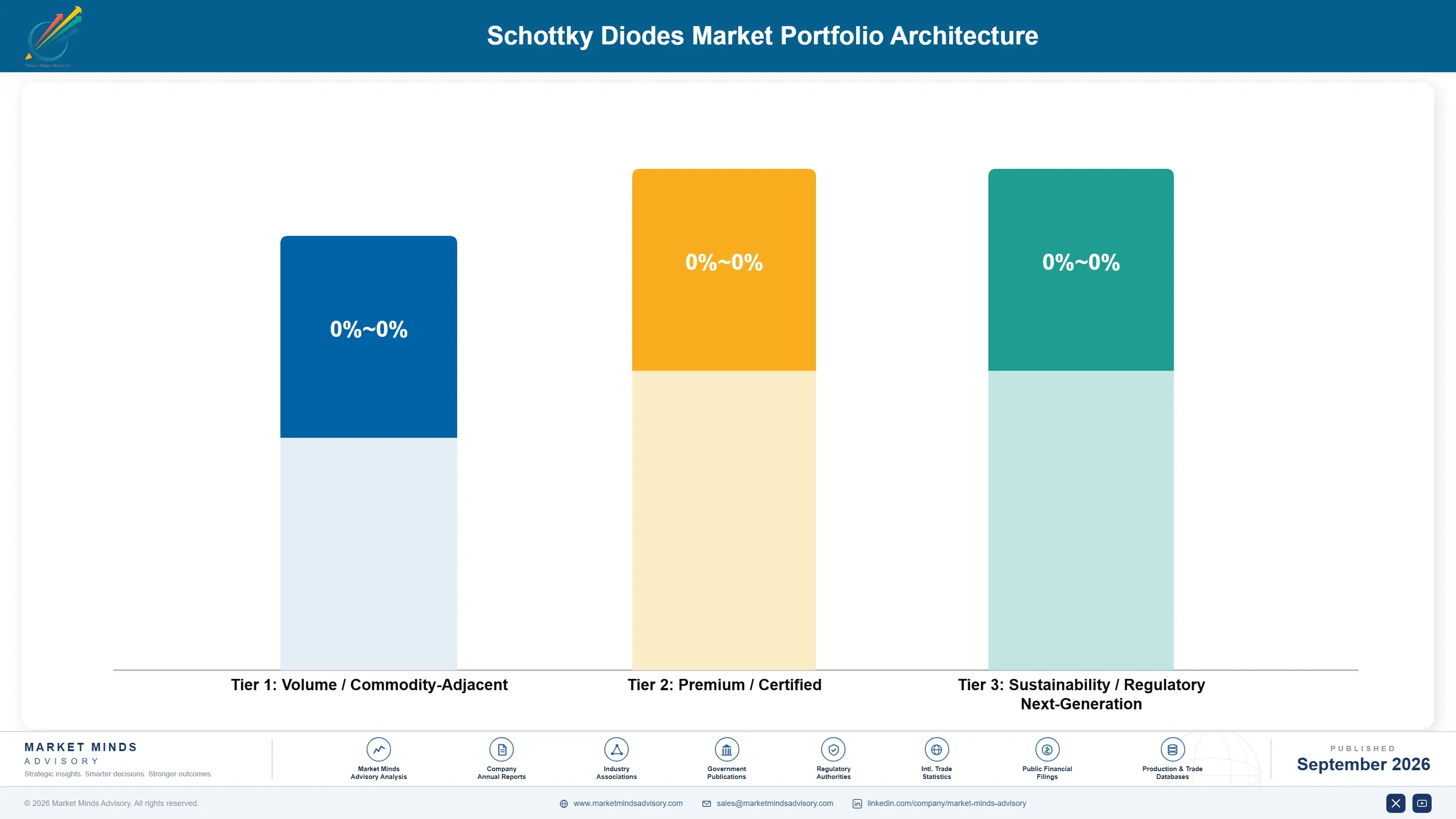
Margin architecture separates on whether the specification alone decides the purchase. Standard planar silicon rectifiers earn least, since they perform identically whoever makes them and compete purely on cost against expanding capacity. Low voltage small signal devices sit slightly above on packaging variety. Carbide barrier diodes, automotive qualified parts and trench rectifiers earn most, because material, approval or construction gives each of them something a datasheet comparison does not resolve.
The volume versus premium tension is a capacity utilisation question rather than a positioning one. Silicon rectifier lines cost the same running half loaded, so commodity volume that earns little still recovers fixed cost and keeps equipment productive. Manufacturers abandoning silicon entirely to chase carbide have found their remaining lines underutilised with nothing to fill them, which is the same lesson passive component makers learned earlier.

High-value pools concentrate in carbide devices and in automotive qualification, and neither is reached by process improvement alone. Carbide requires substrate access at competitive pricing, which most device manufacturers do not control. Automotive qualification requires seventeen month campaigns funded before any order exists. Both are commitments made years ahead of revenue, which is why the same manufacturers keep holding these positions.

Volume / Commodity-Adjacent

Standard planar silicon Schottky rectifiers and low voltage small signal diodes, performing identically whoever manufactures them and competing purely on cost. The eight point spread separates manufacturers with fully utilised fabrication capacity from those running lines below the level fixed costs assume.
Gross Margin: 14% to 22%

Premium / Certified

Trench Schottky and high voltage silicon rectifiers, where construction and process control deliver leakage and efficiency characteristics that standard planar devices cannot. The twelve point spread tracks how much of a manufacturer's volume sits under multi-year supply agreements rather than in distribution and spot sales.
Gross Margin: 28% to 40%

Sustainability / Regulatory / Next-Generation

Silicon carbide barrier diodes and automotive qualified silicon rectifiers, where material access or approval portfolios rather than published specification decide selection. The fourteen point spread reflects substrate integration and qualification breadth, neither of which any entrant assembles quickly at all.
Gross Margin: 42% to 56%
schottky-diodes-market-portfolio-architecture-1789993913030

High-value Sub-segments and Strategic Watch-out

Silicon Carbide Schottky Barrier Diodes

Grows at 12.3% on applications silicon could never serve at all, since leakage makes it impractical much above 200 volts. The fourteen point spread reflects substrate access. Around 58% of the cost sits in a wafer most device manufacturers do not actually make themselves at all.
Gross Margin: 42% to 56%

Automotive Qualified Silicon Schottky Rectifiers

Grows at 10.6% as vehicle electrification multiplies rectification content across charging, conversion and auxiliary systems in every single vehicle built. The fourteen point spread reflects approval breadth. Qualification runs around 17 months before any revenue at all arrives back from the qualification effort that produced it.
Gross Margin: 42% to 56%

Trench Schottky Rectifiers

Grows at 8.9% on trench construction that lowers leakage current against planar devices at comparable voltage and current ratings. The twelve point spread reflects process control. Efficiency in power supply output stages justifies a price premium that the standard planar device simply cannot ever command.
Gross Margin: 28% to 40%

Standard Planar Silicon Schottky Rectifiers

Grows at 2.6%, slowest of the six device classes, on parts performing identically whoever makes them against continually expanding manufacturing capacity. The eight point spread reflects line utilisation alone. No published specification parameter offers any room whatsoever for meaningful differentiation between one supplier and another.
Gross Margin: 14% to 22%

How Design Sockets Persist Here

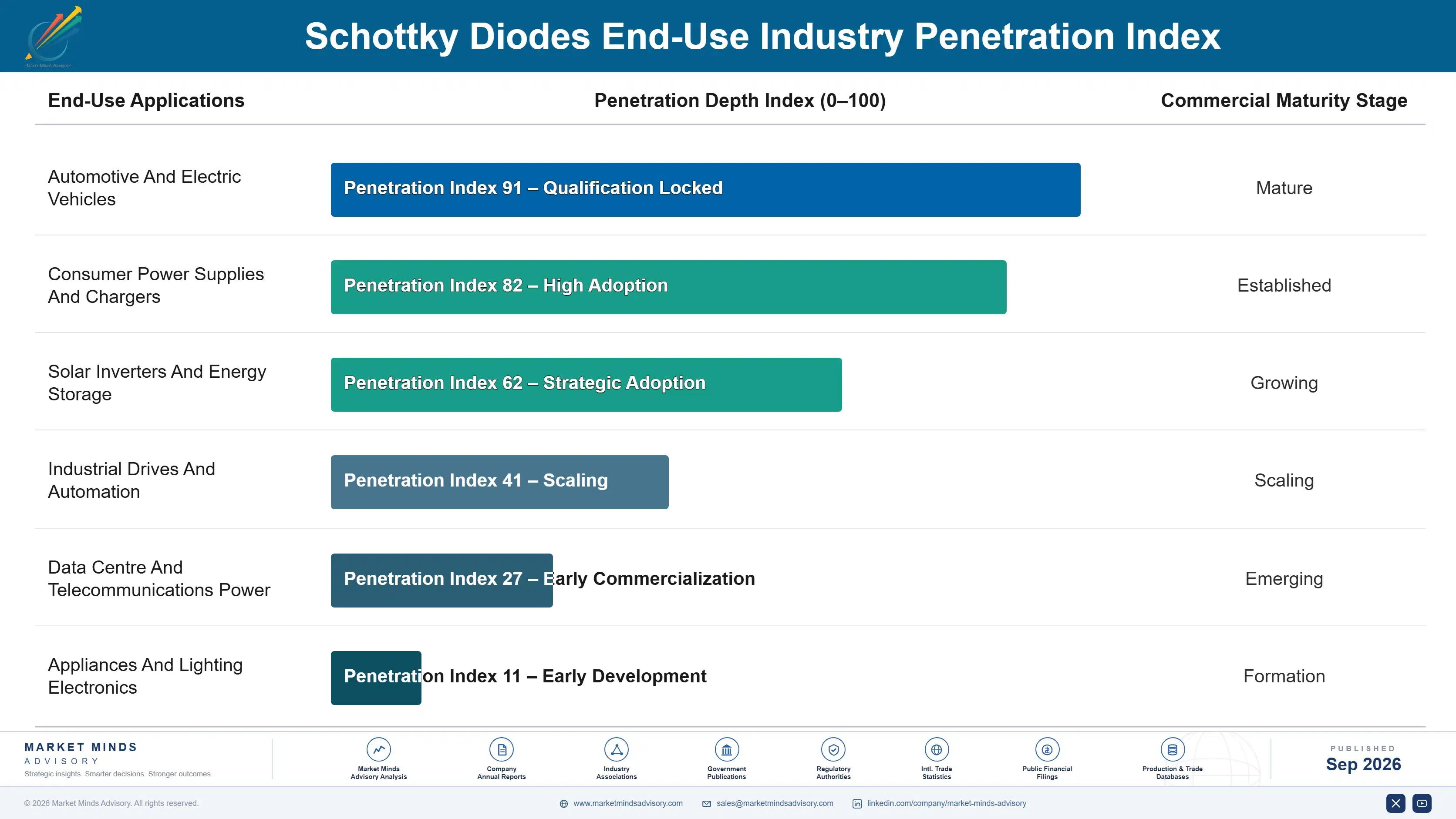
The annuity is the approved vendor list rather than any supply agreement. A device qualified into a vehicle or industrial power programme stays for that programme's production life, because requalifying costs around 17 months and nobody undertakes that to save fractions of a cent. Programme lives run years and often extend into successor designs. Winning at specification is consequently worth far more than the individual order that follows from the decision.
Depth varies by how much validation sits behind the part. An automotive qualified device inside an approved bill of materials is effectively fixed for the programme and often beyond it. A carbide diode inside a switching stage designed around its specific characteristics is similarly locked, since substituting changes the switching behaviour. A standard planar rectifier in consumer electronics gets substituted at every cost reduction exercise, since the alternatives are genuinely identical.

The buyer splits between two conversations that barely connect. A procurement organisation buys interchangeable silicon rectifiers on price across suppliers offering the same specification. An application engineer selects carbide devices by modelling a switching stage where device characteristics determine whether the design works. Manufacturers organised around the first conversation are absent from where growth and margin sit.
schottky-diodes-market-end-use-penetration-index-1789993913520

What Decides Position Here

These are among the four positions where our research anticipates prominent divergence between winners and laggards over the coming forecast period. Each is grounded in the demand model, the regulatory perimeter, and the announced capacity pipeline.
01 / SUBSTRATE ACCESS SECURITY

Own The Wafer Or Contract It

Around 58% of a silicon carbide barrier diode's cost sits in the substrate rather than in any device processing the manufacturer actually performs itself, which makes competitiveness substantially dependent on wafer supply relationships and on pricing set somewhere else entirely. Substrate pricing is falling steadily as capacity expands and access is not evenly available to every manufacturer that wants it. Securing supply at agreed pricing ahead of demand costs real commitment money and determines whether a device business can price competitively at all.
02 / APPLICATION ENGINEERING HONESTY

Tell Designers When Silicon Suffices

Designers routinely specify carbide devices in applications where the operating voltage sits comfortably within silicon capability, because the carbide datasheet reads better on every published parameter and nobody inside the organisation is ever penalised for over-specifying a component. That inflates bill of materials cost in designs that never required it, and the customer notices eventually when somebody performs a cost reduction exercise. Application engineering that models the actual operating envelope wins genuine credibility and frequently a considerably larger overall socket within the same design.
03 / PLATFORM QUALIFICATION DESIGN

Approve The Process, Not The Part

Automotive qualification runs around 17 months from sample submission through to approved production part status, and manufacturers routinely repeat substantial portions of that same work for each voltage rating and package within a single process family. Architecting the qualification campaign around the process platform rather than the individual device lets one approval effort cover an entire family of products at once. Automotive qualified rectifiers compound at 10.6% and carry a premium for physically comparable material, so the return repeats across every part.
04 / NEW ASSEMBLY COVERAGE

Reach The Vendor List Before It Closes

South Asia and Pacific compounds at 10.2% on electronics assembly that did not previously exist rather than on volume relocated from anywhere else, and Indian manufacturing capacity keeps expanding steadily under production linked incentive programmes. New assembly plants build approved vendor lists entirely from scratch, which is an opening an established site never presents to any supplier at any point in its operating life. Reaching those specifications requires local application support and inventory availability before production begins rather than afterwards.

Engagement Snapshot From the Field

A live engagement with an industry participant carrying material or product regulatory and market exposure ahead of a defining policy shift, showing how our research translates into a defensible multi-year portfolio strategy.
MARKET MINDS ADVISORY · CLIENT ENGAGEMENT SUMMARY
Schottky Diodes Producer Strategic Portfolio Review and Transition Roadmap 2026·Investment Scenario on Schottky Diodes Exposure Evaluation 2025-26
CLIENT PROFILE
A European power supply manufacturer producing industrial and telecommunications units across three plants, having standardised on silicon carbide rectification across most designs following a successful high voltage project. Bill of materials cost had risen for two consecutive years and margin was compressing. Nobody had reviewed whether every design using carbide devices actually operated at voltages requiring them.
STRATEGIC CHALLENGE
Engineering defended carbide standardisation on component commonality and simplified qualification, which were both genuine benefits. Finance observed that device cost had risen substantially without any corresponding performance requirement change. Nobody had modelled the actual operating voltage envelope across the design portfolio, and a further standardisation decision was scheduled within the quarter.
MMA APPROACH
MMA modelled the operating voltage envelope across every product in the portfolio and identified which designs genuinely required carbide against which sat comfortably within silicon capability. We priced substitution including requalification effort, and assessed substrate cost exposure across the manufacturer's supply arrangements. The work drew on 47 expert interviews conducted in Q4 2025 with device manufacturers, distributors and comparable power supply firms.
KEY FINDINGS
  1. Around 6 in 10 designs using carbide devices operated below 200 volts, where silicon Schottky rectifiers would have served the requirement entirely adequately.
  2. Device cost on those designs ran roughly 4 times a silicon equivalent, and around 58% of that premium was substrate rather than any device performance.
  3. Requalification effort to substitute silicon on non-automotive designs was modest, since industrial approval requirements are far lighter than vehicle programmes (client-reported, unverified by MMA).
  4. The manufacturer bought carbide devices on distribution pricing rather than under any contracted arrangement, which cost more than a direct agreement would have.
CLIENT PROFILE
A European power supply manufacturer producing industrial and telecommunications units across three plants, having standardised on silicon carbide rectification across most designs following a successful high voltage project. Bill of materials cost had risen for two consecutive years and margin was compressing. Nobody had reviewed whether every design using carbide devices actually operated at voltages requiring them.
STRATEGIC CHALLENGE
Engineering defended carbide standardisation on component commonality and simplified qualification, which were both genuine benefits. Finance observed that device cost had risen substantially without any corresponding performance requirement change. Nobody had modelled the actual operating voltage envelope across the design portfolio, and a further standardisation decision was scheduled within the quarter.
MMA APPROACH
MMA modelled the operating voltage envelope across every product in the portfolio and identified which designs genuinely required carbide against which sat comfortably within silicon capability. We priced substitution including requalification effort, and assessed substrate cost exposure across the manufacturer's supply arrangements. The work drew on 47 expert interviews conducted in Q4 2025 with device manufacturers, distributors and comparable power supply firms.
KEY FINDINGS
  1. Around 6 in 10 designs using carbide devices operated below 200 volts, where silicon Schottky rectifiers would have served the requirement entirely adequately.
  2. Device cost on those designs ran roughly 4 times a silicon equivalent, and around 58% of that premium was substrate rather than any device performance.
  3. Requalification effort to substitute silicon on non-automotive designs was modest, since industrial approval requirements are far lighter than vehicle programmes (client-reported, unverified by MMA).
  4. The manufacturer bought carbide devices on distribution pricing rather than under any contracted arrangement, which cost more than a direct agreement would have.
RECOMMENDED STRATEGY
Phase 1: Phase one: substitute silicon Schottky devices on the designs operating below 200 volts, where carbide delivers no performance the application actually requires. Phase 2: Phase two: negotiate a direct supply arrangement for the carbide devices that remain, rather than continuing to buy through distribution at higher pricing. Phase 3: Phase three: require application engineering to model the operating envelope before device selection, rather than standardising on the better datasheet.
OUTCOME
The manufacturer substituted silicon on the majority of designs and negotiated direct carbide supply for the remainder (client-reported, unverified by MMA). Bill of materials cost fell measurably and no design experienced any performance issue. Device selection now follows a modelled operating envelope rather than standardisation preference, which is the change that outlasted the engagement.

Frequently Asked Questions

Foundational context covering the market sizes, CAGR, scope, country, region and competition that inform every finding below. This section is provided to cover basics and most often pre-purchase conversations, answered from the MMA Primary Research Dataset.

What is the current size of the Schottky Diodes Market?

Global value reaches USD 2.60 billion in 2026, measured as Schottky diode and rectifier shipment revenue across all six device classes. The 2025 base is USD 2.4 billion.

How large will the Schottky Diodes Market be by 2036?

Shipment revenue reaches USD 5.72 billion by 2036, an increase of USD 3.12 billion over the forecast period. That represents 2.20 times expansion from the 2026 base.

What is the CAGR for the Schottky Diodes Market 2026 to 2036?

The base case runs at 8.2% annually, with a bull case at 9.5% if carbide substrate pricing displaces silicon in mid voltage applications and a bear case at 7.0% if silicon rectifier pricing erodes faster.

Which segment is growing fastest?

Silicon carbide Schottky barrier diodes grow at 12.3%, half again the market rate of 8.2%. Leakage makes silicon impractical much above 200 volts while carbide operates well beyond 1200.

Who are the major companies in the Schottky Diodes Market?

Infineon Technologies, onsemi, STMicroelectronics, Rohm and Vishay Intertechnology lead on shipment revenue, together holding 54%. Wolfspeed, Diodes Incorporated and Nexperia hold smaller positions across the classes.

Which country is growing fastest?

China leads at 13.4%, on silicon carbide substrate and device capacity expanding together under national programmes treating wide bandgap semiconductors as strategic. India and Vietnam follow.

Report Segmentation Architecture

The full report scope spans multiple orthogonal segmentation dimensions, with cross-tabulated demand data provided for each dimension pair. Coverage extends further to regional breakdowns, trend trajectories, and the competitive detail needed to support segment-level decision-making.

By Device Class

  • Silicon Carbide Schottky Barrier Diodes
  • Automotive Qualified Silicon Schottky Rectifiers
  • Trench Schottky Rectifiers
  • High Voltage Silicon Schottky Rectifiers
  • Low Voltage Small Signal Schottky Diodes
  • Standard Planar Silicon Schottky Rectifiers

By End-Use Industry

  • Automotive And Electric Vehicles
  • Consumer Power Supplies And Chargers
  • Solar Inverters And Energy Storage
  • Industrial Drives And Automation
  • Data Centre And Telecommunications Power
  • Appliances And Lighting Electronics

By Commercial Dimension

  • Direct Manufacturer Supply Agreements
  • Electronics Distributor Channel
  • Contract Manufacturer Procurement
  • Automotive Tier One Sourcing
  • Approved Vendor List Specification
  • Design Win Application Support

By Region

  • North America
  • Western Europe
  • East Asia
  • South Asia and Pacific
  • Latin America
  • Middle East and Africa
  • Eastern Europe

Scope, Methodology, and Coverage

Every figure in this report is reproducible from documented input assumptions. The scope below maps the historical period, the forecast horizon, the segmentation dimensions, and the countries covered, alongside the underlying primary and qualitative methodology.
Historical Period
2020 to 2025
Forecast Period
2026 to 2036
Base Year
2025 (USD billions; MMA Primary Research Dataset, September 2026)
Market Definition
This report covers Schottky barrier diodes and rectifiers by device class: silicon carbide Schottky barrier diodes, automotive qualified silicon Schottky rectifiers, high voltage silicon Schottky rectifiers, trench Schottky rectifiers, low voltage small signal Schottky diodes, and standard planar silicon Schottky rectifiers. It excludes PN junction and fast recovery rectifiers, transistors and switching devices of any type, integrated power modules, thyristors, and other discrete semiconductor categories.
Quantitative Units
USD millions, shipment revenue basis; shipped device units; forward voltage drop in volts; practical voltage ceilings in volts; substrate share of device cost as a percentage.
Segmentation Dimensions
Device class; end-use application; commercial supply channel; geography across seven regions.
Regions Covered
North America, Western Europe, East Asia, South Asia and Pacific, Latin America, Middle East and Africa, Eastern Europe
Countries Covered
China, Taiwan, Japan, South Korea, India, Vietnam, Australia, United States, Canada, Mexico, Brazil, Germany, Italy, France, Netherlands, Poland, Czechia, Slovakia, Israel, Saudi Arabia.
Key Companies Profiled
Infineon Technologies, onsemi, STMicroelectronics, Rohm, Vishay Intertechnology, Wolfspeed, Diodes Incorporated, Toshiba Electronic Devices, Nexperia, Littelfuse, Taiwan Semiconductor Co, Yangzhou Yangjie Electronic, Hangzhou Silan Microelectronics, Microchip Technology, Mitsubishi Electric.
Quantitative Methodology
Primary survey, n=3,800 respondents, Q4 2025, six countries; demand-side model with trade association cross-validation
Qualitative Methodology
47 expert interviews, Q4 2025; applied to validate demand model assumptions, identify emerging dynamics, and assess competitive positioning
Report Format
PDF and XLSX data workbook (Word format preview document)
Publisher
Market Minds Advisory
Report Code
MMA-2026-TEC-641
Published
September 2026
Contact
sales@marketmindsadvisory.com | www.marketmindsadvisory.com

Purchase the full Schottky Diodes Market Report (2026 to 2036).

This report sizes the global Schottky diode market from 2026 to 2036 across six device classes, six applications and seven regions. It explains why a device unchanged in principle for fifty years still grows, how a 200 volt silicon ceiling created the entire carbide opportunity, and why 58% of wide bandgap device cost sitting in the substrate makes supply relationships more decisive than process capability. Cost composition is sourced to IEA minerals analysis and company annual reports, with substrate access analysed as the competitive determinant. Regional analysis explains why East Asia holds 42% of shipment revenue.
Six device classes sized through to 2036
Voltage ceiling economics modelled across both materials
Substrate and qualification cost composition from company filings
Twenty named manufacturers assessed on shipment revenue
Four revenue levers with quantified commercial impact
Anonymised power supply manufacturer selection engagement included fully

Built For The People Who Decide

From boardroom strategy to bench-side execution, this report is read cover-to-cover by leaders shaping the next decade of their industry, turning demand scenarios, market dynamics and valuation benchmarks into decisions.
CXOs/ Presidents/ VPs/ Managers
M&A and Corporate Development
Strategy Teams and R&D Heads
Procurement and Product Directors
Regulatory and Compliance Leaders
Investor Relations and Equity Analysts