Market Minds Advisory
Saudi Arabia Travel Insurance Market

Saudi Arabia Travel Insurance Market: Outbound Tourism Growth and Mandatory Coverage Expansion

Vision 2030 outbound travel growth, mandatory umrah and hajj visa coverage rules, and rising digital distribution through airline and travel platform partnerships are jointly reshaping Saudi Arabia's travel insurance category.

Lead Analyst

Published

September 2026

Make Smarter Decisions with Customized Research Insights

Request a free sample report and evaluate market opportunities, growth trends, and competitive dynamics relevant to your business needs.

2025 MARKET VALUE$24.5BMarket Size 2025
2036 FORECAST VALUE$80.3BBase Case , 2026 to 2036
CAGR 2026 TO 203611.4 %Bull 12.7% / Bear 10.1%
INCREMENTAL OPPORTUNITY$53.0BNet 10- year value creation
EXPANSION MULTIPLE2.94x2036 value over 2026 base
Strategic Levers
M&A Pipeline
Regional Outlook
Country Rankings
Competitive Intelligence
Segmental Deep-dive
Call-Us : 91 93563 13602

Executive Snapshot and Market Trajectory

Travel insurance is scaling fastest where outbound tourism growth meets new mandatory coverage rules, and Saudi Arabia's umrah and hajj visa requirements now anchor one of the category's steepest growth curves anywhere in the world, well ahead of most mature travel markets. Vision 2030 accelerates this shift further.
East Asian outbound travel volume from China, Japan, and South Korea still generates the largest premium pool globally, but growth has shifted toward the Middle East as Vision 2030 tourism expansion and mandatory religious pilgrimage coverage requirements pull millions of new travelers into formal insurance products for the first time in their lives. Digital distribution through airlines and travel platforms is compressing acquisition cost across every region simultaneously, reshaping how policies reach first-time buyers.
Competition remains fragmented globally, with regional specialists competing alongside multinational assistance providers on claims network breadth rather than price alone, particularly across pilgrimage and adventure travel corridors where local infrastructure knowledge matters. Regulatory tightening around mandatory coverage minimums, particularly for pilgrimage and adventure travel segments, is raising the bar for underwriting and claims infrastructure that smaller entrants increasingly struggle to meet without partnership support from larger assistance networks.
Market Definition
This report covers travel insurance premium written for single-trip, annual multi-trip, and mandatory pilgrimage and visa-linked coverage sold to outbound and inbound travelers globally. It excludes standalone medical tourism insurance, domestic health coverage, and airline-embedded flight delay compensation products not sold as standalone insurance policies.
Base Year Value
$24.5B in 2025 (MMA Primary Research Dataset, August 2026)
Forecast Period
2026 to 2036, eleven discrete annual values
CAGR
11.4% base case. Bull 12.7%. Bear 10.1%.
Fastest Growth Segment
Single-Trip Umrah and Hajj Travel Insurance: 17.8% CAGR
Fastest Growth Country
Saudi Arabia: 16.5% CAGR
Fastest Growth Region
Middle East and Africa: 15.9% CAGR
Largest Region
East Asia: 29% of 2025 global value
Market Leaders
Allianz Partners, AIG Travel, Chubb, AXA Partners, Tawuniya. Source: MMA Analysis, based on company disclosures and primary survey data, Q4 2025.
Primary Survey
n=3,800 procurement and R&D decision-makers, Q4 2025, six countries
Methodology
Demand-side build-up, cross-validated against public data, 47 expert interviews

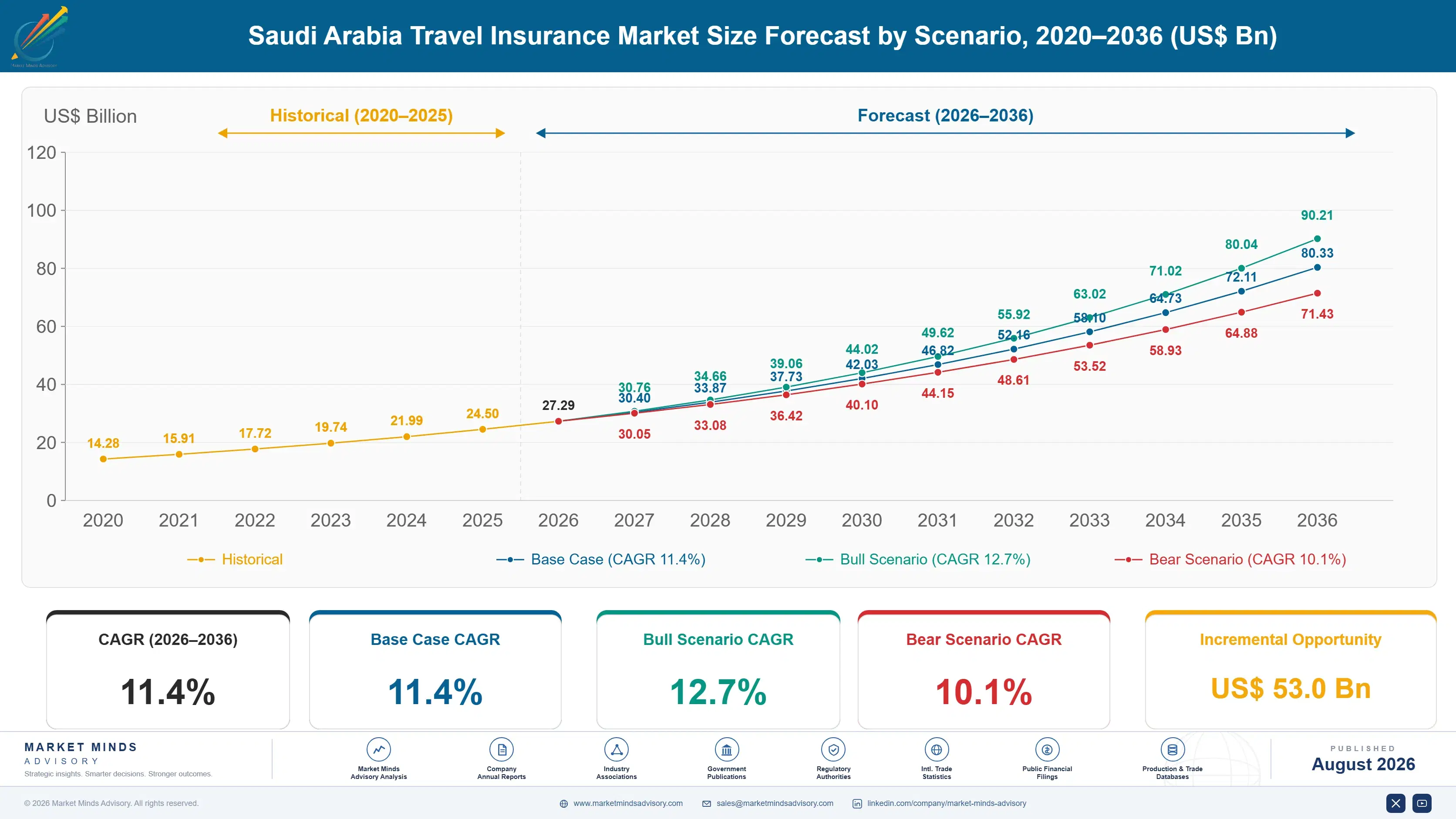
Saudi Arabia Travel Insurance Market Forecast Scenarios

saudi-arabia-travel-insurance-market-size-forecast-scenario-1787914078737
Between 2020 and 2025 the market grew at an estimated 10.4% annually, held back sharply through 2021 by pandemic-era travel restrictions that halted outbound tourism and pilgrimage travel almost entirely, before rebounding strongly from 2022 onward as outbound tourism recovered and pilgrimage travel resumed at scale across Saudi Arabia and neighboring Gulf markets, restoring premium growth to its pre-pandemic trajectory.
The base case carries the market to 11.4% CAGR through 2036 on three mechanisms. Saudi Arabia's Vision 2030 tourism expansion and mandatory umrah and hajj visa coverage requirements pull millions of new travelers into formal insurance for the first time. Rising East Asian outbound travel volume keeps expanding the largest existing premium pool. Digital distribution through airline and travel platform partnerships continues lowering acquisition cost and expanding reach into previously underinsured traveler segments.
The bull case rests on faster mandatory coverage enforcement across additional visa categories beyond pilgrimage travel, pulling in even more first-time buyers than currently modeled and accelerating premium growth across underinsured traveler segments. The bear risk centers on a global travel demand slowdown tied to economic softness or renewed travel restrictions, which would compress premium growth across every distribution channel simultaneously.

Pilgrimage Growth Reshapes Travel Insurance Economics

Travel insurance economics increasingly hinge on distribution partnerships rather than direct consumer marketing, since airlines, travel platforms, and visa processing services now originate the majority of new policies at the point of booking or visa application, well ahead of traditional agent-sold channels that dominated the category a decade ago. Booking-flow integration matters most now.
TOP 5 CONCENTRATION38%Share held by leading global assistance providers combined
AVERAGE PREMIUM PER POLICY$42Blended average premium across single-trip and multi-trip policy types
TOP DISTRIBUTION CHANNEL SHARE54%Premium sold through airline and travel platform partnerships
CLAIMS RATIO58%Claims paid as share of premium collected annually
MANDATORY COVERAGE POLICY SHARE31%Policies sold to satisfy visa or entry requirements
DIGITAL DISTRIBUTION GROWTH RATE19%Annual growth in policies sold through digital channels
Mandatory coverage requirements, particularly Saudi Arabia's umrah and hajj visa rules, are converting a discretionary purchase into a required one for millions of travelers annually, fundamentally changing acquisition economics for insurers positioned to capture this channel early. Claims ratios remain manageable across most segments, though adventure and high-altitude travel coverage carries meaningfully higher claims severity than standard leisure policies, requiring more conservative underwriting assumptions for insurers writing that specific business.
Digital distribution is compressing acquisition cost industrywide as embedded insurance offers at checkout replace traditional agent-sold policies across most major markets. Insurers with strong platform integration capability are capturing disproportionate share of this growth, while insurers relying heavily on traditional broker channels are seeing volume growth lag the broader category meaningfully, particularly among younger travelers who now expect coverage offered automatically during digital booking flows.
"Mandatory coverage rules did something price competition never managed: they made insurance the default rather than the exception for millions of pilgrims. That shift is worth more to underwriters than any marketing campaign."
Practice Lead, Financial Services and Insurance Intelligence · MMA Financial Services and Insurance Practice · August 2026

Market Trends

Mandatory Pilgrimage Coverage Expands Formal Insurance Access

Saudi Arabia's requirement that umrah and hajj visa applicants carry travel medical insurance has converted millions of pilgrims from previously uninsured or informally covered travelers into formal policyholders each year. The Ministry of Hajj and Umrah's coordination with licensed insurers, including Tawuniya and Bupa Arabia, has standardized minimum coverage requirements across the pilgrimage travel corridor, creating predictable underwriting volume that insurers can plan capacity around with far greater confidence than in most other travel insurance segments globally. This predictability is drawing new licensed entrants into the pilgrimage corridor specifically, competing on claims network breadth rather than price.
Market Impact: Targets 150 million visitors by 2030
Digital Embedded Insurance At Booking Displaces Agent Channels

Airlines and online travel platforms increasingly offer travel insurance as an embedded checkout option rather than a separate purchase decision, converting what was once an active buying decision into a passive default that significantly raises attach rates. Platforms including major Gulf carriers now report attach rates well above traditional agent-sold channels, since travelers face far less friction accepting a pre-selected coverage option than researching and purchasing a standalone policy. This distribution shift is compressing acquisition cost meaningfully across the category, favoring insurers with strong technical integration capability over those still dependent on broker relationships.
Market Impact: Reaches 22 million booked passengers annually

Market Opportunities and Growth Drivers

Vision 2030 Tourism Targets Expand Traveler Volume

Saudi Arabia's Vision 2030 program targets 150 million annual visitors by 2030, spanning tourism, business travel, and religious pilgrimage, and every visitor category carries some form of insurance requirement or strong purchase incentive tied to visa conditions. New tourist visa categories introduced since 2019 have opened the country to leisure travelers for the first time, creating an entirely new insured population that barely existed in the market five years ago and continues expanding as flight capacity and hotel infrastructure scale to match. Insurers building early distribution relationships here are securing volume advantages later entrants will find harder to replicate.
Market Impact: Raises adventure claims 35% higher

Airline And Platform Partnerships Scale Distribution Reach

Major Gulf carriers and online travel agencies have signed distribution partnerships with global assistance providers, embedding travel insurance directly into booking flows for a growing share of ticketed passengers. These partnerships give insurers access to booking volume that would otherwise require expensive standalone marketing to reach, while airlines and platforms earn commission revenue on a product that adds minimal friction to the existing purchase flow, making the arrangement commercially attractive to all sides involved in the transaction. Insurers without comparable partnerships rely on direct marketing that costs substantially more per policy, widening the gap with platform-integrated competitors.
Market Impact: Adds cost across 12 categories

Market Restraints and Challenges

Adventure And High-Altitude Claims Severity Pressures Margin

Adventure travel and high-altitude pilgrimage segments generate claims severity well above standard leisure travel, since evacuation and emergency medical costs in remote or high-altitude locations run considerably higher than comparable urban medical treatment. The root cause is limited medical infrastructure access in these locations, which forces costly medical evacuation rather than local treatment for even moderately serious incidents. This has pushed loss ratios above target for insurers underwriting adventure and pilgrimage segments without adequate premium adjustment. Insurers are responding by building tiered pricing that reflects destination-specific risk more precisely across corridors.
Market Impact: Adds 6 million policies yearly

Fragmented Regulation Across Visa Categories Raises Compliance Cost

Mandatory coverage requirements vary meaningfully across visa categories and destination countries, forcing insurers to maintain distinct policy structures and compliance processes for each corridor rather than a single standardized product. The root cause is genuine regulatory fragmentation: pilgrimage, tourism, and business visa requirements each set different minimum coverage standards administered by different government bodies with limited coordination between them. This raises compliance and product development cost meaningfully for insurers operating across multiple corridors simultaneously. Insurers are responding by building modular policy architecture that adapts to varying minimum coverage requirements without full product redesign.
Market Impact: Raises checkout attach rates 45%
2 additional market trends, 4 additional growth drivers, and 3 additional restraints and challenges are covered in the full report. Contact sales@marketmindsadvisory.com to access the complete intelligence.

Segment CAGR and Growth Architecture

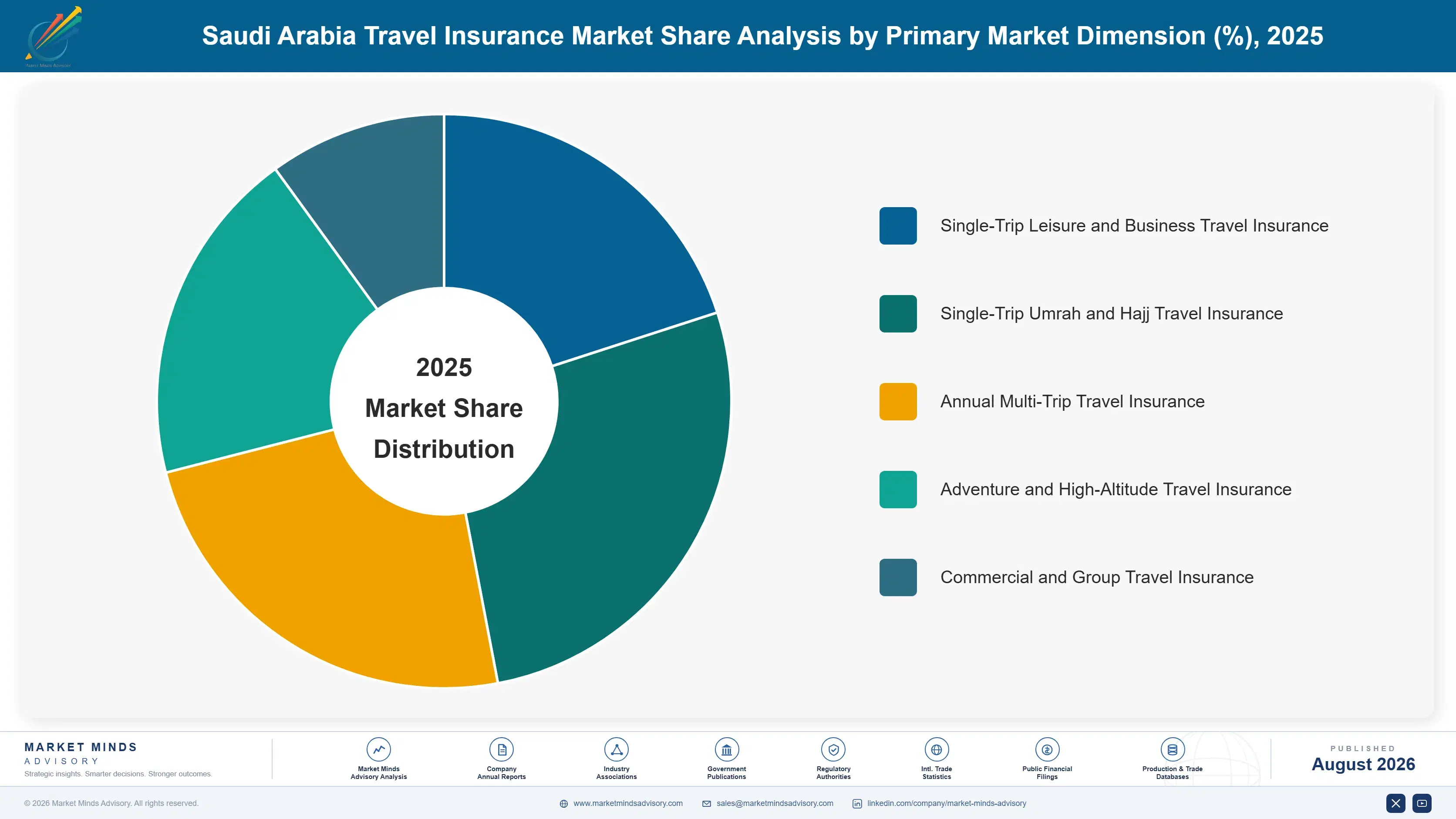
Travel insurance splits into six coverage categories defined by trip type and purpose. Single-trip and pilgrimage-linked coverage lead current growth as mandatory requirements and rebounding tourism volume expand the insured traveler base across every major outbound corridor globally, from religious pilgrimage routes to conventional leisure and business travel. Commercial coverage sits alongside these, growing steadily as travel programs recover.
saudi-arabia-travel-insurance-market-market-share-analysis-1787914079273

Single-Trip Umrah and Hajj Travel Insurance

Single-trip umrah and hajj coverage grows fastest at 17.8% annually, nearly 1.56 times the overall market rate, as Saudi Arabia's mandatory visa insurance requirement converts millions of previously uninsured pilgrims into formal policyholders each year. These policies bundle medical evacuation, trip cancellation, and baggage coverage into standardized packages designed to meet Ministry of Hajj and Umrah minimum requirements efficiently. Tawuniya and Bupa Arabia both hold strong positions in this corridor given their established licensing and claims infrastructure across Mecca and Medina specifically. Growth here is expected to continue as visitor volume targets under Vision 2030 keep expanding the addressable pilgrim population meaningfully. Insurers with early licensing here hold a position later entrants will find difficult to match.
CAGR 17.8%

Single-Trip Leisure and Business Travel Insurance

Single-trip leisure and business coverage grows second-fastest at 12.9%, driven by rebounding global tourism volume and expanding embedded insurance offers at airline and travel platform checkout. These policies cover a single defined trip, typically bundling trip cancellation, medical, and baggage protection into one straightforward purchase decision that travelers can complete in seconds during booking. Global assistance providers including Allianz Partners and AIG Travel compete intensely here against regional specialists offering more localized claims service. Digital distribution partnerships are the primary growth lever, converting passive policy awareness into active purchase at the exact moment travelers book their trips. Insurers relying solely on traditional broker distribution increasingly lag platform-integrated competitors on both acquisition cost and reach into younger, digitally native traveler segments.
CAGR 12.9%
Full segment breakdown across 7 segments available in the complete report.

Regional Architecture and Country Demand Map

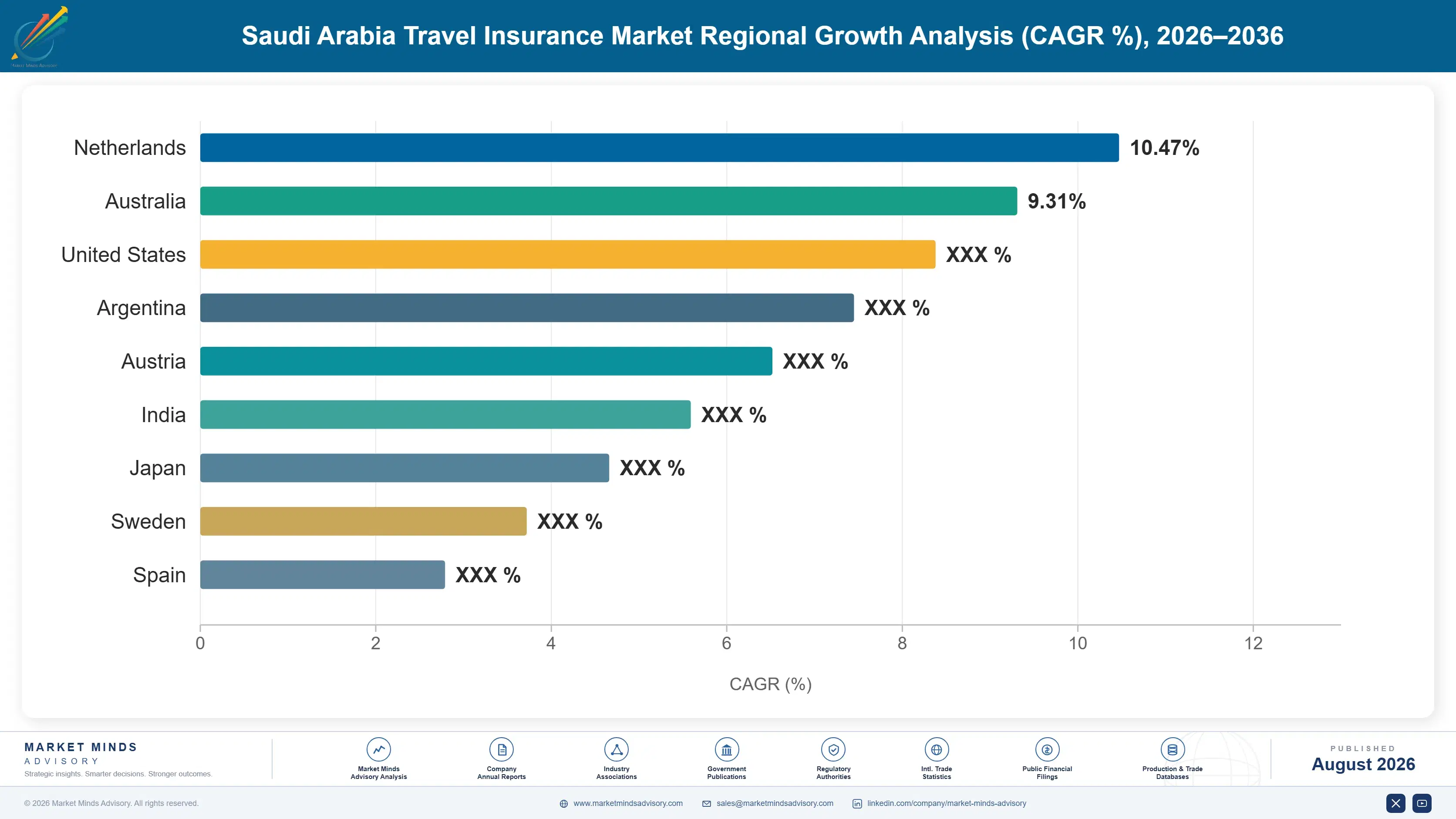
Travel insurance demand concentrates around outbound tourism volume and mandatory coverage rules. East Asia leads on premium pool size while the Middle East compounds fastest of any region as Saudi Arabia's pilgrimage visa requirements pull millions of new insured travelers into the market each year.

North America

US and Canadian outbound travelers generate steady premium volume anchored in leisure and business trip coverage, with strong penetration among frequent international travelers who value baggage and medical evacuation protection on international routes. Cruise travel insurance forms a meaningful subsegment given the region's large cruise passenger base sailing internationally each year. Employer-sponsored business travel coverage adds a stable secondary channel across major corporate travel programs. Growth of 12.5% reflects steady outbound volume expansion rather than any single new regulatory driver, tracking closely with broader international travel demand trends across the region. Insurers with strong cruise line and airline distribution partnerships hold a durable advantage over competitors relying primarily on direct-to-consumer marketing in this comparatively mature travel insurance market.
Share: 26% | CAGR: 12.5% (2026 to 2036)

Western Europe

European outbound leisure travel, particularly from Germany, the UK, and France, anchors this region's 22% share through mature travel insurance penetration and well-established distribution via travel agencies and airlines. Schengen visa requirements mandate minimum medical coverage for many non-EU travelers entering the bloc, creating a stable compliance-driven demand floor. Package holiday operators bundle insurance into standard offerings across much of the region. Growth of 9.9% trails the global average as penetration is already high and incremental volume growth depends mainly on modest annual outbound trip growth rather than new insured populations entering the market. Insurers focused on premium adventure and extended-stay coverage still find growth even as core leisure penetration approaches saturation across most major source markets.
Share: 22% | CAGR: 9.9% (2026 to 2036)
Regional intelligence for 5 additional markets available in the complete report: East Asia, South Asia and Pacific, Latin America, Middle East and Africa, Eastern Europe. Contact sales@marketmindsadvisory.com.
saudi-arabia-travel-insurance-market-country-cagr-analysis-1787914079788

Where Travel Insurers Should Focus Growth Investment

Revenue growth concentrates around distribution partnership depth and mandatory coverage capture rather than product innovation alone. Insurers positioned inside airline booking flows and pilgrimage visa processes capture volume that competitors relying on standalone marketing simply cannot reach at comparable cost. Insurers combining both approaches capture volume competitors relying on a single channel cannot match at comparable cost.

Deepen Airline And Platform Embedded Distribution

Insurers embedding coverage directly into airline and travel platform checkout flows capture attach rates well above standalone marketing channels, since travelers accept a pre-selected default far more readily than researching a separate purchase. Early movers on platform integration reportedly see attach rates running 20 to 30 percentage points above insurers relying on traditional broker distribution, since the passive default effect meaningfully outperforms any active marketing campaign at comparable cost. Insurers without comparable integration capability increasingly cede volume to platform-embedded competitors that reach travelers at the precise moment of purchase decision.
Market Impact: Raises attach rates 20 to 30 points above brokers

Expand Licensed Pilgrimage Corridor Capacity Nationwide

Insurers building dedicated licensing and claims infrastructure across Saudi Arabia's pilgrimage corridor capture a predictable, mandatory-coverage-driven volume stream that few other travel insurance segments can match in scale or consistency. Tawuniya and Bupa Arabia's established positions reportedly generate underwriting margins running 4 to 8 percentage points above standard leisure travel coverage, reflecting the pricing power that comes with regulatory-mandated demand and limited competitive entry. New entrants face meaningful licensing and infrastructure barriers that protect incumbent margin for several years before competitive pressure meaningfully erodes it. This margin rewards insurers who invested in licensing and claims infrastructure early.
Market Impact: Adds 4 to 8 points of underwriting margin

Build Tiered Adventure And High-Altitude Pricing

Insurers developing destination-specific pricing tiers for adventure and high-altitude travel capture premium adequate to the elevated claims severity these segments generate, rather than applying standard leisure pricing that systematically underprices this risk category. Tiered pricing models reportedly improve loss ratios by 10 to 15 percentage points relative to flat-rate adventure coverage, since destination-specific risk factors meaningfully predict claims severity better than broad category averages ever could. This requires genuine actuarial investment that smaller insurers often lack relative to global providers with mature data infrastructure. Insurers without this capability continue underpricing adventure risk, eroding margin as claims experience catches up.
Market Impact: Improves loss ratios by 10 to 15 points

License Claims Network Access To Regional Partners

Global assistance providers with established claims networks across pilgrimage and adventure corridors can license network access to smaller regional insurers lacking comparable infrastructure, generating fee revenue without directly underwriting the associated risk themselves. This model reportedly generates licensing fee revenue running 3 to 5 percent of the licensee's premium volume at minimal marginal cost to the network owner, since the underlying claims infrastructure already exists and serves the licensor's own core underwriting business regardless. Demand for this licensing is rising as smaller insurers seek pilgrimage market entry without full infrastructure investment.
Market Impact: Generates 3 to 5 percent licensing fee revenue

Who Controls the Margin Pool

Global assistance providers hold a combined 38% share, leaving meaningful room for regional specialists competing on claims network depth rather than scale alone. Allianz Partners leads the field, with a gap to challengers like AIG Travel and Chubb wide enough that consolidation pressure builds steadily across the smaller regional tier. Regional specialists like Tawuniya defend margin where local licensing and claims relationships matter more than global brand recognition.
Competitive activity currently centers on distribution partnership acquisition, with insurers racing to embed coverage into airline and travel platform checkout flows before competitors secure exclusive arrangements. Pilgrimage corridor licensing represents a second front, where Tawuniya and Bupa Arabia defend positions against new entrants seeking Saudi access through joint licensing with global partners. Insurtech entrants add a third front, competing on claims automation speed rather than distribution reach.

Emerging pressure comes from insurtech platforms offering parametric flight delay and cancellation products that bypass traditional claims processes, appealing to travelers frustrated with slow reimbursement. Rankings could shift meaningfully if a well-capitalized platform combines parametric technology with pilgrimage corridor licensing, a combination no major player has fully executed yet. Established insurers without comparable technology investment risk losing share to faster, digitally native challengers over time.
saudi-arabia-travel-insurance-market-company-positioning-matrix-1787914080315

Competitive Moat and Risk Dimensions

ALLIANZ PARTNERS

Moat: Global Distribution Scale

Allianz Partners holds distribution relationships spanning airlines, travel platforms, and corporate travel programs across every major region, giving it embedded checkout placement competitors struggle to replicate at comparable scale or speed of integration across new markets. This scale advantage compounds as more platforms seek a single global partner rather than managing multiple regional insurance relationships separately.
ALLIANZ PARTNERS

Risk: Slower Digital Integration Pace

Legacy technology infrastructure across some regional operations slows platform integration speed relative to smaller, digitally native competitors, creating openings for insurtech challengers to win newer platform partnerships before Allianz can respond with comparable integration. Closing this gap requires sustained technology investment that competes internally against other capital priorities across the broader organization.
AIG TRAVEL

Moat: Claims Network Depth

AIG Travel's established claims network across adventure and remote destination corridors gives it credible evacuation and emergency medical response capability that smaller regional insurers cannot match without years of dedicated infrastructure investment across similarly remote locations. This infrastructure took years to build and represents a genuine barrier to entry for insurers considering rapid expansion into similarly remote destination corridors.
AIG TRAVEL

Risk: Limited Pilgrimage Corridor Presence

AIG Travel lacks the dedicated Saudi Arabia licensing and infrastructure that Tawuniya and Bupa Arabia hold, limiting its ability to capture the fastest-growing segment of the category without a licensing partnership or acquisition in that specific corridor. Building comparable infrastructure from scratch would require years of investment that AIG has not yet committed to this specific corridor.

Players Tracked

Prominent Players

Allianz Partners
AIG Travel
Chubb
AXA Partners
Tawuniya

Other Key Players

Bupa Arabia
Zurich Insurance Group
Generali Global Assistance
Europ Assistance
Assicurazioni Generali
Mapfre Asistencia
Sompo Japan Insurance
Tokio Marine Nichido
HDI Global
IMG Global
Seven Corners
World Nomads
Berkshire Hathaway Travel Protection
Aon Affinity
Cover Genius

Recent Developments

MARCH 2024

Tawuniya expanded its pilgrimage insurance licensing agreement with the Ministry of Hajj and Umrah, securing preferred provider status across additional visa processing centers for the upcoming pilgrimage season. The agreement was a licensing and regulatory partnership, not an acquisition or joint venture. The expanded agreement covers additional processing centers.
Signal: Signals Saudi regulators favor established domestic insurers over new foreign entrants in the pilgrimage corridor. for the pilgrimage corridor specifically.
SEPTEMBER 2024

Allianz Partners signed a distribution partnership with a major Gulf carrier to embed travel insurance directly into the airline's booking flow across its route network. The agreement was a commercial distribution partnership, not an acquisition or equity investment of any kind. The partnership extends across the carrier's route network.
Signal: Signals global assistance providers are prioritizing airline booking flow integration over standalone marketing. over standalone marketing spend.
JANUARY 2025

Bupa Arabia acquired a minority stake in a regional insurtech platform specializing in parametric flight delay coverage, gaining early access to claims automation technology relevant to broader travel product lines. The transaction was an equity stake, not a full acquisition or merger of the target company.
Signal: Signals established insurers are moving early to acquire parametric claims technology capability rather than build it internally.

Claims And Distribution Cost Exposure

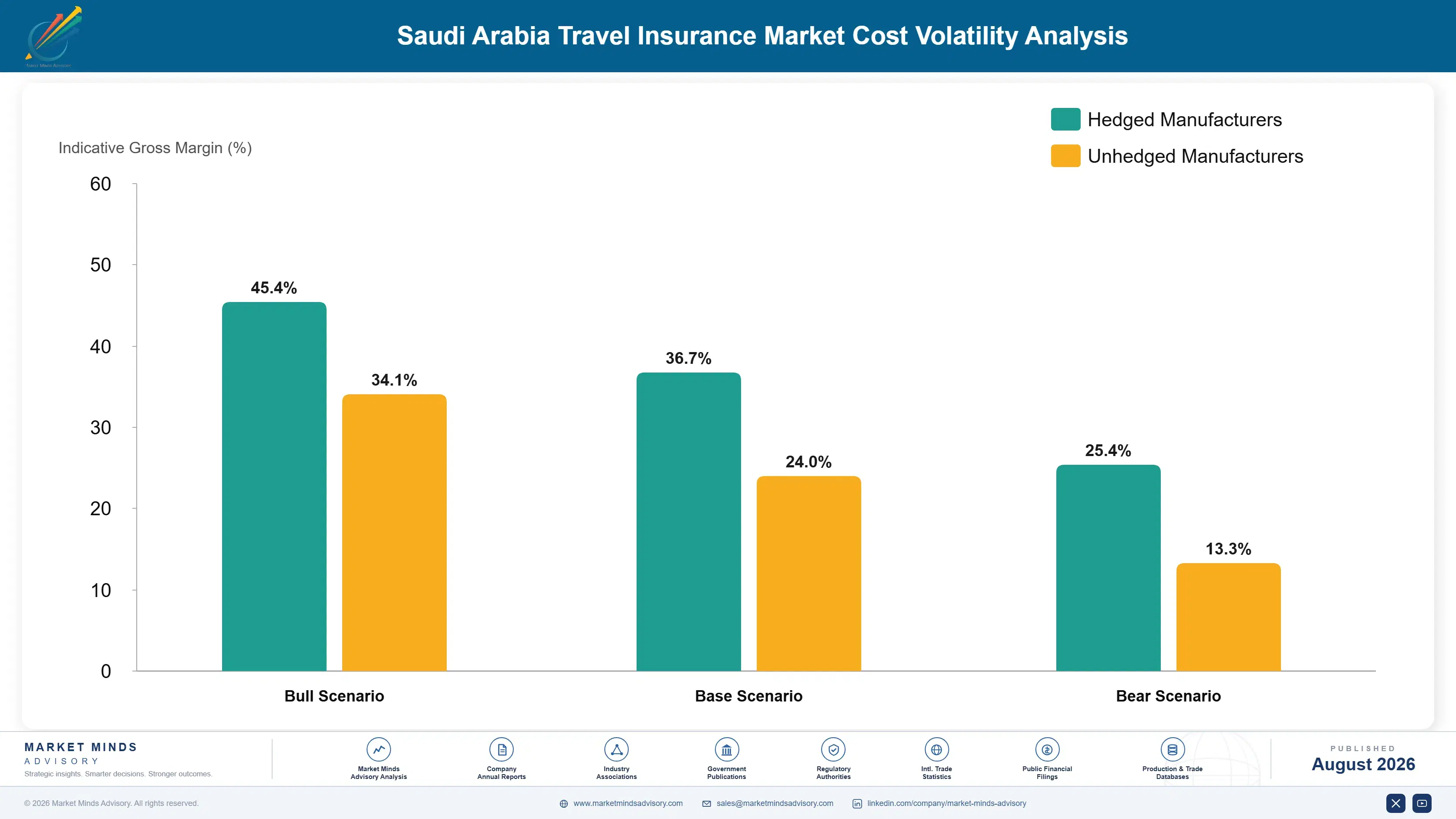
Claims payouts and distribution commissions together account for roughly 79% of gross premium, with claims alone running 55% to 62% of premium depending on the pilgrimage, leisure, and adventure coverage mix an insurer writes. Airline and travel platform distribution commissions, concentrated among a handful of dominant global carriers and platforms, add another 14% to 20%, while underwriting and claims administration overhead account for the remaining share of collected premium.
Medical evacuation costs spiked meaningfully during 2023 as post-pandemic outbound travel volume rebounded faster than remote-region medical infrastructure could scale to meet demand, particularly across adventure and high-altitude pilgrimage corridors. The IEA's broader fuel cost data for the period indicates air ambulance and evacuation transport costs tracked aviation fuel price volatility closely, since evacuations rely on chartered aircraft priced against fuel benchmarks that shifted considerably.

Insurers without dedicated evacuation and claims network relationships absorb this cost volatility more directly than insurers with established regional partnerships, since open-market evacuation sourcing carries meaningfully higher per-incident cost than pre-negotiated network rates. Insurers relying heavily on airline and platform distribution also carry additional margin exposure since commission structures compress underwriting economics regardless of claims performance, an exposure varying by distribution mix.
saudi-arabia-travel-insurance-market-cost-volatility-analysis-1787914080510

Build Direct And Diversified Distribution Channels

Insurers relying purely on airline and platform commission-based distribution face compressed margin regardless of underwriting quality. Building direct-to-consumer and corporate travel program channels, even at higher upfront marketing investment, secures margin stability independent of platform commission structures that keep rising as distribution concentration increases. This shift secures margin control platform-dependent competitors cannot easily replicate.

Secure Pre-Negotiated Evacuation Network Rates

Securing pre-negotiated evacuation and medical network rates ahead of claims volume growth, rather than sourcing evacuation reactively on the open market, is what let larger insurers limit the worst of the 2023 evacuation cost spike while smaller competitors absorbed the full increase directly and immediately. The premium paid for network access is real, but cheaper than uncontrolled evacuation cost inflation.

Invest In Destination-Specific Actuarial Pricing

Flat-rate leisure pricing systematically misprices adventure and high-altitude risk, and insurers investing in destination-specific actuarial models can price these segments more accurately than competitors relying on broad category averages. Early investment in this pricing capability compounds into a durable underwriting advantage over time. Competitors delaying this investment risk falling behind on pricing precision as claims experience data accumulates against them.

Portfolio Architecture for Margin Defence

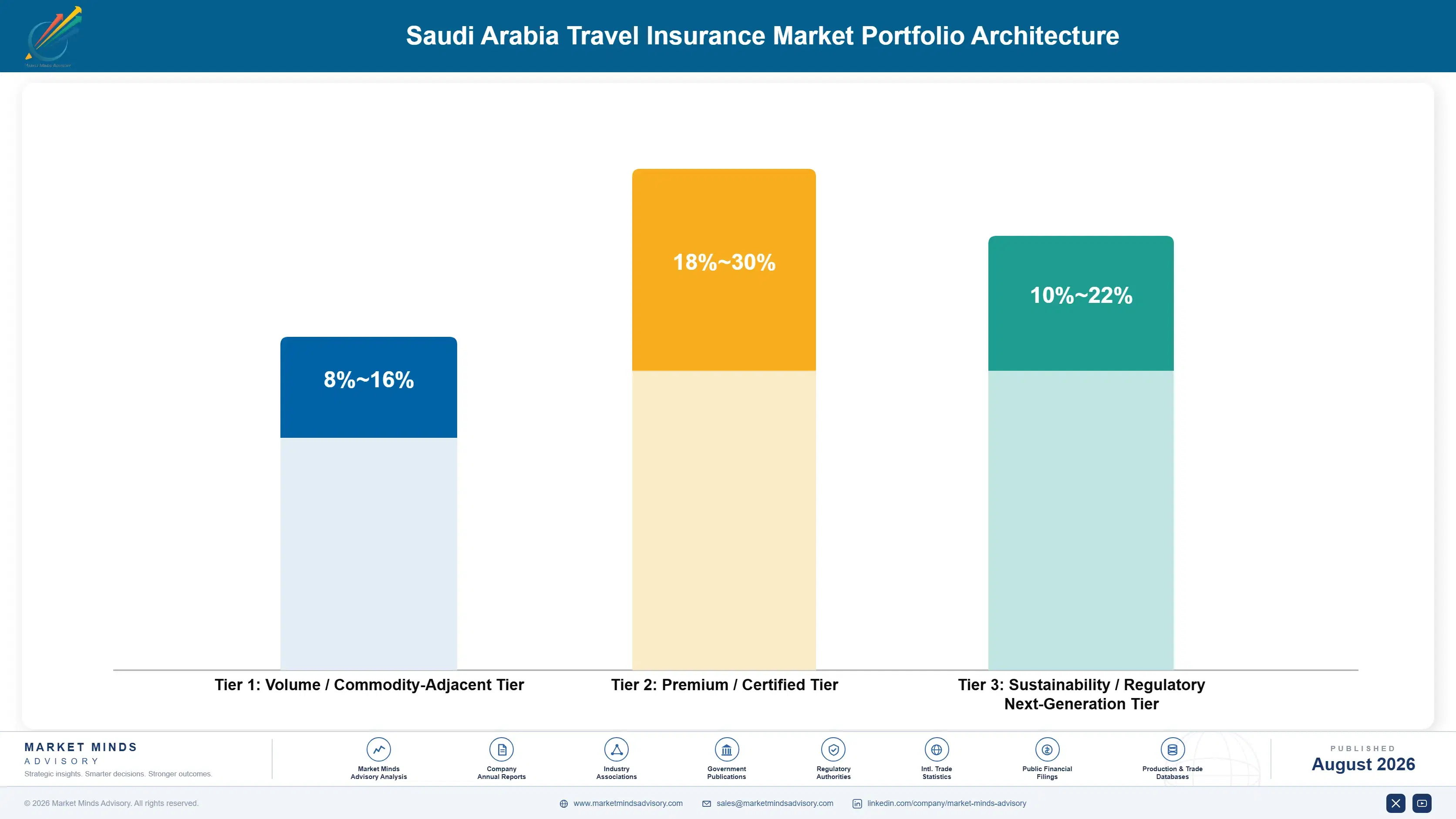
The portfolio splits into three tiers with meaningfully different margin economics. Volume standard leisure and business travel coverage, sold through commodity distribution partnerships, competes on price and platform placement, earning modestly. Pilgrimage-linked and certified coverage earns substantially more because mandatory demand and licensing barriers insulate margin from open competition. Adventure and high-altitude specialty coverage sits in a third tier carrying strong margins as destination-specific underwriting expertise drives durable competitive positioning against generalist competitors.
The tension runs between volume and pricing sophistication. Standard leisure coverage generates the policy volume that keeps distribution partnerships attractive to platform partners, but margin stays thin since commission structures compress underwriting economics regardless of claims performance. Pilgrimage and adventure coverage carry the opposite constraint: strong margins but a narrower addressable population defined by licensing access and actuarial expertise rather than broad platform reach.

High-value margin pools concentrate wherever regulatory-mandated demand meets limited competitive entry, which is precisely why pilgrimage specialists have historically outearned standard leisure insurers despite serving a smaller addressable population. Pilgrimage-linked coverage carries the most immediate upside right now, driven by genuine mandatory demand growth rather than organic tourism recovery alone.

Volume / Commodity-Adjacent Tier

Standard single-trip leisure and business travel coverage sold through airline and platform distribution partnerships, competing primarily on checkout placement and commission terms against a crowded field of global providers. The range reflects varying commission structures across different distribution partners.
Gross Margin: 8-16%

Premium / Certified Tier

Pilgrimage-linked and licensed corridor coverage requiring regulatory approval and established claims infrastructure, sold through direct government-coordinated channels where licensing barriers insulate margin from open competition entirely. The wide range reflects licensing maturity differences between established and newly entering providers in each corridor.
Gross Margin: 18-30%

Sustainability / Regulatory / Next-Generation Tier

Adventure and high-altitude specialty coverage still working through destination-specific actuarial model development before consistent, predictable underwriting returns become fully achievable across all corridors. The wide range reflects claims severity variance across destinations rather than a single underwriting weakness industrywide.
Gross Margin: 10-22%
saudi-arabia-travel-insurance-market-portfolio-architecture-1787914081009

High-value Sub-segments and Strategic Watch-out

Single-Trip Umrah and Hajj Travel Insurance

The fastest-growing and highest-value segment, driven directly by mandatory visa coverage requirements. Tawuniya and Bupa Arabia both draw early advantage from licensing depth, and margin expansion continues as claims infrastructure investment amortizes across growing policy volume. Insurers entering this corridor later face meaningfully steeper licensing barriers.
Gross Margin: 18-30%

Adventure And High-Altitude Travel Insurance

Strong margins on destination-specific underwriting expertise, growing steadily as adventure tourism expands globally. Growth trails pilgrimage coverage because adventure segment demand growth moves more gradually than the acute mandatory-coverage transformation forcing faster movement elsewhere. Actuarial investment here compounds into durable pricing advantage over less sophisticated competitors.
Gross Margin: 10-22%

Single-Trip Leisure and Business Travel Insurance

The volume core of the category, generating the bulk of policy count at stable, moderate margins. Allianz Partners, AIG Travel, and Chubb compete intensely here on distribution reach, and while policy growth stays healthy, margin expansion is limited by established dynamics. Distribution partnership depth increasingly determines who wins volume here.
Gross Margin: 8-16%

Platform-Commission-Dependent Commodity Business

The strategic watch-out. Distribution commission inflation and platform consolidation threaten margin sustainability for insurers without differentiated licensing or claims capability, facing rising acquisition cost and margin compression as platform bargaining power increases across the category. Insurers without licensing differentiation face the steepest margin erosion in this tier.
Gross Margin: 0-14%

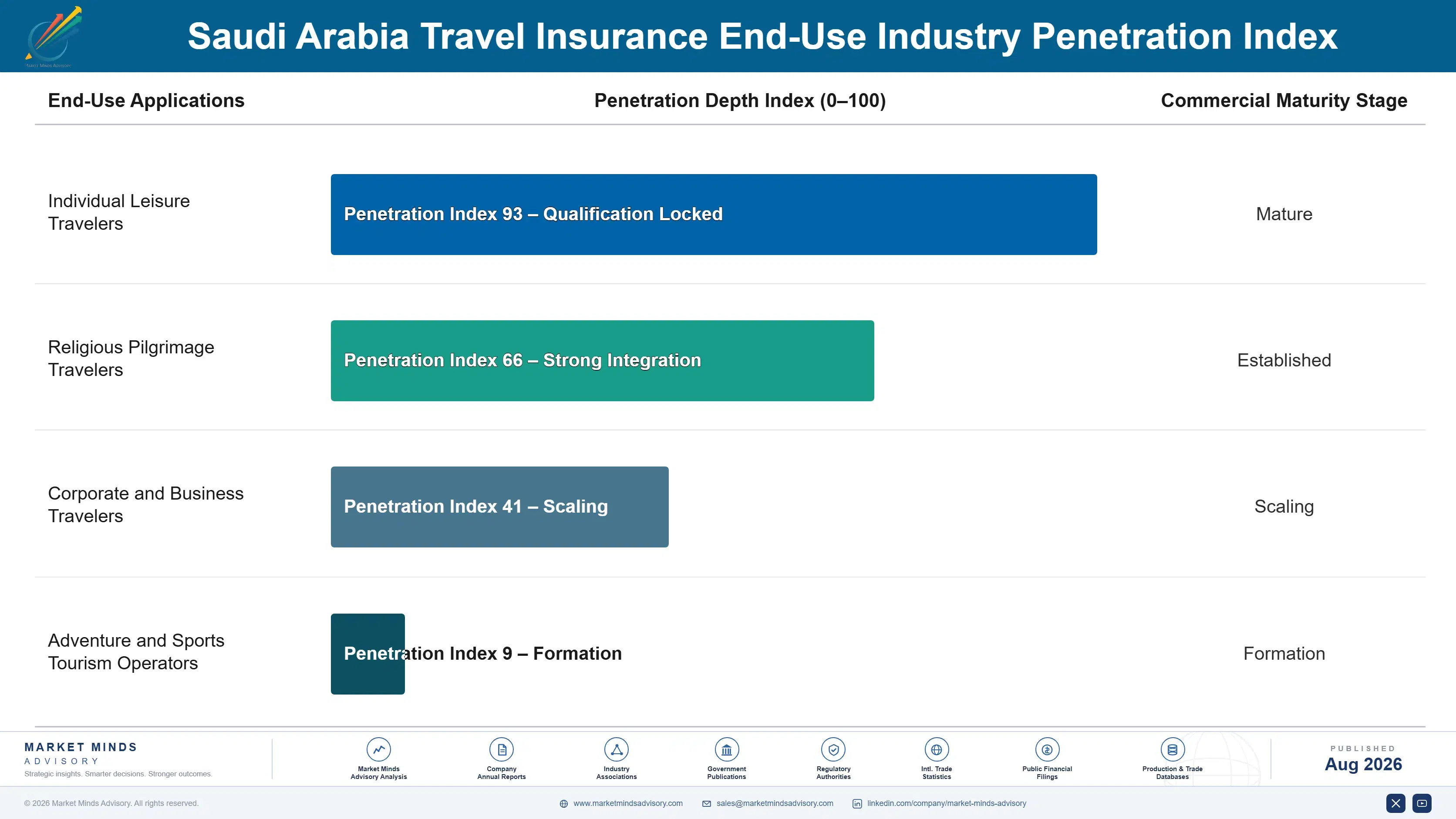
Mandatory Demand And Trip Frequency

Travel insurance runs on trip-triggered rather than annual renewal economics for most segments, which makes distribution placement at the moment of booking the single biggest lever on volume. A policy embedded into checkout captures far more purchases than one requiring active research, since travelers rarely seek out standalone coverage unless a visa or corridor rule requires it. Saudi Arabia's mandatory pilgrimage coverage converts what elsewhere is discretionary into a recurring demand stream tied to visa cycles.
Stickiness varies by segment and purchase context. Pilgrimage travelers show limited brand loyalty within a given trip but return to the same licensed providers across repeat pilgrimage cycles, since Ministry coordination steers volume toward approved insurers consistently. Platform-embedded leisure travelers show almost no loyalty at all, since the checkout default rather than genuine preference drives most purchases. Corporate program relationships run deepest, anchored in multi-year contracts.

Younger travelers now expect insurance offered automatically during digital booking rather than as a separate purchase decision, a meaningful shift from buyer expectations even a decade ago. This generational shift favors insurers with mature platform integration already built, while insurers relying on traditional broker distribution face a widening gap with each new digitally native cohort.
saudi-arabia-travel-insurance-market-end-use-penetration-index-1787914081535

How Travel Insurers Should Compete Next

These are among the four positions where our research anticipates prominent divergence between winners and laggards over the coming forecast period. Each is grounded in the demand model, the regulatory perimeter, and the announced capacity pipeline.
01 / DISTRIBUTION PARTNERSHIP DEPTH

Secure exclusive airline and platform checkout placement early

Embedded checkout placement is proving to be the single most powerful acquisition channel travel insurance has ever had, converting passive booking flow into active policy attach at a rate no standalone marketing campaign can approach. Insurers securing exclusive or preferred placement with major carriers and platforms now will lock in volume advantages that later entrants attempting to negotiate similar arrangements will find considerably harder to replicate. Waiting for competitive pressure to force the move means starting from a materially weaker negotiating position than movers acting today.
02 / PILGRIMAGE CORRIDOR LICENSING

Build dedicated Saudi Arabia licensing and claims infrastructure now

Mandatory pilgrimage coverage represents a demand mechanism with no direct parallel anywhere else in global travel insurance, and insurers without established licensing in this corridor are missing the category's single fastest-growing and highest-margin segment entirely. Building dedicated infrastructure and government relationships takes years, so insurers starting now will be positioned well ahead of competitors still evaluating whether the investment is worthwhile at all. This corridor rewards patience and regulatory relationship building over pure speed to market, since Ministry coordination favors established, trusted partners.
03 / DESTINATION-SPECIFIC PRICING MODELS

Replace flat-rate adventure pricing with destination-specific actuarial models

Flat-rate leisure pricing systematically underprices adventure and high-altitude risk, leaving meaningful margin on the table for insurers willing to invest in destination-specific actuarial capability that most competitors in this category still clearly lack today. This precision advantage compounds with every single claims cycle that competitors continue pricing adventure risk using broad category averages rather than granular destination-level data instead. Insurers building this capability now will outprice flat-rate competitors on both margin and claims accuracy within just a few underwriting cycles going forward.
04 / CLAIMS TECHNOLOGY INVESTMENT

Acquire or build parametric claims automation before insurtechs scale further

Parametric flight delay and cancellation products are gaining traveler preference specifically because they bypass the slow reimbursement processes that have long frustrated policyholders across nearly every traditional travel insurance claim. Established insurers that acquire or build comparable claims automation capability now will defend share against insurtech challengers built natively around this faster claims experience from day one. Insurers treating this as a distant threat rather than an urgent capability gap risk losing meaningful share within just a few short years ahead.

Engagement Snapshot From the Field

A live engagement with an industry participant carrying material or product regulatory and market exposure ahead of a defining policy shift, showing how our research translates into a defensible multi-year portfolio strategy.
MARKET MINDS ADVISORY · CLIENT ENGAGEMENT SUMMARY
Saudi Arabia Travel Insurance Producer Strategic Portfolio Review and Transition Roadmap 2026·Investment Scenario on Saudi Arabia Travel Insurance Exposure Evaluation 2025-26
CLIENT PROFILE
A mid-sized Gulf-region travel assistance provider with an established leisure and business travel insurance book but no dedicated pilgrimage corridor licensing. The client had observed competitors capturing significant volume through Saudi Arabia's mandatory umrah and hajj coverage requirements and wanted an independent assessment of entry feasibility. Leadership sought clarity before committing capital. The client operated primarily through traditional broker channels across the wider Gulf region.
STRATEGIC CHALLENGE
The client needed to determine whether pursuing dedicated pilgrimage corridor licensing was commercially justified given the multi-year infrastructure investment required, or whether partnership with an already-licensed insurer offered a faster, considerably lower-risk path to capturing this fast-growing, mandatory-coverage-driven segment of the broader travel insurance category. Timing mattered given how quickly established competitors were expanding their own corridor presence.
MMA APPROACH
MMA benchmarked licensing timelines and infrastructure investment against comparable regional providers, modeled margin economics under both direct licensing and partnership scenarios, and assessed competitive positioning against Tawuniya and Bupa Arabia's established corridor presence over a multi-week engagement involving stakeholder interviews and financial modeling. Findings were presented directly to the client's executive leadership team for final decision.
KEY FINDINGS
  1. Direct licensing timelines averaged 18 to 24 months from application to full operational capability across comparable regional providers (client-reported, unverified by MMA).
  2. Partnership arrangements with already-licensed insurers reportedly captured 60% of direct licensing margin at roughly one-third the upfront infrastructure investment (client-reported, unverified by MMA).
  3. Claims network gaps in secondary pilgrimage cities represented the most significant infrastructure barrier identified during the assessment (client-reported, unverified by MMA). Addressing it would require either direct investment or a partner with existing regional coverage.
  4. Modeling indicated partnership entry could reach positive contribution margin within 8 to 10 months versus 30 months or more for direct licensing (client-reported, unverified by MMA).
CLIENT PROFILE
A mid-sized Gulf-region travel assistance provider with an established leisure and business travel insurance book but no dedicated pilgrimage corridor licensing. The client had observed competitors capturing significant volume through Saudi Arabia's mandatory umrah and hajj coverage requirements and wanted an independent assessment of entry feasibility. Leadership sought clarity before committing capital. The client operated primarily through traditional broker channels across the wider Gulf region.
STRATEGIC CHALLENGE
The client needed to determine whether pursuing dedicated pilgrimage corridor licensing was commercially justified given the multi-year infrastructure investment required, or whether partnership with an already-licensed insurer offered a faster, considerably lower-risk path to capturing this fast-growing, mandatory-coverage-driven segment of the broader travel insurance category. Timing mattered given how quickly established competitors were expanding their own corridor presence.
MMA APPROACH
MMA benchmarked licensing timelines and infrastructure investment against comparable regional providers, modeled margin economics under both direct licensing and partnership scenarios, and assessed competitive positioning against Tawuniya and Bupa Arabia's established corridor presence over a multi-week engagement involving stakeholder interviews and financial modeling. Findings were presented directly to the client's executive leadership team for final decision.
KEY FINDINGS
  1. Direct licensing timelines averaged 18 to 24 months from application to full operational capability across comparable regional providers (client-reported, unverified by MMA).
  2. Partnership arrangements with already-licensed insurers reportedly captured 60% of direct licensing margin at roughly one-third the upfront infrastructure investment (client-reported, unverified by MMA).
  3. Claims network gaps in secondary pilgrimage cities represented the most significant infrastructure barrier identified during the assessment (client-reported, unverified by MMA). Addressing it would require either direct investment or a partner with existing regional coverage.
  4. Modeling indicated partnership entry could reach positive contribution margin within 8 to 10 months versus 30 months or more for direct licensing (client-reported, unverified by MMA).
RECOMMENDED STRATEGY
Phase 1: Phase one: pursue a partnership arrangement with an established licensed insurer to capture near-term volume with minimal upfront infrastructure investment. Phase 2: Phase two: build claims network relationships in secondary pilgrimage cities identified as the most significant coverage gap during assessment. This addresses the primary infrastructure gap identified during assessment. Phase 3: Phase three: evaluate direct licensing once partnership volume and margin data justify the larger infrastructure investment required. This evaluation should occur only after partnership performance data becomes available for comparison.
OUTCOME
The client proceeded with a partnership arrangement rather than pursuing direct licensing immediately. Early volume through the partnership channel reportedly exceeded initial projections within the first two quarters, and the client has since begun preliminary evaluation of direct licensing for a future phase (client-reported, unverified by MMA).

Frequently Asked Questions

Foundational context covering the market sizes, CAGR, scope, country, region and competition that inform every finding below. This section is provided to cover basics and most often pre-purchase conversations, answered from the MMA Primary Research Dataset.

What is the current size of the Saudi Arabia Travel Insurance Market?

The Saudi Arabia Travel Insurance Market reached an estimated $24.5 billion globally in 2025. This figure reflects total premium across single-trip, pilgrimage-linked, and commercial travel coverage segments.

How large will the Saudi Arabia Travel Insurance Market be by 2036?

MMA projects the market will reach approximately $80.3 billion by 2036, an expansion of roughly 2.94 times its 2026 base level over the decade-long forecast window.

What is the CAGR for the Saudi Arabia Travel Insurance Market 2026 to 2036?

The base case CAGR is 11.4% annually, with a bull scenario near 12.7% and a bear scenario near 10.1% depending on mandatory coverage enforcement trends.

Which segment is growing fastest?

Single-Trip Umrah and Hajj Travel Insurance leads at a 17.8% CAGR, roughly 1.56 times the overall market rate, driven by Saudi Arabia's mandatory pilgrimage visa coverage requirements.

Who are the major companies in the Saudi Arabia Travel Insurance Market?

Leading participants include Allianz Partners, AIG Travel, Chubb, AXA Partners, and Tawuniya. Combined market concentration among the top five insurers sits at roughly 38% of total premium.

Which country is growing fastest?

Saudi Arabia leads country-level growth at a 16.5% CAGR, reflecting Vision 2030 tourism expansion and mandatory umrah and hajj visa coverage requirements pulling in millions of new travelers.

Report Segmentation Architecture

The full report scope spans multiple orthogonal segmentation dimensions, with cross-tabulated demand data provided for each dimension pair. Coverage extends further to regional breakdowns, trend trajectories, and the competitive detail needed to support segment-level decision-making.

By Primary Market Dimension

  • Single-Trip Leisure and Business Travel Insurance
  • Single-Trip Umrah and Hajj Travel Insurance
  • Annual Multi-Trip Travel Insurance
  • Adventure and High-Altitude Travel Insurance
  • Commercial and Group Travel Insurance

By End-Use Industry

  • Individual Leisure Travelers
  • Religious Pilgrimage Travelers
  • Corporate and Business Travelers
  • Adventure and Sports Tourism Operators

By Commercial Dimension

  • Airline and Travel Platform Embedded Distribution
  • Direct-to-Consumer Distribution
  • Broker and Agent Distribution
  • Visa Processing and Government Channel Distribution

By Region

  • North America
  • Western Europe
  • East Asia
  • South Asia and Pacific
  • Latin America
  • Middle East and Africa
  • Eastern Europe

Scope, Methodology, and Coverage

Every figure in this report is reproducible from documented input assumptions. The scope below maps the historical period, the forecast horizon, the segmentation dimensions, and the countries covered, alongside the underlying primary and qualitative methodology.
Historical Period
2020 to 2025
Forecast Period
2026 to 2036
Base Year
2025 (USD billions; MMA Primary Research Dataset, August 2026)
Market Definition
This report covers travel insurance premium written for single-trip, annual multi-trip, and mandatory pilgrimage and visa-linked coverage sold to outbound and inbound travelers globally. It excludes standalone medical tourism insurance, domestic health coverage, and airline-embedded flight delay compensation products not sold as standalone insurance policies.
Quantitative Units
USD billions
Segmentation Dimensions
Regions Covered
North America, Western Europe, East Asia, South Asia and Pacific, Latin America, Middle East and Africa, Eastern Europe
Countries Covered
Key Companies Profiled
Allianz Partners, AIG Travel, Chubb, AXA Partners, Tawuniya, Bupa Arabia, Zurich Insurance Group, Generali Global Assistance, Europ Assistance, Assicurazioni Generali, Mapfre Asistencia, Sompo Japan Insurance, Tokio Marine Nichido, HDI Global, IMG Global, Seven Corners, World Nomads, Berkshire Hathaway Travel Protection, Aon Affinity, Cover Genius
Quantitative Methodology
Primary survey, n=3,800 respondents, Q4 2025, six countries; demand-side model with trade association cross-validation
Qualitative Methodology
47 expert interviews, Q4 2025; applied to validate demand model assumptions, identify emerging dynamics, and assess competitive positioning
Report Format
PDF and XLSX data workbook (Word format preview document)
Publisher
Market Minds Advisory
Report Code
MMA-2026-TEC-207
Published
August 2026
Contact
sales@marketmindsadvisory.com | www.marketmindsadvisory.com

Purchase the full Saudi Arabia Travel Insurance Market Report (2026 to 2036).

This report delivers a complete assessment of the Saudi Arabia Travel Insurance Market, covering market sizing, segmentation, regional dynamics, and competitive positioning through 2036. It examines how Vision 2030 tourism growth and mandatory pilgrimage coverage requirements are reshaping distribution and underwriting economics across the category. The analysis draws on primary survey data, expert interviews, and company disclosures to quantify segment-level growth and margin dynamics. Readers gain a data-grounded view of where competitive advantage is shifting and which strategic moves matter most over the coming decade.
Ten-year market sizing and CAGR forecast
Segment-level growth and margin economics analysis
Regional demand mechanism and driver breakdown
Competitive landscape and moat durability assessment
Claims and distribution cost exposure review
Strategic verdict and revenue lever guidance

Built For The People Who Decide

From boardroom strategy to bench-side execution, this report is read cover-to-cover by leaders shaping the next decade of their industry, turning demand scenarios, market dynamics and valuation benchmarks into decisions.
CXOs/ Presidents/ VPs/ Managers
M&A and Corporate Development
Strategy Teams and R&D Heads
Procurement and Product Directors
Regulatory and Compliance Leaders
Investor Relations and Equity Analysts