Market Minds Advisory
Saudi Arabia Buy Now Pay Later Services Market

Saudi Arabia Buy Now Pay Later Services Market: Vision 2030 and the Gulf Digital Payments Shift

Saudi Arabia's Vision 2030 cashless economy targets are pulling a young, digitally native population toward installment checkout financing faster than regulators can formalize licensing, while global providers race Gulf-native challengers for the same first-time borrowers.

Lead Analyst

Published

September 2026

Make Smarter Decisions with Customized Research Insights

Request a free sample report and evaluate market opportunities, growth trends, and competitive dynamics relevant to your business needs.

2025 MARKET VALUE$425.0BMarket Size 2025
2036 FORECAST VALUE$2134MBase Case , 2026 to 2036
CAGR 2026 TO 203615.8 %Bull 17.1% / Bear 14.5%
INCREMENTAL OPPORTUNITY$1642MNet 10- year value creation
EXPANSION MULTIPLE4.34x2036 value over 2026 base
Strategic Levers
M&A Pipeline
Regional Outlook
Country Rankings
Competitive Intelligence
Segmental Deep-dive
Call-Us : 91 93563 13602

Executive Snapshot and Market Trajectory

Buy now pay later is converting financing from an alternative into default infrastructure. Saudi Arabia's cashless economy targets are pulling a young population toward financing faster than most markets, regulators are racing to formalize licensing frameworks behind explosive growth, and global providers are competing against Gulf-native challengers for first-time borrowers.
Longer-term installment financing leads growth at 19.5% annually, nearly 1.2 times the market average, as providers extend beyond simple four-payment splits into bigger-ticket electronics and furniture financing. B2B BNPL follows closely on trade credit digitization. East Asia holds the largest regional share at 28%, driven by China's massive digital installment volume that dwarfs every other single region's transaction scale by a wide margin.
Competitive intensity concentrates around merchant integration depth and underwriting sophistication rather than brand recognition alone, since checkout conversion and default management increasingly separate profitable providers from growth-chasing ones. Tabby and Tamara command Gulf-native merchant relationships and regulatory credibility, but global providers like Klarna and Affirm hold underwriting scale and capital access that regional challengers have not matched, keeping Saudi Arabia's fastest-growing segments genuinely contested despite consolidation pressure across the broader BNPL industry.
Market Definition
The buy now pay later services market covers short-term and installment financing products offered at the point of sale, both online and in-store, that let consumers split purchases into scheduled payments, including pay-in-4 plans, deferred payment products, longer-term installment financing, and B2B trade credit, measured by gross transaction value processed globally. It excludes traditional credit cards, personal installment loans originated outside a point-of-sale checkout context, and layaway programs that require full payment before goods are delivered.
Base Year Value
$425.0B in 2025 (MMA Primary Research Dataset, August 2026)
Forecast Period
2026 to 2036, eleven discrete annual values
CAGR
15.8% base case. Bull 17.1%. Bear 14.5%.
Fastest Growth Segment
Longer-Term Installment Financing: 19.5% CAGR
Fastest Growth Country
Saudi Arabia: 22.5% CAGR
Fastest Growth Region
South Asia and Pacific: 17.9% CAGR
Largest Region
East Asia: 28% of 2025 global value
Market Leaders
Klarna Bank AB, Affirm Holdings Inc., Block Inc. (Afterpay), Tabby, Tamara. Source: MMA Analysis based on company annual reports.
Primary Survey
n=3,800 procurement and R&D decision-makers, Q4 2025, six countries
Methodology
Demand-side build-up, cross-validated against public data, 47 expert interviews

Saudi Arabia Buy Now Pay Later Services Market Forecast Scenarios

saudi-arabia-buy-now-pay-later-services-market-size-forecast-scenario-1787914059021
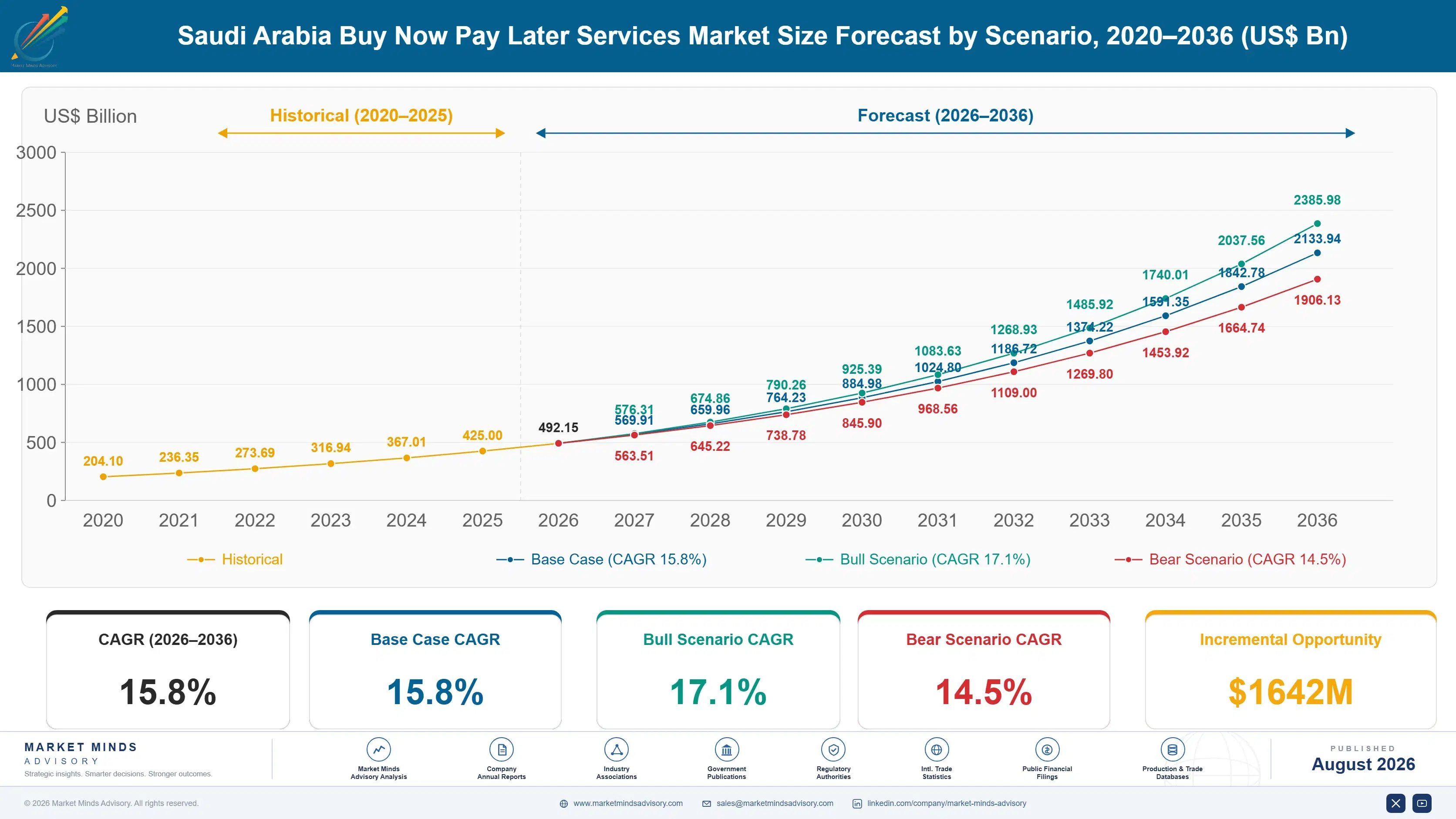
Between 2020 and 2025 the market grew at an estimated 14.6% annually, accelerated early by pandemic-era e-commerce growth that pulled first-time users toward digital checkout financing, then sustained from 2022 onward as merchant integration expanded across new retail categories independently of pandemic-driven online shopping behavior. Growth stayed concentrated in pay-in-4 and deferred payment products through most of the period, with longer-term installment financing scaling more slowly from a smaller base.
The base case carries the market to 15.8% CAGR through 2036 on three mechanisms. Saudi Arabia's Vision 2030 cashless economy targets keep pulling first-time users toward digital checkout financing at a pace few markets can match. Merchant adoption keeps expanding across retail categories as BNPL integration proves it lifts conversion rates and average order values. Regulatory licensing frameworks keep formalizing across major markets, converting BNPL from an unregulated novelty into standard consumer credit infrastructure.
The bull case reaches 17.1% if Gulf state financial inclusion initiatives accelerate faster than currently projected across additional underbanked segments. The bear case falls to 14.5% if regulatory affordability requirements slow approval rates broadly, a pattern already visible in several 2024 and 2025 regulatory proposals across major BNPL markets during the current global regulatory cycle.

Regulatory Formalization Is Redrawing Who Can Compete

Three forces converge on this category. Regulatory licensing keeps expanding which providers can legally operate at scale, merchant integration keeps redrawing where consumers actually encounter financing options, and Gulf state cashless economy targets keep pulling first-time users into formal credit products at a pace few markets can match. Providers that treat these as three separate problems are already behind the ones treating them as one connected challenge.
MARKET CONCENTRATIONCR5: 24%Top five providers hold under a quarter of volume
AVERAGE MERCHANT FEE4.2% of GMVBlended merchant discount rate across major BNPL platforms
TOP TRANSACTION VOLUMEChina: 26%Single country supplies over a quarter of global volume
REPEAT USAGE RATE68%Share of active users completing more than one transaction
DEFAULT RATE2.4% of GMVShare of transaction value written off as uncollectible
REGULATORY COVERAGE SHARE41% of volumeTransactions processed under formal consumer credit licensing rules
Commercial character splits sharply between global scale players and Gulf-native challengers. Global providers like Klarna and Affirm compete on capital access and cross-border merchant relationships built over years of international expansion, while Tabby and Tamara compete on local regulatory credibility and merchant relationships built specifically for Gulf consumer behavior. The global tier offers capital depth, but the regional tier commands materially better local merchant trust and regulatory relationship capital.
Looking to 2036, three shifts matter most. Regulatory licensing will keep expanding across new markets regardless of who wins merchant mandates today, longer-term installment products will increasingly separate providers with genuine underwriting capability from simple four-payment operators, and B2B BNPL will become a genuine competitive battleground as providers compete on trade credit infrastructure rather than consumer checkout alone.
"Everyone still talks about BNPL like it's four interest-free payments. In Saudi Arabia specifically, the real growth is happening in longer installment plans for phones and furniture, and that's a completely different underwriting problem than splitting a USD 50 checkout."
Director, Digital Payments and Consumer Credit Practice · MMA Financial Technology Practice · August 2026

Market Trends

Vision 2030 Cashless Targets Accelerate BNPL Adoption

Saudi Arabia's Vision 2030 economic diversification program set a target for cashless transactions to reach 70% of all payments, and BNPL adoption has become one of the clearest beneficiaries of that policy push as consumers shift away from cash toward digital checkout financing. The Saudi Central Bank has supported fintech licensing to accelerate this transition, treating BNPL providers as a component of the kingdom's digital economy strategy rather than a niche financial product. Tabby and Tamara have both scaled within this policy tailwind, expanding merchant networks across retail categories that previously operated entirely on cash or traditional card payment.
Market Impact: Serves population skewing under 35
Regulatory Licensing Frameworks Formalize BNPL Oversight

The Saudi Central Bank introduced a formal BNPL licensing framework requiring providers to meet capital, disclosure, and affordability assessment requirements comparable to those governing traditional consumer credit products. This regulatory formalization follows a pattern set by the UK's Financial Conduct Authority and similar frameworks emerging across other major BNPL markets, closing a gap that let early providers operate with minimal consumer protection oversight. Providers that secured licensing early, including Tabby and Tamara, gained a genuine credibility advantage with merchants and consumers wary of unregulated financial products, while unlicensed competitors face effective exclusion from the formal market entirely.
Market Impact: Lifts conversion rates 15% at checkout

Market Opportunities and Growth Drivers

Young Population Drives Digital-First Credit Adoption

Saudi Arabia's population skews young, with a large majority under the age of 35, a demographic that has grown up with smartphones and digital payments as the default rather than an alternative to cash and traditional banking. This generation treats BNPL as a natural extension of digital shopping behavior rather than a novel financial product requiring explanation, accelerating adoption curves that took longer in markets with older average populations. Social media-driven shopping behavior, through platforms popular among younger Saudi consumers, integrates BNPL checkout options into the discovery-to-purchase journey, normalizing installment financing as a default rather than exceptional payment choice.
Market Impact: Adds 100% mandatory affordability checks

E-Commerce Growth Expands BNPL-Eligible Transaction Volume

Saudi Arabia's e-commerce sector has expanded as internet penetration and digital payment infrastructure mature, and every online transaction represents a potential BNPL opportunity that did not exist when shopping required in-person store visits and cash payment. E-commerce platforms report measurably higher conversion rates and average order values when BNPL options appear at checkout, giving merchants a commercial incentive to integrate financing regardless of their view on consumer credit expansion. Major regional and global e-commerce platforms operating in Saudi Arabia have integrated BNPL checkout options, embedding installment financing into retail infrastructure at a growing scale.
Market Impact: Compresses fees 50 to 100 bps

Market Restraints and Challenges

Regulatory Affordability Checks Slow Approval Rates

New SAMA licensing requirements mandate affordability assessments before approving BNPL transactions, a consumer protection measure that slows approval speed compared to the near-instant checkout experience that drove BNPL's consumer appeal. The root cause is a tradeoff: faster approval meant less affordability screening, and regulators concluded that consumer protection required accepting friction in exchange for reduced overextension risk. This has forced providers to redesign checkout flows to accommodate affordability checks without losing the instant approval feel that differentiated BNPL from credit applications. Providers are responding with pre-approval systems that run checks before checkout, preserving speed at the point of purchase.
Market Impact: Targets 70% cashless transaction share

Merchant Fee Pressure Compresses Provider Margins

Merchant discount rates, the fee BNPL providers charge merchants per transaction, have compressed as competition intensifies among providers seeking the same pool of major retail merchant partnerships across Saudi Arabia's retail sector. The root cause is competitive intensity: many providers are chasing merchant integration with the same retailers, giving merchants leverage that did not exist when BNPL was a checkout option. This has pushed smaller providers toward margins below their economics assumed, forcing consolidation among providers unable to sustain fee structures. Providers are responding by bundling services, including marketing placement and data insights, to justify merchant pricing beyond payment processing.
Market Impact: Requires licensing under 2024 SAMA framework
3 additional market trends, 3 additional growth drivers, and 3 additional restraints and challenges are covered in the full report. Contact sales@marketmindsadvisory.com to access the complete intelligence.

Segment CAGR and Growth Architecture

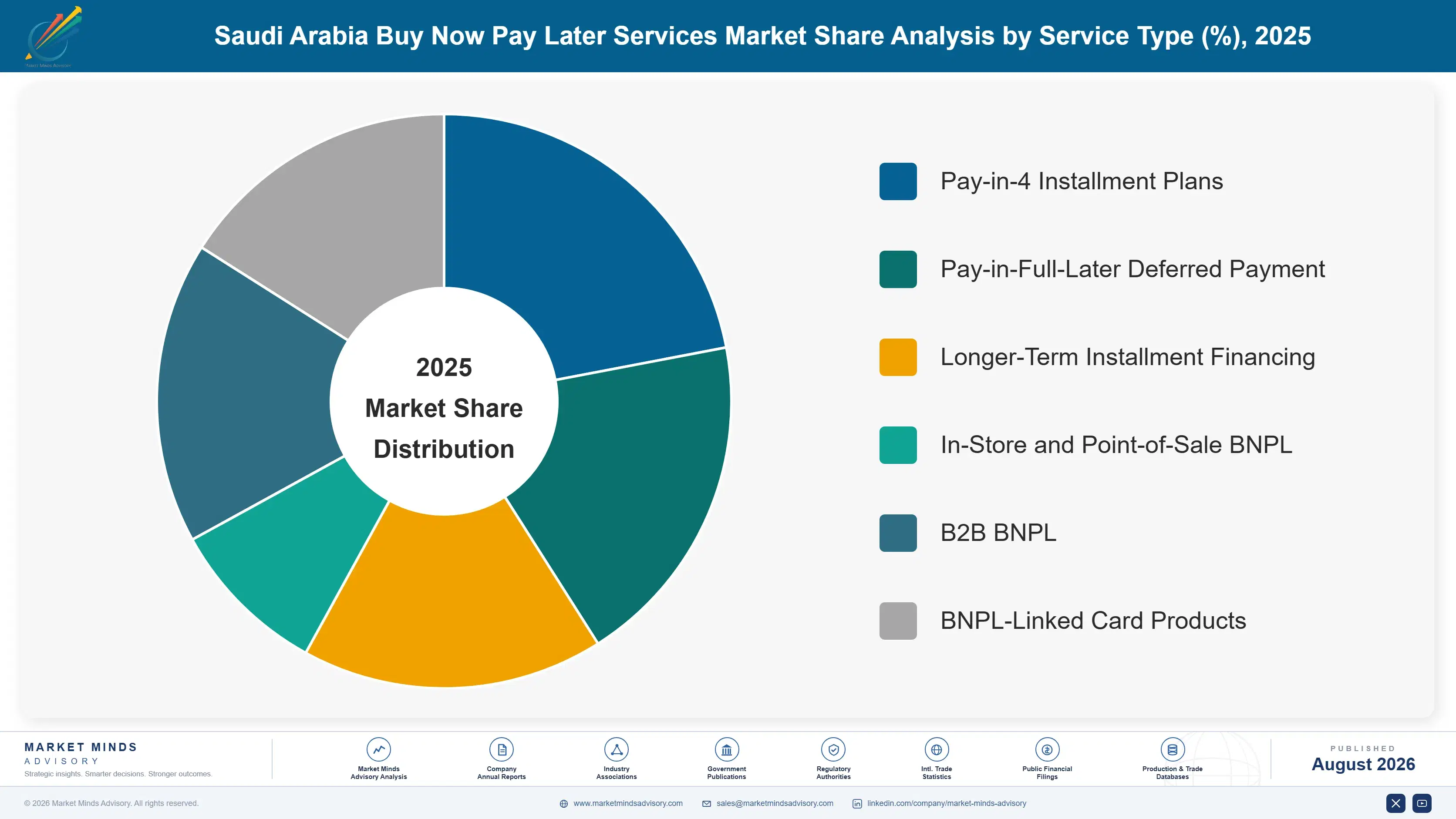
Segmentation follows service type, a single repayment-structure logic spanning pay-in-4 plans, deferred payment products, longer-term installment financing, in-store BNPL, B2B trade credit, and BNPL-linked card products. Each service carries distinct repayment structure, underwriting requirement, and merchant integration model, so commercial position tracks how the credit is structured and how default risk is assessed for each transaction.
saudi-arabia-buy-now-pay-later-services-market-market-share-analysis-1787914059557

Longer-Term Installment Financing

Longer-term installment financing grows fastest at 19.5% annually, nearly 1.2 times the overall market rate, as providers extend beyond simple four-payment splits into structured financing running six to thirty-six months for bigger-ticket purchases like electronics, furniture, and appliances. These products require more sophisticated underwriting than standard pay-in-4 plans, since longer repayment periods carry higher default risk and demand genuine credit assessment rather than simple checkout eligibility screening. Tabby and Tamara have both expanded into this category to capture higher-value transactions that simple short-term products cannot support, competing against traditional consumer finance companies entering the space. The segment's growth reflects merchant demand for financing options that support larger basket sizes beyond what four interest-free payments can cover.
CAGR 19.5%

B2B BNPL

B2B BNPL grows second-fastest at 17.2%, driven by small and medium business demand for trade credit that traditional supplier payment terms and bank financing have not served. These products let businesses defer payment on inventory and supply purchases, distinct from a consumer-facing checkout product, with underwriting based on business cash flow and transaction history rather than individual consumer credit signals. Providers have launched B2B offerings targeting Saudi Arabia's small and medium enterprise sector, recognizing that business financing needs differ from consumer checkout financing in structure and risk. This category remains earlier in its development than consumer BNPL but is scaling quickly as digital procurement adoption expands across the region. Early providers are educating businesses unfamiliar with digital trade credit.
CAGR 17.2%
Full segment breakdown across 6 segments available in the complete report.

Regional Architecture and Country Demand Map

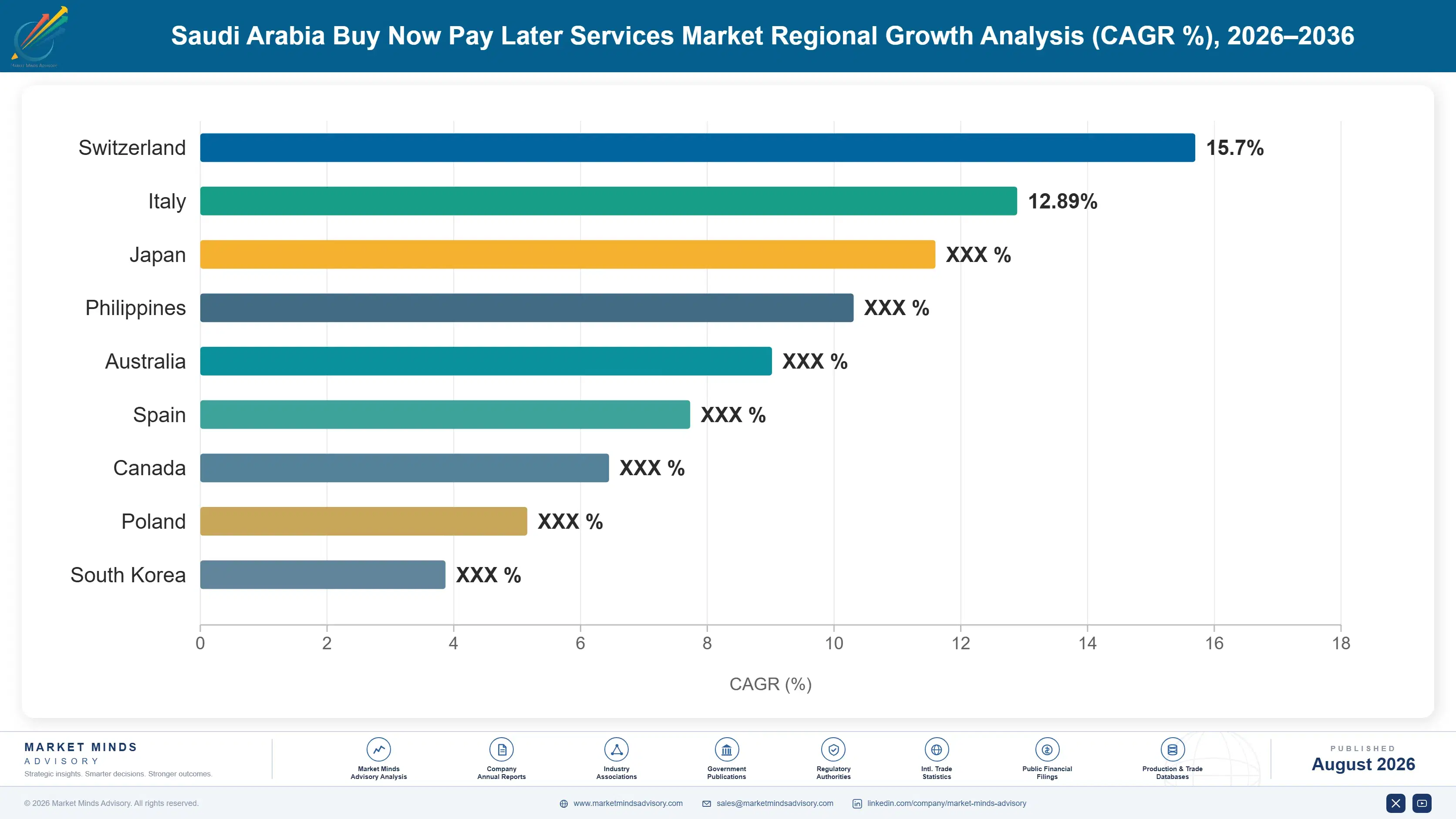
East Asia now leads on China's massive digital installment transaction volume, narrowly ahead of North America's large e-commerce-linked BNPL market. Western Europe follows on Klarna's established home market, while Middle East and Africa posts among the fastest regional growth as Saudi Arabia's cashless targets expand adoption rapidly.

North America

The United States drives most of North America's 24% share through massive e-commerce transaction volume, where Affirm and Klarna both built substantial merchant integration networks across major American retailers. Block's Afterpay acquisition consolidated significant market share under one of the region's largest payment companies, giving it distribution reach independent providers cannot match. Regulatory scrutiny from the Consumer Financial Protection Bureau has increased since 2022, pushing providers toward more standardized disclosure practices comparable to traditional credit products. Canada contributes a smaller, more conservatively regulated BNPL market with steadier adoption curves. Mexico's growing e-commerce sector adds further regional demand from a broader North American perspective. Growth of 14.8% reflects continued merchant category expansion even from an already substantial, mature base.
Share: 24% | CAGR: 14.8% (2026 to 2036)

Western Europe

Sweden anchors much of Western Europe's 22% share as Klarna's home market, where the company built its initial scale before expanding globally into dozens of additional countries. The UK's Financial Conduct Authority has moved to formally regulate BNPL products, a framework other European regulators are watching closely as a template for their own oversight approaches. Germany and France show steady growth in BNPL adoption tied to expanding e-commerce penetration and merchant integration. The EU's broader consumer credit directive increasingly brings BNPL products under regulatory frameworks comparable to traditional installment lending. Growth of 14.2% trails the global rate, consistent with a mature market where most growth now comes from product mix shift rather than new user acquisition.
Share: 22% | CAGR: 14.2% (2026 to 2036)
Regional intelligence for 5 additional markets available in the complete report: East Asia, South Asia and Pacific, Latin America, Middle East and Africa, Eastern Europe. Contact sales@marketmindsadvisory.com.
saudi-arabia-buy-now-pay-later-services-market-country-cagr-analysis-1787914060076

Where BNPL Margin Now Concentrates

Providers face a familiar tension: commodity pay-in-4 financing competes purely on merchant fee and approval speed, while longer-term underwriting and B2B trade credit increasingly carry the margin. The four moves below shift revenue toward defensible, harder-to-replicate positions instead of undifferentiated checkout financing, drawing on how leading providers already separate commodity economics from specialty and regulatory-credentialed lines.

Secure Regulatory Licensing Ahead Of Competitors

Providers that secure formal SAMA licensing ahead of competitors gain merchant and consumer trust that unlicensed providers cannot match, since regulatory credibility increasingly determines which providers major retailers will integrate at checkout. Tabby and Tamara's early licensing reportedly gave them a 20% to 30% faster merchant onboarding advantage over unlicensed competitors, since merchants increasingly require regulatory compliance as a condition of integration. Providers without licensing are ceding the fastest-growing formal merchant relationships to competitors willing to invest in the compliance infrastructure this category now requires, especially as major retailers standardize licensing checks before integration.
Market Impact: Captures 20% to 30% faster merchant onboarding overall

Expand Into Longer-Term Installment Financing Early

Simple pay-in-4 financing faces intensifying competition as more providers chase the same merchant partnerships, while longer-term installment products, serving bigger-ticket electronics and furniture purchases, face meaningfully less competitive pressure and command wider effective yield. Providers building dedicated longer-term underwriting capability now capture origination volume in categories running 300 to 500 basis points wider than comparable pay-in-4 economics, since sophisticated credit assessment remains genuinely scarce among BNPL-native providers. This category remains underpenetrated relative to consumer demand already visible, since many providers still treat pay-in-4 as the default product rather than the increasingly commoditized one.
Market Impact: Commands 300 to 500 bps wider yield overall

Build B2B Trade Credit Capability Early

Small and medium businesses represent a genuinely underserved financing population that consumer-focused BNPL providers have largely ignored, and providers building dedicated B2B trade credit capability now, ahead of the category maturing, capture first-mover positioning before increased competition drives up customer acquisition cost. Early movers gain merchant relationship capital across Saudi Arabia's substantial small and medium enterprise sector and time to build the underwriting expertise that competitors entering later cannot substitute for immediately. Providers waiting to see how B2B BNPL develops before investing are ceding first-mover positioning in what MMA models as a genuine multi-year category expansion worth building toward now.
Market Impact: Targets over 3 million underserved small businesses directly

License Underwriting Analytics To Smaller Providers

Providers that developed proprietary alternative-data underwriting models ahead of competitors hold capability that smaller regional providers now need but cannot develop independently within a reasonable timeframe. Licensing that analytics capability to non-competing regional providers, rather than only lending directly, can generate technology licensing revenue running 2% to 4% of the licensee's transaction volume at minimal marginal cost. This model is still emerging in BNPL but mirrors licensing approaches already established in adjacent financial technology categories, and rising regulatory demand for sophisticated risk assessment is creating exactly the concentrated need that makes licensing commercially attractive right now.
Market Impact: Generates 2% to 4% ongoing licensing revenue stream

Who Controls the Margin Pool

Concentration sits at a low 24% for the top five, evaluated on global BNPL gross transaction value processed across all service types. Klarna's scale gives it the largest single share, but the gap to Gulf-native specialists is narrower than CR5 implies, since Tabby, Tamara, and Zip each hold regional merchant integration depth diversified global platforms have not matched.
Competitive activity runs along three fronts. Regulatory credibility drives merchant trust, where licensed providers like Tabby and Tamara capture integration deals unlicensed competitors cannot secure. Underwriting sophistication drives longer-term product access, where providers with genuine credit assessment capability serve bigger-ticket financing that simple checkout screening cannot support. Capital access drives global expansion, where Klarna and Affirm fund cross-border merchant relationships that regional-only providers cannot replicate quickly.

Pressure is building from Saudi banks entering BNPL directly through digital subsidiaries, narrowing a market position pure-play fintech providers had claimed almost entirely during the category's early growth years. Global payment networks are also pushing further into installment financing themselves, compressing the space specialist providers once occupied alone. Rankings will likely shift toward providers that combine regulatory credibility with underwriting sophistication, since neither advantage alone secures the fastest-growing segments.
saudi-arabia-buy-now-pay-later-services-market-company-positioning-matrix-1787914060602

Competitive Moat and Risk Dimensions

TABBY

Moat: Gulf-Native Regulatory Credibility

Tabby's early SAMA licensing and Gulf-focused product design give it merchant trust and regulatory relationship capital that global providers entering the region cannot replicate quickly, backed by deep understanding of Saudi consumer credit behavior. Its established merchant network across major Saudi retailers provides distribution advantages newer regional entrants lack entirely.
TABBY

Risk: Limited Capital Versus Global Rivals

Tabby's funding base remains smaller than global competitors like Klarna and Affirm, potentially limiting its ability to fund longer-term installment products at the same scale as better-capitalized rivals during periods of rapid growth. International expansion beyond the Gulf region remains limited compared to global providers with established multi-country operations.
TAMARA

Moat: Deep Saudi Merchant Relationships

Tamara's extensive merchant network across Saudi Arabia's retail sector, built through early market entry and sustained local relationship investment, gives it checkout placement advantages that newer entrants cannot secure quickly. Its Sharia-compliant product structuring specifically addresses a consumer preference segment global providers have been slower to prioritize.
TAMARA

Risk: Regional Concentration Risk

Tamara's revenue remains heavily concentrated in Saudi Arabia and the broader Gulf region, leaving it more exposed than globally diversified competitors to any single regulatory change or economic slowdown within that specific market. Expanding beyond the region requires building merchant relationships and regulatory credibility essentially from scratch in each new market.

Players Tracked

Prominent Players

Klarna Bank AB
Affirm Holdings Inc.
Block Inc.
Tabby
Tamara

Other Key Players

PayPal Holdings Inc.
Zip Co Limited
Sezzle Inc.
Splitit Payments Ltd.
Openpay Group
Cashew Payments
Postpay
Souhoola
STC Pay
Alinma Bank
Al Rajhi Bank
Spotii
Fatura
ChargeAfter
Scalapay

Recent Developments

MAY 2025

Tamara Secures Expanded SAMA Licensing Approval

Tamara received expanded regulatory approval from the Saudi Central Bank covering longer-term installment financing products beyond its original pay-in-4 licensing scope. The approval was a regulatory licensing expansion, not a corporate transaction of any kind, corporate or otherwise, involving another company or investor of any type.
Signal: Signals Gulf regulators are formalizing oversight of longer-term BNPL products beyond simple checkout splits industrywide today.
NOVEMBER 2024

Tabby Raises Growth Funding Round

Tabby raised a significant growth funding round from international investors, valuing the company among the region's largest fintech startups and providing capital for continued Gulf expansion. The round was an equity funding raise, not an acquisition or merger of any kind or structure at all.
Signal: Signals international investor confidence in Gulf BNPL growth continues despite broader fintech funding caution elsewhere across the industry.
MARCH 2025

Klarna Signs Merchant Partnership With Major Saudi Retailer

Klarna signed a merchant integration partnership with a major Saudi retail chain, expanding its checkout presence directly into the kingdom's growing e-commerce and in-store retail sector. The agreement was a commercial merchant partnership, not a joint venture or equity investment of any kind whatsoever specifically.
Signal: Signals global BNPL providers are prioritizing direct Gulf market entry rather than acquiring regional players entirely at this stage.

Funding Cost And Default Provisioning Exposure

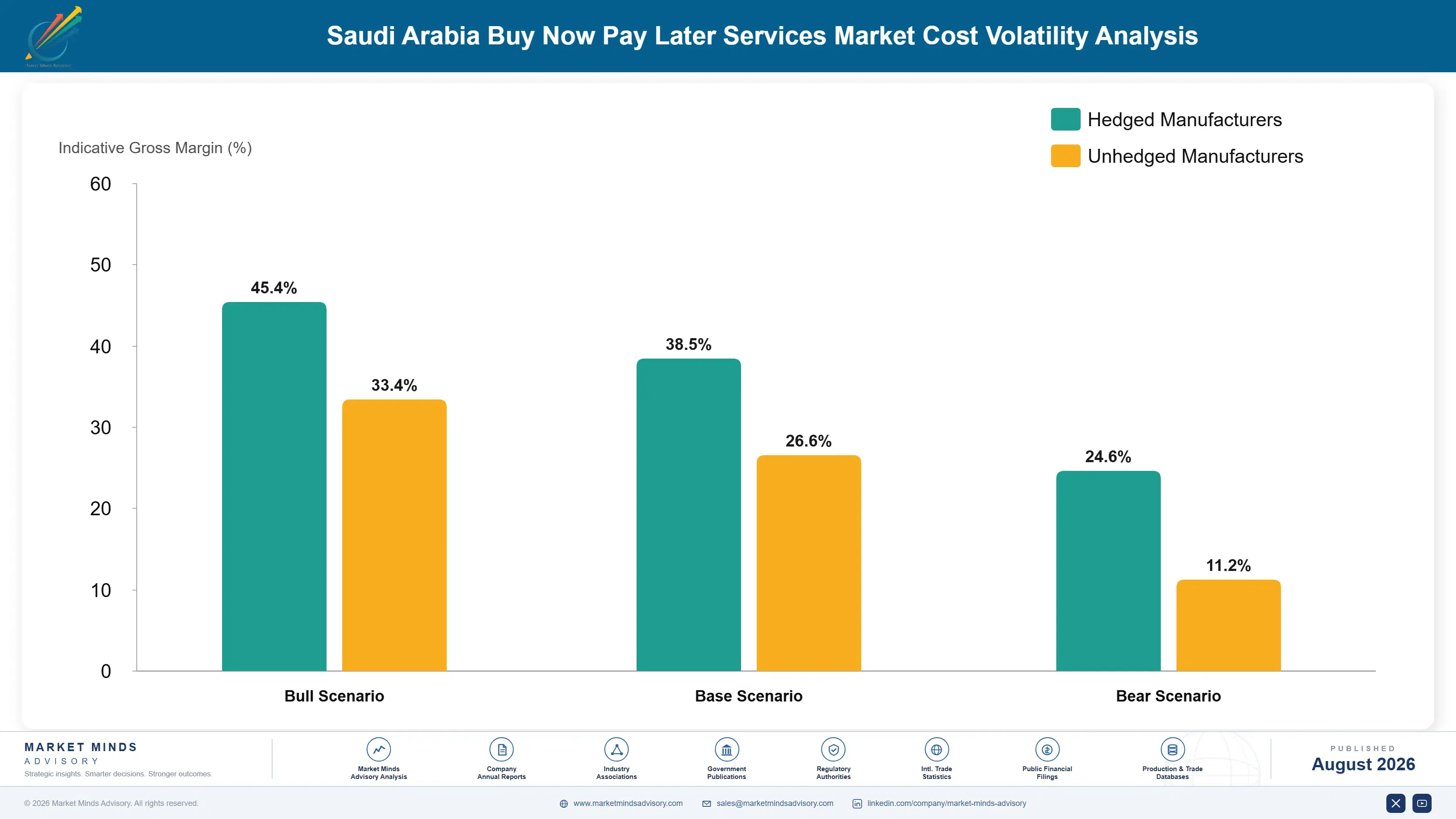
Cost of funds and default loss provisioning together account for roughly 46% of gross merchant fee and interest revenue, with default provisioning alone running 16% to 24% of revenue depending on approval standards within a given underwriting cycle. Cost of funds, tied to benchmark interest rates and provider funding structure, adds another 12% to 18%, while technology and merchant integration overhead account for the remaining share.
Rising interest rates since 2022 pushed provider funding costs higher across the BNPL industry, compressing economics for providers that had built business models around near-zero funding costs during the low-rate period. Affirm's fiscal year 2023 annual report disclosed elevated funding cost pressure across its installment lending segments. Default rates have risen since 2023 across several markets, pushing loss provisioning higher as providers tighten approval standards to manage risk.

Providers without diversified funding sources absorb rate volatility more directly, while Klarna and Affirm negotiate deposit-taking or diversified wholesale funding that smooths cost volatility across larger operating scale. Gulf-native providers relying on venture capital funding carry additional exposure since equity funding costs move differently than deposit or debt funding cycles. Providers without strong institutional banking relationships consistently trail on cost resilience during funding rate cycles.
saudi-arabia-buy-now-pay-later-services-market-cost-volatility-analysis-1787914060799

Diversify Funding Sources Beyond Venture Capital

Providers relying purely on venture capital funding face cost and availability volatility that deposit-taking or bank-partnered institutions largely avoid. Building or securing bank funding partnerships, even at higher regulatory compliance cost, secures funding cost stability independent of venture capital cycles that have nothing to do with underlying transaction performance, a gap that widens during funding downturns.

Tighten Approval Standards Ahead Of Default Cycles

Securing tighter approval standards ahead of a default cycle, rather than reacting once losses climb, is what let disciplined providers limit the worst of recent credit deterioration while growth-focused competitors absorbed the full loss impact directly. The volume given up on marginal approvals is real, but far cheaper than absorbing losses those approvals eventually generate.

Invest In Alternative-Data Risk Modeling

Traditional credit scoring misprices risk for the thin-file consumers common across Saudi Arabia's young population, and providers investing in alternative-data risk modeling can price these consumers more accurately than competitors relying on limited credit history alone. Early investment in modeling capability compounds into a durable underwriting advantage that competitors relying on basic screening cannot easily replicate quickly.

Portfolio Architecture for Margin Defence

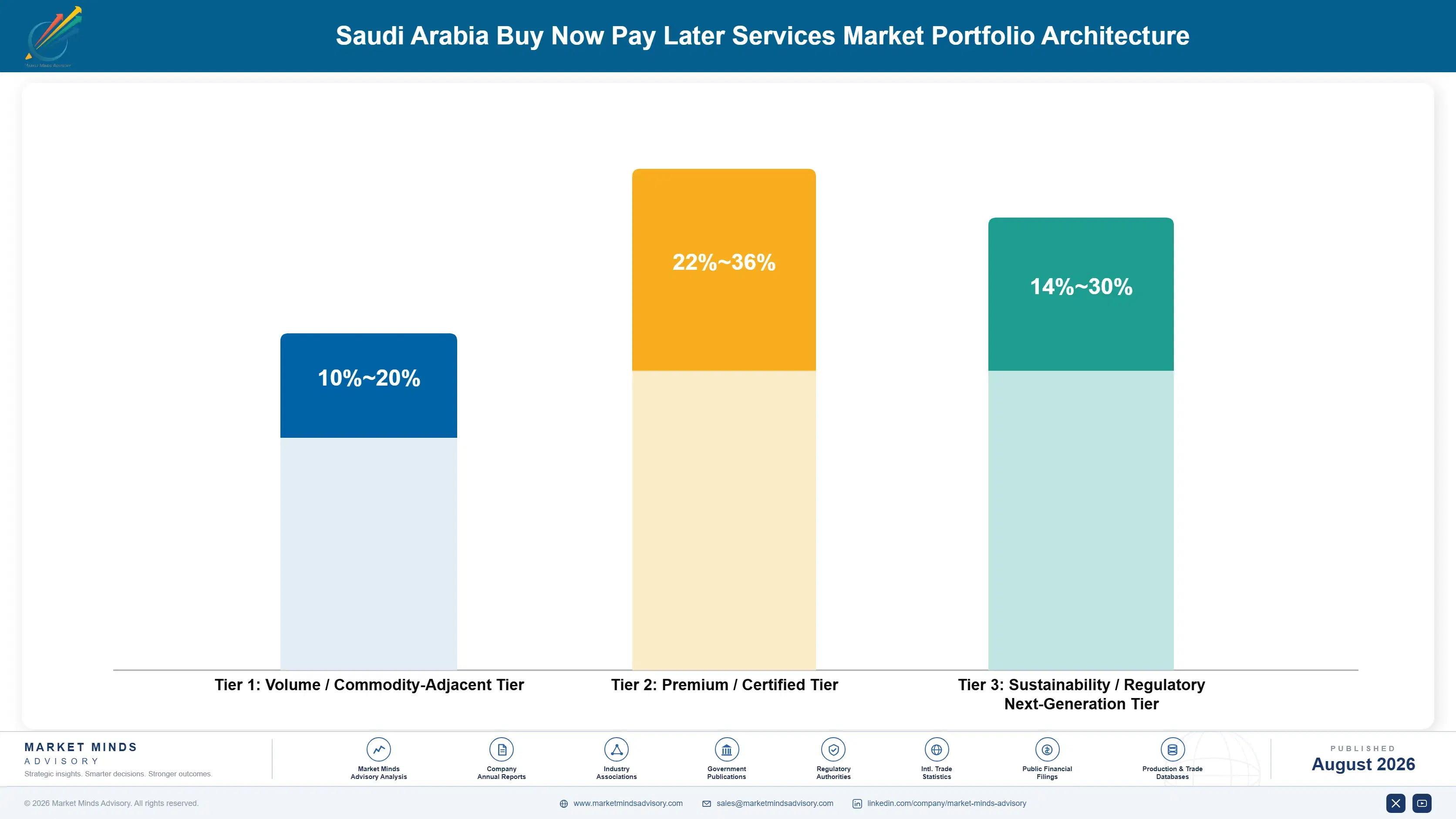
The portfolio splits into three tiers with meaningfully different margin economics. Volume commodity pay-in-4 financing, sold at scale to mainstream checkout customers, competes on merchant fee and approval speed against a crowded field of providers, earning modestly. Premium longer-term installment and B2B trade credit products earn substantially more because underwriting sophistication and merchant integration depth insulate pricing from direct commodity comparison. Regulatory-licensed Gulf market entry sits in a third tier carrying strong margins as cashless economy targets drive urgent near-term merchant adoption.
The tension runs between volume and underwriting specialization. Commodity pay-in-4 financing generates the transaction volume that keeps platforms relevant at scale, but margin stays thin since merchants compare fees relentlessly across largely interchangeable providers. Longer-term and B2B products carry the opposite constraint: strong margins but a narrower addressable customer base defined by underwriting sophistication rather than broad market access.

High-value margin pools concentrate wherever regulatory credibility and underwriting sophistication combine, which is precisely why longer-term and B2B specialists have historically outearned commodity pay-in-4 providers despite serving a smaller addressable customer base. Saudi Arabia's regulatory-licensed market carries the most immediate upside right now, driven by genuine cashless economy policy rather than organic demand growth alone.

Volume / Commodity-Adjacent Tier

Standard pay-in-4 and deferred payment financing sold at scale to mainstream checkout customers through merchant integration, competing primarily on fee and approval speed against a crowded field of providers with largely interchangeable terms.
Gross Margin: 10-20%

Premium / Certified Tier

Longer-term installment and B2B trade credit products requiring underwriting sophistication and regulatory licensing, sold through direct merchant partnerships where technical depth insulates pricing from commodity price comparison across most Gulf markets.
Gross Margin: 22-36%

Sustainability / Regulatory / Next-Generation Tier

Regulatory-licensed Gulf market products and alternative-data underwriting models still working through market development and regulatory maturation before commercial-scale returns become fully predictable across most emerging Gulf markets broadly overall today.
Gross Margin: 14-30%
saudi-arabia-buy-now-pay-later-services-market-portfolio-architecture-1787914061293

High-value Sub-segments and Strategic Watch-out

Longer-Term Installment Financing

The fastest-growing and highest-value segment, driven directly by demand for bigger-ticket electronics and furniture financing. Tabby and Tamara both draw early advantage from Gulf-specific underwriting depth, and margin expansion continues as credit models amortize across growing transaction volume, a pattern likely to persist for years.
Gross Margin: 22-36%

B2B Trade Credit

Strong margins on business underwriting expertise, growing steadily as small business demand expands across the region. Growth trails longer-term consumer financing because B2B adoption cycles move more gradually than the acute consumer cashless policy push currently forcing faster movement elsewhere in the portfolio today consistently.
Gross Margin: 18-32%

Standard Pay-in-4 Financing

The volume core of the category, generating the bulk of transaction volume at stable, moderate margins. Klarna, Tabby, and Tamara compete intensely here on merchant reach and approval speed, and while volume growth stays healthy, margin expansion is limited by established competitive dynamics across the market.
Gross Margin: 10-20%

Unlicensed And Sub-Scale Providers

The strategic watch-out. Regulatory formalization threatens to eliminate providers without formal licensing entirely, and smaller providers without sufficient capital or merchant reach face rising compliance cost and consolidation pressure as SAMA licensing requirements tighten across the category. The wide margin range reflects consolidation-stage volatility rather than a single underwriting issue.
Gross Margin: 0-18%

Merchant Integration Locks In Volume

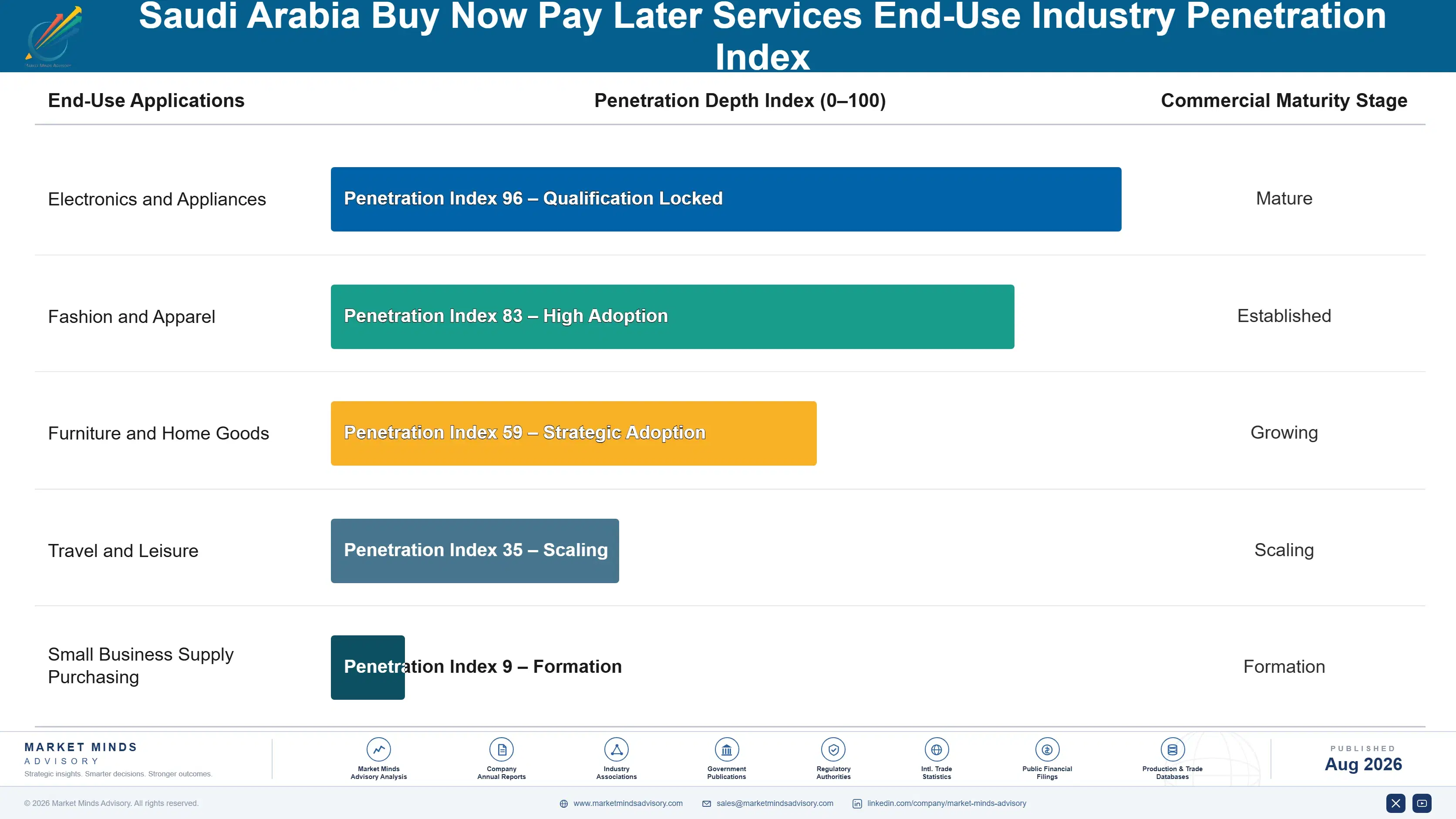
BNPL transactions behave like annuities once a provider secures merchant checkout integration, since the placement generates recurring transaction volume across every subsequent customer purchase without any new acquisition cost per transaction. Longer-term installment products carry even stickier relationships, since consumers repaying over months maintain an active account relationship that a single pay-in-4 transaction does not create.
Adoption depth varies by product type. Merchants with deep BNPL integration show the highest stickiness, since switching providers requires rebuilding checkout integration that most retailers avoid disrupting once established. Repeat consumer users show moderate stickiness, balancing account history and approval reliability against periodic competitive switching when a better offer appears. First-time users show the weakest stickiness, choosing whichever provider a merchant happens to offer at checkout, since no comparable relationship protects the incumbent provider.

Younger, digitally native Saudi consumers treat BNPL as the default checkout option rather than a novelty, a shift social media-driven shopping behavior has accelerated beyond where traditional advertising would have permitted. Older consumers weight cash payment and banking relationships heavily. That generational split is reshaping merchant acquisition strategy, pulling checkout integration from a nice-to-have differentiator toward a conversion requirement across an increasing share of the addressable retail base.
saudi-arabia-buy-now-pay-later-services-market-end-use-penetration-index-1787914061784

Where MMA Sees Divergence Ahead

These are among the four positions where our research anticipates prominent divergence between winners and laggards over the coming forecast period. Each is grounded in the demand model, the regulatory perimeter, and the announced capacity pipeline.
01 / REGULATORY LICENSING PRIORITY

Secure formal licensing before unlicensed exit forced

Regulatory formalization is not slowing down, and the licensing infrastructure it demands does not move for anyone, which means providers that secure formal SAMA credentials earliest capture merchant relationships before the rest of the industry catches up and competition compresses that advantage. Companies still operating without formal licensing while deferring compliance investment are solving the wrong problem for this window, since regulatory credibility, not marketing spend, is what will separate winners from laggards over the next years. The advantage goes to whoever licenses first, not whoever grows fastest unlicensed.
02 / UNDERWRITING SOPHISTICATION PRIORITY

Build longer-term underwriting before it becomes standard

Longer-term installment financing is not a niche extension anymore, it is becoming the primary growth mechanism for providers seeking margin beyond commoditized pay-in-4 checkout splits, and providers that build genuine credit assessment capability now capture pricing power that becomes far harder to establish once mainstream providers eventually build comparable capability at scale. Waiting until longer-term underwriting becomes standard practice means competing for yield that early movers have already claimed. The providers solving this first will define the reference standards everyone else has to match.
03 / B2B TRADE CREDIT INVESTMENT

Enter B2B BNPL before competitors reach small business

Small and medium businesses represent one of the largest genuinely underserved financing populations in Saudi Arabia today, and providers that build affordable, digital-first trade credit products for these businesses now capture customer relationships years before those businesses become profitable enough to attract deeper-pocketed competitors. Waiting for this market to mature before entering means competing for customers that early movers have already converted into loyal, repeat-transaction relationships. The providers solving affordable B2B underwriting first will define the reference products everyone else has to match.
04 / MERCHANT CONSOLIDATION STRATEGY

Consolidate merchant relationships before fee pressure worsens

Merchant fee compression is not a temporary dynamic, and providers that consolidate around fewer, deeper merchant relationships now, rather than spreading thin across many partial integrations, will secure better economics than competitors still chasing every available merchant regardless of relationship depth. Providers building bundled value-added services alongside core payment processing now, while merchants still value differentiation, avoid the margin scramble that will intensify as the category matures further. Preparation before consolidation, not response after it, separates resilient providers from exposed ones.

Engagement Snapshot From the Field

A live engagement with an industry participant carrying material or product regulatory and market exposure ahead of a defining policy shift, showing how our research translates into a defensible multi-year portfolio strategy.
MARKET MINDS ADVISORY · CLIENT ENGAGEMENT SUMMARY
Saudi Arabia Buy Now Pay Later Services Producer Strategic Portfolio Review and Transition Roadmap 2026·Investment Scenario on Saudi Arabia Buy Now Pay Later Services Exposure Evaluation 2025-26
CLIENT PROFILE
A major Saudi electronics and appliance retail chain approached MMA while evaluating whether to expand its existing pay-in-4 BNPL integration into longer-term installment financing for bigger-ticket purchases. The client reported annual revenue near USD 650 million, with electronics and appliances representing purchases that averaged well above typical pay-in-4 transaction limits specifically (client-reported, unverified by MMA).
STRATEGIC CHALLENGE
Leadership saw customers abandoning larger purchases at checkout when pay-in-4 limits could not cover the full transaction value, but had no internal framework for evaluating which longer-term financing provider to partner with or how the underwriting requirements would affect approval rates for its typical customer base overall going forward specifically.
MMA APPROACH
MMA benchmarked comparable electronics retailers' longer-term BNPL partnerships and resulting conversion improvements, modeled the client's likely approval rate and average order value lift against provider underwriting criteria, and assessed which providers offered merchant terms best suited to electronics and appliance financing specifically, drawing on comparable regional retail engagements across the Gulf.
KEY FINDINGS
  1. Comparable electronics retailers offering longer-term installment financing saw average order values increase by roughly 40% compared to pay-in-4-only transactions across similar product categories.
  2. The two providers with the strongest longer-term underwriting capability offered approval rates running 15 percentage points higher than newer entrants still building credit models.
  3. Checkout abandonment for purchases exceeding pay-in-4 limits fell substantially once longer-term financing appeared as a visible checkout option at scale for larger baskets.
  4. Merchant fees for longer-term products ran higher than pay-in-4 fees, but the incremental margin from completed larger transactions more than offset the fee difference.
CLIENT PROFILE
A major Saudi electronics and appliance retail chain approached MMA while evaluating whether to expand its existing pay-in-4 BNPL integration into longer-term installment financing for bigger-ticket purchases. The client reported annual revenue near USD 650 million, with electronics and appliances representing purchases that averaged well above typical pay-in-4 transaction limits specifically (client-reported, unverified by MMA).
STRATEGIC CHALLENGE
Leadership saw customers abandoning larger purchases at checkout when pay-in-4 limits could not cover the full transaction value, but had no internal framework for evaluating which longer-term financing provider to partner with or how the underwriting requirements would affect approval rates for its typical customer base overall going forward specifically.
MMA APPROACH
MMA benchmarked comparable electronics retailers' longer-term BNPL partnerships and resulting conversion improvements, modeled the client's likely approval rate and average order value lift against provider underwriting criteria, and assessed which providers offered merchant terms best suited to electronics and appliance financing specifically, drawing on comparable regional retail engagements across the Gulf.
KEY FINDINGS
  1. Comparable electronics retailers offering longer-term installment financing saw average order values increase by roughly 40% compared to pay-in-4-only transactions across similar product categories.
  2. The two providers with the strongest longer-term underwriting capability offered approval rates running 15 percentage points higher than newer entrants still building credit models.
  3. Checkout abandonment for purchases exceeding pay-in-4 limits fell substantially once longer-term financing appeared as a visible checkout option at scale for larger baskets.
  4. Merchant fees for longer-term products ran higher than pay-in-4 fees, but the incremental margin from completed larger transactions more than offset the fee difference.
RECOMMENDED STRATEGY
Phase 1: Phase 1 (0 to 3 months): Select a longer-term financing provider with proven electronics and appliance underwriting experience and negotiate merchant terms. Phase 2: Phase 2 (3 to 9 months): Launch longer-term financing at checkout across all channels, tracking approval rates and conversion impact closely. Phase 3: Phase 3 (9 to 18 months): Optimize financing terms and promotional positioning based on validated performance data across the full product catalog.
OUTCOME
The client launched longer-term installment financing within five months, ahead of the original seven-month implementation estimate, and saw average order values increase by a reported 36% within the first two quarters. Checkout abandonment on larger purchases fell measurably, more than offsetting the higher merchant fee on longer-term transactions (client-reported, unverified by MMA).

Frequently Asked Questions

Foundational context covering the market sizes, CAGR, scope, country, region and competition that inform every finding below. This section is provided to cover basics and most often pre-purchase conversations, answered from the MMA Primary Research Dataset.

What is the current size of the Saudi Arabia Buy Now Pay Later Services Market?

The market reached USD 425 billion in gross transaction value in 2025 on a global basis, with East Asia holding the largest single regional share at 28%. It spans pay-in-4, deferred payment, and longer-term installment financing.

How large will the Saudi Arabia Buy Now Pay Later Services Market be by 2036?

MMA forecasts the market will reach USD 2,133.9 billion by 2036, expanding roughly 4.34 times its 2026 base value. Longer-term installment and B2B financing drive most of that incremental growth.

What is the CAGR for the Saudi Arabia Buy Now Pay Later Services Market 2026 to 2036?

The base case CAGR runs at 15.8% annually through 2036. Bull scenarios reach 17.1% on faster Gulf financial inclusion, while bear scenarios fall to 14.5% if regulatory affordability checks slow approvals.

Which segment is growing fastest?

Longer-term installment financing grows fastest at 19.5% annually, nearly 1.2 times the overall market rate. Demand for bigger-ticket electronics and furniture financing drives most of that acceleration.

Who are the major companies in the Saudi Arabia Buy Now Pay Later Services Market?

Klarna, Affirm, Block, Tabby, and Tamara lead the market on a consistent global transaction value basis. Together they hold roughly 24% of total category volume combined.

Which country is growing fastest?

Saudi Arabia posts the fastest national growth at roughly 22.5% annually, driven by Vision 2030 cashless economy targets and a young digitally native population. Growth concentrates in longer-term installment financing rather than simple pay-in-4 splits.

Report Segmentation Architecture

The full report scope spans multiple orthogonal segmentation dimensions, with cross-tabulated demand data provided for each dimension pair. Coverage extends further to regional breakdowns, trend trajectories, and the competitive detail needed to support segment-level decision-making.

By Service Type

  • Pay-in-4 Installment Plans
  • Pay-in-Full-Later Deferred Payment
  • Longer-Term Installment Financing
  • In-Store and Point-of-Sale BNPL
  • B2B BNPL
  • BNPL-Linked Card Products

By End-Use Industry

  • Electronics and Appliances
  • Fashion and Apparel
  • Furniture and Home Goods
  • Travel and Leisure
  • Small Business Supply Purchasing

By Commercial Dimension

  • Online E-Commerce Checkout
  • In-Store Point-of-Sale Integration
  • Merchant Partnership Programs
  • Direct-to-Consumer App-Based Financing

By Region

  • North America
  • Western Europe
  • East Asia
  • South Asia and Pacific
  • Latin America
  • Middle East and Africa
  • Eastern Europe

Scope, Methodology, and Coverage

Every figure in this report is reproducible from documented input assumptions. The scope below maps the historical period, the forecast horizon, the segmentation dimensions, and the countries covered, alongside the underlying primary and qualitative methodology.
Historical Period
2020 to 2025
Forecast Period
2026 to 2036
Base Year
2025 (USD billions; MMA Primary Research Dataset, August 2026)
Market Definition
The buy now pay later services market covers short-term and installment financing products offered at the point of sale, both online and in-store, that let consumers split purchases into scheduled payments. It spans pay-in-4 plans, deferred payment products, longer-term installment financing, and B2B trade credit, measured by gross transaction value processed globally. It excludes traditional credit cards, personal installment loans originated outside a point-of-sale checkout context, and layaway programs that require full payment before goods are delivered.
Quantitative Units
USD billions (current prices); gross transaction value in billions where applicable
Segmentation Dimensions
By Service Type; By End-Use Industry; By Commercial Dimension; By Region
Regions Covered
North America, Western Europe, East Asia, South Asia and Pacific, Latin America, Middle East and Africa, Eastern Europe
Countries Covered
USA, China, Germany, France, UK, Japan, South Korea, India, Australia, Canada, Brazil, Mexico, Indonesia, Vietnam, Thailand, Malaysia, UAE, Saudi Arabia, South Africa, Nigeria, Turkey, Poland, Netherlands, Italy, Spain, Sweden, Switzerland, Argentina, Colombia, Singapore, and additional markets relevant to this sector
Key Companies Profiled
Klarna Bank AB, Affirm Holdings Inc., Block Inc., Tabby, Tamara, PayPal Holdings Inc., Zip Co Limited, Sezzle Inc., Splitit Payments Ltd., Openpay Group, Cashew Payments, Postpay, Souhoola, STC Pay, Alinma Bank, Al Rajhi Bank, Spotii, Fatura, ChargeAfter, Scalapay
Quantitative Methodology
Primary survey, n=3,800 respondents, Q4 2025, six countries; demand-side model with trade association cross-validation
Qualitative Methodology
47 expert interviews, Q4 2025; applied to validate demand model assumptions, identify emerging dynamics, and assess competitive positioning
Report Format
PDF and XLSX data workbook (Word format preview document)
Publisher
Market Minds Advisory
Report Code
MMA-2026-TEC-316
Published
August 2026
Contact
sales@marketmindsadvisory.com | www.marketmindsadvisory.com

Purchase the full Saudi Arabia Buy Now Pay Later Services Market Report (2026 to 2036).

The full MMA Saudi Arabia Buy Now Pay Later report sizes the market across six service types, five end-use categories, four commercial channels, and seven regions through 2036. It profiles 20 participants on a consistent global transaction value basis, scoring leaders on regulatory credibility, underwriting sophistication, and merchant integration depth. Scenario models quantify how Vision 2030 cashless targets, regulatory licensing, and merchant fee dynamics move both demand and provider margin performance across commodity and specialty tiers. The report also includes delivered-cost modeling by service type, a regulatory licensing tracker, and a competitive positioning assessment built for merchant, underwriting, and market entry teams.
Six-way service type segmentation with growth forecasts
Twenty-company competitive profiles on consistent revenue basis
Seven-region market sizing with country-level detail
SAMA licensing and global regulatory tracking module
Funding cost and default provisioning modeling by type
Bull, base, and bear demand scenario forecasts

Built For The People Who Decide

From boardroom strategy to bench-side execution, this report is read cover-to-cover by leaders shaping the next decade of their industry, turning demand scenarios, market dynamics and valuation benchmarks into decisions.
CXOs/ Presidents/ VPs/ Managers
M&A and Corporate Development
Strategy Teams and R&D Heads
Procurement and Product Directors
Regulatory and Compliance Leaders
Investor Relations and Equity Analysts