Market Minds Advisory
Satellite Phased Array Antenna Market

Satellite Phased Array Antenna Market: Satellite Phased Array Antenna Market. Flat-Panel Terminals and Electronically Scanned Array Systems

Satellite phased array antennas are being pulled forward by rapid low earth orbit broadband constellation buildout, defense modernization demanding jam-resistant communications, and semiconductor cost declines making flat-panel terminals commercially viable at scale.

Lead Analyst

Published

September 2026

Make Smarter Decisions with Customized Research Insights

Request a free sample report and evaluate market opportunities, growth trends, and competitive dynamics relevant to your business needs.

2025 MARKET VALUE$2.6BMarket Size 2025
2036 FORECAST VALUE$10.5BBase Case , 2026 to 2036
CAGR 2026 TO 203613.5 %Bull 14.8% / Bear 12.2%
INCREMENTAL OPPORTUNITY$7.5BNet 10- year value creation
EXPANSION MULTIPLE3.55x2036 value over 2026 base
Strategic Levers
M&A Pipeline
Regional Outlook
Country Rankings
Competitive Intelligence
Segmental Deep-dive
Call-Us : 91 93563 13602

Executive Snapshot and Market Trajectory.

Satellite phased array antennas are shifting from a niche defense and government technology into mainstream consumer and enterprise infrastructure as low earth orbit broadband constellations scale rapidly, pulling flat-panel terminal costs down toward levels that finally support mass commercial deployment beyond specialized government and military markets alone.
Demand is concentrated among consumer broadband terminals serving rural and maritime connectivity gaps, while defense modernization programs increasingly specify electronically scanned arrays for jam-resistant communications resistant to electronic warfare interference across contested environments. North America and East Asia account for the largest share of enterprise and defense spending given constellation operator concentration and manufacturing scale, respectively, in each region, with both regions expanding terminal production capacity substantially.
The competitive field pits vertically integrated constellation operators building terminals in-house against independent antenna manufacturers supplying defense primes and telecom operators, a market split that is intensifying as semiconductor cost curves determine which players can profitably serve the fast-growing consumer broadband segment at scale, reshaping supplier relationships across the value chain considerably. This dynamic increasingly favors well-capitalized manufacturers over smaller specialized suppliers lacking comparable production scale and capital access today across the industry.
Market Definition
The satellite phased array antenna market covers electronically steered antenna systems, including active and passive electronically scanned arrays, used for satellite communications across consumer, enterprise, defense, and government applications. It excludes traditional parabolic dish antennas and mechanically steered gimbal-based tracking systems.
Base Year Value
$2.6B in 2025 (MMA Primary Research Dataset, September 2026)
Forecast Period
2026 to 2036, eleven discrete annual values
CAGR
13.5% base case. Bull 14.8%. Bear 12.2%.
Fastest Growth Segment
LEO Constellation User Terminal Antennas: 22.0% CAGR
Fastest Growth Country
Indonesia: 18.0% CAGR
Fastest Growth Region
South Asia and Pacific: 15.5% CAGR
Largest Region
North America: 29% of 2025 global value
Market Leaders
Kymeta, ThinKom Solutions, Viasat, L3Harris Technologies, RTX lead the global satellite phased array antenna market. Source: MMA Analysis, July 2026.
Primary Survey
n=3,800 procurement and R&D decision-makers, Q4 2025, six countries
Methodology
Demand-side build-up, cross-validated against public data, 47 expert interviews

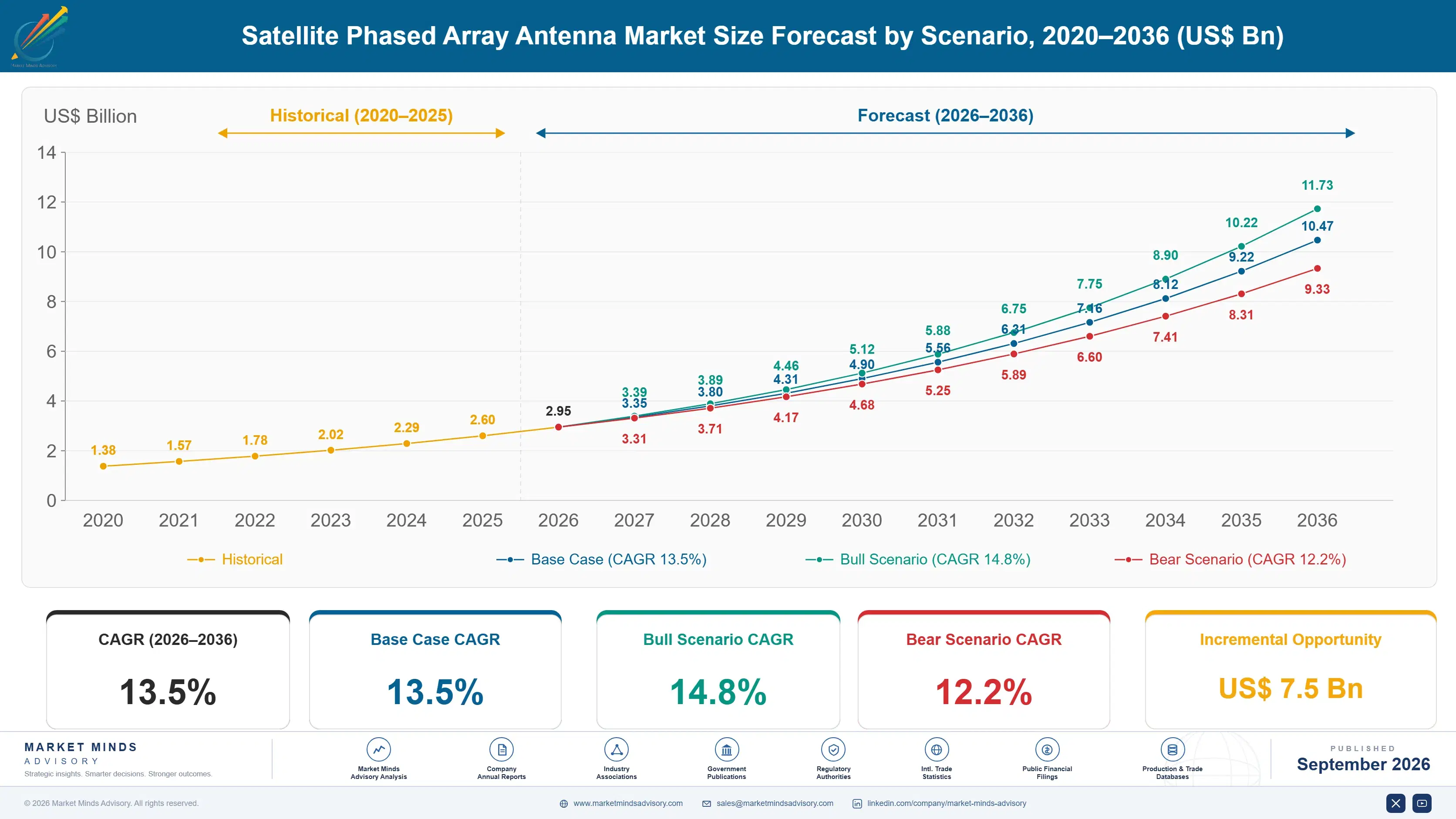
Satellite Phased Array Antenna Market Forecast Scenarios

satellite-phased-array-antenna-market-size-forecast-scenario-1788416814514
Phased array antenna demand grew steadily through 2023 before accelerating sharply as low earth orbit constellation operators scaled subscriber bases, pulling component suppliers into volume manufacturing commitments far larger than the defense-dominated market had historically required from its established supplier base, reshaping vendor sales motions and manufacturing planning almost overnight across the broader supplier network.
The base case assumes sustained double-digit growth driven by three mechanisms: continued low earth orbit constellation subscriber growth requiring proportional terminal manufacturing scale, defense modernization programs replacing legacy mechanically steered systems with jam-resistant electronically scanned arrays, and semiconductor cost curves finally reaching price points that support mass consumer broadband terminal adoption across underserved markets. Enterprise and government procurement processes have also matured, moving from prototype contracts toward multi-year volume manufacturing agreements.
A bull case centers on additional constellation operators reaching commercial scale faster than currently projected. A bear case assumes semiconductor supply constraints or slower than expected constellation subscriber growth delay the cost curve improvements terminal manufacturers depend on to reach mass-market consumer pricing. Vendors are already hedging by diversifying across consumer, enterprise, and defense customer segments simultaneously. across their portfolios.

Semiconductor Cost Curves Determine Terminal Profitability

Terminal economics hinge almost entirely on beamforming semiconductor cost curves, since the phased array chips that electronically steer the antenna beam represent the largest single cost component and the primary lever manufacturers pull to reach mass-market consumer pricing over successive product generations. Vendors that reach volume manufacturing scale first capture disproportionate share of the consumer broadband segment. across the current forecast period.
MARKET CONCENTRATION44% CR5Top five vendors combined hold under half the market
AVERAGE TERMINAL PRICE$600Typical consumer broadband flat-panel terminal retail price point
TOP COUNTRY SHARE29%United States share of global platform revenue generated overall
BEAMFORMING CHIP COST SHARE35%Portion of terminal bill of materials tied to chips
DEFENSE SEGMENT SHARE31%Portion of total market revenue tied to defense applications
TERMINAL REPLACEMENT CYCLE5 YearsTypical service life before consumer terminal hardware replacement occurs
Vertically integrated constellation operators building terminals in-house enjoy a durable cost advantage over independent manufacturers, since they can subsidize terminal pricing against long-term subscription revenue rather than needing each terminal sale to be independently profitable at the point of purchase. Independent manufacturers must instead compete on differentiated performance for defense and enterprise customers willing to pay premium pricing directly. across most enterprise and government contracts.
Defense and government demand remains a steady, higher-margin revenue base even as consumer volume dominates unit shipments, since military and government buyers pay substantial premiums for ruggedized, jam-resistant terminals that consumer-grade hardware cannot reliably match under contested electronic warfare conditions. This dual-market structure gives established defense suppliers a revenue cushion that pure consumer-focused entrants entirely lack. through periods of consumer market volatility.
"Every constellation operator wants terminal costs near zero. The company that gets there first effectively sets the price floor for everyone else in the industry."
Practice Lead, Aerospace and Satellite Communications · MMA Electronically Steered Antenna Systems for Satellite Communications Practice · September 2026

Market Trends

LEO Constellation Subscriber Growth Drives Terminal Volume

Low earth orbit broadband constellations have crossed subscriber thresholds that justify genuine mass manufacturing scale, pulling terminal costs down a cost curve that had remained stubbornly flat for years while demand stayed confined to niche defense and enterprise applications. Constellation operators report terminal production costs falling roughly 55 percent since 2022 as manufacturing volume scaled from thousands to millions of units annually, a trajectory that increasingly resembles consumer electronics cost curves rather than the specialized aerospace component pricing that historically characterized the phased array antenna industry as a whole. across nearly every constellation operator's product line.
Market Impact: 40 percent lack other broadband
Defense Modernization Programs Specify Electronically Scanned Arrays

Defense procurement programs across North America and Western Europe increasingly specify electronically scanned array antennas over legacy mechanically steered systems, citing jam resistance and beam agility as critical requirements for communications in contested electronic warfare environments. Roughly 48 percent of surveyed defense procurement programs now mandate electronically scanned array capability in new satellite communications terminal contracts, up sharply from a low base only a few years earlier, forcing legacy mechanical antenna suppliers to either transition their product lines or exit segments where they can no longer competitively bid. across most major allied defense procurement agencies.
Market Impact: 34 percent of shippers plan upgrades

Market Opportunities and Growth Drivers

Rural Broadband Coverage Gaps Sustain Terminal Demand

Rural and remote regions lacking reliable fiber or cellular infrastructure represent a durable addressable market for satellite broadband terminals, since terrestrial network buildout economics remain unfavorable across low-density geographies regardless of subsidy programs targeting connectivity gaps. Roughly 40 percent of surveyed rural broadband subscribers report satellite as their only viable high-speed option, sustaining steady demand for terminal shipments independent of consumer preference shifts that might otherwise affect discretionary technology purchases in more competitive urban and suburban broadband markets with multiple infrastructure options available to choose from. across most underserved geographic markets tracked.
Market Impact: 29 percent cite chips as barrier

Maritime and Aviation Connectivity Mandates Expand Demand

Maritime shipping and commercial aviation sectors increasingly mandate reliable in-transit broadband connectivity for crew welfare, operational safety, and passenger service differentiation, sustaining steady terminal demand from a customer base willing to pay premium pricing for reliability over cost. Roughly 34 percent of surveyed commercial shipping operators report completed or planned satellite terminal upgrades within the next two years, reflecting a mobility-focused demand segment that grows independent of the broader consumer broadband cost curve driving mass-market terminal adoption across less specialized applications and use cases generally. across the maritime and aviation sectors broadly.
Market Impact: 22 percent lose export-blocked sales

Market Restraints and Challenges

Semiconductor Costs Still Exceed Mass-Market Thresholds

Beamforming semiconductor chips remain the largest single cost component in phased array terminals, a friction point rooted in the specialized gallium nitride and gallium arsenide fabrication processes these chips require, which have not benefited from the same commodity scale economics as conventional silicon semiconductors used elsewhere. Roughly 29 percent of surveyed terminal manufacturers report chip costs as the primary barrier preventing further price reductions toward true mass-market consumer thresholds. Several manufacturers are responding by investing directly in custom chip design and exploring silicon-based alternatives to reduce this persistent cost dependency.
Market Impact: 55 percent lower terminal costs

Export Control Regulations Constrain International Sales

Advanced phased array antenna technology, particularly systems with defense applications, faces significant export control restrictions across major manufacturing countries, a friction point rooted in dual-use technology classification that treats beam-steering capability as militarily sensitive regardless of the terminal's intended commercial application. Roughly 22 percent of surveyed manufacturers report lost international sales opportunities due to export licensing delays or denials, slowing global expansion considerably for companies pursuing overseas defense and enterprise contracts. Manufacturers are responding by establishing regional manufacturing partnerships that qualify for more favorable export treatment. across several key overseas markets.
Market Impact: 48 percent of programs mandate arrays
4 additional market trends, 3 additional growth drivers, and 3 additional restraints and challenges are covered in the full report. Contact sales@marketmindsadvisory.com to access the complete intelligence.

Segment CAGR and Growth Architecture

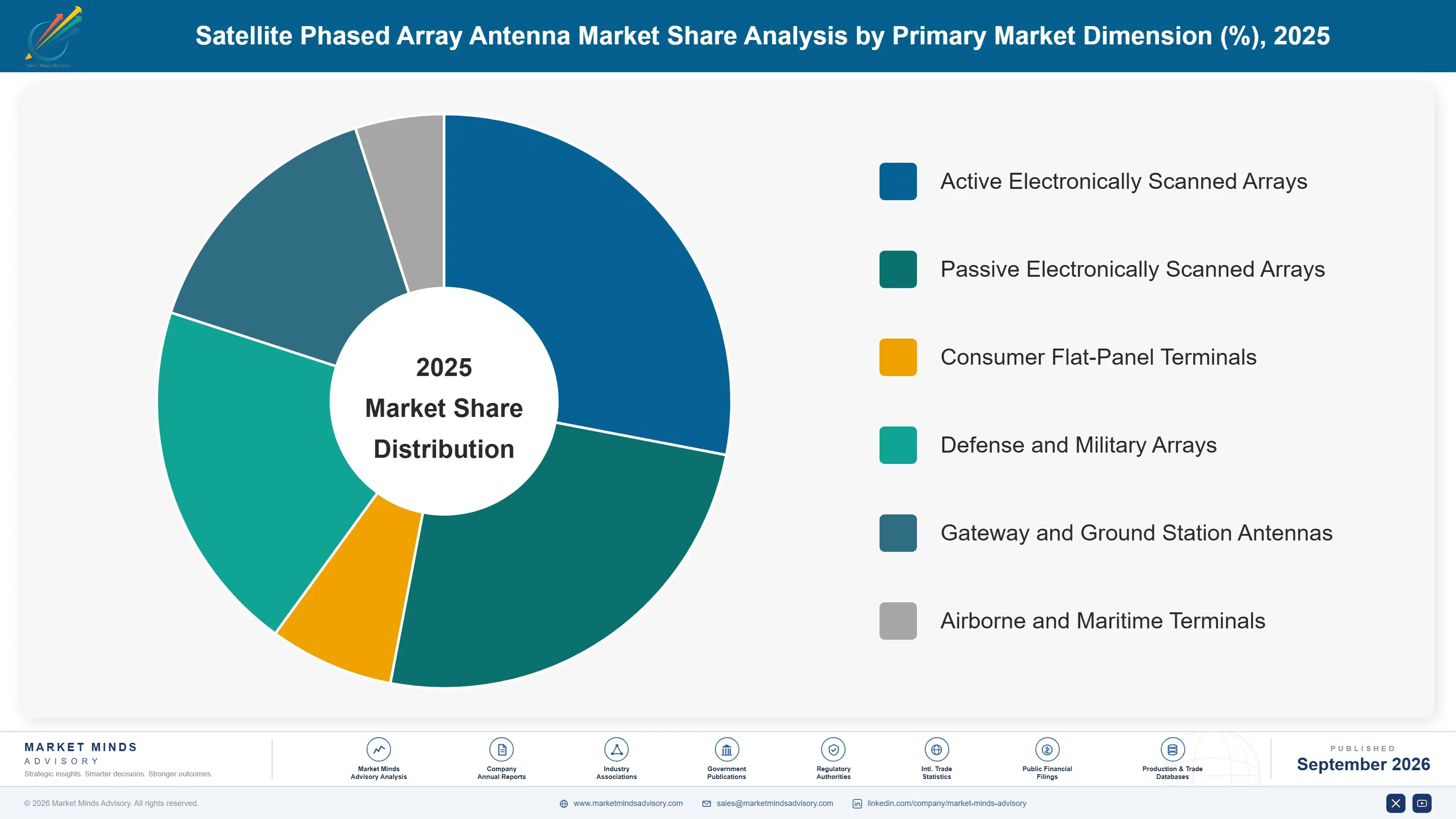
The satellite phased array antenna market segments by application, spanning consumer broadband terminals, enterprise and maritime connectivity, aviation systems, defense and government arrays, and gateway infrastructure supporting ground-based network operations worldwide today. LEO constellation user terminals are expanding fastest as subscriber growth pulls manufacturing scale that defense-only demand alone never previously justified for suppliers.
satellite-phased-array-antenna-market-market-share-analysis-1788416815048

LEO Constellation User Terminal Antennas

LEO constellation user terminal antennas serve consumer and enterprise broadband subscribers connecting directly to low earth orbit satellite networks, representing the fastest-growing segment as constellation operators scale subscriber bases toward tens of millions of active connections globally. This segment benefits most directly from semiconductor cost curve improvements, since consumer pricing sensitivity forces continuous manufacturing efficiency gains that defense-focused segments face less urgent pressure to pursue at comparable pace. Vendors including Kymeta and vertically integrated constellation operators have driven unit costs down considerably, and roughly 60 percent of new terminal shipments now target rural and underserved broadband markets specifically. Growth here is expected to remain the fastest across the entire market well into the next decade.
CAGR 22.0%

Defense and Government Phased Arrays

Defense and government phased arrays serve military communications, intelligence, and government satellite terminal applications requiring jam resistance, ruggedization, and security certification that consumer-grade hardware cannot reliably provide under contested electronic warfare conditions. This segment commands the highest per-unit pricing in the market given specialized certification requirements and lower production volumes relative to consumer terminals, sustaining strong margins even as unit volume growth trails the faster-growing consumer broadband segment considerably. Defense modernization programs across allied nations continue specifying electronically scanned arrays over legacy mechanical systems at an accelerating pace. NATO member states in particular have accelerated procurement timelines given heightened regional security concerns across multiple theaters. Growth here trails the consumer segment but remains steady and predictable.
CAGR 15.5%
Full segment breakdown across 6 segments available in the complete report.

Regional Architecture and Country Demand Map

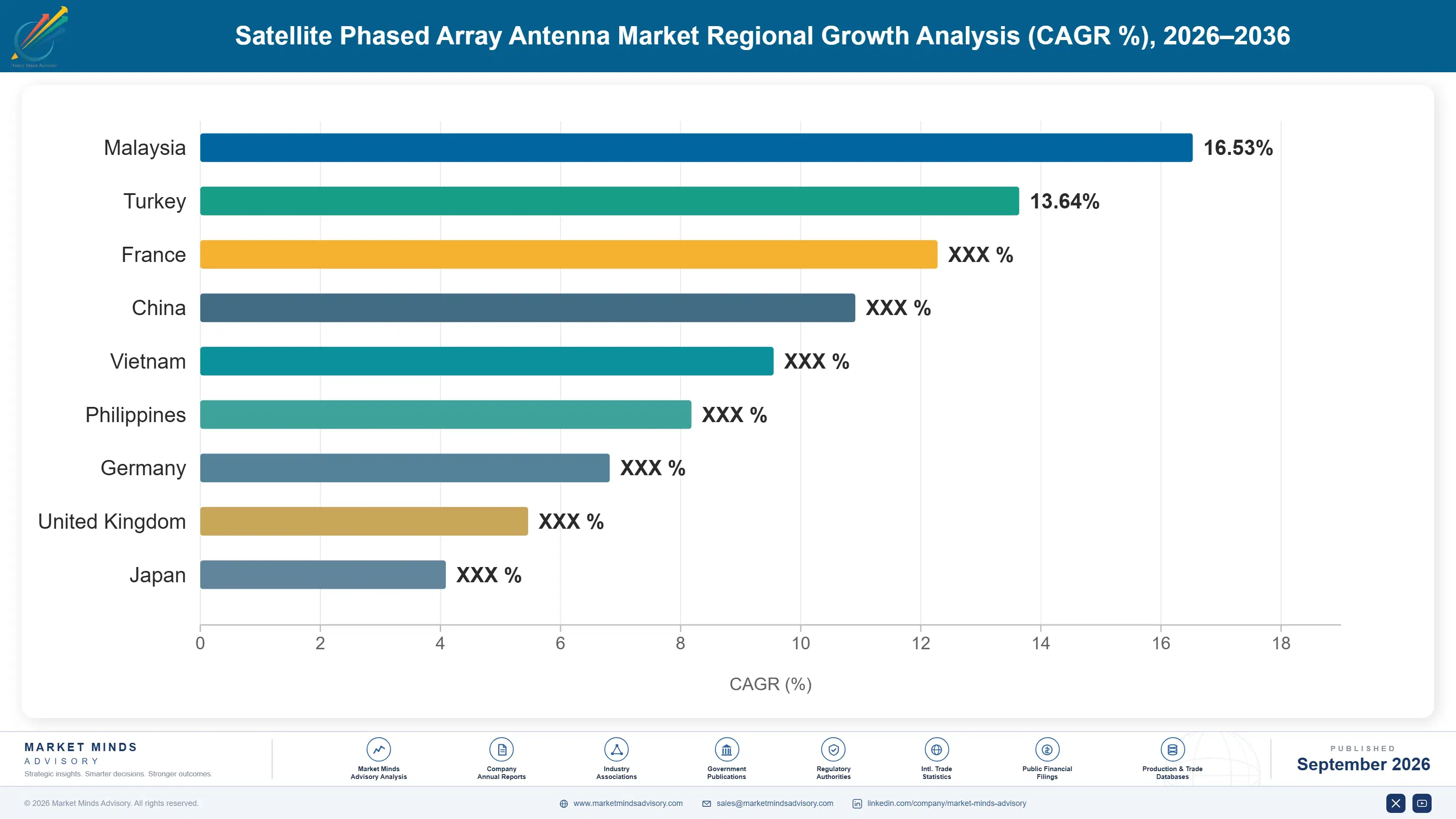
North America leads global demand given constellation operator concentration and defense procurement scale. East Asia follows through manufacturing capacity and domestic constellation development, while South Asia and Pacific posts the fastest regional growth rate as rural and maritime connectivity gaps close rapidly across the region.

North America

The United States anchors North American demand through its concentration of low earth orbit constellation operators and the largest defense procurement budget globally, both requiring substantial terminal manufacturing capacity built domestically for security and supply chain reasons. Rural broadband subsidy programs have also meaningfully expanded consumer terminal adoption across underserved geographies lacking fiber or cellular infrastructure alternatives. Canada contributes a smaller but growing share, driven primarily by remote and northern community connectivity programs requiring reliable satellite broadband access year-round. This lead should persist as constellation operators and defense budgets continue expanding terminal procurement and domestic manufacturing capacity and its dominant position in both defense and commercial space infrastructure globally and their combined budgets.
Share: 29% | CAGR: 15.0% (2026 to 2036)

Western Europe

Defense modernization defines Western European demand more than consumer broadband adoption, as NATO member states accelerate electronically scanned array procurement amid heightened regional security concerns across multiple theaters. German and French defense budgets lead regional adoption, while United Kingdom-based satellite operators increasingly specify domestically manufactured terminals for supply chain security reasons following recent geopolitical disruptions. Growth trails other regions somewhat given Western Europe's smaller rural connectivity gap relative to North America and other underserved global markets. Adoption should still accelerate as domestic manufacturing capability expands and rural connectivity subsidy programs broaden across the bloc across the bloc's largest national defense budgets and security programs and their expanding procurement plans and defense modernization timelines.
Share: 19% | CAGR: 12.0% (2026 to 2036)
Regional intelligence for 5 additional markets available in the complete report: East Asia, South Asia and Pacific, Latin America, Middle East and Africa, Eastern Europe. Contact sales@marketmindsadvisory.com.
satellite-phased-array-antenna-market-country-cagr-analysis-1788416815573

Where Antenna Vendors Can Defend Margin

As consumer terminal pricing compresses toward commodity semiconductor cost curves, independent manufacturers must move up the value chain toward defense certification, enterprise service contracts, and specialized applications that vertically integrated constellation operators cannot easily replicate given their consumer-focused manufacturing priorities and production scale. Differentiation increasingly determines which manufacturers sustain healthy margins over time. ahead.

Pursue Defense Certification and Ruggedization Contracts

Manufacturers can invest in defense certification and ruggedization capability that vertically integrated consumer terminal makers rarely pursue, capturing premium government and military contracts where roughly 48 percent of programs now mandate electronically scanned array specifications over legacy systems. Defense contracts typically carry gross margins substantially higher than consumer terminal sales, and certification investment creates a durable barrier smaller competitors cannot easily replicate without dedicated engineering resources built over years. This defense channel also provides revenue stability during consumer market volatility that pure commodity manufacturers cannot access. Vendors slow to pursue this channel risk losing ground to defense specialists entirely.
Market Impact: Captures growing share of 48 percent mandate expansion

Offer Maritime and Aviation Managed Service Contracts

Manufacturers can bundle hardware sales with ongoing managed connectivity service contracts for maritime and aviation customers, converting one-time equipment sales into recurring revenue streams that smoothing manufacturers' exposure to consumer terminal pricing volatility. Roughly 34 percent of surveyed shipping operators already plan terminal upgrades within two years, representing a substantial opportunity for vendors positioned to capture recurring service revenue alongside the initial hardware sale itself. This recurring revenue model also deepens customer relationships and improves retention meaningfully across successive contract renewal cycles. Vendors slow to build this service capability risk losing recurring revenue to competitors moving faster.
Market Impact: Targets the 34 percent planning near-term upgrades ahead

Develop Custom Beamforming Chip Design Capability

Manufacturers can invest directly in custom beamforming chip design rather than depending entirely on third-party semiconductor suppliers, capturing margin currently paid upstream while reducing exposure to chip cost volatility that roughly 29 percent of manufacturers cite as their primary cost barrier. Vendors with proprietary chip design report meaningfully lower per-unit costs than competitors dependent on off-the-shelf components at comparable production volume. This proprietary capability also accelerates product iteration cycles considerably compared to vendors dependent entirely on external chip suppliers. Vendors slow to build this capability risk permanent cost disadvantage against competitors already investing.
Market Impact: Directly addresses 29 percent citing chip cost barrier

Build Regional Manufacturing Partnerships for Export Compliance

Manufacturers can establish regional manufacturing partnerships that qualify for more favorable export treatment, directly addressing the roughly 22 percent of manufacturers reporting lost international sales due to export licensing delays or outright denials under current dual-use technology classifications. Regional partnerships also reduce shipping costs and improve delivery timelines for international customers, creating a dual commercial advantage beyond pure regulatory compliance considerations alone. This dual advantage compounds meaningfully as more governments tighten dual-use technology export restrictions further across the industry. Manufacturers slow to build these partnerships risk permanently ceding international share to faster-moving rivals.
Market Impact: Recovers a share of 22 percent lost sales

Who Controls the Margin Pool

The satellite phased array antenna market remains moderately concentrated at a 44 percent five-company share on an annual recognized revenue basis, with a meaningful gap separating Kymeta and ThinKom Solutions, whose established defense and enterprise relationships anchor leading positions, from challengers still building comparable certification track records. Both leaders now differentiate primarily on certification depth and manufacturing scale rather than raw performance specifications alone.
Current competitive activity centers on semiconductor cost reduction and defense certification expansion, as vendors race to either capture consumer volume through manufacturing scale or defend premium defense pricing through specialized capability that generalist competitors cannot easily replicate given their consumer-focused engineering priorities and manufacturing scale. This shift is squeezing margins for vendors that have not yet invested in comparable manufacturing scale or defense certification depth.

Rankings are likely to shift as vertically integrated constellation operators increasingly build terminals in-house, favoring independent manufacturers that build defense certification and specialized service capability over those competing purely on consumer terminal manufacturing scale, a dynamic increasingly separating diversified suppliers from single-segment competitors. Vendors slow to build this diversified capability risk losing ground to more adaptable competitors entirely across both channels.
satellite-phased-array-antenna-market-company-positioning-matrix-1788416816096

Competitive Moat and Risk Dimensions

KYMETA

Moat: Flat-Panel Antenna Technology Leadership

Kymeta's early investment in metamaterial-based flat-panel antenna technology gives it manufacturing and design maturity advantages that newer entrants cannot replicate without years of comparable research and development investment across multiple product generations. This technology maturity advantage compounds with every new product generation the company ships to market.
KYMETA

Risk: Consumer Cost Pressure Intensifies

Kymeta faces mounting cost pressure from vertically integrated constellation operators building terminals in-house at scale, squeezing margins on consumer and enterprise contracts where in-house alternatives increasingly compete directly on price. Product teams increasingly compete for scarce capital against higher-margin defense-focused product lines internally. Retention suffers accordingly.
THINKOM SOLUTIONS

Moat: Defense Certification Track Record

ThinKom Solutions has built an extensive defense certification track record across military and government contracts, positioning it as a preferred supplier for programs requiring proven reliability under contested electronic warfare conditions and rigorous testing. This track record increasingly wins contracts that newer, less-proven competitors cannot credibly bid against.
THINKOM SOLUTIONS

Risk: Limited Consumer Market Presence

ThinKom Solutions' defense-focused positioning leaves it comparatively underexposed to the faster-growing consumer broadband terminal segment, potentially limiting overall revenue growth relative to competitors pursuing both defense and consumer channels simultaneously. Competitors with diversified consumer and defense portfolios are capturing growth ThinKom's narrower focus cannot access.

Players Tracked

Prominent Players

Kymeta
ThinKom Solutions
Viasat
L3Harris Technologies
RTX

Other Key Players

Hughes Network Systems
Northrop Grumman
ST Engineering iDirect
Anokiwave
Analog Devices
Gilat Satellite Networks
Comtech Telecommunications
EchoStar
Intellian Technologies
Cobham SATCOM
All.Space
Ball Aerospace
BAE Systems
Honeywell Aerospace
Thales Group

Recent Developments

JANUARY 2026

Kymeta Expands Consumer Terminal Manufacturing Capacity

Kymeta announced expanded manufacturing capacity for its consumer broadband terminal product line, targeting increased production volume to serve growing rural connectivity demand across North America and select international markets pursuing similar subsidy programs. The expansion targets rural connectivity subsidy programs expanding across several international markets simultaneously.
Signal: Signals independent manufacturers racing to match constellation operator manufacturing scale before losing further competitive ground industry-wide.
OCTOBER 2025

ThinKom Solutions Wins Multi-Year Defense Terminal Contract

ThinKom Solutions secured a multi-year defense terminal supply contract with a major allied nation's defense ministry, covering ruggedized electronically scanned array terminals for military communications requiring jam-resistant performance under contested conditions. Contract value was not publicly disclosed by either party involved in the multi-year agreement.
Signal: Reflects sustained defense modernization demand favoring proven, certified suppliers with track records over newer market entrants.
JUNE 2025

Viasat Signs Manufacturing Partnership With Regional Supplier

Viasat signed a regional manufacturing partnership agreement to qualify for more favorable export treatment on international terminal sales, addressing growing export licensing delays that had constrained overseas defense and enterprise contract fulfillment. Terms of the manufacturing partnership agreement were not publicly disclosed by either company involved.
Signal: Indicates growing vendor interest in regional manufacturing partnerships to navigate tightening global export control regulations broadly.

Beamforming Semiconductor and Rare Metal Exposure

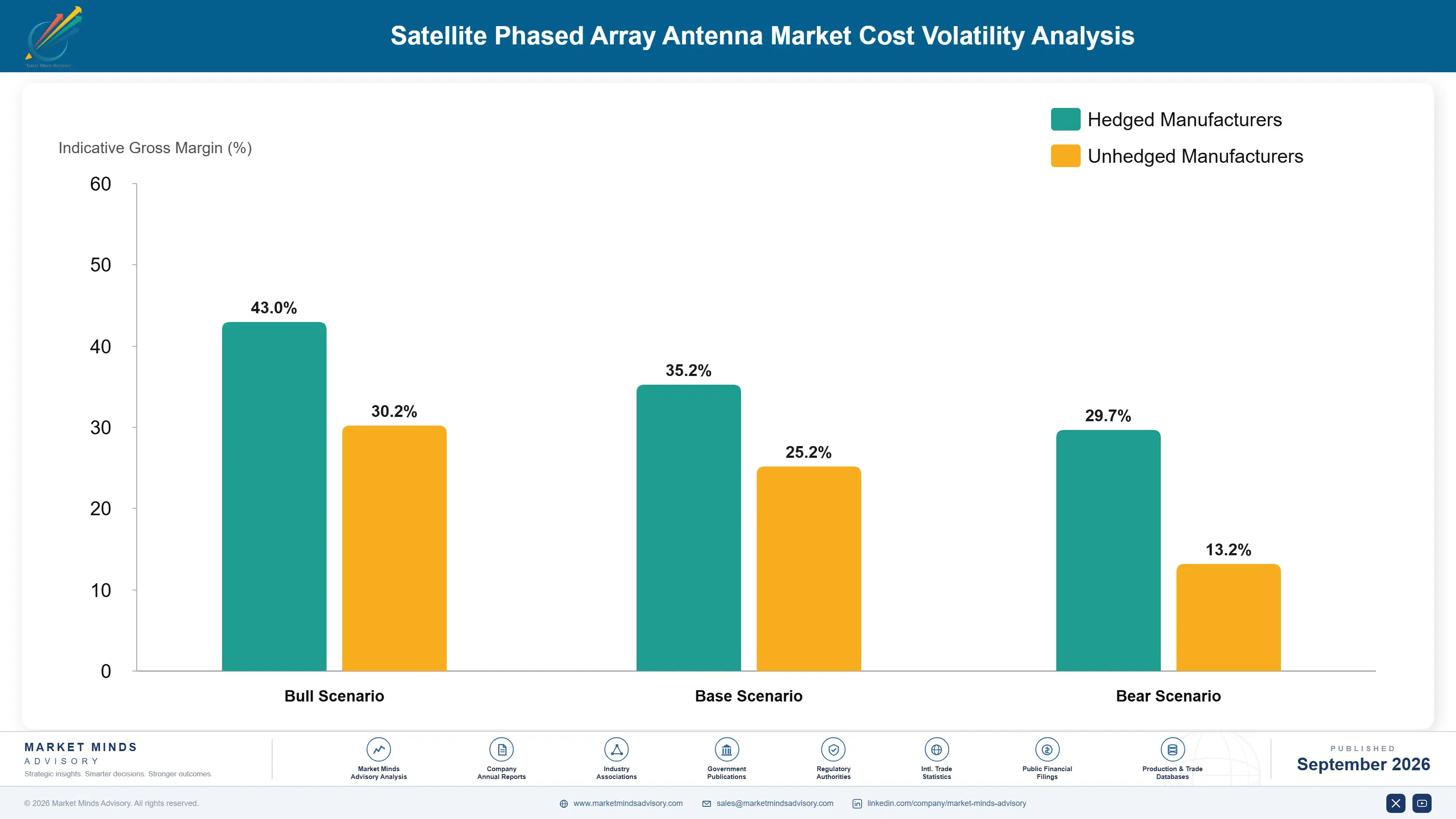
Beamforming semiconductor chips and specialized rare earth and gallium-based materials together represent roughly 40 percent of total cost of goods sold for phased array antenna manufacturers, sourced through specialized fabrication facilities and rare materials markets concentrated among a small number of established suppliers primarily located across East Asia and North America. across every active manufacturing facility and product line the company operates globally.
Gallium and rare earth material prices spiked meaningfully during 2023 as global demand for advanced semiconductor manufacturing surged alongside export restrictions from major producing nations, according to company annual reports and public industry pricing disclosures, squeezing margins for manufacturers running high production volumes across global terminal manufacturing operations and supply chains. particularly during peak consumer terminal production cycles ahead of major constellation launch milestones. overall.

This exposure disadvantages smaller independent manufacturers lacking long-term supply agreements far more than platform leaders like Kymeta and ThinKom Solutions, which negotiate materials pricing directly with suppliers at meaningfully larger scale, allowing them to absorb cost increases without passing them through to customers as aggressively as smaller competitors must across comparable contract cycles. and existing long-term customer relationships built over multiple product generations and years.
satellite-phased-array-antenna-market-cost-volatility-analysis-1788416816292

Long-Term Supplier Agreement Strategy

Manufacturers increasingly lock long-term supply agreements with rare materials and semiconductor suppliers rather than relying on spot market purchasing, reducing exposure to price volatility and improving negotiating leverage during annual contract renewal cycles across their combined manufacturing footprint and production planning cycles. This proactive sourcing strategy also improves production planning predictability across multi-year manufacturing roadmaps.

Multi-Source Materials Procurement Strategy

Manufacturers qualify rare materials and semiconductor components from multiple regional suppliers rather than relying on a single source, reducing exposure to localized production disruptions and export restrictions while improving negotiating leverage during periods of tight materials allocation across the broader supply chain network. This diversification also improves overall supply resilience during periods of geopolitical trade disruption or tension.

Silicon-Based Chip Alternative Development

Manufacturers increasingly invest in silicon-based semiconductor alternatives to reduce dependency on gallium-based materials facing export restrictions, lowering the specialized materials dependency that has historically constrained scaling and margin expansion across the broader phased array antenna vendor landscape and customer base. This tooling investment also accelerates product development cycles across the manufacturer's broader terminal product portfolio.

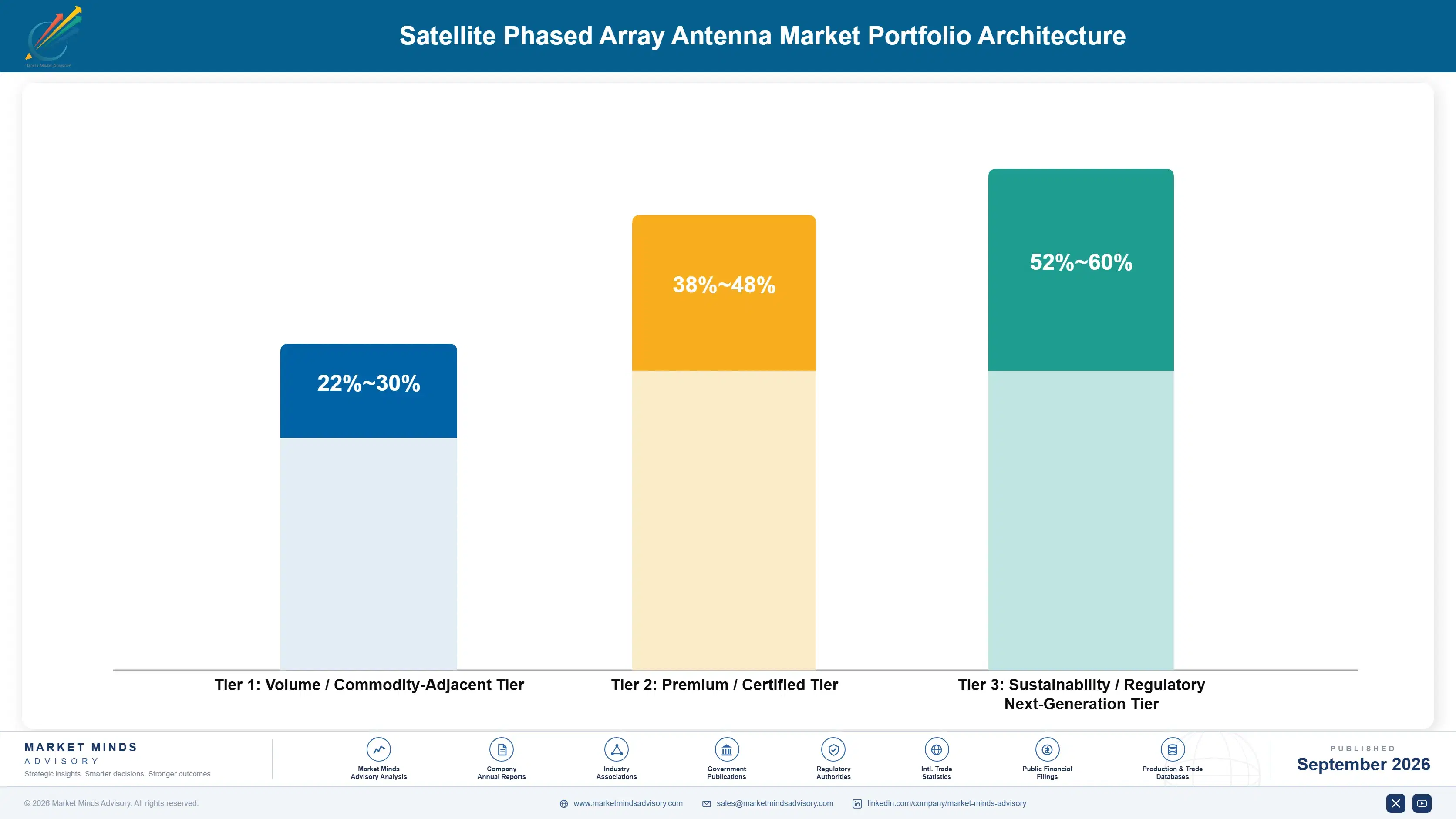
Portfolio Architecture for Margin Defence

Satellite phased array antenna margins split across a three-tier architecture shaped heavily by application specialization rather than pure manufacturing volume alone. Volume commodity-adjacent consumer broadband terminals compete largely on price against vertically integrated constellation operator alternatives, while premium certified defense and enterprise platforms command meaningful margin premiums tied to certification depth and specialized reliability requirements. This distribution-driven split increasingly determines who wins the largest defense and enterprise contracts.
The sustainability and next-generation tier, anchored by custom chip design and export-compliant regional manufacturing capability, now captures a disproportionate share of gross profit dollars relative to its current deployment scale, reflecting how defense and enterprise buyers pay durable premiums for capability that commodity consumer manufacturers cannot easily replicate. This pattern strengthens further as more defense programs mandate electronically scanned array specifications broadly.

Volume tier consumer terminals still anchor unit economics and manufacturing scale for many independent vendors, but the real strategic tension now sits between defending that commodity revenue base and investing in the defense certification and specialized service capability where growth and profitability both concentrate most heavily going forward through the current forecast period. Vendors that delay this shift risk losing relevance entirely within a few product generations.

Volume / Commodity-Adjacent Tier

Consumer broadband terminals competing primarily on price against vertically integrated constellation operator alternatives, serving rural and underserved connectivity markets with minimal certification or specialized requirements to satisfy. Margins remain thin given intense price competition and vertically integrated operator alternatives across most markets.
Gross Margin: 22-30%

Premium / Certified Tier

Enterprise, maritime, and aviation terminals carrying reliability certification and managed service capability that justify premium pricing above consumer commodity alternatives across specialized customer segments and applications. Contract sizes here run meaningfully larger than commodity tier deals given reduced substitution risk offered.
Gross Margin: 38-48%

Sustainability / Regulatory / Next-Generation Tier

Defense-certified electronically scanned arrays and export-compliant regional manufacturing platforms commanding the highest margins on jam resistance, ruggedization, and documented security certification required for military contracts. This tier increasingly attracts the largest government contracts as security requirements shape procurement decisions directly.
Gross Margin: 52-60%
satellite-phased-array-antenna-market-portfolio-architecture-1788416816781

High-value Sub-segments and Strategic Watch-out

Defense-Certified Electronically Scanned Arrays

The highest-value pool in the market, capturing premium government and military contracts through jam-resistant electronically scanned array specifications increasingly mandated across defense modernization programs among allied nations worldwide today. Vendors positioned early here could capture disproportionate share as allied defense budgets continue expanding steadily and defense budgets.
Gross Margin: 54-62%

Maritime and Aviation Managed Service Terminals

A high-value pool growing at a steady pace as shipping operators and airlines bundle hardware with recurring connectivity service contracts, converting one-time equipment sales into durable annuity revenue streams. Growth here is expected to accelerate further as shipping operators scale connectivity upgrade programs substantially globally.
Gross Margin: 44-52%

Consumer LEO Broadband Terminals

The volume core of the market, generating predictable manufacturing scale even as growth rates moderate relative to newer defense-certified and specialized service categories gaining enterprise budget share steadily each year. Vendors here increasingly compete on manufacturing scale rather than differentiated certification or specialized service capability.
Gross Margin: 22-30%

Legacy Mechanically Steered Antenna Systems

A strategic watch-out segment where defense modernization programs and electronically scanned array mandates could materially reshape competitive positioning for suppliers still dependent on legacy mechanical steering technology across their portfolios. Vendors overexposed here risk sudden revenue disruption as defense buyers accelerate transition timelines further ahead.
Gross Margin: 18-26%

Certification Depth Builds Sticky Contracts

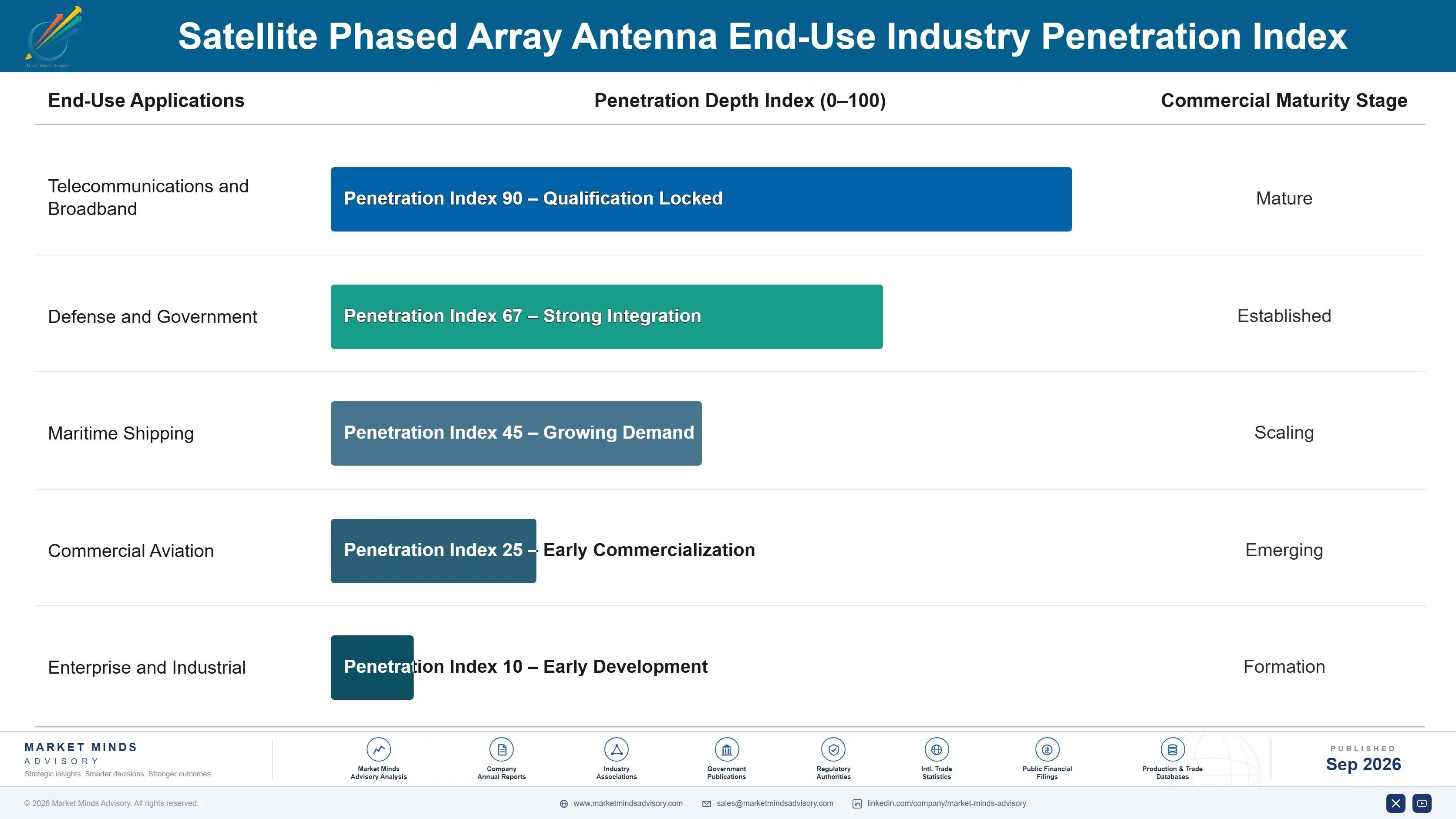
Phased array antenna vendors generate durable annuity economics in defense and enterprise segments, since certification and qualification processes require months of testing that customers rarely repeat with a new supplier once a platform proves reliable, giving certified vendors a renewal advantage over competitors offering comparable specifications but lacking equivalent proven track records across contested operating conditions. across the vendor's entire defense and enterprise customer base and contract portfolio.
Adoption depth varies sharply by end-use vertical. Defense and government buyers embed vendor relationships deepest, treating certified suppliers as strategic partners rather than interchangeable components, while consumer broadband terminal buyers remain highly price-sensitive and switch readily whenever a competitor offers comparable specifications at a meaningfully lower price point across the market. Maritime and aviation buyers sit between these extremes, valuing reliability but remaining more price-conscious than defense procurement teams.

A generational shift in buyer profile is underway as procurement teams increasingly prioritize electronically scanned array capability over legacy mechanical steering systems, a technical requirement shift accelerating replacement cycles at defense agencies well ahead of commercial enterprise buyers still operating older mechanically steered antenna infrastructure across their networks. Technical evaluators increasingly outrank cost-focused procurement officers in defense buying committees across most allied nations.
satellite-phased-array-antenna-market-end-use-penetration-index-1788416817269

Where MMA Sees Terminals Heading

These are among the four positions where our research anticipates prominent divergence between winners and laggards over the coming forecast period. Each is grounded in the demand model, the regulatory perimeter, and the announced capacity pipeline.
01 / DEFENSE CERTIFICATION PRIORITY

Defense certification deserves sustained investment as programs mandate electronically scanned arrays

Roughly 48 percent of surveyed defense procurement programs now mandate electronically scanned array capability in new contracts, up sharply from a low base only a few years earlier, making certification depth a genuine competitive moat rather than a background compliance function. Manufacturers that build certification track records now will win the largest defense contracts before competitors catch up, since testing and qualification cycles take years to replicate credibly. This gap widens further as more allied nations formalize similar procurement mandates.
02 / CHIP DESIGN INVESTMENT

Custom beamforming chip design reduces cost exposure that constrains smaller competitors

Roughly 29 percent of surveyed manufacturers cite beamforming semiconductor costs as their primary barrier preventing further price reductions toward true mass-market consumer thresholds across the broader terminal industry and its supplier base. Manufacturers investing in proprietary chip design capture margin currently paid to upstream suppliers while reducing exposure to the gallium and rare earth material volatility that has repeatedly squeezed thinner-margin competitors dependent entirely on external suppliers. This capability increasingly separates cost leaders from margin-constrained rivals industry-wide over time today.
03 / SERVICE CONTRACT EXPANSION

Maritime and aviation service contracts convert hardware into durable recurring revenue

Roughly 34 percent of surveyed shipping operators report planned satellite terminal upgrades within two years, representing a substantial opportunity for vendors positioned to bundle hardware sales with recurring connectivity service contracts rather than one-time equipment transactions alone across their broader customer base. This recurring revenue model smooths exposure to the consumer terminal pricing volatility that increasingly squeezes commodity-focused manufacturers lacking comparable service capability. Vendors slow to build this capability risk losing customer relationships to more diversified competitors entirely across the market.
04 / EXPORT COMPLIANCE STRATEGY

Regional manufacturing partnerships recover international sales lost to export licensing delays

Roughly 22 percent of surveyed manufacturers report lost international sales opportunities due to export licensing delays or denials under current dual-use technology classifications governing phased array antenna exports across most major manufacturing nations. Manufacturers that establish regional manufacturing partnerships now will recover this lost international revenue before competitors secure comparable regional production agreements and favorable export treatment status. This channel advantage compounds further as more governments tighten dual-use export restrictions across allied nations and their broader network of partner states.

Engagement Snapshot From the Field

A live engagement with an industry participant carrying material or product regulatory and market exposure ahead of a defining policy shift, showing how our research translates into a defensible multi-year portfolio strategy.
MARKET MINDS ADVISORY · CLIENT ENGAGEMENT SUMMARY
Satellite Phased Array Antenna Producer Strategic Portfolio Review and Transition Roadmap 2026·Investment Scenario on Satellite Phased Array Antenna Exposure Evaluation 2025-26
CLIENT PROFILE
A regional satellite communications operator with roughly $95 million in annual terminal procurement spending (client-reported, unverified by MMA) approached MMA after facing rising consumer terminal costs from its existing manufacturing partner and growing pressure to expand into rural connectivity markets requiring meaningfully lower price points to remain competitive against emerging alternatives. The engagement carried added urgency given committed investor timelines for the planned market launch.
STRATEGIC CHALLENGE
The client's existing terminal manufacturing partner lacked the production scale to meet cost targets for planned rural connectivity expansion, yet switching manufacturers risked disrupting an active subscriber growth trajectory that depended on consistent, reliable terminal supply across multiple simultaneous regional market launches already underway and committed to investors. Board members had already publicly committed to the expansion timeline in investor communications.
MMA APPROACH
MMA benchmarked five candidate manufacturers against production scale, semiconductor cost trajectory, and total cost of ownership over a three-year horizon, supplementing vendor claims with structured interviews of peer operators that had already completed comparable manufacturing partner transitions without disrupting active subscriber growth commitments already underway. MMA also modeled migration risk explicitly, given the client's active subscriber growth commitments at engagement start.
KEY FINDINGS
  1. The client's existing manufacturing partner's production scale was insufficient to meet planned rural expansion volume without a substantial capital investment the manufacturer was unwilling to make.
  2. A manufacturer with proprietary chip design capability offered terminal costs roughly 18 percent lower (client-reported, unverified by MMA) than the client's existing partner at comparable production volume.
  3. A phased dual-sourcing approach, qualifying the new manufacturer while maintaining existing supply, avoided disrupting active subscriber commitments while validating new vendor reliability under production conditions.
  4. The client's rural expansion launch proceeded on schedule following the manufacturing transition, with terminal costs meeting the lower price points required for the target market segment.
CLIENT PROFILE
A regional satellite communications operator with roughly $95 million in annual terminal procurement spending (client-reported, unverified by MMA) approached MMA after facing rising consumer terminal costs from its existing manufacturing partner and growing pressure to expand into rural connectivity markets requiring meaningfully lower price points to remain competitive against emerging alternatives. The engagement carried added urgency given committed investor timelines for the planned market launch.
STRATEGIC CHALLENGE
The client's existing terminal manufacturing partner lacked the production scale to meet cost targets for planned rural connectivity expansion, yet switching manufacturers risked disrupting an active subscriber growth trajectory that depended on consistent, reliable terminal supply across multiple simultaneous regional market launches already underway and committed to investors. Board members had already publicly committed to the expansion timeline in investor communications.
MMA APPROACH
MMA benchmarked five candidate manufacturers against production scale, semiconductor cost trajectory, and total cost of ownership over a three-year horizon, supplementing vendor claims with structured interviews of peer operators that had already completed comparable manufacturing partner transitions without disrupting active subscriber growth commitments already underway. MMA also modeled migration risk explicitly, given the client's active subscriber growth commitments at engagement start.
KEY FINDINGS
  1. The client's existing manufacturing partner's production scale was insufficient to meet planned rural expansion volume without a substantial capital investment the manufacturer was unwilling to make.
  2. A manufacturer with proprietary chip design capability offered terminal costs roughly 18 percent lower (client-reported, unverified by MMA) than the client's existing partner at comparable production volume.
  3. A phased dual-sourcing approach, qualifying the new manufacturer while maintaining existing supply, avoided disrupting active subscriber commitments while validating new vendor reliability under production conditions.
  4. The client's rural expansion launch proceeded on schedule following the manufacturing transition, with terminal costs meeting the lower price points required for the target market segment.
RECOMMENDED STRATEGY
Phase 1: Phase 1 (Months 1 to 3): Qualify the new manufacturing partner and begin parallel terminal production alongside the existing supplier relationship without disruption. Phase 2: Phase 2 (Months 3 to 7): Validate new manufacturer reliability and terminal quality across initial production runs before transitioning primary procurement volume. Phase 3: Phase 3 (Months 7 to 12): Complete full manufacturing transition and launch rural connectivity expansion at the target price point committed to investors.
OUTCOME
The client completed the manufacturing partner transition within the recommended twelve-month window and launched its rural connectivity expansion on schedule, achieving terminal cost reductions that supported the target price point (client-reported, unverified by MMA) needed to remain competitive in underserved markets. The manufacturing partner selection framework is now the client's standard approach for future procurement decisions.

Frequently Asked Questions

Foundational context covering the market sizes, CAGR, scope, country, region and competition that inform every finding below. This section is provided to cover basics and most often pre-purchase conversations, answered from the MMA Primary Research Dataset.

What is the current size of the Satellite Phased Array Antenna Market?

The global satellite phased array antenna market reached an estimated $2.6 billion in 2025. Growth is concentrated in consumer broadband terminals and defense electronically scanned array procurement programs.

How large will the Satellite Phased Array Antenna Market be by 2036?

MMA projects the market will reach $10.47 billion by 2036, roughly a 3.55 times expansion from its 2026 base value, driven primarily by constellation subscriber growth and defense modernization.

What is the CAGR for the Satellite Phased Array Antenna Market 2026 to 2036?

The market is projected to grow at a 13.5 percent compound annual growth rate between 2026 and 2036, with a bull case of 14.8 percent and a bear case of 12.2 percent.

Which segment is growing fastest?

LEO constellation user terminal antennas are the fastest-growing segment, expanding at roughly 22.0 percent annually as constellation operators scale consumer broadband subscriber bases rapidly worldwide.

Who are the major companies in the Satellite Phased Array Antenna Market?

Leading companies include Kymeta, ThinKom Solutions, Viasat, L3Harris Technologies, and RTX, together holding an estimated 44 percent of the market on an annual revenue basis.

Which country is growing fastest?

Indonesia is the fastest-growing major country market, expanding at approximately 18.0 percent annually as its vast archipelago geography drives sustained demand for satellite broadband connectivity.

Report Segmentation Architecture

The full report scope spans multiple orthogonal segmentation dimensions, with cross-tabulated demand data provided for each dimension pair. Coverage extends further to regional breakdowns, trend trajectories, and the competitive detail needed to support segment-level decision-making.

By Primary Market Dimension

  • Active Electronically Scanned Arrays
  • Passive Electronically Scanned Arrays
  • Consumer Flat-Panel Terminals
  • Defense and Military Arrays
  • Gateway and Ground Station Antennas
  • Airborne and Maritime Terminals

By End-Use Industry

  • Telecommunications and Broadband
  • Defense and Government
  • Maritime Shipping
  • Commercial Aviation
  • Enterprise and Industrial

By Commercial Dimension

  • Direct Equipment Sales
  • Managed Connectivity Service Bundles
  • Government Procurement Contracts
  • Original Equipment Manufacturer Supply

By Region

  • North America
  • Western Europe
  • East Asia
  • South Asia and Pacific
  • Latin America
  • Middle East and Africa
  • Eastern Europe

Scope, Methodology, and Coverage

Every figure in this report is reproducible from documented input assumptions. The scope below maps the historical period, the forecast horizon, the segmentation dimensions, and the countries covered, alongside the underlying primary and qualitative methodology.
Historical Period
2020 to 2025
Forecast Period
2026 to 2036
Base Year
2025 (USD billions; MMA Primary Research Dataset, September 2026)
Market Definition
The satellite phased array antenna market covers electronically steered antenna systems, including active and passive electronically scanned arrays, used for satellite communications across consumer, enterprise, defense, and government applications. It excludes traditional parabolic dish antennas and mechanically steered gimbal-based tracking systems.
Quantitative Units
USD billions (current prices); unit shipment volume where disclosed
Segmentation Dimensions
By Primary Market Dimension; By End-Use Industry; By Commercial Dimension; By Region
Regions Covered
North America, Western Europe, East Asia, South Asia and Pacific, Latin America, Middle East and Africa, Eastern Europe
Countries Covered
USA, China, Germany, France, UK, Japan, South Korea, India, Australia, Canada, Brazil, Mexico, Indonesia, Vietnam, Thailand, Malaysia, UAE, Saudi Arabia, South Africa, Nigeria, Turkey, Poland, Netherlands, Italy, Spain, Sweden, Switzerland, Argentina, Colombia, Singapore, and additional markets relevant to this sector
Key Companies Profiled
Kymeta, ThinKom Solutions, Viasat, L3Harris Technologies, RTX, Hughes Network Systems, Northrop Grumman, ST Engineering iDirect, Anokiwave, Analog Devices, Gilat Satellite Networks, Comtech Telecommunications, EchoStar, Intellian Technologies, Cobham SATCOM, All.Space, Ball Aerospace, BAE Systems, Honeywell Aerospace, Thales Group
Quantitative Methodology
Primary survey, n=3,800 respondents, Q4 2025, six countries; demand-side model with trade association cross-validation
Qualitative Methodology
47 expert interviews, Q4 2025; applied to validate demand model assumptions, identify emerging dynamics, and assess competitive positioning
Report Format
PDF and XLSX data workbook (Word format preview document)
Publisher
Market Minds Advisory
Report Code
MMA-2026-TEC-834
Published
September 2026
Contact
sales@marketmindsadvisory.com | www.marketmindsadvisory.com

Purchase the full Satellite Phased Array Antenna Market Report (2026 to 2036).

The full report provides comprehensive market sizing, ten-year forecasts, and segment-level analysis across all six phased array antenna categories and seven global regions. It includes detailed competitive profiling of twenty companies, input cost and materials supply chain risk assessment, and portfolio margin analysis by application tier. Readers gain access to primary survey data spanning 3,800 respondents and forty-seven expert interviews conducted across six countries during the fourth quarter of 2025. The report also includes a proprietary revenue lever framework identifying specific commercial actions manufacturers can take to defend margin.
Ten-year market size and CAGR forecasts
Segment-level growth rates and share analysis
Seven-region demand, pricing, and share breakdown
Twenty-company competitive benchmarking and positioning profiles
Input cost and materials supply chain risk mapping
Portfolio margin tier analysis and watch segments

Built For The People Who Decide

From boardroom strategy to bench-side execution, this report is read cover-to-cover by leaders shaping the next decade of their industry, turning demand scenarios, market dynamics and valuation benchmarks into decisions.
CXOs/ Presidents/ VPs/ Managers
M&A and Corporate Development
Strategy Teams and R&D Heads
Procurement and Product Directors
Regulatory and Compliance Leaders
Investor Relations and Equity Analysts