Market Minds Advisory
Satellite Communication Components Market

Satellite Communication Components Market: Satellite Communication Components Market. Mega-Constellation Demand Reshapes Component Supply Chains

Mega-constellation operators racing to launch thousands of satellites while component suppliers struggle with radiation-hardened part shortages are colliding as demand for space-qualified hardware outpaces traditional aerospace supply chain capacity entirely.

Lead Analyst

Published

September 2026

Make Smarter Decisions with Customized Research Insights

Request a free sample report and evaluate market opportunities, growth trends, and competitive dynamics relevant to your business needs.

2025 MARKET VALUE$12.4BMarket Size 2025
2036 FORECAST VALUE$37.2BBase Case , 2026 to 2036
CAGR 2026 TO 203610.5 %Bull 11.8% / Bear 9.2%
INCREMENTAL OPPORTUNITY$23.5BNet 10- year value creation
EXPANSION MULTIPLE2.71x2036 value over 2026 base
Strategic Levers
M&A Pipeline
Regional Outlook
Country Rankings
Competitive Intelligence
Segmental Deep-dive
Call-Us : 91 93563 13602

Executive Snapshot and Market Trajectory.

Mega-constellation operators are placing bulk orders for thousands of identical satellite components at once, forcing suppliers accustomed to one-off government contracts to retool for automotive-style volume manufacturing almost overnight. This shift is reshaping supplier qualification standards across nearly every major space program simultaneously today.
SpaceX's Starlink and Amazon's Kuiper program are each buying phased array antennas, power systems, and propulsion components at a volume that dwarfs the entire prior decade of commercial satellite production combined, and suppliers who can meet automotive-grade manufacturing tolerances at that scale are capturing an outsized share of new contracts. East Asian electronics manufacturers are moving into space-qualified component production fastest, applying consumer electronics manufacturing discipline to a market that historically prized bespoke engineering.
A handful of vertically integrated satellite manufacturers still dominate component sourcing decisions, but a wave of specialist suppliers focused purely on radiation-hardened electronics is entering from the semiconductor side rather than the traditional aerospace side, changing who counts as a credible competitor. Export control regulations governing dual-use space technology are forcing suppliers to navigate a genuinely more complex compliance landscape than commercial electronics manufacturing ever previously required.
Market Definition
This report covers hardware components used in satellite communication systems, including antennas, transponders, power systems, and propulsion modules, measured on a global component revenue basis across commercial, government, and defense satellite programs. It excludes complete satellite platforms sold as integrated systems and ground station equipment not physically mounted on the satellite itself.
Base Year Value
$12.4B in 2025 (MMA Primary Research Dataset, September 2026)
Forecast Period
2026 to 2036, eleven discrete annual values
CAGR
10.5% base case. Bull 11.8%. Bear 9.2%.
Fastest Growth Segment
Phased Array Antenna Components: 16.0% CAGR
Fastest Growth Country
India: 15.5% CAGR
Fastest Growth Region
South Asia and Pacific: 12.8% CAGR
Largest Region
North America: 32% of 2025 global value
Market Leaders
L3Harris, Thales Alenia Space, Airbus Defence and Space, Honeywell, Viasat
Primary Survey
n=3,800 procurement and R&D decision-makers, Q4 2025, six countries
Methodology
Demand-side build-up, cross-validated against public data, 47 expert interviews

Satellite Communication Components Market Forecast Scenarios

satellite-communication-components-market-size-forecast-scenario-1788417155262
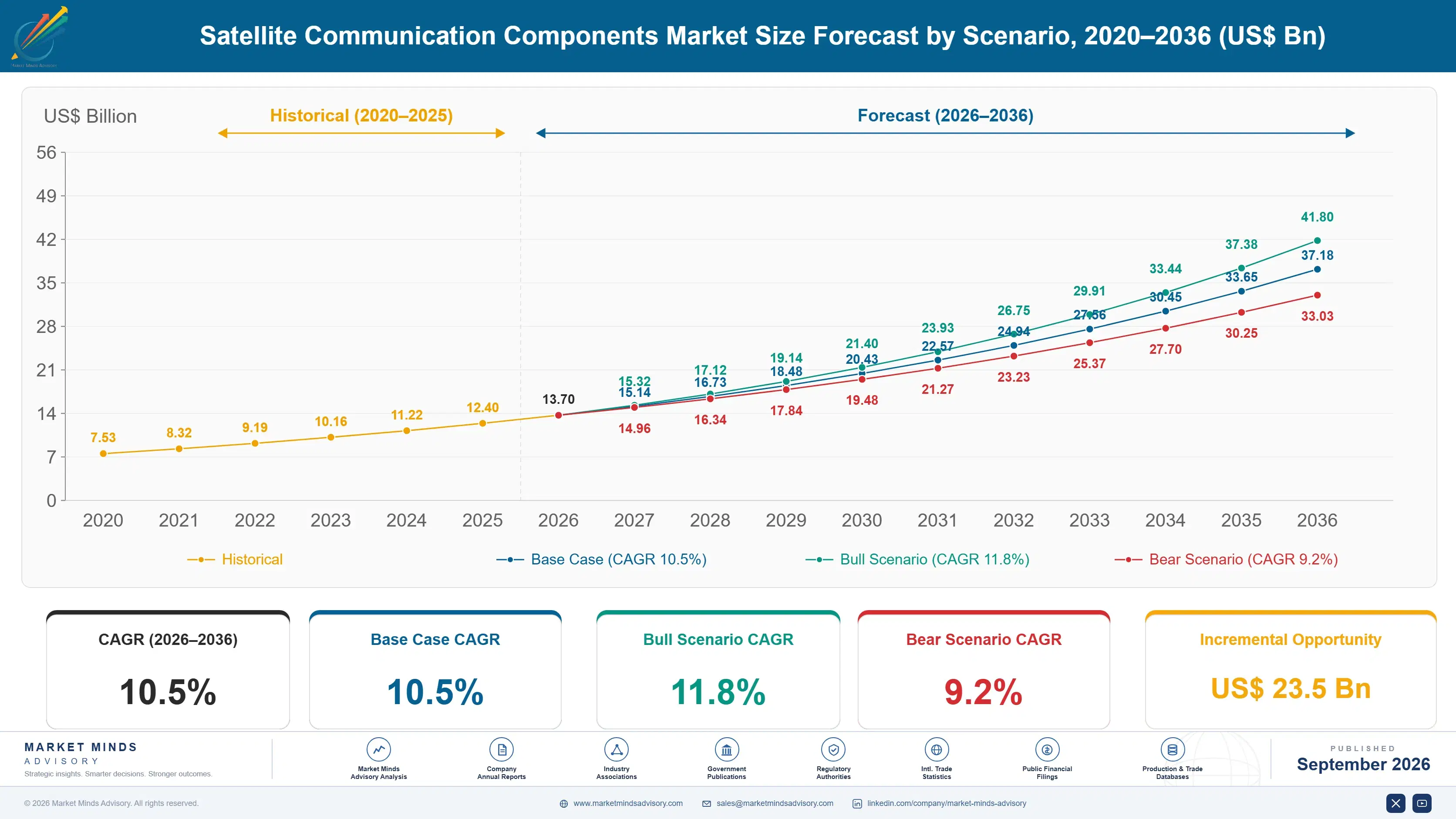
Between 2020 and 2025 the satellite communication components market grew at roughly 9.3 percent annually as early mega-constellation deployment began alongside steady government and defense satellite program spending. Growth accelerated sharply in the back half of that period once Starlink's launch cadence demonstrated that mass-produced satellite components were commercially viable at meaningful scale for the first time.
The base case assumes continued strong double-digit expansion as three commercial mechanisms compound: mega-constellation operators place recurring bulk orders that lock in multi-year supplier relationships, phased array antenna costs keep falling as manufacturing volume scales, and defense agencies increase resilient satellite architecture spending in response to anti-satellite weapons testing by rival nations. Component suppliers respond by building dedicated production lines for constellation customers rather than treating each order as bespoke engineering work.
The bull case centers on additional mega-constellation programs from new entrants launching on a compressed timeline, multiplying aggregate component demand well beyond current forecasts. The bear case centers on a launch vehicle capacity bottleneck or a major on-orbit failure triggering a regulatory pause, delaying constellation deployment schedules and pushing component orders out by a year or more across affected programs.

Satellite Components Become Manufactured Products, Not Bespoke Systems

Component suppliers are no longer building bespoke hardware for a handful of satellites per year, they are running production lines, and that shift is rewriting who counts as a credible supplier to a major constellation operator. A supplier without automated testing and repeatable manufacturing processes cannot win a contract that now requires delivering hundreds of identical units per month.
MARKET CONCENTRATION52% CR5Top five suppliers hold most global component revenue share
AVERAGE COMPONENT LEAD TIMEFourteen months for custom ordersTypical wait between order placement and component delivery
TOP MANUFACTURING COUNTRY SHAREUnited States, 38% of outputSingle country dominates worldwide space component manufacturing capacity
PHASED ARRAY PENETRATION42% of new satellite ordersShare of new satellites using phased array antenna technology
RADIATION-HARDENED COMPONENT PREMIUMThree to five times commercial pricingPrice premium commanded by space-qualified radiation-tolerant electronic components
AVERAGE SATELLITE PRODUCTION CYCLEEighteen months per generationTypical interval between major satellite component design generation changes
Suppliers that historically built custom hardware for individual government programs are being squeezed out unless they can retool for volume manufacturing, since mega-constellation operators refuse to pay bespoke engineering prices for what is now effectively a mass-produced product line. Several smaller specialist manufacturers have already exited the constellation segment entirely, choosing instead to focus on lower-volume, higher-margin government and defense contracts where bespoke engineering still commands a premium.
Traditional aerospace primes are competing directly with semiconductor and consumer electronics manufacturers entering the space component market for the first time, creating a market where manufacturing discipline matters as much as space engineering pedigree for winning the largest constellation contracts available. Constellation operators now evaluate suppliers on production throughput capacity almost as closely as raw component performance, a criterion that barely existed in procurement decisions a decade ago.
"A satellite antenna built like a one-off government contract is priced like one too. The suppliers winning constellation deals learned to build them like car parts instead."
Practice Lead, Space and Satellite Technology · MMA Space and Satellite Communications Hardware Practice · September 2026

Market Trends

Mega-Constellation Operators Standardize Satellite Component Designs

SpaceX has deployed over 7,000 Starlink satellites as of 2025, each using largely standardized phased array antenna and power system designs rather than custom hardware per launch, a manufacturing approach Amazon's Kuiper program is replicating for its planned constellation of over 3,000 satellites. This standardization is forcing component suppliers to design for repeatable production rather than one-off optimization, a fundamental shift from how satellite components were engineered for the prior six decades of the space industry. Suppliers unable to meet automotive-grade manufacturing tolerances at high volume are increasingly excluded from constellation contracts regardless of their individual component performance credentials.
Market Impact: Cost falls under 3,000 dollars
Anti-Satellite Weapons Testing Drives Resilient Architecture Spending

Anti-satellite weapons demonstrations by multiple nations have pushed defense agencies toward distributed constellation architectures using many smaller, cheaper satellites rather than a handful of exquisite, expensive ones that present a single point of failure. The United States Space Force's proliferated architecture programs have committed billions of dollars to this approach, creating sustained demand for lower-cost, higher-volume satellite components distinct from the traditional exquisite satellite procurement model. Component suppliers serving this defense segment increasingly need both space-qualification credentials and volume manufacturing capability simultaneously. These architectures also demand faster replenishment cycles, keeping production lines running continuously rather than in periodic batch orders.
Market Impact: Over 40 billion dollars in subsidies

Market Opportunities and Growth Drivers

Falling Launch Costs Expand Addressable Constellation Programs

Reusable rocket technology has cut the cost of reaching low Earth orbit from roughly 20,000 dollars per kilogram a decade ago to under 3,000 dollars per kilogram today, making mega-constellation economics viable for a wider range of operators beyond SpaceX alone. This cost collapse has pulled at least a dozen new constellation programs into active development across commercial, government, and telecommunications sectors that would not have penciled out economically at prior launch prices. Each new program represents an incremental demand pool for component suppliers, expanding the addressable market well beyond what a single dominant operator could sustain alone.
Market Impact: Adds over 12 months

Government Broadband Subsidies Fund Rural Satellite Connectivity

Government rural broadband programs in the United States, European Union, and India are directing subsidy funding toward satellite-based connectivity in areas where fiber and cellular buildout remains uneconomical, creating a durable government-funded demand channel for satellite communication hardware. The United States alone has allocated over 40 billion dollars toward broadband expansion programs that include satellite as an eligible technology, and several state-level programs have already directed meaningful funding specifically toward low-Earth-orbit satellite service providers rather than traditional geostationary alternatives. Component suppliers serving this segment must design for lower-cost, mass-market pricing rather than the premium pricing government space programs traditionally supported.
Market Impact: Adds 3 to 6 months

Market Restraints and Challenges

Radiation-Hardened Component Shortages Delay Production Schedules

Space-qualified radiation-hardened microelectronics depend on a small number of specialized foundries, a supply base that has struggled to scale output fast enough to meet mega-constellation order volumes. The root cause is that radiation hardening requires specialized fabrication and extensive qualification testing that general-purpose semiconductor foundries have little incentive to prioritize given the far larger commercial electronics market. Lead times for key radiation-hardened components can run over a year longer than commercial equivalents, delaying satellite production schedules across multiple programs. Several suppliers are mitigating this by qualifying commercial-grade components for less critical subsystems where full radiation hardening is not strictly required.
Market Impact: Over 7,000 Starlink satellites deployed

Export Control Regulations Complicate International Supply Chains

Dual-use export control regulations governing space technology components require extensive licensing review before many parts can cross international borders, creating friction that purely commercial electronics manufacturers rarely encounter. The underlying cause is that satellite components carry inherent military applications, placing them under stricter regulatory scrutiny than comparable consumer electronics regardless of their actual end use. This forces suppliers to maintain separate compliance teams and can add months to delivery timelines for international customers. Suppliers are mitigating this by establishing regional manufacturing facilities within key markets to avoid repeated cross-border export licensing entirely.
Market Impact: Over 9 billion committed to programs
3 additional market trends, 4 additional growth drivers, and 3 additional restraints and challenges are covered in the full report. Contact sales@marketmindsadvisory.com to access the complete intelligence.

Segment CAGR and Growth Architecture

The satellite communication components market splits across five hardware-defined segments spanning antennas, power, propulsion, and structural systems on board every satellite. Phased array antenna components lead growth as mega-constellation operators standardize on electronically steered designs, while traditional transponder and payload electronics still represent the largest installed base by unit volume across legacy geostationary programs.
satellite-communication-components-market-market-share-analysis-1788417155792

Phased Array Antenna Components

Phased array antenna components use electronically steered beams rather than mechanically pointed dishes, letting a single satellite maintain continuous ground station contact without moving parts that wear out or fail in orbit. This design is essential for mega-constellations, where satellites move rapidly relative to ground terminals and mechanical steering cannot keep pace with the required handoff speed between satellites. Growth here outpaces every other segment because every mega-constellation satellite requires multiple phased array units, multiplying unit demand far beyond the one-antenna-per-satellite ratio that defined the traditional geostationary satellite era. Suppliers building these units at automotive-style volume, rather than one at a time, are capturing the largest share of new constellation contracts.
CAGR 16.0%

Traditional Transponder and Payload Electronics

Traditional transponder and payload electronics remain the largest segment by installed unit count, covering the signal processing and frequency conversion hardware that geostationary communication satellites have used for decades. This hardware base predates the current constellation boom and continues generating steady replacement and upgrade demand as aging geostationary satellites reach end of life and operators launch replacements with modestly improved electronics. Growth here is comparatively modest since geostationary satellite orders have not grown at anywhere near the pace of low-Earth-orbit constellation deployment, with most new spending going toward incremental capability upgrades rather than fleet expansion. Vendors serving this segment compete primarily on reliability heritage and flight qualification history rather than manufacturing scale.
CAGR 5.5%
Full segment breakdown across 6 segments available in the complete report.

Regional Architecture and Country Demand Map

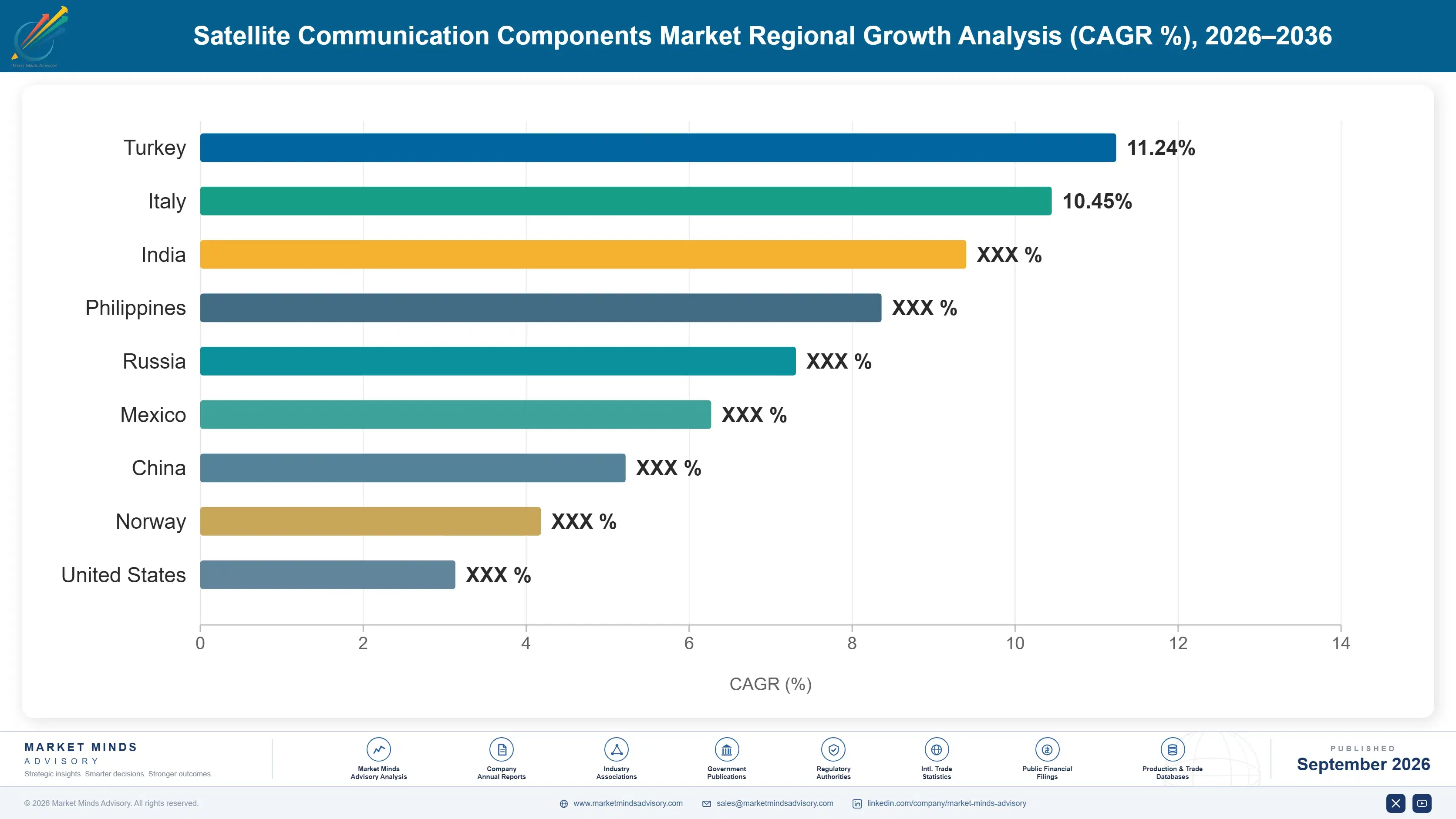
North America leads global component revenue on the strength of SpaceX and Amazon's mega-constellation build-out, while East Asia holds a strong secondary share tied to national satellite programs across China, Japan, and Korea. South Asia and Pacific grows fastest as India expands its commercial space sector.

North America

SpaceX's Starlink and Amazon's Kuiper program together account for a majority of global mega-constellation satellite production, anchoring North America's dominant regional share more decisively than in almost any other technology hardware category this report covers. The United States Space Force's proliferated architecture programs are separately driving substantial defense-oriented component demand distinct from the commercial constellation buildout, concentrated among suppliers holding both space-qualification credentials and security clearances. Canada's satellite manufacturing sector, smaller but growing, increasingly serves as a nearshore supplier to United States prime contractors seeking supply chain diversification away from single-source dependency. Suppliers serving this market increasingly need both automotive-scale manufacturing capability and government security clearances to win the full range of available contracts.
Share: 32% | CAGR: 11.8% (2026 to 2036)

Western Europe

Western Europe's growth trails the global rate mainly because its constellation ambitions, embodied primarily in the UK-based OneWeb network, operate at a fraction of the scale SpaceX and Amazon have achieved domestically. The European Union's IRIS squared sovereign constellation program is nonetheless adding a distinct new wave of government-funded component demand aimed at reducing European dependence on American satellite infrastructure for secure communications. France's Thales Alenia Space and Germany's OHB System continue winning meaningful government and commercial satellite component contracts, sustaining steady rather than explosive regional growth across the broader European supply base. Italy and Spain contribute smaller but growing component manufacturing bases tied to European Space Agency contract awards.
Share: 19% | CAGR: 9.2% (2026 to 2036)
Regional intelligence for 5 additional markets available in the complete report: East Asia, South Asia and Pacific, Latin America, Middle East and Africa, Eastern Europe. Contact sales@marketmindsadvisory.com.
satellite-communication-components-market-country-cagr-analysis-1788417156307

Where Component Suppliers Can Still Add Margin

Commoditizing constellation-grade hardware and thinning volume-manufacturing margins are pushing suppliers toward adjacent revenue lines that ride on top of the same customer relationship rather than the component unit sale itself. Four levers stand out as genuinely additive to core hardware revenue rather than cannibalistic of it, each drawing on capability the supplier already has.

Offering In-Orbit Component Performance Monitoring Subscriptions

Component suppliers with telemetry visibility into how their hardware performs once deployed can package predictive failure analytics as a subscription sold alongside the initial component sale, turning a one-time transaction into a recurring revenue relationship with the satellite operator. Operators running constellations of thousands of satellites value early failure warning since a single component failure can degrade coverage across an entire orbital plane. Suppliers offering this capability command service fees running roughly 6 to 10 percent of the original component contract value annually, a durable margin layer largely uncorrelated with new hardware sales cycles.
Market Impact: Service fees add 6 to 10 percent yearly

Providing Radiation-Hardened Electronics Design Consulting Services

Suppliers with deep expertise in radiation-tolerant electronics design can sell consulting services to newer space companies attempting to design their own components in-house, monetizing engineering knowledge separately from hardware manufacturing. This model captures value from companies that want design guidance without committing to a full manufacturing partnership immediately. Early providers of this service report consulting revenue reaching 4 to 7 percent of total company revenue within two years of launching the offering commercially, a margin layer requiring minimal incremental capital investment. Regulatory export control review still applies to this consulting work, adding compliance overhead most consulting-only firms never encounter.
Market Impact: Consulting revenue reaches 4 to 7 percent share

Selling Test and Qualification Facility Access

Suppliers that have already built expensive radiation testing and thermal vacuum qualification facilities can rent access to smaller companies that cannot justify building their own, capturing value from underutilized capital equipment during periods between internal production runs. This service has proven especially valuable to newer entrants racing to qualify hardware on compressed development timelines without the capital to build dedicated facilities. Vendors offering this report facility access fees adding roughly 10 to 15 percent on top of standard consulting engagement value. Facility scheduling requires careful coordination to avoid conflicts with the supplier's own internal production and qualification testing needs.
Market Impact: Facility fees add 10 to 15 percent more

Building Component Supply Chain Financing Programs

Suppliers with strong balance sheets can offer extended payment terms or direct financing to smaller constellation operators and newer space companies that lack traditional credit access, capturing interest income while also locking in a longer-term purchasing relationship with the customer. Carriers of this capability increasingly view financing terms as a differentiator equal in importance to component pricing itself. Suppliers offering this report financing income reaching 3 to 5 percent of total contract value across qualifying deals. Suppliers extending this financing must carefully manage credit risk exposure across a customer base that includes many early-stage space companies.
Market Impact: Financing income adds 3 to 5 percent overall

Who Controls the Margin Pool

Global component revenue concentrates moderately, with the top five suppliers holding roughly 52 percent share on a component revenue basis, the consistent yardstick applied throughout this assessment. L3Harris and Thales Alenia Space sit well ahead of the next tier, backed by decades of government and defense program relationships that newer entrants cannot easily replicate. The gap between leaders and mid-tier challengers remains wide enough that near-term ranking changes look unlikely absent a major win.
Current activity centers on volume manufacturing capability and vertical integration rather than pure price competition on legacy hardware. Suppliers are racing to build dedicated production lines for mega-constellation customers, since operators refuse to pay bespoke engineering prices for what is now effectively a mass-produced product line. Several mid-tier players have pursued semiconductor foundry partnerships specifically to secure radiation-hardened component supply.

Emerging pressure comes from semiconductor and consumer electronics manufacturers entering the space component market directly, competing with traditional aerospace primes who never built at automotive-style manufacturing volume. Ranking shifts are most likely in the mid-tier, where suppliers lacking volume manufacturing capability risk losing contracts to faster-moving specialists. The very top of the market remains comparatively stable, protected by government relationships built over decades.
satellite-communication-components-market-company-positioning-matrix-1788417156836

Competitive Moat and Risk Dimensions

L3HARRIS

Moat: Deep Defense Program Relationships

L3Harris holds decades of security-cleared relationships with United States defense agencies, giving it access to classified program contracts that commercially-focused entrants cannot pursue. These relationships also provide a stable, less cyclical revenue base than pure commercial constellation supply. Newer entrants rarely have the security clearance infrastructure to compete for these contracts credibly.
L3HARRIS

Risk: Slower Volume Manufacturing Pivot

L3Harris's manufacturing base grew up around lower-volume, higher-margin government programs, leaving it less naturally positioned for mega-constellation-scale production than newer entrants built from the start around automotive-style manufacturing discipline and high-volume output. Closing this gap would require substantial capital investment in new production infrastructure and process redesign.
THALES ALENIA SPACE

Moat: European Sovereign Program Access

Thales Alenia Space holds a privileged position on European Space Agency and IRIS squared constellation contracts, benefiting from policy preferences favoring European suppliers for sovereign communications infrastructure that American vendors cannot access regardless of technical merit. This positioning is difficult for any non-European supplier to replicate regardless of technical capability.
THALES ALENIA SPACE

Risk: Limited Commercial Constellation Scale

Thales Alenia Space's commercial constellation exposure remains far smaller than SpaceX or Amazon's supplier base, limiting its ability to achieve the manufacturing volume economics that are increasingly determining unit cost competitiveness across the broader component market. Closing that gap would require either new commercial contracts or a strategic partnership with a volume-focused manufacturer.

Players Tracked

Prominent Players

L3Harris
Thales Alenia Space
Airbus Defence and Space
Honeywell
Viasat

Other Key Players

Ball Aerospace
Northrop Grumman
Maxar Technologies
OHB System
Mitsubishi Electric
NEC Corporation
Kongsberg Satellite Services
Terran Orbital
Redwire Space
Astranis
Anywaves
Space Micro
Antwerp Space
Comtech Telecommunications
ISISPACE Group

Recent Developments

MARCH 2026

L3Harris Expands Phased Array Antenna Production Capacity

L3Harris announced a capacity expansion at its Florida manufacturing facility dedicated to phased array antenna production, aiming to double annual output in response to growing demand from both commercial constellation operators and United States Space Force proliferated architecture programs. The expansion is expected online within eighteen months.
Signal: Domestic capacity expansion is becoming a competitive necessity as defense and commercial demand both accelerate simultaneously.
NOVEMBER 2025

Thales Alenia Space Wins IRIS Squared Component Contract

Thales Alenia Space secured a multi-year component supply contract for the European Union's IRIS squared sovereign constellation program, expanding its role beyond satellite platform integration into a broader component supply position across the constellation's planned satellite fleet. Financial terms of the multi-year contract were not disclosed by either party.
Signal: Sovereign constellation programs are creating protected demand channels distinct from open commercial competition and pricing pressure.
JULY 2025

Honeywell Acquires Radiation-Hardened Semiconductor Startup

Honeywell completed the acquisition of a smaller radiation-hardened semiconductor design startup, adding specialized component design capability to its existing satellite hardware portfolio rather than relying solely on external foundry partnerships for critical radiation-tolerant electronics. The acquisition closed for an undisclosed sum earlier in the year.
Signal: Vertical integration into semiconductor design is becoming a defensive move against ongoing foundry supply constraints industry-wide.

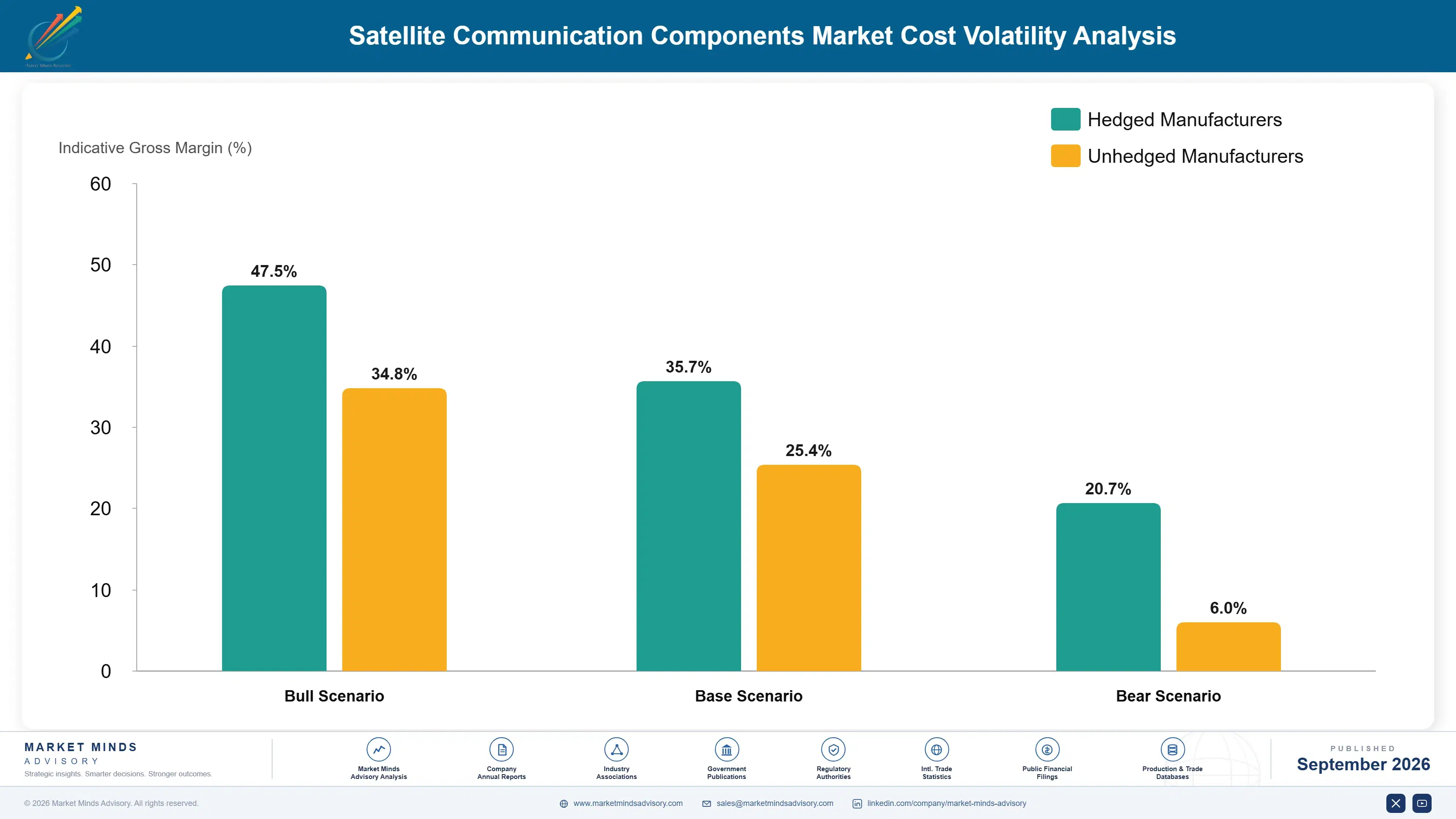
Radiation-Hardened Component Cost Exposure

Radiation-hardened microelectronics and specialty semiconductors account for roughly 35 to 42 percent of a typical satellite component supplier's cost of goods sold, sourced primarily from a small number of specialized foundries in the United States and Europe. Structural materials and precision manufacturing add a further 15 to 20 percent, sourced from a fragmented base of aerospace-grade metal and composite suppliers.
A 2022 radiation-hardened component shortage, documented in Honeywell's 2022 annual report as a material supply constraint, delayed satellite production schedules for multiple customers across several quarters. L3Harris's 2023 annual report similarly cited component allocation challenges as a driver behind its decision to qualify additional foundry partners rather than depending on a single radiation-hardened semiconductor source for critical flight hardware. These sourcing challenges have pushed several suppliers to expand internal semiconductor design capability rather than relying entirely on external foundry partners.

Smaller component suppliers face a genuine disadvantage here because they lack the purchasing volume to secure priority foundry allocation during shortage periods, unlike larger suppliers with long-term supply agreements and dedicated capacity reservations. Suppliers based in countries without domestic radiation-hardened semiconductor fabrication face additional exposure, since export control rules can restrict access to foreign-sourced components during periods of geopolitical tension.
satellite-communication-components-market-cost-volatility-analysis-1788417157032

Dual-Sourcing Radiation-Hardened Semiconductors

Suppliers are increasingly qualifying two or more foundries for critical radiation-hardened components so a single-source shortage cannot halt production. This adds validation cost but has become close to standard practice among suppliers shipping meaningful constellation volume. Vendors serving government and defense contracts increasingly treat dual-sourcing as a contractual requirement rather than an optional engineering choice made independently.

Long-Term Foundry Capacity Reservation Agreements

Locking in multi-year capacity reservation agreements with specialized foundries secures priority allocation during shortage periods and more predictable unit pricing, trading flexibility for supply security that smaller suppliers without scale often cannot negotiate. This approach requires substantial upfront capital commitment years ahead of actual production need, a tradeoff favoring well-capitalized suppliers over smaller rivals.

Commercial-Grade Component Substitution for Non-Critical Systems

Qualifying commercial-grade components for less radiation-sensitive subsystems reduces dependence on the most constrained specialized foundries, reserving scarce radiation-hardened capacity for the components where full hardening is genuinely required. This substitution strategy requires careful engineering analysis to confirm which subsystems can safely tolerate commercial-grade rather than fully hardened components. Suppliers rely on flight heritage data to justify substitutions to customers.

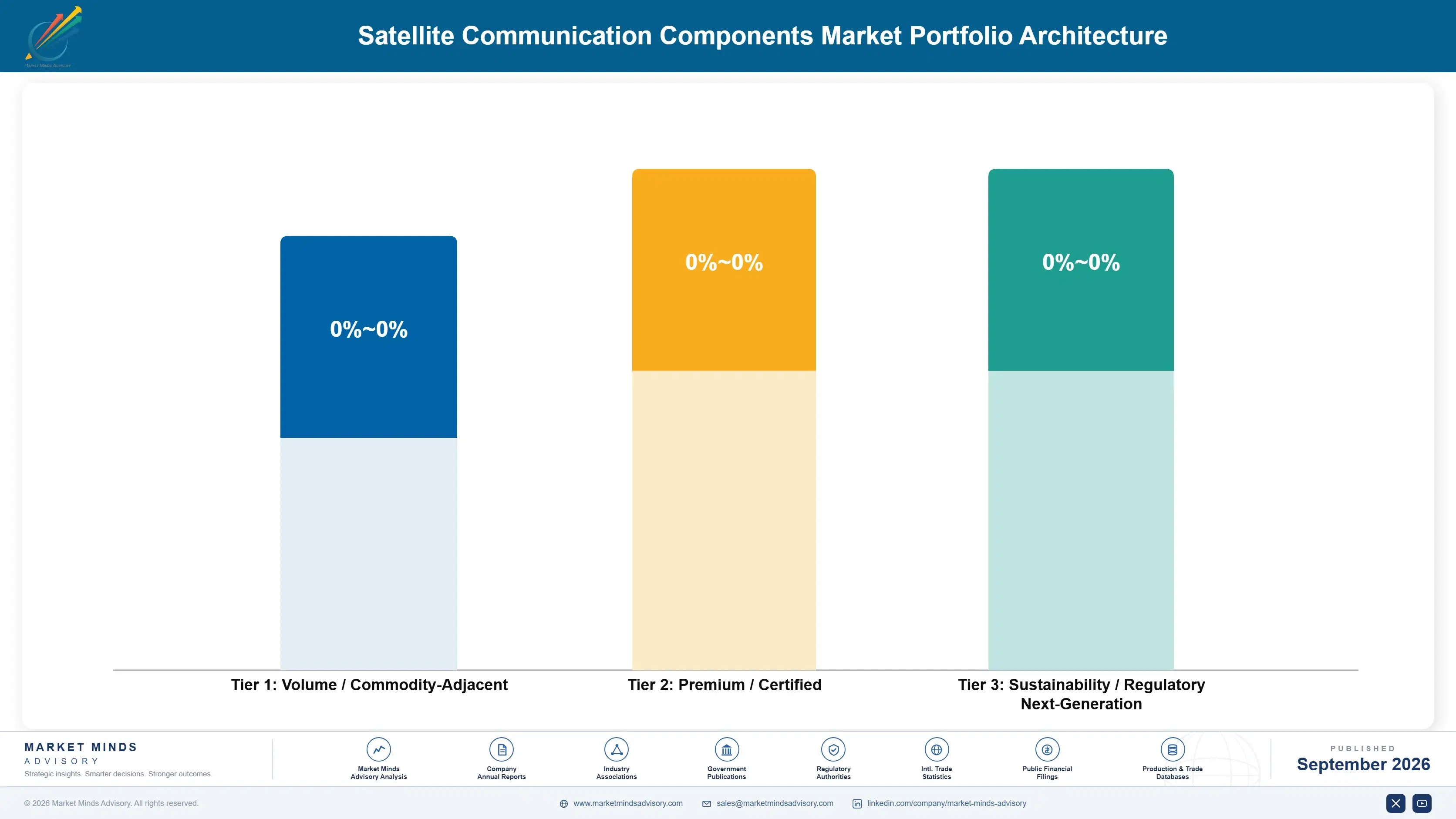
Portfolio Architecture for Margin Defence

Satellite component suppliers operate across a widening tier structure as constellation-scale hardware commoditizes and higher-margin specialized services concentrate pricing power elsewhere in the stack. Volume-tier constellation components now carry gross margins compressed by mass manufacturing competition, while certified defense-grade and radiation-hardened systems serving government programs retain meaningfully stronger pricing. Portfolio strategy increasingly determines profitability more than raw volume.
The tension between chasing constellation volume and defending premium government program positioning defines strategic choice across the industry. Suppliers competing purely on volume manufacturing find margin eroding faster than their cost base can adjust, while suppliers segmenting customers by security clearance and mission-critical requirements are protecting margin even as commodity pricing compresses. This divergence is reshaping how suppliers allocate engineering investment across their customer relationships and program pipeline.

High-value margin pools concentrate in radiation-hardened semiconductors, in-orbit monitoring services, and defense-grade qualification testing sold as standalone offerings rather than bundled features. These pools grow faster than core hardware revenue because they scale with expertise and infrastructure a supplier already owns rather than requiring incremental unit shipments, making them the most defensible source of margin expansion available today. Suppliers without such a plan risk the commodity tier over time.

Volume / Commodity-Adjacent

Mass-produced phased array antenna and power system components sold to mega-constellation operators at scale, where competition centers on manufacturing cost and delivery reliability rather than bespoke engineering. Suppliers in this tier compete on manufacturing scale and cycle time above almost everything else.
Gross Margin: 10 to 16%

Premium / Certified

Government and defense-grade components carrying security clearance requirements and flight heritage certification, sold to customers who value proven reliability over marginal cost savings on critical missions. These programs typically involve multi-year contracts, reducing acquisition cost per dollar of recurring revenue.
Gross Margin: 24 to 34%

Sustainability / Regulatory / Next-Generation

Radiation-hardened semiconductors, proliferated architecture components, and in-orbit monitoring services built to meet emerging defense resilience mandates, commanding premium pricing while capability remains scarce. Suppliers here often price on a service basis tied to mission criticality rather than pure component count.
Gross Margin: 30 to 42%
satellite-communication-components-market-portfolio-architecture-1788417157534

High-value Sub-segments and Strategic Watch-out

In-Orbit Performance Monitoring Services

High-value, high-growth pool as constellation operators pay premium pricing for early failure warning, rewarding suppliers who build accurate predictive models earliest with durable multi-year service contracts locked in ahead of rivals. Suppliers absent from this capability risk losing the largest constellation service contracts to faster-moving specialists.

Radiation-Hardened Design Consulting

High-value, moderate-growth pool constrained by the limited number of engineers with genuine radiation-hardening expertise, but delivering strong margin once a supplier has built a credible consulting practice and reputation. Expansion here depends heavily on how quickly a supplier can build a credible reputation in a competitive field.

Legacy Transponder and Payload Electronics

Volume core segment carrying the bulk of installed satellite hardware but facing steady margin compression as geostationary satellite orders plateau relative to explosive low-Earth-orbit constellation growth elsewhere. Consolidation among smaller legacy suppliers is likely as scale becomes the primary way to defend thinning margin. capacity.

Export Control Compliance Infrastructure

Strategic watch-out segment where shifting export control policy and geopolitical tension could rapidly change the competitive map, rewarding suppliers with flexible multi-jurisdiction manufacturing infrastructure already established. A sudden shift in export policy in any single major market could reroute meaningful supply volume quickly. abruptly and without much warning.

Recurring Revenue Across the Fleet Lifecycle

Component supplier revenue behaves like an annuity once a constellation operator qualifies a component for its satellite platform, since re-qualifying an alternate supplier requires extensive testing and flight heritage validation that operators avoid unless quality deteriorates. This stickiness means suppliers earn recurring revenue across every replenishment satellite for years after initial qualification, with almost no incremental sales cost. First-mover suppliers rarely get displaced once flight-qualified.
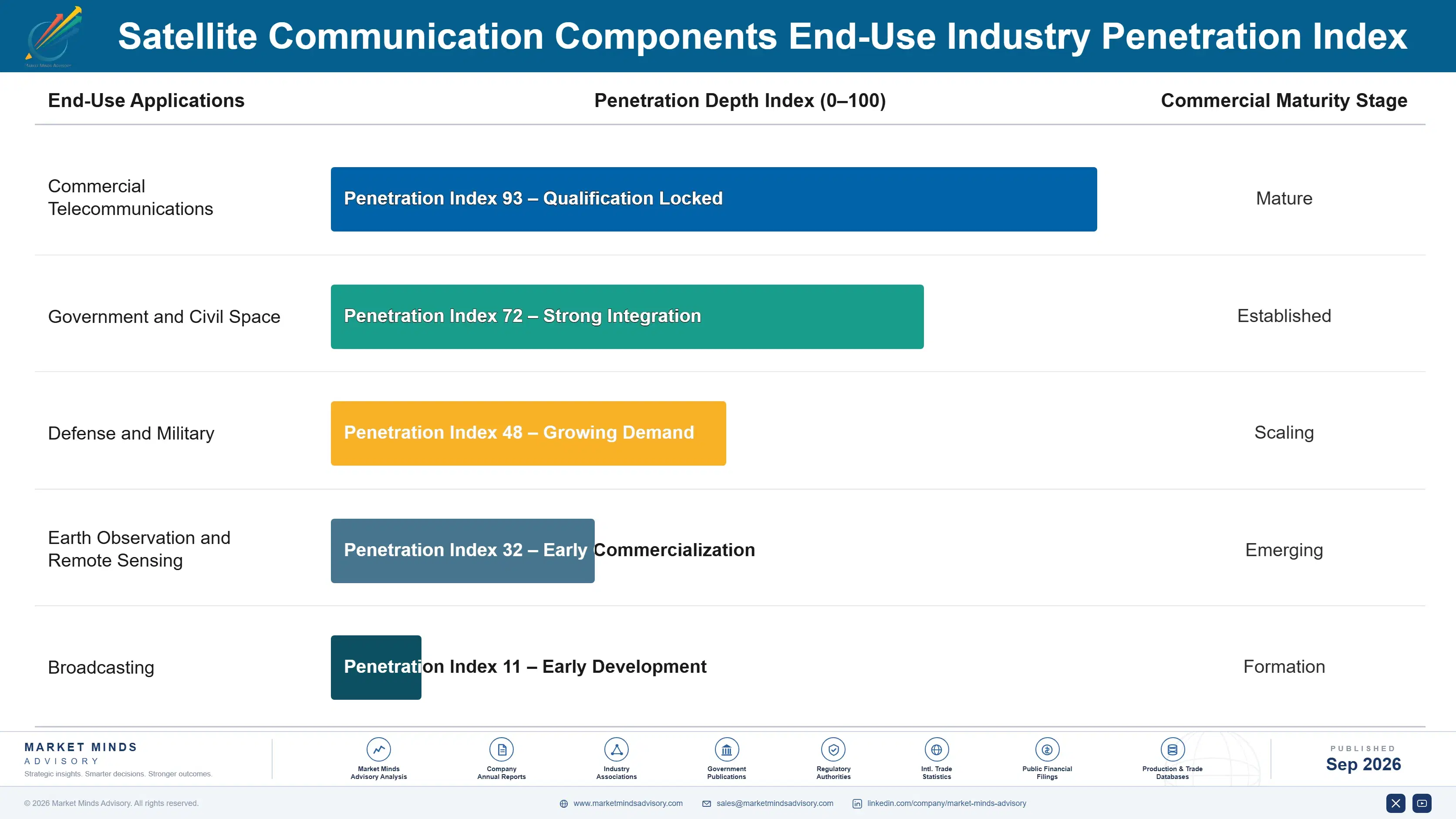
Adoption depth varies sharply by end-use vertical. Commercial constellation operators adopt new component generations quickly since capacity and cost improvements directly affect competitiveness, while government and defense programs integrate new components far more slowly due to security certification cycles stretching past two years. Geostationary satellite operators sit furthest behind, since long satellite lifespans mean component refresh cycles happen only once per generation.

Buyer profiles are shifting generationally as newer commercial space companies, staffed by engineers who grew up with rapid iteration and software-style development cycles, replace an older generation trained on multi-year, risk-averse qualification processes. Younger program managers expect component suppliers to iterate hardware on compressed timelines comparable to consumer electronics rather than the decade-long cycles that defined traditional aerospace procurement. compared with the past.
satellite-communication-components-market-end-use-penetration-index-1788417158028

Where MMA Sees the Real Bets

These are among the four positions where our research anticipates prominent divergence between winners and laggards over the coming forecast period. Each is grounded in the demand model, the regulatory perimeter, and the announced capacity pipeline.
01 / VOLUME MANUFACTURING PIVOT

Retool for automotive-scale production before losing constellation share

Suppliers still building components as one-off government contract work are already losing constellation business to rivals that retooled for repeatable, high-volume manufacturing. This gap widens every quarter a supplier delays investment, since mega-constellation operators refuse to pay bespoke engineering prices once a component category becomes effectively mass-produced across the broader supply chain. MMA views manufacturing scale as the clearest predictor of which suppliers win the largest constellation contracts over the next five years, more so than raw technical component performance alone.
02 / RADIATION-HARDENING CAPACITY BUILD

Secure foundry capacity before the next shortage cycle hits

Radiation-hardened semiconductor supply has repeatedly proven fragile during past shortage cycles, and suppliers lacking secured, dedicated foundry capacity risk losing production schedule commitments to rivals with dual-sourced, redundant supply chains already firmly in place. Building this resilience requires upfront capital and multi-year foundry relationships that smaller suppliers struggle to fund alone without outside financing support. MMA expects suppliers who secure this capacity early to weather the next shortage with far less production disruption than rivals still scrambling for scarce allocation.
03 / SERVICE REVENUE DIVERSIFICATION

Layer in-orbit monitoring and consulting onto core hardware sales

Component margins are compressing as constellation-scale manufacturing commoditizes across nearly every hardware category, making adjacent service revenue increasingly important to overall supplier profitability. Suppliers with rich telemetry visibility and deep technical expertise can package monitoring and consulting services that customers are already willing to pay a meaningful premium for today, well before competitors catch up. MMA strongly advises treating these adjacent services as a standing product priority rather than an opportunistic afterthought bolted on once competitors already offer something similar.
04 / DEFENSE PROGRAM POSITIONING

Pursue proliferated architecture contracts ahead of broader competition

Defense agencies are shifting decisively toward distributed, lower-cost satellite architectures in response to anti-satellite weapons testing by rival nations, creating a durable new demand channel distinct from traditional exquisite satellite procurement. Suppliers with both space-qualification credentials and volume manufacturing capability are best positioned to win this business ahead of competitors still organized around legacy program structures. MMA regards early positioning here as a meaningfully lower-risk approach than waiting for the defense budget cycle to fully mature and competition to intensify.

Engagement Snapshot From the Field

A live engagement with an industry participant carrying material or product regulatory and market exposure ahead of a defining policy shift, showing how our research translates into a defensible multi-year portfolio strategy.
MARKET MINDS ADVISORY · CLIENT ENGAGEMENT SUMMARY
Satellite Communication Components Producer Strategic Portfolio Review and Transition Roadmap 2026·Investment Scenario on Satellite Communication Components Exposure Evaluation 2025-26
CLIENT PROFILE
The client is a mid-sized aerospace component manufacturer historically focused on government satellite programs, generating roughly 180 million dollars in annual revenue from custom, low-volume avionics and antenna hardware. Its manufacturing processes were built around bespoke engineering for individual government contracts rather than repeatable, high-volume production suited to commercial mega-constellation customers. The company employed roughly 400 engineers and technicians across two facilities in the United States.
STRATEGIC CHALLENGE
The manufacturer faced declining government program revenue as several long-running contracts wound down, while lacking the manufacturing infrastructure needed to compete for mega-constellation supplier contracts that required delivering hundreds of identical units monthly. Leadership needed a credible entry strategy into commercial constellation supply within eighteen months, without abandoning its existing government program relationships entirely.
MMA APPROACH
MMA conducted a manufacturing capability assessment alongside interviews with the client's engineering and operations leadership, then benchmarked three volume-manufacturing retooling approaches against capital cost and timeline. The engagement produced a phased transition plan prioritizing a single product line for initial volume conversion, sequenced to prove manufacturing capability before pursuing larger constellation contracts.
KEY FINDINGS
  1. The manufacturer's phased array antenna product line was best suited for volume conversion given its existing design maturity and moderate retooling cost.
  2. Automated testing equipment investment could cut per-unit qualification time from several days to under two hours, a clear prerequisite for constellation-scale delivery.
  3. Two mega-constellation operators expressed willingness to conduct a smaller pilot qualification order before committing to a full multi-year supply contract at scale.
  4. Existing government program relationships provided valuable flight heritage credibility that new commercial entrants to the space industry typically lack entirely at launch.
CLIENT PROFILE
The client is a mid-sized aerospace component manufacturer historically focused on government satellite programs, generating roughly 180 million dollars in annual revenue from custom, low-volume avionics and antenna hardware. Its manufacturing processes were built around bespoke engineering for individual government contracts rather than repeatable, high-volume production suited to commercial mega-constellation customers. The company employed roughly 400 engineers and technicians across two facilities in the United States.
STRATEGIC CHALLENGE
The manufacturer faced declining government program revenue as several long-running contracts wound down, while lacking the manufacturing infrastructure needed to compete for mega-constellation supplier contracts that required delivering hundreds of identical units monthly. Leadership needed a credible entry strategy into commercial constellation supply within eighteen months, without abandoning its existing government program relationships entirely.
MMA APPROACH
MMA conducted a manufacturing capability assessment alongside interviews with the client's engineering and operations leadership, then benchmarked three volume-manufacturing retooling approaches against capital cost and timeline. The engagement produced a phased transition plan prioritizing a single product line for initial volume conversion, sequenced to prove manufacturing capability before pursuing larger constellation contracts.
KEY FINDINGS
  1. The manufacturer's phased array antenna product line was best suited for volume conversion given its existing design maturity and moderate retooling cost.
  2. Automated testing equipment investment could cut per-unit qualification time from several days to under two hours, a clear prerequisite for constellation-scale delivery.
  3. Two mega-constellation operators expressed willingness to conduct a smaller pilot qualification order before committing to a full multi-year supply contract at scale.
  4. Existing government program relationships provided valuable flight heritage credibility that new commercial entrants to the space industry typically lack entirely at launch.
RECOMMENDED STRATEGY
Phase 1: Phase 1 (Months 1-6): retool the phased array antenna production line for fully automated volume manufacturing and testing capability. completely. Phase 2: Phase 2 (Months 7-12): complete pilot qualification orders with two prospective mega-constellation customers simultaneously, running entirely in parallel. throughout. overall. Phase 3: Phase 3 (Months 13-18): scale production volume steadily and negotiate a multi-year supply agreement with the strongest-fit prospective customer. available.
OUTCOME
The manufacturer completed retooling and secured its first pilot qualification order within fourteen months, four months ahead of the original eighteen-month target (client-reported, unverified by MMA). The pilot converted into a three-year supply agreement representing a meaningful new revenue stream within five months of pilot completion (client-reported, unverified by MMA).

Frequently Asked Questions

Foundational context covering the market sizes, CAGR, scope, country, region and competition that inform every finding below. This section is provided to cover basics and most often pre-purchase conversations, answered from the MMA Primary Research Dataset.

What is the current size of the Satellite Communication Components Market?

The Satellite Communication Components Market reached 12.4 billion dollars in 2025, the report's base year for all forecast calculations. This figure covers antennas, transponders, power systems, and propulsion modules globally.

How large will the Satellite Communication Components Market be by 2036?

The market is projected to reach 37.18 billion dollars by 2036, roughly 2.71 times its 2026 starting value. That growth reflects mega-constellation deployment and falling launch costs.

What is the CAGR for the Satellite Communication Components Market 2026 to 2036?

The market is forecast to grow at a 10.5 percent compound annual rate between 2026 and 2036. Bull and bear scenarios range from 11.8 percent to 9.2 percent respectively.

Which segment is growing fastest?

Phased array antenna components lead growth at 16.0 percent CAGR, roughly 1.52 times the overall market rate. Mega-constellation operators standardizing on electronically steered designs are driving this expansion.

Who are the major companies in the Satellite Communication Components Market?

L3Harris, Thales Alenia Space, Airbus Defence and Space, Honeywell, and Viasat lead the market on a component revenue basis. Together these five suppliers hold roughly 52 percent combined share.

Which country is growing fastest?

India leads country-level growth at 15.5 percent CAGR, driven by its expanding commercial space sector and government-backed manufacturing incentives. Domestic suppliers are increasingly winning contracts once reserved for Western vendors.

Report Segmentation Architecture

The full report scope spans multiple orthogonal segmentation dimensions, with cross-tabulated demand data provided for each dimension pair. Coverage extends further to regional breakdowns, trend trajectories, and the competitive detail needed to support segment-level decision-making.

By Primary Market Dimension

  • Phased Array Antenna Components
  • Traditional Transponder and Payload Electronics
  • Power Systems and Solar Arrays
  • Propulsion Modules
  • Structural and Thermal Systems

By End-Use Industry

  • Commercial Telecommunications
  • Government and Civil Space
  • Defense and Military
  • Earth Observation and Remote Sensing
  • Broadcasting

By Commercial Dimension

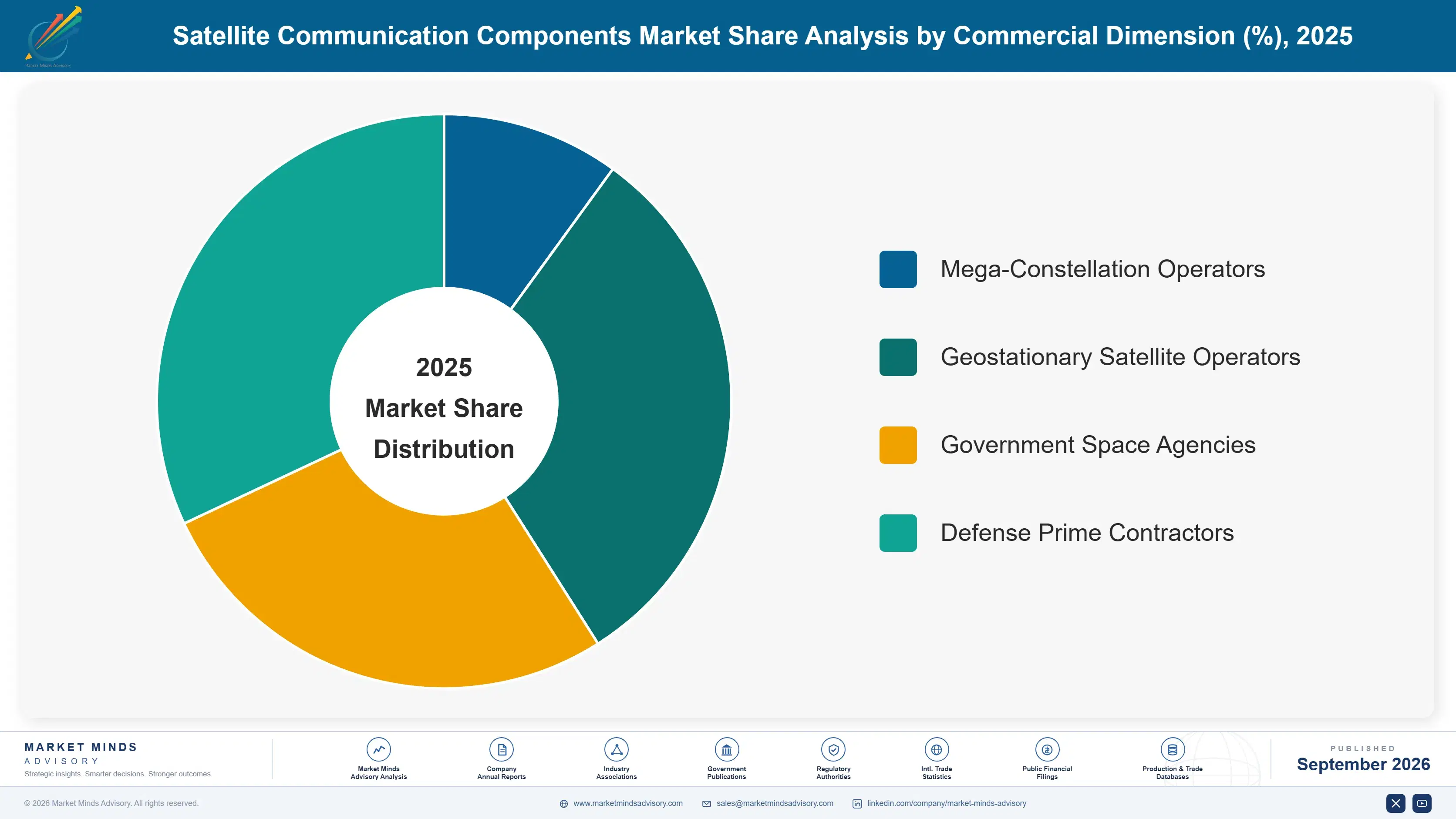
  • Mega-Constellation Operators
  • Geostationary Satellite Operators
  • Government Space Agencies
  • Defense Prime Contractors

By Region

  • North America
  • Western Europe
  • East Asia
  • South Asia and Pacific
  • Latin America
  • Middle East and Africa
  • Eastern Europe

Scope, Methodology, and Coverage

Every figure in this report is reproducible from documented input assumptions. The scope below maps the historical period, the forecast horizon, the segmentation dimensions, and the countries covered, alongside the underlying primary and qualitative methodology.
Historical Period
2020 to 2025
Forecast Period
2026 to 2036
Base Year
2025 (USD billions; MMA Primary Research Dataset, September 2026)
Market Definition
This report covers hardware components used in satellite communication systems, including antennas, transponders, power systems, and propulsion modules, measured on a global component revenue basis across commercial, government, and defense satellite programs. It excludes complete satellite platforms sold as integrated systems and ground station equipment not physically mounted on the satellite itself.
Quantitative Units
USD billions, global market size and forecast
Segmentation Dimensions
Product/technology type, end-use industry, commercial/customer dimension, region
Regions Covered
North America, Western Europe, East Asia, South Asia and Pacific, Latin America, Middle East and Africa, Eastern Europe
Countries Covered
United States, China, Germany, France, United Kingdom, Japan, South Korea, India, Canada, Brazil, Mexico, Indonesia, Vietnam, Thailand, Malaysia, United Arab Emirates, Saudi Arabia, South Africa, Nigeria, Turkey, Poland, Netherlands, Italy, Spain, Sweden, Switzerland, Argentina, Colombia, Australia, Singapore, and additional markets relevant to this sector
Key Companies Profiled
L3Harris, Thales Alenia Space, Airbus Defence and Space, Honeywell, Viasat, Ball Aerospace, Northrop Grumman, Maxar Technologies, OHB System, Mitsubishi Electric, NEC Corporation, Kongsberg Satellite Services, Terran Orbital, Redwire Space, Astranis, Anywaves, Space Micro, Antwerp Space, Comtech Telecommunications, ISISPACE Group
Quantitative Methodology
Primary survey, n=3,800 respondents, Q4 2025, six countries; demand-side model with trade association cross-validation
Qualitative Methodology
47 expert interviews, Q4 2025; applied to validate demand model assumptions, identify emerging dynamics, and assess competitive positioning
Report Format
PDF and XLSX data workbook (Word format preview document)
Publisher
Market Minds Advisory
Report Code
MMA-2026-TEC-131
Published
September 2026
Contact
sales@marketmindsadvisory.com | www.marketmindsadvisory.com

Purchase the full Satellite Communication Components Market Report (2026 to 2036).

This report delivers a comprehensive analysis of the global Satellite Communication Components Market, covering market sizing, segmentation, and regional dynamics through 2036. It profiles the competitive landscape across twenty leading suppliers, benchmarked on a consistent component revenue basis. Regional analysis spans all seven major world regions, quantifying share and growth rate differences driven by government, defense, and commercial constellation demand factors. The report also examines revenue diversification strategies, input cost exposure, and portfolio economics shaping supplier profitability. A dedicated case study illustrates practical implementation lessons for suppliers pursuing constellation qualification programs.
Ten-year market size and CAGR forecast through 2036
Five-segment MECE market breakdown with growth rates
Seven-region share and growth rate analysis
Twenty-company competitive benchmarking on component revenue basis
Revenue diversification strategy analysis across four commercial levers
Anonymized client implementation case study with outcomes

Built For The People Who Decide

From boardroom strategy to bench-side execution, this report is read cover-to-cover by leaders shaping the next decade of their industry, turning demand scenarios, market dynamics and valuation benchmarks into decisions.
CXOs/ Presidents/ VPs/ Managers
M&A and Corporate Development
Strategy Teams and R&D Heads
Procurement and Product Directors
Regulatory and Compliance Leaders
Investor Relations and Equity Analysts