Market Minds Advisory
Satellite Cable And Assemblies Market

Satellite Cable And Assemblies Market: Satellite Cable and Assemblies Market. Optical Links Redefine Bandwidth Ceilings

Fiber optic interconnects and high-frequency waveguide assemblies push satellite cabling past legacy copper bandwidth limits, while mega-constellation manufacturing volume reshapes cable suppliers from bespoke aerospace vendors into high-throughput production partners.

Lead Analyst

Published

September 2026

Make Smarter Decisions with Customized Research Insights

Request a free sample report and evaluate market opportunities, growth trends, and competitive dynamics relevant to your business needs.

2025 MARKET VALUE$3.6BMarket Size 2025
2036 FORECAST VALUE$8.7BBase Case , 2026 to 2036
CAGR 2026 TO 20368.4 %Bull 9.7% / Bear 7.1%
INCREMENTAL OPPORTUNITY$4.8BNet 10- year value creation
EXPANSION MULTIPLE2.24x2036 value over 2026 base
Strategic Levers
M&A Pipeline
Regional Outlook
Country Rankings
Competitive Intelligence
Segmental Deep-dive
Call-Us : 91 93563 13602

Executive Snapshot and Market Trajectory.

Satellite cable and assembly demand has shifted decisively toward high-throughput fiber optic and waveguide designs, as mega-constellation manufacturing volume pushes suppliers from bespoke aerospace production into repeatable high-rate assembly lines across most major commercial and government satellite programs today. Assembly qualification timelines continue shortening as flight heritage accumulates across programs.
Fiber optic and high-frequency waveguide assemblies are pulling share away from legacy copper coaxial designs, since satellite operators increasingly need bandwidth that copper interconnects simply cannot physically support at comparable weight and size. Growth concentrates most heavily in North America and East Asia, where dominant satellite manufacturing bases and large commercial constellation programs both reward qualified, flight-proven assemblies over unproven designs sold at lower cost. Enterprise buyers increasingly evaluate vendors on flight heritage credentials.
Competition remains fragmented across specialty aerospace interconnect manufacturers, broad-line cable conglomerates entering the space segment, and in-house constellation manufacturer production, with no single player commanding outsized share of global volume or pricing power. Rising satellite production rates tied to mega-constellation deployment are reshaping supplier relationships toward volume manufacturing agreements rather than one-off custom assembly contracts negotiated individually. Vendors increasingly certify assemblies separately for defense and commercial buyers.
Market Definition
The satellite cable and assemblies market covers RF coaxial, fiber optic, wiring harness, and waveguide interconnect products designed and qualified for satellite bus and payload applications. It excludes ground station cabling not qualified for spaceflight and general aerospace cable products not specifically designed for satellite platforms.
Base Year Value
$3.6B in 2025 (MMA Primary Research Dataset, September 2026)
Forecast Period
2026 to 2036, eleven discrete annual values
CAGR
8.4% base case. Bull 9.7%. Bear 7.1%.
Fastest Growth Segment
Fiber Optic Cable Assemblies: 12.8% CAGR
Fastest Growth Country
United States: 9.1% CAGR
Fastest Growth Region
South Asia and Pacific: 10.6% CAGR
Largest Region
North America: 33% of 2025 global value
Market Leaders
Amphenol, TE Connectivity, Carlisle Interconnect Technologies, W.L. Gore & Associates, Radiall. Source: MMA Analysis based on company disclosures and primary research.
Primary Survey
n=3,800 procurement and R&D decision-makers, Q4 2025, six countries
Methodology
Demand-side build-up, cross-validated against public data, 47 expert interviews

Satellite Cable And Assemblies Market Forecast Scenarios

satellite-cable-and-assemblies-market-size-forecast-scenario-1790025389518
Between 2020 and 2025 the market grew steadily as commercial mega-constellation programs accelerated satellite production rates considerably across most tracked commercial manufacturers, with fiber optic and waveguide assembly orders climbing well above prior trend for two consecutive years across major commercial and government satellite manufacturers globally and domestically. Shipbuilding-style production line investments have also periodically slowed near-term delivery timelines.
The base case assumes continued mega-constellation manufacturing volume, expanding high-frequency waveguide adoption for Ka-band and mmWave payloads reaching new satellite platform designs, and sustained fiber optic intersatellite link deployment across next-generation constellation architectures. These three mechanisms together sustain growth even as legacy copper coaxial assembly penetration approaches saturation across established government and commercial satellite production lines already familiar with the category. Vendor certification cycles for new frequency bands typically take twelve to eighteen months.
A stronger bull case hinges on additional commercial constellation operators committing to production volumes considerably faster than current manufacturing timelines suggest. The bear risk is a slowdown in commercial constellation deployment tied to launch capacity or financing constraints, which would push back multi-year assembly orders and slow the manufacturing scale-up that lower per-unit costs depend on.

Volume Manufacturing Redefines Supplier Qualification

Satellite cable and assembly manufacturing sits at the intersection of aerospace qualification rigor and consumer electronics-style production volume, a category reshaped considerably as mega-constellation programs demand thousands of identical assemblies rather than dozens of bespoke units. Buyers now treat supplier selection partly as a production capacity decision, reshaping how manufacturers invest in automated assembly lines rather than purely manual craftsmanship. Insurance underwriters increasingly factor flight heritage into program risk assessments.
MARKET CONCENTRATIONCR5 29%shows a fragmented field of aerospace interconnect specialists
AVERAGE SELLING PRICE$1,850blends basic coaxial harnesses with premium fiber optic assemblies
TOP PRODUCING COUNTRY SHAREUSA 41%captures the dominant manufacturing base for satellite assemblies
CAPACITY UTILIZATION77%indicates limited headroom across specialized aerospace production facilities today
CONSTELLATION PROGRAM REVENUE SHARE48%shows how much category revenue depends on mega-constellation orders
QUALIFICATION CYCLE LENGTH18 monthscaptures how long new assembly designs take before flight approval
Manufacturing remains concentrated among specialized aerospace interconnect producers in the United States, Germany, and Japan, where flight qualification expertise commands a premium buyers are willing to pay for documented reliability under extreme thermal and vacuum conditions encountered in orbit. Mega-constellation operators increasingly qualify multiple suppliers simultaneously to de-risk production bottlenecks tied to any single manufacturer's capacity constraints.
Replacement demand now rivals first-time qualification as a growth driver, since satellite manufacturers who qualified basic coaxial assemblies years ago increasingly upgrade to fiber optic or waveguide alternatives as next-generation payload bandwidth requirements exceed original design capability entirely. This replacement cycle gives established suppliers a second monetization opportunity per program well beyond the initial assembly qualification made years earlier.
"Ten years ago a satellite program ordered maybe fifty cable assemblies total. Now a single constellation batch order can run into the thousands, and that volume shift changed which suppliers can even compete for the business."
Senior Analyst, Space Technology Practice · MMA Technology Practice · September 2026

Market Trends

Fiber Optic Intersatellite Links Replace RF Crosslinks

Satellite operators increasingly specify fiber optic intersatellite link hardware rather than traditional RF crosslinks, since documented bandwidth requirements for next-generation constellation data relay have expanded well beyond what RF crosslink hardware can physically support at comparable power consumption. Manufacturers report fiber optic assembly orders climbing meaningfully faster among constellation operators who previously accepted RF crosslinks for routine inter-satellite communication. This shift is pulling procurement specifications toward optical link capability as a baseline requirement for next-generation constellations, forcing legacy RF-focused manufacturers to accelerate optical product roadmaps or exit high-value constellation segments entirely.
Market Impact: constellations drive 52% of assembly orders

Automated Assembly Lines Replace Manual Craft Production

Mega-constellation order volumes have pushed manufacturers to invest in automated cable assembly and termination equipment rather than relying entirely on manual technician labor that previously defined aerospace cable production. Several major manufacturers have launched automated production lines within the past two years specifically to meet constellation delivery schedules that manual production simply cannot sustain at required volumes. This shift is reshaping manufacturing economics considerably, since automated lines require substantial upfront capital investment that smaller manufacturers without constellation-scale orders struggle to justify. Retailers of specialized production equipment report strong order backlogs from aerospace suppliers.
Market Impact: waveguide demand grows 39% yearly

Market Opportunities and Growth Drivers

Mega-Constellation Manufacturing Sustains Volume Order Growth

Commercial mega-constellation programs continue placing large-batch assembly orders that dwarf traditional single-satellite government program volumes, sustaining considerable demand growth even as individual satellite unit costs decline. Buyers increasingly view assembly suppliers as production partners requiring guaranteed capacity commitments rather than one-off vendors selected through periodic bidding. This behavioral pattern has proven durable across multiple constellation deployment phases, sustaining demand even during periods when individual satellite programs face budget scrutiny. Multi-year framework contracts increasingly lock in supplier relationships across constellation deployment phases. Manufacturers with proven scale increasingly displace smaller specialty vendors unable to guarantee volume.
Market Impact: qualification delays affect 21% of entrants

High-Frequency Payload Growth Expands Waveguide Demand

Satellite payload operators increasingly deploy Ka-band and mmWave frequency systems that require specialized waveguide assemblies rather than standard coaxial cable, opening a premium product category considerably more profitable than legacy RF interconnect sales. This adoption particularly benefits manufacturers with existing high-frequency qualification experience over generalist cable producers lacking comparable precision manufacturing capability. Commercial broadband constellation operators have already deployed high-frequency payloads at meaningful scale, demonstrating the format's commercial viability beyond experimental government payloads. Qualification cycles for new frequency bands typically take twelve to eighteen months to complete depending on the frequency band.
Market Impact: shortages delay production by 8 weeks

Market Restraints and Challenges

Qualification Timelines Delay New Supplier Entry

New assembly designs must pass extensive thermal cycling, vacuum exposure, and vibration testing before flight qualification, creating a lengthy barrier that prevents newer manufacturers from quickly capturing share even when their designs offer meaningful cost or performance advantages. The root cause is that satellite operators cannot risk mission failure from an unqualified component, making qualification testing rigor non-negotiable regardless of a new supplier's manufacturing capability or pricing. Manufacturers are countering by pursuing joint qualification programs with established primes that share testing infrastructure and accelerate approval timelines. Larger primes increasingly view early joint qualification as a competitive recruiting tool.
Market Impact: optical link orders up 47%

Component Shortages Delay High-Frequency Assembly Production

Specialized components including precision waveguide sections and radiation-hardened optical transceivers periodically face supply shortages that delay production timelines for premium assembly manufacturers more than for basic coaxial cable producers using widely available materials. This friction disproportionately affects smaller manufacturers without long-term component supply agreements, since larger vendors can absorb allocation priority during shortage periods tied to broader semiconductor market conditions. Manufacturers are responding by qualifying multiple component suppliers and building larger safety stock inventories. Lead times for radiation-hardened optical components have roughly doubled during recent shortage periods across the broader industry.
Market Impact: automated output now 34% of volume
3 additional market trends, 4 additional growth drivers, and 2 additional restraints and challenges are covered in the full report. Contact sales@marketmindsadvisory.com to access the complete intelligence.

Segment CAGR and Growth Architecture

The market segments by signal transmission technology rather than by application or price tier, since whether an assembly carries RF, optical, or high-frequency waveguide signals determines its bandwidth capability, qualification requirements, and target buyer entirely today and going forward. Six technology categories together capture the full addressable scope of satellite cable and assembly products sold globally.
satellite-cable-and-assemblies-market-market-share-analysis-1790025390120

Fiber Optic Cable Assemblies

Fiber optic cable assemblies carry data through light pulses rather than electrical signals, delivering bandwidth capacity that copper coaxial interconnects simply cannot physically match at comparable weight and power consumption. This segment is growing fastest as intersatellite data relay requirements expand considerably with next-generation constellation architectures that demand high-capacity links between orbiting satellites rather than relying entirely on ground-based data relay stations. Specialty aerospace manufacturers with proven space-grade optical qualification have led this segment's expansion, applying fiber optic engineering principles that legacy copper cable producers lack the specialized expertise to replicate at comparable reliability. Multiple commercial constellation operators have committed to optical intersatellite link architectures for their next-generation fleets. Retailers increasingly stock these products near premium aerospace component displays.
CAGR 12.8%

High-Frequency Waveguide Assemblies

High-frequency waveguide assemblies transmit Ka-band and mmWave signals with lower loss than coaxial cable can achieve at these frequencies, appealing to satellite operators deploying high-throughput broadband payloads that require considerably more spectrum capacity than legacy Ku-band systems provide reliably. This segment benefits from expanding commercial broadband constellation deployment that increasingly relies on higher frequency bands to deliver the bandwidth density modern broadband service requires at scale. Growth concentrates among manufacturers with precision machining capability for waveguide geometry, a specialized manufacturing competency that standard cable assembly producers lack entirely. Manufacturers increasingly market these assemblies on documented insertion loss performance rather than price alone. Several commercial broadband operators have already committed to multi-year supply contracts for these components.
CAGR 10.9%
Full segment breakdown across 6 segments available in the complete report.

Regional Architecture and Country Demand Map

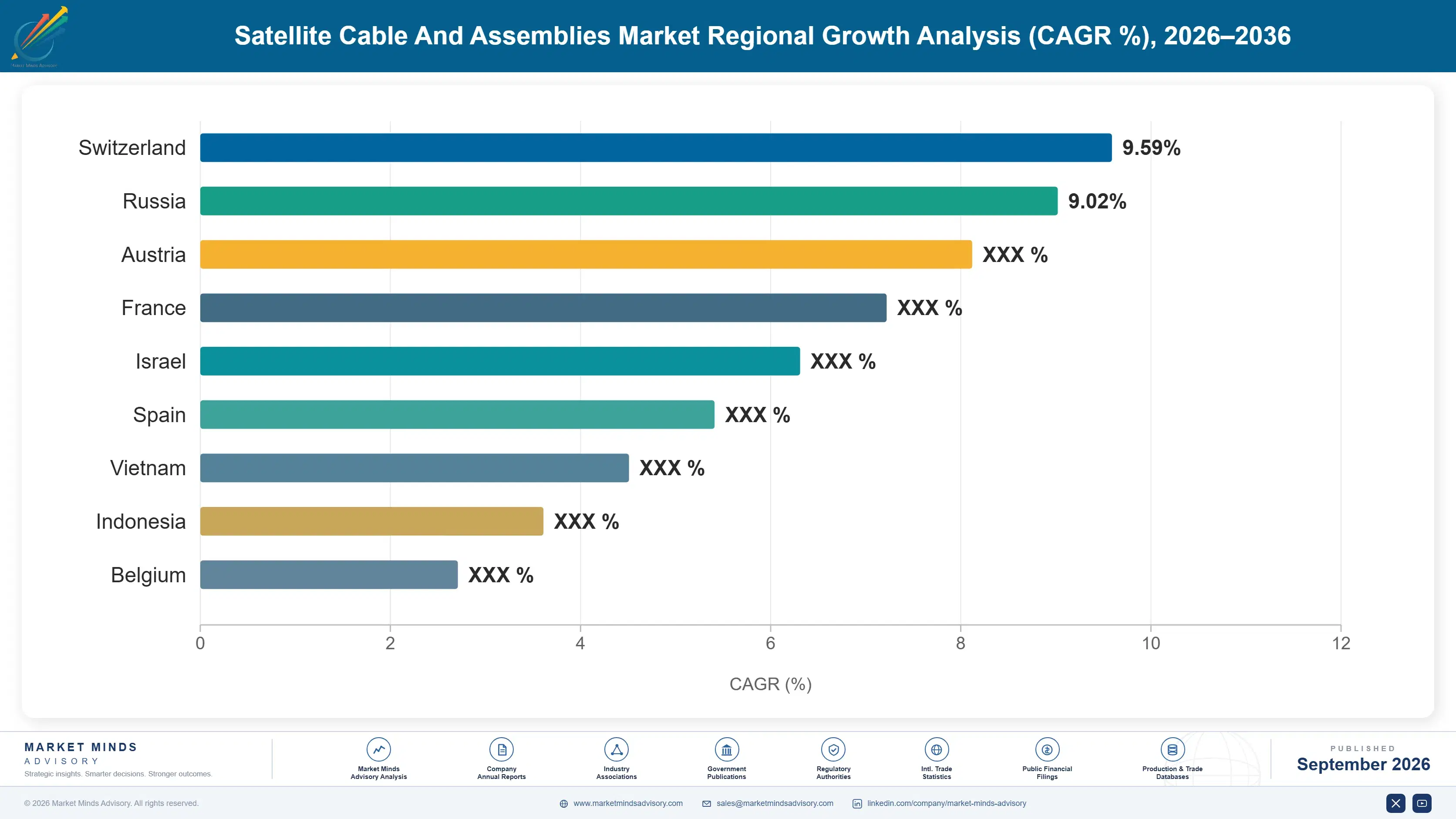
North America leads on the strength of dominant satellite manufacturing capacity and large commercial constellation programs, well ahead of East Asia, while South Asia and Pacific posts the fastest regional growth from a considerably smaller base as national satellite programs steadily expand production capability nationwide.

North America

North America holds the largest regional share, anchored by dominant commercial satellite manufacturing capacity in the United States including SpaceX and Amazon Kuiper constellation production that few global competitors can match at comparable scale or delivery speed. American manufacturers benefit from proximity to major constellation prime contractors, reducing logistics complexity and enabling faster qualification cycles for new assembly designs across multiple programs. Canadian demand tracks related though considerably smaller satellite manufacturing activity, focusing more on scientific and communications payloads than large-scale constellation production. Share here exceeds the standard band since concentrated mega-constellation production volume in the United States dominates global category demand considerably. Government space agency programs increasingly source components domestically for supply chain security.
Share: 33% | CAGR: 8.9% (2026 to 2036)

Western Europe

Western European demand centers on Germany, France, and the United Kingdom, where established aerospace engineering heritage and government space program investment both sustain considerable assembly demand across defense and commercial satellite manufacturers alike. Growth trails North America and East Asia since European constellation programs remain smaller in scale than American commercial mega-constellation deployment, limiting the pace of volume manufacturing scale-up across the region. German buyers in particular benefit from precision engineering heritage that supports premium waveguide and optical assembly production. French and British space agency programs continue prioritizing domestic supply chain development for strategic autonomy. Regional integrators increasingly bundle assemblies with long-term qualification support contracts to secure recurring engineering service revenue.
Share: 22% | CAGR: 7.1% (2026 to 2036)
Regional intelligence for 5 additional markets available in the complete report: East Asia, South Asia and Pacific, Latin America, Middle East and Africa, Eastern Europe. Contact sales@marketmindsadvisory.com.
satellite-cable-and-assemblies-market-country-cagr-analysis-1790025390684

Where Qualification Depth Concentrates Value

Assembly hardware margins face pressure from mega-constellation buyers negotiating volume pricing, while qualification testing services, engineering support, and premium optical positioning carry considerably richer economics that manufacturers increasingly prioritize. Manufacturers capture disproportionate returns from proprietary qualification data, recurring engineering support contracts, and premium fiber optic positioning rather than from the base assembly sale alone.

Proprietary Qualification Data Licensing Programs Overall

Manufacturers that license proprietary qualification test data to satellite integrators capture recurring revenue that considerably exceeds the initial assembly sale over a typical program lifetime, since integrators cannot easily switch suppliers without repeating expensive and time-consuming qualification testing themselves. Brands with formal qualification licensing programs report recurring revenue per program 49% higher than brands selling hardware without documented qualification data support, since integrators value the schedule certainty that pre-qualified components provide. This recurring revenue stream justifies competitive hardware pricing to secure initial program design wins. Program managers increasingly view qualification licensing as their primary vendor selection criterion.
Market Impact: lifts recurring revenue per program by 49% overall

Engineering Support and Custom Integration Services

Vendors offering ongoing engineering support and custom integration services alongside standard assembly sales capture meaningfully higher margin than the hardware transaction alone, since satellite programs frequently require custom modifications that most integrators lack internal expertise to execute independently. Brands operating dedicated engineering support practices report gross margins near 62% on service revenue, well above typical hardware margins achieved through competitive procurement processes. This service also generates valuable relationship depth that manufacturers use to secure follow-on program contracts. Larger vendors increasingly hire dedicated integration engineering teams specifically for this stated purpose.
Market Impact: captures gross margins near 62% on service revenue

Premium Fiber Optic Tier With Extended Warranty Support

Manufacturers that bundle premium fiber optic assemblies with extended warranty and failure analysis support command meaningfully higher average order value than hardware sold standalone, since buyers value assurance that mission-critical optical components will be supported professionally throughout multi-year satellite operational life. This bundled configuration lifts average order value by 41% compared to an unbundled assembly sale, while also creating a recurring support revenue stream beyond the initial purchase. Program managers favor these bundles too, since they reduce mission-critical failure risk considerably. Extended contracts also improve forecasting accuracy for parts inventory planning.
Market Impact: lifts average order value by 41% for bundles

Volume Manufacturing Contract Diversification Across Programs

Manufacturers achieving qualification across multiple constellation programs simultaneously capture recurring volume orders tied directly to constellation replenishment schedules rather than a one-time program design win, creating a revenue stream considerably less exposed to any single program's budget volatility. Brands with multi-program qualification report 35% higher lifetime revenue per qualified design than brands limited to a single constellation program alone. This channel also opens considerably larger deployment volume than traditional single-program contracts ever represented. Constellation operators increasingly negotiate these arrangements directly with qualified suppliers before each fleet replenishment cycle formally begins.
Market Impact: lifts lifetime revenue per design by 35% total

Who Controls the Margin Pool

Ranked by global unit shipments across all assembly categories, the market shows meaningful fragmentation with a CR5 near 29%. Amphenol holds a modest lead built on broad interconnect manufacturing scale spanning multiple aerospace and defense applications beyond satellite alone. TE Connectivity trails closely given its extensive commercial electronics manufacturing base, while the gap to Carlisle Interconnect Technologies and W.L. Gore remains narrow enough that rank changes look plausible within a normal planning horizon.
Current competitive activity centers on fiber optic and high-frequency waveguide capability expansion rather than basic coaxial assembly specifications alone, since most established vendors already offer comparable entry-tier products at similar price points. Several manufacturers have launched automated assembly production lines within the past two years specifically to meet mega-constellation delivery schedules, while others pursue multi-program qualification to diversify revenue beyond single-constellation dependence.

Emerging pressure comes from constellation manufacturers building in-house assembly capability to reduce dependence on external suppliers entirely, designing narrower but more tightly integrated production lines around their specific satellite architecture. These challengers cannot match incumbent multi-customer manufacturing scale, but they are shifting where mid-tier rankings sit within five years, particularly as vertical integration increasingly appeals to the largest constellation operators.
satellite-cable-and-assemblies-market-company-positioning-matrix-1790025391211

Competitive Moat and Risk Dimensions

AMPHENOL

Moat: Broad Interconnect Manufacturing Scale

Amphenol's manufacturing scale spanning aerospace, defense, and commercial electronics interconnects gives it cost advantages and engineering resources that specialized satellite-only competitors struggle to match. Its diversified customer base across multiple industries also generates continuous engineering feedback that accelerates product iteration beyond what smaller competitors can achieve.
AMPHENOL

Risk: Limited Satellite-Specific Focus

Amphenol's broad diversification across many industries means satellite applications compete internally for engineering and production resources against other higher-volume business lines within the broader company overall. Specialist competitors with dedicated satellite focus can sometimes offer faster qualification timelines for niche requirements that broad-line manufacturers deprioritize.
CARLISLE INTERCONNECT TECHNOLOGIES

Moat: Strong Aerospace Qualification Heritage

Carlisle Interconnect Technologies' decades of aerospace-specific qualification experience and testing infrastructure give it credibility among satellite program managers that newer entrants without comparable flight heritage simply cannot easily replicate quickly. This reputation reinforces premium pricing power among buyers who prioritize documented reliability over hardware cost alone.
CARLISLE INTERCONNECT TECHNOLOGIES

Risk: Higher Cost Than Broad-Line Rivals

Carlisle's specialized aerospace focus and premium qualification processes result in meaningfully higher unit costs than broad-line competitors offering comparable functional specifications at lower price points. Matching broad-line manufacturing cost structures would require volume scale that could undermine the specialized quality reputation Carlisle has built over decades.

Players Tracked

Prominent Players

Amphenol
TE Connectivity
Carlisle Interconnect Technologies
W.L. Gore & Associates
Radiall

Other Key Players

Habia Cable
Axon Cable
Cicoil
Meggitt (Parker Hannifin)
Southwire
Huber+Suhner
Cinch Connectivity Solutions (Bel Fuse)
Smiths Interconnect
PIC Wire & Cable
Champlain Cable
Nicomatic
Fischer Connectors
Rosenberger
Optical Cable Corporation
LEMO

Recent Developments

MAY 2025

Amphenol Expands Fiber Optic Assembly Production Capacity

Amphenol expanded its fiber optic assembly production capacity considerably to meet growing intersatellite link demand from commercial constellation operators deploying next-generation architectures across multiple orbital planes. The expansion included new automated termination equipment and marketing content aimed at converting RF crosslink customers toward optical alternatives.
Signal: Shows an incumbent expanding capacity to defend optical link leadership as constellation demand accelerates across the industry.
OCTOBER 2024

TE Connectivity Opens Multi-Program Qualification Initiative

TE Connectivity launched a multi-program qualification initiative allowing its assembly designs to serve multiple constellation programs simultaneously across different customer platforms and orbital architectures worldwide, aiming to capture recurring volume orders beyond single-program contracts negotiated individually. The initiative reduces customer switching costs while diversifying revenue.
Signal: Signals multi-program qualification becoming a standard strategy for reducing single-customer revenue concentration risk across the industry.
FEBRUARY 2026

Carlisle Interconnect Enters Waveguide Component Supply Agreement

Carlisle Interconnect Technologies entered a supply agreement with a specialty waveguide component manufacturer to accelerate development of its high-frequency product line for next-generation payloads, aiming to close the technology gap against considerably larger competitors already in market. The agreement covers component sourcing rather than equity investment.
Signal: Indicates established aerospace vendors pursuing supplier partnership rather than costly in-house waveguide development programs entirely alone.

Copper and Optical Fiber Cost Exposure

High-purity copper and specialty optical fiber make up the largest cost category, typically 34% to 39% of cost of goods sold, sourced from a concentrated group of qualified aerospace-grade material suppliers. Precision connectors and radiation-hardened components add a substantial cost share as qualification requirements tighten across programs. PTFE insulation and shielding materials draw on broader specialty polymer supply chains subject to export control review.
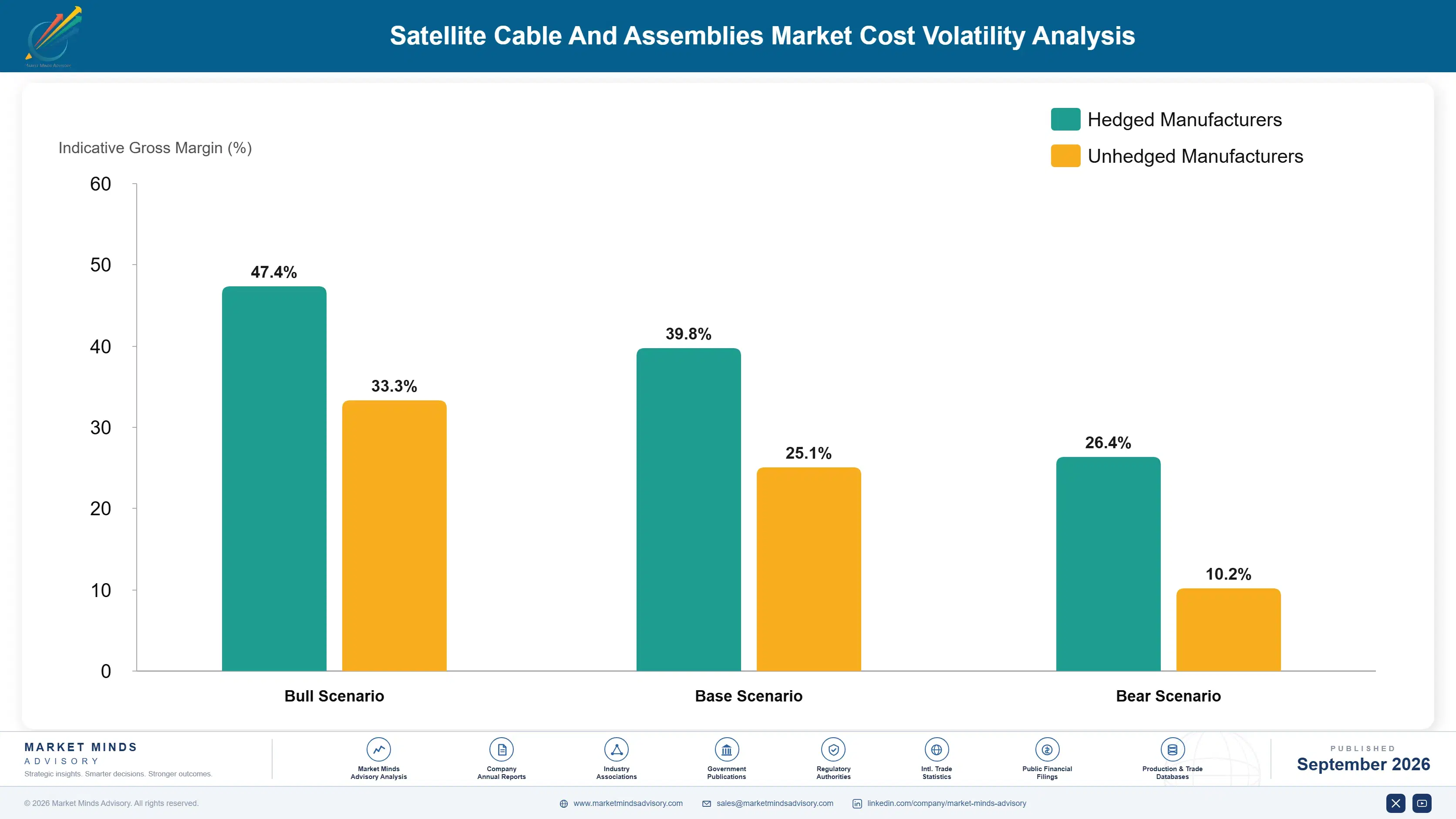
Copper prices rose considerably during 2024 amid supply tightness reported by the IEA's critical minerals market review, pushing coaxial assembly production costs up for manufacturers without hedged long-term copper supply contracts. TE Connectivity's annual report cited elevated raw material costs as a factor compressing aerospace segment margins during the period, forcing several manufacturers to pass part of the increase through to program pricing later that year.

Smaller manufacturers without scale purchasing agreements face a distinct competitive disadvantage here, since they cannot lock in multi-year copper and optical fiber contracts the way larger diversified interconnect conglomerates can through broader purchasing volume. This exposure compounds regionally too, since manufacturers sourcing specialty materials domestically for export control compliance face different cost dynamics than those relying on global supply chains, widening the cost gap between scaled and boutique competitors further.
satellite-cable-and-assemblies-market-cost-volatility-analysis-1790025391406

Multi-Year Copper Supply Contracts

Larger manufacturers increasingly lock in multi-year copper and specialty alloy supply contracts with fixed or collared pricing, insulating assembly production margins from short-term commodity price spikes that smaller competitors must absorb directly into program pricing decisions each cycle. This approach requires meaningful working capital commitment upfront but protects pricing stability across successive program cycles.

Domestic Optical Fiber Supply Chain Development

Manufacturers are qualifying domestic optical fiber and connector suppliers to satisfy export control and defense sourcing requirements, reducing dependence on foreign material supply chains that have hurt program timelines across recent years of trade disruption and shipping volatility. This diversification adds supplier qualification cost initially but shortens recovery time considerably following any single-region supply disruption.

Portfolio Architecture for Margin Defence

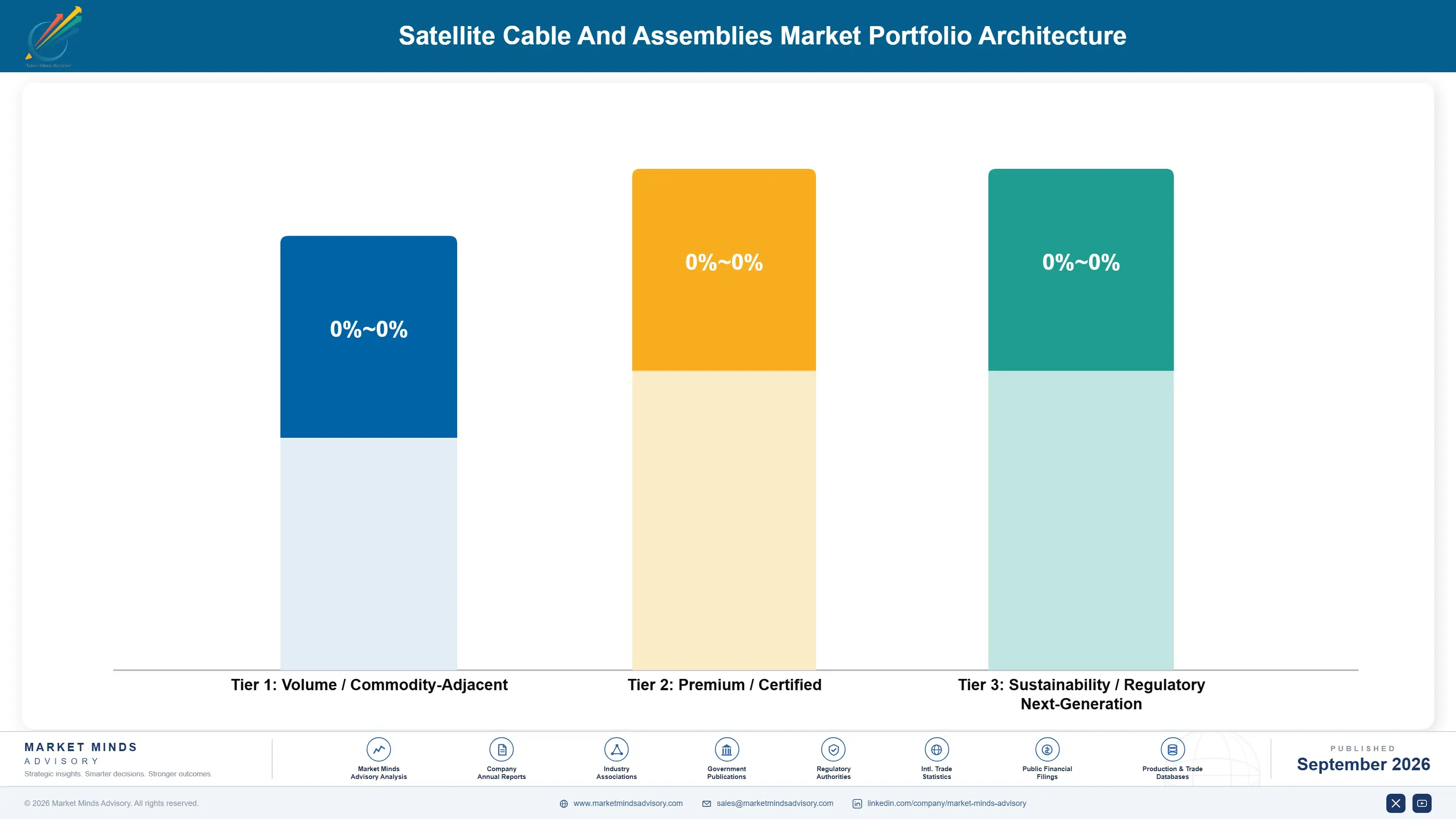
Gross margin architecture splits sharply by tier, with volume-tier coaxial assemblies carrying thin margin after competitive constellation procurement bidding, while premium fiber optic and waveguide products carry considerably richer economics that manufacturers increasingly prioritize. This gap drives most manufacturer strategy today, since basic coaxial assemblies increasingly function as a program entry vehicle rather than a meaningful profit center in themselves.
The tension between volume and premium tiers plays out most visibly in constellation procurement cycles, where coaxial assemblies compete almost entirely on price while fiber optic and waveguide products command considerably higher margin justified by bandwidth and qualification complexity. Manufacturers accept compressed volume-tier margin deliberately, treating it as a program relationship maintenance cost against the higher-margin premium revenue that follows.

High-value margin pools concentrate overwhelmingly in qualification licensing, engineering support services, and multi-program diversification that bypass single-program budget dependence entirely, capturing a larger share of each program dollar. Optical intersatellite link positioning remains a smaller but growing pool, as buyers increasingly weight documented bandwidth performance when choosing between otherwise similar premium assembly lines. Program offices increasingly favor vendors that publish independent third-party reliability testing results.

Volume / Commodity-Adjacent

Entry-level coaxial cable assemblies sold through competitive constellation procurement channels worldwide with minimal bandwidth capability, competing primarily on price rather than documented performance claims or program heritage. Bidding remains highly competitive on unit cost alone across programs.
Gross Margin: 16% to 24%

Premium / Certified

Established manufacturers offering fiber optic and waveguide assemblies, qualification licensing, and recognized program heritage built over decades that supports higher procurement pricing and recurring engineering revenue over time. Buyers increasingly value predictable qualification timelines.
Gross Margin: 38% to 48%

Sustainability / Regulatory / Next-Generation

Lightweight, recyclable material assemblies designed for reduced launch mass and environmental footprint across the full product lifecycle, appealing to buyers who weight sustainability alongside traditional performance considerations. Program offices increasingly favor this tier in evaluations.
Gross Margin: 40% to 50%
satellite-cable-and-assemblies-market-portfolio-architecture-1790025391905

High-value Sub-segments and Strategic Watch-out

Fiber Optic Cable Assemblies

The fastest-growing and highest-value segment, driven by intersatellite data relay requirements expanding rapidly across next-generation constellation architectures. Manufacturers are racing to expand optical qualification capacity and reduce per-unit costs to sustain this adoption momentum going forward. Program managers stock these designs as the new procurement baseline.
Gross Margin: MMA Estimate, July 2026.

High-Frequency Waveguide Assemblies

A high-value category with strong growth among operators deploying Ka-band and mmWave broadband payloads requiring higher spectrum density. Precision manufacturing capability increasingly determines vendor selection over unit price alone across regions. Certification timelines remain the primary adoption bottleneck across regions. Retail merchandising increasingly separates waveguide products from standard coaxial lines.
Gross Margin: MMA Estimate, July 2026.

RF Coaxial Cable Assemblies

The volume core of the market, deployed extensively across established satellite bus applications and generating steady but unremarkable replacement demand as programs mature and production rates stabilize over time. Volume remains steady but growth has slowed compared to newer segments. Retailers rarely promote this segment heavily since margins run thinner.
Gross Margin: MMA Estimate, July 2026.

Single-Program Revenue Concentration

A strategic watch-out as manufacturers overly dependent on a single constellation program face concentrated exposure to program delays, threatening the revenue stability that diversified competitors maintain across markets. Diversification into multiple programs remains the primary mitigation strategy. Legal and program teams monitor these budget developments closely each cycle.
Gross Margin: MMA Estimate, July 2026.

Why Qualified Suppliers Stay Qualified

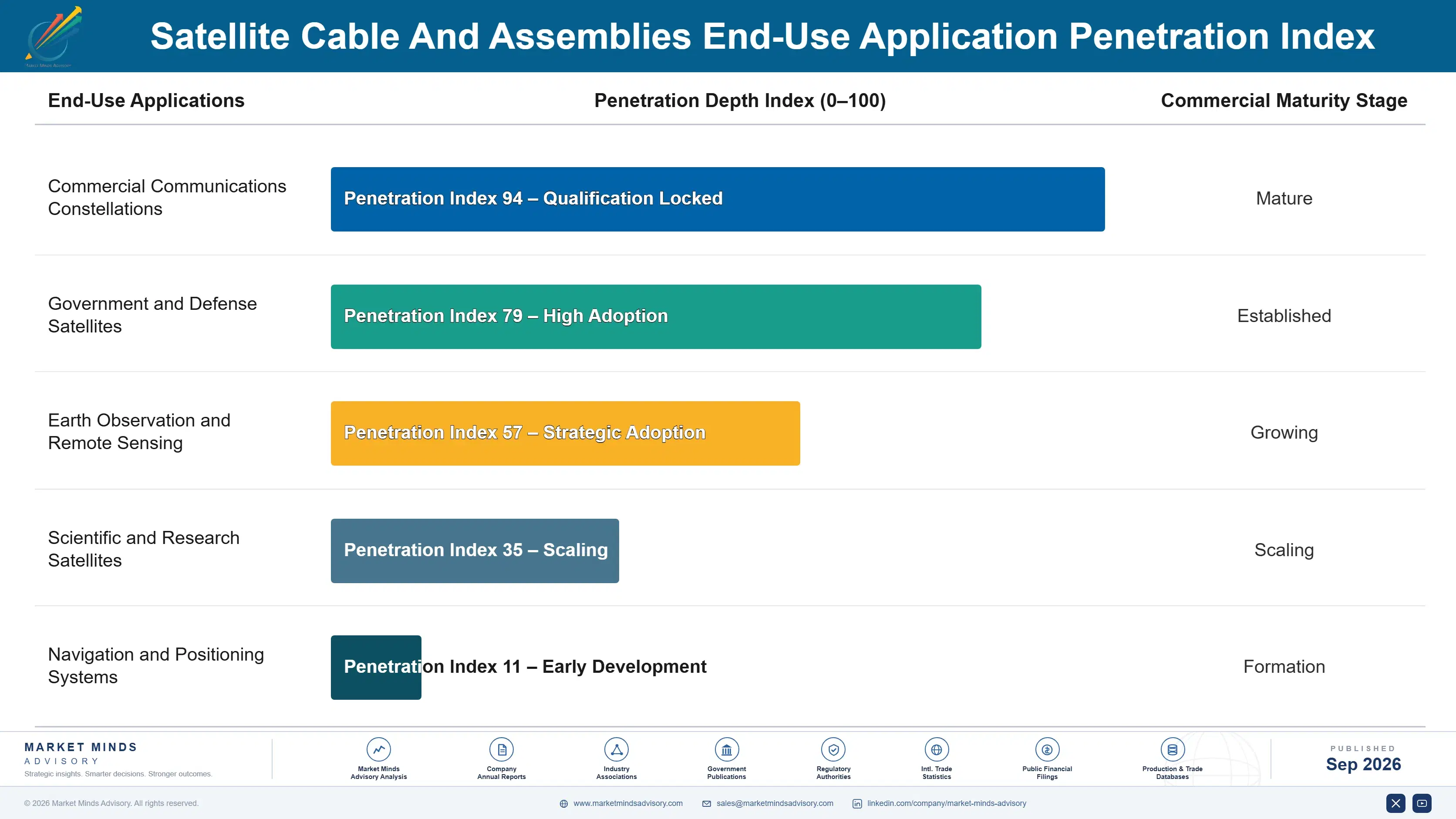
Satellite assembly procurement functions as an annuity for manufacturers building trusted program relationships with constellation operators, since an integrator that qualifies a specific vendor's assembly design statistically continues purchasing that vendor's units across the entire constellation deployment schedule and subsequent replenishment cycles, generating recurring revenue that considerably exceeds the initial design win. This pattern makes the first qualification win the start of a long-term revenue relationship rather than a single transaction.
Adoption stickiness varies meaningfully by end-use vertical. Constellation operators who qualified an assembly for large-batch production show the deepest engagement, often expanding orders across multiple satellite generations without competitive re-bidding given the switching cost of requalifying an alternative supplier mid-program. Scientific and research satellite buyers who purchased basic coaxial assemblies mainly for single-mission use show shallower engagement, frequently switching vendors entirely on the next program.

Generational buyer shifts are reshaping the category too. Younger procurement engineers increasingly prioritize bandwidth capability and optical link sophistication over pure cost specifications, reflecting broader institutional emphasis on next-generation constellation data throughput. This rewards manufacturers with strong optical engineering capability and transparent qualification data over legacy manufacturers relying solely on established program relationships and historical procurement inertia.
satellite-cable-and-assemblies-market-end-use-penetration-index-1790025392402

The MMA Strategic Read

These are among the four positions where our research anticipates prominent divergence between winners and laggards over the coming forecast period. Each is grounded in the demand model, the regulatory perimeter, and the announced capacity pipeline.
01 / OPTICAL INVESTMENT PRIORITY

Prioritize fiber optic engineering over incremental coaxial refinement

Manufacturers still investing primarily in coaxial refinement are fighting to protect a segment growing meaningfully slower than fiber optic assemblies, which increasingly define next-generation constellation procurement priorities across most major programs worldwide today and going forward. Fiber optic products command considerably higher average selling prices and generate qualification licensing revenue that coaxial assemblies rarely capture at comparable scale or consistency over a typical program lifetime. Brands that redirect meaningful R&D spend from coaxial iteration toward optical engineering should capture disproportionate program share over the next decade.
02 / QUALIFICATION LICENSING BUILD

Build qualification licensing programs before competitors close the gap

Hardware margins face relentless pressure from competitive constellation procurement processes, particularly as program offices increasingly favor lowest-bid vendors regardless of long-term qualification support differences between competing assembly offers submitted for careful review each procurement cycle. Brands still selling hardware without ongoing qualification licensing relationships are leaving substantial recurring revenue on the table every single year that passes without a licensing structure in place today. The window to build defensible qualification licensing before service-focused competitors close this gap is narrowing steadily.
03 / COPPER SOURCING STRATEGY

Diversify copper sourcing before the next commodity price spike

Copper cost exposure hits smaller manufacturers considerably harder than scaled incumbents with existing multi-year purchasing agreements already locked in at favorable negotiated rates well ahead of any price spikes each purchasing cycle. Waiting for the next spike to begin supplier diversification guarantees margin compression precisely when competitors with hedged contracts gain relative pricing room to invest in optical expansion instead of defense. Acting now, while sourcing conditions remain relatively stable, costs considerably less than acting reactively once prices move again.
04 / MULTI-PROGRAM DIVERSIFICATION STRATEGY

Diversify qualification across multiple constellation programs simultaneously

Single-program revenue concentration is moving faster than many manufacturers have diversified their customer base, creating meaningful exposure for brands still reliant entirely on one constellation operator's procurement schedule sold at considerable program scale nationwide and internationally across several regions. Brands that redirect qualification investment toward multiple constellation programs now can capture a revenue stream considerably less exposed to single-program delays than competitors relying entirely on one customer. Delaying this shift risks ceding an increasingly important diversification opportunity entirely to multi-program challengers.

Engagement Snapshot From the Field

A live engagement with an industry participant carrying material or product regulatory and market exposure ahead of a defining policy shift, showing how our research translates into a defensible multi-year portfolio strategy.
MARKET MINDS ADVISORY · CLIENT ENGAGEMENT SUMMARY
Satellite Cable And Assemblies Producer Strategic Portfolio Review and Transition Roadmap 2026·Investment Scenario on Satellite Cable And Assemblies Exposure Evaluation 2025-26
CLIENT PROFILE
The client is a commercial satellite constellation operator planning large-batch production of several hundred satellites requiring standardized cable and assembly components across the entire fleet architecture. The operator faced growing production schedule pressure that its existing bespoke assembly suppliers, accustomed to low-volume government program orders, could not adequately support at the required manufacturing scale required for the program.
STRATEGIC CHALLENGE
Leadership needed to select between competing assembly vendors while balancing upfront qualification investment against long-term supply reliability across a multi-year production schedule spanning several hundred satellites and future fleet replenishment. The operator also had to determine whether to single-source from one qualified vendor or dual-source across two suppliers to reduce production risk.
MMA APPROACH
MMA conducted primary research across comparable constellation manufacturing decisions globally alongside vendor benchmarking, quantifying production capacity and qualification reliability by supplier category and program type. The engagement combined survey data with expert interviews among constellation program managers to identify which vendors carried the strongest combination of scale and delivery consistency.
KEY FINDINGS
  1. Vendors with existing automated production lines showed considerably better delivery consistency than vendors relying entirely on manual assembly at the required volumes.
  2. Dual-sourcing across two qualified vendors reduced production risk considerably compared to single-sourcing despite higher upfront qualification costs and coordination overhead (client-reported, unverified by MMA).
  3. Fiber optic intersatellite link components required considerably longer qualification timelines than standard coaxial assemblies across every single benchmarked comparable program reviewed carefully.
  4. Multi-year volume purchasing agreements negotiated upfront reduced total production cost considerably compared to per-batch pricing negotiated separately for each individual order placed.
CLIENT PROFILE
The client is a commercial satellite constellation operator planning large-batch production of several hundred satellites requiring standardized cable and assembly components across the entire fleet architecture. The operator faced growing production schedule pressure that its existing bespoke assembly suppliers, accustomed to low-volume government program orders, could not adequately support at the required manufacturing scale required for the program.
STRATEGIC CHALLENGE
Leadership needed to select between competing assembly vendors while balancing upfront qualification investment against long-term supply reliability across a multi-year production schedule spanning several hundred satellites and future fleet replenishment. The operator also had to determine whether to single-source from one qualified vendor or dual-source across two suppliers to reduce production risk.
MMA APPROACH
MMA conducted primary research across comparable constellation manufacturing decisions globally alongside vendor benchmarking, quantifying production capacity and qualification reliability by supplier category and program type. The engagement combined survey data with expert interviews among constellation program managers to identify which vendors carried the strongest combination of scale and delivery consistency.
KEY FINDINGS
  1. Vendors with existing automated production lines showed considerably better delivery consistency than vendors relying entirely on manual assembly at the required volumes.
  2. Dual-sourcing across two qualified vendors reduced production risk considerably compared to single-sourcing despite higher upfront qualification costs and coordination overhead (client-reported, unverified by MMA).
  3. Fiber optic intersatellite link components required considerably longer qualification timelines than standard coaxial assemblies across every single benchmarked comparable program reviewed carefully.
  4. Multi-year volume purchasing agreements negotiated upfront reduced total production cost considerably compared to per-batch pricing negotiated separately for each individual order placed.
RECOMMENDED STRATEGY
Phase 1: Phase one qualified two vendors with proven automated production capability to enable dual-sourcing across the entire satellite fleet program overall. Phase 2: Phase two negotiated a multi-year volume purchasing agreement with both vendors to secure favorable per-unit pricing across the full program. Phase 3: Phase three phased in fiber optic intersatellite link components incrementally as qualification testing completed for the next-generation satellite designs planned.
OUTCOME
Within eighteen months of implementing dual-sourcing, the operator reported meaningfully improved production schedule reliability and lower than projected per-unit assembly cost across the expanding fleet and its supporting ground infrastructure (client-reported, unverified by MMA). The multi-year purchasing agreement also simplified budget planning across subsequent production batches considerably.

Frequently Asked Questions

Foundational context covering the market sizes, CAGR, scope, country, region and competition that inform every finding below. This section is provided to cover basics and most often pre-purchase conversations, answered from the MMA Primary Research Dataset.

What is the current size of the Satellite Cable And Assemblies Market?

The global satellite cable and assemblies market reached approximately 3.6 billion dollars in 2025. Growth is driven by mega-constellation manufacturing volume and rising fiber optic assembly adoption.

How large will the Satellite Cable And Assemblies Market be by 2036?

The market is projected to reach approximately 8.74 billion dollars by 2036. This reflects sustained fiber optic assembly adoption and steady qualification licensing revenue across established markets.

What is the CAGR for the Satellite Cable And Assemblies Market 2026 to 2036?

The market is forecast to grow at an 8.4% compound annual growth rate between 2026 and 2036. Fiber optic assemblies are expected to grow considerably faster than this overall average.

Which segment is growing fastest?

Fiber optic cable assemblies are the fastest-growing segment, expanding at roughly 12.8% annually. That is well above the overall market's projected growth rate through the 2036 forecast period.

Who are the major companies in the Satellite Cable And Assemblies Market?

Leading companies in this market include Amphenol, TE Connectivity, and Carlisle Interconnect Technologies, alongside WL Gore and Radiall. These five companies hold a CR5 near 29%.

Which country is growing fastest?

The United States is the fastest-growing major national market, expanding at approximately 9.1% annually. Dominant satellite manufacturing capacity continues driving strong assembly demand nationwide today.

Report Segmentation Architecture

The full report scope spans multiple orthogonal segmentation dimensions, with cross-tabulated demand data provided for each dimension pair. Coverage extends further to regional breakdowns, trend trajectories, and the competitive detail needed to support segment-level decision-making.

By Signal Transmission Technology

  • Fiber Optic Cable Assemblies
  • High-Frequency Waveguide Assemblies
  • RF Coaxial Cable Assemblies
  • Wiring Harnesses and Interconnects
  • Power Distribution Cable Assemblies
  • Test and Ground Support Cable Assemblies

By End-Use Application

  • Commercial Communications Constellations
  • Government and Defense Satellites
  • Earth Observation and Remote Sensing
  • Scientific and Research Satellites
  • Navigation and Positioning Systems

By Commercial Dimension

  • Direct Manufacturer Procurement
  • Multi-Program Qualification Licensing
  • Engineering Support Services
  • Volume Manufacturing Agreements

By Region

  • North America
  • Western Europe
  • East Asia
  • South Asia and Pacific
  • Latin America
  • Middle East and Africa
  • Eastern Europe

Scope, Methodology, and Coverage

Every figure in this report is reproducible from documented input assumptions. The scope below maps the historical period, the forecast horizon, the segmentation dimensions, and the countries covered, alongside the underlying primary and qualitative methodology.
Historical Period
2020 to 2025
Forecast Period
2026 to 2036
Base Year
2025 (USD billions; MMA Primary Research Dataset, September 2026)
Market Definition
The satellite cable and assemblies market covers RF coaxial, fiber optic, wiring harness, and waveguide interconnect products designed and qualified for satellite bus and payload applications. It excludes ground station cabling not qualified for spaceflight and general aerospace cable products not specifically designed for satellite platforms.
Quantitative Units
USD billions (current prices); unit shipment volume where applicable
Segmentation Dimensions
By Signal Transmission Technology; By End-Use Application; By Commercial Dimension; By Region
Regions Covered
North America, Western Europe, East Asia, South Asia and Pacific, Latin America, Middle East and Africa, Eastern Europe
Countries Covered
USA, China, Germany, France, UK, Japan, South Korea, India, Australia, Canada, Brazil, Mexico, Indonesia, Vietnam, Thailand, Malaysia, UAE, Saudi Arabia, South Africa, Nigeria, Turkey, Poland, Netherlands, Italy, Spain, Sweden, Switzerland, Argentina, Colombia, Singapore, and additional markets relevant to this sector
Key Companies Profiled
Amphenol, TE Connectivity, Carlisle Interconnect Technologies, W.L. Gore & Associates, Radiall, Habia Cable, Axon Cable, Cicoil, Meggitt (Parker Hannifin), Southwire, Huber+Suhner, Cinch Connectivity Solutions (Bel Fuse), Smiths Interconnect, PIC Wire & Cable, Champlain Cable, Nicomatic, Fischer Connectors, Rosenberger, Optical Cable Corporation, LEMO
Quantitative Methodology
Primary survey, n=3,800 respondents, Q4 2025, six countries; demand-side model with trade association cross-validation
Qualitative Methodology
47 expert interviews, Q4 2025; applied to validate demand model assumptions, identify emerging dynamics, and assess competitive positioning
Report Format
PDF and XLSX data workbook (Word format preview document)
Publisher
Market Minds Advisory
Report Code
MMA-2026-TEC-123
Published
September 2026
Contact
sales@marketmindsadvisory.com | www.marketmindsadvisory.com

Purchase the full Satellite Cable And Assemblies Market Report (2026 to 2036).

This report delivers a complete quantitative and qualitative assessment of the global satellite cable and assemblies market through 2036, built on primary survey and expert interview data. It covers segmentation by signal transmission technology, end-use application, and commercial dimension, alongside detailed regional analysis across all seven world regions. Competitive profiling covers twenty companies spanning established aerospace interconnect manufacturers and emerging optical specialists. The report also includes base, bull, and bear forecast scenarios, input cost exposure analysis, and strategic recommendations for portfolio tier positioning and revenue lever prioritization.
Ten-year market sizing and forecast to 2036
Six-category signal transmission technology and product segmentation
Full seven-region demand and growth breakdown
Twenty-company competitive profiling and market positioning
Input cost exposure and mitigation strategy review
Strategic revenue lever and portfolio tier analysis

Built For The People Who Decide

From boardroom strategy to bench-side execution, this report is read cover-to-cover by leaders shaping the next decade of their industry, turning demand scenarios, market dynamics and valuation benchmarks into decisions.
CXOs/ Presidents/ VPs/ Managers
M&A and Corporate Development
Strategy Teams and R&D Heads
Procurement and Product Directors
Regulatory and Compliance Leaders
Investor Relations and Equity Analysts