Market Minds Advisory
SatCom Terminal Market

SatCom Terminal Market: SatCom Terminal Market. LEO Constellation Buildout Forces a Flat-Panel Antenna Upgrade Cycle

Low earth orbit constellation buildout is multiplying the satellites a terminal must track simultaneously, forcing operators still running fixed-dish VSAT hardware toward electronically steered flat-panel antennas that follow fast-moving spacecraft without any moving parts.

Lead Analyst

Published

September 2026

Make Smarter Decisions with Customized Research Insights

Request a free sample report and evaluate market opportunities, growth trends, and competitive dynamics relevant to your business needs.

2025 MARKET VALUE$6.8BMarket Size 2025
2036 FORECAST VALUE$24.6BBase Case , 2026 to 2036
CAGR 2026 TO 203612.4 %Bull 13.7% / Bear 11.1%
INCREMENTAL OPPORTUNITY$16.9BNet 10- year value creation
EXPANSION MULTIPLE3.22x2036 value over 2026 base
Strategic Levers
M&A Pipeline
Regional Outlook
Country Rankings
Competitive Intelligence
Segmental Deep-dive
Call-Us : 91 93563 13602

Executive Snapshot and Market Trajectory.

A fixed satellite dish simply cannot track a constellation of satellites racing overhead every few minutes, and that basic physics problem is now the single biggest reason terminal hardware is being replaced across nearly every connectivity segment worldwide today, from maritime shipping to remote rural broadband service everywhere.
Maritime, aviation, and military users together drive most premium terminal demand, each pushing manufacturers toward electronically steered flat-panel antennas that switch between satellites instantly without the mechanical repositioning legacy dishes require for every single handoff performed. North America's concentrated satellite manufacturing base and the world's largest operational LEO constellation give the region an outsized role in global terminal demand that exceeds its share of overall telecommunications spending alone by a wide margin.
Five vendors hold under half of global revenue, a fragmented landscape reflecting how differently buyers approach terminals depending on whether they need fixed government installations, mobile military platforms, or consumer-grade rural broadband hardware sold at meaningful scale across many international markets worldwide today. Rising LEO constellation capacity is pushing buyers toward multi-orbit compatible terminals, a shift that favors software-defined radio flexibility over legacy fixed hardware.
Market Definition
The SatCom terminal market covers ground-based hardware, including fixed dishes, electronically steered flat-panel antennas, and mobile terminals, that transmit and receive signals to and from communication satellites across geostationary, medium, and low earth orbit networks. It excludes the satellites themselves and ground station infrastructure operated by satellite network operators.
Base Year Value
$6.8B in 2025 (MMA Primary Research Dataset, September 2026)
Forecast Period
2026 to 2036, eleven discrete annual values
CAGR
12.4% base case. Bull 13.7%. Bear 11.1%.
Fastest Growth Segment
LEO Flat-Panel Phased Array Terminals: 19.6% CAGR
Fastest Growth Country
India: 16.8% CAGR
Fastest Growth Region
South Asia and Pacific: 14.5% CAGR
Largest Region
North America: 32% of 2025 global value
Market Leaders
Hughes Network Systems, Viasat, Kymeta, Starlink (SpaceX), and Gilat Satellite Networks lead the market. Source: MMA Primary Research Dataset, July 2026.
Primary Survey
n=3,800 procurement and R&D decision-makers, Q4 2025, six countries
Methodology
Demand-side build-up, cross-validated against public data, 47 expert interviews

SatCom Terminal Market Forecast Scenarios

satcom-terminal-market-size-forecast-scenario-1790002719142
Between 2020 and 2025 the market grew at roughly 11.3% a year as pandemic-era supply chain disruption slowed early terminal shipments before a strong rebound in LEO constellation launches and maritime connectivity demand pulled growth forward through the back half of the period across most major deployment regions worldwide, particularly across North America and parts of Europe and East Asia.
The base case assumes 12.4% annual growth through 2036, built on three mechanisms: rapidly expanding low earth orbit constellation capacity that requires electronically steered terminals capable of tracking fast-moving satellites across the sky continuously without interruption, rising maritime and aviation connectivity demand driven by passenger expectations for continuous broadband access throughout every journey undertaken today, and growing government and military modernization programmes replacing legacy fixed-dish terminals with multi-orbit compatible hardware.
A bull case near 13.7% follows if additional LEO constellation operators launch commercial service faster than currently announced timelines allow across multiple regions simultaneously and quite reliably indeed. The principal bear risk, a slowdown in satellite launch cadence that delays constellation completion and terminal compatibility certification across the industry, would instead pull growth toward 11.1%.

SatCom Terminal Market Overview

SatCom terminals sit at the point where a constellation's coverage promise either reaches an actual user or stays theoretical bandwidth in orbit, and that intersection has turned a once-simple dish into a genuine electronics engineering challenge. Buyers no longer choose a terminal purely on gain and footprint. They increasingly demand multi-orbit compatibility, rapid satellite handoff, and software-defined flexibility that keeps hardware useful as constellation architecture keeps evolving.
MARKET CONCENTRATIONCR5 48%Top five vendors hold under half of global revenue
AVERAGE SELLING PRICE$600-85,000Price spans consumer flat-panel units to military-grade systems
LEADING PRODUCING COUNTRYUnited States, 44% shareAmerican manufacturers concentrate premium terminal design and assembly
MULTI-ORBIT COMPATIBILITY RATE31% of new terminalsBuyers increasingly favor terminals switching between GEO and LEO networks
TRADE INTENSITY29% import shareMany national markets rely heavily on imported terminal hardware
INPUT COST SHARE52%Phased array antenna components and RF chipsets dominate unit cost
The United States hosts a disproportionate share of premium terminal manufacturing, reflecting the country's concentrated satellite industry and the world's largest operational low earth orbit constellation currently in service. North America more broadly is the largest single demand pool by revenue, driven by extensive military modernization programmes and rapidly growing rural broadband and maritime connectivity deployment across the continent.
Multi-orbit compatibility is accelerating faster than the overall market, since a terminal capable of switching between GEO and LEO networks protects buyers from being locked into a single constellation operator's coverage and pricing decisions long term. Import dependence remains significant across most national markets outside North America, since premium terminal manufacturing concentrates in a relatively small number of production centers.
"A SatCom terminal used to be judged on how big the dish was. Now it's judged on how fast it can find a different satellite when the last one drops below the horizon."
Director, Satellite Communications Practice · MMA Technology Practice · September 2026

Market Trends

Electronically steered flat-panel antennas replace mechanical dishes

Terminal manufacturers are rapidly shifting product lines toward electronically steered flat-panel phased array antennas that redirect their beam electronically rather than physically moving a dish, enabling the instant satellite handoffs that low earth orbit constellations require as satellites pass overhead every few minutes. This technology eliminates moving parts that historically caused reliability issues in maritime and mobile applications exposed to vibration and weather, while also reducing the physical footprint and wind loading that limited terminal placement options on vehicles, vessels, and aircraft. Vendors still selling mechanically steered dishes increasingly find themselves excluded from LEO-compatible procurement specifications entirely.
Market Impact: 8 million LEO terminals shipped annually

Multi-orbit compatibility becomes a standard procurement requirement

Government, military, and large enterprise buyers increasingly specify terminals capable of operating across geostationary, medium, and low earth orbit networks all simultaneously, protecting themselves from dependence on any single constellation operator's coverage, pricing, or geopolitical exposure risk across their entire operating footprint. This requirement is reshaping terminal design toward software-defined radio architectures that can be reconfigured for different orbital networks through firmware updates rather than requiring full hardware replacement. Vendors offering genuine multi-orbit flexibility increasingly win specification battles against single-orbit specialists, even when the single-orbit alternative offers a lower upfront price.
Market Impact: 15 billion dollar defense spend

Market Opportunities and Growth Drivers

Low earth orbit constellation buildout generates first-time terminal demand

Commercial LEO constellation operators continue launching satellites at a pace that expands coverage and capacity substantially year over year, and every new subscriber requires a compatible electronically steered terminal that legacy fixed-dish hardware simply cannot support given the rapid satellite handoffs LEO orbits require. This buildout generates genuine first-time terminal demand independent of ordinary replacement cycles, particularly across rural broadband, maritime, and aviation segments that previously lacked economical connectivity options entirely. Multiple constellation operators are simultaneously scaling production, creating sustained terminal demand well beyond any single operator's subscriber growth alone.
Market Impact: 3,200 dollar average terminal price gap

Military SATCOM modernization programmes require multi-orbit hardware

Defense ministries across major economies are modernizing satellite communication infrastructure specifically to reduce dependence on vulnerable, predictable geostationary satellites in favor of resilient multi-orbit architectures that are harder for adversaries to disrupt or jam during active conflict scenarios and contested electromagnetic environments. These modernization programmes typically procure terminals at a scale that dwarfs ordinary commercial contracts, giving vendors that win a single major defense contract meaningful revenue visibility over a multi-year deployment schedule spanning years. NATO member states have collectively committed substantial defense budgets specifically toward satellite communication resilience upgrades.
Market Impact: 18 months average approval delay

Market Restraints and Challenges

High phased array component costs limit consumer market penetration

Electronically steered flat-panel terminals require precision phased array antenna elements and RF chipsets that remain substantially more expensive to manufacture than a simple mechanical dish, keeping consumer-grade LEO terminal prices higher than many price-sensitive rural households can readily afford today across most markets. The root cause is that phased array manufacturing has not yet reached the production scale and yield maturity of established antenna technologies, though costs continue falling as constellation operators scale subscriber volume. Several manufacturers are investing in simplified phased array designs specifically to reduce component count and manufacturing complexity.
Market Impact: 45% of new terminals now flat-panel

Regulatory spectrum coordination delays cross-border terminal deployment

Satellite terminal operation requires spectrum licensing coordination across many national regulatory authorities worldwide, and inconsistent approval timelines between different countries create genuine delays for operators seeking to deploy terminals across multiple national jurisdictions simultaneously and reliably at meaningful commercial scale. The underlying cause is that spectrum allocation remains a national sovereignty matter historically negotiated country by country rather than through a unified global framework applicable everywhere on the planet today. Several international bodies are working toward simplified coordination processes, though progress remains slow given the number of national regulators involved.
Market Impact: 31% of terminals now multi-orbit
4 additional market trends, 3 additional growth drivers, and 2 additional restraints and challenges are covered in the full report. Contact sales@marketmindsadvisory.com to access the complete intelligence.

Segment CAGR and Growth Architecture

SatCom terminals segment cleanly by antenna technology, the dimension that determines both orbital compatibility and price for a given deployment or use case entirely. This framework separates LEO flat-panel phased array terminals, traditional VSAT fixed dishes, mobile/maritime stabilized terminals, aviation in-flight connectivity terminals, and military-grade ruggedized systems, avoiding overlap between hardware technology and end-use application.
Section default visual

LEO Flat-Panel Phased Array Terminals

LEO flat-panel phased array terminals are pulling ahead of every other configuration as commercial constellation operators scale subscriber volume and manufacturing costs fall correspondingly across the industry each and every year without exception. These terminals track fast-moving satellites electronically without any mechanical parts, a genuine engineering requirement for maintaining continuous connectivity as individual satellites pass overhead every few minutes before dropping below the horizon and losing signal entirely. Rural broadband, maritime, and mobile military applications increasingly favor this configuration because it delivers connectivity previously available only through expensive fixed infrastructure or legacy geostationary services with far higher latency and less reliability overall. Vendors slow to migrate away from mechanically steered designs risk exclusion from most modern procurement specifications.
CAGR 19.6%

Traditional VSAT Fixed Dishes

Traditional VSAT fixed dishes remain the largest single configuration by installed base worldwide today, continuing to serve enterprise and government customers with stable, permanent installations where mechanical steering limitations matter less than in mobile applications requiring constant repositioning throughout the day and across changing weather conditions. Their appeal lies in mature, well-understood technology and lower per-unit cost compared with phased array alternatives, a genuine advantage for budget-conscious deployments that do not require multi-satellite handoff capability at all under normal operating circumstances. Enterprises with existing geostationary satellite contracts continue generating steady replacement demand for this established, proven configuration. Manufacturers continue supporting this technology given its substantial existing installed base across enterprise and government customers worldwide.
CAGR 6.8%
Full segment breakdown across 7 segments available in the complete report.

Regional Architecture and Country Demand Map

North America leads on the strength of the world's largest operational LEO constellation and a heavily concentrated satellite manufacturing headquarters base nationwide today, while East Asia and Western Europe follow closely behind on expanding maritime connectivity and ongoing military modernization programmes across their entire regions.

North America

The United States hosts the world's largest operational low earth orbit constellation and the headquarters of most leading terminal manufacturers, reflecting decades of aerospace industry concentration and deep venture capital investment in satellite technology startups. American defense modernization programmes are procuring multi-orbit terminals at substantial scale, while rural broadband subsidy programmes continue driving consumer terminal adoption across underserved areas. Canadian enterprise and government demand adds meaningful incremental volume behind the much larger American market, growing at a broadly comparable pace overall. Federal support for satellite broadband continues expanding this baseline demand pool across nearly every state and territory served by underserved connectivity programmes nationwide. This trend continues expanding steadily each year.
Share: 32% | CAGR: 13.7% (2026 to 2036)

East Asia

China's expanding domestic satellite constellation programme generates substantial terminal demand tied to national broadband and defense objectives, though foreign vendor participation remains limited given strategic technology restrictions. Japanese and South Korean enterprises favor multi-orbit terminals given both countries' significant maritime shipping industries requiring continuous connectivity across long ocean voyages. Rising defense modernization spending across the region's major economies is accelerating military terminal procurement considerably. Domestic regulatory frameworks increasingly favor locally developed terminal platforms over foreign alternatives, reshaping competitive dynamics across the region's largest national markets and their procurement priorities. Vendor investment in this region continues rising steadily each year across most terminal categories tracked. Taiwan's growing commercial satellite sector adds further incremental demand across the broader region.
Share: 22% | CAGR: 13.2% (2026 to 2036)
Regional intelligence for 5 additional markets available in the complete report: Western Europe, South Asia and Pacific, Latin America, Middle East and Africa, Eastern Europe. Contact sales@marketmindsadvisory.com.
satcom-terminal-market-market-share-analysis-1790002720046

Where Margin Concentrates in SatCom Terminals

Manufacturers capture the widest margins where a terminal becomes a multi-year service relationship rather than a one-time hardware sale, and where multi-orbit flexibility commands a premium over single-network alternatives regardless of upfront cost involved in the purchase. Four levers stand out as the clearest paths to expanding gross margin over the coming decade ahead.

Bundle connectivity subscriptions with terminal hardware sales

Manufacturers that pair terminal hardware with a bundled connectivity subscription capture recurring revenue well beyond the original equipment sale, transforming a one-time hardware transaction into a multi-year commercial relationship with the customer that persists over time. Several leading vendors have expanded bundled service offerings specifically to lock in customers who would otherwise shop connectivity providers independently after purchasing hardware from a different manufacturer entirely. Enterprise customers accepting bundled contracts report blended margin improvements of roughly 17 percentage points compared with pure hardware sales. This shift also strengthens vendor lock-in against competitor switching over time.
Market Impact: 17 percentage point blended margin uplift from bundling

Win exclusive qualification on military procurement frameworks

Securing formal qualification on defense procurement frameworks locks in multi-year government contracts and effectively excludes unqualified competitors from that entire procurement channel for the full contract term and renewal cycle. Defense ministries increasingly standardize on qualified vendors across multiple programmes once a manufacturer proves reliable performance under demanding field conditions and extreme environments. Manufacturers that invest early in qualification testing typically hold their position for years, worth an estimated 24% revenue premium over unqualified competitors bidding on similar contracts. This qualification advantage compounds further as additional defense programmes reference prior successful deployments.
Market Impact: 24% revenue premium earned on qualified defense contracts directly

Sell multi-orbit software upgrades as a premium add-on tier

Manufacturers offering software-defined terminals that can be upgraded to support additional orbital networks through firmware updates, priced as a premium tier above single-orbit hardware, capture margin from customers seeking future flexibility without full hardware replacement down the line. This model rewards vendors that invest early in software-defined radio architecture rather than offering fixed, single-purpose hardware alone across their entire product line. Vendors operating dedicated multi-orbit upgrade programmes report gross margins on this revenue stream near 55%, meaningfully above blended average hardware margins overall. Customers value the assurance that today's investment remains viable as network architectures evolve.
Market Impact: 55% gross margin achieved on orbit upgrade revenue

License network optimization analytics to constellation operators

Constellation operators increasingly pay terminal manufacturers for aggregated performance and usage data that improves network capacity planning and coverage optimization across their entire subscriber base and geographic footprint. This creates a software-like revenue stream layered on top of the original terminal sale, carrying margins that substantially exceed those available on hardware manufacturing alone. Early adopters of this model report that network analytics licensing revenue, while still a modest share of total sales, carries gross margins above 68% and grows independently of new terminal shipment volume. Operators increasingly view this data as essential input for future constellation capacity planning decisions.
Market Impact: 68% gross margin achieved on analytics licensing revenue

Who Controls the Margin Pool

Five vendors, measured by revenue, hold under half of global SatCom terminal sales, leaving the remainder split among specialist military hardware makers, regional maritime terminal suppliers, and emerging LEO-focused manufacturers. Hughes and Viasat lead this group given their decades of established enterprise and government relationships across fixed VSAT deployments, and the gap to the third-ranked player is wide enough that challengers compete mainly for the remaining specialist and regional segments.
Current competitive activity centres on multi-orbit compatibility and software-defined radio architecture, with vendors racing to support both legacy geostationary networks and rapidly expanding LEO constellations within a single unified terminal platform simultaneously. Several producers have added connectivity subscription bundling to previously hardware-only sales, letting a single commercial relationship cover both equipment and ongoing service revenue.

Emerging pressure is coming from vertically integrated constellation operators selling terminals directly to consumers and enterprises, testing whether independent terminal manufacturers can defend their multi-orbit flexibility advantage against operator-subsidized, single-network hardware. Rankings are most likely to shift in rural broadband and maritime segments, where operator-subsidized pricing gives vertically integrated players a genuine cost advantage that independent vendors struggle to match.
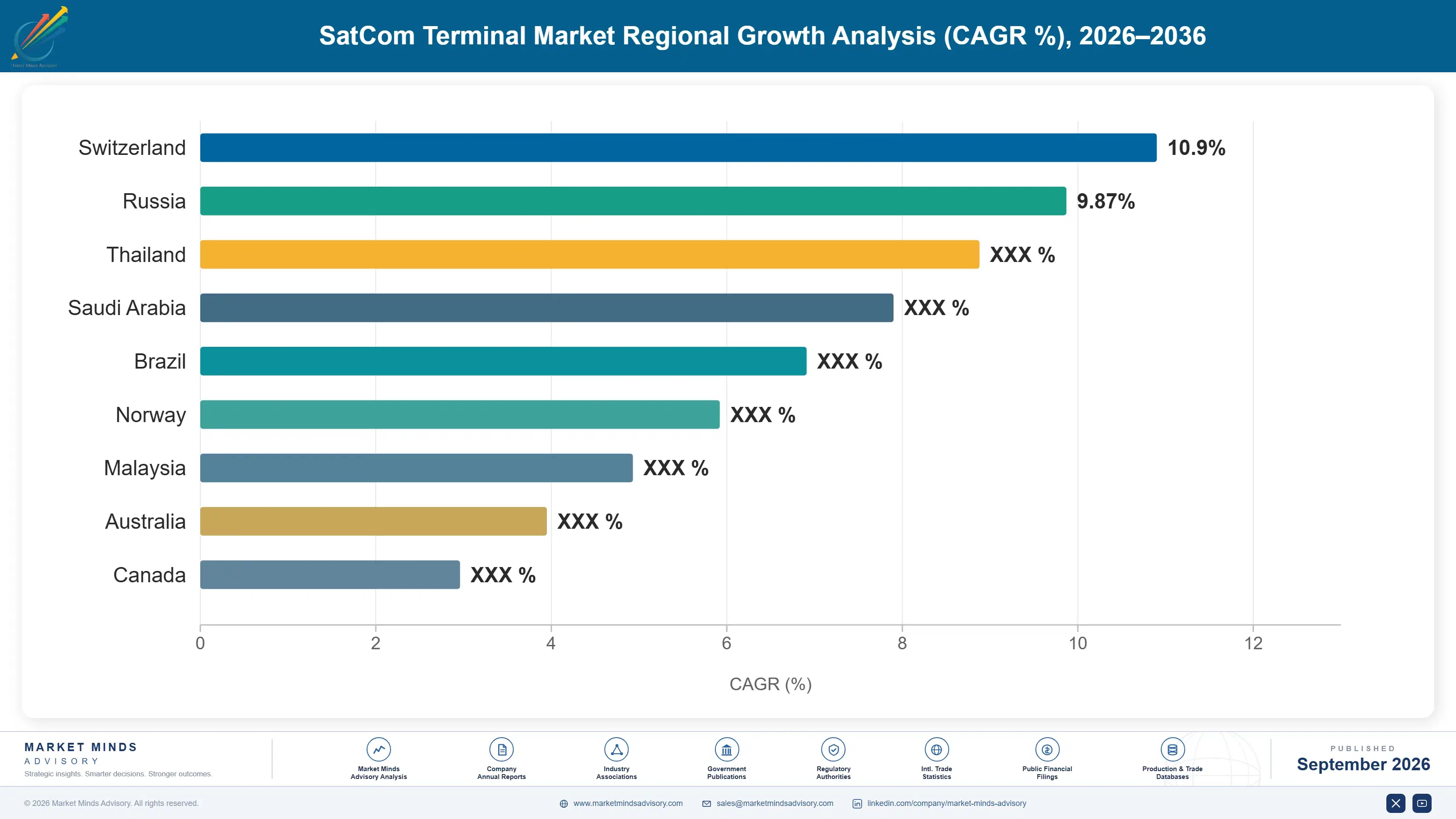
satcom-terminal-market-country-cagr-analysis-1790002720920

Competitive Moat and Risk Dimensions

HUGHES NETWORK SYSTEMS

Moat: Deep enterprise VSAT installed base

Hughes has supplied enterprise and government VSAT terminals for decades, building an installed base and support relationship depth that newer entrants cannot replicate quickly. This history lets Hughes win specification battles on proven reliability and existing service contracts even where competitors offer newer, more advanced hardware at competitive pricing.
HUGHES NETWORK SYSTEMS

Risk: Slower LEO product transition

Hughes built its reputation primarily on geostationary satellite terminals, and transitioning that installed customer base toward LEO-compatible, electronically steered hardware requires sustained investment competing against the company's own legacy product revenue streams and existing customer relationships built over many years of continuous operation and service delivery.
VIASAT

Moat: Vertically integrated satellite capability

Viasat operates its own dedicated satellite constellation alongside terminal manufacturing capability, letting the company optimize hardware and network performance together in ways that pure terminal manufacturers dependent entirely on third-party satellite operators cannot easily match across comparable product lines and customer segments served worldwide today.
VIASAT

Risk: High capital intensity limits flexibility

Viasat's vertically integrated business model requires substantial ongoing satellite capital expenditure that constrains overall financial flexibility compared with terminal-only competitors, leaving Viasat more exposed to satellite launch delays or in-orbit anomalies directly affecting its own network capacity and service reliability over time and across regions.

Players Tracked

Prominent Players

Hughes Network Systems
Viasat
Kymeta
Starlink (SpaceX)
Gilat Satellite Networks

Other Key Players

Thales Alenia Space
L3Harris Technologies
Cobham Satcom
Intellian Technologies
ST Engineering iDirect
Honeywell Aerospace
Iridium Communications
AvL Technologies
General Dynamics Mission Systems
Panasonic Avionics
ORBIT Communication Systems
Comtech Telecommunications
Anywaves
Get SAT
ND SatCom

Recent Developments

MARCH 2026

Hughes acquired a phased array antenna startup specializing in low-cost flat-panel designs for rural broadband applications, adding manufacturing capability Hughes previously lacked for the fast-growing consumer LEO segment entirely. The acquisition brings existing supply chain relationships across several component suppliers directly into Hughes's manufacturing network.
Signal: Legacy VSAT manufacturers are increasingly buying LEO terminal capability rather than building it internally from scratch each time.
AUGUST 2025

Viasat and a major defense contractor signed a joint development agreement to build jam-resistant, multi-orbit military terminals, rather than each company pursuing separate defense procurement bids independently across different programmes entirely. The agreement targets NATO member defense ministries seeking resilient communication hardware for contested environments.
Signal: Defense contractor partnerships are becoming essential for winning major military terminal contracts across allied nations worldwide.

Phased Array and RF Chipset Cost Exposure

Phased array antenna elements and RF chipsets together account for roughly 52% of unit cost of goods sold, sourced primarily from specialized semiconductor fabricators concentrated in the United States and Taiwan, with gallium nitride and gallium arsenide components sourced from a smaller number of specialty compound semiconductor suppliers globally. Precision machined housings and thermal management components, sourced more regionally, add a further meaningful cost layer.
Gallium nitride component supply constraints during 2023 and 2024, documented in multiple manufacturer annual reports and the US Census Bureau's manufacturing survey data, forced several terminal manufacturers to extend lead times and redesign circuit boards around alternative RF component architectures with different performance characteristics. Producers unable to secure priority allocation from major chipmakers lost specification slots on time-sensitive defense and enterprise tenders during this period.

Smaller manufacturers carry disproportionately more of this exposure because they lack the volume commitments and direct chipmaker relationships that larger competitors use to secure priority allocation during shortages. Vendors dependent on distributor channels rather than direct semiconductor sourcing relationships face longer lead times and higher per-unit component costs, a persistent disadvantage that compounds during periods of genuine supply constraint across the industry.
satcom-terminal-market-company-positioning-matrix-1790002721217

Qualify RF components across two semiconductor chemistries

Manufacturers increasingly qualify RF amplifier components from both gallium nitride and gallium arsenide chemistries rather than relying on a single supply relationship, reducing the chance that one material shortage halts production entirely across an entire product line. Hughes and Viasat have both expanded qualified supplier lists for this exact reason in recent product generations.

Hold strategic RF component inventory ahead of demand spikes

Some manufacturers now hold larger safety stock of critical RF components ahead of known demand spikes tied to defense procurement cycles, accepting higher working capital cost in exchange for reduced exposure to sudden allocation shortages during periods of scarcity. This approach requires accurate forecasting of government contract award timelines well in advance of actual need.

Portfolio Architecture for Margin Defence

Manufacturers organize product portfolios across three margin tiers that mirror how customers actually buy terminals, ranging from basic single-orbit consumer hardware purchased for rural broadband to fully ruggedized, multi-orbit military systems specified for defense deployment regardless of cost. Volume tier products carry the thinnest margins but the highest unit sales, while certified premium systems command significantly higher prices from government and enterprise customers that prioritize reliability and orbital flexibility over sticker price.
The tension between volume and premium tiers shows up most clearly in consumer purchasing behavior, where price sensitivity keeps basic single-orbit terminals selling steadily even as enterprises push toward multi-orbit alternatives. High-value margin pools concentrate disproportionately in defense and maritime procurement, where reliability requirements and long-term service contracts justify premium pricing that individual consumers would resist paying.

Next-generation product lines integrating software-defined multi-orbit capability with network analytics are still a small share of total revenue but carry the highest margins in the entire portfolio, reflecting genuine technical differentiation rather than brand premium alone. Manufacturers investing here are positioning for a future where single-orbit, fixed hardware becomes effectively obsolete for defense and enterprise applications.

Basic single-orbit consumer terminals sold primarily on price for rural broadband and small business connectivity with modest performance requirements and quite limited orbital flexibility needs across most standard deployments nationwide.
Gross Margin

Multi-orbit compatible terminals specified by enterprise and maritime customers that must reliably demonstrate consistent connectivity across constantly changing network conditions and diverse geographic coverage requirements across every single deployment site.
Gross Margin

Ruggedized, software-defined military terminals positioned for a modern defense procurement environment that increasingly treats multi-orbit, jam-resistant connectivity as absolutely mandatory rather than merely optional for sustained combat operations conducted worldwide.
Gross Margin
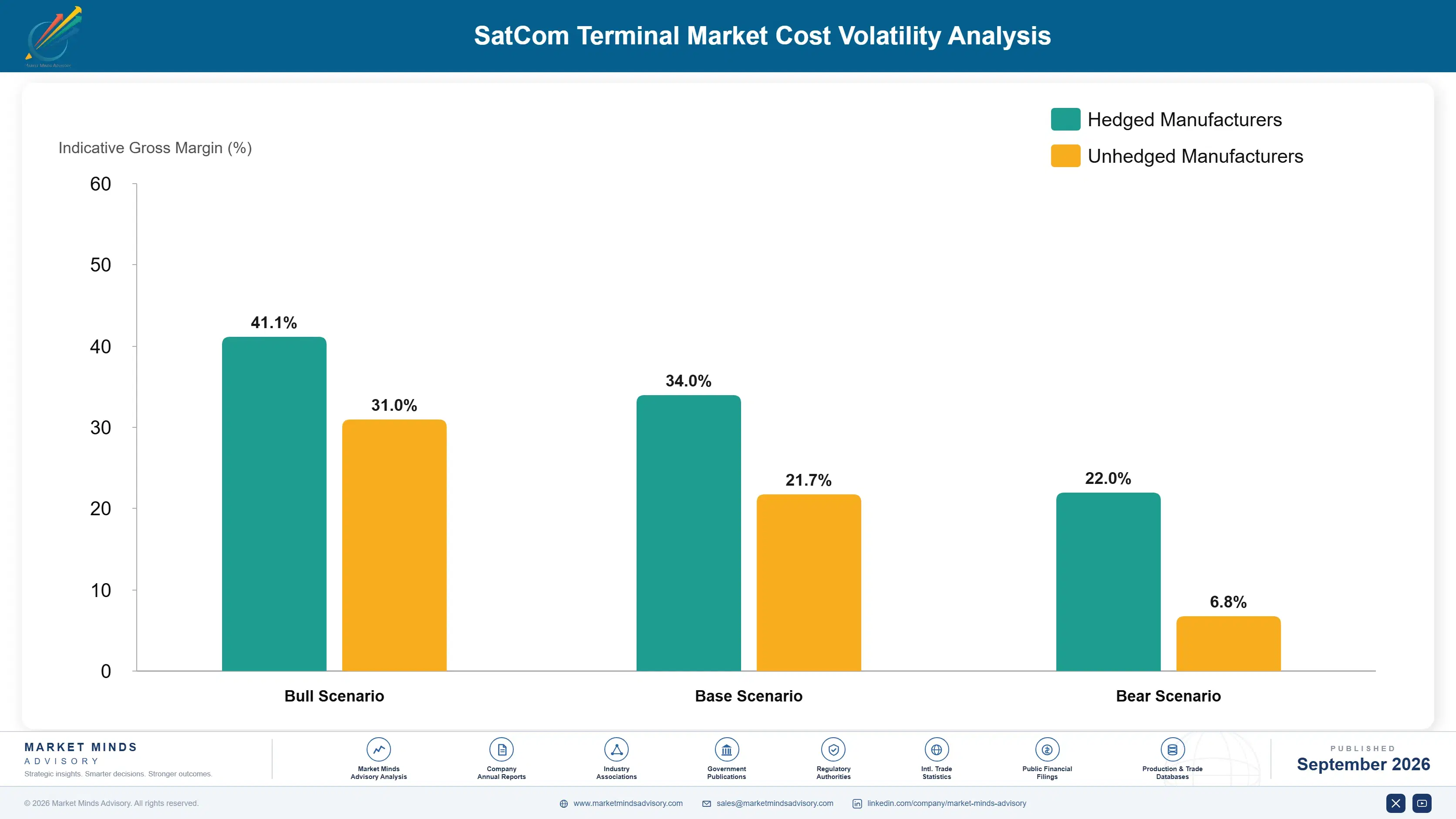
satcom-terminal-market-cost-volatility-analysis-1790002722022

High-value Sub-segments and Strategic Watch-out

LEO Flat-Panel Phased Array Terminals

High-value and high-growth simultaneously, this segment benefits from both constellation buildout and multi-orbit enterprise adoption, commanding growing revenue while adding volume faster than any other configuration in the entire market today across nearly every region tracked in this report. Manufacturers are prioritizing this configuration in future product roadmaps.

Mobile/Maritime Stabilized Terminals

High-value with moderate but steady growth, this segment carries solid margins tied to reliability requirements, expanding gradually as shipping and offshore operators continue upgrading aging communication infrastructure across their entire operating fleets and vessels worldwide. These systems remain critical for reliable operations in remote offshore locations.

Traditional VSAT Fixed Dishes

The volume core of the market, generating the largest unit sales base even as growth slows relative to LEO alternatives, remaining essential for stable enterprise and government installations across every region tracked in this annual report. Rental and leasing programmes are helping sustain unit volume in this category.

Aviation In-Flight Connectivity Terminals

A strategic watch-out segment where growth depends heavily on airline capital spending cycles and passenger connectivity expectations, creating demand that is real but sensitive to broader aviation industry economics and fleet renewal timelines. Manufacturer investment decisions here carry outsized influence on segment trajectory. Growth here remains slower but predictable.

Recurring Connectivity Subscription Economics

SatCom terminals generate something close to annuity economics once a customer adopts a bundled connectivity subscription, because every deployed terminal continues generating recurring service revenue regardless of broader capital equipment spending cycles each year. Capacity expansion follows fleet growth or coverage expansion decisions rather than discretionary upgrade choices, giving vendors offering subscription models unusually predictable long-term revenue visibility across their installed base.
Adoption depth varies sharply by end-use vertical across the market. Defense and government customers exhibit the deepest stickiness, having standardized procurement around specific qualified platforms tied directly to security certification requirements that discourage switching vendors mid-programme entirely. Consumer rural broadband customers show comparatively looser loyalty, frequently choosing terminals based on price and local availability rather than any fixed long-term vendor commitment.

A generational shift in buyer profile is underway as younger procurement managers, more comfortable evaluating software-defined flexibility and multi-orbit compatibility than raw antenna specifications, increasingly influence purchasing decisions once made almost entirely by RF engineering staff members. This shift favors vendors who can present a compelling software and network flexibility story alongside traditional hardware performance claims that dominated buying conversations for decades.
Section default visual

MMA Verdict on SatCom Terminals

These are among the four positions where our research anticipates prominent divergence between winners and laggards over the coming forecast period. Each is grounded in the demand model, the regulatory perimeter, and the announced capacity pipeline.
01 / MULTI-ORBIT PRODUCT STRATEGY

Build genuine multi-orbit capability before it becomes table stakes

Manufacturers still selling single-orbit hardware risk losing specification battles to competitors offering software-defined terminals that switch between GEO and LEO networks without any hardware replacement required at all under any circumstance whatsoever. Winning multi-orbit qualification early generates a durable feature advantage before this capability becomes an expected baseline that buyers assume rather than reward with premium pricing over time. The window to differentiate on genuine multi-orbit flexibility before it becomes fully commoditized is closing fast within the next several years.
02 / DEFENSE QUALIFICATION STRATEGY

Prioritize military qualification over broad commercial market coverage

Manufacturers spreading development resources evenly across every market segment risk losing defense qualification races to competitors who focus engineering effort specifically on military-grade reliability and jam resistance requirements demanded by modern conflict environments worldwide. Winning qualification on a single major defense framework generates multi-year, high-margin revenue that dwarfs what broader but shallower commercial market coverage typically delivers across ordinary accounts. The window to secure this position before competitors catch up on defense-grade performance is closing within the next several years.
03 / BUNDLED SERVICE STRATEGY

Convert hardware sales into subscription relationships aggressively

Vendors selling terminals as one-time hardware transactions leave substantial recurring revenue on the table that competitors bundling connectivity subscriptions directly with hardware capture instead across their entire customer base and installed fleet. Converting a hardware relationship into a subscription generates meaningfully higher lifetime revenue per customer than defending the original equipment sale indefinitely against commoditization pressure from newer entrants. This shift also strengthens customer retention by embedding the vendor relationship into an ongoing service contract rather than a single transaction.
04 / GEOGRAPHIC EXPANSION PRIORITY

Prioritize India and Southeast Asia rural connectivity demand

North American and Western European enterprise and defense demand already carries deep terminal penetration among established vendors with strong existing regulatory and procurement relationships built over many decades of continuous engagement across the entire region and beyond. India's rapidly expanding rural broadband initiative offers considerably more room for genuine share gain than defending position in already saturated mature markets elsewhere in the world. Vendors building local assembly and service capability early will capture this growth before competitors arrive in meaningful force.

Engagement Snapshot From the Field

A live engagement with an industry participant carrying material or product regulatory and market exposure ahead of a defining policy shift, showing how our research translates into a defensible multi-year portfolio strategy.
MARKET MINDS ADVISORY · CLIENT ENGAGEMENT SUMMARY
SatCom Terminal Producer Strategic Portfolio Review and Transition Roadmap 2026·Investment Scenario on SatCom Terminal Exposure Evaluation 2025-26
CLIENT PROFILE
The client is an offshore energy operator running several dozen production platforms and support vessels across the Gulf of Mexico, relying on satellite communication for both operational data transmission and crew welfare connectivity. The operator faced rising bandwidth demands from remote monitoring systems that its aging fixed-dish terminal fleet could no longer support adequately during peak usage periods.
STRATEGIC CHALLENGE
The operator needed to upgrade its entire terminal fleet across dispersed offshore platforms without interrupting operational connectivity during the transition period, all while evaluating whether multi-orbit hardware justified its higher upfront cost against the operator's specific coverage and reliability requirements across the entire Gulf region and its varied weather conditions.
MMA APPROACH
MMA conducted a comparative technical assessment of leading multi-orbit and single-orbit terminal platforms against the operator's specific bandwidth, reliability, and offshore environmental requirements across its entire platform fleet and support vessels. The engagement included a phased rollout plan sequencing replacement by platform cluster to maintain continuous connectivity throughout the transition.
KEY FINDINGS
  1. Multi-orbit terminals reduced connectivity outages during severe weather events by roughly 55%, based on client-reported operational uptime data collected across the trial deployment.
  2. The selected platform supported remote monitoring bandwidth requirements without additional infrastructure investment, according to client-reported technical assessment data shared during the engagement.
  3. Phased rollout avoided any measurable disruption to platform operations during the transition period, per client-reported operational continuity records maintained throughout the rollout.
  4. Crew welfare connectivity satisfaction scores improved measurably following the upgrade across the entire fleet, according to client-reported crew survey data collected after full deployment.
CLIENT PROFILE
The client is an offshore energy operator running several dozen production platforms and support vessels across the Gulf of Mexico, relying on satellite communication for both operational data transmission and crew welfare connectivity. The operator faced rising bandwidth demands from remote monitoring systems that its aging fixed-dish terminal fleet could no longer support adequately during peak usage periods.
STRATEGIC CHALLENGE
The operator needed to upgrade its entire terminal fleet across dispersed offshore platforms without interrupting operational connectivity during the transition period, all while evaluating whether multi-orbit hardware justified its higher upfront cost against the operator's specific coverage and reliability requirements across the entire Gulf region and its varied weather conditions.
MMA APPROACH
MMA conducted a comparative technical assessment of leading multi-orbit and single-orbit terminal platforms against the operator's specific bandwidth, reliability, and offshore environmental requirements across its entire platform fleet and support vessels. The engagement included a phased rollout plan sequencing replacement by platform cluster to maintain continuous connectivity throughout the transition.
KEY FINDINGS
  1. Multi-orbit terminals reduced connectivity outages during severe weather events by roughly 55%, based on client-reported operational uptime data collected across the trial deployment.
  2. The selected platform supported remote monitoring bandwidth requirements without additional infrastructure investment, according to client-reported technical assessment data shared during the engagement.
  3. Phased rollout avoided any measurable disruption to platform operations during the transition period, per client-reported operational continuity records maintained throughout the rollout.
  4. Crew welfare connectivity satisfaction scores improved measurably following the upgrade across the entire fleet, according to client-reported crew survey data collected after full deployment.
RECOMMENDED STRATEGY
Phase 1: Phase one: pilot multi-orbit terminals on a small platform cluster to validate performance under real, sustained offshore weather conditions thoroughly. Phase 2: Phase two: expand deployment by platform cluster over twelve months, sequencing by operational priority and seasonal weather exposure levels carefully. Phase 3: Phase three: retire remaining legacy fixed-dish terminals entirely and standardize monitoring data feeds across the entire full offshore platform fleet.
OUTCOME
The operator completed terminal modernization within its planned timeline and reported measurable improvements in weather resilience, bandwidth capacity, and crew connectivity satisfaction, all figures client-reported and unverified by MMA. The engagement also established a phased rollout template applicable to other offshore operators facing similar modernization pressure.

Frequently Asked Questions

Foundational context covering the market sizes, CAGR, scope, country, region and competition that inform every finding below. This section is provided to cover basics and most often pre-purchase conversations, answered from the MMA Primary Research Dataset.

What is the current size of the SatCom Terminal Market?

The global SatCom terminal market was valued at $6.8 billion in 2025. This figure covers ground-based hardware that transmits and receives signals to and from communication satellites.

How large will the SatCom Terminal Market be by 2036?

The market is projected to reach $24.59 billion by 2036, up from a 2026 base of $7.64 billion. That represents roughly a 3.22 times expansion over the forecast period.

What is the CAGR for the SatCom Terminal Market 2026 to 2036?

The market is expected to grow at a 12.4% compound annual growth rate over this period. Growth is driven primarily by LEO constellation buildout and military modernization programmes.

Which segment is growing fastest?

LEO flat-panel phased array terminals are the fastest-growing segment, expanding at roughly 19.6% annually through 2036. That is about 1.58 times the overall market growth rate.

Who are the major companies in the SatCom Terminal Market?

Hughes Network Systems, Viasat, Kymeta, Starlink, and Gilat Satellite Networks lead the market by revenue. Together these five vendors hold roughly 48% of global market revenue.

Which country is growing fastest?

India is the fastest-growing national market tracked in this report, expanding at roughly 16.8% annually. Growth is tied to expanding rural broadband and defense modernization initiatives.

Report Segmentation Architecture

The full report scope spans multiple orthogonal segmentation dimensions, with cross-tabulated demand data provided for each dimension pair. Coverage extends further to regional breakdowns, trend trajectories, and the competitive detail needed to support segment-level decision-making.

        By Region

        • North America
        • Western Europe
        • East Asia
        • South Asia and Pacific
        • Latin America
        • Middle East and Africa
        • Eastern Europe

        Scope, Methodology, and Coverage

        Every figure in this report is reproducible from documented input assumptions. The scope below maps the historical period, the forecast horizon, the segmentation dimensions, and the countries covered, alongside the underlying primary and qualitative methodology.
        Historical Period
        2020 to 2025
        Forecast Period
        2026 to 2036
        Base Year
        2025 (USD billions; MMA Primary Research Dataset, September 2026)
        Market Definition
        The SatCom terminal market covers ground-based hardware, including fixed dishes, electronically steered flat-panel antennas, and mobile terminals, that transmit and receive signals to and from communication satellites across geostationary, medium, and low earth orbit networks. It excludes the satellites themselves, ground station infrastructure operated by satellite network operators, and consumer smartphone-based satellite messaging services sold without dedicated terminal hardware.
        Quantitative Units
        USD billions
        Segmentation Dimensions
        Regions Covered
        North America, Western Europe, East Asia, South Asia and Pacific, Latin America, Middle East and Africa, Eastern Europe
        Countries Covered
        Key Companies Profiled
        Hughes Network Systems, Viasat, Kymeta, Starlink (SpaceX), Gilat Satellite Networks, Thales Alenia Space, L3Harris Technologies, Cobham Satcom, Intellian Technologies, ST Engineering iDirect, Honeywell Aerospace, Iridium Communications, AvL Technologies, General Dynamics Mission Systems, Panasonic Avionics, ORBIT Communication Systems, Comtech Telecommunications, Anywaves, Get SAT, ND SatCom
        Quantitative Methodology
        Primary survey, n=3,800 respondents, Q4 2025, six countries; demand-side model with trade association cross-validation
        Qualitative Methodology
        47 expert interviews, Q4 2025; applied to validate demand model assumptions, identify emerging dynamics, and assess competitive positioning
        Report Format
        PDF and XLSX data workbook (Word format preview document)
        Publisher
        Market Minds Advisory
        Report Code
        MMA-2026-TEC-315
        Published
        September 2026
        Contact
        sales@marketmindsadvisory.com | www.marketmindsadvisory.com

        Purchase the full SatCom Terminal Market Report (2026 to 2036).

        This report provides a comprehensive analysis of the global SatCom terminal market, covering market sizing, segmentation, competitive dynamics, and regional demand patterns through 2036. It examines the shift toward electronically steered, multi-orbit compatible terminals driven by LEO constellation buildout and military modernization programmes worldwide. The analysis includes detailed profiles of leading terminal manufacturers, input cost exposure, and revenue diversification strategies available to vendors operating in this space. Readers gain a structured view of where margin concentrates across product tiers and which regional markets offer the strongest growth opportunity over the coming decade.
        Full 2026 to 2036 forecast across all major segments
        Detailed competitive profiles of five leading manufacturers
        Regional demand analysis across all seven global regions
        Input cost exposure and mitigation strategy assessment
        Revenue lever analysis for margin expansion opportunities
        Anonymized client case study on terminal modernization

        Built For The People Who Decide

        From boardroom strategy to bench-side execution, this report is read cover-to-cover by leaders shaping the next decade of their industry, turning demand scenarios, market dynamics and valuation benchmarks into decisions.
        CXOs/ Presidents/ VPs/ Managers
        M&A and Corporate Development
        Strategy Teams and R&D Heads
        Procurement and Product Directors
        Regulatory and Compliance Leaders
        Investor Relations and Equity Analysts