Market Minds Advisory
Global Salt Content Reduction Ingredients Market

Global Salt Content Reduction Ingredients Market: Four Jobs, and Every Replacement Does One of Them

Salt delivers taste, preservation, protein functionality and yeast control all at once, and every substitute on the market replaces exactly one of those, which is why reformulation becomes a rebuild.

Lead Analyst

Bilal Shaikh

Published

September 2026

Make Smarter Decisions with Customized Research Insights

Request a free sample report and evaluate market opportunities, growth trends, and competitive dynamics relevant to your business needs.

2025 MARKET VALUE$1.3BMarket Size 2025
2036 FORECAST VALUE$2.8BBase Case , 2026 to 2036
CAGR 2026 TO 20367.4 %Bull 8.6% / Bear 6.2%
INCREMENTAL OPPORTUNITY$1.4BNet 10- year value creation
EXPANSION MULTIPLE2.04x2036 value over 2026 base
Strategic Levers
M&A Pipeline
Regional Outlook
Country Rankings
Competitive Intelligence
Segmental Deep-dive
Call-Us : 91 93563 13602

Executive Snapshot and Market Trajectory

Salt does four jobs in a food product at once. It provides taste, it preserves through water activity, it develops protein and gluten structure, and it controls yeast in fermentation. Every reduction ingredient on the market addresses one of those and leaves the others open. A taste solution addresses one.
Potassium chloride is the workhorse and it stops at roughly 30% substitution before metallic bitterness makes consumers reject the product. Bitter blockers and taste modulators exist to push that ceiling higher, which is why they grow fastest at 11.1%, half again the market rate of 7.4%. The ceiling rather than the sodium chemistry is the technology frontier here. Sodium chemistry has been understood for decades; the bitterness has not.
Front-of-pack warning labels changed the pace of this completely. A black octagon on a package reduces sales of the labelled product by around 24%, which no voluntary target has ever come close to achieving. Brazil grows fastest anywhere at 10.4% following that regulatory route, and manufacturers now reformulate to stay off the label rather than to meet any nutritional guideline. Demand arrives in compliance waves. Deadlines set the pace. Voluntary targets never did this.
Market Definition
Ingredients used to reduce sodium content in food and beverage products while maintaining acceptable taste and function, covering potassium chloride and mineral salts, yeast extracts and savoury enhancers, bitter blockers and taste modulators, nucleotides and amino acid enhancers, sea salt and modified salt crystals, and hydrolysed vegetable proteins and ferments. Measured at ingredient supplier selling value. Excludes ordinary food grade salt, general flavour ingredients without a sodium reduction function, preservatives, and consumer table salt substitutes.
Base Year Value
$1.3B in 2025 (MMA Primary Research Dataset, August 2026)
Forecast Period
2026 to 2036, eleven discrete annual values
CAGR
7.4% base case. Bull 8.6%. Bear 6.2%.
Fastest Growth Segment
Bitter Blockers and Taste Modulators: 11.1% CAGR
Fastest Growth Country
Brazil: 10.4% CAGR
Fastest Growth Region
South Asia and Pacific: 9.4% CAGR
Largest Region
Western Europe: 27% of 2025 global value
Market Leaders
Kerry Group, Givaudan, DSM-Firmenich, Ingredion, Tate and Lyle. Source: MMA Primary Research Dataset, July 2026.
Primary Survey
n=3,800 procurement and R&D decision-makers, Q4 2025, six countries
Methodology
Demand-side build-up, cross-validated against public data, 47 expert interviews

Global Salt Content Reduction Ingredients Market Forecast Scenarios

salt-content-reduction-ingredients-market-size-forecast-scenario-1787595039348
Growth ran near 6.2% between 2020 and 2025, driven substantially by front-of-pack warning label regulation spreading across Latin America and by voluntary target regimes tightening in Britain and North America. Reformulation activity concentrated in categories where salt does least structural work, since bread, cured meat and cheese all resist reduction for functional reasons rather than taste ones. Ingredient suppliers found demand arriving in waves tied to regulatory deadlines.
Base case 7.4% rests on three mechanisms. Front-of-pack warning labels keep spreading, and manufacturers reformulate to avoid a label rather than to satisfy a guideline, which is a considerably sharper incentive. Bitter blockers grow at 11.1% because they raise the potassium chloride substitution ceiling that limits everything else. And Asian sodium intake, running around twice guideline levels, represents the largest untouched reduction opportunity anywhere. Existing technology was built for Western categories.
The bull case at 8.6% assumes warning label regulation reaching major Asian or European markets, which would multiply reformulation activity across categories that have so far only faced voluntary pressure. The bear case at 6.2% is potassium chloride pricing rising on fertiliser demand competition, which would raise the cost of the substitution route most manufacturers currently depend on.

One Ingredient, Four Functions

Reformulating salt out of a product is never a substitution. Salt provides taste, preserves by lowering water activity, develops gluten and protein structure, and controls yeast activity in fermented products, and no single ingredient does more than one of those. A bread reformulation that solves taste will still ferment differently. A cured meat reformulation that solves taste still has a shorter safe life.
TOP FIVE CONCENTRATION49%Flavour house capability narrows the credible supplier field
SUBSTITUTION CEILING30%Potassium replacement before bitterness becomes noticeable to consumers
WARNING LABEL SALES IMPACT24%Sales decline on products carrying a front of pack warning
REFORMULATION COST PREMIUM3.2xReduction ingredient cost against the salt it replaces
INTAKE ABOVE GUIDELINE2.1xAverage sodium consumption against recommended intake in Asia
YEAST EXTRACT COST SHARE38%Reduction system cost accounted for by savoury enhancement
Potassium chloride carries most of the actual sodium reduction and hits a hard wall. Substitution above roughly 30% produces metallic bitterness that consumers detect and reject, which caps what the workhorse ingredient can achieve on its own. Bitter blockers and taste modulators exist to raise that ceiling, and they are where the technical competition genuinely sits. The sodium chemistry has been understood for decades; the bitterness is the unsolved part.
Regulation changed from persuasion to consequence. Voluntary sodium targets produced slow and uneven progress across two decades. Front-of-pack warning labels produce sales declines around 24% on labelled products, which converts reformulation from a public health aspiration into a commercial necessity. Manufacturers in labelled markets reformulate to stay below the threshold rather than to meet any nutritional guideline, and the difference in urgency is stark.
"Twenty years of voluntary targets moved sodium levels slowly and a black octagon moved them in eighteen months. Every ingredient supplier should be watching which parliaments are debating warning labels, because that is where next year's reformulation budget is being decided."
Director, Food Reformulation and Nutrition Ingredients Practice · MMA Food and Beverage Ingredients Practice · August 2026

Market Trends

Warning labels converting reformulation from aspiration into necessity

Front-of-pack warning labels reduce sales of labelled products by around 24%, which is a commercial consequence that two decades of voluntary sodium targets never produced anywhere. Manufacturers in labelled markets reformulate to stay below the threshold rather than to satisfy a nutritional guideline, and they do it on the regulator's timetable rather than their own. Brazil grows fastest anywhere at 10.4% following that route. Ingredient suppliers should track parliamentary debate on labelling more closely than they track food industry commitments. Demand arrives in waves tied to compliance deadlines rather than spreading evenly.
Market Impact: Intake at 2.1 times guideline

Bitter blocking technology raising the potassium substitution ceiling

Potassium chloride substitution above roughly 30% produces metallic bitterness that consumers detect and reject, which caps the workhorse ingredient regardless of how much sodium reduction a manufacturer needs. Bitter blockers and taste modulators raise that ceiling and grow at 11.1% against a market rate of 7.4% on exactly that basis. This is where technical competition genuinely sits, since sodium chemistry has been understood for decades while the bitterness problem remains only partly solved and is worth solving properly. A supplier holding an effective modulator participates in every deep reduction project regardless of which mineral salt the formulator happened to select.
Market Impact: Costs 3.2 times replaced salt

Market Opportunities and Growth Drivers

Asian sodium intake presenting the largest untouched opportunity

Average sodium consumption across much of Asia runs around 2.1 times recommended intake, driven by soy sauce, fermented pastes, pickles and instant noodles rather than by the packaged snacks that dominate Western sodium sources. That difference matters commercially, because reducing sodium in a fermented condiment is a considerably harder technical problem than reducing it in a crisp. Regulatory pressure is building slowly across the region, and the reformulation opportunity is larger than anywhere else by a wide margin. Almost all existing reduction technology was built for Western product categories instead.
Market Impact: Caps substitution near 30%

Category difficulty concentrating demand in easier reformulations first

Bread, cured meat and cheese all resist sodium reduction for functional rather than taste reasons, since salt controls fermentation, water activity and protein structure in each. Manufacturers therefore reformulated snacks, soups, sauces and ready meals first, where salt does the least structural work. That sequencing means the remaining opportunity sits in the hardest categories, which raises the technical requirement and the ingredient value per tonne of product reformulated considerably. Solving water activity and fermentation control alongside taste needs process knowledge rather than a flavour system, which is precisely why so few suppliers hold genuine capability in those applications.
Market Impact: Blocks 3 major food categories

Market Restraints and Challenges

Bitterness ceiling limiting how far substitution can be pushed

Potassium chloride substitution above roughly 30% produces metallic bitterness consumers detect and reject, which caps the principal reduction route regardless of regulatory pressure. The root cause is the potassium ion itself interacting with bitter taste receptors, which no purification addresses. Commercially it means deep reduction requires a system of ingredients rather than a substitution, at around 3.2 times the cost of the salt removed. Bitter blockers and modulators are the mitigation and they work partially rather than completely. Deep reduction therefore becomes a system problem rather than a swap. Modulators work partially rather than completely.
Market Impact: Labelled products lose 24% sales

Functional roles of salt resisting replacement in key categories

Salt controls water activity, protein structure and yeast activity, and reduction ingredients address taste while leaving those functions unserved. The root cause is that these are physical and microbiological effects rather than sensory ones, so a taste solution cannot substitute for them. Commercially it makes bread, cured meat and cheese genuinely difficult rather than merely unpopular to reformulate, and shorter safe life raises food safety questions. Process and packaging changes are the answer, and they cost far more than an ingredient does. Process and packaging changes cost far more than any ingredient ever does.
Market Impact: Raises a 30% substitution ceiling
4 additional market trends, 3 additional growth drivers, and 2 additional restraints and challenges are covered in the full report. Contact sales@marketmindsadvisory.com to access the complete intelligence.

Segment CAGR and Growth Architecture

Six segments are split here by the ingredient's function, because each one addresses a different job that salt performs and combines differently with the others inside a working reduction system. Form and concentration variants sit inside each function rather than beside them. Food category, application and sales channel are all handled in the framework instead.
salt-content-reduction-ingredients-market-market-share-analysis-1787595039903

Bitter Blockers and Taste Modulators

Growing at 11.1%, half again the market rate of 7.4%, these ingredients exist to solve a problem created by another ingredient rather than to reduce sodium themselves. Potassium chloride substitution stops at roughly 30% because of metallic bitterness, and raising that ceiling raises what the whole reduction system can achieve. The technology draws on taste receptor science and includes nucleotides, specific flavour compounds and proprietary modulator molecules. Suppliers holding effective modulators sit at the constraint point of the entire category, which is an unusually strong commercial position for an ingredient that reduces no sodium at all. Approval rather than performance decides where one can be sold. Inclusion rates are tiny and development cost is not.
CAGR 11.1%

Yeast Extracts and Savoury Enhancers

At 8.0% yeast extracts restore the savoury depth lost when salt comes out, contributing glutamates and nucleotides that read as fullness rather than as saltiness. They account for around 38% of reduction system cost, which makes them the largest single element in most formulations. Clean label positioning favours them over synthetic enhancers, since a yeast extract declares acceptably on a pack where monosodium glutamate does not. Production requires fermentation capacity and downstream processing, which limits the supplier field considerably more than blending mineral salts ever would. Clean label pressure favours them strongly over synthetic enhancers, since a yeast extract declares acceptably on a pack where other savoury compounds do not.
CAGR 8.0%
Full segment breakdown across 6 segments available in the complete report.

Regional Architecture and Country Demand Map

Western Europe holds 27% of value on the longest running and strictest sodium reduction regimes found anywhere in the world, which places it just above the standard band. North America follows at 25% on voluntary targets, with East Asia at 24% where intake runs highest.

North America

Voluntary sodium reduction targets set by the food regulator have driven reformulation in phases, with manufacturers responding to published category benchmarks rather than to any mandatory requirement. Progress has been steady and uneven, concentrated in categories where salt does the least functional work. Clean label pressure runs strongly here and favours yeast extracts and fermentation-derived enhancers over synthetic alternatives. Front-of-pack labelling proposals have been debated without adoption. Growth of 6.6% runs below the base case as easier categories are largely reformulated already. Front-of-pack labelling proposals have been debated repeatedly without adoption, which keeps the incentive voluntary and the pace correspondingly gradual. Category benchmarks rather than mandates drive activity. Clean label pressure runs strongly here.
Share: 25% | CAGR: 6.6% (2026 to 2036)

Western Europe

Holding 27% against a band of 18 to 26%, Western Europe sits just above band because British and Nordic salt reduction programmes are the longest running and strictest anywhere, and reformulation has proceeded across more categories than in any other region. That maturity means remaining opportunity lies in the hardest applications, principally bread and cured meat, where salt performs functional rather than sensory work. Ingredient value per tonne reformulated is correspondingly high. Growth at 6.0% runs below the base case on category exhaustion rather than any regulatory easing. Remaining opportunity therefore lies in the hardest applications, principally bread and cured meat, where ingredient value per tonne reformulated runs considerably higher.
Share: 27% | CAGR: 6.0% (2026 to 2036)
Regional intelligence for 5 additional markets available in the complete report: East Asia, South Asia and Pacific, Latin America, Middle East and Africa, Eastern Europe. Contact sales@marketmindsadvisory.com.
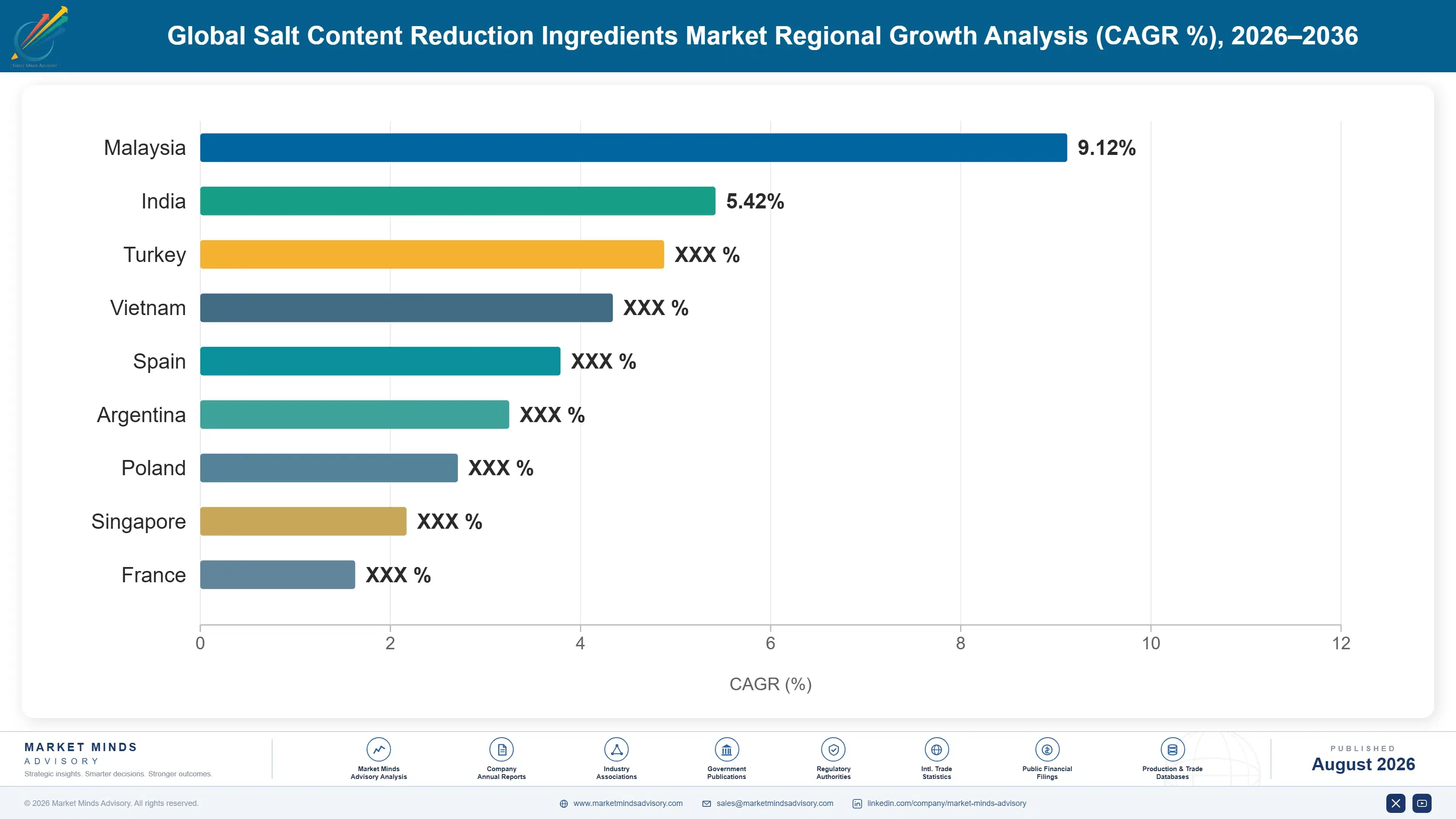
salt-content-reduction-ingredients-market-country-cagr-analysis-1787595040432

Four Moves Around the Bitterness Wall

Almost everything that limits this market comes back to a single technical constraint here. Potassium chloride stops at roughly 30% substitution because of bitterness, and every deep reduction therefore requires a whole system rather than a simple swap, at around 3.2 times the cost of the salt actually being removed from the finished product.

Own the modulator that raises everybody's ceiling

Potassium chloride substitution caps near 30% because of metallic bitterness, and bitter blockers raise what every other ingredient in the system can achieve. Those modulators grow at 11.1% and sit at the constraint point of the entire category despite reducing no sodium themselves. A supplier holding an effective one is selling into every deep reduction project regardless of which mineral salt or savoury enhancer the formulator chose, which is an unusually strong position for an ingredient. Approval breadth across jurisdictions is what limits where it can be sold. Nothing else gates the category this directly.
Market Impact: Lifts the whole 30% substitution ceiling much higher

Track labelling legislation rather than industry commitments

Front-of-pack warning labels cut sales of labelled products by around 24% and produce reformulation on regulatory timetables, while two decades of voluntary commitments produced slow and uneven progress. Ingredient demand in labelled markets arrives in waves tied to compliance deadlines. Watching which parliaments are debating labelling identifies where reformulation budgets will appear next, and it is a considerably better predictor than food industry pledges have ever proved to be. Reformulation budgets appear where labelling deadlines are being set, not where industry commitments are being announced. Voluntary pledges predict very little by comparison.
Market Impact: Anticipates a 24% labelled product sales decline directly

Build capability in the categories everybody avoided

Bread, cured meat and cheese resist reduction because salt performs functional rather than sensory work in each, so manufacturers reformulated snacks and sauces first. The remaining opportunity therefore sits in the hardest applications, where ingredient value per tonne reformulated runs far higher and few suppliers have genuine capability. Solving water activity and fermentation control alongside taste requires process knowledge rather than a flavour system, which is exactly why the field there is thin. Ingredient value per tonne reformulated runs at 3.2 times the salt replaced, and higher still in these applications where process work is required alongside taste correction.
Market Impact: Serves the 3.2 times cost reformulation work directly

Develop fermented condiment reduction for Asian categories

Asian sodium intake runs around 2.1 times guideline levels and comes from soy sauce, fermented pastes, pickles and noodles rather than from packaged snacks. Reducing sodium in a fermented condiment is a genuinely harder problem than in a dry snack, since salt governs the fermentation itself. Suppliers building capability there address the largest untouched opportunity in this market, and almost all existing reduction technology was developed for Western product categories instead. Salt governs the fermentation itself rather than simply seasoning the result. Existing technology addresses Western categories almost exclusively. The opportunity is larger than anywhere else by far.
Market Impact: Addresses 2.1 times the recommended daily sodium intake

Who Controls the Margin Pool

Participation is measured on annual sodium reduction ingredient revenue, and the top five hold 49%. Concentration reflects flavour house capability and application development resources rather than manufacturing, since blending mineral salts is straightforward while solving a bread reformulation is not. Kerry Group and Givaudan lead on application development depth across food categories. The gap to challengers is formulation support rather than ingredient supply. Blending mineral salts is straightforward for anybody.
Competition runs on three fronts. Bitter modulation capability decides how deep a reduction a supplier can support, which caps everything else. Application development decides access to the difficult categories where remaining opportunity concentrates. Regulatory intelligence decides who arrives before a compliance deadline rather than after somebody else has already been specified. Regulatory intelligence decides who arrives before a deadline.

Pressure ahead comes from warning label regulation spreading unpredictably and from potassium chloride pricing competing with fertiliser demand. Givaudan and DSM-Firmenich have both built taste modulation capability through acquisition rather than internal development. Expect application development investment and Asian category work rather than further large transactions. Rankings shift as labelling reaches new markets. Labelling adoption will decide the next reordering.
salt-content-reduction-ingredients-market-company-positioning-matrix-1787595040958

Competitive Moat and Risk Dimensions

KERRY GROUP

Moat: Application development across categories

Reformulating salt out of a product requires solving taste, water activity, protein structure and fermentation together, which needs food application capability rather than ingredient supply alone. Kerry maintains development resources across most major food categories, which lets it deliver a working reformulation where a competitor can only supply components and hope the customer assembles them successfully.
KERRY GROUP

Risk: Ingredient commoditisation exposure

Application development is expensive to maintain and customers who have learned a reformulation approach can subsequently buy the components more cheaply elsewhere. The value created in solving a problem accrues partly to a customer who may take the specification to a lower cost supplier at the next contract review.
GIVAUDAN

Moat: Taste modulation technology position

Proprietary bitter modulation compounds sit at the constraint point of the whole category, since potassium chloride substitution caps near 30% without them and every deep reduction project needs that ceiling raised. Holding an effective modulator means participating in reduction projects regardless of which mineral salt or savoury enhancer a formulator otherwise selects.
GIVAUDAN

Risk: Regulatory approval dependency

Novel taste modulator compounds require food ingredient approval that varies considerably between jurisdictions and can take years, which limits where a technology can be sold regardless of how well it performs. Clean label pressure also disadvantages compounds that declare unfamiliarly on a pack, whatever their regulatory standing.

Players Tracked

Prominent Players

Kerry Group
Givaudan
DSM-Firmenich
Ingredion
Tate and Lyle

Other Key Players

Angel Yeast
Lesaffre
Ohly
Corbion
Cargill
ADM
IFF
Symrise
Sensient Technologies
Innophos
K+S
Salt of the Earth
MicroSalt
Nu-Tek Natural Ingredients
Titan Biotech

Recent Developments

MARCH 2026

Further Latin American market adopts front-of-pack sodium warning labelling

An additional Latin American market adopted front-of-pack warning labelling covering sodium content, following evidence from neighbouring countries that labelled products lose a substantial share of sales. Manufacturers began reformulation programmes ahead of the compliance deadline rather than after it. Compliance deadlines set the reformulation timetable across every affected category.
Signal: Reformulation now follows the labelling deadlines rather than any nutritional guideline or any voluntary industry pledge
OCTOBER 2025

Bakery reformulation programme stalls on fermentation control

A large bakery reformulation programme stalled when reduced salt levels affected yeast activity and dough handling beyond what taste correction could address, requiring process changes rather than ingredient substitution. Project timelines extended considerably beyond original planning assumptions. Ingredient substitution alone could not resolve the fermentation behaviour at all.
Signal: Salt's functional roles defeat taste solutions, and bread remains the hardest category by a wide distance
JANUARY 2026

Modulator approval extends deep reduction capability into new markets

Food ingredient approval for a taste modulator compound was granted in an additional major market, extending the depth of sodium reduction achievable there beyond the potassium chloride bitterness ceiling. Reformulation projects previously constrained by that limit restarted within the following quarter. Approval had taken several years to obtain.
Signal: Modulator approval rather than ingredient availability is what actually gates deep reduction right across most markets

Potassium, Yeast and Approval

Yeast extract accounts for roughly 38% of reduction system cost and requires fermentation capacity plus downstream processing that limits the supplier field considerably. Potassium chloride carries about 24%, priced against agricultural potash markets many times larger than food use. Modulator compounds take around 18% despite tiny inclusion rates, reflecting development and approval cost rather than materials. Application development and technical service absorb the balance.
Potassium chloride pricing moved with agricultural potash through 2021 and 2022 on fertiliser demand and supply disruption, per USDA and national statistical office reporting for the period, with food grade demand far too small to influence the market in any direction. Yeast extract costs moved separately on fermentation substrate and energy prices. The two principal inputs therefore diverged rather than compounding, which helped formulators holding both routes.

Exposure divides on formulation approach and on approval position. A supplier weighted toward mineral substitution carries potash market exposure it cannot influence at all, while yeast extract producers face fermentation and energy costs on an unrelated cycle. Modulator compounds carry approval cost rather than material cost, which behaves like capital expenditure and creates a barrier that rewards early movers considerably more than efficient ones.
salt-content-reduction-ingredients-market-cost-volatility-analysis-1787595041157

Formulate across mineral and fermentation routes together

Potassium chloride follows agricultural potash markets while yeast extract follows fermentation substrate and energy costs, so the two move on entirely unrelated cycles. Holding capability across both lets a formulator shift emphasis as either moves against them. Suppliers weighted entirely toward mineral substitution carried the full potash movement through the last cycle with nowhere useful to go.

Pursue modulator approvals ahead of commercial demand

Novel taste modulators require food ingredient approval that varies by jurisdiction and takes years, which gates deep reduction capability more effectively than any supply constraint. Approval secured before demand arrives means participating when a labelling deadline creates urgency. Suppliers beginning the process after a market adopts labelling arrive well after somebody else has been specified into the reformulation.

Charge for application development rather than absorbing it

Solving a bread or cured meat reformulation requires process and food science work far beyond ingredient supply, and suppliers routinely give it away to win component sales. Customers then take the learned approach to cheaper component suppliers at contract review. Charging separately for development protects the value created and identifies which customers actually value the capability.

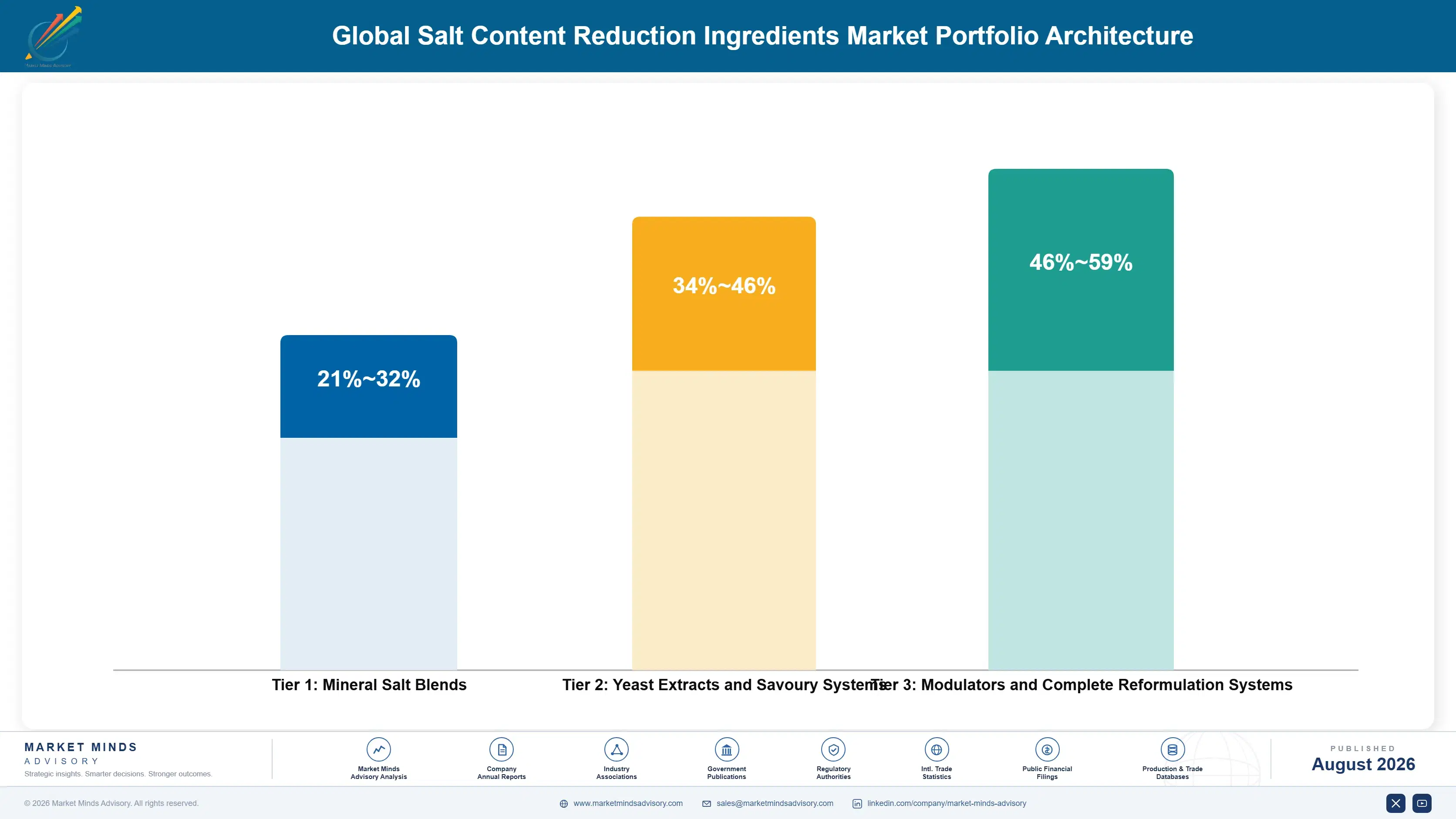
Portfolio Architecture for Margin Defence

Margin here follows how much of the customer's problem an ingredient actually solves. Mineral salt blends earn margins in the low twenties to low thirties, because potassium chloride is a traded commodity, blending it is straightforward and any competent supplier delivers an equivalent product against the same specification. Potash pricing rather than anything else moves this tier. Blending confers no durable advantage on anybody.
Yeast extracts and savoury enhancement systems do considerably better in the mid thirties to mid forties, because fermentation capacity and downstream processing limit the supplier field and clean label positioning favours them over synthetic alternatives that declare badly on a pack. The range reflects production capability and application support depth. Fermentation capacity is a genuine barrier to entry here. Application support depth separates suppliers considerably here.

Taste modulators and complete reformulation systems hold the strongest position, reaching into the high fifties, because they sit at the constraint point of the category and are protected by approvals that take years to obtain. Those margins reflect development and regulatory position rather than any material cost, since inclusion rates are tiny. Inclusion rates are tiny and approval timelines are long. Years of approval work protect the position afterwards.

Mineral Salt Blends

Potassium chloride and mineral salt blends supplied against standard specifications. The eleven point range reflects potash buying position and blending scale rather than product difference, since equivalent material is widely available.
Gross Margin: 21-32%

Yeast Extracts and Savoury Systems

Fermentation-derived savoury enhancement restoring the depth lost when salt is removed. The twelve point range reflects fermentation capacity, downstream processing capability and the depth of application support offered alongside the ingredient.
Gross Margin: 34-46%

Modulators and Complete Reformulation Systems

Taste modulators and full reformulation systems addressing taste and function together in one package. The thirteen point range reflects approval breadth across jurisdictions and application development capability rather than any material cost.
Gross Margin: 46-59%
salt-content-reduction-ingredients-market-portfolio-architecture-1787595041660

High-value Sub-segments and Strategic Watch-out

Taste Modulator Compounds

High value and the fastest growth at 11.1%, sitting at the constraint point of the whole category despite reducing no sodium at all. Approval breadth rather than performance decides where a modulator can actually be sold. Clean label pressure disadvantages unfamiliar declarations. Approval breadth decides reach.
Gross Margin: 48-59%

Difficult Category Reformulation Systems

High value and growing as easier categories exhaust, since bread, cured meat and cheese need process knowledge alongside taste correction. Ingredient value per tonne reformulated runs far higher in these applications. Process knowledge rather than flavour systems is what these applications actually require from a supplier.
Gross Margin: 42-55%

Mineral Salt Blends

The volume core, where potassium chloride is a traded commodity priced against agricultural potash and blending confers no advantage. Equivalent material is widely available and specifications are met identically by everybody. Any competent supplier delivers an equivalent product. Specifications are met identically by everybody. Nothing differentiates here.
Gross Margin: 21-32%

Potash Price Exposure

The strategic watch-out. Food grade potassium demand is far too small to influence a fertiliser market many times its size, and the range reflects how far a supplier has built fermentation-based alternatives. Fermentation-derived alternatives move on entirely unrelated cost cycles, which is the only useful hedge available.
Gross Margin: 16-34%

Deadlines Rather Than Demand

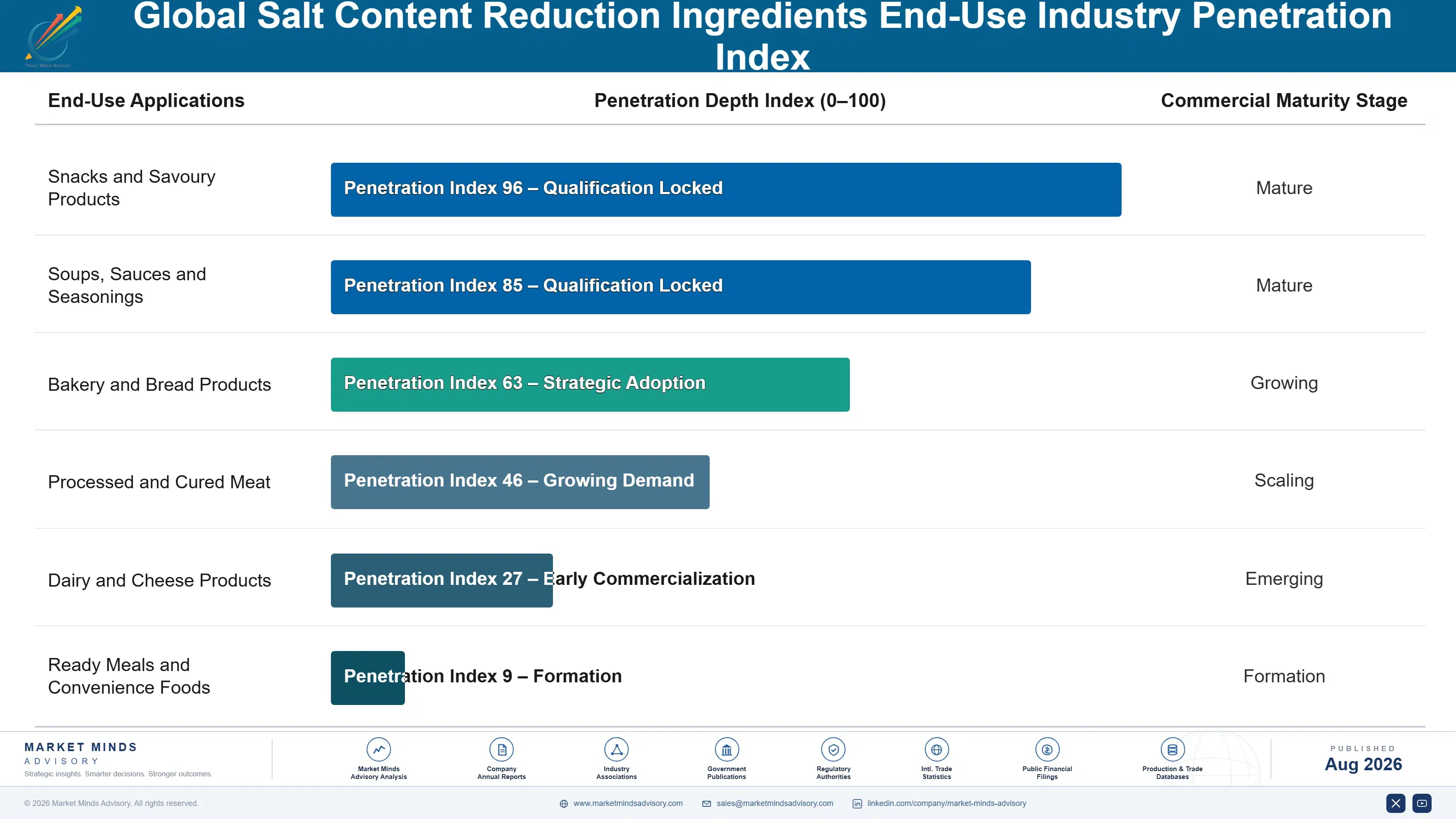
Ingredient demand here arrives in waves tied to regulatory compliance dates rather than spreading evenly across a year. A labelling deadline triggers reformulation across every affected product in a market simultaneously, then activity falls away until the next threshold or the next jurisdiction. That makes capacity planning genuinely difficult and rewards suppliers who track legislation rather than order books. Capacity planning is correspondingly difficult.
Stickiness follows the reformulation rather than the ingredient. A product reformulated around a specific system runs on it for years, because reopening a formulation means repeating sensory testing, shelf life validation and consumer acceptance work that nobody undertakes voluntarily. Component substitution at the next contract review is the real risk, since a customer who has learned the approach can buy the pieces elsewhere. Sensory testing and shelf life validation are what nobody wants to repeat.

The deciding function has moved from procurement toward regulatory affairs and product development together. Procurement handled ingredient buying when sodium reduction was voluntary and gradual. Labelling thresholds made it a compliance matter with a deadline attached, which brings in functions that weigh capability and timing far above unit price. Capability and timing now outweigh unit price considerably.
salt-content-reduction-ingredients-market-end-use-penetration-index-1787595042151

Where We Would Focus Effort

These are among the four positions where our research anticipates prominent divergence between winners and laggards over the coming forecast period. Each is grounded in the demand model, the regulatory perimeter, and the announced capacity pipeline.
01 / MODULATOR POSITION BUILDING

Own the ceiling everybody else runs into

Potassium chloride substitution caps near 30% because of metallic bitterness, and bitter blocking modulators raise what every other ingredient in a reduction system can possibly achieve at all. Those modulators grow at 11.1% and sit at the constraint point of the whole category despite reducing no sodium themselves at all. A supplier holding an effective one participates in every deep reduction project regardless of which mineral salt or savoury enhancer the formulator happened to have happened to have selected first.
02 / LEGISLATION TRACKING DISCIPLINE

Watch parliaments, not industry pledges

Front-of-pack warning labels cut sales of labelled products by around 24% and produce reformulation on the regulator's timetable, while two decades of voluntary industry commitments produced slow and thoroughly uneven progress over that time. Ingredient demand in labelled markets arrives in concentrated waves tied to compliance deadlines rather than spreading evenly. Watching which parliaments are debating labelling identifies where reformulation budgets appear next of all, and it predicts far better than any published published industry pledge has ever once managed to.
03 / DIFFICULT CATEGORY CAPABILITY

The easy reformulations are already done

Bread, cured meat and cheese resist sodium reduction because salt performs functional rather than sensory work in each, controlling fermentation, water activity and protein structure respectively in each case. Manufacturers therefore reformulated snacks, soups and sauces first, which means remaining opportunity sits entirely in the very hardest applications remaining. Ingredient value per tonne reformulated runs far higher there and very few suppliers hold any genuine capability there, because solving it needs process knowledge rather than a flavour system on its own.
04 / ASIAN CATEGORY DEVELOPMENT

The technology was built for the wrong foods

Asian sodium intake runs around 2.1 times guideline levels and arrives through soy sauce, fermented pastes, pickles and instant noodles rather than through the packaged snacks that dominate Western consumption. Reducing sodium in a fermented condiment is genuinely harder than in a dry snack, because salt governs the fermentation itself rather than simply seasoning the result. Almost all existing reduction technology was developed for Western categories, which leaves the largest opportunity in this market barely addressed by anybody at all.

Engagement Snapshot From the Field

A live engagement with an industry participant carrying material or product regulatory and market exposure ahead of a defining policy shift, showing how our research translates into a defensible multi-year portfolio strategy.
MARKET MINDS ADVISORY · CLIENT ENGAGEMENT SUMMARY
Global Salt Content Reduction Ingredients Producer Strategic Portfolio Review and Transition Roadmap 2026·Investment Scenario on Global Salt Content Reduction Ingredients Exposure Evaluation 2025-26
CLIENT PROFILE
A European ingredient supplier selling potassium chloride blends and yeast extracts into food manufacturers across twelve countries, at annual sodium reduction revenue near 46 million euros (client-reported, unverified by MMA). Application development was provided free to win component business, no taste modulator was held, and Asian markets were served through distributors alone rather than any direct presence.
STRATEGIC CHALLENGE
Three large customers had taken reformulation approaches developed at the client's expense to lower cost component suppliers at contract renewal, and deep reduction projects were being lost to competitors holding modulator technology. Management were considering reducing application development spending to protect margin, which the board suspected was the wrong response entirely.
MMA APPROACH
MMA assessed where reduction projects were being won and lost across the client's customer base, benchmarked modulator holdings and approval positions among competitors, sized difficult category opportunity against the reformulated base, and evaluated Asian condiment reduction capability requirements. Interviews with 47 experts covered food reformulation, taste modulation and regulatory affairs.
KEY FINDINGS
  1. Every deep reduction project lost had been decided on modulator availability rather than on mineral salt or yeast extract quality, which the client had assumed was the differentiator.
  2. Free application development was being consumed and then transferred to cheaper component suppliers, with no mechanism to capture the value that development created.
  3. Remaining reformulation opportunity in the client's markets sat overwhelmingly in bread and cured meat, where the client held no process capability whatsoever.
  4. Asian condiment reduction represented a far larger opportunity than the client's whole European base, and existing technology addressed Western categories almost exclusively.
CLIENT PROFILE
A European ingredient supplier selling potassium chloride blends and yeast extracts into food manufacturers across twelve countries, at annual sodium reduction revenue near 46 million euros (client-reported, unverified by MMA). Application development was provided free to win component business, no taste modulator was held, and Asian markets were served through distributors alone rather than any direct presence.
STRATEGIC CHALLENGE
Three large customers had taken reformulation approaches developed at the client's expense to lower cost component suppliers at contract renewal, and deep reduction projects were being lost to competitors holding modulator technology. Management were considering reducing application development spending to protect margin, which the board suspected was the wrong response entirely.
MMA APPROACH
MMA assessed where reduction projects were being won and lost across the client's customer base, benchmarked modulator holdings and approval positions among competitors, sized difficult category opportunity against the reformulated base, and evaluated Asian condiment reduction capability requirements. Interviews with 47 experts covered food reformulation, taste modulation and regulatory affairs.
KEY FINDINGS
  1. Every deep reduction project lost had been decided on modulator availability rather than on mineral salt or yeast extract quality, which the client had assumed was the differentiator.
  2. Free application development was being consumed and then transferred to cheaper component suppliers, with no mechanism to capture the value that development created.
  3. Remaining reformulation opportunity in the client's markets sat overwhelmingly in bread and cured meat, where the client held no process capability whatsoever.
  4. Asian condiment reduction represented a far larger opportunity than the client's whole European base, and existing technology addressed Western categories almost exclusively.
RECOMMENDED STRATEGY
Phase 1: Phase one: license or acquire a taste modulator with approvals in the client's principal markets, since deep reduction projects are decided on that alone. Phase 2: Phase two: charge separately for application development rather than absorbing it, which protects created value and identifies customers who genuinely value capability. Phase 3: Phase three: build fermented condiment reduction capability for Asian categories, where the opportunity is largest and existing technology least applicable.
OUTCOME
The supplier licensed a modulator during 2026 and reported winning deep reduction projects it had previously been excluded from (client-reported, unverified by MMA). Application development was moved to a charged basis, and two customers who had switched components returned. Application development spending was increased rather than reduced.

Frequently Asked Questions

Foundational context covering the market sizes, CAGR, scope, country, region and competition that inform every finding below. This section is provided to cover basics and most often pre-purchase conversations, answered from the MMA Primary Research Dataset.

What is the current size of the Global Salt Content Reduction Ingredients Market?

MMA sizes it at USD 1.28 billion in 2025, rising to USD 1.37 billion in 2026. The figure covers ingredients used to reduce sodium in food and beverage products at supplier selling value.

How large will the Global Salt Content Reduction Ingredients Market be by 2036?

USD 2.80 billion by 2036, an incremental USD 1.43 billion over the 2026 base and an expansion multiple of 2.04 times. Taste modulators account for a disproportionate share.

What is the CAGR for the Global Salt Content Reduction Ingredients Market 2026 to 2036?

7.4% in the base case, with a bull case at 8.6% and a bear case at 6.2%. The spread turns on labelling regulation spreading and on potassium chloride pricing.

Which segment is growing fastest?

Bitter blockers and taste modulators at 11.1%, half again the market rate of 7.4%. They raise the substitution ceiling that limits every other ingredient in a reduction system.

Who are the major companies in the Global Salt Content Reduction Ingredients Market?

Kerry Group, Givaudan, DSM-Firmenich, Ingredion and Tate and Lyle lead on sodium reduction ingredient revenue. Fifteen further participants are profiled in the full report on that same basis.

Which country is growing fastest?

Brazil at 10.4%, following front-of-pack warning label regulation that produces sales declines of around 24% on labelled products and forces reformulation onto strict regulatory timetables.

Report Segmentation Architecture

The full report scope spans multiple orthogonal segmentation dimensions, with cross-tabulated demand data provided for each dimension pair. Coverage extends further to regional breakdowns, trend trajectories, and the competitive detail needed to support segment-level decision-making.

By Ingredient Function

  • Potassium Chloride and Mineral Salts
  • Yeast Extracts and Savoury Enhancers
  • Bitter Blockers and Taste Modulators
  • Nucleotides and Amino Acid Enhancers
  • Sea Salt and Modified Salt Crystals
  • Hydrolysed Vegetable Proteins and Ferments

By End-Use Industry

  • Snacks and Savoury Products
  • Soups, Sauces and Seasonings
  • Bakery and Bread Products
  • Processed and Cured Meat
  • Dairy and Cheese Products
  • Ready Meals and Convenience Foods

By Commercial Dimension

  • Direct Supply to Manufacturers
  • Application Development Services
  • Distributor and Agent Channels
  • Complete Reformulation Systems
  • Contract Development Agreements
  • Export and Cross-Border Supply

By Region

  • North America
  • Western Europe
  • East Asia
  • South Asia and Pacific
  • Latin America
  • Middle East and Africa
  • Eastern Europe

Scope, Methodology, and Coverage

Every figure in this report is reproducible from documented input assumptions. The scope below maps the historical period, the forecast horizon, the segmentation dimensions, and the countries covered, alongside the underlying primary and qualitative methodology.
Historical Period
2020 to 2025
Forecast Period
2026 to 2036
Base Year
2025 (USD billions; MMA Primary Research Dataset, August 2026)
Market Definition
Ingredients used to reduce sodium content in food and beverage products while maintaining acceptable taste and function, covering potassium chloride and mineral salts, yeast extracts and savoury enhancers, bitter blockers and taste modulators, nucleotides and amino acid enhancers, sea salt and modified salt crystals, and hydrolysed vegetable proteins and ferments. Measured at ingredient supplier selling value including application development sold separately. Ordinary food grade salt, general flavour ingredients without a sodium reduction function, preservatives, and consumer table salt substitutes are excluded from scope.
Quantitative Units
USD billions (current prices); thousand tonnes ingredient; USD per kilogram by ingredient function
Segmentation Dimensions
Ingredient function; food category; commercial dimension; region
Regions Covered
North America, Western Europe, East Asia, South Asia and Pacific, Latin America, Middle East and Africa, Eastern Europe
Countries Covered
United Kingdom, Germany, France, Netherlands, Finland, Spain, United States, Canada, Mexico, Brazil, Chile, Argentina, China, Japan, South Korea, India, Indonesia, Australia, South Africa, Poland
Key Companies Profiled
Kerry Group, Givaudan, DSM-Firmenich, Ingredion, Tate and Lyle, Angel Yeast, Lesaffre, Ohly, Corbion, Cargill, ADM, IFF, Symrise, Sensient Technologies, Innophos, K+S, Salt of the Earth, MicroSalt, Nu-Tek Natural Ingredients, Titan Biotech
Quantitative Methodology
Primary survey, n=3,800 respondents, Q4 2025, six countries; demand-side model with trade association cross-validation
Qualitative Methodology
47 expert interviews, Q4 2025; applied to validate demand model assumptions, identify emerging dynamics, and assess competitive positioning
Report Format
PDF and XLSX data workbook (Word format preview document)
Publisher
Market Minds Advisory
Report Code
MMA-2026-AGR-186
Published
August 2026
Contact
sales@marketmindsadvisory.com | www.marketmindsadvisory.com

Purchase the full Global Salt Content Reduction Ingredients Market Report (2026 to 2036).

The full report treats salt's four functional roles separately, because reformulation fails on the ones a taste solution never addresses rather than on flavour. It sizes all six ingredient functions independently through 2036, maps reformulation difficulty by food category against remaining opportunity, and tracks labelling legislation across markets that have not yet adopted it. Regional chapters cover all seven regions with sodium intake sources analysed separately from regulatory pressure, because the two rarely align. Competitive profiling covers 20 participants on a single revenue basis including modulator approval positions.
Six ingredient functions sized independently through 2036
Reformulation difficulty mapped by food category and function
Labelling legislation tracked across markets yet to adopt
Sodium intake sources analysed separately from regulatory pressure
Twenty participants profiled on one consistent revenue basis
Modulator approval positions assessed across major jurisdictions

Built For The People Who Decide

From boardroom strategy to bench-side execution, this report is read cover-to-cover by leaders shaping the next decade of their industry, turning demand scenarios, market dynamics and valuation benchmarks into decisions.
CXOs/ Presidents/ VPs/ Managers
M&A and Corporate Development
Strategy Teams and R&D Heads
Procurement and Product Directors
Regulatory and Compliance Leaders
Investor Relations and Equity Analysts