Market Minds Advisory
Salesforce CRM Document Generation Software Market

Salesforce CRM Document Generation Software Market: Salesforce CRM Document Generation Software Market. Contract, Proposal, and Quote Automation Built Natively on the Salesforce Platform, 2026 to 2036

Sales teams tired of manually copying CRM data into Word templates are pushing Salesforce document generation vendors to fold AI-drafted contract language directly into the quote-to-close workflow itself and beyond.

Lead Analyst

Published

September 2026

Make Smarter Decisions with Customized Research Insights

Request a free sample report and evaluate market opportunities, growth trends, and competitive dynamics relevant to your business needs.

2025 MARKET VALUE$1.3BMarket Size 2025
2036 FORECAST VALUE$5.2BBase Case , 2026 to 2036
CAGR 2026 TO 203613.5 %Bull 14.7% / Bear 12.3%
INCREMENTAL OPPORTUNITY$3.8BNet 10- year value creation
EXPANSION MULTIPLE3.55x2036 value over 2026 base
Strategic Levers
M&A Pipeline
Regional Outlook
Country Rankings
Competitive Intelligence
Segmental Deep-dive
Call-Us : 91 93563 13602

Executive Snapshot and Market Trajectory.

Salesforce document generation software has moved from a nice-to-have quote formatting tool into essential revenue infrastructure, as sales teams increasingly expect contracts and proposals to populate automatically from CRM records without manual copy-paste work slowing down deal velocity across every stage of the pipeline.
AI-driven contract and agreement document generation is growing fastest as legal and sales operations teams push beyond static templates toward systems that draft clause language contextually based on deal terms already captured in the CRM record itself, reducing legal review cycles meaningfully. North America leads regional demand given its concentration of enterprise Salesforce deployments and the largest B2B sales organizations running complex, multi-approval quote workflows across many product lines.
Competitive character increasingly centers on native Salesforce platform depth rather than generic document automation capability, since buyers now expect deep integration with opportunity, quote, and contract objects that generic e-signature or word processing tools simply were never built to understand at the data model level, and switching away from a deeply embedded vendor grows considerably harder the longer a sales organization relies on it for daily quote-to-cash operations across every business unit and region.
Market Definition
The Salesforce CRM Document Generation Software Market covers software built natively on or deeply integrated with the Salesforce platform that automatically generates contracts, proposals, quotes, and other business documents from CRM record data. It excludes standalone document generation tools without native Salesforce data model integration and general-purpose word processing or e-signature software.
Base Year Value
$1.3B in 2025 (MMA Primary Research Dataset, September 2026)
Forecast Period
2026 to 2036, eleven discrete annual values
CAGR
13.5% base case. Bull 14.7%. Bear 12.3%.
Fastest Growth Segment
AI-Driven Contract and Agreement Document Generation: 17.0% CAGR
Fastest Growth Country
Israel: 16.0% CAGR
Fastest Growth Region
South Asia and Pacific: 15.7% CAGR
Largest Region
North America: 31% of 2025 global value
Market Leaders
Leading vendors: Conga, PandaDoc, DocuSign, Titan, S-Docs. Source: MMA Primary Research Dataset, July 2026.
Primary Survey
n=3,800 procurement and R&D decision-makers, Q4 2025, six countries
Methodology
Demand-side build-up, cross-validated against public data, 47 expert interviews

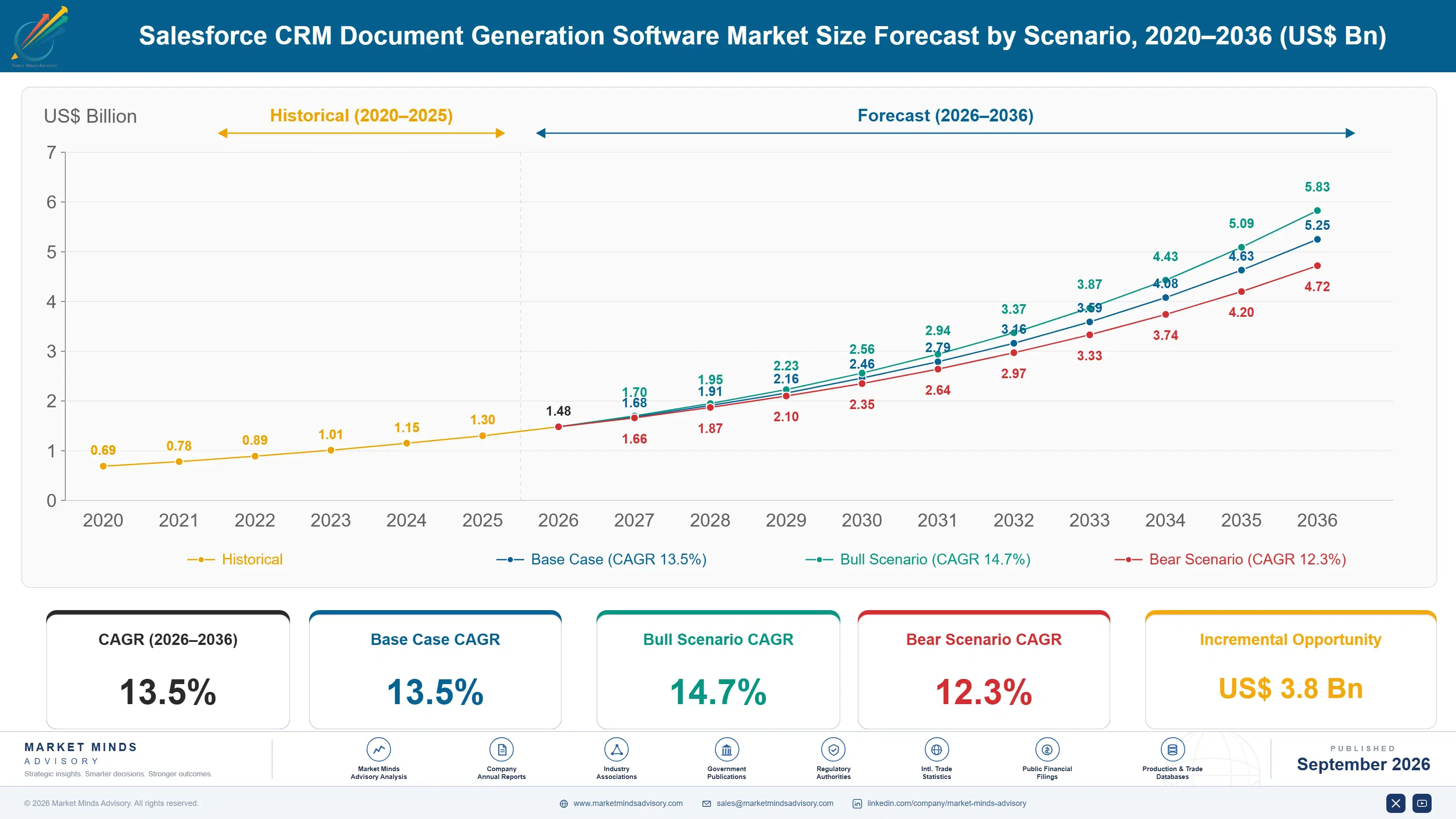
Salesforce CRM Document Generation Software Market Forecast Scenarios

salesforce-crm-document-generation-software-market-size-forecast-scenario-1789993181070
Growth through 2020 to 2025 was strong as Salesforce's own installed base expanded steadily and remote sales teams increasingly needed digital-first quote and contract workflows that did not depend on printing, scanning, or manually assembling documents from scattered templates spread across shared drives and email attachments passed constantly between colleagues, managers, and many entire departments.
Base case growth through 2036 rests on three commercial mechanisms: continued expansion of the underlying Salesforce customer base creating a larger addressable market for native document tools across every industry vertical and company size worldwide, growing legal and sales operations demand for AI-drafted contract language that reduces attorney review time meaningfully, and rising enterprise appetite for consolidating point solutions into fewer, deeply integrated platform-native vendors serving the entire quote-to-cash process.
A bull scenario turns on faster AI contract drafting adoption proving measurable legal review time savings that finally justify premium platform-native pricing over cheaper generic alternatives currently available. The bear risk is that Salesforce itself builds sufficiently capable native document generation directly into its core platform, eliminating the need for a dedicated third-party add-on entirely for most customers going forward.

Quote-to-Cash Economics Behind the Add-On Layer

Salesforce document generation has become a genuine competitive battleground precisely because it sits at the exact moment a deal either closes or stalls, and vendors that can eliminate friction between a closed-won opportunity and a signed contract capture disproportionate credit for accelerating revenue that finance teams actually notice and report to the board each and every quarter without fail.
MARKET CONCENTRATIONCR5: 42%Top five vendors hold a substantial minority of the market
AVERAGE ENTERPRISE CONTRACT VALUE$32,000Typical annual subscription spend for mid-market Salesforce customers
TOP ADOPTING COUNTRY SHAREUSA: 38%Reflects concentration of enterprise Salesforce deployments and large sales teams
CONTRACT CYCLE TIME REDUCTION6 percentage pointsAverage improvement in deal closing speed after full deployment
IMPLEMENTATION TIMELINE4 to 8 weeksTypical time from contract signing to full production rollout
CUSTOMER RENEWAL RATE91%Annual subscription renewal rate reported across leading platform vendors
Vendors compete less on template design flexibility today and more on how deeply their platform understands Salesforce's underlying data model, since generic document tools that bolt on through basic API connections routinely break when customers customize their CRM object structure in ways vendors never anticipated during initial product design or subsequent platform updates released steadily over time and across every release cycle and product version.
AI-drafted contract language has moved from experimental feature to genuine purchasing criterion within larger enterprise accounts, as legal teams increasingly expect software to suggest compliant clause language automatically rather than forcing attorneys to draft every non-standard term completely from scratch during each individual negotiation cycle across every deal in the pipeline and every single quarter of the fiscal year and beyond.
"The vendors still selling this as a fancy mail-merge tool are going to lose to the ones treating it as the connective tissue between sales, legal, and finance. That's where the real value sits."
Practice Lead, Enterprise Software and Sales Technology Research · MMA Technology Practice · September 2026

Market Trends

Generative AI Drafts Contract Clauses Automatically

Document generation vendors have increasingly integrated generative AI capability that drafts contextually appropriate clause language directly from deal terms captured in Salesforce opportunity and quote records, a capability that barely existed as a production feature two years ago but now appears across most major vendor product roadmaps and release plans announced publicly to enterprise customers everywhere. Several leading platforms report legal review time reductions after AI clause drafting adoption, and enterprise legal departments increasingly cite this capability as a required evaluation criterion during vendor selection processes conducted across the industry.
Market Impact: Salesforce base grows over 10% yearly
Salesforce Platform Consolidation Reduces Point Solution Sprawl

Enterprises running Salesforce increasingly consolidate quote, contract, and e-signature point solutions into a smaller number of fewer, deeply integrated platform-native vendors rather than maintaining many separate standalone tools connected through fragile custom integrations that break during routine platform updates and configuration changes made regularly by internal system administrators. This consolidation trend has accelerated as IT and procurement teams grow more sensitive to vendor management overhead and integration maintenance costs, and several large enterprises have publicly disclosed multi-vendor consolidation projects specifically targeting their Salesforce document generation and contract management tool stack.
Market Impact: Contract cycle times fall 25%

Market Opportunities and Growth Drivers

Growing Salesforce Installed Base Expands Addressable Market

Salesforce's own customer base has continued expanding steadily across enterprise and mid-market segments worldwide, directly growing the addressable market for any software built natively on the platform, since document generation vendors depend entirely on Salesforce's own sales motion to reach new potential customers across every industry and company size served today. Salesforce has publicly disclosed revenue growth exceeding 10% annually in recent fiscal years across its core CRM business, and each new Salesforce customer represents a genuine potential document generation software sale for platform-native vendors serving this specific installed base.
Market Impact: Feature parity risk hits 20%

Legal Departments Demand Faster Contract Turnaround Times

Legal departments across most industries face sustained pressure to reduce contract turnaround time as sales teams increasingly treat legal review as a genuine bottleneck slowing deal closure and revenue recognition timing across the entire fiscal quarter and year for the whole company each cycle. Several large enterprises have publicly disclosed contract cycle time reduction initiatives specifically targeting legal review processes, and AI-assisted document generation software that suggests pre-approved clause language directly addresses this pressure by reducing the volume of fully custom contract review legal teams must handle manually each month.
Market Impact: Update-related breakage affects 12% of deployments

Market Restraints and Challenges

Salesforce Native Feature Expansion Threatens Add-On Vendors

Salesforce continues expanding its own native document and quote generation capability directly within the core platform, and the root cause is that Salesforce has clear commercial incentive to capture add-on revenue currently flowing to third-party vendors rather than leaving that value entirely to its partner network of independent software providers. Vendors are mitigating this by pushing further upmarket into complex, industry-specific document workflows that Salesforce's more generic native capability cannot easily replicate, and several vendors have deepened AI drafting and legal compliance features specifically to maintain differentiation against increasingly capable native platform tools.
Market Impact: Legal review time falls 30%

Integration Complexity Rises With Salesforce Platform Updates

Salesforce releases major platform updates multiple times each and every year across most product clouds, and the underlying cause is that deeply integrated third-party document generation tools must continuously retest and often rebuild their integrations to avoid breaking when Salesforce changes underlying data model or API behavior across releases and configuration options. Vendors are mitigating this by investing in dedicated Salesforce release readiness teams that test against beta platform releases before general availability, and several vendors now offer service level guarantees specifically covering integration stability through major Salesforce platform update cycles.
Market Impact: Vendor consolidation projects up 20% yearly
4 additional market trends, 3 additional growth drivers, and 3 additional restraints and challenges are covered in the full report. Contact sales@marketmindsadvisory.com to access the complete intelligence.

Segment CAGR and Growth Architecture

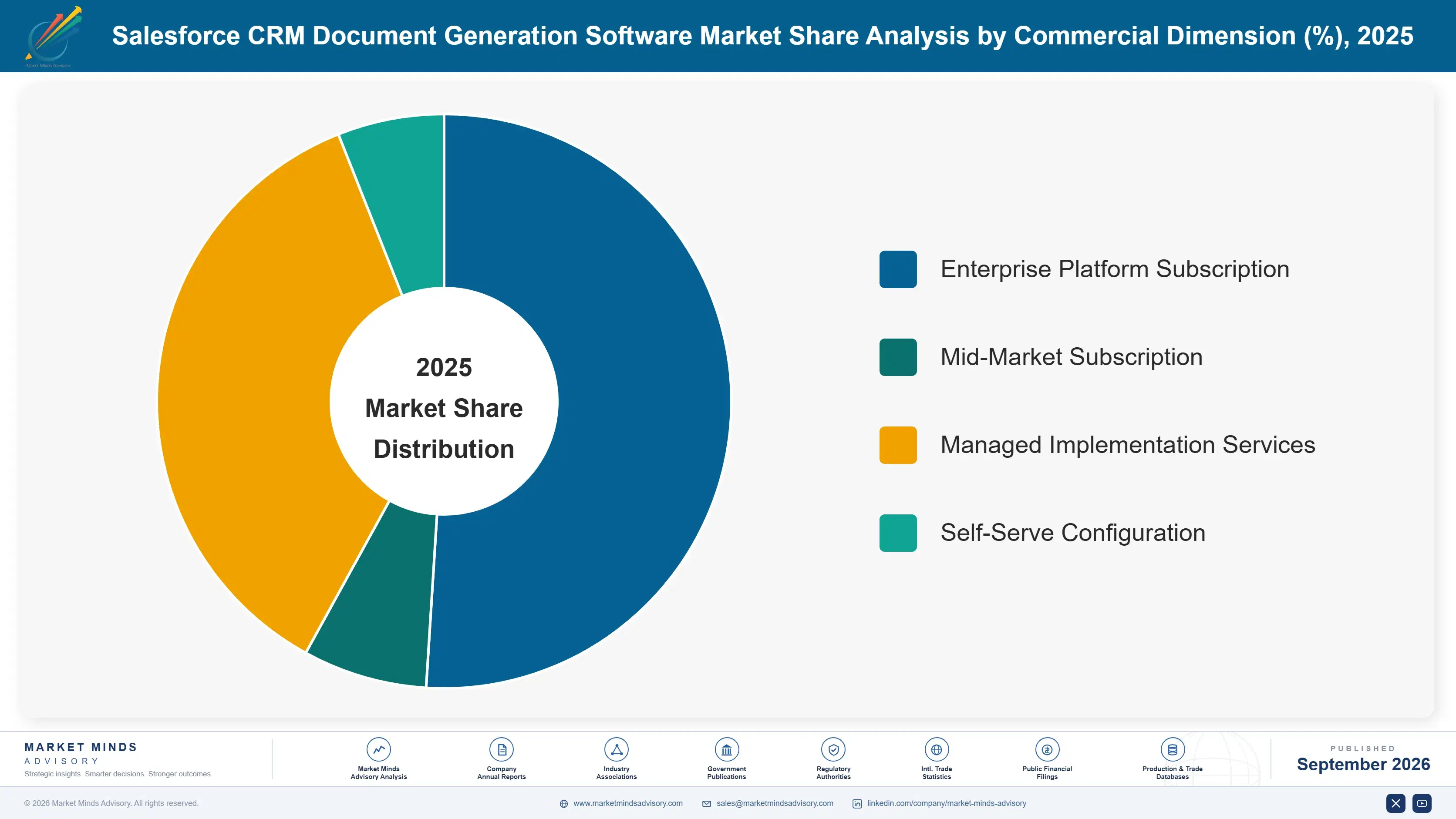
The market divides into five segments by functional capability, spanning AI-driven contract and agreement document generation, proposal and quote document generation, automated template and assembly engines, e-signature integrated document workflows, and approval and compliance workflow software, each addressing a distinct step in the enterprise quote-to-cash process from initial deal creation through final contract signature.
salesforce-crm-document-generation-software-market-market-share-analysis-1789993181662

AI-Driven Contract and Agreement Document Generation

AI-driven contract and agreement document generation is growing fastest as legal and sales operations teams push beyond static clause libraries toward systems that draft contextually appropriate contract language automatically based on deal terms already captured in Salesforce opportunity and quote records across the entire pipeline and every single deal stage tracked closely and reported regularly. This segment increasingly captures the largest share of new platform spending, since legal review time reduction represents the single most measurable return on investment metric that finance and legal leadership can point to when justifying continued or expanded software investment, pushing generic document assembly vendors to rapidly build or acquire AI capability they historically lacked.
CAGR 17.0%

Proposal and Quote Document Generation

Proposal and quote document generation remains the second-fastest-growing segment as sales teams continue demanding faster, more visually polished quote documents that populate automatically from CRM pricing and product configuration data without any manual formatting work required beforehand or afterward at any point in the entire sales and internal approval process handled today. This segment increasingly determines vendor selection at sales-led organizations, since quote turnaround speed directly affects deal velocity in ways that finance and sales leadership can track quarter over quarter across every region and business unit worldwide, keeping this segment central to renewal decisions even as contract generation captures a growing share of overall platform investment across the industry.
CAGR 14.0%
Full segment breakdown across 5 segments available in the complete report.

Regional Architecture and Country Demand Map

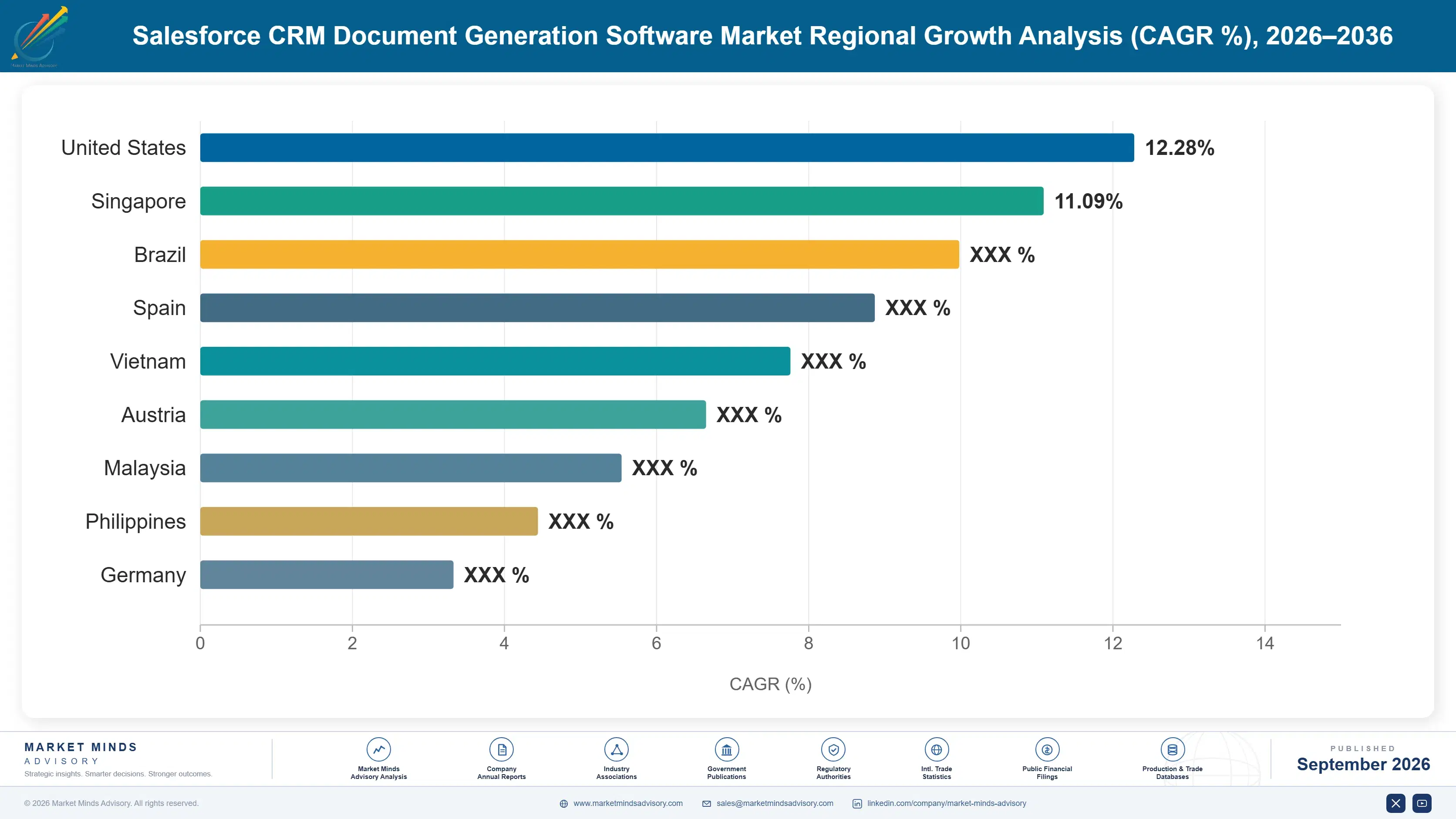
North America leads demand given its exceptional concentration of enterprise Salesforce deployments and the largest B2B sales organizations running complex, multi-approval quote and contract workflows daily and continuously, while Western Europe and East Asia follow closely with substantial adoption across their own established Salesforce customer bases.

North America

American enterprises run some of the largest and most complex Salesforce deployments anywhere in the world, with sales operations teams managing multi-approval quote workflows spanning dozens of product lines and regional pricing variations across a single global account and business unit. San Francisco's proximity to Salesforce's own headquarters has created a dense concentration of independent software vendors building specifically for the platform, including most of the leading document generation companies profiled in this report. Canadian enterprises contribute a smaller but steady secondary demand pool, often adopting Salesforce document generation tools following implementation patterns first proven at larger American parent companies and shared corporate technology standards across the shared border and continent.
Share: 31% | CAGR: 14.4% (2026 to 2036)

Western Europe

German and British enterprises drive the bulk of Western European demand, with London serving as a genuine hub for financial services and insurance companies running complex, regulation-heavy contract generation workflows requiring extensive compliance documentation across every product line. French and Italian enterprises have adopted more cautiously, often citing data residency requirements and integration concerns with legacy contract management systems predating their Salesforce implementation by many years and legacy IT investments. Growth trails North America and East Asia given generally smaller average Salesforce deployment scale across the region and continued reliance on traditional legal department contract drafting processes at many mid-sized European enterprises across the wider continent that has been slower to fully catch up.
Share: 22% | CAGR: 12.1% (2026 to 2036)
Regional intelligence for 5 additional markets available in the complete report: East Asia, South Asia and Pacific, Latin America, Middle East and Africa, Eastern Europe. Contact sales@marketmindsadvisory.com.
salesforce-crm-document-generation-software-market-country-cagr-analysis-1789993182181

How Vendors Actually Expand Margin

Beyond raw seat count growth, four distinct commercial mechanisms determine which vendors actually expand margin rather than simply chasing subscriber growth each and every single fiscal quarter of the entire full calendar year and beyond: AI drafting upselling, deep integration lock-in, vertical-specific compliance depth, and managed implementation services layered on top of the base subscription.

Upselling AI Contract Drafting to Existing Base

Vendors that sell basic document assembly first, then upsell AI-driven contract drafting modules once a customer has proven value on simpler quote generation, capture meaningfully higher revenue per account than vendors selling AI capability upfront to a skeptical buyer with no established platform relationship yet to build meaningfully on at all today or tomorrow. Several leading platforms report AI drafting attach rates exceeding 30% within the first year of module availability, turning an already-installed customer base into the fastest-growing revenue line without requiring any new logo acquisition at all this year.
Market Impact: AI drafting attach rate exceeds 30% in year 1

Deepening Salesforce Data Model Integration Lock-In

Vendors that build genuinely deep integration with Salesforce's custom objects and workflow rules create real switching costs once a customer has configured document templates around specific fields and approval logic unique to their business and internal processes across every single department, team, and business unit. Enterprises report switching document generation vendors after deep customization costs 3 to 4 times more than the original implementation, making integration depth a genuinely durable margin strategy for vendors serving the largest, most customized Salesforce deployments across the entire enterprise organization and its many divisions.
Market Impact: Switching after lock-in costs 3 to 4x more

Building Deep Vertical-Specific Compliance Document Templates

Vendors that build pre-configured compliance templates tailored to specific regulated industries, such as insurance policy documents or financial services disclosures, win deals faster and command premium pricing over generic configurable document platforms requiring lengthy customization before any template can actually go live for regulated use at meaningful scale and reasonable speed today across every regional market. Vertical-specific templates reduce implementation time meaningfully, and several vendors report verticalized go-to-market motions produce win rates roughly 22% higher than horizontal sales approaches targeting any Salesforce customer regardless of industry or overall company size.
Market Impact: Vertical templates lift win rates by 22% overall

Bundling Managed Implementation and Training Services

Vendors increasingly bundle full implementation, template design, and end-user training services on top of the base document generation subscription, capturing revenue that would otherwise flow to independent Salesforce consulting partners hired separately by the customer to complete configuration and rollout work correctly the very first time around. Services attach revenue now represents a meaningful share of total contract value at several leading vendors, sometimes exceeding 20% of first-year deal value, and this bundling also deepens customer relationships and reduces churn risk since switching means redoing a costly implementation entirely from scratch.
Market Impact: Services attach reaches over 20% of deal value

Who Controls the Margin Pool

Competitive concentration sits at a moderate CR5 near 42%, evaluated on annualized recurring revenue across the category, leaving meaningful daylight between the established platform-native leaders and a long tail of smaller point solutions and generic document tools. Conga and DocuSign hold the largest revenue bases through their broad Salesforce partner network presence, and the gap to smaller specialized challengers remains wide given the switching costs embedded in deep platform integration.
Current competitive activity centers on AI drafting capability and deep Salesforce data model integration rather than basic template design, which most serious vendors now treat as table stakes. Several vendors have pursued targeted acquisitions of smaller AI contract analysis startups over the past two years specifically to accelerate capability rather than build it natively, while others have doubled down on vertical-specific compliance depth competitors lack.

Rankings are most likely to shift as vendors offering genuinely native, deeply integrated platforms continue winning share from generic document tools that bolt on through basic API connections lacking deep data model understanding. Consolidation among smaller point-solution vendors appears increasingly likely, and private equity interest in AI-native contract generation companies has picked up noticeably as buyers recognize the durability of deeply embedded platform relationships.
salesforce-crm-document-generation-software-market-company-positioning-matrix-1789993182700

Competitive Moat and Risk Dimensions

CONGA

Moat: Broadest Salesforce Partner Presence

Conga's decade-long history as a leading Salesforce AppExchange partner has produced deep relationships with Salesforce's own sales and implementation teams, giving it visibility into new enterprise deals and referral opportunities that smaller, less established competitors simply cannot easily access at comparable scale, speed, or reach.
CONGA

Risk: Complex, Aging Product Architecture

Conga's product suite has grown through multiple acquisitions over the years, and the underlying technical architecture reportedly carries integration complexity that newer, more modern competitors built on unified codebases can avoid entirely from the outset, occasionally slowing feature development and creating a genuine opening for agile challengers.
DOCUSIGN

Moat: Dominant E-Signature Brand Recognition

DocuSign's brand recognition as the default e-signature provider gives its document generation and contract lifecycle management offerings an immediate trust advantage with buyers already using the company for signature workflows, reducing the sales friction that newer entrants must overcome to win comparable enterprise deals at scale.
DOCUSIGN

Risk: Core Business Growth Has Slowed

DocuSign's core e-signature business growth has slowed considerably as the category matures and competition intensifies, pushing the company to rely more heavily on document generation and contract lifecycle management expansion to sustain overall growth rates that investors have historically expected from the company each quarter.

Players Tracked

Prominent Players

Conga
PandaDoc
DocuSign
Titan
S-Docs

Other Key Players

Nintex
Templafy
Xait
GhostDraft
Foxit
Formstack
Ombud
DealHub
Qwilr
Loopio
Responsive
Proposify
Better Proposals
Docupilot
Plumsail

Recent Developments

MARCH 2026

Conga Acquires AI Contract Analysis Startup

Conga acquired a smaller AI-driven contract analysis startup in March 2026 to accelerate its clause drafting and risk identification capability for enterprise legal teams, adding specialized machine learning talent that had previously required a slower internal development timeline. The deal closed for an undisclosed amount and integrated quickly.
Signal: Signals accelerating AI capability consolidation through acquisition across the entire leading vendor tier this fiscal year
MAY 2026

DocuSign Expands Contract Lifecycle Management Features

DocuSign announced expanded contract lifecycle management features directly integrated with its core e-signature platform in May 2026, targeting enterprise customers seeking a single vendor relationship spanning document generation through final execution and renewal tracking. The expansion responds directly to growing enterprise demand for platform consolidation.
Signal: Signals e-signature vendors steadily expanding much further upstream into document generation capability quite directly and aggressively
JANUARY 2026

S-Docs Signs Reseller Agreement With Systems Integrator

S-Docs signed a multi-year reseller and implementation partnership agreement with a major Salesforce systems integrator in January 2026, expanding its enterprise sales reach into large multinational corporations that previously evaluated S-Docs only through direct sales channels lacking dedicated implementation support. Terms were not disclosed publicly.
Signal: Signals growing vendor reliance on formal channel partnerships to reach large enterprise accounts far more efficiently

Engineering Talent Drives Most Development Costs

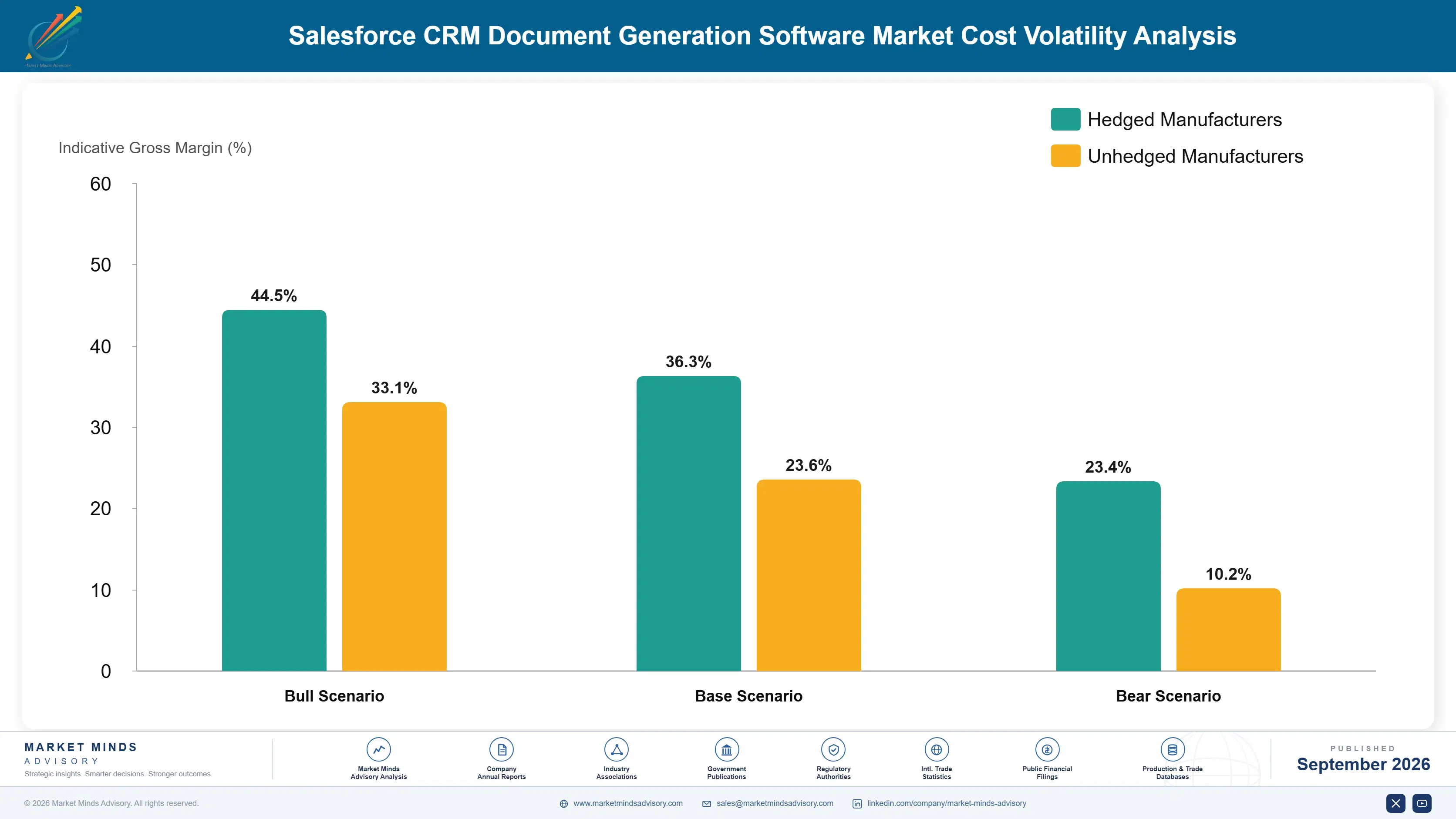
Software engineering and AI model development talent represents the largest cost input for document generation vendors, running roughly 45% of cost of goods sold, concentrated heavily in North American and Western European software engineering labor markets today. Cloud hosting infrastructure adds a smaller but meaningful secondary cost line for most platform vendors operating at scale.
A notable engineering talent cost spike hit the category in 2025 as competition for AI and machine learning engineers intensified sharply following widespread enterprise AI adoption across the broader software industry, a trend documented in multiple company investor updates and referenced in named annual reports from publicly traded enterprise software peers facing comparable hiring pressure. Several vendors slowed non-critical hiring while raising compensation for existing senior engineering staff.

Vendors without significant existing scale face a real cost disadvantage against Conga and DocuSign, both of which can spread fixed engineering and AI research costs across a considerably larger installed customer base than smaller competitors managing comparable product development workloads. This exposure varies by geography too, since vendors based entirely in higher-cost North American engineering markets face meaningfully higher costs than those with access to lower-cost offshore development talent.
salesforce-crm-document-generation-software-market-cost-volatility-analysis-1789993182898

Diversifying Engineering Hiring Across Lower-Cost Regions

Leading vendors increasingly build engineering teams across multiple geographies, including lower-cost markets in Eastern Europe, Latin America, and South Asia, rather than concentrating hiring entirely in expensive North American and Western European talent markets, reducing average blended engineering cost per employee quite substantially over time while still maintaining strong overall technical quality and output.

Reusing AI Infrastructure Across Multiple Product Features

Vendors are increasingly building shared AI infrastructure and model components reusable across multiple product features rather than developing separate machine learning capability for each new module independently and entirely from scratch, spreading fixed AI research investment across a much broader revenue base and reducing marginal cost per new feature shipped to customers each release.

Retaining Senior Engineers Through Equity and Growth Paths

Vendors are investing more heavily in equity compensation and defined technical career progression paths specifically to reduce costly senior engineer attrition during a persistently competitive hiring market, since replacing an experienced engineer costs meaningfully more in both direct recruiting fees and lost institutional knowledge than simply retaining one through much better structured long-term incentives.

Portfolio Architecture for Margin Defence

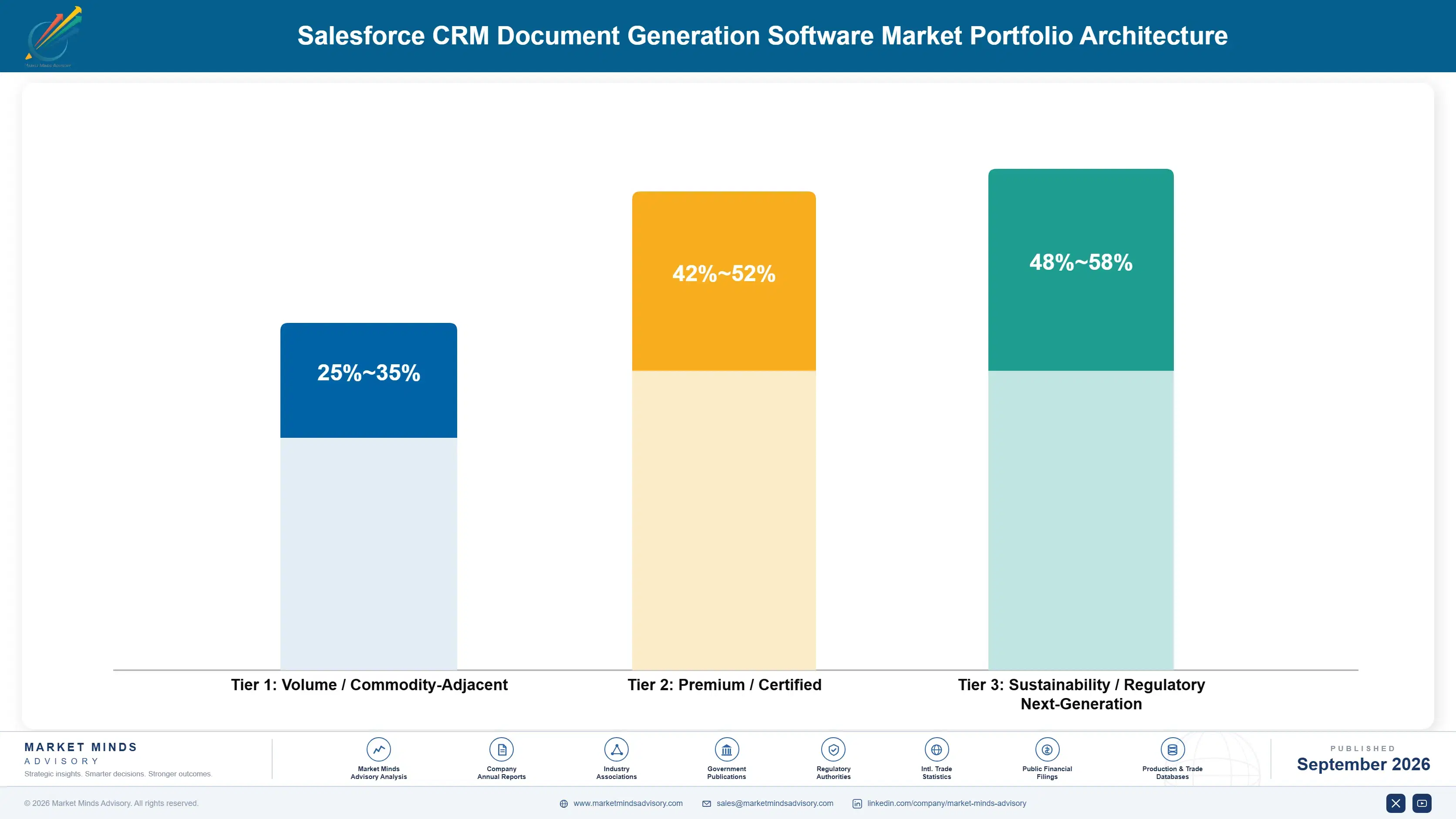
The market splits between commodity-adjacent basic template and assembly tools priced accessibly with thinner margins, and premium AI-driven contract generation platforms carrying meaningfully higher gross margins because deep Salesforce integration, AI drafting capability, and compliance depth justify substantially higher pricing at larger enterprise accounts running complex, multi-approval document workflows across every business unit and geography.
Tension between basic template tools and premium AI-driven platforms plays out in how vendors allocate investment, since simple document assembly requires ongoing cost competitiveness while premium AI drafting demands continuous engineering investment that smaller vendors rarely fund adequately given their limited engineering resources and headcount. Most successful vendors treat basic template tools as an installed-base acquisition funnel rather than a standalone profit center, funding premium development from that steadier baseline revenue instead.

The highest-value margin pools concentrate around AI-driven contract generation and vertical-specific compliance templates serving large enterprise accounts willing to pay premium rates for measurable legal review time savings, a customer set that increasingly determines which vendors capture the fastest-growing and most profitable share of the entire market going forward, leaving basic template vendors competing on thinner and thinner margins with each passing quarter.

Volume / Commodity-Adjacent

Basic template and document assembly tools priced accessibly for smaller Salesforce customers with straightforward, low-complexity quote and proposal generation needs and comparatively modest annual software budgets to spend each fiscal year.
Gross Margin: 25-35%

Premium / Certified

Full contract and proposal generation platforms with e-signature integration serving mid-market and larger enterprises requiring reliable multi-approval workflow support, dedicated ongoing account management, and continuous technical support services throughout the contract term.
Gross Margin: 42-52%

Sustainability / Regulatory / Next-Generation

AI-driven contract drafting and vertical-specific compliance templates serving the largest enterprise accounts willing to pay premium rates for measurable legal efficiency gains and meaningful risk reduction across every business department involved.
Gross Margin: 48-58%
salesforce-crm-document-generation-software-market-portfolio-architecture-1789993183408

High-value Sub-segments and Strategic Watch-out

AI-Driven Contract and Agreement Document Generation

High-value and high-growth, this segment commands premium pricing from enterprises willing to pay for measurable legal review time savings, and its growth rate outpaces every other segment currently by a wide margin as generative AI drafting capability matures across every major vendor's product line and roadmap.
Gross Margin: 48-58%

Proposal and Quote Document Generation

High-value with moderate growth, sales-led organizations pay steadily for faster quote turnaround, though adoption has matured enough at larger customers that growth has settled into a much steadier overall pace than the considerably faster-growing contract generation segment described earlier in this very same overview section.
Gross Margin: 38-48%

Automated Template and Assembly Engines

The volume core of the market, this segment generates the bulk of seat count and recurring subscription revenue across thousands of smaller Salesforce customer accounts worldwide today, even though per-seat margins run well below the premium tiers described above and show little sign of expanding.
Gross Margin: 25-35%

Standalone Basic Document Templates

A strategic watch-out segment: Salesforce's own native document capability keeps steadily adding basic template features that satisfy smaller customers without requiring a dedicated third-party purchase, and vendors must watch this encroachment closely as it threatens the commodity tier most directly and could spread further upmarket.
Gross Margin: 18-28%

Embedded Deep Inside the Sales Motion

Salesforce document generation revenue runs almost entirely on annual subscription contracts tied directly to seat count and platform usage rather than one-time purchases, since sales teams need continuous document generation capability every single business day rather than a single point-in-time software purchase that sits unused between deal cycles, and renewal rates consistently exceed 88% once the tool becomes embedded in daily quote-to-close operations across the entire organization.
Adoption depth varies meaningfully by department: legal and sales operations teams integrate document generation so deeply into daily contract and quote workflows that switching vendors risks disrupting active revenue-generating deals entirely across the entire pipeline, while marketing teams treat proposal formatting more as a convenience layer and switch more readily when a cheaper alternative offers adequate coverage for their comparatively simpler formatting needs.

Buyer profiles have shifted generationally as procurement increasingly runs through revenue operations and legal leadership together rather than either department acting entirely alone, bringing more rigorous evaluation criteria and longer sales cycles but also stickier, better-integrated deployments once a contract finally closes after multiple stakeholder review rounds and a considerably more thorough technical evaluation than firms conducted in years past.
salesforce-crm-document-generation-software-market-end-use-penetration-index-1789993183906

What Vendors Need to Prioritize

These are among the four positions where our research anticipates prominent divergence between winners and laggards over the coming forecast period. Each is grounded in the demand model, the regulatory perimeter, and the announced capacity pipeline.
01 / AI DRAFTING INVESTMENT

AI-driven contract drafting now determines which vendors win enterprise deals

AI-driven contract and agreement generation has become the single most important growth driver in this category today, well ahead of any other capability vendors can offer to enterprise legal and sales teams. Vendors still shipping only static template assembly are losing deals to competitors who can draft contextually appropriate clause language automatically and quantify the legal review time savings that follow. Building this capability now, rather than treating it as a future roadmap item, positions a vendor to capture the fastest-growing segment of new enterprise spending.
02 / INTEGRATION DEPTH STRATEGY

Deep Salesforce data model integration protects against generic competitors

Vendors that build genuinely deep integration with Salesforce's custom objects and workflow rules create real switching costs that generic document tools bolted on through basic API connections simply cannot replicate at comparable depth or reliability. Customers configured around deep customization face meaningfully higher switching costs than customers using shallow integrations, making integration depth a genuinely durable competitive advantage rather than a temporary feature difference easily copied. Vendors relying purely on basic API connectivity increasingly risk losing enterprise deals to platform-native specialists.
03 / SALESFORCE FEATURE RISK RESPONSE

Vendors must differentiate against Salesforce's own expanding native capability

Salesforce continues expanding its own native document and quote generation capability directly within the core platform, creating genuine competitive pressure on third-party vendors serving simpler use cases that native tools can now handle adequately on their own. Vendors that push further upmarket into complex, industry-specific document workflows protect their position more effectively than those competing purely on basic template functionality against an increasingly capable native alternative. This upmarket shift increasingly determines which vendors survive the coming decade of platform consolidation.
04 / VERTICAL COMPLIANCE STRATEGY

Regulated industry compliance depth commands genuine, durable pricing power

Vendors that invest early in vertical-specific compliance templates for regulated industries like insurance and financial services win deals faster than generalist competitors requiring lengthy customer-driven customization before any document can actually ship for regulated use at scale. This compliance gap looks set to widen further as regulatory requirements continue tightening across most major industries and jurisdictions globally each year. Vendors without dedicated vertical compliance investment increasingly find themselves excluded from the fastest-growing and most profitable regulated enterprise accounts available today.

Engagement Snapshot From the Field

A live engagement with an industry participant carrying material or product regulatory and market exposure ahead of a defining policy shift, showing how our research translates into a defensible multi-year portfolio strategy.
MARKET MINDS ADVISORY · CLIENT ENGAGEMENT SUMMARY
Salesforce CRM Document Generation Software Producer Strategic Portfolio Review and Transition Roadmap 2026·Investment Scenario on Salesforce CRM Document Generation Software Exposure Evaluation 2025-26
CLIENT PROFILE
The client was a mid-size B2B enterprise software vendor generating approximately $145 million in annual recurring revenue (client-reported, unverified by MMA), selling through a direct sales team of roughly 80 account executives managing complex, multi-year contract negotiations. The company had relied on a combination of Word templates and manual Salesforce data entry for contract generation since its founding.
STRATEGIC CHALLENGE
Contract turnaround time varied significantly across the sales team depending on individual rep familiarity with legal templates, and legal counsel spent substantial time reviewing avoidable formatting and data entry errors that delayed deal closure and revenue recognition timing considerably each and every single fiscal quarter across the entire sales organization.
MMA APPROACH
MMA conducted a structured platform evaluation benchmarking four leading Salesforce-native contract generation vendors against the client's specific multi-year contract complexity and legal review requirements. The analysis incorporated primary interviews with sales operations and legal leadership, modeling projected contract cycle time reduction and total cost of ownership across each finalist platform using MMA's proprietary benchmarking dataset.
KEY FINDINGS
  1. The two AI-capable finalist platforms projected contract cycle time reductions of 20 to 28 percentage points (client-reported, unverified by MMA) within the first year.
  2. Manual data entry errors accounted for roughly 45% of legal review delays identified, more than any other single operational bottleneck examined during the audit.
  3. Implementation cost estimates varied by nearly $180,000 between finalist vendors, driven primarily by differing template migration complexity and available training resources needed.
  4. Legal counsel ranked automatic clause accuracy as their single highest-priority evaluation criterion, well above raw document generation speed considered by the sales team.
CLIENT PROFILE
The client was a mid-size B2B enterprise software vendor generating approximately $145 million in annual recurring revenue (client-reported, unverified by MMA), selling through a direct sales team of roughly 80 account executives managing complex, multi-year contract negotiations. The company had relied on a combination of Word templates and manual Salesforce data entry for contract generation since its founding.
STRATEGIC CHALLENGE
Contract turnaround time varied significantly across the sales team depending on individual rep familiarity with legal templates, and legal counsel spent substantial time reviewing avoidable formatting and data entry errors that delayed deal closure and revenue recognition timing considerably each and every single fiscal quarter across the entire sales organization.
MMA APPROACH
MMA conducted a structured platform evaluation benchmarking four leading Salesforce-native contract generation vendors against the client's specific multi-year contract complexity and legal review requirements. The analysis incorporated primary interviews with sales operations and legal leadership, modeling projected contract cycle time reduction and total cost of ownership across each finalist platform using MMA's proprietary benchmarking dataset.
KEY FINDINGS
  1. The two AI-capable finalist platforms projected contract cycle time reductions of 20 to 28 percentage points (client-reported, unverified by MMA) within the first year.
  2. Manual data entry errors accounted for roughly 45% of legal review delays identified, more than any other single operational bottleneck examined during the audit.
  3. Implementation cost estimates varied by nearly $180,000 between finalist vendors, driven primarily by differing template migration complexity and available training resources needed.
  4. Legal counsel ranked automatic clause accuracy as their single highest-priority evaluation criterion, well above raw document generation speed considered by the sales team.
RECOMMENDED STRATEGY
Phase 1: Phase 1 (Months 1 to 2): Complete a full structured platform evaluation and total cost of ownership modeling exercise carefully. Phase 2: Phase 2 (Months 3 to 6): Migrate all contract templates and deploy the selected platform to a pilot sales team. Phase 3: Phase 3 (Months 7 to 9): Complete a full company-wide rollout and fully retire legacy Word-based contract generation processes entirely.
OUTCOME
The company selected and fully deployed a Salesforce-native contract generation platform within nine months, reporting a 24 percentage point contract cycle time reduction (client-reported, unverified by MMA) within the first two full quarters after go-live. Legal review time dropped meaningfully as clause accuracy improved company-wide.

Frequently Asked Questions

Foundational context covering the market sizes, CAGR, scope, country, region and competition that inform every finding below. This section is provided to cover basics and most often pre-purchase conversations, answered from the MMA Primary Research Dataset.

What is the current size of the Salesforce CRM Document Generation Software Market?

The Salesforce CRM Document Generation Software Market was valued at $1.3 billion in 2025, the base year for this report. Growth has accelerated as AI-drafted contract language reduces legal review time.

How large will the Salesforce CRM Document Generation Software Market be by 2036?

MMA projects the market will reach $5.25 billion by 2036, up from $1.48 billion in 2026. That represents a 3.55x expansion over the ten-year forecast period.

What is the CAGR for the Salesforce CRM Document Generation Software Market 2026 to 2036?

The market is projected to grow at a 13.5% CAGR between 2026 and 2036, with a bull case of 14.7% and a bear case of 12.3% depending on AI adoption speed.

Which segment is growing fastest?

AI-driven contract and agreement document generation is growing fastest at a 17.0% CAGR, roughly 1.26 times the overall market rate, as legal teams demand faster drafting.

Who are the major companies in the Salesforce CRM Document Generation Software Market?

Leading vendors include Conga, PandaDoc, DocuSign, Titan, and S-Docs, evaluated on annualized recurring revenue across the category. Combined, the top five hold roughly 42% of the market.

Which country is growing fastest?

Israel is growing fastest at a 16.0% CAGR, reflecting its strong concentration of enterprise software and legal technology startups building integrations for the broader region.

Report Segmentation Architecture

The full report scope spans multiple orthogonal segmentation dimensions, with cross-tabulated demand data provided for each dimension pair. Coverage extends further to regional breakdowns, trend trajectories, and the competitive detail needed to support segment-level decision-making.

By Functional Capability

  • AI-Driven Contract and Agreement Document Generation
  • Proposal and Quote Document Generation
  • Automated Template and Assembly Engines
  • E-Signature Integrated Document Workflows
  • Approval and Compliance Workflow Software
  • Document Analytics and Version Control

By End-Use Industry

  • Technology and Software
  • Financial Services and Insurance
  • Manufacturing and Industrial Equipment
  • Healthcare and Life Sciences
  • Professional Services

By Commercial Dimension

  • Enterprise Platform Subscription
  • Mid-Market Subscription
  • Managed Implementation Services
  • Self-Serve Configuration

By Region

  • North America
  • Western Europe
  • East Asia
  • South Asia and Pacific
  • Latin America
  • Middle East and Africa
  • Eastern Europe

Scope, Methodology, and Coverage

Every figure in this report is reproducible from documented input assumptions. The scope below maps the historical period, the forecast horizon, the segmentation dimensions, and the countries covered, alongside the underlying primary and qualitative methodology.
Historical Period
2020 to 2025
Forecast Period
2026 to 2036
Base Year
2025 (USD billions; MMA Primary Research Dataset, September 2026)
Market Definition
The Salesforce CRM Document Generation Software Market covers software built natively on or deeply integrated with the Salesforce platform that automatically generates contracts, proposals, quotes, and other business documents from CRM record data. It excludes standalone document generation tools without native Salesforce data model integration and general-purpose word processing or e-signature software.
Quantitative Units
USD billions (current prices); seat count; CAGR percentage; regional share percentage
Segmentation Dimensions
By Functional Capability; By End-Use Industry; By Commercial Dimension; By Region
Regions Covered
North America, Western Europe, East Asia, South Asia and Pacific, Latin America, Middle East and Africa, Eastern Europe
Countries Covered
USA, China, Germany, France, UK, Japan, South Korea, India, Australia, Canada, Brazil, Mexico, Israel, Netherlands, Singapore, UAE, Saudi Arabia, South Africa, Nigeria, Poland, Italy, Spain, Sweden, Switzerland, Ireland, Argentina, Turkey, Vietnam, Indonesia, and additional markets relevant to this sector
Key Companies Profiled
Conga, PandaDoc, DocuSign, Titan, S-Docs, Nintex, Templafy, Xait, GhostDraft, Foxit, Formstack, Ombud, DealHub, Qwilr, Loopio, Responsive, Proposify, Better Proposals, Docupilot, Plumsail
Quantitative Methodology
Primary survey, n=3,800 respondents, Q4 2025, six countries; demand-side model with trade association cross-validation
Qualitative Methodology
47 expert interviews, Q4 2025; applied to validate demand model assumptions, identify emerging dynamics, and assess competitive positioning
Report Format
PDF and XLSX data workbook (Word format preview document)
Publisher
Market Minds Advisory
Report Code
MMA-2026-TEC-206
Published
September 2026
Contact
sales@marketmindsadvisory.com | www.marketmindsadvisory.com

Purchase the full Salesforce CRM Document Generation Software Market Report (2026 to 2036).

This report provides a comprehensive assessment of the global Salesforce CRM Document Generation Software Market through 2036, covering functional segmentation, regional demand patterns, and competitive positioning across contract, proposal, and e-signature integrated vendors. It quantifies market sizing, growth scenarios, and pricing dynamics shaped by expanding Salesforce adoption and rising demand for AI-drafted contract language across every enterprise buyer segment. Analysis extends to input cost exposure, portfolio margin architecture, and demand stickiness by department. The report closes with forward-looking strategic recommendations for vendors and investors evaluating this category.
Ten-year market sizing and forecast model
Full functional capability and segmentation analysis
Full seven-region demand and growth breakdown
Competitive benchmarking of top twenty vendors
Input cost exposure and mitigation strategy review
Strategic verdict and revenue lever recommendations

Built For The People Who Decide

From boardroom strategy to bench-side execution, this report is read cover-to-cover by leaders shaping the next decade of their industry, turning demand scenarios, market dynamics and valuation benchmarks into decisions.
CXOs/ Presidents/ VPs/ Managers
M&A and Corporate Development
Strategy Teams and R&D Heads
Procurement and Product Directors
Regulatory and Compliance Leaders
Investor Relations and Equity Analysts