Market Minds Advisory
Sailcloth Market

Sailcloth Market: Performance Laminate Technology Reshapes a Legacy Woven Textile Category

Composite laminate sailcloth is displacing woven polyester across performance racing and premium cruising segments nationwide, forcing legacy woven mills to defend recreational volume while high-end lofts chase membrane technology margins and durability claims.

Lead Analyst

Bilal Shaikh

Published

September 2026

Make Smarter Decisions with Customized Research Insights

Request a free sample report and evaluate market opportunities, growth trends, and competitive dynamics relevant to your business needs.

2025 MARKET VALUE$0.7BMarket Size 2025
2036 FORECAST VALUE$1.4BBase Case , 2026 to 2036
CAGR 2026 TO 20366.5 %Bull 7.7% / Bear 5.3%
INCREMENTAL OPPORTUNITY$0.6BNet 10- year value creation
EXPANSION MULTIPLE1.88x2036 value over 2026 base
Strategic Levers
M&A Pipeline
Regional Outlook
Country Rankings
Competitive Intelligence
Segmental Deep-dive
Call-Us : 91 93563 13602

Executive Snapshot and Market Trajectory

Composite laminate technology is redefining sailcloth economics, pulling premium racing and cruising demand away from woven polyester toward higher-margin, higher-durability membrane construction that commands a substantial price premium over traditional Dacron cloth across nearly every performance segment tracked this year across all major global sailing markets.
Racing fleet upgrades, superyacht new-build activity, and expanding charter cruising demand are concentrating growth in performance laminate categories, while recreational dinghy and daysailer segments continue to favor lower-cost woven cloth for cost-sensitive buyers across most markets. Sailmaking lofts increasingly specify laminate constructions as standard rather than optional upgrades on mid-size cruising yachts, a shift that has accelerated meaningfully over the past three years across nearly every major sailing region worldwide.
The competitive field splits between a handful of technical laminate specialists commanding premium loft relationships and a broader base of woven mills competing on price, with regulatory pressure around PFC-based coatings pushing several producers toward reformulated finishing chemistries. Consolidation among sailmaking lofts is reshaping which cloth manufacturers secure long-term supply agreements, favoring producers who can guarantee consistent quality at scale across several production facilities. Buyers increasingly ask for documented sourcing and coating compliance history.
Market Definition
This market covers woven and laminate sailcloth materials used in the construction of sails for racing, cruising, and commercial sailing vessels. It excludes finished sail assembly labor, rigging hardware, and canvas materials used for boat covers or awnings.
Base Year Value
$0.7B in 2025 (MMA Primary Research Dataset, August 2026)
Forecast Period
2026 to 2036, eleven discrete annual values
CAGR
6.5% base case. Bull 7.7%. Bear 5.3%.
Fastest Growth Segment
Composite Membrane Laminate Sailcloth: 9.5% CAGR
Fastest Growth Country
New Zealand: 8.0% CAGR
Fastest Growth Region
South Asia and Pacific: 8.5% CAGR
Largest Region
North America: 30% of 2025 global value
Market Leaders
[object Object]
Primary Survey
n=3,800 procurement and R&D decision-makers, Q4 2025, six countries
Methodology
Demand-side build-up, cross-validated against public data, 47 expert interviews

Sailcloth Market Forecast Scenarios

sailcloth-market-market-trends-size-forecast-scenario-1787594087513
Sailcloth demand grew steadily between 2020 and 2025 as recreational boating participation rebounded sharply from pandemic-era lows and superyacht new-build orders climbed across major shipyards worldwide, though woven polyester volume growth remained modest against laminate's considerably faster expansion pace throughout the period, a divergence that has only widened noticeably since roughly 2023 and shows little sign of narrowing.
The base case assumes continued laminate share gains across competitive racing fleets, sustained superyacht new-build order books through the major European and New Zealand shipyards, and expanding charter cruising fleets replacing sails on notably shorter cycles than private owners typically choose. Recreational participation growth in Asia Pacific sailing markets adds a secondary demand layer that compounds with premium segment gains, supporting the overall base case trajectory through the decade and beyond.
A bull scenario hinges on faster America's Cup-driven technology transfer into consumer laminate product lines, pulling forward adoption timelines meaningfully across mainstream cruising fleets worldwide. The bear risk centers on a downturn in discretionary superyacht spending compressing premium laminate order volume industry-wide, particularly if broader luxury goods demand softens meaningfully across key export markets over the forecast window.

Laminate Economics and Racing-Driven Technology Transfer

Sailcloth economics increasingly hinge on laminate construction margins rather than woven volume, since membrane cloth carries substantially higher per-square-meter pricing while requiring far more capital-intensive production equipment than traditional weaving looms demand. Mills that have not invested in laminate lines increasingly find themselves confined to the lowest-margin end of the category.
MARKET CONCENTRATIONCR5 52%Moderate concentration among leading technical laminate cloth specialists
AVERAGE SELLING PRICE$18-45/sqmWide pricing spread between standard woven and laminate constructions
TOP PRODUCING COUNTRY SHAREUS 28%Reflects concentrated technical laminate manufacturing base held domestically
CAPACITY UTILIZATION72%Seasonal demand cycles constrain year-round production line utilization
TRADE INTENSITY58%Finished cloth exported to sailmaking lofts across multiple continents
FEEDSTOCK COST SHARE34% of COGSAramid and polyester fiber inputs dominate total production cost base
Technology transfer from America's Cup and grand prix racing programs continues to shape consumer laminate specifications within a few product cycles, compressing the gap between what elite racing teams use and what premium cruising buyers can purchase off the shelf. This transfer effect is unusually fast compared with most technical textile categories, where innovation typically takes years rather than months to reach mainstream buyers and everyday sailmaking lofts.
Feedstock costs remain a persistent margin pressure point, with aramid and high-modulus polyethylene fibers subject to price swings tied to aerospace and defense demand competing directly for the same upstream fiber capacity. Producers with vertically integrated fiber sourcing or long-term supply agreements defend margin more effectively than those buying fiber on the spot market, particularly during periods of tight aerospace-grade fiber availability across the wider supply chain.
"Sailcloth looks like a niche technical textile until you notice how much of its innovation pipeline gets funded by teams chasing an America's Cup, not by the mills themselves. That dependency cuts both ways when racing budgets tighten."
Senior Analyst, Technical Textiles and Composites Practice · MMA Chemicals and Materials Practice · August 2026

Market Trends

Membrane Laminate Displaces Woven Cloth in Racing

Competitive racing fleets across Grand Prix and offshore classes have shifted decisively toward composite membrane laminates over the past several seasons, driven by measurable gains in shape retention and reduced stretch under load. Sailmaking lofts report that laminate now accounts for the majority of new racing sail orders across most one-design and grand prix classes tracked. Woven cloth retains relevance mainly in cost-sensitive dinghy and training fleets, where durability against repeated handling outweighs the marginal performance gains laminate offers. This bifurcation is reshaping mill investment priorities industry-wide, concentrating capital spend on laminate lines.
Market Impact: Extends order visibility to 4 years

PFC-Free Coating Reformulation Accelerates Across Producers

Regulatory restrictions on per- and polyfluorinated coating chemistries in the European Union and several US states are forcing sailcloth finishers to reformulate water-repellent treatments ahead of compliance deadlines. Several major mills have already completed PFC-free reformulation across their core product lines, while smaller producers lag behind given the R&D cost of requalifying coating chemistry against durability standards. Buyers increasingly ask for documented PFC-free certification before placing large racing or charter fleet orders, adding a new qualification layer atop traditional performance specifications, and several insurers now factor it into premium calculations too.
Market Impact: Lifts replacement frequency by 30 percent

Market Opportunities and Growth Drivers

Superyacht New-Build Orders Sustain Premium Demand

Superyacht new-build order books at major European and New Zealand shipyards remain full several years out, sustaining demand for premium laminate sailcloth on vessels where owners prioritize performance and finish quality over upfront cost. Each large sailing superyacht requires a substantial sail wardrobe, often replaced on a shorter cycle than comparable cruising boats given the intensity of use during charter seasons. Shipyard order backlogs extending three to four years give sailcloth producers unusually strong forward demand visibility compared with most technical textile categories, supporting sustained capital investment in laminate capacity.
Market Impact: Fiber costs swing 15-20 percent

Charter Fleet Growth Shortens Sail Replacement Cycles

Global charter fleet expansion is shortening average sail replacement cycles, since charter operators cycle sails more frequently than private owners to maintain performance and safety standards across intensive seasonal use. Charter companies increasingly specify laminate construction for its shape retention over repeated heavy use, even though it commands a higher upfront cost than woven alternatives. This shift is measurably increasing average sailcloth spend per vessel across major charter destinations in the Mediterranean, Caribbean, and Southeast Asian cruising grounds, where fleet operators now budget replacement costs a full season further ahead than before.
Market Impact: Extends lead times 6-10 weeks

Market Restraints and Challenges

Aerospace Fiber Competition Constrains Aramid Supply

Sailcloth producers compete with aerospace and defense buyers for the same aramid and high-modulus polyethylene fiber supply, a dynamic that periodically squeezes availability and pushes prices upward during periods of elevated defense procurement. The root cause is that sailcloth represents a small fraction of total demand for these specialty fibers, giving mills little pricing leverage against fiber producers who prioritize larger aerospace contracts. Some producers are exploring long-term supply agreements and alternative fiber blends to reduce exposure, though qualifying substitute fibers against performance standards takes considerable testing time before commercial adoption.
Market Impact: Exceeds 55 percent of racing orders

Skilled Loft Labor Shortage Limits Finishing Capacity

The sailmaking trade requires skilled labor for cutting, seaming, and finishing that takes years to develop, and an aging workforce combined with limited apprenticeship pipelines is constraining how quickly lofts can expand finishing capacity even as cloth demand grows steadily. The root cause traces to declining vocational trade enrollment across most developed sailing markets over the past two decades. Several lofts are investing in semi-automated cutting and seaming equipment to offset labor constraints, while others are relocating finishing operations to regions with deeper available skilled labor pools and lower wage costs.
Market Impact: Covers 40 percent of cloth volume
3 additional market trends, 3 additional growth drivers, and 4 additional restraints and challenges are covered in the full report. Contact sales@marketmindsadvisory.com to access the complete intelligence.

Segment CAGR and Growth Architecture

Sailcloth is segmented by construction technology, spanning legacy woven fabrics through advanced composite membrane laminates, each serving distinct performance and cost tiers across racing, cruising, and commercial sailing applications worldwide. Buyer selection typically balances upfront cost against durability and shape retention requirements specific to the intended vessel use, racing class, and each owner's overall budget.
sailcloth-market-market-trends-market-share-analysis-1787594088074

Composite Membrane Laminate Sailcloth

Composite membrane laminate sailcloth bonds fiber layers, typically aramid, carbon, or high-modulus polyethylene, between polyester or Mylar film using minimal or no woven scrim, producing cloth with superior shape retention and minimal stretch under sustained racing load conditions. This construction dominates competitive racing and premium cruising orders, commanding a substantial price premium over woven alternatives. Production requires specialized lamination equipment and considerable capital investment, concentrating manufacturing among a handful of technically capable mills worldwide. Demand growth is outpacing every other segment as racing technology transfer accelerates consumer adoption and superyacht new-build programs specify laminate as standard rather than optional upgrade equipment across most vessel classes tracked in this report today.
CAGR 9.5%

Woven Aramid-Reinforced Sailcloth

Woven aramid-reinforced sailcloth combines traditional weaving with aramid fiber content to deliver improved strength and reduced stretch compared with standard polyester weaves, at a meaningfully lower price point than full laminate construction overall. This segment appeals to performance-oriented cruisers and club racers seeking a durability and cost balance between commodity woven Dacron and premium laminate. Growth is being pulled by expanding mid-tier cruising yacht sales and club racing fleet upgrades in markets where full laminate remains cost-prohibitive for many private owners currently. Mills serving this segment increasingly blend aramid yarns into existing weaving lines rather than building entirely dedicated new production capacity from scratch, preserving existing capital investment across their broader manufacturing base.
CAGR 8.0%
Full segment breakdown across 6 segments available in the complete report.

Regional Architecture and Country Demand Map

North America leads on recreational boating scale and technical laminate mill concentration, while Western Europe follows closely on deep sailing racing tradition and superyacht refit capacity. South Asia and Pacific posts the fastest growth given New Zealand and Australian America's Cup and racing infrastructure investment.

North America

The United States anchors this region through Newport, Rhode Island's dense sailmaking cluster and a recreational boating population that outnumbers most other regions combined. North Sails and Challenge Sailcloth maintain domestic production capacity here, supplying both racing fleets and the broader cruising market across every major coastal boating hub. Grand prix and offshore racing circuits based in the Northeast and West Coast keep demand for laminate technology upgrades steady year over year, reinforced by a dense network of yacht clubs that run regular competitive racing calendars. Canada contributes a smaller but stable cruising and charter market concentrated along its coastal provinces, adding incremental volume without materially shifting regional demand patterns or overall competitive dynamics.
Share: 30% | CAGR: 7.5% (2026 to 2036)

Western Europe

France, the United Kingdom, and Italy form the backbone of European sailcloth demand, home to America's Cup team bases, Volvo Ocean Race infrastructure, and Mediterranean superyacht refit yards that consume substantial laminate volume every season. Dimension-Polyant's German operations and Contender Sailcloth in the Netherlands supply much of the continent's woven and laminate output across both racing and cruising channels. Spain's Mallorca refit cluster alone services a meaningful share of Europe's superyacht sail replacement demand each season, drawing vessels from across the wider Mediterranean basin for scheduled maintenance. Regulatory pressure on PFC coatings originates largely from European Union rulemaking, giving regional producers an early compliance lead over overseas rivals still adapting their finishing chemistry.
Share: 26% | CAGR: 5.0% (2026 to 2036)
Regional intelligence for 5 additional markets available in the complete report: East Asia, South Asia and Pacific, Latin America, Middle East and Africa, Eastern Europe. Contact sales@marketmindsadvisory.com.
sailcloth-market-market-trends-country-cagr-analysis-1787594088613

Laminate Migration and Racing Technology Channels

Producers building durable margin advantage in sailcloth are concentrating investment around four commercial levers: laminate conversion, racing technology partnerships, charter fleet contracts, and PFC-free certification, each addressing a distinct buyer segment, price point, and purchasing cycle across the different racing, cruising, and charter sailing markets tracked worldwide over this current ten-year forecast horizon and beyond.

Accelerate the Shift from Woven to Laminate

Mills still concentrated in woven production face a widening margin gap against laminate specialists, since laminate cloth commands 40 to 60 percent higher per-square-meter pricing while requiring proportionally less raw fiber input per unit of finished strength delivered to buyers. Producers converting even a portion of existing capacity toward laminate lines capture meaningfully better blended margins within two to three production cycles. The conversion requires significant upfront capital for lamination presses and quality control equipment, but mills that delay risk losing premium loft relationships permanently to competitors who move first and build scale early.
Market Impact: Lifts blended gross margin by 8 to 12 points

Deepen America's Cup and Grand Prix Technology Ties

Direct technical partnerships with America's Cup and grand prix racing programs give producers early access to performance data that shapes next-generation consumer product specifications before competitors can replicate the innovation, typically 2 to 3 seasons ahead of general market availability across mainstream cruising lines. These relationships also carry substantial marketing value, since racing pedigree remains a powerful purchase driver among premium cruising buyers evaluating multiple laminate suppliers. Producers without a racing technology relationship increasingly struggle to justify premium pricing against rivals who can point to documented on-the-water performance credentials. That advantage compounds over multiple racing seasons as technology transfer accelerates.
Market Impact: Adds roughly a 15 percent margin premium overall

Secure Multi-Year Charter Fleet Supply Agreements

Charter operators replace sails on predictable, shorter cycles than private owners, often every 2 to 3 years, making them attractive anchor customers for multi-year supply agreements that smooth demand volatility across seasonal cycles and simplify production planning considerably. Producers securing these agreements gain forward volume visibility that supports more efficient production scheduling and reduces reliance on unpredictable spot orders from individual private owners. Charter fleet contracts also build defensible switching costs, since operators standardizing on one cloth specification across a fleet rarely switch suppliers mid-contract without a compelling reason. Volume forecasting improves accordingly across a producer's broader order book.
Market Impact: Secures 20 to 25 percent recurring volume base

Lead PFC-Free Certification Ahead of Deadlines

Producers completing PFC-free coating reformulation ahead of regulatory deadlines capture meaningful share from competitors still requalifying finishing chemistry, particularly among European Union buyers who increasingly require documented compliance before placing large fleet orders worth well over 100,000 dollars each on average. Early movers also avoid the scramble pricing that typically emerges as compliance deadlines approach and lagging producers compete for limited requalification testing capacity. This lever carries relatively modest capital cost compared with laminate conversion, making it accessible even to smaller regional mills with tighter budgets. Regulators in several other jurisdictions are expected to follow the European Union's lead soon.
Market Impact: Captures 10 to 15 percent EU share shift

Who Controls the Margin Pool

Sailcloth concentration sits at a moderate CR5 of 52 percent, split between a handful of technical laminate specialists and a broader field of woven mills competing mainly on price. The gap between the leading laminate producers and mid-tier challengers is widening as capital requirements for lamination equipment climb, making it harder for smaller mills to close the technology gap through organic investment alone.
Current competitive activity centers on laminate capacity expansion, PFC-free coating reformulation, and direct technical partnerships with elite racing programs that generate marketing value alongside product development insight. Several producers are also pursuing vertical integration into fiber sourcing to defend margin against upstream aerospace-driven price volatility, a defensive move that smaller regional mills generally cannot afford to match. Margin defense increasingly depends on supply chain control as much as cloth quality.

Emerging pressure is building from mid-tier producers investing in semi-automated finishing equipment to close the labor productivity gap with larger rivals, alongside challenger brands positioning around recycled and bio-based fiber content ahead of anticipated regulatory tightening. Rankings could shift meaningfully if a well-capitalized challenger secures a marquee racing technology partnership currently associated with an incumbent leader. Buyers increasingly weigh sustainability credentials alongside performance metrics.
sailcloth-market-market-trends-company-positioning-matrix-1787594089135

Competitive Moat and Risk Dimensions

NORTH TECHNOLOGY GROUP

Moat: Racing Technology Pedigree

Ownership of North Sails and deep technical ties to America's Cup and grand prix racing programs give this group unmatched access to performance data that shapes next-generation laminate product development well ahead of most competitors, reinforcing a premium brand position that commands loyalty among performance-focused buyers across nearly every major racing class.
NORTH TECHNOLOGY GROUP

Risk: High Cost Structure Exposure

The group's premium positioning and extensive loft network carry a considerably higher cost base than leaner regional competitors, leaving less pricing flexibility if a downturn in discretionary racing and superyacht spending compresses order volume across its core premium customer segments over an extended downturn. That exposure grows more pronounced in a prolonged downturn.
DIMENSION-POLYANT

Moat: Diversified Manufacturing Footprint

Production facilities spanning Germany and the United States give this producer supply continuity advantages that single-site competitors cannot match, along with the flexibility to serve both European and North American lofts without the lead times and tariff exposure that cross-Atlantic shipping otherwise introduces on large recurring orders.
DIMENSION-POLYANT

Risk: Limited Racing Program Ties

Weaker direct ties to marquee racing programs compared with North Technology Group mean this producer captures less of the marketing halo and early technology access that flow from elite racing partnerships, a gap that could widen further if rivals lock up remaining top-tier sponsorship opportunities across the next several racing seasons.

Players Tracked

Prominent Players

North Technology Group
Dimension-Polyant
Contender Sailcloth
Challenge Sailcloth
Bainbridge International

Other Key Players

Dacron Fabrics Inc.
Fibron Sailcloth
Elvstrom Sails
Doyle Sailmakers
Ullman Sails
Hyde Sails
Quantum Sail Design Group
One Sails Group
Vela Sailmakers
Marlow Ropes
Sunbrella Fabrics
Petticrows
Technora Corporation
Toray Advanced Composites
DuPont Performance Fibers

Recent Developments

MARCH 2025

North Sails Expands Laminate Capacity

North Sails opened a new laminate production line at its existing facility to meet growing demand from racing and premium cruising customers across North American and European lofts, adding capacity dedicated primarily to composite membrane construction for competitive fleets ahead of the upcoming racing season.
Signal: Signals confidence in sustained laminate demand growth ahead of continued racing fleet upgrades across the industry.
SEPTEMBER 2024

Dimension-Polyant Completes PFC-Free Reformulation

Dimension-Polyant announced completion of PFC-free coating reformulation across its core woven and laminate product lines, positioning the company well ahead of pending European Union regulatory deadlines affecting water-repellent textile treatments across the wider industry and its broader downstream customer base heading into the next production cycle.
Signal: Signals early compliance positioning that could pressure slower competitors on EU-bound orders over the coming year.
JANUARY 2025

Contender Sailcloth Signs Charter Fleet Supply Agreement

Contender Sailcloth signed a multi-year supply agreement with a major Mediterranean charter fleet operator, securing recurring laminate cloth volume across the operator's growing bareboat and skippered charter yacht fleet spanning several countries throughout the wider Adriatic and Aegean cruising regions this coming season and beyond.
Signal: Signals growing producer interest in charter fleet contracts as a stable recurring revenue anchor point going forward.

Aerospace Fiber Competition and Coating Cost Pressure

Specialty fiber inputs, aramid, high-modulus polyethylene, and carbon, together represent roughly 40 percent of finished sailcloth cost of goods sold, with the balance split across film substrates, adhesives, and PFC-free coating chemistries. Most fiber supply originates from a small number of aerospace-grade producers in the United States, Japan, and the Netherlands, concentrating sourcing risk among a handful of global suppliers.
The 2022 to 2023 period saw notable aramid fiber price volatility as defense procurement demand surged following renewed geopolitical tension in Europe, pulling supply away from civilian technical textile buyers including sailcloth mills. Several producers reported delivery delays exceeding eight weeks during the tightest months, according to IEA industrial materials tracking and company annual reports covering the period. Pricing has since stabilized but remains elevated relative to pre-2022 levels.

Smaller regional mills without long-term fiber supply agreements face a genuine competitive disadvantage against larger integrated producers who can negotiate volume-based contracts directly with fiber manufacturers. This exposure varies meaningfully by geography, with European producers generally securing better terms given proximity to aramid fiber manufacturing hubs, while smaller Asian and Latin American mills often pay a premium for smaller-volume spot purchases.
sailcloth-market-market-trends-cost-volatility-analysis-1787594089333

Multi-Year Fiber Supply Agreements

Locking in volume commitments with fiber producers two to three years ahead smooths price volatility and secures allocation priority during periods of tight aerospace-driven demand, though it requires accurate long-range demand forecasting to avoid overcommitment. Producers that negotiate these agreements early typically secure meaningfully better pricing than those buying on the spot market later.

Alternative Fiber Blend Qualification

Testing blended fiber constructions that reduce reliance on the tightest aerospace-competing fibers offers a hedge against supply disruption, though qualifying new blends against established performance standards takes considerable testing time before commercial rollout. Several producers are already piloting reduced-aramid blends for cruising-grade laminate applications where performance margins matter less. Early results suggest a modest tradeoff.

Shared Regional Purchasing Consortiums

Smaller mills pooling purchasing volume through regional consortiums can negotiate terms closer to those available to larger integrated producers, spreading fixed negotiation costs across multiple participants while improving individual members' effective bargaining position. This approach has gained traction particularly among smaller European and Latin American mills facing the steepest spot-market premiums. Early participants report meaningfully improved lead times as well.

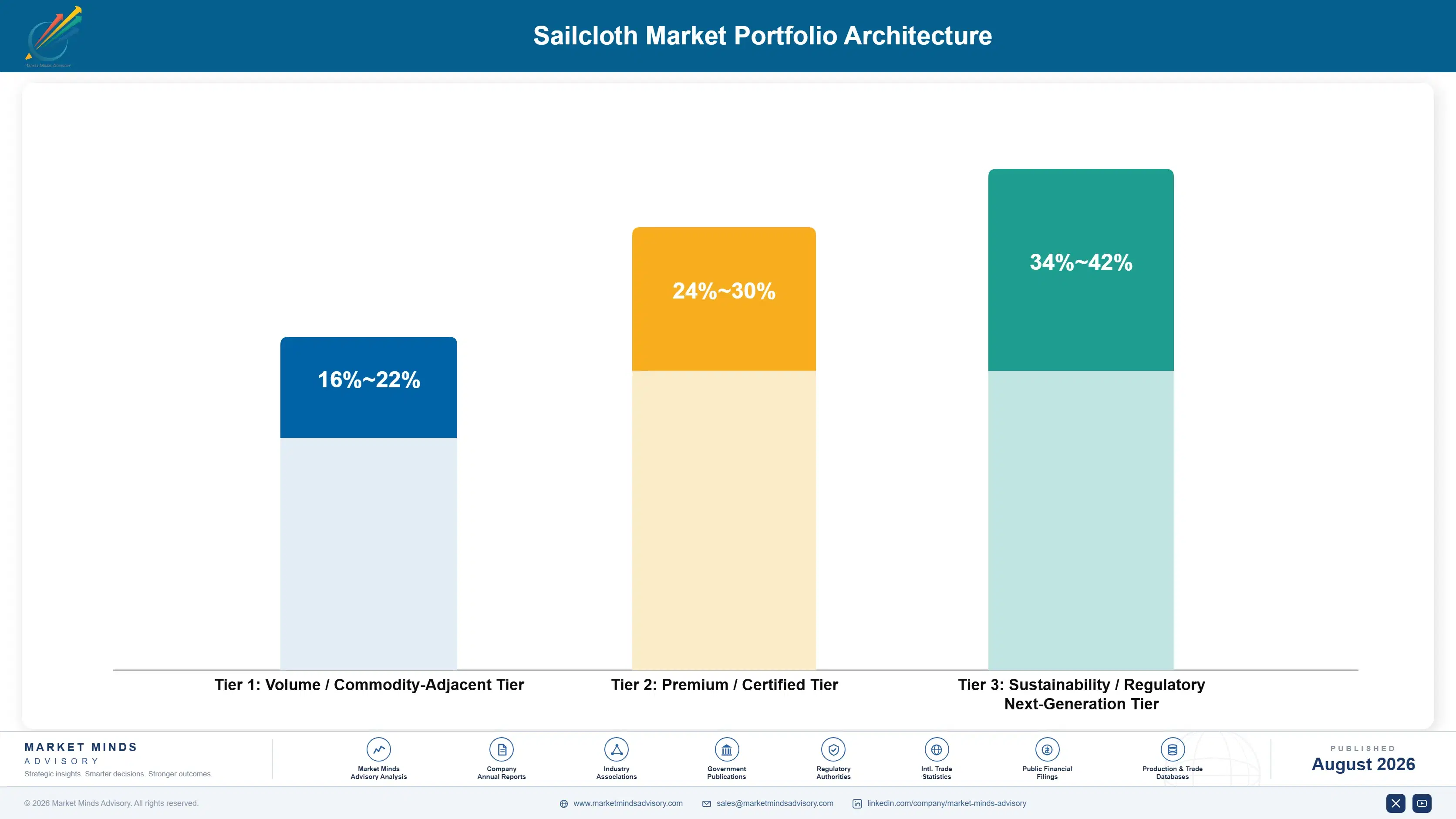
Portfolio Architecture for Margin Defence

MMA's three-tier portfolio architecture separates commodity woven cloth from certified premium aramid-reinforced fabrics and next-generation composite laminates, with gross margins ranging from the high teens for standard woven grades to well above 35 percent for laminate constructions. Producers positioned across multiple tiers capture more total margin than single-tier specialists. Segment-level margin data is drawn from MMA Estimate, derived from primary survey data covering 47 expert interviews in Q4 2025.
The tension between volume and premium runs through the entire category: woven cloth sustains recreational dinghy and daysailer volume at thin margins, while laminate construction sacrifices total addressable volume for materially better unit economics among racing and premium cruising buyers. Mid-sized mills attempting to straddle both tiers often lack the capital to compete effectively on either end, losing price competitiveness in woven while falling short of laminate quality benchmarks.

High-value margin pools concentrate in composite laminate and racing-technology-linked products, both commanding premiums the woven channel cannot match. Producers under-invested in laminate capacity risk ceding the category's most profitable share to better-capitalized specialists. Building dedicated lamination capability requires patient capital and technical expertise, which favors larger, more established producers over smaller regional mills.

Volume / Commodity-Adjacent Tier

Standard woven polyester sailcloth sold into recreational dinghy, daysailer, and entry-level cruising markets, competing primarily on price and availability rather than technical differentiation. Producers rely on high-volume throughput to defend already-thin margins.
Gross Margin: 16-22%

Premium / Certified Tier

Woven aramid-reinforced and technical fiber-blend sailcloth carrying documented strength and stretch specifications, commanding a meaningful step-up in contract price over standard woven constructions. Buyers pay for consistency rather than pure price alone.
Gross Margin: 24-30%

Sustainability / Regulatory / Next-Generation Tier

Composite membrane laminate sailcloth targeting racing fleets and premium cruising buyers, commanding the category's highest margins but requiring significant capital investment, technical certification, and ongoing racing technology partnership relationships to maintain leadership position.
Gross Margin: 34-42%
sailcloth-market-market-trends-portfolio-architecture-1787594089840

High-value Sub-segments and Strategic Watch-out

Composite Membrane Laminate Sailcloth

The highest-margin, fastest-growing pool in the category, driven by racing technology transfer and superyacht new-build demand, though production remains concentrated among a handful of technically capable mills with limited near-term capacity to expand rapidly. Waitlists at leading mills already exceed several months. Order backlogs already extend well past a year.
Gross Margin: 34-42%

Woven Aramid-Reinforced Sailcloth

A high-value pool growing at a steady pace, appealing to performance-oriented cruisers seeking a durability and cost balance between commodity woven cloth and full laminate construction pricing, with margins holding well above commodity levels across most established markets. Demand growth here consistently outpaces the volume tier by a wide margin.
Gross Margin: 24-30%

Standard Woven Polyester Sailcloth

The volume core of the category, carrying the thinnest margins but the largest absolute revenue base, funding many mills' investment into higher-margin laminate and aramid-reinforced product lines over time even as its share slowly narrows. Most mills depend on this tier for cash flow. Volume alone rarely funds meaningful reinvestment.
Gross Margin: 16-20%

Legacy Woven Mills Without Laminate Capacity

A strategic watch-out segment: mills that have not invested in lamination equipment risk accelerated share loss as racing and premium cruising buyers continue migrating toward composite construction, a shift several major lofts already treat as the new default specification for new sail orders. A handful are already discussing acquisition.
Gross Margin: 14-18%

Fleet Renewal and Racing Loyalty Cycles

Sailcloth demand carries meaningful annuity characteristics once a loft and cloth supplier establish a working relationship, since racing teams rarely switch cloth suppliers mid-season given the risk to boat performance and crew familiarity with handling characteristics. Charter operators similarly renew with incumbent suppliers on predictable multi-year cycles tied to fleet maintenance schedules, giving established producers unusually strong forward revenue visibility for a technical textile category.
Adoption stickiness varies by end-use vertical. Competitive racing fleets show the deepest stickiness once a cloth specification proves itself on the water, since switching risks losing hard-won performance gains. Charter fleets show moderate stickiness, weighing cost against proven durability. Private cruising owners show the least stickiness, often price-shopping across multiple lofts before each replacement purchase given the infrequency of their buying cycle.

Buyer profiles are shifting generationally as sustainability credentials gain weight alongside pure performance metrics. Younger boat owners and charter operators increasingly ask about fiber sourcing and coating chemistry before placing orders, a consideration largely absent from buying decisions a decade ago. Racing sailors remain more conservative, still weighting proven on-the-water performance above sustainability credentials in nearly every purchase decision.
sailcloth-market-market-trends-end-use-penetration-index-1787594090337

Where Sailcloth Producers Should Focus Next

These are among the four positions where our research anticipates prominent divergence between winners and laggards over the coming forecast period. Each is grounded in the demand model, the regulatory perimeter, and the announced capacity pipeline.
01 / LAMINATE CAPACITY INVESTMENT

Prioritize laminate conversion ahead of the racing technology curve

Producers still concentrated in woven production genuinely risk permanent share loss to laminate specialists, since racing and premium cruising buyers increasingly treat composite construction as the default rather than an optional upgrade across nearly every performance class and racing circuit tracked. Early movers are already locking in multi-year loft relationships that will prove considerably harder to displace once formed and genuinely trusted. Waiting until laminate demand fully materializes effectively means competing for capacity that faster-moving rivals have already secured well in advance.
02 / FIBER SOURCING SECURITY

Secure multi-year fiber agreements ahead of the next volatility cycle

Producers without long-term fiber supply agreements remain genuinely exposed to the kind of aerospace-driven price volatility that disrupted margins meaningfully in 2022 and 2023 across the wider industry and downstream sailmaking lofts. Negotiating volume-based contracts directly with fiber manufacturers now measurably reduces that exposure while also improving allocation priority during the next tight-supply period affecting the category. Producers that fully commit to this will enter the next cycle with a genuinely durable cost advantage over spot-market buyers still exposed to volatility.
03 / RACING TECHNOLOGY PARTNERSHIP

Build direct ties to elite racing programs before rivals lock them up

Direct technical partnerships with America's Cup and grand prix programs deliver both product development insight and marketing value that meaningfully outweighs the sponsorship cost for most established producers competing in this category and its adjacent premium segments. Rivals without such ties increasingly struggle to justify premium pricing against competitors who can point to documented racing pedigree and credentials. Producers that continue delaying this investment risk watching the remaining top-tier partnerships get locked up entirely by faster-moving competitors already positioning themselves.
04 / CHARTER FLEET CONTRACT FOCUS

Pursue multi-year charter fleet agreements over spot market sales

Charter fleet contracts deliver genuinely more predictable recurring revenue than spot-market private owner sales, and operators standardizing on one cloth specification rarely switch mid-contract without meaningful cause or a genuinely significant price gap emerging over time. Producers securing these agreements gain forward volume visibility that measurably improves production scheduling efficiency across their broader order book and seasonal staffing plans considerably. Continuing to prioritize one-off private sales over fleet contracts leaves producers considerably more exposed to demand volatility than genuinely necessary.

Engagement Snapshot From the Field

A live engagement with an industry participant carrying material or product regulatory and market exposure ahead of a defining policy shift, showing how our research translates into a defensible multi-year portfolio strategy.
MARKET MINDS ADVISORY · CLIENT ENGAGEMENT SUMMARY
Sailcloth Producer Strategic Portfolio Review and Transition Roadmap 2026·Investment Scenario on Sailcloth Exposure Evaluation 2025-26
CLIENT PROFILE
A mid-sized North American sailmaking loft serving competitive racing and premium cruising clients across the East Coast, with annual revenue in the low tens of millions (client-reported, unverified by MMA). The loft had historically sourced cloth from a single woven mill and faced growing customer demand for laminate construction options it could not yet reliably supply.
STRATEGIC CHALLENGE
The loft's largest racing team client had announced plans to switch to laminate sails for the upcoming season, representing roughly twenty-five percent of the loft's annual revenue (client-reported, unverified by MMA). Leadership needed to identify a reliable laminate cloth supplier quickly without disrupting existing woven order fulfillment for other clients.
MMA APPROACH
MMA conducted a supplier landscape assessment across laminate sailcloth producers, evaluating lead times, minimum order volumes, and technical support capacity in close detail. The engagement combined primary interviews with three candidate suppliers and secondary analysis of comparable loft transitions to build a defensible, risk-managed sourcing roadmap for client leadership to act on.
KEY FINDINGS
  1. Only two of five candidate suppliers could meet the loft's required delivery timeline without a costly rush-order surcharge being applied to the contract.
  2. Laminate cloth pricing carried a thirty to forty percent premium over the loft's existing woven contract terms and delivery schedule (client-reported, unverified by MMA).
  3. A dual-sourcing arrangement measurably reduced supply continuity risk compared with a full single-supplier switch attempted earlier by a comparable regional loft nearby.
  4. Technical support responsiveness varied significantly between the candidate suppliers, materially affecting the loft's overall fabrication timeline estimates and final delivery confidence level.
CLIENT PROFILE
A mid-sized North American sailmaking loft serving competitive racing and premium cruising clients across the East Coast, with annual revenue in the low tens of millions (client-reported, unverified by MMA). The loft had historically sourced cloth from a single woven mill and faced growing customer demand for laminate construction options it could not yet reliably supply.
STRATEGIC CHALLENGE
The loft's largest racing team client had announced plans to switch to laminate sails for the upcoming season, representing roughly twenty-five percent of the loft's annual revenue (client-reported, unverified by MMA). Leadership needed to identify a reliable laminate cloth supplier quickly without disrupting existing woven order fulfillment for other clients.
MMA APPROACH
MMA conducted a supplier landscape assessment across laminate sailcloth producers, evaluating lead times, minimum order volumes, and technical support capacity in close detail. The engagement combined primary interviews with three candidate suppliers and secondary analysis of comparable loft transitions to build a defensible, risk-managed sourcing roadmap for client leadership to act on.
KEY FINDINGS
  1. Only two of five candidate suppliers could meet the loft's required delivery timeline without a costly rush-order surcharge being applied to the contract.
  2. Laminate cloth pricing carried a thirty to forty percent premium over the loft's existing woven contract terms and delivery schedule (client-reported, unverified by MMA).
  3. A dual-sourcing arrangement measurably reduced supply continuity risk compared with a full single-supplier switch attempted earlier by a comparable regional loft nearby.
  4. Technical support responsiveness varied significantly between the candidate suppliers, materially affecting the loft's overall fabrication timeline estimates and final delivery confidence level.
RECOMMENDED STRATEGY
Phase 1: Phase one: qualify two laminate suppliers in parallel to avoid single-source dependency risk during the entire year-long supplier transition period. Phase 2: Phase two: negotiate volume-tiered pricing that improves progressively as laminate order volume scales past the initial annual contract minimums agreed. Phase 3: Phase three: extend the laminate sourcing relationship to additional racing and premium cruising clients using this transition as a reference.
OUTCOME
The loft retained its largest racing team client by delivering laminate sails ahead of the season deadline, preserving a relationship worth roughly twenty-five percent of annual revenue (client-reported, unverified by MMA). Dual-sourcing reduced future supply risk, and the loft subsequently converted two additional premium cruising clients to laminate within the following year.

Frequently Asked Questions

Foundational context covering the market sizes, CAGR, scope, country, region and competition that inform every finding below. This section is provided to cover basics and most often pre-purchase conversations, answered from the MMA Primary Research Dataset.

What is the current size of the Sailcloth Market?

The global sailcloth market reached an estimated 0.68 billion dollars in 2025. Growth is being driven by laminate technology adoption and expanding superyacht new-build activity worldwide.

How large will the Sailcloth Market be by 2036?

MMA projects the market will reach approximately 1.36 billion dollars by 2036. That represents nearly a 1.88 times expansion from the 2026 forecast base value.

What is the CAGR for the Sailcloth Market 2026 to 2036?

The market is projected to grow at a 6.5 percent compound annual rate over the forecast period. The bull case reaches 7.7 percent, while the bear case falls to 5.3 percent.

Which segment is growing fastest?

Composite Membrane Laminate Sailcloth leads at a 9.5 percent CAGR, roughly 1.46 times the overall market growth rate. Woven Aramid-Reinforced Sailcloth follows at 8.0 percent.

Who are the major companies in the Sailcloth Market?

Leading producers include North Technology Group, Dimension-Polyant, Contender Sailcloth, Challenge Sailcloth, and Bainbridge International. The top five hold an estimated 52 percent combined share on a production capacity basis.

Which country is growing fastest?

New Zealand leads at an 8.0 percent CAGR, driven by its America's Cup hosting legacy and concentrated superyacht building expertise around Auckland. Technology developed there filters quickly into consumer laminate products.

Report Segmentation Architecture

The full report scope spans multiple orthogonal segmentation dimensions, with cross-tabulated demand data provided for each dimension pair. Coverage extends further to regional breakdowns, trend trajectories, and the competitive detail needed to support segment-level decision-making.
  • Composite Membrane Laminate Sailcloth
  • Woven Aramid-Reinforced Sailcloth
  • Standard Woven Polyester Sailcloth
  • Nylon Spinnaker and Downwind Sailcloth
  • Technora and Vectran High-Performance Fiber Sailcloth
  • Recycled and Bio-Based Sailcloth
  • Competitive Racing and Grand Prix Yachts
  • Premium and Charter Cruising Vessels
  • Superyacht New-Build and Refit
  • Commercial and Naval Training Vessels
  • Direct Loft Supply Contracts
  • Charter Fleet Supply Agreements
  • Distributor and Retail Channels
  • Custom Racing Program Partnerships

By Region

  • North America
  • Western Europe
  • East Asia
  • South Asia and Pacific
  • Latin America
  • Middle East and Africa
  • Eastern Europe

Scope, Methodology, and Coverage

Every figure in this report is reproducible from documented input assumptions. The scope below maps the historical period, the forecast horizon, the segmentation dimensions, and the countries covered, alongside the underlying primary and qualitative methodology.
Historical Period
2020 to 2025
Forecast Period
2026 to 2036
Base Year
2025 (USD billions; MMA Primary Research Dataset, August 2026)
Market Definition
This report covers woven and laminate sailcloth materials used in the construction of sails for racing, cruising, and commercial sailing vessels. It excludes finished sail assembly labor, rigging hardware, and canvas materials used for boat covers or awnings.
Quantitative Units
USD Billion, Volume in Square Meters
Segmentation Dimensions
Construction Technology, End-Use Vessel Type, Commercial Channel, Region
Regions Covered
North America, Western Europe, East Asia, South Asia and Pacific, Latin America, Middle East and Africa, Eastern Europe
Countries Covered
United States, Canada, France, United Kingdom, Italy, Germany, New Zealand, Australia, China, Netherlands
Key Companies Profiled
20
Quantitative Methodology
Primary survey, n=3,800 respondents, Q4 2025, six countries; demand-side model with trade association cross-validation
Qualitative Methodology
47 expert interviews, Q4 2025; applied to validate demand model assumptions, identify emerging dynamics, and assess competitive positioning
Report Format
PDF and XLSX data workbook (Word format preview document)
Publisher
Market Minds Advisory
Report Code
MMA-2026-CHM-125
Published
August 2026
Contact
sales@marketmindsadvisory.com | www.marketmindsadvisory.com

Purchase the full Sailcloth Market Report (2026 to 2036).

This full report delivers comprehensive market sizing, segmentation, and competitive analysis for the global sailcloth market through 2036. Coverage spans both traditional woven construction and advanced composite laminate technologies across racing, cruising, and commercial applications. It includes detailed profiles of the twenty leading producers plus region-by-region demand forecasts across all seven tracked regions. Pricing trend analysis is tied directly to specialty fiber and coating cost movements. Subscribers also receive full access to the underlying primary survey dataset and complete expert interview transcripts referenced throughout this analysis.
Twenty detailed producer competitive profiles and rankings
Seven-region demand and pricing forecasts through 2036
Specialty fiber cost trend and volatility analysis
Segment-level growth rate breakdowns by construction type
Primary survey dataset access included with subscription
Quarterly market update subscription option available

Built For The People Who Decide

From boardroom strategy to bench-side execution, this report is read cover-to-cover by leaders shaping the next decade of their industry, turning demand scenarios, market dynamics and valuation benchmarks into decisions.
CXOs/ Presidents/ VPs/ Managers
M&A and Corporate Development
Strategy Teams and R&D Heads
Procurement and Product Directors
Regulatory and Compliance Leaders
Investor Relations and Equity Analysts