Market Minds Advisory
RTD Bottled Cocktails Market

RTD Bottled Cocktails Market: The Format That Can Actually Hold a Negroni

Glass gives up the beach and the stadium entirely, and gets back the classic cocktails that citric acid and pasteurisation will never let a can carry properly for very long.

Lead Analyst

Lisa Gevelber

Published

September 2026

Make Smarter Decisions with Customized Research Insights

Request a free sample report and evaluate market opportunities, growth trends, and competitive dynamics relevant to your business needs.

2025 MARKET VALUE$4.6BMarket Size 2025
2036 FORECAST VALUE$9.5BBase Case , 2026 to 2036
CAGR 2026 TO 20366.8 %Bull 8.0% / Bear 5.6%
INCREMENTAL OPPORTUNITY$4.6BNet 10- year value creation
EXPANSION MULTIPLE1.93x2036 value over 2026 base
Strategic Levers
M&A Pipeline
Regional Outlook
Country Rankings
Competitive Intelligence
Segmental Deep-dive
Call-Us : 91 93563 13602

Executive Snapshot and Market Trajectory

Bottled cocktails made the opposite trade from cans. Glass loses the beach, the stadium and the festival entirely, and gains the home occasion, the gift and the classic cocktails a can genuinely cannot carry for long. It is a narrower occasion set bought at considerably better prices.
Chemistry is part of that. Citric acid attacks internal can linings over time and pasteurisation strips the aromatic character out of vermouth and bitters, so spirit-forward classics survive in glass and struggle in aluminium. Classic constructions grow fastest at 10.2%, half again the market rate of 6.8%, with Italy expanding at 10.8% on aperitivo tradition. Consumers judge these against a bar serve rather than a shelf.
The economics differ completely as well. A single multi-serve bottle pours around five drinks at roughly 42% below the equivalent canned price per serve, which shifts the comparison away from beer and toward whether somebody makes the drink themselves. Around 34% of annual volume moves during the gifting season, which is a shape no canned format has ever produced anywhere. Presentation matters here in a way it never does in aluminium. Cans never manage it.
Market Definition
Alcoholic cocktails packaged ready to drink in glass or plastic bottles, covering classic spirit-forward cocktails, aperitif and vermouth-based cocktails, citrus and sour styles, cream and liqueur-based cocktails, tropical and fruit-forward cocktails, and batch punches and multi-serve formats. Measured at producer selling value. Excludes canned ready-to-drink cocktails, bottled spirits sold for mixing, wine, beer, cider, non-alcoholic mixers and cocktail syrups.
Base Year Value
$4.6B in 2025 (MMA Primary Research Dataset, August 2026)
Forecast Period
2026 to 2036, eleven discrete annual values
CAGR
6.8% base case. Bull 8.0%. Bear 5.6%.
Fastest Growth Segment
Classic Spirit-Forward Cocktails: 10.2% CAGR
Fastest Growth Country
Italy: 10.8% CAGR
Fastest Growth Region
South Asia and Pacific: 8.8% CAGR
Largest Region
Western Europe: 30% of 2025 global value
Market Leaders
Campari Group, Diageo, Bacardi, Pernod Ricard, William Grant and Sons. Source: MMA Primary Research Dataset, July 2026.
Primary Survey
n=3,800 procurement and R&D decision-makers, Q4 2025, six countries
Methodology
Demand-side build-up, cross-validated against public data, 47 expert interviews

RTD Bottled Cocktails Market Forecast Scenarios

rtd-ready-to-drink-bottled-cocktails-market-trends-size-forecast-scenario-1787594997624
Growth ran near 5.8% between 2020 and 2025, lifted sharply through the period when hospitality closed and home cocktail making became a substitute for going out. Much of that trial converted into habit rather than reversing when bars reopened, though the growth rate normalised considerably. Premium formats gained more than value formats, since the comparison was against a bar bill.
Base case 6.8% rests on three mechanisms. Classic spirit-forward constructions grow at 10.2% because glass carries vermouth, bitters and citrus in ways aluminium cannot sustain over shelf life. Aperitivo culture keeps spreading beyond Italy and Spain, with Italy itself growing at 10.8%. And multi-serve economics at around 42% below canned price per serve give bottled formats a real advantage in home entertaining, where the host is pouring for several people at once.
The bull case at 8.0% assumes premium bottled cocktails establishing themselves as a mainstream gifting category rather than a specialist one, which would compound the seasonality already concentrating around 34% of volume into a short period. The bear case at 5.6% is home cocktail habits eroding back toward on-premise consumption as hospitality recovers fully, taking the occasion the format depends on with it.

What Glass Buys and What It Costs

Everything about this format is a trade against the can. Glass cannot go where aluminium goes, which surrenders the beach, the stadium, the festival and the pool outright. What it buys is the home occasion, the gift, the multi-serve pour and, most usefully, the classic cocktails that a can struggles to hold. Around 34% of annual volume moves in a single gifting season, which is a shape no canned format has produced.
TOP FIVE CONCENTRATION38%Spirits brand ownership rather than packaging decides position
SERVES PER BOTTLE5Drinks poured from a standard multi-serve bottle format
PRICE PER SERVE GAP42%Bottled cost advantage against an equivalent canned serve
GIFTING SEASON SHARE34%Annual volume moving during a single short season
CAN LINING ACID LIMIT18 monthsShelf life before acidic contents affect internal coating
GLASS COST SHARE24%Delivered cost accounted for by the bottle itself
The technical constraint is real rather than a marketing story. Citric acid works on internal can linings over time, and shelf life above roughly 18 months becomes difficult for genuinely acidic constructions. Pasteurisation, which canned formats generally require, strips aromatic character from vermouth, bitters and fresh citrus. A negroni or a martini in glass tastes like the drink; the same construction in a can generally does not survive the process intact.
Value comparison runs differently as well. A multi-serve bottle pours around five drinks at roughly 42% below the equivalent canned price per serve, which moves the competitive set away from beer and toward the question of whether the consumer makes the drink themselves. A well made bottled cocktail beats most home attempts comfortably.
"The canned people talk about occasions and the bottled people talk about liquid, and both are right about their own format. Where bottled producers keep going wrong is pricing against cans instead of against the bottle of gin and the jar of vermouth the consumer would otherwise have bought."
Director, Beverage Alcohol and Premium Spirits Practice · MMA Food and Beverage Practice · August 2026

Market Trends

Classic constructions finding a format that holds them properly

Citric acid attacks internal can linings over time and pasteurisation strips aromatic character from vermouth, bitters and fresh citrus, which means spirit-forward classics survive in glass and degrade in aluminium. Negroni, martini, old fashioned and manhattan constructions therefore belong to the bottled format almost by default, and they grow at 10.2% against a market rate of 6.8%. That gives bottled producers a category cans cannot contest on quality, which is a rare position in a market where formats usually overlap. Consumers judge these against a bar serve rather than another packaged drink.
Market Impact: Costs 42% less per serve

Aperitivo culture spreading well beyond its Mediterranean origins

Italy grows fastest anywhere at 10.8%, with bottled spritz and negroni formats fitting an aperitivo occasion that already existed rather than creating a new one. That pattern is spreading into northern European, North American and Asian markets where the ritual is being adopted as an imported convention. Aperitif and vermouth-based cocktails grow at 8.6% on that spread. The occasion is inherently social and home-based, which suits multi-serve bottles considerably better than single-serve cans could ever manage. Lower strength construction suits an occasion built around lingering rather than drinking quickly, which is exactly what a multi-serve bottle serves best.
Market Impact: Concentrates 34% of annual volume

Market Opportunities and Growth Drivers

Multi-serve economics beating canned pricing per drink

A standard multi-serve bottle pours around five drinks at roughly 42% below the equivalent canned price per serve, which is a substantial difference over an evening of home entertaining. That shifts the competitive comparison away from beer and toward whether the host makes the drinks themselves, a comparison bottled cocktails win more often than producers seem to believe. Hosts also value not opening and disposing of a dozen cans in front of guests, which is a presentation point that matters more than most research captures. Producers consistently underestimate how favourably that comparison lands.
Market Impact: Loses 71% occasion access

Gifting seasonality concentrating volume and supporting premium pricing

Around 34% of annual bottled cocktail volume moves during a single gifting season, which is extreme concentration but comes with pricing that no other occasion supports. Glass presents as a gift where a can cannot, and premium packaging, gift boxes and limited editions all work in this format. That seasonality demands forecasting accuracy and inventory discipline, since unsold gift packaging has no second life and the following year's design will differ anyway. Unsold gift packaging has no second life and next year's design will differ anyway, which makes forecasting accuracy genuinely consequential rather than merely desirable here.
Market Impact: Risks 34% of annual volume

Market Restraints and Challenges

Glass packaging excluding the occasions cans have taken

Beaches, stadiums, festivals, pools and boats either prohibit glass outright or make it impractical to carry, which removes the fastest growing occasions in beverage alcohol from this format entirely. The root cause is physical and cannot be engineered around, since lightweight glass and plastic bottles both fail the venue restriction test regardless of what they weigh. Commercially it caps the addressable occasion set considerably. Plastic multi-serve formats reach some outdoor occasions, at a clear cost to premium positioning. The fastest growing occasions in beverage alcohol sit outside this format entirely.
Market Impact: Shelf life beyond 18 months

Seasonal concentration creating forecasting and inventory exposure

With around 34% of volume moving in one short gifting season, a forecasting error produces either lost sales during the only weeks that carry premium pricing or unsold gift packaging with no second life. The root cause is that gifting demand is genuinely seasonal rather than merely seasonal in emphasis. Commercially it ties up working capital and punishes optimism severely. Shorter production lead times and design carryover across years are the mitigations, and retailers resist the second one firmly. Retailers resist design carryover because novelty drives their own displays. Working capital gets tied up months ahead.
Market Impact: Italian demand growing at 10.8%
4 additional market trends, 3 additional growth drivers, and 2 additional restraints and challenges are covered in the full report. Contact sales@marketmindsadvisory.com to access the complete intelligence.

Segment CAGR and Growth Architecture

Six segments are split by cocktail construction, because construction determines which ingredients must survive packaging, what shelf life is achievable, which occasion the product serves and what a consumer will pay for it. Strength and pack size variants sit inside each construction rather than beside them. Occasion, channel and pack format are handled in the framework instead.
rtd-ready-to-drink-bottled-cocktails-market-trends-market-share-analysis-1787594998157

Classic Spirit-Forward Cocktails

Growing at 10.2%, half again the market rate of 6.8%, these are the constructions that genuinely require glass. Negroni, martini, old fashioned and manhattan formats depend on vermouth, bitters and spirit character surviving intact, and pasteurisation combined with can lining interaction degrades all three over any useful shelf life. Consumers judge them against a bar serve rather than against another packaged drink, which supports pricing that refreshment formats never reach. Batch consistency is the technical achievement being sold, since a well made bottled classic beats most home attempts and many indifferent bar ones. Batch consistency is what a producer is genuinely selling here, rather than convenience. Bar comparison rather than shelf comparison sets the price.
CAGR 10.2%

Aperitif and Vermouth-Based Cocktails

At 8.6% aperitif formats ride a ritual that already existed rather than creating a new occasion, which is a considerably easier commercial position than most beverage launches occupy. Spritz and negroni constructions dominate, and the aperitivo occasion is social, home-based and multi-serve by nature, which suits bottled formats far better than single-serve packaging. Italy grows fastest anywhere at 10.8% and the convention is spreading into northern European, North American and Asian markets as an imported ritual. Lower strength construction also suits an occasion built around lingering rather than drinking quickly. The convention is spreading as an imported ritual rather than developing locally, which means entering as it arrives is far easier than building an occasion.
CAGR 8.6%
Full segment breakdown across 6 segments available in the complete report.

Regional Architecture and Country Demand Map

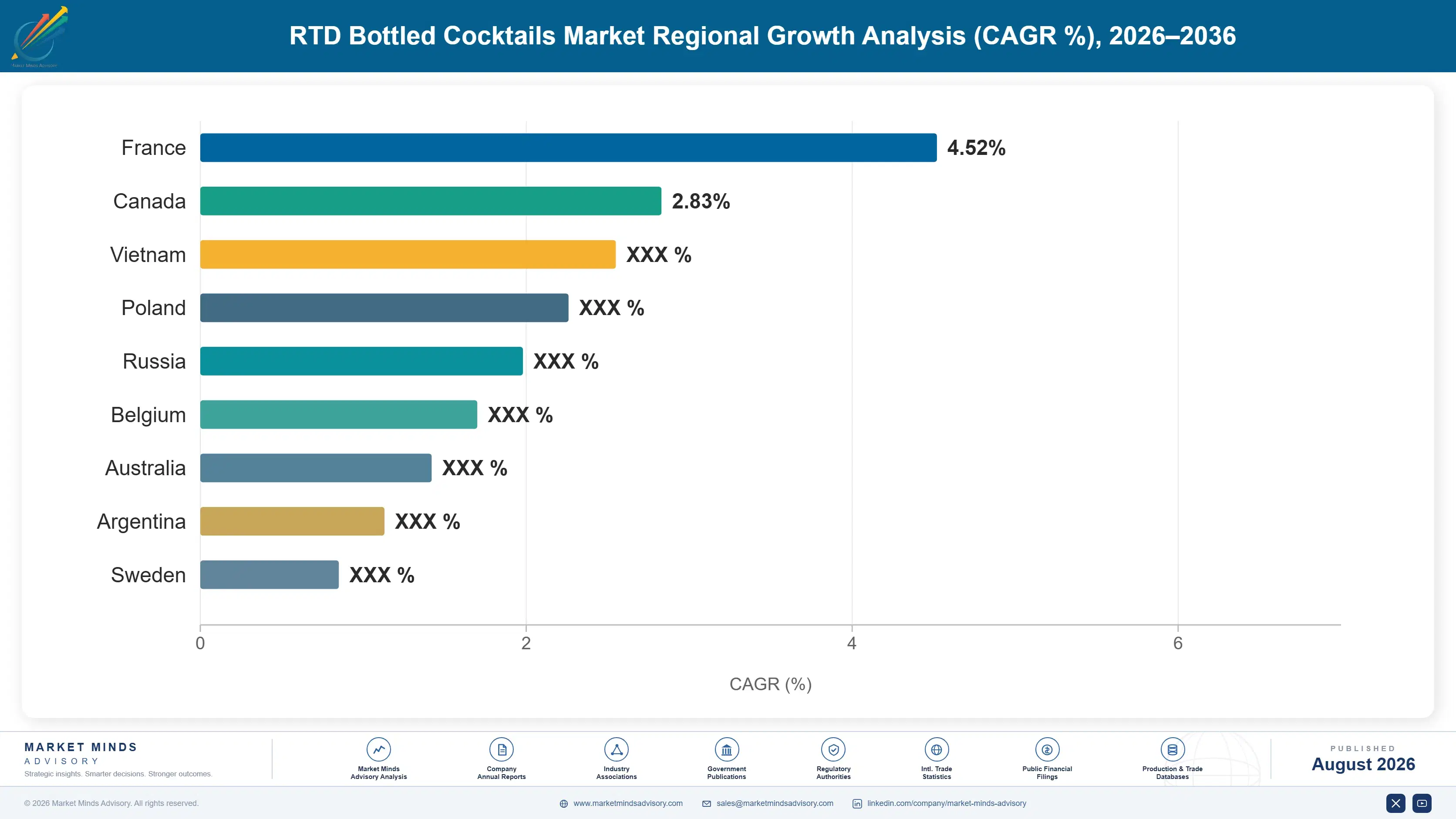
Western Europe holds 30% of value on aperitivo tradition and premium bottled cocktail culture, which places it above the standard band by construction rather than judgement. North America follows at 26% on home cocktail habits formed recently, with East Asia at 22% on premium gifting demand.

North America

Home cocktail making expanded substantially when hospitality closed and much of that behaviour persisted afterwards, which built an occasion this format serves directly. Premium bottled classics compete against a bar serve rather than against packaged alternatives, supporting pricing that canned formats cannot approach. Gifting seasonality is pronounced, with a substantial share of annual volume moving through a short period. Liquor store distribution dominates, since most spirits-based products cannot reach grocery shelves. Growth of 6.0% runs below the base case as the pandemic-era acceleration normalises. Most spirits-based products cannot reach grocery shelves, which concentrates distribution in liquor retail and shapes how the category is merchandised. Gifting seasonality is pronounced across the region.
Share: 26% | CAGR: 6.0% (2026 to 2036)

Western Europe

Holding 30% against a band of 18 to 26%, Western Europe sits above band because aperitivo and vermouth traditions give bottled cocktails an established cultural occasion that most regions lack entirely. Italy grows fastest anywhere at 10.8%, with bottled spritz and negroni formats serving a ritual that predates packaged cocktails by generations. Spanish and French markets follow similar patterns. British premium bottled cocktails developed through a strong independent producer base and specialist retail. Growth at 5.4% runs below the base case on category maturity rather than any weakness. A strong independent producer base and specialist retail have carried British premium bottled cocktails further than mainstream grocery would have. Spanish and French markets follow similar patterns.
Share: 30% | CAGR: 5.4% (2026 to 2036)
Regional intelligence for 5 additional markets available in the complete report: East Asia, South Asia and Pacific, Latin America, Middle East and Africa, Eastern Europe. Contact sales@marketmindsadvisory.com.
rtd-ready-to-drink-bottled-cocktails-market-trends-country-cagr-analysis-1787594998677

Four Moves Against the Home Bar

Bottled producers keep pricing against cans, which is entirely the wrong comparison to be making. The consumer's actual alternative is a bottle of gin, a jar of vermouth and their own uncertain technique, and a well made bottled classic beats that comfortably at a price this format very rarely troubles to ask them for.

Price against home preparation, not against canned formats

A multi-serve bottle pours around five drinks at roughly 42% below canned price per serve, and producers treat that as the argument when the real comparison is against buying spirits and making the drink. A well made bottled classic beats most home attempts and many indifferent bar serves, which supports considerably better pricing than a per-serve comparison with aluminium ever will. Almost every bottled producer frames it the cheaper way, which leaves value on the table permanently. Value is left on the table permanently as a result of that framing.
Market Impact: Beats canned formats by 42% on per serve

Own the classics that cans cannot hold at all

Citric acid affects can linings over shelf life and pasteurisation strips aromatic character from vermouth, bitters and citrus, which means spirit-forward classics belong to glass by physics rather than by preference. Those constructions grow at 10.2% and cannot be contested by canned formats on quality at any price. Building the range around negroni, martini, old fashioned and manhattan rather than around refreshment drinks puts a producer where competition genuinely cannot follow. Refreshment styles compete directly with cans and lose that comparison on occasion access, which makes concentrating the range on classics a defensive move as much as an offensive one.
Market Impact: Serves the 10.2% growing classic cocktail range directly

Build the gifting proposition deliberately rather than seasonally

Around 34% of annual volume moves in one gifting season at pricing no other occasion supports, and glass presents as a gift where a can simply cannot. Purpose-built gift packaging, limited editions and premium presentation all work in this format. The forecasting exposure is real, since unsold gift packaging has no second life, but the pricing available through that window justifies carrying the working capital risk rather than avoiding the occasion altogether. Purpose-built packaging, limited editions and premium presentation all work here in ways they never do in aluminium, and the pricing available justifies carrying the working capital risk.
Market Impact: Captures 34% of the seasonal volume at premium

Follow aperitivo ritual into markets adopting it

Italy grows fastest at 10.8% because aperitivo is an existing occasion rather than one the category had to create, and the ritual is spreading into northern European, North American and Asian markets as an imported convention. Entering as the ritual arrives is considerably easier than building an occasion from nothing, and aperitif formats grow at 8.6% on that spread. Tracking where the convention is being adopted matters more than tracking spirits consumption data. Tracking convention adoption matters considerably more than tracking spirits consumption data, and very few producers monitor it deliberately at all.
Market Impact: Rides 8.6% annual growth across the aperitif formats

Who Controls the Margin Pool

Participation is measured on annual bottled cocktail production volume, and the top five hold 38%. Concentration reflects spirits brand ownership and liquor channel access rather than any packaging or blending capability, both of which are widely available through contract producers. Campari Group leads through aperitif brand ownership that maps directly onto the fastest growing constructions. The gap to challengers is brand equity rather than product capability. Contract bottling is available to anybody who wants it.
Competition runs on three fronts. Cocktail construction decides which formats a producer can offer at all, since classics require glass and refreshment drinks do not. Brand equity transferred from parent spirits decides trial and pricing. Gifting execution decides participation in the season that carries around 34% of annual volume at the best available prices. Classics require glass and refreshment drinks do not.

Pressure ahead comes from canned formats taking refreshment occasions permanently and from independent producers crowding the premium classics where the technical barrier is lower than it appears. Campari Group has built position through aperitif brand ownership rather than acquisition of ready-to-drink specialists. Rankings shift as aperitivo culture spreads and as gifting execution separates participants. Gifting execution separates participants more than liquid does.
rtd-ready-to-drink-bottled-cocktails-market-trends-company-positioning-matrix-1787594999193

Competitive Moat and Risk Dimensions

CAMPARI GROUP

Moat: Aperitif brand ownership alignment

Owning the aperitif brands that define spritz and negroni constructions means the fastest growing bottled formats are built on liquid the company already makes, which no competitor can replicate without licensing from it. As aperitivo ritual spreads into new markets, the brands carrying that convention travel with it rather than competing against it.
CAMPARI GROUP

Risk: Single occasion concentration

A position built on aperitivo depends on one social occasion continuing to spread and hold, and rituals adopted as imported conventions can fade as easily as they arrived. Concentration in aperitif constructions leaves less exposure to classic spirit-forward growth and to gifting occasions where other spirits categories present more naturally.
DIAGEO

Moat: Spirits portfolio breadth across constructions

Brand ownership across gin, whisky, vodka and rum means the company can build authentic versions of most classic constructions using its own liquid, which matters because consumers judge a bottled classic against the spirit they would otherwise have used. That breadth also spreads exposure across occasions rather than concentrating it in one.
DIAGEO

Risk: Cannibalising bottled spirits sales

A bottled cocktail replaces a bottle of spirits and a mixer purchase, which means growth here comes partly from the company's own core business rather than from competitors. Internal resource allocation between a high margin spirits bottle and a ready-to-drink format serving the same occasion is genuinely difficult to settle.

Players Tracked

Prominent Players

Campari Group
Diageo
Bacardi
Pernod Ricard
William Grant and Sons

Other Key Players

Suntory
Brown-Forman
Constellation Brands
Halewood Artisanal Spirits
Stock Spirits
Gruppo Montenegro
Lucas Bols
De Kuyper Royal Distillers
Marussia Beverages
Amber Beverage Group
Edrington
Remy Cointreau
La Martiniquaise
Distell Group
Mast-Jagermeister

Recent Developments

MARCH 2026

Premium producer launches bottled classics range against bar serve pricing

A premium spirits producer launched a bottled classic cocktail range priced explicitly against a bar serve rather than against canned alternatives, supported by batch consistency claims and recognisable parent brand liquid. Retail listings were secured in specialist rather than grocery channels. Grocery distribution was deliberately avoided.
Signal: Pricing against the bar serve rather than the can is where the value in this format actually sits
NOVEMBER 2025

Gifting season concentration reaches record share of annual volume

Bottled cocktail volume through the gifting season reached a record share of annual sales across several major markets, with premium gift packaging and limited editions accounting for most of the increase. Producers reported forecasting difficulty and residual packaging write-offs afterwards. Limited editions accounted for most of the increase.
Signal: Gifting carries the best pricing and the worst forecasting exposure, which most producers still badly underestimate
JANUARY 2026

Aperitivo format listings expand across northern European retail

Bottled spritz and aperitif cocktail listings expanded materially across northern European grocery and specialist retail, following adoption of the aperitivo occasion as an imported social convention rather than any local tradition. Volume growth exceeded producer forecasts across the affected markets. Local tradition played no part in the adoption.
Signal: The ritual travels ahead of the category, and entering as it arrives beats building an occasion

Glass, Spirit and the Gift Box

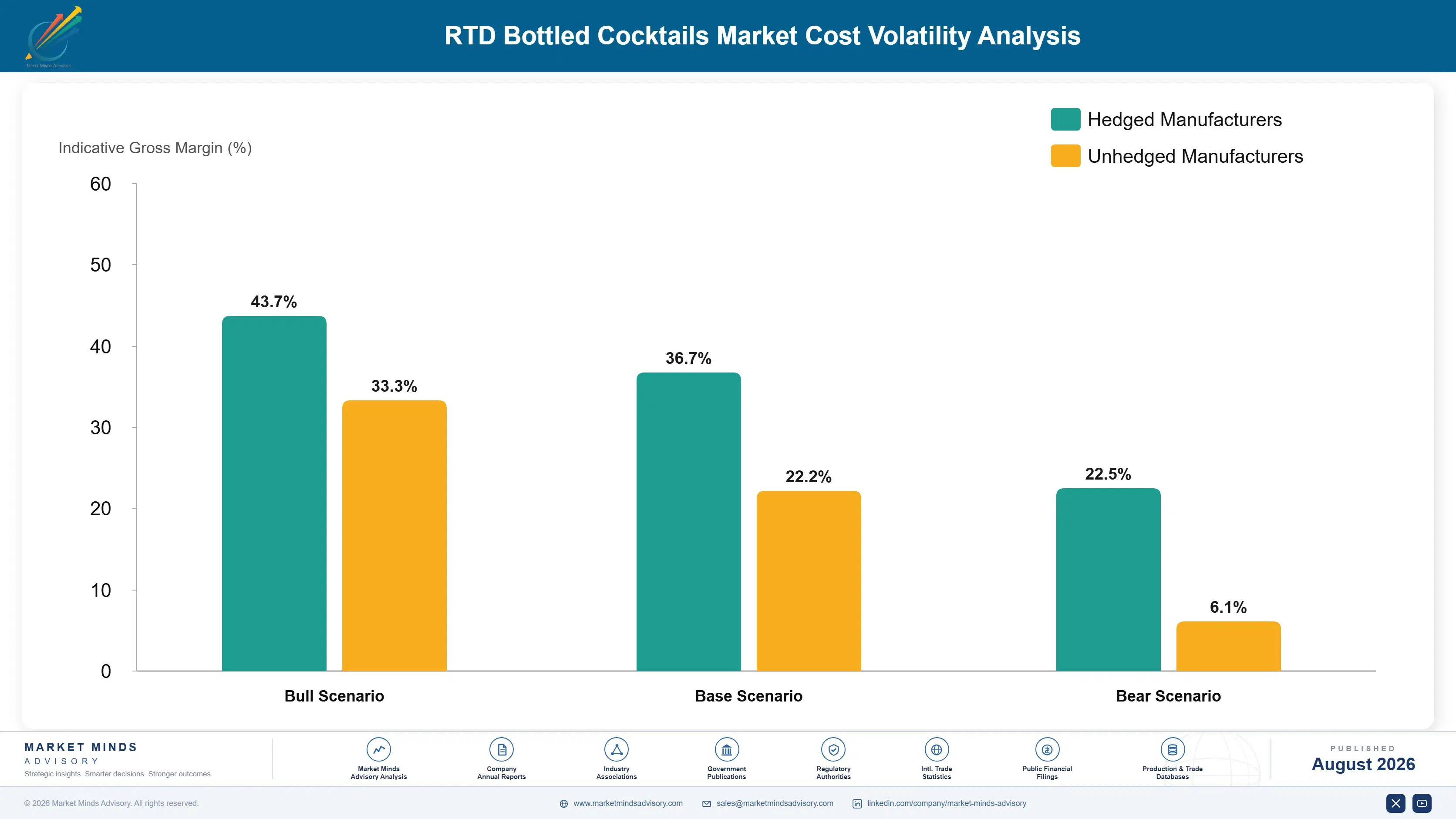
The glass bottle accounts for roughly 24% of delivered cost, with premium closures, labelling and decoration adding several points beyond that on gifting formats. Base spirits and liqueurs carry about 31%, higher than canned equivalents because bottled constructions are generally stronger and use better liquid. Gift packaging takes around 9% seasonally. Filling, logistics and warehousing absorb the balance across a heavy and fragile product.
European glass container prices rose sharply through 2022 as furnace energy costs climbed, per European Commission energy market monitoring for the period, and container glass is among the most energy intensive packaging materials produced anywhere. Producers holding annual retail agreements absorbed most of it. Base spirit costs moved separately on agricultural and agave cycles entirely, which spread exposure rather than compounding it. Exposure spread rather than compounding.

Exposure divides on packaging weight and on seasonal commitment. Premium presentation using heavy glass and decorated finishes carries considerably more energy-linked cost than a standard bottle, and that gap widens whenever furnace energy prices climb. Seasonal gift packaging is the sharper exposure, since it must be committed months ahead and has no residual value if the forecast proves optimistic in either direction.
rtd-ready-to-drink-bottled-cocktails-market-trends-cost-volatility-analysis-1787594999387

Index retail agreements to published glass and energy references

Container glass is around 24% of delivered cost and among the most energy intensive packaging materials made anywhere, which ties it directly to furnace energy pricing. Annual retail agreements rarely reprice mid-term. Indexing to published references passes movement through with a defined lag, and specialist retailers accept it considerably more readily than grocery buyers ever do.

Carry gift packaging designs across seasons where possible

Seasonal packaging commits months ahead and has no residual value if demand disappoints, which makes around 34% of annual volume dependent on a forecast made long in advance. Carrying core design elements across years reduces write-off exposure considerably. Retailers resist this because novelty drives their own displays, which makes it a negotiation rather than a decision.

Reduce glass weight where the occasion permits it

Heavy decorated glass carries meaningful energy-linked cost that lighter containers avoid entirely, and not every occasion actually requires premium presentation. Everyday and multi-serve formats tolerate lighter glass without damaging positioning, while gifting formats genuinely do not. Matching packaging weight to occasion rather than applying one specification across a whole range releases cost without touching perceived quality.

Portfolio Architecture for Margin Defence

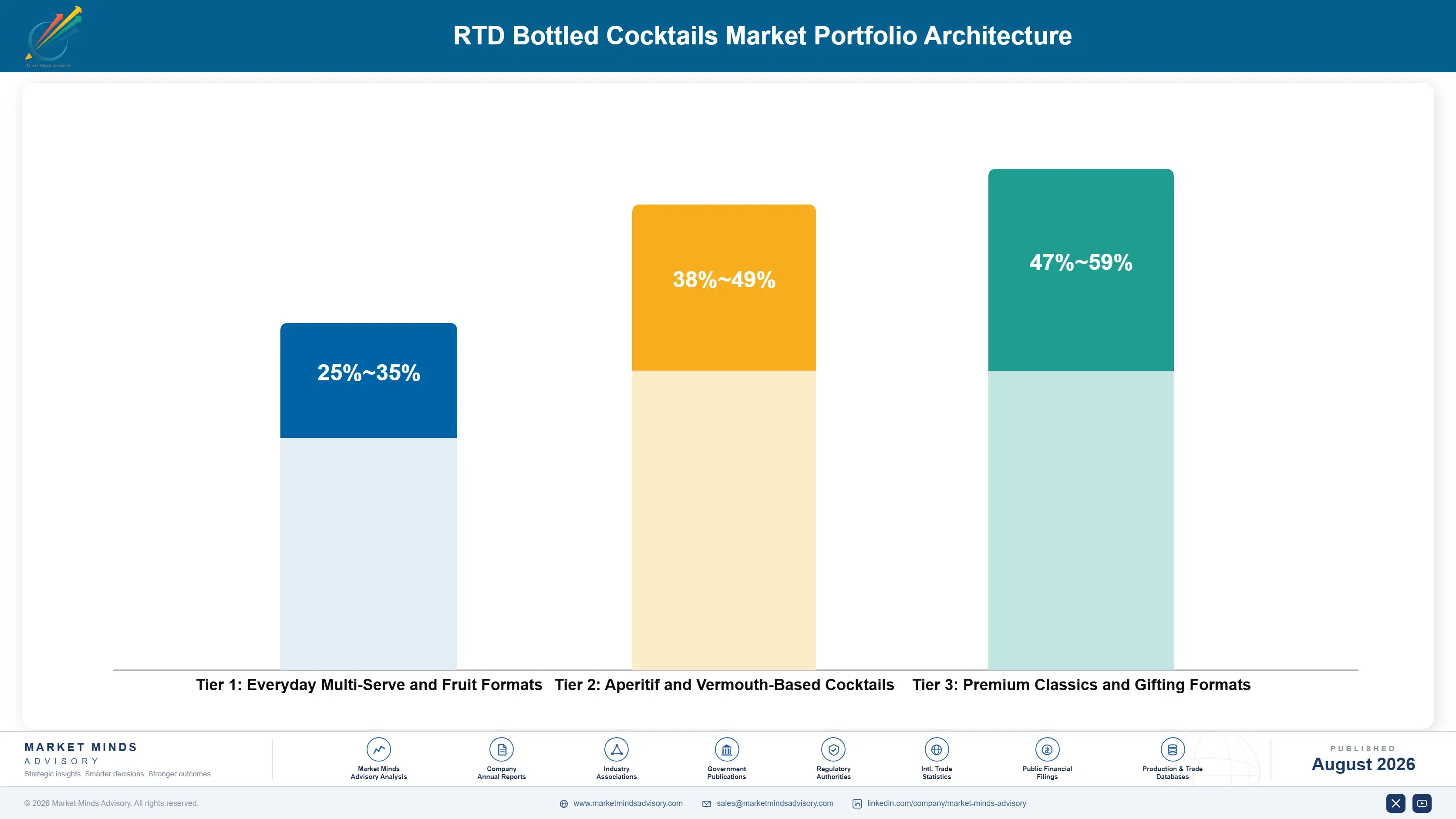
Margin here follows what the product is compared against, which is a more useful frame than production cost in this category. Everyday multi-serve and fruit-forward formats earn margins in the mid twenties to mid thirties, because consumers compare them against other packaged drinks and price promotion in grocery channels takes much of the benefit back. Grocery promotion is heavy and constant throughout the year.
Aperitif and vermouth-based cocktails do considerably better in the high thirties to high forties, because they serve an established ritual with recognised brands attached and the occasion supports pricing that refreshment formats never reach. The range reflects brand ownership and how far the aperitivo convention has been adopted in each market. Brand ownership rather than formulation decides who can serve this.

Premium classics and gifting formats hold the strongest position, reaching into the high fifties, because the comparison is against a bar serve or a gift budget rather than another bottle on a shelf. Those margins reflect what the consumer is measuring against, and gifting seasonality concentrates them into a genuinely short window. A short window concentrates the best margins in the category.

Everyday Multi-Serve and Fruit Formats

Fruit-forward and multi-serve cocktails sold through grocery and general retail channels. The ten point range reflects brand strength and promotional intensity rather than any difference in construction or ingredient quality between products.
Gross Margin: 25-35%

Aperitif and Vermouth-Based Cocktails

Spritz and negroni constructions built on recognised aperitif brands serving an established ritual. The eleven point range reflects brand ownership and how far the aperitivo convention has been adopted locally.
Gross Margin: 38-49%

Premium Classics and Gifting Formats

Spirit-forward classics and purpose-built gift presentations judged against a bar serve rather than a shelf. The twelve point range reflects parent brand equity and the quality of gifting execution across a very short season.
Gross Margin: 47-59%
rtd-ready-to-drink-bottled-cocktails-market-trends-portfolio-architecture-1787594999884

High-value Sub-segments and Strategic Watch-out

Premium Classic Constructions

High value and the fastest growth at 10.2%, protected by a genuine technical barrier since acid and pasteurisation both defeat canned versions. Consumers judge them against a bar serve rather than another packaged drink. That comparison supports far better pricing. Cans cannot contest it. Pricing follows accordingly.
Gross Margin: 49-59%

Aperitif and Spritz Formats

High value and growing at 8.6% as aperitivo ritual spreads well beyond Italy and Spain. Entering as the convention arrives in a market is considerably easier than building the occasion from nothing at all. Aperitivo is social, home-based and multi-serve by nature. Ritual travels ahead of category.
Gross Margin: 40-49%

Everyday Multi-Serve Formats

The volume core, compared against other packaged drinks in grocery channels where promotional intensity takes back much of the pricing benefit. Brand strength rather than construction decides position at this level. Consumers compare against other packaged drinks rather than home preparation. Brand strength decides position.
Gross Margin: 25-35%

Gifting Season Dependence

The strategic watch-out. Around 34% of volume moves in one short season at the best available pricing, and the range reflects how badly a forecasting error punishes a producer committed to seasonal packaging. Seasonal packaging must be committed months ahead and carries no residual value whatsoever.
Gross Margin: 20-56%

Hosting and Giving

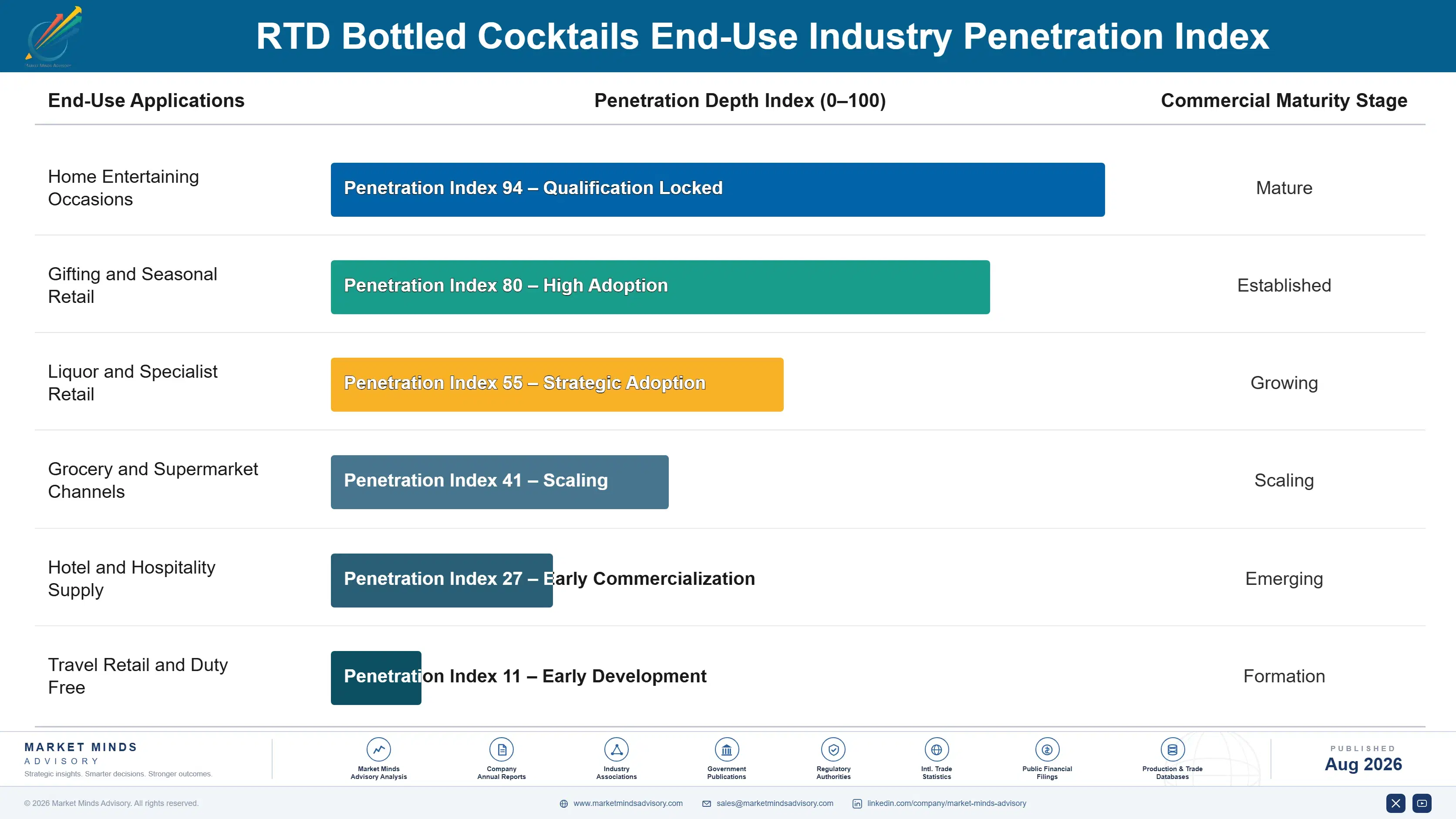
Demand attaches to two occasions that behave quite differently. Home entertaining is recurring, social and multi-serve, which suits bottled formats naturally and produces steady baseline volume through the year. Gifting is concentrated, premium and unforgiving, moving around 34% of annual volume through a short season at the best pricing the category ever sees. Almost nothing else in beverage alcohol has that shape. Baseline and peak behave nothing alike.
Loyalty attaches to the parent spirits brand rather than to the cocktail producer, since consumers judge a bottled classic against the spirit they would otherwise have used to make it. That gives brand-owning producers an advantage independent producers must overcome through liquid quality and specialist retail advocacy, which is achievable but considerably slower to build. Specialist retail advocacy is the independent producer's route.

The purchase decision sits with a host or a gift buyer rather than with somebody buying for themselves, which changes what matters. Presentation, brand recognition and perceived generosity all weigh heavily, and price sensitivity is lower than in any self-consumption occasion. That is precisely why the format can support pricing the canned category never reaches. Perceived generosity weighs more heavily than price.
rtd-ready-to-drink-bottled-cocktails-market-trends-end-use-penetration-index-1787595000396

Where We Would Focus Effort

These are among the four positions where our research anticipates prominent divergence between winners and laggards over the coming forecast period. Each is grounded in the demand model, the regulatory perimeter, and the announced capacity pipeline.
01 / COMPARISON SET REPRICING

You are competing with their gin, not with a can

A multi-serve bottle pours around five drinks at roughly 42% below canned price per serve, and producers keep treating that as the sales argument when the genuine alternative is buying spirits and making the drink at home. A well made bottled classic beats most home attempts and a fair number of indifferent bar serves, which supports considerably better pricing than any per-serve comparison with aluminium will ever deliver. Almost every producer frames it the cheaper way instead, and loses accordingly.
02 / TECHNICAL BARRIER EXPLOITATION

Build the range where cans physically cannot go

Citric acid affects internal can linings across shelf life and pasteurisation strips aromatic character from vermouth, bitters and fresh citrus, which means spirit-forward classics belong to glass by physics rather than by anybody's preference. Those constructions grow at 10.2% against a market rate of 6.8% and cannot be contested by canned formats on quality at any price point whatsoever. Building the range around negroni, martini and old fashioned puts a producer where competition genuinely simply cannot follow it at all.
03 / GIFTING EXECUTION DISCIPLINE

One season, the best prices, no second chances

Around 34% of annual volume moves during a single gifting season at pricing that no other occasion in this category supports, and glass presents as a gift in a way aluminium simply never will. Purpose-built packaging, limited editions and premium presentation all work here. The forecasting exposure is genuine, since unsold gift packaging has no second life at all afterwards, but the pricing available justifies carrying that working capital risk rather than avoiding the occasion altogether out of simple caution.
04 / RITUAL ADOPTION TRACKING

Arrive with the occasion, not after it

Italy grows fastest anywhere at 10.8% because aperitivo is an occasion that already existed rather than one this category ever had to invent for itself, and the ritual is spreading into northern European, North American and Asian markets as an imported convention. Entering a market as the ritual arrives is far easier than building an occasion from nothing, and aperitif formats grow at 8.6% on exactly that spread. Tracking convention adoption beats tracking spirits consumption data by a considerable distance.

Engagement Snapshot From the Field

A live engagement with an industry participant carrying material or product regulatory and market exposure ahead of a defining policy shift, showing how our research translates into a defensible multi-year portfolio strategy.
MARKET MINDS ADVISORY · CLIENT ENGAGEMENT SUMMARY
RTD Bottled Cocktails Producer Strategic Portfolio Review and Transition Roadmap 2026·Investment Scenario on RTD Bottled Cocktails Exposure Evaluation 2025-26
CLIENT PROFILE
A European premium spirits producer selling bottled cocktails alongside its core spirits range across seven markets, at annual bottled cocktail revenue near 58 million euros (client-reported, unverified by MMA). Pricing had been set against canned competitor products on a per-serve basis, and gifting formats were treated as a seasonal add-on rather than a planned proposition.
STRATEGIC CHALLENGE
Margins on the bottled range ran well below the core spirits business while volumes grew, and management were concerned the format was cannibalising higher margin spirits sales without replacing the value. They were considering withdrawing from the category entirely rather than repositioning it, and had no basis for choosing between the two.
MMA APPROACH
MMA tested consumer comparison sets across occasions, benchmarked pricing against both canned alternatives and home preparation cost, sized gifting occasion volume and pricing separately from everyday consumption, and assessed which constructions competitors could not reproduce in cans. Interviews with 47 experts covered premium spirits, beverage packaging and retail category management.
KEY FINDINGS
  1. Consumers were comparing bottled classics against a bar serve or against making the drink themselves, and not against canned products at all in any occasion tested.
  2. Pricing set against canned per-serve economics sat far below what the actual comparison set would have supported, leaving substantial value uncaptured across the range.
  3. Gifting volume commanded materially higher pricing than everyday consumption, and the client's unplanned seasonal approach was capturing very little of that available premium.
  4. Cannibalisation of core spirits was real but smaller than assumed, and was more than offset where bottled classics reached consumers who would not have attempted the drink at home.
CLIENT PROFILE
A European premium spirits producer selling bottled cocktails alongside its core spirits range across seven markets, at annual bottled cocktail revenue near 58 million euros (client-reported, unverified by MMA). Pricing had been set against canned competitor products on a per-serve basis, and gifting formats were treated as a seasonal add-on rather than a planned proposition.
STRATEGIC CHALLENGE
Margins on the bottled range ran well below the core spirits business while volumes grew, and management were concerned the format was cannibalising higher margin spirits sales without replacing the value. They were considering withdrawing from the category entirely rather than repositioning it, and had no basis for choosing between the two.
MMA APPROACH
MMA tested consumer comparison sets across occasions, benchmarked pricing against both canned alternatives and home preparation cost, sized gifting occasion volume and pricing separately from everyday consumption, and assessed which constructions competitors could not reproduce in cans. Interviews with 47 experts covered premium spirits, beverage packaging and retail category management.
KEY FINDINGS
  1. Consumers were comparing bottled classics against a bar serve or against making the drink themselves, and not against canned products at all in any occasion tested.
  2. Pricing set against canned per-serve economics sat far below what the actual comparison set would have supported, leaving substantial value uncaptured across the range.
  3. Gifting volume commanded materially higher pricing than everyday consumption, and the client's unplanned seasonal approach was capturing very little of that available premium.
  4. Cannibalisation of core spirits was real but smaller than assumed, and was more than offset where bottled classics reached consumers who would not have attempted the drink at home.
RECOMMENDED STRATEGY
Phase 1: Phase one: reprice the classics range against bar serve and home preparation comparison rather than against canned competitor products on a per-serve basis. Phase 2: Phase two: build the gifting proposition deliberately with purpose-designed packaging and planned inventory, rather than treating the season as an opportunistic add-on. Phase 3: Phase three: concentrate the range on constructions that canned formats cannot reproduce, and withdraw from refreshment styles competing directly with cans.
OUTCOME
The producer repriced its classics range during 2026 and reported margin improving substantially with volume broadly maintained (client-reported, unverified by MMA). A planned gifting programme was launched, and two refreshment-style products competing against cans were discontinued. Cannibalisation proved smaller than the board had assumed throughout.

Frequently Asked Questions

Foundational context covering the market sizes, CAGR, scope, country, region and competition that inform every finding below. This section is provided to cover basics and most often pre-purchase conversations, answered from the MMA Primary Research Dataset.

What is the current size of the RTD Bottled Cocktails Market?

MMA sizes it at USD 4.6 billion in 2025, rising to USD 4.91 billion in 2026. The figure covers alcoholic cocktails packaged ready to drink in bottles at producer selling value.

How large will the RTD Bottled Cocktails Market be by 2036?

USD 9.48 billion by 2036, an incremental USD 4.57 billion over the 2026 base and an expansion multiple of 1.93 times. Classic constructions account for a disproportionate share.

What is the CAGR for the RTD Bottled Cocktails Market 2026 to 2036?

6.8% in the base case, with a bull case at 8.0% and a bear case at 5.6%. The spread turns on gifting category development and on home cocktail habit persistence.

Which segment is growing fastest?

Classic spirit-forward cocktails at 10.2%, half again the market rate of 6.8%. Acid interaction and pasteurisation both prevent canned formats from carrying these constructions properly.

Who are the major companies in the RTD Bottled Cocktails Market?

Campari Group, Diageo, Bacardi, Pernod Ricard and William Grant lead on bottled cocktail volume. Fifteen further participants are profiled in the full report on that basis.

Which country is growing fastest?

Italy at 10.8%, where bottled spritz and negroni formats serve an aperitivo ritual that predates packaged cocktails by generations rather than needing to be created.

Report Segmentation Architecture

The full report scope spans multiple orthogonal segmentation dimensions, with cross-tabulated demand data provided for each dimension pair. Coverage extends further to regional breakdowns, trend trajectories, and the competitive detail needed to support segment-level decision-making.

By Cocktail Construction

  • Classic Spirit-Forward Cocktails
  • Aperitif and Vermouth-Based Cocktails
  • Citrus and Sour Style Cocktails
  • Cream and Liqueur-Based Cocktails
  • Tropical and Fruit-Forward Cocktails
  • Batch Punches and Multi-Serve Formats

By End-Use Industry

  • Home Entertaining Occasions
  • Gifting and Seasonal Retail
  • Liquor and Specialist Retail
  • Grocery and Supermarket Channels
  • Hotel and Hospitality Supply
  • Travel Retail and Duty Free

By Commercial Dimension

  • Brand Owner Direct Supply
  • Contract Bottling Arrangements
  • Private Label Production
  • Gift Pack and Limited Edition Formats
  • Online and Direct to Consumer
  • Export and Cross-Border Supply

By Region

  • North America
  • Western Europe
  • East Asia
  • South Asia and Pacific
  • Latin America
  • Middle East and Africa
  • Eastern Europe

Scope, Methodology, and Coverage

Every figure in this report is reproducible from documented input assumptions. The scope below maps the historical period, the forecast horizon, the segmentation dimensions, and the countries covered, alongside the underlying primary and qualitative methodology.
Historical Period
2020 to 2025
Forecast Period
2026 to 2036
Base Year
2025 (USD billions; MMA Primary Research Dataset, August 2026)
Market Definition
Alcoholic cocktails packaged ready to drink in glass or plastic bottles across single-serve and multi-serve formats, covering classic spirit-forward cocktails, aperitif and vermouth-based cocktails, citrus and sour styles, cream and liqueur-based cocktails, tropical and fruit-forward cocktails, and batch punches and multi-serve formats. Measured at producer selling value excluding excise duty. Canned ready-to-drink cocktails, bottled spirits sold for mixing, wine, beer, cider, non-alcoholic mixers and cocktail syrups are excluded from scope.
Quantitative Units
USD billions (current prices); million nine-litre cases; USD per case by cocktail construction
Segmentation Dimensions
Cocktail construction; occasion and retail channel; commercial dimension; region
Regions Covered
North America, Western Europe, East Asia, South Asia and Pacific, Latin America, Middle East and Africa, Eastern Europe
Countries Covered
Italy, Spain, France, United Kingdom, Germany, Netherlands, Sweden, United States, Canada, Mexico, Brazil, Japan, South Korea, China, Australia, India, Thailand, South Africa, Poland, Czech Republic
Key Companies Profiled
Campari Group, Diageo, Bacardi, Pernod Ricard, William Grant and Sons, Suntory, Brown-Forman, Constellation Brands, Halewood Artisanal Spirits, Stock Spirits, Gruppo Montenegro, Lucas Bols, De Kuyper Royal Distillers, Marussia Beverages, Amber Beverage Group, Edrington, Remy Cointreau, La Martiniquaise, Distell Group, Mast-Jagermeister
Quantitative Methodology
Primary survey, n=3,800 respondents, Q4 2025, six countries; demand-side model with trade association cross-validation
Qualitative Methodology
47 expert interviews, Q4 2025; applied to validate demand model assumptions, identify emerging dynamics, and assess competitive positioning
Report Format
PDF and XLSX data workbook (Word format preview document)
Publisher
Market Minds Advisory
Report Code
MMA-2026-AGR-185
Published
August 2026
Contact
sales@marketmindsadvisory.com | www.marketmindsadvisory.com

Purchase the full RTD Bottled Cocktails Market Report (2026 to 2036).

The full report prices bottled cocktails against the comparison consumers actually make, which is a bar serve or their own home preparation rather than a canned alternative on the next shelf. It sizes all six cocktail constructions independently through 2036, quantifies the technical shelf life and aromatic limits separating bottled from canned formats, and models gifting occasion volume and pricing separately from everyday consumption. Regional chapters cover all seven regions with aperitivo ritual adoption tracked as a distinct variable. Competitive profiling covers 20 participants on a single volume basis.
Six cocktail constructions sized independently through 2036
Consumer comparison sets tested across occasion and format
Technical shelf life limits quantified between bottled and canned
Gifting volume and pricing modelled separately from everyday consumption
Twenty participants profiled on one consistent volume basis
Aperitivo ritual adoption tracked as a distinct market variable

Built For The People Who Decide

From boardroom strategy to bench-side execution, this report is read cover-to-cover by leaders shaping the next decade of their industry, turning demand scenarios, market dynamics and valuation benchmarks into decisions.
CXOs/ Presidents/ VPs/ Managers
M&A and Corporate Development
Strategy Teams and R&D Heads
Procurement and Product Directors
Regulatory and Compliance Leaders
Investor Relations and Equity Analysts