Market Minds Advisory
Royal Jelly Market

Royal Jelly Market: Marker Acid Standardisation, Residue Compliance and Cold Chain Economics, 2026 to 2036

Harvesting royal jelly still means grafting larvae into queen cells by hand and collecting every third day, which is precisely why nearly nine tenths of world supply comes from one country.

Lead Analyst

Lisa Gevelber

Published

September 2026

Make Smarter Decisions with Customized Research Insights

Request a free sample report and evaluate market opportunities, growth trends, and competitive dynamics relevant to your business needs.

2025 MARKET VALUE$0.9BMarket Size 2025
2036 FORECAST VALUE$1.8BBase Case , 2026 to 2036
CAGR 2026 TO 20366.6 %Bull 7.8% / Bear 5.4%
INCREMENTAL OPPORTUNITY$0.9BNet 10- year value creation
EXPANSION MULTIPLE1.90x2036 value over 2026 base
Strategic Levers
M&A Pipeline
Regional Outlook
Country Rankings
Competitive Intelligence
Segmental Deep-dive
Call-Us : 91 93563 13602

Executive Snapshot and Market Trajectory

Authenticity rather than availability is what this market actually trades on. Adulteration with sugars, starches and glycerol has been widespread for decades, and the marker acid known as 10-HDA remains the only practical way a buyer can verify that any shipment is genuinely what it claims to be.
Freeze-dried royal jelly powder grows at 9.9%, a full 1.50 times the market rate, because removing water removes the cold chain that governs everything about fresh royal jelly logistics. East Asia holds 42% of global value, far outside the standard regional band, because Chinese apiaries supply roughly 88% of world production while Japanese, Korean and Chinese consumers absorb most of what actually gets made each year.
Concentration is low at 22% for the top five suppliers, which reflects an industry whose supply chain begins with tens of thousands of individual beekeepers. The commercial pressure that matters most is residue compliance: European and Japanese maximum residue limits on veterinary drugs and pesticides reject Chinese consignments regularly, and the suppliers who have solved that problem at apiary level sell into markets that the rest simply cannot reach at any price.
Market Definition
The market covers royal jelly harvested from honeybee colonies and supplied as fresh frozen, freeze-dried powder, standardised marker acid concentrate, encapsulated softgel and honey-blended formats for dietary supplement, functional food, cosmetic and traditional medicine use. It excludes honey, propolis, bee pollen, beeswax and bee venom, royalactin and other isolated proteins sold as characterised compounds, finished cosmetic products, and beekeeping equipment or queen rearing services.
Base Year Value
$0.9B in 2025 (MMA Primary Research Dataset, August 2026)
Forecast Period
2026 to 2036, eleven discrete annual values
CAGR
6.6% base case. Bull 7.8%. Bear 5.4%.
Fastest Growth Segment
Freeze-Dried Royal Jelly Powder: 9.9% CAGR
Fastest Growth Country
India: 10.2% CAGR
Fastest Growth Region
South Asia and Pacific: 8.9% CAGR
Largest Region
East Asia: 42% of 2025 global value
Market Leaders
Comvita, Wuhan Bee Healthy, Zhejiang Jiangshan Bee Enterprise, Bee Health, Y.S. Eco Bee Farms. Source: MMA Primary Research Dataset, July 2026.
Primary Survey
n=3,800 procurement and R&D decision-makers, Q4 2025, six countries
Methodology
Demand-side build-up, cross-validated against public data, 47 expert interviews

Royal Jelly Market Forecast Scenarios

royal-jelly-market-trends-size-forecast-scenario-1787312601989
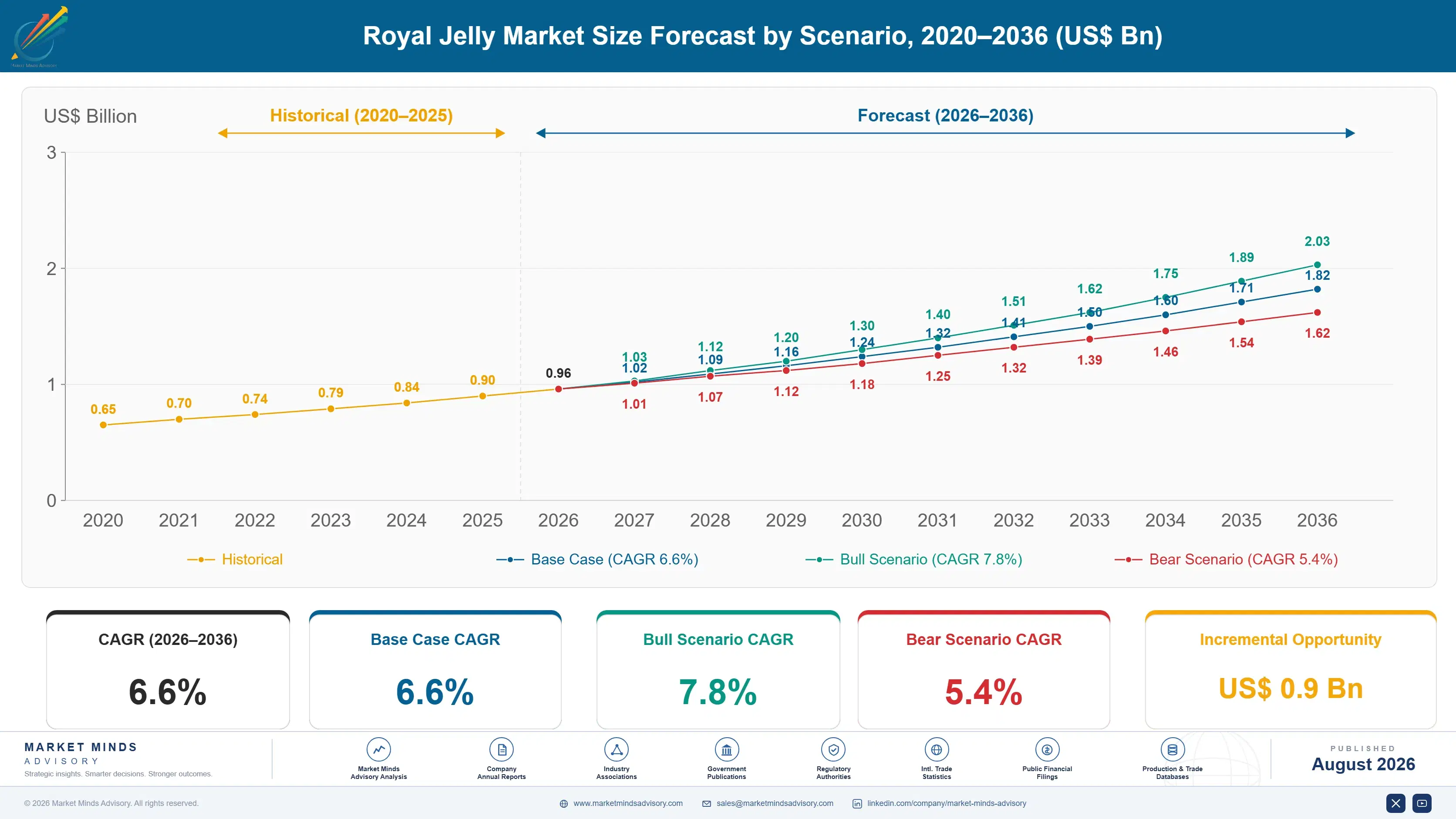
The market compounded at 5.4% between 2020 and 2025, and supply constraints rather than demand shaped it. Chinese apiary labour costs rose through the period as rural wages climbed, and grafting is work that no machine performs. Several European import rejections on residue grounds tightened compliant supply further. Demand from Japanese and Korean functional food manufacture grew steadily throughout regardless.
The 6.6% base case rests on three mechanisms. First, marker acid standardisation lets suppliers make verifiable quality claims, which supports premium pricing that unstandardised material never achieves. Second, cosmetic and skincare applications keep expanding as royal jelly protein fractions find formulation uses beyond ingestion. Third, freeze-dried formats grow faster than the market as a whole, because they remove cold chain cost entirely and open distribution channels that fresh material can never serve.
The bull case at 7.8% assumes residue compliance improves enough across Chinese supply to open European and Japanese demand fully. The bear case at 5.4% turns on labour: Chinese apiary wages continue rising, grafting remains entirely manual, and if beekeepers move to less labour-intensive honey production instead, supply tightens in a way that price alone cannot resolve within a single season.

Why Marker Acid Content Decides Value

Royal jelly is one of very few agricultural products where production has resisted mechanisation entirely. Producing it requires grafting young larvae into artificial queen cells by hand, waiting three days, then harvesting the jelly before the colony completes the queen. Nobody has automated any part of that.
TOP FIVE CONCENTRATION22%Combined position of the five largest royal jelly suppliers
AVERAGE SELLING PRICE$95 per kilogramTypical realised price across fresh and freeze-dried forms
TOP PRODUCING COUNTRY SHARE88%Chinese share of global royal jelly production volume
MARKER ACID THRESHOLD1.8% minimumMarker acid level required for premium grade certification
COLD CHAIN COST SHARE17% of COGSRefrigerated storage and transport share of delivered cost
SUPPLEMENT DEMAND SHARE64%Portion of output consumed by dietary supplement manufacture
Labour economics therefore decide geography absolutely. Roughly 88% of world production comes from Chinese apiaries, principally in Zhejiang and Jiangsu, because the grafting and harvesting cycle is affordable there and nowhere else at scale. Attempts to establish commercial production in higher-wage countries have consistently failed on cost rather than on technical grounds. That concentration means a single country's labour market, colony health and regulatory compliance record govern global supply.
Verification is the second defining feature. Royal jelly is expensive, visually unremarkable and easy to extend with sugars, starch or glycerol, and adulteration has been documented repeatedly across decades of trade. The unsaturated fatty acid 10-HDA occurs in royal jelly and essentially nowhere else, which makes it the practical authenticity marker and, increasingly, the quality specification. Material certified above 1.8% marker acid sells at a substantial premium to unstandardised jelly, and buyers increasingly refuse to purchase without it.
"Every few years someone announces they will produce royal jelly outside China at commercial scale, and every few years the arithmetic defeats them. You cannot automate grafting, you cannot stretch the three-day harvest window, and you cannot pay European wages for either. The concentration is not a market failure, it is simply what the biology costs."
Senior Analyst, Natural Health Ingredients Practice · MMA Healthcare Practice

Market Trends

Marker Acid Standardisation Becomes The Quality Currency

Buyers who once accepted royal jelly on appearance and origin now specify a minimum 10-HDA content, typically 1.8% for premium supplement use, and verify it analytically on receipt. That has converted an opaque trade into something closer to a specified ingredient market. Certified material sells at roughly 55% above unstandardised jelly, and the gap widens each year as more manufacturers write the specification into purchasing contracts. Suppliers who invested in analytical capability and apiary-level batch control capture that premium; those trading on relationships and origin claims alone increasingly cannot participate at all.
Market Impact: Accounts for 58% of global volume
Residue Limits Split Supply Into Compliant And Non-Compliant

European and Japanese maximum residue limits on veterinary antibiotics and agricultural pesticides have caused repeated rejections of Chinese royal jelly consignments, and the compliance burden falls at apiary level where thousands of small beekeepers operate. Suppliers running controlled apiary programmes with documented treatment records reach markets that account for roughly 34% of global value. Those without them are confined entirely to considerably less demanding destinations. That split is widening steadily rather than closing, because genuine compliance requires supply chain control at colony level rather than any processing change downstream at all.
Market Impact: Takes 19% of total output

Market Opportunities and Growth Drivers

East Asian Functional Food Demand Remains The Foundation

Japanese, Korean and Chinese consumers have used royal jelly as a health food for generations, and the category enjoys mainstream acceptance there that Western supplement markets have never given it. Japanese functional food regulation permits specific claims that support retail positioning at premium price points. Combined regional consumption accounts for roughly 58% of total global volume each year. That demand is habitual, repeat-driven and considerably less sensitive to wellness fashion than Western supplement categories, which makes it the genuinely stable foundation that everything else in this market is built upon.
Market Impact: Requires harvest within 3 days

Cosmetic Applications Expand Beyond Ingestible Formats

Royal jelly protein fractions have found formulation use across skincare, particularly across Korean and Japanese cosmetic development, where fermented and bee-derived ingredients already carry well established consumer recognition. Topical applications tolerate lower marker acid content than ingestible supplements demand, which lets suppliers place material that would never meet premium ingestible specification anywhere. Cosmetic use now takes roughly 19% of total output, against under 10% only a decade ago. The cosmetic channel also pays reliably and buys on annual contract rather than through the spot trading that dominates supplement supply everywhere.
Market Impact: Requires warnings in 6 jurisdiction

Market Restraints and Challenges

Manual Grafting Caps Supply Regardless Of Price

Producing royal jelly requires transferring young larvae into artificial queen cells by hand and harvesting within three days, and no part of that has been mechanised despite decades of attempts. The root cause is biological precision rather than engineering difficulty: larvae must be a specific age and handled without damage. Commercially this means supply responds to price only through beekeeper labour allocation, which is slow and limited. Participants are addressing it through improved grafting tools that raise operator throughput, and by contracting apiary labour ahead of the season rather than competing for it.
Market Impact: Sells at 55% above unstandardised j

Anaphylaxis Risk Constrains Mass Regulatory Positioning

Royal jelly has caused severe allergic reactions including fatal anaphylaxis, particularly among people with asthma or existing atopic conditions, and several jurisdictions require explicit warning labelling as a result. The root cause is protein allergenicity inherent to the material rather than any contamination or quality issue. Commercially this limits mass-market retail positioning and excludes the product from several institutional and food service channels entirely. Participants manage it through prominent labelling, through cosmetic and topical formats that avoid ingestion, and by concentrating commercial effort on those markets where consumer familiarity is already highest.
Market Impact: Gates 34% of global market value
3 additional market trends, 2 additional growth drivers, and 4 additional restraints and challenges are covered in the full report. Contact sales@marketmindsadvisory.com to access the complete intelligence.

Segment CAGR and Growth Architecture

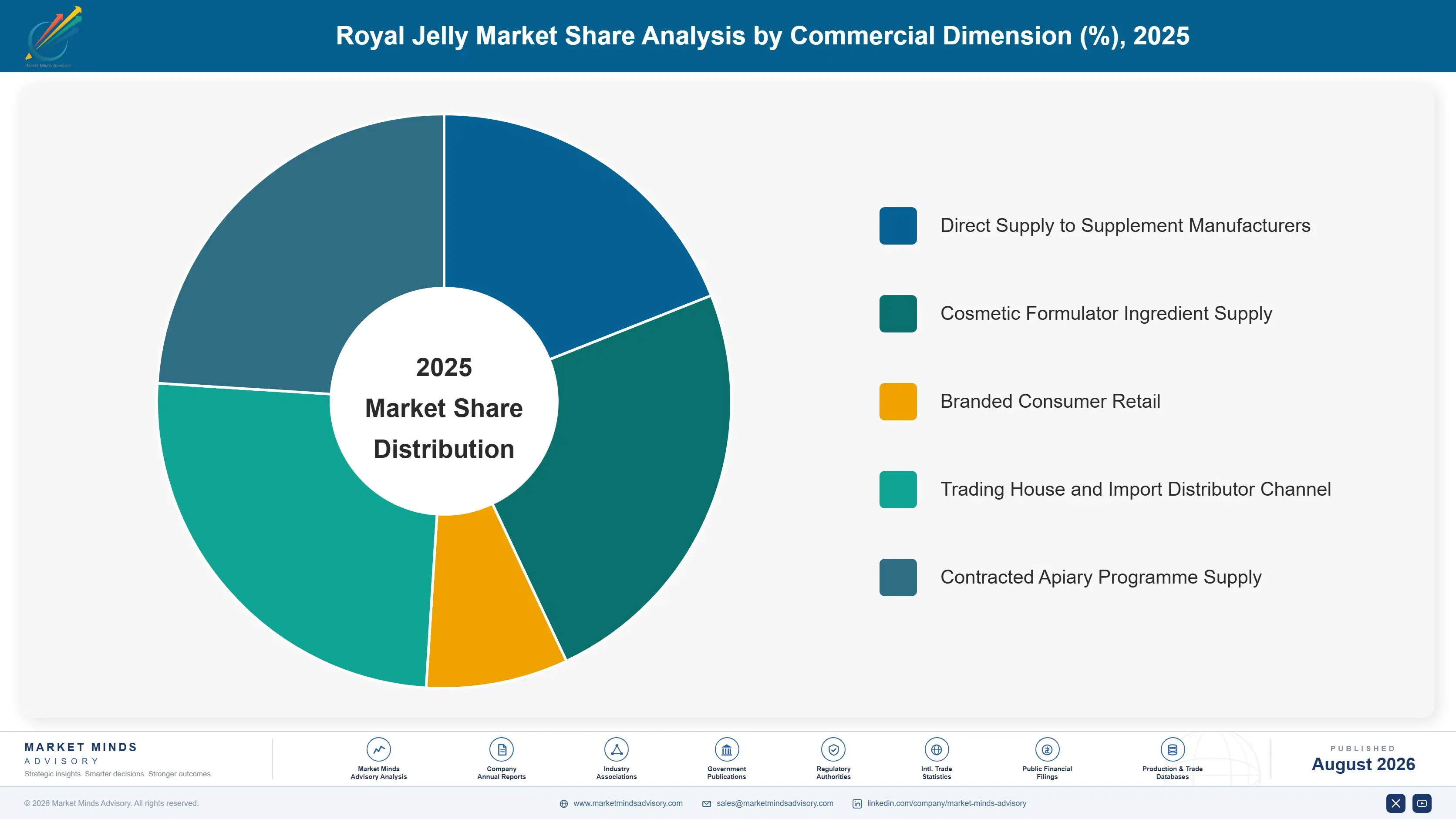
Segmentation here follows product form and verification status, meaning how the jelly is preserved and what a buyer can actually prove about it. That single dimension determines cold chain requirement, shelf life, achievable price, which regulatory markets accept the material, and how much of this trade's persistent authenticity problem a given supplier has actually solved.
royal-jelly-market-trends-market-share-analysis-1787312602516

Freeze-Dried Royal Jelly Powder

The fastest segment at 9.9%, a full 1.50 times the market rate, covering royal jelly lyophilised to a stable powder typically at a three to one concentration ratio. The commercial attraction has nothing to do with the jelly itself and everything to do with logistics: removing water removes the cold chain that governs fresh material, which cuts distribution cost, extends shelf life from months to years and opens ambient retail channels entirely closed to frozen product. Marker acid content concentrates proportionally through the process, which suits standardised supplement formulation particularly well. Freeze-drying capacity sited near the apiaries rather than near the customer is what determines which participant actually captures this value.
CAGR 9.9%

Standardised Marker Acid Concentrate

Growing at 8.5% annually on material analytically verified and adjusted to a guaranteed minimum 10-HDA marker acid content, usually 1.8% or above where the material is destined for premium supplement manufacture. This is less a product form than a documentation position in truth, since the underlying jelly may be fresh or reconstituted. What buyers pay for is certainty in a trade where adulteration with sugars, starch and glycerol has been documented repeatedly across decades. Realised pricing runs roughly 55% above unstandardised material on only modest additional analytical cost. Suppliers here need laboratory capability and batch-level apiary traceability rather than any processing advantage whatsoever, which is why so few of them have it.
CAGR 8.5%
Full segment breakdown across 5 segments available in the complete report.

Regional Architecture and Country Demand Map

East Asia dominates both production and consumption, holding a share far outside any normal regional band. South Asia and Pacific grows fastest as Indian supplement demand expands. North America consumes far less than its supplement market size would suggest, on allergen labelling and consumer familiarity grounds together.

East Asia

Forty-two percent of global value sits here. Note: this sits far outside the standard regional band because Chinese apiaries supply roughly 88% of world production while Japanese, Korean and Chinese consumers absorb most of what is made, so the region dominates both sides of the trade. Zhejiang and Jiangsu provinces account for the great bulk of Chinese output, and rural labour economics there are what make manual grafting affordable at all. Japanese functional food regulation permits health claims that support genuinely premium retail pricing. Growth of 7.8% reflects Chinese domestic supplement demand rising alongside continued export volume. Fresh frozen formats retain genuine consumer preference here. Domestic supplement demand is rising alongside export volume.
Share: 42% | CAGR: 7.8% (2026 to 2036)

Western Europe

Twenty percent of value on 5.0% growth, and this is the market where residue compliance matters most in the world. European maximum residue limits on veterinary antibiotics and pesticides have caused repeated rejections of Chinese consignments, and access effectively requires apiary-level treatment documentation that most Chinese suppliers cannot provide. Italian, Spanish and French supplement manufacture takes most regional volume, with royal jelly holding a long-established position in pharmacy and health food retail. Domestic production exists but at very small scale, since European apiary labour costs make commercial grafting uneconomic almost everywhere. Access effectively requires documentation most Chinese suppliers cannot yet provide. Domestic production remains negligible on labour cost grounds alone.
Share: 20% | CAGR: 5.0% (2026 to 2036)
Regional intelligence for 5 additional markets available in the complete report: North America, South Asia and Pacific, Latin America, Middle East and Africa, Eastern Europe. Contact sales@marketmindsadvisory.com.
royal-jelly-market-trends-country-cagr-analysis-1787312603027

Where Value Escapes The Commodity Trade

Four commercial moves separate the suppliers earning genuine ingredient margins from those merely trading undifferentiated jelly on origin and appearance alone. Each one depends on proving something that a buyer simply cannot verify for itself: marker acid content, apiary-level residue compliance, cold chain integrity from harvest, or the freeze-drying capability that removes the chain entirely.

Certify Marker Acid Content On Every Batch

Buyers increasingly refuse royal jelly without verified 10-HDA content, and certified material at 1.8% or above sells at roughly 55% more than unstandardised jelly. Laboratory capability and batch-level traceability together cost under $700,000 to establish at a processing site, which is close to trivial against the pricing difference realised across any meaningful volume. The reason most suppliers have not done it is that the trade historically ran on relationships and origin claims rather than on analysis, and that habit has proved surprisingly durable right across the industry despite the pricing evidence.
Market Impact: Realises about 55% above unstandard

Control Residue Compliance At Apiary Level

European and Japanese maximum residue limits reject consignments over veterinary antibiotic and pesticide traces, and those markets represent roughly 34% of global value. Compliance cannot be fixed downstream at all, because the residues enter the product at colony level. Suppliers running controlled apiary programmes with documented treatment records, typically covering 200 to 600 beekeepers under contract, reach demand that non-compliant competitors cannot access at any price. The programme costs $4 to $9 per kilogram of jelly in oversight and testing, against pricing differences that run several times larger than that oversight cost.
Market Impact: Opens roughly 34% of total global m

Build Freeze-Drying Capacity Beside The Apiaries

Fresh royal jelly requires unbroken frozen cold chain from harvest, which costs roughly 17% of delivered value and closes ambient retail channels entirely. Freeze-drying near production removes that cost entirely and extends shelf life from months into years. Equipment costs between $2 million and $5 million per line and pays back inside three years on the cold chain saving alone. Locating it near the apiaries rather than near the customer is what matters, because the cold chain being removed is the long international leg rather than the short domestic one.
Market Impact: Removes 17% cold chain share of del

Contract Apiary Labour Ahead Of The Season

Grafting is manual, skilled and seasonally concentrated, and Chinese rural wages have risen roughly 60% across a decade, enough that beekeepers now genuinely choose between royal jelly and less labour-intensive honey production. Suppliers contracting apiary labour and jelly volume ahead of the season secure supply that spot buyers simply cannot obtain when wages spike. Contracting typically costs eight to twelve percent above expected spot cost. Against being unable to fill orders in a tight year, and against the reputational cost of failing a standing supplement customer, that premium is easily justified.
Market Impact: Secures volume at 12% above expecte

Who Controls the Margin Pool

Concentration is low at 22% for the five largest suppliers, measured on royal jelly revenue across all participants, and it stays low because the supply chain begins with tens of thousands of individual beekeepers. Comvita leads on brand position and verified quality documentation rather than on volume, and the gap to the second tier is widest in traceability rather than in production access.
Competition runs on three dimensions. Verified authenticity decides which buyers a supplier can serve at all, since marker acid certification has become a purchasing requirement rather than a differentiator. Residue compliance decides access to European and Japanese demand specifically. Price competition is fiercest in undifferentiated jelly sold into markets that do not yet specify analysis, where origin claims and appearance remain the only comparison anybody makes.

Two pressures are building. Chinese suppliers who invested in apiary programmes and analytical capability are moving upmarket into demand Western brands previously held on documentation alone. Meanwhile rising Chinese rural wages threaten the labour economics that made this industry possible, and no substitute geography has emerged. Rankings shift where residue compliance meets secured apiary labour, since one without the other leaves a supplier unable either to sell or to buy.
royal-jelly-market-trends-company-positioning-matrix-1787312603548

Competitive Moat and Risk Dimensions

COMVITA

Moat: Strongest verified quality brand

A consumer brand built on verified bee product quality, combined with analytical documentation and traceability systems, lets the company command retail pricing that undifferentiated suppliers cannot approach. In a category where adulteration is a documented and persistent problem, a brand that consumers trust to have checked is worth considerably more than any production advantage.
COMVITA

Risk: Dependence on external jelly supply

The company does not control the Chinese apiary base that supplies most world royal jelly, so its verified quality position rests on auditing suppliers rather than owning production. Any deterioration in Chinese compliance or availability affects it directly. Building alternative supply is uneconomic given the labour cost differential that concentrated production there originally.
WUHAN BEE HEALTHY

Moat: Deepest contracted apiary network

Direct contracting across a large base of Chinese beekeepers gives the company both volume security and the treatment record documentation that European and Japanese residue compliance demands. Assembling that network took years of field relationships rather than capital, and it cannot be replicated quickly by a competitor entering with funding alone.
WUHAN BEE HEALTHY

Risk: Exposure to rural wage inflation

The contracted beekeeper base is the company's principal asset and also its principal cost exposure, since grafting labour cannot be mechanised and rural wages continue rising. Beekeepers switching to less labour-intensive honey production reduce available volume regardless of contracted terms. No alternative production geography exists at comparable cost anywhere in the world.

Players Tracked

Prominent Players

Comvita
Wuhan Bee Healthy
Zhejiang Jiangshan Bee Enterprise
Bee Health
Y.S. Eco Bee Farms

Other Key Players

Stakich
Durham's Bee Farm
Apiary Sunshine
Xi'an Sgonek Biological Technology
Alpha Health Products
Manuka Health
Bee and You
Swanson Health Products
Nature's Bounty
Wellco
Nutrapure
Royal Nectar
Beefine
Anhui Fenyang Royal Jelly
Changge Jiaoyang Bee Products

Recent Developments

FEBRUARY 2025

Wuhan Bee Healthy expands contracted apiary compliance programme

Direct contracting arrangements and veterinary treatment documentation requirements were both extended considerably across a substantially larger group of contracted Chinese beekeepers, targeting directly the residue compliance requirements that have repeatedly caused both European and Japanese import rejections for any consignment arriving without apiary-level veterinary treatment records.
Signal: Residue compliance is now being solved at
JUNE 2025

Comvita introduces marker acid certified royal jelly range

A consumer retail range carrying batch-level certified minimum marker acid content figures was introduced during the year, converting a quality claim that consumers had previously been asked to accept purely on trust into an analytical specification printed directly onto the packaging of every unit sold.
Signal: Analytical certification is now moving out
OCTOBER 2025

Zhejiang Jiangshan commissions freeze-drying capacity near apiaries

Substantial new freeze-drying capacity entered commercial service immediately alongside the company's Zhejiang apiary base, removing entirely the international frozen cold chain that governs all fresh royal jelly logistics and opening up the ambient retail distribution channels that had previously been closed to this product entirely.
Signal: Freeze-drying located beside production ra

What Drives Delivered Jelly Cost

Apiary labour dominates and accounts for roughly 41% of cost of goods, because grafting and harvesting are manual, skilled and impossible to mechanise. Colony maintenance including feeding and veterinary treatment adds 18%. Cold chain storage and transport contribute 17% on fresh material, falling to almost nothing on freeze-dried powder. Analytical testing adds a further 6% on standardised grades.
Chinese rural wage inflation has been the defining cost pressure of the past decade. Agricultural wages across the main producing provinces have risen substantially and continuously, and because grafting cannot be automated the cost passes straight into the jelly. Beekeepers respond by shifting effort toward honey production, which requires far less labour per unit. Comvita reporting has documented raw material cost pressure across bee product sourcing, and the pattern is visible industry-wide.

The competitive disadvantage mechanism runs through form and destination. A supplier shipping fresh frozen jelly to Europe carries both cold chain cost and residue compliance risk, and either can destroy a consignment's economics. One shipping certified freeze-dried powder carries neither, since the chain is gone and compliance was resolved at apiary level. Suppliers without apiary contracts sit worst, buying spot jelly of uncertain provenance into markets demanding documented origin.
royal-jelly-market-trends-cost-volatility-analysis-1787312603742

Convert fresh volume to freeze-dried where channels permit

Cold chain represents 17% of delivered cost on fresh material and closes ambient retail entirely. Freeze-drying near the apiaries removes that cost and extends shelf life from months to years, at equipment cost of $2 million to $5 million per line. The constraint is that some traditional buyers still specify fresh material, particularly across East Asian retail.

Contract beekeeper volume before the grafting season

Grafting labour is seasonal, skilled and increasingly contested against honey production, which simply pays better per hour worked. Contracting jelly volume and labour before the season costs eight to twelve percent above expected spot but it secures supply that cannot be purchased at any price at all once beekeepers have committed their season elsewhere.

Test at apiary rather than at consignment level

Residue and marker acid testing performed only on finished consignments discovers problems after the material has been aggregated, when a single non-compliant apiary contaminates an entire shipment. Testing at individual apiary batch level costs more in analytical work but isolates any failures cheaply and it protects consignments worth many times the additional analytical expense involved.

Portfolio Architecture for Margin Defence

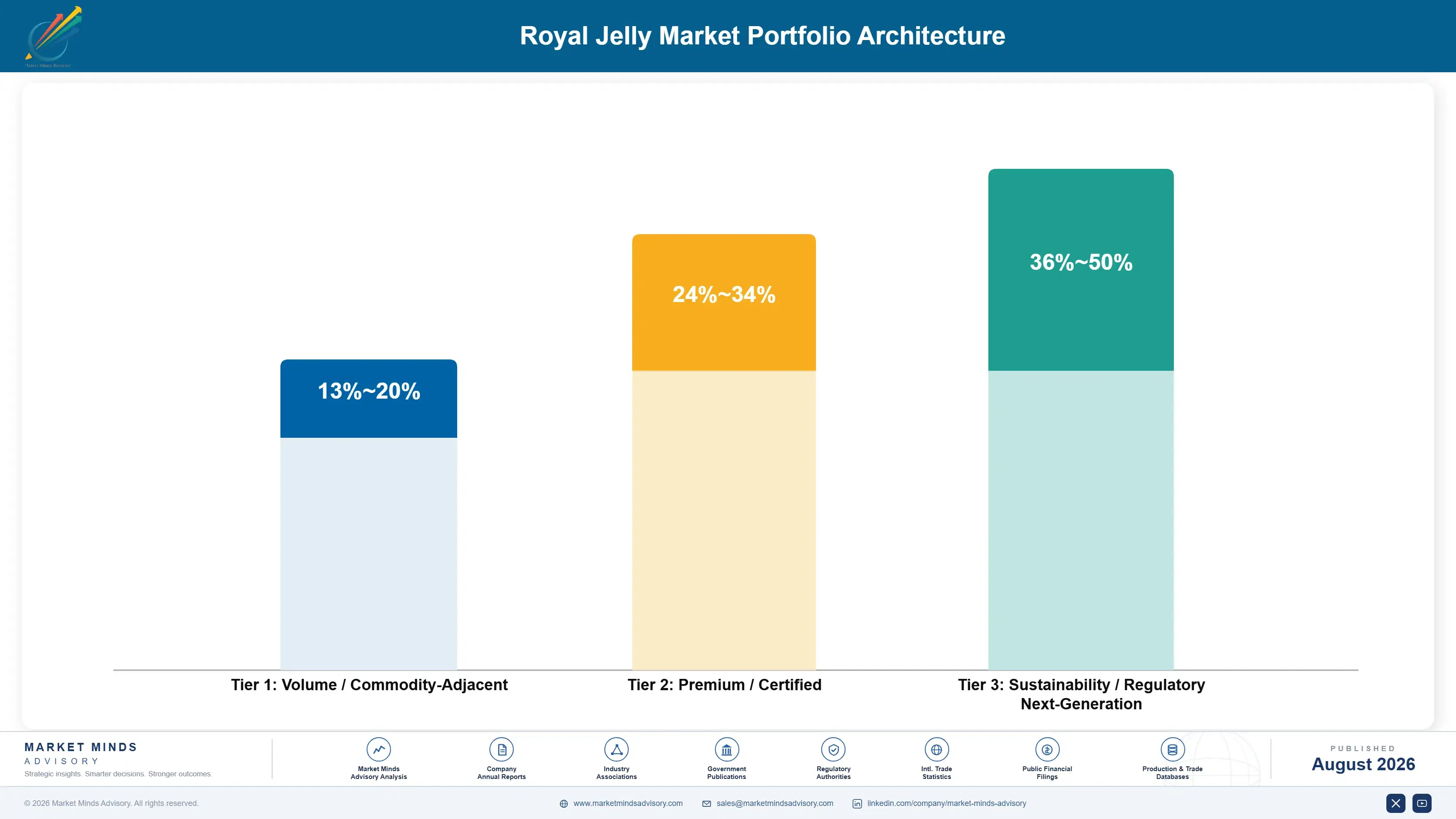
Margin architecture tracks what a supplier can prove rather than what it produces. Undifferentiated fresh jelly sold on origin and appearance into markets without analytical requirements runs at gross margins in the mid teens, because the buyer has no analytical basis at all for distinguishing one consignment from another. Verification changes that arithmetic completely.
The volume-versus-premium tension is genuine because apiary relationships require consistent offtake. A supplier buying only certified premium jelly cannot maintain the beekeeper base that identifies and produces it, since beekeepers need a buyer for everything they harvest rather than only the best batches. Undifferentiated volume is therefore an access cost, and suppliers who tried to purchase selectively found their apiary networks migrating to buyers who took the whole crop.

Value concentrates where verification and compliance exclude competitors. Certified marker acid material into European and Japanese supplement manufacture sits at the top, because those buyers require both analysis and residue documentation and most suppliers hold neither. Freeze-dried powder sits alongside on distribution economics. Undifferentiated fresh jelly sits at the other extreme, where origin and appearance settle a negotiation that analysis would settle very differently.

Volume / Commodity-Adjacent

Undifferentiated fresh frozen jelly sold on origin and appearance into markets that do not yet specify analytical verification. Buyers compare on price and provenance claims alone. This volume exists to maintain the apiary relationships that produce everything more valuable.
Gross Margin: 13-20%

Premium / Certified

Freeze-dried powder and encapsulated formats supplied with basic quality documentation into supplement and cosmetic manufacture. Removing cold chain and extending shelf life support pricing well above fresh material. Range reflects the spread between contract manufacture and branded supply.
Gross Margin: 24-34%

Sustainability / Regulatory / Next-Generation

Marker acid certified material with apiary-level residue documentation supplied into European and Japanese supplement manufacture. Analytical verification and compliance traceability, rather than any property of the jelly itself, justify the pricing achieved in this tier.
Gross Margin: 36-50%
royal-jelly-market-trends-portfolio-architecture-1787312604242

High-value Sub-segments and Strategic Watch-out

Certified Compliant Supply

High value on genuinely high growth, gated entirely by residue documentation and marker acid analysis, which together open roughly a third of global market value. Most suppliers hold neither capability, and neither capability can be assembled quickly, because both of them require genuine apiary-level control.
Gross Margin: 38-50%

Freeze-Dried Powder Formats

Strong margins on rapid growth at 9.9%, driven entirely by removing the frozen cold chain that consumes fully seventeen percent of delivered value on fresh material. Locating that capacity beside the apiaries rather than near the customer is what determines who actually captures the saving.
Gross Margin: 30-40%

Undifferentiated Fresh Jelly

The apiary access cost of this whole business, earning gross margins in the mid teens on material buyers cannot distinguish. Suppliers who tried purchasing selectively found their beekeeper networks migrating steadily to buyers willing to take the entire harvest instead of only the best batches.
Gross Margin: 13-20%

Chinese Labour Dependency

The strategic watch-out in this portfolio. Rural wage inflation is steadily eroding the very labour economics that concentrated all production in China originally, grafting cannot be mechanised in any part, and no alternative production geography has ever proved commercially viable at any meaningful scale anywhere.
Gross Margin: 13-30%

How This Demand Actually Repeats

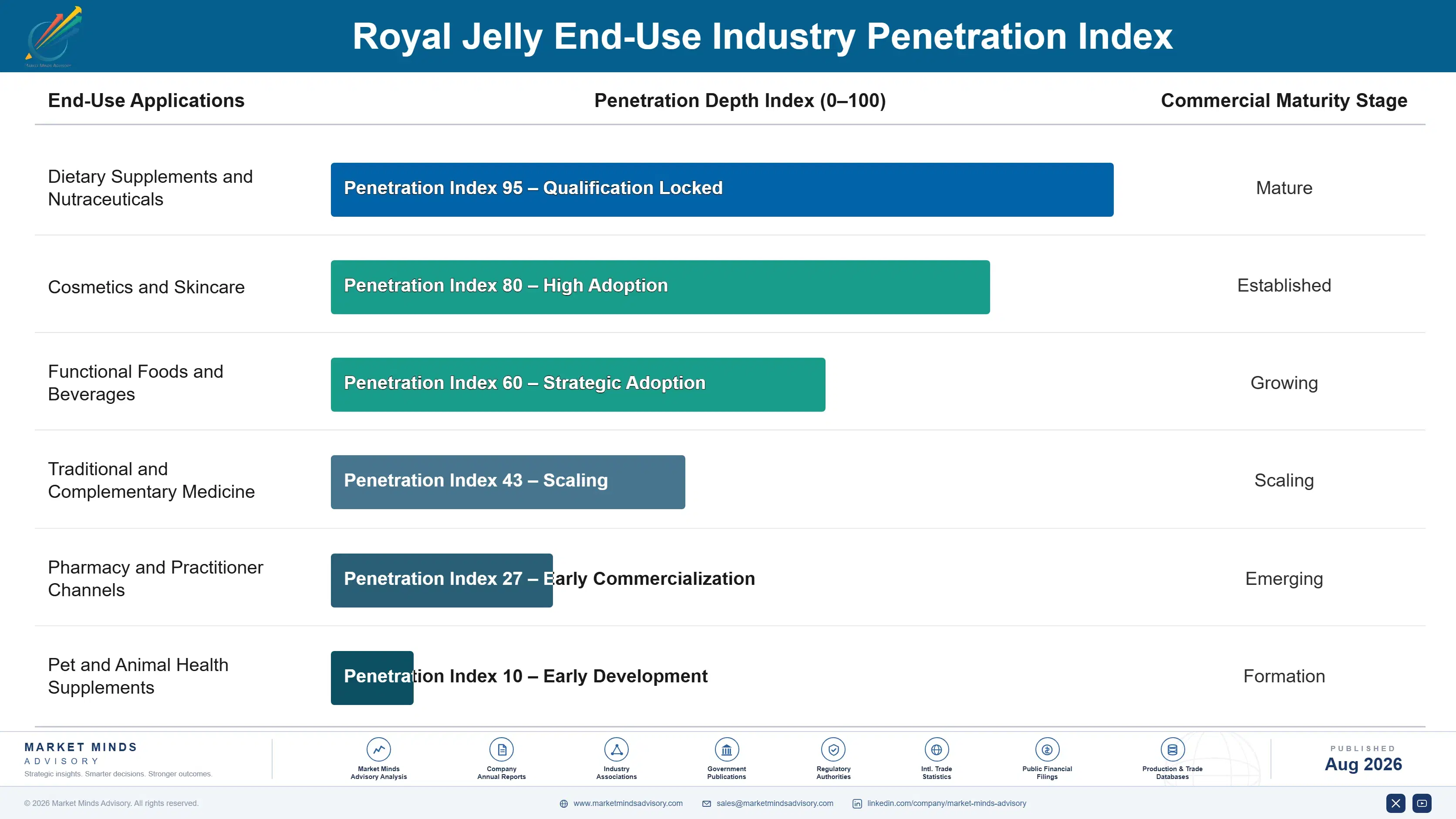
Royal jelly demand recurs through habit rather than through any formulation lock-in. Across East Asia it is consumed as a health food over years and decades, purchased repeatedly by the same households, and that habitual consumption is what gives the category its unusually stable underlying volume base.
Stickiness varies considerably by buyer type. Supplement manufacturers holding certified supply arrangements are the tightest, since requalifying a supplier means repeating residue and marker acid verification across a new apiary base. Cosmetic formulators sit close behind, held by ingredient specification within registered product formulations. East Asian retail consumers are moderately sticky through brand habit. Spot buyers purchasing undifferentiated jelly are entirely unsticky, switching origin and supplier on price with every single purchase.

Buyer profiles have shifted meaningfully. Purchasing once sat with supplement manufacturers comparing origin claims and price per kilogram. It now frequently involves quality assurance functions, regulatory affairs teams and in Europe compliance officers asking about marker acid analysis, residue testing regimes and apiary-level traceability. Suppliers whose commercial approach still leads with origin and relationship find themselves talking to buyers who want a certificate of analysis before any discussion of price.
royal-jelly-market-trends-end-use-penetration-index-1787312604728

Where To Place Capital

These are among the four positions where our research anticipates prominent divergence between winners and laggards over the coming forecast period. Each is grounded in the demand model, the regulatory perimeter, and the announced capacity pipeline.
01 / ANALYTICAL VERIFICATION INVESTMENT

Certification costs little and changes everything

Buyers increasingly refuse royal jelly without verified marker acid content, and certified material at 1.8% or above realises roughly 55% more than unstandardised jelly on the same underlying product. Laboratory capability and batch traceability cost under $700,000 to establish at a processing site. The reason most suppliers have not done it is habit rather than economics, since this trade ran for decades on relationships and origin claims, and that inertia is exactly what leaves this opening available to anyone willing to take it.
02 / APIARY COMPLIANCE CONTROL

Residue problems cannot be fixed downstream

European and Japanese maximum residue limits reject whole consignments over veterinary and pesticide traces, and those markets represent roughly 34% of total global value which non-compliant suppliers simply cannot reach at any price at all. The residues enter the product at the colony itself, so no downstream processing step removes them afterwards. Controlled apiary programmes covering between 200 and 600 contracted beekeepers cost $4 to $9 per kilogram in oversight and testing, against pricing differences running several times that size.
03 / COLD CHAIN ELIMINATION

Freeze-dry beside the apiary, not the customer

Fresh royal jelly requires an unbroken frozen cold chain from harvest onwards, costing roughly 17% of delivered value and closing ambient retail distribution entirely. Freeze-drying removes that cost and extends shelf life from months into years, at an equipment cost of between $2 million and $5 million for each line installed. Siting it near production rather than near the customer is what matters, because the expensive chain being eliminated here is the long international leg rather than the short domestic one.
04 / LABOUR SUPPLY SECURITY

Grafting labour is the real binding constraint

Producing royal jelly requires manual grafting and harvesting within three days, and Chinese rural wages have now risen enough that beekeepers genuinely choose between jelly and far less demanding honey production. Contracting apiary labour and jelly volume ahead of the season costs eight to twelve percent above expected spot pricing. Against being unable to fill orders during a tight year and thereby failing a standing supplement customer, that premium is comfortably justified in almost every single season a supplier trades through.

Engagement Snapshot From the Field

A live engagement with an industry participant carrying material or product regulatory and market exposure ahead of a defining policy shift, showing how our research translates into a defensible multi-year portfolio strategy.
MARKET MINDS ADVISORY · CLIENT ENGAGEMENT SUMMARY
Royal Jelly Producer Strategic Portfolio Review and Transition Roadmap 2026·Investment Scenario on Royal Jelly Exposure Evaluation 2025-26
CLIENT PROFILE
A European natural health ingredient supplier with annual revenue near $46 million (client-reported, unverified by MMA), importing royal jelly from Chinese trading intermediaries for onward supply to supplement and cosmetic manufacturers across the continent. Roughly 81% of volume arrived as fresh frozen material bought on origin and appearance, with no direct apiary relationships and no batch-level marker acid certification.
STRATEGIC CHALLENGE
Two consignments had been rejected at European border control on veterinary residue grounds within eighteen months, and a major supplement customer had begun requiring certified marker acid content the supplier could not provide. Management needed to decide whether to invest in analytical capability, pursue direct apiary sourcing, or shift toward freeze-dried formats, and could not rank the three.
MMA APPROACH
MMA quantified the pricing gap between certified and uncertified material across European supplement buyers, assessed what direct apiary contracting would require against the client's scale, and modelled cold chain cost savings from converting to freeze-dried formats. Findings were tested against 47 expert interviews covering European residue enforcement practice, Chinese apiary contracting and supplement manufacturer qualification requirements.
KEY FINDINGS
  1. Certified marker acid material commanded roughly 51% more than the uncertified jelly the client was selling, on essentially the same underlying product from the same origins.
  2. Residue rejections traced to specific apiaries rather than to any handling failure, meaning no change downstream of the colony would have prevented either consignment loss.
  3. Direct apiary contracting was viable at the client's scale only through a Chinese partner, since the beekeeper base required was larger than the company could manage alone.
  4. Converting to freeze-dried formats would remove an estimated $1.9 million of annual cold chain cost (client-reported, unverified by MMA) and open ambient retail customers entirely closed to fresh material.
CLIENT PROFILE
A European natural health ingredient supplier with annual revenue near $46 million (client-reported, unverified by MMA), importing royal jelly from Chinese trading intermediaries for onward supply to supplement and cosmetic manufacturers across the continent. Roughly 81% of volume arrived as fresh frozen material bought on origin and appearance, with no direct apiary relationships and no batch-level marker acid certification.
STRATEGIC CHALLENGE
Two consignments had been rejected at European border control on veterinary residue grounds within eighteen months, and a major supplement customer had begun requiring certified marker acid content the supplier could not provide. Management needed to decide whether to invest in analytical capability, pursue direct apiary sourcing, or shift toward freeze-dried formats, and could not rank the three.
MMA APPROACH
MMA quantified the pricing gap between certified and uncertified material across European supplement buyers, assessed what direct apiary contracting would require against the client's scale, and modelled cold chain cost savings from converting to freeze-dried formats. Findings were tested against 47 expert interviews covering European residue enforcement practice, Chinese apiary contracting and supplement manufacturer qualification requirements.
KEY FINDINGS
  1. Certified marker acid material commanded roughly 51% more than the uncertified jelly the client was selling, on essentially the same underlying product from the same origins.
  2. Residue rejections traced to specific apiaries rather than to any handling failure, meaning no change downstream of the colony would have prevented either consignment loss.
  3. Direct apiary contracting was viable at the client's scale only through a Chinese partner, since the beekeeper base required was larger than the company could manage alone.
  4. Converting to freeze-dried formats would remove an estimated $1.9 million of annual cold chain cost (client-reported, unverified by MMA) and open ambient retail customers entirely closed to fresh material.
RECOMMENDED STRATEGY
Phase 1: Phase one: establish batch-level marker acid testing before anything else, since it costs least and directly addresses the customer requirement already being lost. Phase 2: Phase two: partner with a Chinese supplier holding contracted apiaries and treatment documentation, rather than attempting to build beekeeper relationships directly. Phase 3: Phase three: shift the supplement portion of volume toward freeze-dried powder, retaining fresh supply only for the cosmetic customers who genuinely specify it.
OUTCOME
The client established marker acid testing within four months and concluded an apiary partnership the following quarter, reporting realised pricing on certified material roughly 44% above its previous uncertified supply (client-reported, unverified by MMA). No further residue rejections occurred, and the supplement customer that had prompted the review renewed on a multi-year agreement.

Frequently Asked Questions

Foundational context covering the market sizes, CAGR, scope, country, region and competition that inform every finding below. This section is provided to cover basics and most often pre-purchase conversations, answered from the MMA Primary Research Dataset.

What is the current size of the Royal Jelly Market?

The market was worth $0.9 billion in 2025 and is forecast to reach $0.96 billion in 2026. Dietary supplement manufacture accounts for 64% of that consumption.

How large will the Royal Jelly Market be by 2036?

MMA forecasts $1.82 billion by 2036, an expansion multiple of 1.90 times the 2026 base. That represents $0.86 billion of incremental value across the forecast period.

What is the CAGR for the Royal Jelly Market 2026 to 2036?

The base case compound annual growth rate is 6.6%, with a bull case of 7.8% and a bear case of 5.4%. Historical growth from 2020 to 2025 also ran at 5.4%.

Which segment is growing fastest?

Freeze-dried royal jelly powder at 9.9%, a full 1.50 times the market rate. Removing water removes the frozen cold chain that governs fresh material logistics entirely.

Who are the major companies in the Royal Jelly Market?

Comvita, Wuhan Bee Healthy, Zhejiang Jiangshan Bee Enterprise, Bee Health and Y.S. Eco Bee Farms lead with 22% between them, alongside fifteen further suppliers holding meaningful regional positions.

Which country is growing fastest?

India at 10.2%, as supplement and Ayurvedic wellness categories expand together and royal jelly finds positioning within both. Almost all material is imported from China.

Report Segmentation Architecture

The full report scope spans multiple orthogonal segmentation dimensions, with cross-tabulated demand data provided for each dimension pair. Coverage extends further to regional breakdowns, trend trajectories, and the competitive detail needed to support segment-level decision-making.

By Product Form

  • Freeze-Dried Royal Jelly Powder
  • Standardised Marker Acid Concentrate
  • Encapsulated and Softgel Formats
  • Fresh Frozen Royal Jelly
  • Royal Jelly in Honey Blends

By End-Use Industry

  • Dietary Supplements and Nutraceuticals
  • Cosmetics and Skincare
  • Functional Foods and Beverages
  • Traditional and Complementary Medicine
  • Pharmacy and Practitioner Channels
  • Pet and Animal Health Supplements

By Commercial Dimension

  • Direct Supply to Supplement Manufacturers
  • Cosmetic Formulator Ingredient Supply
  • Branded Consumer Retail
  • Trading House and Import Distributor Channel
  • Contracted Apiary Programme Supply

By Region

  • North America
  • Western Europe
  • East Asia
  • South Asia and Pacific
  • Latin America
  • Middle East and Africa
  • Eastern Europe

Scope, Methodology, and Coverage

Every figure in this report is reproducible from documented input assumptions. The scope below maps the historical period, the forecast horizon, the segmentation dimensions, and the countries covered, alongside the underlying primary and qualitative methodology.
Historical Period
2020 to 2025
Forecast Period
2026 to 2036
Base Year
2025 (USD billions; MMA Primary Research Dataset, August 2026)
Market Definition
This report covers royal jelly harvested from honeybee colonies and supplied as fresh frozen, freeze-dried powder, standardised marker acid concentrate, encapsulated softgel and honey-blended formats for dietary supplement, functional food, cosmetic and traditional medicine applications. Coverage includes the analytical certification and apiary compliance documentation supplied alongside the material. Honey, propolis, bee pollen, beeswax and bee venom, royalactin and other isolated proteins sold as characterised compounds, finished cosmetic products, and beekeeping equipment or queen rearing services are excluded from scope.
Quantitative Units
USD billions at supplier realised prices; volume in tonnes of fresh weight equivalent; gross margin percentages and marker acid content by tier.
Segmentation Dimensions
Product form and verification status, end-use industry, commercial dimension, region.
Regions Covered
North America, Western Europe, East Asia, South Asia and Pacific, Latin America, Middle East and Africa, Eastern Europe
Countries Covered
China, Japan, South Korea, Taiwan, India, Australia, New Zealand, Vietnam, Thailand, United States, Canada, Mexico, Italy, Spain, France, Germany, Brazil, Turkey, Poland, Russia.
Key Companies Profiled
Comvita, Wuhan Bee Healthy, Zhejiang Jiangshan Bee Enterprise, Bee Health, Y.S. Eco Bee Farms, Manuka Health, Bee and You, Apiary Sunshine, Xi'an Sgonek Biological Technology, Alpha Health Products, and ten further suppliers.
Quantitative Methodology
Primary survey, n=3,800 respondents, Q4 2025, six countries; demand-side model with trade association cross-validation
Qualitative Methodology
47 expert interviews, Q4 2025; applied to validate demand model assumptions, identify emerging dynamics, and assess competitive positioning
Report Format
PDF and XLSX data workbook (Word format preview document)
Publisher
Market Minds Advisory
Report Code
MMA-2026-HLT-816
Published
August 2026
Contact
sales@marketmindsadvisory.com | www.marketmindsadvisory.com

Purchase the full Royal Jelly Market Report (2026 to 2036).

The full report sets out ten-year forecasts for royal jelly by product form, end-use industry and commercial model across seven regions. It quantifies the pricing gap between certified and uncertified material by destination market and buyer type. Competitive assessment covers twenty suppliers on a consistent revenue basis, mapping apiary contracting depth and analytical capability separately from traded volume. Residue rejection patterns are analysed by origin and destination, isolating which compliance failures occur at colony rather than handling level. Findings draw on a quantitative survey of 3,800 respondents across six countries and 47 expert interviews conducted during the fourth quarter of 2025.
Ten-year forecasts by product form and region
Certified versus uncertified pricing gap by destination market
Apiary contracting depth mapped across twenty suppliers
Residue rejection patterns analysed by origin and destination
Cold chain cost quantified against freeze-dried alternatives
Margin architecture across three commercial portfolio tiers

Built For The People Who Decide

From boardroom strategy to bench-side execution, this report is read cover-to-cover by leaders shaping the next decade of their industry, turning demand scenarios, market dynamics and valuation benchmarks into decisions.
CXOs/ Presidents/ VPs/ Managers
M&A and Corporate Development
Strategy Teams and R&D Heads
Procurement and Product Directors
Regulatory and Compliance Leaders
Investor Relations and Equity Analysts