Market Minds Advisory
Global Roofing Chemicals Market

Global Roofing Chemicals Market: A Thirty Year Warranty Nobody Else Will Still Be Around For

The chemistry has to survive thirty years of ultraviolet exposure and thermal cycling while the contractor who applied it and the owner who specified it will both very likely be gone.

Lead Analyst

Bilal Shaikh

Published

September 2026

Make Smarter Decisions with Customized Research Insights

Request a free sample report and evaluate market opportunities, growth trends, and competitive dynamics relevant to your business needs.

2025 MARKET VALUE$22.6BMarket Size 2025
2036 FORECAST VALUE$40.3BBase Case , 2026 to 2036
CAGR 2026 TO 20365.4 %Bull 6.6% / Bear 4.2%
INCREMENTAL OPPORTUNITY$16.5BNet 10- year value creation
EXPANSION MULTIPLE1.69x2036 value over 2026 base
Strategic Levers
M&A Pipeline
Regional Outlook
Country Rankings
Competitive Intelligence
Segmental Deep-dive
Call-Us : 91 93563 13602

Executive Snapshot and Market Trajectory

A commercial roof warranty runs around 30 years, which is longer than most roofing contractors stay in business and longer than most owners hold the building. The chemical manufacturer ends up carrying that liability essentially alone, and prices accordingly. Failures appear late and attribute badly between material and workmanship.
Demand does not follow construction either, which surprises most people looking at it from outside. Roughly 76% of commercial roofing activity is replacement or recover work rather than new build, which ties the market to the age profile of an existing installed base rather than to building starts. That makes it far steadier through construction cycles than anybody expects. Timing rather than whether the work happens is what varies.
Liquid applied restoration carries the interesting economics. A coating extends usable roof life at around 34% of tear-off replacement cost, avoids landfill disposal entirely and can frequently be treated as maintenance expenditure rather than capitalised. Polyurethane and silicone membranes grow fastest at 8.1%, half again the market rate of 5.4%, on that combination rather than on any technical advantage. The finance argument closes more sales than the weathering data does. Landfill avoidance helps too.
Market Definition
Chemical products formulated for roofing systems, covering bituminous modifiers and asphalt additives, acrylic and elastomeric coatings, polyurethane and silicone liquid membranes, thermoplastic single-ply compounds, roofing adhesives and sealants, and insulation foam chemicals and blowing agents. Measured at chemical supplier selling value. Excludes finished membrane sheet manufacture, roof tiles and metal roofing, structural decking, and roofing installation services.
Base Year Value
$22.6B in 2025 (MMA Primary Research Dataset, August 2026)
Forecast Period
2026 to 2036, eleven discrete annual values
CAGR
5.4% base case. Bull 6.6%. Bear 4.2%.
Fastest Growth Segment
Polyurethane and Silicone Liquid Membranes: 8.1% CAGR
Fastest Growth Country
India: 9.2% CAGR
Fastest Growth Region
South Asia and Pacific: 7.4% CAGR
Largest Region
East Asia: 28% of 2025 global value
Market Leaders
Sika, Holcim, Carlisle Companies, Dow, BASF. Source: MMA Primary Research Dataset, July 2026.
Primary Survey
n=3,800 procurement and R&D decision-makers, Q4 2025, six countries
Methodology
Demand-side build-up, cross-validated against public data, 47 expert interviews

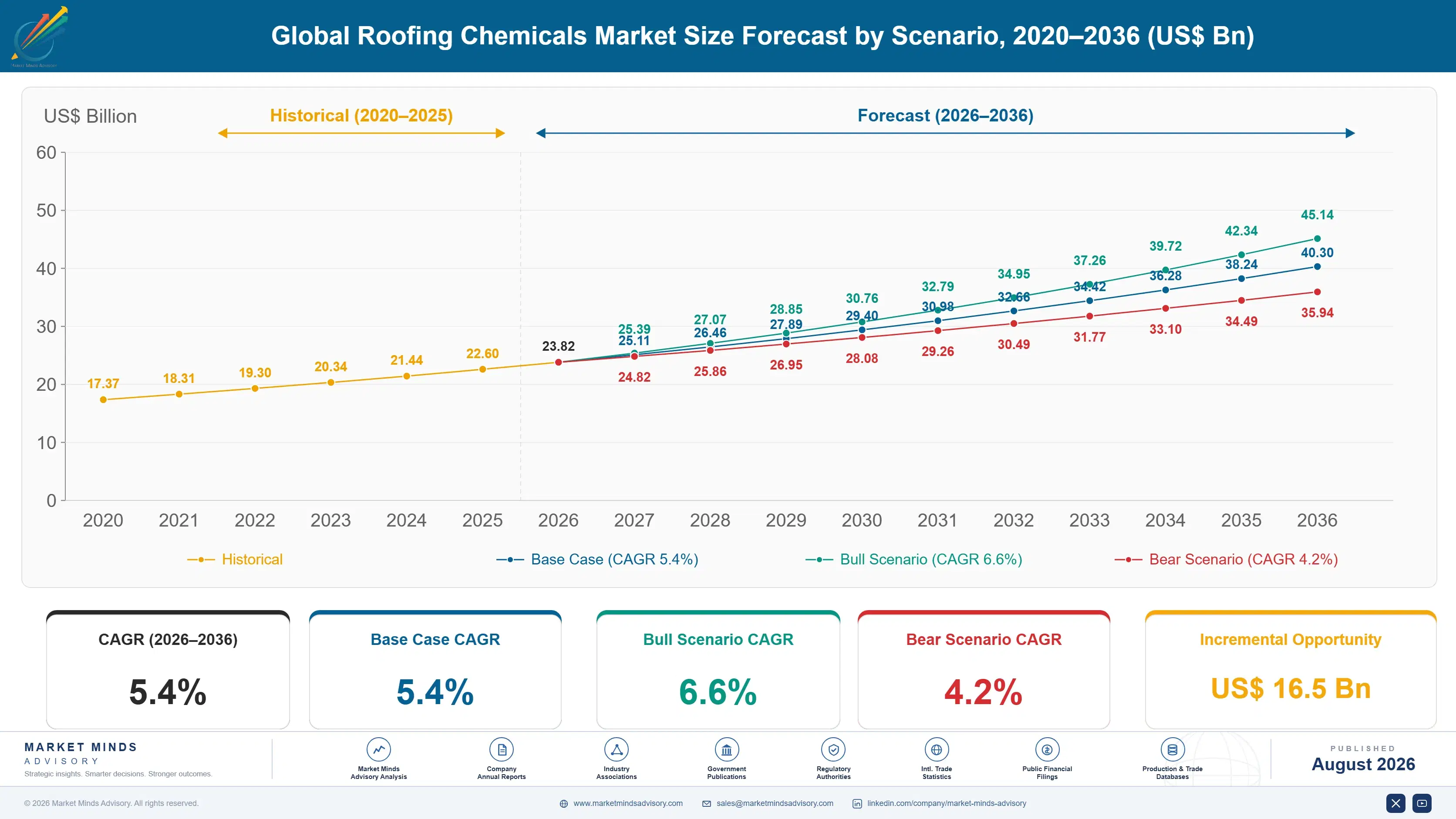
Global Roofing Chemicals Market Forecast Scenarios

roofing-chemicals-market-trends-size-forecast-scenario-1787594979119
Growth ran near 4.6% between 2020 and 2025, supported throughout by reroofing demand that continued while new commercial construction slowed sharply in several markets. Raw material costs were volatile across the period as petrochemical feedstocks moved, and contractors passed through less of it than manufacturers would have liked. Reflective requirements tightened in North America and pulled mix toward lighter systems.
Base case 5.4% rests on three mechanisms. Restoration coatings keep taking share from tear-off replacement because the cost ratio near 34% and the maintenance expenditure treatment together make an unusually easy argument for a building owner. Reflectance requirements continue spreading beyond North America as urban heat becomes a planning concern. And Indian and Southeast Asian commercial construction grows fastest, at 9.2% in India alone. Warehouse building concentrates the largest flat roof areas.
The bull case at 6.6% assumes reflectance and energy performance requirements spreading into European and Asian building codes at the pace North America has already set, which would accelerate the product mix shift considerably. The bear case at 4.2% is sustained commercial property weakness deferring reroofing beyond normal cycles, since a roof that leaks slowly can be patched for years by an owner short of capital.

Thirty Years and Nobody Left to Ask

Roofing chemistry is sold against a promise that outlives everybody who made it. A commercial membrane warranty typically runs around 30 years, during which the product endures continuous ultraviolet exposure, thermal cycling through wide temperature ranges, ponding water and foot traffic. The applying contractor may not exist in a decade and the owner will probably have sold the building.
TOP FIVE CONCENTRATION34%Formulation and warranty capability narrow the credible field
REROOFING ACTIVITY SHARE76%Commercial roofing work that replaces rather than builds
COATING COST RATIO34%Restoration coating cost against a full tear-off replacement
STANDARD WARRANTY TERM30 yearsPeriod the chemistry must survive in continuous service
REFLECTANCE REQUIREMENT0.65Solar reflectance mandated under prevailing commercial building codes
RESIN COST SHARE52%Formulated cost accounted for by purchased polymer resin
That structure explains why the market behaves unlike the construction industry it sits inside. Around 76% of commercial roofing activity is replacement or recover work driven by the age profile of an existing installed base, not by new building starts. Demand therefore holds up through construction downturns far better than anyone outside the sector expects, and it is forecastable from installation records rather than from economic projections.
Restoration coatings have changed the commercial arithmetic considerably. A liquid applied system extends usable roof life at roughly 34% of the cost of tearing off and replacing, avoids sending the old membrane to landfill, and can often be treated as maintenance expenditure rather than capitalised as an asset. For a building owner managing cash and tax position together, that combination is unusually persuasive.
"Every technical conversation in this industry is about ultraviolet resistance and every commercial decision is about whether the finance director can expense it. The manufacturers who worked out that the tax treatment sells more coating than the accelerated weathering data ever will are the ones taking share."
Director, Construction Chemicals and Building Envelope Practice · MMA Construction and Building Materials Practice · August 2026

Market Trends

Restoration coatings displacing tear-off replacement on cost and tax

A liquid applied restoration system extends roof life at around 34% of full replacement cost while avoiding landfill disposal of the existing membrane entirely. The less discussed advantage is accounting treatment, since a coating can frequently be expensed as maintenance where a replacement must be capitalised, which matters considerably to an owner managing cash and tax position together. Polyurethane and silicone membranes grow at 8.1% against a market rate of 5.4% on that combination, and manufacturers who lead with the finance argument outsell those leading with weathering data. Hold period rather than roof condition frequently decides it.
Market Impact: Reroofing carries 76% of work
Reflectance requirements reshaping product mix across major codes

Building codes across North America now mandate solar reflectance around 0.65 for low-slope commercial roofs, driven by cooling energy and urban heat island concerns rather than by any roofing performance argument. That requirement moved the market decisively toward white thermoplastic membranes and reflective coatings, away from the dark bituminous systems that dominated for decades. Similar requirements are appearing in Asian and Middle Eastern codes as urban heat becomes a planning issue, which extends the mix shift well beyond where it started. Suppliers already holding reflective ranges sit well ahead of those that do not.
Market Impact: Indian demand growing at 9.2%

Market Opportunities and Growth Drivers

Installed base age profile driving predictable replacement demand

Around 76% of commercial roofing activity replaces or recovers an existing roof rather than covering a new building, which ties demand to installation records from twenty and thirty years ago rather than to current construction activity. That makes the market forecastable in a way construction chemicals rarely are, and considerably steadier through downturns. Manufacturers who track the age profile of the installed base in their territories can anticipate demand by region and by system type years ahead of any contractor knowing about it. Most of the underlying data is public and almost nobody assembles it.
Market Impact: Commits 30 years of liability

Asian commercial construction expanding across warehouse and industrial building

India grows fastest anywhere at 9.2%, driven by warehouse, logistics and industrial construction expanding alongside organised retail and manufacturing investment. Large flat roof areas on distribution buildings are exactly where roofing chemistry volume concentrates, and specification standards are rising as international occupiers require warranted systems. Southeast Asian construction across Vietnam, Indonesia and the Philippines follows a similar pattern. Reflectance requirements are beginning to appear in regional codes as cooling loads become a planning concern. Monsoon loading and high ultraviolet exposure both shorten membrane life relative to temperate markets, which raises replacement frequency across the region considerably.
Market Impact: Coating costs 34% of replacement

Market Restraints and Challenges

Long warranty exposure concentrating liability on the manufacturer

A 30 year warranty commits a manufacturer to performance across decades while the applying contractor and specifying owner both frequently disappear well before it expires. The root cause is that roofing failures usually appear late and are difficult to attribute between material, workmanship and building movement. Commercially this loads reserve requirements onto manufacturers and deters smaller participants from offering competitive terms at all. Contractor certification programmes and inspection requirements are the mitigation, and they add cost without removing the underlying exposure. Reserve adequacy rests on assumptions about installations nobody can now revisit.
Market Impact: Costs 34% of full replacement

Deferred maintenance stretching replacement cycles under capital pressure

A roof that leaks slowly can be patched for years by an owner short of capital, which stretches replacement cycles well beyond what performance would suggest whenever commercial property finances tighten. The root cause is that roofing is invisible until it fails badly and rarely competes successfully for capital against revenue-generating investment. Commercially it makes demand more cyclical than the installed base age profile alone implies. Restoration coatings at around 34% of replacement cost are the mitigation participants push hardest. Roofing rarely competes successfully against revenue-generating investment for capital. Restoration is the argument participants push hardest.
Market Impact: Mandates 0.65 solar reflectance
4 additional market trends, 3 additional growth drivers, and 2 additional restraints and challenges are covered in the full report. Contact sales@marketmindsadvisory.com to access the complete intelligence.

Segment CAGR and Growth Architecture

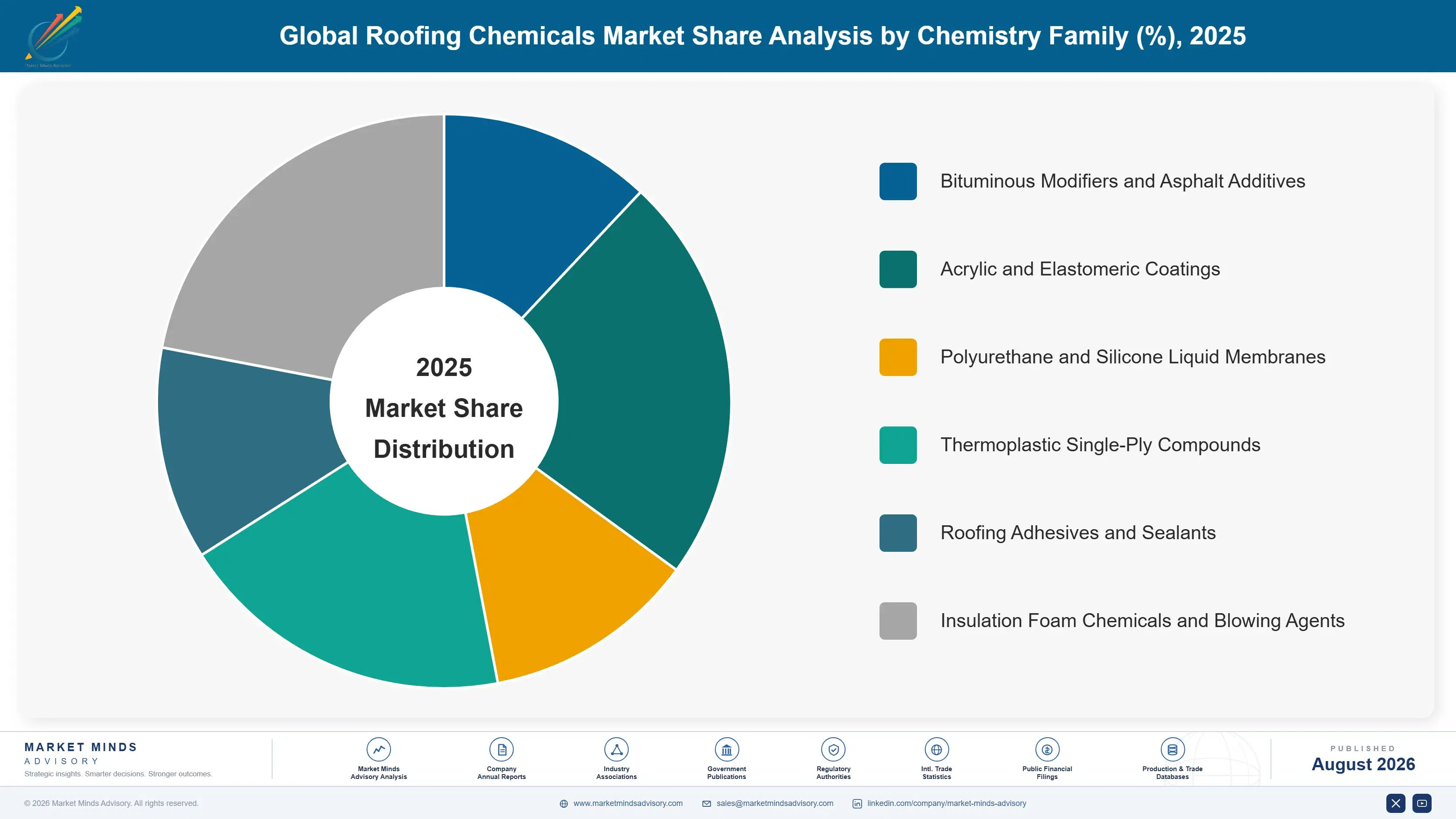
Six segments are split here by chemistry family, because chemistry determines weathering performance, application method, achievable warranty term and which roofing systems a given product can actually serve. Colour, viscosity and cure variants sit inside each family rather than beside them. Roof type, building use and sales channel are all handled in the framework instead.
roofing-chemicals-market-trends-market-share-analysis-1787594979672

Polyurethane and Silicone Liquid Membranes

Growing at 8.1%, half again the market rate of 5.4%, liquid applied polyurethane and silicone systems are the chemistry behind roof restoration, applied over an existing membrane at roughly 34% of tear-off replacement cost. Silicone handles ponding water considerably better than most alternatives, which matters on the flat roofs where restoration is most valuable. Polyurethane offers better mechanical toughness where foot traffic is expected. Both avoid landfill disposal entirely and frequently qualify as maintenance expenditure rather than capital, which is the argument that closes the sale far more often than any weathering datasheet manages to. Silicone handles the flat roofs where restoration matters most, and polyurethane the trafficked ones. Landfill avoidance supports the environmental case as well.
CAGR 8.1%

Acrylic and Elastomeric Coatings

At 6.8% water-based acrylic and elastomeric coatings serve the reflective roofing requirement directly, delivering the solar reflectance around 0.65 that building codes across North America now mandate for low-slope commercial roofs. They cost considerably less than silicone or polyurethane systems and handle ponding water considerably worse, which confines them to roofs with genuine drainage. Recoating intervals are shorter and the maintenance relationship is correspondingly more frequent, which some manufacturers treat as a weakness and others as a recurring revenue position worth defending. Water-based formulation also avoids the solvent handling that liquid membrane systems require on site, which matters for occupied buildings. Application labour is lower as well, with higher coverage per coat.
CAGR 6.8%
Full segment breakdown across 6 segments available in the complete report.

Regional Architecture and Country Demand Map

East Asia currently holds 28% of value on Chinese commercial construction and industrial roofing volume across very large building footprints. North America then follows at 26%, where reflectance codes and restoration adoption both lead the world, with Western Europe holding 20% on continuing renovation demand.

North America

Reflectance requirements originated here and are written into building codes across most states, mandating solar reflectance around 0.65 on low-slope commercial roofs and driving the shift from dark bituminous systems to white thermoplastic membranes. Restoration coating adoption is furthest advanced anywhere, helped by tax treatment that lets owners expense the work as maintenance rather than capitalise it. Reroofing dominates activity at around 76%, tied to an installed base that turned over heavily in the 1990s. Growth of 4.6% runs below the base case on mature installed base dynamics. Certified contractor networks are more developed here than in any other region. Tax treatment helps owners expense restoration work as maintenance rather than capital.
Share: 26% | CAGR: 4.6% (2026 to 2036)

Western Europe

Renovation of existing building stock drives most regional demand, with flat roof repair and restoration substantial across Germany, France, the Netherlands and Britain where post-war construction is reaching the end of successive membrane lives. Reflectance requirements are less prominent than in North America, since cooling loads matter less across most of the region and green roof systems compete for the same specification. Bituminous systems retain a larger share than in North America. Growth at 4.0% runs below the base case, tracking renovation activity rather than any regulatory driver. Green roof systems compete for the same specification in several markets. Post-war building stock is reaching the end of successive membrane lives.
Share: 20% | CAGR: 4.0% (2026 to 2036)
Regional intelligence for 5 additional markets available in the complete report: East Asia, South Asia and Pacific, Latin America, Middle East and Africa, Eastern Europe. Contact sales@marketmindsadvisory.com.
roofing-chemicals-market-trends-country-cagr-analysis-1787594980192

Four Moves on a Thirty Year Promise

Technical selling in this industry addresses ultraviolet resistance and thermal cycling, while the actual decision gets made by somebody weighing capital budget against maintenance budget. Around 76% of the work is replacement rather than new build, which makes the installed base a forecastable asset that almost nobody in the industry bothers to map properly.

Lead restoration selling with the accounting treatment

A restoration coating costs around 34% of tear-off replacement and can frequently be expensed as maintenance where replacement must be capitalised, which reaches a finance director rather than a facilities manager. That argument closes sales far more reliably than accelerated weathering data ever does, and it is one very few manufacturers make in those terms. Polyurethane and silicone systems grow at 8.1% on exactly this combination of cost ratio and tax position rather than on technical merit. Hold period against remaining roof life is the calculation being made. Very few manufacturers frame it that way at all.
Market Impact: Costs 34% of a full tear-off replacement job

Map the installed base age profile by territory

Around 76% of activity replaces existing roofs on cycles driven by installation dates twenty and thirty years past, which makes demand forecastable from records rather than from economic projection. Manufacturers tracking that age profile know where demand will arrive by region and system type years before any contractor does, which allows stocking, specification and contractor development to be positioned in advance. Remarkably few participants have assembled this despite the data being largely public. Field sales deployment can be positioned against it rather than against enquiries. Contractors learn about the work considerably later than this.
Market Impact: Anticipates 76% of the reroofing demand pool accurately

Follow reflectance codes into markets adopting them next

Codes mandating solar reflectance around 0.65 originated in North America and are appearing in Asian and Middle Eastern building regulation as urban heat becomes a planning concern. Being specified before a requirement lands is considerably easier than displacing an incumbent afterwards, and the reflective product mix carries better margins than dark bituminous systems it replaces. Tracking code development rather than construction statistics is what identifies these markets early enough to matter. Reflective products also carry better margins than the systems they displace. Code development rather than construction statistics identifies these markets.
Market Impact: Serves a 0.65 solar reflectance code requirement directly

Turn warranty exposure into a contractor certification moat

A 30 year warranty concentrates liability on the manufacturer because contractors and owners both frequently disappear before it expires. Certification programmes that train and audit applicators reduce workmanship failures and simultaneously build a channel that competitors cannot easily reach, since a certified contractor has invested in that relationship. Smaller manufacturers cannot offer comparable terms at all, which turns a liability problem into a genuine barrier to entry when it is managed deliberately. Claim rates across certified networks run materially below uncertified installers. Smaller manufacturers cannot offer comparable terms at all.
Market Impact: Manages 30 years of accumulated warranty exposure properly

Who Controls the Margin Pool

Participation is measured on annual roofing chemical revenue, and the top five hold 34%. Concentration reflects warranty capability and contractor network depth rather than formulation, since producing a coating is not itself difficult while standing behind it for three decades demands balance sheet and reserve capacity. Sika and Holcim lead through building envelope breadth and contractor certification programmes. The gap to challengers is warranty credibility rather than product performance. Producing a coating is not itself difficult for anybody.
Competition runs on three fronts. Warranty terms decide specification on major commercial projects, where an owner is buying decades of assurance. Contractor certification decides application quality and channel access together. Restoration system capability decides participation in the reroofing work that constitutes around 76% of all activity in this market. Restoration capability decides participation in three quarters of the work.

Pressure ahead comes from reflectance requirements spreading into new markets and from restoration displacing replacement, which reduces material volume per roof while raising value per litre. Holcim acquired Firestone Building Products in 2021, consolidating membrane and chemistry capability. Expect certification investment and restoration system development rather than further large transactions. Rankings shift as restoration keeps taking share from replacement.
roofing-chemicals-market-trends-company-positioning-matrix-1787594980714

Competitive Moat and Risk Dimensions

SIKA

Moat: Building envelope system breadth

Capability spanning roofing, waterproofing, sealants and concrete admixtures lets the company address a whole building envelope rather than a single element, which matters on commercial projects where interface details between systems cause most failures. Specifiers value a single warranty covering those interfaces, and that is something a roofing-only supplier structurally cannot offer.
SIKA

Risk: Long tail warranty reserves

Thirty year commitments accumulate across decades of installations, and failures appear late and are difficult to attribute between material and workmanship. A broad portfolio means broad exposure, and reserve adequacy depends on assumptions about installations made by contractors who may no longer exist to share responsibility for them.
HOLCIM

Moat: Integrated membrane and chemistry position

Following the Firestone Building Products acquisition, the company supplies both finished membrane systems and the chemistry behind them, which captures value across the chain and gives visibility into how products actually perform in the field. That feedback is genuinely difficult to obtain for a chemical supplier selling into somebody else's membrane manufacture.
HOLCIM

Risk: Restoration cannibalising replacement

Restoration coatings at around 34% of replacement cost extend the life of roofs that would otherwise be torn off and replaced with new membrane, which reduces membrane volume directly. An integrated position captures value on both sides but sees more revenue at risk than a coatings-only participant does when restoration takes share.

Players Tracked

Prominent Players

Sika
Holcim
Carlisle Companies
Dow
BASF

Other Key Players

Henkel
H.B. Fuller
Arkema
Covestro
Huntsman
GAF
Owens Corning
Soprema
BMI Group
Tremco
Kraton
Honeywell
Wacker Chemie
Evonik
Nippon Paint

Recent Developments

MARCH 2026

Property group standardises restoration coating across warehouse portfolio

A logistics property group standardised liquid applied restoration across its warehouse portfolio rather than replacing membranes at end of life, citing capital cost near a third of replacement and maintenance expenditure treatment. Roof life extension was assessed against remaining hold periods for each building. Landfill avoidance was cited secondarily.
Signal: Accounting treatment and hold period rather than roof condition are now deciding these specification choices entirely
SEPTEMBER 2025

Asian building code introduces solar reflectance requirement for commercial roofs

An Asian national building code introduced a solar reflectance requirement for low-slope commercial roofs, following urban heat island concerns raised in major metropolitan planning reviews. Suppliers already holding reflective product ranges were positioned considerably ahead of those that were not. Reflective product ranges were scarce among domestic suppliers.
Signal: Reflectance requirements are now spreading well beyond North America into any market facing severe cooling loads
JANUARY 2026

Manufacturer expands contractor certification programme across three regions

A roofing chemical manufacturer expanded contractor certification and auditing across three regions, tying extended warranty terms to certified application. Workmanship-related claims across the certified network ran materially below the uncertified installer base over the assessment period. Extended terms applied only to certified installations across all three regions covered.
Signal: Certification reduces warranty exposure and builds channel access that competitors find genuinely hard to reach afterwards

Resin, Bitumen and Freight

Polymer resin accounts for roughly 52% of formulated cost across coatings and liquid membranes, spanning acrylic dispersions, polyurethane prepolymers and silicone polymers from petrochemical supply. Bitumen and asphalt carry about 21% in modified bituminous products, moving on refinery output rather than on polymer markets. Pigments, particularly titanium dioxide for reflective products, take around 12%. Manufacturing and freight absorb the balance across a heavy, low value density product.
Petrochemical feedstock costs moved sharply through 2021 and 2022 on ethylene, propylene and silicone intermediate availability, per EIA petrochemical price reporting for the period, while titanium dioxide tightened separately on its own supply constraints. Bitumen moved with refinery utilisation on a third cycle entirely. Manufacturers holding annual distributor agreements absorbed most of it, since construction channels reprice slowly and contractors resist mid-season increases. Three separate cycles moved at once.

Exposure divides on chemistry mix and on freight geography. A manufacturer weighted toward liquid membranes carries resin exposure across more than half its cost base, while bituminous producers face refinery-driven pricing on an unrelated cycle. Freight matters unusually here because roofing chemicals ship heavy and cheap, which is why production stays regional and concentration sits at only 34%.
roofing-chemicals-market-trends-cost-volatility-analysis-1787594980908

Run polymer and bituminous chemistries in parallel

Resin at 52% of cost and bitumen at 21% move on entirely unrelated cycles, one petrochemical and one refinery-driven, so a manufacturer holding both can shift emphasis as either deteriorates. The formulation and plant investment for two families is the obstacle. Single-chemistry producers carried the full exposure through the last feedstock cycle with nowhere at all to move.

Index distributor agreements to published feedstock references

Construction channels reprice slowly and contractors resist mid-season increases, which guarantees margin compression whenever resin or bitumen moves against a manufacturer. Indexing distributor agreements to published references passes movement through with a defined lag. Distributors accept indexation considerably more readily than contractors do, which makes the channel level the right place to negotiate it.

Site production close to the roofs being served

Roofing chemicals ship heavy and cheap, so delivered cost rises steeply with distance and regional production beats a single optimised plant almost every time. That freight arithmetic is why concentration sits at only 34% after decades of attempted consolidation. Siting decisions therefore dominate cost position far more than manufacturing efficiency improvements ever manage to.

Portfolio Architecture for Margin Defence

Margin here follows warranty capability rather than formulation difficulty, which catches out participants who invested in laboratories rather than balance sheets. Bituminous modifiers and commodity adhesives earn margins in the high teens to mid twenties, because many regional producers supply equivalent material and contractors buy on delivered price against a specification everybody meets. Delivered price settles the comparison every time.
Reflective coatings and single-ply compounds do considerably better in the high twenties to high thirties, because code compliance and system approval both narrow the supplier field and specification happens at architect or consultant level rather than at the contractor's van. The range reflects code position and certification network depth across territories. Specification happens well before the contractor is appointed. System approval narrows the field before price is discussed.

Liquid applied restoration systems hold the strongest position, reaching into the mid forties, because the customer is buying avoided capital expenditure and favourable accounting treatment rather than a chemical. Those margins reflect the alternative being priced against, which is a full tear-off replacement costing roughly three times as much. Three times the price is what the coating is priced against. Avoided capital expenditure is the actual product being bought.

Bituminous Modifiers and Commodity Adhesives

Asphalt modifiers, standard adhesives and sealants supplied against common specifications. The eight point range reflects freight position and manufacturing scale rather than product difference, since regional producers supply equivalent material everywhere.
Gross Margin: 17-25%

Reflective Coatings and Single-Ply Compounds

Code-compliant reflective coatings and thermoplastic compounds specified at architect or consultant level. The eleven point range reflects code position across territories and the depth of certified contractor networks supporting each system.
Gross Margin: 27-38%

Liquid Applied Restoration Systems

Polyurethane and silicone restoration systems sold against avoided replacement cost. The twelve point range reflects warranty term offered and whether the accounting argument is made to the finance function directly.
Gross Margin: 34-46%
roofing-chemicals-market-trends-portfolio-architecture-1787594981410

High-value Sub-segments and Strategic Watch-out

Liquid Applied Restoration Systems

High value and the fastest growth at 8.1%, since the customer is buying avoided capital expenditure at around 34% of replacement cost together with maintenance expenditure treatment. The comparison being priced against is what supports the margin. Finance functions rather than facilities managers decide it.
Gross Margin: 36-46%

Reflective Coating Systems

High value and growing as codes mandating solar reflectance near 0.65 spread beyond North America into Asian and Middle Eastern regulation. Being specified before a requirement lands is far easier than displacing an incumbent afterwards. Code tracking rather than construction data identifies these markets early.
Gross Margin: 29-38%

Bituminous Modifiers and Adhesives

The volume core, where regional producers supply equivalent material and contractors compare delivered price against specifications everybody meets. Freight economics protect local position without conferring any pricing power at all. Regional producers supply functionally equivalent material at comparable specification everywhere, which leaves nothing to differentiate on.
Gross Margin: 17-25%

Long Tail Warranty Exposure

The strategic watch-out. Thirty year commitments accumulate across decades of installations by contractors who may not exist, and the range reflects how far reserve assumptions have been tested against actual claim experience. Failures appear late and attribute badly between material and workmanship, which makes reserving genuinely difficult.
Gross Margin: 12-40%

Cycles Written Decades Ago

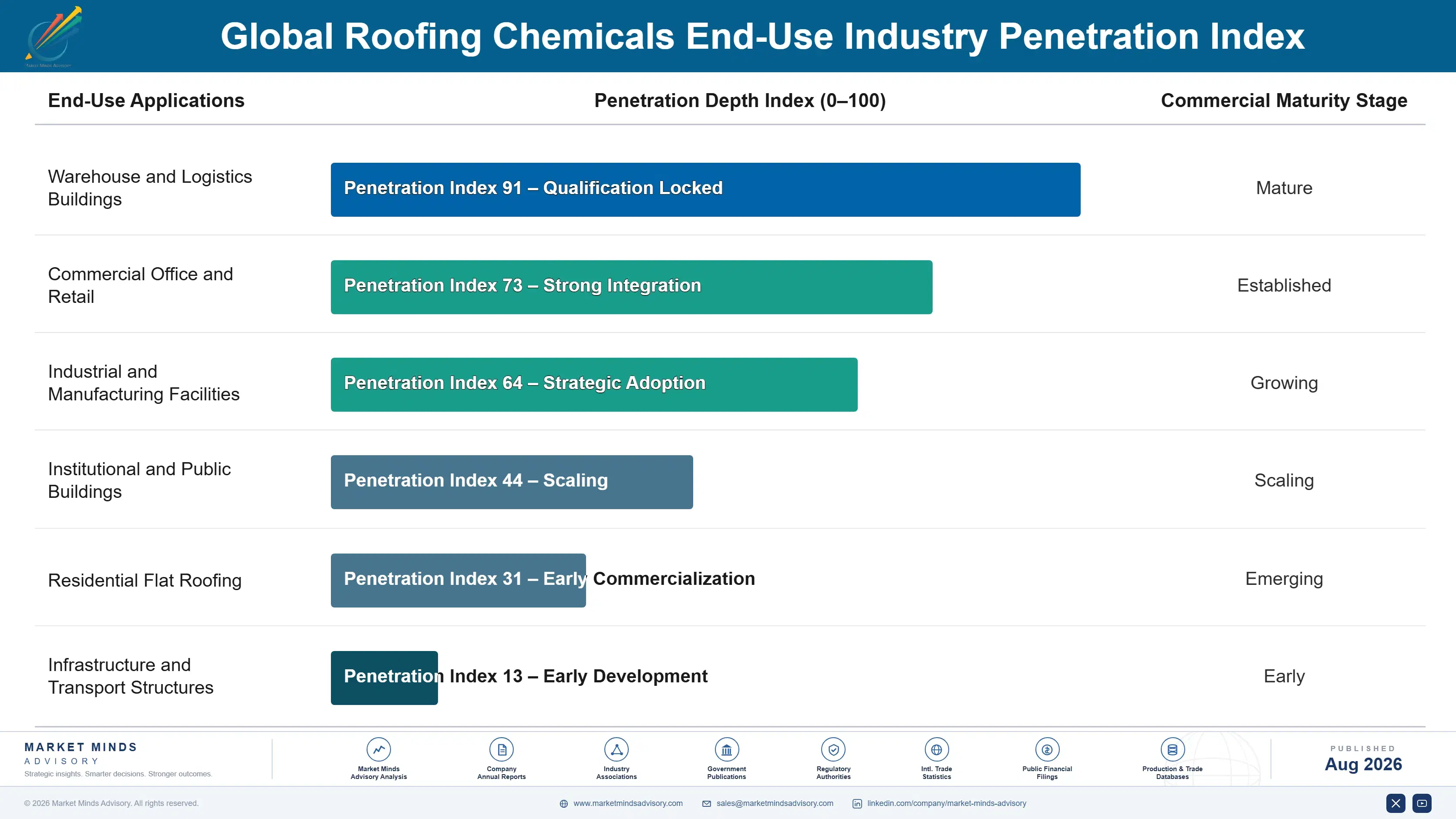
Demand in this market was largely determined twenty and thirty years ago, when the roofs now reaching end of life were installed. Around 76% of activity is replacement or recover work following that age profile, which makes the market unusually forecastable and considerably steadier through construction cycles than new build supply ever is. Installation records forecast it better than economics.
Stickiness sits with the certified contractor network rather than with the specification. A manufacturer whose applicators are trained, audited and warranty-approved holds a channel that competitors cannot reach without building an equivalent programme from nothing. Specification at consultant level is stickier still on major projects, since a system approval and warranty package is difficult to substitute late in a project. Late substitution on a project is rarely practical.

The deciding voice depends entirely on the work. New construction and major replacement are specified by architects and roofing consultants weighing system performance and warranty terms. Restoration is decided by building owners and their finance functions weighing capital against maintenance budget, which is a completely different audience that most roofing sales organisations were never built to reach. Most sales organisations were never built to reach it.
roofing-chemicals-market-trends-end-use-penetration-index-1787594981899

Where We Would Focus Effort

These are among the four positions where our research anticipates prominent divergence between winners and laggards over the coming forecast period. Each is grounded in the demand model, the regulatory perimeter, and the announced capacity pipeline.
01 / ACCOUNTING ARGUMENT SELLING

The finance director buys more coating than the chemist

A restoration coating costs around 34% of a full tear-off replacement and can frequently be expensed as maintenance where replacement must be capitalised on the balance sheet. That combination reaches a finance function weighing cash and tax position rather than a facilities manager comparing weathering datasheets from several competing suppliers. Polyurethane and silicone systems grow at 8.1% largely on that argument, and remarkably few manufacturers make it in the terms a finance director would actually recognise and act upon directly.
02 / INSTALLED BASE MAPPING

The demand was scheduled thirty years ago

Around 76% of roofing activity replaces existing roofs on cycles determined by installation dates two and three decades past, which makes demand forecastable from records rather than from any economic projection. Manufacturers tracking that age profile by territory know where work will arrive by region and system type well before contractors do, allowing stocking, specification effort and contractor development to be positioned in advance. Very few participants have assembled this despite most of the underlying data being entirely public already.
03 / CODE ADOPTION TIMING

Be specified before the requirement lands

Building codes mandating solar reflectance around 0.65 originated in North America and are now appearing in Asian and Middle Eastern regulation as urban heat becomes a serious planning concern across major metropolitan areas. Being written into specifications before a requirement arrives is considerably easier than displacing an established incumbent afterwards, and reflective products carry better margins than the dark bituminous systems they replace. Tracking code development rather than construction statistics identifies these markets early enough to act on properly in advance.
04 / CERTIFICATION NETWORK BUILDING

Turn the warranty problem into the entry barrier

Thirty year warranties concentrate liability on manufacturers because applying contractors and specifying owners both frequently disappear long before the term expires. Certification programmes that train and audit applicators reduce workmanship failures while building a channel competitors cannot easily reach, since certified contractors have invested in that specific supplier relationship. Smaller manufacturers cannot offer comparable warranty terms at all, which converts a liability problem into a genuine barrier when it is managed deliberately rather than merely defensively only after the fact.

Engagement Snapshot From the Field

A live engagement with an industry participant carrying material or product regulatory and market exposure ahead of a defining policy shift, showing how our research translates into a defensible multi-year portfolio strategy.
MARKET MINDS ADVISORY · CLIENT ENGAGEMENT SUMMARY
Global Roofing Chemicals Producer Strategic Portfolio Review and Transition Roadmap 2026·Investment Scenario on Global Roofing Chemicals Exposure Evaluation 2025-26
CLIENT PROFILE
A European construction chemicals manufacturer supplying bituminous modifiers and roofing adhesives across eleven countries, at annual roofing revenue near 180 million euros (client-reported, unverified by MMA). Sales ran through builders merchants to roofing contractors on delivered price, no liquid restoration system existed in the range, and warranty terms offered were considerably shorter than market leaders.
STRATEGIC CHALLENGE
Volume had been flat for five years while competitors grew through restoration systems the company did not offer, and two large specification opportunities had been lost on warranty term rather than on product performance. Management were considering price competition in bituminous products and wanted to know whether that would defend anything.
MMA APPROACH
MMA sized restoration against replacement demand across the client's markets, benchmarked warranty terms and reserve requirements among leading suppliers, mapped installed base age profiles in three territories, and assessed the cost of building a certified contractor network. Interviews with 47 experts covered roofing specification, building envelope consulting and construction chemical distribution.
KEY FINDINGS
  1. Restoration was growing several times faster than replacement across every market examined, and none of that growth was reachable through the client's existing bituminous product range.
  2. Both lost specifications had been decided on warranty term alone, and neither client nor competitor products had been technically differentiated in the consultant's assessment.
  3. Installed base age mapping in the three territories examined identified replacement demand concentrations the client's sales organisation had no visibility of whatsoever.
  4. Building a certified contractor network was affordable within existing sales expenditure if redirected, but required a warranty term the balance sheet had not previously supported.
CLIENT PROFILE
A European construction chemicals manufacturer supplying bituminous modifiers and roofing adhesives across eleven countries, at annual roofing revenue near 180 million euros (client-reported, unverified by MMA). Sales ran through builders merchants to roofing contractors on delivered price, no liquid restoration system existed in the range, and warranty terms offered were considerably shorter than market leaders.
STRATEGIC CHALLENGE
Volume had been flat for five years while competitors grew through restoration systems the company did not offer, and two large specification opportunities had been lost on warranty term rather than on product performance. Management were considering price competition in bituminous products and wanted to know whether that would defend anything.
MMA APPROACH
MMA sized restoration against replacement demand across the client's markets, benchmarked warranty terms and reserve requirements among leading suppliers, mapped installed base age profiles in three territories, and assessed the cost of building a certified contractor network. Interviews with 47 experts covered roofing specification, building envelope consulting and construction chemical distribution.
KEY FINDINGS
  1. Restoration was growing several times faster than replacement across every market examined, and none of that growth was reachable through the client's existing bituminous product range.
  2. Both lost specifications had been decided on warranty term alone, and neither client nor competitor products had been technically differentiated in the consultant's assessment.
  3. Installed base age mapping in the three territories examined identified replacement demand concentrations the client's sales organisation had no visibility of whatsoever.
  4. Building a certified contractor network was affordable within existing sales expenditure if redirected, but required a warranty term the balance sheet had not previously supported.
RECOMMENDED STRATEGY
Phase 1: Phase one: acquire or license a liquid restoration system, since the fastest growing demand cannot be reached with bituminous products at any price point. Phase 2: Phase two: extend warranty terms to competitive levels and build a certified contractor network, redirecting existing sales expenditure rather than adding to it. Phase 3: Phase three: map installed base age profiles by territory, positioning specification effort ahead of replacement demand rather than responding to enquiries.
OUTCOME
The manufacturer licensed a silicone restoration system during 2026 and extended warranty terms across its principal range (client-reported, unverified by MMA). Contractor certification began in two territories, and installed base mapping identified demand concentrations that redirected field sales deployment. Bituminous price competition was abandoned before it started.

Frequently Asked Questions

Foundational context covering the market sizes, CAGR, scope, country, region and competition that inform every finding below. This section is provided to cover basics and most often pre-purchase conversations, answered from the MMA Primary Research Dataset.

What is the current size of the Global Roofing Chemicals Market?

MMA sizes it at USD 22.6 billion in 2025, rising to USD 23.82 billion in 2026. The figure covers chemical products formulated for roofing systems at chemical supplier selling value.

How large will the Global Roofing Chemicals Market be by 2036?

USD 40.31 billion by 2036, an incremental USD 16.49 billion over the 2026 base and an expansion multiple of 1.69 times. Liquid membranes account for a disproportionate share.

What is the CAGR for the Global Roofing Chemicals Market 2026 to 2036?

5.4% in the base case, with a bull case at 6.6% and a bear case at 4.2%. The spread turns on code adoption abroad and on commercial property capital availability.

Which segment is growing fastest?

Polyurethane and silicone liquid membranes at 8.1%, half again the market rate of 5.4%. Restoration costs around a third of replacement and often qualifies as maintenance expenditure.

Who are the major companies in the Global Roofing Chemicals Market?

Sika, Holcim, Carlisle Companies, Dow and BASF lead on annual roofing chemical revenue. Fifteen further participants are profiled in the full report on that same basis.

Which country is growing fastest?

India at 9.2%, driven by warehouse, logistics and industrial construction where large flat roof areas concentrate roofing chemistry volume more than any other building type.

Report Segmentation Architecture

The full report scope spans multiple orthogonal segmentation dimensions, with cross-tabulated demand data provided for each dimension pair. Coverage extends further to regional breakdowns, trend trajectories, and the competitive detail needed to support segment-level decision-making.

By Chemistry Family

  • Bituminous Modifiers and Asphalt Additives
  • Acrylic and Elastomeric Coatings
  • Polyurethane and Silicone Liquid Membranes
  • Thermoplastic Single-Ply Compounds
  • Roofing Adhesives and Sealants
  • Insulation Foam Chemicals and Blowing Agents

By End-Use Industry

  • Warehouse and Logistics Buildings
  • Commercial Office and Retail
  • Industrial and Manufacturing Facilities
  • Institutional and Public Buildings
  • Residential Flat Roofing
  • Infrastructure and Transport Structures

By Commercial Dimension

  • Direct Supply to System Manufacturers
  • Builders Merchant Distribution
  • Certified Contractor Programmes
  • Specification and Consultant Channels
  • Restoration and Maintenance Contracts
  • Export and Cross-Border Supply

By Region

  • North America
  • Western Europe
  • East Asia
  • South Asia and Pacific
  • Latin America
  • Middle East and Africa
  • Eastern Europe

Scope, Methodology, and Coverage

Every figure in this report is reproducible from documented input assumptions. The scope below maps the historical period, the forecast horizon, the segmentation dimensions, and the countries covered, alongside the underlying primary and qualitative methodology.
Historical Period
2020 to 2025
Forecast Period
2026 to 2036
Base Year
2025 (USD billions; MMA Primary Research Dataset, August 2026)
Market Definition
Chemical products formulated for roofing systems worldwide, covering bituminous modifiers and asphalt additives, acrylic and elastomeric coatings, polyurethane and silicone liquid membranes, thermoplastic single-ply compounds, roofing adhesives and sealants, and insulation foam chemicals and blowing agents. Measured at chemical supplier selling value across new construction and reroofing applications. Finished membrane sheet manufacture, roof tiles and metal roofing, structural decking, and roofing installation services are excluded from scope.
Quantitative Units
USD billions (current prices); thousand tonnes formulated product; USD per square metre by system type
Segmentation Dimensions
Chemistry family; end-use building type; commercial dimension; region
Regions Covered
North America, Western Europe, East Asia, South Asia and Pacific, Latin America, Middle East and Africa, Eastern Europe
Countries Covered
United States, Canada, Mexico, Germany, France, United Kingdom, Netherlands, Italy, China, Japan, South Korea, India, Vietnam, Indonesia, Australia, Brazil, Saudi Arabia, United Arab Emirates, South Africa, Poland
Key Companies Profiled
Sika, Holcim, Carlisle Companies, Dow, BASF, Henkel, H.B. Fuller, Arkema, Covestro, Huntsman, GAF, Owens Corning, Soprema, BMI Group, Tremco, Kraton, Honeywell, Wacker Chemie, Evonik, Nippon Paint
Quantitative Methodology
Primary survey, n=3,800 respondents, Q4 2025, six countries; demand-side model with trade association cross-validation
Qualitative Methodology
47 expert interviews, Q4 2025; applied to validate demand model assumptions, identify emerging dynamics, and assess competitive positioning
Report Format
PDF and XLSX data workbook (Word format preview document)
Publisher
Market Minds Advisory
Report Code
MMA-2026-CON-113
Published
August 2026
Contact
sales@marketmindsadvisory.com | www.marketmindsadvisory.com

Purchase the full Global Roofing Chemicals Market Report (2026 to 2036).

The full report forecasts demand from installed base age profiles rather than from construction activity, because around three quarters of the work replaces roofs installed decades ago. It sizes all six chemistry families independently through 2036, models restoration against replacement economics including accounting treatment, and tracks reflectance code adoption across markets that have not yet legislated. Regional chapters cover all seven regions with reroofing and new construction demand separated throughout. Competitive profiling covers 20 participants on a single revenue basis including warranty position and reserve adequacy assessment.
Six chemistry families sized independently through 2036
Demand forecast from installed base age profiles by region
Restoration and replacement economics compared including accounting treatment
Reflectance code adoption tracked across markets yet to legislate
Twenty participants profiled on one consistent revenue basis
Warranty terms and reserve exposure assessed by participant

Built For The People Who Decide

From boardroom strategy to bench-side execution, this report is read cover-to-cover by leaders shaping the next decade of their industry, turning demand scenarios, market dynamics and valuation benchmarks into decisions.
CXOs/ Presidents/ VPs/ Managers
M&A and Corporate Development
Strategy Teams and R&D Heads
Procurement and Product Directors
Regulatory and Compliance Leaders
Investor Relations and Equity Analysts