Market Minds Advisory
Rodent Control Pesticides Market

Rodent Control Pesticides Market: A Chemistry Being Regulated Out and Resisted At Once

Anticoagulants are being restricted for what they do to predators and are failing against populations that have evolved resistance, which leaves the category squeezed hard from two entirely separate directions.

Lead Analyst

Bilal Shaikh

Published

September 2026

Make Smarter Decisions with Customized Research Insights

Request a free sample report and evaluate market opportunities, growth trends, and competitive dynamics relevant to your business needs.

2025 MARKET VALUE$1.4BMarket Size 2025
2036 FORECAST VALUE$2.5BBase Case , 2026 to 2036
CAGR 2026 TO 20365.2 %Bull 6.4% / Bear 4.0%
INCREMENTAL OPPORTUNITY$1.0BNet 10- year value creation
EXPANSION MULTIPLE1.66x2036 value over 2026 base
Strategic Levers
M&A Pipeline
Regional Outlook
Country Rankings
Competitive Intelligence
Segmental Deep-dive
Call-Us : 91 93563 13602

Executive Snapshot and Market Trajectory

Anticoagulant rodenticides kill slowly, which means the rodent keeps feeding and keeps being eaten. Around 84% of tested predatory birds carry anticoagulant residues, and that finding is what has driven restriction across Europe and several American states. Slow action was a design choice with a consequence nobody weighted properly.
Resistance pushes from the other side. Roughly 42% of rodent populations now carry documented genetic resistance to anticoagulant action, so the chemistry that regulators want restricted is also failing where it is still permitted. Cholecalciferol grows fastest at 7.8%, half again the market rate of 5.2%, because it works differently and carries far less secondary risk. It also sidesteps anticoagulant resistance entirely, since the mechanism is unrelated. Bait acceptance requires formulation work anticoagulants never needed.
The channel is where this becomes genuinely awkward. Around 73% of value flows through pest management professionals who sell outcomes and service schedules rather than chemical volume, and remote monitoring cuts their visits by roughly 38%. The people distributing rodenticide therefore have a direct commercial reason to use steadily less of it every year. Restriction, resistance and disintermediation are arriving together.
Market Definition
Chemical and biochemical products registered for rodent control in professional, agricultural and consumer applications, covering second-generation anticoagulants, first-generation anticoagulants, cholecalciferol rodenticides, bromethalin and neurotoxic actives, zinc phosphide and acute actives, and registered fertility control agents. Measured at manufacturer selling value. Excludes mechanical traps and devices, repellents, fumigants used for broader pest control, and pest management service revenue.
Base Year Value
$1.4B in 2025 (MMA Primary Research Dataset, August 2026)
Forecast Period
2026 to 2036, eleven discrete annual values
CAGR
5.2% base case. Bull 6.4%. Bear 4.0%.
Fastest Growth Segment
Cholecalciferol Rodenticides: 7.8% CAGR
Fastest Growth Country
India: 8.4% CAGR
Fastest Growth Region
South Asia and Pacific: 7.4% CAGR
Largest Region
North America: 30% of 2025 global value
Market Leaders
BASF, Bell Laboratories, Liphatech, Bayer, PelGar International. Source: MMA Primary Research Dataset, July 2026.
Primary Survey
n=3,800 procurement and R&D decision-makers, Q4 2025, six countries
Methodology
Demand-side build-up, cross-validated against public data, 47 expert interviews

Rodent Control Pesticides Market Forecast Scenarios

rodent-control-pesticides-market-size-forecast-scenario-1787594959826
Growth ran near 4.2% between 2020 and 2025, held back as European restrictions on second-generation anticoagulants tightened and Californian rules removed a substantial application base. Urban rodent pressure rose across the same period, particularly where food waste handling changed during and after the pandemic. Those forces roughly offset, leaving rising demand for control and shrinking permission to deliver it.
Base case 5.2% rests on three mechanisms. Cholecalciferol and other non-anticoagulant actives grow at 7.8% as restriction removes alternatives rather than as any new capability arrives. Urbanisation and food storage losses drive demand across South and Southeast Asia, with India growing fastest anywhere at 8.4%. And professional pest management keeps expanding as a service category even where chemical use per contract keeps falling, because audit requirements make the contracts themselves effectively mandatory.
The bull case at 6.4% assumes a genuinely new mode of action reaching registration, which would reset a category that has relied on the same chemistry for decades. The bear case at 4.0% is digital monitoring and trapping displacing chemical use faster than expected in the professional channel, where roughly 73% of value sits and visit reduction is already worth around 38% to an operator.

Restricted and Resisted Together

Anticoagulant rodenticides were designed to act slowly so that rodents would not associate the bait with illness and stop eating. That design decision has a consequence nobody weighted heavily at the time: a poisoned rodent stays alive, stays mobile and stays edible for days. Around 84% of tested predatory birds carry anticoagulant residues, and that evidence has driven restriction across Europe and several American states.
TOP FIVE CONCENTRATION61%Registration cost keeps the active supplier field narrow
PREDATOR RESIDUE DETECTION84%Tested predatory birds carrying detectable anticoagulant residues today
RESISTANCE GENE FREQUENCY42%Rodent populations carrying documented resistance to anticoagulant action
PROFESSIONAL CHANNEL SHARE73%Value flowing through pest professionals rather than retail
MONITORING VISIT REDUCTION38%Fewer service visits where remote monitoring has been installed
NEW ACTIVE REGISTRATION TIME11 yearsPeriod from discovery to an approved product registration
Resistance arrived independently and pushes the same direction. Mutations affecting the vitamin K cycle confer genetic resistance to anticoagulant action, and roughly 42% of rodent populations now carry documented resistance in surveyed regions. So the chemistry regulators are restricting is also failing in places where it remains fully permitted, which is an unusual position for an active substance to occupy on both counts at once.
The commercial structure complicates the response. Around 73% of value flows through pest management professionals who sell an outcome and a service schedule rather than a product, and remote monitoring reduces their visits by roughly 38%. Their economics improve when chemical use falls, which means the distribution channel for rodenticide has a direct financial interest in using less of it.
"The industry keeps framing this as a regulatory problem to be lobbied against. It is not. The product is being restricted, resisted and disintermediated simultaneously, and the only participants who look comfortable are the ones who worked out years ago that they were selling control rather than chemistry."
Director, Crop Protection and Pest Management Practice · MMA Agriculture and Pest Management Practice · August 2026

Market Trends

Secondary poisoning evidence driving restriction across major markets

Anticoagulants act over days, so a poisoned rodent remains mobile and edible while carrying a lethal dose, and around 84% of tested predatory birds show residues as a result. European authorisation reviews have tightened second-generation use substantially, and Californian legislation removed most such use outright across the state. Restriction removes applications rather than reducing demand for control, which is why non-anticoagulant actives grow at 7.8% against a market rate of 5.2% without offering any performance advantage. Customer specification is now moving ahead of regulation in several markets. Demand for control is unchanged; only the permitted means have narrowed.
Market Impact: Indian demand growing at 8.4%
Digital monitoring reducing chemical use inside professional contracts

Connected traps and remote monitoring cut service visits by roughly 38% because an operator no longer needs to inspect stations that report their own status. Pest management professionals sell contracts and visits rather than chemical volume, so their economics improve as chemical use falls, which puts around 73% of category value in the hands of a channel with a reason to reduce it. Adoption concentrates in commercial and food industry contracts where documentation requirements are heaviest and margins support the equipment. Documentation requirements are heaviest exactly where the equipment pays back.
Market Impact: Anchors 73% professional channel

Market Opportunities and Growth Drivers

Urbanisation and food storage losses driving Asian demand growth

India grows fastest anywhere at 8.4%, driven by urban rodent pressure, expanding organised food storage and warehousing, and grain losses that agricultural authorities have quantified for decades without solving. Rodent burden across South and Southeast Asia is considerably higher than in developed markets while control spending per unit of burden is far lower, which is the gap driving growth. Professional pest management is developing alongside modern retail and food processing rather than ahead of it. Control spending per unit of burden remains far below developed market levels, which is the gap that drives growth.
Market Impact: Resistance in 42% of populations

Food safety documentation requirements sustaining professional contracts

Food processing, warehousing and retail audit schemes require documented rodent control programmes with evidence of monitoring and response, which makes professional contracts effectively mandatory rather than discretionary for those operators. That demand holds through economic cycles far better than consumer or discretionary pest control does. It also favours suppliers who can provide the documentation systems alongside the product, since the audit rather than the rodent is what the customer is genuinely managing. The audit rather than the rodent is what the customer is genuinely managing here. Contracts persist through cycles that suspend discretionary spending.
Market Impact: Registration takes 11 years

Market Restraints and Challenges

Anticoagulant resistance reducing efficacy where use remains permitted

Mutations affecting the vitamin K cycle confer genetic resistance to anticoagulant action, and roughly 42% of rodent populations carry documented resistance across surveyed regions. The root cause is decades of selection pressure from a single mode of action applied continuously. Commercially it means failed treatments, repeat visits and reputational damage for professionals whose contracts promise results. Resistance mapping and rotation to alternative modes of action are the response, and rotation requires alternatives that regulation has not also restricted. Rotation requires alternatives that regulation has not also restricted somewhere. Failed treatments damage a contractor's reputation directly.
Market Impact: Residues in 84% of predators

Registration timelines preventing rapid replacement of restricted actives

Bringing a genuinely new rodenticidal active from discovery to approved registration takes around eleven years and considerable expenditure, which is why the category has relied on the same chemistry for decades. The root cause is regulatory data requirements that have grown substantially while the addressable market has not. Commercially it means restriction removes options faster than replacements can arrive. Reformulation of existing actives and non-chemical approaches are filling the gap because genuinely new chemistry cannot arrive in time. Licensing an existing registration takes roughly three years instead of eleven. Non-chemical approaches are filling the gap instead.
Market Impact: Cuts service visits by 38%
4 additional market trends, 3 additional growth drivers, and 2 additional restraints and challenges are covered in the full report. Contact sales@marketmindsadvisory.com to access the complete intelligence.

Segment CAGR and Growth Architecture

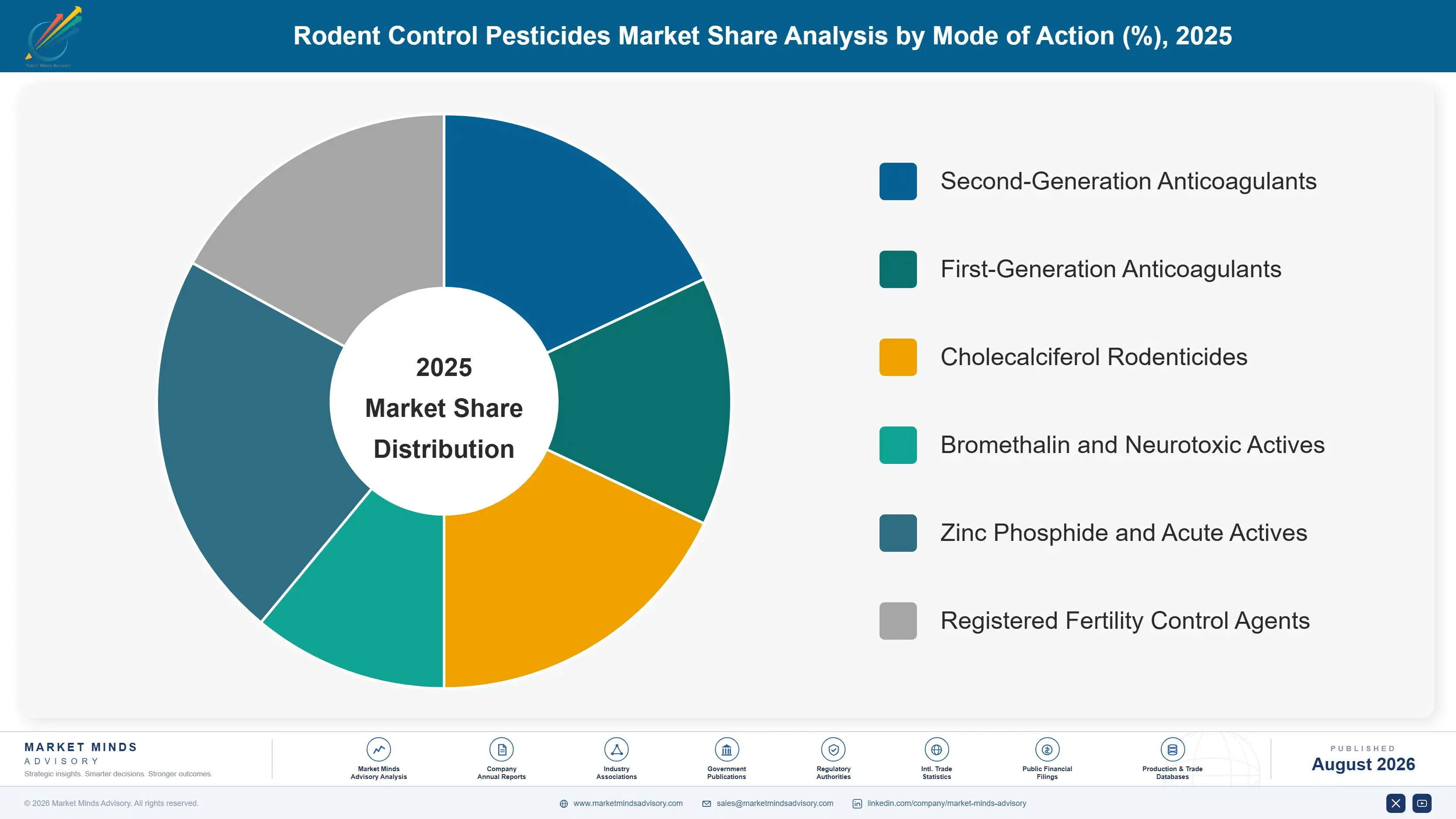
Six segments are split here by the mode of action itself, because the mechanism determines secondary poisoning risk, resistance exposure, regulatory treatment and which applications remain permitted in any given market. Formulation and bait matrix variants sit inside each mode rather than beside them. End-use setting and channel are handled in the framework instead.
rodent-control-pesticides-market-market-share-analysis-1787594960381

Cholecalciferol Rodenticides

Growing at 7.8%, half again the market rate of 5.2%, cholecalciferol causes fatal hypercalcaemia rather than haemorrhage, which gives it a different secondary poisoning profile from anticoagulants and keeps it available where they have been restricted. It also sidesteps anticoagulant resistance entirely, since the mechanism is unrelated to the vitamin K cycle those mutations affect. Growth reflects the removal of alternatives more than any performance advantage, and palatability and bait acceptance require formulation work that anticoagulants did not. Non-target risk is lower rather than absent, which is a distinction regulators are increasingly careful to make. Growth here reflects what has been removed elsewhere rather than any new capability arriving. Regulators distinguish carefully between lower and absent.
CAGR 7.8%

Fertility Control Agents

At 7.2% registered fertility control works by suppressing reproduction rather than killing, which changes the entire proposition from removal to population management over months. That suits sites where sustained pressure matters more than immediate reduction, particularly transport infrastructure, waste facilities and agricultural buildings with persistent reinfestation. Adoption requires customers to accept a slower and less visible result, which is a genuine sales obstacle when a client wants dead rodents as evidence. Regulatory approval as a pesticide was achieved in the United States, and acceptance elsewhere is proceeding at a considerably slower pace. Customers wanting dead rodents as evidence of success find this a difficult proposition to accept, which is the real barrier rather than any question about whether it works.
CAGR 7.2%
Full segment breakdown across 6 segments available in the complete report.

Regional Architecture and Country Demand Map

North America currently holds 30% of value on the largest professional pest management market anywhere in the world today. Western Europe then follows at 22% under the tightest restriction of any region, with East Asia also at 22% across food processing and urban control demand.

North America

The professional pest management sector here is the largest anywhere and accounts for most regional value, with food safety audit requirements making contracts effectively mandatory across food processing and retail. Californian legislation removed most second-generation anticoagulant use across the state, which functioned as a live experiment in operating without the chemistry and pushed adoption of alternatives faster than elsewhere. Digital monitoring adoption is furthest advanced in commercial contracts. Consumer retail rodenticide remains substantial. Growth of 4.4% runs below the base case as restriction offsets underlying demand growth. Restriction here is state-level rather than federal, which produces a patchwork that suppliers manage market by market. Consumer retail rodenticide remains a substantial volume here.
Share: 30% | CAGR: 4.4% (2026 to 2036)

Western Europe

Restriction is tighter here than anywhere, with authorisation reviews progressively narrowing permitted second-generation anticoagulant use and mandating stewardship conditions on professional application. Resistance mapping is also most advanced in this region, with documented genetic resistance across substantial parts of the rodent population in Britain, Germany, France and Denmark. Those two pressures together have driven alternative mode adoption further than regulation alone would have. Digital monitoring has strong penetration in food industry contracts. Growth at 3.6% runs well below the base case throughout the forecast period. Stewardship conditions on professional application are mandated rather than voluntary across most member states. Alternative mode adoption has advanced further than regulation alone would have driven it.
Share: 22% | CAGR: 3.6% (2026 to 2036)
Regional intelligence for 5 additional markets available in the complete report: East Asia, South Asia and Pacific, Latin America, Middle East and Africa, Eastern Europe. Contact sales@marketmindsadvisory.com.
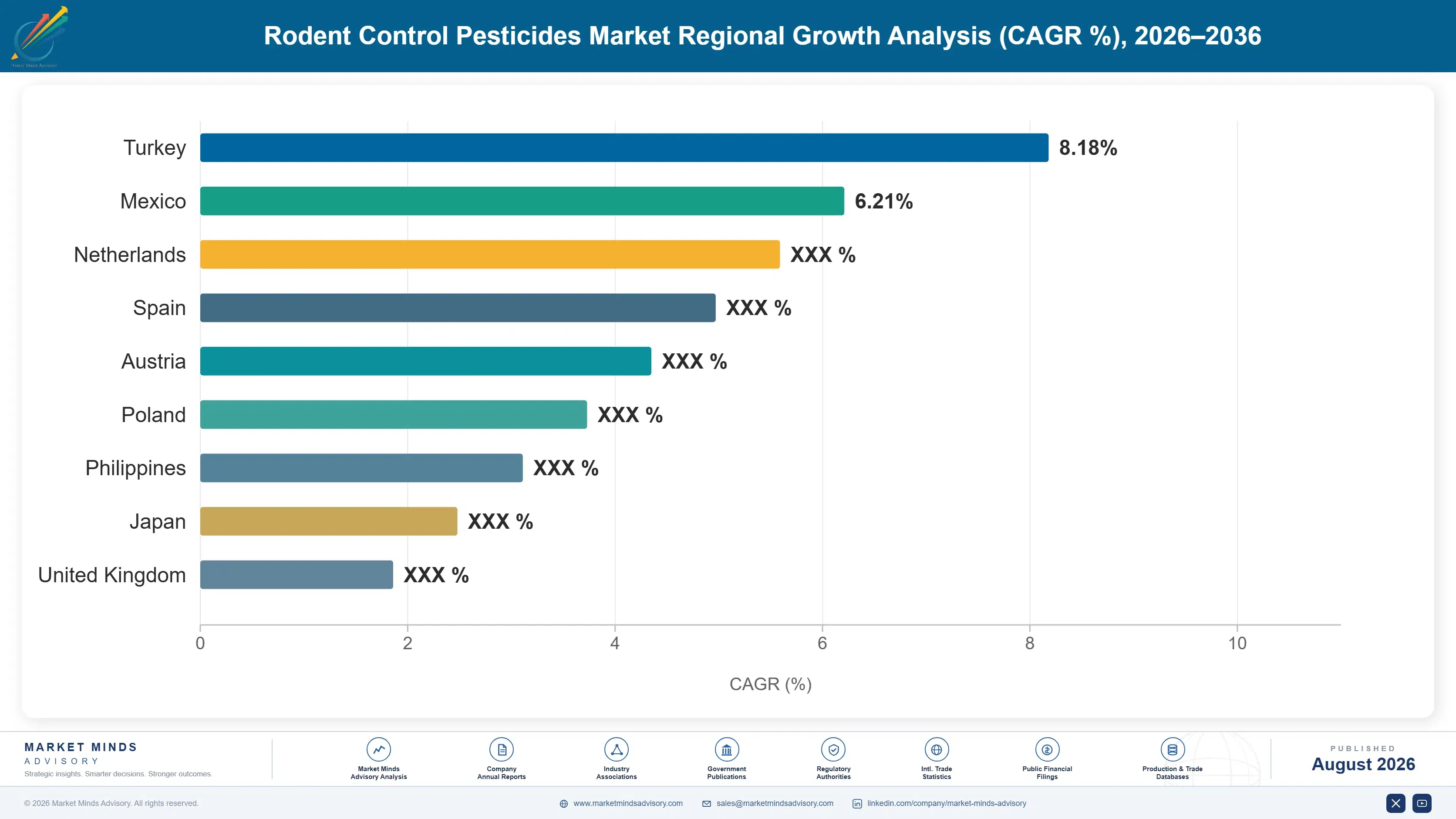
rodent-control-pesticides-market-country-cagr-analysis-1787594960931

Four Moves as the Chemistry Narrows

Defending anticoagulants is a losing position on two fronts simultaneously, since restriction removes the permission to use them and resistance removes the performance. What remains worth holding is mode of action breadth, resistance intelligence, documentation systems and an honest relationship with a channel that profits directly from using less of the product every year.

Build mode of action breadth before restriction reaches you

Restriction has removed second-generation anticoagulant applications across Europe and much of California, and around 42% of rodent populations carry resistance where the chemistry remains permitted. A supplier holding only anticoagulants is exposed on both counts with no answer available inside eleven years of registration timeline. Cholecalciferol, neurotoxic and fertility control actives all grow faster than the market, and breadth across them is the only defensible position as restriction spreads market by market. Licensing an existing registration takes around three years rather than eleven, which decides the question. Restriction spreads market by market rather than everywhere at once.
Market Impact: Answers a 42% resistance frequency directly enough now

Sell resistance mapping as a service, not a datasheet

Roughly 42% of populations carry documented resistance and its distribution is geographically patchy rather than uniform, which means a professional treating a resistant site with anticoagulants fails visibly and repeatedly. Supplying local resistance intelligence turns a supplier into an advisor rather than a bait vendor, and it reaches the technical director rather than the purchasing manager. Very few suppliers offer this at all despite holding the field data that would support it. Treatment failure is visible, repeated and reputationally expensive for a contractor. It reaches a technical director rather than a purchasing function.
Market Impact: Maps the 42% resistance distribution across whole regions

Own the audit documentation the customer actually buys

Food industry customers are managing an audit rather than a rodent, and around 73% of value flows through professionals whose contracts exist because those audits require documented programmes. Supplying monitoring records, treatment logs and compliance reporting alongside product makes the supplier part of what the customer is buying. That position holds even as chemical volumes fall, which is precisely the scenario every anticoagulant supplier should be planning around now. Monitoring records, treatment logs and compliance reporting are the deliverable. That position holds even as chemical volumes decline steadily. Audit evidence is what the customer is actually buying.
Market Impact: Serves the whole 73% professional channel base directly

Partner with monitoring rather than resisting it

Remote monitoring cuts service visits by roughly 38% and improves professional economics, which means the channel will adopt it whatever chemical suppliers prefer. Supplying bait and stations designed to work inside connected systems keeps a supplier present in contracts that use less product per site. Fighting the transition preserves volume briefly and forfeits the relationship afterwards, which several suppliers appear to be choosing without quite admitting it. Being designed into a platform keeps a supplier present as volumes decline. Resisting the transition preserves volume briefly and forfeits everything after. Several suppliers appear to be choosing that quietly.
Market Impact: Accepts a 38% service visit reduction as given

Who Controls the Margin Pool

Participation is measured on annual rodenticide active and formulated product revenue, and the top five hold 61%. Concentration reflects registration cost and data requirements rather than manufacturing, since producing bait is straightforward while maintaining registrations across jurisdictions is not. BASF and Bell Laboratories lead on mode of action breadth and professional channel depth. The gap to challengers is registration portfolio rather than formulation capability. Maintaining registrations across jurisdictions is the genuine barrier.
Competition runs on three fronts. Mode of action breadth decides who still has products where restriction has removed anticoagulants. Professional channel relationships decide access to around 73% of value. Documentation and monitoring integration decide whether a supplier remains relevant as chemical volume per contract falls, which it is doing steadily. Chemical volume per contract is falling steadily everywhere.

Pressure ahead comes from restriction spreading market by market and from service groups adopting monitoring that reduces chemical use. Anticimex has built connected trapping capability across its own service network, which places a large customer partly outside the chemical supply chain. Expect registration investment and monitoring partnerships rather than acquisitions. Rankings shift as restriction reaches further markets. Registration breadth decides who survives the transition.
rodent-control-pesticides-market-company-positioning-matrix-1787594961456

Competitive Moat and Risk Dimensions

BASF

Moat: Mode of action portfolio breadth

Holding registrations across anticoagulant and non-anticoagulant chemistries means restriction in one class removes an option rather than the business, which is a position competitors dependent on a single mode cannot match. Registration portfolios take a decade and considerable expenditure to build, so breadth held today cannot be assembled quickly by anyone deciding they need it now.
BASF

Risk: Shrinking category chemical volume

Every trend in this category points toward less chemical used per site, with monitoring cutting visits by roughly 38% and restriction narrowing permitted applications continuously. A broad registration portfolio protects share in a category whose total chemical volume may decline, which is a different and harder problem than losing share within a growing one.
BELL LABORATORIES

Moat: Professional channel and station integration

Supplying both bait and the stations that hold it, with deep relationships across pest management professionals, keeps the company embedded in contract delivery rather than in product supply alone. That station position also provides a natural route into connected monitoring, since the hardware being instrumented is frequently already the company's own.
BELL LABORATORIES

Risk: Service group vertical integration

Large pest management service groups building their own connected trapping capability move part of the value chain inside their own operations, reducing what they buy externally. A supplier whose position depends on being present in every service contract is exposed when the largest customers decide to build rather than buy the monitoring layer.

Players Tracked

Prominent Players

BASF
Bell Laboratories
Liphatech
Bayer
PelGar International

Other Key Players

Neogen
Syngenta
UPL
Zapi
Impex Europa
Rentokil Initial
Anticimex
SenesTech
Ecolab
Kness Manufacturing
Woodstream
JT Eaton
Barrettine
Detia Degesch
Sumitomo Chemical

Recent Developments

APRIL 2026

European authorisation review narrows permitted anticoagulant applications further

A European authorisation review narrowed permitted second-generation anticoagulant applications and tightened stewardship conditions on professional use, following continued evidence of residues in non-target predatory species. Several formulated products lost approval for specific outdoor application settings entirely. Alternative modes retained approval in those settings throughout. Stewardship conditions tightened simultaneously.
Signal: Restriction removes applications rather than demand, which simply shifts volume toward the alternative available modes instead
OCTOBER 2025

Service group extends connected trapping across commercial contract base

A large pest management service group extended connected trapping and remote monitoring across a substantial share of its commercial contract base, reducing routine inspection visits materially. Chemical bait use per site fell alongside the visit reduction across the affected contracts. Contract pricing was unchanged despite fewer visits.
Signal: The distribution channel for rodenticide has direct commercial reasons to use progressively less of it each year
JANUARY 2026

Resistance survey documents further spread across European populations

A resistance survey documented further geographic spread of vitamin K cycle mutations conferring anticoagulant resistance across European rodent populations, with several previously unaffected regions now showing established resistance. Treatment failure reports had preceded the survey findings in those areas. Rotation guidance was updated across affected regions.
Signal: Resistance distribution is patchy and moving, which makes local intelligence worth more than any product claim

Actives, Grain and Registration

Active substance accounts for roughly 21% of formulated bait cost, which is lower than most crop protection products because inclusion rates are very low. Bait matrix, principally grain, wax and palatability enhancers, carries about 34% and is the largest single element. Manufacturing, packaging and stewardship labelling take around 22%. Registration maintenance across jurisdictions sits outside unit cost and is funded as a continuing programme.
Grain prices rose sharply through 2022 and 2023 following supply disruption and adverse weather across producing regions, per USDA reporting for the period, which mattered more here than active cost movement because the matrix dominates formulated cost. Manufacturers on annual professional distributor agreements absorbed most of it. Wax and paraffin costs moved with petrochemical markets on a separate cycle entirely across the same period. Formulation mix determined who was exposed.

Exposure divides on registration portfolio breadth and on formulation mix. A supplier maintaining registrations across many jurisdictions and several modes of action carries continuing regulatory expenditure that a narrow participant avoids, though that breadth is exactly what restriction makes valuable. Block bait formulations carry higher wax content and different exposure from grain-based products, which gives a mixed portfolio some natural offset against either input moving.
rodent-control-pesticides-market-cost-volatility-analysis-1787594961653

Treat registration maintenance as a continuing strategic programme

Bringing a new active to registration takes around eleven years, while maintaining existing registrations across jurisdictions is a continuing cost narrow participants avoid entirely. That breadth is exactly what restriction makes valuable, since losing one mode removes an option rather than the business. Budgeting it against current chemical volumes systematically underfunds the capability. Restriction makes it valuable.

Balance grain and wax formulation exposure across the portfolio

Bait matrix is around 34% of formulated cost, with grain-based and wax block products drawing on entirely unrelated input cycles. Holding both gives natural offset when either moves sharply, as grain did through 2022 and 2023. Formulation capability across both is modest to maintain and considerably cheaper than carrying single-matrix exposure through a bad harvest year.

Index professional distributor agreements to published grain references

Grain dominates bait matrix cost at a category where active substance is only around 21% of the total, which is the reverse of most crop protection economics. Annual distributor agreements rarely reprice mid-term. Indexing to published references passes movement through with a defined lag, and professional distributors accept it more readily than consumer retail buyers ever will.

Portfolio Architecture for Margin Defence

Margin here follows registration position and channel relationship rather than formulation, which is not difficult for anybody to reproduce. Consumer retail rodenticide earns margins in the low twenties to low thirties, because private label competition is heavy, retail buyers compare on price and the products are functionally interchangeable across brands. Restriction reaches consumer formats before professional ones in most markets. Retail buyers compare purely on shelf price.
Professional anticoagulant and acute bait products do better in the mid thirties to mid forties, because professional distributors value supply reliability and stewardship documentation, and switching a service organisation between products carries training and compliance friction that a consumer purchase does not. Retraining a field workforce across a product range is genuinely expensive. Supply reliability matters as much as documentation to a distributor.

Non-anticoagulant actives and monitoring-integrated systems hold the strongest position, reaching into the mid fifties, because restriction has removed alternatives in growing numbers of markets and integration into connected systems keeps a supplier present as chemical volume falls. Those margins reflect scarcity of permitted options rather than any manufacturing advantage. Scarcity of permitted options rather than manufacturing advantage explains it. Integration keeps a supplier present as volume declines.

Consumer Retail Rodenticide

Retail bait products sold through hardware and grocery channels against heavy private label competition. The eleven point range reflects brand position and retail relationship rather than any functional difference between competing products.
Gross Margin: 21-32%

Professional Anticoagulant and Acute Baits

Professional grade baits supplied with stewardship documentation into pest management distribution channels. The eleven point range reflects distributor relationship depth and the training friction that switching a whole service organisation involves.
Gross Margin: 35-46%

Non-Anticoagulant and Integrated Systems

Cholecalciferol, fertility control and monitoring-integrated products permitted in those markets where the anticoagulants are not. The twelve point range reflects registration breadth and depth of integration into connected monitoring platforms.
Gross Margin: 44-56%
rodent-control-pesticides-market-portfolio-architecture-1787594962149

High-value Sub-segments and Strategic Watch-out

Non-Anticoagulant Active Products

High value and the fastest growth at 7.8%, since restriction removes alternatives faster than any performance advantage would. Registration breadth rather than formulation capability determines who can actually supply these markets. Registration breadth decides who can supply these markets at all. It cannot be assembled quickly by anybody.
Gross Margin: 46-56%

Monitoring-Integrated Bait Systems

High value and growing as connected trapping spreads through professional contracts. Being designed into a monitoring platform keeps a supplier present even as chemical volume per site falls by a third or more. Chemical volume per site falls by a third or more. Platform presence outlasts product volume here.
Gross Margin: 42-54%

Consumer Retail Rodenticide

The volume core, sold through hardware and grocery against heavy private label competition on price alone. Products are functionally interchangeable and restriction reaches consumer formats before professional ones in most markets. Private label competition is heavy and the products are functionally interchangeable between brands. Restriction reaches retail first.
Gross Margin: 21-32%

Anticoagulant-Dependent Portfolios

The strategic watch-out. Restriction removes permission while resistance removes performance, and the twenty-two point range reflects how far a supplier has built alternative modes before both pressures arrive together. Both pressures arriving together is the scenario that removes a business rather than a product line.
Gross Margin: 18-40%

Contracts Rather Than Purchases

Around 73% of value moves through professional service contracts rather than product purchases, which makes demand a function of contract volume and treatment protocol rather than of any buying decision made periodically. Food industry contracts exist because audit schemes require documented programmes, so they persist through economic cycles that would suspend discretionary spending entirely. What varies is how much product each contract consumes. Protocol rather than purchasing decides volume.
Stickiness sits with the service relationship rather than with the chemical. A pest management organisation trained on a product range, with stewardship documentation and compliance procedures built around it, does not switch casually because retraining and revalidating across a field workforce is genuinely expensive. Consumer retail purchases switch on price and shelf position with no friction whatever. Revalidating compliance procedures adds further friction.

The specifying voice has been moving toward the end customer. Technical directors at food processors increasingly specify what their pest contractors may use, sometimes ahead of any regulatory requirement, because residue and reputational concerns reach their own environmental commitments. That places a chemical decision with a party who has never bought rodenticide and never will. Residue concerns reach their own environmental commitments.
rodent-control-pesticides-market-end-use-penetration-index-1787594962641

Where We Would Focus Effort

These are among the four positions where our research anticipates prominent divergence between winners and laggards over the coming forecast period. Each is grounded in the demand model, the regulatory perimeter, and the announced capacity pipeline.
01 / MODE OF ACTION BREADTH

One chemistry is now a single point of failure

Restriction has removed second-generation anticoagulant applications across Europe and most of California, while roughly 42% of rodent populations carry documented resistance where that chemistry remains fully permitted at all. A supplier holding only anticoagulants is exposed on both counts with no answer available inside an eleven year registration timeline for anything genuinely new. Cholecalciferol, neurotoxic and fertility control actives all grow faster than the market, and breadth across them is the only defensible position as restriction keeps spreading market by market.
02 / RESISTANCE INTELLIGENCE SERVICE

Local data beats any product claim

Around 42% of populations carry documented resistance and its distribution is geographically patchy rather than uniform, so a professional treating a resistant site with anticoagulants fails visibly and then repeatedly. Supplying local resistance intelligence turns a supplier into a technical advisor rather than a bait vendor, and it reaches the technical director rather than the purchasing manager who compares bait prices on a spreadsheet. Very few suppliers offer this despite already holding the field data that would support it perfectly well.
03 / AUDIT DOCUMENTATION OWNERSHIP

The customer is managing an audit, not a rodent

Food industry customers hold pest control contracts because audit schemes require documented programmes with monitoring evidence and response records attached to them. Supplying that documentation alongside product makes a supplier part of what the customer is genuinely buying rather than an interchangeable input into somebody else's programme that somebody else has designed for them entirely. That position holds even as chemical volumes decline, which is precisely the scenario every anticoagulant-weighted supplier ought to be planning around seriously at this point.
04 / MONITORING PARTNERSHIP CHOICE

Fighting the transition forfeits the relationship

Remote monitoring cuts professional service visits by roughly 38% and improves contractor economics directly, which means the channel adopts it regardless of what chemical suppliers might have preferred to see happen instead of it. Supplying bait and stations designed to work inside connected systems keeps a supplier present in contracts consuming progressively less product per site each year. Resisting the transition preserves volume briefly and forfeits the relationship afterwards, which several participants appear to be choosing without ever quite saying so plainly.

Engagement Snapshot From the Field

A live engagement with an industry participant carrying material or product regulatory and market exposure ahead of a defining policy shift, showing how our research translates into a defensible multi-year portfolio strategy.
MARKET MINDS ADVISORY · CLIENT ENGAGEMENT SUMMARY
Rodent Control Pesticides Producer Strategic Portfolio Review and Transition Roadmap 2026·Investment Scenario on Rodent Control Pesticides Exposure Evaluation 2025-26
CLIENT PROFILE
A European rodenticide manufacturer producing anticoagulant baits for professional and consumer channels across nine countries, at annual revenue near 74 million euros (client-reported, unverified by MMA). Around ninety percent of revenue came from second-generation anticoagulant products, and the company held no non-anticoagulant registrations anywhere in its portfolio or anywhere under active development anywhere in the business.
STRATEGIC CHALLENGE
Authorisation reviews had narrowed permitted applications in three of the company's markets within two years, and treatment failure complaints were rising in regions where resistance surveys had documented spread. Management were preparing a regulatory lobbying programme and wanted to understand whether defending the chemistry was a viable strategy at all.
MMA APPROACH
MMA mapped restriction trajectories across the client's nine markets against resistance survey data, benchmarked registration acquisition timelines and costs for alternative modes of action, assessed monitoring adoption among the client's professional distributors, and tested whether end customers were specifying ahead of regulation. Interviews with 47 experts covered pest management practice, rodenticide registration and food industry audit requirements.
KEY FINDINGS
  1. Restriction and documented resistance overlapped geographically in only two of the nine markets, meaning most exposure came from one pressure or the other rather than both at once.
  2. Acquiring or licensing a non-anticoagulant registration was achievable within roughly three years, far faster than the eleven years a new active would have required from discovery.
  3. Two large food processing customers had already specified non-anticoagulant programmes across their supplier networks, ahead of any regulatory requirement in those countries.
  4. Professional distributors adopting connected monitoring reported chemical volume per site falling substantially, and none had discussed that trajectory with the client at any point.
CLIENT PROFILE
A European rodenticide manufacturer producing anticoagulant baits for professional and consumer channels across nine countries, at annual revenue near 74 million euros (client-reported, unverified by MMA). Around ninety percent of revenue came from second-generation anticoagulant products, and the company held no non-anticoagulant registrations anywhere in its portfolio or anywhere under active development anywhere in the business.
STRATEGIC CHALLENGE
Authorisation reviews had narrowed permitted applications in three of the company's markets within two years, and treatment failure complaints were rising in regions where resistance surveys had documented spread. Management were preparing a regulatory lobbying programme and wanted to understand whether defending the chemistry was a viable strategy at all.
MMA APPROACH
MMA mapped restriction trajectories across the client's nine markets against resistance survey data, benchmarked registration acquisition timelines and costs for alternative modes of action, assessed monitoring adoption among the client's professional distributors, and tested whether end customers were specifying ahead of regulation. Interviews with 47 experts covered pest management practice, rodenticide registration and food industry audit requirements.
KEY FINDINGS
  1. Restriction and documented resistance overlapped geographically in only two of the nine markets, meaning most exposure came from one pressure or the other rather than both at once.
  2. Acquiring or licensing a non-anticoagulant registration was achievable within roughly three years, far faster than the eleven years a new active would have required from discovery.
  3. Two large food processing customers had already specified non-anticoagulant programmes across their supplier networks, ahead of any regulatory requirement in those countries.
  4. Professional distributors adopting connected monitoring reported chemical volume per site falling substantially, and none had discussed that trajectory with the client at any point.
RECOMMENDED STRATEGY
Phase 1: Phase one: license a non-anticoagulant registration rather than pursuing new active development, since three years against eleven decides the question by itself. Phase 2: Phase two: build resistance mapping into the technical offer, reaching distributor technical directors rather than purchasing functions comparing bait prices. Phase 3: Phase three: reduce the regulatory lobbying programme and redirect that budget toward registration acquisition and monitoring integration work in its place.
OUTCOME
The manufacturer licensed a cholecalciferol registration during 2026 and secured supply into one of the food processing networks that had specified against anticoagulants (client-reported, unverified by MMA). Resistance mapping was launched with distributors, and the lobbying programme was substantially reduced. Consumer channel exposure was reduced deliberately.

Frequently Asked Questions

Foundational context covering the market sizes, CAGR, scope, country, region and competition that inform every finding below. This section is provided to cover basics and most often pre-purchase conversations, answered from the MMA Primary Research Dataset.

What is the current size of the Rodent Control Pesticides Market?

MMA sizes it at USD 1.42 billion in 2025, rising to USD 1.49 billion in 2026. The figure covers registered rodent control products across professional, agricultural and consumer applications at manufacturer selling value.

How large will the Rodent Control Pesticides Market be by 2036?

USD 2.47 billion by 2036, an incremental USD 0.98 billion over the 2026 base and an expansion multiple of 1.66 times. Non-anticoagulant actives account for a disproportionate share.

What is the CAGR for the Rodent Control Pesticides Market 2026 to 2036?

5.2% in the base case, with a bull case at 6.4% and a bear case at 4.0%. The spread turns on new mode registration and on digital monitoring displacement pace.

Which segment is growing fastest?

Cholecalciferol rodenticides at 7.8%, half again the market rate of 5.2%. Growth reflects restriction removing the alternatives rather than any performance advantage over the anticoagulants.

Who are the major companies in the Rodent Control Pesticides Market?

BASF, Bell Laboratories, Liphatech, Bayer and PelGar International lead on rodenticide product revenue. Fifteen further participants are profiled in the full report on that basis.

Which country is growing fastest?

India at 8.4%, driven by urban rodent pressure, expanding organised warehousing and food processing bringing documented pest control requirements alongside modern retail development right across the country.

Report Segmentation Architecture

The full report scope spans multiple orthogonal segmentation dimensions, with cross-tabulated demand data provided for each dimension pair. Coverage extends further to regional breakdowns, trend trajectories, and the competitive detail needed to support segment-level decision-making.

By Mode of Action

  • Second-Generation Anticoagulants
  • First-Generation Anticoagulants
  • Cholecalciferol Rodenticides
  • Bromethalin and Neurotoxic Actives
  • Zinc Phosphide and Acute Actives
  • Registered Fertility Control Agents

By End-Use Industry

  • Food Processing and Manufacturing
  • Warehousing and Logistics
  • Agricultural and Grain Storage
  • Urban and Municipal Control
  • Commercial and Hospitality Premises
  • Residential and Consumer Use

By Commercial Dimension

  • Professional Distributor Supply
  • Direct Service Group Contracts
  • Consumer Retail Channels
  • Agricultural Cooperative Supply
  • Monitoring-Integrated Programmes
  • Export and Cross-Border Supply

By Region

  • North America
  • Western Europe
  • East Asia
  • South Asia and Pacific
  • Latin America
  • Middle East and Africa
  • Eastern Europe

Scope, Methodology, and Coverage

Every figure in this report is reproducible from documented input assumptions. The scope below maps the historical period, the forecast horizon, the segmentation dimensions, and the countries covered, alongside the underlying primary and qualitative methodology.
Historical Period
2020 to 2025
Forecast Period
2026 to 2036
Base Year
2025 (USD billions; MMA Primary Research Dataset, August 2026)
Market Definition
Chemical and biochemical products registered for rodent control across professional, agricultural and consumer applications, covering second-generation anticoagulants, first-generation anticoagulants, cholecalciferol rodenticides, bromethalin and neurotoxic actives, zinc phosphide and acute actives, and registered fertility control agents. Measured at manufacturer selling value across all channels. Mechanical traps and devices, repellents, fumigants used for broader pest control, and pest management service revenue are excluded from scope.
Quantitative Units
USD billions (current prices); thousand tonnes formulated bait; USD per kilogram by mode of action
Segmentation Dimensions
Mode of action; end-use setting; commercial dimension; region
Regions Covered
North America, Western Europe, East Asia, South Asia and Pacific, Latin America, Middle East and Africa, Eastern Europe
Countries Covered
United States, Canada, Mexico, Germany, France, United Kingdom, Netherlands, Denmark, China, Japan, South Korea, India, Indonesia, Vietnam, Australia, Brazil, Argentina, Saudi Arabia, South Africa, Poland
Key Companies Profiled
BASF, Bell Laboratories, Liphatech, Bayer, PelGar International, Neogen, Syngenta, UPL, Zapi, Impex Europa, Rentokil Initial, Anticimex, SenesTech, Ecolab, Kness Manufacturing, Woodstream, JT Eaton, Barrettine, Detia Degesch, Sumitomo Chemical
Quantitative Methodology
Primary survey, n=3,800 respondents, Q4 2025, six countries; demand-side model with trade association cross-validation
Qualitative Methodology
47 expert interviews, Q4 2025; applied to validate demand model assumptions, identify emerging dynamics, and assess competitive positioning
Report Format
PDF and XLSX data workbook (Word format preview document)
Publisher
Market Minds Advisory
Report Code
MMA-2026-AGR-183
Published
August 2026
Contact
sales@marketmindsadvisory.com | www.marketmindsadvisory.com

Purchase the full Rodent Control Pesticides Market Report (2026 to 2036).

The full report maps restriction trajectories against documented resistance distribution, because the two pressures overlap geographically less than the industry assumes and exposure differs sharply between markets. It sizes all six modes of action independently through 2036, quantifies chemical volume displacement from connected monitoring inside professional contracts, and assesses registration portfolio breadth by participant against where restriction is heading next. Regional chapters cover all seven regions with restriction status and resistance data presented separately. Competitive profiling covers 20 participants on a single revenue basis, with registration portfolios assessed alongside commercial position.
Six modes of action sized independently through 2036
Restriction trajectories mapped against documented resistance distribution
Monitoring displacement quantified inside professional service contracts
Registration portfolio breadth assessed by participant and jurisdiction
Twenty participants profiled on one consistent revenue basis
Customer specification tracked ahead of regulatory requirement

Built For The People Who Decide

From boardroom strategy to bench-side execution, this report is read cover-to-cover by leaders shaping the next decade of their industry, turning demand scenarios, market dynamics and valuation benchmarks into decisions.
CXOs/ Presidents/ VPs/ Managers
M&A and Corporate Development
Strategy Teams and R&D Heads
Procurement and Product Directors
Regulatory and Compliance Leaders
Investor Relations and Equity Analysts