Market Minds Advisory
Robotic Massage & Wellness Market

Robotic Massage & Wellness Market: Robotic Massage And Wellness: Labour Substitution, Unattended Operation And The Therapist Who Cannot Be Scaled

A massage therapist can treat six people a day and a machine can treat thirty, which is the entire commercial argument and also the reason the experience has to be good enough.

Lead Analyst

Published

September 2026

Make Smarter Decisions with Customized Research Insights

Request a free sample report and evaluate market opportunities, growth trends, and competitive dynamics relevant to your business needs.

2025 MARKET VALUE$2.4BMarket Size 2025
2036 FORECAST VALUE$8.7BBase Case , 2026 to 2036
CAGR 2026 TO 203612.4 %Bull 13.7% / Bear 11.1%
INCREMENTAL OPPORTUNITY$6.0BNet 10- year value creation
EXPANSION MULTIPLE3.22x2036 value over 2026 base
Strategic Levers
M&A Pipeline
Regional Outlook
Country Rankings
Competitive Intelligence
Segmental Deep-dive
Call-Us : 91 93563 13602

Executive Snapshot and Market Trajectory.

This market exists because massage does not scale. A therapist treats perhaps six people in a working day, cannot work more of them, and takes years to train. Everything here is an attempt to answer that constraint with equipment. Nothing about that constraint is going away.
Unattended commercial placement systems grow fastest at 18.6%, because a machine in an airport, a gym or a shopping centre earns revenue with nobody present to supervise it. Utilisation runs around 31% of available hours against a therapist who is either booked or idle. The operator is buying an asset that works unsupervised rather than a substitute for a person. Nobody is buying a substitute for a person, whatever the marketing happens to claim.
Concentration sits at 45% and rests on manufacturing scale and placement networks rather than on any therapeutic distinction. Consumer chairs and commercial systems are different businesses sharing a heading. Robotic arm systems delivering targeted work are a third thing again, and they are the part regulators have started paying attention to. Selling a chair and operating a placed asset are not variations on the same business at all.
Market Definition
Revenue from powered equipment delivering massage and physical wellness treatment with reduced or no practitioner involvement, covering consumer massage chairs and recliners, unattended commercial placement systems, robotic arm and targeted treatment systems, handheld and localised percussion devices, compression and pneumatic therapy systems, and hydrotherapy and thermal wellness equipment. Excludes therapist-delivered manual massage services, medical rehabilitation equipment used under clinical supervision, spa facility construction and fit-out, and consumables such as oils and linens.
Base Year Value
$2.4B in 2025 (MMA Primary Research Dataset, August 2026)
Forecast Period
2026 to 2036, eleven discrete annual values
CAGR
12.4% base case. Bull 13.7%. Bear 11.1%.
Fastest Growth Segment
Unattended Commercial Placement Systems: 18.6% CAGR
Fastest Growth Country
India: 14.6% CAGR
Fastest Growth Region
South Asia and Pacific: 14.6% CAGR
Largest Region
East Asia: 34% of 2025 global value
Market Leaders
Panasonic, Bodyfriend, OSIM International, Therabody and Fuji Medical Instruments lead on robotic massage and wellness equipment revenue. Source: company annual reports and MMA Primary Research Dataset, July 2026.
Primary Survey
n=3,800 procurement and R&D decision-makers, Q4 2025, six countries
Methodology
Demand-side build-up, cross-validated against public data, 47 expert interviews

Robotic Massage & Wellness Market Forecast Scenarios

robotic-massage-and-wellness-market-size-forecast-scenario-1788165823394
The 2020 to 2025 period shifted this market from a furniture proposition toward a services one. Consumer chair sales grew strongly while people were at home and then normalised, and the more interesting development was commercial placement in venues that had never previously offered any wellness service at all. Therapist shortages worsened across most developed markets. Revenue compounded near 10.9%, with the commercial channel growing considerably faster than consumer chairs.
Three mechanisms carry the base case. Practitioner scarcity continues worsening across developed markets, which makes equipment the only way most operators can add treatment capacity at all. Unattended placement extends wellness revenue into venues with existing footfall and no service staff. And robotic arm systems delivering targeted work are moving from demonstration into commercial deployment at gyms, clinics and recovery studios. None of the three depends on households buying any more chairs at all.
The bull catalyst is insurer or employer reimbursement recognising equipment-delivered treatment, which would convert discretionary consumer spending into funded provision at considerable scale. The bear risk is regulatory: a serious injury involving an unsupervised robotic system would attract classification requirements that most participants in this category are nowhere near ready to satisfy. Nobody is ready.

Massage Does Not Scale

Everything in this market follows from a constraint that no amount of demand can relieve. A massage therapist treats around six clients a day, cannot physically treat more, and takes years to qualify. Demand for treatment has grown steadily and the supply of practitioners has not, which leaves operators choosing between turning customers away and finding equipment that does some version of the work unsupervised.
MARKET CONCENTRATION CR545%Share of equipment revenue held by the leading manufacturers
THERAPIST DAILY CAPACITY6 clientsTypical number a practitioner can treat in one day
UNATTENDED UNIT UTILISATION31%Share of available operating hours a placed system runs
COMMERCIAL PAYBACK PERIOD17 monthsTime for a placed unit to recover its acquisition cost
CONSUMER CHAIR PRICEUSD 3,200Typical retail price for a mid-range domestic massage recliner
SESSION PRICE DIFFERENTIAL4.7 timesTherapist session cost against an equivalent equipment based session
The commercial answer arrived through placement rather than through better chairs. A system installed in an airport, a gym or a shopping centre earns across roughly 31% of available hours unsupervised, and pays back its acquisition cost in about 17 months. That is an asset proposition rather than a wellness one, and the buyers are frequently venue owners with footfall rather than anybody in the treatment business.
The experience question is what decides whether any of this works. A machine session costs roughly a quarter of what a therapist charges, which buys considerable tolerance but not unlimited tolerance. Robotic arm systems delivering genuinely targeted work are the first equipment that a practitioner would describe as doing something rather than approximating it, and they are also the first to attract serious regulatory attention.
"The chairs were always furniture pretending to be therapy. What changed is that somebody worked out a venue with footfall and no staff is a better customer than a household, and the whole category quietly became a placement business."
Director, Wellness Technology Practice · MMA Wellness Technology and Equipment Practice · August 2026

Market Trends

Placement Economics Displaced The Household Sales Model

A unit placed in a venue with existing footfall earns across roughly 31% of available hours and repays its acquisition cost in about 17 months, which is an asset return rather than a retail transaction. Venue operators with no wellness capability at all are buying on exactly that basis. Manufacturers organised around household retail have found themselves selling to a customer who evaluates payback periods rather than comfort, and several have adapted considerably slower than the opportunity moved. Selling to somebody who counts payback months is a different business entirely.
Market Impact: Grows at 18.6% against 12.4%
Practitioner Scarcity Is Structuring Demand Rather Than Preference

Massage therapist supply has not grown with demand across most developed markets, and training a practitioner takes years that no operator can compress. Facilities adding treatment capacity increasingly cannot recruit for it, which turns equipment from a cheaper alternative into the only available option. That is a considerably stronger demand mechanism than consumer enthusiasm, because it applies regardless of whether the buyer would prefer a person doing the work instead. Demand created by an absence of people is more durable than demand created by enthusiasm, because nobody can decide to stop needing it next quarter.
Market Impact: Costs 4.7 times less per session

Market Opportunities and Growth Drivers

Unattended Operation Opens Venues With No Service Staff

A system that runs without supervision can be placed in airports, gyms, hotels, offices and shopping centres that have footfall and no capability to employ treatment staff. That extends the addressable market well beyond wellness operators to anybody holding floor space and passing traffic. Placement systems accordingly grow at 18.6% against a market rate of 12.4%. The buyer is a venue operator evaluating an asset return rather than a wellness business evaluating a treatment. Floor space with passing traffic turns out to be the scarce input rather than treatment capability.
Market Impact: Charges 4.7 times less than therapists

Price Differential Buys Considerable Customer Tolerance

A therapist session costs roughly 4.7 times an equivalent equipment based one, and that gap purchases a great deal of forgiveness for an experience that is plainly not the same thing. Customers comparing a machine against nothing at all reach very different conclusions from customers comparing it against a skilled practitioner. Venue placement generally competes against nothing, which is the most favourable comparison available and the reason the channel works commercially. Nobody placing a unit in an airport is competing against a skilled practitioner, and every manufacturer selling into that channel should understand why.
Market Impact: Operates with 0 staff present

Market Restraints and Challenges

Equipment Cannot Yet Replicate What A Practitioner Assesses

A therapist adjusts continuously to what they find in the tissue, and equipment executes a programme against a body it does not genuinely understand. The root cause is that assessment rather than force application is the skilled part of the work. Commercially it caps what equipment can charge and confines it to applications where the comparison is against no treatment at all. Mitigation runs through pressure sensing and adaptive control, body mapping, robotic arm targeting, and honest positioning against the practitioner comparison. No amount of programming replaces the judgement in a practitioner's hands.
Market Impact: Repays acquisition in 17 months

Unsupervised Operation Carries Injury And Liability Exposure

Equipment applying substantial force to a body with nobody present creates exposure that a supervised treatment does not, and contraindications the customer may not disclose or understand. The root cause is that unattended operation removes the judgement a practitioner would apply automatically. Commercially it concentrates risk on venue operators who have no clinical capability. Mitigation runs through force limiting, screening questionnaires, remote monitoring, contraindication interlocks and clear operator training on who should not use these systems. Every one of those measures adds cost that outright sale competitors decline to carry.
Market Impact: Serves 6 clients per therapist
4 additional market trends, 3 additional growth drivers, and 2 additional restraints and challenges are covered in the full report. Contact sales@marketmindsadvisory.com to access the complete intelligence.

Segment CAGR and Growth Architecture

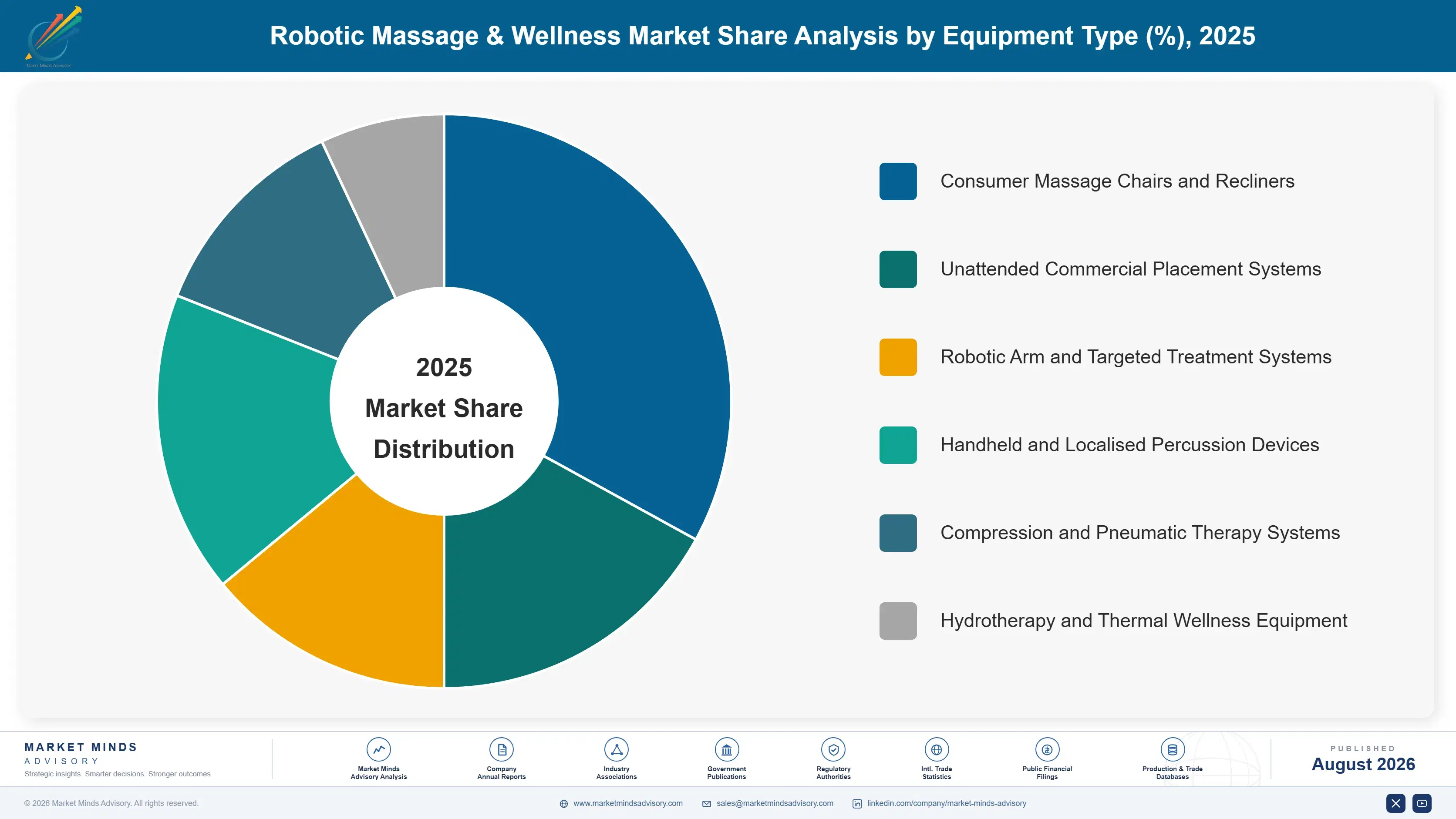
Segmentation follows equipment type, because each carries a different buyer, a different operating model and a different degree of regulatory exposure despite all of them applying pressure to a body. Six types describe the market completely, from handheld percussion devices bought individually through to unattended placement systems purchased as revenue generating assets by venue operators.
robotic-massage-and-wellness-market-market-share-analysis-1788165823952

Unattended Commercial Placement Systems

The fastest type grows at 18.6%, half again the market rate of 12.4%, and the buyer is what makes it interesting. A venue operator with footfall and no treatment staff evaluates a placed unit on utilisation and payback rather than on therapeutic merit, and at roughly 31% of available hours with a 17 month payback the asset case stands on its own. Airports, gyms, hotels, offices and shopping centres are all buying on exactly that reasoning. The competitive comparison is against no treatment being available at all, which is by some distance the most favourable position any equipment in this market ever occupies. Nothing else in this market ever competes so favourably.
CAGR 18.6%

Robotic Arm and Targeted Treatment Systems

Robotic arm systems grow at 16.2% and are the first equipment in this category a practitioner would describe as doing something rather than approximating it. Pressure sensing, body mapping and articulated delivery allow targeted work on specific tissue rather than a programmed sequence applied to whatever happens to be in the chair. That capability is also what has attracted regulatory attention, since a system applying meaningful force with genuine precision sits considerably closer to a treatment device than a recliner does. Deployment is moving from demonstration into gyms, recovery studios and clinical settings at pace. Being genuinely good is what creates the regulatory question in the first place, which is awkward.
CAGR 16.2%
Full segment breakdown across 6 segments available in the complete report.

Regional Architecture and Country Demand Map

Adoption follows manufacturing capability, practitioner scarcity and cultural familiarity with equipment-delivered treatment. East Asia leads on both production and consumption, with South Asia and Pacific growing fastest and Western markets adopting commercial placement faster than household purchase. Manufacture and consumption very largely coincide in this category.

East Asia

Out-of-band note: this region holds 34% against a band of 22 to 30% because it both manufactures and consumes the great majority of this equipment, and no segmentation reasonably distributes that away. Japanese and Korean households treat massage chairs as ordinary furniture rather than as a novelty purchase, which produced a domestic market nowhere else has matched. Chinese manufacture supplies almost every price point globally. Unattended placement in transport hubs and shopping centres has been routine here for considerably longer than in Western markets. Familiarity of that kind is a genuine commercial asset, since a household treating a massage chair as ordinary furniture requires none of the explanation that Western buyers still need before they will consider one.
Share: 34% | CAGR: 13.6% (2026 to 2036)

North America

Commercial placement has grown faster than household purchase here, driven by venue operators who evaluate a unit on payback rather than on any wellness proposition. Practitioner scarcity is acute and worsening, which pushes gyms, recovery studios and clinics toward equipment they would previously have resisted. Recovery and performance positioning rather than relaxation has proved the more effective commercial framing. Consumer chair adoption remains constrained by price and by the amount of floor space the units actually require. Recovery positioning works here because it attaches equipment to something the buyer already believes in, whereas relaxation positioning asks them to accept a machine in place of a person and generally fails at that.
Share: 24% | CAGR: 13.0% (2026 to 2036)
Regional intelligence for 5 additional markets available in the complete report: Western Europe, South Asia and Pacific, Latin America, Middle East and Africa, Eastern Europe. Contact sales@marketmindsadvisory.com.
robotic-massage-and-wellness-market-country-cagr-analysis-1788165824476

Where Massage Equipment Margin Sits

Four levers work on placement economics, operating models and positioning rather than on the equipment itself, which competes on comfort and specification that buyers struggle to distinguish. Placement network building, revenue sharing, targeted capability and safety design each address something a manufacturer controls now. None of the four requires a better chair than anybody else already makes.

Build A Placement Network Rather Than Selling Units

A venue operator buying a unit is a single transaction, while a placement network operating units across many venues is a recurring revenue business with an asset base behind it. Utilisation around 31% and a 17 month payback support that model comfortably. Manufacturers selling equipment outright hand the recurring economics to whoever operates it. Building placement capability requires site acquisition, servicing and cash collection that a manufacturing organisation has no natural reason to hold at all. The 17 month payback belongs to whoever owns the unit rather than whoever built it.
Market Impact: Operates placed units at roughly 31% utilisation rates

Offer Revenue Share Instead Of Capital Purchase

Many venue operators with ideal footfall will not commit capital to equipment they cannot evaluate, and a revenue share arrangement removes that obstacle entirely while keeping the manufacturer in the recurring economics. Typical splits run 30 to 40 percent to the venue. The manufacturer carries the asset and the risk and receives a considerably better return than an outright sale produces. Placement footprint expands faster because the venue decision stops being a capital one. A venue contributing floor space and footfall is contributing exactly what the manufacturer actually lacks most.
Market Impact: Shares roughly 35% of revenue with venue operators

Invest In Targeted Capability Over Comfort Features

Robotic arm and pressure sensing systems delivering genuinely targeted work grow at 16.2% and command session pricing that programmed chairs cannot approach. Buyers can distinguish targeted treatment from a sequence of rollers, and they cannot distinguish one comfort specification from another. Development cost is higher and the competitive position is far more defensible. Manufacturers still competing on upholstery, programme count and heating features are competing on attributes no customer evaluates properly. Buyers who can tell the difference will pay for it, and buyers who cannot were never paying much anyway.
Market Impact: Grows at 16.2% against a 12.4% market rate

Design Safety For Genuinely Unattended Operation

Equipment applying substantial force with nobody present carries exposure that no venue operator is equipped to manage, and one serious incident would attract classification requirements across the category. Force limiting, contraindication screening and remote monitoring cost perhaps 4% of unit cost to build in properly. Manufacturers who designed for supervised use and then sold into unattended placement are carrying a risk they have not priced. The regulators have started looking at exactly this. Building it in from the start costs 4% and adding it afterwards costs considerably more than that later.
Market Impact: Costs roughly 4% of the total unit cost

Who Controls the Margin Pool

Concentration sits around 45% across the five largest participants measured on robotic massage and wellness equipment revenue, and the group spans businesses with very little in common. Consumer chair manufacturers, handheld device brands and commercial placement operators share a heading and almost no customer overlap. Manufacturing scale rather than therapeutic capability explains most of the concentration that exists. The heading is doing a lot of work.
Competition runs on placement access, operating model and demonstrable capability. Placement access decides who reaches venues with footfall, which is where the growth sits. Operating model decides whether a manufacturer earns once or continuously. Demonstrable capability decides session pricing, and it is the one dimension where robotic arm systems genuinely separate themselves from programmed chairs. Nobody competes on all three.

Pressure is arriving from recovery equipment brands and from placement operators rather than from traditional chair manufacturers. Recovery brands hold gym and studio relationships that chair makers have never possessed. Independent placement operators control venue access and treat manufacturers as suppliers. Rankings will shift toward participants holding placement networks and targeted capability, since one captures recurring revenue and the other supports the pricing.
robotic-massage-and-wellness-market-company-positioning-matrix-1788165825001

Competitive Moat and Risk Dimensions

PANASONIC

Moat: Manufacturing scale and domestic base

Panasonic manufactures at a scale and quality level that smaller participants cannot approach, supported by a domestic market where massage chairs are ordinary household furniture rather than a novelty. That base funds engineering investment which purely commercial participants cannot justify. Distribution and service networks across East Asia reach both household and commercial buyers without additional infrastructure being required.
PANASONIC

Risk: Household model versus placement growth

Growth in this market has moved toward commercial placement where the buyer evaluates payback rather than comfort, and a household-oriented product and channel organisation is poorly matched to that customer. Placement requires site operations capability that a manufacturer has no reason to hold. Competitors organised around venues rather than living rooms are taking exactly the segment that is growing fastest.
THERABODY

Moat: Recovery positioning and studio relationships

Therabody built recovery and performance positioning that reaches gyms, studios and athletes rather than relaxation buyers, which has proved the more commercially effective framing in Western markets by some distance. Those relationships give it venue access that chair manufacturers have never had. Brand recognition among a demographic that buys wellness equipment repeatedly rather than once supports range extension effectively.
THERABODY

Risk: Limited unattended placement capability

Handheld and localised devices do not address the unattended placement economics driving the fastest growth in this market, where a unit earns across available hours without anybody present. Building placement systems requires engineering and site operations capability outside the current product line. Recovery positioning also competes with an increasingly crowded field of similar devices.

Players Tracked

Prominent Players

Panasonic
Bodyfriend
OSIM International
Therabody
Fuji Medical Instruments

Other Key Players

Inada Family
Luraco Technologies
Human Touch
Positive Posture
Hypervolt by Hyperice
Aescape
Massage Robotics
Bodyweather
iRest
RoTai
Ogawa World
Comfier
Dr Wellness Spa
Recovery Systems
Normatec

Recent Developments

JULY 2024

Robotic arm massage system entered commercial fitness deployment

A robotic arm massage system with pressure sensing and body mapping moved from demonstration into commercial deployment at fitness and recovery facilities, delivering targeted treatment on specific tissue rather than programmed sequences. This was a commercial rollout rather than any acquisition, merger or joint venture between participants.
Signal: Targeted robotic delivery is the first equipment here that practitioners describe as genuinely doing something useful.
JANUARY 2025

Placement operator agreed revenue sharing across transport venues

A placement business agreed revenue sharing arrangements covering massage systems installed across transport venues, removing the capital decision from venue operators while retaining the recurring economics for itself. This was a commercial operating agreement rather than any acquisition, merger or corporate transaction between the parties involved.
Signal: Removing the capital decision expands placement footprint considerably faster than any equipment improvement ever manages to.
APRIL 2025

Regulator opened review of unsupervised force applying equipment

A regulator opened a review of equipment applying substantial mechanical force to users without supervision present, examining contraindication screening, force limiting and operator responsibility across commercially placed wellness systems. This was a regulatory proceeding rather than any commercial arrangement between any of the manufacturers concerned in it.
Signal: Unattended operation was always the commercial advantage and it is now also the regulatory question too.

What A Placed Unit Costs

Cost divides four ways and the mechanism is smaller than the object suggests. Frame, upholstery and mechanical assembly absorb roughly 34% of unit cost, actuators, motors and control electronics near 27%, logistics and installation near 22%, and servicing with warranty provision the remaining 17%. A placed commercial unit adds site operations and cash handling on top, which manufacturers selling outright never encounter and placement operators discover quickly.
Actuator, motor and control electronics pricing moved sharply across recent years and raised unit cost accordingly, since these are mechanically complex products with substantial component content. Panasonic and OSIM International have both discussed component cost and supply conditions across recent reporting periods. Shipping cost for a bulky heavy item has moved further still, and it matters disproportionately because a massage chair is expensive to move.

Exposure varies by business model rather than by geography. Manufacturers selling units outright recover cost at the point of sale and carry warranty exposure afterwards. Placement operators carry the asset, the servicing and the utilisation risk, and recover across roughly 17 months. Revenue share arrangements distribute that differently again, with the manufacturer holding the asset and the venue contributing only floor space and footfall.
robotic-massage-and-wellness-market-cost-volatility-analysis-1788165825195

Component commonality across consumer and commercial ranges

Actuators, motors and control electronics absorb roughly a quarter of unit cost and are frequently specified differently across product ranges for no engineering reason at all. Common component platforms across consumer and commercial units improve purchasing position measurably. Most manufacturers in this category developed ranges separately and have never consolidated the parts underneath them.

Servicing designed for placed unit uptime economics

A placed unit earning across roughly a third of available hours loses revenue directly whenever it is out of service, which makes serviceability a commercial specification. Modular replacement and remote diagnostics reduce downtime substantially at modest design cost. Manufacturers designing for household use rarely consider uptime at all, because a household chair sitting idle costs nobody anything.

Freight cost designed into product architecture early

A massage chair is bulky, heavy and awkward, and shipping cost is a meaningful share of the delivered price on every unit sold. Designing for modular shipment and site assembly reduces that considerably and is generally considered far too late in development. Participants who engineered for freight early carry a durable cost advantage that competitors cannot easily recover afterwards.

Portfolio Architecture for Margin Defence

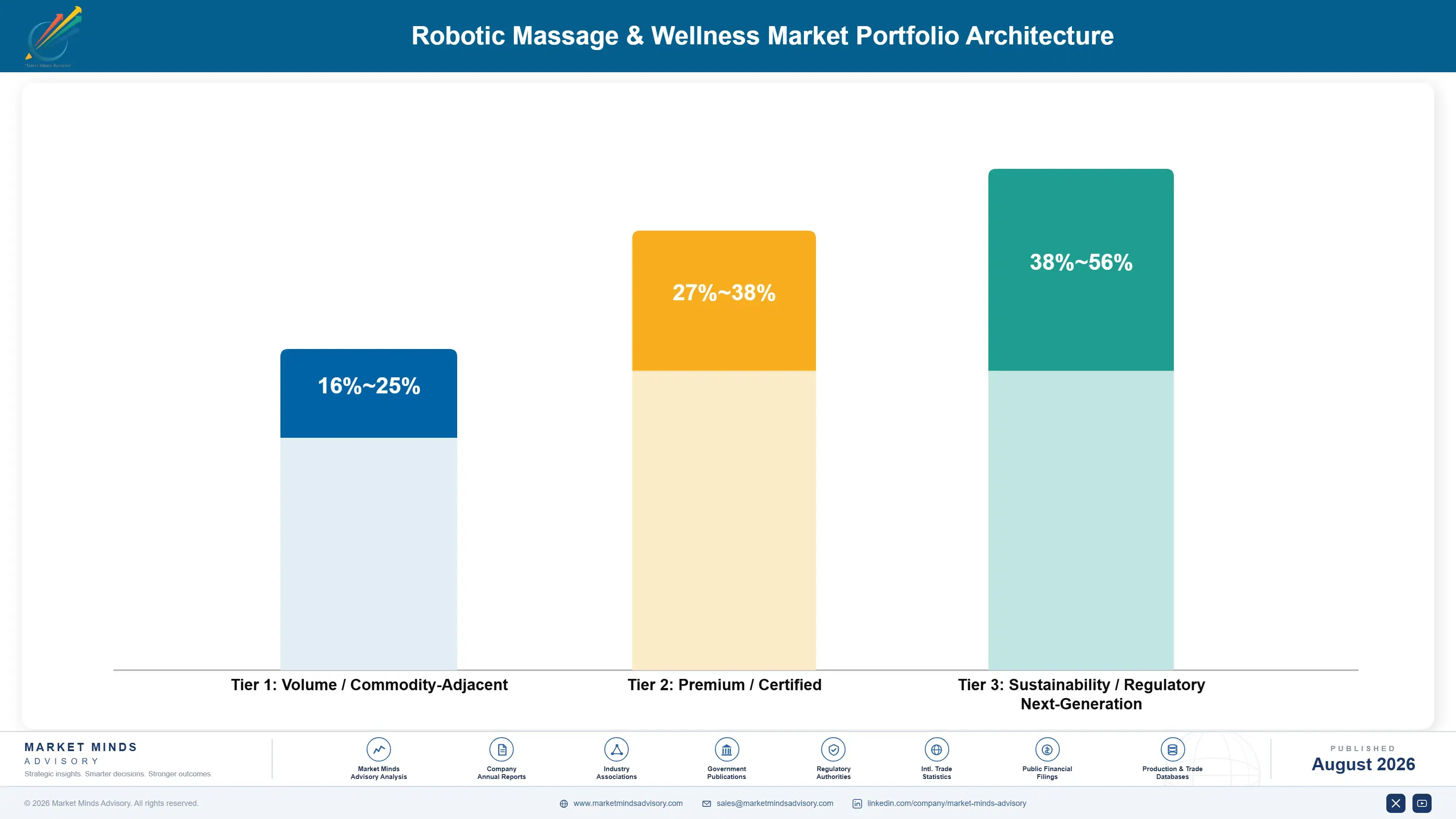
The portfolio separates by who owns the earning asset. Consumer chairs and handheld devices are the volume core: large unit sales, a single transaction, and margins reflecting competition on comfort specifications that buyers cannot meaningfully compare. Substantial revenue, no recurring economics, and a product that sits in a living room generating nothing for the manufacturer afterwards. The manufacturer earns once and then stops.
Margin concentrates in commercial placement and targeted robotic systems, and for different reasons. Placement produces recurring revenue against an asset earning across roughly a third of available hours. Targeted robotic delivery supports session pricing that programmed chairs cannot approach, because the customer can actually tell the difference. Both require capabilities that chair manufacturing organisations have no natural reason to hold. Neither is a chair manufacturing capability.

The overlooked pool is revenue share operation. Many venues with ideal footfall will not commit capital to equipment they cannot evaluate, and a share arrangement removes that obstacle while keeping the manufacturer in the economics. Placement footprint expands considerably faster because the venue decision stops being a capital one at all. Almost nobody in this category offers that arrangement yet.

Volume / Commodity-Adjacent

Consumer massage chairs, recliners and handheld percussion devices sold outright to households. Range spans nine points because manufacturing scale and freight efficiency decide outcomes far more than product specification does.
Gross Margin: 16-25%

Premium / Certified

Premium consumer chairs, compression therapy systems and hydrotherapy and thermal wellness equipment. Range spans eleven points because brand position and channel structure vary considerably between participants in this tier. Channel structure decides it.
Gross Margin: 27-38%

Sustainability / Regulatory / Next-Generation

Unattended commercial placement operation, revenue share arrangements and targeted robotic treatment systems. Range spans eighteen points because recurring operation and equipment sale economics are barely comparable inside one tier. Recurrence changes everything.
Gross Margin: 38-56%
robotic-massage-and-wellness-market-portfolio-architecture-1788165825686

High-value Sub-segments and Strategic Watch-out

Unattended Commercial Placement Systems

High value and high growth at 18.6%, earning across available hours with nobody present to supervise the operation. The fourteen point range separates operators holding placement networks and recurring revenue from manufacturers who simply sell the units outright once. The buyer is a venue rather than a household.
Gross Margin: 42-56%

Robotic Arm and Targeted Treatment Systems

High value with moderate growth at 16.2%, delivering work a practitioner would recognise rather than a programmed roller sequence. The twelve point range reflects regulatory positioning, since targeted force delivery attracts classification questions that recliners never had to answer. Capability rather than comfort supports the pricing.
Gross Margin: 36-48%

Consumer Massage Chairs and Handheld Devices

The volume core, sold once to a household and generating nothing for anybody afterwards. Competition on comfort specifications that buyers cannot compare, heavy freight cost on every unit, and no recurring economics of any kind behind the transaction. Everybody starts here and the economics stop there.
Gross Margin: 16-25%

Unsupervised Operation Liability

The strategic watch-out rather than a growth pool. Equipment applying real force with nobody present concentrates risk on venue operators with no clinical capability, and a single serious incident would reclassify the whole category. Nobody in this category has priced that exposure properly yet at all.
Gross Margin: Variable

Why Placement Revenue Recurs

Placement produces annuity economics that equipment sales never approach. A unit earning across roughly 31% of available hours generates revenue daily, repays acquisition in about 17 months and continues for its service life. A chair sold to a household generates nothing after the transaction closes. That difference is the most important commercial fact here and few manufacturers have organised around it.
Stickiness varies by who controls the site. Placement operators holding venue relationships and site agreements are genuinely difficult to displace, since a venue changing supplier means removing working equipment and installing an unproven alternative. Revenue share arrangements are stickier still, because the venue has no capital at risk and no reason to disturb the arrangement. Household sales have no stickiness at all, and nothing to be sticky about.

The buyer has changed almost completely and the industry took a while to notice. Early demand came from households buying furniture for a living room. Growth now comes from venue operators evaluating utilisation, payback and floor space return, and from gym and studio operators who cannot recruit practitioners. Manufacturers whose commercial approach was built for retail find both buyers ask questions their sales material never addressed.
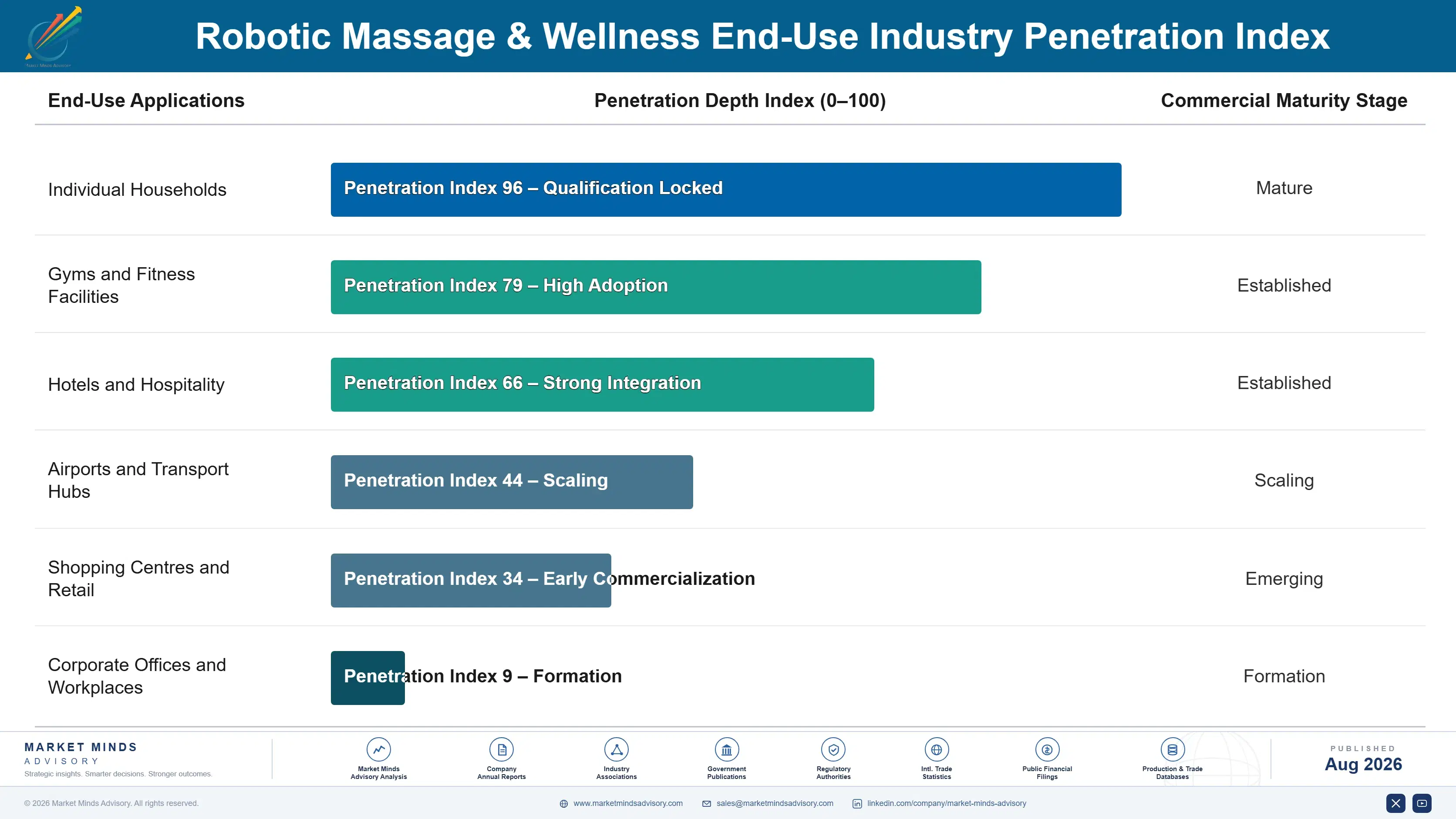
robotic-massage-and-wellness-market-end-use-penetration-index-1788165826175

Where Manufacturers Should Commit

These are among the four positions where our research anticipates prominent divergence between winners and laggards over the coming forecast period. Each is grounded in the demand model, the regulatory perimeter, and the announced capacity pipeline.
01 / PLACEMENT NETWORK BUILDING

Own the earning asset rather than selling it once

A venue operator buying a unit outright is a single transaction, while a placement network operating units across many separate venues is a recurring revenue business with a real asset base sitting behind it entirely. Utilisation around 31% and a payback of roughly seventeen months support that model comfortably in most reasonable locations. Manufacturers selling equipment outright hand all the recurring economics to whoever ends up operating it, which is a decision very few of them examined properly at all.
02 / REVENUE SHARE STRUCTURING

Remove the capital decision from the venue entirely

Many venue operators who hold ideal footfall will not commit any capital to equipment they have no real ability to evaluate, and a revenue share arrangement removes that obstacle completely while keeping the manufacturer inside the recurring economics of it. Typical splits in practice run thirty to forty percent to the venue operator itself. The manufacturer carries the asset and the utilisation risk and receives a considerably better long-term return than any outright sale would ever produce for it anywhere.
03 / TARGETED CAPABILITY INVESTMENT

Buyers can tell targeted work from rollers

Robotic arm and pressure sensing systems that deliver genuinely targeted treatment work grow at 16.2% against a market rate of 12.4% and they command session pricing that programmed chairs simply cannot approach anywhere at all. Customers can readily distinguish targeted work from a mere sequence of rollers, and they cannot distinguish one comfort specification from another one at all. Manufacturers who still compete on upholstery, programme counts and heating features are competing on attributes that nobody actually evaluates at all.
04 / UNATTENDED SAFETY DESIGN

One incident reclassifies this entire category

Equipment applying substantial mechanical force with nobody present carries an exposure that no venue operator is remotely equipped to manage, and a single serious incident would attract classification requirements across every single participant in this market. Force limiting, contraindication screening and remote monitoring together cost perhaps four percent of unit cost to build in properly right from the start. Manufacturers who designed their products for supervised use and then sold them into unattended placement are carrying an entirely unpriced risk.

Engagement Snapshot From the Field

A live engagement with an industry participant carrying material or product regulatory and market exposure ahead of a defining policy shift, showing how our research translates into a defensible multi-year portfolio strategy.
MARKET MINDS ADVISORY · CLIENT ENGAGEMENT SUMMARY
Robotic Massage & Wellness Producer Strategic Portfolio Review and Transition Roadmap 2026·Investment Scenario on Robotic Massage & Wellness Exposure Evaluation 2025-26
CLIENT PROFILE
A massage chair manufacturer selling premium consumer units through retail and a commercial range sold outright to gyms and hotels, with no placement operation and no recurring revenue of any kind. Unit volumes had grown steadily while margin declined across three years, and management had responded by adding programme features and upholstery options that buyers had not asked for.
STRATEGIC CHALLENGE
The board needed to establish whether the commercial range should continue being sold outright or operated under placement, and whether a revenue share structure would expand footprint enough to justify carrying the assets. It also faced a decision on investing in pressure sensing and targeted delivery, which engineering regarded as expensive and unnecessary against existing programmed systems.
MMA APPROACH
MMA rebuilt margin by channel and by unit across three years, modelling outright sale against placement operation and revenue share under several utilisation assumptions. It assessed the client's commercial units in venues already operating them to establish actual utilisation. Expert interviews with venue operators, gym chains, placement businesses and practitioners established what buyers evaluate and what they will pay for.
KEY FINDINGS
  1. Units the client had sold outright to venues were generating recurring revenue for their owners that exceeded the original sale price within roughly two years of installation.
  2. Venue operators interviewed overwhelmingly preferred a revenue share arrangement, and several had declined outright purchase purely on the capital decision that it involved.
  3. Programme features and upholstery options added across three years showed no relationship with purchase decisions in any commercial channel the client served.
  4. Practitioners and gym operators could distinguish targeted pressure sensing delivery from programmed sequences immediately, and priced sessions accordingly at a meaningful premium.
CLIENT PROFILE
A massage chair manufacturer selling premium consumer units through retail and a commercial range sold outright to gyms and hotels, with no placement operation and no recurring revenue of any kind. Unit volumes had grown steadily while margin declined across three years, and management had responded by adding programme features and upholstery options that buyers had not asked for.
STRATEGIC CHALLENGE
The board needed to establish whether the commercial range should continue being sold outright or operated under placement, and whether a revenue share structure would expand footprint enough to justify carrying the assets. It also faced a decision on investing in pressure sensing and targeted delivery, which engineering regarded as expensive and unnecessary against existing programmed systems.
MMA APPROACH
MMA rebuilt margin by channel and by unit across three years, modelling outright sale against placement operation and revenue share under several utilisation assumptions. It assessed the client's commercial units in venues already operating them to establish actual utilisation. Expert interviews with venue operators, gym chains, placement businesses and practitioners established what buyers evaluate and what they will pay for.
KEY FINDINGS
  1. Units the client had sold outright to venues were generating recurring revenue for their owners that exceeded the original sale price within roughly two years of installation.
  2. Venue operators interviewed overwhelmingly preferred a revenue share arrangement, and several had declined outright purchase purely on the capital decision that it involved.
  3. Programme features and upholstery options added across three years showed no relationship with purchase decisions in any commercial channel the client served.
  4. Practitioners and gym operators could distinguish targeted pressure sensing delivery from programmed sequences immediately, and priced sessions accordingly at a meaningful premium.
RECOMMENDED STRATEGY
Phase 1: Phase one: stop selling commercial units outright and move the range onto revenue share arrangements agreed with venue operators instead of outright. Phase 2: Phase two: build site operations, servicing and cash collection capability, which the manufacturing organisation currently has no version of at all. Phase 3: Phase three: invest in pressure sensing and targeted delivery, and stop adding comfort features that no buyer has ever evaluated.
OUTCOME
The client reported recurring revenue reaching a meaningful share of the commercial range within five quarters (client-reported, unverified by MMA). Placement footprint expanded considerably faster under the revenue share model. Comfort feature development was halted entirely, and a targeted delivery programme entered engineering development shortly afterwards.

Frequently Asked Questions

Foundational context covering the market sizes, CAGR, scope, country, region and competition that inform every finding below. This section is provided to cover basics and most often pre-purchase conversations, answered from the MMA Primary Research Dataset.

What is the current size of the Robotic Massage & Wellness Market?

The market is valued at USD 2.4 billion in 2025, measured as revenue from powered equipment delivering massage and physical wellness treatment with reduced practitioner involvement.

How large will the Robotic Massage & Wellness Market be by 2036?

MMA forecasts USD 8.68 billion by 2036, up from USD 2.70 billion in 2026. That represents incremental revenue of USD 5.98 billion and an expansion multiple of 3.22 times.

What is the CAGR for the Robotic Massage & Wellness Market 2026 to 2036?

The base case CAGR is 12.4%, with a bull case of 13.7% and a bear case of 11.1%. Unattended commercial placement supplies the largest part of that growth.

Which segment is growing fastest?

Unattended commercial placement systems grow at 18.6%, half again the market rate of 12.4%, because a placed unit earns revenue with nobody present to supervise it.

Who are the major companies in the Robotic Massage & Wellness Market?

Panasonic, Bodyfriend, OSIM International, Therabody and Fuji Medical Instruments lead on equipment revenue, holding around 45% between them across a genuinely broad and varied category.

Which country is growing fastest?

India grows fastest at 14.6%, driven by commercial placement in malls, airports and gyms where footfall is enormous and treatment staff are scarce and expensive.

Report Segmentation Architecture

The full report scope spans multiple orthogonal segmentation dimensions, with cross-tabulated demand data provided for each dimension pair. Coverage extends further to regional breakdowns, trend trajectories, and the competitive detail needed to support segment-level decision-making.

By Equipment Type

  • Consumer Massage Chairs and Recliners
  • Unattended Commercial Placement Systems
  • Robotic Arm and Targeted Treatment Systems
  • Handheld and Localised Percussion Devices
  • Compression and Pneumatic Therapy Systems
  • Hydrotherapy and Thermal Wellness Equipment

By End-Use Industry

  • Individual Households
  • Gyms and Fitness Facilities
  • Hotels and Hospitality
  • Airports and Transport Hubs
  • Shopping Centres and Retail
  • Corporate Offices and Workplaces

By Commercial Dimension

  • Outright Equipment Sale
  • Placement Network Operation
  • Revenue Share Arrangements
  • Equipment Leasing and Rental
  • Retail and Online Distribution
  • Contract Manufacture Supply

By Region

  • East Asia
  • North America
  • Western Europe
  • South Asia and Pacific
  • Latin America
  • Middle East and Africa
  • Eastern Europe

Scope, Methodology, and Coverage

Every figure in this report is reproducible from documented input assumptions. The scope below maps the historical period, the forecast horizon, the segmentation dimensions, and the countries covered, alongside the underlying primary and qualitative methodology.
Historical Period
2020 to 2025
Forecast Period
2026 to 2036
Base Year
2025 (USD billions; MMA Primary Research Dataset, August 2026)
Market Definition
Revenue from powered equipment delivering massage and physical wellness treatment with reduced or no practitioner involvement, spanning consumer massage chairs and recliners, unattended commercial placement systems, robotic arm and targeted treatment systems, handheld and localised percussion devices, compression and pneumatic therapy systems, and hydrotherapy and thermal wellness equipment. Outright equipment sale, placement network operation, revenue share arrangements, leasing and rental, retail distribution and contract manufacture supply are all included. Therapist-delivered manual massage services, clinically supervised rehabilitation equipment, spa facility construction, and consumables such as oils and linens are excluded.
Quantitative Units
USD billions, equipment and placement operation revenue
Segmentation Dimensions
Equipment type, venue or user setting, commercial operating model, region
Regions Covered
East Asia, North America, Western Europe, South Asia and Pacific, Latin America, Middle East and Africa, Eastern Europe
Countries Covered
Japan, South Korea, China, United States, Canada, United Kingdom, Germany, France, India, Australia, Brazil, Mexico, United Arab Emirates, Poland
Key Companies Profiled
Panasonic, Bodyfriend, OSIM International, Therabody, Fuji Medical Instruments, Inada Family, Aescape, Luraco Technologies, Human Touch, Ogawa World
Quantitative Methodology
Primary survey, n=3,800 respondents, Q4 2025, six countries; demand-side model with trade association cross-validation
Qualitative Methodology
47 expert interviews, Q4 2025; applied to validate demand model assumptions, identify emerging dynamics, and assess competitive positioning
Report Format
PDF and XLSX data workbook (Word format preview document)
Publisher
Market Minds Advisory
Report Code
MMA-2026-MED-121
Published
August 2026
Contact
sales@marketmindsadvisory.com | www.marketmindsadvisory.com

Purchase the full Robotic Massage & Wellness Market Report (2026 to 2036).

The full report follows this market as it quietly stopped being a furniture business and became a placement one. It quantifies unattended unit utilisation and payback against outright sale economics, separates recurring placement revenue from equipment transactions across the participant base, and assesses unsupervised operation liability as the regulatory question now forming around the category. Segment analysis covers all six equipment types, with particular attention to commercial placement and targeted robotic systems where the growth and the margin both sit. Competitive assessment ranks twenty participants on robotic massage and wellness equipment revenue.
Six equipment type segmentation with growth rates
Placement utilisation and payback compared against outright sale
Twenty participant assessment on equipment and placement revenue
Revenue share structures modelled across venue operator types
Practitioner scarcity quantified against equipment substitution demand
Unsupervised operation liability assessed across regulatory jurisdictions

Built For The People Who Decide

From boardroom strategy to bench-side execution, this report is read cover-to-cover by leaders shaping the next decade of their industry, turning demand scenarios, market dynamics and valuation benchmarks into decisions.
CXOs/ Presidents/ VPs/ Managers
M&A and Corporate Development
Strategy Teams and R&D Heads
Procurement and Product Directors
Regulatory and Compliance Leaders
Investor Relations and Equity Analysts