Market Minds Advisory
Robotic-Assisted Endovascular Systems Market

Robotic-Assisted Endovascular Systems Market: An Occupational Health Case Nobody Makes

Interventional cardiologists spend thirty years standing beside a live X-ray beam in seven kilograms of lead. The strongest argument for these systems is about the operator, and almost nobody sells it that way.

Lead Analyst

Alice Ballenger

Published

September 2026

Make Smarter Decisions with Customized Research Insights

Request a free sample report and evaluate market opportunities, growth trends, and competitive dynamics relevant to your business needs.

2025 MARKET VALUE$0.3BMarket Size 2025
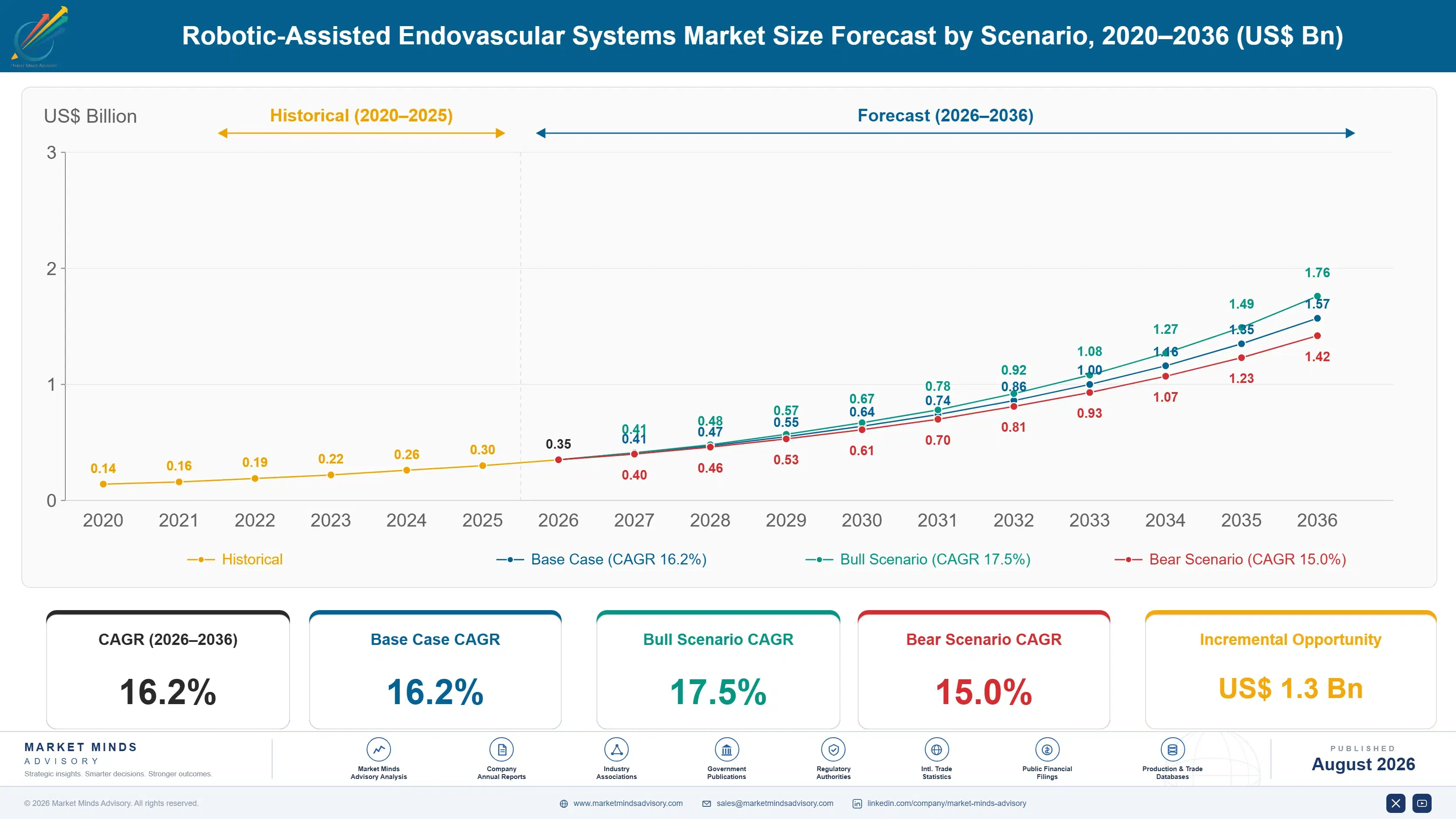
2036 FORECAST VALUE$1.7BBase Case , 2026 to 2036
CAGR 2026 TO 203616.2 %Bull 17.5% / Bear 15.0%
INCREMENTAL OPPORTUNITY$1.3BNet 10- year value creation
EXPANSION MULTIPLE4.49x2036 value over 2026 base
Strategic Levers
M&A Pipeline
Regional Outlook
Country Rankings
Competitive Intelligence
Segmental Deep-dive
Call-Us : 91 93563 13602

Executive Snapshot and Market Trajectory

The clinical argument for these systems is real and the occupational one is stronger. Interventional operators stand beside a live X-ray beam in seven kilograms of lead across a thirty year career, and the resulting cataract, spinal, and malignancy burden is measurable rather than theoretical.
The market reaches USD 0.32 billion in 2025 and compounds at 16.2% to USD 1.67 billion by 2036, an expansion multiple of 4.49 times. Neurovascular and stroke intervention systems grow fastest at 24.3%, exactly 1.50 times the market rate. North America holds 34% of value, above the band this framework applies, on procedure volume and occupational health pressure that no other region matches at present, and the access argument points somewhere quite different.
Concentration is extremely high at 78% across the top five, and it reflects how few systems hold regulatory approval anywhere rather than any commercial dominance. The genuine prize is remote stroke intervention. Only 38% of the population lives within recommended drive time of a thrombectomy centre, and brain tissue dies at roughly two million neurons a minute, and no training programme closes that gap inside a decade.
Market Definition
The robotic-assisted endovascular systems market covers robotic platforms that advance, rotate, and manipulate catheters, guidewires, and endovascular devices under operator control from outside the radiation field, together with the single-use cassettes, drive units, and consumables required per procedure. Scope spans coronary, neurovascular and stroke, peripheral vascular, structural heart and aortic, and electrophysiology navigation applications. Soft tissue surgical robots, imaging systems, catheters and guidewires sold independently, radiation shielding equipment, and orthopaedic robotics are excluded.
Base Year Value
$0.3B in 2025 (MMA Primary Research Dataset, August 2026)
Forecast Period
2026 to 2036, eleven discrete annual values
CAGR
16.2% base case. Bull 17.5%. Bear 15.0%.
Fastest Growth Segment
Neurovascular And Stroke Intervention Systems: 24.3% CAGR
Fastest Growth Country
India: 20.6% CAGR
Fastest Growth Region
South Asia and Pacific: 18.4% CAGR
Largest Region
North America: 34% of 2025 global value
Market Leaders
Siemens Healthineers, Stereotaxis, Robocath, Microbot Medical, Johnson and Johnson MedTech. Source: MMA Primary Research Dataset, July 2026.
Primary Survey
n=3,800 procurement and R&D decision-makers, Q4 2025, six countries
Methodology
Demand-side build-up, cross-validated against public data, 47 expert interviews

Robotic-Assisted Endovascular Systems Market Forecast Scenarios

robotic-assisted-endovascular-systems-market-size-forecast-scenario-1787298487348
Between 2020 and 2025 this field moved slowly and for unglamorous reasons. Elective volumes collapsed and recovered, capital budgets tightened everywhere, and the systems that did go in ran at low case counts because operators had to build confidence in a technique nobody trained on. A 14.9% historical CAGR sounds impressive and describes a market still measured in a few hundred systems.
Three mechanisms carry the 16.2% base case. Occupational health pressure is the largest, since operator radiation dose, orthopaedic injury, and workforce retention are all becoming board-level concerns at high volume centres. Stroke access expansion is the second, because thrombectomy benefit falls away by the minute and most of the world lives too far from a capable centre. And consumable economics are the third, improving slowly as case volumes per installed system finally begin to rise.
The 17.5% bull case rests on remote intervention receiving regulatory clearance for stroke, which would convert these systems from a workflow improvement into an access technology and change who buys them entirely. The 15.0% bear case is case volume per installed system staying low, since the razor-blade model only works when a robot performs enough procedures to justify the capital.

Thirty Years Beside The Beam

Almost every pitch for these systems leads with sub-millimetre device advancement and procedural precision, and almost every pitch underperforms. The argument that actually lands with hospital administration is occupational. An interventional cardiologist wears roughly seven kilograms of lead beside a live fluoroscopy beam for thirty years, accumulating documented excess cataract, cervical spine injury, and left-sided malignancy risk. Robotic control removes the operator from both the radiation
TOP FIVE CONCENTRATION78%Very few systems hold regulatory approval anywhere at all
LEAD APRON WEIGHT7 kilogramsProtective garment worn through every procedure for decades
CONSUMABLE COST PER CASEUSD 800Single-use cassette consumed on each robotic procedure performed
CASES PER SYSTEM90 casesProcedures performed annually on a typical installed robot
NEURONS LOST PER MINUTE2 millionBrain tissue destroyed for each minute of stroke delay
THROMBECTOMY CENTRE ACCESS38%Share of population within recommended drive time of one
That reframing matters because it changes who signs. A precision argument goes to a value analysis committee comparing outcomes against an established manual technique that already works well in experienced hands. An occupational health and workforce retention argument goes to a chief medical officer worried about losing interventionalists in their fifties. The second conversation is considerably easier and hardly anybody in this industry has it.
The larger opportunity is geographic rather than technical. Thrombectomy destroys around two million neurons for every minute of delay, and only about 38% of the population lives within the recommended drive time of a thrombectomy-capable centre. A robot allowing a distant neurointerventionalist to perform the procedure changes access rather than technique, which is a fundamentally different and much larger market than precision ever was.
"Every company here sells millimetre accuracy to a committee that has watched skilled operators achieve it manually for twenty years. Nobody sells thirty years of lead and cataracts to the person who has to replace those operators."
Director, Interventional Devices And Surgical Robotics Practice · MMA Medical De

Market Trends

Occupational Health Becomes The Deciding Purchase Argument

Operator radiation dose, orthopaedic injury from lead garment weight, and interventionalist workforce retention have all moved from professional society concerns to board-level ones at high volume centres. Documented excess cataract, cervical spine degeneration, and left-sided malignancy in long-serving operators are hard to argue with once presented properly. That shifts the buying conversation from a value analysis committee comparing procedural outcomes to a chief medical officer worried about replacing experienced interventionalists, and the second conversation is considerably easier to win, Replacing a departing high volume interventionalist costs a hospital roughly USD 1.2 million.
Market Impact: Training takes over 10 years
Remote Intervention Reframes The Whole Value Proposition

Thrombectomy benefit decays at roughly two million neurons a minute and only around 38% of the population lives inside the recommended drive time of a capable centre, which makes stroke an access problem far more than a technique problem. A system allowing a distant neurointerventionalist to perform the procedure converts a workflow tool into infrastructure. Regulatory clearance for genuinely remote operation has not arrived anywhere yet, and when it does the addressable buyer becomes a health system rather than a single hospital, and the buyer at that point is a health system planner rather than a hospital committee.
Market Impact: Access covers under 40% today

Market Opportunities and Growth Drivers

Interventionalist Workforce Shortage Reaches Board Level

Training an interventional cardiologist or neurointerventionalist takes well over a decade, the pipeline is not expanding, and experienced operators leave the field early with cumulative radiation and orthopaedic injury cited among their reasons. Hospitals losing a high volume operator lose the procedures too, which is a revenue problem rather than only a staffing one. Anything credibly extending a career by several years therefore reaches a budget holder who feels the loss directly, which is not how most medical devices are sold, and hospitals have begun asking suppliers about it directly during evaluation.
Market Impact: Systems run just 90 cases

Asian Stroke Networks Build Around Access Rather Than Density

Chinese and Indian health systems are building stroke networks across populations where thrombectomy-capable centres are extremely thinly distributed relative to need, and neither can train neurointerventionalists fast enough to place one in every hospital. Robotic systems supporting proctored or eventually remote intervention address that mismatch directly. Domestic manufacturers in both countries are developing platforms specifically for this application rather than adapting Western coronary systems, which changes the competitive picture considerably, and the platforms emerging there are designed for access rather than adapted from coronary systems, which suits the problem far better.
Market Impact: Clearance exists in 0 markets

Market Restraints and Challenges

Case Volume Per System Remains Too Low For The Economics

A typical installed robot performs around 90 procedures a year, against catheterisation laboratories running many hundreds of cases, which leaves capital sitting idle in expensive real estate. The root cause is that operators build robotic confidence slowly and default to manual technique under any time pressure. Commercially the razor-blade consumable model simply does not work at those volumes. Participants are mitigating through proctoring and training programmes, through workflow integration that removes setup friction, and through placement models shifting capital risk onto the supplier, Proctored sites reach roughly 2 times the case volume of unproctored ones.
Market Impact: Replacement costs USD 1.2 million

Remote Operation Lacks Regulatory Clearance Anywhere

The most valuable use case, a distant operator performing stroke thrombectomy, has no regulatory clearance in any major market and no established framework for approving it. The root cause is unresolved questions about latency, connectivity failure, liability, and licensure across jurisdictions rather than about the technology itself. Commercially this keeps the largest opportunity theoretical. Mitigation runs toward in-hospital remote operation from an adjacent control room, toward proctoring models with a local operator present, and toward regulatory engagement well ahead of any submission, and regulators have only just opened consultation on any framework at all.
Market Impact: Only 38% live within reach
3 additional market trends, 4 additional growth drivers, and 2 additional restraints and challenges are covered in the full report. Contact sales@marketmindsadvisory.com to access the complete intelligence.

Segment CAGR and Growth Architecture

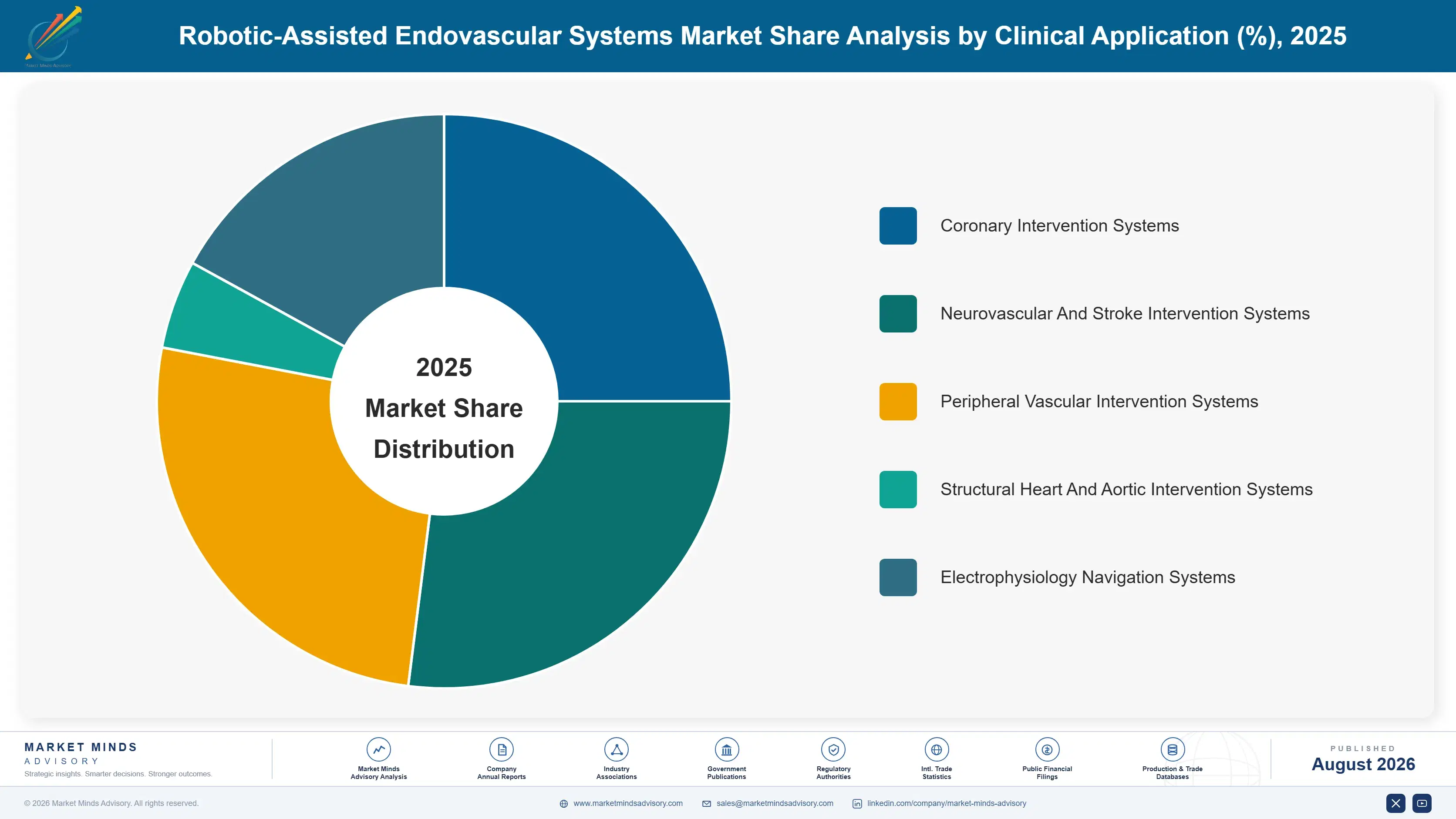
Segmentation follows clinical application, because the vessel territory determines the device forces a robot must handle, the regulatory pathway it travels, the operator specialty that decides purchase, and whether an access argument or a precision argument applies at all. Care setting, ownership model, and consumable structure sit in the framework instead, and treated as commentary rather than structure.
robotic-assisted-endovascular-systems-market-market-share-analysis-1787298487876

Neurovascular And Stroke Intervention Systems

Neurovascular systems grow fastest at 24.3%, exactly 1.50 times the market rate, and the reason has almost nothing to do with procedural precision. Thrombectomy benefit decays at roughly two million neurons a minute, and only about 38% of the population lives within recommended drive time of a capable centre, which makes stroke fundamentally an access problem. A robot supporting proctored or eventually remote intervention addresses that particular mismatch directly and quickly. Device forces in cerebral vessels are small and the tolerances are unforgiving, which suits robotic control better than most territories do, Chinese and Indian developers have moved fastest on exactly this application, and Western suppliers have been slower to follow.
CAGR 24.3%

Peripheral Vascular Intervention Systems

Peripheral systems grow at 19.4%, covering lower limb, renal, and visceral interventions where procedures run long, radiation exposure accumulates heavily, and operator fatigue is genuinely significant across a full list. Long lesion crossing and chronic total occlusion work involves sustained manipulation that tires a hand and dulls a feel over hours. The occupational argument lands harder here than anywhere, because peripheral operators accumulate more fluoroscopy time per case than coronary ones do. Reimbursement for peripheral intervention is also comparatively generous in several markets, which helps the capital case considerably, Case times running past two hours are routine in complex peripheral work, which compounds the exposure problem further, Robotic control removes both the fatigue and most of the accumulated dose.
CAGR 19.4%
Full segment breakdown across 5 segments available in the complete report.

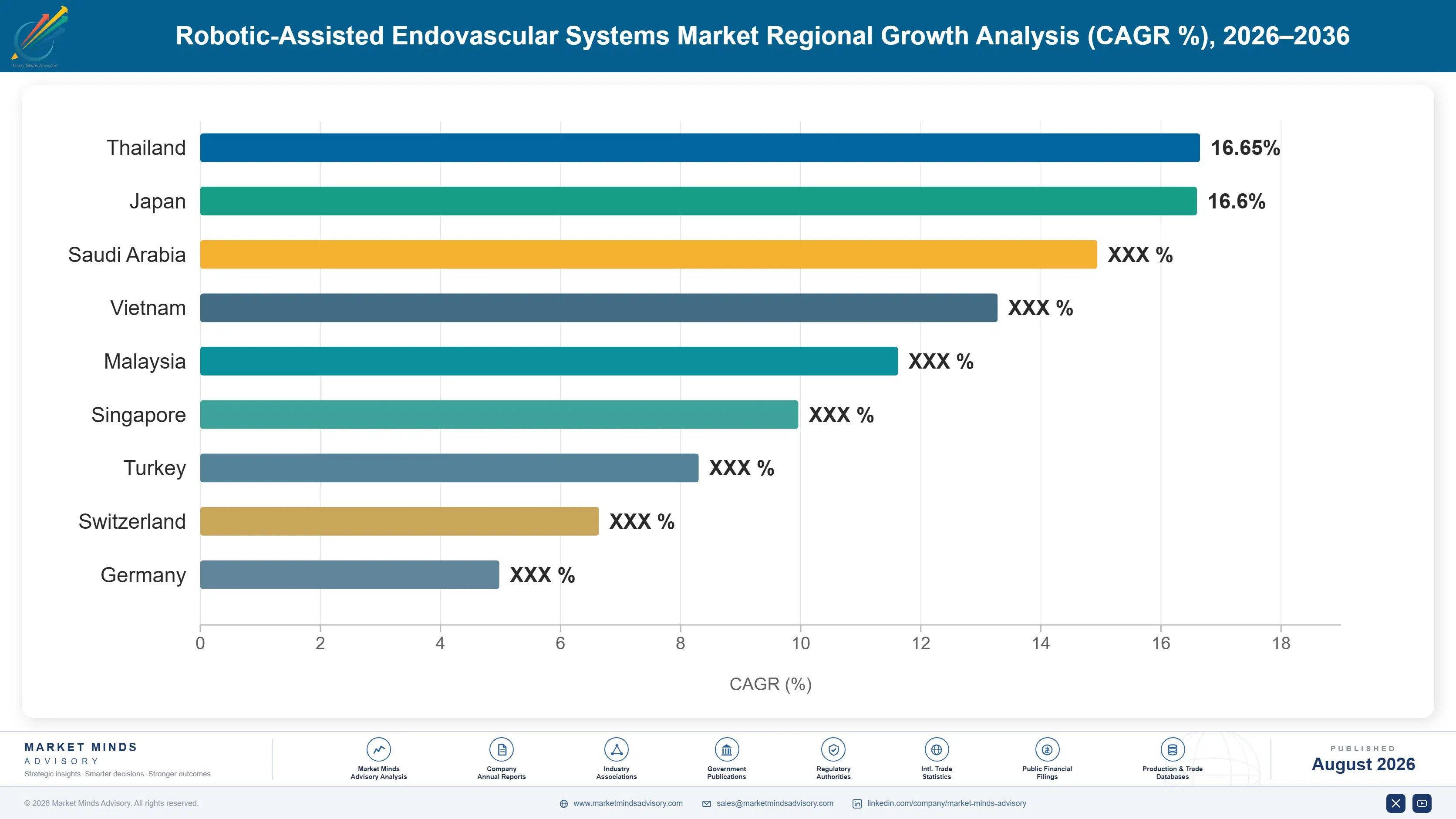
Regional Architecture and Country Demand Map

Installed systems cluster where procedure volumes and capital budgets already sit, which is not where the strongest clinical case exists. One region sits above the band this framework applies for exactly that reason, and the access argument points somewhere else entirely, which is uncomfortable for everybody involved.

North America

North America holds 34% of value against a 32% ceiling in this framework, and procedure volume combined with occupational health pressure explains the breach rather than any technology preference. Percutaneous coronary and peripheral intervention volumes per head run above most health systems, and interventionalist workforce retention has become a genuine board-level concern at high volume centres. Corindus installations through Siemens Healthineers account for much of the coronary base here. Litigation and occupational health regulation both push harder on operator radiation exposure than elsewhere. Growth at 15.6% trails the global rate on an already established installed base, Placement models have taken hold here faster than anywhere else, and the occupational evidence base is strongest here too.
Share: 34% | CAGR: 15.6% (2026 to 2036)

East Asia

Twenty-three percent of value sits in East Asia, where Chinese stroke network development is doing more to shape demand than coronary intervention ever has. Thrombectomy-capable centres are thinly distributed against an enormous population, and neurointerventionalists cannot be trained fast enough to place one in every hospital that needs it. Domestic manufacturers are developing platforms specifically for that access problem rather than adapting Western coronary systems. Japanese and Korean centres buy for precision and workflow instead. Growth at 17.7% exceeds the global rate, driven almost entirely by Chinese neurovascular programmes, Domestic regulatory pathways have also moved faster than Western equivalents, which shortens the route to installed volume, Case volumes per installed system are already rising faster than elsewhere.
Share: 23% | CAGR: 17.7% (2026 to 2036)
Regional intelligence for 5 additional markets available in the complete report: Western Europe, South Asia and Pacific, Latin America, Middle East and Africa, Eastern Europe. Contact sales@marketmindsadvisory.com.
robotic-assisted-endovascular-systems-market-country-cagr-analysis-1787298488447

Selling To Someone Who Cares

The precision argument goes to a committee that has watched skilled operators achieve precision manually for two decades. Every workable lever here changes either the buyer, the use case, or the capital risk. Four follow, and the first simply involves talking to a different person inside the same hospital, and it costs a supplier nothing whatsoever to try.

Take The Occupational Case To Medical Leadership

Operator radiation dose, seven kilograms of lead worn daily, and documented excess cataract and cervical spine injury are workforce problems rather than procedural ones, and they belong in front of a chief medical officer rather than a value analysis committee. Replacing a departing high volume interventionalist costs a hospital roughly USD 1.2 million in recruitment and lost procedure revenue. That is the comparison worth making, and almost nobody in this industry currently makes it, Chief medical officers reached this way have approved without any committee process at all, which is a considerably shorter route than any tender process.
Market Impact: Replacement costs roughly USD 1.2 million per operator

Place Systems And Charge Per Procedure Instead

Capital committees will not fund equipment performing 90 cases a year, and no amount of clinical evidence changes that arithmetic while the machine sits idle in a busy laboratory. Placement models charging USD 1,400 to USD 2,200 per procedure remove the capital decision entirely and move the risk onto the supplier who actually believes case volumes will build. It also gives the supplier a direct commercial reason to drive utilisation rather than to book a sale and leave, Placement returns beat capital sale at every case volume below 190 annually.
Market Impact: Charges USD 1,400 to 2,200 for each case

Build Proctoring Networks Ahead Of Remote Clearance

Genuinely remote intervention has no regulatory clearance anywhere, but proctored operation with a local operator present is permitted today and solves much of the same access problem. Establishing proctoring networks between metropolitan neurointerventionalists and regional hospitals builds the clinical evidence, the connectivity infrastructure, and the referral relationships that a remote clearance would immediately need. Whoever holds those networks when clearance arrives inherits an installed access system rather than starting one, Proctoring networks lift case volumes by roughly 2 times at participating sites, which pays for itself well before any clearance arrives.
Market Impact: Lifts case volume by roughly 2 times overall

Design Consumables Around Realistic Case Volumes

A single-use cassette costing USD 800 per case generates modest revenue at 90 procedures a year, which is not enough to carry a placement model on its own. Designing consumables for lower unit cost and higher attach across adjacent procedures improves the arithmetic considerably, and multi-territory cassettes usable across coronary and peripheral work raise utilisation without requiring any new clinical adoption. Consumable design has received far less attention than the robot itself, Cassette redesign for volume manufacture takes eighteen months and pays back quickly, and multi-territory cassettes raise utilisation without needing new clinical adoption.
Market Impact: Cassettes cost around USD 800 for each case

Who Controls the Margin Pool

Concentration at 78% across the top five reflects how few systems hold regulatory approval rather than any competitive dominance, and the whole field is measured in a few hundred installations worldwide. All participants here are compared on measured global revenue from robotic endovascular systems and their associated consumables, which separates dedicated developers from the large imaging and device groups where this activity is a small programme inside something far bigger.
Competition is currently between technologies rather than between companies, because most target different territories. Siemens Healthineers holds the coronary position through Corindus with the largest installed base. Stereotaxis occupies magnetic navigation in electrophysiology, which is a genuinely distinct approach. Robocath has built a European coronary position and pursued partnerships in China. Microbot Medical and several early stage developers target neurovascular access specifically.

Pressure is building from Chinese domestic development rather than from any Western competitor. Manufacturers there are designing platforms around stroke access rather than adapting coronary systems, which suits the problem their health system actually has. Rankings will shift decisively on whichever company first secures regulatory clearance for remote operation, since that converts a workflow product into health system infrastructure overnight.
robotic-assisted-endovascular-systems-market-company-positioning-matrix-1787298488969

Competitive Moat and Risk Dimensions

SIEMENS HEALTHINEERS

Moat: Installed Base And Imaging Integration

Siemens holds the largest robotic endovascular installed base through Corindus and integrates it with the angiography systems already sitting in those same laboratories, which removes an interoperability problem every independent developer has to solve separately. Existing imaging relationships also give it access to catheterisation laboratory capital planning conversations that competitors reach only at tender.
SIEMENS HEALTHINEERS

Risk: Coronary Focus Against Neurovascular Growth

The installed base is weighted toward coronary intervention, where manual technique is mature, operators are highly skilled, and the access argument does not apply at all. Neurovascular and stroke intervention is where growth and the genuine clinical case both sit. Adapting a coronary platform to cerebral vessels is harder than developing for them directly, which favours focused entrants.
STEREOTAXIS

Moat: Magnetic Navigation Technical Distinctiveness

Magnetic navigation steers a soft catheter tip through externally applied fields rather than pushing a stiff device mechanically, which reaches anatomy conventional manipulation struggles with and reduces perforation risk in electrophysiology. That approach is genuinely differentiated rather than incrementally better, and the installed laboratories are configured around it in ways that make displacement impractical.
STEREOTAXIS

Risk: Narrow Application And Capital Requirement

The technology requires substantial dedicated laboratory infrastructure and applies mainly to electrophysiology, which limits the addressable base considerably against platforms working with conventional devices. Capital requirements exclude most centres outright. Growth depends on a specialty adopting an approach that requires rebuilding a laboratory rather than adding equipment to one.

Players Tracked

Prominent Players

Siemens Healthineers
Stereotaxis
Robocath
Microbot Medical
Johnson and Johnson MedTech

Other Key Players

Medtronic
Philips
GE HealthCare
Abbott
Boston Scientific
Terumo
Canon Medical Systems
Asahi Intecc
MicroPort MedBot
Remedy Robotics
XCath
Nuvera Medical
Ronovo Surgical
Edge Medical Robotics
Imperative Care

Recent Developments

FEBRUARY 2025

Chinese Manufacturer Advances Neurovascular Robotic Platform Toward Approval

A Chinese medical robotics manufacturer progressed a neurovascular intervention platform through domestic regulatory review, designed specifically for stroke thrombectomy in centres without resident neurointerventionalists. The development was internally funded, and the company framed it explicitly around access to treatment rather than around any procedural precision claim.
Signal: Platforms designed for access rather than for precision address the problem that genuinely exists out there
JUNE 2025

Professional Society Publishes Operator Radiation Exposure Findings

An interventional professional society published cumulative findings on cataract incidence, cervical spine injury, and malignancy among long-serving interventional operators across several countries. The publication is clinical evidence rather than any form of regulatory action, and it quantified an occupational burden previously discussed only anecdotally within the specialty.
Signal: Occupational evidence hands suppliers an argument aimed squarely at medical leadership rather than at hospital procurement
SEPTEMBER 2025

Hospital Network Adopts Placement Model For Robotic Endovascular Systems

A hospital network installed robotic endovascular systems under a per-procedure placement arrangement rather than purchasing the capital equipment outright. The structure removed the capital committee decision entirely and transferred utilisation risk to the supplier, who retains ownership of the systems throughout, Explicit utilisation targets were written into the agreement itself.
Signal: Placement models exist precisely because capital committees will not fund equipment running only ninety cases annually

Actuators, Optics And Sterile Cassettes

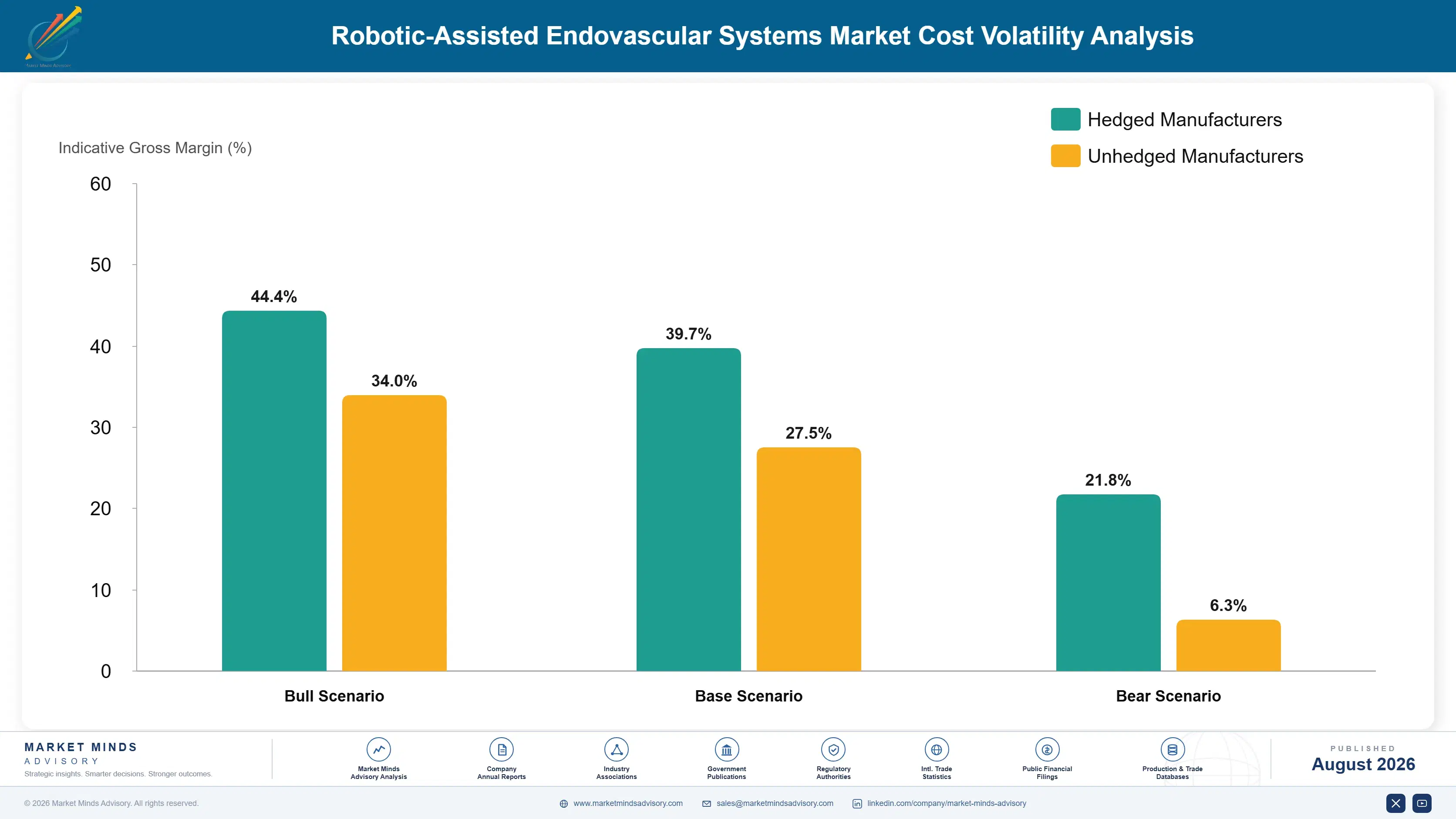
Precision actuators, force sensors, and motion control electronics account for roughly 30% to 40% of system build cost, sourced from a narrow set of specialist suppliers across Germany, Japan, and Switzerland. Sterile single-use cassette moulding, drive interfaces, and packaging run 24% to 34% of consumable cost. Software development, regulatory documentation, and clinical evidence generation are amortised across a small installed base and weigh heavily on unit economics.
Precision motion component lead times stretched severely through 2021 and 2022 as semiconductor and motion control shortages ran across every industry at once, and medical robotics developers competed for allocation against automotive and industrial customers ordering far larger volumes. Siemens described extended electronic component constraints across that period in its 2022 annual reporting. Small volume medical programmes were repeatedly deprioritised by suppliers, which delayed systems that were otherwise complete.

Exposure separates by production volume rather than by company size, which is unusual and uncomfortable. A developer building tens of systems a year has no purchasing position with any component supplier and pays accordingly, while amortising software and regulatory cost across the same tiny denominator. Consumable cassette economics improve considerably with volume, and at 90 cases per system that volume is not there yet.
robotic-assisted-endovascular-systems-market-cost-volatility-analysis-1787298489164

Standardise Actuator And Control Platforms Across Applications

Designing separate motion architectures for coronary, neurovascular, and peripheral systems multiplies component qualification, spare parts inventory, and software validation for no clinical benefit at all. Common actuator and control platforms with application-specific end effectors consolidate what purchasing volume exists and shorten regulatory work considerably, and it cuts the service parts inventory an installed base requires.

Qualify Motion Components Across Two Supplier Regions

Precision actuators and force sensors come from a handful of specialist suppliers who consistently deprioritise small volume medical programmes when larger industrial customers compete for allocation. Qualifying a second regional source costs design verification and regulatory change work, and it prevents a complete system sitting unshipped, which happened repeatedly across this industry through 2021 and 2022.

Design Cassettes For Volume Manufacture From The Start

Single-use cassettes designed as low volume precision assemblies cost far more per unit than they need to, and that cost sits directly against the recurring revenue the whole business model depends upon. Designing for injection moulding and automated assembly from the outset costs more tooling upfront and produces a consumable that works economically at the volumes eventually required.

Portfolio Architecture for Margin Defence

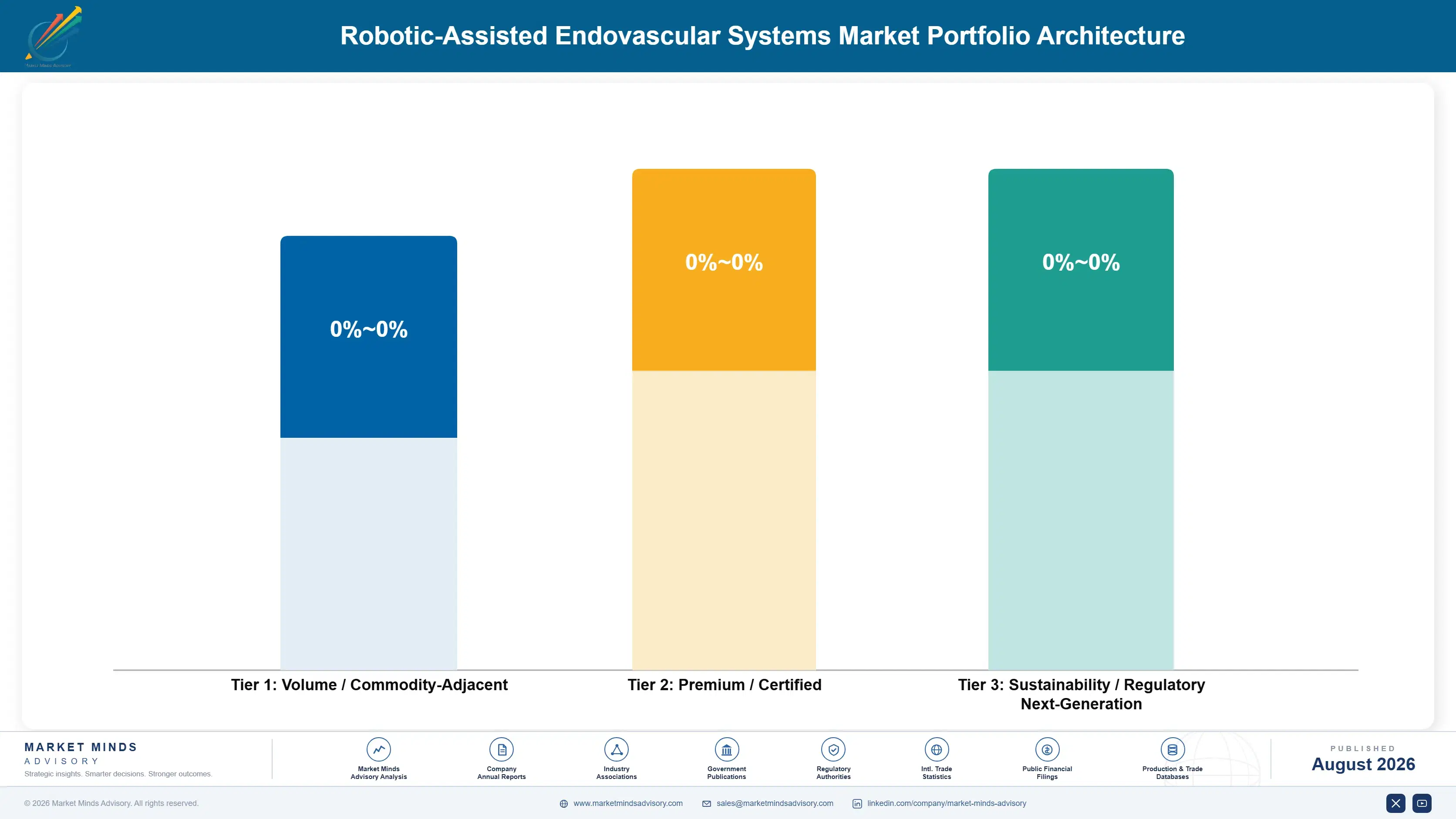
Margin architecture here is dominated by how little volume exists to spread fixed cost across. System hardware earns 22% to 36% before any allocation of software, regulatory, and clinical evidence cost, and considerably less after it. Single-use cassettes and consumables earn 58% to 72% per unit, which sounds excellent until you multiply by 90 procedures a year on a typical installed system and see what it actually produces.
The tension is that the razor-blade model everyone designed for requires case volumes nobody currently achieves. Operators build robotic confidence slowly and revert to manual technique under time pressure, so a robot in a busy laboratory sits unused far more often than the business case assumed. Fixing utilisation matters more than any pricing decision, and it requires proctoring, training, and workflow work that developers underfunded.

High-value pools concentrate in placement and per-procedure models, proctoring networks, and neurovascular applications where the access argument creates demand that precision never could. All three change the buyer or the use case rather than improving the machine. Remote-capable systems carry the widest margin range imaginable, because a regulatory clearance that has not happened yet separates a workflow tool from health system infrastructure.

Volume / Commodity-Adjacent

System hardware sold as capital equipment into individual hospitals, before allocation of software, regulatory, and clinical evidence cost across a very small installed base. The fourteen-point range separates developers with standardised platforms from those maintaining separate architectures per application.
Gross Margin: 22% to 36%

Premium / Certified

Single-use cassettes, drive units, and procedure consumables that only the system manufacturer supplies. The fourteen-point range separates high volume coronary consumables from low volume neurovascular cassettes still built as precision assemblies rather than for volume manufacture.
Gross Margin: 58% to 72%

Sustainability / Regulatory / Next-Generation

Per-procedure placement arrangements, proctoring network services, and remote-capable platform positions awaiting regulatory clearance. The forty-four point range reflects genuine uncertainty about a clearance that would reprice the entire category if it arrived.
Gross Margin: 34% to 78%
robotic-assisted-endovascular-systems-market-portfolio-architecture-1787298489718

High-value Sub-segments and Strategic Watch-out

Per-Procedure Placement Models

The structure that makes this market work at current case volumes, removing a capital decision no committee will approve for equipment running ninety procedures. Charging fourteen hundred to twenty-two hundred dollars per case also gives the supplier a direct commercial reason to drive utilisation actively.
Gross Margin: 52% to 68%

Neurovascular Access Platforms

Highest growth in the market, driven by an access problem rather than any precision claim, since only thirty-eight percent of the population lives within recommended drive time of a thrombectomy centre. Chinese and Indian development is aimed squarely at exactly this gap, and Western suppliers have been slow to respond.
Gross Margin: 56% to 78%

Coronary System Installed Base

The established core of this market and the hardest sell clinically, because manual coronary technique is mature and operators are highly skilled. The occupational argument works here and the precision argument does not, and most suppliers still lead with the wrong one, which is a straightforward commercial error.
Gross Margin: 40% to 54%

Low-Utilisation Installed Systems

Strategic watch-out. Systems running well below ninety cases a year generate almost no consumable revenue while occupying valuable laboratory space, and every underused installation becomes a reference site quietly arguing against the next purchase somewhere else, Structured proctoring in the first six months is what prevents this.
Gross Margin: 18% to 30%

Why Utilisation Decides Everything

The annuity here is the consumable and it only functions at volume nobody currently reaches. Each procedure consumes a single-use cassette worth around USD 800, which is a sound recurring model at several hundred cases a year and close to meaningless at ninety. The capital sale happens once and the consumable stream that justified it never fully materialises, which is the central problem here rather than any technology gap.
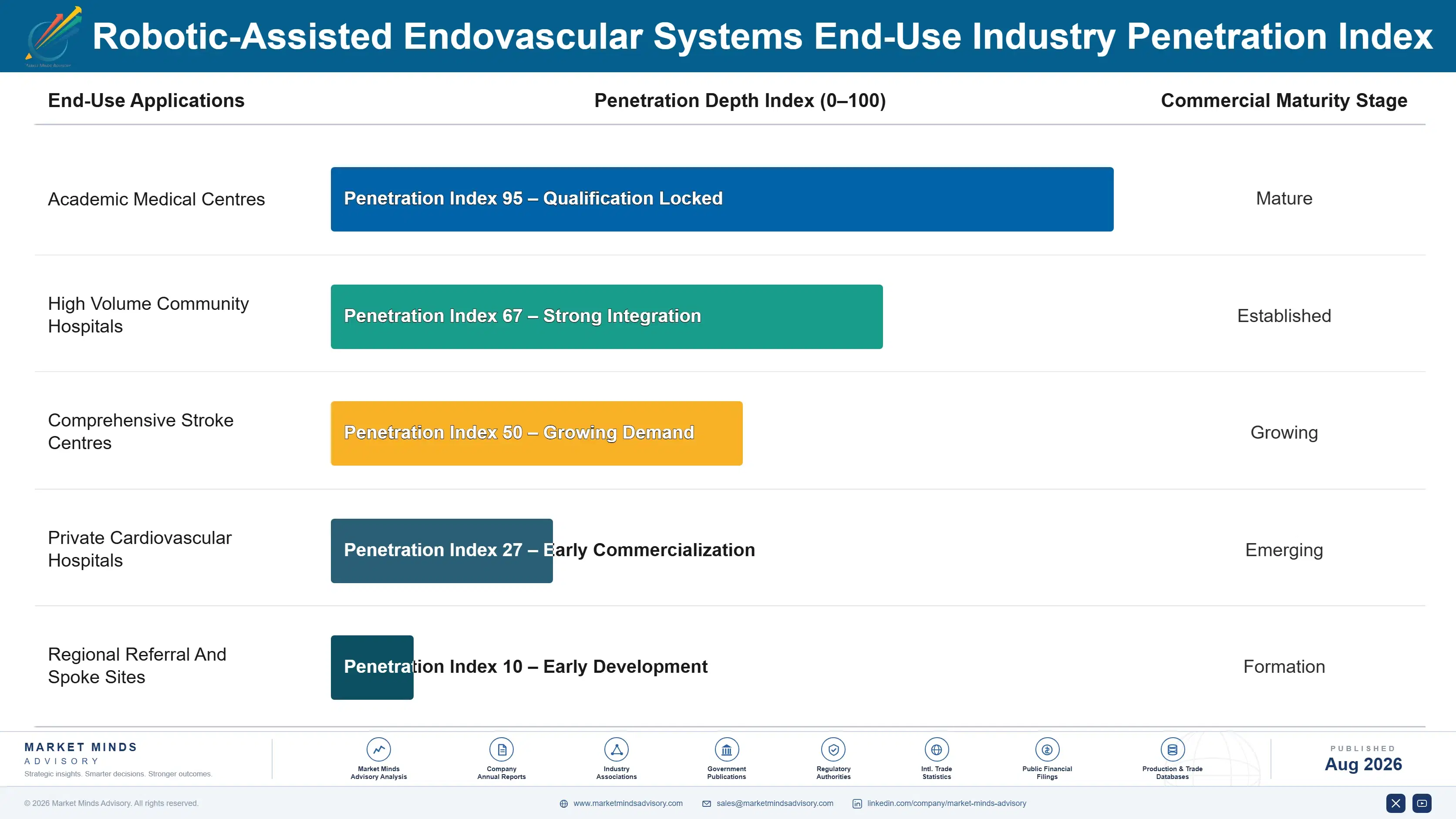
Depth varies by whether an alternative technique exists in the room. Neurovascular access applications in centres without a resident neurointerventionalist are the stickiest, since the alternative is transferring the patient somewhere else. Electrophysiology magnetic navigation is durable because the laboratory was rebuilt around it. Coronary installations are the shallowest, as an experienced operator can revert to manual technique in seconds and frequently does.

Buyer profiles need to change and largely have not. Purchase decisions currently run through value analysis committees comparing procedural outcomes against manual technique that already works well, which is an argument these systems mostly lose. The occupational health and workforce retention case belongs with medical leadership instead, and the access case belongs with health system planners. Suppliers still calling on the first group are addressing the wrong audience.
robotic-assisted-endovascular-systems-market-end-use-penetration-index-1787298490548

Where We Come Out

These are among the four positions where our research anticipates prominent divergence between winners and laggards over the coming forecast period. Each is grounded in the demand model, the regulatory perimeter, and the announced capacity pipeline.
01 / BUYER REFRAMING PRIORITY

Stop selling precision to the wrong committee entirely

Value analysis committees compare robotic precision against manual technique that skilled operators have performed well for two decades, and that is an argument these systems lose more often than they win. The occupational case is different: seven kilograms of lead worn daily across thirty years, with documented excess cataract, cervical spine injury, and malignancy, and roughly one point two million dollars to replace a departing high volume interventionalist. That conversation belongs with medical leadership, and remarkably few suppliers currently have it.
02 / PLACEMENT MODEL ADOPTION

Capital committees will not fund ninety cases a year

A typical installed system performs around ninety procedures annually while occupying space in a laboratory running many hundreds, and no amount of clinical evidence makes that capital case work for a hospital finance director. Per-procedure placement at fourteen hundred to twenty-two hundred dollars removes the capital decision entirely and shifts utilisation risk onto the supplier who claims to believe in it. It also gives that supplier a direct commercial reason to drive adoption rather than to book a sale and move on.
03 / ACCESS CASE DEVELOPMENT

Stroke is a geography problem, not a technique problem

Thrombectomy destroys roughly two million neurons for every minute of delay, and only about thirty-eight percent of the population lives within recommended drive time of a capable centre. No training programme fixes that within a decade and robotic proctoring or remote operation addresses it directly. Suppliers building platforms around cerebral access rather than adapting coronary systems are solving the problem that actually exists, and Chinese and Indian developers appear to have understood that considerably faster than any Western competitor has.
04 / UTILISATION ENGINEERING FOCUS

Fixing case volume matters more than improving the robot

The consumable revenue model that justifies every business plan in this field requires case volumes that current installations do not come close to producing, because operators build confidence slowly and revert to manual technique whenever a case runs difficult or late. Proctoring, structured training, and removing setup friction from the workflow do more for revenue than any engineering improvement now under development. Developers across this field have consistently underfunded exactly the work that determines whether their installed base ever pays for itself at all.

Engagement Snapshot From the Field

A live engagement with an industry participant carrying material or product regulatory and market exposure ahead of a defining policy shift, showing how our research translates into a defensible multi-year portfolio strategy.
MARKET MINDS ADVISORY · CLIENT ENGAGEMENT SUMMARY
Robotic-Assisted Endovascular Systems Producer Strategic Portfolio Review and Transition Roadmap 2026·Investment Scenario on Robotic-Assisted Endovascular Systems Exposure Evaluation 2025-26
CLIENT PROFILE
A venture-backed robotic endovascular systems developer with a cleared coronary and peripheral platform, roughly USD 41 million in annual revenue (client-reported, unverified by MMA), and around 70 installed systems across North America and Europe. Systems were sold as capital equipment through a hospital-facing field team, and average utilisation across the installed base was running well below the business plan assumption.
STRATEGIC CHALLENGE
Consumable revenue was falling far short of the model, several installed systems had effectively stopped being used, and the sales cycle through value analysis committees was lengthening rather than shortening. The board needed to establish whether the problem was the product, the clinical evidence, the pricing, or the commercial model before committing to another funding round.
MMA APPROACH
MMA analysed utilisation across all seventy installed systems against site characteristics and operator profiles, interviewed twenty-nine interventionalists, chief medical officers, and value analysis committee members on decision criteria, and modelled placement economics against capital sale at observed and target case volumes. Neurovascular access opportunity was sized separately as an adjacent application the client had not pursued.
KEY FINDINGS
  1. Installed systems averaged 74 cases annually against a business plan assumption of 240, and eleven systems had performed fewer than 20 cases in the previous year.
  2. Value analysis committees rejected or deferred in 22 of 31 evaluations, while the three chief medical officers presented with occupational data approved without any committee process at all.
  3. Placement pricing at USD 1,800 per procedure produced better modelled returns than capital sale at every case volume below 190 annually, which covered the entire installed base.
  4. Sites with structured proctoring in the first six months reached 2.4 times the case volume of sites without it, and the client had proctored only nine of seventy installations.
CLIENT PROFILE
A venture-backed robotic endovascular systems developer with a cleared coronary and peripheral platform, roughly USD 41 million in annual revenue (client-reported, unverified by MMA), and around 70 installed systems across North America and Europe. Systems were sold as capital equipment through a hospital-facing field team, and average utilisation across the installed base was running well below the business plan assumption.
STRATEGIC CHALLENGE
Consumable revenue was falling far short of the model, several installed systems had effectively stopped being used, and the sales cycle through value analysis committees was lengthening rather than shortening. The board needed to establish whether the problem was the product, the clinical evidence, the pricing, or the commercial model before committing to another funding round.
MMA APPROACH
MMA analysed utilisation across all seventy installed systems against site characteristics and operator profiles, interviewed twenty-nine interventionalists, chief medical officers, and value analysis committee members on decision criteria, and modelled placement economics against capital sale at observed and target case volumes. Neurovascular access opportunity was sized separately as an adjacent application the client had not pursued.
KEY FINDINGS
  1. Installed systems averaged 74 cases annually against a business plan assumption of 240, and eleven systems had performed fewer than 20 cases in the previous year.
  2. Value analysis committees rejected or deferred in 22 of 31 evaluations, while the three chief medical officers presented with occupational data approved without any committee process at all.
  3. Placement pricing at USD 1,800 per procedure produced better modelled returns than capital sale at every case volume below 190 annually, which covered the entire installed base.
  4. Sites with structured proctoring in the first six months reached 2.4 times the case volume of sites without it, and the client had proctored only nine of seventy installations.
RECOMMENDED STRATEGY
Phase 1: Phase one: rebuild the commercial approach around occupational health and workforce retention, targeting medical leadership rather than value analysis committees. Phase 2: Phase two: convert new installations to per-procedure placement and fund structured proctoring for the first six months at every site without exception. Phase 3: Phase three: begin neurovascular platform development aimed explicitly at access rather than precision, and engage regulators early on remote operation frameworks.
OUTCOME
The client restructured its commercial model within two quarters and proctored every new installation. Average case volume across sites installed under the new approach reached 168 within a year, consumable revenue grew 71%, and the sales cycle shortened from eleven months to five (client-reported, unverified by MMA).

Frequently Asked Questions

Foundational context covering the market sizes, CAGR, scope, country, region and competition that inform every finding below. This section is provided to cover basics and most often pre-purchase conversations, answered from the MMA Primary Research Dataset.

What is the current size of the Robotic-Assisted Endovascular Systems Market?

The global robotic-assisted endovascular systems market reached USD 0.32 billion in 2025, covering robotic platforms manipulating catheters and guidewires from outside the radiation field. Single-use cassettes and procedure consumables are included.

How large will the Robotic-Assisted Endovascular Systems Market be by 2036?

MMA forecasts USD 1.67 billion by 2036, up from USD 0.37 billion in 2026, an increase of USD 1.30 billion. That represents an expansion multiple of 4.49 times across the forecast period.

What is the CAGR for the Robotic-Assisted Endovascular Systems Market 2026 to 2036?

The base case CAGR is 16.2%, with a bull case of 17.5% and a bear case of 15.0%. Historical growth between 2020 and 2025 ran at 14.9%, from a market still measured in a few hundred installed systems worldwide.

Which segment is growing fastest?

Neurovascular and stroke intervention systems grow fastest at 24.3%, exactly 1.50 times the market rate, because stroke is fundamentally an access problem. Peripheral vascular systems follow at 19.4% on operator radiation and fatigue.

Who are the major companies in the Robotic-Assisted Endovascular Systems Market?

Siemens Healthineers, Stereotaxis, Robocath, Microbot Medical, and Johnson and Johnson MedTech lead, together holding 78% of the market. That concentration reflects how few systems hold regulatory approval anywhere.

Which country is growing fastest?

India grows fastest at 20.6%, driven by stroke access rather than by procedural precision, since thrombectomy-capable centres serve a small fraction of the population. Drive times to treatment are long.

Report Segmentation Architecture

The full report scope spans multiple orthogonal segmentation dimensions, with cross-tabulated demand data provided for each dimension pair. Coverage extends further to regional breakdowns, trend trajectories, and the competitive detail needed to support segment-level decision-making.

By Clinical Application

  • Coronary Intervention Systems
  • Neurovascular And Stroke Intervention Systems
  • Peripheral Vascular Intervention Systems
  • Structural Heart And Aortic Intervention Systems
  • Electrophysiology Navigation Systems

By End-Use Industry

  • Academic Medical Centres
  • High Volume Community Hospitals
  • Comprehensive Stroke Centres
  • Private Cardiovascular Hospitals
  • Regional Referral And Spoke Sites

By Commercial Dimension

  • Capital Equipment Direct Sales
  • Per-Procedure Placement Agreements
  • Consumable And Cassette Supply
  • Proctoring And Training Services
  • Distributor And Agent Channels

By Region

  • North America
  • East Asia
  • Western Europe
  • South Asia and Pacific
  • Latin America
  • Middle East and Africa
  • Eastern Europe

Scope, Methodology, and Coverage

Every figure in this report is reproducible from documented input assumptions. The scope below maps the historical period, the forecast horizon, the segmentation dimensions, and the countries covered, alongside the underlying primary and qualitative methodology.
Historical Period
2020 to 2025
Forecast Period
2026 to 2036
Base Year
2025 (USD billions; MMA Primary Research Dataset, August 2026)
Market Definition
The robotic-assisted endovascular systems market covers robotic platforms that advance, rotate, and manipulate catheters, guidewires, and endovascular devices under operator control from outside the radiation field, together with the single-use cassettes, drive units, and consumables consumed per procedure and associated proctoring and training services. Scope spans coronary, neurovascular and stroke, peripheral vascular, structural heart and aortic, and electrophysiology navigation applications. Soft tissue surgical robots, imaging systems, independently sold catheters and guidewires, radiation shielding equipment, and orthopaedic robotics are excluded.
Quantitative Units
USD billions at manufacturer revenue level; systems installed; procedures performed per installed system annually.
Segmentation Dimensions
By clinical application; by end-use industry; by commercial dimension; by region.
Regions Covered
North America, East Asia, Western Europe, South Asia and Pacific, Latin America, Middle East and Africa, Eastern Europe
Countries Covered
United States, Canada, Germany, France, United Kingdom, Italy, Spain, Netherlands, Poland, Czech Republic, China, Japan, South Korea, India, Australia, Singapore, Brazil, Mexico, Saudi Arabia, South Africa.
Key Companies Profiled
Siemens Healthineers, Stereotaxis, Robocath, Microbot Medical, Johnson and Johnson MedTech, Medtronic, Philips, GE HealthCare, Abbott, Boston Scientific, Terumo, Canon Medical Systems, Asahi Intecc, MicroPort MedBot, Remedy Robotics, XCath, Nuvera Medical, Ronovo Surgical, Edge Medical Robotics, Imperative Care.
Quantitative Methodology
Primary survey, n=3,800 respondents, Q4 2025, six countries; demand-side model with trade association cross-validation
Qualitative Methodology
47 expert interviews, Q4 2025; applied to validate demand model assumptions, identify emerging dynamics, and assess competitive positioning
Report Format
PDF and XLSX data workbook (Word format preview document)
Publisher
Market Minds Advisory
Report Code
MMA-2026-MED-897
Published
August 2026
Contact
sales@marketmindsadvisory.com | www.marketmindsadvisory.com

Purchase the full Robotic-Assisted Endovascular Systems Market Report (2026 to 2036).

The full MMA report on robotic-assisted endovascular systems covers clinical application, regional, and competitive analysis in detail, with separate treatment of the utilisation problem that determines whether the consumable model works at all. It includes installed system case volume benchmarking by site type and operator profile, placement against capital sale economics at varying case volumes, occupational health evidence assessment as a commercial argument, and thrombectomy access mapping against population drive times. Regional chapters cover twenty countries with procedure volumes and access gaps assessed individually. Competitive profiling spans twenty companies on a consistent revenue basis.
Twenty country procedure volume and access chapters
Installed system case volume benchmarking by site type
Placement against capital sale economics at varying volumes
Occupational health evidence assessed as a commercial argument
Twenty company competitive profiles compared consistently
Thrombectomy access mapping against population drive times

Built For The People Who Decide

From boardroom strategy to bench-side execution, this report is read cover-to-cover by leaders shaping the next decade of their industry, turning demand scenarios, market dynamics and valuation benchmarks into decisions.
CXOs/ Presidents/ VPs/ Managers
M&A and Corporate Development
Strategy Teams and R&D Heads
Procurement and Product Directors
Regulatory and Compliance Leaders
Investor Relations and Equity Analysts