Market Minds Advisory
Robot Controller Integrator and Software Market

Robot Controller Integrator and Software Market: Where Automation Value Moves Above The Motion Kernel

Controller architectures are opening after four decades of proprietary lock-in, and the integrators who once monetised that closure now compete against software vendors selling programming time reductions directly to plant engineers.

Lead Analyst

Published

September 2026

Make Smarter Decisions with Customized Research Insights

Request a free sample report and evaluate market opportunities, growth trends, and competitive dynamics relevant to your business needs.

2025 MARKET VALUE$18.4BMarket Size 2025
2036 FORECAST VALUE$50.5BBase Case , 2026 to 2036
CAGR 2026 TO 20369.6 %Bull 10.9% / Bear 8.3%
INCREMENTAL OPPORTUNITY$30.3BNet 10- year value creation
EXPANSION MULTIPLE2.50x2036 value over 2026 base
Strategic Levers
M&A Pipeline
Regional Outlook
Country Rankings
Competitive Intelligence
Segmental Deep-dive
Call-Us : 91 93563 13602

Executive Snapshot and Market Trajectory

The scarce input in robot deployment is no longer the arm. It is the engineering hour needed to program, commission and re-task it, and that constraint now sets the pace of automation across most manufacturing sectors worldwide today. Nothing else binds harder, and buyers have started to notice.
Demand concentrates where robot density is climbing fastest rather than where it is already high, which puts East Asia at 38% of spending and China at the centre of controller localisation. Fleet coordination and traffic management software grows at 14.4%, half again the market rate of 9.6%, as mobile fleets outgrow the cell-level control logic that industrial arms were built around. Integration labour absorbs most of every project budget, and that share has proved stubborn.
Four Japanese and European controller vendors set the architecture everyone else adapts to, yet none of them controls the integrator channel that actually delivers the work. That gap is where software vendors are inserting themselves. ISO 10218 revisions published in 2025 tighten collaborative safety validation, and the vendors whose control stacks can generate that evidence automatically will win specification battles they would otherwise lose. Certification speed has become a commercial weapon.
Market Definition
The market covers robot controller hardware and embedded motion firmware, the software used to program, simulate, orchestrate and monitor robots, and the system integration services that specify, build and commission robotic cells and fleets. Robot arms, mobile bases, end effectors and machine vision cameras are excluded and counted as robot hardware. Plant-level MES and ERP software sits outside scope.
Base Year Value
$18.4B in 2025 (MMA Primary Research Dataset, August 2026)
Forecast Period
2026 to 2036, eleven discrete annual values
CAGR
9.6% base case. Bull 10.9%. Bear 8.3%.
Fastest Growth Segment
Fleet Coordination and Traffic Management: 14.4% CAGR
Fastest Growth Country
China: 12.6% CAGR
Fastest Growth Region
South Asia and Pacific: 11.8% CAGR
Largest Region
East Asia: 38% of 2025 global value
Market Leaders
FANUC, ABB, Yaskawa Electric, KUKA, Mitsubishi Electric. Source: MMA Analysis based on disclosed robotics and automation segment revenue, company annual reports 2025.
Primary Survey
n=3,800 procurement and R&D decision-makers, Q4 2025, six countries
Methodology
Demand-side build-up, cross-validated against public data, 47 expert interviews

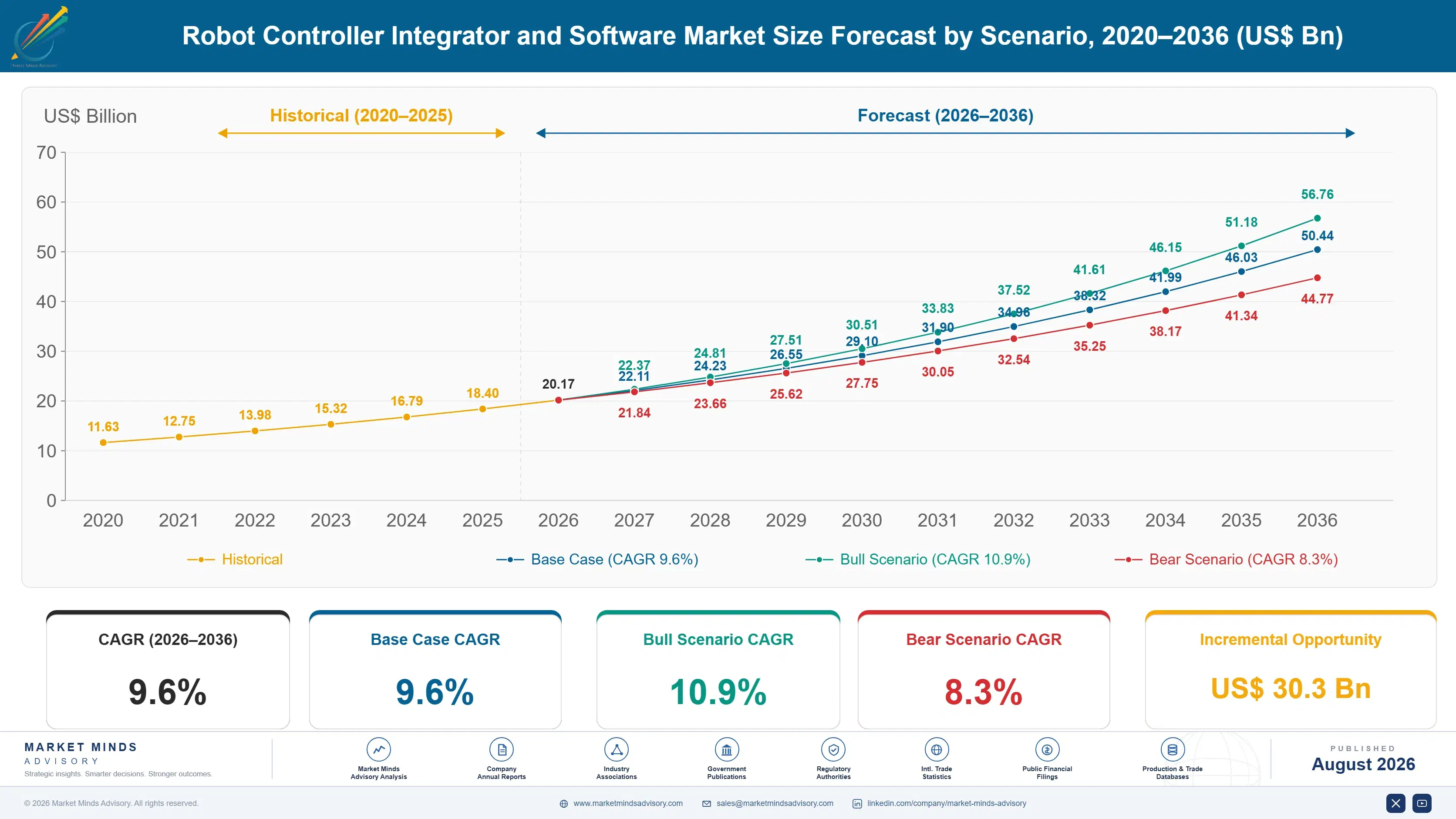
Robot Controller Integrator and Software Market Forecast Scenarios

robot-controller-integrator-and-software-market-size-forecast-scenario-1787676864482
Between 2020 and 2025 the sector compounded at 8.4%, but the shape of that growth changed twice. Pandemic labour shortages pulled forward orders in 2021 and 2022. Then automotive retooling paused, and the integrators carrying fixed engineering headcount felt it first. Software revenue held up throughout, because licences renew whether or not new cells get built. That asymmetry matters more than it looks.
The 9.6% base case rests on three mechanisms. Controller replacement cycles are shortening as vendors withdraw support for pre-2010 architectures, forcing modernisation spend that has nothing to do with new capacity. Offline programming is displacing teach-pendant hours at a measurable rate, which converts integrator labour into software licence value. And electronics and logistics buyers, who deploy in fleets rather than cells, now specify orchestration software before they specify robots at all. None of the three depends on a capex recovery.
The bull case at 10.9% turns on natural-language programming reaching production reliability, which would collapse deployment cost for small-batch users currently priced out. The bear case at 8.3% is simpler: a prolonged automotive capex freeze in Europe and North America, where installed bases are oldest and modernisation budgets are discretionary rather than contracted. Neither is remote.

Where The Engineering Hour Actually Goes

Buy a robot and you have bought perhaps a third of what it costs to make it useful. The rest is controller, software and the engineering time to make the three agree with each other. That ratio has been stable for years, which is precisely why it is now under attack: every vendor with a software product is selling against the integrator hour rather than against another controller. The economics invite it.
FIVE-FIRM CONCENTRATION34%Share held by the largest controller vendors by revenue
AVERAGE CONTROLLER PRICE$14,200Typical unit price for a mid-range industrial robot controller
TOP PRODUCING COUNTRYChina 32%Chinese output share of global controller unit production
INTEGRATION LABOUR SHARE58%Portion of a typical cell project billed as engineering
INSTALLED CONTROLLER BASE4.6 millionActive units in service across manufacturing plants worldwide today
CONTROLLER REPLACEMENT CYCLE11 yearsMedian interval between controller modernisation events at heavy users
Controller architectures split into two camps. Closed stacks from the Japanese majors deliver deterministic motion and decades of field-proven reliability, and they resist third-party code. Open stacks, built on industrial PCs and increasingly on ROS 2, trade some determinism for the ability to run vision, planning and fleet logic on the same machine. Buyers are choosing by application, not by loyalty.
The integrator channel is the part nobody models properly. Roughly 12,000 firms worldwide deliver robotic cells, most with fewer than 40 engineers, and their capacity sets the real ceiling on deployment. Software that halves commissioning time does not shrink this market. It lets the same headcount deliver more projects, which is a different thing entirely.
"The controller vendors think they are defending a hardware franchise. They are actually defending a compiler, and compilers have historically not stayed proprietary for long."
Director, Industrial Automation and Robotics Practice · MMA Technology Practice · August 2026

Market Trends

Offline Programming Displaces Teach Pendant Engineering Hours

Teaching a weld path by pendant takes a skilled engineer days. Generating it offline from CAD geometry, then validating it against a simulated cell, takes hours. The shift has been technically possible since the 1990s and commercially marginal until robot fleets grew large enough to amortise the licence. Automotive tier ones now run offline programming as default policy, and general industry is following through vendor-bundled entry tiers. What changed is not the software. It is that engineering labour got scarce enough for the arithmetic to work at plants running twenty robots rather than 200.
Market Impact: Shifts 32% of unit volume
ROS 2 Crosses Into Production Industrial Deployment

For a decade ROS was research software that industrial engineers were told not to trust with a moving axis. ROS 2 changed the argument by adding real-time-capable middleware and a security model, and the industrial distributions now shipping carry commercial support contracts. Logistics and warehouse operators adopted first, because their fleets were never served well by cell-oriented controllers anyway. Automotive is slower and will stay slower. The commercial consequence is that a controller's value increasingly sits in its motion kernel and its safety certification, not in the programming environment wrapped around it.
Market Impact: Adds 14,000 unfilled engineering roles

Market Opportunities and Growth Drivers

China Localisation Policy Reshapes Controller Supply Chains

MIIT's robotics development guidance sets domestic content targets that reach deep into the control layer, not just the arm. Chinese integrators specifying Estun, Inovance or Siasun controllers qualify for provincial subsidy schemes that foreign-controller cells do not. The effect is visible in unit share rather than value share, because domestic controllers still price well below Japanese equivalents. For the incumbents this is a slow squeeze: they keep the high-precision and automotive work, and lose the general assembly volume that funded their engineering overhead in the first place. The subsidy is the smaller half of the story.
Market Impact: Extends payback by 9 months

Engineering Labour Scarcity Forces Software Substitution Decisions

Every industrial economy is short of controls engineers, and the shortage is worse in the mid-market than at the majors. German and Japanese integrators report vacancy periods measured in quarters, not weeks. That scarcity is what makes simulation and offline programming purchases defensible to a finance director who has never approved software before: the licence competes against a hire that cannot be made. Buyers frame it as capacity, not efficiency. Vendors who price against headcount cost rather than against competing licences have consistently captured better margin, and they have kept it through two down years.
Market Impact: Locks out 4.6 million controllers

Market Restraints and Challenges

Brownfield Integration Costs Resist Every Software Promise

Software vendors demonstrate on clean cells. Real plants have 30-year-old PLCs, undocumented fixtures and safety circuits nobody wants to touch. The root cause is that integration cost scales with the surrounding equipment, not with the robot, so a tool that halves programming time might cut total project cost by a tenth. Buyers who expected more have become sceptical of the next claim, which lengthens sales cycles for everyone. The mitigation pathway is diagnostic: vendors now run paid pre-engineering audits that scope the brownfield problem before anyone quotes a licence. It is slower and it works.
Market Impact: Cuts commissioning time roughly 40%

Safety Recertification Blocks Controller Software Update Cycles

A controller running safety-rated motion cannot take a software update without revalidation, and in regulated plants that means a documented risk assessment and often a notified body review. Root cause is architectural: safety and motion logic share the same certified stack in most legacy designs. The commercial consequence is that vendors cannot ship features to the installed base, so software revenue depends on new cells rather than on the four million controllers already deployed. Separating the safety domain onto its own certified module is the fix, and it is already shipping on newer platforms.
Market Impact: Opens roughly 18% of new deployments
4 additional market trends, 3 additional growth drivers, and 2 additional restraints and challenges are covered in the full report. Contact sales@marketmindsadvisory.com to access the complete intelligence.

Segment CAGR and Growth Architecture

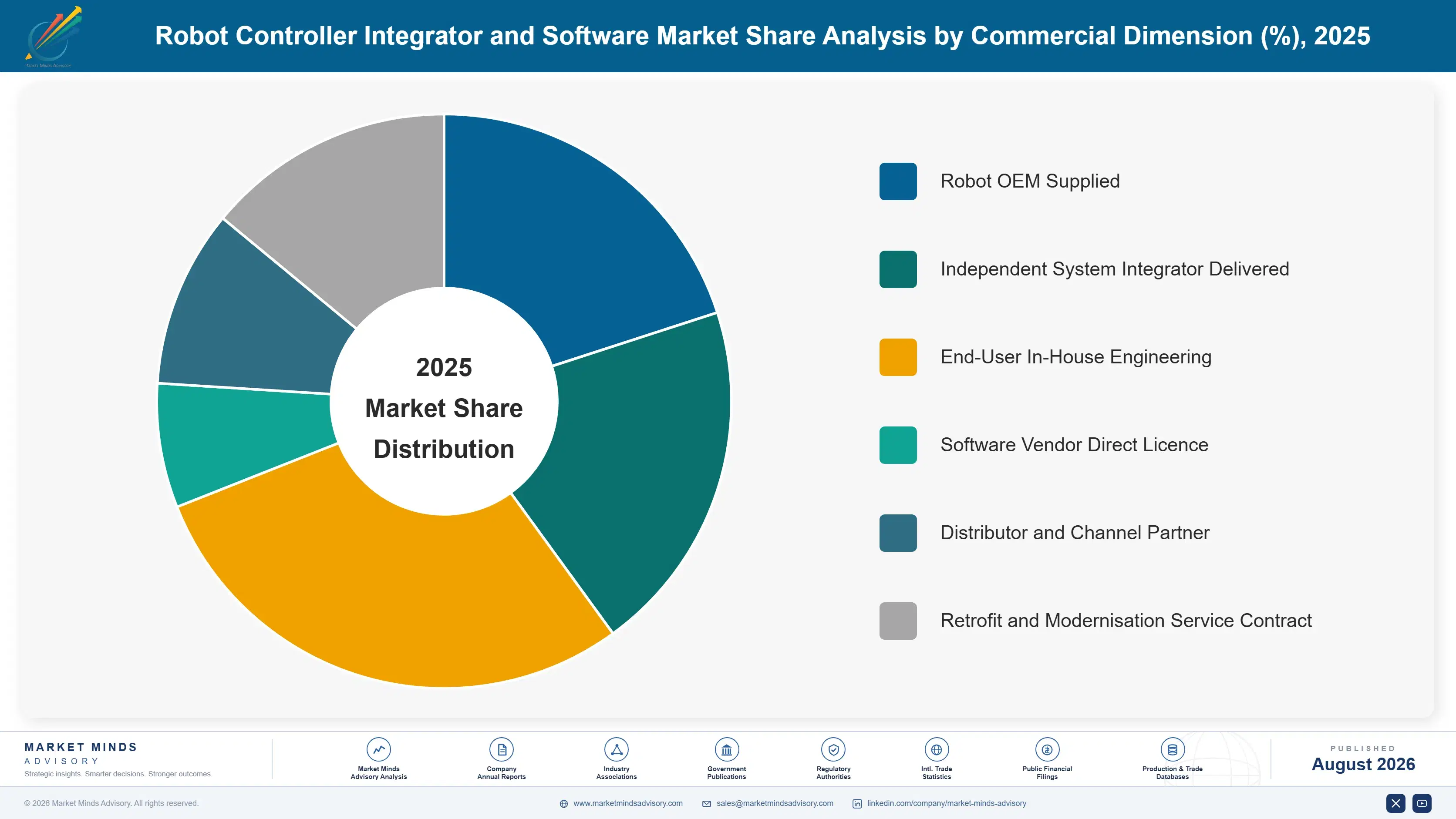
Segmentation follows control function: what the software and hardware actually do inside a deployment, rather than who supplies it or under what commercial model. Six functions cover the market without overlap, from deterministic motion execution through to multi-robot traffic management. Supplier type and delivery model are treated separately, as commercial dimensions, because both cut across every function.
robot-controller-integrator-and-software-market-market-share-analysis-1787676865077

Fleet Coordination and Traffic Management

Cell controllers were designed to run one arm well. Fleet coordination software solves a different problem: which of 40 mobile robots goes where, in what order, when two of them want the same aisle. Warehouse and parcel operators drove the early demand, and manufacturing is adopting the same logic for intralogistics between cells. Growth at 14.4%, half again the market rate of 9.6%, reflects both fleet size and the fact that no incumbent controller vendor owned this layer to begin with. The competitive field is therefore open in a way the rest of the market is not, which is why several robot makers have bought rather than built here. Building it late is expensive.
CAGR 14.4%

Simulation and Virtual Commissioning

Virtual commissioning means proving a cell works before anyone bolts it to a floor. The pitch is straightforward: catch the collision, the reach problem and the cycle-time miss in software, where fixing costs an afternoon rather than a shutdown. Automotive body shops have run this way for years. What is new is mid-market adoption, driven by licence tiers priced for plants with one cell rather than 100, and by CAD interoperability that finally works without a translation step. At 12.8% it grows faster than programming software because the value is measured against downtime, which every plant manager already prices, rather than against engineering hours. That is a much shorter sales conversation.
CAGR 12.8%
Full segment breakdown across 6 segments available in the complete report.

Regional Architecture and Country Demand Map

Geography follows robot installation volume rather than manufacturing output, and the two diverged years ago. East Asia takes the largest share on Chinese installation volume alone. North America and Western Europe hold value share through automotive and aerospace complexity, while South Asia grows fastest from a small base.

North America

Automotive still anchors North American spending, but the growth is elsewhere. Food processing plants across the Midwest and the South are automating packaging lines that were manual until labour costs made them indefensible, and those buyers want turnkey cells rather than components. Warehouse operators are the second engine, buying fleet orchestration at volumes that dwarf what any single factory needs. Mexican operations complicate the picture usefully: nearshoring has filled Bajio industrial parks with cells specified in Detroit and commissioned by integrators who bill in pesos. Canadian demand is narrower, concentrated in aerospace machining around Montreal and in mining equipment maintenance. Aerospace work pays best per hour. Volume sits south of the border now.
Share: 22% | CAGR: 8.9% (2026 to 2036)

Western Europe

Germany accounts for the largest single block of European spending, and its character is specific: high-mix machinery builders who need flexible programming more than they need cycle time. Italian demand runs through packaging machinery, where robotic handling is sold inside the machine rather than as a separate cell. France concentrates in aerospace and nuclear, both of which pay premium rates for certified control stacks and traceable software versioning. Nordic industry adopted collaborative robots early and now runs the largest per-capita installed base of them anywhere. The Iberian automotive plants buy on cost, which is why Spanish integrators have become the price reference for the whole region. Four buying logics, one currency.
Share: 19% | CAGR: 8.1% (2026 to 2036)
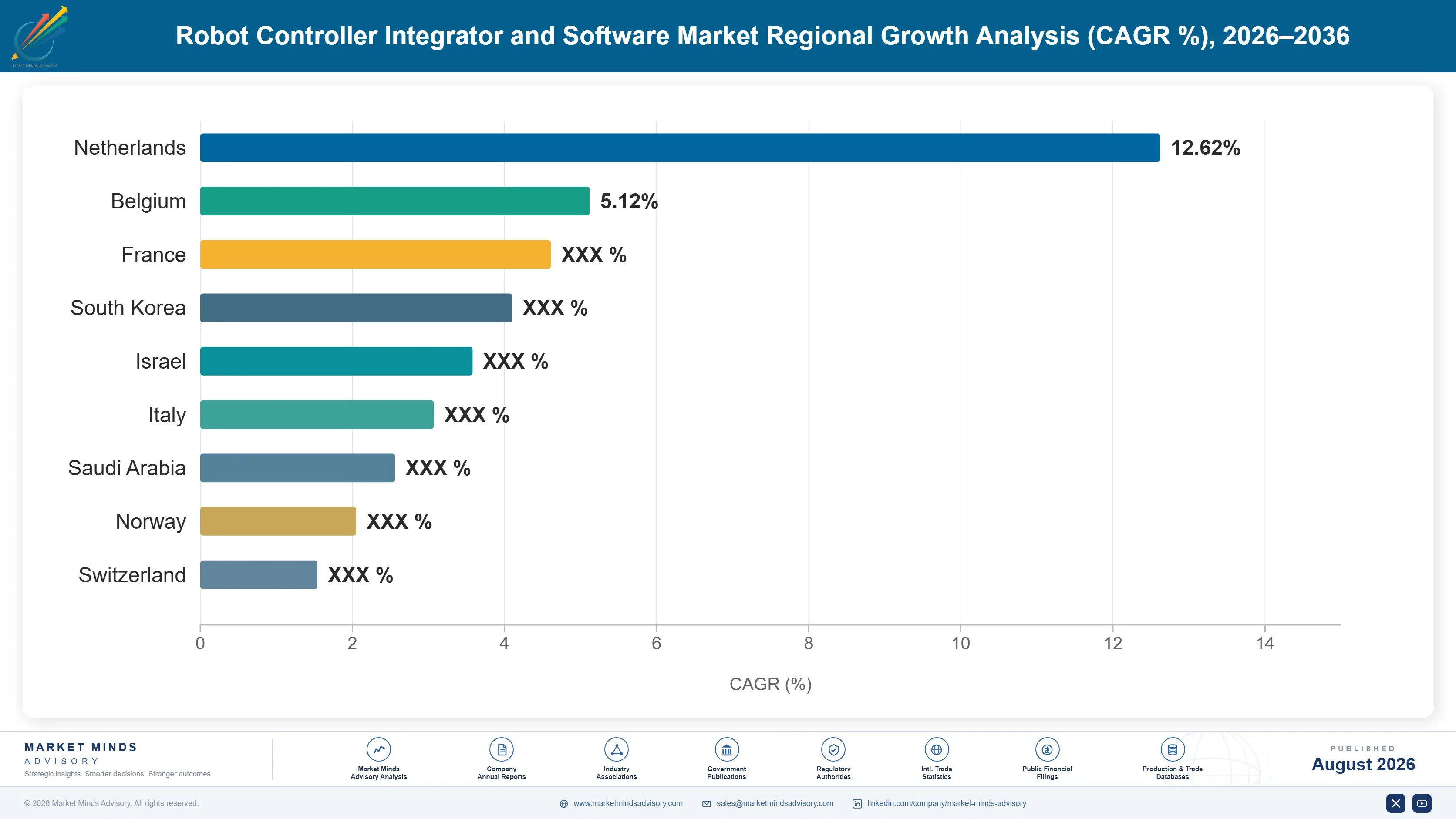
Regional intelligence for 5 additional markets available in the complete report: East Asia, South Asia and Pacific, Latin America, Middle East and Africa, Eastern Europe. Contact sales@marketmindsadvisory.com.
robot-controller-integrator-and-software-market-country-cagr-analysis-1787676865615

Four Ways To Get Paid Better

Margin in this market does not come from selling more controllers. It comes from changing what the customer is buying: an outcome instead of a component, a subscription instead of a project, a certified stack instead of a compatible one. Four levers move the number, and three of them require giving something away first. Two are uncomfortable.

Price Programming Software Against Engineering Headcount Cost

A fully loaded controls engineer costs a German integrator roughly 95,000 euros a year. Priced against that number, an offline programming seat at 8,000 euros is trivially justified; priced against a competing seat at 6,000 euros it is a hard negotiation. The same product, two conversations, and the difference in realised margin runs to 20 points. Vendors who make this switch have to retrain a sales force that has spent years discounting on feature comparison. The ones who did it before their competitors set the reference price for the segment and have kept it.
Market Impact: Lifts software gross margin by 20 percentage points

Convert Commissioning Projects Into Multi-Year Support Subscriptions

Integrators historically finished a cell, invoiced, and went looking for the next one. The subscription version bundles remote monitoring, programme updates and a guaranteed response window at roughly 12% of project value annually, which converts a one-off into an eight-year relationship. Customers accept it because the alternative is keeping their own robot programmer on staff. The catch is working capital: subscription revenue arrives slowly while engineering payroll does not, and several mid-sized integrators have run into trouble making the transition. Those who staged it, converting one customer segment at a time, came through intact.
Market Impact: Adds recurring revenue worth 12% of project value annually

Certify Control Stacks Ahead Of Safety Standard Revisions

ISO 10218 was revised in 2025 and the transition period is short. Vendors who certified early can hand an integrator a compliance file instead of a testing programme, and that saves roughly 6 weeks on every collaborative installation. Buyers under a plant start-up deadline will pay for those weeks without much argument. The investment is real: a full certification cycle costs a mid-sized vendor well over a million euros and ties up the engineering team that would otherwise be shipping features. It buys a specification position that lasts until the next revision.
Market Impact: Saves roughly 6 weeks on every collaborative installation project

Sell Retrofit Modernisation To The Existing Installed Base

There are 4.6 million controllers in service and a meaningful fraction run architectures their makers no longer support. Retrofit sells against a specific fear: a line stopping because a 20-year-old drive card cannot be sourced. Modernisation packages that keep the mechanical arm and replace the control cabinet cost around 35% of a new cell and take a weekend rather than a quarter. Margins are better than new-build because the engineering is repeatable across a fleet of identical machines. The constraint is finding the installed base, which is why vendors are buying service businesses to get the customer list.
Market Impact: Captures 35% of new-cell value on each retrofit sale

Who Controls the Margin Pool

Measured on disclosed robotics and automation segment revenue, the five largest suppliers hold a CR5 of 34%, which understates how concentrated the controller layer actually is. Hardware architecture is set by four firms. Delivery is fragmented across thousands of integrators, and that split is the defining feature of the market. FANUC and ABB sit clearly ahead of the challenger group on installed base.
Competition currently runs on three fronts. The first is programming environment quality, where vendors are racing to make their own tools good enough that customers stop asking for third-party alternatives. The second is fleet software, contested mainly through acquisition because building it internally has proved slow. The third is the integrator channel itself, where vendors compete on training, certification and lead referral rather than on product at all. Channel loyalty is bought, and it is expensive.

Rankings will shift where the control layer decouples from the arm. Chinese vendors are already winning general assembly volume on price and adequate performance, and Western software firms are winning the orchestration layer above the controller entirely. The incumbents keep automotive and precision work. That is a good business and a smaller one than they have now.
robot-controller-integrator-and-software-market-company-positioning-matrix-1787676866143

Competitive Moat and Risk Dimensions

FANUC

Moat: Deterministic Motion Control Reliability

FANUC's control kernel has been refined against the same automotive duty cycles for four decades, and the field failure data behind it is not something a new entrant can assemble quickly. Buyers running unattended shifts pay for that record specifically. It is a moat built from time rather than from patents, which makes it durable and slow to extend.
FANUC

Risk: Closed Architecture Limits Software

The same closure that protects the motion kernel keeps third-party developers out, and the interesting robotics software is written by people who will not sign a partner agreement to get access. If orchestration and planning migrate above the controller, a superb motion kernel becomes a component sold on price. FANUC's moves toward interface publication suggest the risk is understood internally.
ABB

Moat: Integrated Process Application Depth

ABB sells control alongside drives, electrification and process instrumentation, which lets it quote a paint shop or a welding line as one package rather than as a robot plus adjacent equipment. That breadth is hard to match without owning the portfolio. It matters most where the robot is a minority of capital cost and integration risk dominates.
ABB

Risk: Portfolio Breadth Dilutes Focus

Breadth cuts both directions. A specialist competing only on robot control can move faster on programming tools and fleet software than a division answering to a broader industrial portfolio. ABB's robotics business has been restructured more than once for exactly this reason, and each reorganisation costs momentum in a segment where release cadence is now a competitive variable.

Players Tracked

Prominent Players

FANUC
ABB
Yaskawa Electric
KUKA
Mitsubishi Electric

Other Key Players

Kawasaki Heavy Industries
Denso Wave
Nachi-Fujikoshi
Seiko Epson
Universal Robots
Estun Automation
Shenzhen Inovance Technology
Siasun Robot and Automation
Omron
Rockwell Automation
Siemens
Beckhoff Automation
Staubli
Comau
Hyundai Robotics

Recent Developments

MARCH 2025

ABB completes acquisition of warehouse fleet orchestration software developer

ABB acquired a fleet orchestration software developer serving warehouse operators, adding multi-robot traffic management to a portfolio previously organised around cell-level control. The purchase was an acquisition rather than a partnership, and the acquired team continues to support installations running competitors' mobile hardware alongside ABB units.
Signal: Incumbent controller vendors are buying the orchestration layer rather than building it, which confirms the timing pressure.
JULY 2025

FANUC publishes expanded controller interface specification for third-party developers

FANUC published an expanded interface specification opening defined controller functions to external software developers under a registration scheme. This was an organic product decision, not a partnership or joint venture, and it stops well short of full openness: motion kernel access remains closed and safety functions stay entirely proprietary.
Signal: The most closed architecture in the market is opening selectively, which tells you where competitive pressure is actually landing.
NOVEMBER 2025

Estun Automation expands controller production capacity at Nanjing plant

Estun Automation commissioned additional controller and drive production capacity in Nanjing, an organic expansion funded from retained earnings rather than any joint venture or acquisition. The stated purpose was serving domestic integrator demand created by provincial automation subsidy programmes that favour locally manufactured control hardware.
Signal: Domestic Chinese controller capacity is being built for policy-driven demand, which makes the volume shift difficult to reverse later.

What Sits Underneath The Control Cabinet

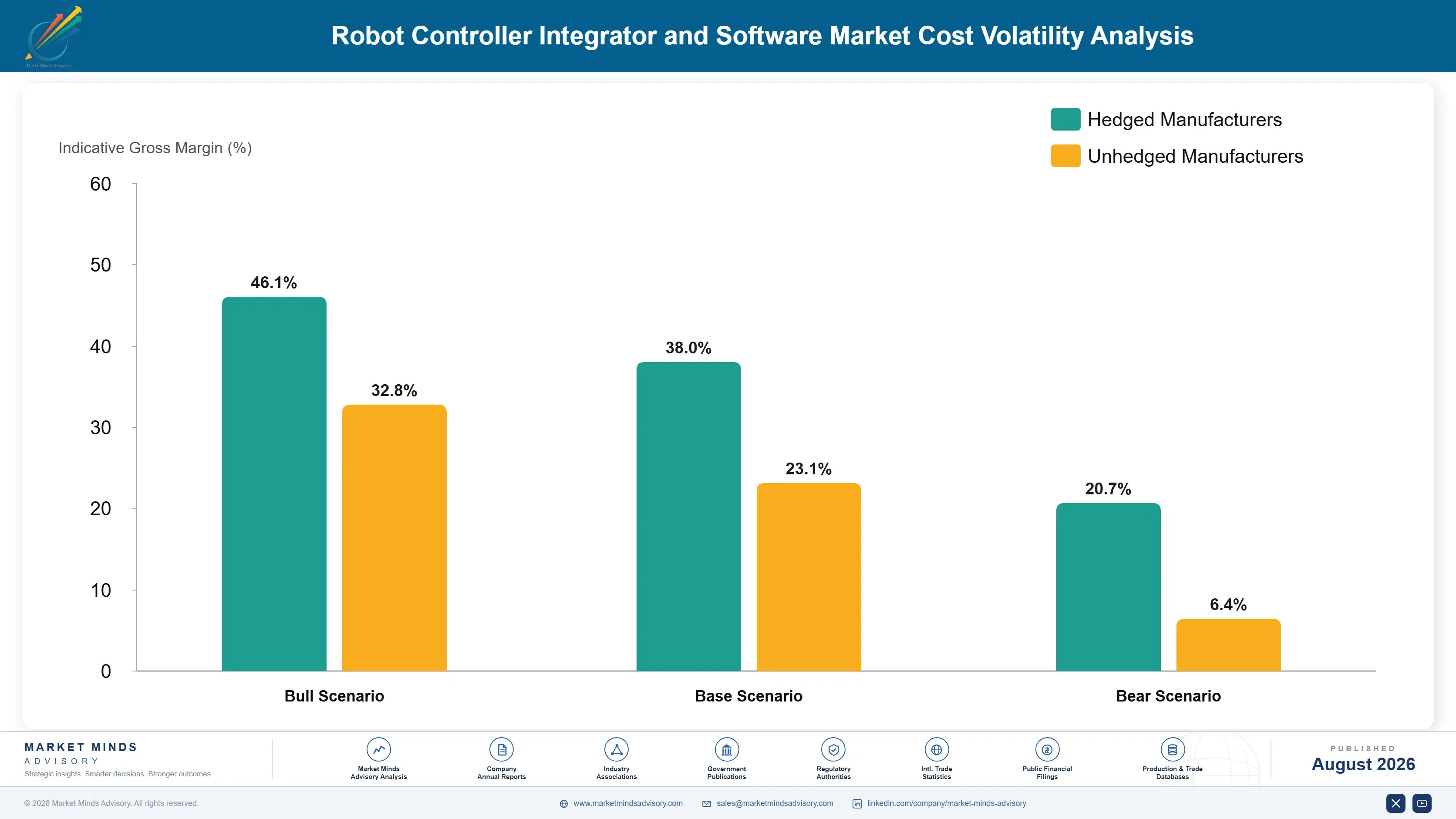
Controller hardware cost is dominated by semiconductors. Power modules, FPGAs and motion processors together run 38 to 41% of cabinet COGS, and the supply origin is narrow: Japanese and European power semiconductor fabs, Taiwanese foundries for the logic. Passive components and connectors add another 14%, sourced largely from Japan and China. Enclosure metalwork and cabling are commodity items and rarely the problem.
The 2021 to 2023 semiconductor shortage hit controllers harder than robots. Renesas and Infineon annual reports for those years document allocation regimes that pushed lead times on motion control microcontrollers past 52 weeks. Robot makers held finished arms waiting for cabinets. Two of the majors disclosed deferred revenue tied specifically to controller availability, and integrator project schedules slipped a quarter or more across automotive programmes that had no flexibility to absorb it.

Exposure is not equal. Vendors with in-house power electronics design can qualify a second source in months; those buying reference designs from a single supplier cannot. Chinese producers were relatively protected because domestic fabs prioritised them under allocation, which is part of why their unit share moved when it did. The small integrator buying cabinets one at a time has no leverage and simply waits.
robot-controller-integrator-and-software-market-cost-volatility-analysis-1787676866340

Dual-source motion control silicon at design stage

Qualifying two power module suppliers costs engineering time upfront and buys optionality that matters once every four or five years. The vendors who did this before 2021 shipped through the shortage. Design-stage dual sourcing is far cheaper than emergency requalification, which requires safety retesting on any controller carrying a certified motion function. The cost sits in the wrong budget.

Hold strategic inventory of long-lead control components

Carrying 12 months of motion processors ties up working capital and offends every inventory policy written in the last 30 years. It also kept several vendors shipping while competitors quoted eight-month lead times. The discipline is selective: stock only the components with single-source exposure and long qualification cycles, and let commodity passives run lean as before.

Shift value from cabinet hardware toward software licences

The cleanest hedge against semiconductor cost is selling less semiconductor. Vendors moving revenue mix toward programming, simulation and orchestration licences reduce COGS exposure without touching their supply chain at all. This takes years and changes the sales model, but it is the only mitigation that improves gross margin rather than merely protecting it from the next shortage.

Portfolio Architecture for Margin Defence

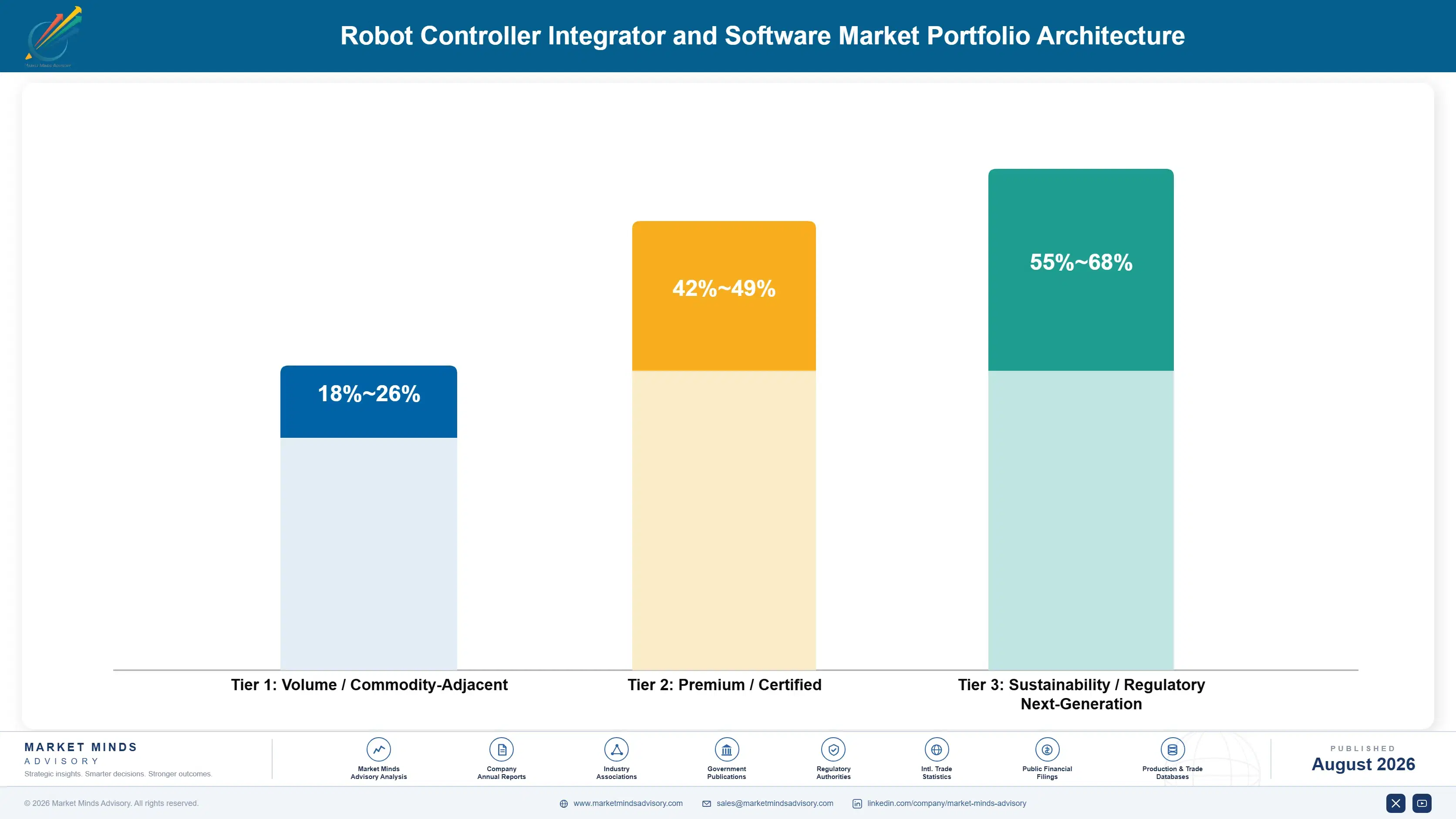
Margin architecture in this market is unusually wide. Controller hardware sold to a robot OEM earns commodity electronics margins. The same vendor's simulation licence, sold to the same customer's engineering department, earns software margins four times higher. Integration services sit between the two and vary more by contract discipline than by anything the market does.
The tension is that volume and premium are sold to the same buyer, often in the same quotation. A vendor discounting cabinet hardware to win the robot socket then has to defend software pricing to a procurement team that has just watched it concede 15 points. Several have separated the two commercially, quoting hardware and software from different entities with different discount authority, and their realised software margins are visibly better for it.

High-value pools concentrate in three places. Safety-certified control for collaborative and medical applications, where certification cost creates a defensible price. Fleet orchestration, where the software has no hardware anchor and therefore no hardware pricing gravity. And modernisation engineering for the installed base, which carries premium rates because the alternative is unplanned downtime. None of these is where the volume sits, and all three are where the profit does.

Volume / Commodity-Adjacent

Controller cabinets and drive hardware sold into robot OEM programmes and price-led general assembly. The 8-point range reflects the gap between high-payload cabinets carrying substantial power silicon and lighter collaborative units. Volume is high and pricing is contested every renewal.
Gross Margin: 18-26%

Premium / Certified

Certified safety control, precision motion for machining and semiconductor handling, and the programming environments bundled with them. The 7-point spread separates standard safety-rated products from application-certified stacks for medical and aerospace work. Specification position matters more than price here.
Gross Margin: 42-49%

Sustainability / Regulatory / Next-Generation

Fleet orchestration, virtual commissioning and AI-assisted programming, sold as licences with negligible marginal cost. The 13-point range is unusually wide because early-stage products price on value delivered rather than on any cost basis, and discounting discipline varies enormously between vendors.
Gross Margin: 55-68%
robot-controller-integrator-and-software-market-portfolio-architecture-1787676866841

High-value Sub-segments and Strategic Watch-out

Fleet Orchestration Software

The highest-value pool and the fastest-growing, currently contested by startups and acquisitive incumbents in roughly equal measure. Value sits in interoperability across mixed robot fleets, which is precisely what a single hardware vendor is least placed to deliver credibly. Neutrality is the product, and ownership undermines it.
Gross Margin: 60-63%

Safety-Certified Control Modules

High value and steady rather than spectacular growth, tied to collaborative installation volume and to the ISO 10218 transition. Certification cost keeps entrants out and keeps prices firm. Demand is regulatory rather than discretionary, which makes forecasting unusually reliable and the revenue unusually defensible. Few segments offer both.
Gross Margin: 48-51%

Standard Motion Controller Cabinets

The volume core, and the part of the market Chinese vendors are taking on price with performance that has become adequate for general assembly. Defending it on specification is expensive and increasingly futile. Most incumbents are quietly conceding unit share while protecting the applications where precision still commands premium.
Gross Margin: 19-22%

Legacy Teach-Pendant Programming Tools

The strategic watch-out. Revenue is still substantial and the installed base is loyal, but every offline programming sale erodes it and the erosion compounds. The risk is treating a declining annuity as a stable one and underinvesting in the replacement product until a competitor has already shipped theirs.
Gross Margin: 32-35%

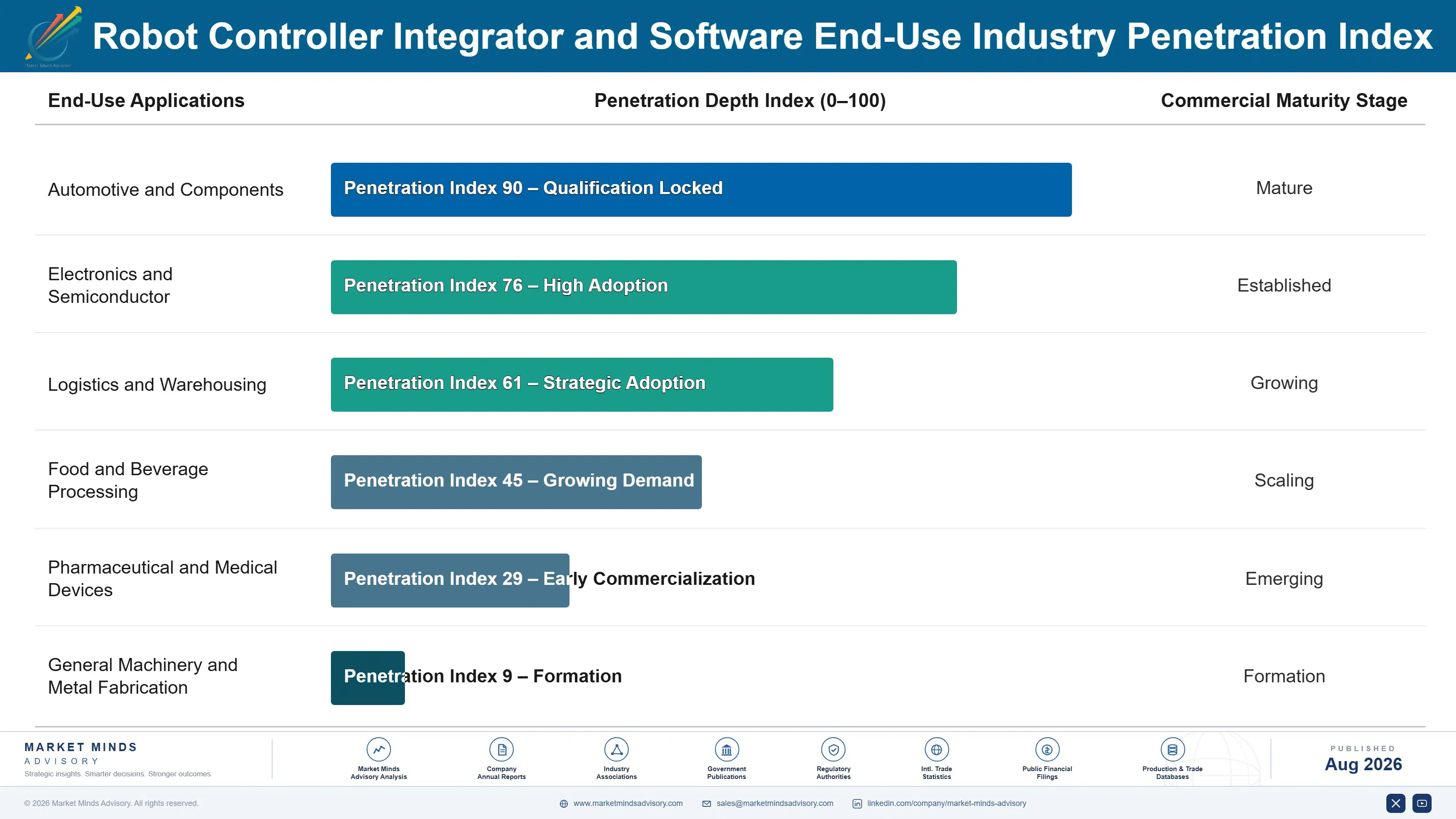
Why Control Spend Keeps Recurring

A robot cell generates control spending long after the capital invoice clears. Software maintenance runs 18 to 20% of licence value annually. Controller spares, programming support and periodic modernisation add more, and none of it appears in the original business case. Over a 12-year cell life the recurring stream typically exceeds the original control hardware purchase by a wide margin.
Stickiness varies sharply by vertical, and it tracks validation burden rather than satisfaction. Pharmaceutical and medical device plants change control architecture almost never, because requalification costs more than the equipment. Automotive changes at platform boundaries, roughly every seven years. Electronics assembly changes whenever the contract moves, which can be annually. General machinery sits in between and switches on price when a plant engineer retires and takes the accumulated preference with them.

The buyer is changing generation. The engineer who learned one pendant syntax in 1995 and specified the same brand for 30 years is retiring. Their replacement learned Python, expects documentation online rather than in a binder, and has no loyalty to a vendor whose tools require a training course. Brand preference was always personal. It is now being reset, one retirement at a time.
robot-controller-integrator-and-software-market-end-use-penetration-index-1787676867333

Where To Put The Money

These are among the four positions where our research anticipates prominent divergence between winners and laggards over the coming forecast period. Each is grounded in the demand model, the regulatory perimeter, and the announced capacity pipeline.
01 / CONTROL LAYER POSITIONING

Own the layer above the controller, not the controller

The motion kernel is a magnificent piece of engineering and it is becoming a component, because the decisions that determine cell productivity are increasingly made in software running above it. Fleet orchestration grows at 14.4%, half again the market rate of 9.6%, and no hardware vendor holds a defensible position there yet. Capital committed to controller performance improvement earns less than the same capital committed to the orchestration and programming layers, and that gap widens with every year that passes.
02 / CHANNEL CAPACITY INVESTMENT

Buy integrator capacity before software makes it scarce

Every efficiency gain in programming software raises the number of projects a given integrator team can deliver, which makes integrator headcount more valuable rather than less. Vendors treating the channel as a distribution cost are underpricing an asset that sets the ceiling on their own deployment volume, and several have already discovered this the expensive way. Acquiring or contractually locking regional integration capacity now costs less than competing for it in three years, when the same efficiency gains have made every competitor aware of its scarcity.
03 / CHINA VOLUME CONCESSION

Concede general assembly volume, defend precision applications

Chinese controllers have reached performance adequacy for general assembly at prices Japanese and European vendors cannot match without destroying their own margin structure, and provincial subsidy schemes make the gap wider still. Fighting for that volume costs margin on every unit and buys a share position that policy can reverse at any point, which makes it a poor use of pricing authority. The defensible ground is precision machining, semiconductor handling and safety-certified applications, where performance requirements remain genuinely beyond the domestic alternatives today.
04 / INSTALLED BASE MONETISATION

Modernise the installed base before someone else does

There are 4.6 million controllers in service, a large share of them running architectures whose makers have stopped shipping spares, and the owners mostly do not know which category theirs falls into. Retrofit modernisation captures roughly 35% of new-cell value at better margin than new-build because the engineering repeats across identical machines, and it arrives without a capital approval fight. The vendor who maps that installed base first controls the conversation, which is why service business acquisitions in this market are really customer list acquisitions.

Engagement Snapshot From the Field

A live engagement with an industry participant carrying material or product regulatory and market exposure ahead of a defining policy shift, showing how our research translates into a defensible multi-year portfolio strategy.
MARKET MINDS ADVISORY · CLIENT ENGAGEMENT SUMMARY
Robot Controller Integrator and Software Producer Strategic Portfolio Review and Transition Roadmap 2026·Investment Scenario on Robot Controller Integrator and Software Exposure Evaluation 2025-26
CLIENT PROFILE
A European tier-one automotive supplier operating 11 plants across four countries, producing powertrain and chassis components with combined annual revenue reported at 3.4 billion euros (client-reported, unverified by MMA). The company ran approximately 640 industrial robots across three controller architectures accumulated through two decades of acquisitions, supported by a central automation team of nine engineers and four regional integrator relationships.
STRATEGIC CHALLENGE
Programming and commissioning costs had risen faster than robot prices for six consecutive years, and the automation team could not staff the retooling programme scheduled for the next platform. Consolidating onto a single controller architecture would strand working equipment. Keeping three architectures meant maintaining three sets of skills the company could no longer hire. Neither option had an obvious owner internally.
MMA APPROACH
MMA mapped every deployed cell by controller generation, support status and remaining mechanical life, then modelled three consolidation paths against the retooling schedule rather than against a clean-sheet target. 12 expert interviews with integrators in the client's regions established realistic commissioning rates. The analysis deliberately treated engineering capacity, not capital, as the binding constraint on every option considered.
KEY FINDINGS
  1. Only 190 of the 640 robots ran controllers still under manufacturer support, and 84 of those were scheduled for end-of-support notification within 30 months.
  2. Offline programming adoption was blocked not by software cost but by missing CAD fixture data, which no single department owned or had budget to reconstruct.
  3. Integrator commissioning rates in the client's Eastern European plants had converged with Western European rates, removing the labour arbitrage the automation plan still assumed.
  4. Consolidating to two architectures rather than one captured 80% of the skills benefit at roughly a third of the equipment write-down (client-reported, unverified by MMA).
CLIENT PROFILE
A European tier-one automotive supplier operating 11 plants across four countries, producing powertrain and chassis components with combined annual revenue reported at 3.4 billion euros (client-reported, unverified by MMA). The company ran approximately 640 industrial robots across three controller architectures accumulated through two decades of acquisitions, supported by a central automation team of nine engineers and four regional integrator relationships.
STRATEGIC CHALLENGE
Programming and commissioning costs had risen faster than robot prices for six consecutive years, and the automation team could not staff the retooling programme scheduled for the next platform. Consolidating onto a single controller architecture would strand working equipment. Keeping three architectures meant maintaining three sets of skills the company could no longer hire. Neither option had an obvious owner internally.
MMA APPROACH
MMA mapped every deployed cell by controller generation, support status and remaining mechanical life, then modelled three consolidation paths against the retooling schedule rather than against a clean-sheet target. 12 expert interviews with integrators in the client's regions established realistic commissioning rates. The analysis deliberately treated engineering capacity, not capital, as the binding constraint on every option considered.
KEY FINDINGS
  1. Only 190 of the 640 robots ran controllers still under manufacturer support, and 84 of those were scheduled for end-of-support notification within 30 months.
  2. Offline programming adoption was blocked not by software cost but by missing CAD fixture data, which no single department owned or had budget to reconstruct.
  3. Integrator commissioning rates in the client's Eastern European plants had converged with Western European rates, removing the labour arbitrage the automation plan still assumed.
  4. Consolidating to two architectures rather than one captured 80% of the skills benefit at roughly a third of the equipment write-down (client-reported, unverified by MMA).
RECOMMENDED STRATEGY
Phase 1: Phase one: reconstruct CAD fixture data for the 190 supported cells and pilot offline programming on two plants before any hardware decision. Phase 2: Phase two: consolidate to two controller architectures at platform changeover, retiring only cells whose mechanical life ends inside the retooling window. Phase 3: Phase three: move commissioning to a subscription arrangement with two integrators, converting project spend into contracted engineering capacity through the platform cycle.
OUTCOME
The client adopted the two-architecture path and completed the fixture data programme ahead of the platform changeover. Commissioning hours on the first two converted plants fell 34% against the prior programme, and the retooling schedule was met without additional automation headcount (client-reported, unverified by MMA). The subscription arrangement with integrators is now standard practice across all 11 sites.

Frequently Asked Questions

Foundational context covering the market sizes, CAGR, scope, country, region and competition that inform every finding below. This section is provided to cover basics and most often pre-purchase conversations, answered from the MMA Primary Research Dataset.

What is the current size of the Robot Controller Integrator and Software Market?

The market was worth 18.4 billion dollars in 2025, covering controller hardware, robot software and system integration services. It reaches 20.2 billion dollars in 2026 on current forecasts.

How large will the Robot Controller Integrator and Software Market be by 2036?

MMA forecasts 50.5 billion dollars by 2036, an increase of 30.3 billion dollars over the 2026 base. That represents an expansion multiple of 2.50 times across the forecast period.

What is the CAGR for the Robot Controller Integrator and Software Market 2026 to 2036?

The base case compounds at 9.6% annually. MMA's bull case reaches 10.9% on natural-language programming adoption, while the bear case sits at 8.3% if automotive capital spending stays frozen.

Which segment is growing fastest?

Fleet coordination and traffic management software, at 14.4%, half again the market rate of 9.6%. Multi-robot deployments outgrew the cell-level control logic that industrial controllers were originally designed around.

Who are the major companies in the Robot Controller Integrator and Software Market?

FANUC, ABB, Yaskawa Electric, KUKA and Mitsubishi Electric lead on disclosed robotics and automation segment revenue. Estun Automation, Inovance, Siasun, Universal Robots and Rockwell Automation compete strongly in specific segments.

Which country is growing fastest?

China at 12.6%, driven by MIIT localisation policy and provincial subsidies that favour domestically manufactured controllers. India follows closely on production-linked incentive support for electronics and auto component automation.

Report Segmentation Architecture

The full report scope spans multiple orthogonal segmentation dimensions, with cross-tabulated demand data provided for each dimension pair. Coverage extends further to regional breakdowns, trend trajectories, and the competitive detail needed to support segment-level decision-making.

By Control Function

  • Motion and Trajectory Control
  • Programming and Path Generation
  • Simulation and Virtual Commissioning
  • Fleet Coordination and Traffic Management
  • Adaptive Process and Vision-Guided Control
  • Safety and Compliance Control

By End-Use Industry

  • Automotive and Components
  • Electronics and Semiconductor
  • Logistics and Warehousing
  • Food and Beverage Processing
  • Pharmaceutical and Medical Devices
  • General Machinery and Metal Fabrication

By Commercial Dimension

  • Robot OEM Supplied
  • Independent System Integrator Delivered
  • End-User In-House Engineering
  • Software Vendor Direct Licence
  • Distributor and Channel Partner
  • Retrofit and Modernisation Service Contract

By Region

  • North America
  • Western Europe
  • East Asia
  • South Asia and Pacific
  • Latin America
  • Middle East and Africa
  • Eastern Europe

Scope, Methodology, and Coverage

Every figure in this report is reproducible from documented input assumptions. The scope below maps the historical period, the forecast horizon, the segmentation dimensions, and the countries covered, alongside the underlying primary and qualitative methodology.
Historical Period
2020 to 2025
Forecast Period
2026 to 2036
Base Year
2025 (USD billions; MMA Primary Research Dataset, August 2026)
Market Definition
Scope covers robot controller hardware and embedded motion firmware, robot programming, simulation, orchestration and monitoring software, and the system integration engineering services that specify, build, commission and modernise robotic cells and fleets. Robot arms, mobile bases, end effectors and vision cameras are counted as robot hardware and excluded. Plant-level manufacturing execution and enterprise resource planning software falls outside the boundary.
Quantitative Units
USD billions (current prices); controller units shipped; installed controller base; software licence seats; integration engineering hours
Segmentation Dimensions
By Control Function; By End-Use Industry; By Commercial Dimension; By Region
Regions Covered
North America, Western Europe, East Asia, South Asia and Pacific, Latin America, Middle East and Africa, Eastern Europe
Countries Covered
USA, China, Germany, France, UK, Japan, South Korea, India, Brazil, Mexico, Italy, Spain, Poland, Saudi Arabia, South Africa
Key Companies Profiled
FANUC, ABB, Yaskawa Electric, KUKA, Mitsubishi Electric, Kawasaki Heavy Industries, Denso Wave, Nachi-Fujikoshi, Seiko Epson, Universal Robots, Estun Automation, Shenzhen Inovance Technology, Siasun Robot and Automation, Omron, Rockwell Automation, Siemens, Beckhoff Automation, Staubli, Comau, Hyundai Robotics
Quantitative Methodology
Primary survey, n=3,800 respondents, Q4 2025, six countries; demand-side model with trade association cross-validation
Qualitative Methodology
47 expert interviews, Q4 2025; applied to validate demand model assumptions, identify emerging dynamics, and assess competitive positioning
Report Format
PDF and XLSX data workbook (Word format preview document)
Publisher
Market Minds Advisory
Report Code
MMA-2026-TEC-118
Published
August 2026
Contact
sales@marketmindsadvisory.com | www.marketmindsadvisory.com

Purchase the full Robot Controller Integrator and Software Market Report (2026 to 2036).

The full report runs to 210 pages and covers all six control function segments, seven regions and 20 profiled companies in detail. It includes the complete segment CAGR set, regional installation and value data, and controller architecture share analysis by application. Company profiles carry evaluation on disclosed robotics and automation segment revenue, with moat and risk assessment for the top five suppliers. The competitive section extends to 18 tracked corporate developments across 2024 and 2025, each with commercial interpretation. Primary research inputs include a quantitative survey of 3,800 respondents and 47 expert interviews conducted in Q4 2025.
Six control function segments with individual CAGR forecasts
Seven regional markets with installation volume and value
Twenty company profiles on consistent revenue evaluation basis
Eighteen tracked corporate developments with commercial interpretation notes
Controller architecture share analysis across nine end-use industries
Retrofit and modernisation opportunity sizing by installed base age

Built For The People Who Decide

From boardroom strategy to bench-side execution, this report is read cover-to-cover by leaders shaping the next decade of their industry, turning demand scenarios, market dynamics and valuation benchmarks into decisions.
CXOs/ Presidents/ VPs/ Managers
M&A and Corporate Development
Strategy Teams and R&D Heads
Procurement and Product Directors
Regulatory and Compliance Leaders
Investor Relations and Equity Analysts