Market Minds Advisory
Robot-Assisted Surgical Microscope Market

Robot-Assisted Surgical Microscope Market: Ergonomics, Fluorescence, and the Quiet End of the Eyepiece

Neurosurgeons spend eight-hour operations bent over eyepieces, and most of them report neck and shoulder damage for it, which is why the screen is now steadily winning against the optics.

Lead Analyst

Alice Ballenger

Published

September 2026

Make Smarter Decisions with Customized Research Insights

Request a free sample report and evaluate market opportunities, growth trends, and competitive dynamics relevant to your business needs.

2025 MARKET VALUE$1.1BMarket Size 2025
2036 FORECAST VALUE$3.0BBase Case , 2026 to 2036
CAGR 2026 TO 20369.2 %Bull 10.4% / Bear 8.0%
INCREMENTAL OPPORTUNITY$1.8BNet 10- year value creation
EXPANSION MULTIPLE2.40x2036 value over 2026 base
Strategic Levers
M&A Pipeline
Regional Outlook
Country Rankings
Competitive Intelligence
Segmental Deep-dive
Call-Us : 91 93563 13602

Executive Snapshot and Market Trajectory

The eyepiece is losing, and posture is the reason. Roughly 58% of microsurgeons report neck or shoulder damage from operating bent over oculars, and a screen-based system lets a surgeon sit upright while the whole theatre sees the same view. That trade is being made in theatres everywhere.
Digital robotic exoscopes compound at 13.8%, a full 1.50x the market rate, from a small base. East Asia holds the largest share at 31%, on Chinese tertiary hospital neurosurgery expansion and a Japanese neurosurgeon density that exceeds every other country by a considerable margin. Chinese purchasing runs through tender where domestic manufacturers compete hard on price, so unit share and value share diverge. Japanese demand is replacement-driven and specification-heavy.
Concentration is very high at 74%, which is unusual even for capital equipment. Zeiss and Leica hold the field on optical quality, navigation integration and surgeon relationships formed during residency training. What threatens that position is not a better microscope but a different architecture: an exoscope competes on ergonomics and theatre workflow rather than on lens performance. Hybrid systems are the incumbent answer so far. Whether that is a defence or a delay is unresolved.
Market Definition
This market covers surgical visualisation systems with powered or robotic positioning, spanning manual and semi-automated optical systems, robotic-positioned optical microscopes, fluorescence-integrated robotic systems, digital hybrid systems combining oculars with heads-up display, and digital robotic exoscopes. Endoscopes and endoscopic camera systems, loupes and headlight systems, surgical navigation platforms sold separately, robotic surgical manipulators that operate on tissue, laboratory and pathology microscopes, and imaging agents themselves are excluded.
Base Year Value
$1.1B in 2025 (MMA Primary Research Dataset, August 2026)
Forecast Period
2026 to 2036, eleven discrete annual values
CAGR
9.2% base case. Bull 10.4%. Bear 8.0%.
Fastest Growth Segment
Digital Robotic Exoscope Systems: 13.8% CAGR
Fastest Growth Country
India: 12.6% CAGR
Fastest Growth Region
South Asia and Pacific: 11.4% CAGR
Largest Region
East Asia: 31% of 2025 global value
Market Leaders
Carl Zeiss Meditec, Leica Microsystems, Olympus, Haag-Streit Surgical, and Alcon. Source: MMA Primary Research Dataset, July 2026.
Primary Survey
n=3,800 procurement and R&D decision-makers, Q4 2025, six countries
Methodology
Demand-side build-up, cross-validated against public data, 47 expert interviews

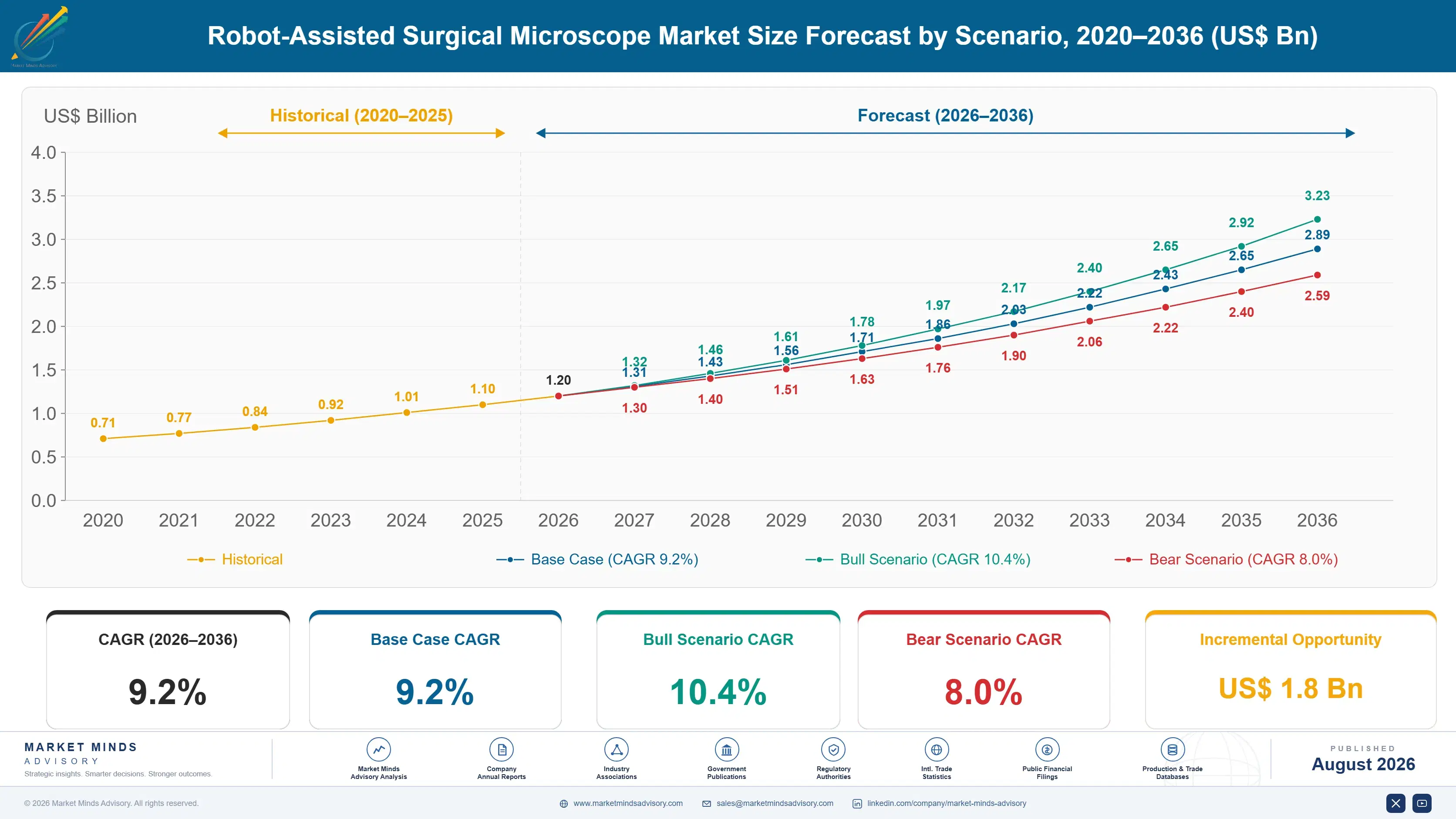
Robot-Assisted Surgical Microscope Market Forecast Scenarios

robot-assisted-surgical-microscope-market-size-forecast-scenario-1787305785164
Growth ran near 8.0% from 2020 to 2025 and the composition mattered more than the rate. Elective surgical volume collapsed and then recovered, which moved capital purchases around without changing their total. Underneath that, fluorescence-capable systems and digital visualisation took share steadily from conventional optical microscopes, and the mix shift contributed more to value growth than unit volume did.
Base case growth of 9.2% rests on three mechanisms. Ergonomic pressure keeps pushing screen-based visualisation into procedures that eyepieces have always owned. Fluorescence-guided resection continues moving from academic centres into general neurosurgical practice, and the imaging agent approvals require a capable system. And Asian tertiary hospital construction adds theatres that need visualisation from the first case. Each works independently of the others, and none requires an incumbent to lose position.
The bull case at 10.4% assumes exoscope adoption crosses from early neurosurgical adopters into spine and reconstructive work, where the ergonomic argument is at least as strong. The bear case at 8.0% reflects hospital capital deferral, which is straightforward here: a thirteen-year microscope that still focuses can be run for sixteen years when a hospital needs to protect its operating position.

Visualisation Systems: Posture, Fluorescence, Screens

For a century the surgical microscope asked the surgeon to come to it. The optics sat in a fixed relationship to the specimen and the operator bent, twisted and held position for hours to see through them. Roughly 58% of microsurgeons report neck or shoulder problems as a result, which is a workforce cost in a specialty that takes fifteen years to train and cannot easily replace anyone.
TOP FIVE CONCENTRATION74%Highly concentrated among optical specialists with deep surgical relationships
SYSTEM SERVICE LIFE13 yearsYears a hospital keeps a system before replacing it
SURGEON SYMPTOM RATE58%Microsurgeons reporting neck or shoulder problems from oculars
AVERAGE SELLING PRICE$385,000Typical price across configurations sold to hospital theatres
FLUORESCENCE ATTACHMENT48%Neurosurgical systems supplied with fluorescence imaging capability included
CAPITAL TENDER SHARE79%Systems bought through capital tender rather than direct order
Two changes address that. Robotic positioning lets the system move to a stored position or follow a navigated trajectory rather than requiring the surgeon to reposition manually and then find the view again. Digital visualisation goes further: the surgeon watches a high-resolution three-dimensional screen, sits upright, and the entire theatre team sees exactly what the operator sees rather than guessing from a side monitor.
The second change is the more consequential commercially, because it moves the competitive ground. A century of optical engineering advantage matters considerably less when the image reaches a sensor rather than an eye, and camera technology comes from an industry with different economics entirely. Exoscopes compound at 13.8% from a small base, and the threat they pose to incumbents is architectural rather than a matter of image quality.
"Zeiss and Leica did not spend a century getting better at optics to be beaten by a camera sensor and a monitor. But a surgeon who can sit upright through a ten-hour resection, with the whole team watching the same image, will take that trade. Ergonomics is doing more damage to the eyepiece than any competitor's lens ever did."
Principal Analyst, Surgical Visualisation and Neurotechnology Practice · MMA Med

Market Trends

Screen-based visualisation displaces the eyepiece on ergonomics

Digital exoscopes remove the oculars entirely, letting the surgeon operate while watching a three-dimensional monitor in a neutral posture. Roughly 58% of microsurgeons report musculoskeletal symptoms from conventional operating position, and in a specialty requiring fifteen years to train, that is a workforce problem rather than a comfort question. The whole theatre team also sees the operative view, which improves assistance and teaching materially. The segment compounds at 13.8% against a market rate of 9.2%, and the competitive ground shifts from optics toward sensors and displays. Incumbent optical advantage counts for considerably less once that happens.
Market Impact: Systems priced 2x manual equivalent
Imaging agent approvals require capable visualisation systems

Regulatory approval of optical imaging agents for tumour visualisation created a requirement that only fluorescence-capable systems can meet, and a hospital wanting to offer fluorescence-guided resection must own the equipment before it can use the agent. Roughly 48% of neurosurgical systems now ship with fluorescence capability, up substantially over the period. The pharmaceutical approval, not any device development, drove that specification change. It is one of the few situations where a drug decision determines capital equipment purchasing directly. Retrofit modules also reach departments that will not replace a system for years, widening the addressable base well beyond annual shipments.
Market Impact: India compounding at 12.6% annually

Market Opportunities and Growth Drivers

Navigation integration removes repositioning from the operative flow

Registering the visualisation system to a neuronavigation platform lets it move automatically to a planned trajectory rather than requiring the surgeon to release, reposition and refocus manually while holding a mental model of the anatomy. That saves time in procedures measured in hours and reduces the cognitive interruption that manual repositioning creates. Systems offering integrated navigation and robotic positioning command clear price premiums over manually positioned equivalents, and surgeons who have used the integration describe returning to manual positioning as genuinely disruptive. Departments that adopt the integration rarely revert, which makes the first installation unusually decisive.
Market Impact: Service life running 13 years

Asian tertiary hospital construction adds theatres from zero

China's provincial and county hospital programme continues adding neurosurgical and spine theatres that need visualisation equipment from their first operating day, which is new demand rather than replacement. India's private hospital groups are expanding neurosurgical capacity on a similar logic at a smaller scale. India compounds at 12.6%, faster than any other country covered. Neither market carries the installed base that makes developed market demand a slow replacement cycle, so growth arrives in equipment volume rather than in mix improvement. Specification levels are lower than in developed markets, so unit growth translates into value growth at a discount.
Market Impact: Preference persisting across 30 yea

Market Restraints and Challenges

Thirteen-year service life makes replacement entirely deferrable

A surgical microscope lasts around thirteen years and frequently longer, and a system that still focuses and illuminates is hard to justify replacing on clinical grounds when capital is constrained. The root cause is that optical and mechanical components degrade very slowly compared with electronics. Commercial impact is that 79% of demand runs through capital tender where deferral costs a hospital nothing immediately. Manufacturers respond with upgrade paths, fluorescence module retrofits, service contracts and financing structures that convert a capital decision into an operating one. Deferral is administratively easy and clinically defensible.
Market Impact: Exoscope segment compounding at 13.

Surgeon preference forms in training and rarely changes

Neurosurgeons learn microsurgical technique on a particular platform during residency and fellowship, and that familiarity persists across an entire career because operative technique and instrument handling are learned together. The root cause is training exposure rather than any objective performance difference between systems. Commercial impact is that displacing an incumbent in an established department is close to impossible, and new entrants must reach residents rather than consultants. Participants respond by funding training laboratories, fellowship programmes and simulation centres well ahead of any sales conversation. The payback horizon exceeds most commercial planning cycles.
Market Impact: Fluorescence capability on 48% of s
3 additional market trends, 4 additional growth drivers, and 2 additional restraints and challenges are covered in the full report. Contact sales@marketmindsadvisory.com to access the complete intelligence.

Segment CAGR and Growth Architecture

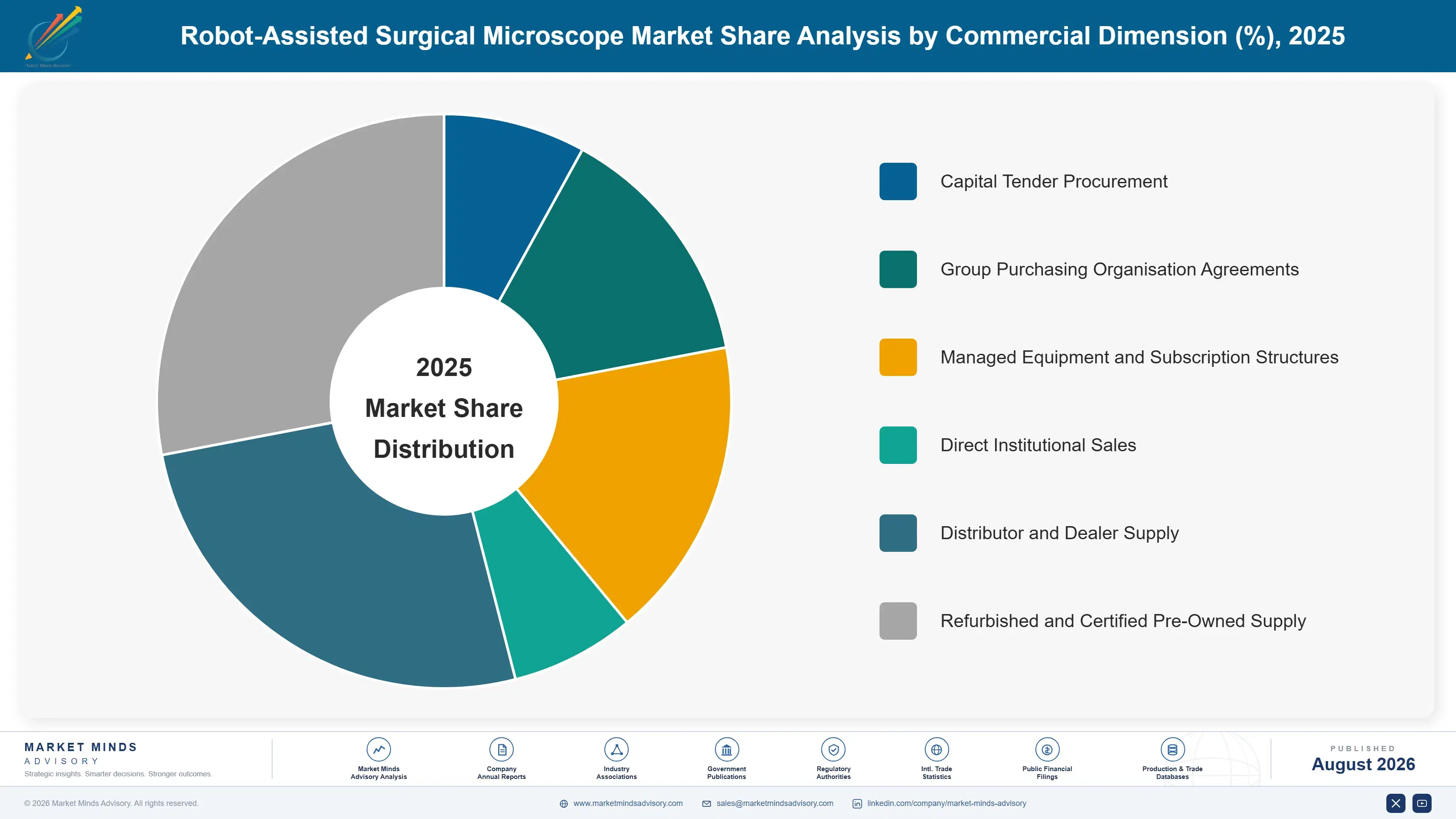
Five system classes divide this market by visualisation and positioning architecture, which is the dimension that actually determines both price and competitive dynamics. The classification separates how the image reaches the surgeon from how the system moves, and those two questions are what current competition turns on entirely. Price spans a wide range on that basis.
robot-assisted-surgical-microscope-market-market-share-analysis-1787305785730

Digital Robotic Exoscope Systems

Compounding at 13.8%, a full 1.50x the market rate, exoscopes remove the oculars completely and present a three-dimensional image on a theatre monitor while a robotic arm handles positioning. The clinical argument is ergonomic and it is strong: surgeons operate upright through long procedures, and the entire team sees the operative view rather than inferring it. The commercial significance is that competitive advantage moves from optical engineering toward sensor and display technology, which comes from industries with entirely different cost structures. Adoption remains concentrated in academic neurosurgery, and spine and reconstructive work represent the larger opportunity ahead. Surgeons trained within the past decade evaluate these systems on ergonomics alone, having never treated oculars as a reference standard.
CAGR 13.8%

Digital Hybrid Systems

Growing at 11.6%, hybrid systems retain oculars while adding a heads-up digital display, which lets a department adopt screen-based operating gradually rather than committing a whole theatre to an unfamiliar architecture. That optionality is genuinely valuable to a purchasing committee weighing surgeon resistance against ergonomic evidence, and it explains why hybrids outsell pure exoscopes in most markets currently. Incumbents favour this class because it preserves their optical advantage while answering the ergonomic argument. Whether it proves a durable position or merely a transitional one is the central strategic question facing established manufacturers. Purchasing committees weighing surgeon resistance against ergonomic evidence find the hybrid an easy compromise, which is exactly why it sells.
CAGR 11.6%
Full segment breakdown across 5 segments available in the complete report.

Regional Architecture and Country Demand Map

Regional distribution follows neurosurgical and microsurgical procedure volume alongside hospital construction, and those two diverge considerably. Mature markets replace equipment slowly while building markets equip entirely new theatres, which is a much faster and less deferrable form of demand. Construction activity predicts this market better than procedure volume does.

East Asia

Thirty-one per cent of global value, the largest regional position. Note: this share sits above the 22 to 30% band because Japan carries a neurosurgeon density far exceeding any other country and China is equipping tertiary and provincial hospital theatres at a rate no other market approaches. Japanese demand is replacement-driven and specification-heavy, with Mitaka Kohki and Takagi Seiko holding domestic positions alongside the German manufacturers. Chinese purchasing runs through hospital tender where domestic manufacturers compete aggressively on delivered price at the lower specification tiers. Exoscope adoption across the region trails North American practice noticeably. Fluorescence attachment is also lower, reflecting later imaging agent availability across most of the region.
Share: 31% | CAGR: 10.2% (2026 to 2036)

North America

Twenty-five per cent of value on considerably fewer units than East Asia, which reflects specification and pricing rather than procedure volume. Academic neurosurgery centres here adopted fluorescence-guided resection and exoscope visualisation earlier than anywhere else, and the ergonomic argument reaches a surgical workforce that is both scarce and expensive to replace. Capital tender governs most purchasing, and interviewed facilities leaders described microscope replacement as among the easier deferrals available when operating margins tighten. Group purchasing agreements cover a meaningful share of volume and concentrate awards considerably. Surgeon-initiated purchase requests carry more weight here than in most regions, since departments compete for scarce neurosurgical staff and equipment is part of that competition.
Share: 25% | CAGR: 8.8% (2026 to 2036)
Regional intelligence for 5 additional markets available in the complete report: Western Europe, South Asia and Pacific, Latin America, Middle East and Africa, Eastern Europe. Contact sales@marketmindsadvisory.com.
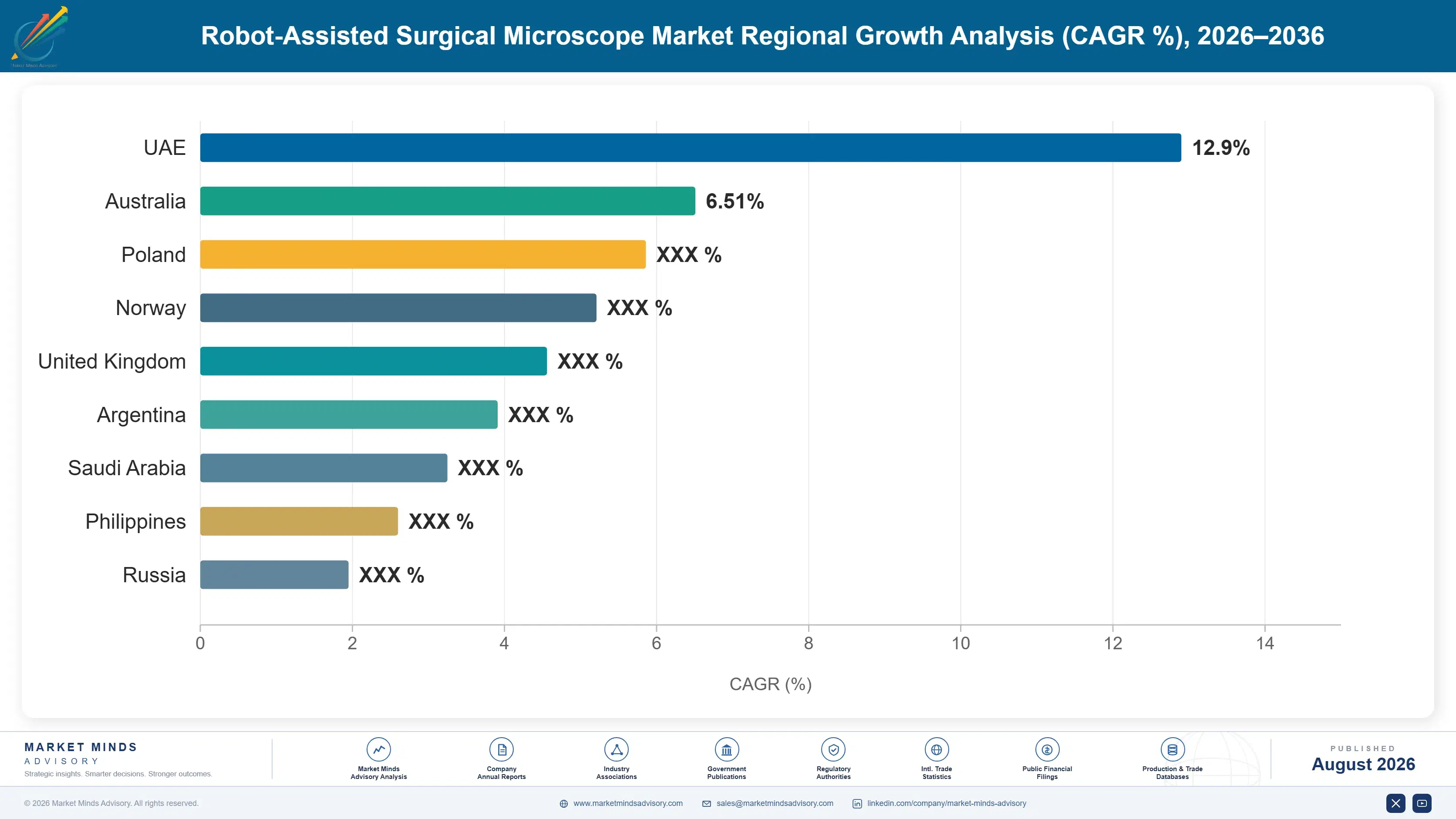
robot-assisted-surgical-microscope-market-country-cagr-analysis-1787305786251

Where Visualisation System Value Sits

Optical quality no longer decides anything, because every serious system resolves adequately for the procedure. Value now comes from the posture the surgeon operates in, the imaging capability that a drug approval made necessary, and the training relationship that forms a decade before anyone signs a purchase order. None of those three is an optical engineering problem.

Compete on posture rather than on optical resolution

Every established system resolves adequately for the work, so resolution comparisons in a tender document persuade nobody who operates. Roughly 58% of microsurgeons carry neck or shoulder damage from conventional operating position, and a system that removes that is arguing about workforce retention in a specialty nobody can staff quickly. Manufacturers that led with ergonomic evidence rather than optical specification reported surgeon-initiated purchase requests rising by around 45%. The argument reaches the person who will use the equipment rather than the committee that scores the bid. Specification sheets never reach that person at all.
Market Impact: Surgeon-initiated requests rising r

Attach fluorescence capability to every neurosurgical configuration

Imaging agent approvals made fluorescence a clinical requirement rather than a research capability, and a hospital cannot offer fluorescence-guided resection without a system that supports it. Attachment now runs at roughly 48% of neurosurgical systems and continues rising, and the module carries considerably better margin than the base platform. Retrofit onto installed systems reaches departments that will not replace equipment for years. Manufacturers treating fluorescence as a premium option rather than a standard configuration leave both the revenue and the clinical position to competitors. Absence now disqualifies bids rather than merely weakening them.
Market Impact: Attachment now reaching 48% of all

Fund training laboratories a decade before the tender

Surgeons learn microsurgical technique on a specific platform during residency and fellowship, and that preference persists across careers measured in thirty years. Displacing an incumbent in an established department is close to impossible, which makes training exposure the only route into it. Participants funding cadaver laboratories, fellowship programmes and simulation centres reach surgeons before any preference exists. The investment pays back over a horizon most commercial planning cycles cannot accommodate, which is exactly why relatively few manufacturers sustain it properly. Preference formed in residency persists across careers of 30 years, and no competing specification dislodges it later.
Market Impact: Preference persisting across 30 yea

Convert capital purchases into operating commitments

A thirteen-year service life and 79% tender purchasing mean demand can simply be postponed whenever hospital margins tighten, and nothing a manufacturer does changes that from the outside. Managed equipment agreements, upgrade subscriptions and per-procedure structures move the cost from capital budget to operating budget, where deferral is far less attractive administratively. Suppliers offering these structures reported closing roughly 30% of deals that would otherwise have been postponed. The structure also builds a continuing relationship rather than a transaction every thirteen years. It also replaces a transaction every thirteen years with a continuing relationship.
Market Impact: Roughly 30% of otherwise deferred d

Who Controls the Margin Pool

The top five hold 74% of the market measured on revenue from surgical visualisation systems with powered or robotic positioning, the basis used throughout this section. That concentration is extreme even by capital equipment standards, and it rests on optical manufacturing capability, navigation integration and surgeon relationships formed during training. Carl Zeiss Meditec and Leica Microsystems sit clearly ahead, with Olympus strongest where its imaging joint venture reaches surgical visualis
Competitive activity runs along three lines. Incumbents are building digital hybrid systems that retain oculars while adding heads-up display, preserving optical advantage while answering the ergonomic argument. Newer participants are pursuing pure exoscope architectures where sensor and display capability matters more than lens design. And Chinese manufacturers compete on delivered price at lower specification tiers, particularly in domestic tender and across price-sensitive export markets.

Pressure is emerging from an unfamiliar direction. The exoscope moves competitive advantage from optical engineering toward imaging sensors and displays, which are supplied by industries with entirely different scale and cost economics. An incumbent's century of lens expertise is worth considerably less when the image reaches a sensor. Rankings will shift on whether hybrid systems prove a durable position or merely a transitional one.
robot-assisted-surgical-microscope-market-company-positioning-matrix-1787305786772

Competitive Moat and Risk Dimensions

CARL ZEISS MEDITEC

Moat: Integration across navigation and fluorescence

The platform combines robotic positioning, navigation registration and fluorescence imaging in configurations that departments adopt as a whole rather than assembling from components, and surgeons trained on it during residency carry that familiarity through their careers. Replacing it means retraining operative technique that was learned alongside the instrument, which departments resist strongly regardless of any competing specification.
CARL ZEISS MEDITEC

Risk: Architecture shift devalues optics

The company's deepest advantage is a century of optical engineering, and an exoscope reduces the importance of that by placing a sensor where an eye used to be. Its hybrid systems answer the ergonomic argument while preserving the optical position, but if pure digital architectures become standard, the advantage that justifies premium pricing narrows considerably over a decade.
LEICA MICROSYSTEMS

Moat: Fluorescence imaging depth

Fluorescence-guided resection capability across multiple imaging agents and wavelengths gives the company a strong position in exactly the application that drug approvals made clinically necessary, and attachment now runs at roughly 48% of neurosurgical systems. Ownership within a broader hospital equipment group also supports service coverage and financing structures that a standalone optical manufacturer would find difficult to sustain.
LEICA MICROSYSTEMS

Risk: Narrower installed base position

The installed base outside neurosurgery is thinner than the leading competitor's, which limits the departmental relationships available when a hospital standardises visualisation across specialties. In a market where surgeon preference forms during training and rarely changes, a narrower training footprint compounds slowly into a narrower commercial position over successive generations of surgeons.

Players Tracked

Prominent Players

Carl Zeiss Meditec
Leica Microsystems
Olympus
Haag-Streit Surgical
Alcon

Other Key Players

Topcon
Synaptive Medical
Karl Storz
Mitaka Kohki
Takagi Seiko
Global Surgical Corporation
Seiler Instrument
Labomed
Chongqing Shengfeng
Alltion
Zumax Medical
Karl Kaps
Ecleris
Inami
Sony Olympus Medical Solutions

Recent Developments

JUNE 2017

Optical imaging agent approved for glioma visualisation

United States regulators approved an optical imaging agent for visualising malignant glioma tissue during resection, a decade after European approval. The agent requires a fluorescence-capable visualisation system, which made a pharmaceutical decision the direct determinant of hospital capital equipment specification for neurosurgical theatres. Attachment rates rose sharply afterward.
Signal: A drug approval, not a device advance, dec
MAY 2021

European medical device regulation becomes fully applicable

The European Union Medical Device Regulation became fully applicable, requiring recertification of surgical visualisation platforms under considerably stricter clinical evidence and technical documentation requirements. Several older systems were withdrawn from the European market rather than recertified, since the compliance cost exceeded what remaining sales justified.
Signal: Regulatory recertification cost pruned pro
MARCH 2023

European certificate transition deadlines extended

The European Union extended transition deadlines for legacy device certificates after notified body certification capacity fell well short of demand. The extension was a regulatory amendment rather than any commercial arrangement, and it gave manufacturers additional time to recertify visualisation platforms they had intended to retain in the market.
Signal: Certification capacity rather than clinica

What Actually Costs Money Here

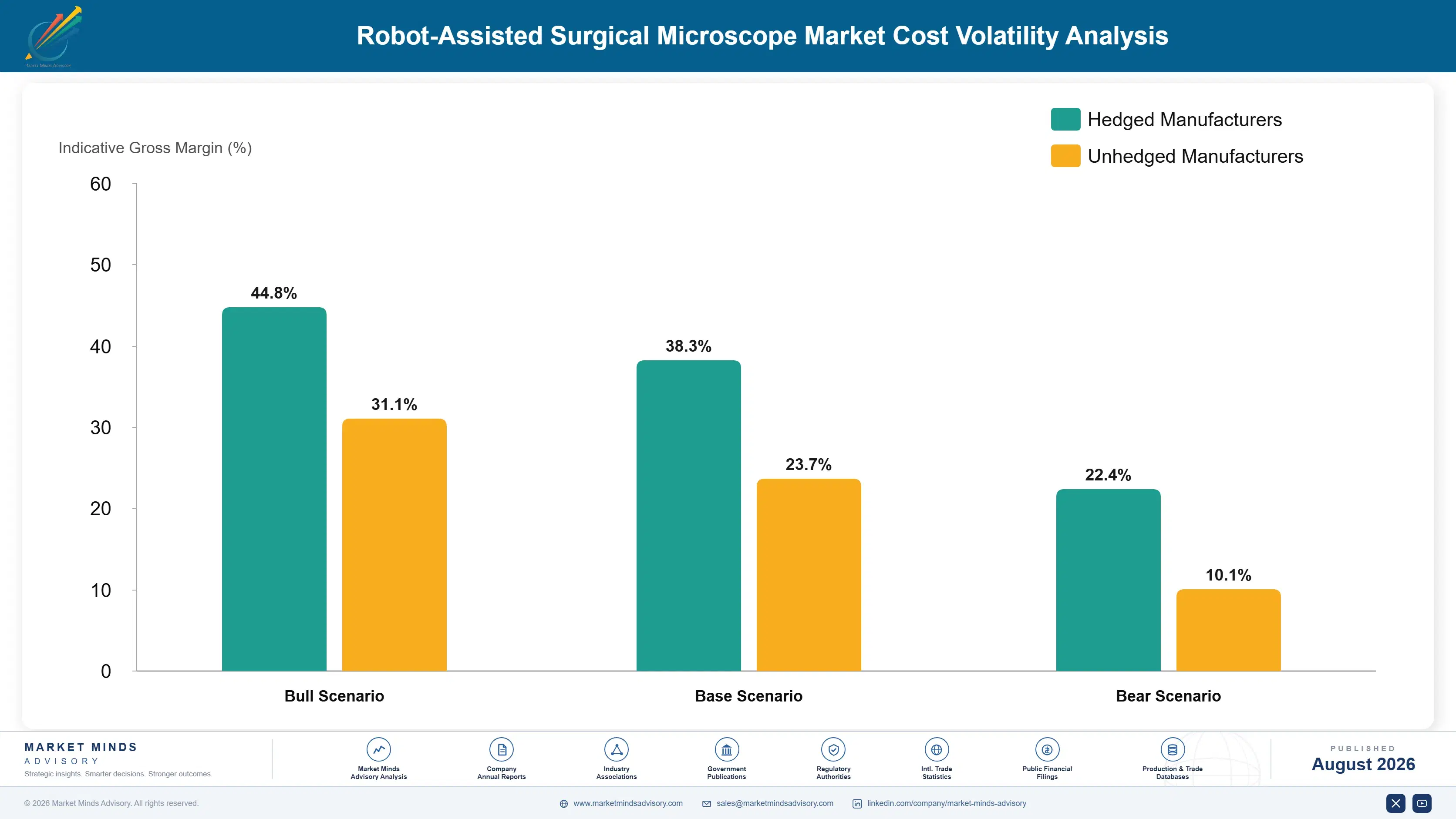
Precision optics dominate this cost base in a way that is unusual among medical devices. Optical glass, lens grinding, coating and assembly account for roughly 34% of cost of goods, and the capability is concentrated in a small number of German, Japanese and Swiss facilities that cannot be substituted quickly. Robotic positioning arms, motors and encoders add a further 19%, and imaging sensors and displays around 14%.
Optical glass and coating capacity tightened through 2021 and 2022 as demand across semiconductor lithography, defence and medical optics competed for the same specialist supply, and manufacturers reported extended lead times through their annual filings. Imaging sensor availability constrained digital system production during the same period, since medical volumes are trivial beside consumer electronics and allocation follows volume. Skilled optical assembly labour remains genuinely scarce and slow to train.

Exposure varies most by architecture. Manufacturers whose value rests in precision optics carry concentrated supply risk in a capability almost nobody else has, protective commercially and fragile operationally. Those building digital systems depend on imaging sensors and displays where they are a very small customer of very large suppliers, with correspondingly little influence over allocation. Participants building both carry each exposure simultaneously.
robot-assisted-surgical-microscope-market-cost-volatility-analysis-1787305786968

Vertical integration of optical manufacturing

Precision optical capability is concentrated enough that buying it exposes a manufacturer to lead times it cannot influence, and the incumbents that own their glass and coating operations weathered recent constraint far better. Building that capability is a decade-long undertaking, which is precisely why the position it creates is difficult for any new entrant to attack.

Long-horizon sensor supply agreements

Medical imaging volumes are negligible beside consumer electronics, so allocation during constraint follows the larger customer every time. Multi-year committed agreements secure supply at the cost of inventory risk and technology lock-in, and choosing the commitment horizon against a sensor generation cycle is where most of the judgement actually sits. Most participants get that horizon wrong at least once.

Modular platforms across specialty configurations

Building neurosurgical, spine, ophthalmic and ENT systems from shared optical and positioning modules spreads development and qualification cost across a broader revenue base. It constrains configuration freedom at the specialty level, which surgeons notice, so the architecture decision has to be made against clinical requirements rather than manufacturing convenience alone. Surgeons notice configuration compromises immediately.

Portfolio Architecture for Margin Defence

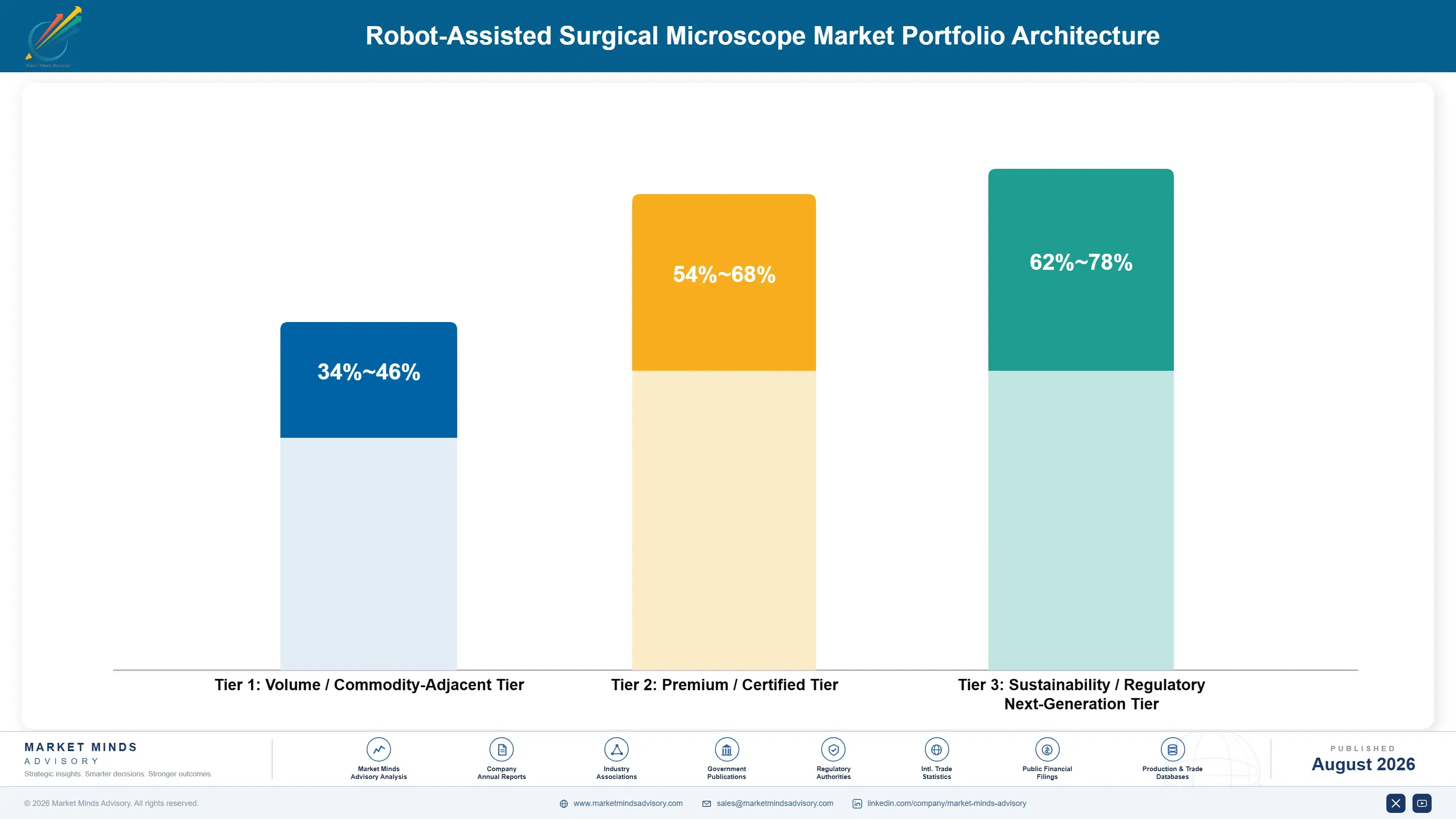
Margin architecture separates by whether the buyer is a committee or a surgeon. Entry-level and mid-specification systems sold into general theatres compete on delivered price against Chinese manufacturers with different cost structures, and gross margin sits in the high thirties. Neurosurgical configurations with navigation integration and fluorescence are specified by surgeons who name the platform they want, and they clear well above sixty per cent.
The tension is between installed base and margin. Volume systems in ophthalmology, ENT and general surgery build the departmental relationships and service coverage that the premium neurosurgical business depends upon, yet they carry the thinnest margins and the most price exposure. Nobody has sustained a premium-only position, and volume-only participants find themselves competing purely on cost against manufacturers structured for it.

High-value pools concentrate where a capability enables a procedure rather than merely performing one better. Fluorescence-guided resection, navigation-integrated positioning and exoscope ergonomics all sit there, because each changes what a department can offer or how long a surgeon can operate. Everything sold on optical resolution and magnification range competes on specifications that every serious system already satisfies adequately, which is not a contest anybody wins.

Volume / Commodity-Adjacent Tier

Entry-level and mid-specification optical systems for general surgical, ENT, dental and ophthalmic use, purchased through tender where resolution and magnification are comparable and delivered price decides awards outright. Chinese manufacturers set the achievable price here.
Gross Margin: 34-46%

Premium / Certified Tier

Neurosurgical and spine configurations with robotic positioning and navigation integration, specified by surgeons who name the platform during evaluation and defended by training familiarity formed years before any purchase. Departments resist substitution strongly regardless of specification.
Gross Margin: 54-68%

Sustainability / Regulatory / Next-Generation Tier

Fluorescence-integrated systems and digital robotic exoscopes, defended by imaging agent compatibility approvals and by ergonomic evidence that addresses surgical workforce retention rather than any image quality argument. Workforce retention rather than image quality is the argument.
Gross Margin: 62-78%
robot-assisted-surgical-microscope-market-portfolio-architecture-1787305787459

High-value Sub-segments and Strategic Watch-out

Digital Robotic Exoscope Systems

High value and the fastest growth at 13.8%, moving competitive advantage from optical engineering toward sensors and displays. Adoption sits in academic neurosurgery today, and spine and reconstructive work represent the far larger opportunity ahead. Sensor supply relationships are the entry requirement. Optics count for less here.
Gross Margin: 62-78%

Fluorescence-Integrated Robotic Systems

High value at 10.2% growth, made necessary by imaging agent approvals rather than by any device development. Attachment runs near 48% of neurosurgical systems, and retrofit reaches departments that will not replace equipment for years. Tender disqualification makes this urgent rather than optional. Retrofit widens the base further.
Gross Margin: 60-74%

Robotic-Positioned Optical Systems

The volume core at 6.4%, carrying the installed base and departmental relationships that premium selling depends upon entirely. Margin is adequate rather than good, and Chinese competition presses steadily upward through the specification tiers. Departmental relationships built here carry the premium business. Losing it costs the premium too.
Gross Margin: 48-60%

Digital Hybrid Systems

The strategic watch-out at 11.6%. It answers the ergonomic argument while preserving optical advantage, which suits incumbents, but whether it is a durable position or a transitional one is genuinely unresolved. Incumbents favour it for obvious reasons. Surgeons appear indifferent. Durability of the position is unresolved.
Gross Margin: 56-70%

Who Specifies and What Persists

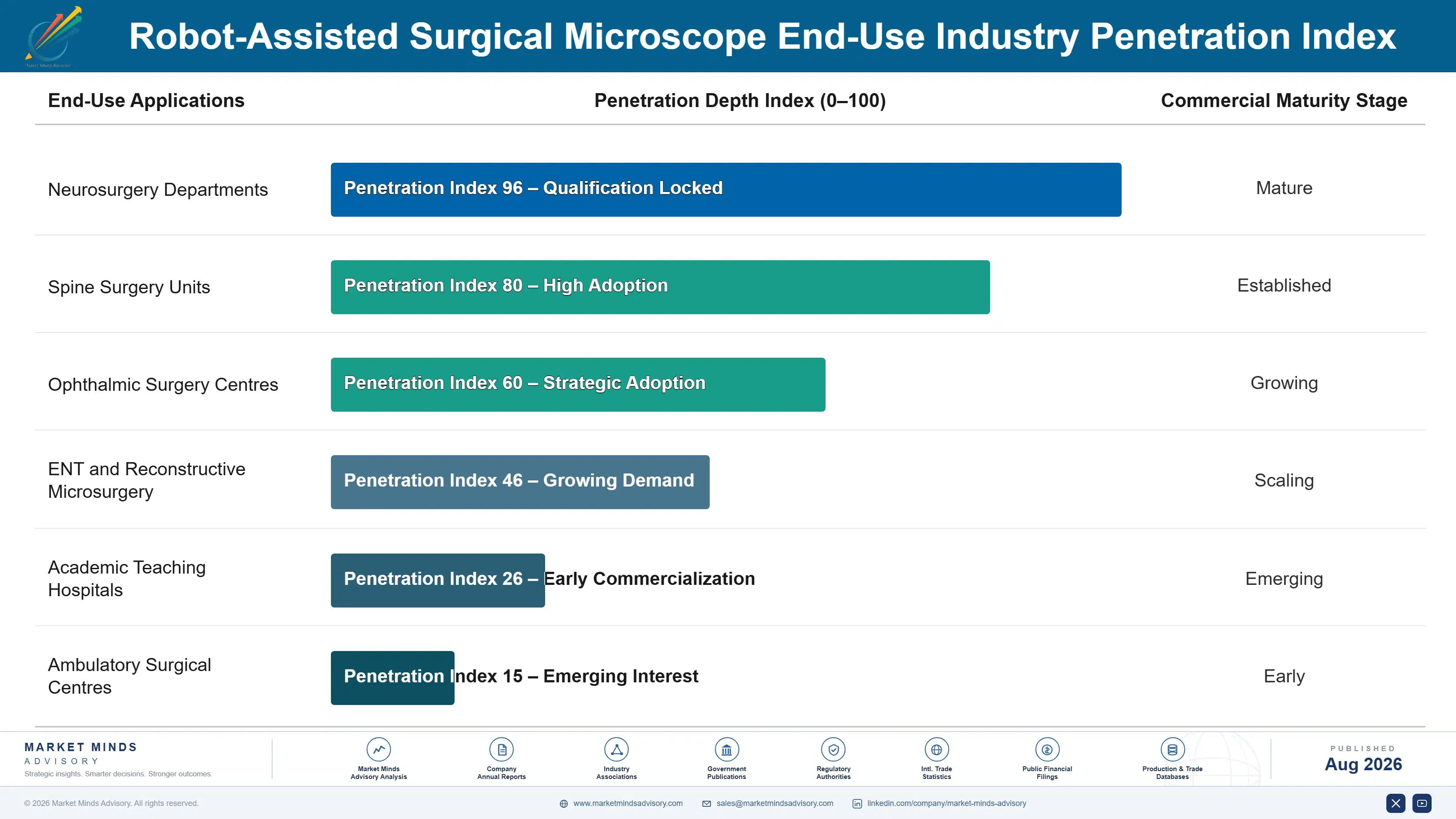
Revenue arrives once every thirteen years per system and then largely stops, which makes this among the least annuity-like businesses in medical technology. Service contracts, fluorescence module retrofits, software upgrades and consumable-adjacent revenue fill part of that gap, but they do not approach the value of the original transaction. Winning a department therefore matters enormously and losing one is close to irreversible within a decade.
Adoption depth varies sharply by specialty. Neurosurgery is the stickiest by a wide margin, because operative technique and instrument handling are learned together during a long training pathway and substitution carries perceived risk to the patient. Spine and reconstructive microsurgery follow at some distance. Ophthalmology is considerably looser, since cataract work is high-volume and standardised enough that platform differences matter less to the operating surgeon.

The specifying voice is also generational. Surgeons trained in the past decade have used digital displays throughout their careers and treat screen-based operating as unremarkable, while those trained earlier frequently regard oculars as the reference standard for image fidelity. As department leadership turns over, the ergonomic argument reaches decision-makers who never formed an attachment to the eyepiece, and that transition is doing more for exoscope adoption than evidence has.
robot-assisted-surgical-microscope-market-end-use-penetration-index-1787305787949

Where Value Actually Sits

These are among the four positions where our research anticipates prominent divergence between winners and laggards over the coming forecast period. Each is grounded in the demand model, the regulatory perimeter, and the announced capacity pipeline.
01 / ERGONOMIC ARGUMENT OWNERSHIP

Posture sells better than resolution ever did

Every serious system on the market resolves perfectly adequately for the procedures it performs, so optical comparisons in a tender document persuade nobody who actually operates for a living. Roughly 58% of microsurgeons carry neck or shoulder damage from the conventional operating position, in a specialty that takes fifteen years to train and cannot be restaffed at any speed. Manufacturers that led with ergonomic evidence rather than optical specification reported surgeon-initiated purchase requests rising by around 45% within two years.
02 / FLUORESCENCE CONFIGURATION STANDARD

A drug approval decided the equipment specification

Imaging agent approvals for tumour visualisation created a clinical requirement that only fluorescence-capable systems can satisfy, and no hospital can offer fluorescence-guided resection at all without owning the right equipment first. Attachment now runs at roughly 48% of neurosurgical systems and keeps rising steadily, with the module itself carrying considerably better margin than the base platform beneath it. Treating fluorescence as a premium option rather than a standard configuration concedes both the revenue and the clinical position to a competitor entirely.
03 / TRAINING PIPELINE INVESTMENT

The purchase decision is made during residency

Surgeons learn microsurgical technique on one specific platform during their residency and fellowship years, and that preference then persists across their entire careers, measured in thirty years or more. Displacing an incumbent inside an established department is close to impossible on any specification argument, which makes training exposure the only genuine route into one. Cadaver laboratories, fellowship funding and simulation centres pay back over a horizon that most commercial planning cycles simply cannot accommodate, which is why few sustain them.
04 / ARCHITECTURE TRANSITION RISK

A century of lenses matters less behind a sensor

The exoscope moves competitive advantage away from optical engineering and toward imaging sensors and displays, which are supplied by industries operating at an entirely different scale with different cost economics. Incumbents have answered so far with hybrid systems that retain the oculars while adding a heads-up display alongside them, preserving their existing optical position while addressing the ergonomic argument fairly directly. Whether that proves a durable defence or merely a transitional accommodation remains the central unresolved question in this whole market.

Engagement Snapshot From the Field

A live engagement with an industry participant carrying material or product regulatory and market exposure ahead of a defining policy shift, showing how our research translates into a defensible multi-year portfolio strategy.
MARKET MINDS ADVISORY · CLIENT ENGAGEMENT SUMMARY
Robot-Assisted Surgical Microscope Producer Strategic Portfolio Review and Transition Roadmap 2026·Investment Scenario on Robot-Assisted Surgical Microscope Exposure Evaluation 2025-26
CLIENT PROFILE
A surgical visualisation manufacturer with annual revenue near $290 million (client-reported, unverified by MMA), holding a mid-tier optical microscope range sold into ENT, spine and general surgical theatres across three regions. The company had no exoscope product and no fluorescence capability, and leadership needed to decide whether to develop either, both, or neither before the architecture question resolved against it.
STRATEGIC CHALLENGE
Developing a digital exoscope meant competing on sensor and display capability against participants with consumer electronics scale, while fluorescence required imaging agent compatibility work and regulatory submissions. Both were expensive and the company could fund one properly. Leadership also needed to know whether its existing surgeon relationships would transfer to a new architecture or whether preference was tied to the optical platform itself.
MMA APPROACH
We interviewed 39 neurosurgeons, spine surgeons and reconstructive microsurgeons on platform preference, ergonomic experience and willingness to change architecture. Tender specifications were analysed across four years to track fluorescence and digital requirements entering documents. We modelled an exoscope development programme against a fluorescence capability build using installed base overlap as the segmentation variable.
KEY FINDINGS
  1. Surgeons trained within the past decade showed no attachment to oculars and evaluated exoscopes on ergonomics alone, while those trained earlier treated optical fidelity as the reference standard.
  2. Fluorescence requirements appeared in 61% of neurosurgical tender specifications by the final year examined, against 22% at the start, and absence disqualified bids outright.
  3. The company's installed base sat overwhelmingly in ENT and spine, where fluorescence demand is limited and the ergonomic argument for exoscopes is strong but under-articulated.
  4. Exoscope development modelled at roughly twice the cost of fluorescence capability, with sensor supply exposure the client had no existing relationships to manage.
CLIENT PROFILE
A surgical visualisation manufacturer with annual revenue near $290 million (client-reported, unverified by MMA), holding a mid-tier optical microscope range sold into ENT, spine and general surgical theatres across three regions. The company had no exoscope product and no fluorescence capability, and leadership needed to decide whether to develop either, both, or neither before the architecture question resolved against it.
STRATEGIC CHALLENGE
Developing a digital exoscope meant competing on sensor and display capability against participants with consumer electronics scale, while fluorescence required imaging agent compatibility work and regulatory submissions. Both were expensive and the company could fund one properly. Leadership also needed to know whether its existing surgeon relationships would transfer to a new architecture or whether preference was tied to the optical platform itself.
MMA APPROACH
We interviewed 39 neurosurgeons, spine surgeons and reconstructive microsurgeons on platform preference, ergonomic experience and willingness to change architecture. Tender specifications were analysed across four years to track fluorescence and digital requirements entering documents. We modelled an exoscope development programme against a fluorescence capability build using installed base overlap as the segmentation variable.
KEY FINDINGS
  1. Surgeons trained within the past decade showed no attachment to oculars and evaluated exoscopes on ergonomics alone, while those trained earlier treated optical fidelity as the reference standard.
  2. Fluorescence requirements appeared in 61% of neurosurgical tender specifications by the final year examined, against 22% at the start, and absence disqualified bids outright.
  3. The company's installed base sat overwhelmingly in ENT and spine, where fluorescence demand is limited and the ergonomic argument for exoscopes is strong but under-articulated.
  4. Exoscope development modelled at roughly twice the cost of fluorescence capability, with sensor supply exposure the client had no existing relationships to manage.
RECOMMENDED STRATEGY
Phase 1: Phase one: build fluorescence capability first, since tender disqualification is an immediate revenue risk while architecture displacement operates over a decade. Phase 2: Phase two: articulate the ergonomic argument aggressively within the existing spine and ENT base, where it is strong and no competitor currently makes it. Phase 3: Phase three: pursue exoscope development through partnership with a sensor and display supplier rather than internal capability building. Sensor supply exposure argues against building alone.
OUTCOME
Fluorescence capability reached market in sixteen months and removed disqualification from tenders representing roughly 40% of the company's addressable neurosurgical pipeline (client-reported, unverified by MMA). Ergonomic positioning in spine produced measurable enquiry growth. Exoscope partnership discussions opened with two display suppliers during the second year.

Frequently Asked Questions

Foundational context covering the market sizes, CAGR, scope, country, region and competition that inform every finding below. This section is provided to cover basics and most often pre-purchase conversations, answered from the MMA Primary Research Dataset.

What is the current size of the Robot-Assisted Surgical Microscope Market?

The global market is valued at $1.15 billion in 2025, rising to $1.26 billion in 2026. East Asia holds the largest share at 31%, reflecting Japanese neurosurgeon density and Chinese hospital theatre construction.

How large will the Robot-Assisted Surgical Microscope Market be by 2036?

MMA forecasts $3.03 billion by 2036, an increase of $1.77 billion over the 2026 base and an expansion multiple of 2.40x. Digital and fluorescence-capable systems carry most of that growth.

What is the CAGR for the Robot-Assisted Surgical Microscope Market 2026 to 2036?

The base case compound annual growth rate is 9.2%, with a bull case at 10.4% and a bear case at 8.0%. Historical growth from 2020 to 2025 ran near 8.0%, driven more by mix than by unit volume.

Which segment is growing fastest?

Digital robotic exoscope systems compound at 13.8%, a full 1.50x the market rate. Removing the oculars lets surgeons operate upright and gives the whole theatre team the operative view.

Who are the major companies in the Robot-Assisted Surgical Microscope Market?

Carl Zeiss Meditec, Leica Microsystems, Olympus, Haag-Streit Surgical and Alcon together hold 74% of revenue from powered and robotic visualisation systems. Concentration is extreme even by capital equipment standards.

Which country is growing fastest?

India compounds at 12.6%, faster than any other country covered, as private hospital groups equip new neurosurgical and spine theatres from nothing. Price sensitivity keeps mid-specification systems dominant there.

Report Segmentation Architecture

The full report scope spans multiple orthogonal segmentation dimensions, with cross-tabulated demand data provided for each dimension pair. Coverage extends further to regional breakdowns, trend trajectories, and the competitive detail needed to support segment-level decision-making.

By System Architecture

  • Manual and Semi-Automated Optical Systems
  • Robotic-Positioned Optical Systems
  • Fluorescence-Integrated Robotic Systems
  • Digital Hybrid Systems
  • Digital Robotic Exoscope Systems

By End-Use Industry

  • Neurosurgery Departments
  • Spine Surgery Units
  • Ophthalmic Surgery Centres
  • ENT and Reconstructive Microsurgery
  • Academic Teaching Hospitals
  • Ambulatory Surgical Centres

By Commercial Dimension

  • Capital Tender Procurement
  • Group Purchasing Organisation Agreements
  • Managed Equipment and Subscription Structures
  • Direct Institutional Sales
  • Distributor and Dealer Supply
  • Refurbished and Certified Pre-Owned Supply

By Region

  • East Asia
  • North America
  • Western Europe
  • South Asia and Pacific
  • Latin America
  • Middle East and Africa
  • Eastern Europe

Scope, Methodology, and Coverage

Every figure in this report is reproducible from documented input assumptions. The scope below maps the historical period, the forecast horizon, the segmentation dimensions, and the countries covered, alongside the underlying primary and qualitative methodology.
Historical Period
2020 to 2025
Forecast Period
2026 to 2036
Base Year
2025 (USD billions; MMA Primary Research Dataset, August 2026)
Market Definition
This market comprises surgical visualisation systems with powered or robotic positioning, measured at manufacturer revenue across capital tender procurement, group purchasing organisation agreements, managed equipment and subscription structures, direct institutional sales, distributor and dealer supply, and refurbished or certified pre-owned supply. Coverage spans manual and semi-automated optical systems retaining powered focus or zoom, robotic-positioned optical microscopes with stored positions and automated repositioning, fluorescence-integrated robotic systems supporting approved optical imaging agents across multiple wavelengths, digital hybrid systems combining conventional oculars with heads-up three-dimensional display, and digital robotic exoscopes presenting the operative view exclusively on theatre monitors. Rigid and flexible endoscopes with their camera systems, surgical loupes and headlight illumination, surgical navigation platforms sold independently of visualisation, robotic surgical manipulators that act directly on tissue, laboratory research and pathology microscopes, optical imaging agents and pharmaceuticals themselves, and theatre display hardware sold separately from a visualisation system fall outside scope.
Quantitative Units
USD millions (current prices); systems shipped by architecture class; installed base; average selling price by configuration; fluorescence attachment rate; system service life; tender share of purchases
Segmentation Dimensions
By System Architecture; By End-Use Industry; By Commercial Dimension; By Region
Regions Covered
East Asia, North America, Western Europe, South Asia and Pacific, Latin America, Middle East and Africa, Eastern Europe
Countries Covered
Japan, China, South Korea, Taiwan, United States, Canada, Germany, Switzerland, France, United Kingdom, Italy, Spain, Netherlands, Sweden, Austria, India, Australia, Singapore, Thailand, Malaysia, Indonesia, Brazil, Mexico, Argentina, Chile, Colombia, Saudi Arabia, United Arab Emirates, Israel, Egypt, South Africa, Poland, Czechia, Hungary, Romania, Turkey, and additional markets relevant to surgical visualisation analysis
Key Companies Profiled
Carl Zeiss Meditec, Leica Microsystems, Olympus, Haag-Streit Surgical, Alcon, Topcon, Synaptive Medical, Karl Storz, Mitaka Kohki, Takagi Seiko, Global Surgical Corporation, Seiler Instrument, Labomed, Chongqing Shengfeng, Alltion, Zumax Medical, Karl Kaps, Ecleris, Inami, Sony Olympus Medical Solutions
Quantitative Methodology
Primary survey, n=3,800 respondents, Q4 2025, six countries; demand-side model with trade association cross-validation
Qualitative Methodology
47 expert interviews, Q4 2025; applied to validate demand model assumptions, identify emerging dynamics, and assess competitive positioning
Report Format
PDF and XLSX data workbook (Word format preview document)
Publisher
Market Minds Advisory
Report Code
MMA-2026-MED-479
Published
August 2026
Contact
sales@marketmindsadvisory.com | www.marketmindsadvisory.com

Purchase the full Robot-Assisted Surgical Microscope Market Report (2026 to 2036).

The full MMA report treats the eyepiece as the thing under threat and quantifies what replaces it, tracing how ergonomics and imaging agent approvals rather than optical performance now drive specification. It sizes five architecture classes and seven regions to 2036, modelling systems shipped, installed base, pricing by configuration, fluorescence attachment, service life and tender exposure separately. Competitive assessment covers twenty manufacturers on one consistent revenue basis. Cost exposure is traced through optical glass, robotic components and imaging sensors. Four commercial levers and a strategic verdict close the report, grounded in 47 expert interviews and a 3,800-respondent survey.
Five architecture classes sized separately through 2036
Tender specification requirements tracked across four years
Fluorescence attachment quantified against neurosurgical system volume
Twenty manufacturers assessed on one consistent revenue basis
Surgeon platform preference mapped by training generation
Anonymised manufacturer engagement with tested development recommendations

Built For The People Who Decide

From boardroom strategy to bench-side execution, this report is read cover-to-cover by leaders shaping the next decade of their industry, turning demand scenarios, market dynamics and valuation benchmarks into decisions.
CXOs/ Presidents/ VPs/ Managers
M&A and Corporate Development
Strategy Teams and R&D Heads
Procurement and Product Directors
Regulatory and Compliance Leaders
Investor Relations and Equity Analysts