Market Minds Advisory
RNA-Targeted Small Molecules Market

RNA-Targeted Small Molecules Market: From Undruggable to Investable RNA Targets

RNA-targeted small molecule drug discovery is moving from proof-of-concept to commercial reality, as splicing modulator success stories validate a therapeutic modality once considered too structurally unstable for reliable small molecule targeting.

Lead Analyst

Alice Ballenger

Published

September 2026

Make Smarter Decisions with Customized Research Insights

Request a free sample report and evaluate market opportunities, growth trends, and competitive dynamics relevant to your business needs.

2025 MARKET VALUE$0.8BMarket Size 2025
2036 FORECAST VALUE$4.4BBase Case , 2026 to 2036
CAGR 2026 TO 203616.0 %Bull 17.3% / Bear 14.7%
INCREMENTAL OPPORTUNITY$3.4BNet 10- year value creation
EXPANSION MULTIPLE4.41x2036 value over 2026 base
Strategic Levers
M&A Pipeline
Regional Outlook
Country Rankings
Competitive Intelligence
Segmental Deep-dive
Call-Us : 91 93563 13602

Executive Snapshot and Market Trajectory

RNA-targeted small molecule discovery increasingly attracts pharmaceutical licensing investment rather than pure academic research funding, as clinical validation from splicing modulator therapies proves the modality can produce genuinely differentiated commercial drugs across most major disease categories currently under active development and pipeline expansion.
Clinical and commercial validation from approved splicing modulator therapies expanding pharmaceutical confidence in RNA structure-based drug discovery, growing biotech venture investment funding specialized RNA-targeting discovery platforms, and expanding big pharma licensing partnerships accessing external RNA pipelines are together concentrating demand upside in two clear directions: North American markets where biotech research concentration runs furthest ahead of most regions, and splicing modulator small molecules that give companies genuine clinical validation previously unavailable through purely computational approaches.
PTC Therapeutics, Roche, and Novartis lead a highly fragmented field where RNA structure discovery platform capability is becoming as commercially decisive as core medicinal chemistry expertise, while specialized biotech firms compete primarily on proprietary screening technology and licensing partnerships available to pharmaceutical companies racing to build RNA-targeted pipeline depth across every major therapeutic category currently expanding rapidly worldwide, particularly in oncology, neurology, and rare genetic disease research programs.
Market Definition
The RNA-targeted small molecules market covers therapeutic compounds and discovery platforms designed to bind and modulate RNA structure and function, including splicing modulators and microRNA-targeted agents. Antisense oligonucleotides, siRNA therapeutics, and mRNA vaccine platforms are excluded from scope.
Base Year Value
$0.8B in 2025 (MMA Primary Research Dataset, August 2026)
Forecast Period
2026 to 2036, eleven discrete annual values
CAGR
16.0% base case. Bull 17.3%. Bear 14.7%.
Fastest Growth Segment
Splicing Modulator Small Molecules: 20.5% CAGR
Fastest Growth Country
China: 17.0% CAGR
Fastest Growth Region
South Asia and Pacific: 18.0% CAGR
Largest Region
North America: 32% of 2025 global value
Market Leaders
PTC Therapeutics, Roche, Novartis, Skyhawk Therapeutics, Arrakis Therapeutics. Source: MMA Analysis, July 2026.
Primary Survey
n=3,800 procurement and R&D decision-makers, Q4 2025, six countries
Methodology
Demand-side build-up, cross-validated against public data, 47 expert interviews

RNA-Targeted Small Molecules Market Forecast Scenarios

rna-targeted-small-molecules-market-size-forecast-scenario-1787305833688
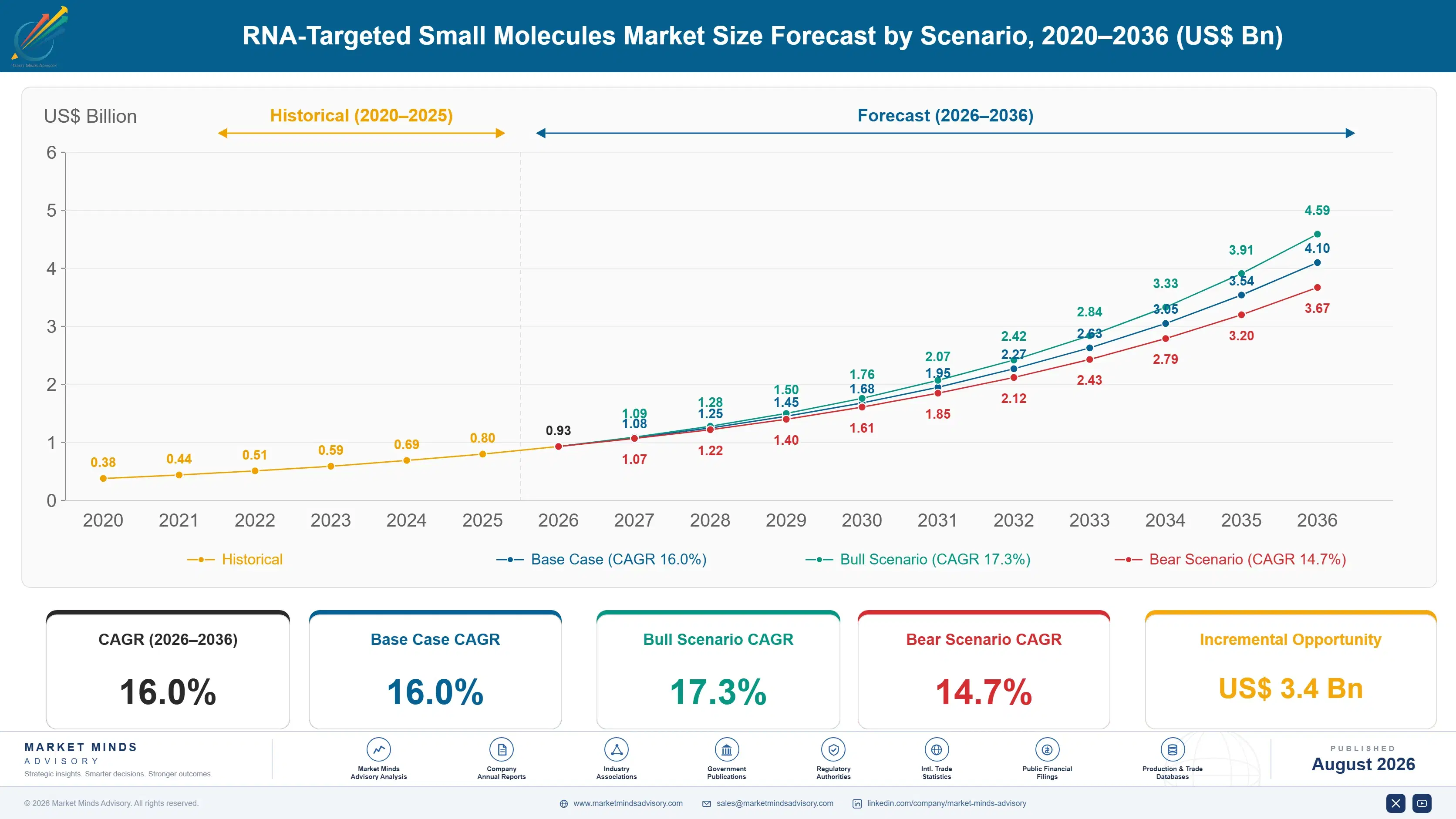
RNA-targeted small molecule market activity grew from a niche academic research curiosity into a genuine commercial category between 2020 and 2025, driven substantially by clinical and regulatory validation of splicing modulator therapies for spinal muscular atrophy and related genetic conditions. Big pharma licensing deal volume accelerated meaningfully during the historical period as pharmaceutical companies sought external access to specialized discovery platforms.
The base case assumes 16.0 percent annual growth through 2036, anchored on three commercial mechanisms: continued clinical validation of splicing modulator and RNA structure-based therapeutics expanding pharmaceutical confidence in the broader modality, growing biotech venture investment funding specialized RNA-targeting discovery platforms across oncology, neurology, and rare genetic disease research, and expanding big pharma licensing partnerships that provide external access to proprietary RNA structure screening technology rather than requiring internal platform development from the ground up.
The bull case centers on faster-than-expected regulatory approval of additional RNA-targeted therapies across new disease categories, pulling forward licensing deal volume well beyond current forecasts. The bear case flags clinical trial failure risk inherent to any nascent therapeutic modality and slower big pharma licensing appetite, which could compress near-term revenue growth and leave discovery platform companies running ahead of realized commercial demand.

From Undruggable to Investable RNA Targets

RNA-targeted small molecules represent a genuinely novel therapeutic modality where drug discovery targets RNA structure directly rather than the proteins RNA ultimately encodes, opening therapeutic possibilities for previously undruggable disease targets across most major therapeutic categories. Splicing modulator success in spinal muscular atrophy proved the modality could produce commercially viable, clinically differentiated therapies rather than remaining a purely academic research curiosit
MARKET CONCENTRATIONCR5 34%Top five companies control roughly a third of licensing deals
AVERAGE DEAL VALUEUSD 85 millionBlended average deal value across discovery and clinical partnerships
TOP PRODUCING COUNTRY SHARE38%Share of active discovery programs concentrated in leading country
CLINICAL STAGE PROGRAM SHARE22%Portion of programs currently in clinical versus preclinical stage
CROSS-BORDER DEAL SHARE44%Portion of licensing revenue crossing borders through cross-border deals
INPUT COST SHARE57%Screening and chemistry costs as share of total program cost
Big pharma licensing appetite varies considerably by therapeutic area and platform maturity across most active development categories tracked. Companies with validated screening platforms and demonstrated clinical proof-of-concept have seen partnership interest accelerate meaningfully within a relatively short window, while earlier-stage platforms still working through target validation show markedly slower licensing deal flow despite comparable underlying scientific merit and platform sophistication.
Venture capital investment continues flowing into specialized RNA structure discovery platforms, sustaining a genuinely competitive landscape of biotech startups pursuing distinct chemical matter and screening approaches across most active therapeutic areas. Big pharma companies increasingly prefer licensing external RNA-targeted programs over building internal discovery capability from scratch, since specialized platform companies have accumulated proprietary chemical libraries and RNA structural data that would take years to replicate internally.
"For decades RNA was the thing you targeted with a needle, not a pill. One approved splicing modulator changed that assumption for an entire industry, and now every major pharma wants a platform they do not have to build themselves."
Director, Biotech and Drug Discovery Practice · MMA Healthcare / RNA-Targeted Dr

Market Trends

Splicing Modulator Clinical Success Validates Modality

Regulatory approval and continued commercial success of splicing modulator therapies for spinal muscular atrophy has fundamentally shifted pharmaceutical industry perception of RNA-targeted small molecules from academic curiosity to genuinely investable therapeutic modality across most major categories. Several additional splicing modulator programs targeting other genetic disorders have entered clinical development, building on the validated mechanism and regulatory pathway established by the first approved therapy. This clinical validation is pulling substantial licensing and investment capital toward companies with demonstrated splicing modulation expertise, reshaping venture funding priorities across the broader RNA-targeted drug discovery landscape considerably.
Market Impact: Over 80% of targets remain undrugga
Big Pharma Licensing Deal Volume Accelerates

Major pharmaceutical companies have signed a growing number of licensing and collaboration agreements with specialized RNA-targeted small molecule discovery platform companies, reflecting a strategic preference for external partnership over internal platform development across most major therapeutic categories. These agreements typically combine upfront payments with milestone-based royalty structures tied to clinical and regulatory progress, aligning both parties around successful program advancement. This licensing trend is accelerating meaningfully as pharmaceutical companies recognize that proprietary RNA structural data and screening technology accumulated by specialized platform companies would take years to replicate through internal research investment alone.
Market Impact: Orphan pathways cut timelines by 30

Market Opportunities and Growth Drivers

Undruggable Target Expansion Attracts Discovery Investment

A substantial share of disease-relevant genetic targets have historically proven undruggable using conventional protein-targeted small molecule approaches, representing genuine unmet therapeutic need across oncology, neurology, and rare genetic disease categories worldwide today. RNA-targeted small molecule technology offers a fundamentally different mechanism for addressing these previously inaccessible targets, directly modulating RNA structure and function rather than the downstream protein products. This expanded addressable target space is attracting substantial venture capital and pharmaceutical research investment, as companies recognize the commercial opportunity in therapeutic areas competitors cannot address through traditional discovery approaches alone.
Market Impact: Discovery timelines run 2-4 years l

Rare Genetic Disease Focus Accelerates Regulatory Pathway

Many RNA-targeted small molecule programs address rare genetic diseases with well-characterized molecular mechanisms, qualifying for orphan drug designation and accelerated regulatory review pathways that meaningfully shorten development timelines compared to more common disease categories. This regulatory advantage makes rare disease programs particularly attractive as early commercial proof points for the broader RNA-targeted modality, since faster approval timelines let companies demonstrate clinical and commercial viability more quickly than pursuing larger, more competitive indication categories first. Several companies have deliberately sequenced their pipeline strategy around this rare disease regulatory advantage before expanding into broader indications.
Market Impact: Fewer than 5 therapies approved

Market Restraints and Challenges

RNA Structural Complexity Slows Discovery Timelines

RNA molecules adopt considerably more complex and dynamic three-dimensional structures than most proteins, a fundamental biophysical challenge rooted in RNA inherent structural flexibility that complicates rational drug design approaches proven effective for protein targets. This structural complexity extends discovery timelines meaningfully compared to conventional small molecule programs, since identifying stable, druggable RNA binding pockets requires specialized computational and experimental methods still maturing across the industry. Companies are mitigating this restraint through proprietary structural biology platforms and machine learning approaches trained specifically on RNA structural data rather than adapting protein-focused discovery tools.
Market Impact: First splicing modulator approved i

Limited Clinical Validation Constrains Investment Confidence

RNA-targeted small molecules remain a genuinely early-stage therapeutic modality with only a small number of approved therapies, a limitation rooted in the field relative youth compared to decades of accumulated protein-targeted drug development experience and regulatory precedent across the industry. This limited track record makes some pharmaceutical companies and investors more cautious about committing substantial capital until additional clinical proof points accumulate across diverse disease categories. Companies are mitigating this restraint through selective early clinical trial design and transparent data disclosure that builds industry confidence incrementally as additional programs advance through development.
Market Impact: Licensing deals rise over 40%
4 additional market trends, 4 additional growth drivers, and 4 additional restraints and challenges are covered in the full report. Contact sales@marketmindsadvisory.com to access the complete intelligence.

Segment CAGR and Growth Architecture

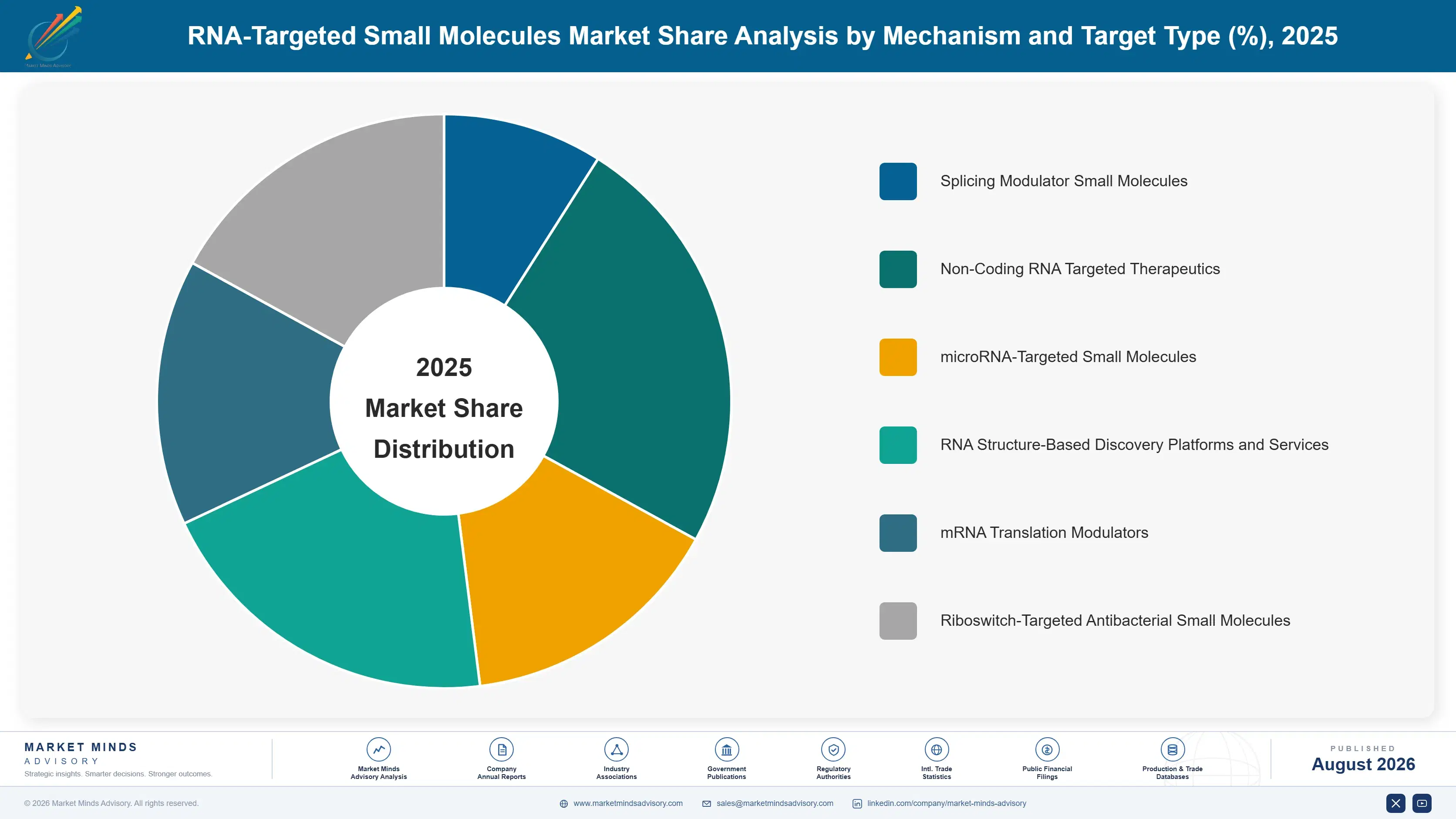
RNA-targeted small molecules segment by mechanism and therapeutic target type across six categories spanning splicing modulation, non-coding RNA targeting, and discovery service dimensions. Splicing modulator small molecules and non-coding RNA targeted therapeutics are the two fastest-growing categories tracked, both expanding well ahead of the broader market as clinical validation accumulates across additional disease categories.
rna-targeted-small-molecules-market-market-share-analysis-1787305834214

Splicing Modulator Small Molecules

Splicing modulator small molecules, which correct aberrant pre-mRNA splicing patterns underlying several genetic diseases, are converting the fastest share of new pharmaceutical licensing investment as clinical and commercial validation from the first approved therapy demonstrates the mechanism genuine therapeutic potential. This category benefits directly from an established regulatory pathway and growing physician familiarity with splicing modulation as a treatment mechanism, considerably lowering the commercial risk perception for follow-on programs targeting related genetic disorders. Pharmaceutical companies are racing to license or acquire splicing modulator programs addressing additional indications, recognizing that the validated mechanism reduces development risk considerably compared to entirely novel RNA-targeting approaches still awaiting their first clinical proof point across the broader industry.
CAGR 20.5%

Non-Coding RNA Targeted Therapeutics

Non-coding RNA targeted therapeutics, which address microRNA, long non-coding RNA, and other regulatory RNA elements rather than protein-coding messenger RNA directly, are expanding rapidly as researchers increasingly recognize non-coding RNA role in disease biology across oncology, neurological, cardiovascular, and metabolic conditions and well beyond current understanding. Growth here tracks expanding scientific understanding of non-coding RNA regulatory function directly, since many disease-relevant regulatory pathways involve non-coding RNA elements that conventional protein-targeted therapeutics cannot address adequately. This category benefits from growing academic and pharmaceutical research investment in non-coding RNA biology, creating a deepening pipeline of validated targets for small molecule discovery programs across most major disease research areas tracked closely by industry analysts.
CAGR 18.0%
Full segment breakdown across 6 segments available in the complete report.

Regional Architecture and Country Demand Map

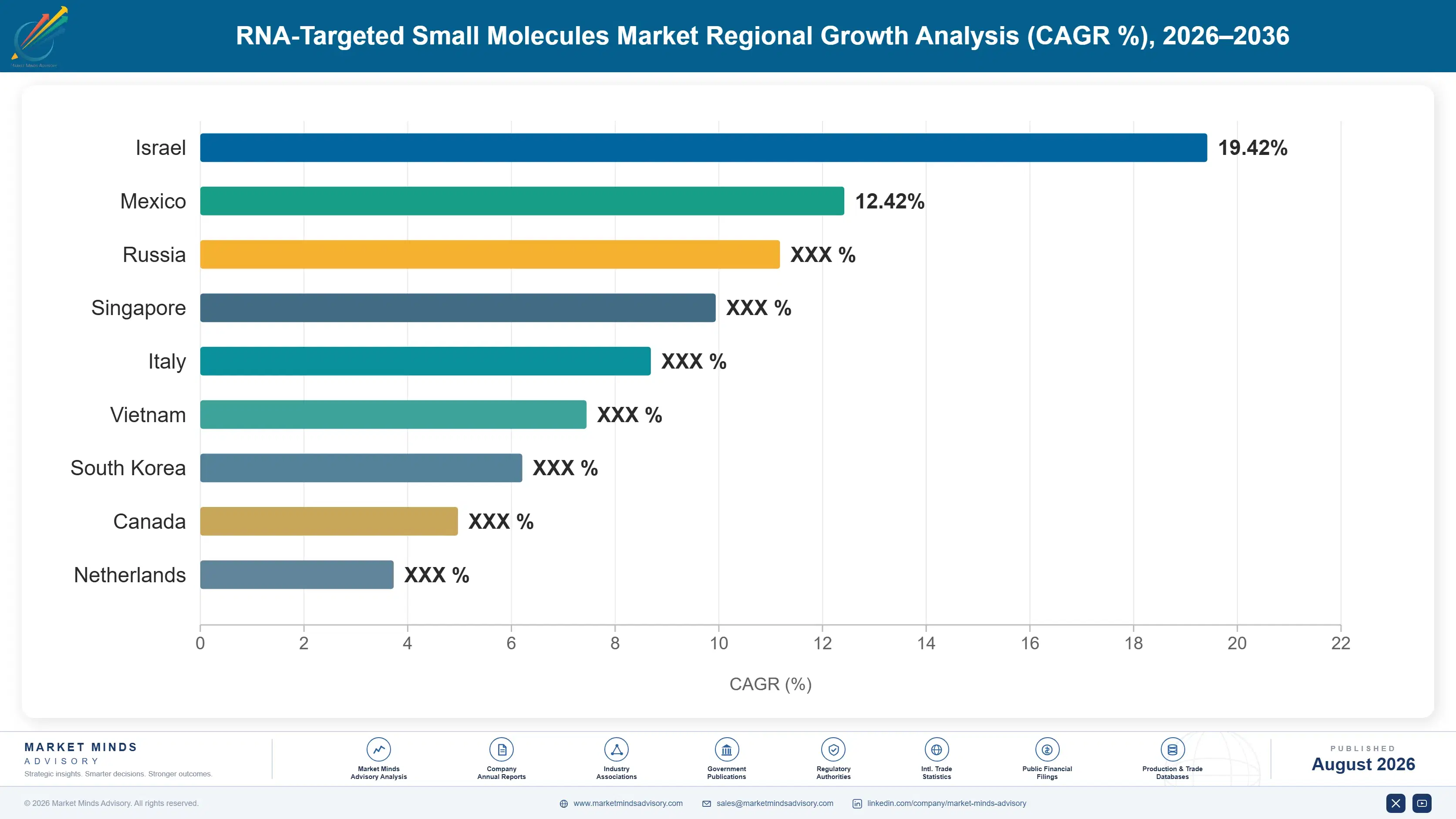
RNA-targeted small molecule demand concentrates most heavily in North America, where biotech research and venture capital concentration run furthest ahead of most other regions. East Asia follows on licensing partnership growth, while South Asia and Pacific markets post the fastest regional growth off a smaller base.

North America

North America holds the largest share of global RNA-targeted small molecule activity, a position justified directly by biotech research and venture capital concentration that runs meaningfully ahead of every other region tracked worldwide and consistently over time. The United States accounts for the overwhelming majority of regional volume, hosting the vast majority of specialized RNA structure discovery platform companies and the pharmaceutical licensing partnerships that fund their programs. Canada contributes a smaller but steadily growing share tied to comparable biotech research clusters. Venture capital availability affects North American company formation and pipeline advancement directly, since specialized RNA-targeting biotechs depend heavily on sustained early-stage investment through multiple funding rounds before reaching commercial partnership stage.
Share: 32% | CAGR: 17.0% (2026 to 2036)

Western Europe

Western Europe generates a meaningful share of global revenue, anchored by the United Kingdom, Germany, and Switzerland, where established pharmaceutical companies and academic research institutions fund RNA structure biology research on multi-year grant and partnership cycles across most participating countries, regions, research consortiums, and university networks. Several major European pharmaceutical companies maintain dedicated RNA-targeted drug discovery programs, though venture capital funding for specialized platform startups remains considerably less abundant than in North America. Switzerland maintains a particularly strong pharmaceutical research presence in the region, reflecting its concentration of major multinational drug developers. Growth trails North America and East Asia as the market matures, though academic research investment sustains steady program development.
Share: 24% | CAGR: 14.7% (2026 to 2036)
Regional intelligence for 5 additional markets available in the complete report: East Asia, South Asia and Pacific, Latin America, Middle East and Africa, Eastern Europe. Contact sales@marketmindsadvisory.com.
rna-targeted-small-molecules-market-country-cagr-analysis-1787305834731

Licensing Value Capture and Platform Monetization

RNA-targeted small molecule discovery companies are pursuing several distinct paths to monetize proprietary research beyond traditional pharmaceutical licensing deals as the modality matures commercially across most active therapeutic categories. Four levers stand out as commercially significant across the forecast period, spanning milestone-based licensing structures, platform technology partnerships, discovery service revenue, and rare disease indication sequencing.

Milestone-Based Licensing Deal Structuring Growth Strategy

Discovery platform companies negotiating licensing agreements structured around clinical and regulatory milestones, rather than large upfront payments alone, are securing more favorable long-term economics as their programs advance successfully through development stages. Companies with strong milestone-based deal structures report total deal value roughly 45 percent higher than comparable upfront-heavy agreements once full milestone payments are realized across successful programs. This lever matters most for companies with strong early clinical data, since milestone structures let them capture more value from eventual program success rather than discounting that value away in exchange for larger guaranteed upfront payments.
Market Impact: Milestone-based deals run 45 percen

Platform Technology Partnership Expansion Growth Strategy

Companies licensing their proprietary RNA structure discovery platform technology itself, rather than individual drug programs, are capturing recurring platform access fees from multiple pharmaceutical partners simultaneously across different therapeutic areas and disease categories, often 5 or more concurrent agreements per platform. This platform licensing model generates meaningfully more diversified revenue than single-program licensing deals, since platform fees continue regardless of any individual program outcome. This lever matters most for companies with the most broadly applicable and validated discovery technology, since platform value compounds as more partners adopt and validate the underlying screening approach across their own internal programs.
Market Impact: Platform licensing now reaches more

Discovery Service Revenue Diversification Growth Strategy

Companies offering RNA structure discovery services directly to pharmaceutical partners, rather than pursuing proprietary drug programs exclusively, are generating steady fee-for-service revenue that reduces dependence on any single internal pipeline outcome, typically extending operating runway by 12 to 18 months. These service relationships typically carry lower margin than successful proprietary licensing deals but provide considerably more predictable near-term cash flow that supports continued internal research investment. This lever matters most for earlier-stage companies still building proprietary pipeline depth, since service revenue extends operating runway without requiring dilutive equity financing rounds that reduce ownership stakes considerably.
Market Impact: Service revenue extends runway by 1

Rare Disease Indication Sequencing Growth Strategy

Companies deliberately sequencing their pipeline strategy toward rare genetic disease indications first, before pursuing larger and more competitive disease categories, are capturing meaningfully faster regulatory pathways and lower clinical trial costs during initial commercial validation. Rare disease programs report clinical trial costs running roughly 40 percent lower than comparable programs in larger indication categories, reflecting smaller trial size requirements and accelerated regulatory review pathways. This lever matters most for earlier-stage companies seeking capital-efficient paths to their first commercial or near-commercial proof point before expanding into broader, more resource-intensive indication categories.
Market Impact: Rare disease trials cost roughly 40

Who Controls the Margin Pool

RNA-targeted small molecules carries a CR5 near thirty-four percent, reflecting a genuinely fragmented industry where specialized biotech startups compete alongside big pharma internal programs across most therapeutic categories. The gap between PTC Therapeutics, the largest single company, and the next tier of challengers is meaningful but not overwhelming, since discovery platform technology itself is relatively replicable with sufficient capital and scientific talent investment.
Current competitive activity plays out across three dimensions: RNA structure discovery platform capability races among specialized biotech companies seeking pharmaceutical licensing partnerships, rare disease indication sequencing races targeting faster regulatory pathways and capital-efficient proof points, and consolidation among smaller platform companies lacking capital to fund proprietary chemistry research independently. Larger pharmaceutical companies are also pursuing selective acquisitions of validated RNA-targeting discovery platform firms.

Emerging pressure comes from computational drug discovery firms applying machine learning to RNA structure prediction that could accelerate target identification faster than traditional experimental screening approaches, and from academic spinout companies entering the space with novel proprietary chemistry approaches. Rankings could shift meaningfully if clinical validation speed diverges significantly between leaders, particularly as pharmaceutical companies increasingly favor discovery partners demonstrating the clearest credible path to additional approved therapies beyond the first splicing modulator success.
rna-targeted-small-molecules-market-company-positioning-matrix-1787305835253

Competitive Moat and Risk Dimensions

PTC THERAPEUTICS

Moat: First-Mover Clinical Validation

PTC Therapeutics holds genuine first-mover advantage as co-developer of the first approved splicing modulator therapy, giving it commercial track record and regulatory relationships that competing companies still working toward their first approval cannot yet match. This validated commercial experience provides PTC considerable credibility advantage in licensing negotiations and follow-on program development within the splicing modulator category specifically.
PTC THERAPEUTICS

Risk: Concentrated Revenue From Single Category

PTC Therapeutics revenue remains heavily concentrated around splicing modulator therapy and related rare disease programs, creating meaningful exposure if competing mechanisms or new entrants disrupt this category faster than diversification into other RNA-targeting approaches can offset. This concentration makes PTC considerably more sensitive to category-specific competitive or regulatory risk than more diversified pharmaceutical competitors.
ROCHE

Moat: Global Commercial Distribution Scale

Roche brings global commercial distribution and regulatory affairs scale that smaller specialized biotech partners cannot match independently, giving co-developed programs meaningfully broader and faster international market access than partnering with smaller pharmaceutical companies would achieve. This distribution advantage matters considerably for rare disease programs where efficient global rollout maximizes the limited patient population commercial opportunity.
ROCHE

Risk: Diluted Focus Across Broad Portfolio

Roche substantial size and broad pharmaceutical portfolio means RNA-targeted small molecule programs compete internally for research and commercial resources against many other therapeutic categories within the company. This could slow Roche responsiveness to emerging RNA-targeting opportunities compared to smaller, more narrowly focused specialty competitors dedicating their entire organizational focus to this single therapeutic modality.

Players Tracked

Prominent Players

PTC Therapeutics
Roche
Novartis
Skyhawk Therapeutics
Arrakis Therapeutics

Other Key Players

Expansion Therapeutics
Ribometrix
Remix Therapeutics
GSK
Merck & Co.
Amgen
Gilead Sciences
Biogen
Ionis Pharmaceuticals
Eli Lilly and Company
Storm Therapeutics
Anima Biotech
Twentyeight-Seven Therapeutics
Beam Therapeutics
Novo Nordisk

Recent Developments

APRIL 2025

PTC Therapeutics Advances Second Splicing Modulator Into Clinical Trials

PTC Therapeutics advanced a second splicing modulator small molecule candidate into clinical trials targeting a distinct genetic disorder, building on the validated mechanism and manufacturing platform established by its first approved therapy. The program targets a rare disease population with significant unmet need and no approved disease-modifying treatment options.
Signal: Signals accelerating pipeline expansion as
SEPTEMBER 2024

Skyhawk Therapeutics Signs Multi-Program Licensing Agreement With Major Pharma

Skyhawk Therapeutics signed a multi-program licensing agreement with a major pharmaceutical company covering several RNA-targeted small molecule candidates across neurology and oncology indications, combining upfront payment with milestone-based royalty structures. The agreement grants the pharmaceutical partner exclusive development and commercialization rights while Skyhawk retains discovery and early development responsibilities.
Signal: Signals growing big pharma appetite for mu
JANUARY 2025

Arrakis Therapeutics Acquires Computational RNA Structure Prediction Startup

Arrakis Therapeutics completed the acquisition of a computational RNA structure prediction startup applying machine learning to accelerate target identification and druggability assessment, strengthening its internal discovery platform capability. The acquisition accelerates Arrakis internal computational roadmap, reducing dependence on external academic collaboration for structure prediction research.
Signal: Signals continued consolidation as discove

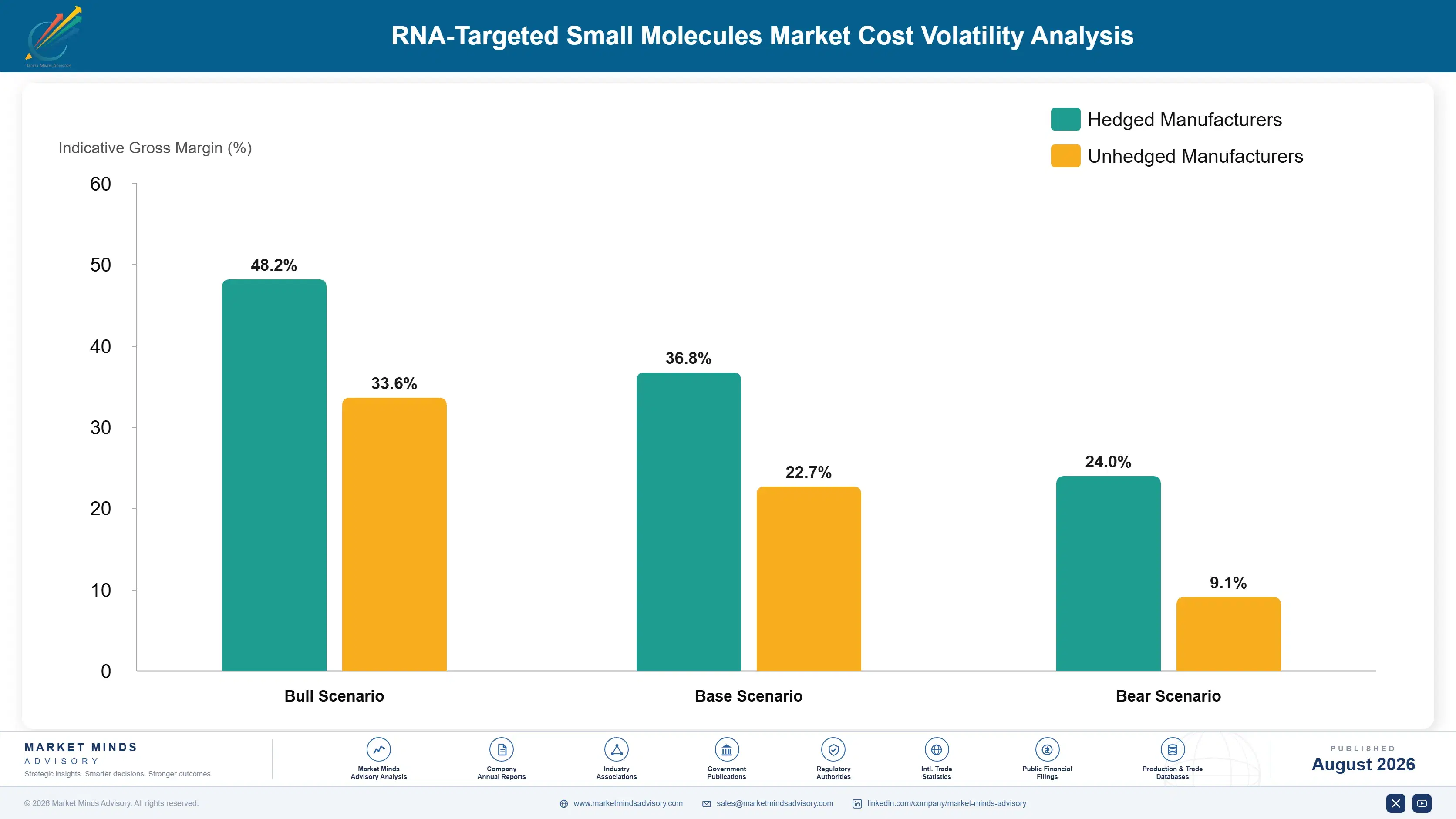
Medicinal Chemistry and Screening Platform Cost

Medicinal chemistry synthesis, high-throughput screening infrastructure, and structural biology equipment together represent roughly fifty-five to sixty percent of RNA-targeted small molecule discovery program cost, reflecting the category unusually research-intensive nature relative to more mature drug discovery categories. These specialized capabilities are concentrated among a relatively small number of companies with proprietary RNA structural biology expertise.
Specialized RNA structural biology talent and computational infrastructure costs rose meaningfully during 2022 and 2023 amid intensifying competition for scientists with proven RNA-targeting drug discovery experience across an expanding number of well-funded biotech startups. Several companies disclosed in investor communications that talent acquisition and retention costs increased considerably during this period, prompting some companies toward expanded academic partnerships and computational tool licensing to supplement internal capability through 2024 and into 2025.

Cost exposure varies by company platform maturity and business model. Companies with established, validated discovery platforms absorb research cost pressure more easily than earlier-stage companies still building foundational screening infrastructure from limited venture funding. Geographic exposure also differs: companies based in North American biotech hubs face considerably higher talent and facility costs than those operating in lower-cost research locations with comparable scientific talent availability.
rna-targeted-small-molecules-market-cost-volatility-analysis-1787305835451

Academic Partnership and Collaboration Expansion

Companies are expanding academic research partnerships to access specialized RNA structural biology expertise without bearing the full cost of internal talent acquisition and retention. This approach requires careful intellectual property negotiation but meaningfully reduces internal research and development cost, giving companies access to broader scientific expertise than internal teams alone could support at comparable cost.

Computational Tool Licensing Over Internal Development

Several companies are licensing computational RNA structure prediction and screening tools from specialized software vendors rather than building comparable capability entirely in-house internally. This approach requires ongoing licensing fees but avoids the substantial upfront investment and specialized talent recruitment required for internal computational platform development, letting companies redirect capital toward proprietary chemistry research instead.

Talent Retention Through Equity Compensation Structures

Companies are structuring compensation packages with meaningful equity components to retain specialized RNA structural biology talent without requiring proportionally higher cash compensation that would strain limited venture funding runway. This approach aligns employee incentives with long-term company success while managing near-term cash burn rate, though it requires careful equity dilution management across successive funding rounds.

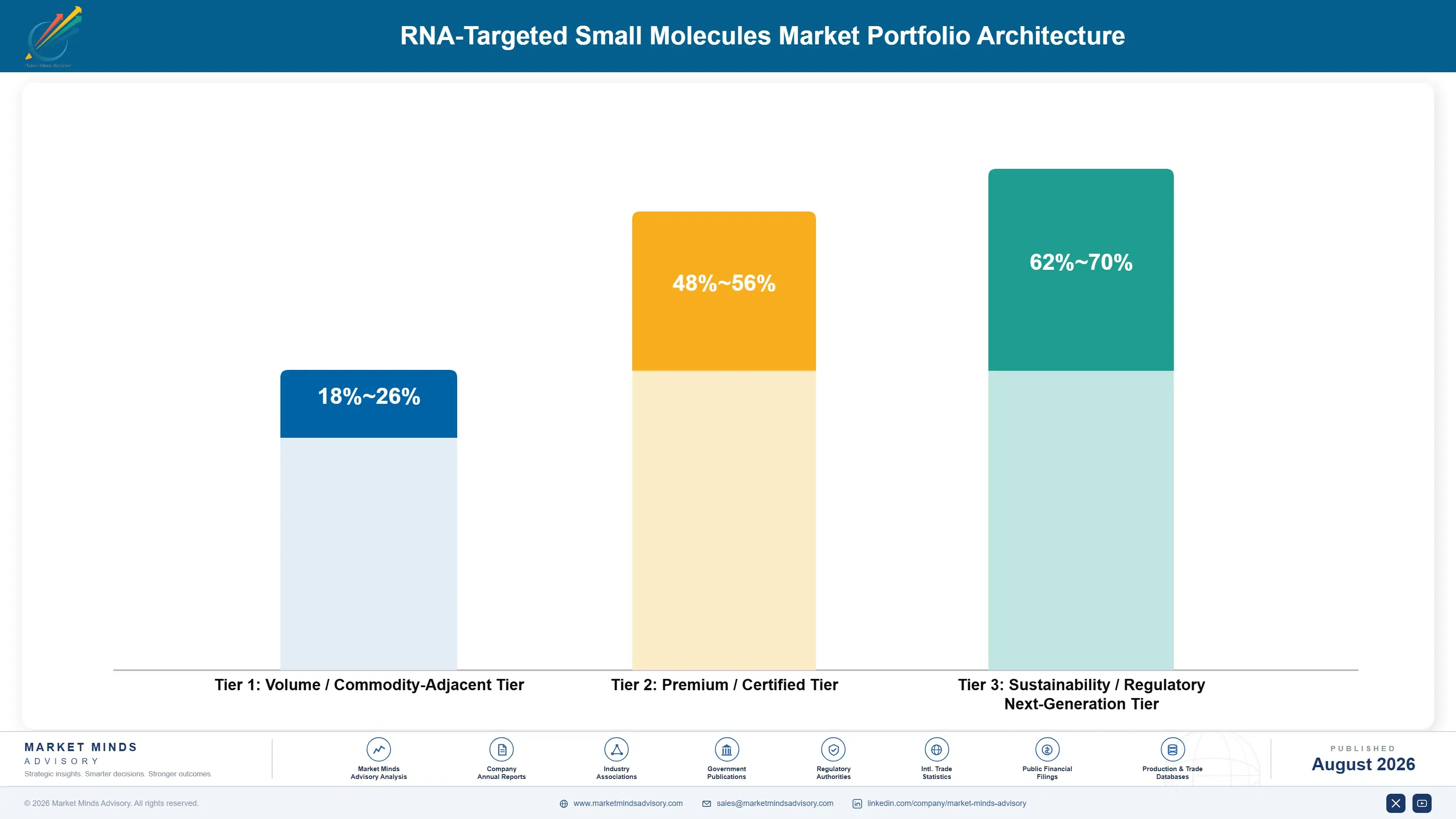
Portfolio Architecture for Margin Defence

RNA-targeted small molecule portfolios span three margin tiers running from commodity-adjacent discovery service contracts through certified clinical-stage licensing programs to sustainability-linked next-generation platform technology and rare disease franchise assets. Gross margin widens considerably moving up the tier structure, driven primarily by clinical validation depth and platform differentiation rather than pure chemistry output alone across most company portfolios and programs.
Volume tier competition centers on service pricing and basic discovery reliability for companies offering fee-for-service research capacity, where cost management matters more than proprietary technology differentiation or clinical pipeline depth. Premium tier competition instead centers on clinical validation evidence, platform technology breadth, and licensing partnership relationships, an entirely different buying calculus that rewards companies with dedicated scientific research capability built over many years.

High-value margin pools concentrate overwhelmingly in the premium and next-generation tiers, where clinical-stage licensing deals and platform technology partnerships generate revenue considerably above any discovery service transaction alone across the full program lifecycle. Companies increasingly steer research investment and business development strategy toward this upper tier as fee-for-service revenue continues serving primarily as a cash flow bridge rather than a long-term value creation strategy.

Volume / Commodity-Adjacent Tier

Fee-for-service discovery contracts and basic screening capacity targeting pharmaceutical partners seeking outsourced research capability where cost management matters more than proprietary technology differentiation or exclusive licensing rights across most contract categories.
Gross Margin: 18%-26%

Premium / Certified Tier

Clinical-stage licensing programs with demonstrated proof-of-concept data, typically structured with milestone-based royalty agreements to pharmaceutical companies seeking validated RNA-targeting pipeline assets across oncology, neurology, and rare genetic disease treatment categories.
Gross Margin: 48%-56%

Sustainability / Regulatory / Next-Generation Tier

Platform technology partnerships and rare disease franchise assets bundling proprietary discovery capability, validated clinical mechanisms, and orphan drug regulatory advantages, targeting leading pharmaceutical companies building dedicated RNA-targeted therapeutic portfolios ahead of broader adoption.
Gross Margin: 62%-70%
rna-targeted-small-molecules-market-portfolio-architecture-1787305835944

High-value Sub-segments and Strategic Watch-out

Splicing Modulator Small Molecules

Splicing modulator small molecules are the fastest-growing, highest-margin pool as clinical and commercial validation accelerates pharmaceutical licensing interest across most therapeutic categories tracked. Companies with deeper splicing biology expertise and regulatory precedent capture disproportionate share as buyer evaluation criteria shift decisively toward validated mechanism credentials.
Gross Margin: 58%-66%

Platform Technology Licensing Partnerships

Platform technology licensing generates steady high-margin recurring revenue tied closely to pharmaceutical partnership breadth and discovery platform validation depth and quality. Growth here tracks pharmaceutical licensing appetite directly, offering companies predictable revenue even as individual program outcomes remain inherently uncertain given the field early clinical stage.
Gross Margin: 52%-60%

Discovery Service Fee-For-Service Contracts

The largest volume category by contract count, fee-for-service discovery contracts remain the backbone of near-term revenue for many earlier-stage companies. Margins are thinner and growth slower than premium categories, but contract volume sustains operating cash flow and anchors long-term pharmaceutical relationships across most active research partnerships.
Gross Margin: 16%-24%

Clinical Trial Failure Disruption Risk

Clinical trial failure risk inherent to any nascent therapeutic modality bears close watching across most active development programs and pipelines, since a high-profile late-stage failure could meaningfully compress pharmaceutical licensing appetite and venture investment across the broader category faster than individual company differentiation can offset.
Gross Margin: 10%-20%

Platform Loyalty and Licensing Trust

RNA-targeted small molecule licensing relationships carry genuine annuity characteristics through multi-year milestone-based agreements that continue generating payments as programs advance through successive development stages, meaning discovery companies capture far more value from sustained partnership relationships than from any single upfront payment alone. Pharmaceutical partners increasingly value platform reliability over pure initial deal terms, since switching discovery partners mid-pr
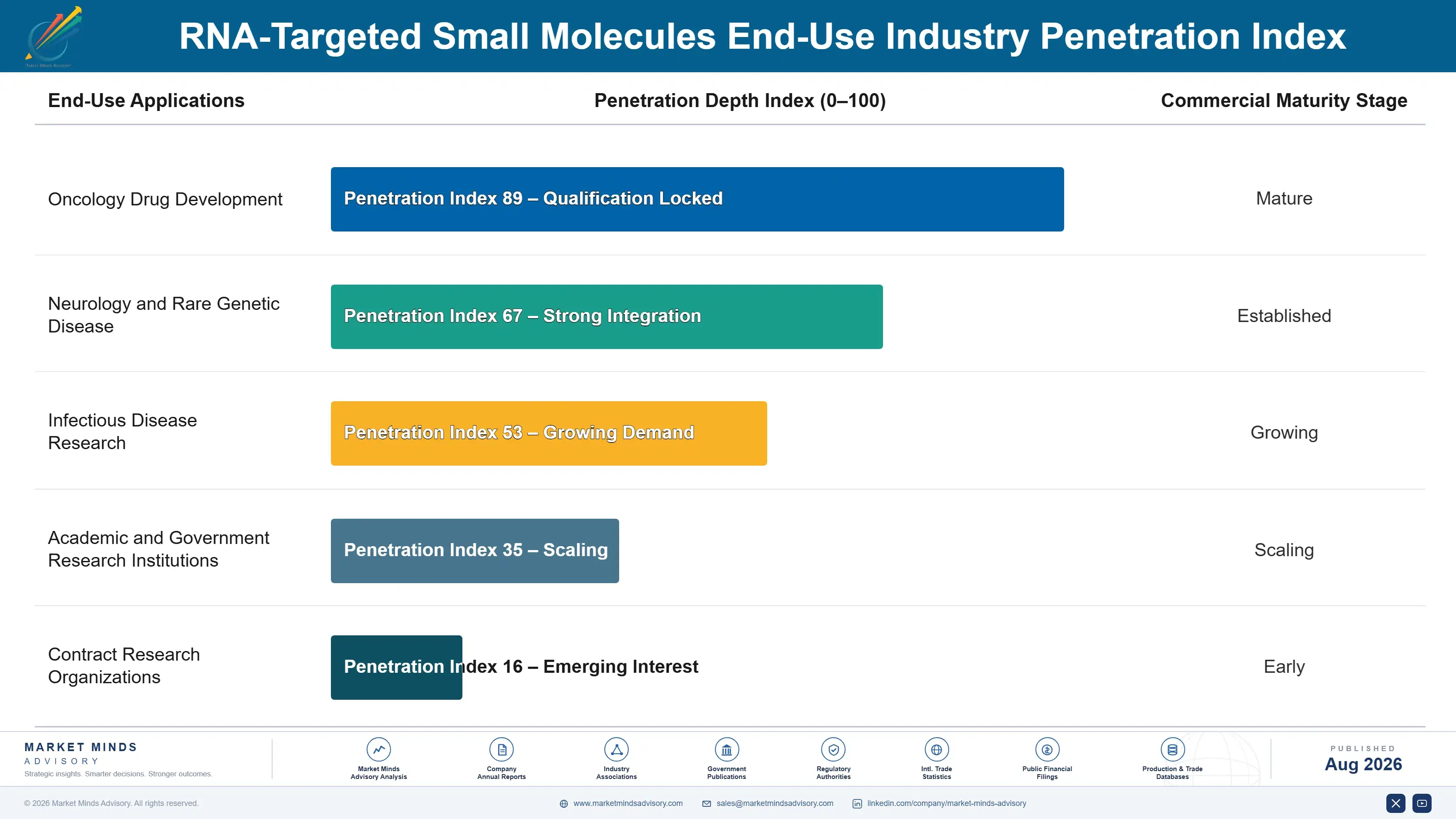
Adoption depth varies sharply by therapeutic category and disease severity. Rare genetic disease programs show the deepest and most rapidly advancing pharmaceutical engagement, layering across an increasingly broad set of validated genetic targets given faster regulatory pathways and lower clinical trial costs. Broader oncology and neurology categories show more cautious, incremental adoption patterns, with growth tracking accumulating clinical validation rather than any single dramatic catalyst.

A generational shift in scientific and business development leadership is underway as younger pharmaceutical research leaders trained on RNA structural biology increasingly champion external licensing over internal discovery investment for this modality. This cohort expects RNA-targeted small molecule capability as a standard pipeline component rather than an experimental curiosity, reshaping partnership criteria toward validated platform depth and away from the purely academic framing that dominated the field a decade ago.
rna-targeted-small-molecules-market-end-use-penetration-index-1787305836434

Where RNA-Targeted Small Molecule Value Concentrates

These are among the four positions where our research anticipates prominent divergence between winners and laggards over the coming forecast period. Each is grounded in the demand model, the regulatory perimeter, and the announced capacity pipeline.
01 / SPLICING MODULATOR PIPELINE INVESTMENT

Prioritize Splicing Modulator Programs Over Novel Mechanism Bets

Companies that invest in expanding splicing modulator pipeline depth are capturing disproportionate share of pharmaceutical licensing interest across most therapeutic categories today and throughout the coming years of continued clinical validation and regulatory precedent building. Pharmaceutical partners increasingly weigh validated mechanism precedent alongside novel target biology, a shift that rewards sustained splicing modulator investment over entirely novel mechanism exploration alone. Companies slow to build genuine splicing expertise risk losing licensing partnership opportunities within three to five years as this becomes the clear default choice.
02 / NORTH AMERICAN TALENT CONCENTRATION

Anchor Discovery Operations in North American Biotech Hubs

Pharmaceutical licensing partners are concentrating deal activity around North American biotech hubs faster than most companies elsewhere currently have comparable talent and infrastructure access to compete profitably at meaningful scale across most major licensing relationships and venture funding sources available today. Establishing North American research operations ahead of broader industry maturation requires patient multi-year investment with limited near-term payback for most companies entering these markets. Companies that build this presence early are positioned to capture disproportionate share as licensing activity continues concentrating steadily.
03 / MILESTONE DEAL STRUCTURING

Structure Licensing Deals Around Milestones Not Upfront Payments

Companies accepting large upfront payments in exchange for reduced milestone and royalty exposure risk leaving substantial value on the table faster than they can offset through immediate cash flow benefit alone across most standard licensing negotiations and deal structures currently being finalized in the market. Companies need genuine confidence in their clinical data and platform validation to negotiate milestone-heavy structures that capture more long-term value. Companies accepting unfavorable upfront-heavy terms risk losing the recurring value that sustains profitability across successful program outcomes.
04 / CLINICAL RISK DIVERSIFICATION

Diversify Pipeline Across Multiple Mechanisms to Manage Trial Risk

Concentration in any single RNA-targeting mechanism or therapeutic category threatens to compress company value faster than platform differentiation alone can offset if a high-profile clinical trial failure occurs across most standard development timelines and investor expectations currently prevailing across the broader sector and venture community. Companies need genuine mechanism and indication diversification that reduces single-program dependence without diluting focus on core scientific strengths. Companies concentrating pipeline risk too narrowly face disproportionate value destruction from any single clinical setback across their broader portfolio.

Engagement Snapshot From the Field

A live engagement with an industry participant carrying material or product regulatory and market exposure ahead of a defining policy shift, showing how our research translates into a defensible multi-year portfolio strategy.
MARKET MINDS ADVISORY · CLIENT ENGAGEMENT SUMMARY
RNA-Targeted Small Molecules Producer Strategic Portfolio Review and Transition Roadmap 2026·Investment Scenario on RNA-Targeted Small Molecules Exposure Evaluation 2025-26
CLIENT PROFILE
The client is a mid-size pharmaceutical company with an established oncology franchise seeking to diversify its discovery pipeline into RNA-targeted small molecules without building internal structural biology capability from scratch. The company had limited prior experience evaluating RNA-targeting discovery platforms and needed an independent framework for comparing scientific merit across several candidate licensing partners with meaningfully different technology approaches.
STRATEGIC CHALLENGE
Leadership needed to evaluate which of several candidate discovery platform companies offered the strongest scientific fit with the company existing oncology pipeline priorities, while also assessing realistic timelines to clinical proof-of-concept given the modality relative immaturity. The company also needed to structure licensing terms appropriately given uncertain probability of technical success for this novel therapeutic approach.
MMA APPROACH
MMA conducted an independent scientific and commercial assessment across four candidate discovery platform companies, benchmarking target validation evidence, chemistry tractability data, and comparable licensing deal terms from recent industry transactions. The engagement combined primary interviews with discovery scientists and business development leadership at each candidate firm, competitive benchmarking against peer pharmaceutical licensing decisions, and structured deal term negotiation support.
KEY FINDINGS
  1. Two of four candidate platforms offered target validation evidence directly relevant to the company existing oncology pipeline priorities, meaningfully narrowing the realistic licensing decision.
  2. Comparable recent licensing deals in the RNA-targeting space averaged milestone-heavy structures with upfront payments representing an estimated twenty percent of total potential deal value (client-reported, unverified by MMA).
  3. Chemistry tractability assessment identified one candidate platform with meaningfully more advanced medicinal chemistry data than the others, reducing perceived technical risk for the selected partnership.
  4. Structured deal negotiation secured milestone timing terms considered more favorable than the company initial internal benchmark, based on comparable transaction analysis conducted during the engagement.
CLIENT PROFILE
The client is a mid-size pharmaceutical company with an established oncology franchise seeking to diversify its discovery pipeline into RNA-targeted small molecules without building internal structural biology capability from scratch. The company had limited prior experience evaluating RNA-targeting discovery platforms and needed an independent framework for comparing scientific merit across several candidate licensing partners with meaningfully different technology approaches.
STRATEGIC CHALLENGE
Leadership needed to evaluate which of several candidate discovery platform companies offered the strongest scientific fit with the company existing oncology pipeline priorities, while also assessing realistic timelines to clinical proof-of-concept given the modality relative immaturity. The company also needed to structure licensing terms appropriately given uncertain probability of technical success for this novel therapeutic approach.
MMA APPROACH
MMA conducted an independent scientific and commercial assessment across four candidate discovery platform companies, benchmarking target validation evidence, chemistry tractability data, and comparable licensing deal terms from recent industry transactions. The engagement combined primary interviews with discovery scientists and business development leadership at each candidate firm, competitive benchmarking against peer pharmaceutical licensing decisions, and structured deal term negotiation support.
KEY FINDINGS
  1. Two of four candidate platforms offered target validation evidence directly relevant to the company existing oncology pipeline priorities, meaningfully narrowing the realistic licensing decision.
  2. Comparable recent licensing deals in the RNA-targeting space averaged milestone-heavy structures with upfront payments representing an estimated twenty percent of total potential deal value (client-reported, unverified by MMA).
  3. Chemistry tractability assessment identified one candidate platform with meaningfully more advanced medicinal chemistry data than the others, reducing perceived technical risk for the selected partnership.
  4. Structured deal negotiation secured milestone timing terms considered more favorable than the company initial internal benchmark, based on comparable transaction analysis conducted during the engagement.
RECOMMENDED STRATEGY
Phase 1: Phase 1 (Months 1 to 2): Complete scientific and commercial assessment across all four candidate discovery platform companies and their technology approaches. Phase 2: Phase 2 (Months 3 to 4): Conduct focused due diligence and structured negotiation with the two highest-scoring candidate platforms identified during assessment. Phase 3: Phase 3 (Months 5 to 6): Finalize licensing agreement terms and establish joint development governance structure with the selected discovery partner.
OUTCOME
Within six months, the pharmaceutical company completed licensing negotiations with its selected discovery partner, securing milestone-heavy deal terms considered favorable relative to comparable industry transactions (client-reported, unverified by MMA). The company has since initiated a second RNA-targeting evaluation process for its neurology franchise using the same assessment framework.

Frequently Asked Questions

Foundational context covering the market sizes, CAGR, scope, country, region and competition that inform every finding below. This section is provided to cover basics and most often pre-purchase conversations, answered from the MMA Primary Research Dataset.

What is the current size of the RNA-Targeted Small Molecules Market?

The global RNA-targeted small molecules market was valued at 0.85 billion dollars in 2025. This figure covers therapeutic compounds and discovery platforms designed to bind and modulate RNA structure.

How large will the RNA-Targeted Small Molecules Market be by 2036?

MMA forecasts the market will reach 4.37 billion dollars by 2036, more than quadrupling in value. This growth is driven primarily by splicing modulator validation and pharmaceutical licensing activity.

What is the CAGR for the RNA-Targeted Small Molecules Market 2026 to 2036?

The base case CAGR is 16.0 percent annually across the forecast period. Bull and bear scenarios range from 17.3 percent to 14.7 percent depending on clinical validation pace.

Which segment is growing fastest?

Splicing modulator small molecules are the fastest-growing segment, expanding at approximately 20.5 percent annually. This is roughly 1.3 times the overall market growth rate, driven by clinical validation.

Who are the major companies in the RNA-Targeted Small Molecules Market?

Leading companies include PTC Therapeutics, Roche, Novartis, Skyhawk Therapeutics, and Arrakis Therapeutics. These five companies hold a combined CR5 near thirty-four percent of the global market.

Which country is growing fastest?

China is the fastest-growing national market, expanding at approximately 17.0 percent annually. This reflects rapidly expanding domestic biotech research investment and pharmaceutical licensing partnership activity.

Report Segmentation Architecture

The full report scope spans multiple orthogonal segmentation dimensions, with cross-tabulated demand data provided for each dimension pair. Coverage extends further to regional breakdowns, trend trajectories, and the competitive detail needed to support segment-level decision-making.

By Mechanism and Target Type

  • Splicing Modulator Small Molecules
  • Non-Coding RNA Targeted Therapeutics
  • microRNA-Targeted Small Molecules
  • RNA Structure-Based Discovery Platforms and Services
  • mRNA Translation Modulators
  • Riboswitch-Targeted Antibacterial Small Molecules

By End-Use Industry

  • Oncology Drug Development
  • Neurology and Rare Genetic Disease
  • Infectious Disease Research
  • Academic and Government Research Institutions
  • Contract Research Organizations

By Commercial Dimension

  • Direct Pharmaceutical Licensing Deals
  • Platform Technology Partnerships
  • Fee-for-Service Discovery Contracts
  • Venture-Backed Proprietary Pipeline Development

By Region

  • North America
  • Western Europe
  • East Asia
  • South Asia and Pacific
  • Latin America
  • Middle East and Africa
  • Eastern Europe

Scope, Methodology, and Coverage

Every figure in this report is reproducible from documented input assumptions. The scope below maps the historical period, the forecast horizon, the segmentation dimensions, and the countries covered, alongside the underlying primary and qualitative methodology.
Historical Period
2020 to 2025
Forecast Period
2026 to 2036
Base Year
2025 (USD billions; MMA Primary Research Dataset, August 2026)
Market Definition
The RNA-targeted small molecules market covers therapeutic compounds and discovery platforms designed to bind and modulate RNA structure and function, including splicing modulators and microRNA-targeted agents. Antisense oligonucleotides, siRNA therapeutics, and mRNA vaccine platforms are excluded from scope.
Quantitative Units
USD billions (current prices); active discovery program count where applicable
Segmentation Dimensions
By Mechanism and Target Type; By End-Use Industry; By Commercial Dimension; By Region
Regions Covered
North America, Western Europe, East Asia, South Asia and Pacific, Latin America, Middle East and Africa, Eastern Europe
Countries Covered
USA, China, Germany, France, UK, Japan, South Korea, India, Australia, Canada, Brazil, Mexico, Indonesia, Vietnam, Thailand, Malaysia, UAE, Saudi Arabia, South Africa, Nigeria, Turkey, Poland, Netherlands, Italy, Spain, Sweden, Switzerland, Argentina, Colombia, Singapore, and additional markets relevant to this sector
Key Companies Profiled
PTC Therapeutics, Roche, Novartis, Skyhawk Therapeutics, Arrakis Therapeutics, Expansion Therapeutics, Ribometrix, Remix Therapeutics, GSK, Merck & Co., Amgen, Gilead Sciences, Biogen, Ionis Pharmaceuticals, Eli Lilly and Company, Storm Therapeutics, Anima Biotech, Twentyeight-Seven Therapeutics, Beam Therapeutics, Novo Nordisk
Quantitative Methodology
Primary survey, n=3,800 respondents, Q4 2025, six countries; demand-side model with trade association cross-validation
Qualitative Methodology
47 expert interviews, Q4 2025; applied to validate demand model assumptions, identify emerging dynamics, and assess competitive positioning
Report Format
PDF and XLSX data workbook (Word format preview document)
Publisher
Market Minds Advisory
Report Code
MMA-2026-HLT-530
Published
August 2026
Contact
sales@marketmindsadvisory.com | www.marketmindsadvisory.com

Purchase the full RNA-Targeted Small Molecules Market Report (2026 to 2036).

The full report delivers detailed segment-level revenue forecasts across all six mechanism categories through 2036. It includes country-level breakdowns for the fourteen markets carrying the deepest primary research coverage, alongside a complete competitive benchmarking module covering all twenty profiled companies. Proprietary MMA survey data drawn from 3,800 respondents across six countries supports the demand analysis, complemented by expert interview findings from 47 industry specialists gathered during the fourth quarter of 2025. Buyers also receive editable data tables and a quarterly market monitor update subscription for twelve months following purchase.
Segment-level revenue forecasts across six mechanism categories
Country-level breakdowns for fourteen deeply researched markets
Competitive benchmarking module covering twenty profiled companies
Proprietary survey data from 3,800 respondents worldwide
Expert interview findings from 47 industry specialists
Twelve months of quarterly market monitor updates

Built For The People Who Decide

From boardroom strategy to bench-side execution, this report is read cover-to-cover by leaders shaping the next decade of their industry, turning demand scenarios, market dynamics and valuation benchmarks into decisions.
CXOs/ Presidents/ VPs/ Managers
M&A and Corporate Development
Strategy Teams and R&D Heads
Procurement and Product Directors
Regulatory and Compliance Leaders
Investor Relations and Equity Analysts